


April’s showers have given way to rich and fertile earth, and as the land greens, there are few celebrations as representative of fertility as Beltane. Observed on May 1st (or October 31-November 1 for our Southern Hemisphere readers), festivities typically begin the evening before, on the last night of April. It’s a time to welcome the abundance of the fertile earth, and a day that has a long (and sometimes scandalous) history.
As Beltane approaches, you can decorate your home (and keep your kids entertained) with a number of easy craft projects. Start celebrating a bit early with fun floral crowns and a Maypole altar centerpiece, do some meditative braiding, or even get to the know the Fae! A few simple seasonal crafts are a great way to celebrate the Beltane Sabbat. There’s more to this time of year than just plants and greenery, so be sure to check out these simple craft ideas!
Wigington, Patti. “Crafts for the Beltane Sabbat.” Learn Religions, Feb. 25, 2026, learnreligions.com/crafts-for-the-beltane-sabbat-4126784.

These colors can be used for altar clothes, candles, clothing, Sabbat, and other things. Some of the colors also correspondence to a specific day and/or month. 
The Litha sabbat falls on the longest day of the year – that means you have more hours of daylight on the summer solstice than on any other day, and that’s definitely worth celebrating! Solar symbols like suns and circles, gods eyes, Brighid’s crosses and sunwheels are all perfect representatives of this season – hang them on your walls and doors, or add them to your Litha altar. More »
By the time midsummer rolls around, our flower gardens are in full bloom. This is a time to gather up those blossoms and enjoy their beauty – collect an assortment of brightly colored flowers and bring them indoors to keep you company. Consider, especially, flowers in bright sunny colors like yellows and reds and oranges. Sunflowers, tulips, roses, tiger lilies, and black-eyed Susans are all associated with the sun at the height of its power.
In addition to fresh flowers, we’ve also got fresh produce rapidly filling our gardens. The sun brings warmth to the earth, which in turn brings new life to our plants. Harvest your midsummer fruits and vegetables, and leave them in bowls and baskets around the house. Some goodies, like onions and herbs, can be hung up to dry, which will allow you to enjoy the scents as well as the flavor.
Carrying on the solar theme, Litha is a celebration of fire – after all, that’s what the sun is, right? Use big candles all around your home, in yellows and golds and other sunny colors. You can also string festively colored lights along your walls and windows, to bring that brightness indoors. For your outdoor decor, use a tabletop brazier or even Tiki torches to celebrate with flames and fire. More »
At Litha, the summer solstice, it’s the last day of the sun’s full power. For the next six months, darkness will begin to take over, growing stronger until Yule, the longest night of the year. At that point, the process will reverse once more and the light return. Decorate your home with symbols of opposites – fire and water, earth and air, darkness and light, yin and yang.


Lughnasadh is a Gaelic festival that occurs on August 1st each year, marking the dawn of the harvest season. This holiday marks the midpoint between the Summer Solstice and the Autumn Equinox. Lughnasadh traditions celebrate the first cutting of grain, the bountiful harvests of corn, and the Irish craftsman and warrior god, Lugh.
Traditionally, Lughnasadh is celebrated in Ireland, Scotland, and the Isle of Man. Historically, the occasion was marked with a festive competition testing skills of craft and athleticism in honor of Lugh and his foster mother Tailtiu. Offerings made to Lugh would include a sacred bull and a cutting of the first harvest of corn.
This holiday is considered a cross-quarter day on the neo-pagan Wheel of the Year. In some Wiccan traditions, this is the time of year in which the Horned God’s power begins to wane, and the Goddess prepares for his passing at the coming Samhain.
On the same day, some Christians celebrate the holiday of Lammas in an incredibly similar tradition. With the first harvest of grain a loaf of bread is baked and brought to the church to be blessed. Once its blessing is received, the baker takes the bread back home, breaks it into four pieces, and places them at the four corners of their barn or property to protect the grain in the coming months.
Though the two are often conflated in Neo-Pagan groups, Lughnasadh and Lammas are two separate celebrations. Lughnasadh is a holiday that is still celebrated by pagans and non-pagans alike in Ireland, Scotland, and The Isle of Man. Though it doesn’t look like what we think the ancient practices may have been, we do know that the traditions surrounding Lughnasadh have been syncretized and are still alive today.
Lammas is the name typically chosen for the Wiccan Wheel of the Year. It is celebrated as the first harvest festival of the year. As stated above, this is the time of year within Wiccan traditions when the Horned God prepares for his passing during Samhain. This holiday is celebrated with bread baking, frivolity, and feasting.
There are many ways that you can celebrate Lughnasadh or Lammas. Here are a few ideas to help you build your own traditions!
Check out some of these spells and rituals to get some inspiration for Lughnasadh! Click on hyperlink above and scrool down for these spells.
Imbolc, also called Imbolg or St. Brigid’s Day, is a traditional Gaelic holiday that is celebrated by pagans worldwide, including Wiccans as one of the eight Sabbats.
Imbolc marks the midpoint between the winter solstice (Yule) and the spring equinox (Ostara). As such, it is considered a cross-quarter day on the pagan wheel of the year, and it is often celebrated around February 1st – 2nd, or August 1st – 2nd if you’re in the Southern hemisphere.
What’s the meaning of Imbolc? Each winter, we shut ourselves up in our homes for warmth, much like the animals and insects that enter hibernation through the colder months. The home has collected dust and stagnant energy as we have shifted our focus to survival mode.
Imbolc is a word that comes from the Old Irish i mbolc (Modern Irish: i mbolg), meaning ‘in the belly’, and refers to the pregnancy of ewes at this time of year. Spiritually, Imbolc is a time of banishing the winter season so that we can sow a bountiful harvest in the springtime. During this time, we celebrate the first signs of the approaching spring: blades of grass and dandelions steadily emerge from the cold ground, the singing of birds returns to soften the cold chill of the air, and many of those hibernating creatures are beginning to awaken.
Imbolc is traditionally the great festival and honoring of Goddess Brigid, known as St. Brigid by Catholics.
The days are becoming longer again, and we can finally open up our homes to clear out the winter blues that have been lingering within. This time of new beginnings presents a wonderful opportunity to cleanse and purify ourselves and our homes of that stagnant energy we’ve been building up in hibernation.
Let’s take a look at some Imbolc rituals and other ways that pagans around the world practice Imbolc, including the members of our group: The Infinite Roots Coven
It’s the season of fairies, and nothing delights the inner child more than playing with the woodland spirits.
This one is so easy, it’s almost self-explanatory.
Literally: Glue some sticks together. Yup. That’s it. I used hot glue for the one above.
If you want to get fancy, add little bits of (affiliate link —–>) sheet moss to get that aged-in-the-garden feel.
You can even train roses or herbs to grow on it.
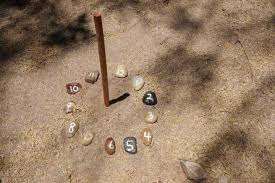
Stonehenge is one of the world’s best known stone circles, and many researchers have noted that the structure functions as a giant astronomical calendar and sundial. Most people can’t build a Stonehenge replica in their back yard, but what you can do is create a sundial of your own using stones you’ve found. If you have children, this is a great science project to do, but even if you don’t have kids, it’s fascinating to create your own sundial.

Find a place in your yard that gets sun for most of the day. Although it’s ideal to do this in the grass of even a patch of dirt, if all you have is a sidewalk or driveway, then that’s fine too. Mount the pole by sticking it into the dirt. If you’re making your sundial on a hard surface like concrete, then use a block of clay or a bucket of soil to secure the pole.
Keep an eye on your clock. At each hour, take note of where the pole’s shadow falls, and mark the spot with a stone.
If you start this project in the morning, you’ll be able to mark most of the daytime spots – if you start later in the day, you may have to come back the next morning to figure out where your morning hours are.
To tell the time with your sundial, look for the pole’s shadow. Where it falls between the stones will give you the time.
Source: Article found on & owned by About.comBy Patti Wigington


If you have children or grandchildren print out pages for them to color with you. You don’t even have to color in the lines…lol. Email your colored picture to ladybeltane@witchesofthecraft.com and they will be in a post. Pictures to be posted must be received in an email to me by 8:00 PM CDT on Saturday, July 8, 2023 and have been saved as a jpeg file or else WordPress won’t let me post them.


Free_Printable_Celtic_Knot_Coloring_Page
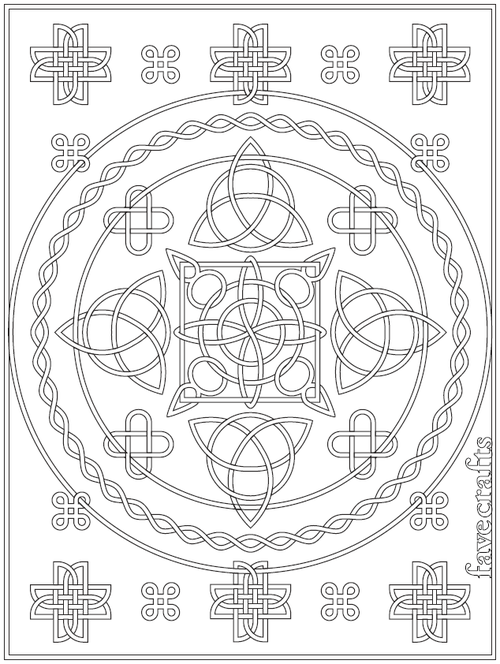

It is small but I enjoyed coloring it with one of my grandchildren.


|
||
Makes approximately 500g of Bath SaltsWhat you need: Method: That’s it! Easy peasy. Patchouli essential oil and dried Patchouli leaves – Money-drawing & Energising. |


You must be logged in to post a comment.