

Tag: Litha/Summer Solstice
Let’s Have Some Fun – Printable Mabon Coloring Pages


(One Person’s View Point) Fertility Deities of Beltane
Fertility Deities of Beltane
Beltane is a time of great fertility — for the earth itself, for animals, and of course for people as well. This season has been celebrated by cultures going back thousands of years, in a variety of ways, but nearly all shared the fertility aspect. Typically, this is a Sabbat to celebrate gods of the hunt or of the forest, and goddesses of passion and motherhood, as well as agricultural deities. Here are a list of gods and goddesses that can be honored as part of your tradition’s Beltane rituals.
Artemis (Greek): The moon goddess Artemis was associated with the hunt and was seen as a goddess of forests and hillsides. This pastoral connection made her a part of spring celebrations in later periods.
Bes (Egyptian): Worshiped in later dynasties, Bes was a household protection god, and watched over mothers and young children. He and his wife, Beset, were paired up in rituals to cure problems with infertility.
Bacchus (Roman): Considered the equivalent of Greek god Dionysus, Bacchus was the party god — grapes, wine, and general debauchery were his domain. In March each year, Roman women could attend secret ceremonies called the bacchanalia, and he is associated with sexual free-for-alls and fertility.
Cernunnos (Celtic): Cernunnos is a horned god found in Celtic mythology. He is connected with male animals, particularly the stag in rut, and this has led him to be associated with fertility and vegetation. Depictions of Cernunnos are found in many parts of the British Isles and western Europe. He is often portrayed with a beard and wild, shaggy hair — he is, after all, the lord of the forest.
Flora (Roman): This goddess of spring and flowers had her own festival, Floralia, which was celebrated every year between April 28 to May 3. Romans dressed in bright robes and floral wreaths, and attended theater performances and outdoor shows. Offerings of milk and honey were made to the goddess.
Hera (Greek): This goddess of marriage was the equivalent of the Roman Juno, and took it upon herself to bestow good tidings to new brides. A maiden about to marry could make offerings to Hera, in the hopes that she would bless the marriage with fertility. In her earliest forms, she appears to have been a nature goddess, who presides over wildlife and nurses the young animals which she holds in her arms.
Kokopelli (Hopi): This flute-playing, dancing spring god carries unborn children upon his own back, and then passes them out to fertile women. In the Hopi culture, he is part of rites that relate to marriage and childbearing, as well as the reproductive abilities of animals. Often portrayed with rams and stags, symbolic of his fertility, Kokopelli occasionally is seen with his consort, Kokopelmana.
Pan (Greek): This agricultural god watched over shepherds and their flocks. He was a rustic sort of god, spending lots of time roaming the woods and pastures, hunting and playing music on his flute. Pan is typically portrayed as having the hindquarters and horns of a goat, similar to a faun. Because of his connection to fields and the forest, he is often honored as a spring fertility god.
Priapus (Greek): This fairly minor rural god has one giant claim to fame — his permanently erect and enormous phallus. The son of Aphrodite by Dionysus (or possibly Zeus, depending on the source), Priapus was mostly worshiped in homes rather than in an organized cult. Despite his constant lust, most stories portray him as sexually frustrated, or even impotent. However, in agricultural areas he was still regarded as a god of fertility, and at one point he was considered a protective god, who threatened sexual violence against anyone — male or female — who transgressed the boundaries he guarded.
Sheela-na-Gig (Celtic): Although the Sheela-na-Gig is technically the name applied to the carvings of women with exaggerated vulvae that have been found in Ireland and England, there’s a theory that the carvings are representative of a lost pre-Christian goddess. Typically, the Sheela-na-Gig adorns buildings in areas of Ireland that were part of the Anglo-Norman conquests in the 12th century. She is shown as a homely woman with a giant yoni, which is spread wide to accept the seed of the male. Folkloric evidence indicates that the figures are theory that the figures were part of a fertility rite, similar to “birthing stones”, which were used to bring on conception.
Xochiquetzal (Aztec): This fertility goddess was associated with spring, and represented not only flowers but the fruits of life and abundance. She was also the patron goddess of prostitutes and craftsmen.
Source: Patti Wigington Published on ThoughtCo
Some of the Witchcraft/Magickal Correspondence for Beltane
(YOU CAN COPY AND PASTE ANY CORRESPONDENCES POSTED TO A DOCUMENT TO PRINT AND/OR SAVE ON YOUR COMPUTER FOR PERSONAL USE ONLY)
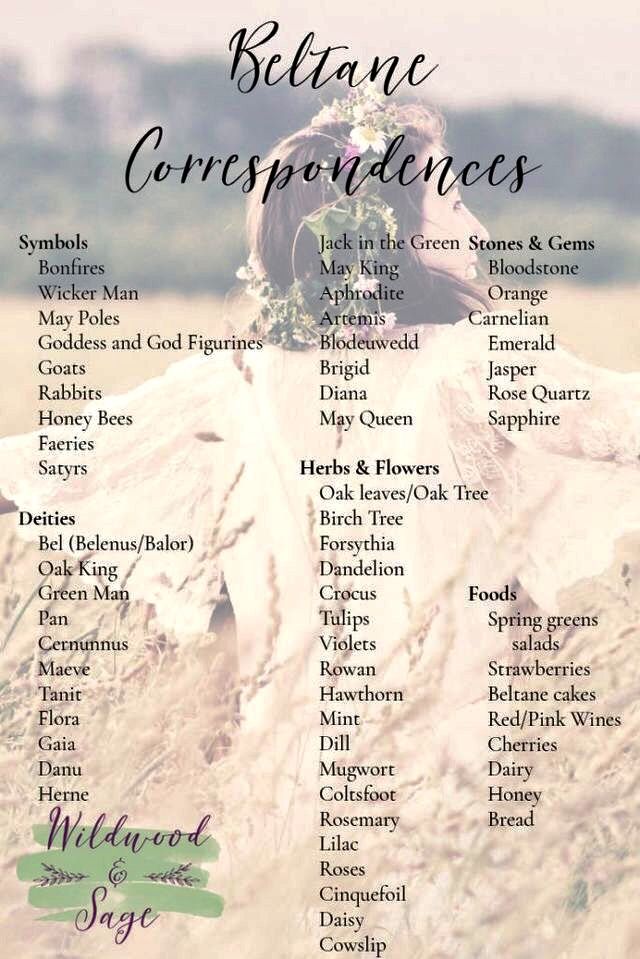
(One Person’s View Point) Beltane Sunset to Sunset. April 30th – May 1st
Beltane honours Life. It represents the peak of Spring and the beginning of Summer. Earth energies are at their strongest and most active. All of life is bursting with potent fertility and at this point in the Wheel of the Year, the potential becomes conception. On May Eve the sexuality of life and the earth is at its peak. Abundant fertility, on all levels, is the central theme. The Maiden goddess has reached her fullness. She is the manifestation of growth and renewal, Flora, the Goddess of Spring, the May Queen, the May Bride. The Young Oak King, as Jack-In-The-Green, as the Green Man, falls in love with her and wins her hand. The union is consummated and the May Queen becomes pregnant. Together the May Queen and the May King are symbols of the Sacred Marriage (or Heiros Gamos), the union of Earth and Sky, and this union has merrily been re-enacted by humans throughout the centuries. For this is the night of the Greenwood Marriage. It is about sexuality and sensuality, passion, vitality and joy. And about conception. A brilliant moment in the Wheel of the Year to bring ideas, hopes and dreams into action. And have some fun…..
Traditions of Beltane
Beltane is a Fire Festival. The word ‘Beltane’ originates from the Celtic God ‘Bel’, meaning ‘the bright one’ and the Gaelic word ‘teine’ meaning fire. Together they make ‘Bright Fire’, or ‘Goodly Fire’ and traditionally bonfires were lit to honour the Sun and encourage the support of Bel and the Sun’s light to nurture the emerging future harvest and protect the community. Bel had to be won over through human effort. Traditionally all fires in the community were put out and a special fire was kindled for Beltane. “This was the Tein-eigen, the need fire. People jumped the fire to purify, cleanse and to bring fertility. Couples jumped the fire together to pledge themselves to each other. Cattle and other animals were driven through the smoke as a protection from disease and to bring fertility. At the end of the evening, the villagers would take some of the Teineigen to start their fires anew.” (From Sacred Celebrations by Glennie Kindred) Green Man – Beltane
Click here to read the rest of this article Source: .goddessandgreenman.co.uk
For Your Listening Pleasure – Beltane

(One Person’s View Point) Beltane Activities and Correspondences
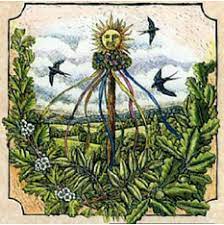
Beltane Activities and Correspondences
Guest Author – Leslie Ravenwing
Herbs – hawthorn, honeysuckle, St John’s wort, wood ruff, all flowers.
Colors- Green, Yellow, Pink, Blue
Foods – Strawberries, Cherries, Fruits, Salads, Wine
Goddesses – Aphrodite, Asherah, Belili, Brigid, Danu, Freya, Flora, Gwenhwyvar, Hina, Ishtar, Maia, Mary, Oiwyn, Oshun, Ostara, Sappha, Tonantzin, Vesta
Gods – Beltene, Cernunnous, Cupid/Eros, Manawyddan and Pan
Activities and Rituals
Fertilize, nurture and boost existing goals, games, activities of pleasure, leaping bonfires, making garlands, May Pole dance, planting seeds, walking one’s property, feasting
Stones/Gems – Emerald, malachite, amber, orange carnelian, sapphire, rose quartz
Other Names – Cetsamhain (opposite Samhain),May Day, Fairy Day,Sacred Thorn Day, Rood Day, Roodmas (the Christian term for Rood Day, Old Beltane, Beltaine, Beltain, Baltane, Walpurgis Night, Floriala (Roman feast of flowers from April 29 to May 1), Walpurgisnacht (Germanic-feast of St. Walpurga), Thrimilce (Anglo-saxon), Bloumaand (Old Dutch)
-Make paper baskets (use yarn as a handle) and place real or silk flowers in each basket. Hang them on door knobs of neighbors and family members but don’t let them know you did it!
-If you have children, make necklaces out of diasies and place them around their necks for the day to bring protection to them.
-Begin planting for the season.
-Create a MayPole and dance around it with your family or friends.
-Make a dish of fruits, berries, nuts and leave in the wood for the animals and fae folk to enjoy
– This is a night for bonfires, torch-lit processions and the high revelry of witches, preferably in high places. It is prime time for the Great Rite, a night (like Samhain) when the Goddess descends into women. Cailleach Beara (Cally Berry, Brighid’s crone aspect) turns to stone this night and does not to return until Samhain. Beltane Eve also marks the setting of the Pleiades
Let’s Have Some Fun – Samhain
Let’s Have Some Fun – Beltane

(One Person’s View Point) Samhain (Sow-en) – The Celtic roots of Halloween
As millions of children and adults participate in the fun of Halloween on the night of October 31st, few will be aware of its ancient Celtic roots in the Samhain (Samain) festival. In Celtic Ireland about 2,000 years ago, Samhain was the division of the year between the lighter half (summer) and the darker half (winter). At Samhain the division between this world and the otherworld was at its thinnest, allowing spirits to pass through.
The family’s ancestors were honoured and invited home whilst harmful spirits were warded off. People wore costumes and masks to disguise themselves as harmful spirits and thus avoid harm. Bonfires and food played a large part in the festivities. The bones of slaughtered livestock were cast into a communal fire, household fires were extinguished and started again from the bonfire. Food was prepared for the living and the dead, food for the ancestors who were in no position it eat it, was ritually shared with the less well off.
Christianity incorporated the honouring of the dead into the Christian calendar with All Saints (All Hallows) on November 1st, followed by All Souls on November 2nd. The wearing of costumes and masks to ward off harmful spirits survived as Halloween customs. The Irish emigrated to America in great numbers during the 19th century especially around the time of famine in Ireland during the 1840’s. The Irish carried their Halloween traditions to America, where today it is one of the major holidays of the year. Through time other traditions have blended into Halloween, for example the American harvest time tradition of carving pumpkins.
Two hills in the Boyne Valley were associated with Samhain in Celtic Ireland, Tlachtga and Tara. Tlachtga was the location of the Great Fire Festival which begun on the eve of Samhain (Halloween). Tara was also associated with Samhain, however it was secondary to Tlachtga in this respect.
The entrance passage to the Mound of the Hostages on the Hill of Tara is aligned with the rising sun around Samhain. The Mound of the Hostages is… Click here to read the rest of this article about Samhain
5 Easy Decorating Ideas for Litha
Need some quick and affordable decorating ideas for Litha, the summer solstice? Here are some tips on how to bring the season into your home without breaking your bank account!
• Suns and Solar Symbols
The Litha sabbat falls on the longest day of the year – that means you have more hours of daylight on the summer solstice than on any other day, and that’s definitely worth celebrating! Solar symbols like suns and circles, gods eyes, Brighid’s crosses and sunwheels are all perfect representatives of this season – hang them on your walls and doors, or add them to your Litha altar. More »
• Fresh Blossoms and Blooms
By the time midsummer rolls around, our flower gardens are in full bloom. This is a time to gather up those blossoms and enjoy their beauty – collect an assortment of brightly colored flowers and bring them indoors to keep you company. Consider, especially, flowers in bright sunny colors like yellows and reds and oranges. Sunflowers, tulips, roses, tiger lilies, and black-eyed Susans are all associated with the sun at the height of its power.
• The Bounty of the Garden
In addition to fresh flowers, we’ve also got fresh produce rapidly filling our gardens. The sun brings warmth to the earth, which in turn brings new life to our plants. Harvest your midsummer fruits and vegetables, and leave them in bowls and baskets around the house. Some goodies, like onions and herbs, can be hung up to dry, which will allow you to enjoy the scents as well as the flavor.
Fire and Light
Carrying on the solar theme, Litha is a celebration of fire – after all, that’s what the sun is, right? Use big candles all around your home, in yellows and golds and other sunny colors. You can also string festively colored lights along your walls and windows, to bring that brightness indoors. For your outdoor decor, use a tabletop brazier or even Tiki torches to celebrate with flames and fire. More »
• Opposites
At Litha, the summer solstice, it’s the last day of the sun’s full power. For the next six months, darkness will begin to take over, growing stronger until Yule, the longest night of the year. At that point, the process will reverse once more and the light return. Decorate your home with symbols of opposites – fire and water, earth and air, darkness and light, yin and yang.
Let’s Have Some Fun – Coloring Page Litha

Let’s Have Some Fun Coloring Page Litha

Let’s Have Some Fun – 2 Coloring Pages

Let’s Have Some Fun – Yule Coloring Page

A Yule Drink and Litha Cake – Combined Them for Brunch or a Snack for a Solstice Feast – Flashback to 2012
I know I have been doing separate posts for Yule and Litha things but when I came across these two recipes, in Llewellyn’s Witches’ Datebook 2012, one for each season of the year the two hemispheres are going into, they sounded yummy to me to have together. I apologize in advance for not calculating from American measurements to other parts of Mother Earth. I just found this website https://www.europeancuisines.com/ while it says European Cuisines it covers other countries measuring styles as well.
SIDE NOTE if you do not have a Sun shaped disc to pour the batter in use cookie cutters for whatever shapes remind you of the Sun or use a knife to cut out a shape. Even a young child could use cookie cutters with the child’s caregivers supervising. Then either eat the scraps from the cut outs or put them outside for the wildlife in your area to celebrate the Solstice with your family. This is a good day to have breakfast for dinner/supper/tea or use for part of your feast after your families Solstice ritual
Sun God Supreme
1 cup flour
1 teaspoon baking powder
1/4 teaspoon baking soda
2 Tablespoons of melted butter or oil
1 egg
3/4 cup yogurt
Garnish with 3 cups cubed fruit, all colors
Sift dry ingredients together. Then separately whisk wet ingredients together. Combined wet and dry ingredients, mixing for no more then 20 strokes, one for each day in June (or December) until the Solstice. Let mixture sit for 10 minutes while you prepare the fruit, set the table, and heat the frying pan lightly coated with oil or butter on a medium heat.
(SIDE NOTE Depending on the ages of the people attending your celebration feast designated cutting the fruit, setting and clearing the table, and doing dishes along with wiping the table and kitchen surfaces. If you allow a child of 3 to cut up their pancake with a plastic knife this can also be used to slice bananas or other soft fruit. This is a family celebration so let the family help with the work and as you are your homes’ Priestess or Priest you can relax and enjoy the feast and time together with a lot less stress)
Pour batter into sun-shaped discs (or pour batter from a measuring cup with a lip to get lovely round pancakes.) cook until bubbles that have formed in the batter burst and make little dry craters. Flip one and briefly cook the other side. Serve on brighly colored plates surrounded by fruit of all colors, which represent the abundant growth and glory of the Earth Goddess. Drizzle with honey or maple syrup and enjoy.
Pancakes combine the traditional foods of Litha — butter, milk, cakes, and honey — represent the Sun God at the height of his reign.
Copyright Dallas Jennifer Cobb page 77

Magical Mulled Cider
(SIDE NOTE This cider contains no alcohol so the whole family can enjoy it. If you want to spike it for the adults I have used dark rum measured to taste of the person drinking it. It is also good cooled to room temperature but I did not like the taste after being chilled in the refrigerator)
1 quart (or 1 liter) apple cider
6 orange, sliced to look like the sun
12 whole cloves
1/8 teaspoon of nutmeg
1/2 teaspoon ground cinnamon
6 cinnamon sticks
Honey to taste
Toast the return of the Sun God, and the holy rebirth, with this warming drink when you gather with friends and family on the longest night of the year, Best made over an open fire, but easily concocted on a stove indoors will warm the hearth, heart, and home. Sip this and know anything is possible.
In a large pot combine apple cider which represents the Sun God, cloves, nutmeg, and ground cinnamon. Simmer for at least half an hour to make your house smell wonderfully festive, or longer for a stronger mulled taste. This simmering symbolically brings the God and Goddess together. and adds a little “spice” to the mix. Pour into a mug, carefully an orange slice into each cup. Add cinnamon stick and serve. Makes 6 servings.
Copyright by Dallas Jennifer Cobb page 129
A Very Happy and Blessed Samhain to All
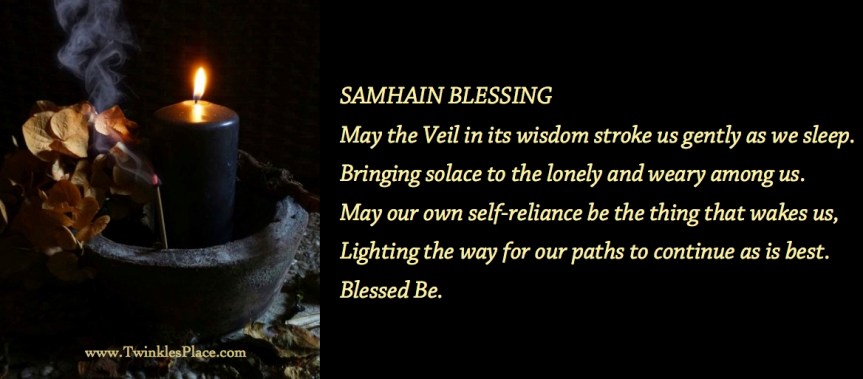
The Wheel of the Year has turned completely around as we come to close of another year.
In the coming year may your and your family’s lives be filled with enough income to meet every thing you have to with some leftover for fun, more love, happiness, laughter, joy, and positive things!
Blessed be dear Sisters, Brother , and Honored Guests
Imbolc marks the Irish pagan start of spring – something is stirring
As the great wheel turns, we find ourselves slowly re-emerging from the deep dreamtime of winter into the portal of Imbolc.
Flashback 2002 Lammas
Lammas is the first of the harvest festivals and this year despite the fiery Sun, it has a strong, sensual feel of cardinal earth. Mars lends a masculine energy to the Sun this week to help with the organizing for this bread festival. Round cornbread as a solar disk is an apt and easy choice for the altar, but if you plan several days ahead, you can sprout a small amount (1/4 cup) of wheat or barely for kitchen witchery. Add this to your other grains to your own bread from scratch; or buy frozen bread dough, thaw, pat into a rectangle, and sprinkle the sprouted grains. Roll up your dough like a jelly roll and place in a greased bread pan into which you have sprinkled Irish oats. You can use a sharp knife to crave goddess symbols into the loaf before baking.
©️ By K. D. Spitzer Llewellyn’s Witches’ Datebook 2002 Page 93
Flashback 2002 Imbolc
Imbolc is an important day of purification and initiation; on the Sun’s day, February 2, the energies are very airy. This Sabbat is a good day for coven work, with an emotionally detached masculine Moon and Sun on the Sun’s day.
Dress yourself and your altar in white, while serving white beverages or any dairy food to honor the calving season. Spread the top of a one-pound round Camembert or Bire cheese with raspberry preserves. Cut a circle of puff pastry large enough to cover the cheese, wrap it, tucking the ends of the pastry under. Use scraps to decorate the top with goddess symbols. Brush with beaten egg yolk. Bake at 425 degrees until golden, and serve hot and melting on crackers. During this ritual, bless and dedicate all candles you will need for other ritual work throughout the year. A good way to start the ceremony is to light candles in the darkened room with chanting to encourage the lengthening days.
©️ By K. D. Spitzer Llewellyn’s Witches’ Datebook 2002 Page 41


You must be logged in to post a comment.