Magickal timing: Choosing the right day of the week for your spell

Planetary magick is a complex system which blends astrology, ancient cosmology, and celestial intelligences in an attempt to bring the most effective results. In this article, we’ll discuss the planetary rulers of the seven days of the week, and the best day to perform different types of magick.

Planetary magic can seem cumbersome, especially to Witches more accustomed to elemental (Earth) magic.  But you don’t have to spend hours drafting talismans or poring over charts to add some planetary flavor to your spellwork. Using a very simple overview of magickal timing, you can make sure your working is aligned with the appropriate planetary ruler.

The idea of planetary rulership (and the 7-day week) dates all the way back to Chaldean (Babylonian) astrology.  They assigned a planet to rule each day, and further divided the day into planetary hours.  Later, the Greek and Roman civilizations adapted the Babylonian calender for their use.  Planetary magic was re-discovered by the medieval magicians, who looked to the Classical world for inspiration.  The tradition of using different days for different types of magic was put forth in the 16th-century Key of Solomon, a foundational text of the Western magical tradition.

Planetary magick relies mainly on the seven Classical “planets,” (although minor planets, comets, and other features enter into advanced systems).  Of the seven, the sun and moon aren’t really planets, of course.  But ancient astrologers didn’t know that, so the nickname stuck.

In English (as well as in French, Spanish and related languages), the names of the days of the week still reflect their planetary rulers.  (This is very handy when you’re trying to remember which is which!)
Source: groveandgrotto.com

May 15 and 16, 2024 Current Moon Phase for the Northern and Southern Hemispheres

You can use this link to go forward or backward in time for Moon phase information. If you are curious, you can even find out what phase the Moon was in when you or anyone else was born.

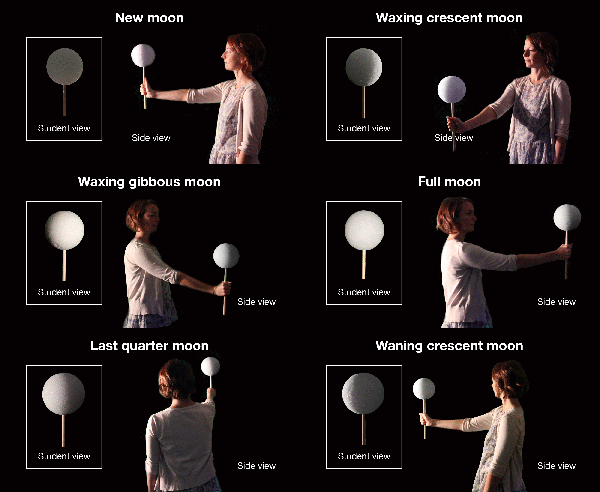
The 8 Lunar Phases

There are 8 lunar phases the Moon goes through in its 29.53 days lunar cycle. The 4 major Moon phases are Full Moon, New Moon, First Quarter and Last Quarter. Between these major phases, there are 4 minor ones: the Waxing Crescent, Waxing Gibbous, Waning Gibbous and Waning Crescent. For more info on the Moon Cycle and on each phase check out Wikipedia Lunar Phase page.

Useful Moon Resources

Check the weather before a night of Moon gazing at weather.com

For a list of all the current meteor showers visit American Meteor Society

Source: MoonGiant.com

Northern Hemisphere

May 15, 2024

The Moon’s current phase for today and tonight is a First Quarter phase. This phase occurs roughly 7 days after the New Moon when the moon is one quarter of the way through its orbit around the earth. Exactly half the moon will be illuminated and half dark. On the day of the First Quarter phase the moon is high overhead at sunset and is visible until mid-night when it sets in the west. The First Quarter phase is a one-day event and in the following days enters a Waxing Gibbous phase becoming more illuminated each day until the Full Moon.

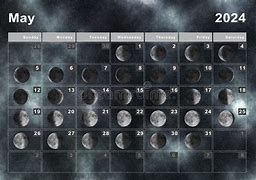
Visit the May 2024 Moon Phases Calendar to see all the daily moon phase for this month.

Today’s First Quarter Phase

The First Quarter on May 15 has an illumination of 50%. This is the percentage of the Moon illuminated by the Sun. The illumination is constantly changing and can vary up to 10% a day. On May 15 the Moon is 7.38 days old. This refers to how many days it has been since the last New Moon. It takes 29.53 days for the Moon to orbit the Earth and go through the lunar cycle of all 8 Moon phases.

Phase Details

Phase: First Quarter
Illumination: 50%
Moon Age: 7.38 days
Moon Angle: 0.49
Moon Distance: 402,385.72 km
Sun Angle: 0.53
Sun Distance: 151,266,465.74 km

Southern Hemisphere

16 May 2024

The Moon’s current phase for today and tonight is a Waxing Gibbous phase. Visible through most of the night sky setting a few hours before sunrise. This phase is when the moon is more than 50% illuminated but not yet a Full Moon. The phase lasts about 7 days with the moon becoming more illuminated each day until the Full Moon. This September Full Moon will be the forth and final supermoon of 2023.

During a Waxing Gibbous the moon rises in the east in mid-afternoon and is high in the eastern sky at sunset. The word Gibbous first appeared in the 14th century and has its roots in the Latin word “gibbosus” meaning humpbacked.

Visit the May 2024 Moon Phases Calendar to see all the daily moon phase for this month.

Today’s Waxing Gibbous Phase

The Waxing Gibbous on May 16 has an illumination of 59%. This is the percentage of the Moon illuminated by the Sun. The illumination is constantly changing and can vary up to 10% a day. On May 16 the Moon is 8.28 days old. This refers to how many days it has been since the last New Moon. It takes 29.53 days for the Moon to orbit the Earth and go through the lunar cycle of all 8 Moon phases.

Phase Details

Phase: Waxing Gibbous
Illumination: 59%
Moon Age: 8.28 days
Moon Angle: 0.49
Moon Distance: 404,361.13 km
Sun Angle: 0.53
Sun Distance: 151,297,924.39 km