

Category: Miscellaneous Pagan
Some of the Witchcraft/Magickal Correspondence for Love
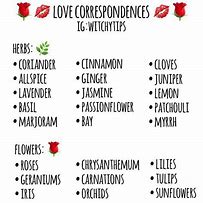
Love Magic: The Best Tools & Correspondence for Love Spells
Roses are red, violets are blue, I radiate love, through and through. A simple little love spell perhaps? Well, it’s February and love magic is in the air!
So, not everyone is a huge fan of Valentine’s Day but I say bring it on! I like to consider February love month. It’s a perfect time to focus on fostering positivity and love in your life, and to indulge in some extra self love and care. We can take this time to create new healthy habits, enhance our most special relationships, and discover new ways to focus on nurturing our own wants and needs.
This time of year is just perfect to indulge in the magic that is love. Commercially, the month tends to focus on couples but everyone can benefit from celebrating love once in a while. We can all choose to thrive this month while fostering love and positive relationships with friends, family, pets, and of course with ourselves.
Love Magic: They Love Me, They Love Me Not
Love magic is probably one of the most popular things people want to learn about when they begin their journey into magic. This is a magic that should be beautiful, gentle, warm, and soothing. We all need that feeling of love in our lives in order to feel emotionally strong and vibrant.
What it isn’t however, or shouldn’t be, is an opportunity to bend or manipulate the will of others. The wonderful energy that can blossom from this type of magic should indeed be used to bring more love and fulfillment into your life but not at the expense of others.
Use this magic with wisdom and care. Direct the magic inwards to gather more love for yourself, to draw more love to you, or to grow nourish, and strengthen relationships. Allow the magic to come from a caring and well intentioned place.
So, what elements may we include in these types of spells and rituals? Very happy you asked! Scroll down and keep on reading
Love Magic Correspondence
Best Day of the Week – Friday
Best Moon Phase – Waxing or New
Energy Centre – Heart
Herbs & Plants – anise, basil, cardamom, cinnamon, clove, coriander, dill, fennel, ginger, hibiscus, lavender, lemon balm, parsley, patchouli, rosemary, thyme, vanilla, valerian, yarrow
Flowers – aster, bleeding heart, carnation, cherry blossom, geranium, hyacinth, jasmine, lilac, orchid, rose, tulip
Crystals – amber, amethyst, garnet, lapis lazuli, moonstone, rhodochrosite, rhodonite, rose quartz, ruby, pink topaz
Essential Oils – anise, birch, cardamom, clove, ginger, grapefruit, jasmine, juniper berry, lemongrass, lime, marjoram, myrrh, patchouli, peppermint, rose, rosemary, spearmint, vanilla, vetiver
Colours – pink, red, white
Foods – avocado, banana, Brazil nuts, beets, cherry, chocolate, lemon, lime, orange, passion fruit, peas, pistachio, rhubarb, rye bread, sugar, sweet potato, strawberry, tomato, white wine
Ways to Incorporate Love Magic into your Day, Month, & Year
Click here to read the rest of this article from thewholesomewitch.com
Another Look at the Detities of Love anf Lust – Printable
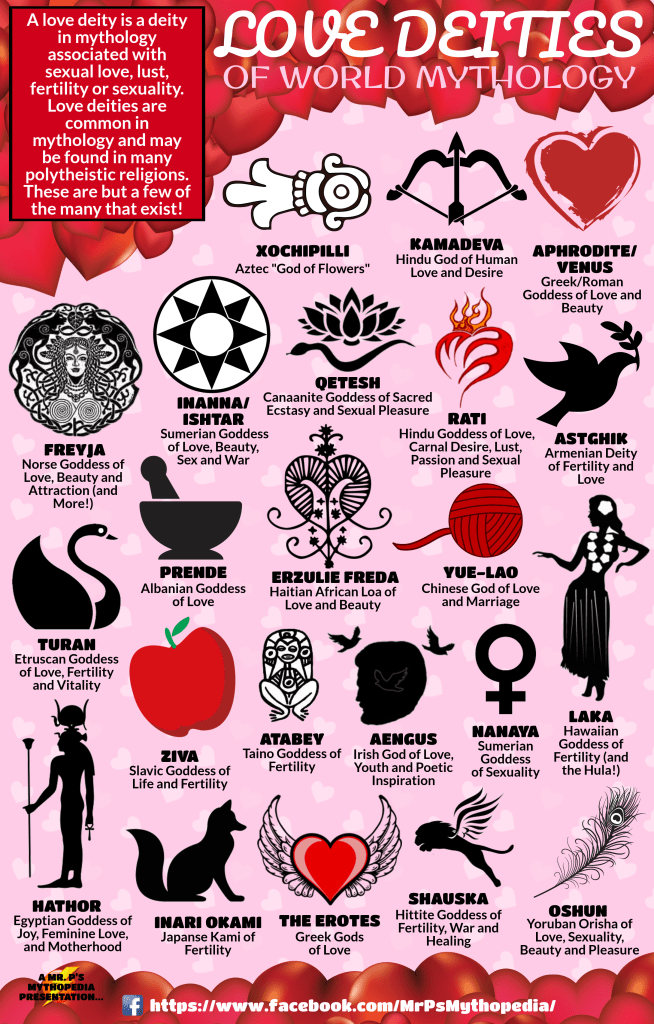
10 “Mythological” Deities Of Love And Lust
While the standards of beauty may have changed throughout the centuries, all humans share an inescapable biological urge to procreate. Feelings of love and lust are therefore extremely important and have influenced even our deities—who, after all, are usually reflections of our own characteristics.
10 Xochiquetzal – Aztec Mythology
With a name meaning “precious feather flower” the Nahuatl language, it’s no surprise that Xochiquetzal was an Aztec goddess of love. Various other aspects of Aztec life, such as flowers, pregnancy, and prostitutes, also fell under her domain, making her one of the more popular deities of the time—a feast in which her devotees dressed up in animal masks was held every eight years. Because of her affinity for marriage, she was often believed to be the wife of the rain god Tlaloc.
Unlike most Aztec fertility goddesses, Xochiquetzal was usually depicted as a beautiful young woman, which caused her problems with some of the more misogynistic gods of their pantheon. While still married to Tlaloc, she was kidnapped by Tezcatlipoca, the god of the night, and forced to marry him, after which she was enthroned as the goddess of love. By another of her husbands she was also the mother of Quetzalcoatl, the feathered serpent god of Aztec mythology.
Clíodhna was an Irish goddess sometimes depicted as a banshee or even Queen of the Banshees (or Fairies, depending on the translation). However, she was also the goddess of love, perhaps because she was considered the most beautiful woman in the world. Unlike many other love deities, Clíodhna remained chaste, keeping her love locked away until she met the mortal Ciabahn—who, in a lucky coincidence, just happened to be among the most handsome men ever to have walked the Earth. Clíodhna loved him so much that she left Tir Tairngire, the land of the gods, to be with him.
However, when the other Irish deities found out about this, they conspired to get her back. While Ciabahn was away, Clíodhna was lulled to sleep by the music played by a local minstrel and was subsequently taken by a wave (the tide in the area is still referred to as “Clíodhna’s wave”). Depending on the source, she was either returned to Tir Tairngire or drowned in the sea.
8 Tu Er Shen – Chinese Mythology
A relatively minor deity of Chinese mythology, Tu Er Shen—or Hu Tianbao, as he was known when he was mortal—is the god of homosexual love and marriage. Born during the Qing dynasty, Hu Tianbao found himself attracted to an official of the local government, spying on him naked through a hole in his bathroom wall. When his peeping was discovered, Tianbao was beaten to death. Moved by his unrequited love, the gods of the underworld took pity on him and restored him to life as the deity of homosexual relationships.
Perhaps because they were used as a slang term for homosexual men, rabbits are considered a symbol of homoerotic love in China, and Tu Er Shen is often depicted as a rabbit in the few shrines dedicated to him. Sadly, in many of the places where he is worshiped, homosexual activity remains a punishable criminal offense.
7 Hathor – Egyptian Mythology
One of the most popular, and longest-lasting, of the Egyptian goddesses, Hathor was mentioned as early as the second dynasty (around 2890-2686 BC), and perhaps even before that. Since she survived for so long, Hathor took on a number of roles, including spells as the goddess of love, beauty, mining, and music. However, it was her time as the Eye of Ra which led to her most interesting stories. The Eye of Ra is the term Egyptians used for the feminine counterpart to Ra, a role filled by a number of goddesses, including Ra’s daughter, Hathor.
Found in King Tut’s tomb, a story known as “The Destruction of Mankind” tells of a time when Hathor, at Ra’s insistence, became the war goddess Sekhmet in order to punish humans for their sinful ways. When the bloodthirsty goddess got out of control, Ra tried to stop his daughter—but failed. Just before she killed every last person on Earth, Ra managed to get her drunk. Hathor immediately forgot what she was doing and returned to normal. In another, possibly equally disturbing story, she performed a striptease for her father in order to cheer him up.
6 Eros – Greek Mythology
The Greek version of Cupid, Eros was Aphrodite’s son and the god of desire and attraction (although, he was sometimes depicted as one of the Protogenoi, or primeval gods). Much like his Roman counterpart, he often took the form of a young winged boy, complete with bow and arrow. He was fiercely loyal to his mother—although he was prone to fits of disobedience. That rebellious aspect of the god showed up prominently in his most famous myth.
A young woman named Psyche was born and proclaimed to be so beautiful as to be the second coming of Aphrodite. As was her nature, the goddess was angered and sent Eros to shoot her with her arrow and cause her to fall in love with the ugliest man on Earth as punishment. However, her beauty was so great that Eros fell in love and ignored his mother’s wishes, whisking Psyche away. Eros never revealed his identity but Psyche’s curiosity got the better of her and she peeked in on him when he was sleeping. Betrayed by his love, the god fled and Psyche wandered the Earth until Zeus agreed to let them get married.
5 Rati- Hinduism
More popularly known as the wife of Kama, the god of love, Rati herself plays a large role in love and lust in Hinduism. With a number of names, most of which speak to her immense beauty, it seems obvious Rati would be the goddess of desire. Depending on the source, she is the daughter of either Daksha or Brahma. In the case of the latter, she was the reason for the god’s suicide, after he lusted after her. Rati immediately killed herself as well (they were both quickly resurrected).
But Rati’s biggest claim to fame was successfully changing Shiva’s mind. The Destroyer, sworn to ascetic ways after his first wife’s death, had been forced to fall in love again. In revenge, he killed Kama, turning him to ash with his third eye. The best known version of the story has Rati persuade Shiva to revive her husband, with the caveat that Kama is to be invisible for eternity.
Celtic Gods and Goddesses: Exploring the Pantheon and Mythology of the Ancient Celts
This article is not a complete list of the Celtic Goddesses and Gods. It seems to be the more popular ones in modern pagan traditions. They will also correspondence to some of the other ancient pantheons in other parts of the ancient world.
To read about the different Gods and Goddesses please click on their hyperlink this comes from historycooperative.org
You’ve always wanted to stroll across the beautiful landscape of Ireland. To make sure that you don’t miss out on the best spots, you decide to make use of a local touring company.
Suddenly one appears before you. How strange that you didn’t notice this building before, but heck, the banner outside claims it’s five-star and that you’ll meet Celtic gods and goddesses in person. They are probably just actors in costume — a little cheesy — but you don’t see any other places that are open at the moment.
To your surprise, you realize that your hiking companions are the actual Celtic gods and goddesses. While you fight off the sudden faint feeling, you remember that the ridiculously steep deposit is only refundable at the end of the trip. There’s no turning back now.
A big guy claps his hand on your shoulder and says, “Fear not, tiny mortal. You’re going to have a fun time learning all about the ancient Celtic pantheon and the people who worshipped us.”
You just want your deposit back. So when the group picks up their backpacks and heads out, you follow.
Dagda – The Good Father God of Ireland, Knowledge, Weather, Wise Druids, and Wariors
Name: The Dagda – the good god
Realms: Father god of Ireland; knowledge, weather, fertility, druids, warriors
Family: Father of Aengus, Brigid, and Danu, member of the Tuatha Dé Dannan
Fun Fact: In Dorsetshire is an enormous drawing of a man. Some believe that the chalk creation is meant to show this deity…
Ériu – The Patron Goddess of Ireland
Name: Ériu
Realms: Patron goddess of Ireland
Family: Daughter of Ernmas and Fiachna Mac Delbáeth; has two sisters called Banba and Fódla; mother of Bres
Fun Fact: Her sisters’ names are sometimes used as poetic titles for Ireland…
Lugh – The God of Crafts, Light, and Sun
(Side Note: This is the God who is honored during a Lammas/Lughnasadh celebration)
Name: Lugh
Realms: God of crafts, light, and Sun
Family: Son of Eithne and Cian; father of Cú Chulainn
Fun Fact: His full name is a little strange — Lugh of the Long Arms…
Epona’s Horses Aren’t Fond of Mortals (Don’t Get Too Close)
(Side Note: Epona is also considered the Goddess of all domestic animals in modern times. I work with her closely when teaching a puppy or an older dog manners to get along better in the human world)
Name: Epona
Realms: Patron goddess of horses, mules, fertility, and cavalry
Family: ???
Fun Fact: In the Gaulish tradition, Epona was never shown in human form; only as a mule or a horse. The Romans showed her as a woman on a throne, standing between horses or driving a chariot…
The Group’s Healer Is Kind of a Reaper
(Side Note: This is the Goddess who is honored during a Imbolc celebration)
Name: Brigid
Realms: Goddess of poetry, fertility, motherhood, passion, dawn, healing, smithing, fire, invention, and life
Family: Married to Bres; mother of Ruadán; daughter of the Dagda
Fun Fact: She inspired a goddess in Haiti, called Maman Brigitte
Danu Knows All About Death and Daffodils
Name: Danu
Realms: A mother goddess; the earth, nature, wind, fertility, death, wisdom, cattle, regeneration, wealth
Family: She was the consort of both the Sun god, Belenos, and the sea god, Beli; daughter of the Dagda, member of the Tuatha De Dannan.
Fun Fact: Danu is another geographical smash hit. Among the places named after this goddess is the River Danube, the Paps of Anu, a region in Ireland’s County Kerry, and possibly the Dane Hills in Leicestershire…
The God of Love Has Daddy Issues (Rightfully So)
Name: Aengus
Realms: God of love and youth
Family: Son of Boann and the Dagda, member of the Tuatha Dé Dannan
Fun Fact: Four birds surround him at all times and, according to mythology, they symbolize his smooches (Yep. His kisses)…
There’s a Confused God Looking for Some Guy Called “Asterix”
Name: Toutatis
Realms: Possibly the guardian god of the Gauls
Family: ???
Fun Fact: Ancient writers suggested that he was the equivalent of the Roman god, Mars…
There’s a Wolf Wearing Bloody Armor
Name: The Morrigan, the Great Queen, the Phantom Queen.
Realms: Goddess of war, fate, death, and destiny
Family: Great-granddaughter of King Nuada, member of the Tuatha Dé Dannan
Fun Fact: In some versions of Celtic mythology, Ireland was named for this Irish goddess…
You Don’t Mess With This Healer — He’ll Knock You Out (Then Put an Ice Pack on It)
Name: Belenus
Realms: God of the Sun, spring festivals, healing, medicine, and guardianship
Family: ???
Fun Fact: According to Roman sources, Belenus was the popular kid in the Celtic mythology during the 3rd century…
This God Adores Wheels and Human Sacrifices
Name: Taranis
Realms: Wheels, thunder, weather, the sky
Family: ???
Fun Fact: Archaeologists have discovered thousands of votive wheels in Gaul. They were popular offerings to Taranis…
Cernunnos Refuses to Show Himself, Because No One Remembers Him
(Side Note: This is the God who is honored during a Beltane celebration)
Name: Cernunnos
Realms: Forests, wildlife, wealth, fertility, and possibly the underworld
Family: ???
Fun Fact: This Celtic god is more of an entity today, in modern Wiccan traditions, than during the past…
Pagan Word Definition – Witchcraft
From merriam-webster.com
witchcraft
noun
witch·craft ˈwich-ˌkraft
1
a
: the use of sorcery or magic
b
: communication with the devil or with a familiar
2
: an irresistible influence or fascination
3
a
: rituals and practices that incorporate belief in magic and that are associated especially with neo-pagan traditions and religions (such as Wicca)
Practitioners of Wicca … use the tools … such as the broom (a purifying symbol), the wand, candles, crystals and the knife …. They refer to their practices as witchcraft …—Lesley Wright
b
or less commonly Witchcraft : a tradition or religion that involves the practice of witchcraft
Feminist witchcraft sees women’s oppression and environmental abuse, which they argue are intimately linked, as firmly rooted in patriarchal religions.—Wendy Griffin
Wicca, which emerged in the 1940s in England, is the original form of modern Pagan Witchcraft.—Meg Yardley
Synonyms
Word History
First Known Use
before the 12th century, in the meaning defined at sense 1a
Time Traveler
The first known use of witchcraft was before the 12th century
We Must Hide No Longer c. 2011
We Must Hide No Longer

Author: Ryan Smith
Welcome to America, the self-proclaimed land of the free and home of the brave. The country where, at least in theory, one can practice any faith one wishes and can fully exercise as the Founding Fathers put it the “freedom of conscience.”
The First Amendment, which starts with “Congress shall make no law respecting an establishment of religion, or prohibiting the free exercise thereof, ” while plain on its face has had a lot of footnotes attached to it over the years by the Christian supermajority. Freedom of religion as long as your faith is Abrahamic in origin. Freedom from persecution as long as you kneel before the Cross. Freedom to worship openly and unhindered only if your faith is one that was thrust on your ancestors by foreign missionaries who claimed to have their best interests at heart.
As a member of what is America’s Invisible Minority, I am no stranger to what happens to Pagans when one is ‘outed’. While I have not been physically assaulted or fired because of my faith I do know what it is for people to go oddly silent when I offer a blessing. I know what it is to be mocked as “insane” and/or labeled a “devil-worshiper”. And of course, I have heard the ever-popular chastisement of, “You’re going to Hell.” I’m fairly sure that anyone whom is not Christian reading this knows what I’m talking about. I’m also fairly sure most people reading this, if they personally have not been the victims of it, at least know someone who lost their job shortly after being outed for “personality issues” or because “didn’t quite work out” or because “we no longer have need of your services.”
Then we have the worst examples: Brandi Blackbear, who was suspended from school for fifteen days in Oklahoma due to accusations of witchcraft (1) . In 1999 Tempest Smith of Michigan who, after school administrators washed their hands of the ongoing harassment by Christian students at her school, hung herself rather than deal with it any longer in 2001 (2) .
Palmdale, California, the state that is seen by many and prided as the most forward-thinking in the country, in 2002 had a local Christian group invade a Pagan store and harass, browbeat, intimidate, and threaten patrons who were honoring Ostara. The best part was when the Sheriff’s Department refused to investigate because, oh by the way, a volunteer department chaplain was at the attack and helped organize it (3) .
2004 in South Carolina saw local prosecutors state that a man accused of murder did so because he was Wiccan (4) . There is of course the infamous case of the Wiccan Nevada National Guardsman denied a pentacle on his headstone by the US government (5) .
In 2007 an Army Chaplain, in spite of his stellar record as a soldier and Chaplain, was not only denied his request to serve as a Wiccan Chaplain but also removed from the Chaplain’s Corps (6) . I’m sure there are plenty of other incidents like these that are as bad, possibly worse, that have not been mentioned here.
So what, you may be wondering, is the point of all this? The point is simple: we as a diverse group of Earth-based faith traditions are routinely disrespected and disregarded by American society as a whole.
Now I know a lot of Pagans are likely thinking to themselves, “Why should we care what a bunch of superficial ‘sheeple’ think? We’re free spirits who dance to the beat of our own drums and don’t care what other people say about us!” There is a very serious problem with that kind of thinking.
In the United States of America today there are about 300 million people (7) . Of that 300 million it is estimated only 1.3 million are Pagans of some kind or another (8) . As much as our independent spirit and willingness to question convention is probably our greatest strength it cannot be ignored that we are a tiny minority in an overwhelmingly Christian nation.
What would happen if, for example, the good people at Operation Rescue who had regularly targeted Dr. Tiller’s clinic in Kansas for protest (9) were very directly confronted in the national media and asked if their accusations of him being a mass-murderer (10) were responsible in some fashion for his cold-blooded assassination inside his own church? You would have wall-to-wall coverage of pundits, preachers, and politicians tearing their hair out and wailing about “persecution.”
Now what happens if, say, a Druid Grove is accused of human sacrifice? First off you probably wouldn’t see any media attention given to such a story unless someone decides to go and actually do something about “those dangerous cultists.” You would probably also see outrage and condemnation on the web on Pagan blogs. And just like many other instances of persecution after we as a whole vow “Never Again” and some group or foundation takes up the incident as their championed cause, it sinks back into the morass of apathy.
Why does this happen? Are we not devoted enough to our own dignity? The answer is rather more elementary than Pagans being undeserving or incapable of organizing or any of the other excuses bandied about.
With only a small handful of real victories against our persecutors and attackers, any move to do something about it is already seen by many as doomed to fail. Too many Pagans give our independent nature and notorious difficulty in being organized in any meaningful fashion as cop-outs to really having an impact on society and improving our standing in it. It is, sadly, understandable why many would do so.
Who wants to exhaust their time, money, and energy fighting for a cause pre-determined in the minds of their colleagues as lost? Everyone wants to be the hero riding over the hill; no one wants to be the person who makes the glorious last stand for a greater moral victory. Far better, it would be argued, to think small.
Better to gain a seat on an Interfaith Council or use of a Unitarian Church than to run for public office. Better to make small, easy victories than to organize, mobilize, and take the fight to where it matters most: the public square. Better to cede the debate to people who do not understand us and in many cases are actively hostile to us.
To take such an approach is to sacrifice the future of our faith, of our community, and of the next generation of Pagans for the sake of questionable comfort and unsteady safety in the immediate present. As Ben Franklin once said, “He who would give up a little liberty for a little security will gain neither and lose both.”
We cannot continue to “wait and see” or “let our moment come” or “try not to upset people.” We upset a sizable fraction of the population simply by breathing; staying quiet and walking small will not change that. I see no reason why we, a community that wears our free spirits as a badge of honor and believe in the importance of personal responsibility, should be afraid of standing up for what we believe. Every other group striving for rights and dignity in American history has been told the same thing when they began their push.
If all the other groups had listened then we probably would still have slavery in the South, women as property of their husbands, and only those with land of their own having the right to vote. Discretion is said to be the better part of valor, but when discretion is forced by circumstance then it is no longer a guardrail against madness but a straightjacket for the soul.
So long as we allow inaction we will remain the Invisible Minority. So long as we act in reaction to fear Pagans will continue to be harassed, attacked, fired, and forgotten. The promise of the Declaration of Independence of, “life, liberty, and the pursuit of happiness” will remain unfulfilled for all of us. The effort will be long. It will be hard. Only a fool would promise that it would be easy. But America now is no longer the America where the Religious Right stood unchallenged in their agenda by the masses.
The time is now. We stand at a vital crossroads in history. With the power of the social conservatives, at least for now, broken and our numbers on the rise we must seize the moment and begin the long journey to respect and acceptance. In so doing we must remember, for all who join us in the cause, that we do not just do so for ourselves. We fight for each other, our fellow Kin regardless of Tradition.
Most importantly, we are fighting for the future. The future of our Traditions. The future of our community as a whole and the health, vitality, and success of our local communities in particular. Most vitally we are struggling for the next generation. We must take up the cause to demand respect and dignity and work long and hard now so that when the next generation comes of age they will not know the fear, uncertainty, loneliness, and hardship that many of us have been forced to live with.
We begin today so tomorrow we may openly stand on the mountaintops and in the public square with each other, our children, and our fellow Americans and have no fear anywhere in this nation, from Seattle to Atlanta, from San Francisco to San Antonio, from New York to New Orleans there will be no place where we must hide the truth of who we are for the sake of survival or propriety.
We must take up the cause of liberation. We can no longer let fear instilled by our attackers to keep us shoved into the shadows. We must stand up and get involved in our local communities. We need to actively participate in local, state, and federal politics whether or not it is directly Pagan related or not. To give us a voice in public offices, we need to cultivate, assist and support people to run for these offices including those within the existing two major parties.
We must aggressively dispel the lies perpetrated by our foes by coming out to the public where it is safe to do so as a Pagan, as a Druid, as a Witch, as a Heathen so they know we are not some mysterious dark cult but real people they know. We must do this for what are our natural rights as human beings of life, liberty, and the pursuit of happiness on our terms according to what we believe not what others say we must believe.
We have no time to wait, no time to allow our moment to come. Our time is here.
Every act we take, great or small, alone or in a group, which is one made for the good of our greater community is one worth doing. Every act no matter its impact is one more step on the road to victory.
We cannot wait for heroes to come riding down from on high to our rescue. We must answer the call and rise to the challenge that we all face.
Footnotes:
1. http://findarticles.com/p/articles/mi_m1568/is_9_32/ai_70461580/
2. http://community-2.webtv.net/FullMoonCircle/TempestSmith/
3. Rich Breault, “Wiccagate: What do Witches Grove protesters have to hide?, ” Valley Press, 2002-APR-8.
4. http://www.wistv.com/Global/story.asp?S=2347141 and nav=0RaPRIlo
5. http://archives.chicagotribune.com/2007/feb/08/news/chi-0702080027feb08
6. http://www.northcountrygazette.org/articles/2007/032907WitchTrials.html
7. https://www.cia.gov/library/publications/the-world-factbook/geos/US.html
8. http://religions.pewforum.org/pdf/affiliations-all-traditions.pdf
9. http://www.washingtonpost.com/wp-srv/national/longterm/abortviolence/stories/tiller3.htm
10. http://www.christiannewswire.com/news/8967610531.html
Flashback 2011 – The Rise of Wicca and Neo–Paganism in the United States
Author: Govannon Thunderwolf
Wicca is becoming the fastest growing religion in the United States. This statement was something I was hearing and reading more and more. Being a member of the Pagan community, I didn’t really notice any of this growth happening. The more books and articles on the Internet that I read, the more I kept seeing this statement. The research into this declaration became my focus of interest. What fascinated me the most about this account was the fact that Wiccans and neo – Pagans do not go around with the specific intent of finding converts. In the teachings and ideas of Wicca and Paganism, the idea of looking for converts is not encouraged and is looked down upon. Anyone seeking converts into Wicca or Paganism is breaking a cardinal rule.
Even though Wicca is generally a female dominated religion, there are men involved as well. Wicca is a religion that recognizes women and men as equals, but it does put a slight emphasis on women and the Goddess. Female witches out number males two to one in the United States, according to the Covenant of the Goddess’s estimates. Covenant of the Goddess is one of the oldest and largest Wiccan groups in the United States. They also state that much of the recent growth in Wicca and neo – Paganism has been among women. (Sanders xiv)
Where would someone look to find followers of Wicca and Pagans? They can be found anywhere and everywhere. The actual number of Wiccan and Pagan followers in the United States changes constantly, but in 1999 Helen Berger, a sociologist who spent ten years as a member of the neo – Pagan community, estimated that there are between 150, 000 and 200, 000 Pagans in the United States. It is suspected that there are many more among the ranks of Pagans today. Berger’s census also found that California has the highest amount of Pagans living within its boundaries at 15.7 percent, followed by Massachusetts at 7.6 percent, and New York at 7.3 percent. (Sanders xiv)
While there were many contributors to the construct of Wicca since the 1890’s, there was one man, who in 1954 wrote and published Witchcraft Today, and that man was Gerald Gardner (1884 – 1964) . Even though Druidism, Witchcraft, and other forms of Paganism were originally oral traditions, their revival is attributed to written text. (Clifton 14 – 15)
Very little is known about Gerald Gardner except for what is public record. He was a civil servant for the United Kingdom, and spent most of his career in Britain’s Asian colonies before he retired and settled in southern England. Gardner was one of the many who thought it more prestigious to have learned the “craft”, a term used for Witchcraft, an elder of one’s own family. Gardner didn’t claim to have learned Wicca from an elder of his own family, but did claim to have learned it from elders with family ties that went way back many generations. For most people in the Pagan community, it was well know that Gardner was considered a bit of a pervert due to his tendency toward bondage and ritualized punishment. It came through in his writings and ideas of practice, but the resurgence of “the craft” is mainly attributed to him. The people of Britain have always made changes to religions to try and make them their own, but Wicca is the only religion that originated in the United Kingdom. (Clifton 14 – 15)
Wicca is generally a solitary religion and seventy percent of its followers are solitary, taking personal responsibility for their own religious practice, rather than following an authority figure. Without a strict set of beliefs, “each practitioner can add or subtract beliefs at will, ” this is a part of what makes Wicca so popular. (Sanders 5)
Now I will continue this paper on three main reasons that I found the most compelling reasons for people of all walks of life to be drawn to Wicca and Paganism, beginning with a concern for the Earth.
The fear of Global Warming and preserving what we now have for future generations is a major common concern among contemporary Pagans. Most of modern society has lost an important connection with nature. In some cases there is even a fear of nature. To be fearful of the natural world, in which we as human beings came from, just as all life has, is quite a cause for alarm. When the system of Wicca was originally developed, its focus was on fertility, just as the ancients were focused on fertility. As history has shown, fertility was a main concern for all people in ancient times.
Life was hard for our ancient ancestors and fertility of the land, animals, people, etc. was the only way for them to continue life and surviving. With human fertility becoming less of a concern in modern times because of improvements in science, the focus has now shifted to nature. This change is another way in which Wicca and Paganism can remain a positive religion. It is a religion that recognizes change and changes with it. If something can’t change with the times, it will get left behind and become history.
The American mainstream religions have done very little to foster concern for nature. Never, have I heard of any sermons given on how people should be encouraged to care for the environment, be good caretakers of nature, and preservation of natural resources. This again, leads many to view Paganism and Wicca more approvingly. (Sanders 22)
Paganism also acknowledges nature by following the cycles of the seasons and life. Pagans and Wiccans are encouraged to live their lives by looking to nature as their guide. They live in the here and now as opposed to living and planning for the end of life. Through this view of nature, Wiccans and Pagans acknowledge their connection to all life and the greater cosmos. Many mainstream religious writers believe that honoring nature is not enough for religion or life because it contains violence and brutality. (Harvey 187) This worldview on life and nature is the basis for Wiccans and Pagans to believe in no absolute good or evil. All things in nature are good and evil at the same time and therefore it applies to life as well.
The second reason for the attraction to Paganism and Wicca is empowerment for women. The Christian church has treated women like “second – class citizens” for much of its history. This treatment of women is also prevalent in much of the Western world as well. (Sanders 22) Many women have become quite discontent with the Christian church. When women have expressed an interest in becoming more involved in the church, they are usually directed to make coffee and teach Sunday school. With the concerns of equal rights coming more and more to the forefront in our society, how do the patriarchal religions expect women to remain subservient? (Sanders 22)
For the last several thousand years of patriarchal religions domination of the Western world, large numbers of women have been searching for a spiritual existence free from the patriarchal dogma. With Wicca’s emphasis on Goddess worship, it attracts those women who want to find a spiritual side to their feminism. (Adler 207 – 24)
The feminist views of women have been the main driving force pushing Wicca to be accepted as a religion. Not all Wiccan groups are feminist though. Most Pagans and Wiccans have a more moderate view of the feministic ideas. Feminist Wiccan groups have dropped a lot of common beliefs in the Pagan community in favor of an all female belief system. By doing such things as only recognizing the female deities and eliminating the male deities, they are alienating themselves from the rest of the Pagan and Wiccan community. (Adler 180 – 81)
Many women have become quite discontent with the Christian church. When women have expressed an interest in becoming more involved in the church, they are usually directed to make coffee and teach Sunday school. With the concerns of equal rights coming more and more to the forefront in our society, how do the patriarchal religions expect women to remain subservient? (Sanders 22)
One doesn’t need to look very hard to see the atrocities that have been committed against women in history by patriarchal societies. One common saying in modern Pagan communities that can be found imprinted on t – shirts and bumper stickers is, “Don’t forget the burning times.” This refers to the days of the infamous witch-hunts. Malleus Maleficarum (The Hammer of Evildoers) published in 1486/87 by Jacob Spenger and Heinrich Krämer was the authoritative witch hunter’s manual. One key phrase from this manual that modern Pagan writers like to quote is: “All witchcraft comes from carnal lust, which in women is insatiable.” (Clifton 100) This “authoritative” work also stated that women were created from the bent rib of Adam, therefore women are “imperfect animals” if they are even animals at all. (Pearson 302)
In the Malleus Maleficarum, inquisitors, the ones who were authorized to verify involvement in witchcraft, were informed that guilty women would make sexual pacts with Satan. Therefore, after this pact was made, any event in the local community that disrupted the well being of the people was most certainly caused by a witch in their ranks. (Pearson 302 – 3)
When the inquisitors were in search of a “witch”, one could be found quite readily. More often than not, the accused was just a woman that someone had a grudge against. Many also speculated that these “witches” might have been highly learned women, such as early scientists. Because of the ridiculous information contained in the Malleus Maleficarum on how to proceed with the “trials” of the accused, there generally was “no mistake” of finding them guilty. Guilty women and a few men as well, were relatively few in the colonies of America. On the other hand, in Europe the numbers of the accused were astronomical. Imagine the amount of people that lost their lives due to the feelings of resentment of some sort or other, such as the amount of land they owned or a person’s general success. Many Wiccans and Pagans feel that the amount of people who were actually true witches during these “trials” was closer to none. (Gibson 112 – 18)
The final main reason that I would like to point out for the attraction of Wicca and Paganism is the attraction of the supernatural. While Pagans and Wiccans accept the belief in an unseen world, forces, and entities, many, if not all, Christian churches, in these modern times, ignore this belief. In many cases, a person could stir up quite a bit of trouble for themselves by stating a belief in an unseen world in the Christian church. (Sanders 23 – 26)
Reading ones future by using tarot cards and runes are very popular forms of divination among Pagans and Wiccans. There are many other popular forms of divination and occult sciences such as the use of crystals. Even though many of these beliefs forms were allowed by Christianity in their early years of development, now these systems have no place in Christianity. Many people have speculated when and why this shift occurred. Modern science has been trying to validate these occult sciences for quite some time now, but with limited success. The simple fact that the occult sciences are being tested gives valid support in their existence. (Handbook of Contemporary 425)
There are still many things in the world that can’t be explained by modern science. In the acknowledgement of this fact is where modern Pagans revel. It still gives room for belief in the ideas of fairies, mythical beings, and other such beliefs.
Discussions of the supernatural will quickly conjure up visions and ideas in relation to recent popular movies such as Harry Potter, The Seeker, Lord of the Rings, and many, many other movies. While these movies and books quickly catch the imagination, their similarities to actual supernatural occurrences are very, very limited. For the most part, these movies and books are purely fantasy. Even so, there have been some Christian based groups that are in opposition of these forms of entertainment. They believe that it sways people, especially children, to take an interest in Wicca and Paganism. (Handbook of New 459 – 60)
As Catherine Edwards Sanders, a Christian journalist, points out, “most Wiccans [and Pagans] have thought more seriously about spirituality and some of life’s big questions than many in the secular and even Christian cultures. They have not been content to skate through life seeking the gods of fashion, peer pressure, or materialism, reserving religion for weekends and special holidays.” (30)
Most Pagans and Wiccans actually view their lives as being interconnected with the rest of the world as a whole. They realize that there are, in fact, fewer events in their lives through this interconnection with the rest of the world.
With the impending end of the Mayan calendar in 2012, there have been many theories in reference to the end of the world. In fact, recently the “dooms day” movies have been coming out more and more frequently. One can only speculate that as 2012 draws nearer, the apocalyptic world movies and theories will by coming out at a frantic pace.
In the Wiccan and Pagan groups though, ideas of the world coming to an end are not so prevalent. Many think that the date of 12 December 2012 will be a beginning of a ‘New World Age.’ Many experts believe that this will be an age of peace and interconnection with the rest of the world and beyond for the next 5, 200 years. The experts are also saying that the ‘veil’ that separates our world from the spirit world will be lifted. The descendents of the Ancient Mayan’s say that we are already in the twenty – five year timeline of this change. (Rennison np.)
This information of the coming change according to the Mayan calendar is something that modern Pagans and Wiccans are looking forward to.
In conclusion, is there a rise in the Wicca and Pagan belief system? Given the research, the answer would definitely be a resounding yes. The movement is very broad and difficult to pin down, but it has been noticed. Many authors and professionals are calling on others to try and do research on the subject. With others taking an interest in the movement, maybe someone or maybe a group of individuals will come forward with some new views or theories on this movement. With these new views and theories we can only hope to find a definite reason for this shift.
Until then, there will be many I’m sure who will take on this daunting task. There are hundreds of theories already studied or in the process of being studied. I’m sure that there are many other ideas out there that have not yet been discussed or found in the public forum. With the case of the ancient Mayans, their descendants have said that there is plenty more information that they are in possession of, but have yet to let the rest of the world know about it. Whether there is more information yet to come remains to be seen.
I’m sure that there other ancient civilizations out there that have possessed knowledge or information, now lost. Unfortunately, just as these civilizations have disappeared, so has their immediate knowledge of this information. They did leave behind recordings of information that are in the processes of being deciphered and theories investigated. The only problem is that many individuals in the modern world have a very difficult time believing what the ancients were saying. This in turn leads to very different ideas in what is being told, many times the information is right there, but many misinterpret the information only because the obvious is just too difficult to comprehend.
Footnotes:
Works Cited:
Adler, Margot. Drawing Down the Moon Witches, Druids, Goddess-Worshippers, and Other Pagans in America. New York: Penguin (Non-Classics) , 2006. Print.
Berger, Helen A., Evan A. Leach, and Leigh S. Shaffer. Voices from the Pagan Census A National Survey of Witches and Neo-Pagans in the United States (Studies in Comparative Religion) . New York: University of South Carolina, 2003. Print.
Clifton, Chas S. Her Hidden Children: the Rise of Wicca and Paganism in America. Lanham: AltaMira, 2006. Print.
Gibson, Marion H. Witchcraft Myths in American Culture. New York: Routledge, 2007. Print.
Handbook of New Age (Brill Handbooks on Contemporary Religion) . New York: Brill Academic, 2007. Print.
Handbook of Contemporary Paganism (Brill Handbooks on Contemporary Religion) . New York: Brill Academic, 2009. Print.
Harvey, Graham. Contemporary Paganism Listening People, Speaking Earth. New York: NYU, 2000. Print.
Pearson, Joanne. Belief Beyond Boundaries Wicca, Celtic Spirituality and the New Age (Religion Today-Tradition, Modernity and Change) . Grand Rapids: Ashgate, 2002. Print.
Sanders, Catherine. Wicca’s Charm Understanding the Spiritual Hunger Behind the Rise of Modern Witchcraft and Pagan Spirituality. Wheaton: Shaw, 2005. Print.
“Susan Rennison’s Website.” Susan Joy Rennison’s Website. Web. 18 Dec. 2009. .
The 161 Laws of Wicca
by Gerald B. Gardner
1. The Law was made and ordained of old.
2. The Law was made for the Wicca, to advise and help in their troubles.
3. The Wicca should give due worship to the gods and obey their will, which they ordain, for it was made for the good of Wicca as the worship of the Wicca is good for the gods. For the gods love the brethren of Wicca.
4. As a man loveth a woman by mastering her.
5. So the Wicca should love the gods by being mastered by them.
6. And it is necessary that the Circle, which is the temple of the gods, should be truly cast and purified. And that it may be a fit place for the gods to enter.
7. And the Wicca shall be properly prepared and purified to enter into the presence of the gods.
8. With love and worship in their hearts, they shall raise power from their bodies to give power to the gods.
9. As has been taught of old.
10. For in this way only may men have communion with the gods, for the gods cannot help man without the help of man.
11. And the High Priestess shall rule her coven as the representative of the God.
12. And the High Priest shall support her as the representative of the God.
13. And the High Priestess shall choose whom she will, be he of sufficient rank, to be her High Priest.
14. For as the god himself kissed her feet in the fivefold salute, laying his power at the feet of the Goddess because of her youth and beauty, her sweetness and kindness, her wisdom and justice, her humility and generosity,
15. So he resigned all his power to her.
16. But the High Priestess should ever mind that all power comes from him.
17. It is only lent, to be used wisely and justly.
18. And the greatest virtue of a High priestess be that she recognize that youth is necessary to the representative of the goddess.
19. So she will gracefully retire in favor of a younger woman should the Coven so decide in council.
20. For a true High Priestess realizes that gracefully surrendering pride of place is one of the greatest virtues.
21. And that thereby she will return to that pride of place in another life, with greater power and beauty.
22. In the old days, when witchdom extended far, we were free and worshipped in all the greater temples.
23. But in these unhappy times we must celebrate our sacred mysteries in secret.
24. So be it ordained, that none but the Wicca may see our mysteries, for our enemies are many and torture loosens the tongue of man.
25. So be it ordained that no Coven shall know where the next Coven bide.
26. Or who its members be, save only the Priest and Priestess and messenger.
27. And there shall be no communication between them, save by the messenger of the gods, or the summoner.
28. And only if it be safe may the covens meet in some safe place for the great festivals.
29. And while there, none shall say whence they came nor give their true names.
30. To this end, any that are tortured in their agony may not tell if they do not know.
31. So be it ordained that no one shall tell anyone not of the craft who be of the Wicca, nor give any names or where they bide, or in any way tell anything which can betray any of us to our foes.
32. Nor may he tell where the Covendom be.
33. Or the Covenstead.
34. Or where the meetings be.
35. And if any break these laws, even under torture, THE CURSE OF THE GODDESS SHALL BE UPON THEM, so they may never be reborn on earth and may remain where they belong, in the hell of the Christians.
36. Let each High Priestess govern her Coven with justice and love, with the help and advice of the High Priest and the Elders, always heeding the advice of the messenger of the gods if he cometh.
37. She will heed all complains of all Brothers and strive to settle all differences among them.
38. But it must be recognized that there will always be people who will ever strive to force others to do as they will.
39. These are not necessarily evil.
40. And they oft have good ideas and such ideas should be talked over in council.
41. But if they will not agree with their Brothers, or if they say,
42. “I will not work under this High Priestess,”
43. It hath ever been the Old Law to be convenient to the Brethren and to avoid disputes.
44. Any of the third may claim to found a new Coven because they live over a league away from the Covenstead, or that they are about to do so.
45. Anyone living within the Covendom and wishing to form a new Coven shall tell the Elders of their intention and on the instant avoid their dwelling and remove to the new Covendom.
46. Members of the old Coven may join the new one when it is formed. But if they do, they must utterly avoid the old Coven.
47. The Elders of the new and the old Covens should meet in peace and brotherly love to decide the new boundaries.
48. Those of the craft who dwell outside both Covendoms may join either but not both.
49. Though all may, if the Elders agree, meet for the great festivals if it be truly in peace and brotherly love,
50. But splitting the Coven off means strife, so for this reason these Laws were made of old and may the CURSE OF THE GODDESS BE ON ANY WHO DISREGARD THEM. So be it ordained.
51. If you would keep a book, let it be in your own hand of write. Let brothers and sisters copy what they will, but never let the book out of your hands, and never keep the writings of another.
52. For if it be found in their hand of write, they may be taken and arraigned. Let each guard his own writings and destroy them
53. whenever danger threatens.
54. Learn as much as you may by heart and, when danger is past, rewrite your book, an it be safe.
55. For this reason, if any die, destroy their book if they have not been able to.
56. For, if it be found, `tis clear proof against them.
57. And our oppressors know well “Ye may not be a witch alone”.
58. So all their kin and friends be in danger of torture.
59. So destroy everything not necessary.
60. If your book be found on you, `tis clear proof against you alone, you may be arraigned.
61. Keep all thoughts of the craft from your mind.
62. If the torture be too great to bear, say, “I will confess. I can’t bear this torture. What do you want me to say?”
63. If they try to make you speak of the Brotherhood, do not.
64. But if they try to make you speak of impossibilities such as flying through the air, consorting with a Christian devil or sacrificing children, or eating men’s flesh.
65. To obtain relief from torture say, “I had an evil dream I was beside myself, I was crazed.”
66. Not all magistrates are bad, if there be an excuse, they may show mercy.
67. If you have confessed ought, deny it afterwards, say you babbled under torture, and say you knew not what you said.
68. If you are condemned, fear not.
69. The Brotherhood is powerful and will help you to escape if you stand steadfast, but if you betray ought there is no hope for you in this life or in that to come.
70. Be sure, if steadfast you go to the pyre, drugs will reach you, you will feel naught you go to death and what lies beyond, the ecstasy of the goddess.
71. To avoid discovery, let the working tools be as ordinary things that any may have in their houses.
72. Let the pentacles be of wax so that they may be broken at once or melted.
73. Have no sword unless your rank allows it.
74. Have no names or signs on anything.
75. Write the names and signs on them in ink before consecrating them and wash it off immediately afterwards.
76. Let the color of the hilts tell which is which.
77. Do not engrave them unless they cause discovery.
78. Ever remember ye are the hidden children of the Goddess so never do anything to disgrace them or Her.
79. Never boast, never threaten, never say you would wish ill of anyone.
80. If any person not in the Circle, speak of the craft, say, “Speak not to me of such, it frightens me, `tis evil luck to speak of it.
81. For this reason, the Christians have their spies everywhere. These speak as if they were well affected to us, as if they wouldn’t come into our meetings, saying, “My mother used to worship the Old Ones. I would I could go myself.”
82. To such as these ever deny all knowledge.
83. But to others, ever say, “Tis foolish men talk of witches flying through the air. To do so they must be as light as thistledown. And men say that witches all be blear eyed old crones, so what pleasure can there be at a witch meeting such as folks talk on?”
84. And say, “Many wise men now say there be no such creatures.”
85. Ever make it a jest, and in some future time perhaps, the persecution may die and we may worship our gods in safety again.
86. Let us all pray for that happy day.
87. May the blessings of the Goddess and God be on all who keep these Laws which are ordained.
88. If the craft hath any appendage, let all guard it and witchcraft in the land,” because our oppressors of old make it heresy not to believe in witchcraft and so a crime to deny it which thereby puts you under suspicion.
89. And let all justly guard all monies of the craft.
90. And if any Brother truly wrought it, `tis right they have their pay, an it be just. An this be not taking money for the art, but for good and honest work.
91. And even the Christians say, “The laborer is worthy of his hire,” but if any Brother work willingly for the good of the craft without pay, `tis but to their greater honor. So be it ordained.
92. If there be any dispute or quarrel among the Brethren, the High Priestess shall straightly convene the Elders and enquire into the matter, and they shall hear both sides, first alone and then together.
93. And they shall decide justly, not favoring one side or the other.
94. Ever recognizing there be people who can never agree to work under others.
95. But at the same time; there be some people who cannot rule justly.
96. To those who ever must be chief, there is one answer.
97. Void the Coven or seek another one, or make a Coven of your own, taking with you those who will go.
98. To those who cannot, justly the answer be, “Those who cannot bear your rule will leave with you.
99. For none may come to meetings with those whom they are at variance.
100. So, an either cannot agree, get hence, for the craft must ever survive, so be it ordained.
101. In the olden days when we had power, we could use the art against any who ill-treated the Brotherhood. But in these evil days we must not do so. For our enemies have devised a burning pit of everlasting fire into which they say their god casteth all the people who worship him, except it be the very few who are released by their priests, spells and masses. And this be chiefly by giving monies and rich gifts to receive his favor for their great god is ever in need of money.
102. But as our gods need our aid to make fertility for man and crops, so is the god of the Christians ever in need of man’s help to search out and destroy us. Their priests ever tell them that any who get our help are damned to this hell forever, so men be mad with the terror of it.
103. But they make men believe that they may escape this hell if they give victims to the tormentors. So for this reason all be forever spying, thinking, “And I can catch but one of these Wicca, I will escape from this fiery pit.”
104. So for this reason we have our hides, and men searching long and Doth finding, say, “There be none, or if there be, they be in a far country.”
105. But when one of our oppressors die, or even be sick, ever is the cry, “This be witches’ malice”, and the hunt is up again. And though they slay ten of their own to one of ours, still they care not. They have countless thousands.
106. While we are few indeed. So be it ordained.
107. That none shall use the art in any way to do ill to any.
108. However much they injure us, harm none. And now times many believe we exist not.
109. That this Law shall ever continue to help us in our plight, no one, however great an injury or injustice they receive, may use the art in any way to do ill, or harm any. But they may, after great consultations with all, use the art to restrain Christians from harming us Brothers, but only to constrain them and never to punish.
110. To this end men will say, “Such a one is a mighty searcher out, and a persecutor of old women when they desire to be witches, and none hath done him harm, so it be proof that they cannot or more truly there be none.
111. For all know full well that so many folk have died because someone had a grudge against them, or were persecuted because they had money or goods to seize, or because they had none to bribe the searchers. And many have died because they were scolding old women. So much that men now say that only old women are witches.
112. And this be to our advantage and turns suspicion away from us.
113. In England and Scotland `tis now many a year since a witch hath died the death. But any misuse of the power might raise the persecution again.
114. So never break this Law, however much you are tempted, and never consent to its being broken in the least.
115. If you know it is being broken, you must work strongly against it.
116. And any High Priestess or High Priest who consents to its breach must immediately be deposed for tis the blood of the Brethren they endanger.
117. Do good, an it be safe, and only if it be safe.
118. And strictly keep to the Old Law.
119. Never accept money for the work of the art, for money ever smeareth the taker. “Tis sorcerers and conjurors and the priests of the Christians who ever accept money for the use of their arts. And they sell pardons to let men escape from their sins.
120. Be not as these. If you accept no money, you will be free from temptation to use the art for evil causes.
121. All may use the art for their own advantage or for the advantage of the craft only if you are sure you harm none.
122. But ever let the Coven debate this at length. Only if all are satisfied that none may be harmed, may the art be used.
123. If it is not possible to achieve your ends one way, perchance the aim may be achieved by acting in a different way so as to harm none. MAY THE CURSE OF THE GODDESS BE UPON ANY WHO BREAKETH THIS LAW. So be it ordained.
124. “Tis judged lawful if ever any of the craft need a house or land and none will sell, to incline the owner’s mind so as to be willing to sell, provided it harmeth him not in any way and the full price is paid without haggling.
125. Never bargain or cheapen anything whilst you buy by the art. So be it ordained.
126. Tis the Old Law and the most important of all laws, that no one may do anything which will endanger any of the craft, or bring them into contact with the law of the land or any persecutors
127. In any dispute between the Brethren, no one may invoke any laws but those of the craft.
128. Or any tribunal but that of the Priestess, Priest and Elders.
129. It is not forbidden to say as Christians do, “There be witchcraft in the land,” because our oppressors of old make it heresy not to believe in witchcraft and so a crime to deny it which thereby puts you under suspicion.
130. But ever say, “I know not of it here, perchance there may be but afar off, I know not where.”
131. But ever speak of them as old crones, consorting with the devil and riding through the air.
132. And ever say, “But how may many ride the air if they be not as light as thistledown.”
133. But the curse of the Goddess be on any who cast suspicion on any of the Brotherhood.
134. Or who speak of any real meeting place or where they bide.
135. Let the craft keep books with the names of all herbs which are good, and all cures so all may learn.
136. But keep another book with all Bills and Apices and let only the Elders and other trustworthy people have this knowledge. So be it ordained.
137. And may the blessings of the gods be on all who keep these Laws, and the curses of both the God and the Goddess be on all who break them.
138. Remember the art is the secret of the gods and may only be used in earnest and never for show or vain glory.
139. Magicians and Christians may taunt us saying, “You have no power, show us your power. Do magic before our eyes, then only will we believe,” seeking to cause us to betray the art before them.
140. Heed them not, for the art is holy and may only be used in need, and the curse of the gods be on any who break this Law.
141. It ever be the way with women and with men also, that they ever seek new love.
142. Nor should we reprove them for this.
143. But it may be found a disadvantage to the craft.
144. And so many a time it has happened that a High Priest or a High Priestess, impelled by love, hath departed with their love. That is, they have left the Coven.
145. Now if the High Priestess wishes to resign, she may do so in full Coven.
146. And this resignation is valid.
147. But if they should run off without resigning, who may know if they may not return in a few months?
148. So the Law is, if a High Priestess leaves her Coven, she be taken back and all be as before.
149. Meanwhile, if she has a deputy, that deputy shall act as High Priestess for as long as the High Priestess is away.
150. If she returns not at the end of a year and a day, then shall the Coven elect a new High Priestess.
151. Unless there is a good reason to the contrary.
152. The person who has done the work shall reap the benefit of the reward, maiden and deputy of the High Priestess.
153. It had been found that practicing the art doth cause a fondness between aspirant and tutor, and it is the cause of better results if this be so.
154. And if for any reason this be undesirable, it can easily be avoided by both persons from the outset firmly resolving in their minds to be as brother and sister, or parent and child.
155. And it is for this reason that a man may be taught only by a woman and a woman by a man, and women and women should not attempt these practices together. So be it ordained.
156. Order and discipline must be kept.
157. A High Priestess or a High Priest may, and should, punish all faults.
158. To this end all fault and his sentence pronounced.
159. All properly prepared, the culprit should be told his fault, and his sentence pronounced.
160. Punishment should be followed by something amusing.
161. The culprit must acknowledge the justice of the punishment by kissing the hand on receiving sentence and again thanking for punishment received. So be it ordained.
Friday the 13th the First of Two for 2023
For many people, Friday the 13th is a holiday that carries ominous overtones and is considered unlucky in Western culture. It’s a day which occurs at least once every year and may occur up to 3 times in a calendar year. However, while some people consider the day to be unlucky or even evil, statistical analysis has shown that fewer accidents happen on this day than on any other day. Which is probably due to more people staying home and being extra careful on this day.
History of Friday the 13th
Unfortunately, the history of this day is somewhat obscured by time, so it really isn’t known why it has come to be known as an unlucky day. Throughout much of modern human history, Friday has been considered unlucky and the number 13 has been unlucky, but the combination of the two wasn’t considered especially unlucky together until about the late 19th century or early 20th century.
Since ancient times, Friday has always been a day of bad luck. On Fridays, sailors avoided starting new journeys, seamstresses would avoid needlework on this day and businessmen would avoid writing letters on this day. The superstition that this day was unlucky was so prevalent that farmers would avoid starting their crops on a Friday. However, not every Friday was considered equal. Good Friday was a day that was seen as a day that brought good luck – especially if you were a sailor who just so happened to have made their maiden voyage on Good Friday.
Likewise, the number 13 has been unlucky since ancient times as well. However, it really isn’t known when that superstition began. Some people think that it goes back to the last supper of Jesus Christ. Counting Jesus and his 12 disciples, there were 13 people at the table. This is considered unlucky because the 13th guest, Judas Iscariot would betray Christ and died by his own hand. This led to the belief that if 13 people sat down to a meal together, one of them would die by the end of the year. The “unluckiness” of the number 13 became extremely popular during the 19th century. During this time, people would avoid having anything to do with this number. So much so, the number was often skipped when numbering hotel rooms and the 13th floor of buildings were often mislabeled as the 14th floor.
The Horror Movie Franchise …
Click here to read the rest of this article from holidayscalendar.com
Can Full Moon Rituals Be Done Inside?
Can Full Moon Rituals Be Done Inside?
Question: Can Full Moon Rituals Be Done Inside
A reader writes in asking, “I want to do a full moon ritual this month, but it’s getting really cold. Will the ritual still be effective if I do it inside?”
Another reader asks, “If I’m doing a full moon rite outside and the clouds cover the moon, should I start over again?”
Answer:
The short answers to those are yes and no. Yes, your ritual will still be effective if you do it inside.
No, you don’t have to start over if the moon goes behind a cloud. Here’s why:
Just because you can’t see the moon doesn’t mean it’s not there, or that it’s no longer full. You’re basing your working or ritual on the energy of the full moon, and that never changes — whether you can see it or not.
Looking for seasonal full moon rituals? Try one of these to get you started, depending on the time of the year!
-
Autumn Full Moon Ceremony
- This ritual can be held during any of the Autumn full moon cycles. Celebrate the Corn Moon in September, the Harvest Moon in October, and November’s Blood Moon. Although this ceremony is designed for a group, it could easily be adapted for a solitary practitioner.
-
Winter Full Moon Ceremony
- Instead of a regular Esbat rite, some Wiccan and Pagan groups tailor their full moon celebrations to the season. This ceremony is designed for a group of at least four people, and can be held during any of the chilly winter months.
-
Spring Full Moon Ceremony
- Celebrate the arrival of spring with a seasonal full moon. Welcome spring with a water-themed ritual adaptable for either groups or solitaries.
-
Summer Full Moon Ceremony
- Instead of a regular Esbat rite, some Wiccan and Pagan groups tailor their full moon celebrations to the season. This ceremony is designed for a group of at least four people, and can be held during any of the sunny summer months.
Source: Patti Wigington, Paganism/Wicca Expert
Watch for January’s Full Wolf Moon!

The full Wolf Moon rises on Friday, January 6, 2023. It’s also a micromoon! How is that different from a supermoon? Learn what’s special about the January full Moon!
When to See January’s Full Moon
January’s full Wolf Moon reaches peak illumination on Friday, January 6, at 6:09 P.M. EST. At a full Moon, the Moon is located on the opposite side of the Earth to the Sun so the face of the Moon facing towards the Earth will be completely illuminated by the Sun’s rays. Look for the Moon to rise from the northeastern horizon around sunset that evening.
Consult our Moonrise Calculator to see what time you can expect to catch a glimpse of the first full Moon of 2023!
January Micromoon
January’s full Moon is a “Micromoon” this year. Think of this term as the opposite of a “Supermoon.” It simply means that the full Moon is at its farthest point from Earth (not the nearest point). In astronomical terms, we call this “apogee.” Specifically, January’s Micro full Moon is about 252,600 miles from Earth.
Why is the Moon nearer or farther (in this instance) from Earth? Simple: The Moon orbits Earth in an elliptical path. One side is nearer to Earth and one side is farther. This distance does affect the Moon’s size and brightness, although it’s probably not that visible to the naked eye. The perceived size of the Moon from Earth is more related to the “Moon Illusion” and how close the Moon appears to the horizon; in this case, it’s high above the horizon so it may not appear to loom over us the way it appears when it’s near the horizon.
Look up at the full Moon on the 6th (or a day earlier or later)! What do you think?
The sunset embers smolder low,
The Moon climbs o’er the hill,
The peaks have caught the alpenglow,
The robin’s song is still.
–John L. Stoddard (1850–1931)
Why Is It Called the Full Wolf Moon?
The full Moon names used by The Old Farmer’s Almanac come from a number of places, including Native American, Colonial American, and European sources. Traditionally, each full Moon name was applied to the entire lunar month in which it occurred, not just to the full Moon itself.
The Wolf Moon …
Click here to read the rest of this article about January’s Full Moon from Farmers almanac.com
Honoring Other Religions/Spiritual Paths Holy Days and Holidays
Warning this article has not been proofread. I wrote it while listening to my Spirit Guides, Ancestors, and to me most important my heart. So I decided to leave the words stand as they came to me to be typed.
We as Pagans and witches would like to be accepted openly by society as other more mainstream religions are. Do be able to wear our pentacle, ankh, or other pagan pendants and amulets proudly displayed outside of our shirt, blouse, or dress as other people proudly display a symbol of the spiritual belief.
Granted, being a solitary witch is more the norm for us than belonging to a coven or other pagan groups. Have you ever asked yourself why this is? Or why is it so hard to find a coven, especially a face to face one? Putting it bluntly our spiritual paths are very misunderstood because of the horrible way movies, television shows, books, history, and word to ear stories are told. If people of other spiritual paths would read just one non-fiction book about witchcraft and ask a real, practicing witch about their lifestyle and beliefs public opinion would start to change for the better.
As pagans and witches I feel and think we should set the example of tolerance for other people’s religious beliefs. So, I have decided to further this train of thought by doing posts, starting this December, that will qgive us some insight into other spiritual paths/religions holy and holidays. My hope is that even those of us that have come to some type of pagan spiritual tradition from a “main stream” religion can lose some of the nasty taste leftover from our former spiritual walk while learning things about different religions worldwide. Just as ignorance about Paganism gives us a bad reputation throughout most of today’s cultures and societies, our ignorance of other religions can tend to make us think badly of those that follow them.
I ask you to please read the short definition I will post about each holy or holiday a day or two before it takes place to widen your knowledge of the many different spitual paths people walk and their traditions. Yes, just as there are witches who turn The Craft into something dark to fit their own needs and beliefs there are those of all religions that do the same. Just like we do not want to be judge as a whole by those few please do not judge everyone who follows another religion by the ones that twist it into something it is not.
Do not judge others unless you enjoy someone judging you.
16 Pagan Christmas Traditions that People Mistakenly Credit to Christianity
Christmas is a midwinter festival celebrated on December 25th that is dedicated to the birth of Jesus Christ. Those who mark it celebrate in a variety of ways. Some attend services at church- the traditional services that initially gave the festival its name: “Christ’s mass.” Even those who do not believe in Christ enjoy the attendant festivities, celebrated with family and friends as well as putting up decorations, lighting candles, holding parties, eating and drinking and giving and receiving gifts.
Many of these Christmas traditions seem puzzling when compared to the central message of the Christian Christmas. For they either appear entirely irrelevant to it or else forced to fit. The reason for this is that many Christmas practices are much older than Christ’s Mass itself, dating back to much older religious traditions and gods. Some of these traditions can be easily traced back to their origins, while the exact roots of others have become lost in time. Here are just sixteen of the pagan traditions of Christmas.
16. The Twelve Days of Christmas Originates from the Numerous Pagan Festivals Once celebrated around midwinter.
15. Christmas Feasting and overindulgence was a Hangover from Pagan Midwinter Celebrations.
14. The Original Christmas Carols were not Christian hymns; they were pagan seasonal songs to drive away Evil.
13. Decking the Halls with Greenery was a Sign of Life during the Dead of Winter.
12. Christmas Trees were an extension of this tradition of life amidst the death of winter.
11. Christmas wreaths are another form of Christmas greenery that celebrates the wheel of life.
10. Holly was the symbol of the Pagan ‘King of Winter’- not the Blood of Christ.
9. Ivy was the partnership plant of Holly. However, it was the symbol of death, not life.
8. Mistletoe was an ancient symbol of peace, reconciliation- and love.
7. The Yule Log was lit to celebrate the rebirth of the Sun- and to keep fires burning while people partied.
6. Candles were lit to imitate the sun and Ward off Evil
5. The Giving of Gifts at Christmas has nothing to do with the Three Wise Men
4. The Lord of Misrule was a Popular Figure in the Middle Ages. However, he was a blatant hangover from Saturnalia.
3. Father Christmas or Santa Claus Started Life as a Pagan God
2. New Year Celebrations were so Pagan that the Council of Tours banned them.
1. Christmas Day was the date of the Rebirth of the Sun before it was the Birthday of the Son of God.
Click here to read the rest of this informative article historycollection.com
Where Do We Get This stuff? Here are our sources:
Nine Christmas Customs with Pagan Roots, Patti Wigington, Learn Religions, June 18, 2017
Lord of Misrule, Encyclopedia Britannica, August 13, 2015
Christmas tree, Encyclopedia Britannica, October 15, 2018
Chambers Dictionary of Beliefs and religions, ed Mark Vernon, Chambers, 2010
Chambers Book of Days, ed R Chambers, Chambers, 2004
Christmas wreaths, Christmas Forest
Stations of the Sun: A history of the Ritual Year in Britain, Ronald Hutton, 1996
Tree worship: why are our trees so sacred? Ed Cumming, The Telegraph, December 19, 2013
Ancient mysteries described: especially the English miracle plays, founded on apocryphal New Testament story, extant among the unpublished manuscripts in the British Museum: including notices of ecclesiastical shows. William Hone, London: W. Hone, 1823
Did the Romans invent Christmas? BBC: Religion and Ethics, December 17, 2012
St Nicholas, Bishop of Myra, Encyclopedia Britannica, March 14, 2018
The Ancient Origins of New Years Celebrations, April Holloway, Ancient Origins, December 30, 2013
Did the Romans Invent Christmas? Matt Salusbury. History Today. 12 December 2009
Pagan Roots? 5 Surprising Facts About Christmas. Stephanie Pappas. Live Science. December 23, 2012
An Invaluable Herbal Grimoire Reference Guide

By Graphia, The Wordsmith Witch

No matter what your spiritual path looks like, every Witch can benefit from possessing a thorough, comprehensive Herbal Grimoire. Many practitioners include such contents as a guide for the magical correspondences of different herbs, a list of various herbal substitutions for spellcrafting, and last, but not least – a reference section that lists commonly found baneful herbs and their toxicity levels.


This herb correspondence chart is the culmination of years of research. We hope this reference guide will help you to understand the magical properties of herbs, roots, flowers, barks and resins. It is our goal to provide others with accurate sources of information to enrich their lives and their Craft. What are some ways you can implement the information in the following guide into your own practice? Click on the link below to view the chart.

Rune Meanings
You may well be aware of rune stones, and also aware of how to spell cast a. But are you aware of the meaning behind each stone? Did you know that if you were aware of each rune meaning that you could then create your own rune stones?
Well to follow on from our recent articles about rune stones and rune casting this article focuses on rune meanings and explains the rune meaning for each of the 22 Elder Futhark rune stones.
Contents
2 How Are Rune Meanings Applied?
3 Rune Meanings For The Elder Futhark Rune Stone Set
4 Who Is A Rune Casting Reading For?
5 Where To Find the Best Rune Casters Online
6 Here are the Pros and Cons Of Getting A Rune Casting Reading Today
7 Don’t forget to give us feedback after!
Click here to read the rest of this article by psychicguild.com
Witch Camps
The Witch Camps Where Hundreds of Elderly Women Are Left to Die… https://share.newsbreak.com/25kng4m1
CIRCLE MAKING THROUGH THE SEASONS
CIRCLE MAKING THROUGH THE SEASONS
By Selena Fox – Copyright 1985
Reprinted with the expressed written permission of Selena Fox/Circle
Sanctuary
Whether you celebrate the Pagan seasonal holidays indoors or outside, alone or
with others, you can enhance the beauty and effectiveness of you Sabbat
ceremonies by decorating your circle with gifts of Nature appropriate to the
season.
Marking the circle space and the four directions on the ground or floor aids in
visualizing the circle of energy that forms in a place during a ritual. Doing
this is very helpful for beginners in ritual, for new groups, and for ecumenical
workings which include people of many paths. Using seasonal decorations to mark
the circle and quarters strengthens the connection of the participants and the
ceremony with Nature and the particular energy of a holiday. For the same
reason, it also is good to have some seasonal decorations on the altar, whether
it is positioned centrally as we do or at some other place in the circle.
When possible, those taking part in a Sabbat ceremony should ritually collect
decorations for the circle from Nature themselves. When collecting plant parts,
be they dried or fresh, from gardens, parks, or the wilds, before you begin, be
sure to honor the Spirits of the Plants and the Spirit of the Place you are
visiting. Pause a few moments, commune with them through silent meditation,
state your need for circle decorations, and ask for their help. Then, let them
intuitively guide you during the gathering process. When you are done, give
thanks for the gifts you have received. Remember that the decorations you gather
are parts of other life-forms here on Planet Earth, rather than non-sentient
things for you to manipulate for your own purposes. Respect Nature Spirits and
they will become you friends and bring special blessings to your seasonal
celebrations.
Spending time in natural settings to collect decorations before a rite can
greatly help you spiritually align yourself to the season. This is especially
important for you to do if you spend a lot of your waking life inside buildings
and traveling around in heavily urbanized areas. However, if circumstances are
such that you cannot gather decorations from Nature for a holiday, you can still
ask Plant Spirits for guidance in your selection process when you shop in the
marketplace.
Once you have obtained the decorations, as you place them in and around your
circle focus on honoring the space, the plants, the season, and the ritual about
to happen. This can be done silently as a meditation or by jubilantly singing
and moving to a seasonal song. For group rituals, outlining the circle is a
wonderful way to get all participants, including children, involved in preparing
for the ritual. The shared experience of creating the space aids in attunement
and in developing a strong group spirit necessary for effective ceremonies. When
everyone is responsible for bringing a particular kind of decoration to outline
a circle, such as pine boughs for Yule, not only does the circle take form with
greater ease, but more importantly, marking out the circle with everyone’s
contributions symbolizes the blending together of the individual energies of
participants into a harmonious whole.
After a seasonal ritual is over, remove decorations from the circle with the
spirit of thanksgiving. These decorations not only embody the energy of the
Nature Spirits worked with during their gathering, but also contain the energy
of the ritual. They have served as ceremonial tools and should be taken away
with respect, not hurriedly swept up and thrown into a trash can. Often, we
return the natural decorations we have used to Mother Earth, letting wildlife
feed on fruits and grains, and mulching the plants in our gardens with flowers
and greens. Decorations also can be placed on personal altars after the ceremony
as reminders of the season or given as healing gifts to friends who were not
able to be present at the ceremony. If they have been energized for a particular
purpose during a ceremony, decorations can also serve as charms.
The suggestions I present here for each holiday are drawn primarily from my own
experiences doing Sabbats with groups of people in these Northlands, and should
be adapted to suit your own circumstances, such as local climate and vegetation
cycles, ceremonial place, number of ritual participants, and type of spiritual
path. I’ve included ideas for outlining the circle space itself, marking the
quarters and decorating a central altar.
SAMHAIN / HALLOWEEN
Outline the circle with dry colored leaves and perhaps some nuts and sprigs of
dried herbs such as curled dock flowers. At each of the four quarters, stand a
shock of dried corn stalks with a lighted carved pumpkin or jack-o-lantern at
the base. On the altar in the center, place a large jack-o-lantern to symbolize
the Spirit of the holiday and the Otherworld, and surround it with acorns,
symbols of rebirth, and with photographs and other mementos of dead friends,
relatives, and ancestors you would like to honor. You might also place a lit
votive candle by mementos of each loved one to represent their Spirit which
lives on.
YULE / WINTER SOLSTICE
Outline the circle with pine cones and freshly cut pine boughs. Set tall red
candles at the four quarters with holly at their bases. In the center, lay a
Yule wreath of evergreens, preferably one you have fashioned yourself. In the
center of the wreath, place a large red candle to represent the reborn Sun.
Place it in a small cauldron, if you have one, to symbolize the Goddess of
Rebirth. Around the outside of the wreath make another circle with sprigs of
mistletoe which can be energized during the rite and later given to participants
and friends to bring blessings to their homes in the New Solar Year. Our
community Yule altar also contains eight red ribbons representing the Wheel of
the Year, eight plates for Sabbat cakes, and personal blessing candles brought
by participants.
IMBOLC / CANDLEMAS
Outline the circle with white votive candles, symbolizing the purification
aspect of this holiday. Place large white candles at each of the quarters and at
the center. Surround the central candle with any early greens and buds that have
appeared in your area, and with sunflower seeds to represent the promise of
renewed life in coming Spring. The seeds can be later set out for wild birds.
White candles also can be set in the center by participants to symbolize self-
purification and spiritual awakening.
OSTARA / SPRING EQUINOX
Outline the circle with any greenery that has appeared already in the Spring,
such as budding willow branches, ground ivy and other herbs. If Winter snows
still abound, which often is the case here in Wisconsin, use a green cord or
green ribbons to form the circle and represent the greening of Spring. You could
also outline the circle with packets of seeds which will later be planted in
gardens. At each of the four quarters, place a green candle. In the center of
the circle, place a basket with brightly colored hard-boiled eggs in it,
representing the Spring Goddess and the resurrection of life. These eggs can be
eaten as part of the rite or later buried in gardens as fertility charms.
BELTANE / MAY DAY
Outline the circle with a variety of flowers and tree blossoms, symbolizing the
blossoming of life. For group ceremonies, have everyone exchange some of the
flowers they bring with other participants before the outlining of the circle
begins. This ancient gesture of friendship aids in group attunement, generates a
festive mood, and strengthens connection with the love energy of the holiday. At
each of the four quarters, place a basket or vase of flowers. In the center, set
a Maypole decorated with brightly colored ribbons to represent the activating
principle of Nature. The ribbons should be an even number of streamers if the
traditional Maypole dance will be done. Otherwise, each participant should tie a
bit of ribbon around the pole to symbolize wishes for personal growth in the
coming Summer. Free-form ecstatic dancing can then be done around the pole to
energize the wishes. After the rite, take flowers to gardens to bless them and
promote fertility.
LITHA / SUMMER SOLSTICE
Outline the circle with candle lanterns or candles set in earth in wide-mouthed
jars. A beautiful and powerful way to create the circle space with these lights
is to have participants carry the candles in a ritual procession at dusk to the
ceremonial spot, circle it several times clockwise, come to a standstill once a
comfortable sized circle is made, and then set them down behind them. This works
very well especially with large groups and it is a part of each year’s opening
ritual at the International Pagan Spirit Gathering we sponsor at Solstice time.
Luminarias, which are candles set in sand in small paper bags, are another
stunning way to create a ring of light for an evening Solstice ceremony.
However, the ring of light is made, torches or large candles work well in the
four quarters. In the center of the circle, kindle a large bonfire of sacred
woods and herbs, if your location permits. You might want to feed the fire as it
rises with the dried wreath from Yule as we do each year to symbolize the peak
of the Solar Year. Otherwise, set a large red candle in the center, and surround
it with oak boughs, yarrow flowers, and other sacred plants of the season
growing in the area.
LUGHNASSAD / LAMMAS
Outline the circle with stalks of wheat or other grains, if available. Or, if
you prefer, make the circle with sprigs of sweet smelling herbs such as mint and
basil, and with wildflowers such as Queen Anne’s Lace and red clover blossoms.
Set baskets of herbs and Summer flowers at the four quarters and in the center,
representing the productiveness of Nature. Also on the central altar, place a
freshly-bakes loaf of bread to symbolize the Spirit of the holiday. The bread
can be shared among participants and with the Earth as a form of communion.
MABON / FALL EQUINOX
Outline the circle with gourds, apples, nuts, and other foods of the season.
Preferably, these are ones grown in your own gardens or in fields in the local
areas. Set a large gourd or pile of fruits and vegetables at each of the
quarters to represent harvest abundance. In the center, place a thanksgiving
cornucopia or cauldron filled to overflowing with offerings of harvest produce
and herbs. Ears of multi-colored Indian corn also are an excellent seasonal
altar decoration. The foods that ring the circle can later be eaten in a Harvest
feast. The central offerings should be returned to the Earth in thanksgiving.
With my thanks to Lady Abyss for this great information first posted this in January 2011
The Tools Of Ritual Magick
The Tools Of Ritual Magick
Formal ritual magick requires its own special tools. These may be real or symbolic.
The list I give here is intended only as a guide: some of these may not be relevant to your own way of working. I have listed the areas of the circle in which each tool is traditionally placed. There are many sources of magical tools and, as I mentioned in the section on spells, you may already have a number in your home. You do not need to spend a great deal of money unless you wish, but I would suggest that you take time in finding the right items. Even if you work in a group, you may like to build up a set for your own personal work.
Some people prefer to make their own magical tools and this certainly does endow them with energies. I have suggested books that tell you how to make your own candles for special ceremonies and even your own knife. Woodcarvers are an excellent source for small staves suitable as wands and will often make items to order. In time, you will build up a collection of items and by personalising and charging them, you make them not only powerful, but also your own.
Keep your magical tools in a special place, separate from your everyday household items, wrapped in a natural fabric. You can buy excellent hessian bags and may wish to keep fragile or items that will scratch in separate ones. You can also use silk. Secure your bags with three protective knots.
You may have heard various warnings about needing to destroy charged tools on the demise of the owner, and the dire consequences of their being touched by any outsider. This is real late-night-cinema stuff. But common sense dictates that you should not leave knives, sharp wands, etc. where children might harm themselves and on the whole it is better to keep magical items away from the curious and the sceptical.
There is really no reason why you should not use your kitchen knife for cutting vegetables and then, after a quick purification in water or incense, chop herbs in an impromptu spell, or open your circle with it. But on the whole it is better to keep a separate knife for your special ceremonies.
I believe that even formal tools are like electrical devices that are lying unplugged and unused: they contain the potential to help or harm only if misused. What is more, without your personal vibes, which act as your password, the power cannot flow; you have not created an independent life form.
The following tools are commonly used in formal magick.
The Athame
An athame is, quite simply, a ceremonial knife. It is one of the ritual tools that entered the tradition through the influence of magicians and witches who set out the wisdom, mainly at the beginning of the twentieth century and in the upsurge of covens during the 1950s. Gerald Gardener, one of the founding fathers of Wicca, considered ritual knives and swords of prime importance in modern formal witchcraft.
You can obtain an athame from a specialist magical shop, but as I said before, any knife – even a letter opener – will do, although it should preferably have a silver-coloured blade. Athames are traditionally double-edged and black-handled, but a single-edged blade is better if you are new to magick, to avoid unintentional cuts.
There is a vast array of scouting and craft knives available, with black wooden handles on which you can engrave magical symbols such as your zodiacal and planetary glyphs with a pyrographic set obtained from an art shop. You can also paint moons, stars, spirals, suns, or crosses with silver paint. I use a curved-bladed knife with a silver engraved scabbard, which I bought from a souvenir shop in Spain.
The athame is set in the East of the altar and represents the element of Air. Like the sword, it is traditionally used for drawing magical circles on the ground and directing magical Air energies into a symbol. When you are casting a circle, you can point your athame diagonally towards the ground, so that you do not need to stoop to draw (which is not very elegant and bad for the back). With practice, the movement becomes as graceful as with a sword.
The athame can also be used as a conductor of energy, especially in solitary rituals, being held above the head with both hands to draw down light and energy into the body. This uses the same principle as that of arching your arms over your head to create a light body as described on page 124. One method of releasing the power is then to bring the athame down with a swift, cutting movement, horizontally at waist level, then thrust it away from the body and upwards once more to release this power. If others are present, direct the athame towards the centre of the circle. After the ritual you can drain excess energies by pointing the athame to the ground.
An athame may be used to invoke the elemental Guardian Spirits by drawing a pentagram in the air and for closing down the elemental energies after the ritual. With its cutting steel of Mars, it is effective in power, matters of the mind, change, action, justice, banishing magick, protection and for cutting through inertia and stagnation. The athame is sometimes also associated with the Fire element.
If you don’t like the idea of a full-sized athame, there are some lovely paper knives in the shape of swords or with animal or birds’ heads.
Some covens give each of their members a tiny athame, to be used for drawing down energies during ceremonies. The main athame is used by the person leading the ritual who may draw the circle, open all four quarters and close them after the ritual.
An athame with a white handle is used for cutting wands, harvesting herbs for magick or healing, carving the traditional Samhain jack-o’-lantern, and etching runes and other magical or astrological symbols on candles and talismans. Some practitioners believe that you should never use metal for cutting herbs but instead pull them up, shred them and pound them in a mortar and pestle, kept for the purpose. Pearl-handled athames are considered to be especially magical.
The Sword
Like the athame, the sword stands in the East of the circle as a tool of the Air element. Swords are the suit symbol of Air in the Tarot and are also one of the Christian as well as the Celtic Grail treasures.
Each of the Tarot suits and the main elemental ritual items in magick, represented by these four suits, is associated with one of the treasures of the Celts. The treasures belonged to the Celtic Father God, Dagda, and are said to be guarded in the Otherworld by Merlin. There were 13 treasures in total, but four have come into pre-eminence in magick and Tarot reading.
These four main sacred artefacts – swords, pentacles, wands and cups, or chalices – have parallels in Christianity and were associated with the legendary quest of the knights of King Arthur, who attempted to find them. The Grail Cup was the most famous of these. The Christian sword of King David, identified in legend with Arthur’s sword Excalibur, appears in Celtic tradition as the sword of Nuada whose hand was cut off in battle.
With a new hand fashioned from silver, he went on to lead his people to victory. According to one account, the Christian treasures were brought in AD 64 to Glastonbury in England by Joseph of Arimathea, the rich merchant who caught Christ’s blood in the chalice as He was on the cross and took care of His burial after the crucifixion.
Some present-day, peace-loving witches, myself included, do not really like the concept of using swords, even though they are pretty spectacular for drawing out a circle on a forest floor, and swords are rarely used in home ritual magick. If you do want to use one, however, you can obtain reproduction ceremonial swords.
The sword is the male symbol to the female symbol of the cauldron, and plunging the swords into the waters of the cauldron can be used in love rituals and for the union of male and female, god and goddess energies as the culmination of any rite. However, the chalice and the athame, or wand, tend to be used for the same purpose, unless it is a very grand ceremony.
The Bell
The bell stands in the North of the circle and is an Earth symbol. It is an optional tool and can be made from either crystal or protective brass. Best for magick is the kind that you strike.
The bell is traditionally rung nine times at the beginning and close of each ritual; the person ringing the bell should stand in the South of the circle, facing North. (Nine is the magical number of completion and perfection.) It is also rung to invoke the protection of angels or the power of a deity and in ceremonies to welcome departed members to the circle. You can also sound the bell in each of the four elemental quadrants, before creating the invoking pentagram, to request the presence of each elemental guardian. It can also be sounded as you pass your chosen symbol around each quadrant of the circle. However, you should not use the bell to excess – it is better under-utilised.
The Broom
The broom, or besom, was originally – and still is – a domestic artefact. It represents magically the union of male and female in the handle and the bristles and so is a tool of balance. Brooms have several uses in magick. A broom is sometimes rested horizontal to the altar to add protection, and couples jump over one in their handfasting ceremony. Most important, you should use your broom to cleanse the ritual area before every ritual.
Brooms are easily obtainable from any garden centre (you want one in the traditional ‘witches’ broomstick’ shape, not an ordinary brush). Brooms made with an ash handle and birch twigs bound with willow are traditionally recognised as being especially potent, being endowed with protective and healing energies. Some practitioners carve or paint a crescent moon at the top of the handle, others decorate theirs with their personal ruling planetary and birth sign glyphs entwined.
When cleansing the area for rituals, you might like to scatter dried lavender or pot pourri and sweep it in circles widdershins, saying:
Out with sorrow, out with pain,
Joyous things alone remain.
You can also sweep areas of your home such as uncarpeted floors, patio paths and yards to cleanse the home of negativity. Remember to sweep out of the front door, away from the house and eventually into the gutter, or if in you live in a flat, you can collect the lavender and dust in a pan and send it down the waste disposal unit.
You may also wish to cleanse the area further by sprinkling salt and pepper dissolved in water after sweeping. If you are working on carpet, you can use a very soft broom (some modern witches even hoover in circles widdershins and sprinkle the area with water in which a few drops of a cleansing flower essence, such as Glastonbury Thorn, has been added).
The broom is an Earth artefact.
The Cauldron
The cauldron is the one ritual tool that is positively charged by being the centre of domestic life and can replace the altar as a focus for less formal magick spells. If you can obtain a flameproof cauldron with a tripod, you can, on special occasions such as Hallowe’en, light a fire out of doors and heat up a brew of herbs and spices in the cauldron. When not in use, you can keep your cauldron filled with flowers or pot pourri.
If your circle is large enough, you can place your cauldron in the centre. Then, if you are working in a group, form your circle of power around it, so that the altar is within the outer consecrated circle and you make a human inner circle with the cauldron as the hub. If you are working alone, you can have your altar in the centre with the cauldron in front of it. Alternatively, you can have a small pot or cauldron in the centre of the altar.
Experiment with the different positions both for group and solitary work and walk or dance your way around to work out the logistics. Some practitioners do not use a cauldron at all.
In your rituals, you can light a candle in front of the cauldron, fill it with sand in which to stand candles, or surround it with a circle of red candles to represent Fire. Wishes written on paper can be burned in the candles. Water darkened with mugwort may be placed in the cauldron, especially on seasonal festivals such as Hallowe’en and May Eve, and white candle wax dripped on the surface to create divinatory images that offer insights into potential paths.
You can cast flower petals into the cauldron water to get energies flowing. For banishing, add dead leaves and tip the cauldron water into a flowing source of water. You can also burn incense in the cauldron if this is the focus of a ritual.
The cauldron is a tool of Spirit or Akasha, the fifth element.
The Chalice
The chalice, or ritual cup, used for rituals is traditionally made of silver, but you can also use crystal, glass, stainless steel or pewter. The chalice represents the Water element and is placed in the West of the altar. Like the sword, it is a sacred Grail treasure and is a source of spiritual inspiration.
The Grail cup is most usually represented as the chalice that Christ used at the Last Supper, in which His blood was collected after the crucifixion. As such, it signifies not only a source of healing and spiritual sustenance, but also offers direct access to the godhead through the sacred blood it once contained. Tradition says that the original Grail cup was incorporated by Roman craftsmen into a gold and jewelled chalice called the Marian Chalice after Mary Magdalene. In Celtic tradition, it became the Cauldron of Dagda.
In rituals, the chalice can be filled with pure or scented water with rose petals floating on top. I have also mentioned its ritual use with the athame in male/female sacred rites, as the symbolic union of god and goddess that has in many modern covens replaced an actual sexual union (that now tends to occur in privacy between established couples only).
The chalice is also central to the sacred rite of cakes and ale that occurs at the end of formal ceremonies – the pagan and much older equivalent of the Christian holy communion. The offering of the body of the Corn God is made in the honey cakes on the pentacle, or sacred dish, and the beer or wine in the chalice is fermented from the sacrificed barley wine. In primaeval times, actual blood was used to symbolise the sacrifice of the Sacred King at Lughnassadh, the festival of the first corn harvest. The rite goes back thousands of years.
The cakes and ale are consumed by the people acting as High Priestess and Priest in a dual energy rite or by those initiated in those roles. Crumbs and wine are first offered to the Earth Mother or poured into a libation dish (a small dish for offerings). Then the priestess offers the priest a tiny cake and then takes one herself and he offers her the wine before drinking himself. The dual roles work just as well in a single-sex coven. The cakes and ale are then passed round the circle and each person partakes of the body and blood of the Earth, offering a few words of thanks for blessings received.
In some groups each person has an individual chalice set before them, but everyone still drinks one after the other, offering thanks, unless there is a communal chant of blessing before drinking.
The chalice can be filled with wine or fruit juice or water, depending on the needs and preferences of the group.
The cakes and ale ceremony and the male/female chalice rite can both be easily incorporated into a solitary ritual.
The Pentacle
The pentacle is a symbol of the Earth and is familiar to users of Tarot packs. It is placed in the North of the altar.
It consists of a flat, round dish or disc, engraved with a pentagram within a circle. The pentacle has been a magical sign for thousands of years. The five-pointed star of the pentagram within it is a sacred symbol of Isis and the single top point is considered by many to represent the Triple Goddess.
You can place crystals or a symbol of the focus of the ritual or charged herbs on the pentacle to endow it with Earth energies. It can then be passed through the other elements or empowered by passing over the pentacle incense for Air, a candle for Fire and burning oils or water itself for the Water element.
The pentacle can be moved to the centre of the altar once the symbol on it has been fully charged. It is very easy to make a pentacle of clay, wood, wax or metal, and on it mark a pentagram with the single point extending upwards. This is what you might call the all-purpose pentagram – drawn this way it always has a positive influence.
You might also like to make a larger pentacle for holding the tiny cakes for the cakes and ale ceremony. You can find special recipes for these cakes in books but any tiny honey cakes will serve well.
The Wand
The wand is a symbol of Fire and should be placed in the South of the altar.
The wand is sometimes represented by a spear. Both the wand and spear, like the athame and sword, are male symbols. The spear, another Fire symbol, is not used in magick, except occasionally in the form of a sharpened stick in sacred sex rites, when it is plunged into the cauldron or the chalice as a symbol of the sacred union of Earth and Sky, Water and Fire.
The wand is traditionally a thin piece of wood about 50 centimetres (21 inches) long, preferably cut from a living tree (some conservationists disagree unless the tree is being pruned). After a strong wind or in a forest where trees are being constantly felled, it is often possible to find a suitable branch from which the wand can be cut. It should be narrowed to a point at one end and rubbed smooth.
You can make a series of wands from different woods for your ceremonies.
Ash is a magical wood, associated with healing and positive energies.
Elder wands are symbols of faerie magick and so are good for any visualisation work.
Hazel comes from the tree of wisdom and justice and is linked with the magick of the Sun. The wand should be cut from a tree that has not yet borne fruit.
Rowan is a protective wood and so is good for defensive and banishing magick.
Willow is the tree of intuition and is said to be endowed with the blessing of the Moon.
You can also use a long, clear quartz crystal, pointed at one end and rounded at the other, as a wand. In its crystalline form, especially, the wand is used for directing healing energies from the circle to wherever they are needed.
The wand is used for directing energies and for making circles of power in the air – hence the image of the faerie godmother waving her wand – deosil for energies to attract energies and widdershins for banishing. It can be used to draw pentagrams in the air at the four quarters and it can also be used for drawing an invisible circle when you are working on carpet or another fabric that cannot be physically marked.
In some traditions, the wand is a tool of Air and so this and the athame, or the sword, are fairly interchangeable. However, the wand seems more effective for casting and uncasting circles, invoking quarters and closing power. It is also particularly good for directing energies in rites of love, healing, fertility, prosperity and abundance.
— Practical Guide to Witchcraft and Magic Spells By Cassandra Eason
With my thanks to Lady Abyss for this great information first posted in April of 2019
 Witches Of The Craft®
You must be logged in to post a comment.