
This is a video showing how to make a Summer Solstice/Litha candle to keep or give as a gift.
This video has some ideas for things to make to decorate your home or altar with.

Lady of the Abyss is has a way to teach us new things from the Spirit Plane by me reposting a post of hers done on November 17, 2018.
Following our guide to white magic, we’ve written another outlining the habits which every white witch should cultivate. ‘White witchcraft’ is a term traditionally used to describe magic which is performed for good and unselfish purposes – people of any colour can be white witches, and even though we use the term “she” in this article, men can be white witches too!
1 – A White Witch Respects Nature Nature is an important source of inspiration and wisdom for witches, and most Wiccans recognise that the Divine is present all around them in nature. This is why everything that exists in nature – from plants to animals, to rocks and elements – is regarded as sacred and treated with respect.
But what does this mean for a modern White Witch who’s trying to find her way through the jungle of big city life? It means developing habits that protect the environment, such as recycling, buying fairtrade and eco-friendly produce, choosing to eat organic food that’s free from pesticides, and other activities that help to renew and restore nature.
2 – A White Witch Casts White Magic Spells The Wiccan Rede states “An it harm none, do what ye will.” The White Witch is aware of this when preparing her potions or casting magick spells. She makes it her best practice to observe this law. She sees her magic as a way to serve good and selfless purposes. For this, she knows that she needs to do some inner searching to find out what her true motivations are, so she can ensure that her magic truly is designed for selfless purposes.
She recognises that Black Magic aims to take energy away, that it’s designed to manipulate and hurt others. So before casting love spells, money spells or healing spells, she takes the time to ensure that no one will be manipulated or cheated by her spells.
Even if someone has wronged her, she tries to forgive them, seeing the act as a limitation of that individual’s perspective or an unresolved and deeply seated hurt that they are not aware of. She does not engage in revenge spells because she knows that all people are born of the Divine and therefore all are One. She knows that by hurting someone else, she’s actually hurting herself. Before casting a White Magic Spell, she asks the spell to serve the highest good for everyone involved.
3 – A White Witch Knows the Value of Silence We live in a culture that prides extraverted attributes – people who can perform public speaking, loudly state their ideas during work meetings and entertain others with casual chit-chat are regarded as successful. But silence has its own merit, and a White Witch knows the value of silence.
She does not feel guilty for giving up on social activities whenever she feels the need to retreat into the silence of her own room to meditate and do some inner searching. A White Witch might have a daily meditation practice (10 minutes will do) that allows her to tap into her inner wisdom and intuition, and use it for guidance in her daily life.
4 – A White Witch Clears Her Energy A White Witch knows that energies accumulate. Everything around her vibrates with a certain emotional or energetic signature and she picks up on these vibes like a radar, especially if she’s a particularly empathetic or sensitive individual.
In order to clear herself of the residue of everyday life, she uses white sage, daily rituals or meditation to cleanse herself of the imprints that have been left on her energy field. She knows that having boundaries is healthy (unless they start to feel isolating) and she’s careful not to sacrifice the ‘me-time’ for anyone else, a time that she needs for herself.
5 – A White Witch Recognises the Divine All Around Her Just as nature is to be honoured and respected, so is everything else. The Divine is present all around us, and it’s both male and female. Therefore the goddess is just as important in Wicca as the god is. A White Witch recognises that the Divine is present in all of us, too. And so, any spiritual practice dedicated to a god or goddess is not complete, unless it is extended to the daily dealings with the people around us.
What’s more, a White Witch knows that the magical powers that she develops are not unique to her – everyone is entitled to them, just as she is. Everyone can tap into magick and their inner wisdom, if they make an active choice to do so.
6 – A White Witch Acknowledges Personal Responsibility “Ever mind the rule of three: What ye send out comes back to thee.” That’s how the Rule of Three or The Law of Threefold Return goes. There are many interpretations of this law. Some believe that it is similar to karmic laws – if you do harm unto others, if you send negativity out into the Universe, then negativity will come back to haunt you threefold. And the same goes for good things – if you do good deeds, then good deeds will come back to you threefold.
Of course, in life it does not always feel like that, so it’s very important to recognise not only your actions, but also your intentions behind your actions, and things start to make more sense. For example, helping someone is generally a good thing, but if you help someone without them asking for your help first, the energy that you send out into the Universe is not helpful – it’s actually binding and controlling, and that’s the energy that you’ll receive back.
Although the Law of Threefold Return is interpreted in many ways, what’s important for a White Witch is to recognise that her actions will have repercussions, and they are likely to be physical, emotional and spiritual. So before you engage in an important action, examine your intentions first, and be aware of the potential consequences that your actions may have. When you do, be ready to own up to those consequences.
7 – A White Witch Respects the Beliefs of Others Although a White Witch has found her own Path, she is fully aware that this Path is unique to her alone. Therefore, she does not object when others share their personal spiritual beliefs. She doesn’t mind that other people may not share her beliefs – she knows that they come from different backgrounds, family settings, even cultures. She is simply grateful to have found her Path and shares her insights with those who ask her about them. She does not preach or try to convert anyone to her version of the truth – rather, she delights in learning about the different perspectives that others around her hold.
8 – A White Witch Knows That She’s Just Human While a White Witch is aware of the Threefold Law and that Divinity exists all around her, she knows that she is merely human. Humans are flawed by nature (if you believe that perfection even exists) and so she knows that she can’t possibly predict all of the consequences of her actions, that she has all kinds of feelings (sometimes negative) and that sometimes she needs to vent these to someone, or ask for help. She sees no shame in this because a White Witch does not strive to be perfect – she tries to be kind to herself and not to judge herself too harshly for her mistakes. When she practices self-love, she feels that she becomes kinder and more forgiving to those around her as well.
Ieva Remmerte enjoys writing about philosophy, spirituality, ancient practices and general fiction, and holds holds an MA in Creative Writing from Bath Spa University. You can find her on her website: wholistically.me.
Published on Wiccan Spells
“The lunar tree calendar of the Celts has long been a source of controversy among Celtic scholars. Some even claim it was never a part of the old Celtic world, but was an invention of author/researcher Robert Graves. The Druids are generally given credit by other researchers for creating this system. There seems to be no scholarly evidence to prove otherwise, yet many Celtic Pagans feel that the system pre-dates the time of Druidic influence over Celtic religious matters. It is probably reasonable to believe that the truth lies somewhere in between these three extremes. It is most likely that the tree system was in place, with minor regional variations before the time of the Druids who experimented with it, discovered the magical properties of each tree, and codified all the information into the system we have today.”
The Hazel Moon was known to the Celts as Coll, which translates to “the life force inside you.” This is the time of year when Hazelnuts are appearing on the trees, and are an early part of the harvest. Hazelnuts are also associated with wisdom and protection. Hazel is often associated in Celtic lore with sacred wells and magical springs containing the salmon of knowledge. This is a good month to do workings related to wisdom and knowledge, dowsing and divination, and dream journeys. If you’re a creative type, such as an artist, writer, or musician, this is a good month to get your muse back, and find inspiration for your talents. Even if you normally don’t do so, write a poem or song this month.
Source
Patti Wigington, Author
Published on ThoughtCo

Your tools
Some ice
Lavender incense
A compass
Set-up your altar, place the ice in the cauldron and the incense anywhere.
Perform a meditation.
Cast your circle.
Hold your hands up in the air saying:
“GREAT WINTER I WELCOME YOU,GODDESS OF NGHT.”
Place your hands in the cauldron and move them around in the ice while saying:
“I WELCOME YOUR MIGHT,YOUR COLD.”
Light the incense. Take aa sip from the chalice. Take the athame and point it toward the west while saying:
“GREAT WINTER I CALL YOU,COME FORTH,I WELCOME YOU.”
Close your eyes and visualize the winter in all her fury. At this point you may end this ritual,or continue with a spell.
“SO MOTE IT BE”
Close your circle.
At Lammas, also called Lughnasadh, the hot days of August are upon us, much of the earth is dry and parched, but we still know that the bright reds and yellows of the harvest season are just around the corner. Apples are beginning to ripen in the trees, our summer vegetables have been picked, corn is tall and green, waiting for us to come gather the bounty of the crop fields.
Now is the time to begin reaping what we have sown, and gathering up the first harvests of grain, wheat, oats, and more.
This holiday can be celebrated either as a way to honor the god Lugh, or as a celebration of the harvest.
Grain has held a place of importance in civilization back nearly to the beginning of time. Grain became associated with the cycle of death and rebirth. The Sumerian god Tammuz was slain and his lover Ishtar grieved so heartily that nature stopped producing. Ishtar mourned Tammuz, and followed him to the Underworld to bring him back, similar to the story of Demeter and Persephone.
In Greek legend, the grain god was Adonis. Twogoddesses, Aphrodite and Persephone, battled for his love. To end the fighting, Zeus ordered Adonis to spend six months with Persephone in the Underworld, and the rest with Aphrodite.
In early Ireland, it was a bad idea to harvest your grain any time before Lammas — it meant that the previous year’s harvest had run out early, and that was a serious failing in agricultural communities.
However, on August 1, the first sheaves of grain were cut by the farmer, and by nightfall his wife had made the first loaves of bread of the season.
The word Lammas derives from the Old English phrase hlaf-maesse, which translates to loaf mass. In early Christian times, the first loaves of the season were blessed by the Church.
In some Wiccan and modern Pagan traditions, Lammas is also a day of honoring Lugh, the Celtic craftsman god. He is a god of many skills, and was honored in various aspects by societies both in the British Isles and in Europe. Lughnasadh (pronounced Loo-NAS-ah) is still celebrated in many parts of the world today. Lugh’s influence appears in the names of several European towns.
In our modern world, it’s often easy to forget the trials and tribulations our ancestors had to endure. For us, if we need a loaf of bread, we simply drive over to the local grocery store and buy a few bags of prepackaged bread. If we run out, it’s no big deal, we just go and get more. When our ancestors lived, hundreds and thousands of years ago, the harvesting and processing of grain was crucial. If crops were left in the fields too long, or the bread not baked in time, families could starve. Taking care of one’s crops meant the difference between life and death.
By celebrating Lammas as a harvest holiday, we honor our ancestors and the hard work they must have had to do in order to survive. This is a good time to give thanks for the abundance we have in our lives, and to be grateful for the food on our tables. Lammas is a time of transformation, of rebirth and new beginnings.
The Wheel of the Year has turned once more, and you may feel like decorating your house accordingly. While you probably can’t find too many items marked as “Lammas decor” in your local discount store, there are a number of items you can use as decoration for this harvest holiday.
Because of its association with Lugh, the skilled god, Lammas (Lughnasadh) is also a time to celebrate talents and craftsmanship. It’s a traditional time of year for craft festivals, and for skilled artisans to peddle their wares. In medieval Europe, guilds would arrange for their members to set up booths around a village green, festooned with bright ribbons and fall colors. Perhaps this is why so many modern Renaissance Festivals begin around this time of year!
Lugh is also known in some traditions as the patron of bards and magicians. Now is a great time of year to work on honing your own talents. Learn a new craft, or get better at an old one. Put on a play, write a story or poem, take up a musical instrument, or sing a song. Whatever you choose to do, this is the right season for rebirth and renewal, so set August 1 as the day to share your new skill with your friends and family.
By: Patti Wigington
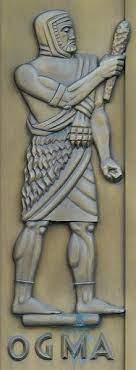
In Irish-Celtic myth, Ogma is the god of eloquence and learning. He is the son of the goddess Danu and the god Dagda, and one of the foremost members of the Tuatha Dé Danann. He is the reputed inventor of the ancient Ogham alphabet which is used in the earliest Irish writings.
In the final battle at Mag Tuireadh he managed to take away the sword of the king of the Fomorians, but had to pay with his life for this feat. His Celtic equivalent is Ogmios.
Ogma or Oghma is a character from Irish mythology. A member of the Tuatha Dé Danann, he is often considered a deity and may be related to the Gaulish god Ogmios.
He fights in the first battle of Mag Tuired, when the Tuatha Dé take Ireland from the Fir Bolg. Under the reign of Bres, when the Tuatha Dé are reduced to servitude, Ogma is forced to carry firewood, but nonetheless is the only one of the Tuatha Dé who proves his athletic and martial prowess in contests before the king. When Bres is overthrown and Nuadu restored, Ogma is his champion. His position is threatened by the arrival of Lugh at the court, so Ogma challenges him by lifting and hurling a great flagstone, which normally required eighty oxen to move it, out of Tara, but Lugh answers the challenge by hurling it back. When Nuadu hands command of the Battle of Mag Tuired to Lugh, Ogma becomes Lugh’s champion, and promises to repel the Fomorian king, Indech, and his bodyguard, and to defeat a third of the enemy. During the battle he finds Orna, the sword of the Fomorian king Tethra, which recounts the deeds done with it when unsheathed. During the battle Ogma and Indech fall in single combat, although there is some confusion in the texts as in Cath Maige Tuired Ogma, Lugh and the Dagda pursue the Fomorians after the battle to recover the harp of Uaitne, the Dagda’s harper.
He often appears as a triad with Lugh and the Dagda, who are sometimes collectively known as the trí dée dána or three gods of skill, although that designation is elsewhere applied to other groups of characters. His father is Elatha and his mother is usually given as Ethliu, sometimes as Étaín. His sons include Delbaeth and Tuireann. He is said to have invented the Ogham alphabet, which is named after him.
Scholars of Celtic mythology have proposed that Ogma represents the vestiges of an ancient Celtic god. By virtue of his battle prowess and invention of Ogham, he is compared with Ogmios, a Gaulish deity associated with eloquence and equated with Herakles. J. A. MacCulloch compares Ogma’s epithet grianainech (sun-face) with Lucian’s description of the “smiling face” of Ogmios, and suggests Ogma’s position as champion of the Tuatha Dé Danann may derive “from the primitive custom of rousing the warriors’ emotions by eloquent speeches before a battle”, although this is hardly supported by the texts. Scholars such Rudolf Thurneysen and Anton van Hamel dispute any link between Ogma and Ogmios.
*
A Proto-Indo-European root *og-mo– ‘furrow, track, incised line’ may be the origin of the stem of the name. In addition, Proto-Celtic had a causative verbal suffix *-ej– ~ *-īj-. A hypothetical Proto-Celtic *Ogm-īj-o-sogm-. This agent noun would therefore mean ‘furrow-maker, incisor’ and may have had a metaphorical sense of ‘impresser.’ therefore looks very much like an agent noun derived from a verb formed by the addition of this causative suffix to the stem *
The Irish god of writing, eloquence and poetry. Ogma was credited of being inventor of the Celtic writing systems that the Druids used for their magic. These scripts were known as Ogham.
Ogma was the son of Dagda and the goddess Danu. Some other writers say that Ogma and Dagda were brothers; in this version they were the sons of Eithne. Ogma had also being called the son of Elatha, the king of the Fomorians.
Ogma was one the seven champions in the First Battle of Moytura (Mag Tuired), but when Bres became the king of Tuatha dé Danann, Ogma was degraded into working on humiliating manual job of gathering firewood.
When Lugh went to Nuada, asking for a place to serve the king, Ogma seemed to be Nuada’s foremost fighter. During the second battle of Moytura, Ogma had killed one of the Fomorian leaders, named Indech, the son of Domnu.
Ogma had married Etain, the daughter of Dian Cécht. Ogma had a son named Caipre. Some say that he was the father of MacCuill, MacCecht and MacGrené (MacGrene), the three Danann kings who ruled Ireland, during the Milesian invasion, though other say that Neit was their father.
To the Celtic Gauls he was called Ogmios. According to both Gallic and Irish myths Ogma was a warrior god, depicted as a wrinkled old man, wearing lion’s skin cloak, carrying a bow and club. The Romans considered Ogmios as the Celtic equivalent of Hercules (Greek Heracles). They also depicting Ogimos as holding people chained to his tongue by their ears, to indicate he was the god of eloquence and poetry.
Forging Your Own Path: My Journey

Author: Bear Stormcrowe
Ever since I was a wee lad, I knew that I had a special relationship with Mother Earth and the elements around me. I always had this magnetic attraction to all things mystical, offbeat, and natural. I remember quite well the times I used to ‘trick’ my parents into buying trees from the Arbor Day Foundation in order to plant them as an homage to Mother Gaia. I would sit outside and plant them, whispering softly to the planet; “Here you go. Thank you for giving us what you give us.”
When my family finally got the Internet, I remember sneaking onto my computer at night; silently hoping the dial-up connection sounds wouldn’t stir my family. It was there that my journey began. I searched earth-based religions high and low…and I came to the realization: I’m a Witch.
I had always been more mature than others of my age group, and since my epiphany I’ve referred to myself as a Natural Witch. I began seriously pursuing the Well-Worn Path soon after that epiphany and started my path as a solitary practitioner in full force. At the time, I was still green on the subject of Witchcraft, even though I was naturally inclined to it; So, I began researching books from the library and following their paths and their beliefs but something didn’t feel quite right. In any religion, a personal means of practicing helps you get that more personal connection with your deity. In my case, it was multiple deities but namely, Lugh and Danu. It was then I realized that I could forge my own path…my own solitary journey.
Since beginning my own personal journey, following the rules of the Wicca, and showing reverence to my amazing deities, I found my connection and my own personal practice. When it came to Sabbats I followed a loosely based outline but added my own flair in the mix, it all worked just the same if not better because all of my mind, body, and spirit were put into my craft. I came “out of the broom closet”, so to speak, to my friends in high school—then to my friends and professors in college.
After much networking and a twist of fate I owe all to the God and Goddess, I met a woman who is now my fiancée and a group of friends with whom I created a small active coven. They were all well seasoned in the Craft already but I found myself answering their questions with a knowledge I had no idea was hiding deep within me. The advice and techniques I offered proved a success and I realized that I had an even deeper calling: High Priestdom. After meeting and discussing the future of the coven, they all agreed unanimously that they felt I would take the high priest position and honor it well.
So, what’s the point of this story? You ask. In my personal experience I’ve found that crafting your own spells and following the path that your heart and soul vibrates well with yields better results. In my case, a closer connection to the deities I’ve aligned myself with.
How do you find your own path? The simplest way to do it is follow your heart. However, if you are unsure of what your heart is telling you here are some simple techniques that have helped me when the answers my heart had given didn’t really satisfy my spirit.
Meditation: Simple two-step meditation works wonders.
The First Step is to open sacred space. This is the brief equivalent of casting a circle. How I open sacred space is by grounding and centering me then I say:
“By the Grace and Power of the Great Ones, Within and Without, I allow love to enter this space, but keep evil and ill intent out.”
Your sacred space is now open. Feel free to change the invocation of positive energies to something of your liking.
The Second Step is to clear your mind of all things but your question at hand. This takes a lot of practice so do this on a day that has been relatively uneventful if at all possible. Clearing your mind and focusing on your own path and what fits just right for your individual Witchiness should yield some result the first few times you try it.
Scrying: Using a scrying mirror or bowl is another way to get some answers. Be prepared to look deep into the mirror/bowl for some time. As with most divination arts, symbols are left to the diviner to interpret so have a notebook and writing utensil (or computer for those tech-savvy Witches) to record the symbols for interpretation after the scrying session. It’s been my experience to wait until the end of the session to interpret symbols and messages because if you take your focus to one symbol, you may miss other important ones. Once you’ve finished scrying, interpret symbols, make connections, and have fun with it.
To end this article, I’d like to say that if you follow a set path founded by someone else and you feel at home in that path, then by all means continue on the path you are most comfortable with. You may get things from different paths in order to forge your own way. That is perfectly acceptable. It’s all what feels right to each individual witch.
I write this article in the light of Lugh and Danu and with love to all of my fellow Pagans and Earth-Children. May bright blessing and prosperity come your way and as always—Blessed Be.
-Adam Osborne (Sacred Magick)
Eclectic Pagan, High Priest, and Lightworker.

WOTC Extra – Ten Questions You Should Be Able to Answer After a Year and A Day
1.) How would you define Witchcraft?
How would you define Wicca?
What would you say if asked? Are you able to discuss the history of the Craft and how Wicca relates to Magick?
2.) Upon what premise does the moral foundation of the Wicca rest?
Do you consider yourself a practitioner of the dark arts or the white- (or light) magickal arts? Why do you think this?
03.) Explain what is meant by divination.
Explain what is meant by the following terms:
aura reading,
palomancy,
crystalomancy,
magick mirror,
runecasting,
Iching?
Have you found a favorite method of divination?
What is this method?
Have you become skilled at this, and how skilled?
Do you consider yourself a Master of the Art?
Are you practicing this form of divination for yourself and others on a regular basis, and if not, why not?
04.) Are you thoroughly familiar with some form of the healing arts?
What do you know about the following:
color or sound therapy,
aromatherapy,
herbal healing?
Which of these have you studied enough to have become quite familiar with the healing art?
Are you a Master of the Art?
Do you intend to become a Master?
Have you begun your hand-written herbal or other log of your healing practice?
05.) Have you accumulated all your magickal tools?
How many of these tools have you made yourself?
What was given to you?
Why did this object become a part of your magickal collection?
Are these tools all consecrated?
Why are they consecrated?
Are you knowledgeable enough about the uses of all these tools to be able to explain their uses to another?
06.) If someone, a friend perhaps, comes to you for help in the following areas, can you help them?
The areas might be love, health, wealth, protection, uncrossing, legal aid, self-help or development.
Could you devise a spell to help him or her? Would you? Why? Why not?
Could you include all the proper correspondences, talismans, stones, crystals, candles?
Would you be able to cast the spell during the correct phase of the Moon, the most auspicious day of the week and hour of the day?
Have you kept accurate records of your magickal work in your Book of Shadows or hand-written Magickal Diary?
If not, why not?
07.) Are you able to explain the Sabbats and Esbats?
Can you perform an impromptu ritual for each?
Have you begun your personal hand-written Book of Shadows?
08.) Are you familiar enough with any of the Pentagram Rituals to explain them to others?
09.) Have you composed at least two complete Sabbat rituals and a full or new Moon ritual, incorporating all the proper correspondences;
astrological timing,
proper god and goddess forms for the particular ritual,
the correct candles,
scents, invocations, etc?
10.) Can you explain why Wicca is important to you -and why you wish to become a Witch and Wiccan?
By Patti Wigington, About.com
It’s Imbolc, and that’s the Sabbat where many Wiccans and Pagans choose to honor the Celtic goddess Brighid, in her many aspects. However, other than having a giant statue of Brighid on your altar, there are a number of ways you can set up for the season. Depending on how much space you have, you can try some or even all of these ideas — obviously, someone using a bookshelf as an altar will have less flexibility than someone using a table, but use what calls to you most.
Traditionally, the colors of red and white are associated with Brighid. The white is the color of the blanket of snow, and the red symbolizes the rising sun. In some traditions, the red is connected with the blood of life. Brighid is also tied to the color green, both for the green mantle she wears and for the life growing beneath the earth. Decorate your altar with a white cloth, and drape a swath of red across it. Add green candles in candleholders.
Altar decor should reflect the theme of the Sabbat. Because Imbolc is a harbinger of spring, any plants that symbolize the new growth are appropriate. Add potted bulbs — don’t worry if they’re blooming yet — and spring flowers such as forsythia, crocus, daffodils, and snowdrops. If you don’t have much luck planting bulbs, think about making a Brighid’s crown as a centerpiece — it combines flowers and candles together.
Brighid is, after all, a goddess of the Celtic peoples, so it’s always appropriate to add some sort of Celtic design to your altar. Consider adding a Brighid’s cross6 or any other item incoporating Celtic knotwork. If you happen to have a Celtic cross, don’t worry about the fact that it’s also a Christian symbol — if it feels right on your altar, go ahead and add it.

So how does a Witch celebrate the Sabbats? Hmm, we always take for granted that each of automatically know what they are suppose to do on our Sabbats. Well, at least I did to recently. I was talking to a dear friend and I asked them how was your Yule. Did you do anything special? The reply was, well we did whatever Pagans are suppose to do, whatever that is! It didn’t dawn on me till a few days later. Perhaps we aren’t doing the job I thought we were doing. I decided to make a commitment to all of you. The commitment is before each Sabbat (over a few days) we will give your morning prayers, rituals, spells, activities, the correspondences and the Deities of that Sabbat. You will have the information to celebrate that Sabbat correctly.
I am very glad that my dear friend made this comment. I believe there are others that might be saying or thinking the same but have never told us. So now, we are going to provide you with everything you need. There will be no more wondering what Pagans/Witches do on the current Sabbats as the Wheel turns.
I hope you enjoy the information. If you ever have any questions or concerns about any issue, please contact us. Because if you don’t contact us, we won’t never know where we are lacking in our service to you.
Lady A & The WOTC
Put in soap or annoint candles
5 drops frankincense
5 drops rosemary
3 drops cinnamon
2 drops sandalwood
Add a piece of rowan and a small hematite, garnet, and clear quartz crystal. A spicy, sunny scent for awakening the earth.
Imbolc can be symbolically represented by a dish of snow, evergreens and/or candles. Ritually, you may choose to light and hold candles (symbol of light) within the Circle. You may also want to place a wheel symbol upon the Altar. It is traditional upon Imbolc, at sunset or just after ritual, to light every lamp in the house — if only for a few moments. Or, light candles in each room in honor of the Sun’s rebirth. Alternately, light a kerosene lamp with a red chimney and place in a prominent part of the home or in a window. If snow lies on the ground, walk in it for a moment, recalling the warmth of Summer. With your projective hand, trace an image of the Sun on the snow. Other Pagan activities may include the gathering of stones and the searching for signs of Spring. It is considered taboo to cut or pick plants at this time.
Imbolc…or As The Wheel Turns
Author: Morbek
As the wheel turns…
Sorry, that was a, now obscure, reference to an old soap opera. Imbolc is tomorrow! The meaning of the word it’s self is “in the milk” or something close to that. The real meaning of Imbolc is that we are beginning to see the changes in the days and that spring will eventually be here!
The promise that we will be able to survive another year and thrive is starting to materialize. When Imbolc was Christianized, it became Candlemas, and is a celebration of light. We have just moved through the darkest part of the year and we are headed for the light.
So, beyond the textbook stuff, let’s look at what this Sabbat means to 21st century people. Since we get our milk and meat from the grocery store and no longer have to plan out how and what we will be eating for more than 24 hours, agrarian celebrations no longer resonate with a clear message or meaning for most of us.
We get up in the morning, go to work, grab lunch…. you know the routine. How or even why do we care if ewes are starting to produce milk? We don’t and it is that simple. But if you think about what the last few months have been like, dark, wet dreary, you can identify with the longing for bright blue skies and nice warm weather. Imbolc reminds us that, in a chaotic world, there are many things we can still predict. Stability is important to us.
This Sabbat is also an opportunity for us to bring ourselves, spiritually, into the light. The “Dark night of our soul” is almost over and we have a chance to reflect about the lessons we’ve learned through the tough times and integrate them into our personal wisdom and offer them to others’ through collective wisdom.
I encourage everyone to recognize that what we’ve gone through is over and we never have to visit those same dark days again. Remember the difficulties, glean the lessons learned and then let go of the pain and fear. There is no way to move forward into perfect love and perfect trust if you are clinging onto fear or emotional pain. Imbolc presents an occasion to learn and let go!
Humans are obsessed with marking time. Months, years, decades, centuries, are important mental markers. They Mayan people were so obsessed with time keeping that they wrote a calendar for the past as well as the future. I think our obsession is, in part, a need to compare our personal growth. We need mental cairn to see “from whence we came’.
So, where was I 10 years ago? Living in Pony, MT!
I was secretly wishing that the world would go to hell in a hand basket because of Y2K but I knew it wouldn’t because some pretty smart people who caused that little glitch, were still around to fix that little glitch. I was dealing w/that lovely inner ear/vertigo issue that I have called Meniers’ disease for the first time! I was scared because I had no spirituality and I was on the run from a stalker (hence, why I was in Pony (middle of no where) Montana) .
Where am I now? In Killeen, TX!
The world did go to hell in a hand basket but it had nothing to do with a computer glitch.
I still have the Meniers disease but it’s under control with medication. I have a spiritual system that works especially well for me so I am no longer afraid. And I have taken a stand against the stalker (yes…. 10 years later. He is still at it) .
Imbolc 2010 has presented me with an inner reflection opportunity. Having just attended the Army’s “Spiritual Fitness Summit” with some really smart, spiritual and powerful chaplains, I discovered what has kept most of us from being open to acceptance of other religious systems is fear.
Once I started talking while we were working in our small groups to set the U.S. Army’s definition of spirituality, everyone began to relax. I am guessing that they figured out that I wasn’t going to sacrifice anything in the middle of the room!!! Then this group of men did something I did not expect them to do…they listened to me! Balance will now be included in the definition of healthy spirituality as well as the recognition of nontraditional religions, either formal or informal!
What should be addressed here isn’t “wow, look at the good stuff I’ve done. Yay me!”
I want to look at the road that it took to get to where I am. I want to remember the lessons that I learned on that road (which was full of pot holes and always a construction zone) and i want to, somehow, help others to see that life is a good place to be when you are living in the moment!
I have always felt a call to serve others. Even when I was much younger and being self-centered, spoiled and without a clue what Personal Responsibility, Compassion and Unconditional love meant. I thought that I was too fat for the military so serving there was not going to work and I needed to be doing something that earned money. I wanted to raise children, so the convent was out! Besides….I like sex way too much to give that up for the god of Abraham! What to do? I was stuck at 20…then, along came my eldest child and, thankfully, my (still) best friend, Tara.
Yes, I know…I went back MUCH further than 10 years, stay with me here.
Because of my choice to become a mother, I learned responsibility and because of my oldest daughters’ network of friends (thanks Mark…I owe you one for this lesson) I learned personal responsibility and compassion.
Tara stood by me through all of my thoughtlessness, insults, screw-ups and selfishness. Tara was there for all times, the good and the horrible. Tara taught me that you could love the person but not their actions. She taught me that you love without conditions and you love freely without expectations of being loved back. Because of Tara, I learned unconditional love.
So, what am I doing with all of these lessons? I am making an attempt to teach them to others in a gentler manner than I learned them. I am leading, as best I can, by example. I have been smart enough to form friendships with deep connections with people who will call me on my bullsh*t so that I can do it while not giving all of myself while serving others…or so that I can do it and not be a hypocrite by doing it for my ego.
November 5th is the day my father died when i was 15. November 5th two thousand and nine is the day that I found my feet. It is the day that I honestly answered that call to serve others. THAT is another article for a later time.
Blessed Imbolc, be fearless and loving!
By Patti Wigington, About.com
Imbolc is a time when the Wheel of the Year has reached a crossroads between light and dark. The earth is about to quicken, and yet no one knows exactly what lies ahead of us. There are twists and turns on the path to come, although where it leads is anyone’s guess.
Among her many aspects, Brighid is considered a goddess of the crossroads. She is said to be able to see where we’ve been, and where each road might take us, should we choose to follow it. A Brighid’s Cross unites the four elements, and creates paths which travel in the four directions. Because of this, Imbolc is an ideal time for divination. Not sure where your headed this year, or what choices lie before you? Let Brighid help guide you as you weave a crossroads of your own in her honor. As you create a Brighid’s Cross as part of this divination, ask her to inspire you, and guide you towards the right path in the coming months.
For this divination, you’ll want to find a place where you can be alone and undisturbed. If it’s warm enough, try to get outside, perhaps out in the woods where two paths intersect. Before you begin, read the instructions here on how to Make a Brighid’s Cross. Have all your supplies on hand prior to beginning your divination ritual.
Begin by closing your eyes, and thinking about where you’ve been in the past year, spiritually, emotionally, even physically. What things have you done that bring your regret? What things have brought you joy? Is there anything you wanted to do, but didn’t get a chance to? Picture yourself wandering along a path, out of the past and into the present. Let your mind roam freely, and visualize yourself approaching a crossroads. Perhaps it’s a place in a forest, where a pair of deer trails run together. Maybe it’s in the mountains, where streams intersect. Or maybe you picture yourself out in a wide open space, with roads connected in the middle of nowhere.
Regardless, see yourself at that crossroads. You are at the center, and branching out from where you stand are many paths. Each leads in a different direction. Each path will take you to something new. Begin creating your Make a Brighid’s Cross, and as you weave the straws together, think about what may lie in each direction. As you look out over your choices, thinking about which way to travel, Brighid herself is standing beside you. Continue weaving your cross, and watch her. She points out one of the roads.
When you’ve finished your cross, close your eyes once more, and meditate on the path which Brighid indicated for you. What lies in that direction? Is it something familiar and comforting? Something new and unknown? Focus on the cross you’ve made, and let this newly chosen path inspire you. Know that it will ultimately bring you to something good and positive and strong.
When you’ve finished, you may wish to make an offering to Brighid as a gesture of thanks for her guidance.
Though the whole idea of doing resolutions for New Year is not a Pagan tradition at all, that doesn’t mean we don’t all try to manage few each year. So why not try some Pagan New Year’s resolutions this time?
Attend a Festival
This is a particularly important resolution if you are typically a solitary type of Pagan who doesn’t get to be social in their path very often. Do a little research and find a good Pagan festival that is taking place close enough to where you live and make plans to go. It could be a 1-day gathering or a week-long extravaganza. If you have never gone to a Pagan festival, you might want to try a shorter one to get your feet wet. Gatherings that take a few days usually mean you’ll be doing some camping. These are great for meeting new people and doing some networking in the larger community.
Make a New Altar Tool
Unless you already have an altar full of wonderful home-made goodies, you should try to make at least one new tool for yourself this year. That doesn’t mean you have to master blacksmithing so you can create a metal-worked athame or buy a kiln to craft a ceramic goblet. Use what crafty skills you have and use some basic supplies to create something new. Wands are actually quite easy, and candle-making supplies are common enough in craft stores. Decorate a notebook for a new Book of Shadows or go an extra mile to design a personalized Tarot deck. Work with what you have and make creative magick.
Explore a New Path
Now this doesn’t mean that there is anything wrong with your current path or that you have to change your beliefs in any way. But it never hurts to branch out or to see things in a new way occasionally. Do a little study into a path that is different from yours and see what’s different. Read some books or websites, or even try to take part in a meeting, circle or other gathering if you can find a local group. Of course, make arrangements before you just show up so they know why you’re there. You certainly don’t have to change anything about your own practice but this branching out can help breathe some fresh air into your own beliefs.
Make some Deity Time
This may not apply to everyone, depending on your current practice and understanding of the Divine. But many people are so busy these days that quiet time with a God or Goddess can easily be overlooked. It doesn’t have to be daily (though that would be nice), but you should be able to find some time each week for some kind of spiritual pursuits. Meditation or ritual should do just fine.
Non-Pagan Ideas
Well, these are kind of Pagan and I thought they would round out my list nicely. You can make a tribute to Mother Earth by spending some time outdoors helping to pick up litter or trash, or you could find a cause that fits your Pagan ideals and do some other types of volunteering (maybe an animal shelter). It doesn’t have to be a local cause either. Get involved with some online activism to help promote ideas you are passionate about.
There are some ideas to get you started. You don’t have to do all of them, but maybe one or two will peak your interest for the upcoming year.
Ezine Articles
Author: By Terri Paajanen, About.com

We are of the Old Ways, among those who walk with the Goddess and God and
receive Their love.
Keep the Sabbats and Esbats to the best of your abilities, for to do otherwise
is to lessen your connection with the Goddess and God.
Harm none. This, the oldest law, is not open to interpretation or change.
Shed not blood in ritual; the Goddess and God need not blood to be duly
worshipped.
Those of our ways are kind to all creatures, for hurtful thoughts are quiet
draining and aren’t worth the loss of energy.
Misery is self-created; so, too, is joy, so create joy and disdain misery and
unhappiness. And this is within your power. So harm not.
Teach only what you know, to the best of your ability, to those students who
you choose, but teach not to those who would use your instructions for
destruction or control. Also, teach not to boost pride, forever remember: She
who teaches out of love shall be enfolded in the arms of the Goddess and God.
Ever remember that if you would be of our way, keep the law close to your
heart, for it is the nature of the Wicca to keep the Law.
If ever the need arises, any law may be changed or discarded, and new laws
written to replace them, so long as the new laws don’t break the oldest law of
all: Harm None.
Blessings of the Goddess and God on us all.
(* Wicca – S. Cunningham)


You must be logged in to post a comment.