June 20 and 21, 2024 Current Moon Phase for the Northern and Southern Hemispheres

Source: nineplanets.org
Northern Hemisphere

June 20, 2024

The current moon phase for today is the Waxing Gibbous phase.

On this day, the moon is 13.33 days old and 94.35% illuminated with a tilt of 130.633°. The approximate distance from Earth to the moon is 389,913.44 km and the moon sign is Sagittarius.

The Moon phase for today is a Waxing Gibbous phase. This is the phase where the moon is more than 50% illuminated but has not yet reached 100% illumination (which would be a Full Moon).

In the Northern Hemisphere, the right side will be illuminated, and in the Southern hemisphere it’ll be the left side that is illuminated.

The Waxing Gibbous phase, like all moon phases, will last for just over 7 days. The actual length will vary because of the elliptical shaped orbit of the moon. During this Waxing Gibbous phase the moon will rise in the east in the mid- to late-afternoon and will be high in the eastern sky at sunset.

Assuming it’s a clear night, the Waxing Gibbous moon will then be visible through most of the night before setting just before sunrise.

Fun fact: the word Gibbous was first used in the 14th century and comes from the latin word gibbosus which means humpbacked.

Phase Details

Phase: Waxing Gibbous

Moon age: 13.33 days

Moon illumination: 94.35%

Moon tilt: 130.633°

Moon angle: 0.51

Moon distance: 389,913.44 km

Moon sign: Sagittarius

Southern Hemisphere

21 June 2024

The current moon phase for June 21st, 2024 is the Waxing Gibbous phase.

On this day, the moon is 14.37 days old and 98.3% illuminated with a tilt of 115.368°. The approximate distance from Earth to the moon is 385,297.81 km and the moon sign is Sagittarius.

The Moon phase for June 21st, 2024 is a Waxing Gibbous phase. This is the phase where the moon is more than 50% illuminated but has not yet reached 100% illumination (which would be a Full Moon).

In the Northern Hemisphere, the right side will be illuminated, and in the Southern hemisphere it’ll be the left side that is illuminated.

The Waxing Gibbous phase, like all moon phases, will last for just over 7 days. The actual length will vary because of the elliptical shaped orbit of the moon. During this Waxing Gibbous phase the moon will rise in the east in the mid- to late-afternoon and will be high in the eastern sky at sunset.

Assuming it’s a clear night, the Waxing Gibbous moon will then be visible through most of the night before setting just before sunrise.

Fun fact: the word Gibbous was first used in the 14th century and comes from the latin word gibbosus which means humpbacked.

Phase Details

Phase: Waxing Gibbous

Moon age: 14.37 days

Moon illumination: 98.3%

Moon tilt: 115.368°

Moon angle: 0.52

Moon distance: 385,297.81 km

Moon sign: Sagittarius

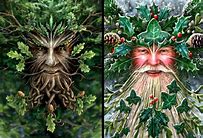
The Holly King and The Oak King

The legend of the Holly King and the Oak King is oft referred to as we approach Yule and start decking the halls with boughs of holly, but what is it all about and where does the story come from?

There are two main versions of the story, each with slightly different characters. In one, the Oak King is a figure similar to the Green Man; a summer God of warm smiles and broad green leaves, while the Holly King is a similarly benign and jolly chap dressed in red and with holly tangled in his long white beard (sound familiar?), associated with winter. He even rides a sleigh pulled by deer. This version has its roots in Wiccan belief, and tells of two battling kings; the Holly King reigns the waning year and is defeated at the Winter Solstice by the Oak King, who then reigns the waxing year in turn until he is defeated at the Summer Solstice by the Holly King, and so on ad infinitum.

The second version of the story has older roots in European witchcraft traditions, and as with so much goes back …

Click here to read the rest of this article

13 Fascinating Winter Solstice Traditions Around the World

Just when you think December has enough to celebrate between ChristmasHanukkahKwanzaa, and the impending New Year, there’s yet another reason to gather with your loved ones and celebrate: the winter solstice. You might be more familiar with the winter solstice as the day with the shortest amount of sunlight. But around the world, many cultures still celebrate the longest night of the year with unique winter solstice traditions. Read on to find out what they are. Then learn when the winter solstice is this year and what the 2021 winter solstice means for your zodiac.

Winter solstice traditions: Saint Lucia Day, Scandinavia

As with many modern celebrations, ancient festivals observing the winter solstice merged with newer traditions to create the holiday season as we know it today. In Scandinavia…

Click here to read the rest of this article

Difference Between the Winter and Summer Solstices?

To understand the difference between summer and winter solstices, we need to have a clear understanding of the word solstice. We know that earth revolves around sun in an elliptical orbit, but it also spins around its own axis. This is an imaginary line going right across the planet from North Pole to South Pole. Fortunately for our planet, this axis is not perpendicular but tilted about 23.5 degrees and it is this tilt that gives us seasons on earth. This tilt makes one half of earth receive more direct rays from sun than the other half which remains away from earth.

The axis, when it tilts towards the sun, it makes northern hemisphere receive more direct rays from the sun than southern hemisphere. This phenomenon occurs between June and September and thus this is the period when it is summer season in the northern hemisphere. Again, this axis tilts away from the sun between December and March which is why we have winter season in the northern hemisphere during this period. While it is summers in northern hemisphere as it receives more direct rays from the sun, it is winter in the southern hemisphere, and vice versa in winters.

To read the rest of this article from differencebetween.com

Summer Solstice: The Meaning and History Behind the First Day of Summer

The summer solstice sets off the official start of summer as the Northern Hemisphere angles itself at the point in its orbit closest to the sun, causing the longest day and shortest night of the calendar year.

Many cultures, both ancient and modern, celebrate the sunlight with rituals and holidays.

What is the summer solstice?

The term solstice comes from the Latin words “sol” (sun) and “stitium” (still or stopped). It is used to describe the exact moment when the poles are tilted at their maximum toward or away from the sun.

The summer solstice occurs when the sun is directly above the Tropic of Cancer, which is the circle marking the latitude 23.5 degrees north, and which runs through …

Click here to read the rest of this article

5,400-year-old Tomb Discovered in Spain Perfectly Captures the Summer Solstice

Archaeologists have discovered a 5,400-year-old stone tomb beside a prominent lone mountain in southern Spain, indicating it was a local focus for the prehistoric people of the region.

The area, in the countryside near the city of Antequera, is renowned for its megaliths — prehistoric monuments made from large stones — and the newly found tomb seems to solve one of the mysteries of their alignment.

The tomb was designed to funnel light from the rising midsummer sun into a chamber deep within — much like the contemporary megalithic tomb built more than 1,000 miles (1,600 kilometers) away at Newgrange in Ireland, suggesting both places shared similar beliefs about the afterlife more than 5,000 years ago.

“Newgrange is much bigger and more complex than the tomb we have discovered [in Spain], but they have something in common — the interest of the builders to use sunlight at a specific time of the year, to produce a symbolic — possibly magic — effect,” Leonardo García Sanjuán, an archaeologist at the University of Seville, told Live Science. 

Click here to read the rest of this article

Some of the Witchcraft/Magickal Correspondence and More for the Summer Solstice/Litha

Summer Solstice/Litha from thepeculiarbrunette.com

Each season and celebration has its vibe and energy, and Litha and the Summer Solstice are no different! It’s got a punch of power and symbolism, and all we need to do is slow down and observe what Nature is showing us.

Please note that I make every effort to ensure this information is correct and accurate through my own experiences and referencing sources throughout AND at the bottom of this article.

Posts on this site may contain affiliate links that allow me to earn a small commission from your purchases (at no extra cost to you!)

Many Pagans, Witches, and those interested in Nature Spirituality celebrate the seasonal cycles. Sometimes referred to as the Wheel of the Year, and consisting of eight celebrations. Four of these festivals (ImbolcBeltaneLughnasadh, and Samhain) are rooted in Celtic history and origins.

The other four (Spring Equinox, Summer Solstice, Autumn Equinox, and Winter Solstice) represent the sun’s location. I created a complete guide to each season, including history, traditions, symbols, correspondences, ritual ideas, and how you can celebrate.