A Pagan Saturday c. 2016

gothic fantasy

A Pagan Saturday

Saturday is the day of the week between Friday and Sunday. It is the either the sixth or seventh day of the week as discussed below. Jews and many Christians believe that God established the 7-day weekly cycle at Creation as related in the Book of Genesis chapters 1 and 2.

Origins of the name
It was named no later than the second century for the planet (Saturn), which controlled the first hour of that day according to Vettius Valens. The planet was named for the Roman god of agriculture Saturn. It has been called dies Saturni (“Saturn’s Day”), through which from it entered into Old English as Sæternesdæg and gradually evolved into the word “Saturday”.

Saturday is the only day of the week in which the English name comes from Roman mythology. The English names of all of the other days of the week come from Germanic mythology. In India, Saturday is Shanivar, based on Shani, the Vedic God manifested in the planet Saturn. In the Thai solar calendar of Thailand, the day is named from the Pali word for Saturn, and the color associated with Saturday is purple. The Celtic languages also name this day for Saturn: Irish an Satharn or dia Sathuirn, Scottish Gaelic Disathairne, Welsh dydd Sadwrn, Breton disadorn.

In Jewish tradition Saturday is the Shabbat. Christianity adopted this tradition in terms of the Sabbath. Thus, in many languages the Saturday is named after the Sabbath. Eastern Orthodox churches distinguish between the Sabbath (Saturday) and the Lord’s Day (Sunday). Roman Catholics put so little emphasis on that distinction that many among them follow – at least in colloquial language – the Protestant practice of calling Sunday the sabbath (see Sabbath in Christianity). Quakers traditionally refer to Saturday as “Seventh Day” eschewing the “pagan” origin of the name. In Islamic countries, Fridays are holidays, however they are considered as the sixth day of the week.

In the Eastern Orthodox Church Saturdays are days on which the Theotokos (Mother of God) and All Saints are commemorated, The day is also a general day of prayer for the dead, because it was on a Saturday that Jesus lay dead in the tomb. The Octoechos contains hyms on these themes, arranged in an eight-week cycle, that are chanted on Saturdays throughout the year. At the end of services on Saturday, the dismissal begins with the words: “May Christ our True God, through the intercessions of his most-pure Mother, of the holy, glorious and right victorious Martyrs, of our reverend and God-bearing Fathers…”. For the Orthodox, Saturday is never a strict fast day. When a Saturday falls during one of the fasting seasons (Great Lent, Nativity Fast, Apostles’ Fast, Dormition Fast) the fasting rules are always lessened to an extent. The Great Feast of the Exaltation of the Cross and the Beheading of St. John the Baptist are normally observed as strict fast days, but if they fall on a Saturday or Sunday, the fast is lessened.

In Scandinavian countries, Saturday is called Lördag or Löverdag etc., the name being derived from the old word laugr (hence Icelandic name Laugardagur), meaning bath, thus Lördag equates to bath-day. This is due to the Viking usage of bathing on Saturdays.

Today, Saturday is officially called Samstag in all German-speaking countries, however, there are two names for this day in modern Standard German. Samstag is always used in Austria, Liechtenstein, the German speaking part of Switzerland and generally used in southern and western Germany. It derives from Old High German sambaztac, which itself derives from Greek Σάββατο, and this Greek word derives from Hebrew שבת (Shabbat). However, the current German word for sabbath is Sabbat. The second name for Saturday in German is Sonnabend, which derives from Old High German sunnunaband, and is closely related to the Old English word sunnanæfen. It means literally “Sun eve”, i.e. “The day before Sunday”. Sonnabend is generally used in northern and eastern Germany, and was also the official name for Saturday in East Germany. In the Westphalian dialects of Low Saxon, in East Frisian Low Saxon and in the Saterland Frisian language, Saturday is called Satertag, also akin to Dutch Zaterdag, which has the same linguistic roots as the English word Saturday.

Similarly, the Romance languages follow the Greek usage, so that their word for “Saturday” is also a variation on “Sabbath”: the Italian is sabato, the French is samedi, the Spanish and Portuguese is sábado and the Romanian is sâmbătă.

The modern Maori name for it, Rahoroi, means “washing-day”. For other languages, see Days of the week Planetary table.

Position in the week
The three Abrahamic religions, via their original languages, regard Saturday as the seventh day of the week (Judaism via Hebrew, Christianity via Ecclesiastical Latin, and Islam via Arabic) by naming Monday, Tuesday, Wednesday, and Thursday as the second through fifth days of the week. This is concordant with the European Pagan tradition, which named the days of the week after the seven Classical planets (in order Sun, Moon, Mars, Mercury, Jupiter, Venus, Saturn), naming the first day of the week for the Sun, perceived as most important, and moving to those perceived as lesser.

The Slavic languages of Eastern Europe regard Saturday as the sixth day of the week by naming Tuesday, Thursday, and Friday as the second, fourth, and fifth days of the week, although their name for Wednesday, middle, would imply that Saturday is the seventh day of the week.

Beginning in the twentieth century, many Europeans have considered Saturday the sixth (penultimate) day of the week, and Sunday the last[citation needed]. This current European labour-oriented convention has been formalized by ISO 8601 which is used by businesses such as airlines in drawing up timetables, etc

Source

The Pagan Calendar


Goddess of the Day – Blodeuwedd

Blodeuwedd


Blodeuwedd was created out of flowers by Gwydion to wed Llew Llaw Gyffes. She betrayed Llew, either because she had no soul, being non-human, or because she resented being his chattel, or because the triplet of one woman and two men must play itself out in Welsh myth, and Llew Llaw Gyffes must die. At any rate, she fell in love with Goronwy and, wishing to be rid of Llew, she tricked out of him the clearly supernatural and ritual manner in which only he could be killed: neither by day nor night, indoors nor out of doors, riding nor walking, clothed nor naked, nor by any weapon lawfully made. She asked him to explain this, and he did: he could be killed only if it were twilight, wrapped in a fish net, with one foot on a cauldron and the other on a goat, and if the weapon had been forged during sacred hours when such work was forbidden. Blodeuwedd convinced him to demonstrate how impossible such a position was to achieve by chance, and when he was in it, het lover Goronwy leapt out and struck. Llew was transformed into an eagle and eventually restored to human form, after which he killed Goronwy. Blodeuwedd was transformed into an owl, to haunt the night in loneliness and sorrow, shunned by all other birds.

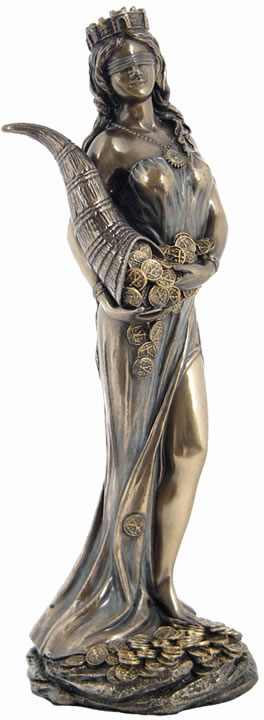
Goddess of the Day – Fortuna

Fortuna


From Wikipedia, the free encyclopedia

Fortuna (equivalent to the Greek goddess Tyche) was the goddess of fortune and personification of luck in Roman religion. She might bring good luck or bad: she could be represented as veiled and blind, as in modern depictions of Justice, and came to represent life’s capriciousness. She was also a goddess of fate: as Atrox Fortuna, she claimed the young lives of the princeps Augustus’ grandsons Gaius and Lucius, prospective heirs to the Empire.

Her father was said to be Jupiter and like him, she could also be bountiful (Copia). As Annonaria she protected grain supplies. June 11 was sacred to her: on June 24 she was given cult at the festival of Fors Fortuna.

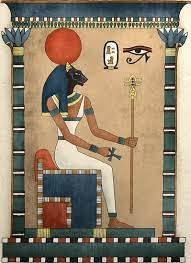
Goddess of the Day – Bast


Bast

In Egyptian mythology, Bast (also spelled Ubasti, Baset, and later Bastet) is an ancient solar and war goddess, worshipped at least since the Second Dynasty. In the late dynasties, the priests of Amun began to call her Bastet, a repetitive and diminutive form after her role in the pantheon became diminished as Sekhmet, a similar lioness war deity, became more dominant in the unified culture of Lower and Upper Egypt. In the Middle Kingdom, the cat appeared as Bastet’s sacred animal and after the New Kingdom she was depicted with a woman with a cat’s head carrying a sacred rattle and a box or basket.

Bast or Bastet was the cat goddess and local deity of the town of Bubastis or Per-Bast in Egyptian, where her cult was centered. Bubastis was named after her. Originally she was viewed as the protector goddess of Lower Egypt, and consequently depicted as a fierce lioness. Indeed, her name means (female) devourer. As protector, she was seen as defender of the pharaoh, and consequently of the later chief male deity, Ra, who was a solar deity also, gaining her the titles Lady of Flame and Eye of Ra.

The goddess Bast was sometimes depicted holding a ceremonial sistrum in one hand and an aegis in the other – the aegis usually resembling a collar or gorget embellished with a lioness head.

Bast was a goddess of the sun throughout most of Ancient Egyptian history, but later when she was changed into a cat goddess rather than a lion, she was changed to a goddess of the moon by Greeks occupying Ancient Egypt toward the end of its civilization. In Greek mythology, Bast is also known as Aelurus.

History and Connection to Other HodsDue to the threat to the food supply that could be caused by simple vermin such as mice and rats, and their ability to fight and kill snakes, especially cobras, cats in Egypt were revered highly, sometimes being given golden jewellery to wear and were allowed to eat from the same plates as their owners. Consequently, later as the main cat (rather than lioness) deity, Bastet was strongly revered as the patron of cats, and thus it was in the temple at Per-Bast that cats were buried and mummified.

When the owner died they would put the owner next to the mummified cat. More than 300,000 mummified cats were discovered when Bast’s temple at Per-Bast was excavated. Herodotus writes that when a cat in the family dies, Egyptians shaved their eyebrows and took the body to Bubastis to be embalmed.

As a cat or lioness war goddess, and protector of the lands, when, during the New Kingdom, the fierce lion god Maahes of Nubia became part of Egyptian mythology, she was identified, in the Lower Kingdom, as his mother. This paralleled the identification of the fierce lioness war goddess Sekhmet, as his mother in the Upper Kingdom.

As divine mother, and more especially as protector, for Lower Egypt, she became strongly associated with Wadjet, the patron goddess of Lower Egypt, eventually becoming Wadjet-Bast, paralleling the similar pair of patron (Nekhbet) and lioness protector (Sekhmet) for Upper Egypt. Bastet was the daughter of Amun Ra.

Later PerceptionLater scribes sometimes renamed her Bastet, a variation on Bast consisting of an additional feminine suffix to the one already present, thought to have been added to emphasize pronunciation; but perhaps it is a diminutive name applied as she receded in the ascendancy of Sekhmet in the Egyptian pantheon. Since Bastet literally meant, (female) of the ointment jar, Bast gradually became regarded as the goddess of perfumes, earning the title perfumed protector. In connection with this, when Anubis became the god of embalming, Bast, as goddess of ointment, came to be regarded as his wife. The association of Bastet as mother of Anubis, was broken years later when Anubis became Nephthys’ son.

Egypt’s loss in the wars between Upper and Lower Egypt led to a decrease in her ferocity. Thus, by the Middle Kingdom she came to be regarded as a domestic cat rather than a lioness. Occasionally, however, she was depicted holding a lioness mask, hinting at potential ferocity. Because domestic cats tend to be tender and protective of their offspring, Bast was also regarded as a good mother, and she was sometimes depicted with numerous kittens. Consequently, a woman who wanted children sometimes wore an amulet showing the goddess with kittens, the number of which indicated her own desired number of children.

Eventually, her position as patron and protector of Lower Egypt led to her being identified with the more substantial goddess Mut, whose cult had risen to power with that of Amun, and eventually being syncretized with her as Mut-Wadjet-Bast. Shortly after, Mut also absorbed the identities of the Sekhmet-Nekhbet pairing as well.

This merging of identities of similar goddesses has led to considerable confusion, leading to some attributing to Bastet the title Mistress of the Sistrum (more properly belonging to Hathor, who had become thought of as an aspect of the later emerging Isis, as had Mut), and the Greek idea of her as a lunar goddess (more properly an attribute of Mut) rather than the solar deity she was. Indeed, much of this confusion occurred with subsequent generations; the identities slowly merged among the Greeks during their occupation of Egypt, who sometimes named her Ailuros (Greek for cat), thinking of Bastet as a version of Artemis, their own moon goddess.Thus, to fit their own cosmology, to the Greeks Bastet is thought of as the sister of Horus, whom they identified as Apollo (Artemis’ brother), and consequently, the daughter of the later emerging deities, Isis and Ra.

The worship of the Goddess Bast continues today through Khemetic reconstructionalist religions, there are several ‘Bast Cults’ some of which may be found online and as such, technically, predates most Religions. In current day it is very common for Bast to be seen as a fertility goddess or even a goddess of lesbianism, despite the fact that research on her actual functions within the Egyptian pantheon is so very easy.

From Crystalinks.com

Goddess of the Day – Demeter

Demeter

The goddess of agriculture, horticulture, grain and harvest. Demeter is a daughter of Cronus and Rhea and sister of Zeus, by whom she bore Persephone. She was depicted as a mature woman, often crowned and holding sheaf’s of wheat and a torch. Her symbols are the Cornucopia (horn of plenty), wheat-ears, the winged serpent and the lotus staff. Her sacred animals are pigs and snakes.

Goddess of the Day – The Moirae

Goddess of the Day – The Moirae

 
The Moirae, also known as the Fates
“O Fates of Life, I ask your aid.
To clear my path and set me free.”
(Prayer to the Fates)
 

The Greek Goddess of Fate is a daughter of Nyx, Goddess of the Night. In Her singular form, the Goddess of Fate is called Moira; and in Her triple form She becomes three sisters known as the Moirae. The Moirae are: Klotho the Spinner, who spins the thread of a person’s life; Lachesis the Measurer, who decides how much time is to be allowed each person, and Atropos the Cutter, who cuts the thread when you are supposed to die. The name ‘Moira’ actually means ‘part‘ and in fact, the triple form of the Fates mimics the triple moon phases and the three phases of life – maiden, mother and crone. Moira is known to the Romans as Fortuna, to the Scandinavians as Norns, to the Anglo-Saxons as Wyrd, and to the Celts as Morrigan. During the middle ages, the Fates became known as the Parcae.

As the spinner of Fate, Moira spins out the days of our lives as yarn and weaves it into a tapestry. The length of the yarn – hence your life span – is decided solely by the Goddess of Fate. All the Gods are subject to the whims of the Fates as are mortal man. Because of this, even though the other Gods are almighty, and supposedly immortal, even Hera has reason to fear Moira. Moira’s function is to see that the natural order of things is respected and She possesses the gift of prophecy – Her priests and priestesses are always oracles or soothsayers (seers of the future). Moira is often accompanied by the Keres (Dogs of Hades), who are three beings with sharp teeth and who are robed in red. In ancient times, the Fates were honored by sacrifices of honey and flowers.

Moira is associated with December’s full moon – which is often called the Cold Moon or the Wolf Moon. The colors of Moira are red, black and white.

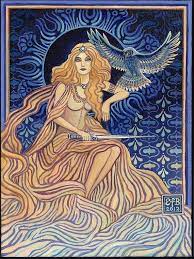
Goddess of The Day – Minerva

Goddess of The Day: MINERVA

Terminalia (Rome)

Themes: Earth; Home 0

Symbols: Owl; Geranium

About Minerva: This Etruscan/Italic Goddess blended the odd attributes of being a patroness of household tasks, including arts and crafts, and also being the patroness of protection and of war. Today she joins in pre-spring festivities by helping people prepare their lands for sowing and embracing the figurative lands of our hearts, homes, and spirits with her positive energy.

To Do Today: In ancient times, this was a day to bless one’s lands and borders. Gifts of corn, honey, and wine were given to the earth and its spirits to keep the property safe and fertile throughout the year. In modern times, this equates to a Minerva-centered house blessing.

Begin by putting on some spiritually uplifting music. Burn geranium-scented incense if possible; otherwise, any pantry spice will do. Take this into every room of your home, always moving clockwise to promote positive growing energy. As you get to each room, repeat this incantation:

Minerva, protect this sacred space and all who live within. By your power and my will, the magic now begins!

Wear a geranium today to commemorate Minerva and welcome her energy into your life.

)0(

By Patricia Telesco and GrannyMoon’s Morning Feast Archives

Not A Deity of the Day But One of My Favorite Celtic Women In History…. c. 2015

(Side Note from Lady Beltane – I want to grow up to be like this astounding woman)

Boudica, Battle of Watling Street by Roman Lappat · Putty&Paint

Boudica

Boudica (/ˈbuːdɨkə/; alternative spelling: Boudicca, also known as Boadicea /boʊdɨˈsiːə/ and in Welsh as Buddug [ˈbɨ̞ðɨ̞ɡ]) (d. AD 60 or 61) was a queen of the British Iceni tribe who led an uprising against the occupying forces of the Roman Empire.

Boudica’s husband Prasutagus ruled as a nominally independent ally of Rome and left his kingdom jointly to his daughters and the Roman emperor in his will. However, when he died, his will was ignored and the kingdom was annexed. Boudica was flogged, her daughters raped, and Roman financiers called in their loans.

In AD 60 or 61, when the Roman governor Gaius Suetonius Paulinus was campaigning on the island of Anglesey off the northwest coast of Wales, Boudica led the Iceni, the Trinovantes and others in revolt. They destroyed Camulodunum (modern Colchester), earlier the capital of the Trinovantes but at that time a colonia, a settlement for discharged Roman soldiers, and site of a temple to the former Emperor Claudius. Upon hearing of the revolt, Suetonius hurried to Londinium (modern London), the twenty-year-old commercial settlement that was the rebels’ next target.

The Romans, having concluded that they did not have the numbers to defend the settlement, evacuated and abandoned Londinium. Boudica led 100,000 Iceni, Trinovantes and others to fight Legio IX Hispana and burned and destroyed Londinium, and Verulamium (modern-day St Albans). An estimated 70,000–80,000 Romans and British were killed in the three cities by those led by Boudica. Suetonius, meanwhile, regrouped his forces in the West Midlands, and despite being heavily outnumbered, defeated the Britons in the Battle of Watling Street.

The crisis caused the Emperor Nero to consider withdrawing all Roman forces from Britain, but Suetonius’s eventual victory over Boudica confirmed Roman control of the province. Boudica then either killed herself so she would not be captured, or fell ill and died. The extant sources, Tacitus and Cassius Dio, differ.

Interest in these events revived in the English Renaissance and led to Boudica’s fame in the Victorian era. Boudica has remained an important cultural symbol in the United Kingdom. However, the absence of native British literature during the early part of the first millennium means that knowledge of Boudica’s rebellion comes solely from the writings of the Romans

History

Boudica’s name

Boudica has been known by several versions of her name. Raphael Holinshed calls her Voadicia, while Edmund Spenser calls her Bunduca, a version of the name that was used in the popular Jacobean play Bonduca, in 1612. William Cowper’s poem, Boadicea, an ode (1782) popularised an alternate version of the name. From the 19th century and much of the late 20th century, Boadicea was the most common version of the name, which is probably derived from a mistranscription when a manuscript of Tacitus was copied in the Middle Ages.

Her name was clearly spelled Boudicca in the best manuscripts of Tacitus, but also Βουδουικα, Βουνδουικα, and Βοδουικα in the (later and probably secondary) epitome of Cassius Dio. The name is attested in inscriptions as “Boudica” in Lusitania, Boudiga in Bordeaux, and Bodicca in Algeria.

Kenneth Jackson concludes, based on later development of Welsh and Irish, that the name derives from the Proto-Celtic feminine adjective *boudīka, “victorious”, that in turn is derived from the Celtic word *bouda, “victory” (cf. Irish bua (Classical Irish buadh), Buaidheach, Welsh buddugoliaeth), and that the correct spelling of the name in the British language is Boudica, pronounced [bɒʊˈdiːkaː].

The closest English equivalent to the vowel in the first syllable is the ow in “bow-and-arrow”. The modern English pronunciation is /ˈbuːdɪkə/, and it has been suggested that the most comparable English name, in meaning only, would be “Victoria”.

Background

Location of Iceni territory within England, Wales and Mann; modern county borders for England and pre-1996 borders for Wales are shown for context.

Tacitus and Dio agree that Boudica was of royal descent. Dio describes her as “possessed of greater intelligence than often belongs to women.” He also describes her as tall, with tawny hair hanging down to below her waist, a harsh voice and a piercing glare. He notes that she habitually wore a large golden necklace (perhaps a torc), a colourful tunic, and a thick cloak fastened by a brooch.

Her husband Prasutagus was the king of the Iceni, the people who inhabited roughly what is now Norfolk. They initially were not part of the territory under direct Roman control, having voluntarily allied themselves to Rome following Claudius’ conquest of AD 43. They were proud of their independence, and had revolted in AD 47 when the then-governor Publius Ostorius Scapula threatened to disarm them. Prasutagus had lived a long life of conspicuous wealth and, hoping to preserve his line, made the Roman emperor co-heir to his kingdom, along with his wife and two daughters.

It was normal Roman practice to allow allied kingdoms their independence only for the lifetime of their client king, who would then agree to leave his kingdom to Rome in his will. For example, the provinces of Bithynia and Galatia were incorporated into the Empire in just this way. Roman law also allowed inheritance only through the male line, so when Prasutagus died, his attempts to preserve his line were ignored and his kingdom was annexed as if it had been conquered. His lands and property were confiscated and nobles treated like slaves. According to Tacitus, Boudica was flogged and her daughters were raped. Cassius Dio says that Roman financiers, including Seneca the Younger, chose this time to call in their loans. Tacitus does not mention this, but does single out the Roman procurator Catus Decianus for criticism for his “avarice”. Prasutagus, it seems, had lived well on borrowed Roman money, and on his death his subjects had become liable for the debt.

Boudica’s uprising

In AD 60 or 61, while the current governor, Gaius Suetonius Paulinus, was leading a campaign against the island of Mona (modern Anglesey) in the north of Wales, which was a refuge for British rebels and a stronghold of the druids, the Iceni conspired with their neighbours the Trinovantes, amongst others, to revolt. Boudica was chosen as their leader. According to Tacitus, they drew inspiration from the example of Arminius, the prince of the Cherusci who had driven the Romans out of Germany in AD 9, and their own ancestors who had driven Julius Caesar from Britain. Dio says that at the outset Boudica employed a form of divination, releasing a hare from the folds of her dress and interpreting the direction in which it ran, and invoked Andraste, a British goddess of victory.

The rebels’ first target was Camulodunum (Colchester), the former Trinovantian capital and, at that time, a Roman colonia. The Roman veterans who had been settled there mistreated the locals and a temple to the former emperor Claudius had been erected there at local expense, making the city a focus for resentment. The Roman inhabitants sought reinforcements from the procurator, Catus Decianus, but he sent only two hundred auxiliary troops. Boudica’s army fell on the poorly defended city and destroyed it, besieging the last defenders in the temple for two days before it fell. Archaeologists have shown that the city was methodically demolished. The future governor Quintus Petillius Cerialis, then commanding the Legio IX Hispana, attempted to relieve the city, but suffered an overwhelming defeat. His infantry was wiped out—only the commander and some of his cavalry escaped. The location of this famous destruction of the Legio IX is now claimed by some to be the village of Great Wratting, in Suffolk, which lies in the Stour Valley on the Icknield Way West of Colchester, and by a village in Essex. After this defeat, Catus Decianus fled to Gaul.

When news of the rebellion reached him, Suetonius hurried along Watling Street through hostile territory to Londinium. Londinium was a relatively new settlement, founded after the conquest of AD 43, but it had grown to be a thriving commercial centre with a population of travellers, traders, and, probably, Roman officials. Suetonius considered giving battle there, but considering his lack of numbers and chastened by Petillius’s defeat, decided to sacrifice the city to save the province.

…Alarmed by this disaster and by the fury of the province which he had goaded into war by his rapacity, the procurator Catus crossed over into Gaul. Suetonius, however, with wonderful resolution, marched amidst a hostile population to Londinium, which, though undistinguished by the name of a colony, was much frequented by a number of merchants and trading vessels. Uncertain whether he should choose it as a seat of war, as he looked round on his scanty force of soldiers, and remembered with what a serious warning the rashness of Petilius had been punished, he resolved to save the province at the cost of a single town. Nor did the tears and weeping of the people, as they implored his aid, deter him from giving the signal of departure and receiving into his army all who would go with him. Those who were chained to the spot by the weakness of their sex, or the infirmity of age, or the attractions of the place, were cut off by the enemy. – Tacitus

Londinium was abandoned to the rebels who burnt it down, slaughtering anyone who had not evacuated with Suetonius. Archaeology shows a thick red layer of burnt debris covering coins and pottery dating before AD 60 within the bounds of Roman Londinium., whilst Roman-era skulls found in the Walbrook in 2013 were potentially linked to victims of the rebels. Verulamium (St Albans) was next to be destroyed.

In the three settlements destroyed, between seventy and eighty thousand people are said to have been killed. Tacitus says that the Britons had no interest in taking or selling prisoners, only in slaughter by gibbet, fire, or cross. Dio’s account gives more detail; that the noblest women were impaled on spikes and had their breasts cut off and sewn to their mouths, “to the accompaniment of sacrifices, banquets, and wanton behaviour” in sacred places, particularly the groves of Andraste.

Romans rally

While Boudica’s army continued their assault in Verulamium (St. Albans), Suetonius regrouped his forces. According to Tacitus, he amassed a force including his own Legio XIV Gemina, some vexillationes (detachments) of the XX Valeria Victrix, and any available auxiliaries. The prefect of Legio II Augusta, Poenius Postumus, stationed near Exeter, ignored the call, and a fourth legion, IX Hispana, had been routed trying to relieve Camulodunum, but nonetheless the governor was able to call on almost ten thousand men.

Suetonius took a stand at an unidentified location, probably in the West Midlands somewhere along the Roman road now known as Watling Street, in a defile with a wood behind him — but his men were heavily outnumbered. Dio says that, even if they were lined up one deep, they would not have extended the length of Boudica’s line. By now the rebel forces were said to have numbered 230,000, however, this number should be treated with scepticism — Dio’s account is known only from a late epitome, and ancient sources commonly exaggerate enemy numbers.

Boudica exhorted her troops from her chariot, her daughters beside her. Tacitus gives her a short speech in which she presents herself not as an aristocrat avenging her lost wealth, but as an ordinary person, avenging her lost freedom, her battered body, and the abused chastity of her daughters. She said their cause was just, and the deities were on their side; the one legion that had dared to face them had been destroyed. She, a woman, was resolved to win or die; if the men wanted to live in slavery, that was their choice.

However, the lack of manoeuvrability of the British forces, combined with lack of open-field tactics to command these numbers, put them at a disadvantage to the Romans, who were skilled at open combat due to their superior equipment and discipline. Also, the narrowness of the field meant that Boudica could put forth only as many troops as the Romans could at a given time.

First, the Romans stood their ground and used volleys of pila (heavy javelins) to kill thousands of Britons who were rushing toward the Roman lines. The Roman soldiers, who had now used up their pila, were then able to engage Boudica’s second wave in the open. As the Romans advanced in a wedge formation, the Britons attempted to flee, but were impeded by the presence of their own families, whom they had stationed in a ring of wagons at the edge of the battlefield, and were slaughtered. This is not the first instance of this tactic—the women of the Cimbri, in the Battle of Vercellae against Gaius Marius, were stationed in a line of wagons and acted as a last line of defence Ariovistus of the Suebi is reported to have done the same thing in his battle against Julius Caesar. Tacitus reports that “according to one report almost eighty thousand Britons fell” compared with only four hundred Romans.

According to Tacitus in his Annals, Boudica poisoned herself, though in the Agricola which was written almost twenty years prior he mentions nothing of suicide and attributes the end of the revolt to socordia (“indolence”); Dio says she fell sick and died and then was given a lavish burial; though this may be a convenient way to remove her from the story. Considering Dio must have read Tacitus, it is worth noting he mentions nothing about suicide (which was also how Postumus and Nero ended their lives).

Postumus, on hearing of the Roman victory, fell on his sword. Catus Decianus, who had fled to Gaul, was replaced by Gaius Julius Alpinus Classicianus. Suetonius conducted punitive operations, but criticism by Classicianus led to an investigation headed by Nero’s freedman Polyclitus. Fearing Suetonius’ actions would provoke further rebellion, Nero replaced the governor with the more conciliatory Publius Petronius Turpilianus. The historian Gaius Suetonius Tranquillus tells us the crisis had almost persuaded Nero to abandon Britain.

Location of her defeat

The location of Boudica’s defeat is unknown. Most historians[citation needed] favour a site in the West Midlands, somewhere along the Roman road now known as Watling Street. Kevin K. Carroll suggests a site close to High Cross in Leicestershire, on the junction of Watling Street and the Fosse Way, which would have allowed the Legio II Augusta, based at Exeter, to rendezvous with the rest of Suetonius’s forces, had they not failed to do so. Manduessedum (Mancetter), near the modern town of Atherstone in Warwickshire, has also been suggested, as has “The Rampart” near Messing in Essex, according to legend. More recently, a discovery of Roman artefacts in Kings Norton close to Metchley Camp has suggested another possibility, and a thorough examination of a stretch of Watling Street between St. Albans, Boudica’s last known location, and the Fosse Way junction has suggested the Cuttle Mill area of Paulerspury in Northamptonshire, which has topography very closely matching that described by Tacitus of the scene of the battle.

In 2009 it was suggested that the Iceni were returning to East Anglia along the Icknield Way when they encountered the Roman army in the vicinity of Arbury Bank, Hertfordshire. In March 2010, evidence was published suggesting the site may be located at Church Stowe, Northamptonshire.

Historical sources

Tacitus, the most important Roman historian of this period, took a particular interest in Britain as his father-in-law Gnaeus Julius Agricola served there three times (and was the subject of his first book). Agricola was a military tribune under Suetonius Paulinus, which almost certainly gave Tacitus an eyewitness source for Boudica’s revolt. Cassius Dio’s account is only known from an epitome, and his sources are uncertain. He is generally agreed to have based his account on that of Tacitus, but he simplifies the sequence of events and adds details, such as the calling in of loans, that Tacitus does not mention.

Gildas, in his 6th century De Excidio et Conquestu Britanniae, may have been alluding to Boudica when he wrote “A treacherous lioness butchered the governors who had been left to give fuller voice and strength to the endeavours of Roman rule”.

History and literature

By the Middle Ages Boudica was forgotten. She makes no appearance in Bede’s work, the Historia Brittonum, the Mabinogion or Geoffrey of Monmouth’s History of the Kings of Britain. But the rediscovery of the works of Tacitus during the Renaissance allowed Polydore Vergil to reintroduce her into British history as “Voadicea” in 1534. Raphael Holinshed also included her story in his Chronicles (1577), based on Tacitus and Dio, and inspired Shakespeare’s younger contemporaries Francis Beaumont and John Fletcher to write a play, Bonduca, in 1610. William Cowper wrote a popular poem, “Boadicea, an ode”, in 1782.

It was in the Victorian era that Boudica’s fame took on legendary proportions as Queen Victoria came to be seen as Boudica’s “namesake”, their names being identical in meaning. Victoria’s Poet Laureate, Alfred, Lord Tennyson, wrote a poem, “Boadicea”, and several ships were named after her.

A statue of Boudica with her daughters in her war chariot (a historically furnished with scythes after the Persian fashion) was executed by Thomas Thornycroft over the 1850s and 1860s with the encouragement of Prince Albert, who lent his horses for the model.Thornycroft exhibited the head separately in 1864. It was cast in bronze in 1902, 17 years after Thornycroft’s death, by his son Sir John, who presented it to the London County Council. They erected it on a plinth on the Victoria Embankment next to Westminster Bridge and the Houses of Parliament, inscribed with the following lines from Cowper’s poem:

Regions Caesar never knew
Thy posterity shall sway.

Ironically, the great anti-imperialist rebel was now identified with the head of the British Empire, and her statue stood guard over the city she razed to the ground.

Boudica and King’s Cross

The area of King’s Cross, London was previously a village known as Battle Bridge which was an ancient crossing of the River Fleet. The original name of the bridge was Broad Ford Bridge.

The name “Battle Bridge” led to a tradition that this was the site of a major battle between the Romans and the Iceni tribe led by Boudica. The tradition is not supported by any historical evidence and is rejected by modern historians. However, Lewis Spence’s 1937 book Boadicea – warrior queen of the Britons went so far as to include a map showing the positions of the opposing armies. There is a belief that she was buried between platforms 9 and 10 in King’s Cross station in London, England. There is no evidence for this and it is probably a post-World War II invention.


Source:
Wikipedia

A Little Humor for Your Day c. 2017

And Goddess Made Dogs & Cats


Man said, “Goddess, when I was in the garden, you walked with me every day. Now I do not see you anymore. I am lonesome here, and it is difficult for me to remember how much you love me.”

And the Goddess said, “No problem! I will create a companion for you that will be with you forever, who will be a reflection of my love for you, so that you will love me even when you cannot see me. Regardless of how selfish or childish or unlovable you may be at times, this new companion will accept you as you are and will love you as I do, in spite of yourself.”

And the Goddess created a new animal to be a companion for Man. And it was a good animal. And the Goddess was pleased. And the new animal was pleased to be with Man, and he wagged his tail a lot.

And Man said, “Goddess, I have already named all the animals on your Earth. I cannot think of a name for this new animal.”

And the Goddess said, “No problem! Because I have created this new animal to be a reflection of my love for you, his name will be a partial reflection of my own name, and you will call him DOG.”

And DOG lived with Man, was a companion to him, and loved him. And DOG was beside Man, all the day long. And Man was comforted. And the Goddess was pleased. And DOG was content and wagged his tail.

After a while, it came to pass that Man’s spirit guide came to the Goddess and said, “Mother, Man has become filled with pride. He struts and preens like a peacock, and he believes he is worthy of adoration. DOG has indeed taught him that he is loved, but perhaps too well.”

And the Goddess said, “No problem! I will create for him a companion who will be with him forever, who will see him as he is. The companion will remind him of his limitations, so he will know that he is not always worthy of adoration.”

And the Goddess created CAT to be a companion to Man.

And CAT would not obey Man. And CAT would love Man when CAT chose to love Man, and not when Man chose CAT to share affection.

And when Man gazed into CAT’s eyes, he was reminded that he was not the supreme being. And Man learned humility.

And the Goddess was pleased. And Man was greatly improved. And DOG was happy, and wagged his tail.

EagleStar, Author

Originally published on Pagan Library

(Spell for Today) FOLK MEDICINE HEALING c. 2014

FOLK MEDICINE HEALING

Folk medicine consists of traditional healing beliefs and methods used in
past cultures mostly by people deemed to have the healing power. As an part of a
culture’s knowledge and values, folk medicine is a system based on traditional
modes of conduct, of coping with sickness. Often sanctioned by the population’s
claims or religious beliefs, these popular practices are used to alleviate the
distress of disease and restore harmony in people who are emotionally or
physically ill, or both. Folk medicine’s lore is widely known among members of a
culture and is usually handed down from generation to generation by word of
mouth.

In general, the system is flexible, allowing the introduction of new ideas about
sickness and healing practices, many of them borrowed from classical and modern
medicine.

——————————————————————————–

HEALERS

To implement the various folk curing practices, most social groups have
established a hierarchy of healers–beginning with the individuals affected,
their immediate families and friends, knowledgeable herbalists, members of the
clergy, faith healers, and SHAMANS, or medicine men. Many are consulted because
of their empirical knowledge of roots and herbs possessing medicinal properties.
Others are considered endowed with healing gifts because of station or accidents
of birth. The belief that posthumous children have such talents is widely known
in the United States. In the European folk-medical tradition, seventh sons and
daughters are said to possess unusual curing powers; the same applies to twins.
Often spouses and children of known healers are automatically considered to have
similar gifts. As in primitive medicine, many people affected by ailments that
are considered minor and natural treat themselves, with the help of family
members. A vast array of easily available herbal preparations known to most
members of the culture is used to effect a cure. More difficult cases suspected
to be of a magico-religious nature are referred to local healers who are endowed
with special powers. These shamans stage a variety of ceremonies and employ many
of the techniques used in preliterate social groups.

——————————————————————————–

NAVAJOS

Native American folk medicine is popular in the less acculturated Indian
tribes. A notable example are the Navajos still living in their homeland.
Disease is considered a disruption of harmony caused either by external agents
such as lightning and winds, powerful animals and ghosts, and witchcraft, or by
the breaking of taboos. Three categories of folk healers are usually consulted:
first the herbalists, for symptomatic relief of minor ailments; if no
improvement is observed, then the hand trembler, or diviner, is called; finally,
the singer, or MEDICINE MAN, will carry out specific healing ceremonies
suggested by the hand trembler’s diagnosis. Ritual sweatbaths, drinking of
herbs, and elaborate sandpainting ceremonies characterize Navajo folk healing.

——————————————————————————–

HOT-COLD THEORY

The hot-cold theory of disease ranks among the most popular systems of
contemporary folk medicine in the United States. In health, the human body
displays a balanced blending of hot and cold qualities. Sickness will ensue
if an excess of hot or cold foodstuffs is ingested. The basic scheme was
introduced into Latin America by the Spanish during the 16th century. Reinforced
by native cultural values, it became firmly embedded in popular Latin healing
traditions. The hot-cold scheme is applied to foods, diseases, and remedies. The
terms hot and cold do not necessarily refer to the temperature of foods or
remedies. Qualities are assigned on the basis of origin, color, nutritional
value, physiological effects of the food or remedy, as well as therapeutical
action. Among New York Puerto Ricans, for example, bananas, coconuts, and sugar
cane are considered cold, whereas chocolate, garlic, alcoholic beverages, and
corn meal are hot. Cold-classified illnesses such are arthritis, colds, and
gastric complaints must be treated with hot foods and remedies. Their hot
counterparts –constipation, diarrhea, and intestinal cramps–require treatment
with cold substances.

——————————————————————————–

BLACK AMERICANS

The medical folklore of black Americans contains elements derived from popular
European and African beliefs, blended with religious elements belonging to
Christian Fundamentalism and West Indian voodoo. The world is seen as a
dangerous place, prompting individuals to constantly exert caution because
of the whims of nature, frequent divine punishment, and the threat of witchcraft
practiced by hostile humans. Individuals are urged to look out for themselves,
be distrustful, and avoid the wrath of God. Sickness is broadly divided into
“natural” and “unnatural.” The former comprises bodily conditions caused by
environmental forces as well as God’s punishment for sin. Unnatural illness
represents health problems caused by evil influences and witchcraft after the
loss of divine protection; the magical intrusion of “animals” into the body and
the placement of a certain hex play prominent roles in the causation of disease.

——————————————————————————–

MEXICAN-AMERICANS

Folk medicine is still popular among large groups of Mexican-Americans in New
Mexico, Colorado, Arizona, California, and especially in West Texas. Their
healing system, based on pre-Columbian indigenous lore, reflects a degree of
isolation and unwillingness to assimilate Anglo-Saxon culture. Moreover, the
inability of scientific medicine to offer relief for various categories of folk
illness further enhances the usefulness of these practices. Five types of folk
illness are most prominent: mal de ojo (evil eye), empacho (gastro-intestinal
blockage due to excessive food intake), susto (magically induced fright), caida
de la mollera (fallen fontanel, or opening in or between bones), and mal puesto
(sorcery). Prominent among Mexican-American folk healers is the curandero, a
type of shaman who uses white magic and herbs to effect cures. In the cosmic
struggle between good and evil, the curandero, using God-given powers, wards
against harmful spells and hexes. As in other folk systems, faith in the
curandero’s abilities is the essence of the healer’s continued success.

——————————————————————————–

FOLK MEDICINE TODAY

Folk medical systems, especially those ftinctionffig in a pluralistic society
comprising several distinct ethnic groups (as in the United States), govern
domestic healing activities to a great extent. Recently, the increasing
complexity, technicality, and cost of modem medicine have spurred renewed
attempts at self-medication and the use of herbal preparations, thus reviving
folk medical practices.

A number of folk remedies used *in the past are now manufactured as
pharmaceutical preparations prescribed by physicians. For example, rauwolfia is
an extract of the snakeroot plant, which was used for centuries in the Far East
for its calming effect. It is now prescribed by physicians to lower blood
pressure. Reserpine, a derivative of rauwolfia, has been used by psychiatrists
‘in treating severe mental disorders. Foxglove was first brewed by Indians to
treat dropsy, fluid in the legs caused by heart problems. This practice occurred
for hundreds of years before it was discovered that foxglove contributed the
active ingredients now known as digitalis. Today digitalis is commonly used to
stimulate weakened hearts.

Enhanced by Zemanta

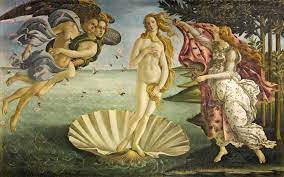
Goddess of the Day – Venus


Venus, Goddess of Love and Beauty

The Roman equivalent of Aphrodite, Venus was a goddess of love and beauty. Originally, she was believed to be associated with gardens and fruitfulness, but later took on all the aspects of Aphrodite from the Greek traditions. She is considered by many to be the ancestor of the Roman people, and was the lover of the god Vulcan, as well as of the warrior god Mars.

Worship and Celebration

The earliest known temple to Venus was dedicated on the Aventine hill in Rome, around 295 b.c.e. However, her cult was based in the city of Lavinium, and her temple there became the home of a festival known as the Vinalia Rustica. A later temple was dedicated after the defeat of the Roman army near Lake Trasimine during the Second Punic War.

Venus appears to have been very popular amongst the plebian class of Roman society, as evidenced by the existence of temples in areas of the city which were traditionally plebian rather than patrician. A cult to her aspect of Venus Erycina existed near Rome’s Colline gate; in this guise, Venus was a goddess primarily of fertility.

Another cult honoring Venus Verticordia also existed between the Aventine hill and Circus Maximus.

As often found in Roman gods and goddesses, Venus existed in many different incarnations. As Venus Victrix, she took on the aspect of warrior, and as Venus Genetrix, she was known as the mother of the Roman civilization. During the reign of Julius Caesar, a number of cults were started on her behalf, since Caesar claimed that the family of the Julii were directly descended from Venus. She is also recognized as a goddess of fortune, as Venus Felix.

Brittany Garcia of Ancient History Encyclopedia says, “Venus’ month was April (the beginning of spring and fertility) when most of her festivals were held. On the first of April a festival was held in honor of Venus Verticordia called Veneralia. On the 23rd, Vinalia Urbana was held which was a wine festival belonging to both Venus (goddess of profane wine) and Jupiter. Vinalia Rusticia was held on August 10th. It was Venus’ oldest festival and associated with her form as Venus Obsequens. September 26th was the date for the festival of Venus Genetrix, the mother and protector of Rome.”

The Lovers of Venus

Similar to Aphrodite, Venus took a number of lovers, both mortal and divine. She bore children with Mars, the god of war, but doesn’t seem to have been particularly maternal in nature. In addition to Mars, Venus had children with her husband, Vulcan, and when conflated with Aphrodite, is commonly believed to be the mother of Priapus, conceived during a fling with the god Bacchus (or one of Venus’ other lovers).

Scholars have noted that Venus doesn’t have many myths of her own, and that many of her stories are borrowed from the tales of Aphrodite.

Venus in Art and Literature

Venus is nearly always portrayed as young and lovely. Throughout the Classical period, a number of statues of Venus were produced by different artists. The statue Aphrodite of Milos, better known as the Venus de Milo, depicts the goddess as classically beautiful, with womanly curves and a knowing smile. This statue is believed to have been done by Alexandros of Antioch, around 100 b.c.e.

During the European Renaissance period and beyond, it became fashionable for upper class ladies to pose as Venus for paintings or sculptures. One of the best known is that of Pauline Bonaparte Borghese, younger sister of Napoleon. Antonio Canova sculpted her as Venus Victrix, reclined on a lounge, and although Canova wanted to sculpt her in a robe, Pauline apparently insisted on being portrayed nude.

Chaucer wrote regularly of Venus, and she appears in a number of his poems, as well as in The Knight’s Tale, in which Palamon compares his lover, Emily, to the goddess. In fact, Chaucer uses the turbulent relationship between Mars and Venus to represent Palamon, the warrior, and Emily, the lovely maiden in the flower garden.

Author

Patti Wigington, Paganism/Wicca Expert
Originally published on & owned by About.com


Your Daily Witches Digest for February 19th (Tarot Cards, Runes and Much More) c. 2017

Your Daily Witches Digest for Tuesday, December 5th

(Tarot Cards, Runes & Much More)


Tarot Card of the Day

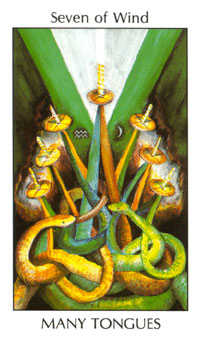
Seven of Wind


The Seven of this suit typically refers to mental preparedness, acquired through the use of imagination, including the rehearsing and visualizing of desired results. This card represents the positive mental habits of a natural winner. The image most often associated with this card is that of a canny warrior who has infiltrated into the enemy camp on the eve of a fateful battle, checking out their preparations and stealing their swords. Such a move is guaranteed to demoralize the enemy and undermine their performance in the upcoming confrontation.

Putting it in modern terms, one who draws this card needs to work smarter, not harder. Think long and deep, study all the angles and put yourself in the shoes of your competition. As a result, you will have such a thorough grasp of the whole situation that there will be no surprises — and no excuses for anything but success. Skillful preparation justifies the optimism of the natural winner.

Tarot.com is a Part of the Daily Insight Group ©2017

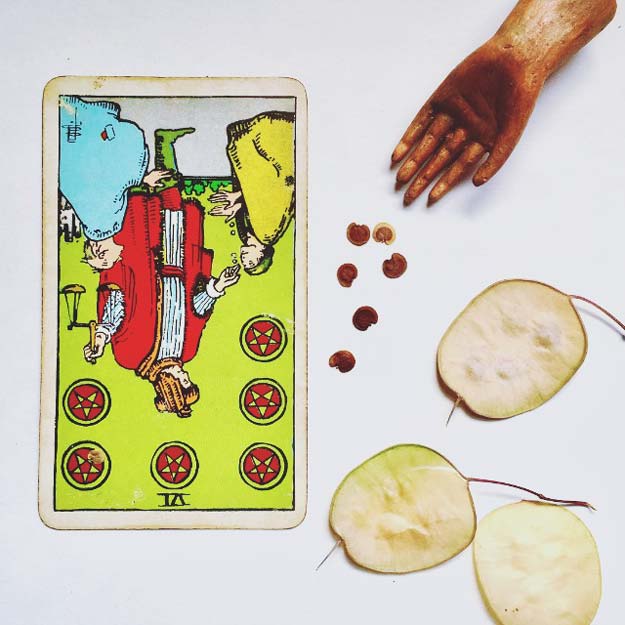
Six of Pentacles reversed


Here’s this card again! We saw the Six of Pentacles last month as well, and it does seem that some of the lessons or struggles present in November are still with us currently. This is not unexpected. November marked the start of a chain of busy holidays; this year a number of stores where I live started merchandising for Christmas even before Halloween, and now are in full-swing with decorations and many additional products. In our spread, we have the Six of Pentacles positioned in reverse, which seems in direct alignment with this month’s theme card. I can’t help thinking about the fine line between holiday spirit and holiday pressure — pressure to find the perfect present for everyone on my list, pressure to get everything done on time… By some people’s standards, I’m already late if I’m still doing my holiday shopping now! And as noted above, if you’re operating on a budget, and many of us are, including everyone you care about and finding just the right thing for each of them can be tough.

When this card is reversed, it often indicates mishandling of resources, so I’m taking its appearance here as a warning. What sort of creative solutions might we find to honor those we love with clever gifts that don’t have to drain our resources? Last month’s appearance of this card asked us to think about different ways we could serve others. Generosity does not have to be financial, even though Pentacles are the suit of tangible concerns. There are many ways to show love. We can give others our time and energy to help improve the quality of their tangible existence. We can use our time and skills to make something for loved ones. People often say that it’s the thought that counts, but this is usually meant to excuse a lack of effort. If we put care into what we make, these gifts will be seen as both thoughtful AND enjoyable.

This card in reverse can also suggest greed, but in the current context, I would interpret that a little differently. Pressure to perform as expected can cause many of us to withdraw. I sense fear of a sort in this card, too. Perhaps we fear that others will not return our efforts of generosity. Giving to get or giving only because we received is a strangely deceptive cycle. Overall, this card is a reminder that how we treat others is important. A balance of the material and spiritual is essential for our well-being, and the act of giving supports that balance.

Considerations for the reversed Six of Pentacles:

1. What actions by others make you feel loved?
2. How do you typically show your love for others?
3. Think about those closest to you, people you would want to demonstrate your care for with a gift of some sort. What do you think makes each of them feel loved? How could you tailor your gift to match this?

Tarot.com is a Part of the Daily Insight Group ©2017

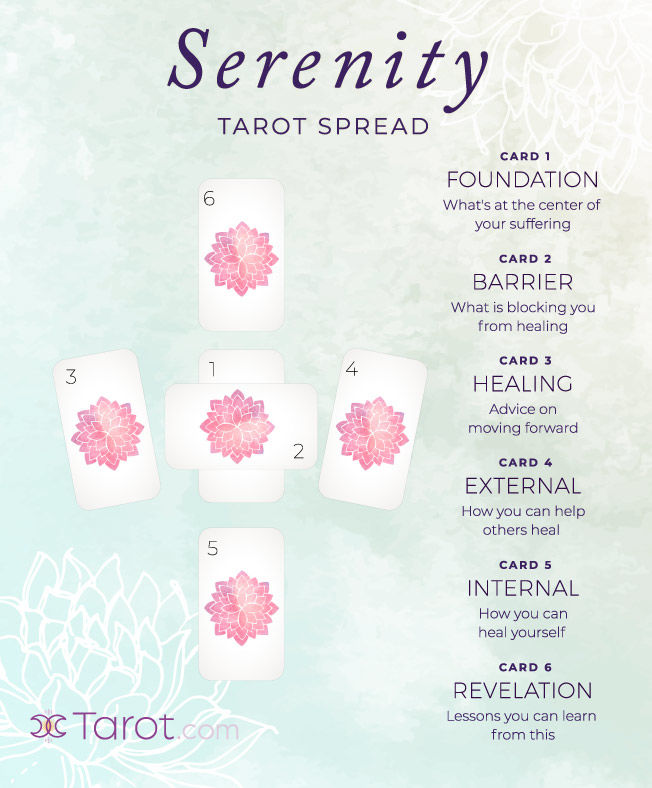
How to Do a Serenity Tarot Reading

A Tarot spread to help you heal and find inner peace


The famous singer Marvin Gaye once said, “If you cannot find peace within yourself, you’ll never find it anywhere else.” How true this is! Unfortunately, sometimes it seems as if life gets in the way, and achieving tranquility is harder than it should be. Are you struggling with overcoming grief, feeling bombarded by the negativity in the news, or managing some kind of internal conflict? This 6-card do-it-yourself Serenity Tarot spread shows you exactly what you need to do to clear out the emotional clutter, and put yourself back onto a more positive path. Keep reading to see how YOU can use this spread to heal.

Position 1: Foundation card

Heart of the issue

The first card of this reading takes a look at what’s really at the center of your suffering. While it’s usually pretty easy to identify how we’re feeling, sometimes we don’t know why we’re feeling the way we do. When pulling this card, make sure to sit and focus on the emotions you’re experiencing at that moment. Allow yourself to fully embrace what it is that’s going on in your head and heart. Think of this card as putting the spotlight on the darkness you’re experiencing right now.

Position 2: Barrier card

What is blocking you from healing?

The path to healing is not a straight line. The Barrier Card will help you see what it is that has been preventing you from finding the inner peace you need. Sometimes these stumbling blocks come from outside influences, and sometimes the struggle is coming from within. The message you receive from this card will allow you to confront — and deal with — what has been stopping you from finding inner peace.

Position 3: Healing card

Advice on how to move forward

When we’re swimming in an ocean of emotion, it’s not always easy to see what it is we need to do to feel good again. The third card in this spread takes a look at your situation and gives you the practical insight and advice needed to help soothe any anxiety or uncertainty you’re feeling. Think of the Healing Card as your own personal counselor, helping guide you towards a better future.

Position 4: External card

What you can do to help others

In dark times it is not only we who are hurting — others around us may be as well. We all have an internal light that acts as a beacon of hope no matter how dark these times may seem, and your External Card helps you see what this special gift is. Is your higher power that you act as a pillar of strength? Or, is it your unwavering compassion for those suffering around you?

Position 5: Internal card

What you can do to help yourself

The Tarot is known for its ability to empower us, and there is nothing more empowering than learning that everything you need to be happy is already inside of you. Think of your fifth card as your “self” card, one that shines a spotlight on your greatest source of inner strength. The insight revealed in this position will show you that not only is healing is possible, but that you already have what it takes to get there.

Position 6: Revelation card

Lessons you can learn from this situation

While it may not seem like it at the time, there is always a silver lining in times of adversity. Not only can our suffering teach us important lessons about life, but it can also teach us important lessons about ourselves. Think of your Revelation Card as a glimpse into your future — a future where you’re stronger and wiser for having gone through this situation.

No matter what it is you’re dealing with right now, this simple 6-card Tarot reading can help guide you towards a happier, brighter tomorrow. Are you ready to get started? Take a deep breath, shuffle the cards, and let the power of the Tarot guide you now.

Tarot.com is a Part of the Daily Insight Group ©2017

Your Crowley Thoth Tarot Card for Today

Lust


While similar to classic Tarot’s Strength card, Lust goes a step further by suggesting we should enjoy the pleasures of exercising our strengths, sating our passions, and embracing that which allows one to express the majesty of their unique self. The lust this card indicates is not purely sexual, but at its most basic this lust is a primal desire to experience life to the fullest degree possible while taming our more beastly side. Lust implies that we not fight with our base instincts, but rather that we accept and manage and nourish them as an essential aspect of maintaining a balanced, complete self.


Your Weekly Influences


Tarot Influence

The Hanged Man Reversed

The reversed Hanged Man represents a preoccupation with the worldly and wasted energy. This is the card of false prophecy and time wasted.


Astrological Influence

Taurus

With The Bull comes strength, loyalty and determination


Element Influence

Fire Reversed

Fire reversed denotes calamity that may be on a catastrophic level. Prepare to deal with changes you do not want.


Your Ancient Symbol Card for Today


The Green Man

Where the Green Man appears the mystery and untamed energy of nature abounds. The Green Man indicates the presence of choices and powers that have not been muted by civilization. The Green Man represents the antithesis of technology and industrialization. He offers primal energies veiled in mystery and derived from the spirit of nature in its purest form.

As a daily card, The Green Man indicates you are in a place where you will be well served by exploring your place in the natural world. At the moment the wisdom that will serve you best cannot be found in books or on talk shows or extracted from today’s headlines. What’s called for is an affirmation of your place in the natural world.


Psychic Tip of the Day

UNCOVERED
You are confronted by a misunderstanding that you might have used to your advantage. Someone is not as forgiving this time. Are you discovering a new set of facts?


Witches Rune for the Day


The Blank Rune

Meaning: This is a rune of difficulty and negative influences will rule your life for a time, but as all difficulties are a learning experience it will lead to improved personal perspective and progress on your life’s path. Always consult the surrounding runes with this stone. If it lies with a positive stone, it indicates that the pain of this experience will lead to a beneficial change in circumstances.


Your Daily Elder Futhark Rune for Today

Save


Your Animal Spirit Guide for Today


Crack the Cookie


The Wisdom of Buddha

When one has the feeling of dislike for evil, when one feels tranquil, one finds pleasure in listening to good teachings; when one has these feelings and appreciates them, one is free of fear.


February 19th Divination Journal by Lady Abyss

Your Daily Rune c. 2019

Jera

Rune of harvest and reward for, or reaction to, right actions in a horizontal (naturally ordered) cyclical process. Rune of peace on the land and in the heart.

Psi: psychological time, patience, the measurement of time

Energy: good harvest, orbits, cycles, progress, biorhythms, right effort

Mundane: waiting, gardening, farming, the seasons, harvest

Divinations: Reward for positive action, plenty, peace, proper timing; or repetition, bad timing, poverty, conflict, regression.

Governs:
Fertility, creativity and harmony with the land
Peace, prosperity and plenty
Realization of the cyclical nature of the multiverse, invoking the power of time and cycles
Bringing other concepts gently into material manifestation
Initiating gradual and lasting change in flow of life

Your Daily Witches Rune c. 2019

The Wave

Meaning: This rune symbolizes your friends and family and their influence upon you. Its meaning is usually derived from the other stones closest to it. This rune is also associated with travel. A journey abroad is indicated especially if the Sun rune is nearby, but a journey for someone close to you if the Moon stone is closest. If it is near to the Rings it foretells a holiday or long distance relationship.

Your Personal Daily Tarot Card c. 2015

The Hanged Man


The Hanged Man is the most enigmatic card of the Tarot. Even Tarot giants like Waite, Crowley and Levi had trouble deciphering The Hanged Man’s true meaning. Generally The Hanged Man is thought to represent the value of surrender and selfless acts. The Hanged Man embodies the notion that sometimes to lose is to win. Unlike the aggressive Chariot, The Hanged Man creates his fate through inaction and accepts his fortune passively, without resistance. He does not struggle to control the path his life takes, but rather allows events to sweep him where they will, even if he is called upon to sacrifice himself. He is so at ease with the Fate the Universe chose for him that even hanging upside down from a tree does not ruffle his inner peace.

(Sorry the divination journal is so short there will be a longer one in the northern hemisphere’s morning)

(A Thought for Today) How Do You Measure a Soldier’s Sacrifice? c. 2018

IN HONOR OF THOSE WHO SERVE AND THE FAMILIES AND FRIENDS LEFT AT HOME.


How Do You Measure a Soldier’s Sacrifice?

How do you measure a soldier’s sacrifice?
Is it by the number of friends and family left behind?
Is it by the months or years given in service?

How do you measure a soldier’s courage?
Is it by the number of objectives completed,
Or by the number of bullets dodged or missions served?

How do you measure a soldier’s honor?
Is it by the duty he or she volunteers for,
Or by the number of medals earned?

The simple truth is that these things are immeasurable,
As is this country’s debt to all who serve,
And pay the price for freedom in this land.


Our Hearts and Our Words Can Never Express Our Thanks to All

Who Have fought and died and those still serving to this day for your sacrifices

and never questioning when there is a need you go,

You go to defend our freedom, our  rights and our privileges we enjoy in this great country.

Thank you for your service to our great country.

May the Goddess Bless Those Who have Made the Ultimate Sacrifice

And May She Watch Over and Protect Those Still Serving Our Great Nation To To This Day.

You are in our thoughts and prayers,

Come home safely our brave soliders

Come home safely!


Thank you for all you have given us.

Lady of the Abyss & The WOTC Staff


Poem:

Poems Honoring Our Soldiers
By Kelly Roper

Chinese vs. Western Astrology: What Are the Differences? C. 2018

Learn how the east and the west view the cosmos


Chinese and western Astrology are both systems of divination that are based on date and time of birth. And although both traditions rely heavily on symbols to communicate their theories, each differs substantially.

Here’s a crash course in understanding the differences between the two systems. Quite often, people will identify with one more strongly, but still ascribe to some of the other tradition’s beliefs — mix and match at will!


Time frame

Chinese Astrology divides astrological signs by years, whereas western Astrology separates them by months. Therefore, the Chinese believe that people born in the same year share the same traits, whereas westerners group people on a month-by-month basis. This difference in sensibilities makes sense for each culture, as eastern societies play great emphasis on generational differences, whereas western countries focus more on psychological ones.


Icons

The 12 zodiac signs discussed in Chinese Astrology derive from a myth. According to legend, when God was developing a calendar, he summoned all the creatures on Earth to participate in a race. The first twelve species to cross the finish line were awarded signs in the Chinese zodiac. Consequently, the Rat got first place through cunning and strategy, while the meticulous Pig came in last because it was continually distracted by niggling details.

Western Astrology, on the other hand, bases its 12 zodiac signs on the constellations that move through the sky throughout the 12 months of the year. Therefore, the month of January is associated with Capricorn because that constellation is directly overhead during that time, whereas the month of July is linked to Cancer because this is when the Crab is at its zenith.


Lunar vs. solar calendars

Chinese Astrology is based on the lunar calendar, which is arranged by the phases of the Moon. According to the lunar calendar, each month begins with a New Moon and lasts for approximately 29 days. The western calendar is organized according to Earth’s orbit around the Sun. According to the western calendar, each month begins on a set date and can last between 28 and 31 days.


The elements

Chinese Astrology identifies the world as being comprised of five elements: Fire, Earth, Metal, Water and Wood. In the lunar calendar, each element is linked to a 2-year period, and governs the motivating forces in your life. Fire signs are inspired by excitement; Earth types are motivated to create secure foundations. People born under the Metal element are driven to create order, while Water types are compelled to form emotional bonds. People born under the Wood element are motivated to explore.

In western Astrology, four elements are identified: Fire, Earth, Air, and Water. Each element is associated with three zodiac signs, and governs the prevailing psychology of each group. According to western Astrology, signs governed by the Fire element are impulsive, while Earth element signs are practical. People born under Air signs are intellectually oriented, whereas Water signs are driven by emotion.


Lunar phases vs. modes

Chinese Astrology places great emphasis on the lunar phase of birth. This system of divination links a person’s temperament with the phase of the Moon at the time of their birth. There are four types of lunar phases: New Moon, Waxing Moon, Full Moon and Waning Moon. New Moon types are adventurous and seek innovative environments. Waxing Moon people are hard-working and desired merit-based systems. Full Moon types are diplomatic and seek out environments where protocol is emphasized. Waning Moon people are introspective and desire peaceful surroundings.

Conversely, western Astrology identifies three zodiac sign qualities: Cardinal, Fixed, and Mutable. Each mode is linked to four signs. According to western Astrology, one’s mode of birth determines how one operates in any given environment. Consequently, Cardinal signs seek acceptance by becoming leaders. Fixed types make their mark through hard work. Mutable signs form deep personal connections as a means to fit in.


Tarot.com is Part of the Daily Insight Group ©2018

(Spell for Today) FOLK MEDICINE CURES c. 2014

FOLK MEDICINE

Amulets for Health

To relieve pain, touch the affected area with an amulet created from a poultice
of red coral and ash leaves. Bury the amulet under an oak tree. Similar methods
were used to rid the body of warts. A potato was applied to the wart, then
buried. For any health-related magic, coral, ash leaves, oak leaves or a piece
of potato makes an excellent focuses or components.

Arthritis
One teaspoon of chopped garlic twice daily with water is reputed to ease
arthritis symptoms. This folk remedy may have come from the belief that garlic
aids the blood circulation. Other options include wearing charmed belts or
blessed cords of wool near the afflicted area.

Athlete’s Foot
Saltwater soaks and cornstarch powder dusted on the feet daily work against the
fungus that causes athlete’s foot. In ancient Greece, you may have been given
powdered orris root. This not only helps keep your feet dry, but also relieves
odors.

Bee Stings
Plant leaves are the common denominator in methods of relieving the pain and
itch of bee stings. Turks apply wet tobacco leaves directly to the sting. In
other cultures, various types of plant leaves or petals are used, including
burdock, dandelion and marigold.

Burns
The three most universal aids to spread over a burn are damp baking soda, honey
or aloe. Any of these might also be metaphorically applied in a spell to ease
fiery anger. Rub the substance over a picture of the individual who is irate.

Colds
A tea made of lemon juice and honey in warm water is soothing, and hot tar smoke
is thought to relive and prevent coughs. If you put seven beans in your pocket
and throw one away each day, but the end of the week your cold should be gone.
This can be further assisted by eating horseradish.

Constipation
A daily cup of licorice and senna tea works to relieve constipation. These herbs
are also excellent magical ingredients for spells to overcome an artistic block
or any other barrier.

Cramps
Ginger and pepper combine for a good hot drink to ease stomach cramps.
For muscle cramps, wear a garter of corks near the afflicted muscle or place it
between the springs of your bed and the mattress. This last idea may have
developed because, when a cork is taken from a bottle, it releases pressure with
a pop. Consider employing this symbolism any time you feel constrained or
limited.

Diarrhea
Peppermint tea is one of the best-known remedies for this uncomfortable
condition. An alternative drink is ginger tea with two teaspoons of vinegar and
a dash of salt.

Dog Bite
The bid of a mad dog was once thought to be cured by eating some of the
creature’s hair boiled or fried with rosemary. This was how the saying “hair of
the dog that bit you” came into being and is an excellent early example of
sympathetic magic. Thus, when people drink alcohol for a hangover, they are
using the “biting” item to effect their cure.

Eyewash
Ringing the eye with the water used for steeping a lapis stone is said to
relieve itching eyes. One work of caution: be sure the lapis and water are both
clean and free from impurities. Lapis water blessed beneath a full moon can also
enhance psychic vision.

Fever
Goldenseal tea and a teaspoon of lemon juice taken every four hours reduces
fever. Another recommendation is to take clippings of your fingernails and mix
them with warm wax which is then bound to a tree or rock so that the fever is
attached to something other than you. Similar symbolism can be used when you are
feeling angry and out of balance. In a symbolic sense, you are literally
disengaging the negativity from yourself.

Gemstones
The use of gem stones in remedial work was closely tied to their color, planet
of influence, and other commonly associated superstitions. Red stones, for
example, were frequently considered helpful for blood conditions, green stones
for all type of healing, and blue for improving emotional disposition.
Gems were used in a wide variety of ways not only as curatives, but also
to ward off sickness. In many instances, the individual was instructed to wear
or carry the stone in a specific manner, frequently near the center of the
prevailing problem. This was done so that the stone could collect any illness.
An alternative to amuletic work was the gem elixir. These may or may not
have actually been made from gemstones, considering the expense involved and the
cleverness of many healers. Instead, solutions likely had the appearance of a
particular stone in coloration. The other option was to place a particular stone
in any liquid for a duration of time to allow absorption of its positive
remedial qualities. Some of these costly cures include diamonds and emeralds for
an antidote for poison, jade for kidney disease, jasper for stomach ailments,
ruby for flatulence, topaz for the plague, and bloodstone to stop hemorrhaging.
Crystalline elixirs are used by many people in the New Age community today
to internalize specific aspects of a stone. Usually the gem (or crystal) is
steeped in spring water by the light of the sun or moon, depending on its
intended use. The stone is removed afterwards and the liquid drunk.

Headaches
An amethyst, warmed by the rays of the sun, wrapped in silk, and then bound
lightly to the temples, eases the pain of a headache. Wearing rings of lead or
quicksilver also prevents and soothes this difficulty. These suggestions are
likewise applicable for psychically caused pain as experienced from overexertion
in a reading, or returning to normal awareness too quickly after meditation.

King’s Evil
This is a disease of the lymph glands thought in the Middle Ages to be cured
only by the touch of a reigning monarch. The first instance we see of King’s
Evil is during the time of Edward the Confessor (A.D. 1024-1066). Most likely,
this superstition was invented by the court to improve the king’s esteem in the
eyes of the populace.
Since kings are not readily available these days, a supplication directly
to the king and queen of the heavens can be made to reduce the swelling of the
lymph glands. Or wear a piece of blue flannel tied nine times around your neck.
The warmth of the flannel, combines with its peaceful color was considered a
powerful combination.

Laryngitis
When your voice leaves you, try gargling three times with a combination of
vinegar, rainwater and honey. Salt and garlic water are also effective. In
England, country physicians recommend the juice of a boiled cabbage with honey.
By adding a little incantation, such as “through the guns and past the
lips, my speech is strengthened with each sip” you can also use these
concoctions before a speaking engagement to empower your presentation. While the
incantation may seem a little silly, it is easily committed to memory and has a
meter which allows for rhythmic repetition.

Laying On Of Hands
Great power and reverence has always been given to the hands of the healer. They
are the conduit not only of divine energy, but also, more immediately
significant, of relief from pain. Many religions and even modern science speak
of the amazing power of touch to calm, reassure, and grant emotional relief on a
temporary basis. Many healing methods have developed from the simple laying on
of hands, for example, acupressure, shiatsu, and reiki. In these methods,
pressure points, massage and touch are incorporated to improve circulation, ease
pain, perform auric cleansings and even cure hiccups.

Melancholy
To cure a case of melancholy in India, healers suggest wearing lapis lazuli
around the neck and keeping busy so there wasn’t time to think about troubles.

Pain
Jade or lapis worn on any afflicted area is thought to relieve pain. Once the
pain is gone, the stone should either be thoroughly cleansed in saltwater or
buried so the pain isn’t returned the next time the gem is handled. For
emotional pain, place the stone over your heart.

Prescriptions
Medicinal prescriptions have been found in cultures dating from ancient
Mesopotamia, Egypt, Greece and Rome. These first prescriptions included clearly
written instructions and pictures. These images were not only for the
illiterate, but also were believed to help improve the effectiveness of the folk
cure. (Considering the handwriting of many contemporary physicians, they might
want to consider doing likewise.)
More seriously, we can continue this tradition by adding appropriate runes
or other personal symbols to any written spell.

Sand Paintings
One of the more interesting healing traditions is that of sacred sand painting
practiced by the Hopi culture in the southwestern United States. Here, it is
regarded as a kind of magic, where the ancestors and the Gods are called in to
aid the patient.
When the shaman finishes the painting (usually a two-day process), the
patient sits on one portion while the shaman chants and blesses him or her.
Eventually, some indication is given to the healer that the work is complete and
the sand painting is destroyed with the remains being given to the winds.
In our own healing rituals, sand could be used in a similar manner.
Personally significant symbols can be sketched with various colors of sand, then
given to the afflicted person to hold. He or she should then direct all aches
and pains to the grains of sand while releasing them to the winds. This will
carry the sickness away.

Scapegoat
The term scapegoat dates back to the time when animals were used for disease
transference. Here, one particular animal would be chosen to bear the sickness
of the entire community, and would then be ritually killed, burned, or buried to
cure the people.
Most magical people today disdain such activities as disrespectful to the
animals involved, so a kinder alternative should be considered. Inanimate
objects such as the sand illustrated above can be substitute for a creature with
equal effectiveness, since symbolism is the most important factor in sympathetic
magic.

Skin Disease
Tenth-century Anglo-Saxons used a basic preparation of goose fat mixed with
elecampane, bishop’s wort, cleavers, and a spoonful of old soap, lathered it
onto the skin at night to relieve skin problems. Additionally, a little blood
taken from a scratch on the neck was released into a flowing stream to magically
carry the sickness. While it moved away, the afflicted person would say, “take
this disease and depart with it” three times, then return home by an open road,
going both ways in silence.

Sneezing
The sneeze was considered a message direct from God or a bit of the soul being
released. In Scotland, parents waited impatiently for their child’s first sneeze
to prove there was no fairy hold over him or her and that the child was thus of
sound mind.
There is also a form of divination by sneezing: if you sneeze after dinner
it means good health; three sneezes in a row portend gifts or a letter; two, a
wish; five, silver; six, gold. Perhaps it seems a little silly to try, but if
you are performing prosperity magic, you might keep a little pepper handy to see
if the sneeze helps empower your spell!

Sympathetic Magic
Sympathetic, or symbolic magic, whether called by that name or not, is common
throughout various cultures. For example, the patient would have a string
attached to the affected area and the healer would place the other end in his
mouth to suck out the sickness; to break curses or mark transitions from the
sickness to health, the patient would be moved through a fire or wreath.
Similar versions of sympathetic magic can be seen in prescriptions calling
for a wool string to be worn around the neck to cure a cold, red glass beads
worn as a necklace to prevent nosebleeds, placing medicine on an object of help
cure a wound it inflicted, and making headaches disappear by sleeping with
scissors under your pillow.
The marvelous part about sympathetic magick is the wide variety of
creative approaches it offers. Consider what it is you are trying to accomplish,
an appropriate symbol of that goal, and finally what magickal procedures you
want to follow, and you have just originated a personalized spell or ritual.

Toothaches
A nearly universal treatment for toothaches is clove oil.  In Kenya, wax or
chewing gum is used for temporary fillings. Another interesting superstition is
that a wedding ring touched to an aching tooth will relieve the pain because of
the power of love.

Toxins
In Scotland, a poultice of onions is applied to the stomach and armpits in order
to help the body sweat out any toxic materials. This might be a good folk remedy
to try when you are going through a personal purification or attempting to rid
yourself of a physically addictive habit such as smoking.

Enhanced by Zemanta

Key Features Needed To Make A Ritual Work c. 2014

WOTC Extra  – Key Features Needed To Make A Ritual Work

Wiccan rituals fit together a variety of tried-and-true magickal methods to form a congruous whole, rather like a spiritual jigsaw puzzle. Dancing around a ritual fire, singing, chanting, meditating, communicating with deities, casting spells, crafting charms, making wishes, pouring libations, asperging the participants or the sacred space — every part of a ritual has purpose and meaning in relation to the whole.

In Wiccan rituals, great care is taken to make sure there are no meaningless words or actions. A ritual without meaning becomes a liturgy to which the participants have no connection, and therefore cannot effect magick.

Not every ritual you create or attend will contain all of the following elements. However, any of these features applied in meaningful combinations will help generate similarly meaningful results.

Location

Where a ritual transpires has a tremendous effect on the participants and the resulting magick. Many witches enjoy enacting rituals outdoors. This allows participants to connect with nature and to recognize their place in the universe. If you’re a solitary witch, you have more options than a group of thirty people might. If you live in a heavily populated city, you may not have as many sites to choose from as rural witches do.

Accept your limitations and plan with the goals of the ritual in mind. Make sure that your space, whether indoors or outside, can comfortably hold all the people participating in the ritual and allow for the process to take place. If you’re going to do a spiral dance, you need a lot of room. Sitting and meditating, by comparison, requires far less space.

Ambiance

The right environment for your ritual is essential. Ideally, the place where you perform ritual should be a sacred space dedicated to this purpose. You don’t want anything to distract, interrupt, or otherwise take you away from the ritual at an important juncture — it should go without saying that ritual space is a cell-phone-free zone. Set the right mood by using appropriate decorations, aromatics, altar configuration, and so on. All of these components should reflect the ritual’s purpose.

Seasonal rituals usually include decorative and symbolic touches that reflect the cycle being commemorated. Fresh blossoms might grace an Ostara ritual; evergreen boughs compliment a Yule celebration. Well-chosen music, incense, and thematic items can make a big difference in the ambiance of a ritual. These touches affect your senses, which in turn influence both the conscious and subconscious mind.

Personal Preparation

Everyone in attendance should be in the right frame of mind, for their combined thoughts and emotions generate the ritual’s energy. When you participate in a ritual, you set aside daily concerns and mundane thoughts to focus on the goal of the ritual.

Before beginning a ceremony, many witches take ritual baths to cleanse themselves in body and mind. Salt is usually added to the bathwater (symbolizing purification) and sometimes essential oils. Ideally, you should bathe in a stream, lake, or the ocean; however, most ritual baths take place in an ordinary indoor tub.

Witches gather in circles to demonstrate visually and spatially each participant’s equal responsibility and relevance in the ritual. Everyone who chooses to participate should feel wholly comfortable with the ritual and its components. They should understand the ritual’s significance, its goals, and the steps involved, and be ready to contribute mentally and physically to the ritual’s purpose.

For the good of all, anyone who cannot fulfill these conditions is better off not participating. One person’s lower energies or distractions become a weak link in the circle of the power of creation and the direction of magickal energy.

Tools and Components

Do you need a complete altar setup? Do you want to wear costumes? What about a special altar cloth? A ritual might require any of the following tools:

Asperger

Athame

Broom

Candles

Cauldron

Chalice

Circumference-marking material (such as chalk)

Crystals or stones

Drum or other musical instruments

Essential oils

Feather or fan

Foods or beverages

Incense

Incense burner

Masks (or other props)

Objects representing the four elements

Offerings

Pentagram

Plants or flowers

Salt

Smudge wand

Statuary

Sword

Wand

Everything that will be used in the ritual should be cleansed in advance. In addition, each ritual object should be charged for its task in the ritual. (Refer to the cleansing and charging methods described in Chapter 13.) Bring all the items you’ll need for the ritual into the area where you’ll be working before you cast a circle.

Progression

A ritual follows a logical progression, like a play. The ritual’s progression creates the pattern — the actions and words that become tradition.

Each ritual should have a defined beginning, such as creating sacred space. The beginning of a ritual sets the tone for everything to follow. In particular, it transports the participants to that place between the worlds and unifies their hearts and spirits, directing them toward the ritual’s goal. A typical beginning in a group setting might include breathing in unison, holding hands, and calling the Watchtowers. Practitioners of solitary rituals might take a moment for prayer or meditation, followed by invoking the circle.

After the ritual space reaches this juncture, what happens varies dramatically, depending on the ritual and its goals. As mentioned previously, this middle portion might involve weaving spells, dancing, singing, drumming, meditations, visualization, divination, enactments, and so on. Whatever takes place should be congruent with the beginning of the ritual.

As is the case with spellcraft, the more sensual aspects you include, the more energy a ritual is likely to raise. As participants work their way through the ritual, everything perceived through their senses helps them maintain focus and direct energy. When the members of the circle are raising energy, drumming might get faster or chanting might grow louder, for example. Each cue communicates the goals of the ritual to the individual’s awareness and to the Divine, and therefore nourishes the magick.

“I think the highest purpose of ritual or magickal work is to seek our gods, to commune with the cosmic ‘mirror’ and the spirits of nature in order to learn more of the divinity within ourselves and reach evermore toward personal growth in its highest expression.”

— Maria Kay Simms, A Time for Magick

Human beings like closure; solid endings also bring the participants’ attention back to mundane matters. A ritual without a defined ending is like omitting the last chapter in a book; it leaves both the participants and the energy hanging. It’s also important to thank and release the Watchtowers who have been present during the ritual. Furthermore, participants need this time to gear down a bit (or ground out, as witches say). End the ritual by deconstructing the circle, saying a closing prayer, or stating a parting wish. Some circles end with a chant:

The circle is open, but unbroken May the peace of the Goddess be forever in your heart. Merry meet and merry part And merry meet again.

Author:
Sky Alexander
netplaces>>>>>Wicca and Witchcraft
Enhanced by Zemanta

Let’s Talk Witch – Warnings and Cautions For The New Wiccan or Witch c. 2014


Let’s Talk Witch – Warnings & Cautions For The New Wiccan or Witch

If you’ve looked at this site at all, you’ve seen the wonderful things that happen when you begin following a Wiccan path. I’ve been asked to discuss the not-so-nice things that can happen. I’m not trying to scare anyone off, just give you enough information so you can make an informed decision.

The Shadows are out there:

They exist, in the invisible world that parallels our own, living creatures. Unlike creatures from our world, they lack physical form, and feed on energy instead of matter. They are as varied as the animal life on our world. They range in size (power) from the equivalent of insects and rodents to the equivalent of magically trained humans, and beyond to the Great Old Ones. (My land is inhabited by one of these-it gives the psychic impression of a mountain with legs. It is not unfriendly, but an elephant is not unfriendly toward ants either. I stay out of our woods when it is about.) I mentioned that these creatures feed on energy. Most are content to graze on the random energy fields that leak from humans and other creatures in our world. Others, however, are a little more sinister. These, the ones you have to worry about, I call the Shadows.

Shadows come in three basic varieties. First are the little ones that feed off the energy in negative emotions. If you are emitting strong negativity, they will be drawn to you like flies to rotten meat. If you aren’t magically protected, they will happily latch onto your energy field (aura) and snack on it. They are usually not much more troublesome than leeches or mosquitoes; however, a thousand leeches could weaken a person severely.

Next come the more dangerous variety, more like rats or vultures than mosquitoes. These are attracted both by negative emotions and the energy of magical workings. They are stronger, and can push past weak or flawed defenses to get to you. And they are much harder to peel loose once they have their teeth into you.

Last are the intelligent variety. Their favorite meal is human life energy, the ‘heart-fire’ that burns in each of us. They are relatively rare even in their own realm, but they exist. The terms ‘Imp’ , ‘Evil Spirit’ and ‘Demon’ are fairly accurate. They are very strong. The more intelligent ones are capable of working their own Magic to breach your defenses. The most intelligent variety , being as lazy as humans, prefer to talk you into dropping your defenses and linking your energy field to theirs. (“Open yourself to me, and I will grant you power beyond your wildest dreams.” Yeah, right.) They also are capable (if someone is helpful enough to open a doorway for them) of entering our world. Once here, if they can get past all your defenses unless you are very strong at warding. They can enter your body and feast at will, even asserting a degree of control over you. Yes, this is exactly like the old stories of Demon possession.

You – yes, you can be a Vampire:

There exist in this world evil creatures. They are highly intelligent, capable of working magic, and extremely devious. They are capable of not only psychic magical attacks, but physical ones as well. As a species, they tend to be amoral, murderous animals. I call them ‘humans’. Humans are also capable of ‘feeding’ off the energies of other humans- Herne (owner of this website) calls them “Psychic Vampires”. They do this to gain more magical power, to control others, or to replace the energies they are losing by dealing with the Shadows. Some humans can even do this while traveling astrally. So that Evil Spirit that tried to get into your last circle may not have been from the other side; it could have been your next-door neighbor.

Oops! Did I just do that?

Magic is an art form. Despite the best efforts of Ritual Magicians and Technopagans, it remains as unpredictable and powerful as the weather unless you are highly skilled and focused. Scientists studying weather prediction in the 1970’s discovered something amazing. Weather, they found, is so unstable as to be impossible to predict more than a day or two in advance. In fact, computer models suggested something they called the Butterfly Theory. It seems that the air disturbed by a butterfly taking off from a cactus in Mexico, if it happened at the right time and place, could in theory cause devastating storms and tornadoes in the U.S. Midwest. Magic is very similar. Each action we take, magical or mundane, has consequences that spread out from it like the ripples in a pond.

They spread out, touching everything- and reflect back to converge on the source. Be very sure, then, before you work magic, exactly what the consequences may be. Ask yourself, “If this spell backfires on me, and affects me instead of the intended target, can I live with the result?” Thus, I tend to use magic “only in direst need, and then must the cause be just” (author unknown).

Some Wiccans counsel about how rain on your fields could cause drought elsewhere. This might be true, if you are trying with your own personal power to ‘squeeze’ the rain clouds as they pass over. But asking the Lady and Lord for the blessing of rain for everybody’s crops is a different thing entirely. Selfish magic has negative consequences: Loving, giving magic only positive ones. For Selfishness is the true root of all evil. “I want it! Destroy the world, let Chaos take the universe, as long as I get what I want!” Be careful of what you ask, you just may get it…

Power corrupts:

So, you’ve studied hard, learned all about Wiccan magic, and now you find you can really do things. All the power of the Elements is yours to command. Love, money, power, respect- all these are yours. You are special. You are powerful. You are a God! Now, you must convince others to worship you, to lend you their energy so that your power can grow. But that’s OK, because you are a loving God, and you want only what’s best for your worshipers. And you know what’s best for them, for you know all, and see all. For you alone are God of this world you have created.

Can’t happen? Do the names Jim Jones, Sun Myung Moon or David Koresh ring a bell? It is important to remember that the gift of magical power is just that- a gift from the Lady and Lord. It must never be abused. And glorifying yourself because of something lent to you is like showing up at your class reunion in a borrowed suit and a rented Jaguar. This reason and this reason alone is why you will not find the Council of this site posting or trading spells and rituals. We don’t hand out loaded guns here.

Basic Principles and Concepts of Wicca c. 2014

Basic Principles and Concepts of Wicca

By , About.com

Introduction:

There’s an old saying that if you ask any ten Wiccans about their religion, you’ll get at least fifteen different answers. That’s not far from the truth, because with nearly half a million Americans practicing Wicca today, there are dozens — perhaps even hundreds — of different Wiccan groups out there. There is no one governing body over Wicca, nor is there a “Bible” that lays down a universal set of guidelines. While specifics vary from one tradition to the next, there are actually a few ideals and beliefs common to nearly all modern Wiccan groups.

Do keep in mind that this article is primarily focused on Wiccan traditions, rather than on the principles of non-Wiccan Pagan belief systems. Not all Pagans are Wiccans, and not all Pagan traditions have the same set of principles as the core beliefs of modern Wicca.

Origins of Wicca:

Wicca as a religion was introduced by Gerald Gardner in the 1950s. Gardner’s tradition was oathbound, initiatory, and secret. However, after a few years splinter groups began forming, and new traditions were formed. Today, many Wiccan groups owe their basic foundation to the principles laid out by Gardner. Wicca is not an ancient religion, but Gardner did incorporate some old esoteric knowledge into his original tradition, including Eastern mysticism, Kabballah, and British legend.

Who Is a Wiccan, and How Do You Find Them?:

Wiccans come from all walks of life. They are doctors and nurses, teachers and soccer moms, writers and firefighters, waitresses and computer programmers. In other words, anyone can be Wiccan, and people become Wiccan for many reasons. In fact, there are nearly half a million Wiccans in the United States today. As to where to find them, that might take a bit of digging — as a mystery religion that doesn’t proselytize or actively recruit, it can sometimes be difficult to find a group in your area. Never fear, though — the Wiccans are out there, and if you ask around enough, you’ll bump into one eventually.

Calling Upon the Divine:

Wicca acknowledges the polarity of the Divine, which means that both the male and female deities are often honored. A Wiccan may honor simply a non-specific god and goddess, or they may choose to worship specific deities of their tradition, whether it be Isis and Osiris, Cerridwen and Herne, or Apollo and Athena. In Gardnerian Wicca, the true names of the gods are revealed only to initiated members, and are kept secret from anyone outside the tradition.

Initiation and Degree Systems:

In most Wiccan covens, there is some form of initiation and a degree system. Initiation is a symbolic rebirth, in which the initiant dedicates themselves to the gods of their tradition. Typically, only an individual who has attained the rank of Third Degree dedicant may act as a High Priest or High Priestess. Study is required before an individual may advance to the next degree level, and often this is the traditional “year and a day” period.

Someone who is not a member of a coven or formal group may choose to perform a self-dedication ritual to pledge themselves to the gods of their path.

Magic Happens:

The belief in and use of magic and spellwork is nearly universal within Wicca. This is because for most Wiccans, there’s nothing supernatural about magic at all — it’s the harnessing and redirection of natural energy to effect change in the world around us. In Wicca, magic is simply another skill set or tool. Most Wiccans do use specific tools in spellcrafting, such as an athame, wand, herbs, crystals, and candles. Magical workings are often performed within a sacred circle. The use of magic is not limited only to the priesthood — anyone can craft and perform a spell with a little bit of practice.

The Spirit World is Out There:

Because the concept of an afterlife of some sort is typical in most branches of Wicca, there is a general willingness to accept interaction with the spirit world. Seances and contact with the unknown are not uncommon among Wiccans, although not all Wiccans actively seek communication with the dead. Divination such as tarot, runes, and astrology are often used as well.

What Wicca Isn’t:

Wicca does not embrace the concepts of sin, heaven or hell, the evils of sex or nudity, confession, Satanism, animal sacrifice, or the inferiority of women. Wicca is not a fashion statement, and you do not have to dress a certain way to be a “real Wiccan.”

Basic Beliefs of Wicca:

While not exclusive to every single tradition, the following are some of the core tenets found in most Wiccan systems:

  • The Divine is present in nature, and so nature should be honored and respected. Everything from animals and plants to trees and rocks are elements of the sacred. You’ll find that many practicing Wiccans are passionate about the environment.
  • The idea of karma and an afterlife is a valid one. What we do in this lifetime will be revisited upon us in the next. Part of this idea of a cosmic payback system is echoed in the Law of Threefold Return.
  • Our ancestors should be spoken of with honor. Because it’s not considered out of the ordinary to commune with the spirit world, many Wiccans feel that their ancestors are watching over them at all times.
  • The Divine has polarity — both male and female. In most paths of Wicca, both a god and goddess are honored.
  • The Divine is present in all of us. We are all sacred beings, and interaction with the gods is not limited just to the priesthood or a select group of individuals.
  • Holidays are based on the turning of the earth and the cycle of the seasons. In Wicca, eight major Sabbats are celebrated, as well as monthly Esbats.
  • Everyone is responsible for their own actions. Personal responsiblity is the key. Whether magical or mundane, one must be willing to accept the consquences — either good or bad — of their behaviour.
  • Harm none, or something like it. While there are a few different interpretation of what actually constitutes harm, most Wiccans follow the concept that no harm should intentionally be done to another individual.
  • Respect the beliefs of others. There’s no Recruiting Club in Wicca, and the Wiccans are not out to preach at you, convert you, or prosetylize. Wiccan groups recognize that each individual must find their spiritual path on their own, without coercion. While a Wiccan may honor different gods than you do, they will always respect your right to believe differently.


Some of the Witchcraft/Magickal Correspondence for Thursday

Thursday (Thor’s day)

Planet: Jupiter

Colors: Purple, Deep Blue

Crystals: Amethyst, Lepidolite, Sugilite, Tin

Aroma: Melissa, Clove, Oakmoss, Jupiter Oil, Cinnamon, Musk, Nutmeg, and Sage

Herb: Cinquefoil

Ruled by the planet Jupiter and dedicated to Thor, god of thunder and agricultural work. His parallels in various European Traditions include Zeus, Taranis, Perun, and Perkunas. Magical aspects: controlled optimism, energetic growth, physical well-being, material success, expansion, money/wealth, prosperity, leadership, and generosity.

Thursday is the day of Jupiter, the largest of the planets and said to be the most powerful. Spellcasters would be wise to use this day for attempting wealth, success and prosperity spells. Thursday is also associated (in Greek mythology) to Thor – Thor’s day – and some even say that Jupiter and Thor are one in the same. Both are strong and powerful, yet wise and just.

Try a small prayer to Jupiter before commencing any ritual on Thursday as a sign of respect.
This is the proper day of the week to perform spells and rituals involving luck, happiness, health, legal matters, male fertility, treasure, wealth, honour, riches, clothing, money, desires, business, group pursuits, joy, laughter, and expansion.