A very short explanation of the Holly or Oak Kings Ruling as the Goddess Consort’
For More Information on the Oak King
Scroll Down For More Information on the Summer Solstice in the Southern Hemisphere
I hope these links help you learn more about the different topics.
The Oak has will be born at Sunrise on the Summer Solstice after…

Here the young Oak King fights the tired out Holly King to rule from the Litha until Yule until…

The Holly King is reborn. Now the Oak King is an old man but still fights the Holly king.

The Holly King wins and grows to maturity from the Yule until Litha when the cycle of the battle between the young and older Kings battles repeat themselves for the honor to rule as the Goddesses Consort. The Oak Kings is also in some traditions is known as The Green Man or The Horn God or the God of the Hunt.
I have the Goddess with an infant or toddler. What I cannot find is a picture of the Goddess with an infant or toddler. I have this, I think, a cool idea for a post and need both of these kinds of pictures in order to do it.
Thank you so much for your help. It will be much appreciated.


This is a video showing how to make a Summer Solstice/Litha candle to keep or give as a gift.
This video has some ideas for things to make to decorate your home or altar with.
January 14th
Midvintersblot or Midwinter’s offering, often called Tiugunde Day in Old English, was sacred to Tiu, the ancient Teutonic chief God and ruler of the year. The festival falls 20 days after Yule and is when the runic half-month of Peorth commences.
This day was christianized as Saint Hilary’s day (for Hilary of Poitiers), the patron of backward children, who was invoked against snake bites. This time is traditionally the coldest point of the year and marks the time when marriages were once again permitted after the Christmas season.
It is generally accepted that the birth of Christ on December 24th is the invention of some overzealous authors who were trying to create some sort of symmetry between Paganism and Christianity. According to the late fourth-century Scriptor Syrus, it was the custom of the Pagans to celebrate the birthday of the sun on December 25, at which time they kindled lights in token of festivity. The Christians also participated in these solemnities and revelries. Accordingly, when the administrants of the church observed that the Christians had a preference for the festival, they took counsel and resolved that the true Nativity should be solemnized on that day.
The Pagan feast that was replaced by Christmas was of far older origins and may have been built upon the cult of Mithras, who, for the Persians, was the creator of the universe and manifestation of the Creative Logos, or Word. His birth on December 25 was witnessed by shepherds. After many deeds, he held a last supper with his disciples and then returned to heaven. Some believe that, had Christianity not taken hold when it did, Mithraism very well might have become the world religion.
For more that three centuries Christ Mass was a moveable feast, celebrated on the Epiphany (January 6), the day that, according to biblical account, Jesus manifested himself to the Magi. The Western date of December 25 was fixed to coincide with the Roman midwinter festival of the Kalends, which was preceded by seven days of tribute to their God of agriculture, Saturn.
Many of the Yuletide customs we observe today were common to various thanksgiving days and new year’s rites. For example, the hanging of greenery comes from an old ivy-worshiping worshiping cult dating back to the Dionysian revels in ancient Greece; mistletoe was valued-almost worshiped-by the Druids; ids; and gift exchange most likely generated with the Saturnalia. The Christmas tree was introduced by the Prince Albert of Saxony in 1844 and was an adaption of the Paradeisbaum(decorated tree of life) from the medieval drama of the Tannenbaum.
Your tools
Some ice
Lavender incense
A compass
Set-up your altar, place the ice in the cauldron and the incense anywhere.
Perform a meditation.
Cast your circle.
Hold your hands up in the air saying:
“GREAT WINTER I WELCOME YOU,GODDESS OF NGHT.”
Place your hands in the cauldron and move them around in the ice while saying:
“I WELCOME YOUR MIGHT,YOUR COLD.”
Light the incense. Take aa sip from the chalice. Take the athame and point it toward the west while saying:
“GREAT WINTER I CALL YOU,COME FORTH,I WELCOME YOU.”
Close your eyes and visualize the winter in all her fury. At this point you may end this ritual,or continue with a spell.
“SO MOTE IT BE”
Close your circle.
By Patti Wigington To view images go to: http://paganwiccan.about.com/od/yulecrafts/tp/YuleCraftProjects.htm?utm_source=exp_nl&utm_medium=email&utm_term=list_paganwiccan&utm_campaign=list_paganwiccan&utm_content=20150609
There are so many great ways you can decorate your home for the Yule season. Adapt store-bought Christmas decorations, or make your own Pagan-themed home decor for the season. Here’s how you can put together a Yule log of your own, some fun and simple ornaments, a Pagan twist on the “manger” scene, some seasonally-scented potpourri andincense, and more!
The Yule log is an ancient tradition, but you can make one for your own family’s holiday celebration. Put one together with items you find outside, and include it as part of your Yule ritual.
These easy ornaments can be assembled in hardly any time at all. Once they’ve baked, paint them and hang them around your home for Yule! More »
Use a blend of cinnamon, applesauce, and spices to make these spell ornaments – decorate with magical symbols, and hang them on your holiday tree this year
Use dried juniper berries, along with cedar and pine, to make a Yule incense blend. Image by Ed Reschke/Photolibrary/Getty Images
Scents have a way of making time stand still for us sometimes, and the aromas of the winter holidays are no exception. For many people, re-creating the smells and emotions of our childhood, or even of some distant ancestral memory, is part of the magic of the Yule season. More »
Gingerbread men are everywhere during the Yule season – and they’re the perfect shape to use for a magical poppet. Why not get crafty and make some magic for the season? More »
Use your favorite spices to make scented pinecone ornaments. Image by Mike Bentley/E+/Getty Images
The pine cone has long been a symbol of the winter solstice. Make these nature- friendly ornaments to sparkle and shine during your Yule celebration. More »
This sachet is simple to make, and combines some of the most delightful scents of the season. Make them small and hang on a tree, make them a bit larger and give them as gifts! More »
This is a super-easy craft project you can get your kids working on, and have them create a whole bunch of pretty pentacles to hang around your house during the Yule season. More »
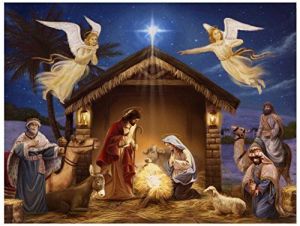
So your neighbors all have cute little mangers in their yards, complete with plastic baby Jesus, light-up sheep, and a couple of Wise Men who have probably seen better days. Are you feeling a bit left out? Don’t worry — you can still set up a Nativity scene (or something close to it) that represents your Pagan or Wiccan beliefs, and honors the birth of the sun, rather than the son of another religion’s god. More »
Make a batch of Yule potpourri, get it simmering on your stovetop, and enjoy the scents of the season! More »

In Irish-Celtic myth, Ogma is the god of eloquence and learning. He is the son of the goddess Danu and the god Dagda, and one of the foremost members of the Tuatha Dé Danann. He is the reputed inventor of the ancient Ogham alphabet which is used in the earliest Irish writings.
In the final battle at Mag Tuireadh he managed to take away the sword of the king of the Fomorians, but had to pay with his life for this feat. His Celtic equivalent is Ogmios.
Ogma or Oghma is a character from Irish mythology. A member of the Tuatha Dé Danann, he is often considered a deity and may be related to the Gaulish god Ogmios.
He fights in the first battle of Mag Tuired, when the Tuatha Dé take Ireland from the Fir Bolg. Under the reign of Bres, when the Tuatha Dé are reduced to servitude, Ogma is forced to carry firewood, but nonetheless is the only one of the Tuatha Dé who proves his athletic and martial prowess in contests before the king. When Bres is overthrown and Nuadu restored, Ogma is his champion. His position is threatened by the arrival of Lugh at the court, so Ogma challenges him by lifting and hurling a great flagstone, which normally required eighty oxen to move it, out of Tara, but Lugh answers the challenge by hurling it back. When Nuadu hands command of the Battle of Mag Tuired to Lugh, Ogma becomes Lugh’s champion, and promises to repel the Fomorian king, Indech, and his bodyguard, and to defeat a third of the enemy. During the battle he finds Orna, the sword of the Fomorian king Tethra, which recounts the deeds done with it when unsheathed. During the battle Ogma and Indech fall in single combat, although there is some confusion in the texts as in Cath Maige Tuired Ogma, Lugh and the Dagda pursue the Fomorians after the battle to recover the harp of Uaitne, the Dagda’s harper.
He often appears as a triad with Lugh and the Dagda, who are sometimes collectively known as the trí dée dána or three gods of skill, although that designation is elsewhere applied to other groups of characters. His father is Elatha and his mother is usually given as Ethliu, sometimes as Étaín. His sons include Delbaeth and Tuireann. He is said to have invented the Ogham alphabet, which is named after him.
Scholars of Celtic mythology have proposed that Ogma represents the vestiges of an ancient Celtic god. By virtue of his battle prowess and invention of Ogham, he is compared with Ogmios, a Gaulish deity associated with eloquence and equated with Herakles. J. A. MacCulloch compares Ogma’s epithet grianainech (sun-face) with Lucian’s description of the “smiling face” of Ogmios, and suggests Ogma’s position as champion of the Tuatha Dé Danann may derive “from the primitive custom of rousing the warriors’ emotions by eloquent speeches before a battle”, although this is hardly supported by the texts. Scholars such Rudolf Thurneysen and Anton van Hamel dispute any link between Ogma and Ogmios.
*
A Proto-Indo-European root *og-mo– ‘furrow, track, incised line’ may be the origin of the stem of the name. In addition, Proto-Celtic had a causative verbal suffix *-ej– ~ *-īj-. A hypothetical Proto-Celtic *Ogm-īj-o-sogm-. This agent noun would therefore mean ‘furrow-maker, incisor’ and may have had a metaphorical sense of ‘impresser.’ therefore looks very much like an agent noun derived from a verb formed by the addition of this causative suffix to the stem *
The Irish god of writing, eloquence and poetry. Ogma was credited of being inventor of the Celtic writing systems that the Druids used for their magic. These scripts were known as Ogham.
Ogma was the son of Dagda and the goddess Danu. Some other writers say that Ogma and Dagda were brothers; in this version they were the sons of Eithne. Ogma had also being called the son of Elatha, the king of the Fomorians.
Ogma was one the seven champions in the First Battle of Moytura (Mag Tuired), but when Bres became the king of Tuatha dé Danann, Ogma was degraded into working on humiliating manual job of gathering firewood.
When Lugh went to Nuada, asking for a place to serve the king, Ogma seemed to be Nuada’s foremost fighter. During the second battle of Moytura, Ogma had killed one of the Fomorian leaders, named Indech, the son of Domnu.
Ogma had married Etain, the daughter of Dian Cécht. Ogma had a son named Caipre. Some say that he was the father of MacCuill, MacCecht and MacGrené (MacGrene), the three Danann kings who ruled Ireland, during the Milesian invasion, though other say that Neit was their father.
To the Celtic Gauls he was called Ogmios. According to both Gallic and Irish myths Ogma was a warrior god, depicted as a wrinkled old man, wearing lion’s skin cloak, carrying a bow and club. The Romans considered Ogmios as the Celtic equivalent of Hercules (Greek Heracles). They also depicting Ogimos as holding people chained to his tongue by their ears, to indicate he was the god of eloquence and poetry.

So how does a Witch celebrate the Sabbats? Hmm, we always take for granted that each of automatically know what they are suppose to do on our Sabbats. Well, at least I did to recently. I was talking to a dear friend and I asked them how was your Yule. Did you do anything special? The reply was, well we did whatever Pagans are suppose to do, whatever that is! It didn’t dawn on me till a few days later. Perhaps we aren’t doing the job I thought we were doing. I decided to make a commitment to all of you. The commitment is before each Sabbat (over a few days) we will give your morning prayers, rituals, spells, activities, the correspondences and the Deities of that Sabbat. You will have the information to celebrate that Sabbat correctly.
I am very glad that my dear friend made this comment. I believe there are others that might be saying or thinking the same but have never told us. So now, we are going to provide you with everything you need. There will be no more wondering what Pagans/Witches do on the current Sabbats as the Wheel turns.
I hope you enjoy the information. If you ever have any questions or concerns about any issue, please contact us. Because if you don’t contact us, we won’t never know where we are lacking in our service to you.
Lady A & The WOTC
Down with Rosemary and so
Down with baies and mistletoe;
Down with Holly, live and all
Wherewith ys drest the Yuletide Hall;
That so the superstitious find No one least Branch there left behind;
For look, how many leaves there be
Neglected there, maids, trust to me,
So many goblins you shall see.
–Robert Herrick
Oimelc – Imbolc in the Saxon – marks the first stirring of life in the earth.
The Yule season originally ended at Oimelc. But with increasing organization and industrialization, increasing demands for labor and production, the holiday kept shrinking, first to the two weeks ending at Twelfth Night, then to a single week ending at New Year’s, then to a single day.
Oimelc begins a season of purification similar to that preceding Yule. It ends
at Ostara. No marriages, initiations or puberty rites should be celebrated
between Oimelc and Ostara.
The candles and torches at Oimelc signify the divine life-force awakening
dormant life to new growth.
THEMES
Growth of roots begin again. Bare branches begin to swell with leaf buds, and
growth appears at the tips of evergreen branches. The tools of agriculture are
being make ready for Spring.
Xian feasts of St. Brigid, and Celtic feast of Brigit, the maiden aspect of the
triple goddess and mother of Dagda. Her symbol is the white swan. A Roman feast of Bacchus and Ceres. The Lupercalia, a feast of Pan. The Nephelim or Titans, those offspring of human-divine unions said to have ruled Atlantis.
Grannus, a mysterious Celtic god whom the Romans identified with Apollo.
PURPOSE OF THE RITES
To awaken life in the Earth. Fire tires to strengthen the young Sun, to bring
the fertilizing, purifying, protective and vitalizing influence of fire to the
fields, orchards, domestic animals, and people. To drive away winter. To charm
candles for household use throughout the year.
FOLK CUSTOMS
The three functions of Oimelc – end of Yule, feast of candles or torches, and
beginning of a purificatory season – are divided by the Xian calendar among
Twelfth Night, Candlemas and Shrove Tuesday (Mardi Gras, Carnival). The customs of all three feasts are derived from Oimelc, with at most a thin Xian gloss.
Parades of giant figures (Titans?) in rural towns in France and at Mardi Gras
and Carnival celebrations. A figure representing the Spirit of Winter or Death,
sometime made of straw, sometimes resembling a snowman, is drowned, burnt or in once case, stuffed with fireworks and exploded. They symbol of Montreal’s Winter Carnival is the giant figure of Bonhomme di Neige (snowman).
Groundhog Day, Chinese New Year and St. Valentine’s Day customs.
The French provinces are so rich in Oimelc customs they cannot be listed here.
Refer to “The Golden Bough”.
Wassailing the trees: at midnight, carolers carry a bucket of ale, cider or
lamb’s wool in a torchlight procession through the orchards. The leader dips a
piece of toast in the drink and sedges it in the fork of each tree, with the
traditional cheer (variations exist) of: “Hats full, holes full, barrels full,
and the little heap under the stairs!”.
Who finds the bean in the Twelfth Night cake becomes king of the feast; who
finds the pea becomes queen – never mind the gender of the finders. Rag-bag
finery and gilt-paper crowns identify the king and queen. The rulers give
ridiculous orders to the guests, who must obey their every command. They are
waited on obsequiously, and everything they do is remarked and announced
admiringly and importantly: “The King drinks!”, “The Queen sneezes!” and
everyone politely imitates the ruler’s example.
SYMBOLIC DECORATIONS
Snowdrops are picked for vases, but otherwise no special decorative effects are
indicated. Go carnival, balloons and confetti.
SOCIAL ACTIVITIES
Parades, with showers of confetti, gala balls, masks, street dancing, mumming,
winter sports, ice and snow sculpture.
THE RITE
Dress in dark colors with much silver jewelry. Outdoors, after dark on the Even,
have the site arranged with a fire in the cauldron and the altar draped in
white, at the Northeast. The fire may be composed all or in part of Yule greens.
Go in a torchlight procession to the Circle. Include a stamping dance, possibly beating the ground with sticks, before the Invocation. The invocation may end with the calling of Hertha, a Teutonic goddess of the earth and the hearth. Call her name three times and at each call beat on the ground three times with the palms of both hands.
A figure representing Winter should be burned in the fire. Communion may consist of Sabbat Cakes or a Twelfth Night cake (there are many traditional recipes) and cider or wassail. A procession may leave the Circle for a time to wassail a nearby orchard. Couples may leap the bonfire. Supplies of candles brought by the coveners are blessed.
Boys puberty rites may be celebrated. These usually include mock plowing by the boys.
Close the Circle and go indoors for the feast.
THE FEAST OF LIGHT
(By: Titania Morgay)
If Candlemas day be fair and bright,
Winter will have another flight.
If Candlemas day clouds and rain,
Winter is gone, and will not come again.
– E. Holden
The time has come to call and welcome the forces of light!
Candlemas or Imbolc is the mid point of the dark half of the year. We
welcome the rebirth and awakening of the Earth, the earliest beginnings of
Spring.
Through Pagan lore, we learn that the Sun God, who is now a young boy, is
beginning to feel his growing powers through the renewing energies of the
Sun, represented in the lengthening in the daylight hours. The Goddess is
awakening from her slumber and rest after giving birth to the
God/Child at Yule. She is represented in the Maiden aspect of the triple
Goddess. The awakening of the Goddess/Earth, causes germination of seeds and
development of buds on the trees, as the powers of the Sun begin to warm and
renew the earth. A celebration of fertility.
Traditionally, Imbolc is a time to prepare for the goals one wishes to
accomplish in the coming months, and to clarify and redefine our personal
projects which were begun at Yule. the fires of Imbolc represent our
personal illumination and inspiration, a celebration of ideas yet to be
born. Imbolc has also become a time for new initiations into covens,
self-dedication, and renewal of our bows. It is also a time for purification
of oneself.
The colors for Imbolc are lavender, white and pink. Herbs include
Heliotrope, Carnation, Poppy, Basil and Violet. Stones used for this
celebration may include Amethyst for peace of mind or jet for
heightened intuition and inner sight.
Offerings of cakes and wine may be presented to the Lord and Lady, to seek
their assistance in helping to ignite your creative fires and energy.
May the fires of Imbolc burn brightly within all of you throughout the
coming year!
Eyes of the Wolf Spell
Midvintersblot or Midwinter’s offering, from called Tiugunde Day in Old England, was sacred to Tiu, the ancient Teutonic Chief God and ruler of the year. This festival falls 20 days after Yule and is when the runic half-month of Peorth commences.
This day was christened as Saint Hilary’s Day (for Hilary of Poitiers), the patron of backward children, who was invoked against snake bites. This time is traditionally the coldest point of the year and marks the time when marriages were once again permitted after the Christmas season

Merry Yule,
Love,
Lady A
2 parts Frankincense
2 parts Pine needles or resin
1 part Cedar
1 part Juniper berries
3 parts Frankincense
2 parts Sandalwood
2 part Chamomile
1 part Ginger
1/2 part Sage
A few drops of Cinnamon oil
3 parts Pine needles or resin
3 parts Cedar
1 part Bayberry
1 part Cinnamon
3 parts frankincense
A few drops orange oil
A few drops juniper oil
1 part crushed juniper berries
½ part mistletoe
Method Blend together and burn on charcoal.
YULE LORE
One traditional Yuletide practice is the creation of a Yule tree. This can be a
living, potted tree which can later be planter in the ground, or a cut one. The
choice is yours.
Appropriate Pagan decorations are fun to make, from strings of dried rosebuds
and cinnamon sticks (or popcorn and cranberries) for garlands, to bags of
fragrant spices which are hung from boughs. Quartz crystals can be wrapped with shiny wire and suspended from sturdy branches to resemble icicles. Apples,
oranges and lemons hanging from boughs are strikingly beautiful, natural
decorations, and were customary in ancient times.
Many enjoy the custom of lighting the Yule log. This is a graphic representation
of the rebirth of the God within the sacred fire of the Mother Goddess. If you
choose to burn one, select a proper log (traditionally of oak or pine). Carve
or chalk a figure of the Sun (such as a rayed disc) or the God (a horned circle
or a figure of a man) upon it, with the Boline, and set it alight in the
fireplace at dusk on Yule. As the log burns, visualize the Sun shining within
it and think of the coming warmer days.
As to food, nuts, fruits such as apples and pears, cakes of caraways soaked in
cider, and (for non-vegetarians) pork are traditional fare. Wassail,
lambswool, hibiscus or ginger tea and fine drinks for the Simple Feast or Yule
Meals.
MIDWINTER NIGHT’S EVE – Y U L E
by Mike Nichols
Our Christian friends are often quite surprised at how enthusiastically we
Pagans celebrate the ‘Christmas’ season. Even though we prefer to use the word
‘Yule’, and our celebrations may peak a few days BEFORE the 25th, we nonetheless follow many of the traditional customs of the season: decorated trees, caroling, presents, Yule logs, and mistletoe. We might even go so far as putting up a ‘Nativity set’, though for us the three central characters are likely to be interpreted as Mother Nature, Father Time, and the Baby Sun-God. None of this will come as a surprise to anyone who knows the true history of the holiday, of course.
In fact, if truth be known, the holiday of Christmas has always been more Pagan
than Christian, with it’s associations of Nordic divination, Celtic fertility
rites, and Roman Mithraism. That is why both Martin Luther and John Calvin
abhorred it, why the Puritans refused to acknowledge it, much less celebrate it
(to them, no day of the year could be more holy than the Sabbath), and why it
was even made ILLEGAL in Boston! The holiday was already too closely associated with the birth of older Pagan gods and heroes. And many of them (like Oedipus, Theseus, Hercules, Perseus, Jason, Dionysus, Apollo, Mithra, Horus and even Arthur) possessed a narrative of birth, death, and resurrection that was uncomfortably close to that of Jesus. And to make matters worse, many of them pre-dated the Christian Savior.
Ultimately, of course, the holiday is rooted deeply in the cycle of the year. It
is the Winter Solstice that is being celebrated, seed-time of the year, the
longest night and shortest day. It is the birthday of the new Sun King, the Son
of God — by whatever name you choose to call him. On this darkest of nights,
the Goddess becomes the Great Mother and once again gives birth. And it makes
perfect poetic sense that on the longest night of the winter, ‘the dark night of
our souls’, there springs the new spark of hope, the Sacred Fire, the Light of
the World, the Coel Coeth.
That is why Pagans have as much right to claim this holiday as Christians.
Perhaps even more so, as the Christians were rather late in laying claim to it,
and tried more than once to reject it. There had been a tradition in the West
that Mary bore the child Jesus on the twenty-fifth day, but no one could seem to
decide on the month. Finally, in 320 C.E., the Catholic Fathers in Rome decided
to make it December, in an effort to co-opt the Mithraic celebration of the
Romans and the Yule celebrations of the Celts and Saxons.
There was never much pretense that the date they finally chose was historically
accurate. Shepherds just don’t ‘tend their flocks by night’ in the high
pastures in the dead of winter! But if one wishes to use the New Testament as
historical evidence, this reference may point to sometime in the spring as the
time of Jesus’ birth. This is because the lambing season occurs in the spring
and that is the only time when shepherds are likely to ‘watch their flocks by
night’ – to make sure the lambing goes well. Knowing this, the Eastern half of
the Church continued to reject December 25, preferring a ‘movable date’ fixed by
their astrologers according to the moon.
Thus, despite its shaky start (for over three centuries, no one knew when Jesus
was supposed to have been born!), December 25 finally began to catch on. By 529,
it was a civic holiday, and all work or public business (except that of cooks,
bakers, or any that contributed to the delight of the holiday) was prohibited by
the Emperor Justinian. In 563, the Council of Braga forbade fasting on Christmas
Day, and four years later the Council of Tours proclaimed the twelve days from
December 25 to Epiphany as a sacred, festive season. This last point is perhaps
the hardest to impress upon the modern reader, who is lucky to get a single day
off work. Christmas, in the Middle Ages, was not a SINGLE day, but rather a
period of TWELVE days, from December 25 to January 6. The Twelve Days of
Christmas, in fact. It is certainly lamentable that the modern world has
abandoned this approach, along with the popular Twelfth Night celebrations.
Of course, the Christian version of the holiday spread to many countries no
faster than Christianity itself, which means that ‘Christmas’ wasn’t celebrated
in Ireland until the late fifth century; in England, Switzerland, and Austria
until the seventh; in Germany until the eighth; and in the Slavic lands until
the ninth and tenth. Not that these countries lacked their own mid-winter
celebrations of Yuletide. Long before the world had heard of Jesus, Pagans had
been observing the season by bringing in the Yule log, wishing on it, and
lighting it from the remains of last year’s log. Riddles were posed and
answered, magic and rituals were practiced, wild boars were sacrificed and
consumed along with large quantities of liquor, corn dollies were carried from
house to house while caroling, fertility rites were practiced (girls standing
under a sprig of mistletoe were subject to a bit more than a kiss), and
divinations were cast for the coming Spring. Many of these Pagan customs, in an
appropriately watered-down form, have entered the mainstream of Christian
celebration, though most celebrants do not realize (or do not mention it, if
they do) their origins.
For modern Witches, Yule (from the Anglo-Saxon ‘Yula’, meaning ‘wheel’ of the
year) is usually celebrated on the actual Winter Solstice, which may vary by a
few days, though it usually occurs on or around December 21st. It is a Lesser
Sabbat or Lower Holiday in the modern Pagan calendar, one of the four quarter-
days of the year, but a very important one. This year (1988) it occurs on
December 21st at 9:28 am CST. Pagan customs are still enthusiastically
followed. Once, the Yule log had been the center of the celebration. It was
lighted on the eve of the solstice (it should light on the first try) and must
be kept burning for twelve hours, for good luck. It should be made of ash.
Later, the Yule log was replaced by the Yule tree but, instead of burning it,
burning candles were placed on it. In Christianity, Protestants might claim that
Martin Luther invented the custom, and Catholics might grant St. Boniface the
honor, but the custom can demonstrably be traced back through the Roman
Saturnalia all the way to ancient Egypt. Needless to say, such a tree should be
cut down rather than purchased, and should be disposed of by burning, the proper
way to dispatch any sacred object.
Along with the evergreen, the holly and the ivy and the mistletoe were important
plants of the season, all symbolizing fertility and everlasting life. Mistletoe
was especially venerated by the Celtic Druids, who cut it with a golden sickle
on the sixth night of the moon, and believed it to be an aphrodisiac. (Magically
— not medicinally! It’s highly toxic!) But aphrodisiacs must have been the
smallest part of the Yuletide menu in ancient times, as contemporary reports
indicate that the tables fairly creaked under the strain of every type of good
food. And drink! The most popular of which was the ‘wassail cup’ deriving its
name from the Anglo-Saxon term ‘waes hael’ (be whole or hale).
Medieval Christmas folklore seems endless: that animals will all kneel down as
the Holy Night arrives, that bees hum the ‘100th psalm’ on Christmas Eve, that a
windy Christmas will bring good luck, that a person born on Christmas Day can
see the Little People, that a cricket on the hearth brings good luck, that if
one opens all the doors of the house at midnight all the evil spirits will
depart, that you will have one lucky month for each Christmas pudding you
sample, that the tree must be taken down by Twelfth Night or bad luck is sure to
follow, that ‘if Christmas on a Sunday be, a windy winter we shall see’, that
‘hours of sun on Christmas Day, so many frosts in the month of May’, that one
can use the Twelve Days of Christmas to predict the weather for each of the
twelve months of the coming year, and so on.
Remembering that most Christmas customs are ultimately based upon older Pagan
customs, it only remains for modern Pagans to reclaim their lost traditions. In
doing so, we can share many common customs with our Christian friends, albeit
with a slightly different interpretation. And thus we all share in the beauty of
this most magical of seasons, when the Mother Goddess once again gives birth to
the baby Sun-God and sets the wheel in motion again. To conclude with a long-
overdue paraphrase, ‘Goddess bless us, every one!
You must be logged in to post a comment.