Goddess Of The Day is Blodeuwedd c. 2011

Blodeuwedd

by Karen Davis
Blodeuwedd was created out of flowers by Gwydion to wed Llew Llaw Gyffes. She betrayed Llew, either because she had no soul, being non-human, or because she resented being his chattel, or because the triplet of one woman and two men must play itself out in Welsh myth, and Llew Llaw Gyffes must die. At any rate, she fell in love with Goronwy and, wishing to be rid of Llew, she tricked out of him the clearly supernatural and ritual manner in which only he could be killed: neither by day nor night, indoors nor out of doors, riding nor walking, clothed nor naked, nor by any weapon lawfully made. She asked him to explain this, and he did: he could be killed only if it were twilight, wrapped in a fish net, with one foot on a cauldron and the other on a goat, and if the weapon had been forged during sacred hours when such work was forbidden. Blodeuwedd convinced him to demonstrate how impossible such a position was to achieve by chance, and when he was in it, het lover Goronwy leapt out and struck. Llew was transformed into an eagle and eventually restored to human form, after which he killed Goronwy. Blodeuwedd was transformed into an owl, to haunt the night in loneliness and sorrow, shunned by all other birds.

Gods – Anubis – Egyptian c. 2018

Anubis


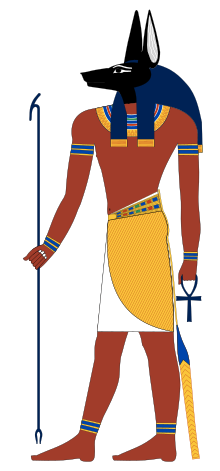
Anubis is the Greek name of a god associated with mummification and the afterlife in ancient Egyptian religion, usually depicted as a canine or a man with a canine head. Archeologists have identified Anubis’s sacred animal as an Egyptian canid, the African golden wolf.

Like many ancient Egyptian deities, Anubis assumed different roles in various contexts. Depicted as a protector of graves as early as the First Dynasty (c. 3100 – c. 2890 BC), Anubis was also an embalmer. By the Middle Kingdom (c. 2055 – 1650 BC) he was replaced by Osiris in his role as lord of the underworld. One of his prominent roles was as a god who ushered souls into the afterlife. He attended the weighing scale during the “Weighing of the Heart,” in which it was determined whether a soul would be allowed to enter the realm of the dead. Despite being one of the most ancient and “one of the most frequently depicted and mentioned gods” in the Egyptian pantheon, Anubis played almost no role in Egyptian myths.

Anubis was depicted in black, a color that symbolized both rebirth and the discoloration of the corpse after embalming. Anubis is associated with Wepwawet (also called Upuaut), another Egyptian god portrayed with a dog’s head or in canine form, but with grey or white fur. Historians assume that the two figures were eventually combined. Anubis’ female counterpart is Anput. His daughter is the serpent goddess Kebechet.

Name

“Anubis” is a Greek rendering of this god’s Egyptian name. In the Old Kingdom (c. 2686 BC – c. 2181 BC), the standard way of writing his name in hieroglyphs was composed of the sound signs jnpw followed by a jackal over a ḥtp sign:

i n
p
w C6

A new form with the “jackal” on a tall stand appeared in the late Old Kingdom and became common thereafter:

i n
p
w E16

Anubis’ name jnpw was possibly pronounced [a.ˈna.pʰa], based on Coptic Anoup and the Akkadian transcription 𒀀𒈾𒉺<a-na-pa> in the name <ri-a-na-pa> “Reanapa” that appears in Amarna letter EA 315. However, this transcription may also be interpreted as rˁ-nfr, a name similar to that of Prince Ranefer of the Fourth Dynasty.

History

In Egypt’s Early Dynastic period (c. 3100 – c. 2686 BC), Anubis was portrayed in full animal form, with a “jackal” head and body.  A “jackal” god, probably Anubis, is depicted in stone inscriptions from the reigns of Hor-Aha, Djer, and other pharaohs of the First Dynasty.  Since Predynastic Egypt, when the dead were buried in shallow graves, “jackals” had been strongly associated with cemeteries because they were scavengers which uncovered human bodies and ate their flesh. In the spirit of “fighting like with like,” a “jackal” was chosen to protect the dead, because “a common problem (and cause of concern) must have been the digging up of bodies, shortly after burial, by jackals and other wild dogs which lived on the margins of the cultivation.”

The oldest known textual mention of Anubis is in the Pyramid Texts of the Old Kingdom (c. 2686 – c. 2181 BC), where he is associated with the burial of the pharaoh.

In the Old Kingdom, Anubis was the most important god of the dead. He was replaced in that role by Osiris during the Middle Kingdom(2000–1700 BC). In the Roman era, which started in 30 BC, tomb paintings depict him holding the hand of deceased persons to guide them to Osiris.

The parentage of Anubis varied between myths, times and sources. In early mythology, he was portrayed as a son of Ra. In the Coffin Texts, which were written in the First Intermediate Period (c. 2181–2055 BC), Anubis is the son of either the cow goddess Hesat or the cat-headed Bastet. Another tradition depicted him as the son of Ra and Nephthys. The Greek Plutarch (c. 40–120 AD) stated that Anubis was the illegitimate son of Nephthys and Osiris, but that he was adopted by Osiris’s wife Isis:

For when Isis found out that Osiris loved her sister and had relations with her in mistaking her sister for herself, and when she saw a proof of it in the form of a garland of clover that he had left to Nephthys – she was looking for a baby, because Nephthys abandoned it at once after it had been born for fear of Seth; and when Isis found the baby helped by the dogs which with great difficulties lead her there, she raised him and he became her guard and ally by the name of Anubis.

George Hart sees this story as an “attempt to incorporate the independent deity Anubis into the Osirian pantheon.” An Egyptian papyrus from the Roman period (30–380 AD) simply called Anubis the “son of Isis.”

In the Ptolemaic period (350–30 BC), when Egypt became a Hellenistic kingdom ruled by Greek pharaohs, Anubis was merged with the Greek god Hermes, becoming Hermanubis. The two gods were considered similar because they both guided souls to the afterlife. The center of this cult was in uten-ha/Sa-ka/ Cynopolis, a place whose Greek name means “city of dogs.” In Book XI of The Golden Ass by Apuleius, there is evidence that the worship of this god was continued in Rome through at least the 2nd century. Indeed, Hermanubis also appears in the alchemical and hermetical literature of the Middle Ages and the Renaissance.

Although the Greeks and Romans typically scorned Egypt’s animal-headed gods as bizarre and primitive (Anubis was mockingly called “Barker” by the Greeks), Anubis was sometimes associated with Sirius in the heavens and Cerberus and Hades in the underworld. In his dialogues, Plato often has Socrates utter oaths “by the dog” (kai me ton kuna), “by the dog of Egypt”, and “by the dog, the god of the Egyptians”, both for emphasis and to appeal to Anubis as an arbiter of truth in the underworld.

Roles

Protector of tombs

In contrast to real wolves, Anubis was a protector of graves and cemeteries. Several epithets attached to his name in Egyptian texts and inscriptions referred to that role. Khenty-imentiu, which means “foremost of the westerners” and later became the name of a different wolf god, alluded to his protecting function because the dead were usually buried on the west bank of the Nile. He took other names in connection with his funerary role, such as tpy-ḏw.f “He who is upon his mountain” (i.e. keeping guard over tombs from above) and nb-t3-ḏsr “Lord of the sacred land”, which designates him as a god of the desert necropolis.

The Jumilhac papyrus recounts another tale where Anubis protected the body of Osiris from Set. Set attempted to attack the body of Osiris by transforming himself into a leopard. Anubis stopped and subdued Set, however, and he branded Set’s skin with a hot iron rod. Anubis then flayed Set and wore his skin as a warning against evil-doers who would desecrate the tombs of the dead. Priests who attended to the dead wore leopard skin in order to commemorate Anubis’ victory over Set. The legend of Anubis branding the hide of Set in leopard form was used to explain how the leopard got its spots.

Most ancient tombs had prayers to Anubis carved on them.

Embalmer

As jmy-wt “He who is in the place of embalming”, Anubis was associated with mummification. He was also called ḫnty zḥ-nṯr “He who presides over the god’s booth”, in which “booth” could refer either to the place where embalming was carried out or the pharaoh’s burial chamber.

In the Osiris myth, Anubis helped Isis to embalm Osiris. Indeed, when the Osiris myth emerged, it was said that after Osiris had been killed by Set, Osiris’s organs were given to Anubis as a gift. With this connection, Anubis became the patron god of embalmers; during the rites of mummification, illustrations from the Book of the Dead often show a wolf-mask-wearing priest supporting the upright mummy.

Guide of souls

By the late pharaonic era (664–332 BC), Anubis was often depicted as guiding individuals across the threshold from the world of the living to the afterlife. Though a similar role was sometimes performed by the cow-headed Hathor, Anubis was more commonly chosen to fulfill that function. Greek writers from the Roman period of Egyptian history designated that role as that of “psychopomp”, a Greek term meaning “guide of souls” that they used to refer to their own god Hermes, who also played that role in Greek religion. Funerary art from that period represents Anubis guiding either men or women dressed in Greek clothes into the presence of Osiris, who by then had long replaced Anubis as ruler of the underworld.

Weighing of the heart

One of the roles of Anubis was as the “Guardian of the Scales.” The critical scene depicting the weighing of the heart, in the Book of the Dead, shows Anubis performing a measurement that determined whether the person was worthy of entering the realm of the dead (the underworld, known as Duat). By weighing the heart of a deceased person against Ma’at (or “truth”), who was often represented as an ostrich feather, Anubis dictated the fate of souls. Souls heavier than a feather would be devoured by Ammit, and souls lighter than a feather would ascend to a heavenly existence.


Source

Wikipedia


A Little Humor for Your Day – Fortune Teller Jokes

Fortune Teller Jokes


Griselda goes to see a fortune teller, who tells her “Two men are madly in love with me!”

Grizelda asks “Who will be the lucky one?”

The fortune teller answers “Morris will marry you, and Irving will be the lucky one.”


Fortune teller One: “Lovely weather we’re having.”

Fortune teller Two: “Yes, it reminds me of the summer of 2023.”


Paul was ambling through a crowded street fair when he decided to stop and sit at a Palm Reader’s table.

Said the mysterious old woman, “For fifteen dollars, I can read your love line and tell your romantic future.”

Paul readily agreed and the reader took one look at his open palm and said, “I can see that you have no girlfriend.”

“That’s true,” said Paul.

“Oh my goodness, you are extremely lonely, aren’t you?”

“Yes,” Paul shamefully admitted. “That’s amazing. Can you tell all of this from my love line?”

“Love line? No, from the calluses.”


Why did the witch give up fortune telling?

There was no future in it.


“Five dollars for one question!” said the woman to the fortune teller.

“That’s very expensive, isn’t it?”

“Next!”

Spell for Tody – A Colorful Sunny Day Spell c. 2018

Finally, it’s Sunday, the official day of rest. Not only do Christians acknowledge this day, but I’m sure many Pagans appreciate this day, as well. Everyone needs rest and lot of people need a good day to worship their creator (whomever or whatever that may be), however they deem fit to do so. With the Sun being the central theme of many ancient rituals, Sunday just seems to fit, in name and theory. Not only is it a good day to worship, it seems good to do more relaxed spells, such as, sleep, dream and rebirth.

A Colorful Sunny Day Spell

Try working this spell on a gloomy, rainy Sunday, or any day. It will lift your spirits, no matter what the weather.

Slip on your sunny outfit or wear your sun-themed jewelry, and then take a moment to imagine yourself either on a sun-drenched beach or in the middle of a bright meadow with the sun streaming down on you. Now picture that a little of the sun’s warmth is soaking into the bright colors or jewelry that you are wearing. Do you feel a bit warmer? While you are visualizing this for a moment or two, repeat the following spell three times:

Even though the skies may be cloudy and gray
I will wear the colors of the sun today
For the colors of yellow, gold, and orange, you see
Work their own sunny magick; so mote it be!

Close the spell by saying:

For the good of all, with harm to none
By color and light, this spell is done!
Then take a deep breath, blow it out, and go dazzle ’em today!

Book of Witchery: Spells, Charms & Correspondences for Every Day of the Week
Ellen Dugan


Correspondences for Sunday, March 25 c. 2019


Correspondences for Sunday

Magickal Intentions: Growth, Advancements, Enlightenment, Rational Thought, Exorcism, Healing, Prosperity, Hope, Exorcism, Money

Incense: Lemon, Frankincense

Planet: Sun

Sign: Leo

Angel: Michael

Colors: Gold, Yellow, Orange and White

Herbs/Plants: Marigold, Heliotrope, Sunflower, Buttercup, Cedar, Beech, Oak

Stones: Carnelian, Citrine, Tiger’s Eye, Amber, Clear Quartz and Red Agate

Oil: (Sun) Cedar, Frankincense, Neroli, Rosemary

The first day of the week is ruled by the Sun. It is an excellent time to work efforts involving business partnerships, work promotions, business ventures, and professional success.

Spells where friendships, mental or physical health, or bringing joy back into life are an issue work well on this day, too

The Witches Divination Journal by Lady Abyss c. 2018


Your Personal Daily Tarot Card

Judgement

Judgment embodies those forces which require us to be accountable for our actions. With Judgment truths are revealed, mysteries are unraveled and responsibility is assigned. Judgment unveils outcomes and marks the ends of things. While it is a time to properly place guilt, it is also a time for atonement and forgiveness. Ultimately the process of Judgment should lead to freedom from errors made in the past and a fresh start with a clean slate. To that end Judgment actually promises the start of a new journey on which we can apply what we have learned from our past.

bling-stars-animated-background8


Your Daily Love Tarot Card for Today

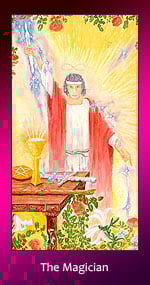
The Magician

Do some magic of your own today, like penetrating facades and gaining insights into dubious stories that lack credibility. Hold onto your heartstrings until you know you haven’t met a fickle flirt or a trickster. The Magician makes us see what we want to see regardless of the reality of a situation. He draws us in because we love secrets and mysteries, but who wants to live with them day after day and year after year?

bling-stars-animated-background8

Your Past Life Tarot Card for Today

The Star

When you stand up for other’s rights you can stir deeply-seated past life memories in yourself. The origin of these feelings might come from having a past life experience of your own family’s struggle. At this time the civil rights leader inside you has come to the forefront. This spirit is more afraid of not standing up for what he or she believes in then fearful of what retribution one could face. This incarnation comes with an inner strength that is founded in compassion.


bling-stars-animated-background8

Your Daily Rune for Today

Fehu

“Fay-Who” – Literally: “Cattle” – Esoteric: Mobile Property, New Beginnings, Wealth

Key Concepts: Wealth, money, food, sustenance, Hamingja, luck, personal power, circulation of power, financial strength, prosperity

Psi: Beginner’s Mind, presence, freedom, first impressions, young love

Energy: mobility, luck, charisma, dynamic power, liquid and mobile transferable energies, abundance, circulation, ‘mana’, sexual attraction

Mundane: money, recent purchases, reputation, freshness, fashionability

Divinations: New beginnings, social success, foresight, energy, travel, money, control; or greed, failure, atrophy, poverty, endings.

Governs:

  • Delegating your energy to another, power transference or projection; the sending rune
  • Drawing gravity into the personal sphere
  • Promotion of personal and social evolution, changing circumstances of importance
  • Increase in personal monetary wealth
  • Beginner’s mind and presence as a tool for consciously creating a fresh start

bling-stars-animated-background8

Your Karmic Number for Today

Life is a bit hard to piece together lately if you’ve drawn out a 3 in opposition like you have now. Jigsaw puzzles can be fun and relaxing. They help pass the time. It is messy when your life is in a thousand pieces. You have pieces missing, so the picture is incomplete. Change your diet. Drink more water, detox, exercise. Do some breathing techniques, journal. Confide in a good friend about your challenges. You are overdue for a purge of the toxins in your life. You will find what you need in unexpected ways.


bling-stars-animated-background8

Crack the Cookie

bling-stars-animated-background8

The Wisdom of Buddha

All wrong-doing arises because of mind. If mind is transformed can wrong-doing remain?

Spell for Today – Exercise Spell c. 2018

Exercise Spell

Items needed for this spell:
Your body
Put on your exercise apparel and start your exercise routine. Do whatever warm-ups you need to do, before starting this spell. Once you are warmed-up, Hold up your hands up in the air and move your arms in gesture, as you say this chant eight times:

“I’m a tree, I’m a tree.
Today is two, for Tuesday.
Tomorrow is three.
Tonight the moon will rise.
Everyone tells me it’s good for
the body,
And that I need to exercise.”

Then, put your hands on your waste. Bend to your left side, eight times, while saying this chant:

“I’m a tree, I’m a tree.
I sway and bend.
One, two, three.
Limbering up for wind.”
Repeat this chant for the right side:
“I’m a tree, I’m a tree.
I sway and bend.
One, two, three.
Limbering up for wind.”

Now, bend over and touch your toes for about eight times. Each time you bend over, say this chant:

“I’m a tree, I’m a tree.
Today is two, for Tuesday.
Tomorrow is three.
Tonight the moon will rise.
I know it’s good for my body,
And that I need to exercise.”

Then, stand on one leg for about a fifteen seconds and alternate between both legs, for a total of about 4 minutes, while doing this, say this chant:

“I’m a tree, I’m a tree.
Today is two, for Tuesday.
Tomorrow is three.
Tonight the moon will rise.
If I want to stay healthy,
I need to exercise.”

Finally, run in place for about 10 minutes and say this chant:

“Step, step, step, step.
One after another
And more to go.
I’m running and talking,
Every day, a little further.
Taking breaths and walking.
Every inch grows.
Step, step, step, step.
Keep going.
Water in my cup.
Or bottled not to spill.
Always a test of the mind,
And a test of the will.
Might run tired,
But I never give up.”

Saying these chants while exercising, will, hopefully, ensure your desire to repeat these routines, week after week, and make the time go by quicker.

A Witch’s Week of Spells and Activities
Helga C. Loueen

The Study of Pagan Gods and Goddesses: Vidar c. 2018

Vidar

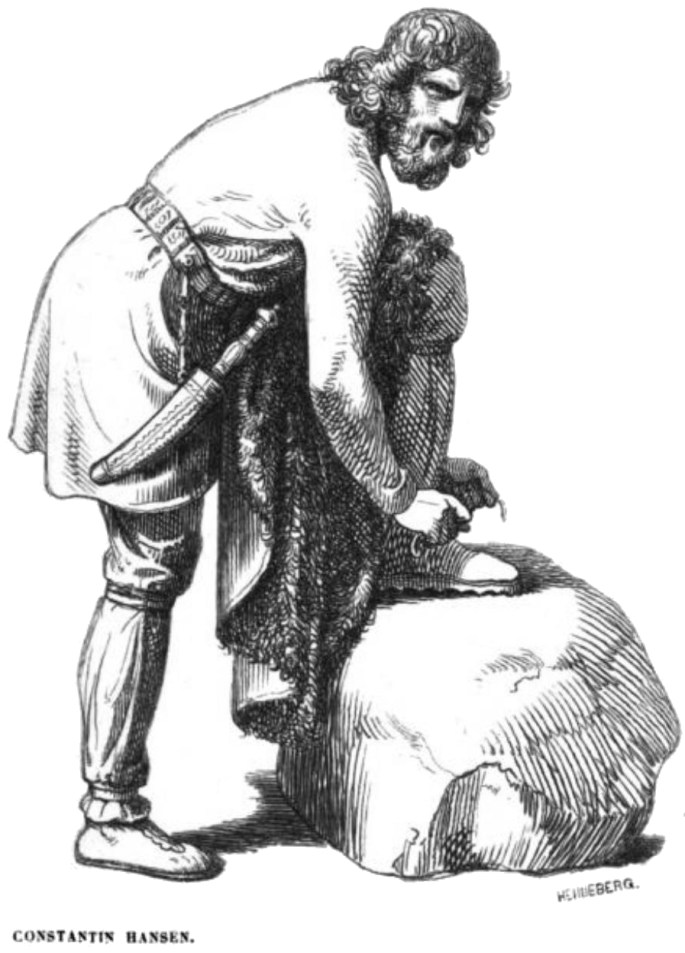
Vidar (Old Norse Víðarr), his name might mean “Wide Ruler” he is the son of the all-father Odin and the giantess Gríðr. Yes, you read that correctly, some of the Æsir have previously been together with the Jotuns, also known as giants. Some of the giants were so beautiful that even the Gods could not resist their beauty.

Vidar is the second strongest of the Æsir only Thor is stronger than him, Vidar might have inherited some of his strength from the giant side of the family. Vidar lives in Asgard in a great hall called Vidi, it’s a peaceful home and the inside looks like a garden.

Vidar is known for being very silent he loves being at peace with nature. Vidar sometimes sits for hours in his garden working on a special shoe.
This special shoe is the strongest of all the shoes and is being made from all bits and pieces of leather that shoemakers throw in the trash when making new shoes in Midgard. Vidar will use this special shoe to revenge his father’s death Odin at Ragnarok (Ragnarök).

This is when Vidar will fight the fearsome Fenris wolf, by placing one foot on Fenris’s lower jaw and pressing his hands on the upper jaw until Fenris’s mouth will be pulled apart. Ragnarok is the doom of the Gods and the end of the world. But from death, there also comes life, and Vidar is one of the few Gods who will survive Ragnarok and rebuilt the new world

—————————————

Hymn to Vidarr

Vidar1Hail to the Silent God
Who sees much and speaks little,
Who waits patiently for the moment
Of injustice that needs to be equalized.
Hail to the God called upon
When cruelty has gone so far
That there is no making things right,
Hail to the God of cold vengeance
Who does what is necessary
To even up the debt,
To bring Fate’s balance true
Quicker than entropy would allow.
Hail to the God of the Thick-Soled Shoe
Whose steps are silent
So that he might approach from behind.
Hail to you, son of Grid the Wise
And Odin the Powerful,
May I know to call upon you
Only as a last resort.

— Seawalker, Author

————————————————–

Vidar

It is said that Odin had an affair with the warrior goddess Grid, and that she bore him a son named Vidarr, who took after his father and became one of the honored Aesir Gods. He is one of the two Gods of Vengeance – the other being his half-brother Váli, as it seems that in ancient Norse culture one deity of vengeance was not enough.

Vidarr’s name may originally have meant “widely ruling”. He is known as “the Silent God”, meaning that he does not flaunt his vengeance; Vidarr is said to speak little, but be a fierce warrior when the moment is needed. It is also said that he is almost as strong as Thor, and that the Gods depend upon him in times of trouble. Some scholars theorize that his “silent God” appellation may have something to do with ancient rituals of vengeance; it may be that individuals who were preparing for a vengeance battle refrained from speaking as part of a ritual purification.

He is also known as the God of the Thick Shoe, as he is constantly in the process of building up the soles of his shoes. This is done so that if Ragnarok comes and he faces Fenrir, he will be able to put his foot on Fenrir’s enormous jaws and strike his heart through his throat. Traditionally, shoemakers (and before that, people who made their own shoes) were encouraged to dedicate the little scraps of leather they trimmed off of their new shoe soles to Vidarr, who would collect them and add them slowly to his own soles.

In the saga Grímnismál, Odin describes the halls of many Gods, including that of his son Vidarr:

Brushwood grows and high grass
widely in Vidar’s land
and there the son proclaims on his horse’s back
that he’s keen to avenge his father.

This latter point is a harbinger of the prophecy that if Ragnarok comes, Fenrir will be loosed and will slay Odin, but he will be slain in turn by Vidarr. Both brothers are said to survive Ragnarok and help to rebuild a new world after Surt’s fires have burnt down. To make an offering to Vidarr, give him a weapon – throw it into icy water, or a bog, or bury it in ice.


Reference

Norse Mythology

Odin’s Family Tribe of Asgard

Goddess Of The Day: VENUS c. 2011

Venus


Lupercalia (Rome)
Themes: Love; Passion; Romance; Sexuality
Symbols: Doves; Flowers; Berries; Trees; Pine Cones
About Venus: Venus was originally an Italic goddess of blossoms; hearts and flowers have slowly become attributed to her loving, passionate energies. In fact, her name became the root for the word to venerate – to lift up, worship, or esteem. So it is that Venus greets prespring efforts for uplifting our hearts with positive relationships.
To Do Today: During Lupercalia, an ancient predecessor of Valentine’s Day, single girls put their names in a box, and unmarried men drew lots to see with whom they would be paired off for the coming year. To be more modern-minded, try pinning five bay leaves to your pillow instead to dream of future loves. If you’re married or otherwise involved, steep the bay leaves in water and drink the resulting tea to strengthen the love in your relationship.
To encourage balance in a relationship, bind together Venus’s symbols, a pine cone and a flower, and put them somewhere in your home. Or, to spice up a passionate moment, feed fresh berries to each others and drink a berry beverage from one cup (symbolizing united goals and destinies).
In Roman tradition, anywhere there’s a large stone adjacent to a tall tree, Venus is also there. Should you know of such a place, go there today and commune with her warm, lusty energy.


)0( 

By Patricia Telesco

Daily OM – Working with Angels c. 2012

Graceful Guidance

by Madisyn Taylor

Our angels are here to help us and by calling on them for assistance they are able to do their job.


At some point in our lives, we are likely to find ourselves asking for help, perhaps from no one in particular, and without knowing where help could possibly come from. We may have raised our eyes skyward or whispered our need under our breath only to find that somehow we were heard, and the help we needed arrived. It might have come in the form of a person who appeared at the right time, or perhaps it came in the form of luck, chance, or divine intervention. However assistance appears, these are times when we can be sure that there are angels watching over us.
We may find ourselves asking for their help with simple things—like finding a parking spot or to watch over loved ones—but then we forgot to call on them when we found ourselves alone or in pain. We don’t need to be aware of them to receive their assistance, but there is comfort in the knowledge that they are there for us when we need them. And when we remain open to their presence, we can call on them whenever we need them to connect and be nurtured by their ethereal and heavenly energy.
As symbols of grace and gentle encouragement, they can offer us comfort as they enfold us in their wings or lift our spirit as they take flight. We may be warmed by their glow, guided by their gentle nudges or inspired by their whispers in our ears. We may hear the name of our angel and feel a personal connection, but it isn’t necessary. All they need is to be heard, to see us benefit from their guidance and perhaps to hear a word of thanks sent their way every now and then. Whether they appear in the guise of a helpful stranger, or as a thought that suddenly occurs to us, angels are our loving guides from the spiritual realm, who with a brush of their angelic wings help us to make the most of our human experience by balancing it with the spiritual awareness that all things are possible and that we are not alone.

Magick Symbols – SQUARE c. 2018

SQUARE

In contrast to the circle which often symbolizes the sacred and spiritual (including the sacred earth), the square represents the physical world. Like the quartered circle, it points pagans to the four compass directions: north, east, south and west. While the circle and “spiral” symbolize female sexuality in many earth-centered cultures, the square represents male qualities.

Since It Is Almost Planting Time, Plants and Herbs for Your Zodiac Sign c. 2019 Printable

Plants and Herbs for Your Zodiac Sign

An astrological guide to the benefits of Mother Nature

Which plants, herbs, fruits and vegetables are most helpful to YOUR zodiac sign? Each of the 12 signs can benefit from the properties of certain plants, which help to heal, grow, balance, and inspire. Look up your sign below and thrive by filling your garden, refrigerator, and home with these brilliant gifts from Mother Nature!
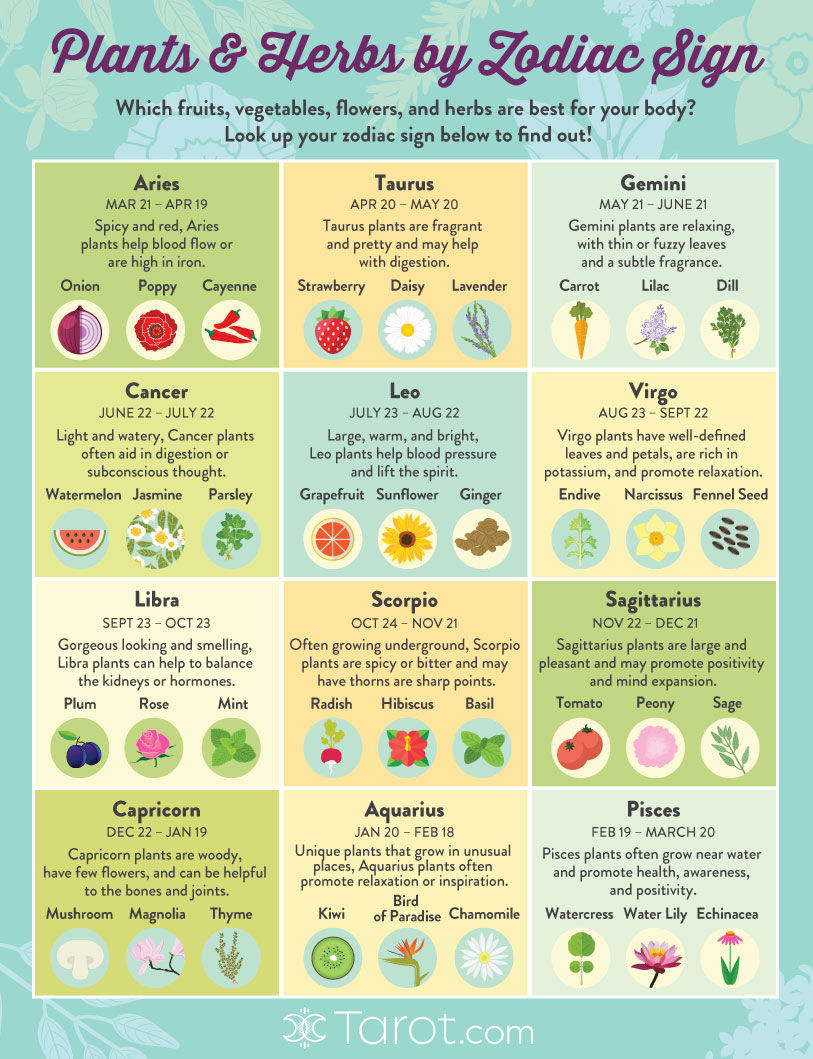
Aries is a Fire sign ruled by the planet Mars. Plants associated with this element and planet usually have thorns or prickles. They are also spicy or bitter in flavor or are red in color. Because Aries rules the head, eyes and face, the best plants for Aries are those that purify the blood, stimulate the adrenal glands, or are high in iron (Mars rules the mineral iron).

Fruits and Vegetables: Chinese cabbage, mustard, horseradish, onion, garlic, leeks, red pepper, rhubarb, chives, radishes

Flowers: Calendula, geranium, anise hyssop, poppies, red roses, tulips, amaryllis, hollyhock, cowslip, tiger lily, impatiens

Herbs: Nettles, burdock root, cayenne, red clover, yellow dock, yarrow, St. John’s wort, hops, marjoram, milk thistle, wormwood, gentian, sarsaparilla, tarragon, ginger, coriander

Taurus (April 20 – May 20)

Taurus is an Earth sign ruled by the planet Venus. Venus is the planet that represents desire and beauty, so Taurus plants often have gorgeous flowers and enticing fragrances. Because Taurus rules the throat and ears, the best plants for the Bull are often soothing to the throat, or may calm the digestive system after overindulging in the finest foods.

Fruits and Vegetables: Spinach, peas, potatoes, sweet potatoes, gourds, artichoke, olive, grape, apple, fig, apricot, pomegranate, strawberry

Flowers: Daisies, lilac, aster, lily of the valley, sweet pea, lilies, larkspur, columbine, violet, foxglove, rose, sweet William, daisy, geranium

Herbs: Licorice, fenugreek, slippery Elm, anise hyssop (Venus), mallow, lavender, dandelion, marshmallow, sage, vervain, feverfew, thyme, angelica, yarrow

Gemini (May 21 – June 20)

Ruled by the planet Mercury, Gemini is an Air sign that rules the lungs, shoulders, arms, and hands.

Gemini’s plants usually feature finely divided leaves or stems (like the bronchi of lungs), hairy or fuzzy leaves (related to the cilia in the lungs), or subtle odors. Plants associated with Gemini help to strengthen the lungs and respiratory system, or relax the nervous system.

Fruits and Vegetables: Endive, carrots, parsnips, oats

Flowers: Orchid, chrysanthemum, lilac, azalea, daffodil, Lily-of-the-valley, honeysuckle

Herbs: Mullein, hyssop, lemon balm, lobelia, elecampane, vervain, woodbine, yarrow, meadowsweet, dill, fennel, skullcap, lavender, fenugreek, licorice, valerian

Cancer (June 21 – July 22)

Because Cancer is a Water sign and is ruled by the Moon, Cancer’s plants generally have soft or Moon-shaped leaves, contain a lot of moisture, or are found near water. Oftentimes they are white in color, or have white or pale yellow flowers. Cancer rules the stomach, breasts, diaphragm, and liver, so plants that aid digestion or affect the subconscious are associated with the sign of the Crab.

Fruits and Vegetables: Brussels sprouts, broccoli, cabbage, cauliflower, endive, kale, lettuce, watercress, kohlrabi, mushroom, turnip, sweet potato, cantaloupe, cucumber, gourds, watermelon, pumpkin, squash, seaweed, mango, banana, apple, pear

Flowers: Daisy, water lilies, jasmine, hyssop, morning glory, geranium, lily, lotus, white roses, opium poppy

Herbs: Peppermint, spearmint, papaya leaf, agrimony, lemon balm, parsley, verbena, chickweed

Leo (July 23 – Aug. 22)

Naturally, Leo is a Fire sign ruled by the brilliant Sun. The part of the body ruled by Leo the Lion is the heart. Leo’s plants are usually large and gold or orange in color, or have heart-shaped leaves or a radiating shape. Plants that regulate blood pressure and have an uplifting effect on the spirit are most beneficial to Leo.

Fruits and Vegetables: Chinese cabbage, corn, collards, mustard, Swiss chard, okra, peppers, pineapple, orange, grapefruit, olive, coconut

Flowers: Marigolds, anise hyssop, sunflower, dahlia, larkspur, aster, passion flower, heliotrope, poppy, peony, calendula, crocus

Herbs: Borage, hawthorn, motherwort, rosemary, celandine, mint, lavender, parsley, dill, fennel, chamomile, St. John’s wort, angelica, eyebright, anise, ginger, saffron

Virgo (Aug. 23 – Sept. 22)

Virgo is an Earth sign ruled by the planet Mercury. Virgo is traditionally the Goddess of the Grain, and is associated with autumn. Her plants often have finely divided leaves or stems, subtle odors, or small, brightly-colored flowers. The most beneficial plants for Virgo are high in potassium and help to calm the nerves.

Fruits, Vegetables and Grains: Endive, carrots, parsnips, barley, oats, rye, wheat, millet

Flowers: Narcissus, chrysanthemum, aster, violet, all brightly colored small flowers (particularly blue or yellow)

Herbs: Dill, fennel, blackberry (leaves and root), plantain, St. John’s wort, skullcap, woodbine, valerian, lavender, marjoram, licorice, parsley, fenugreek, dill

Libra (Sept. 23 – Oct. 22)

Libra is an Air sign, and is ruled by the planet Venus. Because Venus is the planet of beauty and love, Libra’s plants often have light, lovely flowers and gorgeous scents. Libra rules the kidneys and the adrenals, so her plants help to bring balance to these areas of the body.

Fruits and Vegetables: Broccoli, eggplant, spinach, peas, sweet potato, artichoke, watercress, pomegranate, apricot, apple, fig, plum, grape, strawberry, olive

Flowers: Orchid, gardenia, tea roses, tuberose, freesia, gladiolus, aster, hydrangea, daisy, nasturtium, rose, violet, primrose, pansy, columbine

Herbs: Parsley, cleavers, juniper, corn silk, uva ursi, mint, thyme, yarrow, angelica, vervain

Scorpio (Oct. 23 – Nov. 21)

A Water sign ruled by both Mars and Pluto, Scorpio’s plants are often found in remote places or underground. They will likely have thorns, be red in color, and grow under adversity. The reproductive organs are ruled by Scorpio, so plants that balance the hormones, regulate the menstrual cycle, or help with childbirth and pregnancy are very beneficial to Scorpio.

Fruits and Vegetables: Mushroom, peppers, rhubarb, leek, onions, chives, pepper, garlic, horseradish, radish, mustard

Flowers: Calendula, rhododendron, geranium, holly, black-eyed Susan, scarlet monkey flower, anemone, heather, gardenia, honey-suckle, peony, hibiscus

Herbs: Aloe vera, ginseng, pennyroyal, raspberry leaf, saw palmetto, cramp bark, basil, gentian, wormwood, ginger, coriander

Sagittarius (Nov.  22 – Dec.  21)

Sagittarius is a Fire sign that is ruled by the planet large and optimistic planet Jupiter. So the Archer’s plants tend to be large in size and fairly conspicuous, with a pleasant odor. The best plants for Sagittarius will support the liver, are high in the mineral silica, and promote a positive frame of mind.

Fruits and Vegetables: Asparagus, endive, rhubarb, beets, tomato, turnip, watercress, olive

Flowers: Red roses, calendula, anise hyssop, pinks, carnations, clematis, peony, crocus, jasmine

Herbs: Dandelion, horsetail, Oregon grape root, wild yam, sage, feverfew, sage, anise, nutmeg, mint

Capricorn (Dec. 22 – Jan. 19)

As an Earth sign ruled by the planet Saturn, Capricorn’s plants usually have few flowers, are knobby or woody, and may have an unpleasant smell or taste. Saturn rules plants with long lives and slow growth, so plants with annual rings are also associated with the Goat. And because Capricorn rules the knees, joints, bones, and teeth, plants that are high in calcium can be very beneficial.

Fruits and Vegetables: Spinach, mushroom, beets, parsnips, barley, rye

Flowers: Calendula, black poppy, henbane, nightshade, African violet, snowdrop, jasmine, love-lies-bleeding, pansy, baby’s breath

Herbs: Comfrey, sarsaparilla, rue, kava kava, mullein, thyme, horsetail, shepherd’s purse

Aquarius the Water Bearer (Jan. 20 – Feb. 18)

Aquarius is an Air sign ruled by odd-ball Uranus, so the Water-bearer’s plants will often grow in unusual places and may vary in appearance. The most healing and beneficial plants for Aquarius are ones that help circulation, relax the nervous system, or promote inspiration.

Fruits and Vegetables: Spinach, beets, rye, barley, parsnip

Flowers: Bird of paradise, orchid, gladiolus, trillium

Herbs: Chamomile, catnip, skullcap, passion flower, valerian, hops, aloe, myrrh, frankincense, spikenard, kava kava, comfrey, cinnamon, cloves

Pisces the Fish (Feb. 19 – March 20)

As a Water sign ruled by both Jupiter and Neptune, Pisces plants are often large but hard to find, and may grow near the ocean. The most healing plants for Pisces are those that strengthen the immune system or have an antibacterial effect. Pisces plants may also catalyze expanded states of awareness and be helpful in dream work.

Fruits and Vegetables: Asparagus, endive, mushroom, rhubarb, beets, tomato, seaweed, watercress, olive

Flowers: Calendula, anise hyssop, jasmine, lilac, narcissus, water lily, poppy, clematis, wisteria, lilac, orchid

Herbs: Golden seal, Echinacea, chaparral, eyebright, mugwort, kava kava, yarrow, skullcap, oatstraw, nutmeg, anise

Tarot.com is Part of Zappallas USA © 2019

Spell for Today – Honeyed Words Potion

  1. Dip your finger into honey and use it to write your desires into a cup.

  2. Fill it with red wine, so that the honey clinging to the sides isn’t too obvious, and serve to the object of your affections.


c. 2011

Goddess Of The Day: Chihnu

Chihnu

Phra Buddha Bat Fair (Thailand)

  Themes: Arts; Creativity; Tradition; Excellence

Symbols: Woven Items; Thread or Yarn; Home Crafts; Lyres

About Chihnu: In China and surrounding regions, Chihnu’s name means “weaving woman.” According to myths, Chihnu’s talents in this art are so great that she can weave seamless garments for the gods. From her heavenly domain in the constellation Lyre, she acts like a refreshing spring wind to inspire excellence in our inherited arts and crafts.

 To Do Today: This annual Thai festival features folk dancing and traditional handicrafts in honor of Buddha’s footprint, which is enshrined nearby. Generally, it is a time to rejoice in Thai tradition, so if you have a Thai restaurant in the neighborhood, by all means indulge yourself, saying a brief prayer of thanks to the provider of your feast-Chihnu.

 To make a Chihnu-inspired creativity charm, take three strands of yellow thread or yarn (yellow is the color of inventiveness). Braid these together so that the strands cross four rimes, saying,

 One, Chihnu’s power absorbs;

two, inside the magic’s stored;

three, the magic’s alive in me;

four, bear Chihnu’s creativity!

 Carry this when you need more ingenious energy, or leave it near your artistic endeavors so they can absorb Chihnu’s compelling excellence.

 Finally, wear woven or handmade items to honor Chihnu’s talents today.

 .By Patricia Telesco ~ From “365 Goddess”  (FMP) and GrannyMoon’s Morning Feast

c. 2011

Witchcraft Symbols, Terms and Definitions – Iron

Iron Spell: Spoken Word

The power of iron is so strong that even if you don’t have any, just shouting out the word “iron” allegedly routs evil spirits.

c. 2011

God of the Day – Osiris

Osiris

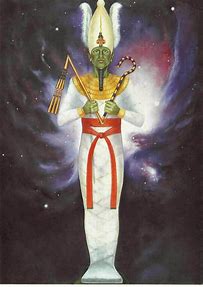
Osiris the god of the afterlife, the underworld, and rebirth in ancient Egyptian religion. He was classically depicted as a green-skinned deity with a pharaoh’s beard, partially mummy-wrapped at the legs, wearing a distinctive atef crown, and holding a symbolic crook and flail. (He was one of the first to be associated with the mummy wrap. When the brother cut him up into pieces after killing him Isis, his wife, found all the pieces and wrapped his body up.) Osiris was at times considered the eldest son of the god Geb and the sky goddess Nut, as well as being brother and husband of Isis, with Horus being considered his posthumously begotten son. He was also associated with the epithet Khenti-Amentiu, meaning “Foremost of the Westerners”, a reference to his kingship in the land of the dead. As ruler of the dead, Osiris was also sometimes called “king of the living”: ancient Egyptians considered the blessed dead “the living ones”. Through syncretism with Iah, he is also the god of the Moon.

Osiris was considered the brother of Isis, Set, Nephthys, and Horus the Elder, and father of Horus the Younger. The first evidence of the worship of Osiris was found in the middle of the Fifth dynasty of Egypt, although it is likely that he was worshiped much earlier; the Khenti-Amentiu epithet dates to at least the first dynasty, and was also used as a pharaonic title. Most information available on the myths of Osiris is derived from allusions contained in the Pyramid Texts at the end of the Fifth Dynasty, later New Kingdom source documents such as the Shabaka Stone and the Contending of Horus and Seth, and much later, in narrative style from the writings of Greek authors including Plutarch and Diodorus Siculus.

Osiris was the judge of the dead and the underworld agency that granted all life, including sprouting vegetation and the fertile flooding of the Nile River. He was described as “He Who is Permanently Benign and Youthful” and the “Lord of Silence”. The Kings of Egypt were associated with Osiris in death – as Osiris rose from the dead so would they in union with him, and inherit eternal life through a process of imitative magic. By the New Kingdom all people, not just pharaohs, were believed to be associated with Osiris at death, if they incurred the costs of the assimilation rituals.

Through the hope of new life after death, Osiris began to be associated with the cycles observed in nature, in particular vegetation and the annual flooding of the Nile, through his links with the heliacal rising of Orion and Sirius at the start of the new year. Osiris was widely worshipped until the decline of ancient Egyptian religion during the rise of Christianity in the Roman Empire.

Etymology of the name

Osiris is a Latin transliteration of the Ancient Greek Ὄσιρις IPA: [ó.siː.ris], which in turn is the Greek adaptation of the original name in the Egyptian language. In Egyptian hieroglyphs the name appears as wsjr, which some Egyptologists instead choose to transliterate ꜣsjr or jsjrj. Since hieroglyphic writing lacks vowels, Egyptologists have vocalized the name in various ways as Asar, Yasar, Aser, Asaru, Ausar, Ausir, Wesir, Usir, Usire or Ausare.

Several proposals have been made for the etymology and meaning of the original name; as Egyptologist Mark J. Smith notes, none are fully convincing. Most take wsjr as the accepted transliteration, following Adolf Erman:

  • John Gwyn Griffiths (1980), “bearing in mind Erman’s emphasis on the fact that the name must begin with an [sic] w“, proposes a derivation from wsr with an original meaning of “The Mighty One”. Moreover, one of the oldest attestations of the god Osiris appears in the mastaba of the deceased Netjer-wser (from nṯr-wsr “Powerful God”).[citation needed]
  • Kurt Sethe (1930) proposes a compound st-jrt, meaning “seat of the eye”, in a hypothetical earlier form *wst-jrt; this is rejected by Griffiths on phonetic grounds.
  • David Lorton (1985) takes up this same compound but explains st-jrt as signifying “product, something made”, Osiris representing the product of the ritual mummification process.
  • Wolfhart Westendorf (1987) proposes an etymology from wꜣst-jrt “she who bears the eye”.
  • Mark J. Smith (2017) makes no definitive proposals but asserts that the second element must be a form of jrj (“to do, make”) (rather than jrt (“eye”)).

However, recently alternative transliterations have been proposed:

  • Yoshi Muchiki (1990) reexamines Erman’s evidence that the throne hieroglyph in the word is to be read ws and finds it unconvincing, suggesting instead that the name should be read ꜣsjr on the basis of Aramaic, Phoenician, and Old South Arabian transcriptions, readings of the throne sign in other words, and comparison with ꜣst(“Isis”).
  • James P. Allen (2000) reads the word as jsjrt but revises the reading (2013) to jsjrj and derives it from js-jrj, meaning “engendering (male) principle”.

Appearance

Osiris is represented in his most developed form of iconography wearing the Atef crown, which is similar to the White crown of Upper Egypt, but with the addition of two curling ostrich feathers at each side (see also Atef crown (hieroglyph)). He also carries the crook and flail. The crook is thought to represent Osiris as a shepherd god. The symbolism of the flail is more uncertain with shepherds whip, fly-whisk, or association with the god Andjety of the ninth nome of Lower Egypt proposed.

He was commonly depicted as a pharaoh with a complexion of either green (the color of rebirth) or black (alluding to the fertility of the Nile floodplain) in mummiform (wearing the trappings of mummification from chest downward).

Early mythology

The Pyramid Texts describe early conceptions of an afterlife in terms of eternal travelling with the sun god amongst the stars. Amongst these mortuary texts, at the beginning of the 4th dynasty, is found: “An offering the king gives and Anubis”. By the end of the 5th dynasty, the formula in all tombs becomes “An offering the king gives and Osiris“.

Father of Horus

Osiris is the mythological father of the god Horus, whose conception is described in the Osiris myth (a central myth in ancient Egyptian belief). The myth describes Osiris as having been killed by his brother, Set, who wanted Osiris’ throne. His wife, Isis finds the body of Osiris and hides it in the reeds where it is found and dismembered by Set. Isis retrieves and joins the fragmented pieces of Osiris, then briefly brings Osiris back to life by use of magic. This spell gives her time to become pregnant by Osiris before he again dies. Isis later gives birth to Horus. As such, since Horus was born after Osiris’ resurrection, Horus became thought of as a representation of new beginnings and the vanquisher of the usurper Set.

Ptah-Seker (who resulted from the identification of Creator god Ptah with Seker) thus gradually became identified with Osiris, the two becoming Ptah-Seker-Osiris. As the sun was thought to spend the night in the underworld, and was subsequently “reborn” every morning, Ptah-Seker-Osiris was identified as king of the underworld, god of the afterlife, life, death, and regeneration.

Ram god

Osiris’ soul, or rather his Ba, was occasionally worshipped in its own right, almost as if it were a distinct god, especially in the Delta city of Mendes. This aspect of Osiris was referred to as Banebdjedet, which is grammatically feminine (also spelt “Banebded” or “Banebdjed“), literally “the ba of the lord of the djed, which roughly means The soul of the lord of the pillar of continuity. The djed, a type of pillar, was usually understood as the backbone of Osiris.

The Nile supplying water, and Osiris (strongly connected to the vegetable regeneration) who died only to be resurrected, represented continuity and stability. As Banebdjed, Osiris was given epithets such as Lord of the Sky and Life of the (sun god) Ra, since Ra, when he had become identified with Atum, was considered Osiris’ ancestor, from whom his regal authority is inherited. Ba does not mean “soul” in the western sense, and has to do with power, reputation, force of character, especially in the case of a god.

Since the ba was associated with power, and also happened to be a word for ram in Egyptian, Banebdjed was depicted as a ram, or as Ram-headed. A living, sacred ram was kept at Mendes and worshipped as the incarnation of the god, and upon death, the rams were mummified and buried in a ram-specific necropolis. Banebdjed was consequently said to be Horus’ father, as Banebdjed was an aspect of Osiris.

Regarding the association of Osiris with the ram, the god’s traditional crook and flail are the instruments of the shepherd, which has suggested to some scholars also an origin for Osiris in herding tribes of the upper Nile. The crook and flail were originally symbols of the minor agricultural deity Andjety, and passed to Osiris later. From Osiris, they eventually passed to Egyptian kings in general as symbols of divine authority.

Mythology

Plutarch recounts one version of the Osiris myth in which Set (Osiris’ brother), along with the Queen of Ethiopia, conspired with 72 accomplices to plot the assassination of Osiris. Set fooled Osiris into getting into a box, which Set then shut, sealed with lead, and threw into the Nile. Osiris’ wife, Isis, searched for his remains until she finally found him embedded in a tamarisk tree trunk, which was holding up the roof of a palace in Byblos on the Phoenician coast. She managed to remove the coffin and retrieve her husband’s body.

In one version of the myth, Isis used a spell to briefly revive Osiris so he could impregnate her. After embalming and burying Osiris, Isis conceived and gave birth to their son, Horus. Thereafter Osiris lived on as the god of the underworld. Because of his death and resurrection, Osiris was associated with the flooding and retreating of the Nile and thus with the yearly growth and death of crops along the Nile valley.

Diodorus Siculus gives another version of the myth in which Osiris was described as an ancient king who taught the Egyptians the arts of civilization, including agriculture, then travelled the world with his sister Isis, the satyrs, and the nine muses, before finally returning to Egypt. Osiris was then murdered by his evil brother Typhon, who was identified with Set. Typhon divided the body into twenty-six pieces, which he distributed amongst his fellow conspirators in order to implicate them in the murder. Isis and Hercules (Horus) avenged the death of Osiris and slew Typhon. Isis recovered all the parts of Osiris’ body, except the phallus, and secretly buried them. She made replicas of them and distributed them to several locations, which then became centres of Osiris worship.

Worship

Annual ceremonies were performed in honor of Osiris in various places across Egypt. These ceremonies were fertility rites which symbolised the resurrection of Osiris. E.A. Wallis Budge stated “Osiris is closely connected with the germination of wheat; the grain which is put into the ground is the dead Osiris, and the grain which has germinated is the Osiris who has once again renewed his life.”

Death or transition and institution as god of the afterlife

Plutarch and others have noted that the sacrifices to Osiris were “gloomy, solemn, and mournful…” (Isis and Osiris, 69) and that the great mystery festival, celebrated in two phases, began at Abydos commemorating the death of the god, on the same day that grain was planted in the ground (Isis and Osiris, 13). The annual festival involved the construction of “Osiris Beds” formed in shape of Osiris, filled with soil and sown with seed.

The germinating seed symbolized Osiris rising from the dead. An almost pristine example was found in the tomb of Tutankhamun by Howard Carter.

The first phase of the festival was a public drama depicting the murder and dismemberment of Osiris, the search of his body by Isis, his triumphal return as the resurrected god, and the battle in which Horus defeated Set.

According to Julius Firmicus Maternus of the fourth century, this play was re-enacted each year by worshippers who “beat their breasts and gashed their shoulders…. When they pretend that the mutilated remains of the god have been found and rejoined…they turn from mourning to rejoicing.” (De Errore Profanorum).

The passion of Osiris was reflected in his name ‘Wenennefer” (“the one who continues to be perfect”), which also alludes to his post mortem power.

Ikhernofret Stela

Much of the extant information about the rites of Osiris can be found on the Ikhernofret Stela at Abydos erected in the 12th Dynasty by Ikhernofret (also I-Kher-Nefert), possibly a priest of Osiris or other official (the titles of Ikhernofret are described in his stela from Abydos) during the reign of Senwosret III (Pharaoh Sesostris, about 1875 BC). The ritual reenactment of Osiris’s funeral rites were held in the last month of the inundation (the annual Nile flood), coinciding with Spring, and held at Abydos/Abedjou which was the traditional place where the body of Osiris/Wesir drifted ashore after having been drowned in the Nile.

The part of the myth recounting the chopping up of the body into 14 pieces by Set is not recounted in this particular stela. Although it is attested to be a part of the rituals by a version of the Papyrus Jumilhac, in which it took Isis 12 days to reassemble the pieces, coinciding with the festival of ploughing. Some elements of the ceremony were held in the temple, while others involved public participation in a form of theatre. The Stela of I-Kher-Nefert recounts the programme of events of the public elements over the five days of the Festival:

  • The First Day, The Procession of Wepwawet: A mock battle was enacted during which the enemies of Osiris are defeated. A procession was led by the god Wepwawet (“opener of the way”).
  • The Second Day, The Great Procession of Osiris: The body of Osiris was taken from his temple to his tomb. The boat he was transported in, the “Neshmet” bark, had to be defended against his enemies.
  • The Third Day: Osiris is Mourned and the Enemies of the Land are Destroyed.
  • The Fourth Day, Night Vigil: Prayers and recitations are made and funeral rites performed.
  • The Fifth Day, Osiris is Reborn: Osiris is reborn at dawn and crowned with the crown of Ma’at. A statue of Osiris is brought to the temple.

Wheat and clay rituals

Contrasting with the public “theatrical” ceremonies sourced from the I-Kher-Nefert stele (from the Middle Kingdom), more esoteric ceremonies were performed inside the temples by priests witnessed only by chosen initiates. Plutarch mentions that (for much later period) two days after the beginning of the festival “the priests bring forth a sacred chest containing a small golden coffer, into which they pour some potable water…and a great shout arises from the company for joy that Osiris is found (or resurrected). Then they knead some fertile soil with the water…and fashion therefrom a crescent-shaped figure, which they cloth and adorn, this indicating that they regard these gods as the substance of Earth and Water.” (Isis and Osiris, 39). Yet his accounts were still obscure, for he also wrote, “I pass over the cutting of the wood” – opting not to describe it, since he considered it as a most sacred ritual (Ibid. 21).

In the Osirian temple at Denderah, an inscription (translated by Budge, Chapter XV, Osiris and the Egyptian Resurrection) describes in detail the making of wheat paste models of each dismembered piece of Osiris to be sent out to the town where each piece is discovered by Isis. At the temple of Mendes, figures of Osiris were made from wheat and paste placed in a trough on the day of the murder, then water was added for several days, until finally the mixture was kneaded into a mold of Osiris and taken to the temple to be buried (the sacred grain for these cakes were grown only in the temple fields). Molds were made from the wood of a red tree in the forms of the sixteen dismembered parts of Osiris, the cakes of ‘divine’ bread were made from each mold, placed in a silver chest and set near the head of the god with the inward parts of Osiris as described in the Book of the Dead (XVII).

Judgment

The idea of divine justice being exercised after death for wrongdoing during life is first encountered during the Old Kingdom in a 6th dynasty tomb containing fragments of what would be described later as the Negative Confessions performed in front of the 42 Assessors of Ma’at.

With the rise of the cult of Osiris during the Middle Kingdom the “democratization of religion” offered to even his humblest followers the prospect of eternal life, with moral fitness becoming the dominant factor in determining a person’s suitability.

At death a person faced judgment by a tribunal of forty-two divine judges. If they led a life in conformance with the precepts of the goddess Ma’at, who represented truth and right living, the person was welcomed into the kingdom of Osiris. If found guilty, the person was thrown to a “devourer” (such as the soul-eating demon Ammit) and did not share in eternal life.

The person who is taken by the devourer is subject first to terrifying punishment and then annihilated. These depictions of punishment may have influenced medieval perceptions of the inferno in hell via early Christian and Coptic texts.

Purification for those who are considered justified may be found in the descriptions of “Flame Island“, where they experience the triumph over evil and rebirth. For the damned, complete destruction into a state of non-being awaits, but there is no suggestion of eternal torture.

Divine pardon at judgement was always a central concern for the ancient Egyptians.

During the reign of Seti I, Osiris was also invoked in royal decrees to pursue the living when wrongdoing was observed, but kept secret and not reported.

Greco-Roman era

Hellenization

The early Ptolemaic kings promoted a new god, Serapis, who combined traits of Osiris with those of various Greek gods and was portrayed in a Hellenistic form. Serapis was often treated as the consort of Isis and became the patron deity of the Ptolemies’ capital, Alexandria. Serapis’s origins are not known. Some ancient authors claim the cult of Serapis was established at Alexandria by Alexander the Great himself, but most who discuss the subject of Serapis’s origins give a story similar to that by Plutarch. Writing about 400 years after the fact, Plutarch claimed that Ptolemy I established the cult after dreaming of a colossal statue at Sinope in Anatolia. His councillors identified as a statue of the Greek god Pluto and said that the Egyptian name for Pluto was Serapis. This name may have been a Hellenization of “Osiris-Apis”. Osiris-Apis was a patron deity of the Memphite Necropolis and the father of the Apis bull who was worshipped there, and texts from Ptolemaic times treat “Serapis” as the Greek translation of “Osiris-Apis”. But little of the early evidence for Serapis’s cult comes from Memphis, and much of it comes from the Mediterranean world with no reference to an Egyptian origin for Serapis, so Mark Smith expresses doubt that Serapis originated as a Greek form of Osiris-Apis’s name and leaves open the possibility that Serapis originated outside Egypt.

Destruction of cult

The cult of Isis and Osiris continued at Philae until at least the 450s CE, long after the imperial decrees of the late 4th century that ordered the closing of temples to “pagan” gods. Philae was the last major ancient Egyptian temple to be closed.


Source

Wikipedia

c. 2018

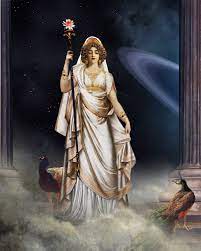
Goddess Of The Day: HERA

Hera

Daedala (Greece)
 
Themes: Love; Romance; Forgiveness; Humor
Symbols: Oak; Myrrh; Poppy
 
About Hera: Hera rules the earth, its people, and the hearts of those people. Using passion and creativity, Hera nudges star-crossed lovers together, chaperones trysts, and helps struggling marriages with a case of spring twitterpation!
 
Legend tells us that Hera refused to return to Zeus’s bed because of a quarrel. Zeus, however, had a plan. He humorously dressed up a wooden figure to look like a bride and declared he was going to marry. When Hera tore off the dummy’s clothes and discovered the ruse, she was so amused and impressed by Zeus’s ingenuity that she forgave him.
 
To Do Today: Ancient Greeks honored Hera and Zeus’s reconciliation today, often in the company of old oak trees. Small pieces of fallen wood are collected to symbolize the divinities, then burned on the ritual fire to keep love warm. To mirror this custom, find a fallen branch and burn a small part of it as an offering to Hera. Keep the rest to use as a goddess image year-round, burning a few slivers whenever love needs encouragement.
 
Present someone you love or admire with a poppy today to symbolically bestow Hera’s blessings on your relationship. If you have a loved one away from home, burn some myrrh incense in front of their picture so Hera can watch over them and keep that connection strong.
.
By Patricia Telesco ~ From “365 Goddess”  (FMP) and GrannyMoon’s Morning Feast
c. 2011

Herb Magickal and Medicinal Uses – Rosemary

No herb should be used for medicinal use until you have check with your health care professional to ask if it safe for you to use it for any reason. Witches of The Craft and Lady Carla Beltane are not responsible for any negative reaction when using this herb for any reason.

Goddess Of The Day – Hexe

Hexe

Saint Hildegard Dies


Themes: Health, Banishing:Magic

Symbols: Healing Herbs and Charms


About Hexe: This ancient Germanic witch’s goddess rules over health, banishing curses and teaching

people the effective use of spells, charms and other mystical procedure for improving well being, Thus

we come by the old phrase “hex doctor”.


To Do Today: Living in the 1100’s St Hildegard was a renowned Benedictine nun living in Bingen and

ministering to people with herbal preparations received in visions. Many of these had magical overtone,

perhaps guided by Hexe’s influence. In any case, today’s theme is learning the art of weaving, “Hexes”

for physical, mental and spiritual health.


On the physical level take a natural object like a cut potato and rub it against an inflicted area. Bury the

potato to “bury” the malady and decompose it. Or carry a jet stone to absorb the problem, then cleanse

the rock in saltwater to wash the bas energy away. For mental well being, enjoy a soothing cup of mint

tea stirred countercockwise so tensions and negativity will wane. Or, carry a flourite stone with you

throughout the day to strengthen your mental powers. For spiritual health, sprinkle nutmeg-laden water

clockwise throughout your aura to empower your physic self. Or, carry a lapis or amethyst stone to draw

goddess centered thinking and action into your day.


By Patricia Telesco

Goddess of the Day – Aphrodite

Aphrodite

Greek goddess of love and beauty

By deTraci Regula, About.com Guide

Aphrodite

From ‘The Dictionary of Classical Antiquities’

Aphrodite’s Appearance:Aphrodite is a gorgeous, perfect, eternally young woman with a beautiful body.Aphrodite’s Symbol or Attribute:Her Girdle, which has magical powers to compel love.

Strengths:Potent sexual attractiveness, dazzling beauty.

Weaknesses:A bit stuck on herself, but with a perfect face and body, who can blame her?

Aphrodite’s Parents: One genealogy gives her parents as Zeus, King of the Gods, and Dione, an early earth/mother goddess. More commonly, she was believed to be born of the foam in the sea which bubbled around the severed member of Ouranos when Kronos slew him.

Aphrodite’s Birthplace: Rising from the foam off of the islands of Cyprus or Kythira. Milos, where the famed Venus de Milo was found, is also associated with her in modern times.

Aprhodite’s Husband:Hephaestus, the lame smith-god. Also associated with Ares, god of War.

Children: Eros, a Cupid-like figure.

Some Major Temple Sites of Aphrodite: Kythira, an island she visited; Cyprus.

Basic Story: Aphrodite rises from the foam of the waves of the sea, enchanting anyone who sees her and inciting feelings of love and lust wherever she goes. She is a contender in the story of the Golden Apples, when Paris chooses her as the fairest of the three goddesses (the others were Hera and Athena) and Aphrodite decides to “reward” him for giving her the Golden Apple (the prototype of most modern awards) by giving him the love of Helen of Troy, something of a mixed blessing that led to the Trojan War.

Interesting Fact: The island of Cyprus has many places believed to have been enjoyed by Aphrodite when she was on earth. Recently, the Cypriots have revived a tourist-friendly version of some of Aphrodite’s festivals at the town of Paphos.