
Tag: Pagan Terminology
Spell for Today – 3 To have Someone Call You Spells
To Have Someone Call You
Put a glass of water in the middle of your altar. Pour two or three teaspoons of salt into your dominant hand, and use it to make 3 equal armed crosses over the glass allowing some salt to fall into the water while doing this chant:
Hear me, call me get in touch
We need to talk please hurry rush
Expect to hear from the person by the time the water evaporates.
Another Spell To Have Someone Call You
Firmly push a needle into the center of a yellow un-anointed candle until the eye is flush with the candle. Inscribe the persons name onto the candle using your athame or a pin, light the wick. The person will usually call before the candle burns halfway down.
The Phone Charm
Take a piece of fine writing paper, inscribe the person’s name twice in a circle to make the ends meet. As you do this concentrate on their face and your desire for them to call you, then while still concentrating put a needle through the circle then place the charm by the phone. In either 5 minutes or 5 days your call will come, depending on how much energy you put into it!
Source
Cottage Witch, Natural Magick for Hearth & Home
Ellen Dugan
Some of the Witchcraft/Magickal Correspondence for Wednesday
From flyingthehedge.com
Wednesday
This day of the week gets its name from Woden’s Day, an Old English name. It is a direct translation of the Latin term mercurri dies, “day of Mercury.” When they translated the day, they changed to god Mercury to a local god, Woden, so people would understand. This is a great day to work on communications, thought, wisdom, self-expression, and the arts. Also a good day for divination.
Color: Purple, orange
Planet: Mercury
Deities: Odin, Woden, Hermes, Mercury, Athena, Lugh
Crystals: Adventuine, agate
Herbs: Aspen, lilies, lavender, fern
Associations: Business, communication, debt, the arts, transportation, fortune, chance, creativity

From learnreligions.com
Wednesday is named for Woden himself, although the Romans called it dies Mercurii. This is a day associated with the color purple, the planet Mercury, and the metal quicksilver—which is also called mercury. See a pattern here?
When it comes to deities… yes, Mercury! However, there are a few other gods associated with Wednesday, including Odin and Hermes, Athena, and Lugh. Gemstones like adventurine and agate come in handy as well, as do plants such as aspen trees, lilies, lavender, and even ferns.
Business and job-related issues, communication, loss and debt, traveling, and journeys are all tied into Wednesday. This is a good day to do a working to open up lines of communication—especially if your actions are preventing you from being an effective speaker or listener. Go someplace new or return to an old favorite stomping ground, step up your game, and settle up your accounts.
Goddess of the Day – Aphrodite

Aphrodite
Greek goddess of love and beauty
By deTraci Regula, About.com Guide
Aphrodite
From ‘The Dictionary of Classical Antiquities’
Aphrodite’s Appearance:Aphrodite is a gorgeous, perfect, eternally young woman with a beautiful body.Aphrodite’s Symbol or Attribute:Her Girdle, which has magical powers to compel love.
Strengths:Potent sexual attractiveness, dazzling beauty.
Weaknesses:A bit stuck on herself, but with a perfect face and body, who can blame her?
Aphrodite’s Parents: One genealogy gives her parents as Zeus, King of the Gods, and Dione, an early earth/mother goddess. More commonly, she was believed to be born of the foam in the sea which bubbled around the severed member of Ouranos when Kronos slew him.
Aphrodite’s Birthplace: Rising from the foam off of the islands of Cyprus or Kythira. Milos, where the famed Venus de Milo was found, is also associated with her in modern times.
Aprhodite’s Husband:Hephaestus, the lame smith-god. Also associated with Ares, god of War.
Children: Eros, a Cupid-like figure.
Some Major Temple Sites of Aphrodite: Kythira, an island she visited; Cyprus.
Basic Story: Aphrodite rises from the foam of the waves of the sea, enchanting anyone who sees her and inciting feelings of love and lust wherever she goes. She is a contender in the story of the Golden Apples, when Paris chooses her as the fairest of the three goddesses (the others were Hera and Athena) and Aphrodite decides to “reward” him for giving her the Golden Apple (the prototype of most modern awards) by giving him the love of Helen of Troy, something of a mixed blessing that led to the Trojan War.
Interesting Fact: The island of Cyprus has many places believed to have been enjoyed by Aphrodite when she was on earth. Recently, the Cypriots have revived a tourist-friendly version of some of Aphrodite’s festivals at the town of Paphos.
Flower Meaning, Symbol and Spiritual Meaning
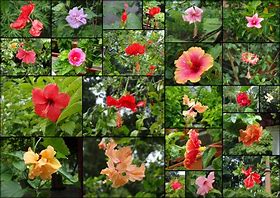
Hibiscus Flower Meanings & Symbolism + Hibiscus Planting, Care & Uses from Uniguide.com
Hibiscus flower meanings include ephemeral beauty, romantic love and passion, friendship, hospitality, and joy. The quintessential tropical flower, the hibiscus originated in Asia and then made its way to other warm places around the world, including Polynesia, Australia, New Zealand, Hawaii, Florida, and the Caribbean. Not only are hibiscus flowers considered beautiful, they have significant spiritual meanings in many cultures.
22 March 2023 Southern Hemisphere’s Planetary Positions

If you need to calculate the planetary positions for a specific use and time, click on this link
Currentplanetarypositions.com
To figure out GMT (Greenwich Mean Time) to your local time use this link
For Your Local Time and Date
Southeastern Hemisphere
This local time is in Sao Paulo, Brazil, South America
22 March 2023
06:00 pm GMT 3:00 PM BRT
Zodiac: Tropical (Standard Western)
Sun:01 Aries 51
Moon:15 Aries 35
Mercury:07 Aries 09
Venus:06 Taurus 59
Mars:28 Gemini 41
Jupiter:16 Aries 54
Saturn:01 Pisces 44
Uranus:16 Taurus 22
Neptune:25 Pisces 22
Pluto:29 Capricorn 59
Moon:15 Aries 35
Mercury:07 Aries 09
Venus:06 Taurus 59
Mars:28 Gemini 41
Jupiter:16 Aries 54
Saturn:01 Pisces 44
Uranus:16 Taurus 22
Neptune:25 Pisces 22
Pluto:29 Capricorn 59
True Lunar Node:04 Taurus 17 Rx
Mean Lunar Node:05 Taurus 56 Rx
Lilith (Black Moon):08 Leo 12
Chiron:15 Aries 02
Ceres:00 Libra 06 Rx
Pallas:15 Cancer 39
Juno:06 Taurus 19
Vesta:19 Aries 06
Eris:24 Aries 19
Fire:8
Earth:6
Air:2
Water:3
Earth:6
Air:2
Water:3
Cardinal:10
Fixed:6
Mutable:3
Fixed:6
Mutable:3
Southern Hemisphere
This local time is in Cape Town, South Africa
22 March 2023
01:00 pm GMT 3:00 PM SAST
Zodiac: Tropical (Standard Western)
Sun:01 Aries 38
Moon:12 Aries 37
Mercury:06 Aries 44
Venus:06 Taurus 44
Mars:28 Gemini 35
Jupiter:16 Aries 51
Saturn:01 Pisces 43
Uranus:16 Taurus 21
Neptune:25 Pisces 22
Pluto:29 Capricorn 59
Moon:12 Aries 37
Mercury:06 Aries 44
Venus:06 Taurus 44
Mars:28 Gemini 35
Jupiter:16 Aries 51
Saturn:01 Pisces 43
Uranus:16 Taurus 21
Neptune:25 Pisces 22
Pluto:29 Capricorn 59
True Lunar Node:04 Taurus 17 Rx
Mean Lunar Node:05 Taurus 56 Rx
Lilith (Black Moon):08 Leo 11
Chiron:15 Aries 01
Ceres:00 Libra 09 Rx
Pallas:15 Cancer 36
Juno:06 Taurus 12
Vesta:19 Aries 01
Eris:24 Aries 19
Fire:8
Earth:6
Air:2
Water:3
Earth:6
Air:2
Water:3
Cardinal:10
Fixed:6
Mutable:3
Fixed:6
Mutable:3
Southwestern Hemisphere
This local time is in Melbourne, Victoria, Australia
22 March 2023
04:00 am GMT 3:00 PM AEDT
Zodiac: Tropical (Standard Western)
Sun:01 Aries 16
Moon:07 Aries 14
Mercury:05 Aries 58
Venus:06 Taurus 17
Mars:28 Gemini 24
Jupiter:16 Aries 46
Saturn:01 Pisces 40
Uranus:16 Taurus 20
Neptune:25 Pisces 21
Pluto:29 Capricorn 59
Moon:07 Aries 14
Mercury:05 Aries 58
Venus:06 Taurus 17
Mars:28 Gemini 24
Jupiter:16 Aries 46
Saturn:01 Pisces 40
Uranus:16 Taurus 20
Neptune:25 Pisces 21
Pluto:29 Capricorn 59
True Lunar Node:04 Taurus 18 Rx
Mean Lunar Node:05 Taurus 58 Rx
Lilith (Black Moon):08 Leo 08
Chiron:15 Aries 00
Ceres:00 Libra 14 Rx
Pallas:15 Cancer 30
Juno:05 Taurus 59
Vesta:18 Aries 50
Eris:24 Aries 19
Fire:8
Earth:6
Air:2
Water:3
Earth:6
Air:2
Water:3
Cardinal:10
Fixed:6
Mutable:3
Fixed:6
Mutable:3
March 22 Today in Worldwide History
Today’s Important Historical Events
1622 First American Indian (Powhatan) massacre of Europeans in Jamestown Virginia, 347 killed
1765 Stamp Act passed; 1st direct British tax on American colonists, organized by Prime Minister George Grenville
1784 The Emerald Buddha is moved with great ceremony to its current place in Wat Phra Kaew, Thailand
1832 British Parliament, led by Charles Grey, passes the Reform Act, introducing wide-ranging changes to electoral system of England and Wales, increasing electorate from about 500,000 voters to 813,000
1954 Northland Center, the world’s largest shopping mall at the time, opens in Oakpark, Michigan
1965 US confirms its troops used chemical warfare against the Vietcong
2018 US President Donald Trump imposes $60 billion worth of tariffs on Chinese imports
Today’s Historical Events
238 Gordian I and his son Gordian II are proclaimed Roman emperor
752 Stephen II elected Catholic Pope (or 23rd)
871 Battle at Marton: Ethelred van Wessex beats Danish invasion army
1349 Townspeople of Fulda, Germany massacre Jews, blaming them for the Black Death
1421 Battle of Baugé – French defeat English
1556 Cardinal Reginald Pole becomes archbishop of Canterbury
1565 Turkish Armada leaves Constantinople bound for the siege of Malta with about 193 ships
1594 French King Henry IV festival in Paris
Today’s Historical Events in Flim and TV
1895 Auguste & Louis Lumiere show their 1st movie to an invited audience
1928 Noël Coward‘s musical “This Year of Grace” premieres in London
1936 “The Great Ziegfeld” directed by Robert Z. Leonard and starring William Powell and Luise Rainer premieres in Los Angeles (Best Picture 1937
1941 James Stewart is inducted into the Army, becoming the first major American movie star to wear a military uniform in World War II
1944 American movie star Jimmy Stewart flies his 12th combat mission, leading the 2nd Bomb Wing in an attack on Berlin
1956 Musical “Mr Wonderful” with Sammy Davis, Jr. and father Sammy Davis, Sr. opens at Broadway Theater NYC for 383 performances
1962 Musical “I Can Get It For You Wholesale” starring Barbra Streisand in her Broadway debut, opens at Shubert Theater, NYC; runs for 300 performances
1964 Barbra Streisand appears on the cover of NY Times Magazine section
Today’s Historical Events in Music
1957 “All Shook Up” single released by Elvis Presley
1963 The Beatles release their 1st album, “Please Please Me”
1969 “Come Summer” closes at Lunt Fontanne Theater NYC after 7 performances
1971 6th Academy of Country Music Awards: Merle Haggard and Lynn Anderson win
1972 Musical “The Selling of the President” opens at Shubert Theater, NYC; runs for 5 performances
1973 Joffrey Ballet revives Diaghilev’s “Parade” at The City Center, NYC
1975 “Dr Jazz” closes at Winter Garden Theater, NYC, after 5 performances
1975 “Letter for Queen Victoria” opens at ANTA Theater NYC for 18 performances
Today’s Historical Events in Sports
1894 Stanley Cup, Victoria Rink, Montreal, Quebec: Montreal Hockey Club defeats Ottawa HC, 3-1 to win 3-team challenge tournament
1896 Charilaos Vasilakos of Greece wins 1st modern marathon in 3:18 at the Panhellenic Games
1907 69th Grand National: Alf Newey wins aboard 8/1 chance Eremon
1929 88th Grand National: Robert W. H. Everett wins aboard 100/1 outsider Gregalach
1952 Wales wins Five Nations Rugby Championship, Grand Slam & Triple Crown with a 9-5 win over France at St. Helen’s Ground, Swansea
1958 20th NCAA Men’s Basketball Championship: Kentucky beats Seattle, 84-72; Seattle’s future Hall of Fame small forward Elgin Baylor is named tournament MOP
1964 LPGA Western Open Women’s Golf, Scenic Hills CC: Carol Mann her 1st of 2 major titles by 2 shots from Ruth Jessen and Judy Kimball
1967 Muhammad Ali KOs Zora Folley in 7 for heavyweight boxing title
March 23 Today in Worldwide History
Today’s Important Historical Events
1490 1st dated edition of Maimonides “Mishneh Torah”, a code of Jewish religious law is published
1775 Patrick Henry proclaims “Give me liberty or give me death” in speech in favour of Virginian troops joining US Revolutionary war
1919 8th Congress of the Russian Communist Party re-establishes a five-member Politburo which becomes the center of political power in the Soviet Union. Original members Vladimir Lenin, Leon Trotsky, Joseph Stalin, Lev Kamenev and Nikolai Krestinsky
1933 Enabling Act: German Reichstag grants Adolf Hitler dictatorial powers
1945 Battle of Okinawa: US Navy ships bomb the Japanese island of Okinawa in preparation for the Allied invasion; it would become the largest battle of the Pacific War in World War II
2019 Syrian Democratic Forces announce that the last Islamic State territory has been retaken raising flags in Baghuz, Syria and ending the five-year Islamic State “caliphate”

Today’s Historical Events
1026 Conrad II crowns himself King of Italy
1066 18th recorded perihelion passage of Halley’s Comet
1153 Treaty of Konstanz between Frederick I “Barbarossa” & Pope Eugene III
1174 Jocelin, abbot of Melrose, is elected bishop of Glasgow
1490 1st dated edition of Maimonides “Mishneh Torah”, a code of Jewish religious law is published
1534 Aragonese legal code formally recognised
1568 Treaty of Longjumeau: French huguenots go on strike
1579 Friesland joins Union of Utrecht
Today’s Historical Events in Flim and TV
1940 1st radio broadcast of “Truth or Consequences” on CBS
1950 22nd Academy Awards: “All The King’s Men”, Broderick Crawford and Olivia de Havilland win
1972 Geoge Harrison and Friends’ “The Concert for Bangladesh” concert film, directed by Saul Swimmer released in the US
1986 6th Golden Raspberry Awards: “Rambo: First Blood Part II” wins
1994 Howard Stern formally announces his Libertarian run for NY governor
1997 “Mandy Patinkin in Concert” closes at Lyceum Theater NYC
1997 17th Golden Raspberry Awards: “Striptease” wins
1997 WrestleMania XIII, Rosemont Horizon, IL: Undertaker beats Sycho Sid for WWF Heavyweight title
Today’s Historical Events in Music
1743 George Frideric Handel‘s oratorio “Messiah” premieres at the Royal Opera House, Covent Garden, London
1881 Gas lamp sets fire to Théâtre Municipal” opera house in Nice, France; 70 die, and building completely destroyed
1886 Tchaikovsky‘s “Manfred” symphony premieres in Moscow, Russia, conducted by Max Erdmannsdörfer
1896 Umberto Giordano’s opera “Andrea Chénier” premieres in Milan
1901 Australian opera star Dame Nellie Melba reveals secret of her now famous toast
1923 Frank Silver and Irving Conn publish their hit song “Yes, We Have No Bananas”
1933 Kroll Opera in Berlin opens
1939 1st performance of Béla Bartók’s 2nd Violin Concerto at the Concertgebow, Amsterdam with Zoltán Székely on violin and Willem Mengelberg conducting the Concertgebouw Orchestra
Today’s Historical Events in Sports
1877 39th Grand National: Fred Hobson aboard 15/1 shot Austerlitz wins by 4 lengths from Congress
1878 English FA Cup Final, Kennington Oval, London: Wanderers beat Royal Engineers, 3–1; Wanderers’ back-to-back and 5th title overall
1888 50th Grand National: George Mawson aboard 40/1 outsider Playfair easily wins by 10 lengths from Frigate
1923 82nd Grand National: Capt. Tuppy Bennett wins aboard 13-year-old 100/6 shot Sergeant Murphy; first US bred horse to win race
1930 US Ladies Figure Skating championship won by Maribel Vinson
1930 US Mens Figure Skating championship won by Roger Turner
1934 93rd Grand National: Gerry Wilson wins aboard 8/1 Golden Miller in race record 9:20.04; becomes only horse to win both UK’s premier steeplechases with Cheltenham Gold Cup victory 1934
1938 MLB Commissioner Kenesaw Mountain Landis frees 74 St Louis Cardinals minor league players from their contracts
A Thought for Today
I call to the Witches,
Both near and far.
No need to name you,
You know who you are.
Come Dane with me,
By the firelight,
and give praise to the Goddess,
this full moon night.
It doesn’t matter where you are.
Send your soul,
it travels far.
I’ll wait for you,
as the sun goes to rest,
tonight will be truly blessed.
Brothers, Sisters, dance with me.
As I will it,
So more it be.
By Shines Gaughan
Blessed Mabon

Mabon Ritual Just For You – Solitary
Altar Arrangement:
My altar almost always contains the following tools at minimum:
Athame
God and Goddess candle or representation
Pentacle
Incense – I usually use Cinnamon for Mabon
Chalice
Small Cauldron containing Salt
Gemstones as needed
Candles as needed
Circle Casting:
(Note: I light incense and altar candles before this part of the ritual)
Hail to you Spirits of the North and the power of Air,
I do summon, stir and call you up to witness these rites and to guard this sacred space.
Hail to you Spirits of the East and the power of Earth,
I do summon, stir and call you up to witness these rites and to guard this sacred space.
Hail to you Spirits of the South and the power of Fire,
I do summon, stir and call you up to witness these rites and to guard this sacred space.
Hail to you Spirits of the West and the power of Water,
I do summon, stir and call you up to witness these rites and to guard this sacred space.
This sacred circle is cast
between future and past.
As above, so below,
The circle is made whole.
So mote it be!
At this time I will be invite my personal guides – both known and unknown
Invocation:
They who are called by many names, I honor you!
Father God, come join with me!
Tonight, I offer thanks for the blessings you have given me.
and for the sacrifice You have made for my benefit.
I mourn for You and rejoice in Your rebirth to come.
Autumn’s grain is Spring’s seed.
Mother Goddess, come join with me!
Tonight I offer thanks for the blessings to come.
As sunlight wanes and shadow grows,
I celebrate your mysteries.
With death comes new life.
Now I will offer a prayer of personal thanks to the Deities.
Meditation:
As this is the time of the autumnal equinox, I will focus on achieving balance.
Raising and directing power:
I will be releasing negative self image by writing our my self hatred and burning the paper. Afterwards, I will be raising power for healing myself and others I know who are in need. When I have directed the power to it’s purpose, I will earth the power.
Thanking the Deities:
Mother Goddess, Father God,
Who created All and are All
I thank you for your presence here
and for the blessings you have bestowed on me!
May Your love stay with me now and evermore.
I will now thank my personal guides.
Opening the circle:
Spirits of Air, Earth, Fire and Water,
Go if you must or stay if you will.
I humbly thank thee for your presence tonight!
Though the circle is open, it remains unbroken.
As Above, So Below.
So I have said.
So mote it be.
Spell for Today – Prayer for Mabon/Fall Equinox
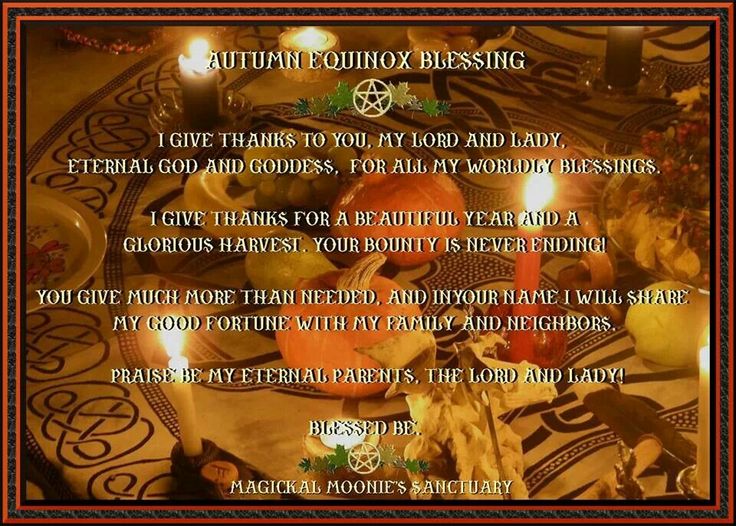
Spell for Today – 5 Simple Mabon Rituals – Printable

Mabon Activities and Correspondences
Mabon Activities and Correspondences
Symbolism of Mabon: The completion of the Harvest begun. Day and night are equal and the God prepares to leave His physical body and begin the great adventure into the unseen.
Symbols of Mabon: all harvest symbols, corn, autumn flowers, red poppies,nuts, grains, leaves, acorns, pine and cypress cones, oak sprigs, wreaths, vine, grapes, cornucopia, horns of plenty, burial cairns, apples, marigolds, harvested crops. wine, gourds
Colors : Orange, Dark Red, Yellow, Indigo, Maroon and Brown.
Goddesses: Modron(Welsh), Bona Dea, Harvest Dieties, Persephone, Demeter/Ceres, Morgan(Welsh- Cornish), Snake Woman(Aboriginal), Epona (Celtic-Gaulish), Pamona(Roman), the Muses(Greek).
Gods: Mabon, Modron(Welsh), Sky Father, John Barleycorn , the Wicker-Man, the Corn Man, Thoth(Egyptian), Hermes, Hotei(Japanese), Thor, Dionysus(Roman), Bacchus(Greek) and all wine Deities.
Tarot Cards: Judgment and The World
Altar Decorations: acorns, pinecones, autumn leaves, pomegranate, statue of the Triple Goddess in her Mother phase.
Mabon Herbs: Rue, yarrow, rosemary, marigold, sage, walnut leaves and husks, mistletoe, saffron, chamomile, almond leaves, passionflower, frankincense, rose hips, bittersweet, sunflower, wheat, oak leaves, dried apple or apple seeds.
Foods of Mabon: cornbread, wheat products, bread, grains, berries, nuts, grapes, acorns, seeds, dried fruits, corn, beans, squash, roots (ie onions, carrots, potatoes, etc), hops, apples, pomegranates, carrots, onions, potatoes, roast goose or mutton, wine, ale and ciders, breads, apples, pomegranates
Animals: dogs, wolves, stag, blackbird, owl, eagle, birds of prey, salmon & goat, Gnomes, Sphinx, Minotaur, Cyclops, Andamans and Gulons.
Element: water.
Incense : pine, sweetgrass, apple blossom, benzoin, myrrh, frankincense, jasmine, sage wood aloes, black pepper, patchouly, cinnamon, clove, oak moss
Mabon Stones : During Mabon, stones ruled by the Sun will help bring the Sun’s energy to you.clear quartz, amber, peridot, diamond, gold, citrine, yellow topaz, cat’s-eye, adventurine.
Customs: offerings to land, preparing for cold weather by bringing in harvest, cutting willow wands( Druidic), leaving apples upon burial cairns & graves as a token of honor, walks in forests, gather seed pods & dried plants, fermenting grapes to make wine,picking ripe produce, stalk bundling
Spellworkings of Mabon: Protection, prosperity, security, and self- confidence. Also those of harmony and balance. Taboos:It was considered unlucky to cut down the very last of the Harvest, and so was also left to stand in the field by some traditions.
Activities of Mabon: Select the best of each vegetable, herb, fruit, nut, and other food you have harvested or purchased and give it back to Mother Earth with prayers of thanksgiving. Hang dried ears of corn around your home in appreciation of the harvest season. Do meditations and chanting as you store away food for the Winter. Do a thanksgiving circle, offering thanks as you face each direction – – for home, finances, and physical health (North); for gifts of knowledge (East); for accomplishments in career and hobbies (South); for relationships (West); and for spiritual insights and messages (Center). Decorate the table with colorful autumn leaves in a basket. Display the fruits of the harvest – corn, gourds, nuts, grapes, apples – preferably in a cornucopia. Or decorate with wildflowers, acorns, nuts, berries, cocoons, anything that represents the harvest to you. Like its sister equinox, halfway across the Wheel of the Year, the Autumn Equinox is a good occasion for a ritual feast. Plan a meal that uses seasonal and symbolic fruits and vegetables. You can serve bread, squash, corn, apples, cider and wine. Make some homemade wine or cordial gather and dry herbs, plants, seeds and seed pods. Make grapevine wreaths using dried bitter-sweet herb for protection. Use ribbons of gold and yellow to bring in the energy of the Sun, and decorate with sprigs of dried yarrowor cinnamon sticks. Make a protection charm of hazelnuts (filberts) strung on red thread. Make a witch’s broom. Tie dried corn husks or herbs (broom, cedar, fennel, lavender, peppermint, rosemary) around a strong, relatively straight branch of your choice. Make magic Apple Dolls Gifts of the Harvest can be used to make tools and emblems that will remind us of their bounty all year round. Look for colored leaves. Collect fallen leaves and make a centerpiece or bouquet for your home. Save the leaves to burn in your Yule fire. Vist an apple orchard and, if possible, pick your own apples. Hang apples on a tree near your home. Watch the birds and other small animals who will enjoy your gift. This is also the time for replacing your old broom with a new one. As the broom corn is ripe now, besom making is traditional and magickal this time of year. Begin the festival with a vineyard or orchard harvest. You might check the farm lands in your area to see if there’s an orchard or pumpkin patch that allows customers to harvest produce for themselves. Traditionally Sabbat festivals begin at sun set on the eve of the Holiday. You can use the daytime hours of this holiday eve to prepare baskets for harvesting the next day. Baking a pumpkin pie (from scratch if possible) is a wonderful way to bring in the fragrance of the holiday season
Mabon History: The Second Harvest c. 2018

Mabon History: The Second Harvest
By Patti Wigington, ThoughtCo.com
The Science of the Equinox:
Two days a year, the Northern and Southern hemispheres receive the same amount of sunlight. Not only that, each receives the same amount of light as they do dark — this is because the earth is tilted at a right angle to the sun, and the sun is directly over the equator. In Latin, the word equinox translates to “equal night.” The autumn equinox takes place on or near September 21, and its spring counterpart falls around March 21. If you’re in the Northern hemisphere, the days will begin getting shorter after the autumn equinox and the nights will grow longer — in the Southern hemisphere, the reverse is true.
Global Traditions:
The idea of a harvest festival is nothing new. In fact, people have celebrated it for millennia, all around the world. In ancient Greece, Oschophoria was a festival held in the fall to celebrate the harvesting of grapes for wine. In the 1700’s, the Bavarians came up with Oktoberfest, which actually begins in the last week of September, and it was a time of great feasting and merriment, still in existence today. China’s Mid-Autumn festival is celebrated on the night of the Harvest Moon, and is a festival of honoring family unity.
Giving Thanks:
Although the traditional American holiday of Thanksgiving falls in November, many cultures see the second harvest time of the fall equinox as a time of giving thanks. After all, it’s when you figure out how well your crops did, how fat your animals have gotten, and whether or not your family will be able to eat during the coming winter. However, by the end of November, there’s not a whole lot left to harvest. Originally, the American Thanksgiving holiday was celebrated on October 3, which makes a lot more sense agriculturally.
Thanksgiving was originally celebrated on October 3. In 1863, Abraham Lincoln issued his “Thanksgiving Proclamation”, which changed the date to the last Thursday in November. In 1939, Franklin Delano Roosevelt adjusted it yet again, making it the second-to-last Thursday, in the hopes of boosting post-Depression holiday sales. Unfortunately, all this did was confuse people. Two years later, Congress finalized it, saying that the fourth Thursday of November would be Thanksgiving, each year.
Symbols of the Season:
The harvest is a time of thanks, and also a time of balance — after all, there are equal hours of daylight and darkness. While we celebrate the gifts of the earth, we also accept that the soil is dying. We have food to eat, but the crops are brown and going dormant. Warmth is behind us, cold lies ahead.
Some symbols of Mabon include:
Mid-autumn vegetables, like squashes and gourds
Apples and anything made from them, such as cider or pies
Seeds, nuts and seed pods
Baskets, symbolizing the gathering of crops
Sickles and scythes
Grapes, vines, wine
You can use any of these to decorate your home or your altar at Mabon.
Feasting and Friends:
Early agricultural societies understood the importance of hospitality — it was crucial to develop a relationship with your neighbors, because they might be the ones to help you when your family ran out of food. Many people, particularly in rural villages, celebrated the harvest with great deals of feasting, drinking, and eating. After all, the grain had been made into bread, beer and wine had been made, and the cattle were brought down from the summer pastures for the coming winter. Celebrate Mabon yourself with a feast — and the bigger, the better!
Magic and Mythology:
Nearly all of the myths and legends popular at this time of the year focus on the themes of life, death, and rebirth. Not much of a surprise, when you consider that this is the time at which the earth begins to die before winter sets in!
Demeter and Her Daughter
Perhaps the best known of all the harvest mythologies is the story of Demeter and Persephone. Demeter was a goddess of grain and of the harvest in ancient Greece. Her daughter, Persephone, caught the eye of Hades, god of the underworld. When Hades abducted Persephone and took her back to the underworld, Demeter’s grief caused the crops on earth to die and go dormant. By the time she finally recovered her daughter, Persephone had eaten six pomegranate seeds, and so was doomed to spend six months of the year in the underworld. These six months are the time when the earth dies, beginning at the time of the autumn equinox.
Inanna Takes on the Underworld
The Sumerian goddess Inanna is the incarnation of fertility and abundance. Inanna descended into the underworld where her sister, Ereshkigal, ruled. Erishkigal decreed that Inanna could only enter her world in the traditional ways — stripping herself of her clothing and earthly posessions. By the time Inanna got there, Erishkigal had unleashed a series of plagues upon her sister, killing Inanna. While Inanna was visiting the underworld, the earth ceased to grow and produce. A vizier restored Inanna to life, and sent her back to earth. As she journeyed home, the earth was restored to its former glory.
Modern Celebrations
For contemporary Druids, this is the celebration of Alban Elfed, which is a time of balance between the light and the dark. Many Asatru groups honor the fall equinox as Winter Nights, a festival sacred to Freyr.
For most Wiccans and NeoPagans, this is a time of community and kinship. It’s not uncommon to find a Pagan Pride Day celebration tied in with Mabon. Often, PPD organizers include a food drive as part of the festivities, to celebrate the bounty of the harvest and to share with the less fortunate.
If you choose to celebrate Mabon, give thanks for the things you have, and take time to reflect on the balance within your own life, honoring both the darkness and the light. Invite your friends and family over for a feast, and count the blessings that you have among kin and community.
Spell for Today – Morrigan Invocation
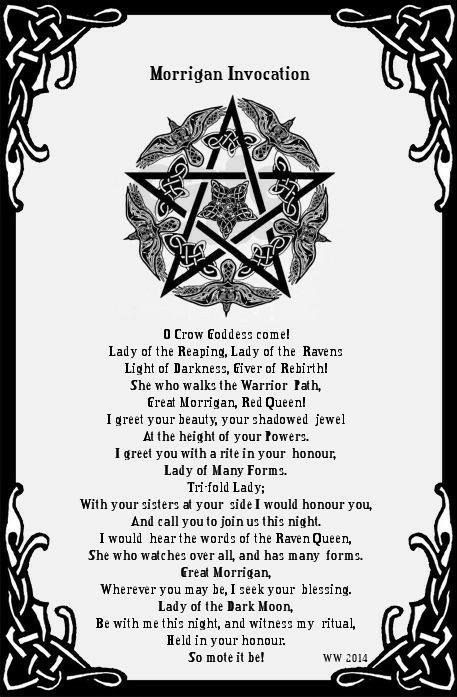
Spell for Today – Protection – Printable
Some of the Witchcraft/Magickal Correspondence for Morrigan

Goddess of the Day – Morrigan c. 2012
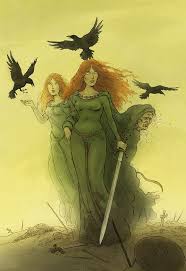
The Morrigan
Goddess Of Battle, Strife, and Fertility
The Morrígan (“phantom queen”) or Mórrígan (“great queen”), also written as Morrígu or in the plural as Morrígna, and spelt Morríghan or Mór-Ríoghain in Modern Irish, is a figure from Irish mythology who appears to have once been a goddess, although she is not explicitly referred to as such in the texts.
The Morrigan is a goddess of battle, strife, and fertility. She sometimes appears in the form of a crow, flying above the warriors, and in the Ulster cycle she also takes the form of an eel, a wolf and a cow. She is generally considered a war deity comparable with the Germanic Valkyries, although her association with cattle also suggests a role connected with fertility, wealth, and the land.
She is often depicted as a triple goddess, although membership of the triad varies; the most common combination is the Badb, Macha and Nemain, but other accounts name Fea, Anann, and others.
Etymology
There is some disagreement over the meaning of the Morrígan’s name. Mor may derive from an Indo-European root connoting terror or monstrousness, cognate with the Old English maere (which survives in the modern English word “nightmare”) and the Scandinavian mara; while rígan translates as ‘queen’. This can be reconstructed in Proto-Celtic as *Moro-rīganī-s. Accordingly, Morrígan is often translated as “Phantom Queen”. This is the derivation generally favoured in current scholarship.
In the Middle Irish period the name is often spelt Mórrígan with a lengthening diacritic over the ‘o’, seemingly intended to mean “Great Queen” (Old Irish mór, ‘great’; this would derive from a hypothetical Proto-Celtic *Māra Rīganī-s.). Whitley Stokes believed this latter spelling was a due to a false etymology popular at the time. There have also been attempts to link the Morrígan with the fairy Morgan from Arthurian romance, in whose name ‘mor’ may derive from ‘sea’ or ‘water’.
The name is also sometimes spelt Morrígu and given in plural as Morrígna in Old Irish.
Glosses and glossaries
The earliest sources for the Morrígan are glosses in Latin manuscripts, and glossaries (collections of glosses). In a 9th century manuscript containing the Latin Vulgate translation of the Book of Isaiah, the word Lamia is used to translate the Hebrew Lilith. A gloss explains this as “a monster in female form, that is, a morrígan“. Cormac’s Glossary (also 9th century), and a gloss in the later manuscript H.3.18, both explain the plural word gudemain (“spectres”) with the plural form morrígna. The 8th century O’Mulconry’s Glossary says that Macha is one of the three morrígna. It therefore appears that at this time the name Morrígan was seen as referring to a class of beings rather than an individual.
Ulster Cycle
The Morrígan’s earliest narrative appearances, in which she is depicted as an individual, are in stories of the Ulster Cycle, where she has an ambiguous relationship with the hero Cú Chulainn. In Táin Bó Regamna (The Cattle Raid of Regamain), Cúchulainn encounters the Morrígan, but does not recognize her, as she drives a heifer from his territory. In response to his challenge, she insults him, but before he can attack she becomes a black bird on a nearby branch. Cúchulainn now knows who she, and tells her that had he known before, they would not have parted in enmity. She notes that whatever he had done would have brought him ill luck. To his response that she cannot harm him, she makes a series of threats, foretelling a coming battle in which he will be killed. She tells him, enigmatically, “I guard your death”.
In the Táin Bó Cuailnge queen Medb of Connacht launches an invasion of Ulster to steal the bull Donn Cuailnge; the Morrígan, like Alecto of the Greek Furies, appears to the bull in the form of a crow and warns him to flee. Cúchulainn defends Ulster by fighting a series of single combats at fords against Medb’s champions. In between combats the Morrígan appears to him as a young woman and offers him her love, and her aid in the battle, but he spurns her. In response she intervenes in his next combat, first in the form of an eel who trips him, then as a wolf who stampedes cattle across the ford, and finally as a red heifer leading the stampede, just as she had threatened in their previous encounter. However Cúchulainn wounds her in each form and defeats his opponent despite her interference. Later she appears to him as an old woman bearing the same three wounds that her animal forms sustained, milking a cow. She gives Cúchulainn three drinks of milk. He blesses her with each drink, and her wounds are healed. As the armies gather for the final battle, she prophesies the bloodshed to come.
In one version of Cúchulainn’s death-tale, as the hero rides to meet his enemies, he encounters the Morrígan as a hag washing his bloody armour in a ford, an omen of his death. Later in the story, mortally wounded, Cúchulainn ties himself to a standing stone with his own entrails so he can die upright, and it is only when a crow lands on his shoulder that his enemies believe he is dead.
Mythological Cycle
The Morrígan also appears in texts of the Mythological Cycle. In the 12th century pseudohistorical compilation Lebor Gabála Érenn she is listed among the Tuatha Dé Danann as one of the daughters of Ernmas, granddaughter of Nuada.
The first three daughters of Ernmas are given as Ériu, Banba, and Fódla. Their names are synonyms for Ireland, and they were married to Mac Cuill, Mac Cécht, and Mac Gréine, the last three Tuatha Dé Danann kings of Ireland. Associated with the land and kingship, they probably represent a triple goddess of sovereignty. Next come Ernmas’s other three daughters: the Badb, Macha, and the Morrígan. A quatrain describes the three as wealthy, “springs of craftiness” and “sources of bitter fighting”. The Morrígan’s name is said to be Anann, and she had three sons, Glon, Gaim, and Coscar. According to Geoffrey Keating’s 17th century History of Ireland, Ériu, Banba, and Fódla worshipped the Badb, Macha, and the Morrígan respectively, suggesting that the two triads of goddesses may be seen as equivalent.
The Morrígan also appears in Cath Maige Tuireadh (The Battle of Mag Tuired). On Samhain she keeps a tryst with the Dagda before the battle against the Fomorians. When he meets her she is washing herself, standing with one foot on either side of the river Unius. In some sources she is believed to have created the river. After they have sex, the Morrígan promises to summon the magicians of Ireland to cast spells on behalf of the Tuatha Dé, and to destroy Indech, the Fomorian king, taking from him “the blood of his heart and the kidneys of his valour”. Later, we are told, she would bring two handfuls of his blood and deposit them in the same river (however, we are also told later in the text that Indech was killed by Ogma).
As battle is about to be joined, the Tuatha Dé leader, Lug, asks each what power they bring to the battle. The Morrígan’s reply is difficult to interpret, but involves pursuing, destroying and subduing. When she comes to the battlefield she chants a poem, and immediately the battle breaks and the Fomorians are driven into the sea. After the battle she chants another poem celebrating the victory and prophesying the end of the world.
In another story she lures away the bull of a woman called Odras, who follows her to the otherworld via the cave of Cruachan. When she falls asleep, the Morrígan turns her into a pool of water.
Nature and functions
The Morrígan is often considered a triple goddess, but her supposed triple nature is ambiguous and inconsistent. Sometimes she appears as one of three sisters, the daughters of Ernmas: the Morrígan, the Badb and Macha. Sometimes the trinity consists of the Badb, Macha and Nemain, collectively known as the Morrígan, or in the plural as the Morrígna. Occasionally Fea or Anu also appear in various combinations. However the Morrígan also frequently appears alone, and her name is sometimes used interchangeably with the Badb, with no third “aspect” mentioned.
The Morrígan is usually interpreted as a “war goddess”: W. M. Hennessey’s “The Ancient Irish Goddess of War,” written in 1870, was influential in establishing this interpretation. Her role often involves premonitions of a particular warrior’s violent death, suggesting a link with the Banshee of later folklore. This connection is further noted by Patricia Lysaght: “In certain areas of Ireland this supernatural being is, in addition to the name banshee, also called the badhb“.
It has also been suggested that she was closely tied to Irish männerbund groups (described as “bands of youthful warrior-hunters, living on the borders of civilized society and indulging in lawless activities for a time before inheriting property and taking their places as members of settled, landed communities”) and that these groups may have been in some way dedicated to her. If true, her worship may have resembled that of Perchta groups in Germanic areas.
However, Máire Herbert has argued that “war per se is not a primary aspect of the role of the goddess”, and that her association with cattle suggests her role was connected to the earth, fertility and sovereignty; she suggests that her association with war is a result of a confusion between her and the Badb, who she argues was originally a separate figure. She can be interpreted as providing political or military aid, or protection to the king — acting as a goddess of sovereignty, not necessarily a war goddess.
There is a burnt mound site in County Tipperary known as Fulacht na Mór Ríoghna (“cooking pit of the Mórrígan”). The fulachta sites are found in wild areas, and usually associated with outsiders such as the Fianna and the above-mentioned männerbund groups, as well as with the hunting of deer. The cooking connection also suggests to some a connection with the three mythical hags who cook the meal of dogflesh that brings the hero Cúchulainn to his doom. The Dá Chich na Morrigna (“two breasts of the Mórrígan”), a pair of hills in County Meath, suggest to some a role as a tutelary goddess, comparable to Danu or Anu, who has her own hills in County Kerry. Other goddesses known to have similar hills are Áine and Grian of County Limerick who, in addition to a tutelary function, also have solar attributes.
Arthurian legend
There have been attempts by some modern authors of fiction to link the Arthurian character Morgan le Fay with the Morrígan. Morgan first appears in Geoffrey of Monmouth’s Vita Merlini (The Life of Merlin) in the 12th century. However, while the creators of the literary character of Morgan may have been somewhat inspired by the much older tales of the goddess, the relationship ends there. Scholars such as Rosalind Clark hold that the names are unrelated, the Welsh “Morgan” (Wales being the source of Arthurian legend being derived from root words associated with the sea, while the Irish “Morrígan” has its roots either in a word for “terror” or a word for “greatness”.
Origins of The Morrigan
The origins of the Morrigan seem to reach directly back to the megalithic cult of the Mothers. The Mothers (Matrones, Idises, Disir, etc.) usually appeared as triple goddesses and their cult was expressed through both battle ecstasy and regenerative ecstasy. It’s also interesting to note that later Celtic goddesses of sovereignty, such as the trio of Eriu, Banba, and Fotla, also appear as a trio of female deities who use magic in warfare. “Influence in the sphere of warfare, but by means of magic and incantation rather than through physical strength, is common to these beings.” (Ross 205)
Eriu, a goddess connected to the land in a fashion reminiscent of the Mothers, could appear as a beautiful woman or as a crow, as could the Morrigan. The Disir appeared in similar guises. In addition to being battle goddesses, they are significantly associated with fate as well as birth in many cases, along with appearing before a death or to escort the deceased.
There is certainly evidence that the concept of a raven goddess of battle was not limited to the Irish Celts. An inscription found in France which reads Cathubodva, ‘Battle Raven’, shows that a similar concept was at work among the Gaulish Celts.
Valkyries in Norse cosmology. Both use magic to cast fetters on warriors and choose who will die.
During the Second Battle, the Morrigan “said she would go and destroy Indech son of De Domnann and ‘deprive him of the blood of his heart and the kidneys of his valor’, and she gave two handfuls of that blood to the hosts. When Indech later appeared in the battle, he was already doomed.” (Rees 36)
Compare this to the Washer at the Ford, another guise of the Morrigan. The Washer is usually to be found washing the clothes of men about to die in battle. In effect, she is choosing who will die.
An early German spell found in Merseburg mentions the Indisi, who decided the fortunes of war and the fates of warriors. The Scandinavian “Song of the Spear”, quoted in “Njals Saga”, gives a detailed description of Valkyries as women weaving on a grisly loom, with severed heads for weights, arrows for shuttles, and entrails for the warp. As they worked, they exulted at the loss of life that would take place. “All is sinister now to see, a cloud of blood moves over the sky, the air is red with the blood of men, and the battle women chant their song.” (Davidson 94)
An Old English poem, “Exodus”, refers to ravens as choosers of the slain. In all these sources, ravens, choosing of the slain, casting fetters, and female beings are linked.
“As the Norse and English sources show them to us, the walkurjas are figures of awe an even terror, who delight in the deaths of men. As battlefield scavengers, they are very close to the ravens, who are described as waelceasega, “picking over the dead”…” (Our Troth)
“The function of the goddess [the Morrigan] here, it may be noted, is not to attack the hero [Cu Chulainn] with weapons but to render him helpless at a crucial point in the battle, like the valkyries who cast ‘fetters’ upon warriors … thus both in Irish and Scandinavian literature we have a conception of female beings associated with battle, both fierce and erotic.” (Davidson 97, 100)
The Morrigan and Cu Chulainn
She appeared to the hero Cu Chulainn(son of the god Lugh) and offered her love to him. When he failed to recognize her and rejected her, she told him that she would hinder him when he was in battle. When Cu Chulainn was eventually killed, she settled on his shoulder in the form of a crow. Cu’s misfortune was that he never recognized the feminine power of sovereignty that she offered to him.
She appeared to him on at least four occasions and each time he failed to recognize her.
- When she appeared to him and declared her love for him.
- After he had wounded her, she appeared to him as an old hag and he offered his blessings to her, which caused her to be healed.
- On his way to his final battle, he saw the Washer at the Ford, who declared that she was washing the clothes and arms of Cu Chulainn, who would soon be dead.
- When he was forced by three hags (the Morrigan in her triple aspect) to break a taboo of eating dogflesh.
THE GREAT GODDESS MORRIGAN
Created By Calesta
The information on Morrigan is vast, and at times contradictory. It would take many, many webpages to tell all of her stories and it was very difficult to narrow this down! From maiden to mother to crone, from the destruction of war and death, to the beauty of the river of rebirth, Morrigan shows us the full circle of life. As with many Divine Feminine images, time can distort, and different cultures take on different attributes. What I have found that is close to the truth in my experience with her follows.
Morrigan is an Irish and Celtic Goddess. She can shapeshift into a crow or raven. It is said that she would take this form and fly over battlefields “calling upon the spirits of slain warriors.” (p. 252, McCoy) She is a triple goddess, with the aspects of the “virgin Ana, flowering fertility- goddess; the mother Babd, “Boiling” the cauldron perpetually producing life; and the crone Macha, “great Queen of the Phantoms” or Mother Death.” (p. 675, Walker). I believe she was also originally connected to the Great Irish Mother Goddess, Anu (later called Danu). In her aspect of Macha she was so powerful her name was the ancient capital of Ireland (p. 186, Kimball).
In the tales of the first people of Ireland, the Tuatha De Danann (literally the people of the Goddess Danu, pg. 189 Kimball), Morrigan was said to have blown a protective fog over all of the land, so that they would not be invaded. This shows the strength of Morrigan, and the protection the people received from her. Morrigan is also connected with death and destruction and battles. One story tells that Macha was forced to race while pregnant with twins, and when she (easily) won she gave birth to the twins. She was so angry at her tormentors for giving birth in public that way, she cursed them with the pain of childbirth before enemies were closing in. For nine generations when Ulster came under attack the men would experience the pains of childbirth (p. 192 Kimball).
Morrigan is a “Goddess of rivers, lakes and freshwaters”, and she was seen by Cu Chulain before his death, washing the clothes and arms. It is said that if one sees Morrigan by the river washing their clothes or body, is is a prediction of death before going into battle. Looking at this story, one can see the river or water as a place of rebirth, that Morrigan as the Goddess washing, anointing the body before being reborn.
Calling upon the strength of a woman that can fight off armies, and wash the dead is very powerful. Darkness, death, is a natural part of life, and brewing in the cauldron of rebirth is new life. But what I have found is to recognize that over time most Goddesses have been demonized… made to be solely focused on sex or death. Taking out pieces of the cycle, and turning them into something evil. Just as the wise crone was turned to hag.
Hymn to the Morrigan by Isaac Bonewits
O Morrigan, we call your name Across the dusty years.
You speak to us, of blood and lust. You show us all our fears.
You are a goddess, old and wise. Of holy power you have no dearth.
Beneath your wings : Black, Red and White, We learn of death and birth.
You walk about, this ancient land, Your hungers raw and clear.
You make the crops, grow rich and strong, As well your geese and deer.
A flirting maid, a lusty hag, A mother of great girth :
Without the touch of your black wings, We cannot heal the earth.
You float upon, a blood red wave, Of swords and spears and knives.
Your voice inspires, fear and dread, That you’ll cut short our lives.
You try the warriors’, courage sore, Our inner souls unearth.
Without the touch of your red wings, We cannot know our worth.
You fly above the silver clouds, To Manannan’s shining Gate.
You lead the dead along that path, To meet our final fate.
The joke’s on us, we find within, A land of laughter and of mirth.
Without the touch of your white wings, We cannot have rebirth.
Magick Symbols – ELEMENTS c. 2018
ELEMENTS
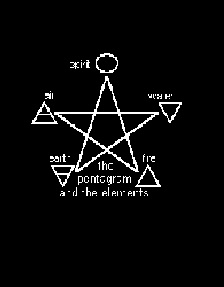
The four basic elements to many pagans are earth, water, air (wind or spirit) and fire. Many consider the first two passive and feminine—and the last two active and masculine. In Wiccan or Native American rituals, the “quartered circle” (similar to the Medicine Wheel) represents a “sacred space” or the sacred earth. The four lines may represent the spirits of the four primary directions or the spirits of the earth, water, wind and fire.
 Witches Of The Craft®
You must be logged in to post a comment.