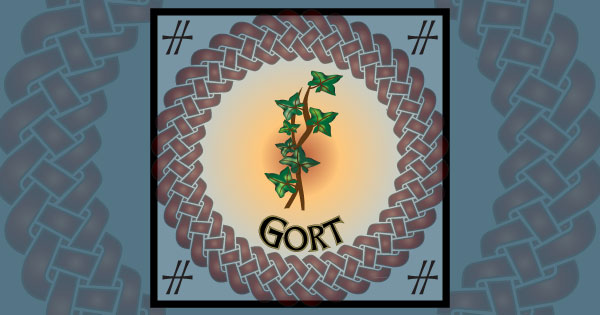
Celtic Calendar Month- Ivy September 30 to October 27

From mothermoonsmessage.blogspot.com

Beginning September 30th through October 27th we celebrate the Celtic Tree month of Ivy.  Although Ivy is not what most consider a tree, it still holds its place among the others in Celtic Tree Lore.  Its uses and importance are just as strong as that of the Oak or Hazel. In the coming weeks we will examine a few of these important traits. 
Ivy is a wild evergreen climbing vine that attaches itself to other trees as well as stone walls and other surfaces. It climbs such surfaces by fibers that grow our from every part of the stem. These fibers resembles roots and have small disks at the end by which it attaches itself to the roughness of the tree or wall it is climbing. If by chance the ivy finds soil or a deep crack the fibers will then become roots. These roots act as a means to obtain nourishment for the stem as it climbs. When this is done to another tree, the ivy can actually injure the tree it is attached to by taking of the trees life resources to aid itself.
Ivy only produces flowers when the branches get above their support. The flowering branches are bushy and come out from the climbing stem with flowers at the end of each shoot. Usually an ivy will flower during Autumn if there is enough sunlight. They appear as small clusters of greenish white or yellow . They can continue to bloom until late December. There bloom is scentless yet still they are a good source of food for birds, and insects during the cooler months when there…

Myths and legends about St. Patrick’s Day c.2017


Myths and legends about St. Patrick’s Day

St. Patrick’s Day is that one day of the year when everybody is Irish.. .or at least pretends to be. But what does that actually entail? When it comes to St. Patrick’s Day history, the US has all kinds of traditions that, frankly, aren’t even Irish. Who was Saint Patrick anyway? And what myths and legends about this Irish holiday have we all been blindly thinking are true for years? This list of St. Patrick’s Day facts will separate myth from reality and let you in on how this green (or maybe blue?!) holiday is really celebrated in Ireland.

You might be surprised to know that if you were an actual Irish person living in Ireland even a few decades ago, it would involve not shenanigans and drinking green beer, but solemn prayer and abstaining from alcohol. And you certainly wouldn’t be going to a parade, picking four-leaf clovers or hanging out with leprechauns. And the namesake of the holiday, Ireland’s patron saint… wasn’t actually Irish (or even British!).

Shocked? Surprised? Jonesing for a Guinness? It’s okay, you just need to get the facts straight about what’s real and what’s pop culture myth when it comes to this leprechaun-laden holiday. Upvote the most interesting St. Patrick’s Day trivia below!
1. St. Patrick Was Not Born in Ireland

THE MYTH: St. Patrick was Irish.

THE REALITY: Though one of Ireland’s great icons, Patrick himself wasn’t Irish. In fact, we know little of Patrick’s life except from two letters that are generally attributed to him. What we do know is that he was born somewhere in the British Isles (where exactly depends on which account you read) circa 390 and didn’t come to the Emerald Isle until he was 16. That’s when he was kidnapped and enslaved by Irish pirates.

He was brought to Ireland and held as a slave for six years, with traditional accounts saying he was a shepherd in County Antrim. He eventually escaped after claiming to have heard a heavenly voice and fled to England, where he continued the religious awakening that began during his escape.

2. Christianity Was Already Thriving in Ireland

THE MYTH: St. Patrick brought Christianity to Ireland.

THE REALITY: In 431, Pope Celestine is said to have sent a bishop named Palladius “to the Irish believing in Christ.” Patrick didn’t come back to Ireland until a year later, in 432. This would indicate that there was already an active Christian community there. In fact, Palladius actually fits into some theories about Patrick’s life – namely, that the modern version of St. Patrick is an amalgam of the two men. There were numerous other clerics active in Ireland at the time, and many Irish churches are dedicated to some of these bishops.

3. Ireland Never Had Snakes to Drive Out

THE MYTH: St. Patrick drove out the snakes from Ireland.

THE REALITY: In all probability, Ireland probably never had snakes to begin with. Before the last Ice Age, Ireland was simply too cold for snakes to survive, then when the glaciers receded, it left the land an island, impossible for snakes to reach. Fossil records from the country corroborate this, as no evidence of snakes has ever been found among the animals living there.

The legend that Patrick stood on an Irish hillside and delivered a thundering sermon that drove the island’s serpents into the sea is probably just an allegory for his eradication of pagan ideology – with snakes standing in for the serpents of Druid mythology.

4. The Shamrock May or May Not Be Apocryphal

THE MYTH: St. Patrick used the three-leaf clover to explain the Holy Trinity to Irish pagans.

THE REALITY: The parable of the three-leaf clover standing in for the Father, Son and Holy Ghost is one of the things that’s pretty hard to prove either way. What we do know is that clovers were already important in paganism, with their green color representing rebirth. Three was also an important number in paganism, and in ancient religions in general, with a number of “triple deities” represented in everything from Hindu mysticism to Sumerian gods. So if Patrick did use the clover to explain the Trinity, he already had some of the heavy lifting done for him.

5. St. Patrick’s Day Was a Dry Holiday in Ireland

THE MYTH: Irish people get hammered on St. Patrick’s Day.

THE REALITY: Ireland has a robust pub culture, and they gave the world the miracle of Guinness. But that doesn’t mean they all get blotto on St. Patrick’s Day. In fact, for most of the 20th century, pubs were legally closed on March 17th, since it was considered a religious holiday, meant as a solemn day of national piety (not to mention it falls right in the middle of Lent.)

Those laws were finally taken off the books in the late ’60s, but even then, the Irish didn’t drink green beer. That pleasure was reserved for their American cousins.

6. St. Patrick Wasn’t Even English

THE MYTH: St. Patrick was British.

THE REALITY: Technically, he was a Roman citizen, as the British Isles were under Roman rule at that point. His father and grandfather were active in Roman Christianity, but Patrick didn’t truly become a believer until after his escape. Some scholars believe his family was Roman aristocracy, and possibly even hailed from Italy, but nobody knows for sure. Even his name is in dispute, as later documents, from after Patrick’s time, list his birth name as “Maewyn Succat.” His two letters are signed by “Patricius,” and he probably adopted the name Patrick from the Latin for “well born.”

7. Leprechauns Have Nothing to Do with St. Patrick’s Day

THE MYTH: Leprechauns are inexorably linked with St. Patrick’s Day

THE REALITY: While the little green, red-bearded troublemakers are an important part of Irish folklore in general, they have literally nothing to do with the historical St. Patrick’s Day. Leprechauns didn’t appear in Irish literature until the Middle Ages, well after Patrick’s return to Ireland. While you’ll probably see drawings of leprechauns during your St. Patrick’s Day shenanigans, it’s not because of their link to the holiday, it’s just because they make a handy representation of “something Irish” – mostly due to pop culture depictions.

8. Green Wasn’t Always the Traditional St. Patrick’s Day Color

THE MYTH: Green is the color associated with St. Patrick’s Day.

THE REALITY: It is now, but it wasn’t always. Ireland itself might live up to the idea of being an Emerald Isle, but the use of green to celebrate Sr. Patrick’s Day is a recent invention, probably from the 18th century, when supporters of Irish independence from England used the color to represent their cause. Knights in the Order of St. Patrick actually wore a color known as St. Patrick’s blue – a deep and rich blue (Pantone 295, to be exact) that served as the background for the Kingdom of Ireland’s coat of arms.

9. Irish People Don’t Really Eat Much Corned Beef

THE MYTH: Corned beef and cabbage are the traditional St. Patrick’s Day feast.

THE REALITY: In America, sure. But debates rage as to whether or not this is actually a traditional Irish meal. Proponents say it is, based on the curing of ham to use on long ocean voyages. Others say it’s a more American twist on traditional Irish cuisine.

The truth is somewhere in the middle. The Irish, like pretty much everyone else, would salt-cure meat – but cows were expensive and needed for producing milk, so they’d rarely be slaughtered for food. Irish corned beef was extremely popular in England in the first half of the 1800s, but it was far too expensive for rural Irish tenant farmers to eat.

However, Irish immigrants in New York City’s Lower East Side couldn’t get the pork they were used to eating, as it was much more expensive in the US. So they bought corned beef from their Jewish neighbors because it was cheaper. The corned beef found in pubs and on dinner tables in America is much closer to traditional deli corned beef than what was for sale in Ireland 200 years ago.

10. It’s Not That Big of a Deal in Ireland

THE MYTH: Ireland pulls out all the stops to celebrate St. Patrick’s Day.

THE REALITY: They don’t, at least not the way Americans do. Until the 1700s, St. Patrick’s Day was simply one of many Roman Catholic feasts, and was only observed in Ireland. There was no raucous drinking of green beer, or kissing anyone because they were Irish. Like all feasts, it was spent somberly praying at home or in church.

But when large numbers of Irish immigrants came to America, they pushed back against nativist anti-Irish sentiment by organizing parades and other displays of pride centered around March 17th. The first was in Boston in 1737, with New York following suit. Ireland itself never had a St. Patrick’s Day parade until the 1930s. With anti-Irish bigotry having subsided, the holiday is now simply seen as a celebration of Irish culture, cuisine, and history.

11. The Shamrock and the Four-Leaf Clover Are Different

THE MYTH: The shamrock is the symbol of St. Patrick’s Day, but for extra luck, you really want a four-leaf clover – which is also Irish.

THE REALITY: Four-leaf clovers are prized for their rarity, and as such, are thought to bring great luck. But the difference between the shamrock and the four-leaf clover is more than just a leaf – one is a symbol of national pride, and the other… isn’t.

The four-leaf clover isn’t intrinsically Irish in any way, being a universal symbol for good fortune – and one that can be found everywhere. In fact, the clover with the most leaves in history (56, to be exact) was found in Moroka, Japan in 2009.

12. Chicago Can’t Dye the River Blue

THE MYTH: Chicago dyes the Chicago River green for St. Patrick’s Day, so why don’t they dye it blue the rest of year?

THE REALITY: The Windy City does dye the Chicago River green on St. Patrick’s Day, which they started doing in 1962. But as for dyeing it blue the rest of the year… bodies of water are the color they are because of the light that gets filtered through the water, not because of what’s in them. Fill a glass of water from the Chicago River, and it’ll be neither green nor blue, but clear. Also, please don’t drink it.

13. You Probably Don’t Want to Kiss the Blarney Stone

THE MYTH: You kiss the Blarney Stone on St. Patrick’s Day to get the gift of gab.

THE REALITY: The Blarney Stone is another one of those intrinsically “Irish” things that people use as shorthand for Irish culture. But it has nothing to do with St. Patrick, as Blarney Castle wasn’t built until 1446, a thousand years after the time of St. Patrick. As an aside, both native Irish people and hygiene experts agree that actually kissing the Blarney Stone is incredibly unsanitary and quite overrated as a tourist destination.

St. Patrick’s Day: Why He Slaughtered the Druids c. 2017


St. Patrick’s Day: Why He Slaughtered the Druids

St. Patrick was born around 450 AD on the Scottish border. His father was a Christian Roman soldier and his mother was a native British woman. Only two of his letters survive telling details about his life. When he was fourteen to sixteen years old, he was taken into captivity in Ireland by the Irish raiders in Britain; he tended cattle for more than six years. In this time of captivity, he drew closer to God before finally escaping on a trading ship. He returned years later to spread Catholicism throughout Ireland while destroying the Druids who resisted Roman and British rule in Ireland. Because he believed so strongly in the Catholic Church, he thought that anyone who was not Christian had to become one in order to be ³saved´. Those who resisted were slaughtered in the Christian holy wars of Gaul


The Irish people at that time were happy and doing quite well. However, St.Patrick was insistent that the Pagan Celts convert to Christianity. He noticed that the Druids were the most powerful people of the Celts, so he figured that if he could convert them, then the rest of the people would follow. When the Druids refused to be bribed by the Romans, this angered the rulers of the Catholic Church.St. Patrick declared that he would drive all of the snakes out of Ireland. ³Snakes´was a metaphor for the Druids.
Since the Druids did not write their teachings down, all we know about them is was handed down to us by the Romans. It was often said that the Celts were heathens who could not read or write, but they did know how to read and write in Greek. While they didn¶t write down the secret teachings of the Druids, they were expected to memorize the knowledge. Julius Caesar had this to say about the Druids:
The Druids usually hold aloof from war, and do not pay war-taxes with the rest; they are excused from military service and exempt from all liabilities. Tempted by these great rewards, many young men assemble of their own motion to receive their training; many are sent by parents and relatives. Report says that in the schools of the Druids. They learn by heart a great number of verses, and therefore some persons remain twenty years in training. And they do not think it proper to commit these utterances to writing,although in almost all other matters, and in their private and public accounts, they make use of Greek letters. I believe that they have adopted the practice for two reasons ± that they do not wish the rule to become common property, nor those who learn the rule to rely on writing and so neglect the cultivation of the memory;and, in fact, it does usually happen that the assistance of writing tends to relax the diligence of the student and the action of the memory. The cardinal doctrine which they seek to teach is that souls do not die, but after death pass from one to another; and this belief, as the fear of death is thereby cast aside, they hold to be the greatest incentive to valour. (Caesar The Gallic War VI.13-14)


We do know that Druidism was a science and not a religion. It was the study of the relationships between opposites: summer and winter, men and women,consciousness and unconsciousness, force and matter. Some of the main tenets:

*Every action has a consequence that must be observed and you must be prepared to compensate for your actions if required.
* Life is sacred and all are responsible for seeing that this standard is upheld.

*You do still live in society and are bound by its rules.

*Work with high standards.

*Make an honest living.

*Be a good host as well as a good guest.

*Take care of yourself. (Health was held in high esteemamongst the Celts, so much that a person could be finedfor being grossly overweight due to lack of care.)

*Serve your community.

*Maintain a healthy balance of the spiritual and mundane.(Nihtscad writes: Ethical and self respecting Druids did nothing without being properly schooled or aware of the consequences ahead of time. They knew when it was appropriate to visit the Otherworld and immerse themselves in the spiritual as well as when it was appropriate to be fully in this world.

*Uphold the Truth, starting with yourself.

*Be sure in your convictions, particularly when judging or accusing someone, but also when debating. Ask yourself:are you really sure? Do you really know that this the case?


One part of the Druid class were the ³Bards´, whose job it was to remember all of the history of the people. The Celts did not rely on a written language because they memorized the songs and poetry of the Bards. The Irish believed that history was very important, for if you didn¶t remember what had happened in the past, you couldn¶t safely plan for the future.Druid priests were the keepers of the knowledge of
Earth and Spirits. It was their responsibility to learn the spirit world in order to keep people in harmony with nature. Priests performed marriages, baptisms, and acted as psychiatrists and doctors.The Romans considered the Celts to be good fighters. In 300 BC, Alexander the Great considered it prudent to treat the Celts as equals. In the fourth century,Ammianus Marcellinus, a Byzantine writer, wrote of the Celts:
Nearly all the Gaels are of a lofty stature, fair and of ruddy complexion:terrible from the sternness of their eyes, and of great pride and insolence. A whole troop of foreigners would not be able to withstand a single Gaul if he called his wife to his assistance, which is usually very strong and with blue eyes.


Ancient Celtic women could be warriors. Legend says that Scathach, a female warrior from Isle of Skye in Scotland, trained a great Irish hero, Cuchilainn. Boudicca, a red-haired queen of the British Iceni tribe, led a revolt against the Romans following her husband¶s death.During large battles, the Celts had a strategy to terrify their opponents: they blew war horns, they roared, they rumbled chariots, they banged their swords on their shields, and then they attacked the enemy. These tactics did not work against the well-trained Romans who were trained to resist the attacks of their enemies. The Celts became disheartened by their inability to break the Romans quickly. The main reason why the Celts lost the war was due to the fact that they were not united. Clans attacked farms and stole cattle and other goods during the battles.This caused many Celts to view their own clans as enemies and kept them from uniting as a people. They did not understand how important it was to fight together as an army against the Romans.St. Patrick destroyed the influence of the Druids by destroying the sacred sites of the people and building churches and monasteries where the Druids used to live and teach. Instead of hearing the teachings and advice of the Druids, the people began to hear the teachings of Rome. Because the Druids were the only ones who were taught to remember the history, with the Druids dead and their influence broken, the history was forgot


By killing off the teachers and the wise ones, Catholicism could be spread. For this mass conversion of a culture to Christianity, and for the killing of thousands of innocent people, Patrick was made a Saint by his church.

The Gods of Asgard c. 2018

Not A Deity of the Day But One of My Favorite Celtic Women In History…. c. 2015

(Side Note from Lady Beltane – I want to grow up to be like this astounding woman)

Boudica, Battle of Watling Street by Roman Lappat · Putty&Paint

Boudica

Boudica (/ˈbuːdɨkə/; alternative spelling: Boudicca, also known as Boadicea /boʊdɨˈsiːə/ and in Welsh as Buddug [ˈbɨ̞ðɨ̞ɡ]) (d. AD 60 or 61) was a queen of the British Iceni tribe who led an uprising against the occupying forces of the Roman Empire.

Boudica’s husband Prasutagus ruled as a nominally independent ally of Rome and left his kingdom jointly to his daughters and the Roman emperor in his will. However, when he died, his will was ignored and the kingdom was annexed. Boudica was flogged, her daughters raped, and Roman financiers called in their loans.

In AD 60 or 61, when the Roman governor Gaius Suetonius Paulinus was campaigning on the island of Anglesey off the northwest coast of Wales, Boudica led the Iceni, the Trinovantes and others in revolt. They destroyed Camulodunum (modern Colchester), earlier the capital of the Trinovantes but at that time a colonia, a settlement for discharged Roman soldiers, and site of a temple to the former Emperor Claudius. Upon hearing of the revolt, Suetonius hurried to Londinium (modern London), the twenty-year-old commercial settlement that was the rebels’ next target.

The Romans, having concluded that they did not have the numbers to defend the settlement, evacuated and abandoned Londinium. Boudica led 100,000 Iceni, Trinovantes and others to fight Legio IX Hispana and burned and destroyed Londinium, and Verulamium (modern-day St Albans). An estimated 70,000–80,000 Romans and British were killed in the three cities by those led by Boudica. Suetonius, meanwhile, regrouped his forces in the West Midlands, and despite being heavily outnumbered, defeated the Britons in the Battle of Watling Street.

The crisis caused the Emperor Nero to consider withdrawing all Roman forces from Britain, but Suetonius’s eventual victory over Boudica confirmed Roman control of the province. Boudica then either killed herself so she would not be captured, or fell ill and died. The extant sources, Tacitus and Cassius Dio, differ.

Interest in these events revived in the English Renaissance and led to Boudica’s fame in the Victorian era. Boudica has remained an important cultural symbol in the United Kingdom. However, the absence of native British literature during the early part of the first millennium means that knowledge of Boudica’s rebellion comes solely from the writings of the Romans

History

Boudica’s name

Boudica has been known by several versions of her name. Raphael Holinshed calls her Voadicia, while Edmund Spenser calls her Bunduca, a version of the name that was used in the popular Jacobean play Bonduca, in 1612. William Cowper’s poem, Boadicea, an ode (1782) popularised an alternate version of the name. From the 19th century and much of the late 20th century, Boadicea was the most common version of the name, which is probably derived from a mistranscription when a manuscript of Tacitus was copied in the Middle Ages.

Her name was clearly spelled Boudicca in the best manuscripts of Tacitus, but also Βουδουικα, Βουνδουικα, and Βοδουικα in the (later and probably secondary) epitome of Cassius Dio. The name is attested in inscriptions as “Boudica” in Lusitania, Boudiga in Bordeaux, and Bodicca in Algeria.

Kenneth Jackson concludes, based on later development of Welsh and Irish, that the name derives from the Proto-Celtic feminine adjective *boudīka, “victorious”, that in turn is derived from the Celtic word *bouda, “victory” (cf. Irish bua (Classical Irish buadh), Buaidheach, Welsh buddugoliaeth), and that the correct spelling of the name in the British language is Boudica, pronounced [bɒʊˈdiːkaː].

The closest English equivalent to the vowel in the first syllable is the ow in “bow-and-arrow”. The modern English pronunciation is /ˈbuːdɪkə/, and it has been suggested that the most comparable English name, in meaning only, would be “Victoria”.

Background

Location of Iceni territory within England, Wales and Mann; modern county borders for England and pre-1996 borders for Wales are shown for context.

Tacitus and Dio agree that Boudica was of royal descent. Dio describes her as “possessed of greater intelligence than often belongs to women.” He also describes her as tall, with tawny hair hanging down to below her waist, a harsh voice and a piercing glare. He notes that she habitually wore a large golden necklace (perhaps a torc), a colourful tunic, and a thick cloak fastened by a brooch.

Her husband Prasutagus was the king of the Iceni, the people who inhabited roughly what is now Norfolk. They initially were not part of the territory under direct Roman control, having voluntarily allied themselves to Rome following Claudius’ conquest of AD 43. They were proud of their independence, and had revolted in AD 47 when the then-governor Publius Ostorius Scapula threatened to disarm them. Prasutagus had lived a long life of conspicuous wealth and, hoping to preserve his line, made the Roman emperor co-heir to his kingdom, along with his wife and two daughters.

It was normal Roman practice to allow allied kingdoms their independence only for the lifetime of their client king, who would then agree to leave his kingdom to Rome in his will. For example, the provinces of Bithynia and Galatia were incorporated into the Empire in just this way. Roman law also allowed inheritance only through the male line, so when Prasutagus died, his attempts to preserve his line were ignored and his kingdom was annexed as if it had been conquered. His lands and property were confiscated and nobles treated like slaves. According to Tacitus, Boudica was flogged and her daughters were raped. Cassius Dio says that Roman financiers, including Seneca the Younger, chose this time to call in their loans. Tacitus does not mention this, but does single out the Roman procurator Catus Decianus for criticism for his “avarice”. Prasutagus, it seems, had lived well on borrowed Roman money, and on his death his subjects had become liable for the debt.

Boudica’s uprising

In AD 60 or 61, while the current governor, Gaius Suetonius Paulinus, was leading a campaign against the island of Mona (modern Anglesey) in the north of Wales, which was a refuge for British rebels and a stronghold of the druids, the Iceni conspired with their neighbours the Trinovantes, amongst others, to revolt. Boudica was chosen as their leader. According to Tacitus, they drew inspiration from the example of Arminius, the prince of the Cherusci who had driven the Romans out of Germany in AD 9, and their own ancestors who had driven Julius Caesar from Britain. Dio says that at the outset Boudica employed a form of divination, releasing a hare from the folds of her dress and interpreting the direction in which it ran, and invoked Andraste, a British goddess of victory.

The rebels’ first target was Camulodunum (Colchester), the former Trinovantian capital and, at that time, a Roman colonia. The Roman veterans who had been settled there mistreated the locals and a temple to the former emperor Claudius had been erected there at local expense, making the city a focus for resentment. The Roman inhabitants sought reinforcements from the procurator, Catus Decianus, but he sent only two hundred auxiliary troops. Boudica’s army fell on the poorly defended city and destroyed it, besieging the last defenders in the temple for two days before it fell. Archaeologists have shown that the city was methodically demolished. The future governor Quintus Petillius Cerialis, then commanding the Legio IX Hispana, attempted to relieve the city, but suffered an overwhelming defeat. His infantry was wiped out—only the commander and some of his cavalry escaped. The location of this famous destruction of the Legio IX is now claimed by some to be the village of Great Wratting, in Suffolk, which lies in the Stour Valley on the Icknield Way West of Colchester, and by a village in Essex. After this defeat, Catus Decianus fled to Gaul.

When news of the rebellion reached him, Suetonius hurried along Watling Street through hostile territory to Londinium. Londinium was a relatively new settlement, founded after the conquest of AD 43, but it had grown to be a thriving commercial centre with a population of travellers, traders, and, probably, Roman officials. Suetonius considered giving battle there, but considering his lack of numbers and chastened by Petillius’s defeat, decided to sacrifice the city to save the province.

…Alarmed by this disaster and by the fury of the province which he had goaded into war by his rapacity, the procurator Catus crossed over into Gaul. Suetonius, however, with wonderful resolution, marched amidst a hostile population to Londinium, which, though undistinguished by the name of a colony, was much frequented by a number of merchants and trading vessels. Uncertain whether he should choose it as a seat of war, as he looked round on his scanty force of soldiers, and remembered with what a serious warning the rashness of Petilius had been punished, he resolved to save the province at the cost of a single town. Nor did the tears and weeping of the people, as they implored his aid, deter him from giving the signal of departure and receiving into his army all who would go with him. Those who were chained to the spot by the weakness of their sex, or the infirmity of age, or the attractions of the place, were cut off by the enemy. – Tacitus

Londinium was abandoned to the rebels who burnt it down, slaughtering anyone who had not evacuated with Suetonius. Archaeology shows a thick red layer of burnt debris covering coins and pottery dating before AD 60 within the bounds of Roman Londinium., whilst Roman-era skulls found in the Walbrook in 2013 were potentially linked to victims of the rebels. Verulamium (St Albans) was next to be destroyed.

In the three settlements destroyed, between seventy and eighty thousand people are said to have been killed. Tacitus says that the Britons had no interest in taking or selling prisoners, only in slaughter by gibbet, fire, or cross. Dio’s account gives more detail; that the noblest women were impaled on spikes and had their breasts cut off and sewn to their mouths, “to the accompaniment of sacrifices, banquets, and wanton behaviour” in sacred places, particularly the groves of Andraste.

Romans rally

While Boudica’s army continued their assault in Verulamium (St. Albans), Suetonius regrouped his forces. According to Tacitus, he amassed a force including his own Legio XIV Gemina, some vexillationes (detachments) of the XX Valeria Victrix, and any available auxiliaries. The prefect of Legio II Augusta, Poenius Postumus, stationed near Exeter, ignored the call, and a fourth legion, IX Hispana, had been routed trying to relieve Camulodunum, but nonetheless the governor was able to call on almost ten thousand men.

Suetonius took a stand at an unidentified location, probably in the West Midlands somewhere along the Roman road now known as Watling Street, in a defile with a wood behind him — but his men were heavily outnumbered. Dio says that, even if they were lined up one deep, they would not have extended the length of Boudica’s line. By now the rebel forces were said to have numbered 230,000, however, this number should be treated with scepticism — Dio’s account is known only from a late epitome, and ancient sources commonly exaggerate enemy numbers.

Boudica exhorted her troops from her chariot, her daughters beside her. Tacitus gives her a short speech in which she presents herself not as an aristocrat avenging her lost wealth, but as an ordinary person, avenging her lost freedom, her battered body, and the abused chastity of her daughters. She said their cause was just, and the deities were on their side; the one legion that had dared to face them had been destroyed. She, a woman, was resolved to win or die; if the men wanted to live in slavery, that was their choice.

However, the lack of manoeuvrability of the British forces, combined with lack of open-field tactics to command these numbers, put them at a disadvantage to the Romans, who were skilled at open combat due to their superior equipment and discipline. Also, the narrowness of the field meant that Boudica could put forth only as many troops as the Romans could at a given time.

First, the Romans stood their ground and used volleys of pila (heavy javelins) to kill thousands of Britons who were rushing toward the Roman lines. The Roman soldiers, who had now used up their pila, were then able to engage Boudica’s second wave in the open. As the Romans advanced in a wedge formation, the Britons attempted to flee, but were impeded by the presence of their own families, whom they had stationed in a ring of wagons at the edge of the battlefield, and were slaughtered. This is not the first instance of this tactic—the women of the Cimbri, in the Battle of Vercellae against Gaius Marius, were stationed in a line of wagons and acted as a last line of defence Ariovistus of the Suebi is reported to have done the same thing in his battle against Julius Caesar. Tacitus reports that “according to one report almost eighty thousand Britons fell” compared with only four hundred Romans.

According to Tacitus in his Annals, Boudica poisoned herself, though in the Agricola which was written almost twenty years prior he mentions nothing of suicide and attributes the end of the revolt to socordia (“indolence”); Dio says she fell sick and died and then was given a lavish burial; though this may be a convenient way to remove her from the story. Considering Dio must have read Tacitus, it is worth noting he mentions nothing about suicide (which was also how Postumus and Nero ended their lives).

Postumus, on hearing of the Roman victory, fell on his sword. Catus Decianus, who had fled to Gaul, was replaced by Gaius Julius Alpinus Classicianus. Suetonius conducted punitive operations, but criticism by Classicianus led to an investigation headed by Nero’s freedman Polyclitus. Fearing Suetonius’ actions would provoke further rebellion, Nero replaced the governor with the more conciliatory Publius Petronius Turpilianus. The historian Gaius Suetonius Tranquillus tells us the crisis had almost persuaded Nero to abandon Britain.

Location of her defeat

The location of Boudica’s defeat is unknown. Most historians[citation needed] favour a site in the West Midlands, somewhere along the Roman road now known as Watling Street. Kevin K. Carroll suggests a site close to High Cross in Leicestershire, on the junction of Watling Street and the Fosse Way, which would have allowed the Legio II Augusta, based at Exeter, to rendezvous with the rest of Suetonius’s forces, had they not failed to do so. Manduessedum (Mancetter), near the modern town of Atherstone in Warwickshire, has also been suggested, as has “The Rampart” near Messing in Essex, according to legend. More recently, a discovery of Roman artefacts in Kings Norton close to Metchley Camp has suggested another possibility, and a thorough examination of a stretch of Watling Street between St. Albans, Boudica’s last known location, and the Fosse Way junction has suggested the Cuttle Mill area of Paulerspury in Northamptonshire, which has topography very closely matching that described by Tacitus of the scene of the battle.

In 2009 it was suggested that the Iceni were returning to East Anglia along the Icknield Way when they encountered the Roman army in the vicinity of Arbury Bank, Hertfordshire. In March 2010, evidence was published suggesting the site may be located at Church Stowe, Northamptonshire.

Historical sources

Tacitus, the most important Roman historian of this period, took a particular interest in Britain as his father-in-law Gnaeus Julius Agricola served there three times (and was the subject of his first book). Agricola was a military tribune under Suetonius Paulinus, which almost certainly gave Tacitus an eyewitness source for Boudica’s revolt. Cassius Dio’s account is only known from an epitome, and his sources are uncertain. He is generally agreed to have based his account on that of Tacitus, but he simplifies the sequence of events and adds details, such as the calling in of loans, that Tacitus does not mention.

Gildas, in his 6th century De Excidio et Conquestu Britanniae, may have been alluding to Boudica when he wrote “A treacherous lioness butchered the governors who had been left to give fuller voice and strength to the endeavours of Roman rule”.

History and literature

By the Middle Ages Boudica was forgotten. She makes no appearance in Bede’s work, the Historia Brittonum, the Mabinogion or Geoffrey of Monmouth’s History of the Kings of Britain. But the rediscovery of the works of Tacitus during the Renaissance allowed Polydore Vergil to reintroduce her into British history as “Voadicea” in 1534. Raphael Holinshed also included her story in his Chronicles (1577), based on Tacitus and Dio, and inspired Shakespeare’s younger contemporaries Francis Beaumont and John Fletcher to write a play, Bonduca, in 1610. William Cowper wrote a popular poem, “Boadicea, an ode”, in 1782.

It was in the Victorian era that Boudica’s fame took on legendary proportions as Queen Victoria came to be seen as Boudica’s “namesake”, their names being identical in meaning. Victoria’s Poet Laureate, Alfred, Lord Tennyson, wrote a poem, “Boadicea”, and several ships were named after her.

A statue of Boudica with her daughters in her war chariot (a historically furnished with scythes after the Persian fashion) was executed by Thomas Thornycroft over the 1850s and 1860s with the encouragement of Prince Albert, who lent his horses for the model.Thornycroft exhibited the head separately in 1864. It was cast in bronze in 1902, 17 years after Thornycroft’s death, by his son Sir John, who presented it to the London County Council. They erected it on a plinth on the Victoria Embankment next to Westminster Bridge and the Houses of Parliament, inscribed with the following lines from Cowper’s poem:

Regions Caesar never knew
Thy posterity shall sway.

Ironically, the great anti-imperialist rebel was now identified with the head of the British Empire, and her statue stood guard over the city she razed to the ground.

Boudica and King’s Cross

The area of King’s Cross, London was previously a village known as Battle Bridge which was an ancient crossing of the River Fleet. The original name of the bridge was Broad Ford Bridge.

The name “Battle Bridge” led to a tradition that this was the site of a major battle between the Romans and the Iceni tribe led by Boudica. The tradition is not supported by any historical evidence and is rejected by modern historians. However, Lewis Spence’s 1937 book Boadicea – warrior queen of the Britons went so far as to include a map showing the positions of the opposing armies. There is a belief that she was buried between platforms 9 and 10 in King’s Cross station in London, England. There is no evidence for this and it is probably a post-World War II invention.


Source:
Wikipedia

Ivy – symbol of strength and determination

From Ireland Calling

Ivy has many superstitions and beliefs attached to it.

Because it had the ability to form dense thickets in woodland, grow where other plants could not and block out the light from even the mighty oak, ivy was believed to be very powerful by the Druids, more powerful than its enemy, the vine and quite sinister.

Ivy tree in Celtic Mytholgy

The ivy and the vine have been seen as enemies since ancient times. This seems odd since the same Greek and Roman gods are associated with each.

Bacchus, god of wine

In Greek mythology ivy was sacred to Osiris and also associated with Dionysus. In Roman mythology Ivy was connected to Bacchus, the god of wine as it grew over his home land.

Bacchus is often portrayed wearing an ivy crown, perhaps because this was once thought to prevent intoxication. The poisonous berries of the ivy, when ground into a powder were also once believed to be a hangover cure.

The link between Bacchus and ivy was taken over to England where old English Taverns would display ivy above their doors indicating the high quality of their drinks.

The proverb ‘Good wine needs no bush’, meaning good wine speaks for itself, comes from this practice.

Gort, G – Ivy, a symbol of strength and determination to the Druids, is the twelfth letter of the ogham alphabet, gort, and the eleventh month in the Celtic tree calendar, representing September 30th to October 27th.

Protection from evil

In old Ireland ivy was thought to provide protection from evil when growing on or near to a dwelling.

However, if it should die or fall down then misfortune would fall upon those therein.

Ivy was often carried by young women for good luck and fertility. Used at weddings intertwined with holly, the ivy would symbolise fidelity and at Yule-tide, would bring peace to the household.

Ivy was also linked to inspiration and worn by poets in the form of a crown.

August 17th N. H. Current Moon Phase

SATURDAY, AUGUST 17, 2019

Today the Moon will be in a Waning Gibbous Phase. This is the first phase after the Full Moon occurs. It lasts roughly 7 days with the Moon’s illumination growing smaller each day until the Moon becomes a Last Quarter Moon with a illumination of 50%. The average Moon rise for this phase is between 9am and Midnight depending on the age of the phase. The moon rises later and later each night setting after sunrise in the morning. During this phase the Moon can also be seen in the early morning daylight hours on the western horizon.

previous moonPREVIOUS
NEXT DAYnextDayArrow

Female Druids, the Forgotten Priestesses of the Celts

In all my studies I have never heard of Female Druid Priestess. But after reading this article and thinking back over what I have learn about the ancient Celtics spiritual path and the duality of it I than wondered was this information did not come out until now. I am going to look for at least two other article  confirming what this on days and I will post the links to them. I did a thank you ritual to Bridget for pushing to get this information to us. I would like to hear what you think of this especially if you follow a Druid path.


In medieval Irish legends they were called Banduri or Bandorai. Their existence was confirmed by ancient Greek and Roman writers. But who were the legendary female Druids?

The Druids were the ancient religious leaders, scientists and researchers of the Celtic society. For centuries, there was a common misconception that Druids were only male. However, numerous historical records attest to the fact that there were in fact women among their ranks.

The Wise Ones of Celtic society

The term ”Druid” comes from the Indo-European word ”deru”, which means ”the truth” or ”true”. This word has evolved into the Greek term ”drus”, meaning ”oak”.

The Druids were the intellectual elite. Being a Druid was a tribal function, but they were also poets, astronomers, magicians, and astrologers. It took them 19 years to gain the necessary knowledge and skills in alchemy, medicine, law, the sciences, and more. They organized intellectual life, judicial processes, had skills to heal people, and were involved in developing strategies for war. They were an oasis of wisdom and highly respected in their society.

Roman Accounts of the Druidesses

Gaius Julius Caesar was fascinated with the Druids. He wrote that they were scientists, theologians, and philosophers, and acquired knowledge that was extraordinary. According to experts in Caesar’s writings, the great Roman leader was well aware of the female Druids. Unfortunately, most of the Roman writers ignored women in general, so it is not easy to find reference to them in historical texts. However, Strabo wrote about a group of religious women who lived on an island near the Loir River. In ‘Historia’, Augusta is a description of Diocletian, Alexander Severus and Aurelian, who discussed their problems with the female Druids.

To read the rest of this interesting article copy and paste this link into your browser:

https://www.ancient-origins.net/history/female-druids-forgotten-priestesses-celts-005910

Uath (Hawthorn) May 13 to June 9

  • Ogham Letter: Huathe (H)
  • Symbolic Meaning: Purification, sacred marriage and male-female unity
  • Ruling Planet: Mars & Venus (Vulcan)?
  • Ruling Element:
  • Season:
  • Corresponding Star Sign: Gemini / Cancer


The Hawthorn Tree rules the sixth month of the Celtic Tree Calendar. It’s a tree of contradictions and opposites, it pulls together the complete idea of duality and oppositions.


The tree has strong links to male energy, however, it is symbolic of fertility and it also deeply rooted to female deities. This balance and unity of male and female energies gave this tree the name the “marriage tree”.


The hawthorn is sacred and its thorny branches produce an abundance of foliage and blossoms that have healing properties thought to circulatory disorders and high blood pressure.


Hawthorn Tree Zodiac


Those born under the sign of the Hawthorn are a paradox and are not at all what they seem at first glance. Seemingly quite average on the outside but inside is burning bright with a creative passion. They are quick witted with an excellent memory making them knowledgeable about a wide variety of topics. They can adapt to almost any situation and will more often than not be able to see the bigger picture making them great listeners and ones to go to in a time of need.


Hawthorn signs pair well with Ash and Rowan


–tree2mydoor.com

Saille (Willow) April 15 to May 12

  • Ogham Letter: Saille (S)
  • Symbolic Meaning: Fertility, Flexibility, New Life
  • Ruling Planet: Moon
  • Ruling Element:
  • Season:
  • Corresponding Star Sign: Taurus / Gemini


It’s the Willow tree that rules the fifth month in the calendar. The tree thrives in wet boggy areas and can often be found planted next to areas of water.


Willow has deep roots with spirituality and psychic ability with specific links to the lunar realm. The strong association with the moon comes from the trees love for water.


It’s a symbol of fertility and new life, a willow branch can be planted in the ground and from it a new tree will grow in its place. Willow trees are flexible, the branches can be contorted in ridiculous ways without any signs of snapping, this makes it a popular wood to use in weaving and wicker work..


When it comes to medicinal values, the willow has many healing properties. The bark could be used as a treatment for cold and flu and young twigs from the tree were once be chewed in aid of pain relief.


Willow Tree Zodiac


People born under the Willow sign seem understand the world around them a little more than others. They are very intune with their psychic side and their personality is ruled by the moon. They are intuitive and have deep roots within other worldly realms, in particular, the lunar realm. Willow signs are intelligent and highly creative however do not like showing this side of their personality in fear of seeming arrogant or over the top. Other signs find them mysterious and hard to get to know but once they are friends, willow signs are fiercely loyal and great at keeping secrets. They have a realistic outlook on life giving them much more patience than other signs.


Willow signs are compatible with Birch and Ivy signs.


–tree2mydoor.com

Hawthorn Tree: May 13th – June 9th

  • Ogham Letter: Huathe (H)
  • Symbolic Meaning: Purification, sacred marriage and male-female unity
  • Ruling Planet: Mars & Venus (Vulcan)?
  • Ruling Element:
  • Season:
  • Corresponding Star Sign: Gemini / Cancer


The Hawthorn Tree rules the sixth month of the Celtic Tree Calendar. It’s a tree of contradictions and opposites, it pulls together the complete idea of duality and oppositions.


The tree has strong links to male energy, however, it is symbolic of fertility and it also deeply rooted to female deities. This balance and unity of male and female energies gave this tree the name the “marriage tree”.


The hawthorn is sacred and its thorny branches produce an abundance of foliage and blossoms that have healing properties thought to circulatory disorders and high blood pressure.


Hawthorn Tree Zodiac


Those born under the sign of the Hawthorn are a paradox and are not at all what they seem at first glance. Seemingly quite average on the outside but inside is burning bright with a creative passion. They are quick witted with an excellent memory making them knowledgeable about a wide variety of topics. They can adapt to almost any situation and will more often than not be able to see the bigger picture making them great listeners and ones to go to in a time of need.


Hawthorn signs pair well with Ash and Rowan


–tree2mydoor.com