Can I Be A Christian Wiccan or Witch? (1 Person Opinion)

Many people in the Pagan community were raised in a religion that wasn’t Paganism, and sometimes, it can be a challenge to set aside the beliefs with which you were raised. Occasionally, however, you’ll encounter people who didn’t set their beliefs aside at all, but have found a way to blend their Christian upbringing with Wicca or some other Pagan path that they’ve discovered later in life. So, that begs the question, what about that whole “Thou shalt not suffer a witch to live” thing that appears in the Bible? There’s an argument in some circles that the word witch was a mistranslation, and that it’s actually supposed to be poisoner. If this is the case, does that mean it’s possible to be a Christian Wiccan?

Christian Wicca

Unfortunately, this is one of those questions that has to get broken down into a bunch of really small bits, because there’s no simple answer, and no matter how it gets answered, somebody is going to be upset with the response. Let’s try to break this down a bit, without turning it into a debate on Christian theology.

First, let’s clarify one thing right off the bat. Wicca and witchcraft are not synonymous. One can be a witch without being Wiccan. Wicca itself is a specific religion. Those who follow it—Wiccans—honor the deities of their particular tradition of Wicca. They don’t honor the Christian god, at least not in the way that Christianity mandates that he be honored. In addition, Christianity has some pretty strict rules about what gods you get to worship—pretty much none other than theirs. You know, there’s that “thou shall have no other gods before me” bit. By the rules of Christianity, it’s a monotheistic religion, while Wicca is polytheistic. These make them two very distinct and very different religious belief systems.

So, if you go strictly by the very definition of the words, one could not be a Christian Wiccan any more than one could be a Hindu Muslim or a Jewish Mormon. There are Christians who practice witchcraft within a Christian framework, but this is not Wicca. Do keep in mind that there are people who declare themselves to be Christian Wiccans, or even ChristoPagans, honoring Jesus and Mary as god and goddess together. It’s generally rude to argue with how people self-identify, but if you go by actual semantics, it seems that one would rule out the other.

There are some practitioners who follow what they call Trinitarian Wicca, which “is a tradition based on American Wicca, boasting no direct lineage. Trinitarians work exclusively with the Goddess-inclusive Christian Pantheon. This tradition is not eclectic nor is it ChristoPagan because our devotion lies exclusively with the Christian pantheon.”

Witch, or Poisoner?

Let’s move on. Let’s assume that you’re interested in becoming a witch, but you plan on remaining Christian. In general, the witch community isn’t going to care—after all, what you do is your business, not ours. However, your local pastor might have quite a bit to say about it. After all, the Bible does say “thou shall not suffer a witch to live.” There’s been a great deal of discussion in the Pagan community about that line, with many people arguing that it’s a mistranslation, and that originally it had nothing to do with witchcraft or sorcery, but that the original text was “thou shall not suffer a poisoner to live.”

In general, the notion of the line in the Book of Exodus applying to poisoners and not witches is one that is popular in Pagan circles but has been repeatedly dismissed by Jewish scholars. This theory of mistranslation of the word “poisoner” as “witch” is acknowledged as being patently false, and based upon ancient Greek texts.

In the original Hebrew, the text is very clear. In the Targum Onkelos, which is an ancient translation of the Torah into Aramaic, the verse in question reads M’khashephah lo tichayyahwhich loosely translates into “A M’khashephah you shall not let live.” For the early Jews, a M’khashephah was a witch who used herbal magic as a form of sorcery. While herbalism could have involved herbal poisons, if the Torah had meant to say poisoner, it would have used a different word, rather than one that meant, specifically, witch.

While this doesn’t need to turn into a discussion on Biblical theory, many Jewish scholars have asserted that the passage in question does in fact refer to witchcraft, which seems fairly sensible, since they’re the ones who speak the language best. Keeping that in mind, if you choose to practice witchcraft under the umbrella of Christianity, don’t be surprised if you run into some opposition from other Christians.

The Bottom Line

So can you be a Christian Wiccan? In theory, no, because they’re two separate religions, one of which forbids you from honoring the gods of the other. Can you be a Christian witch? Well, maybe, but that’s a matter for you to decide for yourself. Again, the witches probably don’t care what you do, but your pastor may be less than thrilled.

If you’re interested in practicing witchcraft and magic within a Christian framework, you may want to look into some of the writings of Christian mystics, or perhaps the Gnostic Gospels, for further ideas.

SOURCE: Wigington, Patti. “Can I Be A Christian Wiccan or Witch?” Learn Religions, Apr. 5, 2023, learnreligions.com/can-i-be-a-christian-wiccan-or-witch-2562901.

Can you be a Christian Witch? (1 Persons Opinion)

The short answer is yes…

The long answer is: No, not really, depending on which “brand” of Christianity you subscribe to.

The other disclaimer I would like to give is that there is honestly so much to this topic. This article is likely to barely scratch the surface, which is one of the reasons I have put off writing about it. The other reason is that I am honestly afraid of being targeted and attacked by Christians & the Christian-Witch community… because they don’t exactly have a good track record of being understanding, or civil.

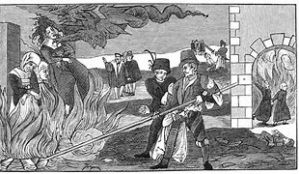
So if I am burned at the stake for writing this, we’ll know for sure that nothing’s changed in the last few hundred years…

A brief history of Christianity & Witchcraft: … 

Tension in the communities: …

Inculturation: …

Personal Practice vs Organized Religion: …

The (Cursed?) Original Book of Witchcraft

This article was co-researched and co-written by digital library specialist Elizabeth Gettins, who also had the brilliant idea for the piece.

An ancient tome delving into the dark arts of witchcraft and magic…a book of doom…yet it lives…at the Library of Congress.

You’re forgiven if you think we’re talking about H.P. Lovecraft’s fictional book of magic, “Necronomicon,” the basis for the plot device in “The Evil Dead” films, or something Harry Potter might have found in the Dark Arts class at Hogwarts.

But, as the darkness of Halloween descends, we’re not kidding. A first edition of “The Discouerie of Witchcraft,” Reginald Scot’s 1584 shocker that outraged King James I, survives at your favorite national library in the Rare Book and Special Collections Reading Room. (The Library has a copy of the original edition, as well as a 1651 edition.)

It is believed to be the first book published on witchcraft in English and extremely influential on the practice of stage magic. Shakespeare likely researched it for the witches scene in “Macbeth.” It was consulted and plagiarized by stage magicians for hundreds of years. Today, you can peruse its dark secrets online. How could your wicked little fingers resist? Scot promises to reveal “lewde dealings of witches and witchmongers”! The “pestilent practices of Pythonists”!  The “vertue and power of natural magike”!

Also, juggling.

It is one of the  foundational examples of grimoire, a textbook on magic, groundbreaking for its time and nearly encyclopedic in its information. Scot’s research included consulting dozens of previous thinkers on various topics such as occult, science and magic, including Agrippa von Nettesheim’s “De Occulta Philosophia,” in 1531 and John Dee’s “Monas Hieroglyphica” in 1564. The result is a most impressive compendium.

But Scot wasn’t lurking about in a hooded cape, looking for eyes of newts and toes of frogs to bewitch mortals. A skeptic, he wrote to make it plain that “witches” were not evil, but instead were resourceful and capable women who practiced the art of folk healing as well as sleight of hand. Their apparently miraculous feats were in no way wicked. He wrote, “At this day it is indifferent to say in the English tongue, ‘she is a witch’ or ‘she is a wise woman.’ ”

Born in 1538 in Kent under the rule of Henry VIII, Scot was landed gentry. He was educated and a member of … Click here to read the rest of this article from blogs.loc.gov/loc

Happy Witchy Wednesday WOTC Family and Friends – Charge of the Goddess – Part 2

(I am trying something new today to see if you like it or not. Instead of a short thing for “A Thought for Today” I decided to bring you something with a little more background on a piece of poetry and how it came about. Let me know in the comments if you like to see more of this type of post please. Thank you for your help!)

The Sources of the Charge of the Goddess

(Warning this a very informative but long article. You will find a link at the bottom of this post to read the entire thing if you wish to)

The Charge of the Goddess is the closest thing to scripture that Wicca possesses. Like scripture, it is used in rituals and to support beliefs. And like scripture, its origins are obscure.

The Charge itself claims to be the words of the Goddess, beginning “Listen to the words of the Great Mother.” When Gerald Gardner first published an excerpt from it in Witchcraft Today (1954, p. 42), he claimed it came from the Roman era . He also speculated that “a similar charge was a feature of the ancient mysteries.”

Fairly early, however, the age and origin of the Charge was questioned. Stewart Farrar, in 1971 (p. 34), pointed out that a large part of it was quoted from Charles Godfrey Leland’s Aradia. Since then more work has been done in ferreting out the Charge’s sources, especially in Farrar and Farrar (1981, p. 42) and Kelly (1991, pp. 52 – 4, 114 – 5). The purpose of this essay will be to gather this work together, add more sources to it, and then analyze the relative contributions of the authors of the Charge.

The earliest form of the Charge (given by Kelly, 1991, p. 53), was a prose version put together by Gerald Gardner, called “Leviter Veslis” (“The Lifting of the Veil”). It consists mainly of the Leland material with large quotations from Aleister Crowley added, along with very small amount of original material. Kelly dates this version to before 1948. According to Doreen Valiente’s own account (1989, 60 – 62), some time after her initiation in 1953 she wrote first a rhyming version, and then the prose version used by most Wiccans. The first prose and the rhyming versions may be found in Kelly (p. 53) and Valiente (pp. 61-2), respectively. The first prose version reads:

Listen to the words of the Great mother, who of old was also called among men Artemis, Astarte, Dione, Melusine, Aphrodite, and by many other names.

“At mine Altars the youth of Lacedaemon in Sparta made due sacrifice.

[Whenever ye have need of anything, once in the month, and better it be when the moon is full, then ye shall assemble in some secret place and adore the spirit of Me who am Queen of all Witcheries.]

[“There ye shall assemble, ye who are fain to learn all sorcery, yet have not won its deepest secrets. To these will I teach things that are yet unknown.]

[“And ye shall be free from slavery, and as a sign that ye be really free, ye shall be naked in your rites, both men and women, and ye shall dance, sing, feast, make music, and love, all in my praise.]

For ecstasy is mine, and joy on earth. For ‘love is my law.’ Keep pure your highest ideal: strive ever toward it. Let naught stop you or turn you aside.

{There is a Secret Door that I have made to establish the way} to taste even on earth the elixir of immortality.}

Say {‘let ecstasy be mine, and joy on earth even to me, To Me} For I am a gracious Goddess. {I give unimaginable joys on earth, certainty, not faith, while in life! And upon death, peace unutterable, rest, and ecstacy, nor do I demand aught in sacrifice.”}

Hear ye the words of the {Star Goddesss}.

{“I love you: I yearn for you: pale or purple, veiled or voluptuous.}

{“I who am all pleasure, and purple and drunkenness of the innermost senses, desire you, put on the wings, arouse the coiled splendor within you, ‘Come unto me.’}

{“For I am the flame that burns in the heart of every man, and the core of every Star.}

“Let it be your inmost divine self who art lost in the constant rapture of infinite joy.

{“Let the rituals be rightly performed with joy and beauty.} Remember that all acts of love and pleasure are my rituals. So let there be {beauty and strength, leaping laughter, force and fire} within you.

(“And if thou sayest, I have journeyed unto thee, and it availed me not, Rather shalt thou say, ‘I called upon thee, and I waited patiently, and Lo, Thou wast with me from the beginning,’

For they that ever desired me, shall ever attain me, even to the end of desire.)

(The text is as published in Kelly, with corrections from Kelly, unpublished manuscript.)

The words within square brackets ([ ]) are from Leland, those within brackets ({ }) are from Aleister Crowley’s Book of the Law, and those within parentheses (( )) are from Crowley’s Liber LXV,. The passages in italics are found in Crowley’s essay “The Law of Liberty.”

The line “Hear ye the words of the Star Goddess” is not exactly the same as the line from The Law of Liberty, which reads “We have heard the voice of the Star Goddess.” However, the line in The Law of Liberty is followed by the same material as is found here, so we can be confident that that is its source. The first thing that should be noticed is how little of this version cannot be traced to published sources. Except for the introduction, this version is essentially quotations linked with a small number of connecting phrases.

The large number of quotations from “The Law of Liberty” illustrates Gardner’s method of composition especially well. He must have had that essay in front of him as he wrote, since his quotations from it are in the same order as they appear in the essay. This is especially striking in the case of the sections of the Charge wherein quotations from the essay are followed by excerpts from The Book of the Law. In all cases, these quotations are also found together in the essay.

Further, all but one of the quotations from The Book of the Law are also found in “The Law of Liberty.” In fact, except for that one phrase, all of this prose version of the Charge (except for the introduction and the short connectors) can be traced to three sources: Leland, “The Law of Liberty,” and Liber LXV. The significance of these Crowley sources will be discussed later.

In my earlier version of this article (Serith, 1996), I suggested that the only line from The Book of the Law which is found in the Charge but is not in “The Law of Liberty” (“There is a Secret Door that I have made to establish the way) would be found quoted in another of Crowley’s works. I have indeed found that work, Khabs Am Pekht. At the time that Gardner was composing the first prose version, it was to be found in The Equinox Vol. III:1, commonly called The Blue Equinox because of the color of its binding. Also published in The Blue Equinox were “The Law of Liberty” and Liber LXV.

There has been a fair amount of speculation on the connection between Crowley and Gardner. Some have gone so far as to suggest that Crowley wrote the Gardnerian rituals (Adler, 1979, 1986, p. 64, gives some examples).

Those wishing to see a strong Crowley influence have often pointed to the Charge. As I have shown, there is at this early point a fair amount of Crowley in it. Words from Crowley’s works are also found in the Great Rite and the Drawing Down the Moon rituals, as published by Stewart Farrar (1971, pp. 93-94 and 68 respectively). These are taken from the Gnostic Mass. It should come as no suprise at this point that the Gnostic Mass was published by Crowley in The Blue Equinox.

All of this material comes from the first, the earliest, layer of the Book of Shadows (Kelly’s 1949 version, and Farrar and Farrar’s (1984) Text A). There is one other identifiable quotation from Crowley in this layer, taken from “Two Fragments of Ritual” (Equinox I:10, Kelly, p. 56). The next layer (Kelly’s 1953 and Farrar and Farrar Text B) is that used by Gardner at the time of Valiente’s initiation. It contains one more piece by Crowley, the Amalthean Horn prayer (given in Kelly, p. 81, and Farrar and Farrar, 1981, p. 41), which is a slightly altered version of the poem “La Fortune,” from his Collected Works, Vol. III (p. 120). More Crowley was to enter later, under the editing of Valiente, as will be seen later. To be blunt: with one exception, all of the material taken from Crowley that has been attributed in print to the Book of Shadows in the phase during which Gardnerian Wicca was first taking shape (the 1949/Text A version) comes from one book – The Blue Equinox. Rather than there having been a strong connection between the Gardner and Crowley, then, their contact is likely to have been extremely limited.

The first entry into print of the Charge was an excerpt published In Witchcraft Today (p. 42), which reads:

Listen to the words of the Great Mother, who of old was also called among men Artemis, Astarte, Dione, Melusine, Aphrodite and many other names. At mine altars the youth Lacedaemon made due sacrifice. Once in the month, and better it be when the moon is full, meet in some secret place and adore me, who am queen of all the magics….For I am a gracious goddess, I give joy on earth, certainty, not faith, while in life; and upon death, peace unutterable, rest and the ecstasy of the goddess. Nor do I demand aught in sacrifice…. (The ellipses are in the original.)

This is the version that Gardner says he thinks “came from the time when Romans or sirangers came in.” It should be noted that since it was published in 1954 it dates from after Valiente’s inititiation in 1953. In light of that it seems a bit odd that, as seen below in the textual comparison, it deviates quite significantly from the first prose version, and that the second prose version follows the first prose rather than the published excerpt. It is likely from this that Gardner did not consider this published version authoritative, and may have been working from memory, resulting in the differences.

Most interesting is the phase with which Gardner introduces this fragment: “Before an initiation a charge is read beginning:”That he mentions this document specifically in the context of an initiation ritual is clear evidence that the idea of a “charge” and, of course, the term itself, originated in Gardner’s Masonic roots, where such charges are part of inititiation rituals.

The sources of the final version of the Charge, as edited by Valiente, are more complex. In the following analysis, I give the exact quotations from her sources, along with the Charge itself, so that Valiente’s editing may be seen more clearly. I have included as well those sections of Gardner’s Charge (both the first prose and the Witchcraft Today versions) which survived into the final form.

I have used these abbreviations for the sources:

AL: The Book of the Law (Liber AL vel Legis).
AP: Alipilli
AR: Aradia: Gospel of the Witches.
GD: The Golden Dawn (ed. Israel Regardie, III, p. 245). (The second half of this passage, “From me … return,” is also found in Milton’s “Paradise Lost,” Book V, but since the first part is not, it is unlikely that Valiente took it from Milton.)
KJV: King James Version of the Bible KP: “Khabs Am Pekht.”
LL: “The Law of Liberty” (including quotations ultimately from The Book of the Law.)
P1: Gardner’s prose version.
P2: Valiente’s prose version
65: Liber LXV II: 59-60 (Crowley).
V: This is material that could have been drawn from any number of sources. VV: The Vision and the Voice, chapters 19 and 5 (Crowley).
WT: The Witchcraft Today version.

Full bibliographical information will be found at the end of this article.

For the text itself I have relied on Kelly,1991, pp. 114-5 (correcting what appears to be an error by changing “ideals” to “ideal”). The few differences between this and other published versions do not affect my results in any substantial manner. (Other versions may be found in Farrar, 1971, pp. 197-198; Lady Sheba, 1971, pp. 65-67; and Leek, 1971, pp. 189-191. Excerpts from it are found in Holzer, 1971, pp. 16-17; Huson, 1970, p. 221; and Johns, 1969, p. 143. Starhawk, 1979, pp. 76-77, gives an awkardly edited version in which she has removed every phrase that has the word “man” in it.) I have used the abbreviation “P2” for this version.

P2: Listen to the words of the Great mother,
P1: Listen to the words of the Great mother,
WT: Listen to the words of the Great Mother,

P2: who was of old also called among men,
P1: who … of old was also called among men
WT: who … of old was also called among men

P2: Artemis, Astarte, Dione, Melusine,
P1: Artemis, Astarte, Dione, Melusine,
LL: Melusine
WT: Artemis, Astarte, Dione, Melusine,

P2: Aphrodite, Cerridwen, Diana, Arianrhod, Bride,
P1: Aphrodite,
WT: Aphrodite

P2: and by many other names. “At mine Altars the youth
P1: and by many other names. “At mine Altars the youth
WT: and many other names. At mine altars the youth

P2: of Lacedaemon in Sparta made due sacrifice.
P1: of Lacedaemon in Sparta made due sacrifice.
WT: of Lacedaemon made due sacrifice.

P2: “Whenever ye have need of anything, once in the month, and
P1: Whenever ye have need of anything, once in the month, and
WT: Once in the month, and
AR: Whenever ye have need of anything, Once in the month, and

P2: better it be when the moon is full. Then ye shall assemble
P1: better it be when the moon is full, ye shall assemble
WT: better it be when the moon is full, meet
AR: when the moon is full, Ye shall assemble

P2: in some secret place
P1: in some secret place
WT: in some secret place
AR: in some desert place, Or in a forest all together join,

P2: and adore the spirit of Me
P1: and adore the spirit of Me
WT: and adore me,
AR: To adore the potent spirit of your

P2: who am Queen of all Witcheries.
P1: who am Queen of all Witcheries.
WT: who am queen of all the magics
AR: queen, My mother, great Diana.

P2: “There ye shall assemble, ye who are fain to learn all
P1: There ye shall assemble, ye who are fain to learn all
AR: ye shall assemble She who fain would learn all

P2: sorcery, yet who have not won its deepest secrets. To
P1: sorcery, yet have not won its deepest secrets. To
AR: sorcery yet has not won Its deepest secrets,

P2: these will I teach things
P1: these will I teach things
AR: them my mother will teach all things

P2: that are yet unknown.
P1: that are yet unknown.
AR: as yet unknown.

P2: “And ye shall be free from slavery,
P1: “And ye shall be free from slavery,
AR: And ye shall all be freed from slavery, And so ye

P2: and as a sign that ye
P1: and as a sign that ye
AR: be free in everything; And as a sign that ye

P2: be really free, ye shall be naked in your rites,
P1: be really free, ye shall be naked in your rites, both
AR: are truly free, Ye shall be naked in your rites, both

P2: and ye shall dance, sing, feast,
P1: men and women, and ye shall dance, sing, feast,
AR: men And women also they shall dance, sing

P2: make music, and love, all in my praise.
P1: make music, and love, all in my praise.
AR: make music and then love in her praise

P2: “For mine is the ecstasy of the Spirit, and mine is also joy
P1: Let ecstasy be mine, and joy
LL: But ecstasy be thine and joy
AL: ecstasy be thine and joy

P2: on earth. For my Law is Love unto all beings.
P1: on earth. For “love is my law.”
LL: of earth Love is the Law
AL: of earth Love is the Law

P2: “Keep pure your highest ideal. Strive ever towards it.
LL: Keep pure your highest ideal; strive ever toward it

P2: Let naught stop you or turn you aside.
LL: without allowing aught to stop you or turn you aside,

P2: “For mine is the secret which opens upon the door of
P1: There is a Secret Door which I have made…
KP: There is a Secret door that I shall make
AL: There is a Secret door that I shall make

P2: youth and mine is the cup of the Wine of Life:

P2: and the Cauldron of Cerridwen,

P2: which is the Holy Grail of Immortality.

P1: to establish the way to taste even on earth the elixir of immortality.

P1: Say, “Let ecstacy be mine, and joy on earth even to me, To Me.

P2: “I am the Gracious Goddess who gives the gift of Joy
P1: For I am a gracious Goddess. I give unimaginable joys,
WT: For I am a gracious Goddess, I give joy
LL: Gracious Goddess I give unimaginable joys
AL: I give unimaginable joys

P2: unto the heart of Man.

P2: “Upon Earth I give the knowledge of the Spirit Eternal,
P1: on earth, certainty
WT: on earth
LL: on earth:
AL: on earth:

P2: and beyond death I give peace and freedom, and reunion
P1: And upon death, peace unutterable, rest and ecstacy,
WT: and upon death, peace
LL: upon death; peace
AL: upon death; peace

P2: with those who have gone before.

P2: Nor do I demand aught in sacrifice, for behold, I am the Mother of
P1: nor do I demand aught in sacrifice.”
WT: nor do I demand aught in sacrifice
LL: Nor do I demand aught in sacrifice.
AL: nor do I demand aught in sacrifice.

P2: all things, and my love is poured out upon earth.”

P2: Hear ye the words of the Star Goddess,
P1: Hear ye the words of the Star Goddess.
LL: We have heard the voice of the Star Goddess

P2: She in the dust of whose feet are

KJV:           dust of      feet

P2: the hosts of Heaven, whose body encircleth the universe.

KJV: host of heaven

P2: “I who am

P2: the beauty of the green earth; and the White Moon

V: the beauty of the green earth P2: amongst the Stars; and the mystery of the Waters;

P2: and the desire of the heart of man. I call unto thy soul:
VV: the blind ache within the heart of man
LL: the heart of every man
AL: the heart of every man

P2: arise and come unto me.
P1: arouse … “come unto me.”
LL: arouse … come unto me!
AL: arouse … come unto me!

P2: “For I am the Soul of nature who giveth life to the
P1: ‘For I am the
GD: O Soul of Nature giving life and energy to the

P2: Universe; 詮rom me all things proceed; and unto me, all
GD: Universe. From thee all things do proceed. Unto Thee all

P2: things must return.’
GD: must return.

P2: Beloved of the Gods and men
P2: thine inmost divine self shall
P1: Let it be your inmost divine self…
LL: He is then your inmost divine self…

P2: be enfolded in the raptures of the infinite
P1: in the constant rapture of the infinite
LL: in the constant rapture of the embraces of Infinite Beauty

P2: “Let my worship be within the heart that rejoiceth, for
VV: the heart that rejoiceth,

P2: behold: all acts of love and pleasure are my rituals;
P1: Remember that all acts of love and pleasure are my rituals.
LL: Remember that all acts of love and pleasure are rituals,

P2: and therefore let there be Beauty and Strength, Power
P1: So let there be beauty and strength,…
AL: beauty and strength

P2: and Compassion, Honour and Humility, Mirth and reverence within you.

P2: “And thou who thinkest to seek me, know that thy seeking and yearning
P1: “And if thou sayest, I have journeyed unto thee,
65: I have journeyed unto Thee,

P2: shall avail thee not
P1: and it availed me not…
65: and it availed me not.

P2:unless thou know the mystery,

P2: ‘That if that which thou seekest
AP: If that which thous seekest

P2: thou findest not within thee, thou wilt never find it without thee,
AP: thou findest not within thee, thou wilt never find it without thee,

P2: for behold; I have been with thee from the beginning,
P1: Thou wast with me from the beginning,’…
65: and Thou wast with me from the beginning.

P2: and I am that which is attained at the end of desire.”
P1: shall ever attain me the end of desire.”

The line attributed here to Alipilli, “That if that which thou seekest thou findest not within thee thou wilt never find it without thee” most likely was taken from L. A. Cahagnet’s Magnetic Magic, where it appears on the title page. It is found in other sources, such as Madame Blavatsky’s , vol. II, p. 617, where she credits it to “Abipili.” (It is more correctly Ali Puli.) However, it is Cahagnet which is found in Gardner’s library, and is therefore almost certainly Gardner’s source.

The material attributed to “Various sources” is that which is found in a number of works with which Gardner and/or Valiente could have been familiar with, and could therefore be thought of as “being in the air.” “The beauty of the green earth” is itself found in various sources. d’Este and Rankine (2008, 155) give two late 19th century examples. It is interesting that in both of their examples the phrase is used to complement “starry heavens,” and here it complements “White Moon amongst the Stars.” The opposition of earth and heaven is an obvious one, but the fact that in both cases the opposition mentions the stars makes me wonder.

“Dust of whose feet” is probably based on the King James Version of the Bible, where variations on it are found certainly four times: “dust of thy feet” (Isaiah 49:23), “dust of his feet” (Nahum 1:3), “dust of your feet” (Matthew 10:14) and “dust of their feet” (Acts 13:51). “Hosts of heaven” is easily formed from “host of heaven,” which is found 19 times in the KJV (Deut 4:19, 17:3; 1 Kings 22:19; 2 Kings 17:16, 21:3, 21:5, 23:4, 23:5; 2 Chron 18:18, 33:3, 3:5; Nehemiah 9:6; Isaiah 34:4; Jeremiah 8:2, 19:13, 33:22; Daniel 8:10; Zephaniah 1:5; Acts 7:42). “Whose body encircleth the universe” is a description of the Egyptian star/night sky goddess Nut, who, as Nuit, formed an important part of Crowley’s system, whose nature is described and name used in “The Law of Liberty.” She is depicted in the “Stele of Revealing,” upon which Crowley based his “Book of the Law.” A depiction of the stele may be found here. There are a total of 498 words in the version given by Kelly. The following table shows how many came from each source:

Valiente: 168 – (33.7%)
Leland: 93 – (18.7%)
Crowley: 83 – (16.7%)
Gardner: 66 – (13.3%)
Crowley
(edited by either Gardner or Valiente): 40 – (8.0%)
Alipilli: 18 – (3.6%)
Gardner (edited by Valiente): 12 – (2.4%)
Golden Dawn: 12 – (2.4%)
King James Version: 6 – (1.2%)

Before going on to discuss the sources further, there is a non-source that I need to address, Apuleius’s The Golden Ass. In this Roman novel the main character is turned into an ass as a punishment for spying on Click here to read the rest of this article from ceisiwrserith.com

The True Legal Horror Story of the Salem Witch Trials

More than 300 years ago, twenty people were put to death for the “crime” of witchcraft during the Salem Witch Trials. The most horrific part? The Salem Witch Trials happened under the auspices of “the law.”

To understand and commemorate this dark period in our country’s legal history, we’re looking back at the court proceedings and laws during the Salem Witch Trials and their impact on the American legal system.

From Hocus Pocus to The Chilling Adventures of Sabrina, it’s clear that people love witches. In fact, witches are the most popular adult Halloween costume year after year. But those frivolous and fanciful witches we know today—cackling in black garb and pointy hats with broomstick in hand—have evolved a great deal over the past several centuries.

More than 300 years ago, it was a felony to practice witchcraft in the American colonies, defined by English law as acting with magical powers bestowed by the Devil. But it wasn’t until legal failings, mass paranoia, and Puritan religious and societal rules converged against a backdrop of economic and political uncertainty that the most horrifying witch-hunt against innocent people occurred in Colonial Massachusetts.

During the Salem Witch Trials of 1692, more than 200 people were accused of practicing witchcraft. Twenty of those people were executed, most by hanging. One man was pressed to death under heavy stones, the only such state-sanctioned execution of its kind. Dozens suffered under inhumane conditions as they waited in jail for months without trials; many of the imprisoned were also tortured, and at least one died in jail before the hysteria abated in 1693.

So much of the tragedy of the Salem Witch Trials comes down to the failure of the court and the laws during that time: Laws that made such things as visions, dreams, and even the testimony of spirits permissible evidence. And a court that accepted accusations so flimsy they would seem laughable today if they weren’t so horrifyingly unjust…

Accusations Spread

The Salem Witch Trials occurred just as Europe’s “witchcraft craze’’ from the 14th to 17th centuries was winding down, where an estimated tens of thousands of European witches, mostly women, were executed.

The chilling mayhem unfolded during the winter of 1692 in Salem Village, now the town of Danvers, Massachusetts, when three girls allegedly having strange visions and fits were “diagnosed” with bewitchment by a doctor.

“Many modern theories suggest the girls were suffering from epilepsy, boredom, child abuse, mental illness, or even a disease brought on by eating rye infected with fungus,” according to The History of Massachusetts blog. Sheer vindictiveness is now considered a plausible explanation as well.

The girls blamed their odd behavior on three women considered social outcasts, including Tituba, a slave, whose confession may have been coerced. Soon a wave of witchcraft allegations throughout the year swept up more than 200 accused witches, including at least one child.

Local magistrates questioned the accused and determined whether any charges were to be brought against them. As paranoia spread, residents of Salem soon found themselves facing accusations from friends, neighbors, and families.

“Bearing false witness and committing perjury were considered felonies in Salem; under normal conditions, those convicted of such charges were prosecuted in public forums. During the witch trials, however, individuals convicted of perjury could save themselves from public humiliation by accusing their neighbors,” according to the First Amendment Encyclopedia.

The Puritans believed physical realities had spiritual causes. For example, if the crops failed, the Devil may have played a role. With this worldview, it was not a stretch for them to accept ‘spectral evidence’ of spirits and visions—which was the primary evidence used as proof of guilt during the Salem Witch Trials.

Evidence points to several factors that may have contributed to the mass hysteria: “An influx of refugees from King William’s War with French colonists, a recent smallpox epidemic, the threat of attack from Native Americans, a growing rivalry with the neighboring seaport of Salem Town, and the simmering tensions between leading families in the community created the perfect storm of suspicion and resentment.” Many historians believe the “witches” were also victims of scapegoating, personal vendettas, and social mores against outspoken, strong women.

Of course, underpinning it all was the Puritans’ deeply held and extraordinarily influential religious beliefs—which were also central to their legal system.

Early Witchcraft Laws

The so-called Witchcraft Act of 1604 served as the primary English law for witchcraft, deeming it a felony. A witch convicted of a minor offense could be imprisoned for a year; a witch found guilty twice was sentenced to death.

In 1641, the General Court, the legislative body of the colony of the Massachusetts Bay, wrote the Body of Libertiesthe first legal code established in New England. This collection of civil and criminal laws and rights included witchcraft among its capital offenses. Citing Biblical sources for its authority, it stated: “If any man or woman be a witch that is, hath, or consulteth with a familiar spirit, they shall be put to death. Exod, 22. 188; Deut. 13.6, 10; Deut. 17. 2, 6.”

In practice, few witches were executed in Colonial America prior to the Salem Witch Trials. In the English tradition, clear and convincing proof of a crime was needed for a conviction. Confessions, especially with other evidence and testimony of at least two trustworthy people, constituted the best proof.

Though the Salem Witch Trials predated the U.S. Constitution and its Bill of Rights protections by almost a century, legal scholars say the accused witches were largely “deprived of the rights to which they should have been entitled under English common law.”

Changes in the American Legal System

During the epidemic of witchcraft accusations in Salem, the legal process changed. The trials followed the temporary suspension of the Colony Charter due to political and religious tension between the colony and England. A new governor and a new charter from England arrived in 1692, but the General Court did not have enough time to create any laws.

On May 27, 1692, Governor William Phips ordered the establishment of a Special Court known as the Court of Oyer and Terminer (which translate to “to hear” and “to determine,” respectively) to decide the cases. Without specific colony laws, the judges accepted “spectral evidence,” which included testimony about dreams and visions.

The Puritans believed that physical realities had spiritual causes. For example, if the crop failed, the Devil may have played a role—and Satan could not take the form of an unwilling person. So if anyone claimed to have seen a ghost or spirit in the form of the accused, that person must be a witch. With this worldview, it was not a stretch for Puritans to believe in spectral evidence, which was the primary evidence used as proof of guilt.

In October, Increase Mather, then president of Harvard, denounced the use of spectral evidence: “It were better that ten suspected witches should escape than one innocent person be condemned,” he said. Not long after, Governor Phips dissolved the Court of Oyer and Terminer.

In January 1693, the newly created Superior Court of Judicature began hearing the remaining witch trials. The judges could not accept spectral evidence and most of the remaining trials ended in acquittal. Phips pardoned the rest.

Enduring Lessons

In 1957, Massachusetts formally apologized for the events of 1692: “The General Court of Massachusetts declares its belief that such proceedings, even if lawful under the Province Charter and the law of Massachusetts as it then was, were and are shocking, and the result of a wave of popular hysterical fear of the Devil in the community…” The Massachusetts state legislature was still exonerating accused witches as recently as the early 2000s.

Today, the Salem Witch Trials continue to capture popular imagination. Less than 20 miles from Boston, Salem has turned its dark history into a thriving tourism industry, with witchcraft-themed shops, eateries, tours, and several museums.

The town commemorates the tragedy of that era with the Salem Witch Trial Memorial and has preserved many buildings and other historic sites associated with the trials, so future generations—and jurists—can learn how mass hysteria can lead to mass injustice.

From nesl.edu

Why Do Witches Ride Brooms? The History Behind the Legend

From pagan fertility rituals to hallucinogenic herbs, the story of witches and brooms is a wild ride.

The evil green-skinned witch flying on her magic broomstick may be a Halloween icon—and a well-worn stereotype. But the actual history behind how witches came to be associated with such an everyday household object is anything but dull.

It’s not clear exactly when the broom itself was first invented, but the act of sweeping goes back to ancient times, when people likely used bunches of thin sticks, reeds and other natural fibers to sweep aside dust or ash from a fire or hearth. As J. Bryan Lowder writes, this household task even shows up in the New Testament, which dates to the first and second centuries A.D.

The word broom comes from the actual plant, or shrub, that was used to make many early sweeping devices. It gradually replaced the Old English word besom, though both terms appear to have been used until at least the 18th century. From the beginning, brooms and besoms were associated primarily with women, and this ubiquitous household object became a powerful symbol of female domesticity.

Despite this, the first witch to confess to riding a broom or besom was a man: Guillaume Edelin. Edelin was a priest from Saint-Germain-en-Laye, near Paris. He was arrested in 1453 and tried for witchcraft after publicly criticizing the church’s warnings about witches. His confession came under torture, and he eventually repented, but was still imprisoned for life.

By the time of Edelin’s “confession,” the idea of witches riding around on broomsticks was already well established. The earliest known image of witches on brooms dates to 1451, when … click here to read the rest of this article

Flashback 2011 – The Rise of Wicca and Neo–Paganism in the United States


Author: Govannon Thunderwolf

Wicca is becoming the fastest growing religion in the United States. This statement was something I was hearing and reading more and more. Being a member of the Pagan community, I didn’t really notice any of this growth happening. The more books and articles on the Internet that I read, the more I kept seeing this statement. The research into this declaration became my focus of interest. What fascinated me the most about this account was the fact that Wiccans and neo – Pagans do not go around with the specific intent of finding converts. In the teachings and ideas of Wicca and Paganism, the idea of looking for converts is not encouraged and is looked down upon. Anyone seeking converts into Wicca or Paganism is breaking a cardinal rule.

Even though Wicca is generally a female dominated religion, there are men involved as well. Wicca is a religion that recognizes women and men as equals, but it does put a slight emphasis on women and the Goddess. Female witches out number males two to one in the United States, according to the Covenant of the Goddess’s estimates. Covenant of the Goddess is one of the oldest and largest Wiccan groups in the United States. They also state that much of the recent growth in Wicca and neo – Paganism has been among women. (Sanders xiv)

Where would someone look to find followers of Wicca and Pagans? They can be found anywhere and everywhere. The actual number of Wiccan and Pagan followers in the United States changes constantly, but in 1999 Helen Berger, a sociologist who spent ten years as a member of the neo – Pagan community, estimated that there are between 150, 000 and 200, 000 Pagans in the United States. It is suspected that there are many more among the ranks of Pagans today. Berger’s census also found that California has the highest amount of Pagans living within its boundaries at 15.7 percent, followed by Massachusetts at 7.6 percent, and New York at 7.3 percent. (Sanders xiv)

While there were many contributors to the construct of Wicca since the 1890’s, there was one man, who in 1954 wrote and published Witchcraft Today, and that man was Gerald Gardner (1884 – 1964) . Even though Druidism, Witchcraft, and other forms of Paganism were originally oral traditions, their revival is attributed to written text. (Clifton 14 – 15)

Very little is known about Gerald Gardner except for what is public record. He was a civil servant for the United Kingdom, and spent most of his career in Britain’s Asian colonies before he retired and settled in southern England. Gardner was one of the many who thought it more prestigious to have learned the “craft”, a term used for Witchcraft, an elder of one’s own family. Gardner didn’t claim to have learned Wicca from an elder of his own family, but did claim to have learned it from elders with family ties that went way back many generations. For most people in the Pagan community, it was well know that Gardner was considered a bit of a pervert due to his tendency toward bondage and ritualized punishment. It came through in his writings and ideas of practice, but the resurgence of “the craft” is mainly attributed to him. The people of Britain have always made changes to religions to try and make them their own, but Wicca is the only religion that originated in the United Kingdom. (Clifton 14 – 15)

Wicca is generally a solitary religion and seventy percent of its followers are solitary, taking personal responsibility for their own religious practice, rather than following an authority figure. Without a strict set of beliefs, “each practitioner can add or subtract beliefs at will, ” this is a part of what makes Wicca so popular. (Sanders 5)

Now I will continue this paper on three main reasons that I found the most compelling reasons for people of all walks of life to be drawn to Wicca and Paganism, beginning with a concern for the Earth.

The fear of Global Warming and preserving what we now have for future generations is a major common concern among contemporary Pagans. Most of modern society has lost an important connection with nature. In some cases there is even a fear of nature. To be fearful of the natural world, in which we as human beings came from, just as all life has, is quite a cause for alarm. When the system of Wicca was originally developed, its focus was on fertility, just as the ancients were focused on fertility. As history has shown, fertility was a main concern for all people in ancient times.

Life was hard for our ancient ancestors and fertility of the land, animals, people, etc. was the only way for them to continue life and surviving. With human fertility becoming less of a concern in modern times because of improvements in science, the focus has now shifted to nature. This change is another way in which Wicca and Paganism can remain a positive religion. It is a religion that recognizes change and changes with it. If something can’t change with the times, it will get left behind and become history.

The American mainstream religions have done very little to foster concern for nature. Never, have I heard of any sermons given on how people should be encouraged to care for the environment, be good caretakers of nature, and preservation of natural resources. This again, leads many to view Paganism and Wicca more approvingly. (Sanders 22)

Paganism also acknowledges nature by following the cycles of the seasons and life. Pagans and Wiccans are encouraged to live their lives by looking to nature as their guide. They live in the here and now as opposed to living and planning for the end of life. Through this view of nature, Wiccans and Pagans acknowledge their connection to all life and the greater cosmos. Many mainstream religious writers believe that honoring nature is not enough for religion or life because it contains violence and brutality. (Harvey 187) This worldview on life and nature is the basis for Wiccans and Pagans to believe in no absolute good or evil. All things in nature are good and evil at the same time and therefore it applies to life as well.

The second reason for the attraction to Paganism and Wicca is empowerment for women. The Christian church has treated women like “second – class citizens” for much of its history. This treatment of women is also prevalent in much of the Western world as well. (Sanders 22) Many women have become quite discontent with the Christian church. When women have expressed an interest in becoming more involved in the church, they are usually directed to make coffee and teach Sunday school. With the concerns of equal rights coming more and more to the forefront in our society, how do the patriarchal religions expect women to remain subservient? (Sanders 22)

For the last several thousand years of patriarchal religions domination of the Western world, large numbers of women have been searching for a spiritual existence free from the patriarchal dogma. With Wicca’s emphasis on Goddess worship, it attracts those women who want to find a spiritual side to their feminism. (Adler 207 – 24)

The feminist views of women have been the main driving force pushing Wicca to be accepted as a religion. Not all Wiccan groups are feminist though. Most Pagans and Wiccans have a more moderate view of the feministic ideas. Feminist Wiccan groups have dropped a lot of common beliefs in the Pagan community in favor of an all female belief system. By doing such things as only recognizing the female deities and eliminating the male deities, they are alienating themselves from the rest of the Pagan and Wiccan community. (Adler 180 – 81)

Many women have become quite discontent with the Christian church. When women have expressed an interest in becoming more involved in the church, they are usually directed to make coffee and teach Sunday school. With the concerns of equal rights coming more and more to the forefront in our society, how do the patriarchal religions expect women to remain subservient? (Sanders 22)

One doesn’t need to look very hard to see the atrocities that have been committed against women in history by patriarchal societies. One common saying in modern Pagan communities that can be found imprinted on t – shirts and bumper stickers is, “Don’t forget the burning times.” This refers to the days of the infamous witch-hunts. Malleus Maleficarum (The Hammer of Evildoers) published in 1486/87 by Jacob Spenger and Heinrich Krämer was the authoritative witch hunter’s manual. One key phrase from this manual that modern Pagan writers like to quote is: “All witchcraft comes from carnal lust, which in women is insatiable.” (Clifton 100) This “authoritative” work also stated that women were created from the bent rib of Adam, therefore women are “imperfect animals” if they are even animals at all. (Pearson 302)

In the Malleus Maleficarum, inquisitors, the ones who were authorized to verify involvement in witchcraft, were informed that guilty women would make sexual pacts with Satan. Therefore, after this pact was made, any event in the local community that disrupted the well being of the people was most certainly caused by a witch in their ranks. (Pearson 302 – 3)

When the inquisitors were in search of a “witch”, one could be found quite readily. More often than not, the accused was just a woman that someone had a grudge against. Many also speculated that these “witches” might have been highly learned women, such as early scientists. Because of the ridiculous information contained in the Malleus Maleficarum on how to proceed with the “trials” of the accused, there generally was “no mistake” of finding them guilty. Guilty women and a few men as well, were relatively few in the colonies of America. On the other hand, in Europe the numbers of the accused were astronomical. Imagine the amount of people that lost their lives due to the feelings of resentment of some sort or other, such as the amount of land they owned or a person’s general success. Many Wiccans and Pagans feel that the amount of people who were actually true witches during these “trials” was closer to none. (Gibson 112 – 18)

The final main reason that I would like to point out for the attraction of Wicca and Paganism is the attraction of the supernatural. While Pagans and Wiccans accept the belief in an unseen world, forces, and entities, many, if not all, Christian churches, in these modern times, ignore this belief. In many cases, a person could stir up quite a bit of trouble for themselves by stating a belief in an unseen world in the Christian church. (Sanders 23 – 26)

Reading ones future by using tarot cards and runes are very popular forms of divination among Pagans and Wiccans. There are many other popular forms of divination and occult sciences such as the use of crystals. Even though many of these beliefs forms were allowed by Christianity in their early years of development, now these systems have no place in Christianity. Many people have speculated when and why this shift occurred. Modern science has been trying to validate these occult sciences for quite some time now, but with limited success. The simple fact that the occult sciences are being tested gives valid support in their existence. (Handbook of Contemporary 425)

There are still many things in the world that can’t be explained by modern science. In the acknowledgement of this fact is where modern Pagans revel. It still gives room for belief in the ideas of fairies, mythical beings, and other such beliefs.

Discussions of the supernatural will quickly conjure up visions and ideas in relation to recent popular movies such as Harry Potter, The Seeker, Lord of the Rings, and many, many other movies. While these movies and books quickly catch the imagination, their similarities to actual supernatural occurrences are very, very limited. For the most part, these movies and books are purely fantasy. Even so, there have been some Christian based groups that are in opposition of these forms of entertainment. They believe that it sways people, especially children, to take an interest in Wicca and Paganism. (Handbook of New 459 – 60)

As Catherine Edwards Sanders, a Christian journalist, points out, “most Wiccans [and Pagans] have thought more seriously about spirituality and some of life’s big questions than many in the secular and even Christian cultures. They have not been content to skate through life seeking the gods of fashion, peer pressure, or materialism, reserving religion for weekends and special holidays.” (30)

Most Pagans and Wiccans actually view their lives as being interconnected with the rest of the world as a whole. They realize that there are, in fact, fewer events in their lives through this interconnection with the rest of the world.

With the impending end of the Mayan calendar in 2012, there have been many theories in reference to the end of the world. In fact, recently the “dooms day” movies have been coming out more and more frequently. One can only speculate that as 2012 draws nearer, the apocalyptic world movies and theories will by coming out at a frantic pace.

In the Wiccan and Pagan groups though, ideas of the world coming to an end are not so prevalent. Many think that the date of 12 December 2012 will be a beginning of a ‘New World Age.’ Many experts believe that this will be an age of peace and interconnection with the rest of the world and beyond for the next 5, 200 years. The experts are also saying that the ‘veil’ that separates our world from the spirit world will be lifted. The descendents of the Ancient Mayan’s say that we are already in the twenty – five year timeline of this change. (Rennison np.)

This information of the coming change according to the Mayan calendar is something that modern Pagans and Wiccans are looking forward to.

In conclusion, is there a rise in the Wicca and Pagan belief system? Given the research, the answer would definitely be a resounding yes. The movement is very broad and difficult to pin down, but it has been noticed. Many authors and professionals are calling on others to try and do research on the subject. With others taking an interest in the movement, maybe someone or maybe a group of individuals will come forward with some new views or theories on this movement. With these new views and theories we can only hope to find a definite reason for this shift.

Until then, there will be many I’m sure who will take on this daunting task. There are hundreds of theories already studied or in the process of being studied. I’m sure that there are many other ideas out there that have not yet been discussed or found in the public forum. With the case of the ancient Mayans, their descendants have said that there is plenty more information that they are in possession of, but have yet to let the rest of the world know about it. Whether there is more information yet to come remains to be seen.

I’m sure that there other ancient civilizations out there that have possessed knowledge or information, now lost. Unfortunately, just as these civilizations have disappeared, so has their immediate knowledge of this information. They did leave behind recordings of information that are in the processes of being deciphered and theories investigated. The only problem is that many individuals in the modern world have a very difficult time believing what the ancients were saying. This in turn leads to very different ideas in what is being told, many times the information is right there, but many misinterpret the information only because the obvious is just too difficult to comprehend.


Footnotes:
Works Cited:

Adler, Margot. Drawing Down the Moon Witches, Druids, Goddess-Worshippers, and Other Pagans in America. New York: Penguin (Non-Classics) , 2006. Print.
Berger, Helen A., Evan A. Leach, and Leigh S. Shaffer. Voices from the Pagan Census A National Survey of Witches and Neo-Pagans in the United States (Studies in Comparative Religion) . New York: University of South Carolina, 2003. Print.
Clifton, Chas S. Her Hidden Children: the Rise of Wicca and Paganism in America. Lanham: AltaMira, 2006. Print.
Gibson, Marion H. Witchcraft Myths in American Culture. New York: Routledge, 2007. Print.
Handbook of New Age (Brill Handbooks on Contemporary Religion) . New York: Brill Academic, 2007. Print.
Handbook of Contemporary Paganism (Brill Handbooks on Contemporary Religion) . New York: Brill Academic, 2009. Print.
Harvey, Graham. Contemporary Paganism Listening People, Speaking Earth. New York: NYU, 2000. Print.
Pearson, Joanne. Belief Beyond Boundaries Wicca, Celtic Spirituality and the New Age (Religion Today-Tradition, Modernity and Change) . Grand Rapids: Ashgate, 2002. Print.
Sanders, Catherine. Wicca’s Charm Understanding the Spiritual Hunger Behind the Rise of Modern Witchcraft and Pagan Spirituality. Wheaton: Shaw, 2005. Print.
“Susan Rennison’s Website.” Susan Joy Rennison’s Website. Web. 18 Dec. 2009. .

The Tools Of Ritual Magick

The Tools Of Ritual Magick

Formal ritual magick requires its own special tools. These may be real or symbolic.

The list I give here is intended only as a guide: some of these may not be relevant to your own way of working. I have listed the areas of the circle in which each tool is traditionally placed. There are many sources of magical tools and, as I mentioned in the section on spells, you may already have a number in your home. You do not need to spend a great deal of money unless you wish, but I would suggest that you take time in finding the right items. Even if you work in a group, you may like to build up a set for your own personal work.

Some people prefer to make their own magical tools and this certainly does endow them with energies. I have suggested books that tell you how to make your own candles for special ceremonies and even your own knife. Woodcarvers are an excellent source for small staves suitable as wands and will often make items to order. In time, you will build up a collection of items and by personalising and charging them, you make them not only powerful, but also your own.

Keep your magical tools in a special place, separate from your everyday household items, wrapped in a natural fabric. You can buy excellent hessian bags and may wish to keep fragile or items that will scratch in separate ones. You can also use silk. Secure your bags with three protective knots.

You may have heard various warnings about needing to destroy charged tools on the demise of the owner, and the dire consequences of their being touched by any outsider. This is real late-night-cinema stuff. But common sense dictates that you should not leave knives, sharp wands, etc. where children might harm themselves and on the whole it is better to keep magical items away from the curious and the sceptical.

There is really no reason why you should not use your kitchen knife for cutting vegetables and then, after a quick purification in water or incense, chop herbs in an impromptu spell, or open your circle with it. But on the whole it is better to keep a separate knife for your special ceremonies.

I believe that even formal tools are like electrical devices that are lying unplugged and unused: they contain the potential to help or harm only if misused. What is more, without your personal vibes, which act as your password, the power cannot flow; you have not created an independent life form.

The following tools are commonly used in formal magick.

The Athame
An athame is, quite simply, a ceremonial knife. It is one of the ritual tools that entered the tradition through the influence of magicians and witches who set out the wisdom, mainly at the beginning of the twentieth century and in the upsurge of covens during the 1950s. Gerald Gardener, one of the founding fathers of Wicca, considered ritual knives and swords of prime importance in modern formal witchcraft.

You can obtain an athame from a specialist magical shop, but as I said before, any knife – even a letter opener – will do, although it should preferably have a silver-coloured blade. Athames are traditionally double-edged and black-handled, but a single-edged blade is better if you are new to magick, to avoid unintentional cuts.

There is a vast array of scouting and craft knives available, with black wooden handles on which you can engrave magical symbols such as your zodiacal and planetary glyphs with a pyrographic set obtained from an art shop. You can also paint moons, stars, spirals, suns, or crosses with silver paint. I use a curved-bladed knife with a silver engraved scabbard, which I bought from a souvenir shop in Spain.

The athame is set in the East of the altar and represents the element of Air. Like the sword, it is traditionally used for drawing magical circles on the ground and directing magical Air energies into a symbol. When you are casting a circle, you can point your athame diagonally towards the ground, so that you do not need to stoop to draw (which is not very elegant and bad for the back). With practice, the movement becomes as graceful as with a sword.

The athame can also be used as a conductor of energy, especially in solitary rituals, being held above the head with both hands to draw down light and energy into the body. This uses the same principle as that of arching your arms over your head to create a light body as described on page 124. One method of releasing the power is then to bring the athame down with a swift, cutting movement, horizontally at waist level, then thrust it away from the body and upwards once more to release this power. If others are present, direct the athame towards the centre of the circle. After the ritual you can drain excess energies by pointing the athame to the ground.

An athame may be used to invoke the elemental Guardian Spirits by drawing a pentagram in the air and for closing down the elemental energies after the ritual. With its cutting steel of Mars, it is effective in power, matters of the mind, change, action, justice, banishing magick, protection and for cutting through inertia and stagnation. The athame is sometimes also associated with the Fire element.

If you don’t like the idea of a full-sized athame, there are some lovely paper knives in the shape of swords or with animal or birds’ heads.

Some covens give each of their members a tiny athame, to be used for drawing down energies during ceremonies. The main athame is used by the person leading the ritual who may draw the circle, open all four quarters and close them after the ritual.

An athame with a white handle is used for cutting wands, harvesting herbs for magick or healing, carving the traditional Samhain jack-o’-lantern, and etching runes and other magical or astrological symbols on candles and talismans. Some practitioners believe that you should never use metal for cutting herbs but instead pull them up, shred them and pound them in a mortar and pestle, kept for the purpose. Pearl-handled athames are considered to be especially magical.

The Sword
Like the athame, the sword stands in the East of the circle as a tool of the Air element. Swords are the suit symbol of Air in the Tarot and are also one of the Christian as well as the Celtic Grail treasures.

Each of the Tarot suits and the main elemental ritual items in magick, represented by these four suits, is associated with one of the treasures of the Celts. The treasures belonged to the Celtic Father God, Dagda, and are said to be guarded in the Otherworld by Merlin. There were 13 treasures in total, but four have come into pre-eminence in magick and Tarot reading.

These four main sacred artefacts – swords, pentacles, wands and cups, or chalices – have parallels in Christianity and were associated with the legendary quest of the knights of King Arthur, who attempted to find them. The Grail Cup was the most famous of these. The Christian sword of King David, identified in legend with Arthur’s sword Excalibur, appears in Celtic tradition as the sword of Nuada whose hand was cut off in battle.

With a new hand fashioned from silver, he went on to lead his people to victory. According to one account, the Christian treasures were brought in AD 64 to Glastonbury in England by Joseph of Arimathea, the rich merchant who caught Christ’s blood in the chalice as He was on the cross and took care of His burial after the crucifixion.

Some present-day, peace-loving witches, myself included, do not really like the concept of using swords, even though they are pretty spectacular for drawing out a circle on a forest floor, and swords are rarely used in home ritual magick. If you do want to use one, however, you can obtain reproduction ceremonial swords.

The sword is the male symbol to the female symbol of the cauldron, and plunging the swords into the waters of the cauldron can be used in love rituals and for the union of male and female, god and goddess energies as the culmination of any rite. However, the chalice and the athame, or wand, tend to be used for the same purpose, unless it is a very grand ceremony.

The Bell
The bell stands in the North of the circle and is an Earth symbol. It is an optional tool and can be made from either crystal or protective brass. Best for magick is the kind that you strike.

The bell is traditionally rung nine times at the beginning and close of each ritual; the person ringing the bell should stand in the South of the circle, facing North. (Nine is the magical number of completion and perfection.) It is also rung to invoke the protection of angels or the power of a deity and in ceremonies to welcome departed members to the circle. You can also sound the bell in each of the four elemental quadrants, before creating the invoking pentagram, to request the presence of each elemental guardian. It can also be sounded as you pass your chosen symbol around each quadrant of the circle. However, you should not use the bell to excess – it is better under-utilised.

The Broom
The broom, or besom, was originally – and still is – a domestic artefact. It represents magically the union of male and female in the handle and the bristles and so is a tool of balance. Brooms have several uses in magick. A broom is sometimes rested horizontal to the altar to add protection, and couples jump over one in their handfasting ceremony. Most important, you should use your broom to cleanse the ritual area before every ritual.

Brooms are easily obtainable from any garden centre (you want one in the traditional ‘witches’ broomstick’ shape, not an ordinary brush). Brooms made with an ash handle and birch twigs bound with willow are traditionally recognised as being especially potent, being endowed with protective and healing energies. Some practitioners carve or paint a crescent moon at the top of the handle, others decorate theirs with their personal ruling planetary and birth sign glyphs entwined.

When cleansing the area for rituals, you might like to scatter dried lavender or pot pourri and sweep it in circles widdershins, saying:

Out with sorrow, out with pain,
Joyous things alone remain.

You can also sweep areas of your home such as uncarpeted floors, patio paths and yards to cleanse the home of negativity. Remember to sweep out of the front door, away from the house and eventually into the gutter, or if in you live in a flat, you can collect the lavender and dust in a pan and send it down the waste disposal unit.

You may also wish to cleanse the area further by sprinkling salt and pepper dissolved in water after sweeping. If you are working on carpet, you can use a very soft broom (some modern witches even hoover in circles widdershins and sprinkle the area with water in which a few drops of a cleansing flower essence, such as Glastonbury Thorn, has been added).

The broom is an Earth artefact.

The Cauldron
The cauldron is the one ritual tool that is positively charged by being the centre of domestic life and can replace the altar as a focus for less formal magick spells. If you can obtain a flameproof cauldron with a tripod, you can, on special occasions such as Hallowe’en, light a fire out of doors and heat up a brew of herbs and spices in the cauldron. When not in use, you can keep your cauldron filled with flowers or pot pourri.

If your circle is large enough, you can place your cauldron in the centre. Then, if you are working in a group, form your circle of power around it, so that the altar is within the outer consecrated circle and you make a human inner circle with the cauldron as the hub. If you are working alone, you can have your altar in the centre with the cauldron in front of it. Alternatively, you can have a small pot or cauldron in the centre of the altar.

Experiment with the different positions both for group and solitary work and walk or dance your way around to work out the logistics. Some practitioners do not use a cauldron at all.

In your rituals, you can light a candle in front of the cauldron, fill it with sand in which to stand candles, or surround it with a circle of red candles to represent Fire. Wishes written on paper can be burned in the candles. Water darkened with mugwort may be placed in the cauldron, especially on seasonal festivals such as Hallowe’en and May Eve, and white candle wax dripped on the surface to create divinatory images that offer insights into potential paths.

You can cast flower petals into the cauldron water to get energies flowing. For banishing, add dead leaves and tip the cauldron water into a flowing source of water. You can also burn incense in the cauldron if this is the focus of a ritual.

The cauldron is a tool of Spirit or Akasha, the fifth element.

The Chalice
The chalice, or ritual cup, used for rituals is traditionally made of silver, but you can also use crystal, glass, stainless steel or pewter. The chalice represents the Water element and is placed in the West of the altar. Like the sword, it is a sacred Grail treasure and is a source of spiritual inspiration.

The Grail cup is most usually represented as the chalice that Christ used at the Last Supper, in which His blood was collected after the crucifixion. As such, it signifies not only a source of healing and spiritual sustenance, but also offers direct access to the godhead through the sacred blood it once contained. Tradition says that the original Grail cup was incorporated by Roman craftsmen into a gold and jewelled chalice called the Marian Chalice after Mary Magdalene. In Celtic tradition, it became the Cauldron of Dagda.

In rituals, the chalice can be filled with pure or scented water with rose petals floating on top. I have also mentioned its ritual use with the athame in male/female sacred rites, as the symbolic union of god and goddess that has in many modern covens replaced an actual sexual union (that now tends to occur in privacy between established couples only).

The chalice is also central to the sacred rite of cakes and ale that occurs at the end of formal ceremonies – the pagan and much older equivalent of the Christian holy communion. The offering of the body of the Corn God is made in the honey cakes on the pentacle, or sacred dish, and the beer or wine in the chalice is fermented from the sacrificed barley wine. In primaeval times, actual blood was used to symbolise the sacrifice of the Sacred King at Lughnassadh, the festival of the first corn harvest. The rite goes back thousands of years.

The cakes and ale are consumed by the people acting as High Priestess and Priest in a dual energy rite or by those initiated in those roles. Crumbs and wine are first offered to the Earth Mother or poured into a libation dish (a small dish for offerings). Then the priestess offers the priest a tiny cake and then takes one herself and he offers her the wine before drinking himself. The dual roles work just as well in a single-sex coven. The cakes and ale are then passed round the circle and each person partakes of the body and blood of the Earth, offering a few words of thanks for blessings received.

In some groups each person has an individual chalice set before them, but everyone still drinks one after the other, offering thanks, unless there is a communal chant of blessing before drinking.

The chalice can be filled with wine or fruit juice or water, depending on the needs and preferences of the group.

The cakes and ale ceremony and the male/female chalice rite can both be easily incorporated into a solitary ritual.

The Pentacle
The pentacle is a symbol of the Earth and is familiar to users of Tarot packs. It is placed in the North of the altar.

It consists of a flat, round dish or disc, engraved with a pentagram within a circle. The pentacle has been a magical sign for thousands of years. The five-pointed star of the pentagram within it is a sacred symbol of Isis and the single top point is considered by many to represent the Triple Goddess.

You can place crystals or a symbol of the focus of the ritual or charged herbs on the pentacle to endow it with Earth energies. It can then be passed through the other elements or empowered by passing over the pentacle incense for Air, a candle for Fire and burning oils or water itself for the Water element.

The pentacle can be moved to the centre of the altar once the symbol on it has been fully charged. It is very easy to make a pentacle of clay, wood, wax or metal, and on it mark a pentagram with the single point extending upwards. This is what you might call the all-purpose pentagram – drawn this way it always has a positive influence.

You might also like to make a larger pentacle for holding the tiny cakes for the cakes and ale ceremony. You can find special recipes for these cakes in books but any tiny honey cakes will serve well.

The Wand
The wand is a symbol of Fire and should be placed in the South of the altar.

The wand is sometimes represented by a spear. Both the wand and spear, like the athame and sword, are male symbols. The spear, another Fire symbol, is not used in magick, except occasionally in the form of a sharpened stick in sacred sex rites, when it is plunged into the cauldron or the chalice as a symbol of the sacred union of Earth and Sky, Water and Fire.

The wand is traditionally a thin piece of wood about 50 centimetres (21 inches) long, preferably cut from a living tree (some conservationists disagree unless the tree is being pruned). After a strong wind or in a forest where trees are being constantly felled, it is often possible to find a suitable branch from which the wand can be cut. It should be narrowed to a point at one end and rubbed smooth.

You can make a series of wands from different woods for your ceremonies.

Ash is a magical wood, associated with healing and positive energies.

Elder wands are symbols of faerie magick and so are good for any visualisation work.

Hazel comes from the tree of wisdom and justice and is linked with the magick of the Sun. The wand should be cut from a tree that has not yet borne fruit.

Rowan is a protective wood and so is good for defensive and banishing magick.

Willow is the tree of intuition and is said to be endowed with the blessing of the Moon.

You can also use a long, clear quartz crystal, pointed at one end and rounded at the other, as a wand. In its crystalline form, especially, the wand is used for directing healing energies from the circle to wherever they are needed.

The wand is used for directing energies and for making circles of power in the air – hence the image of the faerie godmother waving her wand – deosil for energies to attract energies and widdershins for banishing. It can be used to draw pentagrams in the air at the four quarters and it can also be used for drawing an invisible circle when you are working on carpet or another fabric that cannot be physically marked.

In some traditions, the wand is a tool of Air and so this and the athame, or the sword, are fairly interchangeable. However, the wand seems more effective for casting and uncasting circles, invoking quarters and closing power. It is also particularly good for directing energies in rites of love, healing, fertility, prosperity and abundance.


Practical Guide to Witchcraft and Magic Spells By Cassandra Eason

With my thanks to Lady Abyss for this great information first posted in April of 2019

What Is the Meaning of the New Moon? – Article Brought Back From the Past


What Is the Meaning of the New Moon?

This moon phase is a time to rest, recharge and renew

New Moons are special, as a time to unfold into your real self, the timeless one. If it’s true that we rest between lives, in our real home, the New Moon is a time to rest, before the next cycle of happenings.

Because of that, it’s one to get juiced up again, by merging with that renewing, spiritual source. And like other moments of soul searching, like the Sun’s “New Moon” at Winter Solstice, it’s a time to remember who you are and get guidance on the road ahead.

Sun and Moon
When the Moon is new, the Luminaries — the Sun and Moon — are aligned in the same Zodiac sign. That makes it a charged time with concentrated energies of that sign. A New Moon is a symbolic point of attention and a symbolic portal for new beginnings.

New Moons are a great time to set intentions for things you’d like to create, develop, cultivate, make manifest. There are many ways to initiate this communion with the Universe from lighting a candle to elaborate rituals. What matters is that you’re committing yourself to your vision, and open to receiving guidance, healing, support from Spirit.

Following the Moon
When you tune into the Moon’s phases, it’s reassuring to know that there are many chances during the year to tap into lunar energy. Like the tides, the Moon ebbs and flows, a rhythm that women understand intimately. New Moons are a blank page on which to speak your dreams out loud, and Full Moons are for taking action and celebrating the fruit of your efforts.

In the chaotic and temporal world, looking to something larger that is also part of yourself can fill you with awe and make you feel connected. For whatever path you’re on, opening to working with planetary energies links you to the power of the divine.

Getting Ready
It’s a good idea to spend some time reflecting in the days leading up to the new Moon. Knowing exactly what you want to draw into your life is not always easy. Part of preparing for the new Moon is making sure you are clear about your intentions. Sometimes it’s a quality you’d like to cultivate like forgiveness, courage — other times it’s a more specific request for a promotion at work or a new place to live.

What Is a New Moon Ritual?
This depends on your personal tastes, the pace of your life and the time you have to devote to it. Some simply light a candle, while others gather objects and pictures for their altar. Try writing your intentions on a 7-day candle and leaving it in a prominent (and safe) place. With a candle, you can return to it and relight it while meditating on your intentions.

Ritual helps focus your entire being on the quest at hand. In the days leading up to the new Moon, you might gather pictures and totems that symbolize your goal. Creating a New Moon collage gives you a visual reminder of your dreams.

What Does It Mean for Each Different Zodiac Sign?
Every new Moon is different, and this gives you the chance to claim the energies of each different sign. Even if you don’t have planets in the sign for a given month, it falls somewhere in your birth chart. We each have elements of the entire Zodiac in our make-up, with some more emphasized than others. Find out where the new Moon falls in your chart for clues as to what to “call in” that month.

How Is It Different From the Full Moon?
The new Moon has a more inward feel, has a void or empty quality, and therefore can be frightening to those not comfortable with uncertainty. Can you learn to trust the dark? It’s the moment when the old passes away and the new is not yet here. That’s why it’s a powerful time for sending out your prayer, wishes, desires to the Universe.

Source

Molly Hall, Author
Published on ThoughtCo.com

Shrine discovered in Egyptian temple with evidence of previously unknown rituals

The Sikait Project research team, directed by Professor Joan Oller Guzmán from the Department of Antiquity and Middle Age Studies at the UAB, recently published in the American Journal of Archaeology the results obtained from the January 2019 excavation season at the ancient seaport of Berenike, located in Egypt’s Eastern desert.

The paper describes the archaeological dig of a religious complex from the Late Roman Period (4th to 6th centuries CE) named the Falcon Shrine by researchers, and located within the Northern Complex, one of the most important buildings of the city of Berenike at that time.

The site, which was excavated by the Polish Center of Mediterranean Archaeology and the University of Delaware, was a Red Sea harbor founded by Ptolomy II Philadelphus (3rd century BCE) and continued to operate into the Roman and Byzantine periods, when it was turned into the main point of entrance for commerce coming from Cape Horn, Arabia and India.

Within this chronological period, one of the phases yielding the most new discoveries was the one corresponding to the Late Roman Period, from the fourth to sixth centuries CE, a period in which the city seemed to be partially occupied and controlled by …

Click here to read the rest of this article

Wheel of the Year: The 8 Wiccan Holiday Festivals

For the Northern Hemisphere

For the Southern Hemisphere

In Wicca, we make it a point to honor both feminine and masculine energies, lunar and solar cycles. When we’re practicing our craft according to the lunar cycles, we honor the Moon Goddess with esbats. However, we also have eight solar festivals throughout the year, which are represented by the Wiccan Wheel of the Year.

The Wheel of the Year is a physical representation of the eight pagan festivals that celebrate nature’s life cycles. These eight Sabbats include four solar events — two solstices and two equinoxes — and four cross-quarter events. But how did this calendar come about in the first place?

The Origin of the Wheel of the Year Calendar

Many historians postulate that ancient pagans marked the passing of time by celebrating certain solar events. On top of that, some of their celebrations were a way to mark events that had agricultural significance. Even so, we can’t say that the seasonal festivals we’re about to discuss ever existed in their current forms. So how did we get to the Wheel of the Year we observe today?

Well, believe it or not, the Wiccan Sabbats are a result of decades, if not centuries, of modern interpretations of ancient rites. In fact, some pretty famous scholars unknowingly participated in the…

Click here to read the rest of this article

Ancient sanctuary used by Roman soldiers nearly 2,000 years ago found in the Netherlands

One of the most extensive ancient Roman temple complexes in northern Europe, which includes sacrificial altars used by soldiers on a far frontier of the Roman Empire, has been unearthed in the Netherlands.

The first century A.D. site — known as a temple sanctuary — was located near the fork of the Rhine and Waal rivers and a short walk from Roman forts along the Lower German Limes, which was then the northernmost border of the empire. It now lies near the Dutch city of Zevenaar in the eastern Gelderland region, near the border with Germany.

The sanctuary consisted of at least three large temples and many smaller altars dedicated to particular Roman gods and goddesses, and would mainly have been used for sacred vows by Roman soldiers stationed at the nearby forts, project leader Eric Norde, an archaeologist at the Dutch archaeology agency RAAP, told Live Science.

Hundreds of artifacts have been found at the site, including coins and jewelry; while the tips of spears and lances, and the remains of armor and horse harnesses, emphasize its military nature, he said.

The discoveries give a glimpse of the lives of soldiers stationed on the frontiers of the empire, far from the Roman heartlands.

“It’s the best-preserved Roman sanctuary in the Netherlands, and perhaps in a much larger area,” Norde said. “It’s quite extraordinary.”

The central government of the Netherlands and the provincial Gelderland government have contracted RAAP to excavate the site, which was first unearthed during commercial clay extraction works in 2021, according to a statement by the Dutch cultural ministry (opens in new tab). The clay extraction has been stopped for the excavations but is continuing nearby, and so the archaeological site is closed to the public for now.

Votive altars …

Click here to read the rest of this article

Mysterious ‘Lord of the Universe’ Deity from Ancient Palmyra Finally Identified

The identity of an unknown god described in inscriptions from the ancient city of Palmyra, located in modern-day Syria, has long baffled scientists. But now, a researcher declares that she has cracked the case.

Palmyra existed for millennia and the city flourished around 2,000 years ago as a center of trade that connected the Roman Empire with trade routes in Asia, such as the Silk Road.

The anonymous deity is mentioned in numerous Aramaic inscriptions at Palmyra and is referred to as “he whose name is blessed forever,” “lord of the universe” and…

Click here to read the rest of this article

2,550 Submerged Wooden Objects Recovered From The Templo Mayor Of Tenochtitlan

Archaeologists have recovered as many as 2,550 wooden objects from the Templo Mayor in the Aztec city of Tenochtitlan in Mexico City. The rescued objects have survived more than 500 years submerged in water, some completely flooded.

As explained on AncientPages.com earlierthe “most important sacred temple complex of the Aztecs – the Main Temple (in Spanish: Templo Mayor) was built in the center of the Aztec capital Tenochtitlán.

According to Aztec chronicles, the first temple (later followed by its twin temple) was built after 1325 and enlarged several times over the course of the 14th and 15th centuries.

The twin temples were dedicated to the god of rain and fertility, Tlaloc (“the one who makes sprout“), and Huitzilopochtli, god of war and sun.

Aztec chronicles confirm that both gods were frequently appeased with human sacrifices and other public rituals that took place in the temple.”

Scientists report the extraordinary offerings found at the foot of the Great Temple of old Tenochtitlan include darts, dart throwers, pectorals, earrings, masks, ornaments, earmuffs, sceptres, jars, headdresses, a representation of a flower and another of bone, all found in the ritual deposits made by the priests to consecrate a building or make a request to the Aztec gods.

A high and constant level of humidity, little oxygen, and …

Click here to read the rest of this article by Conny Waters on AncientPages.com


Planetary location of the Moon and Their Association With Spellwork


Moon in Aries: Spells involving authority, willpower and rebirth.

Moon in Taurus: Spells involving love, real estate, and money.

Moon in Gemini: Spells involving communication, public relations and travel.

Moon in Cancer: Spells involving domestic life and honoring lunar deities.

Moon in Leo: Spells involving power over others, courage, child birth.

Moon in Virgo: Spells involving employment matters, health and intellectual matters.

Moon in Libra: Spells involving court cases, partnerships and artistic matters.

Moon in Scorpio: Spells involving secrets, power and psychic growth.

Moon in Sagittarius: Spells involving publications, sports and the truth.

Moon in Capricorn: Spells involving career, political matters and ambition.

Moon in Aquarius: Spells involving science, freedom, personal expression, problem solving and friendship.

Moon in Pisces: Spells involving music, telepathy and clairvoyance.

Celebrating Litha: Traditions, Herbs, Symbols & More

Pagans who base their practices around western European pre-Christian traditions commonly observe a set of holidays. These are often grouped together as the Wheel of the Year, which is a way of visualizing the progression of seasons and sacred days as a cycle.

Litha is a solar festival that takes place on the longest day of the year — Midsummer.

About Litha

Litha is a name given to the summer solstice. In the northern hemisphere, this takes place around June 21st.

Because of the Earth’s axial tilt, this actually corresponds with the winter solstice in the southern hemisphere, so Pagans in the south typically celebrate Litha around December 21st. This is considered to be the time when the sun and solar deities are at the height of their power.

Origins & History

It’s hard to say when summer solstice celebrations really began. As long as humans have relied on plants and grazing animals for food, they’ve tracked the seasons.

The word “solstice” comes from Latin, and roughly translates to “sun stands still.” The solstice, then, is the point when the sun seems to stand still in the sky. In other words, it’s when the daylight hours are at their longest.

Nobody’s really certain where the name “Litha” comes from, either. One source cites a document called The Reckoning of Time (De temporum ratione) written by Saint Bede in 725 CE.

In it, he recorded a lot of Anglo-Saxon Pagan concepts, and the names of the months were among them. This time of year was allegedly named “Līða,” which translated to “gentle” or “easy to navigate.”

It was so named because this time of year marked the best weather for sailing, since the breezes were steady and not too powerful. June was Ǣrra-Līða, or “the first Litha,” while July was “the second Litha.”

Another source, Greer’s New Encyclopedia of the Occult, cites J.R.R. Tolkien’s Lord of the Rings trilogy as the actual origin. In it, the Hobbits’ called midsummer Lithe.

It’s possible that we may never find the true name of this holiday. Many of the cultures that inform modern-day European-based Paganism had strong oral traditions, and placed less emphasis on writing. As a result, the only written records left behind stem largely from invaders and other outside observers.

Traditions

Traditionally, Litha was a time to light bonfires, celebrate marriages, feast, sing, and dance. It’s a time when the weather is at its warmest, and all of the crops are at their most fruitful. This is a celebration of plenty, partnership, and community.

In Wicca, it’s customary to use this time to work solar magic, magic for men’s issues, and rituals for community stability, success, environmental healing, and strengthening relationships.

In ancient Rome, people celebrated Vestalia around midsummer. This was to honor Vesta, a virgin goddess of the hearth, home, and family. Under normal circumstances, only her devotees, the Vestal virgins, were allowed into the sacred inner areas of her temples.

During Vestalia, the inner sanctums of her temples would be opened for all women to come make offerings and request her aid and protection.

Folklore

In some forms of Wicca and …

Click here to read the rest of this article

Pagan and Magickal Terms and Definitions

Today’s Word is

Burning Times

From moonlitpriestess.com

Alternate term used for the inquisitions specifically dealing with rooting out witchcraft that occurred in several cultures spanning many generations; a period of turmoil in which there was Catholic and Protestant conflict. Millions were accused of and an estimated 30,000-300,000 were executed for being witches. Those executed were hung (most common), stoned, drowned, or burned. Few of the victims worshiped Pagan deities; many considered themselves to be good Christians – though some did practice old folk traditions that are common in modern Witchcraft as the term is used today. This period was riddled with prejudice, discrimination, sexism, ignorance, and mass hysteria; it was an attack primarily against women and non-Catholics, not the equivalent of modern Witches.

From Spells8.com

A name given to the days of the Reformation, Inquisition, etc., when Witches were tried and executed by inquisitors, sometimes burned at the stake.

Witch hunt

From witchipedia.com

A witch hunt is a scapegoating exercise involving a systematic search for individuals that represent an unpopular, unaccepted or inconvenient social or philosophical position for the purpose of persecuting them. Witch hunts are often carried out by people in power as a means to cement their power by weeding out threats or perceived disloyalty. A defining characteristic of a witch hunt is the use of propaganda to demonize the targeted population. Another is the tendency to declare guilt and rush to judgment with scanty or fabricated evidence, as the punishment takes priority over justice. I.e. Finding someone to punish is more important than finding the guilty party. The crime for which the punishment is deemed necessary may be exaggerated or fabricated and often takes place in secret, thus excusing the lack of evidence. Those lacking power and closer to the targeted population may participate in the witch hunt in the hope of achieving the goodwill of the powerful or simply as a means of self-preservation.

The term witch hunt is now a metaphorical term that derives from the literal witch hunts of the 1400-1700s in Europe and Colonial America; an era known as the burning times among modern Witches. During this period, several incidences occurred involving arrests and executions of sometimes quite large numbers of people for the charge of witchcraft on scant evidence. Most people jailed and executed during this period were certainly not witches and it is difficult to say if any actually were. Court records reveal “spectral” evidence and confessions under torture, leaving most convictions in question. But witches were a popular scapegoat when things went wrong, a belief encouraged by some religious organizations of the time in order to create a perceived enemy of God and the Church to blame “evil” doings on, thus cementing the power of the church and local clergy and anyone who decided to wear the mantle of religion in order to wield power.

Any misfortune could be blamed on a witch and then it was just a matter of deciding who got to be the witch. Some peasants might point out a “witch” in order to turn attention away from their own families in an act of self-preservation, but doing so might also be to their benefit, giving them some power and influence with local magistrates and sometimes even winning them some or all of the “witch’s” property. Thus, anyone who was inconvenient; perhaps not fully self-sufficient, or perhaps someone privy to a dark secret, or perhaps someone who liked to gossip or who was not as friendly or respectful as one would like, or whose dog kept getting into your chickens or who had a nicer bit of land than you presented a convenient target for their neighbors to report to the witch hunter. False accusations were rarely prosecuted.

While literal witch hunts do still take place today, they are generally limited to Africa and the Middle East. This is probably because most people in the West don’t believe in Witchcraft anymore and simply chuckle patronizingly at people who claim to be Witches. Metaphorical witch hunts, however, remain common in the West.

The term witch hunt entered the vernacular in the metaphorical sense in reference to McCarthy’s feverish search for Communist sympathizers and traitors in the US in the 1940s and 50s and Stalin’s feverish search for disloyalty in 1930s and 1940s in Russia.

A Thought for Today

Until we meet again dear sisters, brothers, and honored guests may your life be filled with all things positive!