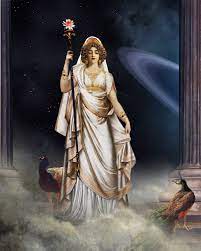
Goddess Of The Day: HERA

Hera

Daedala (Greece)
 
Themes: Love; Romance; Forgiveness; Humor
Symbols: Oak; Myrrh; Poppy
 
About Hera: Hera rules the earth, its people, and the hearts of those people. Using passion and creativity, Hera nudges star-crossed lovers together, chaperones trysts, and helps struggling marriages with a case of spring twitterpation!
 
Legend tells us that Hera refused to return to Zeus’s bed because of a quarrel. Zeus, however, had a plan. He humorously dressed up a wooden figure to look like a bride and declared he was going to marry. When Hera tore off the dummy’s clothes and discovered the ruse, she was so amused and impressed by Zeus’s ingenuity that she forgave him.
 
To Do Today: Ancient Greeks honored Hera and Zeus’s reconciliation today, often in the company of old oak trees. Small pieces of fallen wood are collected to symbolize the divinities, then burned on the ritual fire to keep love warm. To mirror this custom, find a fallen branch and burn a small part of it as an offering to Hera. Keep the rest to use as a goddess image year-round, burning a few slivers whenever love needs encouragement.
 
Present someone you love or admire with a poppy today to symbolically bestow Hera’s blessings on your relationship. If you have a loved one away from home, burn some myrrh incense in front of their picture so Hera can watch over them and keep that connection strong.
.
By Patricia Telesco ~ From “365 Goddess”  (FMP) and GrannyMoon’s Morning Feast
c. 2011

THE WITCHES’ REDE OF CHIVALRY c. 2018

THE WITCHES’ REDE OF CHIVALRY


Insofar as The Craft Of The Wise is the most ancient and most honourable creed of humankind, it behoves all who would be witches to act in ways that give respect to the Old Gods and Goddesses, to their brothers and sisters of The Craft, and to themselves

Chivalry is a high code of honour, which is of most ancient Pagan origin and must be lived by all who follow the Old Ways.

Know well that thoughts and intent put forth will wax strong on many planes of existence and return, bringing into creation that which has been sent forth. For this reason the adept must exercise discipline over his or her thoughts. Remember, ” as you sow, so shall you harvest”

It is only by preparing our minds to be as Gods that we may one day unite with the Godhead.

“This above all … to thine own self be true…”

A witch’s word must have the validity of a signed and witnessed document. It is only by developing such mental discipline that great power may be controlled and directed

It is well to refrain from speaking ill of others for not all truths of the matter may be known

Pass not unverified words about another. For the most part hearsay is a thing of falsehoods

Be honest with others. Have them know that honesty is likewise expected of them

The fury of the moment plays havoc with the truth. Strive always to keep your head

Harm not another. Think always of the consequences of your actions

Dignity, a gracious manner, and a good humour are much to be admired

As a witch you wield much power. Therefore exercise much discretion in its use

Courage and honour endure forever.

Offer friendship only to those worthy of it. To associate with younger souls will only pull you down

Those who follow the mysteries must be above reproach in the eyes of the world

Keep pride in thyself. Seek perfection in body and in mind

41 Greek Gods and Goddesses: Family Tree and Fun Facts

You’re Invited to Olympus Mall Where the Greek Gods Dwell and Sell

Far away on Mount Olympus lives the… Well, the Olympians — the twelve most important Greek dieties.

In ancient times, the Olympians and the rest of their family were an important part of daily Greek culture. Each god and goddess ruled certain realms and also played their part in mythology; fascinating stories that helped ancient Greeks to grasp the world around them, including the weather, religious beliefs, and their own social system.

That being said, even the Olympian gods must earn a living.

Possessing so many powers and abilities, they all agreed that they would make excellent business owners, and so opened a grand mall and invited all the mortals.

Let’s grab a shopping bag and go explore the Greek god family tree!

Table of Contents

Zeus the Mall Manager

Suspect Infidelity? Hera’s Private Eye Business Can Help

Book a Trip at the Atlas Traveling Agency

Find Variety at Apollo’s Flea Market

The Eros Lounge for Lonely Hearts

There’s Even a Wine-Tasting Event

Stay Away From the Security Booth

Rejuvenate With Sleep Therapy to Continue Your Shopping

There’s a Shuttle Service for Tired Shoppers

Ares Runs the Army Surplus Shop

There’s a Creepy Dude on a Boat

Pan’s Pet and Sacrifice Shop

This Family’s Failing Business Sells Air Fresheners

There’s Free Counseling for Disturbed Mortals

This Hardware Shop Has All the Mist You Need

This Paramedic Will Fix Your Bones After Kratos Jumps You

The Mall Has a Mini-Jail Called Tartarus

The Cinema Shows Back-To-Back 3D Horror Movies

The Helios Car Dealership Sells Golden Bowls

The Ghost Tour Has Real Ghosts

Poseidon Runs the Black Market

Please Claim Your Kids at the Lost and Found Tent

Aphrodite’s Kissing Booth

Learn How to Chop Necks at Athena’s Karate Club

Hyperion’s Laser Tag Arena

You Can Buy Bottled Air From Aether

Alastor’s Restaurant Serves All the Revenge You Can Eat

There’s an Old Guy That Sells Answers (But You Probably Won’t Get Them)

Pick a Tour Package at the Extreme Adventure Club

There’s a God in the Mini-Jail

There’s a Celebrity Signing Photos of Himself

Enjoy Free Muffins at the Bingo Hall

You’ll Win Every Race With Nike’s Sports Equipment

The Hypno-Therapist Makes Your Problems Worse

The Water-Girl Might Knock You Out

Hecate’s Hex & Herb Shop 

The Mall’s Casino Doubles as a Human Resources Office

The Archery Range Is Fun (But Deadly If You Upset Artemis) 

The Art Gallery Is Full of Living Things and Violence

Mania Is Too Mad to Have a Business

Get Your Face Peeled by Persephone

Get Your Napalm at the Fire-Starter’s Shop

Thank You for Shopping at the Mount Olympus Mall!

Click here to more of this article from historycooperative.org

Custom Made Magick for Thursday

Spell of Relaxation
Custom Made Magick for Thursday

Well, let’s see … abundance, prosperity, and good health has been our focus for this day. Now how about a little more information and ideas for working practical magick with one of our fascinating featured deities of the day?

Juno was the Queen of Heaven. As the matriarch of the gods, she guarded over women in every aspect of their lives. Juno was thought to have renewed her virginity every year. Similar to other goddess stories, Juno was a triple goddess-a virgin who belonged to no one; a mother and woman in the prime of her life, sexual and mature; and also a crone, powerful, wise, and sometimes vengeful (as she made her husband’s many mistresses’ lives either fairly unhappy or short).

There are references to an early all-female triad of goddesses known as the Capitoline Triad. This triad consisted of Juventas, Juno, and Minerva. To the Greeks, they would have been known as Hebe, Hera, and Hecate. Ultimately the triad became Juno, Minerva, and the male Jupiter. Jupiter, another of Thursday’s gods, was Juno’s consort.

As mentioned earlier, Juno, in her aspect as Juno Moneta, was the patron and protector of the Roman mint. The coins produced at her temples were blessed by Juno and imbued with her powers of abundance and prosperity. In another of her aspects as Juno Augusta, Juno was the goddess of an abundant harvest.

In addition, another of Juno’s magickal correspondences is the semiprecious stone malachite. Malachite is a beautiful green-banded stone that was also called the “peacock stone” in Italy. The peacock was a sacred animal of Juno’s, and the magickal energies of malachite encourage health and prosperity.
 

Source

Book of Witchery: Spells, Charms & Correspondences for Every Day of the Week
Ellen Dugan

Deities Associated with Thursday – Jupiter, Roman God


Deities Associated with Thursday – Jupiter, Roman God

Jupiter, also known as Jove, is the god of sky and thunder, as well as the king of gods in Ancient Roman Mythology. Jupiter is the top god of the Roman pantheon.Jupiter was considered the chief deity of Roman state religion during the Republican and Imperial eras, until Christianity became the dominant religion.

Zeus is Jupiter’s equivalent in Greek Mythology. The two share the same features and characteristics.

Due to Jupiter’s popularity, the Romans named the largest planet in the solar system after him.

Attributes
Jupiter is depicted with a beard and long hair. His other attributes include scepter, eagle, cornucopia, aegis, ram, and lion.

Jupiter, the Planet
The ancient Babylonians were the first known people to record their sightings of the planet Jupiter. The Babylonians’ recordings date back to the seventh century BC. It was initially named after Jupiter, the king of the Roman gods. To the Greeks, the planet represented Zeus, their god of thunder, while the Mesopotamians saw Jupiter as their god, Marduk.

Zeus
Jupiter and Zeus are equivalents in ancient mythology. The share the same traits and characteristics.
The Greek god Zeus was the top Olympian god in the Greek pantheon. After he took credit for rescuing his brothers and sisters from their father Cronus, Zeus became king of heaven and gave his brothers, Poseidon and Hades, the sea and the underworld, respectively, for their domains.

Zeus was the husband of Hera, but he had many affairs with other goddesses, mortal women, and female animals.
Zeus mated with, among others, Aegina, Alcmena, Calliope, Cassiopea, Demeter, Dione, Europa, Io, Leda, Leto, Mnemosyne, Niobe, and Semele.

He is king on Mount Olympus, the home of the Greek gods. He is also credited as the father of Greek heroes and the ancestor of many other Greeks. Zeus mated with many mortals and goddesses but is married to his sister Hera (Juno).

Zeus is the son of the Titans Cronus and Rhea. He is the brother of his wife Hera, his other sisters Demeter and Hestia, and his brothers Hades, Poseidon.

Etymology of Zeus and Jupiter
The root of both “Zeus” and “Jupiter” is in a proto-Indo-European word for the often personified concepts of “day/light/sky”.

Zeus Abducts Mortals:
There are many myths about Zeus. Some involve demanding acceptable conduct of others, whether human or divine. Zeus was enraged with the behavior of Prometheus. The titan had tricked Zeus into taking the non-meat portion of the original sacrifice, so that mankind could enjoy the food. In response, the king of the gods deprived mankind of the use of fire so they wouldn’t be able to enjoy the boon they’d been granted, but Prometheus found a way around this, and stole some of the gods’ fire by hiding it in a stalk of fennel and then giving it to mankind. Zeus punished Prometheus with having his liver pecked out every day.

But Zeus himself misbehaves — at least according to human standards. It is tempting to say that his primary occupation is that of seducer. In order to seduce, he sometimes changed his shape into that of an animal or bird.

· When he impregnated Leda, he appeared as a swan [see Leda and the Swan].
· When he abducted Ganymede, he appeared as an eagle [see Zeus and Ganymede] in order to take Ganymede to the home of the gods where he would replace Hebe as cupbearer; and
· when Zeus carried off Europa, he appeared as a tempting white bull

— although why the Mediterranean women were so enamored of bulls is beyond the imaginative capacities of this urban-dweller — setting in motion the quest of Cadmus and the settling of Thebes. The hunt for Europa provides one mythological version of the introduction of letters to Greece.

The Olympic Games were initially held to honor Zeus.
 

Author

N.S. Gill, Ancient/Classical History Expert
Article published on & owned by About.com


Custom Made Magick for Thursday

FUSION WOMAN BY FABRYKING61
Custom Made Magick for Thursday

Well, let’s see … abundance, prosperity, and good health has been our focus for this day. Now how about a little more information and ideas for working practical magick with one of our fascinating featured deities of the day?

Juno was the Queen of Heaven. As the matriarch of the gods, she guarded over women in every aspect of their lives. Juno was thought to have renewed her virginity every year. Similar to other goddess stories, Juno was a triple goddess-a virgin who belonged to no one; a mother and woman in the prime of her life, sexual and mature; and also a crone, powerful, wise, and sometimes vengeful (as she made her husband’s many mistresses’ lives either fairly unhappy or short).

There are references to an early all-female triad of goddesses known as the Capitoline Triad. This triad consisted of Juventas, Juno, and Minerva. To the Greeks, they would have been known as Hebe, Hera, and Hecate. Ultimately the triad became Juno, Minerva, and the male Jupiter. Jupiter, another of Thursday’s gods, was Juno’s consort.

As mentioned earlier, Juno, in her aspect as Juno Moneta, was the patron and protector of the Roman mint. The coins produced at her temples were blessed by Juno and imbued with her powers of abundance and prosperity. In another of her aspects as Juno Augusta, Juno was the goddess of an abundant harvest.

In addition, another of Juno’s magickal correspondences is the semiprecious stone malachite. Malachite is a beautiful green-banded stone that was also called the “peacock stone” in Italy. The peacock was a sacred animal of Juno’s, and the magickal energies of malachite encourage health and prosperity.

Book of Witchery: Spells, Charms & Correspondences for Every Day of the Week
Ellen Dugan

The Pagan Calendar for November 9th to November 10th

Witchcraft

The Pagan Calendar for November 9th to November 10th


Khalkeia–Old Greek festival honoring Goddess Athena and God Hephaistos for their gifts of crafts and technology. [a/k/a Hephaistia]


About The Goddess Athena

Daughter of Zeus, and only by him, the Goddess Athena was not generated by any woman. She leaped from the head of Zeus, already adult, dressed with her armor. But the mother is not completely missing from the miraculous birth of Pallas Athena. According to Hesiod’s account of the weddings of Zeus, the King of the Gods chose Metis as his first wife. She was of all beings “the most knowing” (as the word metis is interpreted), or “of many counsels” as translated in the sense of the Homeric epithet polymetis. As she was about to give birth to the Goddess Athena, Zeus deceived his pregnant wife with cunning words and assimilated her into his own body. Mother Earth and Father Sky had advised him to do this so as to prevent any of his descendants from robbing him of his kingly rank. For it was destined that the most brilliant children were to be born to the Goddess Metis: first, the daughter Athena, and later a son, the future King of Gods and men. In the most ancient account, the Iliad, Athena is the Goddess of ferocious and implacable fight, but, wherever she can be found, she only is a warrior to defend the State and the native land against the enemies coming from outside. She is, above all, the Goddess of the City, the protectress of civilized life, of artesian activities, and of agriculture. She also invented the horse-bit, which, for the first time, tamed horses, allowing men to use them. She is the favorite daughter of Zeus; and that’s why he let her use his insignia: the terrible shield, the aegis and his devastating weapon, the ray. The most used expression to describe her is “the bright eyed”. She is the first of the three virgin Goddesses, also known as Maiden, Parthenos, and from this name was taken the name to the most important Temple dedicated to her, the Parthenon. In poetry she is the incarnation of Wisdom, Reason and Purity. Athens is her city; the olive tree, created by her, is her tree; the owl, is the birth consecrated to her.


About the God Hephaistos

Hephaistos was the Greek god of blacksmiths, sculptors, metallurgy, fire and volcanoes; thus, he is symbolized with a hammer, an anvil and a pair of tongs.

According to Homer’s epics, the Iliad and the Odyssey, he was the son of Zeus and Hera. However, Hesiod informs us that Hera bore Hephaistos alone. According to an account, after Hephaistos was born, Hera threw him from Olympus because he was crippled; he fell into the ocean and was raised by Thetis and Eurynome. Another myth has it that he once tried to protect his mother from Zeus’ advances and as a result, the father of the Gods flung him down from Olympus, which caused his physical disability; he fell on the island of Lemnos where he became a master craftsman. He was later accepted back to Olympus, and became the craftsman of the gods, creating majestic armors, shields and weapons.

He was married to Aphrodite; after he learned his wife had an affair with her brother, Ares, he devised a plan with which he humiliated both lovers to the other gods.


References:

The Shrine of the Goddess Athena

Greek Mythology


Custom-made Daily Magick for Thursday

A Present From EgyptCustom-made Daily Magick for Thursday

Well, let’s see … abundance, prosperity, and good health has been our focus for this day. Now how about a little more information and ideas for working practical magick with one of our fascinating featured deities of the day?

Juno was the Queen of Heaven. As the matriarch of the gods, she guarded over women in every aspect of their lives. Juno was thought to have renewed her virginity every year. Similar to other goddess stories, Juno was a triple goddess-a virgin who belonged to no one; a mother and woman in the prime of her life, sexual and mature; and also a crone, powerful, wise, and sometimes vengeful (as she made her husband’s many mistresses’ lives either fairly unhappy or short).

There are references to an early all-female triad of goddesses known as the Capitoline Triad. This triad consisted of Juventas, Juno, and Minerva. To the Greeks, they would have been known as Hebe, Hera, and Hecate. Ultimately the triad became Juno, Minerva, and the male Jupiter. Jupiter, another of Thursday’s gods, was Juno’s consort.

As mentioned earlier, Juno, in her aspect as Juno Moneta, was the patron and protector of the Roman mint. The coins produced at her temples were blessed by Juno and imbued with her powers of abundance and prosperity. In another of her aspects as Juno Augusta, Juno was the goddess of an abundant harvest.

In addition, another of Juno’s magickal correspondences is the semiprecious stone malachite. Malachite is a beautiful green-banded stone that was also called the “peacock stone” in Italy. The peacock was a sacred animal of Juno’s, and the magickal energies of malachite encourage health and prosperity.

Book of Witchery: Spells, Charms & Correspondences for Every Day of the Week
Ellen Dugan

Deity of the Day for September 25th is Hera, Queen of the Gods in Greek Mythology

Deity of the Day

Hera

Queen of the Gods in Greek Mythology


Definition:

In Greek mythology, the beautiful goddess Hera was queen of the Greek gods and the wife of Zeus, the king. Hera was goddess of marriage and childbirth. Since Hera’s husband was Zeus, king not only of gods, but of philanderers, Hera spent a lot of time in Greek mythology angry with Zeus. So Hera is described as jealous and quarrelsome.

Hera’s Jealousy

Among the more famous victims of Hera’s jealousy is Hercules (aka “Heracles,” whose name means the glory of Hera).

Hera persecuted the famous hero from before the time he could walk for the simple reason that Zeus was his father, but another woman — Alcmene — was his mother. Despite the fact that Hera was not Hercules’ mother, and despite her hostile actions — such as sending snakes to kill him when he was a newborn baby, she served as his nurse when he was an infant.

Hera persecuted many of the other women Zeus seduced, in one way or another.

“The anger of Hera, who murmured terrible against all child-bearing women that bare children to Zeus….”

Theoi Hera: Callimachus, Hymn 4 to Delos 51 ff (trans. Mair)

“Leto had relations with Zeus, for which she was hounded by Hera all over the earth.”
Theoi Hera: Pseudo-Apollodorus, Bibliotheca 1. 21 (trans. Aldrich)


Hera’s Children

Hera is usually counted single parent mother of Hephaestus and the normal biological mother of Hebe and Ares. Their father is usually said to be her husband, Zeus, although Clark [“Who Was the Wife of Zeus?” by Arthur Bernard Clark; The Classical Review, (1906), pp.

365-378] explains the identities and births of Hebe, Ares, and Eiletheiya, goddess of childbirth, and sometimes named child of the divine couple, otherwise.

Clark argues that the king and queen of the gods had no children together.

Hebe may have been fathered by a lettuce. The association between Hebe and Zeus may have been sexual rather than familial.

Ares might have been conceived via a special flower from the fields of Olenus. Zeus’ free admission of his paternity of Ares, Clark hints, may be only to avoid the scandal of being a cuckold.

On her own, Hera gave birth to Hephaestus.


Parents of Hera

Like brother Zeus, Hera’s parents were Cronos and Rhea, who were Titans.
Roman Hera

In Roman mythology, the goddess Hera is known as Juno.


Fast Facts About Hera

Name: Greek – Hera; Roman – Juno

Family

Parents: Cronus and Rhea

Foster Parents: Oceanus and Thetys, among others

Siblings: Hestia, Demeter, Poseidon, Hades, and Zeus

Mates: Zeus

Children: Ares, Hephaestus, Eileithyia, Hebe

Role of Hestia

For Humans: Hera was goddess of marriage. In later myth, Hera is treated as the queen of heaven, the female counterpart of Zeus
For Gods: Queen

Canonical Olympian? Yes. Hera is one of the canonical Olympians.


Source:

Author: N.S. Gill

N.S. Gill’s Ancient/Classical History Glossary

Article located on About.com

Your Ancient Symbol Card for February 27th is The Peacock

Your Ancient Symbol Card for Today

The Peacock

The iridescent emerald plumage and spectacular broad tail of The Peacock make it the ideal symbol of both justified pride and vanity. It denotes the right for one to be proud of themselves for being who they are and for letting others know. In short, its okay to strut a bit. At the same time The Peacock reminds us that while pride and high self esteem are essential components of a healthy psyche, becoming too full of one’s self makes us vain, and vanity is never attractive in anyone.

As a daily card, The Peacock is reminder that you are inherently valuable, and have a right to be proud of who you are as well as let others know you are proud of yourself. It is also a warning to not allow you pride and sense of self worth grow to such grand proportions that you become vain and conceited.

Enhanced by Zemanta

‘Twas The Night Before Yule

Yule Comments & Graphics

‘Twas The Night Before Yule

‘Twas the night before Yule, and all through the Coven, The cookies were baked and removed from the oven. The bayberry candles were lit on the table, The altar was wrapped in a new cloth of sable.

The children were nestled, all snug in their beds, While visions of Yuletime danced in their heads. Their stockings were hung by the chimney with care, In hopes that some presents soon would be there!

With Rocker in his new robe, and I in mine, We were asking our Goddess her blessing divine. When out on the lawn there arose such a clatter, We sprang from our Circle to see what was the matter.

Away to the window, tripping over my sash, My eyes were a-glamoured with a bright silver flash. The moon on the breasts of the Goddess and God Drew my eyes to behold the blessed Circle they trod.

When, what to my wondering eyes should appear, But the manifestations of all those we hold Dear. The physical forms of those whom we pray to, Even Saint Nick, and his miniature sleigh, too!

Jehovah, Mohammet, Shiva, Hera and Thor. Zeus, Freya, Brahma, and many, many more. All the Spiritual Entities who’d ever been mentioned. Even some, like dear Loki, who sowed seeds of dissension.

They greeted eah other with smile, warm and sweet. Then, forming a Circle, they all took a seat. With multiple Voices all joined as One, The Corners were Called. And, when that was done.

The Chalice was passed from Hand to Hand. Then, a blanket of silence enfolded the land. A crystal clear Voice began to hold sway. Which Deity spoke? I could not say.

But, clearly, I heard all the love in that Voice. It caused my tired heart to take flight and rejoice. “Our Children, it seems, have missed the whole point. “We now join together, their hearts to anoint.

“Pour all of Our love O’er their hearts of stone. “Let them see that together they’re never alone! “Show them it matters not which of Us that they choose. “Their sad hate and mistrust cause each of Us to lose!”

As I stood there transfixed, I could suddenly see If we all stand as one, what a world this could be! Put ALL of our differences well behind us. Let the love of the Gods enfold and remind us.

We ARE all the same,though varied our skins. We all dream the same dreams, we all sin the same sins. With a look of enlightenment etched on my face, I beheld all the Gods in Their glory and grace!

They all bowed Their heads then said”So mote it be!” They all smiled at each Other bestowing winks on me. One by One they disappeared from my sight. Just the Goddess and God were left in the light.

As slowly They twinkled, fading by degree, “Happy Yuletide to all!! Blessed be times three!”

–Written by Mary, a.k.a. Wandering Poet, a.k.a. littlebit Permission to reprint granted to all who keep this credit line by the author.

Website

Rainbow Gryphon

Dieties of Marriage

Dieties of Marriage

by Divine Spirits

Deities Of Marriage These deities can be invoked in rituals concerning the family and the home. Frigg Frigg was the Viking Mother  Goddess whose jewelled spinning wheel formed Orion’s belt; as patroness of marriage, women, mothers and families, she can be invoked for all rituals  concerned with families and domestic happiness. She invited devoted husbands and wives to her hall after death so that they might never be parted again and  so is goddess of fidelity. As Ostara, goddess of spring, she was known among the Anglo-Saxons and is remembered in the festival of Easter as a fertility  goddess and bringer of new beginnings. In her role as Valfreya, the Lady of the Battlefield, Frigg recalls the Northern tradition of warrior goddesses and  offers courage to women. Hera Hera, the wife-sister of Zeus, is a the supreme Greek goddess of protection, marriage and childbirth whose sacred bird is the  peacock. She is a powerful deity of fidelity and is called upon by women seeking revenge upon unfaithful partners. Hestia Hestia is the Greek goddess of the  hearth and home, all family matters and peace within the home. She is a benign, gentle goddess and so can be invoked for matters involving children and pets.  Juno Juno, the wife-sister of Jupiter, is the Roman queen of the gods, the protectress of women, marriage and childbirth and also wise counsellor. Together  with Jupiter and Minerva, the goddess of wisdom, she made up the triumvirate of deities who made decisions about humankind and especially Roman affairs. Her  month, June, is most fortunate for marriage and, like Hera, her Greek equivalent, her sacred creature is the peacock. She is invoked in sex magick as well as  for all matters concerning marriage, children, fidelity and wise counsel. Parvati Parvati is the benign and gentle Hindu Mother Goddess, consort of the god  Shiva and the goddess daughter of the Himalayas. Her name means ‘mountain’ and she is associated with all mountains. She and Shiva are often pictured  as a family in the Himalayas with their sons Ganesh, god of wisdom andlearning, and six-headed Skanda, the warrior god. She is invoked for all family matters  and those concerning children and by women in distress. Vesta Vesta is the Roman goddess of domesticity and of the sacred hearth at which dead and living  were welcomed. The Vestal Virgins of Rome kept alight the sacred flame in Vesta’s temple and this was rekindled at the New Year, as were household  flames. Vesta can be invoked in rituals centred around the element Fire.

The Weeping Willow Tree, The Tree of Hecate

The Weeping Willow Tree, The Tree of Hecate

Folk Names:
“Tree of Enchantment”,”Osier”,and”Sough Tree”

Lore and Divinatory Aspects:

The Willow is associated with the elements of water, the moon, and the gods Artemis, Ceres, Hecate, Persephone, Hera, Mercury, Belili, Circe, and Belenos.
Willow is associated with death, femininity, love, and healing. It posesses the powers of love, divination, friendship, joy, love, peace, protection, and healing.
Magical Usage:

For love magic, protection magic, healing magic, and peaceful magic. Used to create loyalty, make friendship pacts, treaties, or alliances. Used for intuition, knowledge, gentle nurturing, and will elucidate the feminine qualities of both men and women.
Its leaves are used in love attraction sachets and moon magic wands from its wood. Used to dowse for water (underground), earth energies, and buried objects.
Used combined with sandalwood to invoke spirits. Placed in homes, it protects against evil and malign sorcery. Carried, the wood will give bravery, dexterity, and help one overcome the fear of death. If one needs to get something off their chest or to share a secret, confess to a willow and your secret will be trapped.
Willow wood is good for magical harps. Good for planting and lining burial graves for its symbolism of death and protection. If one wants to know if they will be married, on New Year’s Eve, throw your shoe or boot into a willow, if it doesn’t catch in the branches the first time, the individuals has eight more tries, if they succeed, they will wed.
Medicinal Usage:

Dioscorides (1st c. A.D.) discovered its use against pain and inflammation. The Hottentots discovered its use for rheumatic fever.
Willow bark is used to treat rheumatic conditions, gout, heartburn, to stop internal bleeding, gargle for sore throats, skin problems, wounds, and burns.
The purple willow is most effective for lowering fevers.
Black willow bark can be made into an infusion as a sexual sedative and to treat gonorrhoea, relieve ovarian pain, and to curb nocturnal emissions or as a tincture for hysteria, hysteria based on genital organs, nymphomania, spermatorrhoea, satyriasis, erotomania, and lascivious dreams.
Sallow or Goat willow eases indigestion, whooping cough, catarrh, and to disinfect bandages. It is a good eyewash, and if taken orally will clear the skin and face of blemishes, or applied to hair for dandruff. Its flower essences will remedy bitterness and resentment.
Other Uses:

Tender shoots are good for baskets. Willow rods were used as thatching in European traditional homes. Willow protects riverbanks from erosion (Peachleaf Willow), drys the soil in soggy/flooded gardens, and its charcoal (Crack Willow) is used in gunpowder.

Calendar of the Sun for January 10

Calendar of the Sun

10 Wolfmonath

Ilithyia’s Day of the Midwives

Color: Red
Element: Earth
Altar: The altar shall be the same as Sponde the previous day.
Offerings: Give aid to a midwife.
Daily Meal: Center around milk and dairy products.

Ilithyia Invocation

Slim maiden with quick hands
That bring forth the life of others,
Daughter of Hera, child of marriage,
Daughter of Zeus, child of kingship,
Your hands reach forth
To every matron’s opening womb,
Bringing the new bride into the world of family,
Bringing the maiden into the time of mothering,
Bringing the tribe a new life.
Let us learn from you, maiden midwife!
For though we do sometimes find ourselves
Bringing new life into the world,
More often we kneel in your place,
As you kneel between the laboring woman’s thighs,
Watching the opening of the sacred door,
Kneeling in honor of the power of birth,
We find ourselves assisting in the birth
Of the others who struggle,
Who writhe and twist and despair of being done,
Who need out skilled hands, our urgent voices,
Our love and care and attention
That what must be birthed shall come to be.
Teach us, Ilithyia, of how to better hold the labor of another
In our waiting hands.

Chant:
From the dark of the womb we bring forth life
From the dark of the mind we bring forth light
From the dark of the dream we bring forth sight
From the dark of the Wheel we bring forth fate
From the dark of the night we bring forth day
From the dark of the heart we seek the way.

[Pagan Book of Hours]

‘Twas the night before Yule


‘Twas the night before Yule, and all through the Coven,
The cookies were baked and removed from the oven.
The bayberry candles were lit on the table,
The altar was wrapped in a new cloth of sable.

The children were nestled, all snug in their beds,
While visions of Yuletime danced in their heads.
Their stockings were hung by the chimney with care,
In hopes that some presents soon would be there!

With Rocker in his new robe, and I in mine,
We were asking our Goddess her blessing divine.
When out on the lawn there arose such a clatter,
We sprang from our Circle to see what was the matter.

Away to the window, tripping over my sash,
My eyes were a-glamoured with a bright silver flash.
The moon on the breasts of the Goddess and God
Drew my eyes to behold the blessed Circle they trod.

When, what to my wondering eyes should appear,
But the manifestations of all those we hold Dear.
The physical forms of those whom we pray to,
Even Saint Nick, and his miniature sleigh, too!

Jehovah, Mohammed, Shiva, Hera and Thor.
Zeus, Freya, Brahma, and many, many more.
All the Spiritual Entities who’d ever been mentioned.
Even some, like dear Loki, who sowed seeds of dissension.

They greeted each other with smile, warm and sweet.
Then, forming a Circle, they all took a seat.
With multiple Voices all joined as One,
The Corners were Called. And, when that was done.

The Chalice was passed from Hand to Hand.
Then, a blanket of silence enfolded the land.
A crystal clear Voice began to hold sway.
Which Deity spoke? I could not say.

But, clearly, I heard all the love in that Voice.
It caused my tired heart to take flight and rejoice.
“Our Children, it seems, have missed the whole point.
“We now join together, their hearts to anoint.

“Pour all of Our love O’er their hearts of stone.
“Let them see that together they’re never alone!
“Show them it matters not which of Us that they choose.
“Their sad hate and mistrust cause each of Us to lose!”

As I stood there transfixed, I could suddenly see
If we all stand as one, what a world this could be!
Put ALL of our differences well behind us.
Let the love of the Gods enfold and remind us.

We ARE all the same, though varied our skins.
We all dream the same dreams, we all sin the same sins.
With a look of enlightenment etched on my face,
I beheld all the Gods in Their glory and grace!

They all bowed Their heads then said “So mote it be!”
They all smiled at each Other bestowing winks on me.
One by One they disappeared from my sight.
Just the Goddess and God were left in the light.

As slowly They twinkled, fading by degree,
“Happy Yuletide to all!!
Blessed be times three!”

~Written by Mary, a.k.a. Wandering Poet, a.k.a.littlebit~

Permission to reprint granted to all who keep keep this credit line by the author

Deity of the Day for November 23 is Hera

Deity of the Day


HERA


Hera, queen of the gods, the daughter of the Titans Cronus and Rhea, and the sister and wife of the god Zeus. Hera was the goddess of marriage and protector of married women. She was the mother of Ares, god of war; Hephaestus, god of fire; Hebe, goddess of youth; and Ilithyia, goddess of childbirth. A jealous wife, she often persecuted Zeus’s mistresses and children, especially the half- god Hercules, and was known for her vindictive nature.

Creator Deities

Creator Deities

Gods/Goddesses– the Dagda, Cronus, Ptah, Osiris, Sebek, Khnemu, Seb, Ra, Hurukan, Arianrhod, Danu, Demeter, Hera, Rhea, Gaea, Ceres, Juno, Heqet, Isis, Neith, Mut, Tara, Nohochacyum
Color– Brillant Pure Light
Incense/Oil– Angelica, Wisteria
Animals– Hawk
Spirits– Winged Dragon
Stones– Diamond, Zircon
Metal– Gold, Silver
Plants– Shamrock, Clover, Woad, Male Fern, Aspen
Tree– Aspen
Planet– Uranus
Tarot Cards– Four Aces
Magickal Tools– Cauldron
Direction– East
Rituals– Divine Consciousness, Illumination, Enlightment, Spiritual Development/Attainment, Finding Karmic Purpose

Goddesses for every occasion

Goddesses for every occasion

——————————————————————————–
Sunday          Sunne, Frau Sonne, Aditi, Amaterasu, Arinna, Izanami, Ochumare

Monday          Luna, Selene, Diana, Re, Gealach, Ida, Artemis, Yemaya, Erzulie

Tuesday         Pingalla, Anna, Aine, Danu, Yngona, Bellona, Aida Wedo, Sun  Woman

Wednesday       Isis, Demeter, Ceres, Spider Woman, Bona Dea, Oya, Devi-Kali, Hella, Rhiannon, Coatlique

Thursday        Juno, Hera, Kwan Yin, Mary, Cybele, Tara, Mawu, Waresa, Ishtar

Friday          Freya, Astarte, Aphrodite, Erzulie, Eve, Venus, Isis, Diana,  Chalchiuhtlique

Saturday        Ops, Rhea, Tellus mater, Gaia, Eartha, Ge, Ashera, the Shekinah, Mary, Demeter, Herodias

Goddesses of the Zodiac:

Aries = Athena, The Morrigan, Minerva
Taurus = Hathor, Isis, Io, Venus, Selene
Gemini = Kali, Parvati, Tefnut, Leda
Cancer = Ix Chel, Ida, Selene, Luna
Leo = Arinna, Cybele, Neshto, Juno
Virgo = Kwan Yin, Bel, Inanna, Diana, Ishtar
Libra = Ishtar, Aphrodite, Dike, Themis
Scorpio = Pele, Tiamat, Ishara, Selket
Sagittarius = Artemis, Diana, Pingala
Capricorn = Awehai, Ida, Amalthea, Vesta
Aquarius = Mawu, Cybele, Sophia, Iris, Juno
Pisces = Nammu, Anuit, Aphrodite, Dione

Goddesses of the Month:

January  = Juno, Hera, Hestia, Brigid
February = Brigid, White Buffalo Woman, Juno Februa
March  = Ra-Nuit, Artemis, Minerva
April  = Aphrodite, Ishtar, Artemis, Astarte, Eostre
Venus, Terra , Erzulie
May  = Maia, Flora, Tanith, Bel, Mary, Hera
June   = Ishtar, Athena, Demeter, Juno, Persephone,
Luna, Hera, Mawu
July   = Ishtar, Apet, Athena, Demeter, Persephone,
Spider Woman.
August  = Ishtar, Ceres, Lakshmi, Hesperus
September= Hathor, Ishtar, Yemaya, Menkhet, Pomona
October  = Hathor, Demeter, Ceres, the Horae
November = Sekhmet, Demeter, Diana, Kali, Astrae
December = Vesta, Hestia, Befana, Sekhmet, Oya

Hestia        26 December   – 22 January
Bridhe        23 January    – 19 February
Moura         20 February   – 19 March
Columbina     20 March      – 17 April
Maia          18 April      – 15 May
Hera          16 May        – 12 June
Rosea         13 June       – 10 July
Kerea         11 July       –  8 August
Hesperis       9 August     –  5 September
Mala           6 September  –  2 October
Hathor         3 October    – 30 October
Cailleach/
Samhain       31 October    – 27 November
Astraea       28 November   – 25 December

Goddesses for the days of the Moon/month:

1       (new moon)  Hathor, Isis, Anahit, Selene, Juno, Lucina, Luna, Re,
Blodeuwedd.

2       Selene, Luna, the Mothers, Gos, Arstat, Saoka

3       Athena, the Witch of Gaeta, Rata

4       Hathor, Isis, Selene, Luna

5       Maat, the Erinyes, Eric, Terra, the Eumenides

6       Artemis, Erzulie, the Mothers

7       the Sabbatu, Leto, Luna, Arstat

8       Selene, Luna, Ata Bey

9       Rhea, Selene, Spider Woman

10      Anahit, Anaitis, White Buffalo Calf Woman

11      Kista, Athena, Minerva, Sophia, Changing Woman

12      Demeter, Oddudua, Dikaiosune

13      The Muses, Diana, Oya, the Corn Mothers

14      Ishtar, Selene, Gos, Aida Wedo, the Lady, the Great Mother

15      Ishtar, Luna, Mene, Anna Perenna, Mary, Hina, Arianrhod, Aradia, Diana, Cybele, Mah

16      Levanah, Selene, Luna, Kwan Yin, Chalchiuhtlique

17      Ashi Vanguhi, Arstat, Kista, Demeter, Luna, Aida Wedo

18      Ochumare, Mawu, Copper Woman

19      The Manes, Ashi Vanguhi, Minerva

20      Selene, Tonantzin, Coatlique, Mary

21      Drvaspa, Hera, Athene, Medusa

22      Re, Gealach, Rhiannon, Selene, Mayauel

23      Venus, Aphrodite, Oshun, Erzulie, Freya, Xochiquetzl

24      Daena, Kista, Ochumare, Maat, Sophia, Chang-O

25      Ashi Vanguhi, Ard, Kista, Athena

26      Arstat, Cerridwen, Copper Woman, Mother Holle

27      Diana, Hecate, Maman Brigette, Oya

28      Zamyad, Tellus Mater, Hemera, Eos

29      Hecate, Tonantzin, Nyx, Rhiannon, Eurydice

30      Hecate, Mene, Hecate Prosmna, the moon Goddess, the Dark Maiden, the Crone.

Calendar of the Moon for September 17

Calendar of the Moon

17 Muin/Boedromion

Greater Mysteries Day 3: Mother And Daughter

Colors: Gold and black
Element: Earth
Altar: Upon cloth of black and gold set a single white candle to burn, with incense of myrrh, and two cups of mint tea with barley in it. Before the altar lay the Kistai, the round box of holy objects, and the figures of pigs.
Offerings: Pork and grains.
Daily Meal: Pork and grains.

Mysteries Invocation III:

Hail to Demeter, Great Mother of the Fields!
Lady of the corn-golden hair,
You sent your only daughter, jewel of your heart,
Forth to play in the fields with the fair daughters of Oceanus,
Trusting for her return, for you loved no one as you loved her.
Hail to Persephone, Daughter of Demeter!
You went forth, a maiden on the brink of womanhood,
And forth in the field grew, to your wonder,
A great white flower, like unto none other.
You stepped forth to pluck it – you could not have said,
Later, who you were so compelled.
But it was your destiny, and forth from that hole
That cracked the ground in two came black smoke,
The scent of the underworld, and Hades came forth
In his black chariot and took you away,
For so it was destined that you would be his bride.
Hail to Demeter, Mourning Mother left behind!
You searched the Earth for your daughter,
Only to hear from Hecate where she had been taken.
In despair, you wandered the land
And no crops grew; the white barley was cast
Upon the earth many times in vain, and the plow
Curved into the earth to no avail, and the whole race
Of men would have starved, had great Zeus not noticed it.

Chant: Ancient Mother, I hear you calling,
Ancient Mother, I hear your song,
Ancient Mother, I hear your laughter,
Ancient Mother, I taste your tears.
(The tea is poured out as a libation for both goddesses.)

[Pagan Book of Hours]

Ivy (Sept 30 – Oct 27)

IVY LORE

  • 11th Moon of the Celtic Year – (Sept 30 – Oct 27)
  • Latin name: Osirian Ivy – hedera helix
  • Celtic name: Gort (pronounced: goert).
  • Folk or Common names: Ivy.
  • Parts Used: leaves, bark, berries. Caution: Some types of Ivy are poisonous.
  • Herbal usage: The leaves of Ivy can be used to make a douche for treating female infections. Ivy leaves can also be used externally for poultices to heal  nerves, sinews, ulcers and infections. Tender ivy twigs can be simmered in salves to heal sunburn.
  • Magical History & Associations: Ivy is the symbol of resurrection. Ivy is an herb of Jupiter and the sun, and is associated with positive ego  strength. The bird associated with this month is the mute swan, the color is blue, and the gemstone is yellow serpentine. Ivy is sacred to Osiris and Saturn.  It is also connected with the god Dionysus. When Zeus’s wife Hera, discovered that Zeus had bedded Semele, the daughter of Cadmus, King of Thebes, Hera  suggested to Semele that she should ask Zeus to unveil himself to her. When he did so, his divine flames consumed her and almost killed her unborn child,  Dionysus, but for a sudden growth of ivy. In still another story of the deities, Kissos is the name given to a nymph who dances so furiously at a Dionysian  feast that she collapses and dies of exhaustion. Dionysus, grieving her untimely death, changes her into ivy. Most Ivies have five-pointed leaves which are  sacred to the Goddess.
  • Magickal usage: The month of Ivy is a good time to do magick for rebirth and tenaciousness. Ivy has attributes of restraint of fear and dealing with  Emotions. Ivy grows in a sacred spiral, which symbolizes reincarnation, from lifetime to lifetime, and from minute to minute, day to day. Ivy travels  everywhere – it spreads happily and thrives in many places where no other greenery could survive – its determination to reach through obstacles toward light  and food is well known, and therefore Ivy symbolizes strength. Ivy has many uses in Magick done for healing, protection, cooperation, and exorcism, and is  very useful in fertility magick. Ivy is also equated with fidelity and can be used in charms to bind love, luck and fidelity to a person. A talisman made of  Ivy would be good to give a friend since it will help ensure eternal friendship. Ivy provides protection against evil when growing on or near a house but  should it fall off and die, misfortune was said to be on the way. Ivy was sometimes used in divination: an ivy leaf placed in water on New Year’ s Eve  that was still be fresh on Twelfth Night foretold that the year ahead would be favorable. Should ivy not grow upon a grave, the soul of the person buried  there is said to be restless – and should it grown abundantly on the grave of a young woman, then this meant that she died of a broken heart. Ivy is also  connected with the Winter Solstice and is often used for decorating at Yule-tide. Ivy, intertwined with Holly, is traditionally made into crowns for the  bride and groom at weddings/handfastings. Ivy was also used in ancient times for poet’s crowns, since Ivy was believed to be a source of divine  inspiration. Ivy was also used by the Greeks to make victory crowns for conquering heroes in the games held at Corinth. Holly and Ivy make excellent  decorations for altars. An early church council even attempted to ban the use of Ivy in church decorations because of its Pagan associations.