Spell for Tomorrow – Healing Water Enchantment

(YOU CAN COPY AND PASTE ANY SPELLS POSTED TO A DOCUMENT TO PRINT AND/OR SAVE ON YOUR COMPUTER FOR PERSONAL USE ONLY. You can find the origin of the spell by clicking on the hyperlink.)

Healing Water Enchantment

Ingredients:

  • A glass of water (that’s it!)

I prefer to use a glass, but you can use a plastic bottle if it’s all you have. Water is the perfect liquid to imprint with your intensions, so this spell is super simple but instantly powerful.

Hold the glass of water between your hands and say whatever you most need. For example:

My migraine is gone and I am full of health.

Close your eyes as you say these words and focus on putting all of your energy into the water. Raise as much energy as you can (I raise energy through my feet from the earth and send it out through my hands) and picture the outcome that you want. Do this for at least 2 minutes.

Once you have enchanted the water, drink it within the hour for optimal results.

For Your Viewing Pleasure – In Memory of Lady Abyss and Her Appalachian Blood Family

A small part of the Appalachian Mountains

Donnie Laws Narrator

Presents Applanation folk tales and beliefs of these proud citizens of the USA.

The videos I choose to post here have to do with ghosts, witches, superstitions. All videos can be seen on YouTube.com under  Donnie Laws YouTube.com Channel

The Guardian Ghost of the field. True Story of Unexplained Appalachia.

Appalachian Story of Mountain Witches

Appalachian Story of a Strange Hunting Encounter

Mountain superstitions of Appalachia Myths, Wives Tales and Signs

Rare Mountain Superstitions and sayings of Appalachia

Appalachia Mountain Roots Plants and Herbs

He has more videos to see and enjoy. I hope you learned a little something, I know I did, and enjoyed the videos I picked out.

Spell For Tomorrow – Good Luck Prayer to Goddess Fortuna

(YOU CAN COPY AND PASTE ANY SPELLS POSTED TO A DOCUMENT TO PRINT AND/OR SAVE ON YOUR COMPUTER FOR PERSONAL USE ONLY)

Good Luck Prayer to Goddess Fortuna Source: spells8.com

Fortuna was the Roman goddess of…

Light a green candle during this chant

Incense for Fortuna:

Aloe Vera, Cinnamon, Frankincense, Nutmeg, Vanilla

Offerings to Fortuna:

Rosemary, Berries, Meat, Cornucopia, Coins.

However, she was also the cause of unfortunate or unforeseen events, and …

Prayer to Fortuna (text version)

Approach, strong Fortune, with propitious mind
and rich abundance, to my prayer inclined.
Placid, and gentle Hekate, mightly named,
imperial Artemis, born of Pluto famed.

Mankind’s unconquered, endless praise is yours,
sepulchral, widely-wandering power divine!
In you, our various mortal life is found,
and some from you copious wealth abounds.

While others mourn your hand averse to bless,
in all the bitterness of deep distress.
Be present, Goddess, to we who worship you,
and give abundance with benevolent mind.

Goddess of Fate, I call upon thee.
Enter my circle and come to me.
You know every secret and I’m eager to learn,
Clear my paths and let your wheel turn.

Bless my life with good luck and fortune,
Fill me with spiritual and material wealth.
Pluck the vibrating strings of destiny and fate.

Approach, strong Fortune, with propitious mind
and rich abundance, to my prayer inclined.

(One Person’s View Point) Paganism 101: Basics of Pagan Spirituality c. 2016

Paganism 101: Basics of Pagan Spirituality Author: Cu Mhorrigan

Introduction:

Paganism has received a lot of attention in recent years with the increased use of the internet, television shows like Charmed, Buffy: the Vampire Slayer, Angel and movies like The Craft, Harry Potter, as well as cartoons like Sabrina the Teen-Aged Witch.

Nowadays, it has become fashionable to announce oneself to be a Pagan, or Neo-Pagan, Wiccan or Witch – especially for teenagers, wishing to attract attention, adults trying to follow the latest fad in spirituality, or just as an excuse to justify weird or aberrant behavior.

However, calling yourself a Pagan is one thing; actually following the spiritual path is something else. It is my hope with this ‘class’ that I might explain in practical terms what it actually means to be a Pagan in our modern age and to assist those who wish to implement the following of this spiritual path.

Definition of the word “Pagan”:

The Word Pagan is derived from the Latin word ‘paganus’, which is loosely translated to mean “of the country”. It should be noted however that the usage of ‘paganus’ within the Roman Empire (Where they spoke Latin. Duh!) was always meant to be a slur meaning “hillbilly, redneck, hick, trailer trash, or white trash”. Much in the same way we would talk about guests on the Jerry Springer Show.

Later, when the Christian faith took over the Roman Empire under Charlemagne, it was used to describe those outside of the Christian faith and those in need of conversion. Not an improvement, because paganus was still pretty much of an insult.

Turning a negative into a positive:

It wasn’t until recently that the term ‘Pagan’ gained a more positive use with the resurgence of Pagan beliefs within the European and American Cultures. Those who sought spirituality closer to that of their “ancestors” adopted it. Eventually, it came to mean ‘those who follow the Old religions’ or ‘those who follow a spiritual path outside of the big three Abrahamic religions’. (What are the big Three Abrahamic religions?)

What DO Pagans Believe?:

An it harm none Do as thou wilt.

Speaking in general terms, Paganism is an earth-centered spirituality, which believes in the sacredness of all things, equality of all persons regardless of gender, sexual, and spiritual and social practices. The practices within Paganism are extremely diverse and open-ended allowing individuals to incorporate whatever rituals and belief systems they feel comfortable with.

Since there is so much diversity within our spiritual path, we stress personal liberty, and responsibility for one’s own actions. That as long as a person does not cause physical, mental, emotional, financial, and spiritual harm to others or himself, he/she is free to pursue one’s physical, mental and spiritual development as he/she sees fit.

Which brings me to my next point: Pagans, in general, do not proselytize! That means you aren’t going to get a call from us at three o’clock in the morning asking us if you are going to ritual or not. There is no High Priestess going around smacking people over the head if they haven’t worked on their Book of Shadows or if they bought the wrong candle for a personal ritual. Aint gonna happen.

Why? We are assuming that if you are here, you want to be here. We’ll give you information, let you know your options, and the rest is up to you. We aren’t going to stand on a street corner and scream at folks for not worshipping Athena nor at women/men who chose not to go around sky clad (That’s ‘nekkid’ for those of us who are really new to this).

The Law of Return (or sowing and reaping):

There are no true “sins” within our spiritual practices. There are only things that cause harm (or, as I like to call them, “Stupid Ideas”) and things that are helpful (Or as I like to call them, “Good Ideas”).

When you do good things, good things tend to happen to you (Eventually). When you do bad things, bad things tend to happen to you (Eventually). Of course, since we do not live in a static environment, and people tend to interact with one another, sometimes things get a little ‘fa-kakhed’. However, the Universe always balances Itself out in the end.

This concept is called, karma and it’s a relatively complicated matter, which I have here boiled down to its lowest common denominator. Of course, there are differing views of Karma, one of which is the Three-Fold Law What you do comes back three-fold, or three times, back at you. (If you are not sure as to whether an act will have some kind of repercussion, ask yourself, how much would I really like this done to me?)

(The self-defense caveat: Like all “Laws”, there are loopholes. If someone else is out to cause you harm in some way it would be a really STUPID (Bad Karma) idea not to protect yourself, or your family, or your friends. However, make sure you have as many facts as possible (like the guy is holding a knife and threatens to cut you up) before beating the oneness of all things back into these individuals.

Pantheons, Divinities, Spirits, Energies:

Okay this is where it gets a little tricky, but stay with me. The most common (and extremely annoying) question we as Pagans get is, “Don’t you folks worship Satan?” (Everyone roll his or her eyes here.)

The answer to that is a resounding, “NO!” For the most part, you need to keep in mind that Paganism is a separate religion from Christianity. Hence Satan (Whom I call, the Christian God of Evil and Nastiness) is not a part of our pantheon. Sorry…

For the most part (depending on the tradition you follow) the Pagan concept of Divinity falls under one of the following expressions:

Duo-Theism: (Duo=Two or Dual, Theos=Divinities):

The Worship of a Co-Equal God and Goddess, each having unlimited power, compassion, wisdom, energy or what-have-you, but maintaining different roles and functions.

The God is aggressive, powerful, sexual adventurous, skillful. He handles the Male side of fertility.

The Goddess is nurturing, passionate, creative, sensual and artistic. She oversees the power of creating life through birth and the Female side of fertility.

This belief is widely held by the Wiccans and Wicca-like factions of Paganism.

Poly Theism: (Poly=Many, Theos=Divinities) The belief in multiple Gods and Goddesses.

Many folks see these Gods as extensions of the God and Goddess (i.e. Monism) with each one taking on different aspects at the time of their encounter with the worshipper. Others (like myself) believe that They are actually separate entities with Their own personalities, quirks and motives.

Not every god or goddess is a real people person nor does every god and goddess have a laid back attitude. If you are going to get involved with a particular deity, you had better make sure you do a LOT of research as to what they like, don’t like, and if a particular god or goddess is right for you. Otherwise your life will get extremely interesting in a bad way.

The third school of though in polytheism is the idea of the gods and goddesses being archetypes within a person’s own psyche. This is sort of like a piece of our own subconscious wrapped up in a costume and a mask in order to teach our conscious minds lessons they need.

Of course, there is more than those three Schools of thought, but I’m just giving the basics here.

Pantheism:

Simply put, this is the idea that the Divine is in everything; hence all things are a part of the energy we call god. Since all things are a part of god, all things are sacred and are expressions of the divine in some way, shape or form. When I worship a tree, I am worshipping the Divine; when I give food to a hungry stray, I am feeding the Divine; when I am hurting someone, I am hurting the Divine.

Then there is the Fourth Category:

I-have-no-Friggin-Clue-ism:

For the beginner, this is the best spiritual idea I can suggest. The idea is essentially, “I have no friggin’ clue if there is a Divinity or not, therefore unless I am shown otherwise, I will not say that the Gods are this way or that. I will respect the Power behind the name, but I will not pledge myself to him/her/it unless I have an absolutely good reason to.”

This is actually one of the safest belief systems to take as a new student of the Pagan path because you are open enough to receive enlightenment, but at the same time, you do not run the risk of making a total, complete ass out of yourself. The Gods will instruct you as They see fit.

Now of course, Pagans will usually incorporate not only one, but perhaps two or three of the ideas listed above. This usually comes from personal experience and cannot be learned any other way.
Keep in mind that it’s okay to shift from one idea to another or even to incorporate two or more of these ideas…it’s all good. Just find out what works best for you.

So How the Hades do I Become a Pagan? (Or stupid questions that are commonly asked)

Well, for the most part, it’s a matter of doing a lot of reading and a lot of self-exploration. It took me at least two years of studying online and reading books and attending classes to even consider myself a Pagan. A lot of the traditions under the banner of Paganism will have different views on training and initiation (think of it as baptism), and how one becomes a member of that tradition.

The best way is to start out attending Pagan gatherings, visiting bookstores and such, and talk to other Pagans. Eventually, you will either find a religious path that works for you or you will throw your arms up in dismay and run screaming back to your religion of birth. And there is nothing wrong with that. NOT AT ALL! We realize that the Pagan spiritual path is not for everyone, and we will not be offended. Just make sure you don’t tell people we sacrificed your cat and you’ll be cool with us.

Do I Need to Buy Special Clothes and Dress in Black?

The answer is: Only if you really want to. Yes, there are special robes some folks wear, but unless your coven says otherwise, you can pretty much wear what you want.

Just some basic suggestions: Wear something comfortable and wear something you won’t mind getting dirty. Most of our rituals take place outdoors and, while you may look really good in an Armani suit and Gucci shoes, there is a good chance your clothes will get messed up and your shoes scuffed.

Loose, light clothes in summer and spring is always a good idea, and warmer clothes in the fall are really smart. Most winter rituals will be held indoors, depending on the weather. If it makes you comfortable to wear black Witch clothes and pointed hats and cloaks… Knock yourself out…You’ll be getting lots of stares and odd looks (mostly from us), but all-in-all, if it makes you comfortable, then that is all that matters.

Do I Need to Buy Special Jewelry?

Again, only if you want to and if you enjoy it. Jewelry is a personal matter to the people who wear it. And it’s usually best to find a piece that says, “HEY! I LIKE YOU. WEAR ME AROUND YOUR NECK!” Otherwise, No special jewelry is required to be a Pagan.

Do I Need to Kill Something (like a kitten) and Drink its Blood?

No, you don’t have to kill an animal to be a Pagan. For the most part, we are animal friendly and don’t believe in killing a critter in order to work our rituals. Yes, there are some Pagan groups that practice animal sacrifice and it is left alone…but fear not, the only thing usually killed has already been slaughtered and put on the feasting table in a sacred bucket marked, KFC.

Do I Need to Become a Vegetarian?

Nope, being a vegetarian is a matter of personal preference and what you feel in your heart. While many of us are vegetarians, a lot of us aren’t. It may be a good idea to eat a little healthier, but no one is going to come down on you for eating meat or using meat-based products. However, you might want to do your own research and come up with your own choices.

So, What DO I Need to Do?

Excellent question. One, as I suggested before, do a lot of research, a lot of reading and, when in doubt, do more research. A lot of Pagans keep what is called a “Book of shadows”, which is just a fancy name for a Journal. Write down everything you learn in that book and when you get a chance, read it. If you see a cool article on the net, feel free to print it (for your personal use only, please).

To create a book of shadows, I would suggest buying a loose-leaf binder and fill it half-way with paper. It’s also a good idea to invest in a three hole punch. That way, you can put articles that you printed from the net and use them for later reference. Do not worry about using blood and special things to “make it official”. It is your study guide — your book — and so, make sure you personalize it to suit your needs.

When you feel you are ready, and you have found a religious tradition you feel comfy with, take that Book of Shadows and attend any class you can afford. A lot of places have very reasonable rates for their classes. The Learning Annex is one source, but so is your local Pagan bookstore. Just make sure you talk to the person running the store to make sure he knows what he/she is talking about. If you are not entirely comfortable in studying there, consider looking for another teacher. Remember, this is about YOUR spiritual growth and enrichment and you need to be in an environment conducive to YOUR learning.

Holidays, and Rituals:

There are eight major Holy Days during the Pagan year that a lot of us agree upon. There are also rituals that are held on the New Moon and the Full moon depending on how often your coven (A group of Pagans you worship with) meets.

The Eight Major Holidays are listed in the order they fall on:
Imbolc (February)
Spring Equinox (March 21)
Beltaine (May 1)
Summer Solstice (Litha) (June 21)
Lughnassadh or Lamas (August)
Autumn Equinox (Mabon) (September 21)
Samhain or Halloween (October 31 to Nov 1)
Winter Solstice (Yule) (December 21)

Each Holy Day represents a certain mythological event in our religion, which will be discussed by the High Priest (ess) in advance.

It’s usually a good idea to find out what you would need to bring so that you can best participate in the ritual.

Now most likely you are going to have a hard time pronouncing the names of the days when you first start out, so don’t be afraid to ask stupid questions; it’s the only way you are going to learn.

Tools For Rituals:

Energy: This is the most important, and since I am assuming people know Jack about Paganism, I’m going to make this explanation brief: When we perform rituals and cast spells, we are attempting to gather energy. This energy comes from the universe and ourselves. Depending on what we are trying to do, we use certain rituals, and tools. Think of it this way: It’s like gathering up a whole bunch of snow together. We eventually gather enough to make a snowball and then we pack it in and send it off to impact your friend. It’s basically the same thing. When we perform these rites, they help our minds to focus on gathering this energy and tell it what we want done. Energy is the most important part of any ritual, and without it, we are just looking stupid.

Cauldron: This is basically a black, three-legged pot to be used for burning incense and for other things. They range from tiny to huge and can be used to burn incense, burn paper, and make potions. Now cauldrons tend to be rather expensive, so if you are a bit “Price Sensitive” like me, find yourself one of those old fashioned iron pots that Mom uses to make rice. Make sure you clean it before and after use. If you have one of these in your own home and have had it for a long time, you are pretty much used to it and it is used to you. So, you really don’t have to “charge” it with energy.

Athemae: Essentially, this is a knife or a really small sword. This is used to direct energy raised up during rituals. THESE ARE NOT USED TO CUT PEOPLE (of any species). It can be used for cutting vegetables. Most traditions prefer a double sided blade, small enough to conceal. (You would be amazed how many cops will stop you for carrying a broad sword.) If you’re unable to get an athamae, it’s totally cool to make yourself a wand or use your index finger to direct energy.

Wands/Rods: Okay, these are wooden or crystal sticks also used to direct energy as well as to draw it to yourself. Wands tend to be no longer than your arm, while rods can be longer. Best way to get a rod is to go out on little walks in the park and look for a stick. Once you find a stick you like and that screams out for you to take it, take it home, and sand it and decorate it until you are totally comfortable with it. Viola! You have a wand or rod. If you have as much mechanical aptitude as a slug, ask around your local occult bookstores. Keep in mind they are going to be slightly expensive and you will have to charge it once you get it home.

Candles: Candles are used in rituals to help get your mind into the practice of Magic (No, I am not spelling magic with a K or a J…I’m keeping this as simple as possible. If you want to use the funky spellings in your own notebooks, knock yourself out. You’re not being graded here). Candles are lit in order to help get the mind into a state where it’s easier to put the patterns in for the energy to flow. I would strongly suggest getting candles of all colors and sizes and as many as you can afford. (Usually one of each color.) You can pick them up anywhere.

Incense: Like candles, incense helps the mind get energy together to cast spells. It’s a good idea to make your own incense or to purchase them from a botanica, or occult bookstore. Incense sticks may be colored, but it’s usually a good idea to purchase them based on their smells. Pungent or spicy incense is normally used to send stuff away. (Mainly because they are offensive.) Sweet incense is used to bring stuff to you. Earthy smells help to facilitate healing and to strengthen you.

Divination tools: Things like Tarot Cards, Runes and what not. These are mainly used to help you to make decisions or to gain some kind of insight as to what is going on around you. Keep in mind, these items themselves are not magical in and of themselves, but are based on your own intuition interpreting what you are seeing.

Books, books and more books: Like I said earlier, it is suggested you read religiously. It’s best to keep a library of things you have read or are about to read. Don’t just pick books only by one author, but of different ones. Some people may know a lot about what they are talking about; others are complete and utter horse feces. However, the only way you are going to find out is if you look for yourself and keep your Book of Shadows nearby while you read. If something sounds like nonsense, or if you aren’t sure about whether or not what is true within a book, do some research. It sounds like a lot of work, but this is your spirituality we are talking about here.

It is a good idea to question everything and find out if there is an agreement between the authors you have read. Another thing to keep in mind is that some folks are completely full of fluff and bluster while others deliberately water stuff down to keep from divulging too much about their path. And some are completely straightforward about the things they are writing about.

One of the best ways to learn about an author is find out when they are going to be doing a book signing near you. Get to meet them (Most book signings are free and most will give a short lecture about their book just to whet your appetite for it.) Some of the most intense learning experiences I gained were in attending some of these lectures; it’s also a great way to actually see the person who is writing.

Use your intuition…and don’t be shy about picking their brains. That is what they are there for. In fact, I would suggest doing the same thing at the store where you get your tools and books. It helps you learn a lot faster; especially when you ask Stupid questions. Yes you will get looks. Yes, you will even get the occasional shake of the head, But if you don’t ask, you wont know. It’s worth it.

Suggested Things to do:

Check out different groups that meet in your area. You can do this by attending open (public) circles or classes. Use them as a way to meet other Pagans and eventually find a group that you feel comfortable studying with. If you are Solitary Pagan, it helps to “meet and greet” other Pagans.

Look around for Pagan shops, botanicas and other places where you can get supplies. Most botanicas are devoted to Santeria or Voudu, but you can get some really good equipment at cheap prices.

Check out the local library, as well as the bookstore for things you can read about your particular pantheon.

Ask a lot of questions. Even stupid ones. It’s one of the chief tenets of Paganism to question everything you come across. If you get an answer that sounds like horsesh*t, then verify, verify, verify.

Things Not To Do:

Don’t panic; this seems like a lot of information, but it really isn’t. This is just the primer for your own research.

Don’t sweat if you cannot find a teacher right away, Nine times out of ten, they usually show up when you are ready to learn more about a particular aspect of your tradition.

Don’t start off calling yourself a High Something of a particular tradition. Most systems within Paganism have their own methods of teaching and credentials for clergy and what not. No faking!

Don’t be afraid of getting criticized; it’s going to happen. Learn to grow a thick skin, and if someone points something out to you, listen and check out your own motives and conscience. If the shoe fits, wear it. If it doesn’t, then don’t.

Don’t take everything at face value…Learn how to question what you hear and not be a total jerk about it.

Don’t try and convert people, It rarely works just put out information let people know where you stand and end it there.

Recommended Websites:

http://pantheon.org — A great place to learn about the Gods of your chosen pantheon. It doesn’t have all the information, but enough for you to get your feet wet and do some research.

Yahoo.com — They have a plethora of Pagan groups and places where you can talk to people of different walks of life. It’s also a great way to meet Pagans in your area.

Google and other search engines — Another great website with links to thousands of Pagan websites.

Recommended Books:

The Truth about Witchcraft Today: Scott Cunningham
Urban Primitive: Tannin Silverstein and Raven Kaldera
The Book of Shamanic Healing: Kristin Madden
The Celestine Prophecy: James Redfield (Yes, it’s a novel but it helps to get an idea about energy-work and how energy can be gathered and stolen.)
The Wiccan Warrior: Kerr Cucuhain
Witchcraft Theory and Practice: Ly de Angeles
When I see the Wild God: Ly de Angeles
Drawing Down the Moon: Margot Adler (of NPR)
The Spiral Dance: Starhawk
Buckland’s Complete Witches Handbook: Raymond Buckland

________________________________________

Footnotes:
Listed in the article…

Spell – One Way to Dispose of Used Spell Components

How to Dispose of Used Spell Components (Step-by-Step) on magickalspot.com Written by: Morningbird & MS Team

Contents

Plan Ahead for Disposal

During the planning phase of your spellwork, think about the ultimate destiny of your spell components. If your spell is meant to be buried or thrown into water, make sure that you are using safe, biodegradable materials. Choose candles made from tallow, soy, or beeswax versus paraffin or gel which are petroleum products. Choose natural fibers for any fabric you are using in the spell for poppets or mojo bags or whatever.

This way, when you dispose of these items, they will eventually decompose into the Earth and cause no harm. Sometimes, putting items in the regular garbage is the best option, but there are some spells that benefit from more specialized consideration.

Often a spell will tell you what to do with the components when you are done. If it doesn’t, or if you are writing your own spell, then you can use these guidelines:

For Drawing Spells

If you are casting a spell meant to draw something toward you, your home, or your place of business, bury your spell components nearby, in the yard. They will continue to draw energy as the items biodegrade into the Earth. If you’re trying to draw energy toward someone else, it should be their yard.

Burying your items on the East or South side will utilize the sun’s energy to help grow something. The East is better for things like communication, bringing in new customers, etc. The South is best for things like love and creativity. If your spell is focused on creating a solid foundation or security, I would choose the North.

If your spell is about deepening existing relationships, I might choose West.  You may decide to bury your spell components on the side of the house closest to where the target sleeps.  If there is no outdoor dirt to bury it in, a large potted plant may serve the purpose.

If burying is not an option, tucking your bundle of spell components in the crotch of a tree or hanging it from a branch might be a good option for you. When doing this, I like to make the item look decorative, to reduce the creep-out factor, but if you are cursing someone, the creepier the better.

If you have no yard, you may wish to bundle up your spell components and put them inside a wall or in the back corner of a closet that touches an outside wall or put it under the bed or inside the box spring of the target. In this case, you want to make sure that none of your spell components are easily biodegradable so the package doesn’t start to stink and attract vermin. Use dried herbs rather than fresh and no liquids.

For Sending and Banishing Spells

If your spell is designed to send energy out into the world, you can burn your items (again, choose items that are safe to burn) or send them out into the world by tossing them into moving water, like a river or a storm drain (please make sure they are safe for the local wildlife).

This also works for banishing spells. As does flushing the items down the toilet (assuming they won’t back up your system) or down a drain or putting then in the regular garbage so the garbage truck carry them away and bury them in the landfill.

For binding spells, I like to tuck the bundle under a large rock or paving stone.

For Cleansing Spells

Many cleansing spells involve absorbing negative energy into an item that you then discard. Traditionally, this is done by leaving the item at a crossroads or burying it at the base of a tree. In the case of an egg cleansing, for example, the egg may be smashed at the base of a tree to neutralize the energy or in a crossroads to send it far away.

In the case of cleansing washes, the water used can be sent down the drain while visualizing the negative energy washing away. You can also flush it down the toilet. Make sure any bits of herbs have been strained out and never send oils down the drain.

Depending on your septic situation, you may need to make special considerations with salt and products that may disturb its natural digestive cycles. Floor washes may be sent down the drain or tossed out the door with conviction.

Spell Waste

Waste, like ashes and old herbs should be returned to the Earth. The compost will do this for you just fine. Candle ends made of natural materials will eventually break down if you bury them, but there is no reason not to throw them in the regular garbage and it’s probably safer for wildlife. Paper, glass and most metals can be added to the recycling bin.

Reusing Spell Items

Some non-disposable items can be re-used with a good cleansing. Use your judgment on this. Sometimes it feels too weird to reuse something. If it feels uncomfortable, don’t do it. The advice for candles is generally not to reuse them or to make sure you use them for a similar purpose because of the sheer amount of magical energy they absorb and retain.

Things like jars, crystals, fabric items, and tools can be carefully cleaned in the appropriate mundane manner, and then cleansed using smoke, salt, or whatever means is most appropriate to the item.

Spell For Tomorrow – Full Moon Release

(YOU CAN COPY AND PASTE ANY SPELLS POSTED TO A DOCUMENT TO PRINT AND/OR SAVE ON YOUR COMPUTER FOR PERSONAL USE ONLY)

Spell For Tomorrow – Lucky Seven Candle Dressing

(YOU CAN COPY AND PASTE ANY SPELLS POSTED TO A DOCUMENT TO PRINT AND/OR SAVE ON YOUR COMPUTER FOR PERSONAL USE ONLY)

Lucky Seven Candle Dressing

The number seven is lucky because so many good things come in sevens: the chakras or energy centers in the body, and the continents of the world. The number seven ranks among the most favored numbers by gamblers and lottery players. This candle dressing contains seven herbs, each representing something powerful and positive. Dress a candle of any color and burn it to attract luck in all areas of life.

For anointing, use 1 drop mint oil, 1 drop chamomile oil, and 1 drop sandalwood oil. Mix together 1/2 teaspoon crushed dried patchouli leaves for grounding, 1/2 teaspoon dried lavender flowers for attraction, 1/2 teaspoon dried dandelion petals for confidence, 1/2 teaspoon dragon’s blood resin powder for love, 1/2 teaspoon rosemary for truth, 1/2 teaspoon of sage for wisdom, and 1/2 teaspoon crushed myrrh gum for spirituality.

Try using this mixture on rainbow candle of seven colors for extra luck. Burn it just before an important event or celebration to make sure the experience is positive.

By Kate Freuler in Llewellyn’s Witches’ Datebook 2023 page 133

Divination Journal

Tarot Card

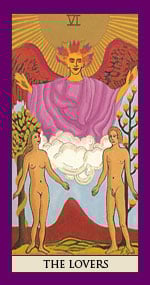
The Lovers

Keywords: choice, decision, love, communication, inspiration (ideas from above)!

Astrological Correspondence: Gemini

The Lovers card is representative not only of crucial life choices, but also of lovers, couples, and other partnerships, like business partners, siblings, and friends. The angel between a woman and a man, depicted on this card, symbolizes the struggle of deciding to follow one’s heart versus one’s temptation or obligation. The Lovers card symbolizes the choices that must be made to progress toward higher self-awareness; choices also reflect emotional values, indecisiveness, hesitation, and our fears about making wrong choices. This applies not only to love relationships – it is applicable to any relationship in which people are drawn together, even a casual one. It’s the card of uncertainty!

Rune

Hagalaz

“Hag-all-az” – Literally: “Hail” or “Hailstone” – Esoteric: Crisis or Radical Change

Key Concepts: hailstones, crisis and catastrophe, disruption, radical change, destructive elements of nature, severe weather, the uncontrollable, unavoidable unpleasantness, Jungian shadow, psychoanalysis, regression, acceptance of the unalterable

Psi: disruption, change, personal past

Energy:
power beyond human ability to harness, perfect pattern, seed formation, objective confrontation, destructive natural forces, chaos

Mundane: bad weather, obstacles, surprises, shelter

Divinations: Change according to ideals, changes for the long-term good, controlled crisis, corrections, completion, inner harmony; or catastrophe, crisis, stagnation, loss of power, loss of property, short-term disappointment, victim-consciousness, obsession with the past, blame.

Governs:
Completeness and balance of power, integration of unconscious shadow elements
The inevitability of Fate, Wyrd, Orlog
Evolutionary progress and operations of becoming
The outworking of a perfect pattern
Protection through banishing or exorcising disharmonious patterns, protection
Awareness of the unconscious ideas for eventual processing
Causing discomfort in others by awakening their own subconscious ‘garbage’


Daily Influences


Tarot Influence

Six of Coins

Material gain, charity and justice are at the forefront. That which is earned will be given.


Astrological Influence

Gemini Reversed

Gemini reversed denotes vacillation. Decisions are not made, because all side of the issue pull with the same strength.


Element Influence

Air

Air denotes freedom and the ability to transcent the mundane. You may be, or may soon experience a spiritual or secular liberation.


Animal Spirit

Characteristics of the Coyote as a Spirit Guide


Advice from the Coyote

Witches Rune

Source: otherworldlyoracle.com

Crossroads

decisions, blocked paths, opportunities, the space between, spirits

The crossroads as a symbol and as an actual place are powerful. When we reach a crossroads in our lives, we have to make a decision. There may be a new path presented to us or our paths might be blocked. This could also indicate a spirit of the crossroads calling us.

Ogham

I Ching

Numerology

Angel Number

Crack the Cookie


The Words of Confucius


It does not matter how slowly you go as long as you do not stop.

(One Person’s View) Casting The Runes c. 2018

Casting The Runes

Each individual will eventually devise his or her own way of casting the runes. What follows are some
suggestions, all following a similar path, but they are by no means fixed rules.


It is important to remember that your runes are your own, and are special. You have created a link
with them and that is important. Never lend your runes, unless you feel comfortable doing this. I
personally would never lend runes, Tarot cards or crystals to anyone else. If you are unsure, maybe
you should try drawing a rune from your pouch and seeing what you get as an answer. It is suggested
that an upright rune gives a Yes answer, and an inverted one a No answer. However, those runes
which look the same either way may prove a problem!


A traditional way of casting the runes is to mix them in a pouch and cast them on a cloth, usually
velvet. I keep my runes in such a pouch and use them in this way. It usually happens that the runes I
am intended to use find their way into my hand or between my fingers as I mix them in the pouch. I
usually draw nine runes.


Others have suggested drawing three runes at a time, three times, with a break in between each set of
three.


Old Nordic tales suggest that throwing runes at a person was a means of casting a magical spell.
Likewise spells are said to have been cast by writing certain runic inscriptions on a piece of paper and
passing it to the unsuspecting intended victim.


All these things may belong in folklore, and have no bearing on the modern usage for runes; it is up to
the individual to decide. One runemaster I know draws three runes which represent current
circumstances. Having looked at these three runes, he returns them to the pouch and draws three
more. The second set of three represents courses of action or possible outcomes. The second set is
then also returned to the pouch and a final single rune drawn, which indicates influences likely to have
a bearing on the problem as a whole.


Tradition suggests that Odin’s number was 5. For this reason, some runemasters work with only five
runes. Those interested in numerology will note that the runes total 25 if you include the blank rune.
This all adds up to 7, which is a powerful and spiritual number, and for this reason, perhaps, some
runemasters draw seven runes when casting.


Another means of casting the runes is to ‘shuffle them’ and leave them to their own devices for a while
(15 minutes is usually suggested), and then draw 12, laying them on a runic chart especially
prepared for the purpose.

(One Person’s View) Ways Of Casting The Runes c. 2018

Ways Of Casting The Runes


There are probably hundreds of different ways to lay the runes for a casting. What is given here is
only a selection. It is by no means exhaustive.

I would suggest that you try some of these, going for the ones with which you feel comfortable before
trying your own ideas out. The reasons for this are many, not least of which it is important to
familiarise yourself with the runes and how they are read as a group before progressing.

It should also be remembered that you may have some personal thoughts on the meanings of the runes
at the time you are carrying out the casting, which you should not dismiss out of hand. The meanings
given here are basic, and again by no means exhaustive. You may for example wish to use all
the reverse meanings given, even though some runes look the same either way up. Experience is the
best teacher, and you must always do what you feel comfortable doing. Don’t go along with something
just because others do – make up your own mind.

Another means of casting the runes consists of five runes, called Odin’s casting. Again these are laid
down from right to left, with the third rune slightly raised from the remainder. I read these as being
two pages within a book with the third rune being that which is either holding the pages together, or
conversely, stopping them from being turned. I use a similar layout in Tarot readings.

Similar layout could be used with seven runes.

You could also consider using a 12 rune casting, linking each rune either with a month or with a sign
of the zodiac. This is usually laid out in a circle, as in Figure 7.3, although I have seen many
variations of this.

Yet another suggestion would be what is sometimes called the rune-cast method. Basically, you ‘shuffle’ the runes within their pouch, and having formed a circle of string on the floor, empty the pouch into it.

Those runes nearest to you have the greatest meaning. Should any have fallen outside the string circle,
these can be ignored; likewise if they fall on the string or have fallen face downwards.

There are many more ways of casting the runes, and no doubt you will find one suitable for you.
Experiment and practise.

Some of Corresponding Colors for Use with Candles, in Spells and Rituals

Source: lightwarriorslegion.com

Some of Corresponding Colors for Use in all Aspects of Witchcraft for Thursday, Friday, and Saturday

Some of Corresponding Colors for Use in all Aspects of Witchcraft for Thursday, Friday, and Saturday

Thursday 

Purple,

Deep Blue,

Green,

Turquoise,

Metallic,

Royal Blue,

Rich Royal Colors

Friday

Pink,

White,

Aqua,

Green,

Rose,

Coral,

Blue,

Copper,

Light Blue


Saturday

Black,

Maroon,

Dark Purple,

Gray,

Red,

Brown,

Blue,

White,

Dark Shades

Some of Corresponding Colors for Use in all Aspects of Witchcraft – Sunday and Monday

Some of Corresponding Colors for Use in all Aspects of Witchcraft

SUNDAY

Gold,

Yellow,

Orange,

Amber,

MONDAY

Silver,

Pearl,

White,

Grey,

Lavender,

Blue,

Ivory,

Light Blue,

Let’s Have Some Fun – Another Coloring Page

Spell For the New Moon – Manifesting Ritual

(YOU CAN COPY AND PASTE ANY SPELLS POSTED TO A DOCUMENT TO PRINT AND/OR SAVE ON YOUR COMPUTER FOR PERSONAL USE ONLY)

Some of the Witchcraft/Magickal Correspondence for the Last Quarter Moon

(YOU CAN COPY AND PASTE ANY CORRESPONDENCES POSTED TO A DOCUMENT TO PRINT AND/OR SAVE ON YOUR COMPUTER)

LAST QUARTER Source: thehoodwitch.com

Moon rises at midnight and sets at noon; best effects between these times

Moon is 7-10 1/2 days after the full moon.

Workings: Addictions, divorce, endings, health and healing (banishing), stress, protection, and ancestors.

Purpose: Absolute destruction

Pagan Holiday: Fall Equinox

Goddess Name: The Morrigan’s Moon

Goddess Energy: harvest goddesses

Offering: Incense

Theme: Banishing

Tarot Trump: Judgement

(One Person’s View Point) A Look at Today’s USA Military’s Views on Wicca and Other Pagan Paths

Today’s Military Views on Wicca US Army Chaplain’s Manual from wicca.com

Excerpt from the U.S. Army’s Religious Requirements and Practices of Certain Selected Groups: A Handbook for Chaplains (pgs 231-236). Available from:

USAF Chaplain’s Service Institute
Resource Division

WICCA

OTHER NAMES BY WHICH KNOWN:
Witchcraft; Goddess worshippers; Neo-Paganism, Paganism, Norse (or any other ethnic designation) Earth Religion, Old Religion, Druidism, Shamanism.

Note: All of these groups have some basic similarities and many surface differences of expression with Wicca.

LEADERSHIP:
No central leadership. The Covenant of the Goddess annually elects a First Officer and there is a constitutional limit of two consecutive terms, but in practice officers have almost always served for one year only. In 1991, there are two Co-First Officers, Phoenix Whitebirch and Brandy Williams.

Note: This Covenant does not govern any Coven other than its’ own.

MEMBERSHIP:
Because of the complete autonomy of covens, this cannot be determined. There are an estimated of 50,000 Wiccans in the United States.

Hernes note: This number is now substantially higher and estimated at over 200,000 (now over 1.5 million in 2020). Wicca is currently the fastest growing spiritual path in the U.S.

HISTORICAL ORIGIN:
Wicca is a reconstruction of the Nature worship of tribal Europe, strongly influenced by the Living Nature worship traditions of tribal peoples in other parts of the world.

The works of such early twentieth century writers as Margaret Murray, Robert Graves and Gerald B. Gardner began the renewal of interest in the Old Religion. After the repeal of the anti-Witchcraft laws in Britain in 1951, Gardner publicly declared himself a Witch and began to gather a group of students and worshipers.

In 1962, two of his students, Raymond and Rosemary Buckland (religious names: Lady Rowen and Robat), emigrated to the United States and began teaching Gardnerian Witchcraft here. At the same time, other groups of people became interested through reading books by Gardner and others. Many covens were spontaneously formed, using rituals created from a combination of research and individual inspiration. These self-created covens are today regarded as just as valid as those who can trace a “lineage” of teaching back to England.

In 1975, a very diverse group of covens who wanted to secure the legal protections and benefits of church status formed Covenant of the Goddess (CoG), which is incorporated in the State of California and recognized by the Internal Revenue Service. CoG does not represent all, or even a majority of Wiccans. A coven or an individual need not be affiliated with CoG in order to validly practice the religion. But CoG is the largest single public Wiccan organization, and it is cross-Traditional (i.e. non-denominational).

BASIC BELIEFS:
Wiccans worship the sacred as immanent in Nature, often personified as Mother Earth and Father Sky. As polytheists, they may use many other names for Deity. Individuals will often choose Goddesses or Gods from any of the world’s pantheons whose stories are particularly inspiring and use those Deities as a focus for personal devotions.

Similarly, covens will use particular Deity names as a group focus, and these are often held secret by the groups. It is very important to be aware that Wiccans do not in any way worship or believe in “Satan,” “the Devil,” or any similar entities. They point out that “Satan” is a symbol of rebellion against and inversion of the Christian and Jewish traditions.

Wiccans do not revile the Bible. They simply regard it as one among many of the world’s mythic systems, less applicable than some to their core values, but still deserving just as much respect as any of the others. Most Wiccan groups also practice magic, by which they mean the direction and use of “psychic energy,” those natural but invisible forces which surround all living things. Some members spell the word “magick,” to distinguish it from sleight of hand entertainments.

Wiccans employ such means as dance, chant, creative visualization and hypnosis to focus and direct psychic energy for the purpose of healing, protecting and aiding members in various endeavors. Such assistance is also extended to non-members upon request.

Many, but not all, Wiccans believe in reincarnation. Some take this as a literal description of what happens to people when they die. For others, it is a symbolic model that helps them deal with the cycles and changes within this life. Neither Reincarnation nor any other literal belief can be used as a test of an individual’s validity as a member of the Old Religion.

Most groups have a handwritten collection of rituals and lore, known as a Book of Shadows. Part of the religious education of a new member will be to hand copy this book for him or herself. Over they years, as inspiration provides, new material will be added. Normally, access to these books is limited to initiated members of the religion.

PRACTICES AND BEHAVIORAL STANDARDS:
The core ethical statement of Wicca, called the “Wiccan Rede” states “an it harm none, do what you will.” The rede fulfills the same function as does the “Golden Rule” for Jews and Christians; all other ethical teachings are considered to be elaborations and applications of the Rede. It is a statement of situational ethics, emphasizing at once the individual’s responsibility to avoid harm to others and the widest range of personal autonomy in “victimless” activities. Wicca has been described as having a “high-choice” ethic.

Because of the basic Nature orientation of the religion, many Wiccans will regard all living things as Sacred, and show a special concern for ecological issues. For this reason, individual conscience will lead some to take a pacifist position. Some are vegetarians. Others will feel that, as Nature’s Way includes self-defense, they should participate in wars that they conscientiously consider to be just. The religion does not dictate either position, but requires each member to thoughtfully and meditatively examine her or his own conscience and to live by it. Social forces generally do not yet allow Witches to publicly declare their religious faith without fear of reprisals such as loss of job, child custody challenges, ridicule, etc. Prejudice against Wiccans is the result of public confusion between Witchcraft and Satanism. Wiccans in the military, especially those who may be posted in countries perceived to be particularly intolerant, will often have their dog tags read “No Religious Preference.” Concealment is a traditional Wiccan defense against persecution, so non-denominational dog tags should not contravene a member’s request for religious services.

Wiccans celebrate eight festivals, called “Sabbats,” as a means of attunement to the seasonal rhythms of Nature. These are January 31 (Called Oimelc, Brigit, or February Eve), March 21 (Ostara or Spring Equinox), April 30 (Beltane or May Eve), June 22 (Midsummer, Litha or Summer Solstice), July 31 (Lunasa or Lammas), September 21 (Harvest, Mabon or Autumn Equinox), October 31 (Samhain, Sowyn or Hallows), and December 21 (Yule or Winter Solstice.)

Some groups find meetings within a few days of those dates to be acceptable, others require the precise date. In addition, most groups will meet for worship at each Full Moon, and many will also meet on the New Moon.

Meetings for religious study will often be scheduled at any time convenient to the members, and rituals can be scheduled whenever there is a need (i.e. for a healing). Ritual jewelry is particularly important to many Wiccans. In addition to being a symbol of religious dedication, these talismans are often blessed by the coven back home and felt to carry the coven’s protective and healing energy.

ORGANIZATIONAL STRUCTURE:
Most Wiccans meet with a coven, a small group of people. Each coven is autonomous. Most are headed by a High Priestess, often with the assistance of a High Priest. Some are headed by a High Priestess or High Priest without a partner, and some regard themselves as a gathering of equals. Covens can be of mixed gender, or all female or male, depending on the preferences of the members. Every initiate is considered to be a priestess or priest.

Most covens are small. Thirteen is the traditional maximum number of members, although not an absolute limit. At that size covens form a close bond, so Wiccans in the military are likely to maintain a strong affiliation with their covens back home. There are many distinct “Traditions” of Wicca, just as there are many denominations within Christianity.

The spectrum of Wiccan practice can be described as ranging from “traditional” to “eclectic,” with Traditions, covens and individuals fitting anywhere within that range. A typical difference would be that more traditional groups would tend to follow a set liturgy, whereas eclectic groups would emphasize immediate inspiration in worship.

These distinctions are not particularly important to the military chaplain, since it is unlikely that enough members of any one Tradition would be at the same base. Worship circles at military facilities are likely to be ad-hoc cross-Traditional groups, working out compromise styles of worship for themselves and constantly adapting them to a changing membership.

Therefore, the lack of strict adherence to the patterns of any one Tradition is not an indicator of invalidity. While many Wiccans meet in a coven, there are also a number of solitairies. These are individuals who choose to practice their faith alone. The may have been initiated in a coven or self initiated. They will join with other Wiccans to celebrate the festivals or to attend the various regional events organized by the larger community.

ROLE OF MINISTERS:
Within a traditional coven, the High Priestess, usually assisted by her High Priest, serves both as leader in the rituals and as teacher and counselor for coven members and unaffiliated Pagans. Eclectic covens tend to share leadership more equally.

WORSHIP:
Wiccans usually worship in groups. Individuals who are currently not affiliated with a coven, or are away from their home coven, may choose to worship privately or may form ad-hoc groups to mark religious occasions. Non-participating observers are not generally welcome at Wiccan rituals.

Some, but not all, Wiccan covens worship in the nude (skyclad) as a sign of attunement with Nature.

Most, but not all, Wiccan covens bless and share a cup of wine as part of the ritual. Almost all Wiccans use an individual ritual knife (an “athame”) to focus and direct personal energy. Covens often also have ritual swords to direct the energy of the group. These tools, like all other ritual tools, are highly personal and should never leave the possession of the owner.

Other commonly used ritual tools include a bowl of water, a bowl of salt, a censer with incense, a disk with symbols engraved on it (a “pentacle”), statues or artwork representing the Goddess and God, and candles. Most groups will bless and share bread or cookies along with the wine. All of these items are used in individual, private worship as well as in congregate rituals.

DIETARY LAWS OR RESTRICTIONS:
None.

FUNERAL AND BURIAL REQUIREMENTS:
None. Recognition of the death of a member takes place within the coven, apart from the body of the deceased. Ritual tools, materials, or writings found among the effects of the deceased should be returned to their home coven (typically a member will designate a person to whom ritual materials should be sent). It is desirable for a Wiccan priest or priestess to be present at the time of death, but not strictly necessary. If not possible, the best assistance would be to make the member as comfortable as possible, listen to whatever they have to say, honor any possible requests, and otherwise leave them as quiet and private as possible. (Sind Note Pagans can now have a pentagram on their headstone in any official USA military cemetary)

MEDICAL TREATMENT:
No medical restrictions. Wiccans generally believe in the efficacy of spiritual or psychic healing when done in tandem with standard medical treatment. Therefore, at the request of the patient, other Wiccan personnel should be allowed visiting privileges as though they were immediate family, including access to Intensive Care Units. Most Wiccans believe that healing energy can be sent from great distances, so, if possible, in the case of any serious medical condition, the member’s home coven should be notified.

OTHER:
With respect to attitude toward military service, Wiccans range from career military personnel to conscientious objectors. Wiccans do not proselytize and generally resent those who do. They believe that no one Path to the Sacred is right for all people, and see their own religious pattern as only one among many that are equally worthy. Wiccans respect all religions that foster honor and compassion in their adherents, and expect the same respect. Members are encouraged to learn about all faiths, and are permitted to attend the services of other religions, should they desire to do so.

GENERAL SOURCE BOOKS:

Note by Herne: Since this was written by the military, the list of books available has grown subtantially. For more topics and titles, see our Suggested Reading List.

The best general survey of the Wiccan and neo-Pagan movement is: Adler, Margot. Drawing Down the Moon. Boston: Beacon Press, 1986. 595pp

For more specific information about eclectic Wicca, see: Starhawk. The Spiral Dance. New York: Harper & Row, 1979.

For more specific information about traditional Wicca, see: Farrar, Janet, and Stewart Farrar. Eight Sabbats for Witches. London: Robert Hale, 1981. 192pp.

The Witches’ Way. London: Robert Hale, 1984. 394pp.

FOR MORE INFORMATION, CONTACT:

Pagan Military Newsletter c/o Terri Morgan, Editor, 829 Lynnhaven Parkway 114-198 Virginia Beach, VA 23452

Because of the autonomy of each coven and the wide variance of specific ritual practices, the best contact person would be the High Priestess or other leader of the member’s home coven.

(One Person’s View Point) Why Light a Candle

Light A Candle

In many different traditions lighting candles is a sacred action.
It expresses more than words can express.
It has to do with gratefulness.
From time immemorial, people have lit candles in sacred places. Why should cyberspace not be sacred?

You may want to begin or end your day by the sacred ritual of lighting a candle or in memory of a loved one … to send healing thoughts … in prayer … it’s all about your intent.
Just follow link below ~

Love & Blessings xxx

http://www.gratefulness.org/candles/candles.cfm?l=eng&gi=AMP

In Memory of WOTC Founder Lady of the Abyss

I type this with tears flowing because I still think about our Lady Abyss everyday. I have her picture on my desk and ask her for guidance often with the website. I had very few people in my life that helped and guided me as a sister and friend as much as she did when I was lost after my mother crossed in 2015. Lady A has touched the hearts and minds of so many people both face to face and through WOTC. She would find time to reply to emails from people needing help or just to say hi to her.

Her and I had a running joke that she twisted my arm hard to come out of retirement and once again help people who want to learn about witchcraft, and/or attend an online coven gathering. She comes to me in my dreams and first kicks my ass for even thinking of throwing in the towel on WOTC than gives me a pep talk about all the people I have helped become a safe practicing witch.

I am thankful for all the years I got to know and love our Lady. I am trying to keep WOTC the kind of website she would be proud of. I might not have everything posted every day that she had but I am trying to do my best for her and all of you dear Sisters, Brothers, and Guests. Am I succeeding?

Please leave your thoughts and memories of Lady of the Abyss in the comments section below as we honor her crossing into the Summerlands 6 years ago.

Blessed be from Lady of the Abyss and myself.

(One Person’s View) List of the Most Used Gods in Witchcraft

Adonis: Greek – consort of Aphrodite

Anubis: Egyptian – Jackal-headed God responsible for conducting souls to the underworld. 

Apollo: Greek & Roman – God of the Sun, twin brother of Artemis 

Cernunnos/Kernunnos: Celtic – The Horned God, consort of the Lady.

Dionysus: Greek – God of wine, fertility, and vegetation. 

Eros: Greek – God of love and passion.

Herne: Celtic/Saxon – see Cernunnos.

Horus (the elder): Egyptian – God of the all-seeing eye. Has the head of a falcon and the body of a man.

Hymen: Greek – God of marriage and wedding feasts. 

Lucifer: Italian – God of light, brother of Diana.

Mithra: Persian – God of the Sun and of victory in war

Odin: Scandinavian – God of the dead and of war. Consort of Freya.

Osiris: Egyptian – Fertility God, brother and consort of Isis.

Pan: Greek – God of nature and of woodland.

Poseidon: Greek – God of the sea.

Ra: Egyptian – God of the Sun. Father of Hathor by Nut.

Shiva: Hindu – God of the cycle of birth-death-rebirth. Consort of Kali.

Thor: Scandinavian – God of the sky and of thunder. Son of Odin

Thoth: Greek – God of wisdom and of writing.

Zeus: Greek – Supreme God. Brother of Demeter.