Gods – Loki

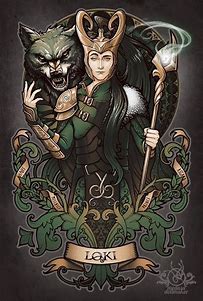
Loki Norse God of Mischief from .gods-and-goddesses.com

Loki is known as the trickster god and deity of mayhem and mischief in Norse mythology. He is one of the most well-known gods of Norse mythology. He is at least half-giant; however, some think he is full-giant but sneaked his way to becoming a god.

Loki Facts

Name(s): Loki
Rules over: Chaos, Mischief
Gender: Male
Symbols: Mistletoe, Horned Helmet (modern depictions)
Linked Animals: Two Intertwined Snakes
Parents: Fárbauti and Laufey
Siblings: Helblindi and Býleistr
Greek Similar: Atë
Roman Similar: Laverna

Family

Loki’s father was Fárbauti and his mother was Laufey. It is unknown whether his mother was a lesser known goddess or a giant, and his father definitely was a giant.

This duplicity may have attributed to Loki’s split feelings about the gods of Asgard. Sometimes he is helpful to them, but other times he insults them, causes trouble, and during Ragnarok leads the giants into battle against Asgard.

Symbols

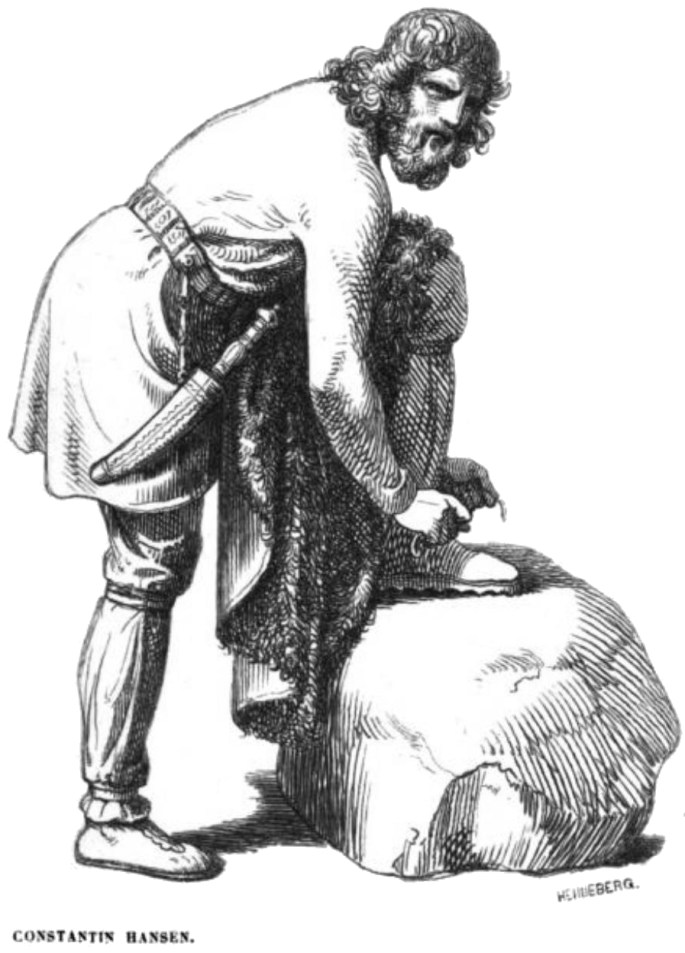
Loki has been associated with mistletoe, two intertwined snakes, and also a helmet with two horns.

Powers & Duties

Loki had the power to shape-shift in Norse legends. In various stories, he turned into a salmon, mare, seal, fly, and elderly woman. He also used a combination of masterful trickery and cunning to achieve his objectives.

Stories

The first time Loki helped the gods was when they were building Asgard. The gods had run out of funds and all they had built was a wall. Loki came up with the idea that a giant should finish the job for them. The gods agreed, as did the giant. But, the giant asked for the Sun, the Moon, and the goddess Freya as payment if he completed the job on time. The gods weren’t sure, but Loki assured them that the giant would never finish on time. The giant had a huge stallion called Svadilfari to help him, and the gods got nervous. Loki changed shape into a mare and seduced the giant’s horse. As a result of Loki’s trickery, the giant wasn’t able to finish on schedule and tried to kidnap Freya. Before the giant could, Thor cracked his skull with a hammer. However, Loki, as the female horse, got pregnant and gave birth to an eight-legged stallion named Sleipnir, which he gave to Odin.

Another time he helps the gods of Asgard is when Thor lost his hammer, Mjolnir. Thor asks Loki for help and they work together to find where the hammer is located. Thrymr, the giant, had stolen the weapon and taken it to the home of the giants. He would only return it if Freya would agree to marry him. Loki came up with a plan that included his and Thor’s cross-dressing to get the hammer back. It succeeded, and Thrymr was punished.

During a great feast in Asgard, Loki wasn’t invited and was upset. He asked the guard what the gods were talking about, and the guard told him they were talking about war, weapons, and saying negative things about Loki. Loki burst in, and the gods became silent. Loki then asks for a seat, and Odin finally agrees to let him sit. Loki gives a toast to all the gods except for Bragi, whom he insults instead. They start arguing and other gods and goddesses get involved.

Loki begins to insult them all, including Odin, and when Frigg, Odin’s wife, tries to stop Loki, he ends up insulting her as well. She tells Loki that if her son Baldur were still alive, Loki wouldn’t be able to escape the wrath of the gods. Loki then reminds her that he is responsible for Baldur’s death. The insults continue when Freya calls Loki mad – he retorts that she is a whore. Heimdall tells Loki he’s drunk and to stop, but Loki insults Heimdall. Skadi tells Loki to watch it or he’ll be bound up, and Loki insults her. Sif, the wife of Thor, gives him mead in a golden goblet saying she is blameless and he can’t insult her. Loki claims she is his lover. Thor finally arrives, threatens Loki to silence with Mjolmir, and Loki finally leaves after insulting Thor. He disguises himself as a salmon, but the gods find him and finally bind him until Ragnarok.

Facts About Loki

  • In Old Norse, Loki means “close”;
  • Loki typically cheated dwarves at any opportunity given to him. They finally were able to stitch his mouth shut to keep him quiet from insults;
  • Loki is the father of Hel, the goddess of the land of the dead. He is also father of Fenrir, the wolf demon that bites off Tyr’s hand and will eat Odin during Ragnarok. He is also the father of Jormungandr, the world serpent;
  • Loki steals Freya’s amber necklace, in which Heimdall fights him and retrieves it;
  • Loki tricked blind Hod to kill Baldur with mistletoe;
  • When bound until Ragnarok, Skadi places a venomous snake above him, which causes him terrible pain with the poison.

Gods – Thoth

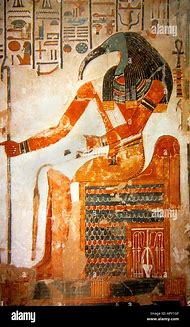
Egyptian God Thoth from gods-and-goddesses.com

Thoth Facts

Name(s): Thoth
Rules over: Knowledge, Wisdom, Moon
Gender: Male
Symbols: Moon Disk
Sacred animals: Ibis bird
Parents: None
Siblings: None
Greek Similar: Apollo, God of Knowledge

Thoth is the Egyptian god of Knowledge. He was widely worshiped as inventor of the written word and credited with the creation of different branches of knowledge.

Thoth is a central figure in ancient Egyptian religion, filling various important roles in the mythological world. However, the worship of Thoth lasted only until the dynastic era. Regardless, the Egyptians and Greeks alike credit him as the inventor of all knowledge.

Family

Egyptian myth told that Thoth was self-created, while at least two alternate stories claim he was either born from the sun god Ra’s lips or from the war god Set’s forehead after Set swallowed the semen of his brother Horus.

Symbols

He is commonly depicted in human form with the head of an Ibis, a sacred bird associated with wisdom. The name Thoth is the Greek version of the Egyptian name Djehuti, which means “He Who is Like the Ibis.” Sometimes he is pictured holding an ankh, a famous hieroglyph resembling a cross, and scepter; other times, he is pictured holding a scribe’s palette and stylus. He is also seen wearing the Atef crown usually worn by Osiris. When he took the form of A’an, god of equilibrium, he was depicted with the head of a baboon.

Powers & Duties

Considered to be the author of the Book of the Dead, Thoth also acted as scribe to the gods and of the underworld. In this capacity, he stood by during the weighing of the hearts of deceased persons. Hearts lighter or equal to the weight of a feather could move on to a heavenly existence. Thoth’s just decisions in these and other matters made him a respected judge.

Appropriately, one epithet given to Thoth is “The Reckoner of Time and of Seasons.” He possesses the gift of measuring and recording time. In one popular myth, he added an extra five days to add to the 360 day calendar. This was to enable Nut, the sky goddess, to have a child on each of these days after Ra issued a decree that she was to have no children on any day of the original year.

Worship

Thoth was first worshiped as a moon god. The moon’s cycles played an important role in Egyptian life. The crescent moon resembled an ibis, the bird associated with Thoth.

Thoth’s main temple is at Khmun. Here he led the Ogdoad pantheon, the four gods and four goddesses who made up the principal deities before creation. He has shrines in numerous other cities.

A festival of Thoth was held at Khmun, where his worshipers buried mummified baboons and ibises as votive offerings. Evidence of these have been found by archaeologists at the necropolis of Tuna el-Gebel.

Facts About Thoth

  • When Set killed Osiris, Thoth helped Isis to resurrect him and assisted Anubis with the first act of mummification;
  • Invoked in many spells used in popular magic, Thoth is also seen as a god of magic;
  • Thoth remains a well-known god in popular culture. In modern literature, for example, he is the character Mr. Ibis in Neil Gaiman’s American Gods. He is also featured on his throne on the logo of the University of Cairo;
  • Thoth was associated with Hermes, the messenger god, by the Greeks. They were combined to form Hermes Trismegistus. Thereafter, Khmun became Hermopolis;
  • According to myth, Thoth wrote 42 books containing all the knowledge humanity needs. He was given the title of “Author of Every Work on Every Branch of Knowledge, Both Human and Divine.” Some of this knowledge was so powerful that it could not be revealed to everyone;
  • The Mansion of Thoth was his home in the afterlife. Souls found a safe place to rest here, where they received magic spells to protect them from demons;
  • Some of the disciplines the Greeks credit Thoth for include mathematics, astrology, geometry, botany, and land surveying;
  • Djehuti, an Egyptian pharaoh of the Sixteenth dynasty, was named after Thoth. He ruled for three years.

Gods – Mercury

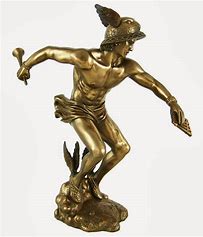
Mercury • Facts & Mythology about the Roman god of communication, trade, business

Mercury is the messenger to the Roman gods. He is well known for his incredible speed. Originally, Mercury was a god of trade related to the corn crop. In fact, his name is derived from the Latin word merces, meaning “merchandise.”

Mercury, who is sometimes referred to as Mercurius, was also lauded as the protector of merchants, travelers, and shopkeepers. He was also defamed as the patron of thieves and those who played practical jokes.

Origins

In early Roman mythology, there was no mention of Mercury as a member of the ruling class of gods. Eventually, he was absorbed into Roman culture from the Greek god Hermes, messenger of the Greek gods. Mercury carried out many of the same functions as Hermes.

Mercury was the son of Jupiter, the Roman equivalent of the Greek god Zeus. The story of the birth of Mercury held that Jupiter secretly impregnated the goddess Maia in a cave on the island of Arcadia. The following day, Maia gave birth to Mercury before wrapping him in swaddling blankets and falling asleep. As his mother slept, Mercury raced across Arcadia to steal cattle from his brother, Apollo, before returning to his mother.

Maia woke to the sight of Mercury wrapped in his swaddling blanket and Apollo accusing him of stealing his cattle. Eventually, Jupiter stepped in to reveal he had watched Mercury steal the cattle and ordered their return. During the night, Mercury had fashioned a lyre from cattle intestines and began playing beautiful music. This inspired Apollo to ask for a trade of the cattle for the lyre.

Appearance

In most portrayals, Mercury is shown as a youthful god of Rome who is clean-shaven and is often little more than a child. Mercury is depicted in Roman artworks as wearing a helmet and sandals with attached wings that reflect his speed and position as the messenger of the gods. The son of Jupiter is also the god of commerce, leading him to being shown in some sculptures and paintings holding a purse.

Symbols

There are many symbols associated with Mercury, including his winged cap and sandals that reflect the speed of the Roman god. Mercury is often depicted as carrying a staff, which was a symbol the members of his cult added to their daily lives.

Mercury is associated with many animals, including the tortoise that played a role in his first day of life. Mercury used the shell of a tortoise to fashion the lyre he would trade for the cattle of Apollo. The tortoise would become a common symbol of Mercury throughout Roman culture and be accompanied by his close links to the ram and the rooster.

The rooster is the symbol of the new day that is brought by Mercury as a messenger of the gods. The ram is a symbol of fertility for the Roman people and is often seen with Mercury in stories and artworks.

Powers & Duties

Mercury’s main power is his ability to move at great speeds. He is most well-known for his role as a messenger to the gods. Interestingly, the role of the messenger also included the task of conducting the passage of individuals from Rome to the underworld when they died.

Mercury is also one of the most duplicitous gods in Roman culture. He is known for his trickery and ability to cheat people out of their belongings.

Myths & Stories

Mercury plays a role in many myths. As noted above, he is said to have stolen cattle and a bow and arrow when just a child. In the myth of Cupid and Psyche, he is called upon by Jupiter to make a proclamation demanding the capture of Psyche.

In the Aeneid, he is sent by Jupiter to Aeneas with orders to leave his lover and “sail away to fulfill his destiny in Italy.” He also plays a role in Roman poetry and theater, much of which was based on mythology.

In the play Amphitruo by the dramatist Plautus, Mercury dresses as a servant and aids Jupiter in disguing himself Amphitryon in order to seduce Amphitryon’s wife.

The poet Horace wrote of him in his Odes. In fact, Horace called himself mercurialis, meaning a lyric poet protected by Mercury.

Many of the myths of Mercury are derived from those of Hermes. Monuments to Hermes were thought to bring good luck, and this idea was perpetuated with Mercury as well. Another borrowed role was that of escorting the souls of the deceased to the underworld. It is speculated that the myths originated among shepherds, lending their interest in “music and fertility.” In fact, in some legends, Mercury is said to have invented the guitar-like lyre, and his son is said to have been a nymph who invented the music of the pastoral societies.

Worship

A temple to Mercury was dedicated on Rome’s Aventine Hill in 495 B.C. The festival of Mercuralia was held on May 15, the anniversary of the temple dedication, in honor of both Mercury and his mother Maia of the Pleiades. Rituals of this festival involved merchants drawing water from the well at Porta Capena to be sprinkled on their trade goods and on their own heads. Trade fairs were also held at the temple, and it was the location of Rome’s busy commercial center.

Art

In art and statues, Mercury is typically depicted as a handsome young man, even boyish in appearance, wearing a white garment. Mercury often carries a money purse, symbolizing his function as patron of merchants and business owners. His fleetness as messenger of the gods is represented by a hat or sandals with wings, called petasus and talaria, respectively. Mercury was thus called Alipes, meaning “with the winged feet.” He is also seen carrying a staff called a caduceus. The caduceus was a symbol of peace, carried by ambassadors to foreign lands. It consisted of a branch with two shoots, originally decorated with ribbons or garlands. In later times, these attributes were replaced by two twining snakes, with a pair of wings above the snakes. The snakes were related to Mercury’s role as a fertility god and in delivering souls to the underworld. Today, this symbol is used to represent physicians, the medical field, and the U.S. Army Medical Corps.

Today

Like many mythical figures, Mercury has been immortalized in the naming of celestial objects. The planet Mercury, as visible just after sunset, was called in ancient times by his Greek counterpart, Hermes. This was likely due to the planet’s rapid motion in comparison to other stellar objects. Interestingly, Mercury’s morning visitation, just before sunrise, was not recognized as being the same “star;” it was thus called Apollos. The element mercury (Hg) , atomic number 80 on the periodic table, was once known as “quicksilver.” The symbol for the planet Mercury was used to represent quicksilver in sixth century alchemy, and thus the chemical took on the name of the god as well.

Facts about Mercury

  • Hermes is the Greek equivalent of the Roman god Mercury.
  • He was the grandson of the Titan Atlas.
  • Woden / Odin was significantly affiliated with Mercury in ancient times. They were referenced together in the Roman author Tacitus’ literary work Germania. Germanic tribes referred to Wednesday as Wodenstag, whereas in Latin Wednesday is called dies Mercurii. This was possibly due to their similar roles in sacrifice and death.
  • Gaulish Mercury refers to worship of Mercury by the early Celtic tribes of western Europe. In these tribes, he was likely held as the highest among the gods.
  • The French translation of Wednesday is Mercredi. In Italian it is Mercoledì. Both are derived from the Latin word for Mercury.
  • Mercury is the closest planet to the Sun. It is the fastest planet to complete a full orbit around the Sun.
  • The element Mercury is named after the Roman god.
  • Mercury was a brand of automobile whose production lasted for 70 years. Production of the cars ceased in 1970.
  • Mercury’s roles included being the god of store owners, merchants, travelers, trade, profit, tricksters, and theives.

Gods – Zeus

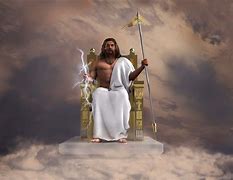
Zeus – Greek God Of The Sky and King of the Gods from greekgodsandgoddesses.net

Zeus was the first of the GODS and a very imposing figure. Often referred to as the “Father of Gods and men”, he is a sky god who controls lightning (often using it as a weapon) and thunder. Zeus is king of Mount Olympus, the home of Greek gods, where he rules the world and imposes his will onto gods and mortals alike.

Zeus was the last child of the titans Cronus and RHEA, and avoided being swallowed by his father (who had been told one of his children would overthrow him) when Rhea sought help from URANUS and Gaea. Cronus had previously swallowed DEMETERHESTIAHERAHADES and POSEIDON.

Along with Hades and Poseidon, Zeus shared the rule of the world and became king of Olympus as the children of CRONUS were filled with admiration for their noble brother and sided with him against their unjust father – even following Zeus into The Battle of the Titans.

Zeus mated with many goddesses and mortals (including Aegina, Alcmena, CALLIOPE, Cassiopea, DEMETER, Dione, Europa, Io, Leda, LETOMNEMOSYNE, Niobe, PERSEPHONE and SEMELE) but was married to his sister Hera – goddess of marriage and monogamy.

Roles and responsibilities of Zeus

As the king of the gods and sitting atop the golden throne on MOUNT OLYMPUS, Zeus was revered by all. Mortal kings would boast that they were descendants of Zeus. With this supreme power came a number of roles and responsibilities.

Hesiod described Zeus as a god who “brought peace in place of violence” and referred to him as the “lord of justice”.

Though he is most well known as GOD OF THE SKY and thunder, Zeus was the supreme cultural embodiment of Greek religious beliefs. He had many epithets (titles) that emphasized different aspects of complete and wide ranging authority.

  • Zeus Olympios emphasized Zeus’s kingship over the gods.
  • Zeus Xenios, Philoxenon or Hospites: Zeus was the patron of hospitality (xenia) and guests, ready to avenge any wrong done to a stranger.
  • Zeus Horkios: Zeus he was the keeper of oaths. Exposed liars were made to dedicate a statue to Zeus, often at the sanctuary of Olympia.
  • Zeus Agoraeus: Zeus watched over business at the agora and punished dishonest traders.
  • Zeus Aegiduchos or Aegiochos: Zeus was the bearer of the AEGIS with which he strikes terror into the impious and his enemies.
  • Zeus Tallaios (“solar Zeus”): the Zeus that was worshiped in Crete.
  • Zeus Geōrgos (“earth worker”, “farmer”), the god of crops and harvest, in Athens.
  • Astrapios (“lightninger”)
  • Brontios (“thunderer”)

Appearance and personality of Zeus

According to “Work and Days” by Hesiod (line 59), Zeus was a carefree god who loved to laugh out loud. He was regarded as wise, fair, just, merciful, and prudent. He was also unpredictable – nobody was able to guess the decisions he would make.

He was also easily angered which could be very destructive. He has previously hurled lightning bolts and caused violent storms that wreaked havoc on earth.

Zeus fell in love easily and had many affairs with various women, however he would severely punish anybody who attempted to escort/fall in love with his wife Hera – like the giant PORPHYRION who took a lightning bolt from the engraged god for lusting after his wife (albeit with a little help from the love god Eros).

He is often described as a strong, imposing man with a regal body and long, often curly, hair. He usually had a short beard or scruff and carried his trusty thunderbolt at all times.

How Many Wives Did Zeus Have?

ZEUS HAD SEVEN IMMORTAL WIVES. They are Metis, Themis, EURYNOME, Demeter, Mnemosyne, Hera, and Leto. From these marriages produced many MANY SONS and  DAUGHTERS.

How Did Zeus Become the Leader of the Gods?

Cronus, managed to overthrow his father, Uranus.

But Uranus made a prediction that Cronus would be overthrown by one of his children. Because Cronus was afraid of losing the kingdom, he made the same mistakes his father did and turned into a terrible, angry king and did lots of horrible things to stay in power.

He ate his children, just to keep them from overthrowing him. But Rhea, his wife, managed to fool Cronus by feeding him a large stone and kept one of his children safe. This child was named Zeus. Rhea hid him away in a cave on the island of CRETE so he would be safe.

Once Zeus grew up, he went to his father’s mountain and served him as a cupbearer. His father did not know that Zeus was his son. A TITAN GODDESS NAMED METIS helped Zeus fool his father into drinking a mixture of mustard in his wine.

This caused Cronus to feel sick, and he threw up all of his children that he had eaten, one by one including the stone. Once Cronus had expelled all of Zeus’ brothers and sisters, Zeus talked them into rebelling against Cronus, their father.

This is what started the TITANOMACHY, or the Titan’s War. Zeus and his brothers and sisters rebelled against their father, Cronus. Zeus set the CYCLOPES and the Hecatonchires free from their underground prison and convinced them to join the fight against Cronus too.

Cronus had been the one who locked up his siblings, so they agreed to join Zeus. The Hecatonchires used rocks as weapons, and the Cyclopes made Zeus’ thunderbolts. Together they also made POSEIDON‘s trident and HADES‘ helm of darkness.

The only Titians to fight with Zeus were THEMIS and PROMETHEUS. This war lasted ten years. ATLAS was a major leader on the side of the Titans and Cronus. After the war was over, Zeus imprisoned all of the Titans in TARTARUS, except for Themis and Prometheus who fought for him.

These Titans were imprisoned in the earth the same way that Cronus, HECATONCHIRES and the Cyclopes once were. Hecatonchires guarded the Titans in their prison. Because Atlas was such an important fighter for the opposition, Zeus gave him the special punishment of holding up the world.

After the Titans’ War Zeus and his brothers, Hades and Poseidon decided to divide the universe into three parts. They drew straws to see who would rule over which part. Zeus drew the longest straw, so he was given the title of king of the sky.

This also meant that he was the head of mortals and all the gods, too. Poseidon got the middle straw, so he became king of the sea. Hades drew the shortest straw, so he became the ruler of the UNDERWORLD.

Facts about Zeus

Zeus became the ruler of heaven and earth after a revolt against his father, Kronos. In his position as king of the gods, Zeus had to play mediator when other the immortals were mad at each other.

He is the father of ATHENA, who is said to have SPRUNG FROM HIS HEAD. She was his favorite child, with whom he shared the thunderbolt and aegis.

Hades and Poseidon were his brothers.

His wife Hera was also his sister.

Zeus was not a faithful husband; he was known for having many affairs with mortal women.

Zeus fathered HERCULES, the famous Greek hero, by deception. He disguised himself as Amphitryon, Alcmene’s husband, in order to have sexual relations with her.

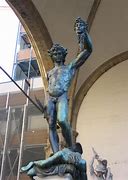
Zeus fathered PERSEUS by impregnating Danaë. When he did so, he appeared to her in the form of a golden shower.

The name Zeus means “bright” or “sky.”

His weapon of choice was the thunderbolt, made for him by the MYTHICAL CREATURES, the CYCLOPS.

Zeus, more recently known for causing thunder and lightning, was once a rain-god. He was always associated with the weather in some form.

The Zeus described in Homer was not an extension of nature; instead, he had a standard of right and wrong that made him more relatable to mankind.

Before monarchies were rendered obsolete, Zeus protected the king and his family.

Hesiod calls Zeus the “the lord of justice.” Perhaps because of this, he was reluctant to join a side in THE TROJAN WAR. He preferred the Trojans, but he wanted to stay neutral because Hera preferred the Greeks. She was insufferable when he opposed her openly.

Metis, the goddess of prudence, was Zeus’s first love.

ARESHEPHAESTUS, Hebe and EILEITHYIA are the CHILDREN OF ZEUS AND HERA.

His union with Leto brought forth the twins APOLLO and Artemis.

Zeus had many children with some believing he had over 50 CHILDREN

When he seduced the Spartan queen Leda, ZEUS TRANSFORMED HIMSELF INTO A BEAUTIFUL SWAN, and two sets of TWINS were born.

When Zeus had an affair with Mnemosyne, he coupled with her for nine nights. This scenario produced nine DAUGHTERS, who became known as the MUSES

Zeus punished men by giving them women.

Zeus’s servants were named Force and Violence.

ZEUS’ FAMILY TREE
Father Cronus Mother Rheas
CHILDREN
Goddesses Mortals
Mother Offspring Mother Offspring
Demeter Persephone Alcmene Heracles
Dione Aphrodite Antiope Amphion, Zethus
Eurynome Charities (Graces) Callisto Arcas
Hera Ares, Eileithyia, Hebe, Hephaestus Danae Perseus
Leto Apollo, Artemis Aegina Aecus
Maia Hermes Electra Dardanus, Harmonia, Iasius
Metis Athena Europa Minos, Rhadamanthys, Sarpedon
Mnemosyne Muses Io Epaphus
Themes Horae (Seasons), Moirae (Fates) Laodamia Sarpedon
Leda Polydeuces (Pollux), Helen
Niobe Argos, Pelasgus
A nymph Tantalus
Semele Dionysus
Taygete Lacadaemon

Zeus FAQS

What is Zeus the God of?

Zeus is the God of sky and thunder in ancient Greek religion, who rules as king of the gods of Mount Olympus.

How many children did Zeus Have?

Zeus had 54 children – 31 by Divine unions including Ares, The Three Graces, The Nine Muses, The Horae and 23 via human unions including Perseus and Heracles.

Who is the Father of Zeus?

The father of Zeus is Cronus, youngest son of Uranus and Gaea, the leader of the first generation of Titans, and, for a brief period, the ruler of all gods and men.

What is the Symbol of Zeus?

The symbols of Zeus include the lightning bolt, the eagle, the bull, and the oak tree. Zeus is often portrayed with a scepter in one hand and the thunderbolt in the other – both symbols of his authority. Sometimes he wears a crown of oak leaves.


Gods -Perses

Perses

Perses from greekgodsandgoddesses.net

Long before the rise of the OLYMPIANS, Titans ruled the world. In Greek mythology, THE TITANS were a race of elder gods. The earliest generation of Titans was born from Chaos. Known as primordial deities, the first Titans represented fundamental principles of the Earth and universe. However, their children and subsequent generations resembled humans and giants with great mystical powers.

As a whole, the Titans are not as well-known as the more famous Olympians of the Greek Pantheon. However, they still play an important role in GREEK MYTHOLOGY.

One Titan whose story is largely lost to the sands of time is Perses. A second-generation Titan god, Perses is the god of destruction. He represents the devastation and disorder that can come from war, depicting the obliteration of land and lives in the process.

The Origins of Perses

Information about Perses is sparse. He did not play a significant role in Greek mythology. Despite his importance to ancient Greeks, he’s only briefly mentioned in poems and texts. Most information comes from “THE THEOGONY” by Hesiod, which is the most trusted source for tracing immortal lineage. Perses is mentioned in the Homeric Hymns and works by Apollodorus as well.

Perses is the son of Titans CRIUS and EURYBIA. Crius was the god of constellations, and Eurybia was the goddess of mastery of the seas. The two elder Titans came from the first primordial deities. Together they bore Perses, Pallas, and ASTRAEUS.

There’s very little information about Perses’ upbringing or personal history. Like many Titans, Greeks didn’t actively worship Perses. The only time Greeks would ask for assistance was during times of war. But outside of that, Perses didn’t have any temples, sanctuaries, or cults.

Perses Depictions

Few artistic depictions exist of Perses exist throughout history. Unlike the Twelve Olympians, Perses and other Titans didn’t get many paintings, sculptures, or pottery. As a result, modern artists have taken many creative liberties with the god’s appearance.

Generally, Perses is shown as a destructive force in the midst of war. As with many other Titans, Perses is usually depicted as a giant among men.

Some scholars believe that Perses was envisioned with animalistic features. The Titan Crius and his three sons have a strong connection to a group of interconnected star constellations, which also hold animal-like qualities. Perses takes the form of a canine. Meanwhile, his brothers Pallas and Astraeus had the form of a goat-like giant and an equine, respectively. Their father, Crius was a ram.

Perses Symbolism

The son of the Titan CRIUS was the personification of destruction. He was a violent and aggressive deity who represented all of the war’s darker aspects. Perses is just one of many war gods. While not as famous as Ares, he certainly made his mark.

Perses had a reputation for his bloodlust. Ancient Greeks knew him as “The Destroyer,” accompanying soldiers in the heat of battle to conquer nations. He had a fondness for chaotic battle, reveling in the ensuing violence.

As mentioned earlier, Perses didn’t have a cult of temples dedicated to his honor. But, that didn’t stop Greeks from praying for his favor. Soldiers often prayed to Perses for assistance during battle. They didn’t just ask for his protection. Greeks turned to Perses for strength and strategy, ensuring that they had what it took to take out their biggest enemies.

According to Hesiod, Perses was also a master of strategy. He reportedly had wisdom that could win battles even if the odds were stacked in his favor. The god was particularly helpful with military strategy, but he also had wisdom that surpassed all men.

Interestingly enough, some versions of Perses’ tale say that he didn’t just focus on destruction. Some scholars believe that Perses was the god of both destruction and peace. In ancient Greece, war was constant. Towns were ransacked frequently as death loomed over territory disputes and simple disagreements.

Many in ancient Greece turned to Perses for more than just success during the war. They asked for a swift end to battle so that they could enjoy the peace that followed. Even if the pause was brief, many saw Perses as a symbol of what came after conflicts were resolved.

Marriage and Children

Perses married Asteria. Asteria was a Titan goddess born from Coeus (Polus) and PHOEBE. She was an immortal inhabitant of Olympus and a dark goddess of necromancy.

Asteria was known to practice witchcraft and communicate with the dead. According to legend, she also predicted the future.

The union of the goddess of necromancy and the god of the destruction resulted in a powerful child. The pair gave birth to Hecate, the GREEK GODDESS of magic, specters, witchcraft, and more.

Confusion with King Perses

The Titan god Perses is often confused with King Perses of COLCHIS. Because there’s not much information about the Titan, some elements of the figures’ stories overlap.

King Perses is a minor figure in Greek mythology. He’s the son of Helios and Perseis, an OCEANID. Helios and Perseis gave birth to multiple children, making Perses the brother of Aeetes, CIRCE, and PASIPHAE.

Of his four siblings, this Perses is one of the least famous. He became the king of Tauric Chersonese. Tauric Chersonese doesn’t exist anymore, but it’s thought to be in the modern-day Crimean peninsula. However, his brother and sisters have a more significant part in Greek mythology. Aeetes became the king of Colchis and is most commonly associated with THE ARGONAUTS. Meanwhile, Circe became a famous sorceress, and Pasiphae married KING MINOS OF CRETE.

Eventually, this Perses did become the king of Colchis. His brother, Aeetes, feared that he would lose his kingdom if THE GOLDEN FLEECE ever left Colchis. If you’re familiar with the story of the hero JASON and his Argonauts, you know what ended up happening with the famed Golden Fleece. It left Colchis, and Perses seized the opportunity to take the throne. Perses threw Aeetes into a prison cell as the sons of HELIOS fell into a full-blown civil war.

Of course, Perses’ rule didn’t last long.

Aeetes’ daughter, Medea, returned to Colchis with her son Medus. The two lied, giving false identities. Perses didn’t recognize his own niece, giving her plenty of opportunities to kill Perses. She gave her son Medus a sword to slay the king of Colchis. Then, she freed her father Aeetes to help him regain his rightful place on the throne.

The story of King Perses doesn’t have any relation to the Titan god Perses. But because their names are the same, many confuse the two. It doesn’t help that names like “Circe” and “Medea” occur in both tales. While there are similarities even in the family tree, most scholars agree that the two Perses’ are unique entities deserving of their own spot in the mythology.

The Legacy of Perses

The Titan Perses doesn’t have much significance in Greek mythology, but he’s important to the earlier history and lore of the ancient religion. Perses was one of the first war gods to exist. As a second-generation Titan, he is an early deity that existed long before the uprising of the Olympians.

He helped ancient Greeks create a path of destruction during war before Ares or ATHENA ever came into the mix. He exhibits the primal nature of warriors and a never-ending lust for blood. The god also represented the powers of war, for better or worse. Even in the wake of massive annihilation, the end of conflicts brought a period of peace that ancient Greeks always longed for.

The Titans eventually fell to ZEUS and the Olympians. How Perses fared in the TITANOMACHY is unknown. Whether or not he participated in the great war is up for debate. One thing scholars do know is that he is not listed among the Titans that were banished to TARTARUS. As a result, most assume that the figure faded into obscurity or served the people of Greece in some other way. He fails to appear in later stories, further cementing the idea that other Greek gods like ARES took over his role.

Trivia:

Perses was the Titan god of destruction.

Not to be confused with King Perses of Colchis, Perseus, the slayer of MEDUSA, or Perses, the ancestor of the Persians.

The name Perses comes from the ancient Greek words “perso” and “pertho,” which has an English translation of “to sack” or “to destroy.”

Perses is the progeny of Titans Crius and Eurybia.

The Titan god Perses belongs to the second generation of Titan gods.

Asteria is Perses’ wife.

With Asteria, Perses had one child: Hecate.

Source: <a href=”https://greekgodsandgoddesses.net/gods/perses/”>Perses – Greek Titan God of Destruction: https://greekgodsandgoddesses.net</a&gt; – Greek Gods & Goddesses, December 22, 2021

God – Xiuhtecuhtli

Xiuhtecuhtli – Aztec god of fire, day and heat from en.wikipedia.org

In Aztec mythologyXiuhtecuhtli [ʃiʍˈtekʷt͡ɬi] (“Turquoise Lord” or “Lord of Fire”),[3] was the god of fire, day and heat.[4] In historical sources he is called by many names, which reflect his varied aspects and dwellings in the three parts of the cosmos.[5] He was the lord of volcanoes,[6] the personification of life after death, warmth in cold (fire), light in darkness and food during famine. He was also named Cuezaltzin [kʷeˈsaɬt͡sin] (“flame”) and Ixcozauhqui [iʃkoˈsaʍki],[7] and is sometimes considered to be the same as Huehueteotl (“Old God”),[8] although Xiuhtecuhtli is usually shown as a young deity.[9] His wife was Chalchiuhtlicue. Xiuhtecuhtli is sometimes considered to be a manifestation of Ometecuhtli, the Lord of Duality, and according to the Florentine Codex Xiuhtecuhtli was considered to be the father of the Gods,[10] who dwelled in the turquoise enclosure in the center of earth.[11] Xiuhtecuhtli-Huehueteotl was one of the oldest and most revered of the indigenous pantheon.[12] The cult of the God of Fire, of the Year, and of Turquoise perhaps began as far back as the middle Preclassic period.[13] Turquoise was the symbolic equivalent of fire for Aztec priests.[14] A small fire was permanently kept alive at the sacred center of every Aztec home in honor of Xiuhtecuhtli.[14]

The Nahuatl word xihuitl means “year” as well as “turquoise” and “fire”,[11] and Xiuhtecuhtli was also the god of the year and of time.[15][16] The Lord of the Year concept came from the Aztec belief that Xiuhtecuhtli was the North Star.[17] In the 260-day ritual calendar, the deity was the patron of the day Atl (“Water”) and with the trecena 1 Coatl (“1 Snake”).[15] Xiuhtecuhtli was also one of the nine Lords of the Night and ruled the first hour of the night, named Cipactli (“Alligator”).[18] Scholars have long emphasized that this fire deity also has aquatic qualities.[13] Xiuhtecuhtli dwelt inside an enclosure of turquoise stones, fortifying himself with turquoise bird water.[19] He is the god of fire in relation to the cardinal directions, just as the brazier for lighting fire is the center of the house or temple.[20] Xiuhtecuhtli was the patron god of the Aztec emperors, who were regarded as his living embodiment at their enthronement.[21] The deity was also one of the patron gods of the pochteca merchant class.[22]

Stone sculptures of Xiuhtecuhtli were ritually buried as offerings, and various statuettes have been recovered during excavations at the Great Temple of Tenochtitlan with which he was closely associated.[23] Statuettes of the deity from the temple depict a seated male with his arms crossed.[24] A sacred fire was always kept burning in the temples of Xiuhtecuhtli.[25] In gratitude for the gift of fire, the first mouthful of food from each meal was flung into the hearth.[21]

Xiuhtecuhtli is depicted in the Codex Borgia.[26]

Attributes

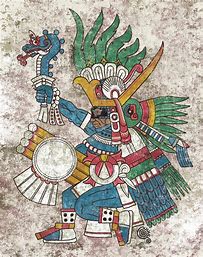
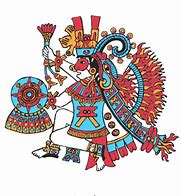
Xiuhtecuhtli’s face is painted with black and red pigment.[16] Xiuhtecuhtli was usually depicted adorned with turquoise mosaic, wearing the turquoise xiuhuitzolli crown of rulership on his head and a turquoise butterfly pectoral on his chest,[27] and he often wears a descending turquoise xiuhtototl bird (Cotinga amabilis) on his forehead and the Xiuhcoatl fire serpent on his back.[28] He owns fire serpent earplugs.[12] On his head he has a paper crown painted with different colors and motifs. On top of the crown there are sprays of green feathers, like flames from a fire.[12] He has feather tufts to each side, like pendants, toward his ears. On his back he has plumage resembling a dragon’s head, made of yellow feathers with marine conch shells.[12] He has copper bells tied to the insteps of his feet. In his left hand he holds a shield with five greenstones, called chalchihuites, placed in the form of a cross on a thin gold plate that covered almost all the shield.[12] In his right hand he has a kind of scepter that was a round gold plate with a hole in the middle, and topped by two globes, one larger than the other, the smaller one had a point.[12] Xiuhtecuhtli is closely associated with youthful warriors and with rulership, and was considered a solar god.[29] His principal symbols are the tecpatl (flint) and the mamalhuatzin, the two sticks that were rubbed together to light ceremonial fires.[30] A staff with a deer’s head was also an attribute of Xiuhtecuhtli, although not exclusively so as it could also be associated with Xochiquetzal and other deities.[31]

Many of the attributes of Xiuhtecuhtli are found associated with Early Postclassic Toltec warriors but clear representations of the god are not common until the Late Postclassic.[28] The nahual, or spirit form, of Xiuhtecuhtli is Xiuhcoatl, the Fire Serpent.[32]

Xiuhtecuhtli was embodied in the teotecuilli, the sacrificial brazier into which sacrificial victims were cast during the New Fire ceremony.[32] This took place at the end of each cycle of the Aztec calendar round (every 52 years),[33] when the gods were thought to be able to end their covenant with humanity. Feasts were held in honor of Xiuhtecuhtli to keep his favors, and human sacrifices were burned after removing their heart.

Annual festival[edit]

The annual festival of Xiuhtecuhtli was celebrated in Izcalli, the 18th veintena of the year.[34] The Nahuatl word izcalli means “stone house” and refers to the building where maize used to be dried and roasted between mid-January and mid-February. The whole month was therefore devoted to fire.[14] The Izcalli rituals grew in importance every four years.[35] A framework image of the deity was constructed from wood and was richly finished with clothing, feathers and an elaborate mask.[34] Quails were sacrificed to the idol and their blood spilt before it and copal was burnt in his honour.[36] On the day of the festival, the priests of Xiuhtecuhtli spent the day dancing and singing before their god.[37] People caught animals, including mammals, birds, snakes, lizards and fish, for ten days before the festival in order to throw them into the hearth on the night of the festival.[38] On the tenth day of Izcalli, during a festival called huauhquiltamalcualiztli (“eating of the amaranth leaf tamales”), the New Fire was lighted, signifying the change of the annual cycle and the rebirth of the fire deity.[39] During the night the image of the god was lit with using the mamalhuatzin.[40] Food was consumed ritually, including shrimp tamales, after first offering it to the god.[38]

Every four years a more solemn version of the festival was held at the temple of Xiuhtecuhtli in Tenochtitlan, attended by the emperor and his nobles.[42] Slaves and captives were dressed as the deity and sacrificed in his honour.[43] Godparents were assigned to children on this day and the children had their ears ritually pierced. After this, the children, their parents and godparents all shared a meal together.[42]

New Fire Ceremony[edit]

Xiuhtecuhtli was celebrated often but especially at the end of every 52-year period. This was the time the 365-day solar and the 260-day sacred calendars ended on the same day and the Aztec celebrated the Binding of the Years with the New Fire Ceremony.[17] In order to perform the ritual, priests marched in solemn procession up the Hill of the Star on a peninsula near Culhuacán to wait for the star Yohualtecuhtli (either Aldebaran in the Taurus constellation or the Pleiades as a whole) to get past its zenith. Having ascertained this, they would tear out the heart of a sacrificial victim and kindle a flame in a small wooden hearth they placed inside the hole left in his chest. Priests used a drill method to generate this sacred flame. It was then carried on pine sticks to light the fires anew in every hearth, including the sacred braziers of perpetual fire, that numbered over 600 in the capital alone.[44]

Gods – Cernunnos

Cernunnos – Wild God of the Forest from learnreligions.com

Cernunnos is a horned god found in Celtic mythology. He is connected with male animals, particularly the stag in rut, and this has led him to be associated with fertility and vegetation. Depictions of Cernunnos are found in many parts of the British Isles and western Europe. He is often portrayed with a beard and wild, shaggy hair–he is, after all, the lord of the forest.

With his mighty antlers, Cernunnos is a protector of the forest and master of the hunt. He is a god of vegetation and trees in his aspect as the Green Man, and a god of lust and fertility when connected with Pan, the Greek satyr. In some traditions, he is seen as a god of death and dying, and takes the time to comfort the dead by singing to them on their way to the spirit world.

History and Worship of Cernunnos

In Margaret Murray’s 1931 book, God of the Witches, she posits that Herne the Hunter is a manifestation of Cernunnos. Because he is found only in Berkshire, and not in the rest of the Windsor Forest area, Herne is considered a “localized” god and could indeed be the Berkshire interpretation of Cernunnos. During the Elizabethan age, Cernunnos appears as Herne in Shakespeare’s Merry Wives of Windsor. He also embodies fealty to the realm, and guardianship of royalty.

In some traditions of Wicca, the cycle of seasons follows the relationship between the Horned God–Cernunnos–and the Goddess. During the fall, the Horned God dies, as the vegetation and land go dormant, and in the spring, at Imbolc, he is resurrected to impregnate the fertile goddess of the land. However, this relationship is a relatively new Neopagan concept, and there is no scholarly evidence to indicate that ancient peoples might have celebrated this “marriage” of the Horned God and a mother goddess.

Because of his horns (and the occasional depiction of a large, erect phallus), Cernunnos has often been misinterpreted by fundamentalists as a symbol of Satan. Certainly, at times, the Christian church has pointed to the Pagan following of Cernunnos as “devil worship.” This is in part due to nineteenth-century paintings of Satan which included large, ram-like horns much like those of Cernunnos.

Today, many Pagan traditions honor Cernunnos as an aspect of the God, the embodiment of masculine energy and fertility and power.

A Prayer to Cernunnos

God of the green,
Lord of the forest,
I offer you my sacrifice.
I ask you for your blessing.

You are the man in the trees,
the green man of the woods,
who brings life to the dawning spring.
You are the deer in rut,
mighty Horned One,
who roams the autumn woods,
the hunter circling round the oak,
the antlers of the wild stag,
and the lifeblood that spills upon
the ground each season.

God of the green,
Lord of the forest,
I offer you my sacrifice.
I ask you for your blessing.

Honoring Cernunnos in Ritual

If your tradition calls for you to honor Cernunnos in ritual–especially around the season of the Beltane sabbat–be sure to read John Beckett’s article at Patheos, The Cernunnos Ritual. Beckett says,

“His presence, which had been mild but undeniable since we started setting up (what, you think a Forest God is going to sit quietly outside the door till he gets a proper invitation?) became overwhelming. Someone shouted. Someone got up and began to dance. Then another got up, and another, and another. Before long we had a whole line of people dancing, spinning, and chanting around the altar.
Cernunnos! Cernunnos! Cernunnos!”

Juniper, at Walking the Hedge, has an absolutely lovely and moving ritual worth reading about called A Devotional Ritual to Cernunnos. She says,

“I call to Him with feeling, with love with desire. I call until I feel His presence, I do not assume a few words of poetry will be enough and carry on. I call until the hair on the back of my neck stands up and goosebumps run down my arms. I call until I can smell His scent on the air… When Cernunnos has arrived I thank Him with gifts, by showing Him what offerings I have brought for Him and placing it at the foot of the god-stang.”

Other ways you can honor Cernunnos in a ritual setting include making offerings to him, particularly if you have a forest or wooded area nearby. Take some wine, milk, or consecrated water in a chalice and pour it upon the ground while calling to him. You can also decorate your altar with his symbols, such as leaves, shed antlers, moss, and fresh clean soil. If you’ve trying to conceive, and you’ve got a significant other who’s open to the practice of ritual sex magic, consider a bit of outdoor passion some evening, and call upon Cernunnos to bless your union.

The Study of Pagan Gods and Goddesses: Vidar c. 2018

Vidar

Vidar (Old Norse Víðarr), his name might mean “Wide Ruler” he is the son of the all-father Odin and the giantess Gríðr. Yes, you read that correctly, some of the Æsir have previously been together with the Jotuns, also known as giants. Some of the giants were so beautiful that even the Gods could not resist their beauty.

Vidar is the second strongest of the Æsir only Thor is stronger than him, Vidar might have inherited some of his strength from the giant side of the family. Vidar lives in Asgard in a great hall called Vidi, it’s a peaceful home and the inside looks like a garden.

Vidar is known for being very silent he loves being at peace with nature. Vidar sometimes sits for hours in his garden working on a special shoe.
This special shoe is the strongest of all the shoes and is being made from all bits and pieces of leather that shoemakers throw in the trash when making new shoes in Midgard. Vidar will use this special shoe to revenge his father’s death Odin at Ragnarok (Ragnarök).

This is when Vidar will fight the fearsome Fenris wolf, by placing one foot on Fenris’s lower jaw and pressing his hands on the upper jaw until Fenris’s mouth will be pulled apart. Ragnarok is the doom of the Gods and the end of the world. But from death, there also comes life, and Vidar is one of the few Gods who will survive Ragnarok and rebuilt the new world

—————————————

Hymn to Vidarr

Vidar1Hail to the Silent God
Who sees much and speaks little,
Who waits patiently for the moment
Of injustice that needs to be equalized.
Hail to the God called upon
When cruelty has gone so far
That there is no making things right,
Hail to the God of cold vengeance
Who does what is necessary
To even up the debt,
To bring Fate’s balance true
Quicker than entropy would allow.
Hail to the God of the Thick-Soled Shoe
Whose steps are silent
So that he might approach from behind.
Hail to you, son of Grid the Wise
And Odin the Powerful,
May I know to call upon you
Only as a last resort.

— Seawalker, Author

————————————————–

Vidar

It is said that Odin had an affair with the warrior goddess Grid, and that she bore him a son named Vidarr, who took after his father and became one of the honored Aesir Gods. He is one of the two Gods of Vengeance – the other being his half-brother Váli, as it seems that in ancient Norse culture one deity of vengeance was not enough.

Vidarr’s name may originally have meant “widely ruling”. He is known as “the Silent God”, meaning that he does not flaunt his vengeance; Vidarr is said to speak little, but be a fierce warrior when the moment is needed. It is also said that he is almost as strong as Thor, and that the Gods depend upon him in times of trouble. Some scholars theorize that his “silent God” appellation may have something to do with ancient rituals of vengeance; it may be that individuals who were preparing for a vengeance battle refrained from speaking as part of a ritual purification.

He is also known as the God of the Thick Shoe, as he is constantly in the process of building up the soles of his shoes. This is done so that if Ragnarok comes and he faces Fenrir, he will be able to put his foot on Fenrir’s enormous jaws and strike his heart through his throat. Traditionally, shoemakers (and before that, people who made their own shoes) were encouraged to dedicate the little scraps of leather they trimmed off of their new shoe soles to Vidarr, who would collect them and add them slowly to his own soles.

In the saga Grímnismál, Odin describes the halls of many Gods, including that of his son Vidarr:

Brushwood grows and high grass
widely in Vidar’s land
and there the son proclaims on his horse’s back
that he’s keen to avenge his father.

This latter point is a harbinger of the prophecy that if Ragnarok comes, Fenrir will be loosed and will slay Odin, but he will be slain in turn by Vidarr. Both brothers are said to survive Ragnarok and help to rebuild a new world after Surt’s fires have burnt down. To make an offering to Vidarr, give him a weapon – throw it into icy water, or a bog, or bury it in ice.


Reference

Norse Mythology

Odin’s Family Tribe of Asgard

God of the Day – Odin

Odin Facts and Mythology from gods-and-goddesses.com

Odin is the Norse king of the Aesir, the principal race of Norse gods. He was considered the father of all the gods and was primarily associated with magic, wisdom, war, poetry, and the runic alphabet.

Mentioned frequently from the period of the Roman occupation to the Viking Age, Odin is a prominent figure in Norse mythology who continues to be acknowledged in modern popular culture. For instance, we are reminded of him every Wednesday, the weekday that was named after him; Odin is Woden in Old English, and Woden’s day became Wednesday.

Appearance

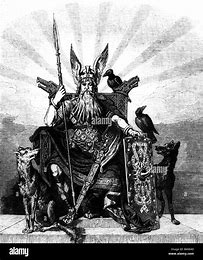
In most Norse texts, Odin is depicted as a long-bearded, one-eyed man wearing a broad hat and a cloak. Odin lost his eye upon visiting a Norse god named Mimir. Mimir was known as an extremely wise god, and he had also possessed a well called Mímisbrunnr. The waters in the well contained substantial wisdom and knowledge, and if someone drank from the well they would also gain wisdom.

However, Mimir required the drinker to sacrifice one of their eyes in order to take a drink. Odin decided to make the trade. Because of this trade, he is traditionally shown as having a dark eye or with a patch over one of his eyes.

Family

Odin had two brothers, named Vili and Ve. Myth has it that Odin created the universe after killing the primal frost giant Ymir with the help of his brothers. The three continued by making the first man and woman, Askr and Embla, from an ash tree and an elm tree.

Odin married Frigg, who is the mother of his sons Baldur, Hod, and Hermod.  With Jord, the earth goddess, he fathered Thor. He is believed to have had more sons by other wives, including Vidar from the giantess Grid.

Symbols

The most common symbol associated with Odin is the Valknut symbol, which is made of three linked or interlocked triangles. This symbol appears in a number of places along with Odin or ravens, including the Tängelgårda stone in Sweden.

There are a number of interpretations about the meaning of the Valknut. Some believe it represented slain warriors, many of which went to stay with Odin in Valhalla. In fact, the word Valknut is derived from the words valr, which means slain warriors, and knut, which means knot. Others think that it may symbolize the heart of Hrungnir.

Another common symbol affiliated with Odin is his spear, called Gungnir, which he acquired from the trickster god Loki after he stole it from the dwarfs who made it.

The ravens Hugin (thought) and Munin (memory) were Odin’s companions. They traveled across the Nine Worlds in Norse cosmology and returned to their master’s shoulder with tales of what they saw.

Odin also had two pet wolves called Geri and Freki. He is said to have created them when he became lonely. Like ravens, they haunt battlefields and feast upon the dead. Odin, who only drinks wine, gave them all his food.

Powers & Duties

In Valhalla, Odin sat on his throne called Hlidskjalf from where he watched over the Nine Realms.

Odin sought further knowledge in the runes, the letters of the runic alphabet. To achieve this, he hung from a tree with a spear in his side for nine days and nights without food or drink. He often used runes to practice wizardry.

Together with Freya, the goddess of love and war, Odin possessed the souls of slain warriors. The half that belonged to him found a final resting place in Valhalla, his palatial home with 640 doors. They were brought here by Odin’s daughters, the Valkyries, who met them on the battlefield.

Odin had a never-ending quest for wisdom. Sometime after he sacrificed his eye, he also took possession of Mimir’s head when Mimir was decapitated by the Vanir, a rival tribe. The head would tell him secrets and give him advice.

Facts About Odin …

God of the Day – Osiris

Osiris

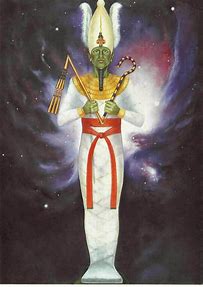
Osiris the god of the afterlife, the underworld, and rebirth in ancient Egyptian religion. He was classically depicted as a green-skinned deity with a pharaoh’s beard, partially mummy-wrapped at the legs, wearing a distinctive atef crown, and holding a symbolic crook and flail. (He was one of the first to be associated with the mummy wrap. When the brother cut him up into pieces after killing him Isis, his wife, found all the pieces and wrapped his body up.) Osiris was at times considered the eldest son of the god Geb and the sky goddess Nut, as well as being brother and husband of Isis, with Horus being considered his posthumously begotten son. He was also associated with the epithet Khenti-Amentiu, meaning “Foremost of the Westerners”, a reference to his kingship in the land of the dead. As ruler of the dead, Osiris was also sometimes called “king of the living”: ancient Egyptians considered the blessed dead “the living ones”. Through syncretism with Iah, he is also the god of the Moon.

Osiris was considered the brother of Isis, Set, Nephthys, and Horus the Elder, and father of Horus the Younger. The first evidence of the worship of Osiris was found in the middle of the Fifth dynasty of Egypt, although it is likely that he was worshiped much earlier; the Khenti-Amentiu epithet dates to at least the first dynasty, and was also used as a pharaonic title. Most information available on the myths of Osiris is derived from allusions contained in the Pyramid Texts at the end of the Fifth Dynasty, later New Kingdom source documents such as the Shabaka Stone and the Contending of Horus and Seth, and much later, in narrative style from the writings of Greek authors including Plutarch and Diodorus Siculus.

Osiris was the judge of the dead and the underworld agency that granted all life, including sprouting vegetation and the fertile flooding of the Nile River. He was described as “He Who is Permanently Benign and Youthful” and the “Lord of Silence”. The Kings of Egypt were associated with Osiris in death – as Osiris rose from the dead so would they in union with him, and inherit eternal life through a process of imitative magic. By the New Kingdom all people, not just pharaohs, were believed to be associated with Osiris at death, if they incurred the costs of the assimilation rituals.

Through the hope of new life after death, Osiris began to be associated with the cycles observed in nature, in particular vegetation and the annual flooding of the Nile, through his links with the heliacal rising of Orion and Sirius at the start of the new year. Osiris was widely worshipped until the decline of ancient Egyptian religion during the rise of Christianity in the Roman Empire.

Etymology of the name

Osiris is a Latin transliteration of the Ancient Greek Ὄσιρις IPA: [ó.siː.ris], which in turn is the Greek adaptation of the original name in the Egyptian language. In Egyptian hieroglyphs the name appears as wsjr, which some Egyptologists instead choose to transliterate ꜣsjr or jsjrj. Since hieroglyphic writing lacks vowels, Egyptologists have vocalized the name in various ways as Asar, Yasar, Aser, Asaru, Ausar, Ausir, Wesir, Usir, Usire or Ausare.

Several proposals have been made for the etymology and meaning of the original name; as Egyptologist Mark J. Smith notes, none are fully convincing. Most take wsjr as the accepted transliteration, following Adolf Erman:

  • John Gwyn Griffiths (1980), “bearing in mind Erman’s emphasis on the fact that the name must begin with an [sic] w“, proposes a derivation from wsr with an original meaning of “The Mighty One”. Moreover, one of the oldest attestations of the god Osiris appears in the mastaba of the deceased Netjer-wser (from nṯr-wsr “Powerful God”).[citation needed]
  • Kurt Sethe (1930) proposes a compound st-jrt, meaning “seat of the eye”, in a hypothetical earlier form *wst-jrt; this is rejected by Griffiths on phonetic grounds.
  • David Lorton (1985) takes up this same compound but explains st-jrt as signifying “product, something made”, Osiris representing the product of the ritual mummification process.
  • Wolfhart Westendorf (1987) proposes an etymology from wꜣst-jrt “she who bears the eye”.
  • Mark J. Smith (2017) makes no definitive proposals but asserts that the second element must be a form of jrj (“to do, make”) (rather than jrt (“eye”)).

However, recently alternative transliterations have been proposed:

  • Yoshi Muchiki (1990) reexamines Erman’s evidence that the throne hieroglyph in the word is to be read ws and finds it unconvincing, suggesting instead that the name should be read ꜣsjr on the basis of Aramaic, Phoenician, and Old South Arabian transcriptions, readings of the throne sign in other words, and comparison with ꜣst(“Isis”).
  • James P. Allen (2000) reads the word as jsjrt but revises the reading (2013) to jsjrj and derives it from js-jrj, meaning “engendering (male) principle”.

Appearance

Osiris is represented in his most developed form of iconography wearing the Atef crown, which is similar to the White crown of Upper Egypt, but with the addition of two curling ostrich feathers at each side (see also Atef crown (hieroglyph)). He also carries the crook and flail. The crook is thought to represent Osiris as a shepherd god. The symbolism of the flail is more uncertain with shepherds whip, fly-whisk, or association with the god Andjety of the ninth nome of Lower Egypt proposed.

He was commonly depicted as a pharaoh with a complexion of either green (the color of rebirth) or black (alluding to the fertility of the Nile floodplain) in mummiform (wearing the trappings of mummification from chest downward).

Early mythology

The Pyramid Texts describe early conceptions of an afterlife in terms of eternal travelling with the sun god amongst the stars. Amongst these mortuary texts, at the beginning of the 4th dynasty, is found: “An offering the king gives and Anubis”. By the end of the 5th dynasty, the formula in all tombs becomes “An offering the king gives and Osiris“.

Father of Horus

Osiris is the mythological father of the god Horus, whose conception is described in the Osiris myth (a central myth in ancient Egyptian belief). The myth describes Osiris as having been killed by his brother, Set, who wanted Osiris’ throne. His wife, Isis finds the body of Osiris and hides it in the reeds where it is found and dismembered by Set. Isis retrieves and joins the fragmented pieces of Osiris, then briefly brings Osiris back to life by use of magic. This spell gives her time to become pregnant by Osiris before he again dies. Isis later gives birth to Horus. As such, since Horus was born after Osiris’ resurrection, Horus became thought of as a representation of new beginnings and the vanquisher of the usurper Set.

Ptah-Seker (who resulted from the identification of Creator god Ptah with Seker) thus gradually became identified with Osiris, the two becoming Ptah-Seker-Osiris. As the sun was thought to spend the night in the underworld, and was subsequently “reborn” every morning, Ptah-Seker-Osiris was identified as king of the underworld, god of the afterlife, life, death, and regeneration.

Ram god

Osiris’ soul, or rather his Ba, was occasionally worshipped in its own right, almost as if it were a distinct god, especially in the Delta city of Mendes. This aspect of Osiris was referred to as Banebdjedet, which is grammatically feminine (also spelt “Banebded” or “Banebdjed“), literally “the ba of the lord of the djed, which roughly means The soul of the lord of the pillar of continuity. The djed, a type of pillar, was usually understood as the backbone of Osiris.

The Nile supplying water, and Osiris (strongly connected to the vegetable regeneration) who died only to be resurrected, represented continuity and stability. As Banebdjed, Osiris was given epithets such as Lord of the Sky and Life of the (sun god) Ra, since Ra, when he had become identified with Atum, was considered Osiris’ ancestor, from whom his regal authority is inherited. Ba does not mean “soul” in the western sense, and has to do with power, reputation, force of character, especially in the case of a god.

Since the ba was associated with power, and also happened to be a word for ram in Egyptian, Banebdjed was depicted as a ram, or as Ram-headed. A living, sacred ram was kept at Mendes and worshipped as the incarnation of the god, and upon death, the rams were mummified and buried in a ram-specific necropolis. Banebdjed was consequently said to be Horus’ father, as Banebdjed was an aspect of Osiris.

Regarding the association of Osiris with the ram, the god’s traditional crook and flail are the instruments of the shepherd, which has suggested to some scholars also an origin for Osiris in herding tribes of the upper Nile. The crook and flail were originally symbols of the minor agricultural deity Andjety, and passed to Osiris later. From Osiris, they eventually passed to Egyptian kings in general as symbols of divine authority.

Mythology

Plutarch recounts one version of the Osiris myth in which Set (Osiris’ brother), along with the Queen of Ethiopia, conspired with 72 accomplices to plot the assassination of Osiris. Set fooled Osiris into getting into a box, which Set then shut, sealed with lead, and threw into the Nile. Osiris’ wife, Isis, searched for his remains until she finally found him embedded in a tamarisk tree trunk, which was holding up the roof of a palace in Byblos on the Phoenician coast. She managed to remove the coffin and retrieve her husband’s body.

In one version of the myth, Isis used a spell to briefly revive Osiris so he could impregnate her. After embalming and burying Osiris, Isis conceived and gave birth to their son, Horus. Thereafter Osiris lived on as the god of the underworld. Because of his death and resurrection, Osiris was associated with the flooding and retreating of the Nile and thus with the yearly growth and death of crops along the Nile valley.

Diodorus Siculus gives another version of the myth in which Osiris was described as an ancient king who taught the Egyptians the arts of civilization, including agriculture, then travelled the world with his sister Isis, the satyrs, and the nine muses, before finally returning to Egypt. Osiris was then murdered by his evil brother Typhon, who was identified with Set. Typhon divided the body into twenty-six pieces, which he distributed amongst his fellow conspirators in order to implicate them in the murder. Isis and Hercules (Horus) avenged the death of Osiris and slew Typhon. Isis recovered all the parts of Osiris’ body, except the phallus, and secretly buried them. She made replicas of them and distributed them to several locations, which then became centres of Osiris worship.

Worship

Annual ceremonies were performed in honor of Osiris in various places across Egypt. These ceremonies were fertility rites which symbolised the resurrection of Osiris. E.A. Wallis Budge stated “Osiris is closely connected with the germination of wheat; the grain which is put into the ground is the dead Osiris, and the grain which has germinated is the Osiris who has once again renewed his life.”

Death or transition and institution as god of the afterlife

Plutarch and others have noted that the sacrifices to Osiris were “gloomy, solemn, and mournful…” (Isis and Osiris, 69) and that the great mystery festival, celebrated in two phases, began at Abydos commemorating the death of the god, on the same day that grain was planted in the ground (Isis and Osiris, 13). The annual festival involved the construction of “Osiris Beds” formed in shape of Osiris, filled with soil and sown with seed.

The germinating seed symbolized Osiris rising from the dead. An almost pristine example was found in the tomb of Tutankhamun by Howard Carter.

The first phase of the festival was a public drama depicting the murder and dismemberment of Osiris, the search of his body by Isis, his triumphal return as the resurrected god, and the battle in which Horus defeated Set.

According to Julius Firmicus Maternus of the fourth century, this play was re-enacted each year by worshippers who “beat their breasts and gashed their shoulders…. When they pretend that the mutilated remains of the god have been found and rejoined…they turn from mourning to rejoicing.” (De Errore Profanorum).

The passion of Osiris was reflected in his name ‘Wenennefer” (“the one who continues to be perfect”), which also alludes to his post mortem power.

Ikhernofret Stela

Much of the extant information about the rites of Osiris can be found on the Ikhernofret Stela at Abydos erected in the 12th Dynasty by Ikhernofret (also I-Kher-Nefert), possibly a priest of Osiris or other official (the titles of Ikhernofret are described in his stela from Abydos) during the reign of Senwosret III (Pharaoh Sesostris, about 1875 BC). The ritual reenactment of Osiris’s funeral rites were held in the last month of the inundation (the annual Nile flood), coinciding with Spring, and held at Abydos/Abedjou which was the traditional place where the body of Osiris/Wesir drifted ashore after having been drowned in the Nile.

The part of the myth recounting the chopping up of the body into 14 pieces by Set is not recounted in this particular stela. Although it is attested to be a part of the rituals by a version of the Papyrus Jumilhac, in which it took Isis 12 days to reassemble the pieces, coinciding with the festival of ploughing. Some elements of the ceremony were held in the temple, while others involved public participation in a form of theatre. The Stela of I-Kher-Nefert recounts the programme of events of the public elements over the five days of the Festival:

  • The First Day, The Procession of Wepwawet: A mock battle was enacted during which the enemies of Osiris are defeated. A procession was led by the god Wepwawet (“opener of the way”).
  • The Second Day, The Great Procession of Osiris: The body of Osiris was taken from his temple to his tomb. The boat he was transported in, the “Neshmet” bark, had to be defended against his enemies.
  • The Third Day: Osiris is Mourned and the Enemies of the Land are Destroyed.
  • The Fourth Day, Night Vigil: Prayers and recitations are made and funeral rites performed.
  • The Fifth Day, Osiris is Reborn: Osiris is reborn at dawn and crowned with the crown of Ma’at. A statue of Osiris is brought to the temple.

Wheat and clay rituals

Contrasting with the public “theatrical” ceremonies sourced from the I-Kher-Nefert stele (from the Middle Kingdom), more esoteric ceremonies were performed inside the temples by priests witnessed only by chosen initiates. Plutarch mentions that (for much later period) two days after the beginning of the festival “the priests bring forth a sacred chest containing a small golden coffer, into which they pour some potable water…and a great shout arises from the company for joy that Osiris is found (or resurrected). Then they knead some fertile soil with the water…and fashion therefrom a crescent-shaped figure, which they cloth and adorn, this indicating that they regard these gods as the substance of Earth and Water.” (Isis and Osiris, 39). Yet his accounts were still obscure, for he also wrote, “I pass over the cutting of the wood” – opting not to describe it, since he considered it as a most sacred ritual (Ibid. 21).

In the Osirian temple at Denderah, an inscription (translated by Budge, Chapter XV, Osiris and the Egyptian Resurrection) describes in detail the making of wheat paste models of each dismembered piece of Osiris to be sent out to the town where each piece is discovered by Isis. At the temple of Mendes, figures of Osiris were made from wheat and paste placed in a trough on the day of the murder, then water was added for several days, until finally the mixture was kneaded into a mold of Osiris and taken to the temple to be buried (the sacred grain for these cakes were grown only in the temple fields). Molds were made from the wood of a red tree in the forms of the sixteen dismembered parts of Osiris, the cakes of ‘divine’ bread were made from each mold, placed in a silver chest and set near the head of the god with the inward parts of Osiris as described in the Book of the Dead (XVII).

Judgment

The idea of divine justice being exercised after death for wrongdoing during life is first encountered during the Old Kingdom in a 6th dynasty tomb containing fragments of what would be described later as the Negative Confessions performed in front of the 42 Assessors of Ma’at.

With the rise of the cult of Osiris during the Middle Kingdom the “democratization of religion” offered to even his humblest followers the prospect of eternal life, with moral fitness becoming the dominant factor in determining a person’s suitability.

At death a person faced judgment by a tribunal of forty-two divine judges. If they led a life in conformance with the precepts of the goddess Ma’at, who represented truth and right living, the person was welcomed into the kingdom of Osiris. If found guilty, the person was thrown to a “devourer” (such as the soul-eating demon Ammit) and did not share in eternal life.

The person who is taken by the devourer is subject first to terrifying punishment and then annihilated. These depictions of punishment may have influenced medieval perceptions of the inferno in hell via early Christian and Coptic texts.

Purification for those who are considered justified may be found in the descriptions of “Flame Island“, where they experience the triumph over evil and rebirth. For the damned, complete destruction into a state of non-being awaits, but there is no suggestion of eternal torture.

Divine pardon at judgement was always a central concern for the ancient Egyptians.

During the reign of Seti I, Osiris was also invoked in royal decrees to pursue the living when wrongdoing was observed, but kept secret and not reported.

Greco-Roman era

Hellenization

The early Ptolemaic kings promoted a new god, Serapis, who combined traits of Osiris with those of various Greek gods and was portrayed in a Hellenistic form. Serapis was often treated as the consort of Isis and became the patron deity of the Ptolemies’ capital, Alexandria. Serapis’s origins are not known. Some ancient authors claim the cult of Serapis was established at Alexandria by Alexander the Great himself, but most who discuss the subject of Serapis’s origins give a story similar to that by Plutarch. Writing about 400 years after the fact, Plutarch claimed that Ptolemy I established the cult after dreaming of a colossal statue at Sinope in Anatolia. His councillors identified as a statue of the Greek god Pluto and said that the Egyptian name for Pluto was Serapis. This name may have been a Hellenization of “Osiris-Apis”. Osiris-Apis was a patron deity of the Memphite Necropolis and the father of the Apis bull who was worshipped there, and texts from Ptolemaic times treat “Serapis” as the Greek translation of “Osiris-Apis”. But little of the early evidence for Serapis’s cult comes from Memphis, and much of it comes from the Mediterranean world with no reference to an Egyptian origin for Serapis, so Mark Smith expresses doubt that Serapis originated as a Greek form of Osiris-Apis’s name and leaves open the possibility that Serapis originated outside Egypt.

Destruction of cult

The cult of Isis and Osiris continued at Philae until at least the 450s CE, long after the imperial decrees of the late 4th century that ordered the closing of temples to “pagan” gods. Philae was the last major ancient Egyptian temple to be closed.


Source

Wikipedia

c. 2018

The Gods of Asgard c. 2018

A New Daily Post – God of the Day – Ra


Ra – Sun God
The ancient Egyptians revered Ra as the god who created everything. Also known as the Sun God, Ra was a powerful deity and a central god of the Egyptian pantheon. The ancient Egyptians worshiped Ra more than any other god and pharaohs often connected themselves with Ra in their efforts to be seen as the earthly embodiment of the Sun God.
Who is Ra?
Ra (pronounced ray) represents sunlight, warmth and growth. It was only natural that the ancient Egyptians would believe him to be the creator of the world, as well as part of him being represented in every other god. The ancient Egyptians believed that every god should illustrate some aspect of him, while Ra himself should also represent every god.
Ra’s Appearance
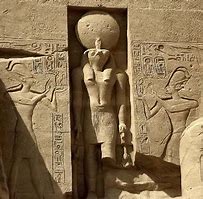
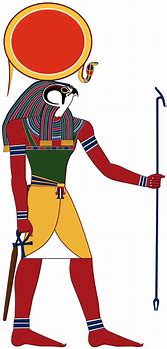
Ra was usually depicted in human form. He had a falcon head which is crowned with a sun disc. This sun disc was encircled by a sacred cobra named Uraeus. Ra has also been depicted as a man with the head of a beetle and also a human man with the head of a ram. The ancients also depicted Ra in full species form such as a serpent, heron, bull, lion, cat, ram, hawk, beetle, phoenix and others. His main symbol, however, is the sun disk.
Ra Mythology
The ancient Egyptians believed that as the sun god, Ra’s role was to sail across the heavens during the day in his boat called the “Barque of Millions of Years.” In the morning when Ra emerged from the east, his boat was named, “Madjet” which meant “becoming strong.” By the end of the day the boat was called, “Semektet” which meant “becoming weak.” At the end of the day, it was believed that Ra died (swallowed by Nut) and sailed on to the underworld, leaving the moon in his place to light up the world. Ra was reborn at dawn the very next day. During his journey across the heavens during the day, he fought with his main enemy, an evil serpent named Apep, or also, The Lord of Chaos. In some stories, Ra, in the form of a cat named Mau, defeats the evil serpent, Apep. This is part of the reason why cats are so highly-revered in Egypt.
Ra created himself from the primordial chaos. He is also known as Re and Atum. His children are Shu, the God of Dry Air and Father of the Sky, and his twin sister Tefnut, the Goddess of Moisture and Wetness. As a lion-headed goddess, Tefnut is responsible for dew and freshness. Humans were created from Ra’s tears.
Although Ra was highly revered and devoutly worshiped by the ancient Egyptians, there is a story to suggest he eventually grew weak. In the Legend of Ra, Isis and the Snake, as Ra grew old, he dribbled saliva. Isis knew that Ra’s power was hidden in his secret name. Isis gathered Ra’s saliva and created a snake out of it. She set the snake in Ra’s path and it bit him. Isis wanted the power Ra had always enjoyed, but she knew she had to get him to tell her his secret name. Eventually, because of the pain he was in, Ra allowed Isis to “search through him” and in so doing, she healed him and Ra’s power was transferred over to her.
The Tree of Life is an important religious symbol to the Egyptians. The Tree of Life was located within Ra’s sun temple in Heliopolis and was considered sacred. The fruit that sprang from this tree was not available to humans, but only in aging-rituals reserved for pharaohs. The Tree of Life is also referred to as the mythical, sacred Ished tree. Eternal life came to those who ate the fruit from the Tree of Life.
Another important ancient Egyptian symbol connected to Ra is the “Bennu”. Bennu is the name of the bird that represented Ra’s soul. This bird is a phoenix and it was seated at the Tree of Life in Ra’s Sun Temple in Heliopolis. Inside the temple, on top of an obelisk, sat the Benben Stone. This pyramid-shaped stone served as a beacon to Bennu and is also an important ancient Egyptian religious symbol.
Worship of the Sun God
Solar temples were built for Ra but did not contain a statue of the god. Instead, they were created to be open to the sunlight that Ra represented. The earliest known temple built in honor of Ra exists in Heliopolis (what is now a Cairo suburb). This solar temple is known as “Benu-Phoenix” and is believed to have been erected in the exact spot where Ra emerged into creation.
Although Ra dates back to the second dynasty, he is not the oldest of the Egyptian gods. It wasn’t until the fifth dynasty that Ra became closely associated with the pharaoh. As the king and leader of Egypt, the pharaoh was seen as the human manifestation of Horus, so the two gods became connected. This new deity fusion was then referred to as “Ra-Horakhty” meaning Ra is Horus of the Horizon. Ra’s relationship with other gods did not stop there. As the powerful creator of mankind and the sun god, he also became associated with Atum to make “Atum-Ra.”
Fifth Dynasty and subsequent pharaohs were all known as “The son of Ra” and Ra became incorporated into every pharaoh’s name from then onward. During the Middle Kingdom, the new deity, Amun-Ra was formed. Amun was one of the gods who formed the Ogdoad (the assembly of eight gods who represented eight elements of creation).
The New Kingdom brought new heights of worship to Ra. Many tombs in the Valley of the Kings portray depictions of Ra and his journey through the underworld. During this time, many solar temples were built.
Eye of Ra
Present in the ancient Egyptian mythology is the Eye of Ra, shown as the sun disk with two ‘uraeus’ cobras coiled around it, next to the white and red crowns of Upper and Lower Egypt. Initially associated with Horus (similarly to the wadjet, the Eye of Horus), the Eye of Ra shifted positions in the myths, becoming both an extension of Ra’s power and a separate entity altogether.
Click here to learn more about The Eye of Ra
Ra God Facts
The ancient Egyptians worshiped Ra to such an extent above other gods that some historians have argued that ancient Egyptian religion was indeed a monotheistic one with Ra as the singular god.
Historians believe that the pyramids might represent rays of sunlight, further connecting the pharaohs with Ra, the sun god.
During Ra’s journey through the heavens he was accompanied by several other gods including Thoth, Horus, Hathor, Maat, Abtu, and Anet.
Nut, goddess of the sky and heavens, is sometimes referred to as Ra’s mother, because he emerges from her and is reborn every morning.
The morning manifestation of Ra is known as “Khepri the scarab God.”
The evening manifestation of Ra is known as the ram-headed god, Khnum.
The sacred cobra that encircled Ra’s crown symbolized royalty, sovereignty and divine authority.
The right eye of Ra represented the Sun; while the left eye of Ra represented the moon.
Ra is also closely associated with the Tree of Life myth, the Ben-Ben Stone and the Bennu Bird myths.
Ra’s glory came to an end during the time when the Roman’s conquered Egypt in 30BC.

Another Look at the Detities of Love anf Lust – Printable

10 “Mythological” Deities Of Love And Lust

While the standards of beauty may have changed throughout the centuries, all humans share an inescapable biological urge to procreate. Feelings of love and lust are therefore extremely important and have influenced even our deities—who, after all, are usually reflections of our own characteristics.

10 Xochiquetzal – Aztec Mythology


With a name meaning “precious feather flower” the Nahuatl language, it’s no surprise that Xochiquetzal was an Aztec goddess of love. Various other aspects of Aztec life, such as flowers, pregnancy, and prostitutes, also fell under her domain, making her one of the more popular deities of the time—a feast in which her devotees dressed up in animal masks was held every eight years. Because of her affinity for marriage, she was often believed to be the wife of the rain god Tlaloc.

Unlike most Aztec fertility goddesses, Xochiquetzal was usually depicted as a beautiful young woman, which caused her problems with some of the more misogynistic gods of their pantheon. While still married to Tlaloc, she was kidnapped by Tezcatlipoca, the god of the night, and forced to marry him, after which she was enthroned as the goddess of love. By another of her husbands she was also the mother of Quetzalcoatl, the feathered serpent god of Aztec mythology.

9 Clíodhna – Irish Mythology


Clíodhna was an Irish goddess sometimes depicted as a banshee or even Queen of the Banshees (or Fairies, depending on the translation). However, she was also the goddess of love, perhaps because she was considered the most beautiful woman in the world. Unlike many other love deities, Clíodhna remained chaste, keeping her love locked away until she met the mortal Ciabahn—who, in a lucky coincidence, just happened to be among the most handsome men ever to have walked the Earth. Clíodhna loved him so much that she left Tir Tairngire, the land of the gods, to be with him.

However, when the other Irish deities found out about this, they conspired to get her back. While Ciabahn was away, Clíodhna was lulled to sleep by the music played by a local minstrel and was subsequently taken by a wave (the tide in the area is still referred to as “Clíodhna’s wave”). Depending on the source, she was either returned to Tir Tairngire or drowned in the sea.

8 Tu Er Shen – Chinese Mythology

A relatively minor deity of Chinese mythology, Tu Er Shen—or Hu Tianbao, as he was known when he was mortal—is the god of homosexual love and marriage. Born during the Qing dynasty, Hu Tianbao found himself attracted to an official of the local government, spying on him naked through a hole in his bathroom wall. When his peeping was discovered, Tianbao was beaten to death. Moved by his unrequited love, the gods of the underworld took pity on him and restored him to life as the deity of homosexual relationships.

Perhaps because they were used as a slang term for homosexual men, rabbits are considered a symbol of homoerotic love in China, and Tu Er Shen is often depicted as a rabbit in the few shrines dedicated to him. Sadly, in many of the places where he is worshiped, homosexual activity remains a punishable criminal offense.

7 Hathor – Egyptian Mythology

One of the most popular, and longest-lasting, of the Egyptian goddesses, Hathor was mentioned as early as the second dynasty (around 2890-2686 BC), and perhaps even before that. Since she survived for so long, Hathor took on a number of roles, including spells as the goddess of love, beauty, mining, and music. However, it was her time as the Eye of Ra which led to her most interesting stories. The Eye of Ra is the term Egyptians used for the feminine counterpart to Ra, a role filled by a number of goddesses, including Ra’s daughter, Hathor.

Found in King Tut’s tomb, a story known as “The Destruction of Mankind” tells of a time when Hathor, at Ra’s insistence, became the war goddess Sekhmet in order to punish humans for their sinful ways. When the bloodthirsty goddess got out of control, Ra tried to stop his daughter—but failed. Just before she killed every last person on Earth, Ra managed to get her drunk. Hathor immediately forgot what she was doing and returned to normal. In another, possibly equally disturbing story, she performed a striptease for her father in order to cheer him up.

6 Eros – Greek Mythology

The Greek version of Cupid, Eros was Aphrodite’s son and the god of desire and attraction (although, he was sometimes depicted as one of the Protogenoi, or primeval gods). Much like his Roman counterpart, he often took the form of a young winged boy, complete with bow and arrow. He was fiercely loyal to his mother—although he was prone to fits of disobedience. That rebellious aspect of the god showed up prominently in his most famous myth.

A young woman named Psyche was born and proclaimed to be so beautiful as to be the second coming of Aphrodite. As was her nature, the goddess was angered and sent Eros to shoot her with her arrow and cause her to fall in love with the ugliest man on Earth as punishment. However, her beauty was so great that Eros fell in love and ignored his mother’s wishes, whisking Psyche away. Eros never revealed his identity but Psyche’s curiosity got the better of her and she peeked in on him when he was sleeping. Betrayed by his love, the god fled and Psyche wandered the Earth until Zeus agreed to let them get married.

5 Rati- Hinduism

More popularly known as the wife of Kama, the god of love, Rati herself plays a large role in love and lust in Hinduism. With a number of names, most of which speak to her immense beauty, it seems obvious Rati would be the goddess of desire. Depending on the source, she is the daughter of either Daksha or Brahma. In the case of the latter, she was the reason for the god’s suicide, after he lusted after her. Rati immediately killed herself as well (they were both quickly resurrected).

But Rati’s biggest claim to fame was successfully changing Shiva’s mind. The Destroyer, sworn to ascetic ways after his first wife’s death, had been forced to fall in love again. In revenge, he killed Kama, turning him to ash with his third eye. The best known version of the story has Rati persuade Shiva to revive her husband, with the caveat that Kama is to be invisible for eternity.

4 Oshun – Yoruba

The goddess of beauty and love, especially of the erotic kind, Oshun is extremely popular among the West African followers of the Yoruba religion. Renowned for her beauty, she is usually depicted as a woman adorned with jewelry, although she is sometimes shown as a mermaid. Oshun is also preeminent among the female deities of the Yoruba religion and demands the respect that title deserves. When the gods were first creating the Earth, and they neglected to ask Oshun to assist, she made it impossible for them to make anything until they came to her for help.

Due to her reputation for complete purity, Oshun is also often associated with fresh water, an extremely important resource for the people of Western Africa. In addition, she also protects women and children during childbirth and is also seen as a protector from diseases, especially smallpox.

3 Hymen- Greek Mythology

The god of married love, Hymen was a lesser-known god of the Greek pantheon. Either the son of Apollo and a Muse or Dionysus and Aphrodite, he led a charmed life thanks to his beauty, until he fell in love with a unnamed maiden, who didn’t feel the same way. While Hymen was trying to court her, she was kidnapped by pirates, along with a number of other young women (some versions of the myth even have Hymen taken by the pirates because his beauty made them mistake him for a woman).

Whatever the reason, Hymen found himself on the ship and killed the pirates, saving the girls, and convincing his love to marry him. Their marriage was so successful that it became the ideal to which every Greek couple aspired—his name was included in the wedding songs in order to invoke his blessing.

2 Yue Lao – Chinese Mythology

Yue Lao, otherwise known as “The Man under the Moon,” is a popular figure in Chinese mythology, as he is the matchmaker and overseer of heterosexual marriage. Widely connected with the red thread of destiny, Yue Lao is often seen as benevolent deity, binding two people’s hearts together in love and marriage.

The best known story involving Yue Lao is that of Wei Gu and his quest to find a wife. After years of unsuccessful attempts, Wei Gu came upon Yue Lao reading from the book of marriages. Insisting he know who his future wife was, Wei Gu was shown a vision of an old woman with a young child, living in poverty. Distraught that the old woman was to be his wife, Wei Gu ordered his servant to kill the young child, though she escaped serious injury. After years passed, he finally found a suitable wife and noticed she had a scar. When Wei Gu asked about it, he was astonished to find that she had been the young child he tried to have killed (although he probably never told her; some secrets are best kept hidden).

1 Freyja – Norse Mythology

Freyja, which translates as “lady,” had a number of roles in the Norse belief system. As well as the goddess of love, she was Queen of Fólkvangr, a place similar to Valhalla, where half of those who died in battle would go after death. However, unlike most of the other deities on this list, Freyja had a vicious bad side, full of greed, jealousy, and evil deeds. Among other things, she’s credited with teaching witchcraft to humans, a practice seen as evil by the Norse.

She was often at odds with Loki, who sought to torment the goddess and steal items from her, including her famed necklace Brísingamen, which was later retrieved by Heimdall. In addition, Freyja would constantly scour the Earth for her husband, who would go missing from time to time, crying tears of red gold as she searched. She did have one tremendous advantage over the other deities on this list—her favored mode of transportation was a chariot pulled by cats.

From listverse.com

Celtic Gods and Goddesses: Exploring the Pantheon and Mythology of the Ancient Celts

This article is not a complete list of the Celtic Goddesses and Gods. It seems to be the more popular ones in modern pagan traditions. They will also correspondence to some of the other ancient pantheons in other parts of the ancient world.

To read about the different Gods and Goddesses please click on their hyperlink this comes from historycooperative.org

You’ve always wanted to stroll across the beautiful landscape of Ireland. To make sure that you don’t miss out on the best spots, you decide to make use of a local touring company.

Suddenly one appears before you. How strange that you didn’t notice this building before, but heck, the banner outside claims it’s five-star and that you’ll meet Celtic gods and goddesses in person. They are probably just actors in costume — a little cheesy — but you don’t see any other places that are open at the moment.

To your surprise, you realize that your hiking companions are the actual Celtic gods and goddesses. While you fight off the sudden faint feeling, you remember that the ridiculously steep deposit is only refundable at the end of the trip. There’s no turning back now.

A big guy claps his hand on your shoulder and says, “Fear not, tiny mortal. You’re going to have a fun time learning all about the ancient Celtic pantheon and the people who worshipped us.”

You just want your deposit back. So when the group picks up their backpacks and heads out, you follow.

Table of Contents

Dagda – The Good Father God of Ireland, Knowledge, Weather, Wise Druids, and Wariors

Name: The Dagda – the good god
Realms: Father god of Ireland; knowledge, weather, fertility, druids, warriors
Family: Father of Aengus, Brigid, and Danu, member of the Tuatha Dé Dannan
Fun Fact: In Dorsetshire is an enormous drawing of a man. Some believe that the chalk creation is meant to show this deity…

Ériu – The Patron Goddess of Ireland

Name: Ériu
Realms: Patron goddess of Ireland
Family: Daughter of Ernmas and Fiachna Mac Delbáeth; has two sisters called Banba and Fódla; mother of Bres
Fun Fact: Her sisters’ names are sometimes used as poetic titles for Ireland…

Lugh – The God of Crafts, Light, and Sun

(Side Note: This is the God who is honored during a Lammas/Lughnasadh celebration)

Name: Lugh
Realms: God of crafts, light, and Sun
Family: Son of Eithne and Cian; father of Cú Chulainn
Fun Fact: His full name is a little strange — Lugh of the Long Arms…

Epona’s Horses Aren’t Fond of Mortals (Don’t Get Too Close)

(Side Note: Epona is also considered the Goddess of all domestic animals in modern times. I work with her closely when teaching a puppy or an older dog manners to get along better in the human world)

Name: Epona
Realms: Patron goddess of horses, mules, fertility, and cavalry
Family: ???
Fun Fact: In the Gaulish tradition, Epona was never shown in human form; only as a mule or a horse. The Romans showed her as a woman on a throne, standing between horses or driving a chariot…

The Group’s Healer Is Kind of a Reaper

(Side Note: This is the Goddess who is honored during a Imbolc celebration)

Name: Brigid
Realms: Goddess of poetry, fertility, motherhood, passion, dawn, healing, smithing, fire, invention, and life
Family: Married to Bres; mother of Ruadán; daughter of the Dagda
Fun Fact: She inspired a goddess in Haiti, called Maman Brigitte

Danu Knows All About Death and Daffodils

Name: Danu
Realms: A mother goddess; the earth, nature, wind, fertility, death, wisdom, cattle, regeneration, wealth
Family: She was the consort of both the Sun god, Belenos, and the sea god, Beli; daughter of the Dagda, member of the Tuatha De Dannan.
Fun Fact: Danu is another geographical smash hit. Among the places named after this goddess is the River Danube, the Paps of Anu, a region in Ireland’s County Kerry, and possibly the Dane Hills in Leicestershire…

The God of Love Has Daddy Issues (Rightfully So)

Name: Aengus
Realms: God of love and youth
Family: Son of Boann and the Dagda, member of the Tuatha Dé Dannan
Fun Fact: Four birds surround him at all times and, according to mythology, they symbolize his smooches (Yep. His kisses)…

There’s a Confused God Looking for Some Guy Called “Asterix”

Name: Toutatis
Realms: Possibly the guardian god of the Gauls
Family: ???
Fun Fact: Ancient writers suggested that he was the equivalent of the Roman god, Mars…

There’s a Wolf Wearing Bloody Armor

Name: The Morrigan, the Great Queen, the Phantom Queen.
Realms: Goddess of war, fate, death, and destiny
Family: Great-granddaughter of King Nuada, member of the Tuatha Dé Dannan
Fun Fact: In some versions of Celtic mythology, Ireland was named for this Irish goddess…

You Don’t Mess With This Healer — He’ll Knock You Out (Then Put an Ice Pack on It)

Name: Belenus
Realms: God of the Sun, spring festivals, healing, medicine, and guardianship
Family: ???
Fun Fact: According to Roman sources, Belenus was the popular kid in the Celtic mythology during the 3rd century…

This God Adores Wheels and Human Sacrifices

Name: Taranis
Realms: Wheels, thunder, weather, the sky
Family: ???
Fun Fact: Archaeologists have discovered thousands of votive wheels in Gaul. They were popular offerings to Taranis…

Cernunnos Refuses to Show Himself, Because No One Remembers Him

(Side Note: This is the God who is honored during a Beltane celebration)

Name: Cernunnos
Realms: Forests, wildlife, wealth, fertility, and possibly the underworld
Family: ???
Fun Fact: This Celtic god is more of an entity today, in modern Wiccan traditions, than during the past…


Flashback 2004 Lammas

(This is written for the Northern Hemisphere in 2004. The date of August 7th is wrong for 2022 the Southern or Northern Hemisphere)

Lammas

Lammas is the first of the harvest festivals, a celebration of ripening grains and grapes. If you celebrate traditionally on the second, the planetary energies offer a for great creative energy, drama, and joy. If you celebrate on the astrologically on August 7 at 15 degrees of Leo, the Moon will aid a ceremony with great magic and mystery.

The Sun is wanning, but still holding sway in the sky. A day of circle dances and foot races will honor the Sun; be certain the music encourages exuberant joy. If you planted wheat in a pot or plot, this is the day to ritually harvest it. Use some to make a Brigid’s cross; save a few stalks to return to the earth as compost next spring and lend continuity from harvest to sowing to harvest.

If corn is your grain of choice, bring ripe ears to the altar and use the husks to make corn dollies for use at Imbolc. Indian corn can be dried, ground, and used in corn bread. Make a fiery incense with dragon’s blood and hot herbs like ginger or galangal. Do a ritual at a sacred spot — a well or tree or sacred hill. Use the colors of green and gold and orange for your altar, and encourage everyone to wear them. The harvest has just begun.

Copyright By K. D. Spitzer in Llewellyn’s Witches’ Datebook 2004 Page 89

Flashback 2004 Imbolc

 Imbolc

Celebrate this festival by draping the altar in white and silver. Kepp the entire altar white — white candlesticks, white incense bowls, etc. Represent the Goddess with a figure of a horned cow. If you wear robes in ritual, honor Brigid in her guise as the goddess of the dairy by wearing white. With Neptune lending the glamour to your robes to the Sun this time, as glitter to your robes with sliver and “diamonds.” Let your imagination run wild.

Save snow from the last storm, or use crushed ice, and put it out in bowls on the altar. Scrub clean an old milke bottle or cream jar and fill it with fresh milk; freshly made mozzarella cheese will round out your cakes and ale. Nestle all bowls in the snow.

The planetary energies are particularly favorable this sabbat for working magic for world peace. Place all the candles you’ll be using this year on the altar and start this ritual in the dark — this is, without lights. Add your magic to the returning Sun. Dedicate and consecrate all your candles during this festival of lights, and consecrate your agricultural tools for use in the coming cycle of growth. This is the festival of new beginnings.

Copyright By K. D. Spitzer in Llewellyn’s Witches’ Datebook 2004 Page 39

41 Greek Gods and Goddesses: Family Tree and Fun Facts

You’re Invited to Olympus Mall Where the Greek Gods Dwell and Sell

Far away on Mount Olympus lives the… Well, the Olympians — the twelve most important Greek dieties.

In ancient times, the Olympians and the rest of their family were an important part of daily Greek culture. Each god and goddess ruled certain realms and also played their part in mythology; fascinating stories that helped ancient Greeks to grasp the world around them, including the weather, religious beliefs, and their own social system.

That being said, even the Olympian gods must earn a living.

Possessing so many powers and abilities, they all agreed that they would make excellent business owners, and so opened a grand mall and invited all the mortals.

Let’s grab a shopping bag and go explore the Greek god family tree!

Table of Contents

Zeus the Mall Manager

Suspect Infidelity? Hera’s Private Eye Business Can Help

Book a Trip at the Atlas Traveling Agency

Find Variety at Apollo’s Flea Market

The Eros Lounge for Lonely Hearts

There’s Even a Wine-Tasting Event

Stay Away From the Security Booth

Rejuvenate With Sleep Therapy to Continue Your Shopping

There’s a Shuttle Service for Tired Shoppers

Ares Runs the Army Surplus Shop

There’s a Creepy Dude on a Boat

Pan’s Pet and Sacrifice Shop

This Family’s Failing Business Sells Air Fresheners

There’s Free Counseling for Disturbed Mortals

This Hardware Shop Has All the Mist You Need

This Paramedic Will Fix Your Bones After Kratos Jumps You

The Mall Has a Mini-Jail Called Tartarus

The Cinema Shows Back-To-Back 3D Horror Movies

The Helios Car Dealership Sells Golden Bowls

The Ghost Tour Has Real Ghosts

Poseidon Runs the Black Market

Please Claim Your Kids at the Lost and Found Tent

Aphrodite’s Kissing Booth

Learn How to Chop Necks at Athena’s Karate Club

Hyperion’s Laser Tag Arena

You Can Buy Bottled Air From Aether

Alastor’s Restaurant Serves All the Revenge You Can Eat

There’s an Old Guy That Sells Answers (But You Probably Won’t Get Them)

Pick a Tour Package at the Extreme Adventure Club

There’s a God in the Mini-Jail

There’s a Celebrity Signing Photos of Himself

Enjoy Free Muffins at the Bingo Hall

You’ll Win Every Race With Nike’s Sports Equipment

The Hypno-Therapist Makes Your Problems Worse

The Water-Girl Might Knock You Out

Hecate’s Hex & Herb Shop 

The Mall’s Casino Doubles as a Human Resources Office

The Archery Range Is Fun (But Deadly If You Upset Artemis) 

The Art Gallery Is Full of Living Things and Violence

Mania Is Too Mad to Have a Business

Get Your Face Peeled by Persephone

Get Your Napalm at the Fire-Starter’s Shop

Thank You for Shopping at the Mount Olympus Mall!

Click here to more of this article from historycooperative.org

When Isis Was Queen

Ancient Egyptian Goddess Isis and God Osiris

At the ancient Egyptian temples of Philae, Nubians gave new life to a vanishing religious tradition.

Hathor.When the Romans conquered Egypt in 30 B.C., the country’s system of temples, which had sustained religious traditions dating back more than 3,000 years, began to slowly wither away. Starved of the funds that pharaohs traditionally supplied to religious institutions, priests lost their vocation and temples fell into disuse throughout the country. The introduction of Christianity in the first century a.d. only hastened this process. But there was one exception to this trend: In the temples on the island of Philae in the Nile River, rites dedicated to the goddess Isis and the god Osiris continued to be celebrated in high style for some 500 years after the Roman conquest. This final flowering of ancient Egyptian religion was only possible because of the piety and support of Egypt’s neighbors to the south, the Nubians.

Philae lies just south of the Nile’s first cataract—one of six rapids along the river—which marked the historical border between ancient Egypt and Nubia, also known as Kush. In this region of Kush, called Lower Nubia, the temple complex at Philae was just one of many that were built on islands in the Nile and along its banks. Throughout the long history of Egypt and Nubia, Lower Nubia was a kind of buffer zone between these two lands and a place…

Information About Some of the Gods and Goddesses

Sun Gods

Cat Gods

Roman Gods and Goddesses

Water Gods and Gods of the Sea

Japanese Gods and Mythology: The Shinto Religion

10 Gods of Death and the Underworld From Around the World

Celtic Gods and Goddesses: Exploring the Pantheon and Mythology of the Ancient Celt

41 Greek Gods and Goddesses: Family Tree and Fun Facts

Norse Gods and Goddesses Pantheon: The Mythology of the Nordic Viking Deities

Ancient Egyptian Gods and Goddesses Pantheon: The Mythology of the Nubian Deities


From HistoryCooperative.org – To read the rest of the article about Gods and Goddesses