

Category: Articles
Spells and Formulas Record Sheet
You can print this out or save it on your computer. Even after practicing for over 45 years I find this page from Lady Abyss very helpful.
Spells and Formulas Record Sheet
TYPE OF SPELL OR FORMULA: This should state very clearly what the type of spell is e.g. blessing, binding etc. When developing formulas for lotions and potions, for instance, you need to be clear as to the exact purpose.
DATE AND TIME MADE: This gives a cross-reference should you wish to use the correct planetary hours or magical days.
REFERENCE: you should develop your own system of reference; this might be, for instance, according to the time of year or alphabetically. Do also remember to keep safely somewhere a record of how you have developed your reference system so that others may benefit from your experience.
ASTROLOGICAL PHASE: if you have an interest in astrology you will probably want to record where the planets are when you prepare the spell or formula. A decent ephemeris (list of planetary positions) can be of great help here though there are also many sources of information on the internet.
SPECIFIC PURPOSE: you should always state the specific purpose of the spell or formula very clearly. This is partly because it helps to focus your own mind, but also because it leaves no one in any doubt as to your intentions. Should you have more than one main purpose, you should also record these.
LIST OF INGREDIENTS AND/OR SUPPLIES NEEDED: Having all your ingredients to hand ensures that you are working with maximum efficiency and not misusing or needing to adjust the energy by leaving the sacred space. Also, when you repeat a working you will need to replicate what you did the first time; even one small change in ingredients can make a tremendous difference to the outcome.
SPECIFIC LOCATION REQUIRED: You may well need to perform some spells within a certain area or setting. Also you may discover that your own energy responds to some locations better than others.
DATE, TIME AND ASTROLOGICAL PHASE WHEN USED: In all probability you will not want all your spells to take effect at the time you cast them. suppose you have applied for a job and wish your spell to work at the time of interview. You would need to carefully calculate the date, time and astrological phase of the interview as well as the time you are actually casting your spell and incorporate both sets of information into your working.
RESULTS: Record carefully all aspects of results you feel are associated with your working. This record should include how successful you consider the spell to be and how it might be improved. There will be some unexpected results, some which appear not to give a tangible result and others which come into play some time after they were expected.
DEITIES INVOKED DURING PREPARATION AND/OR USE: Often a particular god can be helpful in bringing about a needed result for a spell. You will chose the most appropriate for your purpose and can always petition a different one at another time.
STEP-BY-STEP INSTRUCTIONS FOR PREPARATIONS AND/OR USE: Often when spell-working, movements and words are intuitive and instinctive; the more you are able to remember what you did the more likely you are to achieve similar results. Also, should you require them for someone to work on your behalf or to undertake someone else’s magical training, you will have an exact record.
ADDITIONAL NOTES: Here you should record for each occasion anything that seems strange, bizarre or noteworthy so that you know what to expect next time.
In each of the spells we give a list of ingredients and special articles which may be required to achieve a result for that particular spell. Because each individual brings their own energy into the process, you may find that you intuitively want to change something, whether that is an ingredient, a container or the words used. This is absolutely fine, and means that your spell has a very personal ‘feel’ to it.
Keeping Track of Your Spells
KEEPING TRACK OF YOUR SPELLS
Whenever you do a spell, record all the details in your book of shadows. That way, you can perform the spell again at a later date, adjust it, or adapt it to other circumstances. Following is a list of the basic information you should include about any spell or ritual you perform:
Name and type of spell. Write this at the top of the page.
and time you did the spell. If it’s an original spell, you may also wish to add the date and time you composed it.
Who else was present, if anyone.
Moon phase. Add the moon sign if you know it, as well as other pertinent astrological information.
Weather. This is more important than you might think, as weather can affect your feelings as well as the place where you choose to perform your spell.
Location. Did you do the spell in the living room, backyard, etc.?
Your health. Your energy level and overall health can impact your spells. If you are female, also note where you are in your menstrual cycle.
Purpose of the spell. This may be obvious from the name of the spell, but a heading such as “Simple Cauldron Spell” might require a little more information about why you did the spell.
A complete list of the tools and ingredients used. This is vital for future reference and if you choose to repeat the spell.
Deities invoked, if any.
The entire text of the spell or ritual. You can write this down before the ritual, and just work from your text, if necessary.
How long it took to complete the spell.
The immediate reaction you felt to the ritual.
Short-term results. What did you notice over the first few days or weeks following the ritual?
Long-term results. What sort of changes have you observed over the following months or years?
You may choose to add other information you consider relevant, interesting, etc. Add drawings, poems, or other jottings if you like. Of course, you can always come back later and put in notations about things you thought of afterwards, dreams, discussions you may have had with fellow witches, and so on. It’s your book to work with however seems best for you.
Source: The Modern Guide to Witchcraft: Your Complete Guide to Witches, Covens, and Spells bySkye Alexander
Let’s Talk Witch – The Most Powerful Ingredient in Spells
The Most Powerful Ingredient in Spells
Simply relying on the right color candle, correct incense or special herbs to work their magic will leave you wondering what you left out. The special ingredient you may have left out is YOU!
I decided to write this book because our website received so many emails over the years from beginners complaining that they had followed a spell EXACTLY as it was written, and it failed to work. They wanted to know what they were doing wrong. Like most of us, they had seen movies or TV shows that suggested having the right combination of colored candles, special herbs, oils and magical words would solve their financial or relationship problems. They did not understand that the ingredients in their spell was only a small part of the process.
Most books on casting spells only give you half of the information you really need. You are given lists of ingredients and action steps, but no explanation of how or why these spells really work. The Universal Laws that govern the results are not clearly explained and the new practitioner is left with only a vague understanding of what they are doing.
This is a problem, as those who are truly interested in manifesting their desires are not adding the most important ingredient, or worse yet, they are adding the wrong ingredient. That ingredient is the personal energy that they send out. This is what the Universe will ultimately respond to.
Personal energy is the key ingredient in all spells. If you have ever asked your mom or a friend for a recipe because you wanted to make the same meal they made, only to have that recipe fail when you tried to duplicate it, you probably understand what I am talking about. Even when you follow their recipe exactly as it was written, it never seems to turn out the same for you. Their personal touch will always be missing. A good cook will simply add a little of his or her energy to the recipe and make it their own.
Like a favorite recipe, sometimes you may need to modify a spell just a little to make it work for you. Changing the color of a candle or using a different scent of incense will not make the Divine angry or cause the Universe to ignore you. If you are sending out thoughts and feelings that are positive and full of gratitude, your spells will always return positive results.
If you already have a shelf full of spell books and have collected all the right ingredients for a spell, that’s great! But if you are just starting out or are missing what seems to be key ingredients, don’t let it be a major concern. The Universe will be responding to YOU, not your collection of herbs, oils or crystals.
Source: Wicca A Beginner’s Guide to Casting Spells: Herbal, Crystal and Candle Magic (Living Wicca Today Book 3) byKardia Zoe
Happy and Blessed Beltane
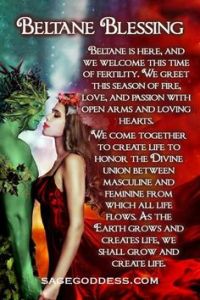
Because of birthday plans I am only doing a few posts today.
(One Person’s View Point) Beltane Explained: How to Celebrate Beltane Like an Ancient Celt
Europeans have been putting on fiery May Day festivals for hundreds, and in some cases, thousands of years.
Whether it’s celebrating Sankt Walpurgisnacht (“Saint Walpurgis Night”) in Germany with bonfires, or celebrating Pálení čarodějnic (“burning of the witches”) in the Czech Republic with the burning of a twenty-five-foot-tall effigy of a witch, or even celebrating Easter in the Netherlands with some Paasvuren (“Easter fires”), these long-standing springtime traditions might all owe their existence to the Celtic cross-quarter day festival of Beltane.
Okay, fine, that’s a bit presumptuous. At the very least, Beltane likely influenced these celebrations, or at the very, very least, Beltane and Walpurgis Night and similar celebrations all share a common prehistoric (i.e., pre-Celtic, pre-Germanic) celebratory ancestor.
According to the World History Encyclopedia, Walpurgis Night, celebrated on the evening of April 30th, is derived from the “merging of the ancient pagan celebration of Beltane with the commemoration of the canonization of the Christian Saint Walpurga (l. c. 710 – c. 777 CE).”
The Encyclopedia goes on to note that the “ancient Celtic Sabbat (religious festival) of Beltane” had “merged with Germanic May Day” and was later Christianized sometime after 870 CE when Walpurga—a British-born Christian missionary and healer known for her ability to combat witchcraft—was canonized in Germany.
Meanwhile, in Ireland, the bishop of Cashel and king of Munster Cormac (d. 908 CE), was writing about Beltane in his eponymous glossary. Cormac claimed the festival of Beltane was named for the “lucky fire” or the “the two fires,” and he described how Irish pagans would drive cattle between two hillside bonfires in order to protect them from disease during their migration to summer pasturelands.
But look at me, getting ahead of myself here, like a bull charging between stacks of yet-to-be-lit firewood on an Irish hillside.
Before we explore all of the rituals associated with the ancient Celtic festival of Beltane, let’s cover the basics, starting with the definition and etymology of Beltane.
What is Beltane? (Definition and Etymology)…
Click her to read the est of this article about Beltane Source: irishmyths.com
(One Person’s View Point) Fertility Deities of Beltane
Fertility Deities of Beltane
Beltane is a time of great fertility — for the earth itself, for animals, and of course for people as well. This season has been celebrated by cultures going back thousands of years, in a variety of ways, but nearly all shared the fertility aspect. Typically, this is a Sabbat to celebrate gods of the hunt or of the forest, and goddesses of passion and motherhood, as well as agricultural deities. Here are a list of gods and goddesses that can be honored as part of your tradition’s Beltane rituals.
Artemis (Greek): The moon goddess Artemis was associated with the hunt and was seen as a goddess of forests and hillsides. This pastoral connection made her a part of spring celebrations in later periods.
Bes (Egyptian): Worshiped in later dynasties, Bes was a household protection god, and watched over mothers and young children. He and his wife, Beset, were paired up in rituals to cure problems with infertility.
Bacchus (Roman): Considered the equivalent of Greek god Dionysus, Bacchus was the party god — grapes, wine, and general debauchery were his domain. In March each year, Roman women could attend secret ceremonies called the bacchanalia, and he is associated with sexual free-for-alls and fertility.
Cernunnos (Celtic): Cernunnos is a horned god found in Celtic mythology. He is connected with male animals, particularly the stag in rut, and this has led him to be associated with fertility and vegetation. Depictions of Cernunnos are found in many parts of the British Isles and western Europe. He is often portrayed with a beard and wild, shaggy hair — he is, after all, the lord of the forest.
Flora (Roman): This goddess of spring and flowers had her own festival, Floralia, which was celebrated every year between April 28 to May 3. Romans dressed in bright robes and floral wreaths, and attended theater performances and outdoor shows. Offerings of milk and honey were made to the goddess.
Hera (Greek): This goddess of marriage was the equivalent of the Roman Juno, and took it upon herself to bestow good tidings to new brides. A maiden about to marry could make offerings to Hera, in the hopes that she would bless the marriage with fertility. In her earliest forms, she appears to have been a nature goddess, who presides over wildlife and nurses the young animals which she holds in her arms.
Kokopelli (Hopi): This flute-playing, dancing spring god carries unborn children upon his own back, and then passes them out to fertile women. In the Hopi culture, he is part of rites that relate to marriage and childbearing, as well as the reproductive abilities of animals. Often portrayed with rams and stags, symbolic of his fertility, Kokopelli occasionally is seen with his consort, Kokopelmana.
Pan (Greek): This agricultural god watched over shepherds and their flocks. He was a rustic sort of god, spending lots of time roaming the woods and pastures, hunting and playing music on his flute. Pan is typically portrayed as having the hindquarters and horns of a goat, similar to a faun. Because of his connection to fields and the forest, he is often honored as a spring fertility god.
Priapus (Greek): This fairly minor rural god has one giant claim to fame — his permanently erect and enormous phallus. The son of Aphrodite by Dionysus (or possibly Zeus, depending on the source), Priapus was mostly worshiped in homes rather than in an organized cult. Despite his constant lust, most stories portray him as sexually frustrated, or even impotent. However, in agricultural areas he was still regarded as a god of fertility, and at one point he was considered a protective god, who threatened sexual violence against anyone — male or female — who transgressed the boundaries he guarded.
Sheela-na-Gig (Celtic): Although the Sheela-na-Gig is technically the name applied to the carvings of women with exaggerated vulvae that have been found in Ireland and England, there’s a theory that the carvings are representative of a lost pre-Christian goddess. Typically, the Sheela-na-Gig adorns buildings in areas of Ireland that were part of the Anglo-Norman conquests in the 12th century. She is shown as a homely woman with a giant yoni, which is spread wide to accept the seed of the male. Folkloric evidence indicates that the figures are theory that the figures were part of a fertility rite, similar to “birthing stones”, which were used to bring on conception.
Xochiquetzal (Aztec): This fertility goddess was associated with spring, and represented not only flowers but the fruits of life and abundance. She was also the patron goddess of prostitutes and craftsmen.
Source: Patti Wigington Published on ThoughtCo
The Nine Sacred Woods for Your Beltane Fire

(SIDE NOTE: These are also the types of wood you need to make Ogham Staves.)
(One Person’s View Point) Samhain (Sow-en) – The Celtic roots of Halloween
As millions of children and adults participate in the fun of Halloween on the night of October 31st, few will be aware of its ancient Celtic roots in the Samhain (Samain) festival. In Celtic Ireland about 2,000 years ago, Samhain was the division of the year between the lighter half (summer) and the darker half (winter). At Samhain the division between this world and the otherworld was at its thinnest, allowing spirits to pass through.
The family’s ancestors were honoured and invited home whilst harmful spirits were warded off. People wore costumes and masks to disguise themselves as harmful spirits and thus avoid harm. Bonfires and food played a large part in the festivities. The bones of slaughtered livestock were cast into a communal fire, household fires were extinguished and started again from the bonfire. Food was prepared for the living and the dead, food for the ancestors who were in no position it eat it, was ritually shared with the less well off.
Christianity incorporated the honouring of the dead into the Christian calendar with All Saints (All Hallows) on November 1st, followed by All Souls on November 2nd. The wearing of costumes and masks to ward off harmful spirits survived as Halloween customs. The Irish emigrated to America in great numbers during the 19th century especially around the time of famine in Ireland during the 1840’s. The Irish carried their Halloween traditions to America, where today it is one of the major holidays of the year. Through time other traditions have blended into Halloween, for example the American harvest time tradition of carving pumpkins.
Two hills in the Boyne Valley were associated with Samhain in Celtic Ireland, Tlachtga and Tara. Tlachtga was the location of the Great Fire Festival which begun on the eve of Samhain (Halloween). Tara was also associated with Samhain, however it was secondary to Tlachtga in this respect.
The entrance passage to the Mound of the Hostages on the Hill of Tara is aligned with the rising sun around Samhain. The Mound of the Hostages is… Click here to read the rest of this article about Samhain
(One Person’s Viewpoint) Celebrating May Day – Beltane History
Celebrating May Day – Beltane History
The Fires of Tara:
Beltane kicks off the merry month of May, and has a long history. This fire festival is celebrated on May 1 with bonfires, Maypoles, dancing, and lots of good old fashioned sexual energy. The Celts honored the fertility of the gods with gifts and offerings, sometimes including animal or human sacrifice. Cattle were driven through the smoke of the balefires, and blessed with health and fertility for the coming year.
In Ireland, the fires of Tara were the first ones lit every year at Beltane, and all other fires were lit with a flame from Tara.
Roman Influences:
The Romans, always known for celebrating holidays in a big way, spent the first day of May paying tribute to their Lares, the gods of their household. They also celebrated the Floralia, or festival of flowers, which consisted of three days of unbridled sexual activity. Participants wore flowers in their hair (much like May Day celebrants later on), and there were plays, songs, and dances. At the end of the festivities, animals were set loose inside the Circus Maximus, and beans were scattered around to ensure fertility. The fire festival of Bona Dea was also celebrated on May 2nd.
A Pagan Martyr:
May 6 is the day of Eyvind Kelda, or Eyvind Kelve, in Norse celebrations. Eyvind Kelda was a Norwegian martyr who was tortured and drowned on the orders of King Olaf Tryggvason for refusing to give up his Pagan beliefs. A week later, Norwegians celebrate the Festival of the Midnight Sun, which pays tribute to the Norse sun goddess.
This festival marks the beginning of ten straight weeks without darkness.
The Greeks and Plynteria:
Also in May, the Greeks celebrated the Plynteria in honor of Athena, the goddess of wisdom and battle, and the patroness of the city of Athens (which was named after her). The Plynteria includes the ritual cleansing of Athena’s statue, along with feasting and prayers in the Parthenon. On the 24th, homage is paid to the Greek moon-goddess Artemis (goddess of the hunt and of wild animals). Artemis is a lunar goddess, equivalent to the Roman moon-goddess Diana – she is also identified with Luna, and Hecate.
The Green Man Emerges:
A number of pre-Christian figures are associated with the month of May, and subsequently Beltane. The entity known as the Green Man, strongly related to Cernunnos, is often found in the legends and lore of the British Isles, and is a masculine face covered in leaves and shrubbery. In some parts of England, a Green Man is carried through town in a wicker cage as the townsfolk welcome the beginning of summer. Impressions of the Green Man’s face can be found in the ornamentation of many of Europe’s older cathedrals, despite edicts from local bishops forbidding stonemasons from including such pagan imagery.
Jack-in-the-Green:
A related character is Jack-in-the-Green, a spirit of the greenwood. References to Jack appear in British literature back as far as the late sixteenth century. Sir James Frazer associates the figure with mummers and the celebration of the life force of trees. Jack-in-the-Green was seen even in the Victorian era, when he was associated with soot-faced chimney sweeps. At this time, Jack was framed in a structure of wicker and covered with leaves, and surrounded by Morris dancers. Some scholars suggest that Jack may have been a ancestor to the legend of Robin Hood.
Ancient Symbols, Modern Rites:
Today’s Pagans celebrate Beltane much like their ancestors did. A Beltane ritual usually involves lots of fertility symbols, including the obviously-phallic Maypole dance. The Maypole is a tall pole decorated with flowers and hanging ribbons, which are woven into intricate pattern by a group of dancers. Weaving in and out, the ribbons are eventually knotted together by the time the dancers reach the end.
In some Wiccan traditions, Beltane is a day in which the May Queen and the Queen of Winter battle one another for supremacy. In this rite, borrowed from practices on the Isle of Man, each queen has a band of supporters. On the morning of May 1, the two companies battle it out, ultimately trying to win victory for their queen. If the May Queen is captured by her enemies, she must be ransomed before her followers can get her back.
There are some who believe Beltane is a time for the faeries — the appearance of flowers around this time of year heralds the beginning of summer and shows us that the fae are hard at work. In early folklore, to enter the realm of faeries is a dangerous step — and yet the more helpful deeds of the fae should always be acknowledged and appreciated. If you believe in faeries, Beltane is a good time to leave out food and other treats for them in your garden or yard.
For many contemporary Pagans, Beltane is a time for planting and sowing of seeds — again, the fertility theme appears. The buds and flowers of early May bring to mind the endless cycle of birth, growth, death and rebirth that we see in the earth. Certain trees are associated with May Day, such as the Ash, Oak and Hawthorn. In Norse legend, the god Odin hung from an Ash tree for nine days, and it later became known as the World Tree, Yggdrasil.
If you’ve been wanting to bring abundance and fertility of any sort into your life — whether you’re looking to conceive a child, enjoy fruitfulness in your career or creative endeavors, or just see your garden bloom — Beltane is the perfect time for magical workings related to any type of prosperity.
Source: Article found on & owned by About.com Author: Patti Wigington
(One Person’s View Point) 2026 April New Moon: Personal Guide for Each Zodiac and More
The April New Moon arriving on April 17 is a massive “reset button” for all of us. It marks the first major lunar shift of the astrological year, and it’s not just a small change—it’s a call to shed your old skin. If you’ve been feeling heavy, stuck, or just “off,” this is the moment the universe gives you permission to start over.
CONTENTS
Here is what you need to focus on right now based on your sign:
New Moon Rituals:
Personal Tip for the April 17 Moon:
Click here to read the rest of this article Source: anamikamishra.com
Also read:
(One Person’s View Point) A Guide to Wiccan New Moon Rituals and Ceremonies
(YOU CAN COPY AND PASTE ANY SPELLS POSTED TO A DOCUMENT TO PRINT AND/OR SAVE ON YOUR COMPUTER FOR PERSONAL USE ONLY. You can find the origin of the spell by clicking on the hyperlink.)
A Guide to Wiccan New Moon Rituals and Ceremonies with Full Script
Wiccan new moon rituals and ceremonies…
Contents:
Hereditary/Solitary Witchcraft

(One Person’s View Point) Various Types of Witchcraft – Hereditary Witchcraft
Hereditary Witchcraft
As you meet more and more people in the Pagan community, you’ll occasionally encounter someone who claims to be a “hereditary witch.” They may even tell you they’ve been “Wiccan since birth,” but what does that really mean?
Well, it could mean a variety of things, but for a lot of us, it generally sends up a red flag when someone uses the phrase “born witch” or “Wiccan from birth.” Let’s look at why that may be the case.
Is There Witch DNA?
You’re not born Christian or Muslim or Hindu. There’s no “Wiccan DNA” that makes any one person more genetically witchy than someone who begins practicing in their fifties. You simply cannot be a Wiccan since birth because Wicca is an orthopraxic religious system that generally involves you doing and believing certain things that make you Wiccan. You can be raised by Wiccans–and many children are–but that doesn’t make you Wiccan from the moment you pop out of the womb, it simply means you were born to Wiccan parents.
That said, certainly, there seem to some people who may be more adept at Witchy Things at some point in their life, but there’s no chromosomal or biological difference in these folks as compared to the general population. You’ll obviously meet people that are psychically gifted, and whose parent or grandparent or child also displays these same traits. But if you operate on the assumption that everyone has some latent psychic ability anyway, it may be that these individuals were encouraged to use their talents while growing up, rather than repressing them like the majority of other people.
You may also encounter people in the Pagan community who claim “born witch” status because of some ancestral link to an individual in the past who was accused of witchcraft. You’ll bump into plenty of people who think Salem ancestry makes them special. It doesn’t, for a variety of reasons.
Familial Traditions of Magic
Also, there are certainly hereditary traditions of witchcraft, but by “hereditary” we don’t mean that the practices are biologically inherited.
These are typically small, familial traditions, or Fam Trads, in which beliefs and practices are handed down from one generation to the next, and outsiders are rarely included. PolyAna identifies as a hereditary witch, and her family hails from Appalachia. She says,
“In our family, what we do is more of a folk magic tradition. My son and I and my granddaughter, who is adopted, practice the same folk magic as my mother and grandmother did. We’ve done it as far back as anyone can remember. We follow the Celtic gods, and my Granny was nominally Catholic but brought a belief in the old gods with her from Ireland. She found a way to make it work, and we’ve carried on those traditions.”
PolyAna’s family practices aren’t typical, but there are certainly other hereditary traditions like hers out there. However, it’s hard to even estimate how many there are, because the information is generally kept within the family and not shared with the general public. Again, this is a family tradition based on practices and beliefs, rather than any documentable genetic link. For families with an Italian background, Stregheria is sometimes practiced in the United States and other countries.
Author Sarah Anne Lawless writes,
“The passing on of traditions through the family is a global concept, and is not restricted to culture or continent. There are many family traditions existing in the United States… who all bear a striking resemblance to the fairy doctors and cunning folk of Northern Europe, many of whom were hereditary themselves. The traditions… were strict and binding; they could only teach one student from the next generation of the family of the opposite sex. In many older witchcraft families in the UK, the traditions of transferring knowledge are thought to follow similar rules.”
For many modern Pagans, including those in hereditary family traditions, witchcraft is either a skill set that is developed and honed over years of practice, or it’s a belief system that is seen as a religion that one spends a lifetime working towards.
For some people, it’s a combination of the two.
So, after all that, could someone be part of a hereditary familial tradition? Absolutely, he or she certainly could. But if what they’re claiming is some sort of biological superiority that makes them witchier than everyone else, you should consider it suspect at best.
____________________________________
Hereditary Witchcraft
Are You:
psychic?
drawn to dark, mysterious things?
not just interested in Vampires and Faeries, you want to be one?
unable to stay away from books about witchcraft and sorcery?
able to see or sense ghosts, and the past lives of places?
excited about going to places like Salem, or Whitby?
into dark glamor and wish to convey a powerful presence?
compelled by the Mysteries?
having trouble staying in your body? Are out of body experiences a away of life?
Since childhood you have practiced rituals to either placate the Gods, or communicate with spirits.
in a natural deep communion with nature and the spirits in trees, plants, animals, and landscapes.
passionate that sacred things and places must be protected.
more perceptive than most other people you know?
convinced that you have to keep these qualities to yourself.
These are just some of the possible traits that can indicate that you may be a hereditary witch — that you are a carrier of the Witch Blood
How it Used to Be
I grew up in the 1960’s and 1970’s, in a small town of Irish and French Catholics in Massachusetts. Witches were believed to be either fairy tale characters or evil old women who were burned at the stake in the Middle Ages.
England had serious laws against witchcraft until 1951. After these laws were repealed, Gerald Gardner went public with Wicca, a religion he developed by cobbling together folk lore, the ideas of Margaret Murray, some involvement with British magical traditions, and perhaps with a mix of the tribal ritual he may have seen in his years as a civil servant in Indonesia.
Robert Cochran came along later claiming to come from a long line of witches, as did Sibyl Leek. Still, the idea of a family carrying on an unbroken heritage of witchcraft or magical practices was considered a very wild claim. Yet some people seemed to be born with psychic and magical powers, were clearly drawn to tales of witchery and magic, and had the imagination to create communities of like minded souls who came together to be witches.
Those desires had to come from some place! This is where the idea of the Witch Blood was born. It may have been Robert Cochran who coined the term to describe people who for some inexplicable reason were willing to risk everything — jobs, houses, partners, families, etc. in order to pursue the path of witchcraft. Witch Queen Maxine Sanders was driven out of her home by frightened neighbors and had another house torched when they found out she was a Witch, even though she had done them no harm.
The conclusion was that, just as in fairy tales in which the Beggar Maid is discovered to be a Princess by virtue of her uncharacteristic beauty and refinement, someone with witch blood in their veins can be spotted by other witches. Perhaps there are people who come from families where the Craft was practiced long ago. These practices went underground, or were replaced with Christianity, but something remains in the genes that is passed down to one or members of the family unrecognized, or misunderstood.
Dormant Witch Blood can also be ignited by Initiation into Wicca, Faery Witchcraft practices, and the creation of a magical way of life.
Now
Today, many people have been born into witch families, and raised in the Craft. There is no doubt that they are hereditary witches and carry the Witch Blood. There is no mystery surrounding it as there when I was a young person just finding this stuff out about myself.
Still, I am sure that there are some in the current generation who feel these things and have no role models in their families. Their families may even be fundamentalist Christians — I have known a few people like that. Some Christians doth protest too much, and some ex-witches have gone into Christianity because of bad experiences in covens, or after frightening themselves when the magic actually works! They can be the most virulent antagonists against witchcraft.
Of course films and now television are currently having a field day with witches. Teenagers can take them on as role models, and in many cases, not be stigmatized as weirdos. In general, I have found witches to be a pretty happy lot, optimistic and creative, imaginative and fun loving. If sinister overtones are there, it is because of the dark cycle we all must go through, and the way some us walk between the worlds. Some witches are also sociopaths, but that isn’t just because they are witches, nor is sociopathology exclusive to witches and magicians.
If you have found yourself wandering in the woods, or walking the hills like a lost soul, hoping somewhere deep inside, where even you cannot verbalize it, that you will find them, then you might be blessed with the witch blood. If you leave offerings for the spirits, try to engage others to sit in a circle and call the spirits, if you feel you have a secret name, you might have the witch blood. If you are more drawn to these things than “normal” activities, are more comfortable in nature than in a church, if you can’t get your nose out of certain types of books….then I may have news for you….you maybe a Hereditary Witch,
Source: Patti Wigington, ThoughtCo
Winterspells
Hereditary Witchcraft
Hereditary Witchcraft
A reader says, “I met a woman who tells me she’s a hereditary born witch who has been Wiccan from birth. What in the world does that actually mean?”
Well, it could mean a variety of things, but for me personally, it generally sends up a red flag when someone uses the phrase “born witch” or “Wiccan from birth.” I realize I’ll get some hatey emails over this, but let me explain why I say that.
You’re not born Christian or Muslim or Hindu.
There’s no “Wiccan DNA” that makes any one person more genetically witchy than someone who begins practicing in their fifties. You simply cannot be a Wiccan since birth because Wicca is an orthopraxic religious system that generally involves you doing and believing certain things that make you Wiccan. You can be raised by Wiccans – and many children are – but that doesn’t make you Wiccan from the moment you pop out of the womb, it simply means you were born to Wiccan parents.
That said, certainly, there seem to some people who may be more adept at Witchy Things at some point in their life, but there’s no chromosomal or biological difference in these folks as compared to the general population. You’ll obviously meet people that are psychically gifted, and whose parent or grandparent or child also displays these same traits. But if you operate on the assumption that everyone has some latent psychic ability anyway, it may be that these individuals were encouraged to use their talents while growing up, rather than repressing them like the majority of other people.
You may also encounter people in the Pagan community who claim “born witch” status because of some ancestral link to an individual in the past who was accused of witchcraft. We get regular emails here from people who want to know if Salem ancestry makes them special. It doesn’t (for a variety of reasons).
Also, there are certainly hereditary traditions of witchcraft, but by “hereditary” we don’t mean that the practices are biologically inherited. These are typically small, familial traditions in which beliefs and practices are handed down from one generation to the next, and outsiders are rarely included. PolyAna identifies as a hereditary witch, and her family hails from Appalachia.
She says, “In our family, what we do is more of a folk magic tradition. My son and I and my granddaughter – who is adopted – practice the same folk magic as my mother and grandmother did. We’ve done it as far back as anyone can remember. We follow the Celtic gods, and my Granny was nominally Catholic but brought a belief in the old gods with her from Ireland. She found a way to make it work, and we’ve carried on those traditions.”
PolyAna’s family practices aren’t typical, but there are certainly other hereditary traditions like hers out there – and it’s hard to even estimate how many there are, because the information is generally kept within the family and not shared with the general public. Again, this is a family tradition based on practices and beliefs, rather than any documentable genetic link. For families with an Italian background, Stregheria is sometimes practiced in the United States and other countries.
For many modern Pagans – including those in hereditary family traditions – witchcraft is either a skill set that is developed and honed over years of practice, or it’s a belief system that is seen as a religion that one spends a lifetime working towards. For some people, it’s a combination of the two.
So, after all that – could this person be part of a hereditary familial tradition? Absolutely, she certainly could. But if what she’s claiming is some sort of biological superiority that makes her witchier than everyone else, I’d consider it suspect at best.
Source: Patti Wigington,Paganism/Wicca Expert Article found on & owned by About.com
(One Person’s View Point) Hereditary Witchcraft: Fact or Fiction?
Hereditary Witchcraft: Fact or FHereditary Witchcraft: Fact or Fiction?iction? Author: chimerical18
“Hello, my name is Megan, and I am a hereditary* witch.” That’s what I should have said. Admittedly, this is what I should say in order to be true to my path and myself. However, instead what came out of my mouth were a few confident rumblings about me and why I’m here. I wasn’t prepared with a stunningly beautiful and completely superficial answer to give my fellow students in the Magick 101 class. I felt like a deer in the headlights, and I truly wished I could have run like one in that moment.
Some time between fear and acceptance, I realized: I can’t be the only person to ever feel this way about their own hereditary craft. In fact, I believe the reason so many are afraid to confidently own up to their own magickal heredity is because they have at some point been unnecessarily judged, and not by the ‘muggles’ who have not the knowledge nor experience to understand it. Instead, we are often judged by other members of the magickal community that our mothers, grandmothers, fathers, and grandfathers helped pave the way for.
I hope in this article to explain and address the controversy of Hereditary Witchcraft, as well as establish some guidelines for up and coming witches to utilize and consider before casting judgment (better known as misguided assumptions) against a fellow witch.
Part One: Why is this a controversy?
So, what in fact makes a hereditary witch- a witch? If someone walks up to you and says, “Hi, my name is Moon Beam, and I am a hereditary witch.” do you ultimately have any reason to believe them? You could of course if it is your way of things accept everything that everybody says in regards to paganism as ultimately true, and right. Ask yourself this question: if Mary Moon Beam said she was a hedge witch, druid, budding pagan polyamorist, Crowley worshiper, or any other path- would you have then believed her? Keeping your first answers to these questions in mind, lets move forward and examine this together.
In most circumstances there is no documented way to determine whether or not a person is hereditary in their craft. There are also many variations of hereditary witchcraft, which have developed and spread throughout the world. Then there’s the fact that hereditary witchcraft in fact isn’t passed down in all cases to a biological relation. Ultimately, there are many founded reasons why a witch of the old ways may choose to pass their knowledge to a non-biological family member. Therefore, there are plenty of witches out there that were not born of another witch but were passed the necessary knowledge with the specific intent of continuing a hereditary tradition. Alright so now we know- there are two basic kinds of hereditary craft: born of, and ‘not so born of’.
To cite a specific example, what if a cousin or nephew was passed the tradition willingly? They then are given (and make a choice to accept) the same responsibility of continuing the tradition that any biological member of the family would have. All right, so, a ‘Hereditary’ witch is generally considered a person who is born of or (not so born of) a hereditary witch and chooses to accept, follow, and continue growing a pre-established tradition of witchcraft. Right? Well, sort of!
Here is even more to consider respectably: what if the act of passing on the family’s specific tradition of witchcraft skipped a generation? How about if the family tradition skipped five generations and then later re-emerged? The reality of modern hereditary witchcraft is that we all have broken branches on our family trees that we can and sometimes can’t account for, justify, or prove. Realistically, this means that many hereditary practitioners have to reforge or reform their traditions in order to fill in the missing gaps of knowledge that were not passed on.
A family tradition is typically an eclectic mix of pantheons, practices, cultures, ancestry, and of course: family. This type of tradition is constantly forming and forging, and is also often referred to specifically as a ‘family tradition’ or ‘fam-trad’ (for short) . If you hear someone referring to a family tradition, remember that they may not be hereditary- but instead could be forming a tradition to be passed on (there by establishing a new hereditary line) . Again, in order to preserve the traditions and practices that have survived the ages, many choose to pass their knowledge on to someone who is not biologically related. Therefore a family tradition can include mothers, brothers, cousins, nephews, fathers, grandfathers, and any other person considered adopted family by all members.
There are some grey areas that are tough to approach regarding both Family Traditions and Hereditary Witchcraft. I am referring to these concepts separately because they are not one in the same. Instead of backing down from explaining this portion of the great controversies surrounding hereditary witchcraft, I would like to address it by issuing a challenge to you (the reader) . Here is your job: ask your teacher, mentor, mother, grandmother, or a leader in community the following question-“Who did you learn from, and who did that person learn from?”
If you have ever done this you will find eventually one teacher, leader, elder, or great-grandmother who learned directly from someone who practiced what once was an exclusively hereditary tradition. In order to understand why some people claim or believe they are hereditary practitioners, you have to wrap your mind around the idea that during the ‘burning times’ witchcraft receded into small groups sometimes (but not always) called covens- which were considered within many traditions the equivalent of family.
We are now of course back to the idea of non-biological heredity within witchcraft. In this case scenario, a lot of practitioners were, and still in modern times, are not biologically related to the craft- but regard themselves as hereditary because they are passing on a tradition that would not survive otherwise. The biggest question in most people’s minds at this point is probably the best test of personal truth: is this still hereditary witchcraft?
Well, actually yes it is. But are the practitioners now still considered hereditary if they are receiving knowledge from a non-biological relation of a witch (a witch who has passed) who was part of a hereditary tradition? Well, no, not really- at least not in my opinion. (Though there are plenty that would probably disagree with me)
In fact, this is the very reason most people believe that hereditary witchcraft is just a big ‘myth’ and that in the modern craft it doesn’t really exist anymore. Many modern practitioners of Wicca and witchcraft seem to believe for some god-awful reason that the old hereditary traditions don’t exist, or that they shouldn’t be exclusive if they do. Worse, there seem to be a lot of preconceived notions floating about our magickal communities regarding what makes the claim of hereditary witchcraft valid or invalid.
Therefore, I have to say it: should we as witches disregard our hereditary lineages, our family lines, our traditions and the knowledge gained thereof because so many other practitioners have actually abandoned the idea that it’s valid? Or worse, because our high priestesses, friends, and fellow practitioners have told us that we are not what we claim?
Part Two: To Be A Witch is first and foremost to know yourself.
I say no, because it’s not their job to tell me who I am. It’s my job, and nobody else’s. To be a witch, means that you already know who you are, and you choose to be true to yourself in actions, words, and energy regardless of what anybody else says. To be a hereditary witch is just as great of a responsibility. There is no more and no less to learn if you are a hereditary witch. There is no more or less power and knowledge available to you if you are a hereditary practitioner.
Hereditary witches are not better, more ‘right’, greater, or even necessarily more powerful than any other witch. Hereditary witches, and practitioners of hereditary traditions should be working together to pass our knowledge on to others who are willing to know themselves and to learn the craft. Instead, too often we are battling against each other over broken lineages, huge gaps in knowledge that we are all trying to fill, and what are occasionally liars claiming heredity. Shall we walk on believing only those who have a firm pedigree should and can claim heredity within the craft?
I believe that each person who claims to be a witch should not only already know their personal sense of truth well, but also is continually reforming it through self discovery. I believe that to be a witch means that you are studying a tradition of some sort whether it is by learning the traditions of others or by birthing your own tradition from what you have learned. It is inescapable that in studying Wicca, witchcraft, or even general paganism that you will have to study someone else’s tradition- and those traditions were preserved by heredity practice to begin with. I believe that heredity is not invisible; it is what makes us who we are regardless of what that heredity is. Whether or not we like what we were taught, or from whom we came- heredity is what shapes us as human beings.
I made a choice a long time ago to honor myself as a witch because I was ready to face and embrace who I am, who I was meant to be, and who I have been. I was not handed my tradition of hereditary witchcraft on a silver platter and told to follow my mother in all that she decided was true and right. (No true witch worth her weight in wax would require their children to follow the craft as their way, because that ideal infringes upon free will.)
My decision to practice witchcraft was completely of my own volition, and of my own making. In order to learn the ways of the old witches, I had to earn it. In fact if there is one clear difference in being raised by a witch, I have to say it’s that there was always more expected of me than of the others around me. It doesn’t make me a better witch, but it does make me a better person.
In all that my mother passed to me of what she does know the most important lesson has been that with great freedom comes great knowledge, and therefore also comes great responsibility. I respect this responsibility, and I use it wisely because it’s my karma that I damage if I choose to disregard the laws of power. I know that I have a greater responsibility than some, and that what I carry is not a burden but instead a blessing.
I refuse to reject the lessons I have earned from my family as a ‘myth’ or ‘excuse’. To disregard the honor it is to be who I am, would be disregarding a deeply felt piece of my heart and spirit. I wish nothing but to further and forward the knowledge we all can gain, and yet some others have disregarded me because I claim my own heredity. I think judgments of this nature are not only astounding, but also disrespectful to the craft itself.
I have spent a great deal of time, effort, and study dedicated to the practice of witchcraft. This being said, I want it to be clear that knowledge is free but wisdom is earned. Just because you can claim a hereditary line does not mean that you ultimately are meant to do so, or even that it would be right for you to do so. Possessing a hereditary line is a tricky thing, and it doesn’t give you a free pass to skip the lessons that we all must learn. Hereditary lineage in fact for most has little bearing on what they learn, as well it should be.
Sometimes a person can be as hereditary as they come, but if it skipped a few generations they may have missed out on the teachings of their great grandmother. That doesn’t make their heritage invalid, or even their knowledge flawed- unless they have chosen to instead base their knowledge on movies and pop culture. Being a hereditary witch has actually nothing to do with making the same choices, and believing the same thing your mother, grandmother, or even great-great grandmother did.
The fundamental myth that we hereditary witches only choose to act as our predecessors did is completely void of truth. How could we be true to ourselves if we did? I am 25 years old, and I still fight and rebel against my mother! I intend to continue doing this for as long as it fits who I am. She and I luckily have a close, and accepting relationship where I am supposed to own up to who I am not reject it.
Another myth of hereditary witchcraft of course is that I somehow learned at birth how to cast a spell, read tarot cards, and astral travel. Ok, so I already knew how to astral travel. But the rest of it certainly isn’t true, and doesn’t mean that I am trained enough to teach another how to practice magic.
You probably wouldn’t even want me to teach you anyway, because what I do is not made of stars and light alone. What I do and practice is what works for me, and yes a lot of it happens to be something I learned from my mother. However, my mother helped form whom I am does not decide or determine whom I choose to be. Therefore if there is something that she believes that I disagree with, I tell her and I include exactly why I disagree. If my mother disagrees with me, she does the same and it is yes usually a long conversation. However, we both do what works for each of us individually because it works and it is who we are to do so.
Of course yet another myth of hereditary tradition and witchcraft is that somehow I think I’m better than other people because of how much I know. This is ironically the biggest complaint I have received from many people, and it is the reason I tell few people that I am a hereditary witch. I don’t know everything, plain and simple. I have always referred others to texts, teachers, and other resources if I feel I do not have a sound explanation for their questions. This of course, may not always even answer the question that was put to me to begin with. I can’t change that, and I hope that nobody whom I love and keep close would see this as insecurity.
Part Three: To Honor our Ancestors, and each other.
Hereditary witchcraft is how we preserved our traditions for centuries. If it had not have been for my mother, or my grandmother- I would not have the right to practice as I believe. I believe if it had not been for all of our elders, leaders, and community pioneers- we wouldn’t be recognized as having a religion within the United States of America. I give honor to all of them, because they are how we got here regardless of who their great, great, grandmothers were.
I also believe that we are a part of the future of witchcraft and paganism because in all that we do we are ever forming it. Like it or not, we are the legacy of modern witchcraft- and what we do will be written on the pages of history. I say, let’s document it better for ourselves this time.
To conclude this exposition in addressing the concept of modern hereditary witchcraft, here is the one thing you need to know to sort the fluffy self-deluded liars from the real witches that might actually want to know. Hereditary witches, to put it bluntly, are not people who have to do less work, or who are handed everything they need to know in a book of shadows from their grandmother. A hereditary witch that you would want to know, respect, and possibly utilize as a resource is someone who a) tells you and if necessary proves to you upon request where their lineage comes from even if it is broken in places b) knows themselves, and is true to themselves even if you don’t like them c) and who is astoundingly honest and expects the same from you.
If this is not what you discover from Mary Moon Beam, who claims hereditary practice is her middle name, then ask her why she believes this about herself. Then, would you please tell, Mary hereditary witch Moon Beam, that she is degrading the practice of other hereditary witches by lying to herself and others. Or alternatively, if you aren’t all that confrontational- walk the other way reminding yourself that you’re glad you are not that self-deluded.
The bottom line when meeting new people in the magical community is that if you don’t ask, you won’t know. Furthermore, if this person (aka Mary hereditary witch moon beam) is self deluded and following a path that isn’t right for them- do you really want to further the grand delusions they may have by feeding them attention for their claims? Generally those witches who lie or exaggerate about the nature of their practices are not the kind you want around, or the type you would want to look to for teaching and guidance.
Hereditary practitioners of magic are bound to the same laws of power everybody else is. We do not ‘skip go’ or collect 200 dollars for being who we are. We instead share the rewarding work of furthering the knowledge and raising the awareness of witchcraft in the modern world from a different vantage point. (Notice that in this sense ‘different’ doesn’t mean better or worse) Hereditary witchcraft is highly unique, relatively rare to find, and deeply rooted once you get to know their traditions. It is just as honorable to be a hereditary witch as it is to be of any other path, creed, ethos, or tradition.
It’s also just as challenging, if not more challenging than learning what have become mainstream traditions. So, don’t forget: they deserve the same respect and honor you give others of the craft- and no less. (Especially if the lack of respect comes from a place of assumption, and envy or jealousy)
It never hurts to remember and continually be reminded of this one fact in regards to dealing with other practitioners of multi-faceted traditions:
Purposefully disrespecting another member of the craft, in order to ‘justify’ the hierarchy, ethos, system of ethics, etc. that you believe in is never appreciated by anybody. Worse, it makes you look like a person who does not have the ability to discern fact from fiction!
From your favorite hereditarily fused and forged witch!
Eorthan Madame
Indianapolis, IN
(One Person’s View Point) The Dark Side of the Water Witch c 2012
The Dark Side of the Water Witch
Water rules the emotions, and the Water Witch has a predisposition to think with the heart and not the head. As she is devoted to water, she believes wholeheartedly that a tiger can change its strips by virtue of cleansing away the negative. She will give a second chance in the case of an innocent mistake. However, if crossed intentionally, the Water Witch will hold a grudge until the end of time. She is a wall builder and will not hesitate to block out anyone who deserves it. Her code of justice is so strict that she often entertain notions of revenge. She is known to overdo it in these matters.
In personal matters, the Water Witch’s intuition does not function at its fullest capacity. She can be quick to assume a slight was intended by an innocent remark and operate strictly on that notion, regardless of its truthfulness. Unfortunately, once this happens the Water Witch can muddy her own waters.
(One Person’s View Point) Balancing the Elements: a Water and Sea Witch guide to finding balance with the elements
Balancing the Elements: a Water and Sea Witch guide to finding balance with the elements
It would be silly to think that someone who calls themselves a water witch works ONLY with the water element. This would make for a very unbalanced practice! Rather Water or Sea Witches work with all the elements through their particular path which is deeply connected to water. A Water Witch may call themselves Water or Sea witch because they derive their power from the Waters or the Spirits that dwell with in it.
Working with Air
Water Witches can work with air in conjunction with water. While I personally don’t resonate with Air as well as I do the other elements, it can still be worked with and incorporated into a balanced practice. There are many stories of Witches having the power to control the wind and weather; many times these stories are about Sea Witches or witches that could be classified as Sea Witches based on where they live. An old folk spell Sea Witches have been recorded as being responsible for, is selling knots to Sailors. Each knot holding the power to release different strengths of wind.
“For the right price, witches supplied sailors with a cord having three knots. When becalmed, untying the first knot was thought to produce a light breeze, undoing the second produced a moderate wind, and the third a strong breeze. Scottish fishermen were known to buy knotted handkerchiefs of wind sorceress, the desired strength of the wind could be obtained by slowly undoing the knot. Once loosened, the knot was useless and for additional winds another purchase was required. If a sailor found a knot in a painter, he could expect a long voyage. When a sailor referred to “tying a knot in the devil’s tail,” he was relating to the “well done” completion of a difficult task.”
Another good example of Water Witches having the power to control the weather and raise up storms is the Gallicanae from the Island of Sena. Here we have a group of 9 priestess with magical powers who are clearly connected to the sea but also have the power to change the winds and work with water in conjunction with air.
“Sena in the British sea, opposite the Ofismician coast, is remarkable for an oracle of the Gallic God. Its priestesses, holy in perpetual virginity, are said to be nine in number. They are called Gallicenae, and are thought to be endowed with singular powers, so as to raise by their charms the winds and seas, to turn themselves into what animals they will, to cure wounds and diseases incurable by others, to know and predict the future; but this they do only to navigators who go thither purposely to consult them.”
In a modern practice, one can look to wisdom from water birds, work with knots as above, charge water in a singing bowls using voice and vibration to charge waters, and can engage in spirit flight using water as a portal to the other world.
Working with Fire
Working with Fire is actually quite fun when working water magic. Fire can heat our cauldrons, and be the catalyst for change, a flame can be lit at a sacred well or near a river. Floating candles can be used to merge the powers of water and fire and holy water can be used to anoint candles. Additionally, there are several European Goddesses that are associated with Fire and Water; Bride, Sulis and Nantosuelta are a few. Grannus is a masculine deity that is also associated with Fire and Natural Springs. Many cultures across the world combine water and fire together by lighting candles and setting them afloat on small rafts of herbs or wreaths. A Water Witch that is particularly connected to springs and wells will find many ways to honor and work with water and fire together. A popular tradition is well dressings, and candles as well as flowers and other offerings are used to decorate the sacred space on holy days.
In a modern practice candles can be anointed with holy water or used to light a ritual bath. Floating candles can be used in a bowl or one can Scry by candle light. Candles are a staple in every witches tool bag, and Water Witches use them as well, though our collection might be heavy on the blue and green side!
Working with Earth
Earth and Water are very compatible and often are used together. Floral essences, Herbal Teas, and Gem elixirs are quick and easy ways to combine earth and water magic together.
The earth is the vessel in which the water is held, both symbolically in the alchemical symbol and actually in the physical world. Our physical bodies which represent earth are filled with water and in a way is a vessel. The earth contains water and while it does not necessarily control it, it holds it, and houses it giving it a structure in which to rest or rage.
For the Sea Witch shells, sand, and drift wood would be earth representations and a beautiful way to combine water and earth. There is nothing more beautiful than a piece of smooth driftwood that washes up at your feet. Water and Earth work together to transform the environment around it; river rocks and beach agates smoothed and tumbled by nature are other good examples of water and earth together.
Witches that work with rivers can connect to the earth with river rock, hag stones and the muddy parts of the shore. Bath salts can also be considered an earth element and are a wonderful edition to any bath!
Dew has much folklore and recorded magical uses, a popular one being collecting dew on May Day from the Hawthorn tree. For the most part Dew relies on plants and grasses to hold its delicate watery form. Again a perfect example of combining the elements.
Working with all the elements is important in any magical practice, and for those of us that are watery it is always good to reach towards a more grounding element in tough times. When our waters need to be stirred up reach towards air and when you need to heat up or become passionate about something working with Fire can be beneficial. Finding balance is important, and so is honoring all the elements even if our home is in the waters!
Source: Published on Patheos by ANNWYN AVALON
(One Person’s View Point) The Path Of The Water Witch
The Path Of The Water Witch
Water Witches are sometimes called Sea Witches, but many of them find a calling with inland creeks, rivers, and lakes. It is rare for them to limit themselves to any one type of body of water. They generally align with all forms, including rain.
In most mythologies, human sprang from the Earth, but the gods themselves came from water. Egyptian theory states that the sun god Re was born from the primordial waters. Today, scientists can back that theory, NASA scientists theorize that water exists in heavy quantities in the universe. It works as a coolant. The water vapors in outer space for the condensing of clouds. Once a cloud condenses enough, it becomes a star.
Water reflects, the Water Witch does the same. If you yell at her, she will yell back at you. If you are kind to her well, she will be kind and treat you well in return. She is very fair. She shares many qualities with her sister Earth Witch, as the Earth is 90 percent water. Among those qualities is the core belief of taking complete responsibility for her actions. The Water Witch accepts that every move she makes can cause ripples across the surface of the water and moves accordingly.
Water is considered a feminine force, and the Water Witch may prefer an alliance with the Goddess, all the while recognizing and maintaining that the God is within the Goddess. She cans sometimes relate closely to Dianic Witches in this preference.
The Water Witch can see things that those on other paths cannot. In fact, the human sense of sight belongs in her realm. Just as the seas teem with life that we have yet to discover and understand, the Water Witch know s that there is much more to our world than what is within our eyesight! While she can be highly superstitious, for the most part she simply knows that there is more just waiting to be discovered, as well as some things that humanity has known about and forgotten over the ages. The old phrase “out of the blue” speaks volumes about the ability of the Water Witch to tune in to her intuition. She is often very gifted in divination practices. Tarot is usually her divinatory tool of choice, but she also has a talent for dowsing.
The Water Witch sees little that she considers an obstacle. She understands that her fate is in her hands, and if she cannot flow through something, she will flow around it. Once her mind is made up, very little can stop her from obtaining what she wants. Because water exists in three forms on Earth, The Water Witch can be considered a formidable force. She will not admit to any weaknesses.
The Water Witch has a close link to the feminine side of nature. She understands reproduction and is akin to her sister Earth Witch in this manner as well. Menstruation falls in the realm of the Water Witch. Because of this, she is instrumental in moon-lodge practices and coming-of-age rites. Her sister Earth Witch may focus more on the rebirth cycle, while the Water Witch is more in touch with creation.
The Water Witch specializes in healing, cleansing, beauty, emotions, intuition and energy. Her magickal style is usually based on instinct. If the feeling hits her to perform a cleansing, she will. She does not necessarily worry about correspondences and timing. Her timing is completely her own–she will not be rushed by others into decisions or action. Schooled in water magick, ice magick and snow magick, the Water Witch can tell you all about the role of water in the metaphysical and physical realms.
Winter is the season when the Water Witch’s power is at its peak. She holds within herself the ability to transform fluidity to solid form during the winter, the same way that water turns to ice. It is during this season that the Water Witch should turn her view inward and evaluate her goals. She often redefines herself through the process. Because of this, a Water Witch grows stronger every year. She understands that just as dry ice is sticky, it is her role to hold thing together.
Throughout the winter months, the Water Witch is abnormally busy, even for her active lifestyle. Because she is at her highest power and incarnated in all three of her forms during these months, she may be short of temper. When you add to that the fact that artificial heat (fire, an evaporating influence on water) is usually pumped into the home during this time and families tend to be cooped up in the same space, you may have one cranky, stressed-out Water Witch on your hands. She longs for room to spread out and flow. A simple snowfall can ease her mind and soothe her spirit; she draws strength from it. If that is not an option, a long bath or a cup of hot tea usually helps. Rest assured that if you visit her in the winter months, she will be a very gracious hostess, regardless of the timing. The Water Witch is known for her generous hospitality.
Her home décor is usually unthemed, with whimsy being the main rule. The Water Witch may have a quirky collection of glass objects, prisms (she tends to like sparkly things), tons of throw pillows and an aquarium. Cool blues and greens are often primary colors in both her wardrobe and her home.
Due to her busy lifestyle, the Water Witch frequently has to let the housework slide somewhat. Although she prefers all things to be clean, she also understands that there must be “salt in the sea.” In other words, a small amount of dirt is inevitable, and she is able to live with that comfortably. She absolutely cannot stand clutter, though. It drives her to distraction.
Another common trait of the Water Witch is a quirky sense of humor. It simply cannot be defined. Some of the things she says seem to come from outer space in their relation to the topic, yet they can make you laugh as nothing else will. This is intentional–the Water Witch is lighthearted. But just when you begin to think she has never had a deep thought in her life, she will prove you wrong. When it comes to serious conversation, the Water Witch can often put her finger on an aspect of the situation that the other Elemental Witches do not see. The Water Witch is very wise.
Like her mythical brethren the mermaids and water nymphs, the Water Wise tends to love long hair. She may keep it pulled back in a ponytail due to a lack of time, but she lets it grow nonetheless. The effects that water has on the body are directly in line with the metaphysical attributes of the Water Witch. Usually beautiful, she is often younger looking in appearance than in age and has a long memory and attention span and bright, shining eyes.
Because the Water Witch always considers every side of an argument before making up her mind, she may be slow to assume a position. Rest assured that when a Water Witch states her opinion., it has been well thought out. She open-minded and fair. Her strength lies in her dual nature an a ability to see the points or view of others. And like water, she will find her way into all of the small nooks and crannies of a situation. She may initially choose an answer based on instinct but if new facts come to light, she will often change her mind. She is flexible.
Those on the water path often find a calling in helping others. They make wonderful therapists, psychiatrists, obstetricians, pediatricians or service personnel. Often people are attracted to their soothing nature and come to them for advice. Like a waterbed, a reflecting pool , or a relaxing bath, Water Witches project an aura of serenity and comfort.
The Water Witch may be seen as moody, but like the sea herself, she is often in motion. She rarely slows down She is full of energy and always on the go. And like the sea, her moods swing with the tides. The moon holds sway over the tides, and one can easily draw a parallel between the moon and the Water Witch’s emotional patterns.
Source: Elemental Witch by Tammy Sullivan
(One Person’s View Point) Water Witches
Water Witches
Most people are familiar with sea witches and sea witchcraft. It seems as if, like the village witch, the sea witch has been recognized as a solitary powerful path by the general community. Of course sea witchcraft is not limited to solitary practitioners, as I know of a few sea witch covens around the globe, but often times sea witches are inclined to carve their own path, similar to the way a river might carve it’s own path through stones. Water witches, like the Sea Witch, are drawn to the water. Water witches are drawn not only to the ocean, but they feel and must answer the call of river water, lake water, canals and even the rain. Like the sea, these bodies of water are seductresses. They pull at our heart strings and torture our spirit; pining and raging like an ocean in a storm. I have heard whispers of those that say they have Mermaid or Selkie blood and also of those that have had past lives as such creatures; perhaps they are true and perhaps it is just the seduction of the mysterious waters. What is known, is that the water calls to us, it pulls us in and we feel empty and lost with out it.
A water witch is simply one that works witchcraft with water. Over the years I have found some that are skeptical, and others that deeply understand my words. It is very interesting that Sea Witches seem to be accepted by the pagan world, but Water Witches are not. However, with the recent publishing of Whist Waters by Gemma Gary, it seems as if the Witchcraft community is finally interested in accepting Water Witchcraft as well. It makes sense; water is everywhere. It is not just the ocean or large lakes, it is the rain, the swamps, large rivers and seasonal streams etc. Water is essential to our life; we cannot go without water for longer than a few days without death. Our bodies are made up of a considerable portion of water. We know from Dr Masaru Emoto’s work with water (which I will discuss below) that even the slightest word can create a change in water, and how that word is spoken influences the outcome of that change. When we put these thoughts about water and change together with the definition of magic…
Magic is…
“the science and art of causing Change to occur in conformity with will”
~Aleister Crowley~
“the art of changing consciousness in accordance with will”
~Doreen Valiente~
We end up with a very clear picture of how powerful water magic can be. In short, since we know that words and intent influence the structure of a water molecule and that magic is change according to will and will and intent are almost synonymous then we have a basic formula for Water magic. Intent + water = a visual change. In a way, we can even see the magic take place!
When we look at Water Magic as a practice, utilizing it in either small (rain, wells, etc) or large quantities (lakes, ocean etc), it is very clear that chanting, spells, incantations, sigils, and many more magical practices can be incorporated and the result is incredibly powerful. For hundreds of years Holy Wells have been revered for their powers of both cursing and healing. Such bodies of water include the famous hot springs at Bath. The hot baths, shrines and a temple dedicated to Sulis, the Goddess that presides over the hot springs, are known to heal, but are also known for its curse tablets, where over 300 were found. Many bodies of water like the Glastonbury red and white wells contain their own properties which are enhanced by the calcium and iron deposits. For hundreds of years Clootie have been hung over sacred wells in the UK. This was practiced widely from Wales to Scottland and still is today. The famous Mother Shipton, witch and oracle, lived by a sacred spring and can still be visited today. Not suprisingly her name is Ursula Southeil (interesting connection to Disney’s little mermaid!) As you can see both Folklore and Science support the idea of water magic.
Water Witchcraft, as I stated before, is very similar to Sea Magic and Sea Witchcraft. Sea Witches usually stick to the sea shore, however water witches will be found just about everywhere. Near lakes, rivers, holy wells etc. Tools are usually gathered from the shoreline and oftentimes shells, driftwood, and plants are their tools of choice. Water Witches will most often blend Sea magic with their craft. Focusing on tides, moon cycles, and so much more. Since there is no specific Water Tradition (with one exception) you will find that most sea/water witches practice very differently. Some incorporate water and sea spirits, fae or deity into their practice, while others believe that there is no religion associated with their practice at all. These topics are very popular in the pagan community and chat boards, and though they do influence water/sea magic, they are not a topic I am going to discuss here and for one very simple reason; No one will ever agree! Water witches will also find that they differ in their beliefs, the one thing that binds us together is Water in her many forms. For me, a Water witch’s practice can be defined by Magic that is focused around water, water creatures living and dead, spirits that are associated with water, and if one wishes Goddess and Gods associated with Water.
** The one exception in tradition I mention above is The Water Witches in the UK. There is very limited information on them however. They are part of a group of people that were very much like gypsies, but their homes were floating barges. There is no particular tradition and with limited information it is hard to say how they practiced. However what we do know is they were wandering people of the industrial revolution that lived on the water canals in the UK. Many people still live this way today, but I am not sure if they exist in the same manner. I call this a tradition because it was a group of people that practiced for years in a similar way, and many were family. You can read about my own adventures on these mysterious canals here.
There are many different types of water; fresh water lakes and the ocean are not the only types and many hold as much power and mystery such as the muddy waters of the Uk Canals, sacred wells, and swamps. Many sea witches work with brackish water and so do water witches. There is so much magic in the brackish waters of the Calvert cliffs. Large Megolodon teeth can be found on the shores, and stingrays swim circles in the early morning on the calm glassy surface of the pale blue and gold water with the sun rising in the east. The shores are full of healing and death, with yarrow growing among the poison hemlock on the banks of the shore speaking of balance and bane. Large predators once roamed the waters and the stings of the jellyfish are fierce. Oh how glorious to watch the storm come across the waters…
Swamp water is also full of mystery and poison. Toads, snakes and spiders lurk with in the grooves of a hollowed cypress tree, tall nubs of the cypress trees roots peek above the surface of the waters. Swamp waters can be found all over the world. Most commonly known would be the Florida Everglades and the Bayou of Louisiana. Any type of magic you can imagine can be practiced in this type of water, from natural magic to voodoo. However I will say, I do not think that ceremonial magic would be suited for this type of environment
Lakes and Fountains hold so much mystery and mythology. The Lady of the lake has to be the most famous account of water magic taking place in a lake. There are several tales of Ladies of the Fountain and Lake Ladies and their magical gardens, healing powers, and bargains.
Rain, Snow, Hail and storm energy in general is very interesting to work with as well. I personally collect water everywhere I go. Often times I label and date it with what type of storm it was. As you can imagine, a summer sun shower would be beautiful warm energy, and hail and a lightning storm pack a VERY powerful punch and can be incorporated into magical workings that need the extra push or used to curse. There is nothing like sitting on the banks of a large body of water, watching a terrible storm roll in. Many water witches enjoy this type of weather, and pull energy from the storm as well as send spells out and let the roaring winds and waters weave the magic.
Types of water you can work with include, sea, brackish, lakes, rivers, distilled, hydrosol, swamps, snow, hail, rain, ponds, canals, seasonal creeks, sacred wells and other bodies of water. Really there is no limit to how you can use water magic! I find that Water Witches are attracted to bottles, bowls, and other vessels. They are often found beach combing or searching the banks of rivers and lakes. Many I have spoken with are drawn to some sort of mythological water spirit or creature such as Mermaids, Selkie, and Lake Ladies. Many love to swim, boat, and are often found in the bath. Interestingly, astrological charts seem to indicate a strong lean towards water, often times having a Water rising sign as well as a Watery moon. However this is not a hard fast rule and it does vary. Often times, Water witches are very good at water scrying, divination with shells or bones found along the shoreline. Almost every Sea/Water witch I have met is a bit of a magpie and will collect shells, wood, glass etc from the water and create shrines or water based altars. Many work with tea, sacred baths, healing waters, holy wells, hydrosols, and water based sprays. I will blog more about how to work with different bodies of water and how to work with them in the future.
Source: Annwyn Avalon, Author Published on The Water Witch


You must be logged in to post a comment.