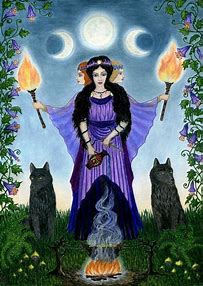
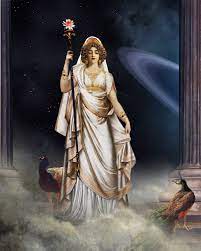
Goddess Of The Day: HERA


By deTraci Regula, About.com Guide
Aphrodite’s Appearance:Aphrodite is a gorgeous, perfect, eternally young woman with a beautiful body.Aphrodite’s Symbol or Attribute:Her Girdle, which has magical powers to compel love.
Strengths:Potent sexual attractiveness, dazzling beauty.
Weaknesses:A bit stuck on herself, but with a perfect face and body, who can blame her?
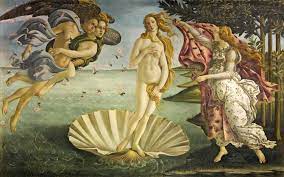
Aphrodite’s Parents: One genealogy gives her parents as Zeus, King of the Gods, and Dione, an early earth/mother goddess. More commonly, she was believed to be born of the foam in the sea which bubbled around the severed member of Ouranos when Kronos slew him.
Aphrodite’s Birthplace: Rising from the foam off of the islands of Cyprus or Kythira. Milos, where the famed Venus de Milo was found, is also associated with her in modern times.
Aprhodite’s Husband:Hephaestus, the lame smith-god. Also associated with Ares, god of War.
Children: Eros, a Cupid-like figure.
Some Major Temple Sites of Aphrodite: Kythira, an island she visited; Cyprus.
Basic Story: Aphrodite rises from the foam of the waves of the sea, enchanting anyone who sees her and inciting feelings of love and lust wherever she goes. She is a contender in the story of the Golden Apples, when Paris chooses her as the fairest of the three goddesses (the others were Hera and Athena) and Aphrodite decides to “reward” him for giving her the Golden Apple (the prototype of most modern awards) by giving him the love of Helen of Troy, something of a mixed blessing that led to the Trojan War.
Interesting Fact: The island of Cyprus has many places believed to have been enjoyed by Aphrodite when she was on earth. Recently, the Cypriots have revived a tourist-friendly version of some of Aphrodite’s festivals at the town of Paphos.


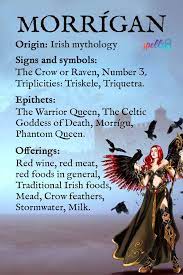
The Morrígan (“phantom queen”) or Mórrígan (“great queen”), also written as Morrígu or in the plural as Morrígna, and spelt Morríghan or Mór-Ríoghain in Modern Irish, is a figure from Irish mythology who appears to have once been a goddess, although she is not explicitly referred to as such in the texts.
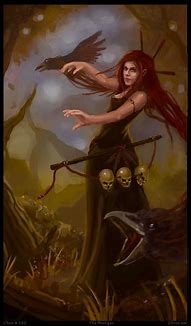
The Morrigan is a goddess of battle, strife, and fertility. She sometimes appears in the form of a crow, flying above the warriors, and in the Ulster cycle she also takes the form of an eel, a wolf and a cow. She is generally considered a war deity comparable with the Germanic Valkyries, although her association with cattle also suggests a role connected with fertility, wealth, and the land.
She is often depicted as a triple goddess, although membership of the triad varies; the most common combination is the Badb, Macha and Nemain, but other accounts name Fea, Anann, and others.
There is some disagreement over the meaning of the Morrígan’s name. Mor may derive from an Indo-European root connoting terror or monstrousness, cognate with the Old English maere (which survives in the modern English word “nightmare”) and the Scandinavian mara; while rígan translates as ‘queen’. This can be reconstructed in Proto-Celtic as *Moro-rīganī-s. Accordingly, Morrígan is often translated as “Phantom Queen”. This is the derivation generally favoured in current scholarship.
In the Middle Irish period the name is often spelt Mórrígan with a lengthening diacritic over the ‘o’, seemingly intended to mean “Great Queen” (Old Irish mór, ‘great’; this would derive from a hypothetical Proto-Celtic *Māra Rīganī-s.). Whitley Stokes believed this latter spelling was a due to a false etymology popular at the time. There have also been attempts to link the Morrígan with the fairy Morgan from Arthurian romance, in whose name ‘mor’ may derive from ‘sea’ or ‘water’.
The name is also sometimes spelt Morrígu and given in plural as Morrígna in Old Irish.
The earliest sources for the Morrígan are glosses in Latin manuscripts, and glossaries (collections of glosses). In a 9th century manuscript containing the Latin Vulgate translation of the Book of Isaiah, the word Lamia is used to translate the Hebrew Lilith. A gloss explains this as “a monster in female form, that is, a morrígan“. Cormac’s Glossary (also 9th century), and a gloss in the later manuscript H.3.18, both explain the plural word gudemain (“spectres”) with the plural form morrígna. The 8th century O’Mulconry’s Glossary says that Macha is one of the three morrígna. It therefore appears that at this time the name Morrígan was seen as referring to a class of beings rather than an individual.
The Morrígan’s earliest narrative appearances, in which she is depicted as an individual, are in stories of the Ulster Cycle, where she has an ambiguous relationship with the hero Cú Chulainn. In Táin Bó Regamna (The Cattle Raid of Regamain), Cúchulainn encounters the Morrígan, but does not recognize her, as she drives a heifer from his territory. In response to his challenge, she insults him, but before he can attack she becomes a black bird on a nearby branch. Cúchulainn now knows who she, and tells her that had he known before, they would not have parted in enmity. She notes that whatever he had done would have brought him ill luck. To his response that she cannot harm him, she makes a series of threats, foretelling a coming battle in which he will be killed. She tells him, enigmatically, “I guard your death”.
In the Táin Bó Cuailnge queen Medb of Connacht launches an invasion of Ulster to steal the bull Donn Cuailnge; the Morrígan, like Alecto of the Greek Furies, appears to the bull in the form of a crow and warns him to flee. Cúchulainn defends Ulster by fighting a series of single combats at fords against Medb’s champions. In between combats the Morrígan appears to him as a young woman and offers him her love, and her aid in the battle, but he spurns her. In response she intervenes in his next combat, first in the form of an eel who trips him, then as a wolf who stampedes cattle across the ford, and finally as a red heifer leading the stampede, just as she had threatened in their previous encounter. However Cúchulainn wounds her in each form and defeats his opponent despite her interference. Later she appears to him as an old woman bearing the same three wounds that her animal forms sustained, milking a cow. She gives Cúchulainn three drinks of milk. He blesses her with each drink, and her wounds are healed. As the armies gather for the final battle, she prophesies the bloodshed to come.
In one version of Cúchulainn’s death-tale, as the hero rides to meet his enemies, he encounters the Morrígan as a hag washing his bloody armour in a ford, an omen of his death. Later in the story, mortally wounded, Cúchulainn ties himself to a standing stone with his own entrails so he can die upright, and it is only when a crow lands on his shoulder that his enemies believe he is dead.
The Morrígan also appears in texts of the Mythological Cycle. In the 12th century pseudohistorical compilation Lebor Gabála Érenn she is listed among the Tuatha Dé Danann as one of the daughters of Ernmas, granddaughter of Nuada.
The first three daughters of Ernmas are given as Ériu, Banba, and Fódla. Their names are synonyms for Ireland, and they were married to Mac Cuill, Mac Cécht, and Mac Gréine, the last three Tuatha Dé Danann kings of Ireland. Associated with the land and kingship, they probably represent a triple goddess of sovereignty. Next come Ernmas’s other three daughters: the Badb, Macha, and the Morrígan. A quatrain describes the three as wealthy, “springs of craftiness” and “sources of bitter fighting”. The Morrígan’s name is said to be Anann, and she had three sons, Glon, Gaim, and Coscar. According to Geoffrey Keating’s 17th century History of Ireland, Ériu, Banba, and Fódla worshipped the Badb, Macha, and the Morrígan respectively, suggesting that the two triads of goddesses may be seen as equivalent.
The Morrígan also appears in Cath Maige Tuireadh (The Battle of Mag Tuired). On Samhain she keeps a tryst with the Dagda before the battle against the Fomorians. When he meets her she is washing herself, standing with one foot on either side of the river Unius. In some sources she is believed to have created the river. After they have sex, the Morrígan promises to summon the magicians of Ireland to cast spells on behalf of the Tuatha Dé, and to destroy Indech, the Fomorian king, taking from him “the blood of his heart and the kidneys of his valour”. Later, we are told, she would bring two handfuls of his blood and deposit them in the same river (however, we are also told later in the text that Indech was killed by Ogma).
As battle is about to be joined, the Tuatha Dé leader, Lug, asks each what power they bring to the battle. The Morrígan’s reply is difficult to interpret, but involves pursuing, destroying and subduing. When she comes to the battlefield she chants a poem, and immediately the battle breaks and the Fomorians are driven into the sea. After the battle she chants another poem celebrating the victory and prophesying the end of the world.
In another story she lures away the bull of a woman called Odras, who follows her to the otherworld via the cave of Cruachan. When she falls asleep, the Morrígan turns her into a pool of water.
The Morrígan is often considered a triple goddess, but her supposed triple nature is ambiguous and inconsistent. Sometimes she appears as one of three sisters, the daughters of Ernmas: the Morrígan, the Badb and Macha. Sometimes the trinity consists of the Badb, Macha and Nemain, collectively known as the Morrígan, or in the plural as the Morrígna. Occasionally Fea or Anu also appear in various combinations. However the Morrígan also frequently appears alone, and her name is sometimes used interchangeably with the Badb, with no third “aspect” mentioned.
The Morrígan is usually interpreted as a “war goddess”: W. M. Hennessey’s “The Ancient Irish Goddess of War,” written in 1870, was influential in establishing this interpretation. Her role often involves premonitions of a particular warrior’s violent death, suggesting a link with the Banshee of later folklore. This connection is further noted by Patricia Lysaght: “In certain areas of Ireland this supernatural being is, in addition to the name banshee, also called the badhb“.
It has also been suggested that she was closely tied to Irish männerbund groups (described as “bands of youthful warrior-hunters, living on the borders of civilized society and indulging in lawless activities for a time before inheriting property and taking their places as members of settled, landed communities”) and that these groups may have been in some way dedicated to her. If true, her worship may have resembled that of Perchta groups in Germanic areas.
However, Máire Herbert has argued that “war per se is not a primary aspect of the role of the goddess”, and that her association with cattle suggests her role was connected to the earth, fertility and sovereignty; she suggests that her association with war is a result of a confusion between her and the Badb, who she argues was originally a separate figure. She can be interpreted as providing political or military aid, or protection to the king — acting as a goddess of sovereignty, not necessarily a war goddess.
There is a burnt mound site in County Tipperary known as Fulacht na Mór Ríoghna (“cooking pit of the Mórrígan”). The fulachta sites are found in wild areas, and usually associated with outsiders such as the Fianna and the above-mentioned männerbund groups, as well as with the hunting of deer. The cooking connection also suggests to some a connection with the three mythical hags who cook the meal of dogflesh that brings the hero Cúchulainn to his doom. The Dá Chich na Morrigna (“two breasts of the Mórrígan”), a pair of hills in County Meath, suggest to some a role as a tutelary goddess, comparable to Danu or Anu, who has her own hills in County Kerry. Other goddesses known to have similar hills are Áine and Grian of County Limerick who, in addition to a tutelary function, also have solar attributes.
There have been attempts by some modern authors of fiction to link the Arthurian character Morgan le Fay with the Morrígan. Morgan first appears in Geoffrey of Monmouth’s Vita Merlini (The Life of Merlin) in the 12th century. However, while the creators of the literary character of Morgan may have been somewhat inspired by the much older tales of the goddess, the relationship ends there. Scholars such as Rosalind Clark hold that the names are unrelated, the Welsh “Morgan” (Wales being the source of Arthurian legend being derived from root words associated with the sea, while the Irish “Morrígan” has its roots either in a word for “terror” or a word for “greatness”.
The origins of the Morrigan seem to reach directly back to the megalithic cult of the Mothers. The Mothers (Matrones, Idises, Disir, etc.) usually appeared as triple goddesses and their cult was expressed through both battle ecstasy and regenerative ecstasy. It’s also interesting to note that later Celtic goddesses of sovereignty, such as the trio of Eriu, Banba, and Fotla, also appear as a trio of female deities who use magic in warfare. “Influence in the sphere of warfare, but by means of magic and incantation rather than through physical strength, is common to these beings.” (Ross 205)
Eriu, a goddess connected to the land in a fashion reminiscent of the Mothers, could appear as a beautiful woman or as a crow, as could the Morrigan. The Disir appeared in similar guises. In addition to being battle goddesses, they are significantly associated with fate as well as birth in many cases, along with appearing before a death or to escort the deceased.
There is certainly evidence that the concept of a raven goddess of battle was not limited to the Irish Celts. An inscription found in France which reads Cathubodva, ‘Battle Raven’, shows that a similar concept was at work among the Gaulish Celts.
Valkyries in Norse cosmology. Both use magic to cast fetters on warriors and choose who will die.
During the Second Battle, the Morrigan “said she would go and destroy Indech son of De Domnann and ‘deprive him of the blood of his heart and the kidneys of his valor’, and she gave two handfuls of that blood to the hosts. When Indech later appeared in the battle, he was already doomed.” (Rees 36)
Compare this to the Washer at the Ford, another guise of the Morrigan. The Washer is usually to be found washing the clothes of men about to die in battle. In effect, she is choosing who will die.
An early German spell found in Merseburg mentions the Indisi, who decided the fortunes of war and the fates of warriors. The Scandinavian “Song of the Spear”, quoted in “Njals Saga”, gives a detailed description of Valkyries as women weaving on a grisly loom, with severed heads for weights, arrows for shuttles, and entrails for the warp. As they worked, they exulted at the loss of life that would take place. “All is sinister now to see, a cloud of blood moves over the sky, the air is red with the blood of men, and the battle women chant their song.” (Davidson 94)
An Old English poem, “Exodus”, refers to ravens as choosers of the slain. In all these sources, ravens, choosing of the slain, casting fetters, and female beings are linked.
“As the Norse and English sources show them to us, the walkurjas are figures of awe an even terror, who delight in the deaths of men. As battlefield scavengers, they are very close to the ravens, who are described as waelceasega, “picking over the dead”…” (Our Troth)
“The function of the goddess [the Morrigan] here, it may be noted, is not to attack the hero [Cu Chulainn] with weapons but to render him helpless at a crucial point in the battle, like the valkyries who cast ‘fetters’ upon warriors … thus both in Irish and Scandinavian literature we have a conception of female beings associated with battle, both fierce and erotic.” (Davidson 97, 100)
She appeared to the hero Cu Chulainn(son of the god Lugh) and offered her love to him. When he failed to recognize her and rejected her, she told him that she would hinder him when he was in battle. When Cu Chulainn was eventually killed, she settled on his shoulder in the form of a crow. Cu’s misfortune was that he never recognized the feminine power of sovereignty that she offered to him.
She appeared to him on at least four occasions and each time he failed to recognize her.
Created By Calesta
The information on Morrigan is vast, and at times contradictory. It would take many, many webpages to tell all of her stories and it was very difficult to narrow this down! From maiden to mother to crone, from the destruction of war and death, to the beauty of the river of rebirth, Morrigan shows us the full circle of life. As with many Divine Feminine images, time can distort, and different cultures take on different attributes. What I have found that is close to the truth in my experience with her follows.
Morrigan is an Irish and Celtic Goddess. She can shapeshift into a crow or raven. It is said that she would take this form and fly over battlefields “calling upon the spirits of slain warriors.” (p. 252, McCoy) She is a triple goddess, with the aspects of the “virgin Ana, flowering fertility- goddess; the mother Babd, “Boiling” the cauldron perpetually producing life; and the crone Macha, “great Queen of the Phantoms” or Mother Death.” (p. 675, Walker). I believe she was also originally connected to the Great Irish Mother Goddess, Anu (later called Danu). In her aspect of Macha she was so powerful her name was the ancient capital of Ireland (p. 186, Kimball).
In the tales of the first people of Ireland, the Tuatha De Danann (literally the people of the Goddess Danu, pg. 189 Kimball), Morrigan was said to have blown a protective fog over all of the land, so that they would not be invaded. This shows the strength of Morrigan, and the protection the people received from her. Morrigan is also connected with death and destruction and battles. One story tells that Macha was forced to race while pregnant with twins, and when she (easily) won she gave birth to the twins. She was so angry at her tormentors for giving birth in public that way, she cursed them with the pain of childbirth before enemies were closing in. For nine generations when Ulster came under attack the men would experience the pains of childbirth (p. 192 Kimball).
Morrigan is a “Goddess of rivers, lakes and freshwaters”, and she was seen by Cu Chulain before his death, washing the clothes and arms. It is said that if one sees Morrigan by the river washing their clothes or body, is is a prediction of death before going into battle. Looking at this story, one can see the river or water as a place of rebirth, that Morrigan as the Goddess washing, anointing the body before being reborn.
Calling upon the strength of a woman that can fight off armies, and wash the dead is very powerful. Darkness, death, is a natural part of life, and brewing in the cauldron of rebirth is new life. But what I have found is to recognize that over time most Goddesses have been demonized… made to be solely focused on sex or death. Taking out pieces of the cycle, and turning them into something evil. Just as the wise crone was turned to hag.
Hymn to the Morrigan by Isaac Bonewits
O Morrigan, we call your name Across the dusty years.
You speak to us, of blood and lust. You show us all our fears.
You are a goddess, old and wise. Of holy power you have no dearth.
Beneath your wings : Black, Red and White, We learn of death and birth.
You walk about, this ancient land, Your hungers raw and clear.
You make the crops, grow rich and strong, As well your geese and deer.
A flirting maid, a lusty hag, A mother of great girth :
Without the touch of your black wings, We cannot heal the earth.
You float upon, a blood red wave, Of swords and spears and knives.
Your voice inspires, fear and dread, That you’ll cut short our lives.
You try the warriors’, courage sore, Our inner souls unearth.
Without the touch of your red wings, We cannot know our worth.
You fly above the silver clouds, To Manannan’s shining Gate.
You lead the dead along that path, To meet our final fate.
The joke’s on us, we find within, A land of laughter and of mirth.
Without the touch of your white wings, We cannot have rebirth.

Hanukkah (Jewish)
Themes: Miracles; Victory, Success; Overcoming
Symbol: Light
About Sephira: This ancient Cabalistic goddess embodies divine light – the active, energetic power that flows
through the Universe in all directions. Thus, it is no coincidence that the ten spheres on the Tree of Life are
called Sephirah, for this goddess guides our way and path with her radiance.
To Do Today: This festival commemorates the rebellion of the Jews against the Syrians, in which a miracle took
place. A small bottle of oil stayed lit for eight days, keeping the temple consecrated until more oil could be brought.
Since Sephira is the light of miracles, today’s a good time to focus on seemingly impossible goals or situations that
you may have set aside or left behind in discouragement. Revisit those dreams; reconsider the logistics of those
circumstances. If there is a better way to approach things, Sephira will illuminate that path or options for you in
your meditations. Make sure to turn on light sources today, and open curtains to let natural light into your home.
Symbolically, this welcomes Sephira’s active power into your spiritual life and quest. Also consider following with
Jewish tradition and giving coins to friends or family. These tokens draw financial security. Or, eat potato pancakes
for providence.
By Patricia Telesco

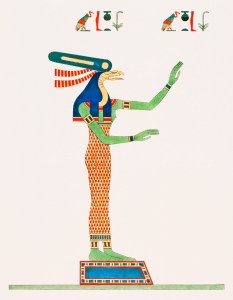
Wadjet (Wadjyt, Wadjit, Uto, Uatchet, Edjo, Buto) was one of the oldest Egyptian goddesses. Her worship was already established by the Predynastic Period, but did change somewhat as time progressed. She began as the local goddess of Per-Wadjet (Buto) but soon became a patron goddess of Lower Egypt.
By the end of the Predynastic Period, Wadjet was considered to be the personification of Lower Egypt rather than a distinct goddess and almost always appeared with her sister Nekhbet (who represented Upper Egypt). The two combined represented the country as a whole and were represented in the “nebty” (one of the pharaoh’s names, also known as “the two ladies”) which indicated that the king ruled over both parts of Egypt. The earliest recovered example of the nebty name is from the reign of Anedjib of the First Dynasty.
In the Pyramid Texts it is suggested that Wadjet created the first papyrus plant and primordial swamp. Her link to the papyrus is strengthened by the fact that her name was written using the glyph of a papyrus plant and the same plant was the heraldic plant of Lower Egypt.
According to another myth Wadjet was the daughter of Atum (or later Ra) who sent her as his “eye” to find Tefnut (moisture) and Shu (air) when they were lost in the waters of Nun. He was so happy when they returned that he cried and created the first human beings from his tears. To reward his daughter, he placed her upon his head in the form of a cobra so that she would always be close to him and could act as his protector.
Wadjet was one of the goddesses given the title “Eye of Ra” (connecting her to Bast, Hathor, Sekhmet, and Tefnut among others). In fact, the symbol of the “Eye of Ra” was often called “the Wedjat”.
In this form she was sent out to avenge her father and almost caused the destruction of mankind. Humanity was saved when she was tricked with some beer which had been dyed red with pomegranate juice to resemble blood.
There is also a suggestion that she was very closely linked to the principle of Ma’at (justice or balance). Before being crowned as king, Geb attacked and raped his mother Tefnut. When he went to take his place as pharaoh and put the Royal Ureas on his own forehead, the snake reared up and attacked the god and his followers. All of Geb’s retinue died and the god himself was badly injured. Clearly, his actions were against Ma’at and Wadjet was not prepared to allow him to go unpunished.
Wadjet is often described as an agressive deity while while her sister Nekhbet was thought of as a more matronly protector. However, she also had her gentler side. Wadjet was believed to have helped Isis nurse the young Horus and to help mother and baby hide from Set in the marshes of the delta. She was also considered to offer protection to all women during childbirth.
Wadjet and her sister also protected the adult Horus from the followers of Set. Horus pursued them in the form of a winged sun disc and Nekhbet and Wadjet flanked him in the form of crowned snakes. This protection was also extended towards the pharaoh who wore the “Royal Ureas” (serpent) on his (or her) forehead.
From the Eighteenth Dynasty the queens also added one or two snakes to their headdresses representing Wadjet and her sister.
Wadjet was associated with the fifth hour of the fifth day of the month and with “iput-hmt” (Epipi), the harvest month of the Egyptian calendar. Festivals were held in her honour on the 10th day of “rh-wr” (Mekhir) which was also called “the day of going forth of the Goddess”, the 7th day of “khnty-khty” (Payni), and the 8th day of “Wpt-rnpt” (Mesori). These latter two dates coincide roughly with the winter and spring solstices.
She was worshiped at the Temple of Wadjet, known as “Pe-Dep”. This temple was already long established by the Old Kingdom and is referred to in the Pyramid Texts. In this temple, Wadjet was linked with Horus.
Wadjet was thought to be the wife of Hapi in Lower Egypt and was linked to Set in his role as a representative of Lower Egypt. She was sometimes described as the wife of Ptah and the mother of Nefertem, probably because she occasionally took the form of a lion like Sekhmet.
Her sacred animal was the cobra, and Wadjet was often depicted as either a rearing cobra, a winged cobra, or a woman with the head of a cobra. She was also depicted as a woman wearing the red crown of Lower Egypt. She often appears with her sister Nekhbet who appeared as a snake or woman.
By the Late Period Wadjet was also associated with the ichneumon (a mongoose-like creature). This animal was known for its skill in killing snakes and was also sacred to Horus.The Egyptians placed mummified ichneumon and shrew (small mice) inside statuettes of Wadjet which were interred with the dead. The two animals represented day (ichneumon) and night (shrew). She was also worshipped as a vulture Goddess. In her form of the “eye of Ra” she was depicted as a lion-headed woman wearing a solar disc and the Uraeus (cobra).

(Auset)
Perhaps the most important goddess of all Egyptian mythology, Isis assumed,
during the course of Egyptian history, the attributes and functions of virtually
every other important goddess in the land. Her most important functions,
however, were those of motherhood, marital devotion, healing the sick, and the
working of magical spells and charms. She was believed to be the most powerful
magician in the universe, owing to the fact that she had learned the Secret Name
of Ra from the god himself. She was the sister and wife of Osiris, sister of
Set, and twin sister of Nephthys. She was the mother of Horus the Child
(Harpocrates), and was the protective goddess of Horus’s son Amset, protector of
the liver of the deceased.
Isis was responsible for protecting Horus from Set during his infancy; for
helping Osiris to return to life; and for assisting her husband to rule in the
land of the Dead.
Her cult seems to have originally centered, like her husband’s, at Abydos near
the Delta in the North (Lower Egypt); she was adopted into the family of Ra
early in Egyptian history by the priests of Heliopolis, but from the New Kingdom
onwards (c. 1500 BC) her worship no longer had any particular identifiable
center, and she became more or less universally worshiped, as her husband was.

In Celtic mythology, Badb, also known as Battle Crow or Death-Bringer, was the goddess of death and war, creating confusion and fear on battlefields in favor of the victors. She was one aspect of the Celtic triple goddess of war, death, and prophecy, called the Morrigan.


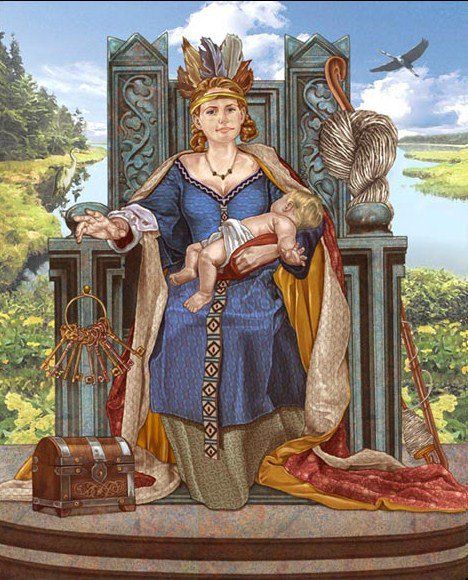
Areas of Influence: Frigg was the Norse Goddess of marriage, childbirth, motherhood, wisdom, household management and weaving and spinning.
She was the Queen of Aesir and the only one permitted to sit on the high seat other than her husband Odin.
This Goddess’s home was Fensalir (Marsh hall) in Asgard. All marshy and boggy ground was sacred to this Goddess.
As Goddess of weaving she was associated with weaving clouds and the threads of fate, known as Wyrd in the Nordic tradition. Despite this and the gift of prophecy she is unable to save her own son from his fate. The Goddess made him invincible to everything other than mistletoe but unfortunately Loki disguised himself and tricked her in to revealing this weakness.
She has more than ten handmaidens who assist her, the most well known of these are Hlin (Goddess of Protection), Gna (a messenger Goddess) and Fulla (a fertility Deity). Some academics have suggested that the attendants represent different faces of this particular Deity.
Barren women would invoke this Goddess and ask her to bless them with children.
Her name means “beloved one.” Other spellings of this Goddesses name include Frea, Fija, Friia, Frig and Friggja.
Origins and Genealogy: She was the daughter of Fjorgynn (the male personification of the earth) and was married to Odin with whom she had two sons, Balder and Hodr.
She was briefly married to Odin’s brother’s Vili and Ve as Odin had been away travelling a long time and was believed to be dead. When he finally returned, the marriage to Odin’s brothers was dissolved and she returned to her husband’s side.
Strengths: A loving mother and home maker.
Weaknesses: Unable to save her son.
Symbolism
Like Freya she wears a ravens clock.
She is associated with constellation the Orion’s Belt which was known as the Frig’s Distaff upon which she winds the threads of fate and weaves the clouds.
Sacred Birds: Ravens, hawks and falcons.
Sacred Plants: Frigg’s grass is a plant was traditionally used as a sedative during birth. Mistletoe is also sacred to her.
Frigg’s Archetype
The Mother
The Mother is a life-giver and the source of nurturing, devotion, patience and unconditional love. The ability to forgive and provide for her children and put them before herself is the essence of a good mother.
In its shadow aspect the Mother can be devouring, abusive and abandoning. The shadow Mother can also make her children feel guilty about becoming independent and leaving her. It is not necessary to be a biological Mother to have this stereotype. It can refer to anyone who has a lifelong pattern of nurturing and devotion to living things.
This Goddess was a devoted mother who was unable to prevent the death of her son. She is also a great domestic Goddess looking after the home.
How to Work With This Archetype
The Mother
You are exhibiting the features of the shadow Mother if you smother your children and are over protective. Encourage independence and allow children to make mistakes but be available to give care and advice when it’s needed.
The other shadow Mother is the one that abandons her children, or is so busy that she has no time for nurturing her young.

Halcyon Days (Greece)
Themes: Winter; Peace; Protection; Air; Meditation; Promises; Beginnings
Symbols: Rainbow; Water
About Iris:
This Greek messenger to the gods traverse between earth and heavens, appearing as a winged maiden on a shining, hopeful rainbow. In this form she represents the calm after the storm – the end of the year’s activities and the advent of a new beginning. Traditional offerings to her include figs, cakes, wheat, and honey. In some stories it was Iris’s job to gather water from the underworld for use in taking sacred oaths.
To Do Today
The word halcyon comes from a legendary bird that builds its nest on the ocean in the winter, sedating the winds with its song to safeguard its young. Thus, the week before and after the winter solstice are said to bear both the halcyon’s and Iris’s calm ambiance and hopeful demeanor.
To inspire an improved outlook, find a rainbow sun catcher and put it in a window today so that Iris’s radiance can fill your home. Get an extra one for your car (or maybe a rainbow-colored air-freshener). so you can keep the energy with you throughout the day.
For another aromatic approach, open a window briefly today and let Iris fly on the wings of change and refreshment. Burn some violet or lavendar incense as you do. These two aromatics accentuate this goddess’s vibration.
By Patricia Telesco

Themes: Luck; Wealth; Beauty
Symbols: Boats; Dragons; Guitars; Snakes; Saltwater
About Benten:
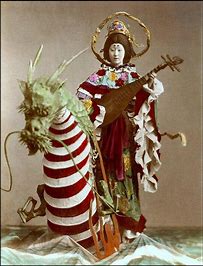
As the Japanese goddess steering the New Year’s Treasure Ship, Benten is a perfect figure to call on for financial improvements this year. She is the only goddess of luck in Japan and is referred to as queen of the seas and patroness of gamblers.
Japanese women invoke her to bring beauty and fortune into their lives. Benten is depicted as riding a golden dragon, playing a biwa (guitar), and sending out white snakes with her missies. Her robe bears a jewel that grants wishes.
To Do Today:
To welcome Benten’s prosperity into your home, sprinkle a little saltwater on the threshold today. Or, to generate beauty within and without, soak in a bath of Epsom salts while listening to guitar music. The Shigato Hajime festival honors the beginning of the work week
in Japan, where it is believed that good omens for work begin today. If you want to get a peek at how your employment will fare this year, try divination by dice (a traditional gambler’s tool). Hold one die in your hand, ask for Benten to provide a sign, then roll it. The results can be interpreted as follows:
(1) a negative omen; (2) feeling torn between two good options; (3) a good omen; (4) financial security (5) not much material change, but improvements in interoffice relationships (6) an excellent omen; roll again. If you get two more sixes, Benten’s treasures will be yours!
By Patricia Telesco
(I could not get the font to go larger, sorry about that)

Feast of Vesta (Rome)
Themes: Home; Love; Fertility; Peace
Symbols: Fire; Donkey; Veils
About Vesta: In Roman mythology, Vesta was part of every fire. As such, Vesta commands the sacred fires of the hearth, the heart of spiritual and emotional stability in your home. Today was one other festival days, Christianized as the Feast of the Ass, which is a sacred animal to her. Traditional offerings for Vesta include homemade bread and salt cakes.
In works of art, Vesta was never shown directly but always depicted her in veils, possibly to honor her importance in Roman society. The vestal priestess was one of the few people considered suited to negotiating peace during war threats.
To Do Today: The first month of the year is a good time to think about the spiritual warmth in your living space. Ask Vesta to kindle those fires anew. Do this by lighting any fire source you have handy-a match, a candle, the oven, a pilot light-or, alternatively, just turn on a light as a symbolic fire. Be sure to keep this lit all day. When a fire goes out on Vesta’s day, it’s considered a bad omen, indicative of love being lost. To encourage peace on any battleground you’re facing this year, light a white candle (the color of truce) and put it in a window to invite Vesta’s presence (being sure it’s safe to do so, of course). Then take a piece of bread outside, breaking it into small bits so the birds can carry your wish of harmony across the earth.
By Patricia Telesco

Goddess of The Day: MINERVA
Terminalia (Rome)
Themes: Earth; Home 0
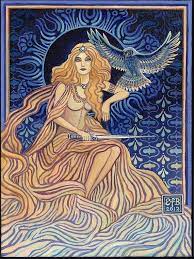
Symbols: Owl; Geranium
About Minerva: This Etruscan/Italic Goddess blended the odd attributes of being a patroness of household tasks, including arts and crafts, and also being the patroness of protection and of war. Today she joins in pre-spring festivities by helping people prepare their lands for sowing and embracing the figurative lands of our hearts, homes, and spirits with her positive energy.
To Do Today: In ancient times, this was a day to bless one’s lands and borders. Gifts of corn, honey, and wine were given to the earth and its spirits to keep the property safe and fertile throughout the year. In modern times, this equates to a Minerva-centered house blessing.
Begin by putting on some spiritually uplifting music. Burn geranium-scented incense if possible; otherwise, any pantry spice will do. Take this into every room of your home, always moving clockwise to promote positive growing energy. As you get to each room, repeat this incantation:
Minerva, protect this sacred space and all who live within. By your power and my will, the magic now begins!
Wear a geranium today to commemorate Minerva and welcome her energy into your life.
)0(
By Patricia Telesco and GrannyMoon’s Morning Feast Archives

The Roman equivalent of Aphrodite, Venus was a goddess of love and beauty. Originally, she was believed to be associated with gardens and fruitfulness, but later took on all the aspects of Aphrodite from the Greek traditions. She is considered by many to be the ancestor of the Roman people, and was the lover of the god Vulcan, as well as of the warrior god Mars.
Worship and Celebration
The earliest known temple to Venus was dedicated on the Aventine hill in Rome, around 295 b.c.e. However, her cult was based in the city of Lavinium, and her temple there became the home of a festival known as the Vinalia Rustica. A later temple was dedicated after the defeat of the Roman army near Lake Trasimine during the Second Punic War.
Venus appears to have been very popular amongst the plebian class of Roman society, as evidenced by the existence of temples in areas of the city which were traditionally plebian rather than patrician. A cult to her aspect of Venus Erycina existed near Rome’s Colline gate; in this guise, Venus was a goddess primarily of fertility.
Another cult honoring Venus Verticordia also existed between the Aventine hill and Circus Maximus.
As often found in Roman gods and goddesses, Venus existed in many different incarnations. As Venus Victrix, she took on the aspect of warrior, and as Venus Genetrix, she was known as the mother of the Roman civilization. During the reign of Julius Caesar, a number of cults were started on her behalf, since Caesar claimed that the family of the Julii were directly descended from Venus. She is also recognized as a goddess of fortune, as Venus Felix.
Brittany Garcia of Ancient History Encyclopedia says, “Venus’ month was April (the beginning of spring and fertility) when most of her festivals were held. On the first of April a festival was held in honor of Venus Verticordia called Veneralia. On the 23rd, Vinalia Urbana was held which was a wine festival belonging to both Venus (goddess of profane wine) and Jupiter. Vinalia Rusticia was held on August 10th. It was Venus’ oldest festival and associated with her form as Venus Obsequens. September 26th was the date for the festival of Venus Genetrix, the mother and protector of Rome.”
The Lovers of Venus
Similar to Aphrodite, Venus took a number of lovers, both mortal and divine. She bore children with Mars, the god of war, but doesn’t seem to have been particularly maternal in nature. In addition to Mars, Venus had children with her husband, Vulcan, and when conflated with Aphrodite, is commonly believed to be the mother of Priapus, conceived during a fling with the god Bacchus (or one of Venus’ other lovers).
Scholars have noted that Venus doesn’t have many myths of her own, and that many of her stories are borrowed from the tales of Aphrodite.
Venus in Art and Literature
Venus is nearly always portrayed as young and lovely. Throughout the Classical period, a number of statues of Venus were produced by different artists. The statue Aphrodite of Milos, better known as the Venus de Milo, depicts the goddess as classically beautiful, with womanly curves and a knowing smile. This statue is believed to have been done by Alexandros of Antioch, around 100 b.c.e.
During the European Renaissance period and beyond, it became fashionable for upper class ladies to pose as Venus for paintings or sculptures. One of the best known is that of Pauline Bonaparte Borghese, younger sister of Napoleon. Antonio Canova sculpted her as Venus Victrix, reclined on a lounge, and although Canova wanted to sculpt her in a robe, Pauline apparently insisted on being portrayed nude.
Chaucer wrote regularly of Venus, and she appears in a number of his poems, as well as in The Knight’s Tale, in which Palamon compares his lover, Emily, to the goddess. In fact, Chaucer uses the turbulent relationship between Mars and Venus to represent Palamon, the warrior, and Emily, the lovely maiden in the flower garden.
Patti Wigington, Paganism/Wicca Expert
Originally published on & owned by About.com
You must be logged in to post a comment.