God of the Day – Odin

Odin Facts and Mythology from gods-and-goddesses.com

Odin is the Norse king of the Aesir, the principal race of Norse gods. He was considered the father of all the gods and was primarily associated with magic, wisdom, war, poetry, and the runic alphabet.

Mentioned frequently from the period of the Roman occupation to the Viking Age, Odin is a prominent figure in Norse mythology who continues to be acknowledged in modern popular culture. For instance, we are reminded of him every Wednesday, the weekday that was named after him; Odin is Woden in Old English, and Woden’s day became Wednesday.

Appearance

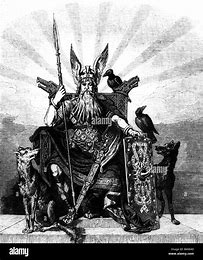
In most Norse texts, Odin is depicted as a long-bearded, one-eyed man wearing a broad hat and a cloak. Odin lost his eye upon visiting a Norse god named Mimir. Mimir was known as an extremely wise god, and he had also possessed a well called Mímisbrunnr. The waters in the well contained substantial wisdom and knowledge, and if someone drank from the well they would also gain wisdom.

However, Mimir required the drinker to sacrifice one of their eyes in order to take a drink. Odin decided to make the trade. Because of this trade, he is traditionally shown as having a dark eye or with a patch over one of his eyes.

Family

Odin had two brothers, named Vili and Ve. Myth has it that Odin created the universe after killing the primal frost giant Ymir with the help of his brothers. The three continued by making the first man and woman, Askr and Embla, from an ash tree and an elm tree.

Odin married Frigg, who is the mother of his sons Baldur, Hod, and Hermod.  With Jord, the earth goddess, he fathered Thor. He is believed to have had more sons by other wives, including Vidar from the giantess Grid.

Symbols

The most common symbol associated with Odin is the Valknut symbol, which is made of three linked or interlocked triangles. This symbol appears in a number of places along with Odin or ravens, including the Tängelgårda stone in Sweden.

There are a number of interpretations about the meaning of the Valknut. Some believe it represented slain warriors, many of which went to stay with Odin in Valhalla. In fact, the word Valknut is derived from the words valr, which means slain warriors, and knut, which means knot. Others think that it may symbolize the heart of Hrungnir.

Another common symbol affiliated with Odin is his spear, called Gungnir, which he acquired from the trickster god Loki after he stole it from the dwarfs who made it.

The ravens Hugin (thought) and Munin (memory) were Odin’s companions. They traveled across the Nine Worlds in Norse cosmology and returned to their master’s shoulder with tales of what they saw.

Odin also had two pet wolves called Geri and Freki. He is said to have created them when he became lonely. Like ravens, they haunt battlefields and feast upon the dead. Odin, who only drinks wine, gave them all his food.

Powers & Duties

In Valhalla, Odin sat on his throne called Hlidskjalf from where he watched over the Nine Realms.

Odin sought further knowledge in the runes, the letters of the runic alphabet. To achieve this, he hung from a tree with a spear in his side for nine days and nights without food or drink. He often used runes to practice wizardry.

Together with Freya, the goddess of love and war, Odin possessed the souls of slain warriors. The half that belonged to him found a final resting place in Valhalla, his palatial home with 640 doors. They were brought here by Odin’s daughters, the Valkyries, who met them on the battlefield.

Odin had a never-ending quest for wisdom. Sometime after he sacrificed his eye, he also took possession of Mimir’s head when Mimir was decapitated by the Vanir, a rival tribe. The head would tell him secrets and give him advice.

Facts About Odin …

God of the Day – Osiris

Osiris

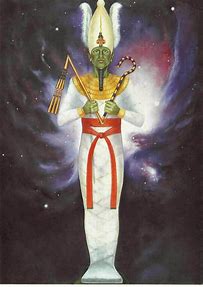
Osiris the god of the afterlife, the underworld, and rebirth in ancient Egyptian religion. He was classically depicted as a green-skinned deity with a pharaoh’s beard, partially mummy-wrapped at the legs, wearing a distinctive atef crown, and holding a symbolic crook and flail. (He was one of the first to be associated with the mummy wrap. When the brother cut him up into pieces after killing him Isis, his wife, found all the pieces and wrapped his body up.) Osiris was at times considered the eldest son of the god Geb and the sky goddess Nut, as well as being brother and husband of Isis, with Horus being considered his posthumously begotten son. He was also associated with the epithet Khenti-Amentiu, meaning “Foremost of the Westerners”, a reference to his kingship in the land of the dead. As ruler of the dead, Osiris was also sometimes called “king of the living”: ancient Egyptians considered the blessed dead “the living ones”. Through syncretism with Iah, he is also the god of the Moon.

Osiris was considered the brother of Isis, Set, Nephthys, and Horus the Elder, and father of Horus the Younger. The first evidence of the worship of Osiris was found in the middle of the Fifth dynasty of Egypt, although it is likely that he was worshiped much earlier; the Khenti-Amentiu epithet dates to at least the first dynasty, and was also used as a pharaonic title. Most information available on the myths of Osiris is derived from allusions contained in the Pyramid Texts at the end of the Fifth Dynasty, later New Kingdom source documents such as the Shabaka Stone and the Contending of Horus and Seth, and much later, in narrative style from the writings of Greek authors including Plutarch and Diodorus Siculus.

Osiris was the judge of the dead and the underworld agency that granted all life, including sprouting vegetation and the fertile flooding of the Nile River. He was described as “He Who is Permanently Benign and Youthful” and the “Lord of Silence”. The Kings of Egypt were associated with Osiris in death – as Osiris rose from the dead so would they in union with him, and inherit eternal life through a process of imitative magic. By the New Kingdom all people, not just pharaohs, were believed to be associated with Osiris at death, if they incurred the costs of the assimilation rituals.

Through the hope of new life after death, Osiris began to be associated with the cycles observed in nature, in particular vegetation and the annual flooding of the Nile, through his links with the heliacal rising of Orion and Sirius at the start of the new year. Osiris was widely worshipped until the decline of ancient Egyptian religion during the rise of Christianity in the Roman Empire.

Etymology of the name

Osiris is a Latin transliteration of the Ancient Greek Ὄσιρις IPA: [ó.siː.ris], which in turn is the Greek adaptation of the original name in the Egyptian language. In Egyptian hieroglyphs the name appears as wsjr, which some Egyptologists instead choose to transliterate ꜣsjr or jsjrj. Since hieroglyphic writing lacks vowels, Egyptologists have vocalized the name in various ways as Asar, Yasar, Aser, Asaru, Ausar, Ausir, Wesir, Usir, Usire or Ausare.

Several proposals have been made for the etymology and meaning of the original name; as Egyptologist Mark J. Smith notes, none are fully convincing. Most take wsjr as the accepted transliteration, following Adolf Erman:

  • John Gwyn Griffiths (1980), “bearing in mind Erman’s emphasis on the fact that the name must begin with an [sic] w“, proposes a derivation from wsr with an original meaning of “The Mighty One”. Moreover, one of the oldest attestations of the god Osiris appears in the mastaba of the deceased Netjer-wser (from nṯr-wsr “Powerful God”).[citation needed]
  • Kurt Sethe (1930) proposes a compound st-jrt, meaning “seat of the eye”, in a hypothetical earlier form *wst-jrt; this is rejected by Griffiths on phonetic grounds.
  • David Lorton (1985) takes up this same compound but explains st-jrt as signifying “product, something made”, Osiris representing the product of the ritual mummification process.
  • Wolfhart Westendorf (1987) proposes an etymology from wꜣst-jrt “she who bears the eye”.
  • Mark J. Smith (2017) makes no definitive proposals but asserts that the second element must be a form of jrj (“to do, make”) (rather than jrt (“eye”)).

However, recently alternative transliterations have been proposed:

  • Yoshi Muchiki (1990) reexamines Erman’s evidence that the throne hieroglyph in the word is to be read ws and finds it unconvincing, suggesting instead that the name should be read ꜣsjr on the basis of Aramaic, Phoenician, and Old South Arabian transcriptions, readings of the throne sign in other words, and comparison with ꜣst(“Isis”).
  • James P. Allen (2000) reads the word as jsjrt but revises the reading (2013) to jsjrj and derives it from js-jrj, meaning “engendering (male) principle”.

Appearance

Osiris is represented in his most developed form of iconography wearing the Atef crown, which is similar to the White crown of Upper Egypt, but with the addition of two curling ostrich feathers at each side (see also Atef crown (hieroglyph)). He also carries the crook and flail. The crook is thought to represent Osiris as a shepherd god. The symbolism of the flail is more uncertain with shepherds whip, fly-whisk, or association with the god Andjety of the ninth nome of Lower Egypt proposed.

He was commonly depicted as a pharaoh with a complexion of either green (the color of rebirth) or black (alluding to the fertility of the Nile floodplain) in mummiform (wearing the trappings of mummification from chest downward).

Early mythology

The Pyramid Texts describe early conceptions of an afterlife in terms of eternal travelling with the sun god amongst the stars. Amongst these mortuary texts, at the beginning of the 4th dynasty, is found: “An offering the king gives and Anubis”. By the end of the 5th dynasty, the formula in all tombs becomes “An offering the king gives and Osiris“.

Father of Horus

Osiris is the mythological father of the god Horus, whose conception is described in the Osiris myth (a central myth in ancient Egyptian belief). The myth describes Osiris as having been killed by his brother, Set, who wanted Osiris’ throne. His wife, Isis finds the body of Osiris and hides it in the reeds where it is found and dismembered by Set. Isis retrieves and joins the fragmented pieces of Osiris, then briefly brings Osiris back to life by use of magic. This spell gives her time to become pregnant by Osiris before he again dies. Isis later gives birth to Horus. As such, since Horus was born after Osiris’ resurrection, Horus became thought of as a representation of new beginnings and the vanquisher of the usurper Set.

Ptah-Seker (who resulted from the identification of Creator god Ptah with Seker) thus gradually became identified with Osiris, the two becoming Ptah-Seker-Osiris. As the sun was thought to spend the night in the underworld, and was subsequently “reborn” every morning, Ptah-Seker-Osiris was identified as king of the underworld, god of the afterlife, life, death, and regeneration.

Ram god

Osiris’ soul, or rather his Ba, was occasionally worshipped in its own right, almost as if it were a distinct god, especially in the Delta city of Mendes. This aspect of Osiris was referred to as Banebdjedet, which is grammatically feminine (also spelt “Banebded” or “Banebdjed“), literally “the ba of the lord of the djed, which roughly means The soul of the lord of the pillar of continuity. The djed, a type of pillar, was usually understood as the backbone of Osiris.

The Nile supplying water, and Osiris (strongly connected to the vegetable regeneration) who died only to be resurrected, represented continuity and stability. As Banebdjed, Osiris was given epithets such as Lord of the Sky and Life of the (sun god) Ra, since Ra, when he had become identified with Atum, was considered Osiris’ ancestor, from whom his regal authority is inherited. Ba does not mean “soul” in the western sense, and has to do with power, reputation, force of character, especially in the case of a god.

Since the ba was associated with power, and also happened to be a word for ram in Egyptian, Banebdjed was depicted as a ram, or as Ram-headed. A living, sacred ram was kept at Mendes and worshipped as the incarnation of the god, and upon death, the rams were mummified and buried in a ram-specific necropolis. Banebdjed was consequently said to be Horus’ father, as Banebdjed was an aspect of Osiris.

Regarding the association of Osiris with the ram, the god’s traditional crook and flail are the instruments of the shepherd, which has suggested to some scholars also an origin for Osiris in herding tribes of the upper Nile. The crook and flail were originally symbols of the minor agricultural deity Andjety, and passed to Osiris later. From Osiris, they eventually passed to Egyptian kings in general as symbols of divine authority.

Mythology

Plutarch recounts one version of the Osiris myth in which Set (Osiris’ brother), along with the Queen of Ethiopia, conspired with 72 accomplices to plot the assassination of Osiris. Set fooled Osiris into getting into a box, which Set then shut, sealed with lead, and threw into the Nile. Osiris’ wife, Isis, searched for his remains until she finally found him embedded in a tamarisk tree trunk, which was holding up the roof of a palace in Byblos on the Phoenician coast. She managed to remove the coffin and retrieve her husband’s body.

In one version of the myth, Isis used a spell to briefly revive Osiris so he could impregnate her. After embalming and burying Osiris, Isis conceived and gave birth to their son, Horus. Thereafter Osiris lived on as the god of the underworld. Because of his death and resurrection, Osiris was associated with the flooding and retreating of the Nile and thus with the yearly growth and death of crops along the Nile valley.

Diodorus Siculus gives another version of the myth in which Osiris was described as an ancient king who taught the Egyptians the arts of civilization, including agriculture, then travelled the world with his sister Isis, the satyrs, and the nine muses, before finally returning to Egypt. Osiris was then murdered by his evil brother Typhon, who was identified with Set. Typhon divided the body into twenty-six pieces, which he distributed amongst his fellow conspirators in order to implicate them in the murder. Isis and Hercules (Horus) avenged the death of Osiris and slew Typhon. Isis recovered all the parts of Osiris’ body, except the phallus, and secretly buried them. She made replicas of them and distributed them to several locations, which then became centres of Osiris worship.

Worship

Annual ceremonies were performed in honor of Osiris in various places across Egypt. These ceremonies were fertility rites which symbolised the resurrection of Osiris. E.A. Wallis Budge stated “Osiris is closely connected with the germination of wheat; the grain which is put into the ground is the dead Osiris, and the grain which has germinated is the Osiris who has once again renewed his life.”

Death or transition and institution as god of the afterlife

Plutarch and others have noted that the sacrifices to Osiris were “gloomy, solemn, and mournful…” (Isis and Osiris, 69) and that the great mystery festival, celebrated in two phases, began at Abydos commemorating the death of the god, on the same day that grain was planted in the ground (Isis and Osiris, 13). The annual festival involved the construction of “Osiris Beds” formed in shape of Osiris, filled with soil and sown with seed.

The germinating seed symbolized Osiris rising from the dead. An almost pristine example was found in the tomb of Tutankhamun by Howard Carter.

The first phase of the festival was a public drama depicting the murder and dismemberment of Osiris, the search of his body by Isis, his triumphal return as the resurrected god, and the battle in which Horus defeated Set.

According to Julius Firmicus Maternus of the fourth century, this play was re-enacted each year by worshippers who “beat their breasts and gashed their shoulders…. When they pretend that the mutilated remains of the god have been found and rejoined…they turn from mourning to rejoicing.” (De Errore Profanorum).

The passion of Osiris was reflected in his name ‘Wenennefer” (“the one who continues to be perfect”), which also alludes to his post mortem power.

Ikhernofret Stela

Much of the extant information about the rites of Osiris can be found on the Ikhernofret Stela at Abydos erected in the 12th Dynasty by Ikhernofret (also I-Kher-Nefert), possibly a priest of Osiris or other official (the titles of Ikhernofret are described in his stela from Abydos) during the reign of Senwosret III (Pharaoh Sesostris, about 1875 BC). The ritual reenactment of Osiris’s funeral rites were held in the last month of the inundation (the annual Nile flood), coinciding with Spring, and held at Abydos/Abedjou which was the traditional place where the body of Osiris/Wesir drifted ashore after having been drowned in the Nile.

The part of the myth recounting the chopping up of the body into 14 pieces by Set is not recounted in this particular stela. Although it is attested to be a part of the rituals by a version of the Papyrus Jumilhac, in which it took Isis 12 days to reassemble the pieces, coinciding with the festival of ploughing. Some elements of the ceremony were held in the temple, while others involved public participation in a form of theatre. The Stela of I-Kher-Nefert recounts the programme of events of the public elements over the five days of the Festival:

  • The First Day, The Procession of Wepwawet: A mock battle was enacted during which the enemies of Osiris are defeated. A procession was led by the god Wepwawet (“opener of the way”).
  • The Second Day, The Great Procession of Osiris: The body of Osiris was taken from his temple to his tomb. The boat he was transported in, the “Neshmet” bark, had to be defended against his enemies.
  • The Third Day: Osiris is Mourned and the Enemies of the Land are Destroyed.
  • The Fourth Day, Night Vigil: Prayers and recitations are made and funeral rites performed.
  • The Fifth Day, Osiris is Reborn: Osiris is reborn at dawn and crowned with the crown of Ma’at. A statue of Osiris is brought to the temple.

Wheat and clay rituals

Contrasting with the public “theatrical” ceremonies sourced from the I-Kher-Nefert stele (from the Middle Kingdom), more esoteric ceremonies were performed inside the temples by priests witnessed only by chosen initiates. Plutarch mentions that (for much later period) two days after the beginning of the festival “the priests bring forth a sacred chest containing a small golden coffer, into which they pour some potable water…and a great shout arises from the company for joy that Osiris is found (or resurrected). Then they knead some fertile soil with the water…and fashion therefrom a crescent-shaped figure, which they cloth and adorn, this indicating that they regard these gods as the substance of Earth and Water.” (Isis and Osiris, 39). Yet his accounts were still obscure, for he also wrote, “I pass over the cutting of the wood” – opting not to describe it, since he considered it as a most sacred ritual (Ibid. 21).

In the Osirian temple at Denderah, an inscription (translated by Budge, Chapter XV, Osiris and the Egyptian Resurrection) describes in detail the making of wheat paste models of each dismembered piece of Osiris to be sent out to the town where each piece is discovered by Isis. At the temple of Mendes, figures of Osiris were made from wheat and paste placed in a trough on the day of the murder, then water was added for several days, until finally the mixture was kneaded into a mold of Osiris and taken to the temple to be buried (the sacred grain for these cakes were grown only in the temple fields). Molds were made from the wood of a red tree in the forms of the sixteen dismembered parts of Osiris, the cakes of ‘divine’ bread were made from each mold, placed in a silver chest and set near the head of the god with the inward parts of Osiris as described in the Book of the Dead (XVII).

Judgment

The idea of divine justice being exercised after death for wrongdoing during life is first encountered during the Old Kingdom in a 6th dynasty tomb containing fragments of what would be described later as the Negative Confessions performed in front of the 42 Assessors of Ma’at.

With the rise of the cult of Osiris during the Middle Kingdom the “democratization of religion” offered to even his humblest followers the prospect of eternal life, with moral fitness becoming the dominant factor in determining a person’s suitability.

At death a person faced judgment by a tribunal of forty-two divine judges. If they led a life in conformance with the precepts of the goddess Ma’at, who represented truth and right living, the person was welcomed into the kingdom of Osiris. If found guilty, the person was thrown to a “devourer” (such as the soul-eating demon Ammit) and did not share in eternal life.

The person who is taken by the devourer is subject first to terrifying punishment and then annihilated. These depictions of punishment may have influenced medieval perceptions of the inferno in hell via early Christian and Coptic texts.

Purification for those who are considered justified may be found in the descriptions of “Flame Island“, where they experience the triumph over evil and rebirth. For the damned, complete destruction into a state of non-being awaits, but there is no suggestion of eternal torture.

Divine pardon at judgement was always a central concern for the ancient Egyptians.

During the reign of Seti I, Osiris was also invoked in royal decrees to pursue the living when wrongdoing was observed, but kept secret and not reported.

Greco-Roman era

Hellenization

The early Ptolemaic kings promoted a new god, Serapis, who combined traits of Osiris with those of various Greek gods and was portrayed in a Hellenistic form. Serapis was often treated as the consort of Isis and became the patron deity of the Ptolemies’ capital, Alexandria. Serapis’s origins are not known. Some ancient authors claim the cult of Serapis was established at Alexandria by Alexander the Great himself, but most who discuss the subject of Serapis’s origins give a story similar to that by Plutarch. Writing about 400 years after the fact, Plutarch claimed that Ptolemy I established the cult after dreaming of a colossal statue at Sinope in Anatolia. His councillors identified as a statue of the Greek god Pluto and said that the Egyptian name for Pluto was Serapis. This name may have been a Hellenization of “Osiris-Apis”. Osiris-Apis was a patron deity of the Memphite Necropolis and the father of the Apis bull who was worshipped there, and texts from Ptolemaic times treat “Serapis” as the Greek translation of “Osiris-Apis”. But little of the early evidence for Serapis’s cult comes from Memphis, and much of it comes from the Mediterranean world with no reference to an Egyptian origin for Serapis, so Mark Smith expresses doubt that Serapis originated as a Greek form of Osiris-Apis’s name and leaves open the possibility that Serapis originated outside Egypt.

Destruction of cult

The cult of Isis and Osiris continued at Philae until at least the 450s CE, long after the imperial decrees of the late 4th century that ordered the closing of temples to “pagan” gods. Philae was the last major ancient Egyptian temple to be closed.


Source

Wikipedia

c. 2018

Goddess Of The Day: HERA

Hera

Daedala (Greece)
 
Themes: Love; Romance; Forgiveness; Humor
Symbols: Oak; Myrrh; Poppy
 
About Hera: Hera rules the earth, its people, and the hearts of those people. Using passion and creativity, Hera nudges star-crossed lovers together, chaperones trysts, and helps struggling marriages with a case of spring twitterpation!
 
Legend tells us that Hera refused to return to Zeus’s bed because of a quarrel. Zeus, however, had a plan. He humorously dressed up a wooden figure to look like a bride and declared he was going to marry. When Hera tore off the dummy’s clothes and discovered the ruse, she was so amused and impressed by Zeus’s ingenuity that she forgave him.
 
To Do Today: Ancient Greeks honored Hera and Zeus’s reconciliation today, often in the company of old oak trees. Small pieces of fallen wood are collected to symbolize the divinities, then burned on the ritual fire to keep love warm. To mirror this custom, find a fallen branch and burn a small part of it as an offering to Hera. Keep the rest to use as a goddess image year-round, burning a few slivers whenever love needs encouragement.
 
Present someone you love or admire with a poppy today to symbolically bestow Hera’s blessings on your relationship. If you have a loved one away from home, burn some myrrh incense in front of their picture so Hera can watch over them and keep that connection strong.
.
By Patricia Telesco ~ From “365 Goddess”  (FMP) and GrannyMoon’s Morning Feast
c. 2011

Goddess Of The Day – Hexe

Hexe

Saint Hildegard Dies


Themes: Health, Banishing:Magic

Symbols: Healing Herbs and Charms


About Hexe: This ancient Germanic witch’s goddess rules over health, banishing curses and teaching

people the effective use of spells, charms and other mystical procedure for improving well being, Thus

we come by the old phrase “hex doctor”.


To Do Today: Living in the 1100’s St Hildegard was a renowned Benedictine nun living in Bingen and

ministering to people with herbal preparations received in visions. Many of these had magical overtone,

perhaps guided by Hexe’s influence. In any case, today’s theme is learning the art of weaving, “Hexes”

for physical, mental and spiritual health.


On the physical level take a natural object like a cut potato and rub it against an inflicted area. Bury the

potato to “bury” the malady and decompose it. Or carry a jet stone to absorb the problem, then cleanse

the rock in saltwater to wash the bas energy away. For mental well being, enjoy a soothing cup of mint

tea stirred countercockwise so tensions and negativity will wane. Or, carry a flourite stone with you

throughout the day to strengthen your mental powers. For spiritual health, sprinkle nutmeg-laden water

clockwise throughout your aura to empower your physic self. Or, carry a lapis or amethyst stone to draw

goddess centered thinking and action into your day.


By Patricia Telesco

Goddess of the Day – Aphrodite

Aphrodite

Greek goddess of love and beauty

By deTraci Regula, About.com Guide

Aphrodite

From ‘The Dictionary of Classical Antiquities’

Aphrodite’s Appearance:Aphrodite is a gorgeous, perfect, eternally young woman with a beautiful body.Aphrodite’s Symbol or Attribute:Her Girdle, which has magical powers to compel love.

Strengths:Potent sexual attractiveness, dazzling beauty.

Weaknesses:A bit stuck on herself, but with a perfect face and body, who can blame her?

Aphrodite’s Parents: One genealogy gives her parents as Zeus, King of the Gods, and Dione, an early earth/mother goddess. More commonly, she was believed to be born of the foam in the sea which bubbled around the severed member of Ouranos when Kronos slew him.

Aphrodite’s Birthplace: Rising from the foam off of the islands of Cyprus or Kythira. Milos, where the famed Venus de Milo was found, is also associated with her in modern times.

Aprhodite’s Husband:Hephaestus, the lame smith-god. Also associated with Ares, god of War.

Children: Eros, a Cupid-like figure.

Some Major Temple Sites of Aphrodite: Kythira, an island she visited; Cyprus.

Basic Story: Aphrodite rises from the foam of the waves of the sea, enchanting anyone who sees her and inciting feelings of love and lust wherever she goes. She is a contender in the story of the Golden Apples, when Paris chooses her as the fairest of the three goddesses (the others were Hera and Athena) and Aphrodite decides to “reward” him for giving her the Golden Apple (the prototype of most modern awards) by giving him the love of Helen of Troy, something of a mixed blessing that led to the Trojan War.

Interesting Fact: The island of Cyprus has many places believed to have been enjoyed by Aphrodite when she was on earth. Recently, the Cypriots have revived a tourist-friendly version of some of Aphrodite’s festivals at the town of Paphos.

Goddess of the Day – Morrigan c. 2012


The Morrigan

Goddess Of Battle, Strife, and Fertility

The Morrígan (“phantom queen”) or Mórrígan (“great queen”), also written as Morrígu or in the plural as Morrígna, and spelt Morríghan or Mór-Ríoghain in Modern Irish, is a figure from Irish mythology who appears to have once been a goddess, although she is not explicitly referred to as such in the texts.

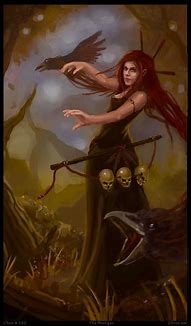
The Morrigan is a goddess of battle, strife, and fertility. She sometimes appears in the form of a crow, flying above the warriors, and in the Ulster cycle she also takes the form of an eel, a wolf and a cow. She is generally considered a war deity comparable with the Germanic Valkyries, although her association with cattle also suggests a role connected with fertility, wealth, and the land.

She is often depicted as a triple goddess, although membership of the triad varies; the most common combination is the Badb, Macha and Nemain, but other accounts name Fea, Anann, and others.

Etymology

There is some disagreement over the meaning of the Morrígan’s name. Mor may derive from an Indo-European root connoting terror or monstrousness, cognate with the Old English maere (which survives in the modern English word “nightmare”) and the Scandinavian mara; while rígan translates as ‘queen’. This can be reconstructed in Proto-Celtic as *Moro-rīganī-s. Accordingly, Morrígan is often translated as “Phantom Queen”. This is the derivation generally favoured in current scholarship.

In the Middle Irish period the name is often spelt Mórrígan with a lengthening diacritic over the ‘o’, seemingly intended to mean “Great Queen” (Old Irish mór, ‘great’; this would derive from a hypothetical Proto-Celtic *Māra Rīganī-s.). Whitley Stokes believed this latter spelling was a due to a false etymology popular at the time. There have also been attempts to link the Morrígan with the fairy Morgan from Arthurian romance, in whose name ‘mor’ may derive from ‘sea’ or ‘water’.

The name is also sometimes spelt Morrígu and given in plural as Morrígna in Old Irish.

Glosses and glossaries

The earliest sources for the Morrígan are glosses in Latin manuscripts, and glossaries (collections of glosses). In a 9th century manuscript containing the Latin Vulgate translation of the Book of Isaiah, the word Lamia is used to translate the Hebrew Lilith. A gloss explains this as “a monster in female form, that is, a morrígan“. Cormac’s Glossary (also 9th century), and a gloss in the later manuscript H.3.18, both explain the plural word gudemain (“spectres”) with the plural form morrígna. The 8th century O’Mulconry’s Glossary says that Macha is one of the three morrígna. It therefore appears that at this time the name Morrígan was seen as referring to a class of beings rather than an individual.

Ulster Cycle

The Morrígan’s earliest narrative appearances, in which she is depicted as an individual, are in stories of the Ulster Cycle, where she has an ambiguous relationship with the hero Cú Chulainn. In Táin Bó Regamna (The Cattle Raid of Regamain), Cúchulainn encounters the Morrígan, but does not recognize her, as she drives a heifer from his territory. In response to his challenge, she insults him, but before he can attack she becomes a black bird on a nearby branch. Cúchulainn now knows who she, and tells her that had he known before, they would not have parted in enmity. She notes that whatever he had done would have brought him ill luck. To his response that she cannot harm him, she makes a series of threats, foretelling a coming battle in which he will be killed. She tells him, enigmatically, “I guard your death”.

In the Táin Bó Cuailnge queen Medb of Connacht launches an invasion of Ulster to steal the bull Donn Cuailnge; the Morrígan, like Alecto of the Greek Furies, appears to the bull in the form of a crow and warns him to flee. Cúchulainn defends Ulster by fighting a series of single combats at fords against Medb’s champions. In between combats the Morrígan appears to him as a young woman and offers him her love, and her aid in the battle, but he spurns her. In response she intervenes in his next combat, first in the form of an eel who trips him, then as a wolf who stampedes cattle across the ford, and finally as a red heifer leading the stampede, just as she had threatened in their previous encounter. However Cúchulainn wounds her in each form and defeats his opponent despite her interference. Later she appears to him as an old woman bearing the same three wounds that her animal forms sustained, milking a cow. She gives Cúchulainn three drinks of milk. He blesses her with each drink, and her wounds are healed. As the armies gather for the final battle, she prophesies the bloodshed to come.

In one version of Cúchulainn’s death-tale, as the hero rides to meet his enemies, he encounters the Morrígan as a hag washing his bloody armour in a ford, an omen of his death. Later in the story, mortally wounded, Cúchulainn ties himself to a standing stone with his own entrails so he can die upright, and it is only when a crow lands on his shoulder that his enemies believe he is dead.

Mythological Cycle

The Morrígan also appears in texts of the Mythological Cycle. In the 12th century pseudohistorical compilation Lebor Gabála Érenn she is listed among the Tuatha Dé Danann as one of the daughters of Ernmas, granddaughter of Nuada.

The first three daughters of Ernmas are given as Ériu, Banba, and Fódla. Their names are synonyms for Ireland, and they were married to Mac Cuill, Mac Cécht, and Mac Gréine, the last three Tuatha Dé Danann kings of Ireland. Associated with the land and kingship, they probably represent a triple goddess of sovereignty. Next come Ernmas’s other three daughters: the Badb, Macha, and the Morrígan. A quatrain describes the three as wealthy, “springs of craftiness” and “sources of bitter fighting”. The Morrígan’s name is said to be Anann, and she had three sons, Glon, Gaim, and Coscar. According to Geoffrey Keating’s 17th century History of Ireland, Ériu, Banba, and Fódla worshipped the Badb, Macha, and the Morrígan respectively, suggesting that the two triads of goddesses may be seen as equivalent.

The Morrígan also appears in Cath Maige Tuireadh (The Battle of Mag Tuired). On Samhain she keeps a tryst with the Dagda before the battle against the Fomorians. When he meets her she is washing herself, standing with one foot on either side of the river Unius. In some sources she is believed to have created the river. After they have sex, the Morrígan promises to summon the magicians of Ireland to cast spells on behalf of the Tuatha Dé, and to destroy Indech, the Fomorian king, taking from him “the blood of his heart and the kidneys of his valour”. Later, we are told, she would bring two handfuls of his blood and deposit them in the same river (however, we are also told later in the text that Indech was killed by Ogma).

As battle is about to be joined, the Tuatha Dé leader, Lug, asks each what power they bring to the battle. The Morrígan’s reply is difficult to interpret, but involves pursuing, destroying and subduing. When she comes to the battlefield she chants a poem, and immediately the battle breaks and the Fomorians are driven into the sea. After the battle she chants another poem celebrating the victory and prophesying the end of the world.

In another story she lures away the bull of a woman called Odras, who follows her to the otherworld via the cave of Cruachan. When she falls asleep, the Morrígan turns her into a pool of water.

Nature and functions

The Morrígan is often considered a triple goddess, but her supposed triple nature is ambiguous and inconsistent. Sometimes she appears as one of three sisters, the daughters of Ernmas: the Morrígan, the Badb and Macha. Sometimes the trinity consists of the Badb, Macha and Nemain, collectively known as the Morrígan, or in the plural as the Morrígna. Occasionally Fea or Anu also appear in various combinations. However the Morrígan also frequently appears alone, and her name is sometimes used interchangeably with the Badb, with no third “aspect” mentioned.

The Morrígan is usually interpreted as a “war goddess”: W. M. Hennessey’s “The Ancient Irish Goddess of War,” written in 1870, was influential in establishing this interpretation. Her role often involves premonitions of a particular warrior’s violent death, suggesting a link with the Banshee of later folklore. This connection is further noted by Patricia Lysaght: “In certain areas of Ireland this supernatural being is, in addition to the name banshee, also called the badhb“.

It has also been suggested that she was closely tied to Irish männerbund groups (described as “bands of youthful warrior-hunters, living on the borders of civilized society and indulging in lawless activities for a time before inheriting property and taking their places as members of settled, landed communities”) and that these groups may have been in some way dedicated to her. If true, her worship may have resembled that of Perchta groups in Germanic areas.

However, Máire Herbert has argued that “war per se is not a primary aspect of the role of the goddess”, and that her association with cattle suggests her role was connected to the earth, fertility and sovereignty; she suggests that her association with war is a result of a confusion between her and the Badb, who she argues was originally a separate figure. She can be interpreted as providing political or military aid, or protection to the king — acting as a goddess of sovereignty, not necessarily a war goddess.

There is a burnt mound site in County Tipperary known as Fulacht na Mór Ríoghna (“cooking pit of the Mórrígan”). The fulachta sites are found in wild areas, and usually associated with outsiders such as the Fianna and the above-mentioned männerbund groups, as well as with the hunting of deer. The cooking connection also suggests to some a connection with the three mythical hags who cook the meal of dogflesh that brings the hero Cúchulainn to his doom. The Dá Chich na Morrigna (“two breasts of the Mórrígan”), a pair of hills in County Meath, suggest to some a role as a tutelary goddess, comparable to Danu or Anu, who has her own hills in County Kerry. Other goddesses known to have similar hills are Áine and Grian of County Limerick who, in addition to a tutelary function, also have solar attributes.

Arthurian legend

There have been attempts by some modern authors of fiction to link the Arthurian character Morgan le Fay with the Morrígan. Morgan first appears in Geoffrey of Monmouth’s Vita Merlini (The Life of Merlin) in the 12th century. However, while the creators of the literary character of Morgan may have been somewhat inspired by the much older tales of the goddess, the relationship ends there. Scholars such as Rosalind Clark hold that the names are unrelated, the Welsh “Morgan” (Wales being the source of Arthurian legend being derived from root words associated with the sea, while the Irish “Morrígan” has its roots either in a word for “terror” or a word for “greatness”.


Origins of The Morrigan

The origins of the Morrigan seem to reach directly back to the megalithic cult of the Mothers. The Mothers (Matrones, Idises, Disir, etc.) usually appeared as triple goddesses and their cult was expressed through both battle ecstasy and regenerative ecstasy. It’s also interesting to note that later Celtic goddesses of sovereignty, such as the trio of Eriu, Banba, and Fotla, also appear as a trio of female deities who use magic in warfare. “Influence in the sphere of warfare, but by means of magic and incantation rather than through physical strength, is common to these beings.” (Ross 205)

Eriu, a goddess connected to the land in a fashion reminiscent of the Mothers, could appear as a beautiful woman or as a crow, as could the Morrigan. The Disir appeared in similar guises. In addition to being battle goddesses, they are significantly associated with fate as well as birth in many cases, along with appearing before a death or to escort the deceased.

There is certainly evidence that the concept of a raven goddess of battle was not limited to the Irish Celts. An inscription found in France which reads Cathubodva, ‘Battle Raven’, shows that a similar concept was at work among the Gaulish Celts.

Valkyries in Norse cosmology. Both use magic to cast fetters on warriors and choose who will die.

During the Second Battle, the Morrigan “said she would go and destroy Indech son of De Domnann and ‘deprive him of the blood of his heart and the kidneys of his valor’, and she gave two handfuls of that blood to the hosts. When Indech later appeared in the battle, he was already doomed.” (Rees 36)

Compare this to the Washer at the Ford, another guise of the Morrigan. The Washer is usually to be found washing the clothes of men about to die in battle. In effect, she is choosing who will die.

An early German spell found in Merseburg mentions the Indisi, who decided the fortunes of war and the fates of warriors. The Scandinavian “Song of the Spear”, quoted in “Njals Saga”, gives a detailed description of Valkyries as women weaving on a grisly loom, with severed heads for weights, arrows for shuttles, and entrails for the warp. As they worked, they exulted at the loss of life that would take place. “All is sinister now to see, a cloud of blood moves over the sky, the air is red with the blood of men, and the battle women chant their song.” (Davidson 94)

An Old English poem, “Exodus”, refers to ravens as choosers of the slain. In all these sources, ravens, choosing of the slain, casting fetters, and female beings are linked.

“As the Norse and English sources show them to us, the walkurjas are figures of awe an even terror, who delight in the deaths of men. As battlefield scavengers, they are very close to the ravens, who are described as waelceasega, “picking over the dead”…” (Our Troth)

“The function of the goddess [the Morrigan] here, it may be noted, is not to attack the hero [Cu Chulainn] with weapons but to render him helpless at a crucial point in the battle, like the valkyries who cast ‘fetters’ upon warriors … thus both in Irish and Scandinavian literature we have a conception of female beings associated with battle, both fierce and erotic.” (Davidson 97, 100)

The Morrigan and Cu Chulainn

She appeared to the hero Cu Chulainn(son of the god Lugh) and offered her love to him. When he failed to recognize her and rejected her, she told him that she would hinder him when he was in battle. When Cu Chulainn was eventually killed, she settled on his shoulder in the form of a crow. Cu’s misfortune was that he never recognized the feminine power of sovereignty that she offered to him.

She appeared to him on at least four occasions and each time he failed to recognize her.

  1. When she appeared to him and declared her love for him.
  2. After he had wounded her, she appeared to him as an old hag and he offered his blessings to her, which caused her to be healed.
  3. On his way to his final battle, he saw the Washer at the Ford, who declared that she was washing the clothes and arms of Cu Chulainn, who would soon be dead.
  4. When he was forced by three hags (the Morrigan in her triple aspect) to break a taboo of eating dogflesh.


THE GREAT GODDESS MORRIGAN

Created By Calesta

The information on Morrigan is vast, and at times contradictory. It would take many, many webpages to tell all of her stories and it was very difficult to narrow this down! From maiden to mother to crone, from the destruction of war and death, to the beauty of the river of rebirth, Morrigan shows us the full circle of life. As with many Divine Feminine images, time can distort, and different cultures take on different attributes. What I have found that is close to the truth in my experience with her follows.

Morrigan is an Irish and Celtic Goddess. She can shapeshift into a crow or raven. It is said that she would take this form and fly over battlefields “calling upon the spirits of slain warriors.” (p. 252, McCoy) She is a triple goddess, with the aspects of the “virgin Ana, flowering fertility- goddess; the mother Babd, “Boiling” the cauldron perpetually producing life; and the crone Macha, “great Queen of the Phantoms” or Mother Death.” (p. 675, Walker). I believe she was also originally connected to the Great Irish Mother Goddess, Anu (later called Danu). In her aspect of Macha she was so powerful her name was the ancient capital of Ireland (p. 186, Kimball).

In the tales of the first people of Ireland, the Tuatha De Danann (literally the people of the Goddess Danu, pg. 189 Kimball), Morrigan was said to have blown a protective fog over all of the land, so that they would not be invaded. This shows the strength of Morrigan, and the protection the people received from her. Morrigan is also connected with death and destruction and battles. One story tells that Macha was forced to race while pregnant with twins, and when she (easily) won she gave birth to the twins. She was so angry at her tormentors for giving birth in public that way, she cursed them with the pain of childbirth before enemies were closing in. For nine generations when Ulster came under attack the men would experience the pains of childbirth (p. 192 Kimball).

Morrigan is a “Goddess of rivers, lakes and freshwaters”, and she was seen by Cu Chulain before his death, washing the clothes and arms. It is said that if one sees Morrigan by the river washing their clothes or body, is is a prediction of death before going into battle. Looking at this story, one can see the river or water as a place of rebirth, that Morrigan as the Goddess washing, anointing the body before being reborn.

Calling upon the strength of a woman that can fight off armies, and wash the dead is very powerful. Darkness, death, is a natural part of life, and brewing in the cauldron of rebirth is new life. But what I have found is to recognize that over time most Goddesses have been demonized… made to be solely focused on sex or death. Taking out pieces of the cycle, and turning them into something evil. Just as the wise crone was turned to hag.


Hymn to the Morrigan by Isaac Bonewits


O Morrigan, we call your name Across the dusty years.
You speak to us, of blood and lust. You show us all our fears.
You are a goddess, old and wise. Of holy power you have no dearth.
Beneath your wings : Black, Red and White, We learn of death and birth.


You walk about, this ancient land, Your hungers raw and clear.
You make the crops, grow rich and strong, As well your geese and deer.
A flirting maid, a lusty hag, A mother of great girth :
Without the touch of your black wings, We cannot heal the earth.


You float upon, a blood red wave, Of swords and spears and knives.
Your voice inspires, fear and dread, That you’ll cut short our lives.
You try the warriors’, courage sore, Our inner souls unearth.
Without the touch of your red wings, We cannot know our worth.


You fly above the silver clouds, To Manannan’s shining Gate.
You lead the dead along that path, To meet our final fate.
The joke’s on us, we find within, A land of laughter and of mirth.
Without the touch of your white wings, We cannot have rebirth.


Goddess Of The Day: SEPHIRA

Sephira

Hanukkah (Jewish)


Themes: Miracles; Victory, Success; Overcoming

Symbol: Light


About Sephira: This ancient Cabalistic goddess embodies divine light – the active, energetic power that flows

through the Universe in all directions. Thus, it is no coincidence that the ten spheres on the Tree of Life are

called Sephirah, for this goddess guides our way and path with her radiance.


To Do Today: This festival commemorates the rebellion of the Jews against the Syrians, in which a miracle took

place. A small bottle of oil stayed lit for eight days, keeping the temple consecrated until more oil could be brought.

Since Sephira is the light of miracles, today’s a good time to focus on seemingly impossible goals or situations that

you may have set aside or left behind in discouragement. Revisit those dreams; reconsider the logistics of those

circumstances. If there is a better way to approach things, Sephira will illuminate that path or options for you in

your meditations. Make sure to turn on light sources today, and open curtains to let natural light into your home.

Symbolically, this welcomes Sephira’s active power into your spiritual life and quest. Also consider following with

Jewish tradition and giving coins to friends or family. These tokens draw financial security. Or, eat potato pancakes

for providence.


By Patricia Telesco

The Witches Survival Guide To Sundays c. 2018


The Witches Digest

The Charge of the Goddess


Whenever ye have need of any thing, once in the month,
and better it be when the moon is full, then shall ye
assemble in some secret place and adore the spirit of
She, who is Queen of all witches. There shall ye assemble,
ye who are fain to learn all sorcery, yet have not won its
deepest secrets; to these will She teach things that are
yet unknown. And ye shall be free from slavery; and as a
sign that ye be really free, ye shall be naked in your
rites; and ye shall dance, sing, feast, make music and love,
all in Her praise. For Hers is the ecstasy of the spirit,
and Hers also is joy on earth; for Her law is love unto all
beings. Keep pure your highest ideal; strive ever towards
it; let naught stop you or turn you aside. For Hers is the
secret door which opens upon the land of youth and Hers
is the cup of wine of life, and the cauldron of Cerridwen,
which is the Holy Grail of immortality. She is the
gracious goddess, who gives the gift of joy unto the heart
of man. Upon earth, She gave the knowledge of the spirit
eternal; and beyond death, She gives peace and freedom,
and reunion with those who have gone before. Nor does
She demand sacrifice, for behold, She is the mother of
all living, and Her love is poured out upon the earth.

She who is the beauty of the green earth, and the white
moon among the stars, and the mystery of the waters, and
the desire of the heart of man, calls unto thy soul. Arise,
and come unto Her. For She is the soul of nature, who
gives life to the universe. from Her all things proceed,
and unto Her all things must return; and before Her face,
beloved of gods and men, let thine innermost divine self
be enfolded in the rapture of the infinite. Let Her
worship be within the heart that rejoiceth; for behold, all
acts of love and pleasure are Her rituals. And therefore
let there be beauty and strength, power and compassion,
honor and humility, mirth and reverence within you. And
thou who thinkest to seek Her, know thy seeking and
yearning shall avail thee not unless thou knowest the
mystery; that if that which thou seekest thou findest not
within thee, then thou wilt never find it without thee. For
behold, She has been with thee from the beginning; and
She is that which is attained at the end of desire.

The Charge of the God


Listen to the words of the Great Father, who of old was called Osiris,
Adonis, Zeus, Thor, Pan, Cernunnos, Herne, Lugh and by many other names.

My law is harmony with all things.

Mine is the secret that opens the gates of life and mine is the dish of salt of
the earth that is the body of Cernunnos that is the eternal circle of rebirth.

I give the knowledge of life everlasting, and beyond death
I give the promise of regeneration and renewal.

I am the sacrifice, the father of all things,
and my protection blankets the earth.

Hear the words of the dancing God, the music of whose laughter
stirs the winds, whose voice calls the seasons.

I who am the Lord of the Hunt and the Power of the Light,
sun among the clouds and the secret of the flame.

I call upon your bodies to arise and come unto me.

For I am the flesh of the earth and all its beings.

Thru me all things must die and with me are reborn.

Let my worship be in the body that sings,
for behold all acts of willing sacrifice are my rituals.

Let there be desire and fear, anger and weakness,
joy and peace, awe and longing within you.

For these too are part of the mysteries found within yourself,
within me, all beginnings have endings, and all endings have beginnings.


Today is Sunday


Traditionally, Sunday is the first day of the week. It is also known as the Lord’s Day from it original association with the Lord, that is, the Sun God, personified as Helios, Apollo, Ogmios, Mithras, and St. Elia. But in the Northern Tradition, the sun is seen as feminine, personified as the goddess known as Phoebe in East Anglia and Saule in eastern Europe. The sun rules the conscious element of the human being, the ego, the real self, and Sunday is the day on which this conscious power is at its most effective.

Deity: Sol

Zodiac Sign: Leo

Planet: Sun

Tree: Birch

Herb: Snakeroot

Stone: Ruby

Animal: Lion

Element: Fire

Color: Gold

Rune: Sigel


The Celtic Tree Month of Luis(Rowan) January 21 – February 17)

Runic Half Month of Peorth (womb, dice cup) ( January 13 – January 27)

Goddess of the Month of Hestia (December 26th – January 22nd)


Source

The Pagan Book of Days
Nigel Pennick


On Sunday, We Honor the Goddess Hera

Hera

Greek Goddess of Marriage and Queen of Olympus

Hera is the Queen of the GODS and is the wife and sister of ZEUS in the Olympian pantheon. She is known for being the Goddess of Marriage & Birth. Despite being the Goddess of Marriage, she was known to be jealous and vengeful towards the many lovers and offspring of her husband Zeus.


She was also known to turn her anger towards mortals who crossed her as well – for example, Paris, who chose APHRODITE over Hera as the most beautiful goddess at the marriage of the sea-nymph Thetis to a mortal called Peleus.


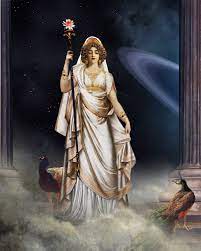
In images and statues, Hera is portrayed as being majestic and solemn, crowned with the polos – a high cylindrical crown worn by many of the Great Goddesses.


Even before her marriage with Zeus, she ruled over the heavens and the Earth. This is one reason why she is referred to as ‘The Queen of Heaven’ – ruling over Mount Olympus where all the gods and goddesses live.


Even the great Zeus feared his wife Hera. Her never-ending hatred of Heracles, the illegitimate son of Zeus and the mortal Alcmene stemmed from his continuous adultery and, amongst other things, Hera raised a storm at sea in order to drive Heracles out of his course to kill him.


Zeus became so angry that he hung her in the clouds by a golden chain, and attached heavy anvils to her feet. Her son Hephaestus tried to release his mother from her humiliating position, for which Zeus threw him out of heaven, and his leg was broken by the fall.


Facts about Hera

Hera was Queen of the OLYMPIAN GODS.
She was the wife and sister of Zeus.
Hera was a jealous wife, and she fought with Zeus frequently over his extramarital affairs and illegitimate children. For this reason, Hera was known for punishing offending husbands.
She was the protector of women, presiding over marriages and births.
While Hera was worshipped in all parts of Greece, temples were erected in her honor at Argos and Salmos.
The peacock was sacred to her.
Hera had few, if any, redeeming qualities. She never forgot an injury.
The Titans Ocean and Tethys brought her up.
Hera is often described as “cow-faced,” although she was also called the chief among the immortals in beauty.
Though she may have been physically attractive, her vindictive personality makes her less so.
The Trojan War would have ended in peace, but Hera had a vested interest in its outcome and influenced Zeus to either switch sides or remain neutral.
Hera had no concept of justice when angry or jealous; she could not forgive the women with whom Zeus had sexual relations—even if they were innocent of wrongdoing.
Ilithyia, a daughter of Hera’s, assisted women in childbirth.
In the story of the Quest of the Golden Fleece, Hera was a gracious protector of the heroes.
Paris awarded Aphrodite the Golden Apple over Athena and Hera.
Hera punished one of Zeus’s love interests, Io, by putting her in the charge of Argus. Argus had a hundred eyes and kept vigilant watch over her so that Zeus could not come to her aid.
Hera turned Callisto into a bear because Zeus fell in love with her.
Hera arranged the death of Semele, another of Zeus’s mortal conquests, although she did not directly cause it.
Hera never forgave HERCULES for being Zeus’s son, but when Hercules died and was taken to heaven, he and Hera reconciled. While in heaven, Hercules married Hera’s daughter Hebe.
In some stories, it was at Hera’s orders that DIONYSUS was torn to pieces. He was brought back to life, and it is this resurrection that was celebrated in theatres.

Source

Greek Gods and Goddesses

Magickal Work for Sunday

 Health
 Abundance
 Leadership
 Strength
 Ambition
 Individuality
 Authority
 Hope
 Joy
 Happiness
 Creativity

Source

A Spell Crafter’s Compendium
Terri Paajanen


Sunday’s Associations

Taking its name from our closet star, the Sun, Sunday is the best day of the week to work magical involving fathers and other authority figures such as your boss. It is also a good day to work on questions regarding leadership, money, prosperity, and power.

Color: Yellow, gold

Planet: Sun

Deities: Brighid, Helios, Ra, Apollo

Crystals: Quartz, diamond, amber, carnelian

Herbs: Marigold, sunflower, cinnamon

Associations: Success, promotion, fame, wealth, prosperity


Source

Flying the Hedge

The Witches Magickal Sunday

Ruler: Sun

Colors: Gold or yellow

Power Hours: Sunrise and sunset.

Key Words: Love, happiness, health, wealth

It is easy to spot the ruler of this day by its name. Sunday is the day of the sun. Community work, volunteer services, exercise, outdoor sports, buying, selling, speculating, meeting people, anything involving groups, running fairs and raffles, growing crops and taking care of all health matters fall under the influence of the Sun. With all this activity and the brightness of the sun, it’s easy to see why the child that is born on the Sabbath day is bonny and blithe, and good and gay.

Michael is the primary angel of Sunday but each hour of this day also has it’s secondary angel. These angels are Michael (first hour), Anael (second hour), Raphael (third hour), Gabril (fourth hour), Cassiel (fifth hour), Sachiel (sixth hour), Samael (seventh hour), Michael (eighth hour), Anael (ninth hour), Raphael (tenth hour), Gabriel (eleventh hour), and Cassiel twelfth hour). Notice some of the angels do double duty this day.

On Sundays, (unless you are invoking a specific angelic energy) the hour of sunrise will be the most powerful time to work, especially if you want to infuse energy into your work. Sunset is the second best time and is favored when you need to calm down a situation. Check the local newspaper, astrological calendar, or almanac to determine your local sunrise.

Source

Gypsy Magic

Sunday’s Witchery

Those ambitious, successful spells and charms will be heightened by working on the day of the week that has the planetary influence of the sun. So light those sunny candles, wear some luminous colors, and break out the gold jewelry! Bake up some cinnamon rolls or low-fat cinnamon muffins for an enchanting family breakfast. Take an orange with you to eat at lunch today. Try using a little magickal aromatherapy and burn some cinnamon-scented incense to encourage success and wealth today. Make the talisman to keep your solar magick with you. Sprinkle some dried marigold petals around your house-or across the threshold-to pull triumph and protection toward you and your family.


Get outside and tip up your face to the sun. Take a walk outside, and soak up some sunshine! Acknowledge the power of Sunna or Helios as they blaze across the sky and bring courage and motivation into your life. Sit outside at sunrise on a Sunday morning and bask in its warm, rosy-golden glow Acknowledge Brigid as the inner, creative spark of imagination and inspiration. She can help these gifts burn brightly within your own soul. Use your imagination and create your own brand of witchery and magick. Here comes the sun, and it’s your turn to shine!

Source

—–Book of Witchery: Spells, Charms & Correspondences for Every Day of the Week
Ellen Dugan


The Witches Correspondences for Sunday

Magickal Intentions: Growth, Advancements, Enlightenment, Rational Thought, Exorcism, Healing, Prosperity, Hope, Exorcism, Money

Incense: Lemon, Frankincense

Planet: Sun

Sign: Leo

Angel: Michael

Colors: Gold, Yellow, Orange and White

Herbs/Plants: Marigold, Heliotrope, Sunflower, Buttercup, Cedar, Beech, Oak

Stones: Carnelian, Citrine, Tiger’s Eye, Amber, Clear Quartz and Red Agate

Oil: (Sun) Cedar, Frankincense, Neroli, Rosemary

The first day of the week is ruled by the Sun. It is an excellent time to work efforts involving business partnerships, work promotions, business ventures, and professional success.

Spells where friendships, mental or physical health, or bringing joy back into life are an issue work well on this day, too.


Sunday is Ruled by the Sun


Sunday corresponds to the sun, our closest star. This day is full of wonder and all sorts of magical potential for success, wealth, and fame. Sundays are for personal achievements of any kind such as working towards a promotion at your job, seeking fame and wealth, or being acknowledged for a job well done. All of these goals fall under the golden influence of the sun. Some suggestions for Sunday enchantments would include:

Sitting outside at sunrise and calling on the goddess Brigid for illumination and inspiration

Wearing gold jewelry or clothing that is gold or sunshine yellow to pull some color magic into your life

Arranging a few sunflowers in a vase and empowering these “flowers of the sun” for fame and ambition

Gathering up the common marigold flower and scattering it’s petals about to encourage prosperity

Baking up a batch of cinnamon rolls for the family and enchanting them for health and success

Snacking on a solar fruit, the orange, and enjoying the magical boost it brings to your life

The Energy of the Sun

The planetary energy of the Sun is stimulating and warm. It encourages growth and expansion as well as general good feelings all around. It may be used for magick related to the growth of anything; career, family, public influence, wealth, the garden, friendships, love, general abundance, employment opportunities, business. Because the Sun shines down on the whole world, and thus sees everything that happens, the Sun’s planetary energy is occasionally used to find objects as well as protecting us from deception or being “kept in the dark”. Looking at the Sun’s universality in a different way, this energy can be used to find a common thread (we’re all warmed by the same Sun) to encourage new friendships and partnerships and reconciliation where existing ones are threatened.

Many things that correspond to the planetary energy of the Sun also correspond to the elemental energy of Fire.
Healing

The sun is associated with the heart, circulatory system, the spinal cord and the thymus gland.

Solar Minerals

Metal Gold

Crystals/Stones

Yellow, red and particularly bright, shiny crystals and stones tend to correspond to the energy of the Sun. diamond, ruby, chrysolite, yellow topaz, citrine, red garnet, chrysoprase and amber- fossilized tree sap said to contain the energy of the Sun as metabolized by the tree. Corundum and yellow Tiger’s Eye show sparkling designs that remind one of the sun and of course, there is sunstone.

Crystals and metals that correspond to the planetary energy of the Sun can be worn, carried or placed on the body to encourage healing or to draw planetary energies ruled by the sun, such as abundance to the individual. They may also be used to create a gem elixir and ingested, assuming they do not contain toxic materials. Crystals can be placed in a location to draw the desired energies to your home, place of business or vehicle as desired, placed on the altar, held, or gazed upon to enhance energies being raised during spellwork or other focusing and manifesting exercises.

Solar Plants and herbs

Plants that resemble the sun in shape or color, that open during the day and close at night, that follow the sun’s movements during the day, and those plants that are traditionally associated with the winter solstice as well as those that provide winter nourishment when fresh plants are unavailable, such as grains and nuts. Physically, edible Sun plants tend to encourage a feeling of warm satisfaction and medicinal plants affect the heart. sunflower, calendula, marigold, daylily, orange, citron, saffron, pine, mistletoe, rosemary, buttercup, heliotrope, bay laurel, daisy, walnut, acorn, maize, wheat, hops, cloves, cinnamon

Herbs can be incorporated into magick by placing them on the altar in the form of fresh flowers or dried potpourri or incorporated into incense to enhance energies raised during spellwork and ritual of a solar nature. They can also be carried or worn in a pouch or placed in an area to attract these energies. An herbal floor wash will infuse an area with the desired energies, or this may be accomplished via fumigation. Edible plants can be consumed as part of a meal or as part of an elixir or other herbal preparation. Those herbs that are skin-safe can be added to massage oils or fragrance sprays and ritual baths. Whole herbs or essential oils may be used.

*Incense* cinnamon, clove, pine, citrus, Benzoin, Pine, Frankincense, Labdanum, Olibanum

Sun fragrances are generous and, to me, home sweet home types of smells, with the exception of a few, which have “special occasion” feels to me. The sorts of smells that fill a temple, or the house on a day when lots of company is coming. Over at http://www.alchemy-works.com/planets_sun.html this family of scents is described as “glorious” and it suits.

Days and Holidays

The Winter Solstice is the day most strongly associated with Solar Energy, though it peaks at the Summer Solstice, it declines thereafter.

Sunday is the Sun’s day.

Zodiac Leo is ruled by the sun.

Other Solar Correspondences

Animals Lion, Sparrowhawk, Griffin, hawk

While animal parts are used for magick in many traditions, they can be difficult or impossible to obtain and some animals are endangered, though you may find using feathers and fur of local animals to be feasible, using important bits of animals that aren’t already raised and slaughtered for food isn’t within the reach or moral compass of most modern witches. Using live animals subjects animals to discomfort and fear and is also not recommended. However, images of animals have a long history of use in magic and images of animals are quite easy to obtain as 2D pictures and 3D sculptures. If you are artistic, the very act of creating these images can help you more closely attune to their energy.

Colors

Orange, amber, gold, yellow, red

Many magic-users bring color into their working through their choice of colored candles, altar cloth and other items placed on the altar. If you wish to bring solar energy into your daily life, you may choose corresponding colors for your clothing or even chose paint, curtains and carpet colors to draw solar energy into your space.

Magick Prosperity, wealth, wealth, growth, confidence, clarity, commonality, abundance, truth, harmony, partnerships.

Source

Witchipedia

Sunday & The Perfect Corresponding Spell


Finally, it’s Sunday, the official day of rest. Not only do Christians acknowledge this day, but I’m sure many Pagans appreciate this day, as well. Everyone needs rest and lot of people need a good day to worship their creator (whomever or whatever that may be), however they deem fit to do so. With the Sun being the central theme of many ancient rituals, Sunday just seems to fit, in name and theory. Not only is it a good day to worship, it seems good to do more relaxed spells, such as, sleep, dream and rebirth.


Sleep Spell – Nap Lavender Spell

Items you will need for this spell: 1 small sachet or bag 1 pinch of lavender 1 handful of roses 1 pinch of allspice 1 pinch of nutmeg 1 white candle 1 lighter or match

Fill a small sachet or bag with the above ingredients. After the bag is filled, tie off the end and shake all the ingredients around. Then, lay the bag on a table next to the white candle. Light the candle and think about having a nice, peaceful rest. Think about how long you want to sleep and how wonderful it feels just to be able to sleep. Take about five, deep breaths and relax. Pick up the candle and pour some wax over the end of the sachet or bag. After that, blow out the candle and put the sachet or bag under your pillow. At night, before you go to bed, get the sachet or bag from under your pillow and smell it. Breathe in the scents and allow your body to relax. Hold it in your hands for as long as you need to. Before you know it, you will be falling asleep.

A Witch’s Week of Spells and Activities
Helga C. Loueen


Visions of Love Spell

Items needed: One dram of pure rose oil; one bowl of water; one pink birthday candle.

Place the bowl of water on the night stand next to your bed. Sprinkle seven drops of rose oil into the bowl. Turn all the lights off in the room. LIght the pink candle. Hold the candle over the bowl so the wax will fall onto the water, and chant the following seven times:

Rose and water,
Flame ad fire,
Reveal this night,
The one I desire.

As soon as the candle has burned out, close your eyes and go to sleep. When you awake in the morning, the name of the one you will marry will be spelled out in the wax dripping left in the bowl.



The Gods of Asgard c. 2018

Some of the Witchcraft/Magickal Correspondence for Hekate or Hecate

From wytchymystique.com

Her Story: 

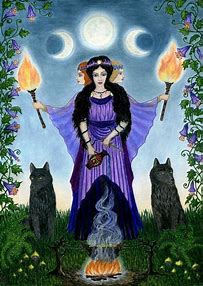
Hecate is one of the triple goddesses, often depicted in art as a single body with three heads.  She is the goddess of witchcraft; the moon; the spirit realm; nature and night visions; considered protectress of the Witches.  She also protects women in childbirth, is the guardian of the spirit world, and “Queen of the Crossroads”– a place of dark magic, spiritual wisdom, and terrible power.
____________________
The moon’s shadow fell as a pattern on the dirt road beneath the trees.  The young woman’s cloak hid her face as she leaned on her knees to dig a small hole, depositing a knotted scarf holding herbs and stones, a tiny carved image, and her menstrual blood.  Her lips moved silently as she invoked the presence of Hecate.

As the young woman covered her sacred bundle with earth and rose from her knees, the sound of a hound baying at the moon echoed in the distance.  The breeze picked up, moving the tree limbs above, shifting the shadows on the road into eerie patterns.  A chill ran up the woman’s spine, and she gathered her cloak more tightly about her shoulders, shivering with the knowledge that the great goddess Hecate was moving through the crossroads.

Embracing the Goddess:

Don’t be afraid to stand up for yourself.  So often women are under the impression that someone else is responsible for their protection, but this isn’t true.  We’re responsible for protecting ourselves, and sometimes this can mean making difficult decisions.

Hecate’s correspondences:

Herbs: garlic, lavender, honey
Animal: dog
Color: purple
Planet: Jupiter
Day: Thursday
Element: Earth
Feminine Face: Crone
Symbols: a torch; a dagger; the crossroads;
the moon; the serpent; fire

Goddess of the Day – Wadjet

Wadjet

Wadjet (Wadjyt, Wadjit, Uto, Uatchet, Edjo, Buto) was one of the oldest Egyptian goddesses. Her worship was already established by the Predynastic Period, but did change somewhat as time progressed. She began as the local goddess of Per-Wadjet (Buto) but soon became a patron goddess of Lower Egypt.

By the end of the Predynastic Period, Wadjet was considered to be the personification of Lower Egypt rather than a distinct goddess and almost always appeared with her sister Nekhbet (who represented Upper Egypt). The two combined represented the country as a whole and were represented in the “nebty” (one of the pharaoh’s names, also known as “the two ladies”) which indicated that the king ruled over both parts of Egypt. The earliest recovered example of the nebty name is from the reign of Anedjib of the First Dynasty.

In the Pyramid Texts it is suggested that Wadjet created the first papyrus plant and primordial swamp. Her link to the papyrus is strengthened by the fact that her name was written using the glyph of a papyrus plant and the same plant was the heraldic plant of Lower Egypt.

According to another myth Wadjet was the daughter of Atum (or later Ra) who sent her as his “eye” to find Tefnut (moisture) and Shu (air) when they were lost in the waters of Nun. He was so happy when they returned that he cried and created the first human beings from his tears. To reward his daughter, he placed her upon his head in the form of a cobra so that she would always be close to him and could act as his protector.

Wadjet was one of the goddesses given the title “Eye of Ra” (connecting her to Bast, Hathor, Sekhmet, and Tefnut among others). In fact, the symbol of the “Eye of Ra” was often called “the Wedjat”.

In this form she was sent out to avenge her father and almost caused the destruction of mankind. Humanity was saved when she was tricked with some beer which had been dyed red with pomegranate juice to resemble blood.

There is also a suggestion that she was very closely linked to the principle of Ma’at (justice or balance). Before being crowned as king, Geb attacked and raped his mother Tefnut. When he went to take his place as pharaoh and put the Royal Ureas on his own forehead, the snake reared up and attacked the god and his followers. All of Geb’s retinue died and the god himself was badly injured. Clearly, his actions were against Ma’at and Wadjet was not prepared to allow him to go unpunished.

Wadjet is often described as an agressive deity while while her sister Nekhbet was thought of as a more matronly protector. However, she also had her gentler side. Wadjet was believed to have helped Isis nurse the young Horus and to help mother and baby hide from Set in the marshes of the delta. She was also considered to offer protection to all women during childbirth.

Wadjet and her sister also protected the adult Horus from the followers of Set. Horus pursued them in the form of a winged sun disc and Nekhbet and Wadjet flanked him in the form of crowned snakes. This protection was also extended towards the pharaoh who wore the “Royal Ureas” (serpent) on his (or her) forehead.

From the Eighteenth Dynasty the queens also added one or two snakes to their headdresses representing Wadjet and her sister.

Wadjet was associated with the fifth hour of the fifth day of the month and with “iput-hmt” (Epipi), the harvest month of the Egyptian calendar. Festivals were held in her honour on the 10th day of “rh-wr” (Mekhir) which was also called “the day of going forth of the Goddess”, the 7th day of “khnty-khty” (Payni), and the 8th day of “Wpt-rnpt” (Mesori). These latter two dates coincide roughly with the winter and spring solstices.

She was worshiped at the Temple of Wadjet, known as “Pe-Dep”. This temple was already long established by the Old Kingdom and is referred to in the Pyramid Texts. In this temple, Wadjet was linked with Horus.

Wadjet was thought to be the wife of Hapi in Lower Egypt and was linked to Set in his role as a representative of Lower Egypt. She was sometimes described as the wife of Ptah and the mother of Nefertem, probably because she occasionally took the form of a lion like Sekhmet.

Her sacred animal was the cobra, and Wadjet was often depicted as either a rearing cobra, a winged cobra, or a woman with the head of a cobra. She was also depicted as a woman wearing the red crown of Lower Egypt. She often appears with her sister Nekhbet who appeared as a snake or woman.

By the Late Period Wadjet was also associated with the ichneumon (a mongoose-like creature). This animal was known for its skill in killing snakes and was also sacred to Horus.The Egyptians placed mummified ichneumon and shrew (small mice) inside statuettes of Wadjet which were interred with the dead. The two animals represented day (ichneumon) and night (shrew). She was also worshipped as a vulture Goddess. In her form of the “eye of Ra” she was depicted as a lion-headed woman wearing a solar disc and the Uraeus (cobra).

Bibliography
  • Bard, Kathryn (2008) An introduction to the Archaeology of Ancient Egypt
  • Budge, E Wallis (1904) The Gods of the Egyptians
  • Goodenough, Simon (1997) Egyptian Mythology
  • Kemp, Barry J (1991) Ancient Egypt: Anatomy of a Civilisation
  • Lehner, Mark (1997) The Complete Pyramids
  • Pinch, Geraldine (2002) Handbook Egyptian Mythology
  • Redford Donald B (2002) Ancient Gods Speak
  • Watterson, Barbara (1996) Gods of Ancient Egypt
  • Wilkinson, Richard H. (2003) The Complete Gods and Goddesses of Ancient Egypt
  • Wilkinson, Richard H. (2000) The Complete Temples of Ancient Egypt

A New Daily Post – God of the Day – Ra


Ra – Sun God
The ancient Egyptians revered Ra as the god who created everything. Also known as the Sun God, Ra was a powerful deity and a central god of the Egyptian pantheon. The ancient Egyptians worshiped Ra more than any other god and pharaohs often connected themselves with Ra in their efforts to be seen as the earthly embodiment of the Sun God.
Who is Ra?
Ra (pronounced ray) represents sunlight, warmth and growth. It was only natural that the ancient Egyptians would believe him to be the creator of the world, as well as part of him being represented in every other god. The ancient Egyptians believed that every god should illustrate some aspect of him, while Ra himself should also represent every god.
Ra’s Appearance
Ra was usually depicted in human form. He had a falcon head which is crowned with a sun disc. This sun disc was encircled by a sacred cobra named Uraeus. Ra has also been depicted as a man with the head of a beetle and also a human man with the head of a ram. The ancients also depicted Ra in full species form such as a serpent, heron, bull, lion, cat, ram, hawk, beetle, phoenix and others. His main symbol, however, is the sun disk.
Ra Mythology
The ancient Egyptians believed that as the sun god, Ra’s role was to sail across the heavens during the day in his boat called the “Barque of Millions of Years.” In the morning when Ra emerged from the east, his boat was named, “Madjet” which meant “becoming strong.” By the end of the day the boat was called, “Semektet” which meant “becoming weak.” At the end of the day, it was believed that Ra died (swallowed by Nut) and sailed on to the underworld, leaving the moon in his place to light up the world. Ra was reborn at dawn the very next day. During his journey across the heavens during the day, he fought with his main enemy, an evil serpent named Apep, or also, The Lord of Chaos. In some stories, Ra, in the form of a cat named Mau, defeats the evil serpent, Apep. This is part of the reason why cats are so highly-revered in Egypt.
Ra created himself from the primordial chaos. He is also known as Re and Atum. His children are Shu, the God of Dry Air and Father of the Sky, and his twin sister Tefnut, the Goddess of Moisture and Wetness. As a lion-headed goddess, Tefnut is responsible for dew and freshness. Humans were created from Ra’s tears.
Although Ra was highly revered and devoutly worshiped by the ancient Egyptians, there is a story to suggest he eventually grew weak. In the Legend of Ra, Isis and the Snake, as Ra grew old, he dribbled saliva. Isis knew that Ra’s power was hidden in his secret name. Isis gathered Ra’s saliva and created a snake out of it. She set the snake in Ra’s path and it bit him. Isis wanted the power Ra had always enjoyed, but she knew she had to get him to tell her his secret name. Eventually, because of the pain he was in, Ra allowed Isis to “search through him” and in so doing, she healed him and Ra’s power was transferred over to her.
The Tree of Life is an important religious symbol to the Egyptians. The Tree of Life was located within Ra’s sun temple in Heliopolis and was considered sacred. The fruit that sprang from this tree was not available to humans, but only in aging-rituals reserved for pharaohs. The Tree of Life is also referred to as the mythical, sacred Ished tree. Eternal life came to those who ate the fruit from the Tree of Life.
Another important ancient Egyptian symbol connected to Ra is the “Bennu”. Bennu is the name of the bird that represented Ra’s soul. This bird is a phoenix and it was seated at the Tree of Life in Ra’s Sun Temple in Heliopolis. Inside the temple, on top of an obelisk, sat the Benben Stone. This pyramid-shaped stone served as a beacon to Bennu and is also an important ancient Egyptian religious symbol.
Worship of the Sun God
Solar temples were built for Ra but did not contain a statue of the god. Instead, they were created to be open to the sunlight that Ra represented. The earliest known temple built in honor of Ra exists in Heliopolis (what is now a Cairo suburb). This solar temple is known as “Benu-Phoenix” and is believed to have been erected in the exact spot where Ra emerged into creation.
Although Ra dates back to the second dynasty, he is not the oldest of the Egyptian gods. It wasn’t until the fifth dynasty that Ra became closely associated with the pharaoh. As the king and leader of Egypt, the pharaoh was seen as the human manifestation of Horus, so the two gods became connected. This new deity fusion was then referred to as “Ra-Horakhty” meaning Ra is Horus of the Horizon. Ra’s relationship with other gods did not stop there. As the powerful creator of mankind and the sun god, he also became associated with Atum to make “Atum-Ra.”
Fifth Dynasty and subsequent pharaohs were all known as “The son of Ra” and Ra became incorporated into every pharaoh’s name from then onward. During the Middle Kingdom, the new deity, Amun-Ra was formed. Amun was one of the gods who formed the Ogdoad (the assembly of eight gods who represented eight elements of creation).
The New Kingdom brought new heights of worship to Ra. Many tombs in the Valley of the Kings portray depictions of Ra and his journey through the underworld. During this time, many solar temples were built.
Eye of Ra
Present in the ancient Egyptian mythology is the Eye of Ra, shown as the sun disk with two ‘uraeus’ cobras coiled around it, next to the white and red crowns of Upper and Lower Egypt. Initially associated with Horus (similarly to the wadjet, the Eye of Horus), the Eye of Ra shifted positions in the myths, becoming both an extension of Ra’s power and a separate entity altogether.
Click here to learn more about The Eye of Ra
Ra God Facts
The ancient Egyptians worshiped Ra to such an extent above other gods that some historians have argued that ancient Egyptian religion was indeed a monotheistic one with Ra as the singular god.
Historians believe that the pyramids might represent rays of sunlight, further connecting the pharaohs with Ra, the sun god.
During Ra’s journey through the heavens he was accompanied by several other gods including Thoth, Horus, Hathor, Maat, Abtu, and Anet.
Nut, goddess of the sky and heavens, is sometimes referred to as Ra’s mother, because he emerges from her and is reborn every morning.
The morning manifestation of Ra is known as “Khepri the scarab God.”
The evening manifestation of Ra is known as the ram-headed god, Khnum.
The sacred cobra that encircled Ra’s crown symbolized royalty, sovereignty and divine authority.
The right eye of Ra represented the Sun; while the left eye of Ra represented the moon.
Ra is also closely associated with the Tree of Life myth, the Ben-Ben Stone and the Bennu Bird myths.
Ra’s glory came to an end during the time when the Roman’s conquered Egypt in 30BC.

Goddess of the Day – Isis

Isis

(Auset)

Perhaps the most important goddess of all Egyptian mythology, Isis assumed,
during the course of Egyptian history, the attributes and functions of virtually
every other important goddess in the land.  Her most important functions,
however, were those of motherhood, marital devotion, healing the sick, and the
working of magical spells and charms.  She was believed to be the most powerful
magician in the universe, owing to the fact that she had learned the Secret Name
of Ra from the god himself.  She was the sister and wife of Osiris, sister of
Set, and twin sister of Nephthys.  She was the mother of Horus the Child
(Harpocrates), and was the protective goddess of Horus’s son Amset, protector of
the liver of the deceased.

Isis was responsible for protecting Horus from Set during his infancy; for
helping Osiris to return to life; and for assisting her husband to rule in the
land of the Dead.

Her cult seems to have originally centered, like her husband’s, at Abydos near
the Delta in the North (Lower Egypt); she was adopted into the family of Ra
early in Egyptian history by the priests of Heliopolis, but from the New Kingdom
onwards (c. 1500 BC) her worship no longer had any particular identifiable
center, and she became more or less universally worshiped, as her husband was.

Goddess of the Day – Badb

Badb – The Celtic Goddess of War from symbolsage.com

In Celtic mythology, Badb, also known as Battle Crow or Death-Bringer, was the goddess of death and war, creating confusion and fear on battlefields in favor of the victors. She was one aspect of the Celtic triple goddess of war, death, and prophecy, called the Morrigan.

Table of Contents

Prayers, Symbols, Books and More for the Goddess Hecate or Hekate –

Goddess Hekate: Prayers, Symbols, Books & More

From magickalspot.com

Today I want to start exploring the incredible magical realm of gods and goddesses with you, and I could not start from any other than Hekate, the mother of all witches! If you want to get to know this mysterious, fascinating goddess, keep reading this article!

Contents

Who is Hekate?

The myth of Hekate: from its origins to ancient Greece

How do you know that Hekate is calling you?

What are Hekate’s symbols?

Best books about Hekate

My favorite Hekate ritual for guidance

Hekate artwork

Conclusion

Dawn’s Thoughts on The Goddess Hecate

History and Origins

Threefold Hecate

Hecate’s Companions

Hecate’s Spheres of Influence

Worship of Hecate

Symbols of Hecate

Goddess of the Day – Frigg

Frigg

Areas of Influence: Frigg was the Norse Goddess of marriage, childbirth, motherhood, wisdom, household management and weaving and spinning.

She was the Queen of Aesir and the only one permitted to sit on the high seat other than her husband Odin.

This Goddess’s home was Fensalir (Marsh hall) in Asgard. All marshy and boggy ground was sacred to this Goddess.

As Goddess of weaving she was associated with weaving clouds and the threads of fate, known as Wyrd in the Nordic tradition. Despite this and the gift of prophecy she is unable to save her own son from his fate. The Goddess made him invincible to everything other than mistletoe but unfortunately Loki disguised himself and tricked her in to revealing this weakness.

She has more than ten handmaidens who assist her, the most well known of these are Hlin (Goddess of Protection), Gna (a messenger Goddess) and Fulla (a fertility Deity). Some academics have suggested that the attendants represent different faces of this particular Deity.

Barren women would invoke this Goddess and ask her to bless them with children.

Her name means “beloved one.” Other spellings of this Goddesses name include Frea, Fija, Friia, Frig and Friggja.

Origins and Genealogy: She was the daughter of Fjorgynn (the male personification of the earth) and was married to Odin with whom she had two sons, Balder and Hodr.

She was briefly married to Odin’s brother’s Vili and Ve as Odin had been away travelling a long time and was believed to be dead. When he finally returned, the marriage to Odin’s brothers was dissolved and she returned to her husband’s side.

Strengths: A loving mother and home maker.

Weaknesses: Unable to save her son.

Symbolism
Like Freya she wears a ravens clock.

She is associated with constellation the Orion’s Belt which was known as the Frig’s Distaff upon which she winds the threads of fate and weaves the clouds.

Sacred Birds: Ravens, hawks and falcons.

Sacred Plants: Frigg’s grass is a plant was traditionally used as a sedative during birth. Mistletoe is also sacred to her.

Frigg’s Archetype
The Mother
The Mother is a life-giver and the source of nurturing, devotion, patience and unconditional love. The ability to forgive and provide for her children and put them before herself is the essence of a good mother.
In its shadow aspect the Mother can be devouring, abusive and abandoning. The shadow Mother can also make her children feel guilty about becoming independent and leaving her. It is not necessary to be a biological Mother to have this stereotype. It can refer to anyone who has a lifelong pattern of nurturing and devotion to living things.

This Goddess was a devoted mother who was unable to prevent the death of her son. She is also a great domestic Goddess looking after the home.

How to Work With This Archetype
The Mother

You are exhibiting the features of the shadow Mother if you smother your children and are over protective. Encourage independence and allow children to make mistakes but be available to give care and advice when it’s needed.

The other shadow Mother is the one that abandons her children, or is so busy that she has no time for nurturing her young.

Source:

Goddess-Guide.com

Goddess Of The Day: IRIS

IRIS

Halcyon Days (Greece)

Themes: Winter; Peace; Protection; Air; Meditation; Promises; Beginnings

Symbols: Rainbow; Water

About Iris:

This Greek messenger to the gods traverse between earth and heavens, appearing as a winged maiden on a shining, hopeful rainbow. In this form she represents the calm after the storm – the end of the year’s activities and the advent of a new beginning. Traditional offerings to her include figs, cakes, wheat, and honey. In some stories it was Iris’s job to gather water from the underworld for use in taking sacred oaths.

To Do Today

The word halcyon comes from a legendary bird that builds its nest on the ocean in the winter, sedating the winds with its song to safeguard its young. Thus, the week before and after the winter solstice are said to bear both the halcyon’s and Iris’s calm ambiance and hopeful demeanor.

To inspire an improved outlook, find a rainbow sun catcher and put it in a window today so that Iris’s radiance can fill your home. Get an extra one for your car (or maybe a rainbow-colored air-freshener). so you can keep the energy with you throughout the day.

For another aromatic approach, open a window briefly today and let Iris fly on the wings of change and refreshment. Burn some violet or lavendar incense as you do. These two aromatics accentuate this goddess’s vibration.


By Patricia Telesco


Goddess Of The Day: BENTEN

BENTEN


Shigato Hajime (Japan)

Themes: Luck; Wealth; Beauty

Symbols: Boats; Dragons; Guitars; Snakes; Saltwater

About Benten:

As the Japanese goddess steering the New Year’s Treasure Ship, Benten is a perfect figure to call on for financial improvements this year. She is the only goddess of luck in Japan and is referred to as queen of the seas and patroness of gamblers.

Japanese women invoke her to bring beauty and fortune into their lives. Benten is depicted as riding a golden dragon, playing a biwa (guitar), and sending out white snakes with her missies. Her robe bears a jewel that grants wishes.

To Do Today:

To welcome Benten’s prosperity into your home, sprinkle a little saltwater on the threshold today. Or, to generate beauty within and without, soak in a bath of Epsom salts while listening to guitar music. The Shigato Hajime festival honors the beginning of the work week

in Japan, where it is believed that good omens for work begin today. If you want to get a peek at how your employment will fare this year, try divination by dice (a traditional gambler’s tool). Hold one die in your hand, ask for Benten to provide a sign, then roll it. The results can be interpreted as follows:

(1) a negative omen; (2) feeling torn between two good options; (3) a good omen; (4) financial security (5) not much material change, but improvements in interoffice relationships (6) an excellent omen; roll again. If you get two more sixes, Benten’s treasures will be yours!

By Patricia Telesco

Goddess Of The Day: ARACHNE

ARACHNE

Saint Distaff’s Day (Europe)

Themes: Work; Weaving Destiny

Symbols: Web; Spinning Wheel; Needle

About Arachne:

Arachne, the Greek Spider goddess, inspires positive changes in your destiny for the new year. Legend tells us that Arachne challenged Athena to a weaving contest and won. In anger, Athena destroyed the girl’s tapestry. Arachne, grief-stricken, took her destiny in hand and turned herself into a spider, but she continues to use her weaving talents to spin and pattern the lives of mortals.To Do Today:

According to lore, Saint Distaff, the patroness of weaving, was a fictional persona made up to mark the resumption of normal activity after the holidays. Instead of this imaginary figure, we turn to Arachne to help us take the strands of our fate in hand and begin weaving a year filled with goddess energy.To direct your spiritual focus toward the goddess, wear something woven today, or display it proudly. If you have no such items, braid together three strands of thread or yarn saying:

Arachne, bless this magick braid, so on you my mind is staid.

Carry this as a charm to keep your thoughts and actions goddess-centered.

Finally, mend any work clothes in need of repairs to improve your job standing. As you make the final knot in a button or hem, bind the magick by saying:

This tread I wind, the magick bind.

Visualize your professional goals as you work.

By Patricia Telesco

Goddess OF The Day: MIELIKKI

MIELIKKI

Tyvendedagen (Norway)

Themes: Change; Providence
Symbols: Bear; Grain; Woodland Plants

About Miellikki: The Finnish Goddess of game, hunting, and the forest,
Mielikki protects our resources during the remaining cold season by
keeping the pantry filled. As the Goddess of abundant grain, she also
encourages the return of fertility to the earth.
To Do Today: Go into your kitchen and get a small handful of any
grain-based cereal. Take this outside and release a pinch of it to the
earth, saying,
Mielikki, see this grain and bless, return to earth in fruitfulness.
Hear the prayer that fills my heart; to my home, providence impart.
Take the remaining pinch back in the house and store it in an airtight
container, symbolically preserving your resources.
Tyvendedagen means “twentieth day after Christmas.” In Norway, today
marks the official end of the Yule season. It’s celebrated with races,
sleigh rides and the storage of ornaments and by burning the Christmas
tree to drive away winter. So, when you dismantle your Yule tree, keep a
jar full of its needles handy. Burn these throughout the year to banish
frosty feelings or to warm up a chilly relationship. The pine smoke,
being from a woodland tree, also draws Mielikki’s attention to any
pressing needs you may have.
By Patricia Telesco