(YOU CAN COPY AND PASTE ANY SPELLS POSTED TO A DOCUMENT TO PRINT AND/OR SAVE ON YOUR COMPUTER FOR PERSONAL USE ONLY)


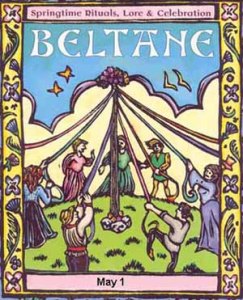
For this ritual one should dress brightly and strikingly, wearing flowers and greenery according to taste. A low altar should be built partially or entirely of stones at the middle of the ritual area.
Two candles should be placed on the altar, and the altar itself arranged as usual. (if the ritual is performed outdoors, the candles may be replaced be torches. These may be stuck in the ground on either side of the altar.)
Four candles or torches are placed before the altar to be lit later. A vertical pole about 3 feet in height is usualy erected on the far side of the altar: it should be decked with fruits, flowers, and bright ribbons. A half full cup of wine should be placed before the image of the Goddess.
Before dressing for the ceremony, take a ritual cleansing bath. When ready to go on with the rite, meditate for a while before going into the ritual area, thinking strongly on the old pagan ways and trying to imagine the rituals wich took place on this night in ages passed.
– Go alone to the ritual place. Kneeling before the altar, light the candles or torches on the altar, and the incense. Set alight the four candles before the altar and place them 3 or 5 feet from the altar at the North, then going deosil, saying:
“Here at this spot Do I create a place Sacred to the Gods of old. For a while, here and now Shall the ancient ways Live again”
– Take the wand and hold it out and salute toward the East, saying:
“Oh winds of the East Blow sweet and pure For the Lady reigns again!”
– Hold the wand out and salute toward the South, saying:
“Oh warmth of the South Bring forth life from the earth For the Lady reigns again!”
– Hold the wand out and salute toward the West, saying:
“Oh waters of the West Glisten clear and fresh For the Lady reigns again!”
– Hold the wand out and salute toward the North, saying:
“Oh lands of the North Grow rich and bounteous For the Lady reigns again!”
– Replace the wand and, holding the arms out over the altar, saying:
“Gracious and lovely Lady of the moon, Of joy and love, Protecteress of forests and wild things, This place is consecrated to Thee.”
-Take up the wine cup, holding it out at arm’s lenght, and pour out a few drops, saying:
” To the Great Ones of old And to the joyous times to come!”
-Drink some of the wine (or if you cannot drink alcohol, use an appropriate substitute).
– After a brief pause, rap three times on the altar with the wand saying:
“As woods and meadows flower forth I celebrate the ancient rite As the Ancients did before me. I cast the words into the mists Of time and space and otherwhere: Where one stays now, in years to come, May scores of others revel there. So may it be!”
– Rap once upon the altar. (More incense should be added now. Ad-lib additions are appropriate at this time…meditations, poetry …and the like.) (If a source of proper music is available, a solitary Dance of the Winds may be improvised.)
– Draw the Fertility talisman on the parchment, suffumigate it thrice, then, recite the supplication written on the back, …bow humbly and say:
“Friends of the nether worlds Now, come and assist us in our humble workings. Follow us to another sacred place of ours, And join your forces with ours, On this Fertilization Day.”
– Bury the talisman into the ground under an oak tree (if available), saying an ad-lib statement on the meaning of the talisman and its correspondances.Go back to the circle.
– When all is done, close by rapping four time with the wand, saying:
“Friends of the nether worlds Who have been about me for a while You may, with thanks, Return from whence you came.”
– Hold out arms and say:
“Blessed Lady of joy and laughter I thank Thee for Thy presence. May some of your love and power Remain with me. Blessed Be!”
– Put out the lights about the altar. As the two on the altar itself are darkened, say:
“This rite is ended…”
Note: Alter this ritual as needed to fit your circumstance. Note that many Beltane celebrations extend roughly one week past the May 1’st date, so any time in early May is appropriate to celebrate, in case you miss celebrating it on the May 1’st date.
(YOU CAN COPY AND PASTE ANY SPELLS POSTED TO A DOCUMENT TO PRINT AND/OR SAVE ON YOUR COMPUTER FOR PERSONAL USE ONLY)
For protection, I now pray,
Let all evil turn away.
Protect me night,
Protect me day,
And keep misfortune well at bay.

Expect the unexpected if you celebrate Samhain – the Celtic New Year – on All Hallows Eve: the planets bring a lot of energetic talk and chaos, and the resultant noise will add exuberance to the ritual. Look for psychic dreams on astrological Samhain, November 6; your intuition will be in top form if you do readings at ritual. The power is the strongest it has been in several years.
This is the sabbat for wearing your witchy black. Clean the house, including the hearth, from top to bottom; the garden also needs to be prepared for the winter by this date. Lay new fires. Fest with your family and set places for your ancestors. Cleanse divination tools (cards, crystals, runes) and rededicate them to the Goddess. For the last harvest festival, put apples, nuts, acorns, and squashes on the altar, and add pictures of the family members you are missing.
Using fresh harvested hazel nuts, make a wreath with nine nuts (three times three) to protect your house from fire and lightening. Offer thanks to the river gods or the gods of the sea, and remember to honor the goddess Hecate.
Source: K. D. Spitzer in Llewellyn’s Witches’ Datebook 2004 Page 63

Beltane is he holiday that draws all witches outside to celebrate the returning power of the Sun and the fertility of the land.
Wear red robes for ritual and dress your altar with reds for passion. If you have identified a nearby rowan tree, you can make a wreath for your hair using rowan twigs. Decorate your house with freshly cut greens, herbs, and flowers. Arrange for music or drumming to lighten your steps of the dancers of the maypole or spiral dance. Lose yourself in the dance.
Fire is the honored element at this ritual, so have circle members jump a cauldron for purification and protection. Watr is another honored element: be certain to visit your local sacred spring or riverbank. Sprinkle perfume into the water for the undines. Again, leave a drop or two of milk and other food offerings for the nature spirits.
Wake before dawn on this day and watch the Sun rise over a river or beach. Gather a pitcherful where the Sun has gilded the water. When you return home, walk the bounds of your land, sprinkling water in your garden beds to ensure plenty of rainfall during the growing season.
By K. D. Spitzer in Llewellyn’s Witches’ Datebook 2004 Page 63
Interested in learning about some of the traditions behind the celebrations of the autumn equinox? Find out why Mabon is important, learn about the legend of Persephone and Demeter, the symbolism of stags, acorns and oaks, and explore the magic of apples and more!
Wondering where the word “Mabon” came from? Was it a Celtic god? A Welsh hero? Is it found in ancient writings? Let’s look at some of the history behind the word.
Mabon falls around September 21 in the northern hemisphere, and around March 21 below the equator. This is the autumn equinox, it’s a time to celebrate the season of the second harvest. It’s a time of balance, of equal hours of light and dark, and a reminder that the cold weather isn’t far away at all. If you’ve got kids at home, try celebrating Mabon with some of these family-friendly and kid-appropriate ideas.
At Mabon, the time of the autumn equinox, there are equal hours of light and dark. It is a time of balance, and while summer is ending, the winter is approaching. This is a season in which farmers are harvesting their fall crops, gardens are beginning to die, and the earth gets a bit cooler each day. Let’s look at some of the ways that this second harvest holiday has been honored around the world for centuries. Read more about the Autumn Equinox Around the World.
Grapes are everywhere in the fall, so it’s no surprise that the Mabon season is a popular time to celebrate wine-making, and deities connected to the growth of the vine. Whether you see him as Bacchus, Dionysus, the Green Man, or some other vegetative god, the god of the vine is a key archetype in harvest celebrations. Learn more about the Gods of the Vine.
Renaissance Faires and Festivals aren’t specifically Pagan, but there are a few reasons why you’ll see a lot of us there. Let’s look at how this counterculture institution of the sixties and seventies turned into a place where you can almost always find other Pagans.
In the British Isles, Michaelmas is celebrated on September 29. As the Feast of St. Michael within the Catholic church, this date is often associated with the harvest because of its proximity to the autumn equinox. Although it’s not a Pagan holiday in the true sense, Michaelmas celebrations often included older aspects of Pagan harvest customs, such as the weaving of corn dolls from the last sheaves of grain. Read more about the Michaelmas Celebration.
Around the middle of September, the nut season starts. Hazelnuts ripen in the hedges, and they have long been connected to folklore and legends. Hazel is associated to the Celtic tree month of Coll, from August 5 to September 1, and the very word Coll means “the life force inside you.” Hazelnuts are connected to wisdom and protection, and are often found near sacred wells and magical springs.
The acorn is a symbol of strength and power. In the fall, these tiny yet hardy little nuggets drop from the oak trees to land on the ground. Because the acorn only appears on a fully mature oak, it is often considered a symbol of the patience needed to attain goals over long periods of time. It represents perseverance and hard work. In many cultures the oak is sacred. Read more about Acorn & Oak Folklore.
Pomona was a Roman goddess who was the keeper of orchards and fruit trees. Unlike many other agricultural deities, Pomona is not associated with the harvest itself, but with the flourishing of fruit trees. She is usually portrayed bearing a cornucopia or a tray of blossoming fruit. Learn more about Pomona, the Goddess of Apples.
Although they haven’t always looked the way they do now, scarecrows have been around a long time and have been used in a number of different cultures. From the farms of ancient Greece to the rice fields of Japan, scarecrows are often used for a variety of purposes. Learn more about Scarecrow Magic & Legends.
:max_bytes(150000):strip_icc():format(webp)/EggBalance_1500-56a6df363df78cf77290a3ea.jpg)
There’s a very popular story that circulates on the Internet twice every year at the spring and fall equinoxes, and it’s about eggs. According to legend, if you try to stand an egg on its end on the vernal or autumnal equinox, you’ll be successful, because of the polarity and balance of the earth. Let’s explore the legend of Egg Balancing on the Equinox.
Source:
Wigington, Patti. “Mabon (Autumn Equinox) Folklore and Traditions.” Learn Religions, Sep. 5, 2021, learnreligions.com/mabon-folklore-traditions-4590167.


Symbolism of Mabon: The completion of the Harvest begun. Day and night are equal and the God prepares to leave His physical body and begin the great adventure into the unseen.
Symbols of Mabon: all harvest symbols, corn, autumn flowers, red poppies,nuts, grains, leaves, acorns, pine and cypress cones, oak sprigs, wreaths, vine, grapes, cornucopia, horns of plenty, burial cairns, apples, marigolds, harvested crops. wine, gourds
Colors : Orange, Dark Red, Yellow, Indigo, Maroon and Brown.
Goddesses: Modron(Welsh), Bona Dea, Harvest Deities, Persephone, Demeter/Ceres, Morgan(Welsh- Cornish), Snake Woman(Aboriginal), Epona (Celtic-Gaulish), Pamona(Roman), the Muses(Greek).
Gods: Mabon, Modron(Welsh), Sky Father, John Barleycorn , the Wicker-Man, the Corn Man, Thoth(Egyptian), Hermes, Hotei(Japanese), Thor, Dionysus(Roman), Bacchus(Greek) and all wine Deities.
Tarot Cards: Judgment and The World
Altar Decorations: acorns, pinecones, autumn leaves, pomegranate, statue of the Triple Goddess in her Mother phase.
Mabon Herbs: Rue, yarrow, rosemary, marigold, sage, walnut leaves and husks, mistletoe, saffron, chamomile, almond leaves, passionflower, frankincense, rose hips, bittersweet, sunflower, wheat, oak leaves, dried apple or apple seeds.
Foods of Mabon: cornbread, wheat products, bread, grains, berries, nuts, grapes, acorns, seeds, dried fruits, corn, beans, squash, roots (ie onions, carrots, potatoes, etc), hops, apples, pomegranates, carrots, onions, potatoes, roast goose or mutton, wine, ale and ciders, breads, apples, pomegranates
Animals: dogs, wolves, stag, blackbird, owl, eagle, birds of prey, salmon & goat, Gnomes, Sphinx, Minotaur, Cyclops, Andamans and Gulons.
Element: water.
Incense : pine, sweetgrass, apple blossom, benzoin, myrrh, frankincense, jasmine, sage wood aloes, black pepper, patchouly, cinnamon, clove, oak moss
Mabon Stones : During Mabon, stones ruled by the Sun will help bring the Sun’s energy to you.clear quartz, amber, peridot, diamond, gold, citrine, yellow topaz, cat’s-eye, adventurine.
Customs: offerings to land, preparing for cold weather by bringing in harvest, cutting willow wands( Druidic), leaving apples upon burial cairns & graves as a token of honor, walks in forests, gather seed pods & dried plants, fermenting grapes to make wine,picking ripe produce, stalk bundling
Spellworkings of Mabon: Protection, prosperity, security, and self- confidence. Also those of harmony and balance. Taboos:It was considered unlucky to cut down the very last of the Harvest, and so was also left to stand in the field by some traditions.
Activities of Mabon: Select the best of each vegetable, herb, fruit, nut, and other food you have harvested or purchased and give it back to Mother Earth with prayers of thanksgiving. Hang dried ears of corn around your home in appreciation of the harvest season. Do meditations and chanting as you store away food for the Winter. Do a thanksgiving circle, offering thanks as you face each direction – – for home, finances, and physical health (North); for gifts of knowledge (East); for accomplishments in career and hobbies (South); for relationships (West); and for spiritual insights and messages (Center). Decorate the table with colorful autumn leaves in a basket. Display the fruits of the harvest – corn, gourds, nuts, grapes, apples – preferably in a cornucopia. Or decorate with wildflowers, acorns, nuts, berries, cocoons, anything that represents the harvest to you. Like its sister equinox, halfway across the Wheel of the Year, the Autumn Equinox is a good occasion for a ritual feast. Plan a meal that uses seasonal and symbolic fruits and vegetables. You can serve bread, squash, corn, apples, cider and wine. Make some homemade wine or cordial gather and dry herbs, plants, seeds and seed pods. Make grapevine wreaths using dried bitter-sweet herb for protection. Use ribbons of gold and yellow to bring in the energy of the Sun, and decorate with sprigs of dried yarrow or cinnamon sticks. Make a protection charm of hazelnuts (filberts) strung on red thread. Make a witch’s broom. Tie dried corn husks or herbs (broom, cedar, fennel, lavender, peppermint, rosemary) around a strong, relatively straight branch of your choice. Make magic Apple Dolls Gifts of the Harvest can be used to make tools and emblems that will remind us of their bounty all year round. Look for colored leaves. Collect fallen leaves and make a centerpiece or bouquet for your home. Save the leaves to burn in your Yule fire. Vist an apple orchard and, if possible, pick your own apples. Hang apples on a tree near your home. Watch the birds and other small animals who will enjoy your gift. This is also the time for replacing your old broom with a new one. As the broom corn is ripe now, besom making is traditional and magickal this time of year. Begin the festival with a vineyard or orchard harvest. You might check the farm lands in your area to see if there’s an orchard or pumpkin patch that allows customers to harvest produce for themselves. Traditionally Sabbat festivals begin at sun set on the eve of the Holiday. You can use the daytime hours of this holiday eve to prepare baskets for harvesting the next day. Baking a pumpkin pie (from scratch if possible) is a wonderful way to bring in the fragrance of the holiday season

Summer Solstice and Winter Solstice are two significant astronomical events that mark the extremes of the Earth’s axial tilt. Summer Solstice occurs around June 21st in the Northern Hemisphere and December 21st in the Southern Hemisphere, while Winter Solstice takes place around December 21st in the Northern Hemisphere and June 21st in the Southern Hemisphere. During Summer Solstice, the hemisphere tilted towards the Sun experiences the longest day of the year, with the Sun reaching its highest point in the sky. In contrast, Winter Solstice brings the shortest day of the year, with the Sun at its lowest point in the sky. These solstices have cultural and historical importance, often celebrated with various rituals and festivals around the world.
| Attribute | Summer Solstice | Winter Solstice |
|---|---|---|
| Date | June 20-22 | December 20-23 |
| Duration of Daylight | Longest day of the year | Shortest day of the year |
| Duration of Darkness | Shortest night of the year | Longest night of the year |
| Position of Sun | Highest in the sky | Lowest in the sky |
| Season | Summer | Winter |
| Hemisphere | Northern Hemisphere | Southern Hemisphere |
| Celebrations | Midsummer, bonfires | Winter festivals, Christmas |
The solstices are significant astronomical events that mark the changing of seasons. The Summer Solstice and Winter Solstice are two of the most well-known solstices, occurring in opposite hemispheres of the Earth. While the Summer Solstice represents the longest day of the year in the Northern Hemisphere, the Winter Solstice marks the shortest day of the year. In this article, we will explore the attributes of both solstices, highlighting their unique characteristics and the impact they have on various aspects of life.
The Summer Solstice, also known as Midsummer, is a time when the Northern Hemisphere experiences the longest day and shortest night of the year. It usually falls on June 20th or 21st. This astronomical event occurs when the tilt of the Earth’s axis is most inclined towards the sun, resulting in the sun reaching its highest point in the sky.
One of the most notable attributes of the Summer Solstice is the extended daylight hours. The sun rises early and sets late, providing ample time for outdoor activities and enjoyment of the warm weather. This extended daylight has a significant impact on agriculture, as it allows for increased photosynthesis and growth of crops. Farmers take advantage of this period to maximize their harvests and ensure bountiful yields.
Furthermore, the Summer Solstice holds cultural and spiritual significance in many societies. It is celebrated in various ways around the world, often with festivals, bonfires, and rituals. For example, the ancient monument of Stonehenge in England attracts thousands of visitors who gather to witness the sunrise on this special day. The solstice is seen as a time of renewal, abundance, and connection with nature.
Additionally, the Summer Solstice has a profound impact on wildlife. Many animals, such as birds, migrate during this time, taking advantage of the extended daylight to find food and build nests. It is also a crucial period for plant pollination, as the longer days provide more opportunities for insects and birds to carry out this essential process.
In terms of climate, the Summer Solstice brings warmer temperatures and the onset of summer. It is a time when people flock to beaches, lakes, and other outdoor destinations to enjoy the sun and engage in recreational activities. The longer days and increased sunlight also have positive effects on human health, as exposure to sunlight stimulates the production of vitamin D, which is essential for bone health and overall well-being.
The Winter Solstice, also known as Midwinter, is the counterpart to the Summer Solstice. It occurs around December 21st in the Northern Hemisphere when the Earth’s axis is tilted furthest away from the sun. As a result, the Winter Solstice represents the shortest day and longest night of the year.
One of the most prominent attributes of the Winter Solstice is the limited daylight hours. The sun rises late and sets early, leading to longer periods of darkness. This reduced sunlight has implications for various aspects of life, including agriculture, human activities, and wildlife behavior.
In terms of agriculture, the Winter Solstice marks a period of dormancy for many crops. The limited sunlight and colder temperatures slow down plant growth, and farmers often use this time to prepare for the upcoming spring season. It is a time for planning, maintenance, and reflection on the previous year’s harvest.
From a cultural perspective, the Winter Solstice holds significant meaning in many societies. It is often associated with celebrations and festivals that embrace the return of light and the promise of longer days. For example, the ancient Roman festival of Saturnalia and the modern-day celebration of Christmas both coincide with the Winter Solstice. These festivities bring people together, fostering a sense of warmth, joy, and hope during the darkest time of the year.
Furthermore, the Winter Solstice affects wildlife behavior in various ways. Many animals adapt to the limited daylight by hibernating or migrating to warmer regions. The scarcity of food during this time also influences the feeding patterns of certain species. Additionally, the Winter Solstice provides unique opportunities for observing nocturnal animals and appreciating the beauty of the night sky.
In terms of climate, the Winter Solstice brings colder temperatures and the official start of winter. It is a time when people bundle up in warm clothing, gather around fireplaces, and engage in indoor activities. The limited daylight can have an impact on mental health, as some individuals may experience seasonal affective disorder (SAD) due to reduced exposure to sunlight. However, the Winter Solstice also offers a chance for introspection, rest, and rejuvenation.
The Summer Solstice and Winter Solstice are two significant astronomical events that mark the changing of seasons in the Northern Hemisphere. While the Summer Solstice represents the longest day and brings extended daylight, warmth, and abundance, the Winter Solstice marks the shortest day and brings limited daylight, colder temperatures, and a time for reflection. Both solstices hold cultural, agricultural, and ecological importance, shaping various aspects of life on Earth. Whether it’s celebrating the sun’s zenith during the Summer Solstice or embracing the return of light during the Winter Solstice, these celestial events remind us of the cyclical nature of our planet and the interconnectedness of all living beings.
Yule, or the Winter Solstice, is one of our favorite Pagan holidays! The vitality of red, the abundance of green, and the protection and guidance of white make up the most memorable vibes and colors of this winter celebration!
As the longest night and shortest day of the year, this wintertime sabbat is also known as the Winter Solstice to many, while some people call it Pagan Christmas. Regardless of what you call it, this beautiful second stop on the new Wheel of the Year represents the rebirth of the Sun!
Yule, also known as the Winter Solstice, is a time for celebrating the renewal and rebirth of life. It is a season that emphasizes the importance of family, with traditions such as feasting and gift-exchanging playing a central role. Gifts symbolize generosity and connection among family and friends, reflecting the spirit of giving during this joyous time. Yule is a period for strengthening bonds with loved ones, honoring family and friends, and reflecting on themes of generosity and unity. Click the hyperlinks above to read the rest of this article

Disclaimer: No crystal, or gem or stone should be used for medicinal purposes in place of what your health care professional has prescribed for you for any reason. The content provided on this website is for informational purposes only and DOES NOT CONSTITUTE THE PROVIDING OF MEDICAL ADVICE and is not intended to be a substitute for independent professional medical judgment, advice, diagnosis, or treatment. Always seek the advice of your physician or other qualified health providers with any questions or concerns you may have regarding your health. WitchesofTheCraft.com, any staff member of WitchesofTheCraft.com and/or Lady Carla Beltane are not responsible for any type of negative reaction when using a crystal or gem or stone for any reason.
by Spiralotus
Abundance is the connection to the source of all that is; manifesting a constant flow to support, nourish and expand life as well as creativity. In Chinese Feng Shui the wealth corner is the corner farthest away and to the far left of the front door or the southeast corner, depending on what system you use. If you like to use this system you can set up crystals to attract various forms of abundance there.
Some crystals that are associated with abundance are usually green, yellow, gold or orange. However there are other stones that do not have those colors and work just as well. Yellow Sapphire is associated with Ganesh, Hindu god of prosperity. This stone attracts wealth to the home. An Abundance Crystal is a Quartz crystal with one long part and many tiny crystals at the base to encourage dreams, well-being, and love. Tiger’s Eye helps people with material things and assists by showing the best way to do something. It stimulates wealth and helps create stability to maintain wealth. Citrine should be placed in your wealth corner to attract abundance. Carnelian improves motivation and getting out of a rut. Peridot brings wealth quickly and is best for someone who already has things under control. Topaz helps you appreciate life and makes room for abundance. It taps into your own natural resources and because its facets carry both negative as well as positive charges, it helps manifest desires.
When you decide on a crystal to use cleanse it first by running it under water, charging it in the sun or moon, putting it in a pyramid, or if you are a Reiki practitioner, simply Reiki your crystal. Some people put their crystals in sea salt. This is a great way to cleanse them, just make sure the crystal that you are working with will not be damaged by the salt. Always throw away your salt when you are done.
You can program your crystal to attract a specific form of abundance by holding it in your hands and picturing what you want to manifest in your life. Make sure you keep your area for your crystal clean and charged. Periodically smudging the area will help you with this. In your abundance area you may wish to include something that represents Deity to you and perhaps the type of abundance you want to bring into your life. Being as specific as possible helps to create the energy you wish to attract. As your wealth increases in material, spiritual, and emotional areas be sure to give thanks for what has manifested in your life.
Spiralotus is High Priestess with the Order of the White Moon. As a Reiki Master and Herbalist, she trains women in the healing arts.

A guide to the Sabbat’s symbolism
by Arwynn MacFeylynnd
Date: August 1 or 2.
Alternative names: Lughnassadh, Lammastide, August Eve, Harvest Home, Ceresalia (Roman, in honor of the grain goddess Ceres), First Fruits, Festival of Green Corn (Native American), Feast of Cardenas, Cornucopia (Strega), Thingtide and Elembiuos. Lammas, an Anglo-Saxon word, means “loaf mass.” Lughnassadh is named for the Irish sun god Lugh (pronounced Loo), and variant spellings are Lughnasadh, Lughnasad, Lughnassad, Lughnasa and Lunasa.
Primary meanings: This festival has two aspects. First, it is one of the Celtic fire festivals, honoring the Celtic culture-bringer Lugh (Lleu to the Welsh, Lugus to the Gauls). In Ireland, races and games were held in his name and that of his mother, Tailtiu (these may have been funeral games). Second, the holiday is the Saxon Feast of Bread, at which the first of the grain harvest is consumed in ritual loaves. These aspects are not too dissimilar, as the shamanic death and transformation of Lleu can be compared to that of the Barley God, known from the folksong “John Barleycorn.”
Lammas celebrates the first of three harvest celebrations in the Craft. It marks the beginning of autumn, the start of the harvest cycle, and relies on the early crops of ripening grain and any fruits and vegetables ready to be harvested. It is associated with bread because grain is one of the first crops harvested. Those in the Craft often give thanks and honor now to gods and goddesses of the harvest, as well as those who represent death and resurrection.
Symbols: All grains, especially corn and wheat, corn dollies, sun wheels, bread, harvesting and threshing tools and the harvest full moon. Altar decorations might include corn dollies or kirn babies (corncob dolls) to symbolize the Mother Goddess of the Harvest. Other appropriate decorations include summer flowers and grains. You might also wish to have a loaf of whole cracked wheat or multigrain bread upon the altar, baked in the shape of the sun.
Colors: Red, orange, gold, yellow, citrine, green, grey and light brown.
Gemstones: Yellow diamonds, aventurine, sardonyx, peridot and citrine.
Herbs: Acacia flowers, aloes, chamomile, cornstalks, cyclamen, fenugreek, frankincense, heather, hollyhock, myrtle, oak leaves, passionflower, rose, rose hips, rosemary, sandalwood, sunflowers and wheat.
Gods and goddesses: Lugh, Thor, John Barleycorn (the personification of malt liquor), Demeter, Danu, Ceres, sun gods, corn mothers, all grain and agriculture deities, mother goddesses and father gods.
Customs and myths: Spellwork for prosperity, abundance and good fortune are especially appropriate now, as well as spells for connectedness, career, health and financial gain. Sacrifice is often associated with this holiday. Visits to fields, orchards, lakes and wells are also traditional. It is considered taboo not to share your food with others now.
Activities appropriate for this time of the year are baking bread, wheat weaving and making corn dollies or other god and goddess symbols. You may want to string Indian corn on black thread to make a necklace, or bake cornbread sticks shaped like little ears of corn for your Sabbat cakes. The corn dolly may be used both as a fertility amulet and as an altar centerpiece.
Some pagans bake Lammas bread in the form of a god-figure or sun wheel — if you do this, be sure to use this bread in your Lammas ritual’s cakes and ale ceremony, if you have one. During the Lammas ritual, some consume bread or something from the first harvest. Some gather first fruits; others symbolically throw pieces of bread into a fire.
Incense
Chalice of water
Salt
Pentacle
Dagger
4 Elemental candles
Chalice of wine
Wand
Plate of bread
Cauldron with a orange candle in it
Fall flowers, ivy, and leaves for decorations
Cast the Circle
Light the cauldron candle and say:
” O Ancient Gods of the Celts, I do ask your presence here.
For this is a time that is not a time,
in a place that is not a place,
on a day that is not a day,
and I await you. ”
Set the plate of bread on the pentacle. Stand still and breathe deeply for a few moments.
Concentrate on the cleansing power of the breath of air, when you feel ready, say:
” I have purified myself by breathing in the life force
of the universe and expelling all evil from me. ”
Lift the plate of bread high and set it back on the altar and say:
” I know that every seed, every grain is a record of ancient time,
and a promise to all of what shall be.
This bread represents eternal life
through the cauldron of the Triple Goddess. ”
Eat a piece of bread, put the wine chalice on the pentacle , lift it high, and then set it on the altar, and say:
” As the grape undergoes change to become wine,
so by the sacred cauldron of life shall I undergo change.
And as this wine can give man enchantment of the divine
or sink him to the lower realms,
so do I realize that all humans rise or fall
according to their own strength and will. ”
Drink some wine and say:
” As in the bread and wine, so it is with me.
Within all forms is locked a record of the past
and a promise of the future.
I ask that you lay your blessings upon me, Ancient Ones,
that this season of waning light
and increasing darkness may not be heavy.
So Mote It Be! ”
The simple feast
Leave a libation for the nature spirits
Close the Circle
Lammas is the first of the harvest festivals and this year despite the fiery Sun, it has a strong, sensual feel of cardinal earth. Mars lends a masculine energy to the Sun this week to help with the organizing for this bread festival. Round cornbread as a solar disk is an apt and easy choice for the altar, but if you plan several days ahead, you can sprout a small amount (1/4 cup) of wheat or barely for kitchen witchery. Add this to your other grains to your own bread from scratch; or buy frozen bread dough, thaw, pat into a rectangle, and sprinkle the sprouted grains. Roll up your dough like a jelly roll and place in a greased bread pan into which you have sprinkled Irish oats. You can use a sharp knife to crave goddess symbols into the loaf before baking.
©️ By K. D. Spitzer Llewellyn’s Witches’ Datebook 2002 Page 93
You must be logged in to post a comment.