
Some of the Witchcraft/Magickal Correspondence for Wednesday

WEDNESDAY CORRESPONDENCES

Mercury/Neptune/Air/North/West/Southwest/Female/Male/Gemini/Virgo

Magickal Intentions: Communication, Divination, Writing, Knowledge, Business Transactions, Debt, Fear, Loss, Travel, Money Matters

Color: black, light blue, brown, gray, green, magenta, orange, peach, purple, red, silver, turquoise, violet, white, yellow; orange is the primary color

Number: 3, 5

Metal: mercury

Charm: distaff, rod, runes, staff, iridescent garments

Stone: moss agate, amethyst, bloodstone, emerald, hematite, lapis lazuli, lodestone, pearl, ruby, sapphire, sodalite, all blue stones

Animal: bear, dog, fox, magpie, swan, weasel

Plant: almond, bayberry, chamomile, cherry, cinnamon, cinquefoil, clove, coltsfoot, ginger, hazel, hazelnut, jasmine, lavender, millet, oak, peppermint, periwinkle, rosemary, sage, St. John’s wort, sweet pea, tamarind, lemon verbena, violet

Incense: cassia, cedar, cinnamon, clove, frankincense, jasmine, lavender, mastic, mint, rosemary, sage, sandalwood, storax, dried and powdered citrus peel, and all incense made from aromatic bark, wood, and seeds

Goddess: Carmenta, Hecate (Queen of Crossroads), Hel, Ishtar, Ma’at, the Morrigan, Nike

God: Anubis, Bragi, Elath-Iahu. Enki, Garuda, Hermes, Maximon (Black Magician), Mercury, Nebo (Wise God of Wednesday), Odin, Shango, Ullr, Vishnu, Wayland, Woden

Evocation: Agrat Bat Mahalat, Michael, Miel, Raphael, Seraphiel, Tiriel

Source

Moonlight Musings

A Thought for Today – Printable

A Laugh for Today and for Your Listening Pleasure

“It’s just another manic Monday…”

The Bangles – Manic Monday

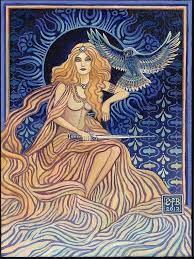
Goddess of The Day – Minerva

Goddess of The Day: MINERVA

Terminalia (Rome)

Themes: Earth; Home 0

Symbols: Owl; Geranium

About Minerva: This Etruscan/Italic Goddess blended the odd attributes of being a patroness of household tasks, including arts and crafts, and also being the patroness of protection and of war. Today she joins in pre-spring festivities by helping people prepare their lands for sowing and embracing the figurative lands of our hearts, homes, and spirits with her positive energy.

To Do Today: In ancient times, this was a day to bless one’s lands and borders. Gifts of corn, honey, and wine were given to the earth and its spirits to keep the property safe and fertile throughout the year. In modern times, this equates to a Minerva-centered house blessing.

Begin by putting on some spiritually uplifting music. Burn geranium-scented incense if possible; otherwise, any pantry spice will do. Take this into every room of your home, always moving clockwise to promote positive growing energy. As you get to each room, repeat this incantation:

Minerva, protect this sacred space and all who live within. By your power and my will, the magic now begins!

Wear a geranium today to commemorate Minerva and welcome her energy into your life.

)0(

By Patricia Telesco and GrannyMoon’s Morning Feast Archives

Witchcraft Symbols, Terms and Definitions

From thoughtcatalog.com

Sun Wheel

The sun wheel is another form of a sun cross as it is also a circle bisected by four lines. It can be used as a calendar with each section of the circle representing the time between an equinox or solstice and also represents the balance of the four seasons. This symbol is sometimes called the eight-spoked wheel.

Represents: sun, four seasons, fire, masculine energy, south.

Used in rituals for: celebrating seasons, invoking the sun.

February 20 Tody in History

Today’s Important Historical Events

1792 US postal service created, postage 6-12 cents depending on distance

1872 New York’s Metropolitan Museum of Art opens

1873 British Naval Officer John Moresby discovers the site of Port Moresby, Papua New Guinea and claims it for the United Kingdom

1938 UK Foreign Secretary Anthony Eden resigns stating Prime Minister Neville Chamberlain has appeased Nazi Germany

1944 Battle of Eniwetok: US forces take Enewetak Atoll at the cost of 37 Americans killed or missing and 94 wounded, Japanese losses were 800 dead and 23 prisoners

1947 Earl Mountbatten of Burma appointed as last viceroy of India to oversee the move to independence

1962 John Glenn becomes the 1st American to orbit the Earth, aboard Friendship 7

Today’s Historical Events

1280 Japanese Imperial Court orders all temples and shrines to pray for victory in the impending second Mongol invasion

1472 Orkney and Shetland are left by Norway to Scotland, due to a dowry payment

1525 Swiss & German mercenaries desert Francois I’s army

1547 King Edward VI of England crowned following the death of his father Henry VIII

1613 Gerard Reynst appointed Governor-General of Dutch East Indies

1619 Trial against Johan van Oldenbarnevelt begins in The Hague for alleged crimes against the federal government

1653 Defeat of Dutch fleet under Adm Van Tromp by Admiral Blake off Portsmouth

1673 1st recorded wine auction held in London

Today’s Historical Events in Flim and TV

1944 Batman & Robin comic strip premieres in newspapers

1952 “African Queen” film directed by John Huston, starring Humphrey Bogart and Katharine Hepburn is released in the US

1956 WOSU TV channel 34 in Columbus, OH (PBS) begins broadcasting

1958 Adaptation of Fyodor Dostoevsky’s “The Brothers Karamazov”, starring Yul Brynner and featuring William Shatner‘s film debut, premieres at Radio City Music Hall, NYC

1971 National Emergency Center erroneously orders US radio & TV stations to go off the air. Mistake wasn’t resolved for 30 minutes

1978 4th People’s Choice Awards: John Wayne and Barbra Streisand (Motion Picture), and James Garner and Mary Tyler Moore (TV) win

1978 Bob Backland beats “Superstar” Billy Graham in NYC, to become WWF wrestling champion

Today’s Historical Events in Music

1724 George Frideric Handel‘s opera “Giulio Cesare in Egitto” premieres at the King’s Theatre in Haymarket, London

1816 Gioachino Rossini‘s comic opera “Barber of Seville” premieres at the Teatro Argentina in Rome, Italy

1917 Jerome Kern, Guy Bolton & P.G. Wodehouse’s musical “Oh, Boy!” opens at the Princess Theatre, NYC; runs for 463 performances

1934 Virgil Thomson and Gertrude Stein’s opera “Four Saints in Three Acts” opens on Broadway at the 44th Street Theatre, NYC

1940 Larry Clinton & his Orchestra record “Limehouse Blues”

1959 Jimi Hendrix (16), rock and roll guitarist, plays his first gig in the Temple De Hirsch synagogue basement, Seattle; fired from the band after the 1st set due to “wild” playing

1965 Beatles record “That Means A Lot”; unhappy with the results, it was given to P.J. Proby to record, the Beatles version was unreleased until 1996 on Anthology 2

1977 Revival of Alan Jay Lerner and Frederick Loewe’s musical “My Fair Lady” closes at the Lunt-Fontanne Theatre, NYC, after 377 performances

Today’s Historical Events in Sports

1912 Argentina beats the MCC in their inaugural 1st-class cricket fixture at the Buenos Aires Cricket Club; lose the second and third games of the series

1919 Foundation NHL club Toronto Arenas are permitted to cease operations due to financial difficulties; later become Toronto St. Patricks and then Maple Leafs

1923 Future Baseball Hall of Fame pitcher Christy Mathewson becomes President and owner of Boston Braves; buys the team for $300,000 with NY attorney Judge Emil Fuchs and Bostonian James McDonough

1926 Montreal and Ottawa battle out just the second 0-0 tie in NHL history; dominant goalies are Clint Benedict (Maroons) and Alex Connell (Senators)

1929 Boston Red Sox announce they will play Sunday MLB games at Braves Field; Fenway Park located too close to a church

1952 American alpine skier Andrea Mead-Lawrence is only multi-gold medallist at the Oslo Winter Olympics when she wins the slalom, after taking out the inaugural giant slalom

1952 Britain’s Jeannette Altwegg wins the Olympic women’s figure skating gold medal at the Olso Winter Games ahead of American Tenley Albright, who goes on to win in Cortina d’Ampezzo (1956)

1952 Emmett Ashford is certified to be first black umpire in organised baseball; has to wait until 1966 for MLB debut

A Laugh for Today

Some of the Witchcraft/Magickal Correspondence for The New Moon


Correspondences for The New Moon


Time: From Dark Moon to Waxing Moon (depends)

Goddess Aspect: Maiden

Associated Goddesses: Callieach, Banshee, Hecate, Kali, Morrigan

Magickal Attributes: BANISHING releasing the old, removing unwanted negative energies, wisdom, psychic abilities, scrying, reversing circumstances.

NEW BEGINNINGS weight loss, goal setting, planning, cleaning, personal cleansing, general beginnings and considerations.

A Thought for Today – Printable

For Your Listening Pleasure

There are many ways to relax on a day off from work with dancing being just one way. Add incentive it helps to maintain or lose weight. It can tire out the children who have been stuck inside because of yucky weather outside – too cold, too hot, too muddy, etc.

So, get up and have some fun just feel the music and let your body flow!!!

Mix – Dance, My Children Dance Belle, Spiral Rhythm, and More

For Your Viewing Pleasure

America’s Hidden Stories: Salem’s Secrets FULL EPISODE | Smithsonian Channel

Not A Deity of the Day But One of My Favorite Celtic Women In History…. c. 2015

(Side Note from Lady Beltane – I want to grow up to be like this astounding woman)

Boudica, Battle of Watling Street by Roman Lappat · Putty&Paint

Boudica

Boudica (/ˈbuːdɨkə/; alternative spelling: Boudicca, also known as Boadicea /boʊdɨˈsiːə/ and in Welsh as Buddug [ˈbɨ̞ðɨ̞ɡ]) (d. AD 60 or 61) was a queen of the British Iceni tribe who led an uprising against the occupying forces of the Roman Empire.

Boudica’s husband Prasutagus ruled as a nominally independent ally of Rome and left his kingdom jointly to his daughters and the Roman emperor in his will. However, when he died, his will was ignored and the kingdom was annexed. Boudica was flogged, her daughters raped, and Roman financiers called in their loans.

In AD 60 or 61, when the Roman governor Gaius Suetonius Paulinus was campaigning on the island of Anglesey off the northwest coast of Wales, Boudica led the Iceni, the Trinovantes and others in revolt. They destroyed Camulodunum (modern Colchester), earlier the capital of the Trinovantes but at that time a colonia, a settlement for discharged Roman soldiers, and site of a temple to the former Emperor Claudius. Upon hearing of the revolt, Suetonius hurried to Londinium (modern London), the twenty-year-old commercial settlement that was the rebels’ next target.

The Romans, having concluded that they did not have the numbers to defend the settlement, evacuated and abandoned Londinium. Boudica led 100,000 Iceni, Trinovantes and others to fight Legio IX Hispana and burned and destroyed Londinium, and Verulamium (modern-day St Albans). An estimated 70,000–80,000 Romans and British were killed in the three cities by those led by Boudica. Suetonius, meanwhile, regrouped his forces in the West Midlands, and despite being heavily outnumbered, defeated the Britons in the Battle of Watling Street.

The crisis caused the Emperor Nero to consider withdrawing all Roman forces from Britain, but Suetonius’s eventual victory over Boudica confirmed Roman control of the province. Boudica then either killed herself so she would not be captured, or fell ill and died. The extant sources, Tacitus and Cassius Dio, differ.

Interest in these events revived in the English Renaissance and led to Boudica’s fame in the Victorian era. Boudica has remained an important cultural symbol in the United Kingdom. However, the absence of native British literature during the early part of the first millennium means that knowledge of Boudica’s rebellion comes solely from the writings of the Romans

History

Boudica’s name

Boudica has been known by several versions of her name. Raphael Holinshed calls her Voadicia, while Edmund Spenser calls her Bunduca, a version of the name that was used in the popular Jacobean play Bonduca, in 1612. William Cowper’s poem, Boadicea, an ode (1782) popularised an alternate version of the name. From the 19th century and much of the late 20th century, Boadicea was the most common version of the name, which is probably derived from a mistranscription when a manuscript of Tacitus was copied in the Middle Ages.

Her name was clearly spelled Boudicca in the best manuscripts of Tacitus, but also Βουδουικα, Βουνδουικα, and Βοδουικα in the (later and probably secondary) epitome of Cassius Dio. The name is attested in inscriptions as “Boudica” in Lusitania, Boudiga in Bordeaux, and Bodicca in Algeria.

Kenneth Jackson concludes, based on later development of Welsh and Irish, that the name derives from the Proto-Celtic feminine adjective *boudīka, “victorious”, that in turn is derived from the Celtic word *bouda, “victory” (cf. Irish bua (Classical Irish buadh), Buaidheach, Welsh buddugoliaeth), and that the correct spelling of the name in the British language is Boudica, pronounced [bɒʊˈdiːkaː].

The closest English equivalent to the vowel in the first syllable is the ow in “bow-and-arrow”. The modern English pronunciation is /ˈbuːdɪkə/, and it has been suggested that the most comparable English name, in meaning only, would be “Victoria”.

Background

Location of Iceni territory within England, Wales and Mann; modern county borders for England and pre-1996 borders for Wales are shown for context.

Tacitus and Dio agree that Boudica was of royal descent. Dio describes her as “possessed of greater intelligence than often belongs to women.” He also describes her as tall, with tawny hair hanging down to below her waist, a harsh voice and a piercing glare. He notes that she habitually wore a large golden necklace (perhaps a torc), a colourful tunic, and a thick cloak fastened by a brooch.

Her husband Prasutagus was the king of the Iceni, the people who inhabited roughly what is now Norfolk. They initially were not part of the territory under direct Roman control, having voluntarily allied themselves to Rome following Claudius’ conquest of AD 43. They were proud of their independence, and had revolted in AD 47 when the then-governor Publius Ostorius Scapula threatened to disarm them. Prasutagus had lived a long life of conspicuous wealth and, hoping to preserve his line, made the Roman emperor co-heir to his kingdom, along with his wife and two daughters.

It was normal Roman practice to allow allied kingdoms their independence only for the lifetime of their client king, who would then agree to leave his kingdom to Rome in his will. For example, the provinces of Bithynia and Galatia were incorporated into the Empire in just this way. Roman law also allowed inheritance only through the male line, so when Prasutagus died, his attempts to preserve his line were ignored and his kingdom was annexed as if it had been conquered. His lands and property were confiscated and nobles treated like slaves. According to Tacitus, Boudica was flogged and her daughters were raped. Cassius Dio says that Roman financiers, including Seneca the Younger, chose this time to call in their loans. Tacitus does not mention this, but does single out the Roman procurator Catus Decianus for criticism for his “avarice”. Prasutagus, it seems, had lived well on borrowed Roman money, and on his death his subjects had become liable for the debt.

Boudica’s uprising

In AD 60 or 61, while the current governor, Gaius Suetonius Paulinus, was leading a campaign against the island of Mona (modern Anglesey) in the north of Wales, which was a refuge for British rebels and a stronghold of the druids, the Iceni conspired with their neighbours the Trinovantes, amongst others, to revolt. Boudica was chosen as their leader. According to Tacitus, they drew inspiration from the example of Arminius, the prince of the Cherusci who had driven the Romans out of Germany in AD 9, and their own ancestors who had driven Julius Caesar from Britain. Dio says that at the outset Boudica employed a form of divination, releasing a hare from the folds of her dress and interpreting the direction in which it ran, and invoked Andraste, a British goddess of victory.

The rebels’ first target was Camulodunum (Colchester), the former Trinovantian capital and, at that time, a Roman colonia. The Roman veterans who had been settled there mistreated the locals and a temple to the former emperor Claudius had been erected there at local expense, making the city a focus for resentment. The Roman inhabitants sought reinforcements from the procurator, Catus Decianus, but he sent only two hundred auxiliary troops. Boudica’s army fell on the poorly defended city and destroyed it, besieging the last defenders in the temple for two days before it fell. Archaeologists have shown that the city was methodically demolished. The future governor Quintus Petillius Cerialis, then commanding the Legio IX Hispana, attempted to relieve the city, but suffered an overwhelming defeat. His infantry was wiped out—only the commander and some of his cavalry escaped. The location of this famous destruction of the Legio IX is now claimed by some to be the village of Great Wratting, in Suffolk, which lies in the Stour Valley on the Icknield Way West of Colchester, and by a village in Essex. After this defeat, Catus Decianus fled to Gaul.

When news of the rebellion reached him, Suetonius hurried along Watling Street through hostile territory to Londinium. Londinium was a relatively new settlement, founded after the conquest of AD 43, but it had grown to be a thriving commercial centre with a population of travellers, traders, and, probably, Roman officials. Suetonius considered giving battle there, but considering his lack of numbers and chastened by Petillius’s defeat, decided to sacrifice the city to save the province.

…Alarmed by this disaster and by the fury of the province which he had goaded into war by his rapacity, the procurator Catus crossed over into Gaul. Suetonius, however, with wonderful resolution, marched amidst a hostile population to Londinium, which, though undistinguished by the name of a colony, was much frequented by a number of merchants and trading vessels. Uncertain whether he should choose it as a seat of war, as he looked round on his scanty force of soldiers, and remembered with what a serious warning the rashness of Petilius had been punished, he resolved to save the province at the cost of a single town. Nor did the tears and weeping of the people, as they implored his aid, deter him from giving the signal of departure and receiving into his army all who would go with him. Those who were chained to the spot by the weakness of their sex, or the infirmity of age, or the attractions of the place, were cut off by the enemy. – Tacitus

Londinium was abandoned to the rebels who burnt it down, slaughtering anyone who had not evacuated with Suetonius. Archaeology shows a thick red layer of burnt debris covering coins and pottery dating before AD 60 within the bounds of Roman Londinium., whilst Roman-era skulls found in the Walbrook in 2013 were potentially linked to victims of the rebels. Verulamium (St Albans) was next to be destroyed.

In the three settlements destroyed, between seventy and eighty thousand people are said to have been killed. Tacitus says that the Britons had no interest in taking or selling prisoners, only in slaughter by gibbet, fire, or cross. Dio’s account gives more detail; that the noblest women were impaled on spikes and had their breasts cut off and sewn to their mouths, “to the accompaniment of sacrifices, banquets, and wanton behaviour” in sacred places, particularly the groves of Andraste.

Romans rally

While Boudica’s army continued their assault in Verulamium (St. Albans), Suetonius regrouped his forces. According to Tacitus, he amassed a force including his own Legio XIV Gemina, some vexillationes (detachments) of the XX Valeria Victrix, and any available auxiliaries. The prefect of Legio II Augusta, Poenius Postumus, stationed near Exeter, ignored the call, and a fourth legion, IX Hispana, had been routed trying to relieve Camulodunum, but nonetheless the governor was able to call on almost ten thousand men.

Suetonius took a stand at an unidentified location, probably in the West Midlands somewhere along the Roman road now known as Watling Street, in a defile with a wood behind him — but his men were heavily outnumbered. Dio says that, even if they were lined up one deep, they would not have extended the length of Boudica’s line. By now the rebel forces were said to have numbered 230,000, however, this number should be treated with scepticism — Dio’s account is known only from a late epitome, and ancient sources commonly exaggerate enemy numbers.

Boudica exhorted her troops from her chariot, her daughters beside her. Tacitus gives her a short speech in which she presents herself not as an aristocrat avenging her lost wealth, but as an ordinary person, avenging her lost freedom, her battered body, and the abused chastity of her daughters. She said their cause was just, and the deities were on their side; the one legion that had dared to face them had been destroyed. She, a woman, was resolved to win or die; if the men wanted to live in slavery, that was their choice.

However, the lack of manoeuvrability of the British forces, combined with lack of open-field tactics to command these numbers, put them at a disadvantage to the Romans, who were skilled at open combat due to their superior equipment and discipline. Also, the narrowness of the field meant that Boudica could put forth only as many troops as the Romans could at a given time.

First, the Romans stood their ground and used volleys of pila (heavy javelins) to kill thousands of Britons who were rushing toward the Roman lines. The Roman soldiers, who had now used up their pila, were then able to engage Boudica’s second wave in the open. As the Romans advanced in a wedge formation, the Britons attempted to flee, but were impeded by the presence of their own families, whom they had stationed in a ring of wagons at the edge of the battlefield, and were slaughtered. This is not the first instance of this tactic—the women of the Cimbri, in the Battle of Vercellae against Gaius Marius, were stationed in a line of wagons and acted as a last line of defence Ariovistus of the Suebi is reported to have done the same thing in his battle against Julius Caesar. Tacitus reports that “according to one report almost eighty thousand Britons fell” compared with only four hundred Romans.

According to Tacitus in his Annals, Boudica poisoned herself, though in the Agricola which was written almost twenty years prior he mentions nothing of suicide and attributes the end of the revolt to socordia (“indolence”); Dio says she fell sick and died and then was given a lavish burial; though this may be a convenient way to remove her from the story. Considering Dio must have read Tacitus, it is worth noting he mentions nothing about suicide (which was also how Postumus and Nero ended their lives).

Postumus, on hearing of the Roman victory, fell on his sword. Catus Decianus, who had fled to Gaul, was replaced by Gaius Julius Alpinus Classicianus. Suetonius conducted punitive operations, but criticism by Classicianus led to an investigation headed by Nero’s freedman Polyclitus. Fearing Suetonius’ actions would provoke further rebellion, Nero replaced the governor with the more conciliatory Publius Petronius Turpilianus. The historian Gaius Suetonius Tranquillus tells us the crisis had almost persuaded Nero to abandon Britain.

Location of her defeat

The location of Boudica’s defeat is unknown. Most historians[citation needed] favour a site in the West Midlands, somewhere along the Roman road now known as Watling Street. Kevin K. Carroll suggests a site close to High Cross in Leicestershire, on the junction of Watling Street and the Fosse Way, which would have allowed the Legio II Augusta, based at Exeter, to rendezvous with the rest of Suetonius’s forces, had they not failed to do so. Manduessedum (Mancetter), near the modern town of Atherstone in Warwickshire, has also been suggested, as has “The Rampart” near Messing in Essex, according to legend. More recently, a discovery of Roman artefacts in Kings Norton close to Metchley Camp has suggested another possibility, and a thorough examination of a stretch of Watling Street between St. Albans, Boudica’s last known location, and the Fosse Way junction has suggested the Cuttle Mill area of Paulerspury in Northamptonshire, which has topography very closely matching that described by Tacitus of the scene of the battle.

In 2009 it was suggested that the Iceni were returning to East Anglia along the Icknield Way when they encountered the Roman army in the vicinity of Arbury Bank, Hertfordshire. In March 2010, evidence was published suggesting the site may be located at Church Stowe, Northamptonshire.

Historical sources

Tacitus, the most important Roman historian of this period, took a particular interest in Britain as his father-in-law Gnaeus Julius Agricola served there three times (and was the subject of his first book). Agricola was a military tribune under Suetonius Paulinus, which almost certainly gave Tacitus an eyewitness source for Boudica’s revolt. Cassius Dio’s account is only known from an epitome, and his sources are uncertain. He is generally agreed to have based his account on that of Tacitus, but he simplifies the sequence of events and adds details, such as the calling in of loans, that Tacitus does not mention.

Gildas, in his 6th century De Excidio et Conquestu Britanniae, may have been alluding to Boudica when he wrote “A treacherous lioness butchered the governors who had been left to give fuller voice and strength to the endeavours of Roman rule”.

History and literature

By the Middle Ages Boudica was forgotten. She makes no appearance in Bede’s work, the Historia Brittonum, the Mabinogion or Geoffrey of Monmouth’s History of the Kings of Britain. But the rediscovery of the works of Tacitus during the Renaissance allowed Polydore Vergil to reintroduce her into British history as “Voadicea” in 1534. Raphael Holinshed also included her story in his Chronicles (1577), based on Tacitus and Dio, and inspired Shakespeare’s younger contemporaries Francis Beaumont and John Fletcher to write a play, Bonduca, in 1610. William Cowper wrote a popular poem, “Boadicea, an ode”, in 1782.

It was in the Victorian era that Boudica’s fame took on legendary proportions as Queen Victoria came to be seen as Boudica’s “namesake”, their names being identical in meaning. Victoria’s Poet Laureate, Alfred, Lord Tennyson, wrote a poem, “Boadicea”, and several ships were named after her.

A statue of Boudica with her daughters in her war chariot (a historically furnished with scythes after the Persian fashion) was executed by Thomas Thornycroft over the 1850s and 1860s with the encouragement of Prince Albert, who lent his horses for the model.Thornycroft exhibited the head separately in 1864. It was cast in bronze in 1902, 17 years after Thornycroft’s death, by his son Sir John, who presented it to the London County Council. They erected it on a plinth on the Victoria Embankment next to Westminster Bridge and the Houses of Parliament, inscribed with the following lines from Cowper’s poem:

Regions Caesar never knew
Thy posterity shall sway.

Ironically, the great anti-imperialist rebel was now identified with the head of the British Empire, and her statue stood guard over the city she razed to the ground.

Boudica and King’s Cross

The area of King’s Cross, London was previously a village known as Battle Bridge which was an ancient crossing of the River Fleet. The original name of the bridge was Broad Ford Bridge.

The name “Battle Bridge” led to a tradition that this was the site of a major battle between the Romans and the Iceni tribe led by Boudica. The tradition is not supported by any historical evidence and is rejected by modern historians. However, Lewis Spence’s 1937 book Boadicea – warrior queen of the Britons went so far as to include a map showing the positions of the opposing armies. There is a belief that she was buried between platforms 9 and 10 in King’s Cross station in London, England. There is no evidence for this and it is probably a post-World War II invention.


Source:
Wikipedia

Let’s Have Some Fun – Triple Goddess Coloring Pages

Astronomy Picture of the Day – February 13 Through the 19

These are the Astronomy Picture of the Day for the proceeding week starting on the past Monday through this Sunday. Just click on the hyperlink next to the date for the pictures you want to see.

2023 February 19: Seven Dusty Sisters in Infrared
2023 February 18: Barred Spiral Galaxy NGC 1365 from Webb
2023 February 17: 2023 CX1 Meteor Flash
2023 February 16: The Hydra Cluster of Galaxies
2023 February 15: Airglow Sky over France
2023 February 14: The Heart and Soul Nebulas
2023 February 13: Comet ZTF and Mars

A Little Humor for Your Day c. 2017

And Goddess Made Dogs & Cats


Man said, “Goddess, when I was in the garden, you walked with me every day. Now I do not see you anymore. I am lonesome here, and it is difficult for me to remember how much you love me.”

And the Goddess said, “No problem! I will create a companion for you that will be with you forever, who will be a reflection of my love for you, so that you will love me even when you cannot see me. Regardless of how selfish or childish or unlovable you may be at times, this new companion will accept you as you are and will love you as I do, in spite of yourself.”

And the Goddess created a new animal to be a companion for Man. And it was a good animal. And the Goddess was pleased. And the new animal was pleased to be with Man, and he wagged his tail a lot.

And Man said, “Goddess, I have already named all the animals on your Earth. I cannot think of a name for this new animal.”

And the Goddess said, “No problem! Because I have created this new animal to be a reflection of my love for you, his name will be a partial reflection of my own name, and you will call him DOG.”

And DOG lived with Man, was a companion to him, and loved him. And DOG was beside Man, all the day long. And Man was comforted. And the Goddess was pleased. And DOG was content and wagged his tail.

After a while, it came to pass that Man’s spirit guide came to the Goddess and said, “Mother, Man has become filled with pride. He struts and preens like a peacock, and he believes he is worthy of adoration. DOG has indeed taught him that he is loved, but perhaps too well.”

And the Goddess said, “No problem! I will create for him a companion who will be with him forever, who will see him as he is. The companion will remind him of his limitations, so he will know that he is not always worthy of adoration.”

And the Goddess created CAT to be a companion to Man.

And CAT would not obey Man. And CAT would love Man when CAT chose to love Man, and not when Man chose CAT to share affection.

And when Man gazed into CAT’s eyes, he was reminded that he was not the supreme being. And Man learned humility.

And the Goddess was pleased. And Man was greatly improved. And DOG was happy, and wagged his tail.

EagleStar, Author

Originally published on Pagan Library

(Spell for Today) FOLK MEDICINE HEALING c. 2014

FOLK MEDICINE HEALING

Folk medicine consists of traditional healing beliefs and methods used in
past cultures mostly by people deemed to have the healing power. As an part of a
culture’s knowledge and values, folk medicine is a system based on traditional
modes of conduct, of coping with sickness. Often sanctioned by the population’s
claims or religious beliefs, these popular practices are used to alleviate the
distress of disease and restore harmony in people who are emotionally or
physically ill, or both. Folk medicine’s lore is widely known among members of a
culture and is usually handed down from generation to generation by word of
mouth.

In general, the system is flexible, allowing the introduction of new ideas about
sickness and healing practices, many of them borrowed from classical and modern
medicine.

——————————————————————————–

HEALERS

To implement the various folk curing practices, most social groups have
established a hierarchy of healers–beginning with the individuals affected,
their immediate families and friends, knowledgeable herbalists, members of the
clergy, faith healers, and SHAMANS, or medicine men. Many are consulted because
of their empirical knowledge of roots and herbs possessing medicinal properties.
Others are considered endowed with healing gifts because of station or accidents
of birth. The belief that posthumous children have such talents is widely known
in the United States. In the European folk-medical tradition, seventh sons and
daughters are said to possess unusual curing powers; the same applies to twins.
Often spouses and children of known healers are automatically considered to have
similar gifts. As in primitive medicine, many people affected by ailments that
are considered minor and natural treat themselves, with the help of family
members. A vast array of easily available herbal preparations known to most
members of the culture is used to effect a cure. More difficult cases suspected
to be of a magico-religious nature are referred to local healers who are endowed
with special powers. These shamans stage a variety of ceremonies and employ many
of the techniques used in preliterate social groups.

——————————————————————————–

NAVAJOS

Native American folk medicine is popular in the less acculturated Indian
tribes. A notable example are the Navajos still living in their homeland.
Disease is considered a disruption of harmony caused either by external agents
such as lightning and winds, powerful animals and ghosts, and witchcraft, or by
the breaking of taboos. Three categories of folk healers are usually consulted:
first the herbalists, for symptomatic relief of minor ailments; if no
improvement is observed, then the hand trembler, or diviner, is called; finally,
the singer, or MEDICINE MAN, will carry out specific healing ceremonies
suggested by the hand trembler’s diagnosis. Ritual sweatbaths, drinking of
herbs, and elaborate sandpainting ceremonies characterize Navajo folk healing.

——————————————————————————–

HOT-COLD THEORY

The hot-cold theory of disease ranks among the most popular systems of
contemporary folk medicine in the United States. In health, the human body
displays a balanced blending of hot and cold qualities. Sickness will ensue
if an excess of hot or cold foodstuffs is ingested. The basic scheme was
introduced into Latin America by the Spanish during the 16th century. Reinforced
by native cultural values, it became firmly embedded in popular Latin healing
traditions. The hot-cold scheme is applied to foods, diseases, and remedies. The
terms hot and cold do not necessarily refer to the temperature of foods or
remedies. Qualities are assigned on the basis of origin, color, nutritional
value, physiological effects of the food or remedy, as well as therapeutical
action. Among New York Puerto Ricans, for example, bananas, coconuts, and sugar
cane are considered cold, whereas chocolate, garlic, alcoholic beverages, and
corn meal are hot. Cold-classified illnesses such are arthritis, colds, and
gastric complaints must be treated with hot foods and remedies. Their hot
counterparts –constipation, diarrhea, and intestinal cramps–require treatment
with cold substances.

——————————————————————————–

BLACK AMERICANS

The medical folklore of black Americans contains elements derived from popular
European and African beliefs, blended with religious elements belonging to
Christian Fundamentalism and West Indian voodoo. The world is seen as a
dangerous place, prompting individuals to constantly exert caution because
of the whims of nature, frequent divine punishment, and the threat of witchcraft
practiced by hostile humans. Individuals are urged to look out for themselves,
be distrustful, and avoid the wrath of God. Sickness is broadly divided into
“natural” and “unnatural.” The former comprises bodily conditions caused by
environmental forces as well as God’s punishment for sin. Unnatural illness
represents health problems caused by evil influences and witchcraft after the
loss of divine protection; the magical intrusion of “animals” into the body and
the placement of a certain hex play prominent roles in the causation of disease.

——————————————————————————–

MEXICAN-AMERICANS

Folk medicine is still popular among large groups of Mexican-Americans in New
Mexico, Colorado, Arizona, California, and especially in West Texas. Their
healing system, based on pre-Columbian indigenous lore, reflects a degree of
isolation and unwillingness to assimilate Anglo-Saxon culture. Moreover, the
inability of scientific medicine to offer relief for various categories of folk
illness further enhances the usefulness of these practices. Five types of folk
illness are most prominent: mal de ojo (evil eye), empacho (gastro-intestinal
blockage due to excessive food intake), susto (magically induced fright), caida
de la mollera (fallen fontanel, or opening in or between bones), and mal puesto
(sorcery). Prominent among Mexican-American folk healers is the curandero, a
type of shaman who uses white magic and herbs to effect cures. In the cosmic
struggle between good and evil, the curandero, using God-given powers, wards
against harmful spells and hexes. As in other folk systems, faith in the
curandero’s abilities is the essence of the healer’s continued success.

——————————————————————————–

FOLK MEDICINE TODAY

Folk medical systems, especially those ftinctionffig in a pluralistic society
comprising several distinct ethnic groups (as in the United States), govern
domestic healing activities to a great extent. Recently, the increasing
complexity, technicality, and cost of modem medicine have spurred renewed
attempts at self-medication and the use of herbal preparations, thus reviving
folk medical practices.

A number of folk remedies used *in the past are now manufactured as
pharmaceutical preparations prescribed by physicians. For example, rauwolfia is
an extract of the snakeroot plant, which was used for centuries in the Far East
for its calming effect. It is now prescribed by physicians to lower blood
pressure. Reserpine, a derivative of rauwolfia, has been used by psychiatrists
‘in treating severe mental disorders. Foxglove was first brewed by Indians to
treat dropsy, fluid in the legs caused by heart problems. This practice occurred
for hundreds of years before it was discovered that foxglove contributed the
active ingredients now known as digitalis. Today digitalis is commonly used to
stimulate weakened hearts.

Enhanced by Zemanta

Goddess of the Day – Venus


Venus, Goddess of Love and Beauty

The Roman equivalent of Aphrodite, Venus was a goddess of love and beauty. Originally, she was believed to be associated with gardens and fruitfulness, but later took on all the aspects of Aphrodite from the Greek traditions. She is considered by many to be the ancestor of the Roman people, and was the lover of the god Vulcan, as well as of the warrior god Mars.

Worship and Celebration

The earliest known temple to Venus was dedicated on the Aventine hill in Rome, around 295 b.c.e. However, her cult was based in the city of Lavinium, and her temple there became the home of a festival known as the Vinalia Rustica. A later temple was dedicated after the defeat of the Roman army near Lake Trasimine during the Second Punic War.

Venus appears to have been very popular amongst the plebian class of Roman society, as evidenced by the existence of temples in areas of the city which were traditionally plebian rather than patrician. A cult to her aspect of Venus Erycina existed near Rome’s Colline gate; in this guise, Venus was a goddess primarily of fertility.

Another cult honoring Venus Verticordia also existed between the Aventine hill and Circus Maximus.

As often found in Roman gods and goddesses, Venus existed in many different incarnations. As Venus Victrix, she took on the aspect of warrior, and as Venus Genetrix, she was known as the mother of the Roman civilization. During the reign of Julius Caesar, a number of cults were started on her behalf, since Caesar claimed that the family of the Julii were directly descended from Venus. She is also recognized as a goddess of fortune, as Venus Felix.

Brittany Garcia of Ancient History Encyclopedia says, “Venus’ month was April (the beginning of spring and fertility) when most of her festivals were held. On the first of April a festival was held in honor of Venus Verticordia called Veneralia. On the 23rd, Vinalia Urbana was held which was a wine festival belonging to both Venus (goddess of profane wine) and Jupiter. Vinalia Rusticia was held on August 10th. It was Venus’ oldest festival and associated with her form as Venus Obsequens. September 26th was the date for the festival of Venus Genetrix, the mother and protector of Rome.”

The Lovers of Venus

Similar to Aphrodite, Venus took a number of lovers, both mortal and divine. She bore children with Mars, the god of war, but doesn’t seem to have been particularly maternal in nature. In addition to Mars, Venus had children with her husband, Vulcan, and when conflated with Aphrodite, is commonly believed to be the mother of Priapus, conceived during a fling with the god Bacchus (or one of Venus’ other lovers).

Scholars have noted that Venus doesn’t have many myths of her own, and that many of her stories are borrowed from the tales of Aphrodite.

Venus in Art and Literature

Venus is nearly always portrayed as young and lovely. Throughout the Classical period, a number of statues of Venus were produced by different artists. The statue Aphrodite of Milos, better known as the Venus de Milo, depicts the goddess as classically beautiful, with womanly curves and a knowing smile. This statue is believed to have been done by Alexandros of Antioch, around 100 b.c.e.

During the European Renaissance period and beyond, it became fashionable for upper class ladies to pose as Venus for paintings or sculptures. One of the best known is that of Pauline Bonaparte Borghese, younger sister of Napoleon. Antonio Canova sculpted her as Venus Victrix, reclined on a lounge, and although Canova wanted to sculpt her in a robe, Pauline apparently insisted on being portrayed nude.

Chaucer wrote regularly of Venus, and she appears in a number of his poems, as well as in The Knight’s Tale, in which Palamon compares his lover, Emily, to the goddess. In fact, Chaucer uses the turbulent relationship between Mars and Venus to represent Palamon, the warrior, and Emily, the lovely maiden in the flower garden.

Author

Patti Wigington, Paganism/Wicca Expert
Originally published on & owned by About.com


Your Daily Witches Digest for February 19th (Tarot Cards, Runes and Much More) c. 2017

Your Daily Witches Digest for Tuesday, December 5th

(Tarot Cards, Runes & Much More)


Tarot Card of the Day

Seven of Wind


The Seven of this suit typically refers to mental preparedness, acquired through the use of imagination, including the rehearsing and visualizing of desired results. This card represents the positive mental habits of a natural winner. The image most often associated with this card is that of a canny warrior who has infiltrated into the enemy camp on the eve of a fateful battle, checking out their preparations and stealing their swords. Such a move is guaranteed to demoralize the enemy and undermine their performance in the upcoming confrontation.

Putting it in modern terms, one who draws this card needs to work smarter, not harder. Think long and deep, study all the angles and put yourself in the shoes of your competition. As a result, you will have such a thorough grasp of the whole situation that there will be no surprises — and no excuses for anything but success. Skillful preparation justifies the optimism of the natural winner.

Tarot.com is a Part of the Daily Insight Group ©2017

Six of Pentacles reversed


Here’s this card again! We saw the Six of Pentacles last month as well, and it does seem that some of the lessons or struggles present in November are still with us currently. This is not unexpected. November marked the start of a chain of busy holidays; this year a number of stores where I live started merchandising for Christmas even before Halloween, and now are in full-swing with decorations and many additional products. In our spread, we have the Six of Pentacles positioned in reverse, which seems in direct alignment with this month’s theme card. I can’t help thinking about the fine line between holiday spirit and holiday pressure — pressure to find the perfect present for everyone on my list, pressure to get everything done on time… By some people’s standards, I’m already late if I’m still doing my holiday shopping now! And as noted above, if you’re operating on a budget, and many of us are, including everyone you care about and finding just the right thing for each of them can be tough.

When this card is reversed, it often indicates mishandling of resources, so I’m taking its appearance here as a warning. What sort of creative solutions might we find to honor those we love with clever gifts that don’t have to drain our resources? Last month’s appearance of this card asked us to think about different ways we could serve others. Generosity does not have to be financial, even though Pentacles are the suit of tangible concerns. There are many ways to show love. We can give others our time and energy to help improve the quality of their tangible existence. We can use our time and skills to make something for loved ones. People often say that it’s the thought that counts, but this is usually meant to excuse a lack of effort. If we put care into what we make, these gifts will be seen as both thoughtful AND enjoyable.

This card in reverse can also suggest greed, but in the current context, I would interpret that a little differently. Pressure to perform as expected can cause many of us to withdraw. I sense fear of a sort in this card, too. Perhaps we fear that others will not return our efforts of generosity. Giving to get or giving only because we received is a strangely deceptive cycle. Overall, this card is a reminder that how we treat others is important. A balance of the material and spiritual is essential for our well-being, and the act of giving supports that balance.

Considerations for the reversed Six of Pentacles:

1. What actions by others make you feel loved?
2. How do you typically show your love for others?
3. Think about those closest to you, people you would want to demonstrate your care for with a gift of some sort. What do you think makes each of them feel loved? How could you tailor your gift to match this?

Tarot.com is a Part of the Daily Insight Group ©2017

How to Do a Serenity Tarot Reading

A Tarot spread to help you heal and find inner peace


The famous singer Marvin Gaye once said, “If you cannot find peace within yourself, you’ll never find it anywhere else.” How true this is! Unfortunately, sometimes it seems as if life gets in the way, and achieving tranquility is harder than it should be. Are you struggling with overcoming grief, feeling bombarded by the negativity in the news, or managing some kind of internal conflict? This 6-card do-it-yourself Serenity Tarot spread shows you exactly what you need to do to clear out the emotional clutter, and put yourself back onto a more positive path. Keep reading to see how YOU can use this spread to heal.

Position 1: Foundation card

Heart of the issue

The first card of this reading takes a look at what’s really at the center of your suffering. While it’s usually pretty easy to identify how we’re feeling, sometimes we don’t know why we’re feeling the way we do. When pulling this card, make sure to sit and focus on the emotions you’re experiencing at that moment. Allow yourself to fully embrace what it is that’s going on in your head and heart. Think of this card as putting the spotlight on the darkness you’re experiencing right now.

Position 2: Barrier card

What is blocking you from healing?

The path to healing is not a straight line. The Barrier Card will help you see what it is that has been preventing you from finding the inner peace you need. Sometimes these stumbling blocks come from outside influences, and sometimes the struggle is coming from within. The message you receive from this card will allow you to confront — and deal with — what has been stopping you from finding inner peace.

Position 3: Healing card

Advice on how to move forward

When we’re swimming in an ocean of emotion, it’s not always easy to see what it is we need to do to feel good again. The third card in this spread takes a look at your situation and gives you the practical insight and advice needed to help soothe any anxiety or uncertainty you’re feeling. Think of the Healing Card as your own personal counselor, helping guide you towards a better future.

Position 4: External card

What you can do to help others

In dark times it is not only we who are hurting — others around us may be as well. We all have an internal light that acts as a beacon of hope no matter how dark these times may seem, and your External Card helps you see what this special gift is. Is your higher power that you act as a pillar of strength? Or, is it your unwavering compassion for those suffering around you?

Position 5: Internal card

What you can do to help yourself

The Tarot is known for its ability to empower us, and there is nothing more empowering than learning that everything you need to be happy is already inside of you. Think of your fifth card as your “self” card, one that shines a spotlight on your greatest source of inner strength. The insight revealed in this position will show you that not only is healing is possible, but that you already have what it takes to get there.

Position 6: Revelation card

Lessons you can learn from this situation

While it may not seem like it at the time, there is always a silver lining in times of adversity. Not only can our suffering teach us important lessons about life, but it can also teach us important lessons about ourselves. Think of your Revelation Card as a glimpse into your future — a future where you’re stronger and wiser for having gone through this situation.

No matter what it is you’re dealing with right now, this simple 6-card Tarot reading can help guide you towards a happier, brighter tomorrow. Are you ready to get started? Take a deep breath, shuffle the cards, and let the power of the Tarot guide you now.

Tarot.com is a Part of the Daily Insight Group ©2017

Your Crowley Thoth Tarot Card for Today

Lust


While similar to classic Tarot’s Strength card, Lust goes a step further by suggesting we should enjoy the pleasures of exercising our strengths, sating our passions, and embracing that which allows one to express the majesty of their unique self. The lust this card indicates is not purely sexual, but at its most basic this lust is a primal desire to experience life to the fullest degree possible while taming our more beastly side. Lust implies that we not fight with our base instincts, but rather that we accept and manage and nourish them as an essential aspect of maintaining a balanced, complete self.


Your Weekly Influences


Tarot Influence

The Hanged Man Reversed

The reversed Hanged Man represents a preoccupation with the worldly and wasted energy. This is the card of false prophecy and time wasted.


Astrological Influence

Taurus

With The Bull comes strength, loyalty and determination


Element Influence

Fire Reversed

Fire reversed denotes calamity that may be on a catastrophic level. Prepare to deal with changes you do not want.


Your Ancient Symbol Card for Today


The Green Man

Where the Green Man appears the mystery and untamed energy of nature abounds. The Green Man indicates the presence of choices and powers that have not been muted by civilization. The Green Man represents the antithesis of technology and industrialization. He offers primal energies veiled in mystery and derived from the spirit of nature in its purest form.

As a daily card, The Green Man indicates you are in a place where you will be well served by exploring your place in the natural world. At the moment the wisdom that will serve you best cannot be found in books or on talk shows or extracted from today’s headlines. What’s called for is an affirmation of your place in the natural world.


Psychic Tip of the Day

UNCOVERED
You are confronted by a misunderstanding that you might have used to your advantage. Someone is not as forgiving this time. Are you discovering a new set of facts?


Witches Rune for the Day


The Blank Rune

Meaning: This is a rune of difficulty and negative influences will rule your life for a time, but as all difficulties are a learning experience it will lead to improved personal perspective and progress on your life’s path. Always consult the surrounding runes with this stone. If it lies with a positive stone, it indicates that the pain of this experience will lead to a beneficial change in circumstances.


Your Daily Elder Futhark Rune for Today

Save


Your Animal Spirit Guide for Today


Crack the Cookie


The Wisdom of Buddha

When one has the feeling of dislike for evil, when one feels tranquil, one finds pleasure in listening to good teachings; when one has these feelings and appreciates them, one is free of fear.


February 19th Divination Journal by Lady Abyss

Your Daily Rune c. 2019

Jera

Rune of harvest and reward for, or reaction to, right actions in a horizontal (naturally ordered) cyclical process. Rune of peace on the land and in the heart.

Psi: psychological time, patience, the measurement of time

Energy: good harvest, orbits, cycles, progress, biorhythms, right effort

Mundane: waiting, gardening, farming, the seasons, harvest

Divinations: Reward for positive action, plenty, peace, proper timing; or repetition, bad timing, poverty, conflict, regression.

Governs:
Fertility, creativity and harmony with the land
Peace, prosperity and plenty
Realization of the cyclical nature of the multiverse, invoking the power of time and cycles
Bringing other concepts gently into material manifestation
Initiating gradual and lasting change in flow of life

Your Daily Witches Rune c. 2019

The Wave

Meaning: This rune symbolizes your friends and family and their influence upon you. Its meaning is usually derived from the other stones closest to it. This rune is also associated with travel. A journey abroad is indicated especially if the Sun rune is nearby, but a journey for someone close to you if the Moon stone is closest. If it is near to the Rings it foretells a holiday or long distance relationship.

Your Personal Daily Tarot Card c. 2015

The Hanged Man


The Hanged Man is the most enigmatic card of the Tarot. Even Tarot giants like Waite, Crowley and Levi had trouble deciphering The Hanged Man’s true meaning. Generally The Hanged Man is thought to represent the value of surrender and selfless acts. The Hanged Man embodies the notion that sometimes to lose is to win. Unlike the aggressive Chariot, The Hanged Man creates his fate through inaction and accepts his fortune passively, without resistance. He does not struggle to control the path his life takes, but rather allows events to sweep him where they will, even if he is called upon to sacrifice himself. He is so at ease with the Fate the Universe chose for him that even hanging upside down from a tree does not ruffle his inner peace.

(Sorry the divination journal is so short there will be a longer one in the northern hemisphere’s morning)

February 19 Today in History

Today’s Important Historical Events

356 Emperor Constantius II shuts all heathen temples

1600 Peruvian stratovolcano Huaynaputina explodes in the most violent eruption in South American recorded history

1878 Thomas Edison is granted a patent for his gramophone (phonograph)

1942 About 150 Japanese warplanes attack the Australian city of Darwin
1945 US 5th Fleet launches invasion of Iwo Jima against the Japanese with 30,000 US Marines

Today’s Historical Events

197 Battle of Lugdunum [Battle of Lyon]: Lucius Septimius Severus‘ army beats Clodius Albinus at Lyon

356 Emperor Constantius II shuts all heathen temples

607 Boniface III begins his reign as Catholic Pope

842 Medieval Iconoclastic Controversy ends as a council in Constantinople formally reinstates the veneration of icons in churches

1512 French troops under Gaston de Foix occupy Brescia

1516 Consecration of the Lady Chapel, part of Westminster Abbey, by Henry VII, called “one of the most perfect buildings ever erected in England” [1]

1539 Jews of Tyrnau Hungary (then Trnava Czech), expelled

1574 Spanish troops plunder Krommenie, Wormerveer & Jisp, Netherlands

Today’s Historical Events in Flim and TV

1922 Ed Wynn becomes 1st talent to sign as a radio entertainer

1942 Dutch actors protest obligatory membership of Culture Chamber

1947 CBS radio premiere of Villa-Lobos’ “Bachianas Brasilieras No 3”

1960 Bil Keane’s “Family Circus” cartoon strip debuts

1968 Children’s educational TV program “Mister Rogers’ Neighborhood” debuts on NET (now PBS)

1971 British TV chat show “Parkinson” debuts on BBC1 presented by Michael Parkinson

1978 Cy Coleman, Betty Comden & Adolph Green‘s musical “On The Twentieth Century”, starring John Cullum and Madeline Kahn, and Kevin Kline, and directed by Hal Prince, opens at the St. James Theatre, NYC; runs for 449 performances, wins 5 Tony and 4 Drama Desk Awards

1985 British soap opera “Eastenders” premieres on the BBC

Today’s Historical Events in Music

1736 George Frideric Handel‘s opera “Alexander’s Feast” premieres at the Covent Garden Theatre, London

1910 English premiere of Richard Strauss‘ opera “Elektra”

1914 Riccardo Zandonai’s opera “Francesco da Rimini” premieres in Turin

1923 Jean Sibelius‘ 6th Symphony premieres

1942 Tommy Dorsey & his orchestra record “I’ll Take Tallulah”

1949 “Inside USA” closes at Century Theater, NYC, after 339 performances

1958 Carl Perkins leaves Sun Records for Columbia Records

1964 UK flies ½ ton of Beatles wigs to the US

Today’s Historical Events in Sports

1928 Canada retains the Olympic ice hockey title when they rout Switzerland, 13-0 in the final round in St. Moritz; Canadian left-wing Dave Trottier top scores with 15 points

1928 Gillis Grafström of Sweden wins his 3rd consecutive Olympic men’s figure skating gold medal at St. Moritz; one of only 2 athletes to win gold at both Winter & Summer Games (won figure skating Antwerp 1920)

1928 II Winter Olympic Games close at St Moritz, Switzerland

1928 World champion French team Andrée Joly and Pierre Brunet win the Olympic pairs figure skating gold medal at the St. Moritz Winter Games; the couple marry in 1929 and take 2nd straight gold in 1932

1942 NY Yankees announce 5,000 uniformed soldiers admitted free at each of their upcoming home games

1946 Giants outfielder Danny Gardella is 1st major leaguer to announce he is jumping to the “outlaw” Mexican League

1952 American defending champion Dick Button becomes first figure-skater to land a triple jump in competition; performs a triple loop in the Olympic free skate in Oslo; wins gold medal ahead of Austria’s Helmut Seibt

1960 Swedish cross country skier Sixten Jernberg follows his 50k gold medal in Cortina d’Ampezzo (1956) with victory in 30k event at the Squaw Valley Winter Olympics