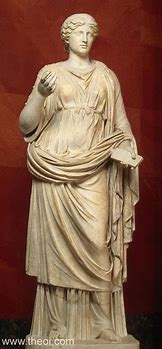
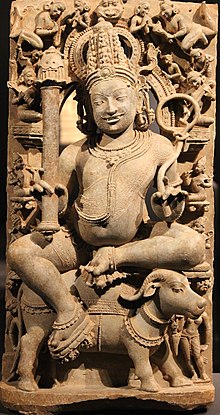
Goddess/Muse – Calliope

THE MUSE CALLIOPE IN GREEK MYTHOLOGY

THE MUSE CALLIOPE

Calliope is a famous name from Greek mythology, for Calliope was one of the Younger Muses, the beautiful goddesses who would inspire writers, artists and artisans.

Calliope the Muse of Epic Poetry, and hers was a name invoked by many writers and poets in antiquity; for they would give praise to the Muse for their ability to bring forth words of great eloquence.

CALLIOPE DAUGHTER OF ZEUS

As one of the Younger Muses, Calliope is the daughter of Zeus and the Titan goddess Mnemosyne; making her sister to Clio, Erato, Euterpe, Melpomene, Terpsichore, Thalia, Polyhmnia and Ourania.

Calliope was named as the eldest of the Younger Muses, conceived on the first night that Zeus lay with Mnemosyne.

CALLIOPE GODDESS OF MUSIC

Calliope was a Greek goddess of music, song and dance, and was specifically named as the Muse of Epic Poetry. In this role, Calliope was normally depicted with a writing tablet in her hand.

Calliope was also said to be the muse who bestowed the gift of eloquence about mortal kings, coming to them when they were a baby, and anointing their lips in honey.

​As a result of Calliope’s actions, when adults, the anointed ones would spout gracious words, and utter true judgements.

Calliope was also considered to be the leader of the Muses, the wisest of the sisters, and also the most assertive.

CALLIOPE MOTHER OF ORPHEUS

Stories from Greek mythology would tell of the marriage of Calliope to the Thracian king Oeagrus, with the wedding taking place at Pimpleia. The marriage of Calliope and Oeagrus was said to have brought forth two notable individuals Orpheus and Linus.  Orpheus was the great musical hero of Greek mythology, and Linus was the inventor of rhythm and melody; alternatively the father of Orpheus and Linus is named as the Olympian god Apollo.

Initially, Calliope and Orpheus were said to reside at Pimpleia, but later Calliope and her son were to be found with the other Younger Muses upon Mount Parnassus. For here Apollo visited to continue the musical training of Orpheus, which had been commenced by Calliope.

CALLIOPE IN GREEK MYTHOLOGY

Calliope was rarely spoken of as an individual but she is named as present, and spoken to by Thetis, when the Muses sang their dirges during the funeral rites of Achilles. Calliope was also certainly present when the Younger Muses were victorious in their contests with the Sirens and Pierides. Indeed, Calliope was said to be the Muse who caused the Pierides to be transformed into magpies after they had had the impudence to challenge Calliope and her sisters. 

Fertility Deities of Beltane c. 2017

Fertility Deities of Beltane

Beltane is a time of great fertility — for the earth itself, for animals, and of course for people as well. This season has been celebrated by cultures going back thousands of years, in a variety of ways, but nearly all shared the fertility aspect. Typically, this is a Sabbat to celebrate gods of the hunt or of the forest, and goddesses of passion and motherhood, as well as agricultural deities. Here are a list of gods and goddesses that can be honored as part of your tradition’s Beltane rituals.

Artemis (Greek): The moon goddess Artemis was associated with the hunt and was seen as a goddess of forests and hillsides. This pastoral connection made her a part of spring celebrations in later periods.

Bes (Egyptian): Worshiped in later dynasties, Bes was a household protection god, and watched over mothers and young children. He and his wife, Beset, were paired up in rituals to cure problems with infertility.

Bacchus (Roman): Considered the equivalent of Greek god Dionysus, Bacchus was the party god — grapes, wine, and general debauchery were his domain. In March each year, Roman women could attend secret ceremonies called the bacchanalia, and he is associated with sexual free-for-alls and fertility.

Cernunnos (Celtic): Cernunnos is a horned god found in Celtic mythology. He is connected with male animals, particularly the stag in rut, and this has led him to be associated with fertility and vegetation. Depictions of Cernunnos are found in many parts of the British Isles and western Europe. He is often portrayed with a beard and wild, shaggy hair — he is, after all, the lord of the forest.

Flora (Roman): This goddess of spring and flowers had her own festival, Floralia, which was celebrated every year between April 28 to May 3. Romans dressed in bright robes and floral wreaths, and attended theater performances and outdoor shows. Offerings of milk and honey were made to the goddess.

Hera (Greek): This goddess of marriage was the equivalent of the Roman Juno, and took it upon herself to bestow good tidings to new brides. A maiden about to marry could make offerings to Hera, in the hopes that she would bless the marriage with fertility. In her earliest forms, she appears to have been a nature goddess, who presides over wildlife and nurses the young animals which she holds in her arms.

Kokopelli (Hopi): This flute-playing, dancing spring god carries unborn children upon his own back, and then passes them out to fertile women. In the Hopi culture, he is part of rites that relate to marriage and childbearing, as well as the reproductive abilities of animals. Often portrayed with rams and stags, symbolic of his fertility, Kokopelli occasionally is seen with his consort, Kokopelmana.

Pan (Greek): This agricultural god watched over shepherds and their flocks. He was a rustic sort of god, spending lots of time roaming the woods and pastures, hunting and playing music on his flute. Pan is typically portrayed as having the hindquarters and horns of a goat, similar to a faun. Because of his connection to fields and the forest, he is often honored as a spring fertility god.

Priapus (Greek): This fairly minor rural god has one giant claim to fame — his permanently erect and enormous phallus. The son of Aphrodite by Dionysus (or possibly Zeus, depending on the source), Priapus was mostly worshiped in homes rather than in an organized cult. Despite his constant lust, most stories portray him as sexually frustrated, or even impotent. However, in agricultural areas he was still regarded as a god of fertility, and at one point he was considered a protective god, who threatened sexual violence against anyone — male or female — who transgressed the boundaries he guarded.

Sheela-na-Gig (Celtic): Although the Sheela-na-Gig is technically the name applied to the carvings of women with exaggerated vulvae that have been found in Ireland and England, there’s a theory that the carvings are representative of a lost pre-Christian goddess. Typically, the Sheela-na-Gig adorns buildings in areas of Ireland that were part of the Anglo-Norman conquests in the 12th century. She is shown as a homely woman with a giant yoni, which is spread wide to accept the seed of the male. Folkloric evidence indicates that the figures are theory that the figures were part of a fertility rite, similar to “birthing stones”, which were used to bring on conception.

Xochiquetzal (Aztec): This fertility goddess was associated with spring, and represented not only flowers but the fruits of life and abundance. She was also the patron goddess of prostitutes and craftsmen.

Source: Patti Wigington Published on ThoughtCo

THE GOD AND GODDESS OF WITCHCRAFT

THE GOD AND GODDESS OF WITCHCRAFT

A general complaint about Christianity by Witches is that there is the worship of the male deity to the exclusion of the female. In fact this is one of the main reasons for people (women especially) leaving Christianity and returning to the Old Religion. And yet it’s a strange paradox that many—if not the majority—of Witchcraft traditions are guilty of this same crime of
Christianity, if in reverse … they laud the Goddess to the near, or even total, exclusion of the God!

Witchcraft is a religion of nature, as any Witch will tell you. Everywhere in nature there is male and female, and both are necessary (I have yet to meet anyone who does not have both a mother and a father). It follows, then, that both the God and the Goddess are important and
should be equally revered. There should be balance. But balance is as woefully missing in most traditions of the Craft as it is in Christianity.

We are all—every single one of us—made up of both masculine and feminine attributes. The toughest, most macho man has feminine aspects just as the most traditionally-feminine woman has male aspects. So it is with the deities. The God has feminine aspects as well as masculine, and the Goddess has masculine as well as feminine.

What names you use for your deities is a matter of personal preference. In Saxon Witchcraft the name Woden is given to the God; in Gardnerian the Latin term Cernunnos is used; in Scottish, Devla. Each tradition has its own name. But names are only labels; they are only a
means of identifying. You should identify, then, using a name with which you can feel completely comfortable. For, after all, religion is a most personal thing, at the core, and—to be of real purpose—should therefore be related to on the most personal level possible. Even if you join an established tradition this is still valid—find a tradition that seems right for you (as I spoke about in Lesson One) but… don’t be afraid to modify where necessary to make it totally right for you. If the name used to identify the God, in the tradition you have chosen, happens to be Cernunnos (for example) and you have difficulty relating to that name, then choose another for your own use. In other words, respect the name Cernunnos in group worship and all matters pertaining to the coven but, in your own mind—and in personal rites—don’t hesitate to substitute Pan or Mananna or Lief or whatever. A name, as I have said, is a label. The God himself knows you are “talking” to him; he’s not going to be confused! (This all
applies equally to the Goddess of course).

It may well be for the above reason that the name Cernunnos is found in so many branches of the Craft. As I’ve mentioned, it is simply the Latin word for “the Homed One”. To add your own personal identification, then, in no way conflicts.

Traditionally the “dark half” of the year is associated with the God. But this does not (or should not) mean that he is “dead”, or incommunicado, in the “light half” of the year (and vice versa with the Goddess). During the light half he is fully active in his feminine aspect; just as the
Goddess is active in the dark half in her masculine aspect. So, both deities are active throughout the year, even though deference may be given to one over the other at certain times.

There is a common theme of death and resurrection found in myths throughout the world. The symbolism is frequently furthered in a descent to the underworld with a later return. We find it with Ishtar’s descent and search for Tannaz; with Sif’s loss of her golden tresses; with Idunn’s loss of her golden apples; with Jesus’ death and resurrection; with Siva’s death and resurrection, and many more. Basically all represent the coming of fall and winter followed by the return of spring and summer; the lead figure represnting the spirit of vegetation. From Witchcraft here are “The Myth Of the Goddess” as found in (a) Gardnerian Wicca and (b)
Saxon Wicca.

“Now G* had never loved, but she would solve all the Mysteries, even the Mystery of Death; and so she journeyed to the Nether Lands. The Guardians of the Portals challenged her, ‘Strip off thy garments, lay aside thy jewels; for naught may ye bring with ye into this our land.’

So she laid down her garments and her jewels and was bound, as are all who enter the Realms of Death the Mighty One. Such was her beauty that Death himself knelt and kissed her feet,
saying, “Blessed be thy feet that have brought thee in these ways. Abide with me, let me place my cold hand on thy heart.’ She replied, ‘I love thee not. Why dost thou cause all things that I love and take delight in to fade and die?’

‘Lady/ replied Death, ‘it is Age and Fate, against which I am helpless. Age causes all things to wither; but when men die at the end of time I give them rest and peace, and strength so that
they may return. But thou, thou art lovely. Return not; abide with me.’

But she answered, 1 love thee not’.

Then said Death, ‘An’ thou receive not my hand on thy heart, thou must receive Death’s scourge’.

It is Fate; better so’, she said and she knelt; and Death scourged her and she cried, ‘I feel the pangs of love’.

And Death said, ‘Blessed be’ and gave her the Fivefold Kiss, saying, ‘Thus only may ye attain to joy and knowledge’.

And he taught her all the mysteries. And they loved and were one, and he taught her all the Magicks.

For there are three great events in the life of Man: Love, Death and Resurrection in a new body; and Magick controls them all.

For to fulfill love you must return again at the same time and place as the loved one, and you must remember and love them again. But to be reborn you must die, and be ready for a new
body; and to die you must be born; and without love you may not be born. And these be all the Magicks.”

–The Meaning of Witchcraft
Gerald B. Gardner, Aquarian Press, London 1959

“All day had Freya, most lovely of the goddesses, played and romped in the fields. Then did she lay down to rest. And while she slept deft Loki, the Prankster, the Mischief-Maker of the
Gods, did espy the glimmering oiBrosingamene, formed of Galdra, her constant companion. Silent as night did Loki move to the Goddess’ side and, with fingers formed over the ages in
lightness, did remove the silver circlet from about her snow-white neck.

Straightway did Freya arouse, on sensing its loss. Though he moved with the speed of the winds yet Loki she glimpsed as he passed swiftly from sight into the Barrow that leads to
Dreun.

Then was Freya in despair. Darkness descended all about her to hide her tears. Great was her anguish. All light, all life, all creatures joined in her doom. To all corners were sent the
Searchers, in quest of Loki; yet knew they, they would find him not. For who is there may descend into Dreun and return again from thence? Excepting the Gods themselves and, alack, mischievous Loki.

So it was that, still weak from grief, Freya herself elected to descend in search otBrosinga-mene. At the portals of the Barrow was she challenged yet recognized and passed. The
multitude of souls within cried joyfully to see her yet could she not tarry as she sought her stolen light. The infamous Loki left no trail to follow, yet was he everywhere past seen. Those to whom she spake held to Freya (that) Loki carried no jewel as he went by. Where, then, was it hid? In despair she searched an age. Hearhden, the mighty smith of the Gods, did arise from his rest to sense the bewailment of the souls to Freya’s sorrow. Striding from his smithy, to find the cause of the sorrow, did he espy the Silver Circlet where Loki Mischief-Maker had laid it:
upon the rock before his door.

Then was all clear. As Hearhden took hold of Brosingamene, (then did) Loki appear before him, his face wild with rage. Yet would Loki not attack Hearhden, this Mighty Smith whose strength was known even beyond Dreun.

By wiles and tricks did he strive to get his hands upon the silver circlet. He shape-shifted; he darted here and there; he was visible then invisible. Yet could he not sway the smith.

Tiring of the fight, Hearhden raised his mighty club. Then sped Loki away. Great was the joy of Freya when Hearhden placed Brosingamene once more about her snow-white neck.

Great were the cries of joy from Dreun and above.

Great were the thanks that Freya, and all Men, gave to the Gods for the return of Brosingamene.”

–The Tree: The Complete Book of
Saxon Witchcraft
Raymond Buckland, Samuel Weiser, NY 1974

Source: Buckland’s Complete Book of Witchcraft

Goddesses- Egyptian Maat Goddess of Truth, Justice and Morality

Maat The Ancient Egyptian Goddess of Truth, Justice and Morality

Maat, also known as Ma’at or Mayet, was a female goddess in the ancient Egyptian religion who represented truth, justice, balance and morality. The daughter of the Egyptian sun deity Ra and wife of the moon god Thoth, she served a kind of spirit of justice to the Egyptians. She decided whether a person would successfully reach the afterlife, by weighing their soul against her feather of truth, and was the personification of the cosmic order and a representation of the stability of the universe. The earliest writings where she is mentioned date back to the Old Kingdom of Egypt more than 2,300 years ago.

The Egyptian culture was centered on order, everything had its due place in the world. This included religion, society and seasonal changes. The goddesses Ma’at came to represent the concept of balance and order because many Egyptians needed to explain the world around them. She was the one that kept the stars in motion, the seasons changing and the maintaining of the order of Heaven and Earth. The opposing force of this was known in ancient terms as “isfet” or chaos. Ancient Egyptians considered the desert beyond the Nile River to be chaotic; whereas, the area close to the Nile was considered orderly. Together, these two forces brought balance to the world in which they lived and was an important part of everyday Egyptian life

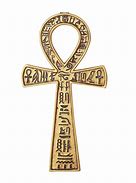
Ma’at is usually depicted in the form of a woman seated or standing with outstretched wings attached to both her arms. In other instances she is seen holding a scepter in one hand and an ankh (the symbol of life) in the other. Her statue was a stone platform depicting a stable foundation on which order was built. A common symbol associated with her is an ostrich feather, which she is almost always shown as wearing in her hair. Often, the Feather of Ma’at was a distinctive feature of her headdress. Less frequently images of the goddess showed her without a head, instead replaced by the feather. In other images the feather alone conveyed her presence. This feather has come to symbolize her being, as well as the representation of balance and order, it became a hieroglyph for “truth.”

Ma’at was associated with the law in ancient Egypt. From the 5th dynasty (c. 2510-2370 BC) onwards, the Vizier responsible for justice was called the Priest of Maat and in later periods judges wore images of her. The ‘Spirit of Maat’ was embodied by the chief judge in charge of the Egyptian law courts. He had a dual role, serving as both a priest and working directly in the law courts and justice system. The “Priest of Ma’at” began court hearings whilst wearing the feather of Ma’at and all other court officials wore small golden images of the goddess as a sign of their judicial authority, also as a symbol that their judgement would be balanced and fair. Priests drew the Feather of Ma’at on their tongues with green dye, so that the words they spoke were truth. The priest would rule on the earthly punishment according to the nature of the law that had been broken. Punishments included imposing fines, corporal punishment and in extreme cases capital punishment. It was considered a crime against Ma’at if a person engaged in jealousy, dishonesty, gluttony, laziness, injustice, and ungratefulness. The guilty Egyptian was deemed to have violated the Spirit of Ma’at and would face a further judgment in the Underworld during the ceremony of justification in the Hall of the Two Truths. The ‘Spirit of Ma’at’ detailed in the wisdom literature contained practical guidance with examples and some rules applied in previous law cases. These kinds of instructional texts have been described as “Ma’at Literature”.

The Book of the Dead is a collection of funerary texts and spells from ancient Egypt designed to assist a person’s journey through the underworld, into the afterlife. Without these spells, it was believed a person could not proceed. In the book is a spell called the “Forty-Two Declarations of Purity” or the “Negative Confessions”. This spell is comprised of confessions the tomb owner believed he committed throughout his life. It was believed that any crimes committed against Ma’at should be written down as they could easily be forgiven. In the Hall of Ma’at is where the judgement of the dead was performed in which Ma’at played an important role. The ceremony, called the “Judgment of Osiris,” was named after Osiris, the god of the dead. When the dead were judged, it was the feather of Ma’at that their hearts were weighed against. If a balanced scale was struck, the deceased was deemed worthy to meet Osiris in Paradise. The weightlessness of their hearts indicated that their souls were not burdened with sin and evil. If the heart of the deceased was found to be heavier than the feather of Ma’at, it would be devoured by Ammit, the soul-eating monster depicted with the head of a crocodile, the forequarters of a lion and the hindquarters of a hippopotamus. Other gods in the judgement hall who were part of the tribunal overseeing the weighing of the heart were also pictured holding a feather but the scales always represented Ma ́at.

Ancient Egyptians worshipped many gods, one was certainly Ma’at, although Egyptian archaeologists now believe she was perhaps more of a concept or an ideal. It’s reasonable to assume her principles aided the people of Egypt in being better individuals and that she could be compared to the conscience of a person. There was a small temple dedicated to Ma’at by Hatshepsut, the fifth pharaoh of the Eighteenth dynasty of Egypt, Egypt’s first female pharaoh, at the Karnak temple complex in Luxor Egypt. Largely in ruins, it still preserves inscriptions of some of the viziers of Ramesses III and XI. A previous Ma’at temple existed in this area, indicated by reliefs and stelae belonging to the reign of Amenhotep III. The temple is inside the Precinct of Montu, the smallest of three enclosures at Ipet-Isut.

Ma’at

Ma’at (pronounced may-et) is the ancient Egyptian goddess of truth, justice, harmony, and balance (a concept known as ma’at in Egyptian) who first appears during the period known as the Old Kingdom (c. 2613 – 2181 BCE) but no doubt existed in some form earlier. She is depicted in anthropomorphic form as a winged woman, often in profile with an ostrich feather on her head, or simply as a white ostrich feather. The feather of Ma’at was an integral part of the Weighing of the Heart of the Soul ceremony in the afterlife where the heart of the soul of the dead person was weighed in the scales of justice against the feather. Historian Margaret Bunson writes:

She maintained a vital role in the mortuary rituals of Egypt where she weighed the hearts of the deceased. This mortuary role evolved over the decades into the principle of ma’at, the desired right attitude, which remained the ethical and moral foundation of the Egyptian people. (152)

NAME & SIGNIFICANCE

Ma’at is said to have been born of the sun god Ra (Atum) at the beginning of creation through the power of Heka, who was magic personified. Her name means “that which is straight” implying order, justice, and harmony. She is thought to have been present from the beginning of time when, from the primordial waters of Nun, the ben-ben (first mound of dry land) rose with Atum (or Ra, the sun god) standing upon it in the presence of the invisible Heka. In the moment that Ra spoke the world into creation, Ma’at was born. Her spirit of harmony and balance infused the creation and caused the world to operate rationally according to purpose. The principle of ma’at was the operational function of life and that of heka (magic) the power source which allowed for it. It is for this reason that she is considered more of a concept than a goddess with a specific personality and story like Isis or Hathor. Ma’at’s spirit is the spirit of all creation, and if one is in tune with that spirit, one will live well and have good reason to hope for eternal peace in the afterlife; if one refused to live in accordance with the principles of Ma’at, then one suffered the consequences which one would have brought upon one’s self. Margaret Bunson comments on this, writing:

Ma’at was the model for human behavior, in conformity with the will of the gods, the universal order evident in the heavens, cosmic balance upon the earth, the mirror of celestial beauty. Awareness of the cosmic order was evident early in Egypt; priest-astronomers charted the heavens and noted that the earth responded to the orbits of the stars and planets. The priests taught that mankind was commanded to reflect divine harmony by assuming a spirit of quietude, reasonable behavior, cooperation, and a recognition of the eternal qualities of existence, as demonstrated by the earth and the sky. All Egyptians anticipated becoming part of the cosmos when they died, thus the responsibility for acting in accordance with its laws was reasonable. Strict adherence to ma’at allowed the Egyptians to feel secure with the world and with the divine plan for all creation. (152)

Her importance is signified by one of the means by which the Egyptians wrote her name. Although she was often identified by the feather symbol, she was also designated by a plinth. The plinth was commonly seen below the thrones of deities but not used to relay their personal names. The fact that Ma’at was signified by a plinth suggests, according to Egyptologist Geraldine Pinch, that Ma’at was considered the foundation upon which Egyptian society was built (160). Her significance is also demonstrated in iconography showing her constantly at the side of Ra in his heavenly barge sailing with him across the sky during the day and helping him defend the boat against the serpent Apophis by night.

The ancient Egyptians also invoked her name in stories of a long-lost past on earth when all things were beautiful and there was no injustice. Such stories usually have to do with the time of Osiris and Isis and their just and benevolent rule of the earth before Osiris was murdered by Set. In some cases, though, it is Ma’at who rules the earth alone as Pinch notes:

Egyptian myths of a golden age included a period when Ma’at was ruler of earth. She was sometimes said to have withdrawn to the heavens because she was grieved by the wicked behavior of humanity. Ma’at could still be thought of as living with an individual like his or her good angel and accompanying that person into the afterlife. Eventually “joining Ma’at” became a euphemism for dying. (160)

It is in her mortuary role that Ma’at is best known to most people in the modern day. One of the most iconic images of ancient Egypt is the ceremony known as The Weighing of the Heart of the Soul in which Ma’at and her white feather of truth were most important.

MA’AT’S WHITE FEATHER OF TRUTH

The Egyptians believed strongly that every individual was responsible for his or her own life and that life should be lived with other people and the earth in mind. In the same way that the gods cared for humanity, so should humans care for each other and the earth which they had been provided with. This philosophy is evident in every aspect of Egyptian culture from the way they constructed their cities to the balance and symmetry of their temples and monuments. If one lived harmoniously in the will of the gods, then one was living in harmony with the concept of ma’at and the goddess who embodied that concept. One was free to live however one wanted, of course, and completely ignore the principle of ma’at, but eventually one would face the trial which awaited everyone: judgment in the Hall of Truth (also known as The Hall of Two Truths) in the afterlife. Wilkinson comments on this:

Her role was multifaceted but embraced two major aspects. On the one hand, Ma’at represesnted the universal order or balance – including concepts such as truth and right – which was established at the time of creation. This aspect is the basis of her relationship with Ra – for she is the order imposed upon the cosmos created by the solar demiurge and as such is the guiding principle who accompanied the sun god at all times…As a natural corollary of her identity with right balance and harmony Ma’at also actively represented the concept of judgement. In the Pyramid Texts the goddess appears in this role in dual form as ‘the two Ma’ats’ judging the deceased king’s right to the thrones of Geb [the rule of the earth] and in the later funerary literature it is in the Hall of the Two Truths (the dual form of Ma’at) that the judgment of the deceased occurs. The gods themselves, acting as the judges of the divine tribunal, are called ‘the council of Ma’at.’ (150)

To the Egyptians, the soul consisted of nine separate parts: the Khat was the physical body; the Ka one’s double-form; the Ba a human-headed bird aspect which could speed between earth and the heavens; Shuyet was the shadow self; Akh the immortal, transformed self; Sahu and Sechem aspects of the Akh; Ab was the heart, the source of good and evil; Ren was one’s secret name. All nine of these aspects were part of one’s earthly existence. When one died, the Akh (with the Sahu and Sechem) appeared before the god Osiris in the Hall of Truth and in the presence of the Forty-Two Judges to have one’s heart (Ab) weighed in the balance on a golden scale against Ma’at’s white feather of truth.

One would need to recite the Negative Confession (those actions one could honestly claim one had never committed in life) and then one’s heart was placed on the scale. If one’s heart was lighter than Ma’at’s feather, one waited while Osiris conferred with the Forty-Two Judges and the god of wisdom, Thoth, and, if considered worthy, was allowed to pass on through the hall and continue one’s existence in paradise; if one’s heart was heavier than the feather, it was thrown to the floor where it was devoured by the monster Ammut (the gobbler), and one then ceased to exist. No one could escape judgment, and the king of the land would have to stand before the scales of Ma’at and Osiris just as the lowest slave of field hand would also.

If one passed through judgment and avoided any of the pitfalls and traps set by demons and the forces of chaos, one arrived at The Field of Reeds, a paradise where one was greeted by those loved ones who had gone before and which was a mirror image of one’s life on earth. Margaret Bunson describes this afterlife:

Eternity itself was not some vague concept. The Egyptians, pragmatic and determined to have all things explained in concrete terms, believed that they would dwell in paradise, in areas graced by lakes and gardens. There they would eat the “cakes of Osiris” and float on the Lake of Flowers. The eternal kingdoms varied according to era and cultic belief but all were located beside flowing water and blessed with breezes, an attribute deemed necessary for comfort. The Garden of A’Aru was one such oasis of eternal bliss. Another was Ma’ati, an eternal land where the deceased buried a flame of fire and a scepter of crystal – rituals whose meanings are lost. The goddess Ma’at, the personification of cosmic order, justice, goodness, and faith, was the protector of the deceased in this enchanted realm, called Hehtt in some eras. Only the pure of heart, the uabt, could see Ma’at. (86-87)

In some images, the goddess is seen atop the scales at the moment of judgment and, in others, she is present near Osiris but she is always there even if only in the form of her feather placed on the scales. In the afterlife, she was thought to help those who had stood for her principles and lived their lives accordingly.

WORSHIP OF THE GODDESS

Although she was considered a very important deity, Ma’at had no temples and no official clergy (as was the case with Heka). She was honored by a small shrine set up in the temples of other gods. Even the one temple known to be erected in her honor by Queen Hatshepsut (1479-1458 BCE) was built within the temple precinct of the god Montu. The people venerated the goddess by living according to her principles and bringing whatever gifts they wanted to offer to her shrines in the temples of the other gods. Wilkinson writes,

Even the title ‘priest of Ma’at’ is often regarded as an honourific which may have been given to those who served as magistrates or who dispensed judicial decisions on her behalf and who apparently wore small golden images of the goddess as a sign of their judicial authority. (152)

The only “official” worship of Ma’at was when the king of Egypt made sacrifice to her upon ascending to the throne and “presented Ma’at” to the gods by offering a small image of her. In doing so, the king was asking for her help in maintaining divine balance in his rule. If the king could not achieve balance and promote harmony, then it was a clear sign that he was not fit to rule. Ma’at – and the vital concept she embodied – was crucial to the king’s success.

She was an important and all-pervasive figure in the Egyptian pantheon, even though very few stories are told of her and she had no temple or cultic following. The gods were said to live off Ma’at and, as the scholar Richard H. Wilkinson notes, most of the images of the king presenting Ma’at to the other gods at his coronation “are essentially identical to those in which the king presents food, wine, or other forms of sacrifice to the gods” (152). The gods would have, in fact, lived off Ma’at in that they were all bound by their own laws to observe harmony and balance and encourage those values in the human beings they cared for.

Temples to Ma’at were the temples of all the other gods because Ma’at was the underlying cosmic principle which made the lives of humans and gods possible. One worshiped the goddess Ma’at by living a life in accordance with the highest principles of justice, order, and harmony keeping in mind one’s neighbors and the earth one had been given to tend. Although goddesses like Hathor and Isis were more popular, and even eventually took on many of Ma’at’s attributes, she remained an important deity throughout Egypt’s history and defined the cultural values of the country for centuries.

__________________________________________

*First article*
By Bryan Hilliard
Published on Ancient Origins

References
“Ancient Egyptian Gods | Ma’at.” Ancient Egyptian Gods | Ma’at. http://www.kingtutone.com/gods/maat/
“Ma’at, Goddess of Egypt.” Egyptian Goddess Maat ***. http://www.landofpyramids.org/maat.htm
Seawright, Caroline. “Ma’at, Goddess of Truth, Balance, Order.” Ma’at, Ancient Egyptian Goddess of Truth and Order.
“Ancient Egypt: The Mythology – Feather.” Ancient Egypt: The Mythology – Feather. http://www.egyptianmyths.net/feather.htm
“Ancient Egypt: The Mythology – Ma’at.” Ancient Egypt: The Mythology – Ma’at. http://www.egyptianmyths.net/maat.htm


*Second article*
APA Style
Mark, J. J. (2016, September 15). Ma’at. Ancient History Encyclopedia. Retrieved from https://www.ancient.eu/Ma’at/

Chicago Style
Mark, Joshua J. “Ma’at.” Ancient History Encyclopedia. Last modified September 15, 2016. https://www.ancient.eu/Ma’at/.

MLA Style
Mark, Joshua J. “Ma’at.” Ancient History Encyclopedia. Ancient History Encyclopedia, 15 Sep 2016. Web. 13 Aug 2018.

License
Written by Joshua J. Mark, published on 15 September 2016 under the following license: Creative Commons: Attribution-NonCommercial-ShareAlike. This license lets others remix, tweak, and build upon this content non-commercially, as long as they credit the author and license their new creations under the identical terms.

Gods – Ra Egyptian Sun God

Ra The Sun God of Egypt

The ancient Egyptians revered Ra as the god who created everything. Also known as the Sun God, Ra was a powerful deity and a central god of the Egyptian pantheon. The ancient Egyptians worshiped Ra more than any other god and pharaohs often connected themselves with Ra in their efforts to be seen as the earthly embodiment of the Sun God.

Ra Mythology

The ancient Egyptians believed that as the sun god, Ra’s role was to sail across the heavens during the day in his boat called the “Barque of Millions of Years.” In the morning when Ra emerged from the east, his boat was named, “Madjet” which meant “becoming strong.” By the end of the day the boat was called, “Semektet” which meant “becoming weak.” At the end of the day, it was believed that Ra died (swallowed by Nut) and sailed on to the underworld, leaving the moon in his place to light up the world. Ra was reborn at dawn the very next day. During his journey across the heavens during the day, he fought with his main enemy, an evil serpent named Apep, or also, The Lord of Chaos. In some stories, Ra, in the form of a cat named Mau, defeats the evil serpent, Apep. This is part of the reason why cats are so highly-revered in Egypt.

Ra created himself from the primordial chaos. He is also known as Re and Atum. His children are Shu, the God of Dry Air and Father of the Sky, and his twin sister Tefnut, the Goddess of Moisture and Wetness. As a lion-headed goddess, Tefnut is responsible for dew and freshness. Humans were created from Ra’s tears.

Although Ra was highly revered and devoutly worshiped by the ancient Egyptians, there is a story to suggest he eventually grew weak. In the Legend of Ra, Isis and the Snake, as Ra grew old, he dribbled saliva. Isis knew that Ra’s power was hidden in his secret name. Isis gathered Ra’s saliva and created a snake out of it. She set the snake in Ra’s path and it bit him. Isis wanted the power Ra had always enjoyed, but she knew she had to get him to tell her his secret name. Eventually, because of the pain he was in, Ra allowed Isis to “search through him” and in so doing, she healed him and Ra’s power was transferred over to her.

The Tree of Life is an important religious symbol to the Egyptians. The Tree of Life was located within Ra’s sun temple in Heliopolis and was considered sacred. The fruit that sprang from this tree was not available to humans, but only in aging-rituals reserved for pharaohs. The Tree of Life is also referred to as the mythical, sacred Ished tree. Eternal life came to those who ate the fruit from the Tree of Life.

Another important ancient Egyptian symbol connected to Ra is the “Bennu”. Bennu is the name of the bird that represented Ra’s soul. This bird is a phoenix and it was seated at the Tree of Life in Ra’s Sun Temple in Heliopolis. Inside the temple, on top of an obelisk, sat the Benben Stone. This pyramid-shaped stone served as a beacon to Bennu and is also an important ancient Egyptian religious symbol.

Worship of the Sun God

Solar temples were built for Ra but did not contain a statue of the god. Instead, they were created to be open to the sunlight that Ra represented. The earliest known temple built in honor of Ra exists in Heliopolis (what is now a Cairo suburb). This solar temple is known as “Benu-Phoenix” and is believed to have been erected in the exact spot where Ra emerged into creation.

Although Ra dates back to the second dynasty, he is not the oldest of the Egyptian gods. It wasn’t until the fifth dynasty that Ra became closely associated with the pharaoh. As the king and leader of Egypt, the pharaoh was seen as the human manifestation of Horus, so the two gods became connected. This new deity fusion was then referred to as “Ra-Horakhty” meaning Ra is Horus of the Horizon. Ra’s relationship with other gods did not stop there. As the powerful creator of mankind and the sun god, he also became associated with Atum to make “Atum-Ra.”

Fifth Dynasty and subsequent pharaohs were all known as “The son of Ra” and Ra became incorporated into every pharaoh’s name from then onward. During the Middle Kingdom, the new deity, Amun-Ra was formed. Amun was one of the gods who formed the Ogdoad (the assembly of eight gods who represented eight elements of creation).

The New Kingdom brought new heights of worship to Ra. Many tombs in the Valley of the Kings portray depictions of Ra and his journey through the underworld. During this time, many solar temples were built.

Eye of Ra

Present in the ancient Egyptian mythology is the Eye of Ra, shown as the sun disk with two ‘uraeus’ cobras coiled around it, next to the white and red crowns of Upper and Lower Egypt. Initially associated with Horus (similarly to the wadjet, the Eye of Horus), the Eye of Ra shifted positions in the myths, becoming both an extension of Ra’s power and a separate entity altogether.

Click here to learn more about The Eye of Ra

Ra God Facts

  • The ancient Egyptians worshiped Ra to such an extent above other gods that some historians have argued that ancient Egyptian religion was indeed a monotheistic one with Ra as the singular god.
  • Historians believe that the pyramids might represent rays of sunlight, further connecting the pharaohs with Ra, the sun god.
  • During Ra’s journey through the heavens he was accompanied by several other gods including Thoth, Horus, Hathor, Maat, Abtu, and Anet.
  • Nut, goddess of the sky and heavens, is sometimes referred to as Ra’s mother, because he emerges from her and is reborn every morning.
  • The morning manifestation of Ra is known as “Khepri the scarab God.”
  • The evening manifestation of Ra is known as the ram-headed god, Khnum.
  • The sacred cobra that encircled Ra’s crown symbolized royalty, sovereignty and divine authority.
  • The right eye of Ra represented the Sun; while the left eye of Ra represented the moon.
  • Ra is also closely associated with the Tree of Life myth, the Ben-Ben Stone and the Bennu Bird myths.
  • Ra’s glory came to an end during the time when the Roman’s conquered Egypt in 30BC.

Who is Ra?

Ra (pronounced ray) represents sunlight, warmth and growth. It was only natural that the ancient Egyptians would believe him to be the creator of the world, as well as part of him being represented in every other god. The ancient Egyptians believed that every god should illustrate some aspect of him, while Ra himself should also represent every god.

Ra’s Appearance

Ra was usually depicted in human form. He had a falcon head which is crowned with a sun disc. This sun disc was encircled by a sacred cobra named Uraeus. Ra has also been depicted as a man with the head of a beetle and also a human man with the head of a ram. The ancients also depicted Ra in full species form such as a serpent, heron, bull, lion, cat, ram, hawk, beetle, phoenix and others. His main symbol, however, is the sun disk.

3,000-year-old Goddess Figurine Found in an Italian Lake Still Bears the Handprints of Its Maker

A 3,000-year-old clay figurine thought to portray an ancient goddess has been discovered in a volcanic lake in central Italy.

Archaeologists think the object was a votive figurine that was probably crafted so prayers could be directed to it. Its features are only crudely finished, but the figurine still bears the handprints of whoever made it, as well as the impression of a fabric pattern that suggests it was originally clothed in some sort of garment.

Government archaeologists for the Etruria region and police divers made the discovery last month at Lake Bolsena, about 50 miles (80 kilometers) northwest of Rome.

The east side of the lake is the location of the submerged Gran Carro archaeological site, which is thought to be the remains of an Iron Age village built in the 10th or ninth century B.C. and which later sank underwater.

Related: Ancient sanctuary used by Roman soldiers nearly 2,000 years ago found in the Netherlands

The clay figurine, which measures about 6 inches (15 centimeters) long, was found in the ruins of a residence at the sunken site, and archaeologists think it was related to a domestic ritual. Similar rituals have been documented in the region in later periods, suggesting such practices are very ancient, and similar figurines have been found in Iron Age graves, according to a translated Facebook post .

“This is an exceptional discovery, one of a kind,” the archaeologists said in the post. “It shows aspects of daily life in the early Iron Age, of which little is known in southern Etruria.”

Submerged village

Geologists have established that Lake Bolsena formed between 600,000 and 200,000 years ago during eruptions of the underlying Vulsini volcano. Roman records indicate the volcano was active as recently as 104 B.C., and scientists now think the ancient village was submerged when the eastern shore sank amid seismic activity.

According to archaeologists, the sunken village containing the newfound figurine was probably built by people from the Villanovan culture, an early stage of the Etruscan civilization that preceded the founding of Rome. The thousands of artifacts found there since the 1960s include pieces of wood, household objects, jewelry and pieces of pottery, and studies of the village’s layout suggest how the Iron Age society there was organized.

The Gran Carro site is now being developed under the National Recovery and Resilience Plan, which includes the creation of an underwater path for visitors, according to the Facebook post.

One of the site’s most mysterious features is the Aiola, a large pile of submerged stones that archaeologists now think was a structure built beside a geothermal spring. Recent discoveries in the San Casciano dei Bagni region, a few miles to the north, indicate such hot springs were sacred to the later Etruscans and Romans.

Explorations in 1991 showed the Aiola structure still contained fragments of wooden poles and pottery from the Iron Age, and research in 2020 showed that the stones covered an earthen mound. Coins minted during the rule of the Roman emperor Constantine the Great (who lived circa 272 to 337) have also been found at the site, indicating it was used even in late Roman times.

Source: https://www.newsbreak.com/livescience-525075/3561041417561-3-000-year-old-goddess-figurine-found-in-an-italian-lake-still-bears-the-handprints-of-its-maker?s=a99&share_destination_id=MTcxMzIwNTE2LTE3MjM3MzYyMjkyNjA%3D&pd=0BaqI8SN&hl=en_US&send_time=1723736229&actBtn=bottomBar&_f=app_share&trans_data=%7B%22platform%22%3A1%2C%22cv%22%3A%2224.31.0%22%2C%22languages%22%3A%22en%22%7D&sep=ns_foryou_recall_exp_24q3-v9%2Cns_foryou_rank_exp_24q3-v6%2Cns_foryou_model_exp_24q3-v2%2Cns_vsp-v1%2Cns_foryou_blend_exp_24q3-v6%2Cns_local_strategy_24q3_exp-v13

Spell for Sunday – Ra Egyptian God of the Sun

(YOU CAN COPY AND PASTE ANY OF THE SPELLS POSTED TO A DOCUMENT TO PRINT AND/OR SAVE ON YOUR COMPUTER)

Set Up An Altar for Ra Egyptian God of the Sun

Setting up an altar for the god Ra is a great way to invite him into your spiritual practice and life. It creates a meeting place for you and your god to connect and communicate. Any flat surface will work such as a table, nightstand, bookshelf, counter, etc. Then add things to represent Ancient Egypt and the god Ra to your altar including: crystal pyramids, a statue of Ra, the Eye of Ra symbol, candles, incense with an incense burner, sun decor, a bowl of water, etc. Cleanse and bless your Ra altar before use.

Wearing Ra Amulets Source: otherworldlyoracle.com

Traditionally, amulets were worn by Ra worshipers to invoke their beloved deity and to show their dedication. Select an amulet that means something to you, but also reminds you of the sun god’s unique qualities. Perhaps a stone the Egyptians revered such as lapis lazuli, quartz, turquoise, or onyx. More appropriately, a sunstone would make a great Ra amulet. Cleanse your new amulet, then ask Ra to imbue his power into it. I like to set my amulets on my gods’ altars to really soak up their energy. Then wear the amulet daily or during special sacred rituals in honor of Ra.

Goddess Knowledge – Gaia

The Goddess Gaia is also known by another name, Mother Earth.

Gaia existed before everything; she existed before time. Gaia, the eternal, prehistoric earth mother goddess,, is fertility incarnate, moist, mysterious, strong. She is life energy itself; everything that lives, breathing or not, overflows with her life. She is the earth and all powers of the earth. Gaia is not always a consoling goddess: standing for life and generation without thought of consequence, she has energy and a power that must be approached carefully. All bodies eventually return to her, into the black, fertile earth, to be devoured and to receive her life to live again. As goddess of the soul, Gaia reminds us that the soul develops in dark places and that ultimately soul must be rooted in the body, in earth. She is a reminder that we must ground ourselves into the reality of nature and incorporate all sides of ourselves, be the pleasant or unpleasant, light or dark.

For more information about Gaia click on this general search link: Information about Gaia

Gaia is also known as Mother Earth here is a link for more information on this name for the same Goddess: Information about Mother Earth

Link for a general search for images of Gaia:Images of Gaia

The general search for images of Mother Earth is basically the same as for Gaia.

Bast/Baset Egyptian Goddess Information

Who are the Harvest Gods and Goddesses? Archetypal meanings of Harvest deities.

Source: .triplemoonpsychotherapy.com

The practice of expressing gratitude for the harvest season and preparing for the onset of winter is a widespread and ancient tradition observed by cultures across the globe.

Festivals are held to celebrate the abundance of crops, offer thanks to Mother Earth, and bid farewell to Summer. Historically, mythologies worldwide have honored and revered various deities associated with the harvest and the Autumn Equinox. Although not a comprehensive account, this article briefly acknowledges some of the most prominent harvest and equinox deities from various cultures, listed alphabetically.

Autumnus, the Roman goddess of the Harvest

Autumnus, the fall season’s deity, embodies nature’s overflowing abundance during harvest. In addition, Autumnus is gender fluid, appearing in both male and female forms, which speaks to the inclusive and diverse nature of this season’s divine patron.

Banbha, the Celtic goddess and Earth Mother

Amidst the fall equinox celebrations, the Irish deity Banbha reigns supreme. As an Earth Mother, she presides over the culmination of the bountiful harvest. Banbha, much like the revered Greek goddess Gaia, is the protector and nurturer of all living beings and the land that sustains them.

Ceres, the Roman goddess of the Harvest, grain, and fertility

Ceres, the goddess of the harvest, was revered for her abundant generosity and for imparting essential knowledge to humanity.

In Greek mythology, she was known as Demeter. She was hailed as the deity who taught people the art of cultivating, preserving, and preparing grains and maize. Her divine powers were closely linked to the land’s fertility, and she was regarded as one of the most prominent guardians of the harvest.

Ceres’ influence and guidance ensured the earth’s bounty was always plentiful. Her legacy lives on as a symbol of abundance and fertility.

Çhicomecoatl, the Aztec goddess of abundance and corn

Çhicomecoatl, the goddess of fire and fertility, embodies vitalitycommunity, and plenty. She is revered in Mexico, particularly during the harvest season, as the guardian of corn and all fertile things. Her emblems are hot spices, maize, and fire, representing her power and providence over the land.

Corn Mother, the goddess of the Harvest of the Indigenous Peoples of North America

With her bountiful presence, the Corn Mother embodies the qualities of abundancevitality, and strength. Her powers of fertility and harvest are celebrated as she blesses the land with the promise of plentiful crops.

In addition to her agricultural emblems of corn and corn sheaves, she also holds the healing attributes of the earth, nurturing all who seek her aid.

Demeter, the Greek goddess of the Harvest and Agriculture

At the center of one of the most famous myths about the seasons and the Harvest lies Demeter, the goddess of grain and fertility and mother of Persephone.

When Hades, the god of the Underworld, abducted Persephone, Demeter’s anguish for her daughter resulted in a severe drought that threatened all life on Earth. With the crops perishing and humankind facing doom, Demeter embarked on a quest to rescue her daughter.

However, despite eventually reuniting with Persephone, now the goddess of the Underworld, fate demanded a sacrifice. Having consumed six pomegranate seeds, Persephone was bound to spend six months of the year in the Underworld, which begins with the Autumn Equinox when Persephone descends again into the depths.

Huichi, the Japanese goddess of the Harvest Click here to read the rest of this article

Ostara – Saxon Goddess Of Spring And Easter

Ostara

From goddessgift.com

Easter gets its name from the goddess Ostara, also known as Eastre. ​Ostara is a fertility goddess. Her annual arrival in spring is heralded by the flowering of trees and plants and the arrival of babies, both animal and human.

Goddesses – Diana Roman

Roman Goddess Diana from gods-and-goddesses.com

Long before popular culture yielded such proficient female characters as Katniss Everdeen, Roman mythology held its own bow and arrow wielding huntress. According to the ancient Roman religion, Diana was the virgin goddess both of hunting and of wild and domestic animals themselves. Her name is derived from the Greek words diviana, dium and dius, meaning “the shining one,” “sky,” and “daylight,” respectively. Diana was considered a fertility goddess, a helper of women during conception and childbirth. It was believed that Diana could help a woman deliver a baby easily and safely. She was also associated with worship of the moon.

Diana Facts

Name(s): Diana
Rules over: Animals, the Hunt
Gender: Female
Symbols: Bow, Quiver
Sacred animals: Hound, Deer
Parents: Jupiter (Father) and Latona (Mother)
Siblings: Apollo
Greek Similar: Artemis
Norse Similar: Skadi

Origins

It is thought that Diana may have originated as “an indigenous woodland goddess,” or a local deity. In time, however, she was associated with the Greek goddess Artemis and came to share her mythology. Even before Rome became an empire, during the time of the Latin League of cities, she was worshiped as Diana Nemorensis, or “Diana of the Wood,” by torch-bearing processions in the sacred forests on the shores of a lake near Rome. Here, she was part of a triad, or trinity, of deities including the river spirit Egeria, a guardian of childbirth, and Virbius, the first priest of Diana’s cult. Custom held that Diana’s priests be escaped slaves, and that to attain the priesthood, they first had to kill the preceding priest in combat using only a branch broken from a tree. Other worship took place on a mountain called Tifata, located near Capua.

Symbols

In statues and artwork, Diana is depicted as carrying a bow and a quiver of arrows, often accompanied by a hound (a hunting dog) or a deer. She is typically lightly clad, perhaps with a short dress or only a draping cloth, or wearing nothing at all.

Myths and Stories

Diana’s myths closely mirror those of her Greek counterpart Artemis. For example, the Roman poet Ovid recounts Actaeon’s unfortunate encounter with her. Diana was said to be a virgin, and was lauded for her purity. Diana had been hunting in a sacred valley which no humans had ever before touched. When she became tired, she and her nymphs bathed in a cool stream. Actaeon, a hunter, got lost and stumbled upon the nude and bathing Diana. So that he could not tell others of what he had seen, Diana turned him into a deer, a stag. His own hunting hounds found him and took his life.

In a related story, Ovid again regales a tale of Diana’s sacred chastity. Diana’s loyal follower Callisto was out hunting when she was spied by Diana’s father, Jupiter. Jupiter felt lustful toward the girl, and so disguised himself as his daughter Diana. He greeted the unsuspecting Callisto with a kiss, embraced her, and then revealed his true self and raped the girl. Callisto was ashamed. The next time she saw Diana, she feared it was Jupiter in disguise yet again. Said Ovid, “If Diana had not been a maiden, she could have known Callisto’s guilt by a thousand signs. They say that the nymphs realized it.” When Diana suggested they bathe in a river, Callisto’s pregnant belly was revealed. Diana sent her away, saying, “Be off from here! Do not defile these sacred waters!” Later, Jupiter’s wife Juno turned Callisto into a bear.

Worship

The oldest temple of Diana stood on Rome’s Aventine Hill. It was thought to date to the sixth century B.C., and it housed the founding charter documents of the Latin League. Many plebians, or working class Roman citizens, worshiped Diana, and slaves could seek asylum in her temple. Diana’s festival was held on the Idus of August, or August 13.

Another important temple, the Aretemesium, was located at Ephesus. This temple was famous for its intricate artwork and great size, so much so that it was considered one of the Seven Wonders of the ancient world. So well known was this temple that it and its patron goddess were mentioned five times in the Bible book of Acts. Today, little remains of the site, but fragments of its columns and statuary are on display at the British Museum.

Facts about Diana

Role in Mythology: Goddess of wild animals and domestic animals, goddess of nature, goddess of the hunt, fertility goddess, goddess of childbirth, moon goddess, protector of slaves and the lower class

Alternative Names: Diana Nemorensis

Family Relationships: Daughter of Jupiter

Symbols: Bow and quiver, hound, deer.

Greek Equivalent: Artemis

Athena – Greek Goddess of Wisdom and War

Athena – Greek Goddess of Wisdom and War Source: greekmythology.com

Athena is the Olympian goddess of wisdom and war and the adored patroness of the city of Athens. A virgin deity, she was also – somewhat paradoxically – associated with peace and handicrafts, especially spinning and weaving. Majestic and stern, Athena surpassed everybody in both of her main domains. In fact, even Ares feared her; and all Greek heroes asked her for help and advice.

Atena’s Roll

Athena’s Name
Athena’s name is closely linked with the name of the city of Athens. The Ancient Greeks debated whether she got her name after the city or the other way around. Modern scholars usually agree that the former was the case.

Athena’s Portrayal and Symbolism
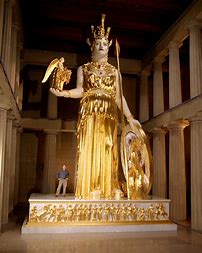
In art and literature, Athena is usually depicted as a majestic lady, with a beautiful, but stern face, unsmiling full lips, grey eyes and a graceful build, emanating power and authority. She is always regally clad in either a chiton or a full armor. In the former case, she is sometimes represented with a spindle. In the latter case, she wears an elaborately crested Corinthian helmet and holds a long spear in one hand and an aegis in the other.

At the center of her aegis there’s oftentimes an image of a Gorgon’s head (Gorgoneion), symbolizing the gift she got from Perseus: the head of Medusa. Just like Medusa’s eyes, Athena’s shield can also turn her enemies to stone. As a symbol of her wisdom, there’s sometimes an owl flying in Athena’s vicinity or sitting on her shoulder; from time to time there may also be a snake or an olive branch.

Athena’s Epithets
Athena was one of the most important Olympian gods and she had many functions. Unsurprisingly, she was known under many different epithets. Some of the most famous were “Virgin,” “Pallas,” “The Unwearying One,” “The One of the City,” “The One with gleaming eyes” and “The One who fights in front.”

Athena’s Early Life

The Birth of Athena
Athena was born in most miraculous circumstances. On learning that Metis’ next child may overthrow him, Zeus swallowed his first wife who was already pregnant with Athens. When the time came, Zeus started feeling tremendous headaches. As even he couldn’t bear them, Hephaestus struck him with his axe and – lo and behold! – Athena leapt out of Zeus’ head, fully armed and with a cry so mighty and fearsome that Uranus and Gaea were shaken to their bones with terror. Zeus was delighted and full of pride.

Athena’s Childhood Friend Pallas
As a child, Athena had a friend she loved above all. Her name was Pallas and she was all but her equal in the art of war. However, one day, as they were practicing some martial exercises, Athena accidentally killed her friend. Grief-stricken and in an attempt to preserve her memory, she added her friend’s name to her own. That’s why many people know Athena as Athena Pallas.

Athena, Goddess of Wisdom

Athena, The Virgin Goddess
Just like Artemis and Hestia, Athena was never swayed by love or passion. Consequently, she never had any children. Some say that Erichthonius was an exception, but, in fact, Athena was only his foster-mother. True, Hephaestus did try to violate her, but she fought him off, so he spilled his seed over the Earth, after which Gaea was impregnated. When Erichthonius was born, Athena took him under her wing, just like she would do afterward with another cult hero, Heracles.

Athena, the Patron of Athens
Poseidon and Athena had a much-publicized quarrel over who deserves to be the patron of the most prosperous Ancient Greek city, Athens. Poseidon claimed that the city would benefit more from him than Athena and to prove this, he struck his trident into a rock, creating a seawater stream which welled up in the Temple of Erechtheion on the north side of the Acropolis. Smart as she was, Athena did nothing spectacular: she merely planted an olive tree. However, the first king of Athens, Cecrops – who was the judge of the contest – realized that the olive tree was much more beneficial, since it gave the Athenians fruit, oil and wood.

Athena, the Patroness of Handicrafts
Athena was a master artisan. As much as she was the women counterpart of Ares as a war goddess, she was also the female equivalent of Hephaestus when it came to arts and crafts. Homer says that Athena fashioned ornate and luxuriously embroidered robes for Hera and herself. Some even say that she combined her two main interests to invent the war chariot and even the warship.

Athena and the Myth of Arachne
However, the most famous myth which connects Athena with handicrafts is the story of Arachne, a mortal craftswoman who boasted that she was more skillful than Athena herself. Athena offered her a chance to repent, but after Arachne refused, she challenged her to a weaving duel. The goddess fashioned a beautiful tapestry which illustrated the gruesome fate of the mortals who had the hubris of challenging the gods. Arachne, on the other hand, chose for a subject the stories of the mortals unjustly victimized by the gods. She didn’t even have a chance to finish it: enraged and offended, Athena tore Arachne’s fabric to pieces and turned her into a spider. As such, Arachne is doomed to weave ever since.

Athena, the Helper of Heroes
As a war goddess associated with wisdom – unlike Ares who was associated with mere violence – Athena was often the main helper of Ancient Greece’s greatest heroes. Most famously, she guided Odysseus during his ten-year-long journey back to Ithaca. But, she also helped many others, such as Heracles, Perseus, Bellerophon, Jason, Diomedes, Argus, and Cadmus.

Athena: Myths and Hidden Truths

Contrary to popular belief, Athena is not a war goddess in the same sense as Ares. While both deities are associated with war, their roles are fundamentally different. Athena is revered for her strategic thinking, wisdom, and diplomacy, whereas Ares embodies the violent and chaotic aspects of war. This misconception often overshadows Athena’s connection to peace, as she sought to resolve conflicts through wisdom and negotiation rather than brute force.

Athena and musical instruments
Although more commonly associated with the arts of war and weaving, Athena was also credited with the creation of the flute and the trumpet. This demonstrates her influence on the arts and highlights her multifaceted nature as a goddess of both wisdom and creativity.

Athena and snakes
Athena’s relationship with animals is another little-known aspect of her mythology. In addition to her iconic association with the owl, symbolizing wisdom and knowledge, Athena was also linked with the serpent. The snake represents transformation, rebirth, and the ability to navigate complex challenges, reflecting Athena’s own attributes as a wise and resourceful goddess.

Athena: Wisdom, War, and the Power of the Goddess

Throughout our journey into the world of Athena, we have been deeply moved by the many facets of this fascinating goddess. Her wisdom, prowess in war, and dedication to the arts have not only inspired us but also served as a reminder of the importance of balance and harmony in life. As we delved into her stories, we felt a profound connection with the heroes who sought her guidance and the city of Athens, which revered her as their patroness. We were particularly touched by her unwavering devotion to her friend Pallas, which highlights the significance of loyalty and remembrance.

Athena’s enduring influence on both the ancient world and our modern lives has been truly captivating, and we hope that our exploration of her mythos has resonated with you, bringing a newfound appreciation for the wisdom and strength of this remarkable goddess.

Athena Sources

Homer’s “Odyssey” is an invaluable source for Athena and her deeds. If you want something briefer, read “The Homeric Hymns to Athena” (11 and 28). In Hesiod’s “Theogony” you can find the story of her birth.
Source: https://www.greekmythology.com/Olympians/Athena/athena.html

List of Lunar Deities

Source: en.wikipedia.org

lunar deity is a deity who represents the Moon, or an aspect of it. Lunar deities and Moon worship can be found throughout most of recorded history in various forms. The following is a list of lunar deities:

African[edit]

Name Image Mythology / Religion Details
Abuk Dinka Goddess of fertility, morality, creativity, and love
Amesemi Kushite Protective goddess and wife of Apedemak, the lion-god. She was represented with a crown shaped as a falcon, or with a crescent moon on her head on top of which a falcon was standing.
Ayyur Berber
Gleti Dahomean
Mawu Dahomean
Iah Egyptian
iNyanga Zulu Goddess of the Moon
Khonsu
Egyptian The god of the moon. A story tells that Ra (the sun God) had forbidden Nut (the Sky goddess) to give birth on any of the 360 days of the calendar. In order to help her give birth to her children, Thoth (the god of wisdom) played against Khonsu in a game of senet. Khonsu lost to Thoth and then he gave away enough moonlight to create 5 additional days so Nut could give birth to her five children. It was said that before losing, the moonlight was on par with the sunlight. Sometimes, Khonsu is depicted as a hawk-headed god, however he is mostly depicted as a young man with a side-lock of hair, like a young Egyptian. He was also a god of time. The centre of his cult was at Thebes which was where he took place in a triad with Amun and Mut. Khonsu was also heavily associated Thoth who also took part in the measurement of time and the moon.
Thoth Egyptian God of wisdom, the arts, science, and judgment
Ela-Opitan Yoruba

American[edit]

Aztec mythology[edit]

Cahuilla mythology[edit]

  • Goddess Menily[1]

Hopi mythology[edit]

Incan mythology[edit]

Inuit mythology[edit]

Lakota mythology[edit]

Maya mythology[edit]

Muisca mythology[edit]

Nivaclé Mythology[edit]

  • Jive’cla

Pawnee mythology[edit]

Tupi Guarani mythology[edit]

Voodoo[edit]

Asian[edit]

Ainu mythology[edit]

  • God Kunnechup Kamui

Anatolian[edit]

Chinese mythology[edit]

Elamite[edit]

Hinduism[edit]

The Hindu moon god Chandra, riding his celestial chariot
  • God Agni, invoked as a moon deity in some hymns[5]
  • God Chandra or Soma, The moon god

Hurro-Urartian[edit]

Indonesian mythology[edit]

Japanese mythology[edit]

Korean mythology[edit]

  • Goddess Myeongwol[6]

Mari mythology[edit]

  • God Tõlze

Philippine mythologies[edit]

  • Kabigat (Bontok mythology): the goddess of the moon who cut off the head of Chal-chal’s son; her action is the origin of headhunting[7]
  • Bulan (Ifugao mythology): the moon deity of the night in charge of nighttime[8]
  • Moon Deity (Ibaloi mythology): the deity who teased Kabunian for not yet having a spouse[9]
  • Delan (Bugkalot mythology): deity of the moon, worshiped with the sun and stars; congenial with Elag; during quarrels, Elag sometimes covers Delan’s face, causing the different phases of the moon; giver of light and growth[10]
  • Bulan (Ilocano mythology): the moon god of peace who comforted the grieving Abra[11]
  • Bulan (Pangasinense mythology): the merry and mischievous moon god, whose dim palace was the source of the perpetual light which became the stars; guides the ways of thieves[12]
  • Wife of Mangetchay (Kapampangan mythology): wife of Mangetchay who gave birth to their daughter whose beauty sparked the great war; lives in the Moon[13]
  • Mayari (Kapampangan mythology): the moon goddess who battled her brother, Apolaqui[14]
  • Apûng Malyari (Kapampangan mythology): moon god who lives in Mount Pinatubo and ruler of the eight rivers[15]
  • Mayari (Tagalog mythology): goddess of the moon;[16] sometimes identified as having one eye;[17] ruler of the world during nighttime and daughter of Bathala[18]
  • Dalagang nasa Buwan (Tagalog mythology): the maiden of the moon[19]
  • Dalagang Binubukot (Tagalog mythology): the cloistered maiden in the moon[20]
  • Unnamed Moon God (Tagalog mythology): the night watchman who tattled on Rajo’s theft, leading to an eclipse[21]
  • Bulan-hari (Tagalog mythology): one of the deities sent by Bathala to aid the people of Pinak; can command rain to fall; married to Bitu-in[22]
  • Bulan (Bicolano mythology): son of Dagat and Paros; joined Daga’s rebellion and died; his body became the Moon;[23] in another myth, he was alive and from his cut arm, the earth was established, and from his tears, the rivers and seas were established[24]
  • Haliya (Bicolano mythology): the goddess of the moon,[25] often depicted with a golden mask on her face
  • Libulan (Bisaya mythology): the copper-bodied son of Lidagat and Lihangin; killed by Kaptan’s rage during the great revolt; his body became the moon[26]
  • Bulan (Bisaya mythology): the moon deity who gives light to sinners and guides them in the night[27]
  • Launsina (Capiznon mythology): the goddess of the Sun, Moon, stars, and seas, and the most beloved because people seek forgiveness from her[28]
  • Diwata na Magbabaya (Bukidnon mythology): simply referred as Magbabaya; the good supreme deity and supreme planner who looks like a man; created the Earth and the first eight elements, namely bronze, gold, coins, rock, clouds, rain, iron, and water; using the elements, he also created the sea, sky, Moon, and stars; also known as the pure god who wills all things; one of three deities living in the realm called Banting[29]
  • Bulon La Mogoaw (T’boli mythology): one of the two supreme deities; married to Kadaw La Sambad; lives in the seventh layer of the universe[30]
  • Moon Deity (Maranao mythology): divine being depicted in an anthropomorphic form as a beautiful young woman; angels serve as her charioteers[31]

Vietnamese mythology[edit]

Semitic mythology[edit]

Turkic mythology[edit]

European[edit]

Name Image Mythology / Religion Details
Arianrhod[citation needed] Welsh
Artemis
Greek Artemis is the ancient Greek goddess of the huntwildernesswild animalschastity, and occasionally the Moon due to being mistaken for Selene.[32][33] She is the daughter of Zeus and Leto and the twin sister of Apollo.[34] She would eventually be extensively syncretized with the Roman goddess DianaCynthia was originally an epithet of the Greek goddess Artemis, who according to legend was born on Mount Cynthus. Selene, the Greek personification of the Moon, and the Roman Diana were also sometimes called “Cynthia”.[35]
Artume Etruscan
Ataegina
Lusitanian
Sen Mesopotamian Religion
Bendis
Thracian
Devana Slavic Devana was the Slavic goddess of wild nature, forests, hunting and the moon, equated with the Greek goddess Artemis and Roman goddess Diana.
Diana
Roman Diana is a goddess in Roman and Hellenistic religion, primarily considered a patroness of the countrysidehunters, crossroads, and the Moon. She is equated with the Greek goddess Artemis (see above), and absorbed much of Artemis’ and Selenes mythology early in Roman history, including a birth on the island of Delos to parents Jupiter and Latona, and a twin brother, Apollo,[36] though she had an independent origin in Italy.
Elatha[citation needed] Irish Elatha was a king of the Fomorians in Irish mythology. He succeeded his father Delbáeth and was replaced by his son Bres, mothered by Ériu.
Hecate
Greek While associated with the Moon, Hecate is not actually considered a goddess of the moon.
Hors Slavic
Hjúki and Bil Norse
Ilargi Basque
Kuu Finnish
Losna Etruscan
Luna
Roman Roman counterpart to the Greek Titaness Selene. Sibling to Sol and Aurora. Considered one of the 20 principal deities of Rome, having had temples on both the Aventine and Palatine hills.
Mano Sámi
Máni
Norse Máni is the personification of the Moon in Norse mythology. Máni, personified, is attested in the Poetic Edda, compiled in the 13th century from earlier traditional sources, and the Prose Edda, written in the 13th century by Snorri Sturluson. Both sources state that he is the brother of the personified sun, Sól, and the son of Mundilfari, while the Prose Edda adds that he is followed by the children Hjúki and Bil through the heavens.
Mehnot Proto-Indo-European mythology
Meness Latvian
Myesyats Slavic
Phoebe Greek
Selene
Greek Selene Titan goddess and personification of the moon. She was depicted as a woman riding sidesaddle on a horse or driving a chariot drawn by a pair of winged steeds.
Triple Goddess
Wicca

Oceanic[edit]

Malagasy mythology[edit]

Polynesian mythology[edit]

Australian Aboriginal mythology[edit]

Mandjindja mythology[edit]

Yolŋu mythology[edit]

See also[edit]

Special Edition of Witchcraft/Magickal Correspondences, Rituals and Other Things for Samhain

Symbolism: death and regeneration, transformation, end of old projects, new beginnings, return, change, rest, success, plenty, knowledge

Symbols: skulls, bats, cats, leaves, nuts, seeds, barren trees and branches, pumpkins, cauldron, pentacle, crystal ball, besom or broom, witch’s hat, moon, crows/ravens, ghosts, goblins, banshees, candy/caramel apples, chocolate, Jack-o-Lanterns, costumes, Trick-or-Treats, Death, acorns, bones, gourds, scarecrowsColors: black, orange, red, silver, gold, brown, purple, yellow

Food and Drink: apples, cider, pork, hazelnuts, pomegranates, pumpkins, potatoes, squash, cranberries, turnips, beets, mugwort tea, ale, mulled wine, pies/cakes for the dead

Herbs: apple leaf, almonds, bay leaf, nettle, hemlock, cloves, cinnamon, mandrake root, marigold, mums, mugwort, pine, rosemarysagewormwood, tarragon, rue, garlic, ginger, hazelnut, allspice

Deities: Hekate, The Crone, Cerridwen, Bast, Persephone, Horned Hunter, Cernunnos, Osiris, Hades, Anubis, Loki, Arawn, Dis, and any other death/underworld god or goddess

Crystals and Gemstones: black obsidian, jasper, onyx, bloodstone, smoky quartz, carnelian,

Animals: cats, especially black cats, bats, spiders, rats, wolves, snakes, ravens and crows, owls, stags, jackals, scorpions

Magic: This is the time to honor the dead. Set up an altar, serve them cakes, and let them know they are not forgotten. If you wish to communicate with deceased friends and family, this is the best time of year. The veil thins the night of Samhain, making communication easy. Do NOT, however, entice spirits, disrespect them, or perform any other magic that is anything less than respectful. I repeat, don’t do it. Samhain is also a great time to practice divination in the form of runes, scrying, tarot, tea readings, etc. Reflect over the previous year and perform blessing spells to ring in the new year. Astral projection, lucid dreaming, and hedge riding are also much easier to perform on this night but remember to be safe. Banishing magic, especially those for bad habits, are especially strong on this night.

Please note this is not a complete list but a brief overview of symbols, colors, herbs, deities, and the like. If I have missed something that you feel should make the list, please feel free to contact me via the comments or through email.

Click her for more ideas from Zenned Out for Samhain Rituals and Correspondences

The ancient Celtic celebration of Samhain (pronounced sow-in), celebrated on October 31st and November 1st, marks the end of our seasonal cycle on the Wheel of the Year. This is why it’s often referred to as the witch’s New Year. Seasonally speaking, Samhain is the third and final harvest of the season or the last rally to store and prepare for the coming Winter season.

This sacred celebration reaches much farther than harvests and is also a time when the veil between the physical and spirit world is at its thinnest. The Celtic people believed that spirits walked among them during this time, so Samhain is accepted as an ideal time to communicate and connect with the spirit realm. Here’s a fun drawing I created with ritual suggestions for Samhain. Keep scrolling to learn more about each one.

See the source image

From PaganPages.org Samhain Correspondences By Jennifer Wright

Free Pagan Magazine

Other Names:
celtic ~ Summer’s End, pronounced “sow” (rhymes with now) “en” (Ireland), sow-een (Wales) – “mh” in the middle is a “w” sound – Greater Sabbat(High Holiday) – Fire Festival Oct 31-Nov 1(North Hemisphere) – Apr 30-May 1 – The Great Sabbat, Samhiunn, Samana, Samhuin, Sam-fuin, Samonios, Halloween, Hallomas, All Hallows Eve, All Saints/All Souls Day(Catholic), Day of the Dead (Mexican), Witches New Year, Trinoux Samonia, Celtic/ Druid New Year, Shadowfest (Strega), Martinmas or Old Hallowmas (Scotttish/Celtic) Lá Samhna (Modern Irish), Festival of the Dead, Feile Moingfinne (Snow Goddess), Hallowtide (Scottish Gaelis Dictionary), Feast of All Souls, Nos Galen-gae-of Night of the Winter Calends (Welsh), La Houney or Hollantide Day, Sauin or Souney ( Manx), oidhche na h-aimiléise-the night of mischief or confusion(Ireland), Oidhche Shamna (Scotland)

Rituals:
End of summer, honoring of the dead,scrying, divination, last harvest, meat harvest

Incense:
Copal, sandalwood, mastic resin, benzoin, sweetgrass, wormwood, mugwort, sage, myrrh or patchouli

Tools:
Besom, cauldron, tarot, obsidian ball, pendulum, runes, oghams, Ouija boards, black cauldron or bowl filled with black ink or water, or magick mirror

Stones/Gems:
Black obsidian, jasper, carnelian, onyx, smoky quartz, jet, bloodstone

Colors:
Black, orange, red

Symbols & Decorations:
Apples, autumn flowers, acorns, bat, black cat, bones, corn stalks, colored leaves, crows, death/dying, divination and the tools associated with it, ghosts, gourds, Indian corn, jack-o-lantern, nuts , oak leaves, pomegranates, pumpkins, scarecrows, scythes, waning moon

Foods:
Apples, apple dishes, cider, meat (traditionally this is the meat harvest) especially pork, mulled cider with spices, nuts-representing resurrection and rebirth, nuts, pomegranates, potatoes, pumpkins, pumpkin bread, pumpkin pie, roasted pumpkin seeds, roasted pumpkin seeds, squash.

Goddesses:
The Crone, Hecate(Greek), Cerridwen(Welsh-Scottish), Arianrhod(Welsh), Caillech (Irish-Scottish), Baba Yaga (Russian), Al-Ilat(persian), Bast (Egyptian), Persephone (Greek), Hel(Norse), Kali(Hindu), all Death & Otherworld Goddesses

Gods:
Horned Hunter(European), Cernnunos(Greco-Celtic), Osiris(Egyptian), Hades (Greek), Gwynn ap Nudd (British), Anubis(Egyptian), Coyote Brother (Native American), Loki (Norse), Dis (Roman), Arawn (Welsh), acrificial/Dying/Aging
Gods, Death and Otherworld Gods

Herbs and Flowers:
Almond, apple leaf , autumn joy sedum, bay leaf, calendula, Cinnamon, Cloves cosmos, garlic, ginger , hazelnut, hemlock cones, mandrake root, marigold, mums, mugwort (to aid in divination), mullein seeds, nettle, passionflower, pine needles, pumpkin seeds, rosemary (for remembrance of our ancestors), rue, sage, sunflower petals and seeds, tarragon, wild ginseng, wormwood

Animals:
Stag, cat, bat, owl, jackal, elephant, ram, scorpion, heron, crow, robin

Mythical Beings:
Pooka, goblin,medusa, beansidhe, harpies

Essence:
Magick, plenty; knowledge, the night, death & rebirth, success, protection; rest, new beginning; ancestors; lifting of the veil, mundane laws in abeyance, return, change

Dynamics/Meaning:
Death & transformation, Wiccan new year,wisdom of the Crone, end of summer, honoring, thinning of the veil between worlds, death of the year, time outside of time, night of the Wild Hunt, begin new projects, end old projects

Work:
Sex magick, release of bad habits, banishing, fairy magick, divination of any kind, candle magick, astral projection, past life work, dark moon mysteries, mirror spells (reflection), casting protection , inner work, propitiation, clearing obstacles, uncrossing, inspiration, workings of transition or culmination, manifesting transformation,creative visualization, contacting those who have departed this plane

Purpose:
Honoring the dead, especially departed ancestors, knowing we will not be forgotten; clear knowledge of our path; guidance, protection, celebrating reincarnation

Rituals/Magicks:
Foreseeing future, honoring/consulting ancestors, releasing the old, power, understanding death and rebirth, entering the underworld, divination, dance of the dead, fire calling, past life recall

Customs:
Ancestor altar, costumes, divination, carving jack-o-lanterns, spirit plate, the Feast of the Dead, feasting, paying debts, fairs, drying winter herbs, masks, bonfires, apple games, tricks, washing clothes

Element:
Water

Gender:
Male

Threshold:
Midnight

From Plentiful Earth – How to pronounce Samhain

Popularized by Wicca, Samhain is a celebration that occurs around the same time as Halloween, All Hallow’s Eve, and Day of the Dead — on or around October 31. This wonderful day is often celebrated as a time to commune with our ancestors and the passing spirits, as the veil between the worlds has become its thinnest. The festival of Samhain is easily most Witches’ favorite Sabbat of the year, a fact we can all agree on. However, it’s easy to strike up a war of the Witches when it comes to saying the word out loud!

We know first hand, as American Witches in the United States, how embarrassing it can be to read the ancient Gaelic word as “Sam-hayne” on paper when we’re learning and then try to say it in front of seasoned coven-mates! We’re here to save you some red cheeks and give you the confidence to talk about your favorite holiday out loud! The good news? There are 3 ways to pronounce this ancient Celtic, each from a different region of its birthplace!

3 Correct Samhain Pronunciations

How to pronounce Samhain – Video

How to pronounce Samhain in Irish Gaelic

  • Sow-in

How to pronounce Samhain in Welsh

  • Sow-een

How to pronounce Samhain in Scottish Gaelic

  • Sav-en

Now, pick your favorite way and say it with pride, Witch!

 Remember what is not harvested by Samhain needs to be left in the fields, tress, bushes, ectara for the wild animals to forge over the cold months.

Wish you all a safe, blessed, and happy Samhain.

Samhain Gods – Yama – Hindu

Yama

Yama or Yamarāja is a god of death, the south direction, and the underworld, belonging to an early stratum of Rigvedic Hindu deities. In Sanskrit, his name can be interpreted to mean “twin”. In the Zend-Avesta of Zoroastrianism, he is called “Yima”.

According to the Vishnu Purana, Yama is the son of sun-god Surya and Sandhya, the daughter of Vishvakarma. Yama is the brother of Sraddhadeva Manu and of his older sister Yami, which Horace Hayman Wilson indicates to mean the Yamuna. According to the Vedas, Yama is said to have been the first mortal who died. By virtue of precedence, he became the ruler of the departed, and is called “Lord of the Pitrs”.

Mentioned in the Pāli Canon of Theravada Buddhism, Yama subsequently entered Buddhist mythology in East Asia, Southeast Asia and Sri Lanka as a Dharmapala under various transliterations. He is otherwise also called as “Dharmaraja”.

Hinduism

In Hinduism, Yama is the lokapala (“Guardian of the Directions”) of the south and the son of Surya. Three hymns (10, 14, and 35) in the 10th book of the Rig Veda are addressed to him. In Puranas, Yama is described as having four arms, complexion of rain cloud with wrathful expression, surrounded by garland of flames, protruding fangs, dressed in red, yellow or blue garments, holding noose and mace or sword, and riding a water-buffalo. He wields a noose with which he seizes the lives of people who are about to die.

According to Hindu itihasa, Yama is the son of Surya and Saranyu. He is the twin brother of Yami, brother of Shraddhadeva Manu and the step brother of Shani. His wife was Goddess Dhumorna and his son was Katila.

Buddhism

In Buddhism, Yama (Sanskrit: यम) is a dharmapala, a wrathful god or the Enlightened Protector of Buddhism that is considered worldly, said to judge the dead and preside over the Narakas (“Hell” or “Purgatory”) and the cycle of rebirth.

The Buddhist Yama has, however, developed different myths and different functions from the Hindu deity. In Pali Canon Buddhist myths, Yama takes those who have mistreated elders, holy spirits, or their parents when they die. Contrary though, in the Majjhima Nikaya commentary by Buddhagosa, Yama is a vimānapeta – a that has a mixed state.

In other parts of Buddhism, Yama’s main duty is to watch over purgatorial aspects of Hell (the underworld), and has no relation to rebirth. His sole purpose is to maintain the relationships between spirits that pass through the ten courts, similar to Yama’s representation in several Chinese religions.

He has also spread widely and is known in every country where Buddhism is practiced, including China, Korea, Vietnam, Japan, Bhutan, Mongolia, Nepal, Thailand, Sri Lanka, Cambodia, Myanmar, Laos, and United States.

China

In Chinese texts, Yama only holds transitional places in Hell where he oversaw the deceased before he, and the Generals of Five Paths, were assigned a course of rebirth. Yama was later placed as a King in the Fifth Court when texts led to the fruition of the underworld that marked the beginnings of systemizations.

Japan

Yama can be found in one of the oldest Japanese religious works called Nipponkoku Genpō Zenaku Ryōiki, a literary work compiled by the Monk Keikai in 822. Yama was introduced to Japan through Buddhism, where he was featured as a Buddhist divinity. He holds the same position title as other works depict him – a judge who imposes decisions on the dead who have mistreated others.

Naraka (Hindu)

Naraka in Hinduism serves only as a temporary purgatory where the soul is purified of sin by its suffering. In Hindu mythology, Naraka holds many hells, and Yama directs departed souls to the appropriate one. Even elevated Mukti-yogyas and Nitya-samsarins can experience Naraka for expiation of sins.

Although Yama is the lord of Naraka, he may also direct the soul to a Swarga (heaven) or return it to Bhoomi (earth). As good and bad deeds are not considered to cancel each other out, the same soul may spend time in both a hell and a heaven. The seven Swargas are: Bhuvas, Swas (governed by Indra), Tharus, Thaarus, Savithaa, Prapithaa, and Maha (governed by Brahma).

Naraka (Sikhism)

The idea of Naraka in Sikhism is like the idea of Hell. One’s soul, however, is confined to 8.4 million life cycles before taking birth as a human, the point of human life being one where one attains salvation, the salvation being sach khand. The idea of khand comes in multiple levels of such heavens, the highest being merging with God as one. The idea of Hell comes in multiple levels, and hell itself can manifest within human life itself. The Sikh idea of hell is where one is apart from naama and the Guru’s charana (God’s lotus feet (abode)). Without naama one is damned. Naama is believed to be a direct deliverance by God to humanity in the form of Guru Nanak. A Sikh is hence required to take the Amrit (holy nectar/water) from gurubani, panj pyare (khanda da pahul) to come closer to naama. A true Sikh of the Gurus has the Guru himself manifest and takes that person into sach khand.

Naraka (Buddhist)

Naraka is usually translated into English as “hell” or “purgatory”. A Naraka differs from the hells of western religions in two respects. First, beings are not sent to Naraka as the result of a divine judgment and punishment; second, the length of a being’s stay in a Naraka is not eternal, though it is usually very long. Instead, a being is born into a Naraka as a direct result of his or her previous karma(actions of body, speech and mind), and resides there for a finite length of time until his karma has exhausted its cumulate effect.

East Asian mythology

Mandarin Diyu, Japanese Jigoku, Korean Jiok, Vietnamese Địa ngục literally “earth prison”, is the realm of the dead or “hell” in Chinese mythology and Japanese mythology. It is based upon the Buddhist concept of Naraka combined with local afterlife beliefs. Incorporating ideas from Taoism and Buddhism as well as traditional religion in China, Di Yu is a kind of purgatory place which serves not only to punish but also to renew spirits ready for their next incarnation. This is interchangeable with the concept of Naraka.

In Japanese mythology, Enma-O or Enma Dai-O judges souls in Meido, the kingdom of the waiting dead. Those deemed too horrible are sent to Jigoku, a land more comparable to the Christian hell. It is a land of eternal toil and punishment. Those of middle note remain in meido for a period awaiting reincarnation. Others, of high note, become honored ancestors, watching over their descendants.

Related concepts

Yama and Ymir

In a disputable etymology, W. Meid (1992) has linked the names Yama (reconstructed in Proto-Indo-European as *yemos) and the name of the primeval Norse frost giant Ymir, which can be reconstructed in Proto-Germanic as *umijaz or *jumijaz, in the latter case possibly deriving from PIE *ym̥yos, from the root yem “twin”. In his myth, however, Ymir is not a twin, and only shares with Yama the characteristics of being primeval and mortal. However, Ymir is a hermaphrodite and engenders the race of giants.

In Iranian mythology

A parallel character in Iranian mythology and Zoroastrianism is known as Yima Xšaēta, who appears in the Avesta. The pronunciation “Yima” is peculiar to the Avestan dialect; in most Iranian dialects, including Old Persian, the name would have been “Yama”. In the Avesta, the emphasis is on Yima’s character as one of the first mortals and as a great king of men. Over time, *Yamaxšaita was transformed into Jamšēd or Jamshid, celebrated as the greatest of the early shahs of the world. Both Yamas in Zoroastrian and Hindu myth guard hell with the help of two four-eyed dogs.

It has also been suggested by I. M. Steblin-Kamensky that the cult of Yima was adopted by the Finno-Ugrians. According to this theory, in Finnish Yama became the god cult Jumula and Joma in Komi. According to this hypothesis, from this cult, the Hungarians also borrowed the word vara which became vár ‘fortress’ and város ‘town’. (ibid)

In Javanese culture

There is Yamadipati in Javanese culture, especially in wayang. The word adipati means ruler or commander. When Hinduism first came to Java, Yama was still the same as Yama in Hindu myth. Later, as Islam replaced Hinduism as the majority religion of Java, Yama was demystified by Walisanga, who ruled at that time. So, in Javanese, Yama became a new character. He is the son of Sanghyang Ismaya and Dewi Sanggani. In the Wayang legend, Yamadipati married Dewi Mumpuni. Unfortunately, Dewi Mumpuni fell in love with Nagatatmala, son of Hyang Anantaboga, who rules the earth. Dewi Mumpuni eventually left Yamadipati, however.

In Buddhist temples

In the Buddhism of the Far East, Yama is one of the twelve Devas, as guardian deities, who are found in or around Buddhist shrines (Jūni-ten, 十二天). In Japan, he has been called “Enma-Ten”. He joins these other eleven Devas of Buddhism, found in Japan and other parts of southeast Asia: Indra (Taishaku-ten), Agni (Ka-ten), Yama (Emma-ten), Nirrti (Rasetsu-ten), Vayu (Fu-ten), Ishana (Ishana-ten), Kubera (Tamon-ten), Varuna (Sui-ten) Brahma (Bon-ten), Prithvi (Chi-ten), Surya (Nit-ten), Chandra (Gat-ten).

Source

Wikipedia 

c. 2018

Long-Lost Ancient Temple of Apollo Uncovered

A long-lost ancient temple of Apollo has been excavated after archaeologists from the Universities of Frankfurt and Kiel in Germany successfully located its whereabouts in Frangissa, near Pera Orinis in Cyprus.

The temple had been known about since 1885 but had been considered lost, a press release from the deputy culture ministry reported.

“The current research project aims to explore these complex structures, which often evolved over several centuries, and gain important insights into the functioning of ancient sanctuaries,” the press release said.

Current estimates place the temple as dating back to the Hellenistic period—a period of Ancient Greece that started in 323 B.C. and ended in 32 B.C.

“After its construction, the district underwent successive remodeling and expansion. In a later phase, transverse walls were added, altering the interior of the courtyard. Additionally, parallel flat stone bases were erected alongside the outer walls, likely serving as supports for columns and carrying the roof of a hall that surrounded all sides,” the statement from the ministry said.

In Ancient Greece, temples provided a place for worship and ritual practices, as well as providing a place for social, political, and economic functions.

In Greek mythology, Apollo was the god of sun and light and was worshiped at temples and during festivals.

“Through the exemplary investigation of the sanctuary of Frangissa, the current research project aims to explore these complex structures, which often evolved over several centuries, and gain important insights into the functioning of ancient sanctuaries,” the statement said.

Of particular interest was the discovery of fragments of terracotta—a type of ancient pot constructed from brownish-red earthenware.

These fragments belonged to a huge male terracotta figure, the press release said.

“The robe of the figure was intricately decorated with incised ornaments. Similar fragments were previously found in 1885 and taken to the Cyprus Museum,” it said. “The newly found fragments perfectly match these ancient fragments, confirming the identification of the sanctuary with the site excavated in 1885, which was previously based on various circumstantial evidence.”

Archaeologists also found a head of an archaic warrior statuette.

Excavations began in 2021, when the remains of ancient masonry were discovered. The work continued in 2022, until the temple was finally uncovered this year,

Excavations will continue in the area, to allow archaeologists to discover more about the site and the role it played in Ancient Greece.

Source: newsweek.com

Goddesses and Gods – Irish Celtic – Aine and Lugh – God of Justice and Oaths and Master of Crafts

Picture by Judith Shawart

Áine – Goddess of Love, Summer and Wealth

As the goddess of summer and wealth, Áine represents the abundance that the land has to offer during its most plentiful season.

Good, fruitful harvests were required to provide for the people and animals, therefore much emphasis was placed on gods and goddesses that represent fertility, such as Áine.

The goddess Áine is strongly associated with the feast of midsummer and the summer sun. She too, like the Morrigan is thought to have the ability to shapeshift and is represented by a red mare, known for its speed.

Áine is sometimes referred to as the Irish goddess of Love or as the Faery Queen.

There are several stories that connect Áine to rape, including one where she bites off the ear of the King of Munster after an unconsented encounter. By disfiguring him, the Celtic goddess of love made him ineligible to be king (only flawless, unmarred men could rule)  and so he was removed from his throne.

In another story of rape, Áine exacted revenge by turned her offender, Gerald, Earl of Desmond into a goose.

The Hill of Knockainy (or Cnoc Áine) in County Limerick was an important site, where ritual blessings to this Irish goddess were carried out.  Offerings to Áine have also been made at Lough Gur in County Limerick.

Lugh – God of Justice and Oaths and Master of Crafts

The god Lugh, (also spelled Lug or Luga) is one of the most notable of all the Irish deities and equates to the pan-Celtic god of Lugus.

Lugh was the god associated with justice and held power over oaths and law. He was also connected with rightfulness, especially in terms of kingship.

He was king of the glorified race of the Tuatha dé Danann, who were known for their superior skills and knowledge, particularly on the battlefield. The inscriptions on some early texts suggest that the Tuath dé Danann were deities, while others allude more to them having magical powers, including shapeshifting.

Lugh was a master craftsman and skilled warrior, known for his ability to throw a spear a very long distance and hence his other name Lugh Lámhfhada. This name means Lugh of the long arm in Irish.

He is believed to have led the Tuatha dé Danann to victory over the invading army of Fomorians as depicted in the Battle of Mag Tuired.

It is said that Lugh initiated a special games event, known as the Tailteann Games or Assembly of Tailti that focused on horse racing and martial arts that ran over the last two weeks in July and culminated with the start of the harvest celebration of Lughnasadh on 1 August. It is said that the games were founded in memory of Lugh’s foster mother Tailtiu, who was also thought to be a goddess.

Legend states that Lugh was also a bit of a trickster and is sometimes known as the Celtic god of mischief.

Lugh is thought to have been the father of demi god and famous Irish warrior, Cú Chulainn.

Are Celtic gods immortal? Seemingly not all of them, Lugh is said to have been speared and drowned in Loch Lugborta (or Loch Lugh) in County Westmeath, by the sons of Cermait after he killed their father.

Both the gods of Lugh and the Dagda are supposedly buried in the sacred center of the island of Ireland, Uisneach.

Goddess – Greek Sorceress and Goddess – Circe

Circe: Powerful Divine Sorceress Who Mastered Healing, Miracles And Transforming People Into Animals

One of many impressive and colorful figures in Greek mythology is Circe, a divine witch, and goddess of incredible power. She had the ability to predict the future and transform people into animals, Circe was also a shape-shifter and performed cleansing rituals.

She could turn people into animals, change the weather, had knowledge about healing herbs, and was skilled in spinning.

Although Circe performed many miracles, she was not immortal.

Daughter of Helios and Perse, an Oceanid, Circe was one of many divine magicians in her family, including Ariadne, Pasiphae, Angitia, Medea, and Hekate.

The daughter of the sun god Helios, and a descendent of the sun, Circe’s eyes shone with brilliant light, according to Homer’s description. Also, Apollonius of Rhodes writes that she (just like every other descendant of Helios) had flashing golden eyes that shot out rays of light,

Homer wrote that Circe’s dwelling was on the Isle of Aiaia (Aeaea) – the “Island of Dawn.” She lived in a stunning marble palace in a forest clearing. Homer described her as “the fair-haired goddess,” forever young and beautiful, who spent her days singing and weaving. The same habits are also associated with goddesses of fate and destiny in Roman and Slavic myths.

Unfortunately, despite her unusually attractive appearance, Circe – the owner of a magic wand – could not be trusted and treated as an ordinary woman because she is a great sorceress. She could appear in any form and had both positive and negative power over people.

Her island of Aeaea was populated by beautiful handmaidens and tamed animals, including wolves and lions, which were actually humans under her spell.

Circe liked to transform male visitors into lions, baboons, and other animals, but mainly into pigs, her sacred animals.

Many famous appearances of Circe can be found in Greek mythology. In Homer’s Odyssey, we also meet Circe, whose transformations are never accidental, and through them, she reveals the true animal identity within each man.

When Odysseus and his crew, trying to return home from the Trojan War, come to the island of Circe, they discover that the inhabitants of the place are charming handmaidens and strange animals.

For the moment, all of them are under Circe’s spell.

However, Odysseus alone is saved from this fate because Hermes, the messenger god sent by the goddess Athena, meets him. He reveals an herbal antidote to Circe’s magic, a mysterious plant called “moly” that can help to defeat Circe in order to free his crew from their enchantment.

According to Homer’s description of the plant, its root “was black, while the flower was as white as milk; the gods call it Moly, Dangerous for a mortal man to pluck from the soil, but not for the deathless gods. All lies within their power…”

This meant that when Circe touched Odysseus with her divine wand, he did not succumb to her power. Also, following the advice given to him earlier by Hermes, Odysseus threatened the sorceress with a sword that could kill her. It was enough for her, and she finally agreed to restore his companions to human form.  She also hosted them for a month (or in other versions, for a whole year). At the same time, Hermes advises Odysseus not to reject Circe’s advances, so Odysseus decides to share a bed with her. He stays with her on the island for years, fathering their son, Telegonus.

As his primary trainer, Circe guides Odysseus into the secrets of shamanism, teaching him how to travel to Hades to interview dead souls and then return.

Thanks to the ability to foresee the future, the great sorceress offers Odysseus travel advice of great importance. Without her help, it’s doubtful that Odysseus would ever have reached home in Ithaca.

No doubt, Circe was often considered as an attractive and seductive but ultimately dangerous woman, but we have to remember that in Homer’s original text, she is a helpful mythological figure.

Strabo writes that a tomb-shrine of Circe was attended in one of the Pharmacussae islands, located off the coast of Attica, ta place associated with ancient hero-worship. Circe was also worshiped in Mount Circeo, in the Italian peninsula, which took its name after her according to ancient legend.

Strabo also says that Circe had a shrine in the small town and that the people there kept a bowl they believed once belonged to Odysseus.

Her sacred plants included enchanter’s nightshade, mandrakes, and junipers.

SOURCE: – A. Sutherland  – AncientPages.com Senior Staff Writer

Goddesses – Ancient Germanic Goddesses – Berchta

Ancient Germanic Goddesses – Berchta from otherworldlyoracle.com

The Germanic tribes of Europe had their own deities, just like the ancient Celts. Some of these deities are commemorated in the days of the week. Frigga and Freya, for example, are remembered in the word Friday. Tyr is remembered in Tuesday. Odin/Wodan – Wednesday. And so on. However, there are many who have been nearly forgotten. Here are eight nearly-forgotten ancient Germanic goddesses whose stories are just as interesting as any others. They each have something to teach us, if we only listen.

1. Berchta: The Germanic Goddess Who Became a Child-Eating Hag

Berchta was an Ancient Germanic goddess whose worship was widespread through the Alps. She came to be known well in Switzerland, Austria, and the Czech Kingdom. There is some speculation that Berchta isn’t Germanic and was actually first a Celtic Alpine deity. Her name, Berchta, means “The Bright One”. Moreover, if we look at the syllables of her name we see “berch” which links her to the Birch tree and the Berkano rune.

Jacob Grimm writes of her in Teutonic Mythology, saying she was once a guardian and protector of babies and children. She ferried the dead across the water to the spirit world. Berchta wore a white gown, which shone in the darkness, and carried a set of keys. She was also a spinner/weaver goddess, which links her to fate and the life/death/rebirth cycle.

How Berchta Became a Hag

When the Church rose to power, Berchta’s name was dragged through the proverbial mud. She was demonized and eventually called the “Christmas Hag”. Her beautiful motherly image morphed into an ugly old hag who ate bad children or slit their bellies open and filled them with straw and stone. This once-loved ancient Germanic goddess became part of the Wild Hunt and rode alongside the wicked dead. Her consorts were Berchtold and sometimes Wotan (Odin). Reduced to a witch, Berchta became an evil figure in folklore to be feared.

An Ancient Germanic Goddess Immortalized

The Perchten are a group of masked men and women who parade on winter holidays to scare away evil spirits. They are modeled after the hag version of Perchta (Berchta). Berchta’s name is immortalized in the Feast of the Epiphany, also known as Berchtentag, and also in the town of Berchtengaten in Bavaria. Legend says she travels with other female spirits and enters the homes of those who leave her offerings on this special night. If Berchta is pleased with the meal, she grants prosperity to the household.
She may be the same goddess as Holda (a.k.a. Mother Holle).