Folklore Fairy Queen: Goddesses and the Fairy Queen Archetype

When it comes to fairies, one of the most profound figures is the Fairy Queen. Numerous stories and myths have featured powerful queens ruling over their fairy courts from ancient times through the modern day.

Today we will explore the roles these mystical figures have played throughout history, myth, and fiction, and discuss what it takes to grow your own personal practice with the queens of the Otherworld.

Fairy Queens

Let’s start at the beginning: who is the fairy queen? And over whom exactly does she reign? The answer may not be so simple! The history of fairies and their mythology is as varied and magickal as the fairy queens themselves.

The fairy folk have been embedded in folklore and literature alike for many years. They come in all shapes, sizes, and forms, from the little pixies that inhabit gardens to the mischievous brownies that are said to lurk in households. Some believe they live among us, just out of sight of humanity, while others hold that they’re much more powerful than we can imagine.

Fairies In Folklore

Seelie & Unseelie

In Scottish folklore, it is known that the land is inhabited by Click here to read the rest of this article…

ELEMENTALS – THEY LIVE AMONG US

(Keep in mind this is one person’s viewpoint.)

The are four groups of nature spirits that are collectively referred to as the Elementals.  They are, in no specific order, the Sylphs, the Undines, the Gnomes, and the Salamanders.  Each of these groups corresponds with one of the four elements; air, fire, earth, and water.  They live among us, yet remain mostly unseen except by children (their young minds have not been corrupted yet) and skilled practitioners who have been trained to see them.

We can trace the roots of the naming to the Swiss physician, alchemist, theologian, and philosopher Paracelsus (ca. 1493–1541).  Paracelsus was an enigma during his life as he found common ground in the physical sciences, magic, theology, and humanity.  Rather than ignore one discipline for the sake of another, he viewed them all to be necessary and dependent on one another.  He was thought to be a prophet of sorts and a diviner, but that’s another story altogether.

Salamanders – Fire…

Gnomes – Earth…

Undines – Water…

Sylphs – Air…

Conclusion

There are many articles about elementals and each one seems to add a degree of spin.  Some are obviously intended to drive social and environmental justice messages.  Others are more focused on the ‘personality’ of each type.  At first I wanted to make this an all encompassing article about every detail I could find, but I didn’t.  I don’t want anyone’s opinion being my opinion.

Use this brief introduction to the Elementals as a starting point in your research.

Click here to read about each class of Elementals from thegypsythread.org

A Laugh for Today – Knock-Knock Jokes

OPEN UP

Knock! Knock! Who’s there? Candice. Candice who? Candice door open, or am I stuck out here?

KNOCK-KNOCK SASS

Knock! Knock! Who’s there? Says. Says who? Says me, that’s who!

DOWNRIGHT MAGICAL

Knock! Knock! Who’s there? Voodoo. Voodoo who? Voodoo you think you are, asking all these questions?

PLAYTIME

Knock! Knock! Who’s there? Canoe. Canoe who? Canoe you come out to play?

Spell for Today – Money Frogs and their Significance

The frog is in the middle of the table. It looks like a brown spot in the picture.

Money frogs originate in Chinese Feng Shui.  It is believed that Money Frogs, sometimes referred to as the Three-legged Toad, are a way to attract financial affluence.

These frogs must be placed in the far left corner of the house if you are standing at your front door looking in.  This is the wealth corner of the house. It is called Xun in Chinese.
According to legend, Money Frog was the wife of one of the Eight Immortals.  She was transformed to a Toad as she was being punished for stealing the Peach from Heaven.  As a greedy creature, she craves for money.  So when a Money Frog is placed, there is usually a bed of money surrounding it.
You can have One Money Frog, Three Money Frogs or even Six or Nine Money Frogs.  A group of Money Frogs is said to bring more wealth then the solitary Toad. Stick to multiples of Three as the number three has magickal significance throughout history and legend.  If you have more than one, you must place them facing in different directions, but never directed to a door or your money will flow out of that door.
To activate your money frogs, you take a coin (usually comes with the frogs) and tie a red ribbon through the coin then place this in the mouth of the frog.  You can also place these frogs on a bed of red fabric to have the same effect (Colors that attract Money are Red, Purple or Green), as the coins sometimes tend to fall out of the mouths if one side is heavy.
The reason the frogs have only three legs is to symbolize long life and good luck (Three is a magickal number).  You can also place a laughing Buddha to attract even more wealth in that same corner with the Money Frogs.
When bringing the Frogs into your home, as with any magickal tools, you should sage them to cleanse any of the energies that any one else touching them could have placed on them.  Then you hold your frogs, one at a time in your hands, cup your hands around the frogs, one at a time, and pour your positive energy into the frogs.  Lay down the red cloth on an elevate surface (small square corner table or plant stand works well) and place the frogs on the red cloth.  Angle them so they face strategic directions, but never toward a door.  Place their coins into their mouths and then place other coins or money around the frogs.  You can place your Buddha, if you have one, behind the frogs.
Happy Feng Shui
Lady Rhiannon

22 February 2023 Southern Hemisphere’s Planetary Positions

If you need to calculate the planetary positions for a specific use and time, click on this link

Currentplanetarypositions.com

To figure out GMT (Greenwich Mean Time) to your local time use this link  

For Your Local Time and Date 

Southeastern Hemisphere

This local time is in Sao Paulo, Brazil, South America

22 February 2023
06:00 pm GMT 3:00 PM BRT
Zodiac: Tropical (Standard Western)

Sun:03 Pisces 50
Moon:07 Aries 41
Mercury:16 Aquarius 36
Venus:02 Aries 59
Mars:16 Gemini 43
Jupiter:10 Aries 29
Saturn:28 Aquarius 28
Uranus:15 Taurus 21
Neptune:24 Pisces 19
Pluto:29 Capricorn 19

True Lunar Node:05 Taurus 55 Rx
Mean Lunar Node:07 Taurus 25 Rx

Lilith (Black Moon):05 Leo 04

Chiron:13 Aries 32
Ceres:05 Libra 40 Rx
Pallas:10 Cancer 38
Juno:20 Aries 35
Vesta:06 Aries 27

Eris:24 Aries 05

Fire:8
Earth:4
Air:4
Water:3
Cardinal:10
Fixed:6
Mutable:3

Southern Hemisphere

This local time is in Cape Town, South Africa

22 February 2023
01:00 pm GMT 3:00 PM SAST
Zodiac: Tropical (Standard Western)

Sun:03 Pisces 38
Moon:04 Aries 41
Mercury:16 Aquarius 17
Venus:02 Aries 43
Mars:16 Gemini 38
Jupiter:10 Aries 27
Saturn:28 Aquarius 27
Uranus:15 Taurus 21
Neptune:24 Pisces 19
Pluto:29 Capricorn 19

True Lunar Node:05 Taurus 56 Rx
Mean Lunar Node:07 Taurus 25 Rx

Lilith (Black Moon):05 Leo 02

Chiron:13 Aries 32
Ceres:05 Libra 42 Rx
Pallas:10 Cancer 37
Juno:20 Aries 28
Vesta:06 Aries 21

Eris:24 Aries 05

Fire:8
Earth:4
Air:4
Water:3
Cardinal:10
Fixed:6
Mutable:3

Southwestern Hemisphere

This local time is in Melbourne, Victoria, Australia

22 February 2023
04:00 am GMT 3:00 PM AEDT
Zodiac: Tropical (Standard Western)

Sun:03 Pisces 15
Moon:29 Pisces 15
Mercury:15 Aquarius 42
Venus:02 Aries 16
Mars:16 Gemini 30
Jupiter:10 Aries 22
Saturn:28 Aquarius 24
Uranus:15 Taurus 20
Neptune:24 Pisces 18
Pluto:29 Capricorn 19

True Lunar Node:05 Taurus 58 Rx
Mean Lunar Node:07 Taurus 26 Rx

Lilith (Black Moon):05 Leo 00

Chiron:13 Aries 31
Ceres:05 Libra 45 Rx
Pallas:10 Cancer 36
Juno:20 Aries 16
Vesta:06 Aries 11

Eris:24 Aries 04

Fire:7
Earth:4
Air:4
Water:4
Cardinal:9
Fixed:6
Mutable:4

A Thought for Today – Printable

The True Legal Horror Story of the Salem Witch Trials

More than 300 years ago, twenty people were put to death for the “crime” of witchcraft during the Salem Witch Trials. The most horrific part? The Salem Witch Trials happened under the auspices of “the law.”

To understand and commemorate this dark period in our country’s legal history, we’re looking back at the court proceedings and laws during the Salem Witch Trials and their impact on the American legal system.

From Hocus Pocus to The Chilling Adventures of Sabrina, it’s clear that people love witches. In fact, witches are the most popular adult Halloween costume year after year. But those frivolous and fanciful witches we know today—cackling in black garb and pointy hats with broomstick in hand—have evolved a great deal over the past several centuries.

More than 300 years ago, it was a felony to practice witchcraft in the American colonies, defined by English law as acting with magical powers bestowed by the Devil. But it wasn’t until legal failings, mass paranoia, and Puritan religious and societal rules converged against a backdrop of economic and political uncertainty that the most horrifying witch-hunt against innocent people occurred in Colonial Massachusetts.

During the Salem Witch Trials of 1692, more than 200 people were accused of practicing witchcraft. Twenty of those people were executed, most by hanging. One man was pressed to death under heavy stones, the only such state-sanctioned execution of its kind. Dozens suffered under inhumane conditions as they waited in jail for months without trials; many of the imprisoned were also tortured, and at least one died in jail before the hysteria abated in 1693.

So much of the tragedy of the Salem Witch Trials comes down to the failure of the court and the laws during that time: Laws that made such things as visions, dreams, and even the testimony of spirits permissible evidence. And a court that accepted accusations so flimsy they would seem laughable today if they weren’t so horrifyingly unjust…

Accusations Spread

The Salem Witch Trials occurred just as Europe’s “witchcraft craze’’ from the 14th to 17th centuries was winding down, where an estimated tens of thousands of European witches, mostly women, were executed.

The chilling mayhem unfolded during the winter of 1692 in Salem Village, now the town of Danvers, Massachusetts, when three girls allegedly having strange visions and fits were “diagnosed” with bewitchment by a doctor.

“Many modern theories suggest the girls were suffering from epilepsy, boredom, child abuse, mental illness, or even a disease brought on by eating rye infected with fungus,” according to The History of Massachusetts blog. Sheer vindictiveness is now considered a plausible explanation as well.

The girls blamed their odd behavior on three women considered social outcasts, including Tituba, a slave, whose confession may have been coerced. Soon a wave of witchcraft allegations throughout the year swept up more than 200 accused witches, including at least one child.

Local magistrates questioned the accused and determined whether any charges were to be brought against them. As paranoia spread, residents of Salem soon found themselves facing accusations from friends, neighbors, and families.

“Bearing false witness and committing perjury were considered felonies in Salem; under normal conditions, those convicted of such charges were prosecuted in public forums. During the witch trials, however, individuals convicted of perjury could save themselves from public humiliation by accusing their neighbors,” according to the First Amendment Encyclopedia.

The Puritans believed physical realities had spiritual causes. For example, if the crops failed, the Devil may have played a role. With this worldview, it was not a stretch for them to accept ‘spectral evidence’ of spirits and visions—which was the primary evidence used as proof of guilt during the Salem Witch Trials.

Evidence points to several factors that may have contributed to the mass hysteria: “An influx of refugees from King William’s War with French colonists, a recent smallpox epidemic, the threat of attack from Native Americans, a growing rivalry with the neighboring seaport of Salem Town, and the simmering tensions between leading families in the community created the perfect storm of suspicion and resentment.” Many historians believe the “witches” were also victims of scapegoating, personal vendettas, and social mores against outspoken, strong women.

Of course, underpinning it all was the Puritans’ deeply held and extraordinarily influential religious beliefs—which were also central to their legal system.

Early Witchcraft Laws

The so-called Witchcraft Act of 1604 served as the primary English law for witchcraft, deeming it a felony. A witch convicted of a minor offense could be imprisoned for a year; a witch found guilty twice was sentenced to death.

In 1641, the General Court, the legislative body of the colony of the Massachusetts Bay, wrote the Body of Libertiesthe first legal code established in New England. This collection of civil and criminal laws and rights included witchcraft among its capital offenses. Citing Biblical sources for its authority, it stated: “If any man or woman be a witch that is, hath, or consulteth with a familiar spirit, they shall be put to death. Exod, 22. 188; Deut. 13.6, 10; Deut. 17. 2, 6.”

In practice, few witches were executed in Colonial America prior to the Salem Witch Trials. In the English tradition, clear and convincing proof of a crime was needed for a conviction. Confessions, especially with other evidence and testimony of at least two trustworthy people, constituted the best proof.

Though the Salem Witch Trials predated the U.S. Constitution and its Bill of Rights protections by almost a century, legal scholars say the accused witches were largely “deprived of the rights to which they should have been entitled under English common law.”

Changes in the American Legal System

During the epidemic of witchcraft accusations in Salem, the legal process changed. The trials followed the temporary suspension of the Colony Charter due to political and religious tension between the colony and England. A new governor and a new charter from England arrived in 1692, but the General Court did not have enough time to create any laws.

On May 27, 1692, Governor William Phips ordered the establishment of a Special Court known as the Court of Oyer and Terminer (which translate to “to hear” and “to determine,” respectively) to decide the cases. Without specific colony laws, the judges accepted “spectral evidence,” which included testimony about dreams and visions.

The Puritans believed that physical realities had spiritual causes. For example, if the crop failed, the Devil may have played a role—and Satan could not take the form of an unwilling person. So if anyone claimed to have seen a ghost or spirit in the form of the accused, that person must be a witch. With this worldview, it was not a stretch for Puritans to believe in spectral evidence, which was the primary evidence used as proof of guilt.

In October, Increase Mather, then president of Harvard, denounced the use of spectral evidence: “It were better that ten suspected witches should escape than one innocent person be condemned,” he said. Not long after, Governor Phips dissolved the Court of Oyer and Terminer.

In January 1693, the newly created Superior Court of Judicature began hearing the remaining witch trials. The judges could not accept spectral evidence and most of the remaining trials ended in acquittal. Phips pardoned the rest.

Enduring Lessons

In 1957, Massachusetts formally apologized for the events of 1692: “The General Court of Massachusetts declares its belief that such proceedings, even if lawful under the Province Charter and the law of Massachusetts as it then was, were and are shocking, and the result of a wave of popular hysterical fear of the Devil in the community…” The Massachusetts state legislature was still exonerating accused witches as recently as the early 2000s.

Today, the Salem Witch Trials continue to capture popular imagination. Less than 20 miles from Boston, Salem has turned its dark history into a thriving tourism industry, with witchcraft-themed shops, eateries, tours, and several museums.

The town commemorates the tragedy of that era with the Salem Witch Trial Memorial and has preserved many buildings and other historic sites associated with the trials, so future generations—and jurists—can learn how mass hysteria can lead to mass injustice.

From nesl.edu

February 21, 2023 Daily Horoscopes

Click here to read Georgia Nicols Daily Horoscopes

Moon Alert

Avoid shopping or major decisions after 11 PM EST today (8 PM to 9:30 PM PST). After that, the Moon moves from Pisces into Aries.

Aries (March 21-April 19)

Trust your gut instincts about how to do something, especially creatively, today because you will probably get farther than reading the instructions or doing it in the tried-and-true method. Be innovative! You are very resourceful at trying something for the first time.

Taurus (April 20-May 20)

Tread carefully when talking to parents and authority figures today (this includes the police) because something unexpected could happen. Someone in authority might throw you a curveball. You might also expect too much from a friend or a member of a group. (A misunderstanding?)

Gemini (May 21-June 20)

You might develop a crush on your boss or an authority figure today or someone who is distant and famous. (You like to have an adoring peanut gallery; and in the same way, you can be an adoring fan.) Enjoy good times with others; however, travel plans might suddenly change. Double check everything.

Cancer (June 21-July 22)

Your idealism is aroused today. Furthermore, relations with authority figures and bosses are so warm, it’s a mutual admiration society! (Yes, you are loved.) Meanwhile, you might be surprised by something related to shared property or inheritances. Know what’s happening. Ka-ching!

Leo (July 23-Aug. 22)

You might fall in love with someone today who is “different” or from another culture or far way. In fact, you might be tempted to be magnanimous and give away the farm because you are smitten by someone. (You are a generous person.) No doubt, someone will react.

Virgo (Aug. 23-Sept. 22)

Today you will feel affectionate and appreciative of a partner or close friend because you value their good qualities. (You believe actions are louder than words.) Romantic passions are also very strong today. Meanwhile, someone might be generous to you. Work interruptions are likely.

Libra (Sept. 23-Oct. 22)

Parents should be extra vigilant today because this is an accident-prone day for their kids. Meanwhile, keep track of details related to shared property, taxes, debt and inheritances because something unexpected might surprise you. A coworker might ask for help or your sympathy.

Scorpio (Oct. 23-Nov. 21)

Your home routine will be interrupted today; hopefully, in a pleasant way. Stock the fridge because surprise company might drop by. Romantic gatherings and playful social outings are definitely possible. Coworkers, friends and family members want to party!

Sagittarius (Nov. 22-Dec. 21)

You feel warm and supportive of family today. In fact, you will help someone if they need a hand. You will also enjoy socializing and flirting with others. However, pay attention to everything you say and do because this is a mildly accident-prone day for you. Enjoy – but be smart.

Capricorn (Dec. 22-Jan. 19)

Keep an eye on your money and your possessions today because something unpredictable could impact them. Meanwhile, relations with others are warm and friendly because it’s easy to see the best in others today. This is a wonderful day to entertain at home. (Invite someone over.)

Aquarius (Jan. 20-Feb. 18)

This is an exciting, vibrant day! You’re filled with ideas, which will make you feel impulsive and spontaneous in everything that you do. Romance will sizzle! Accept invitations to party and socialize. You will want to help a family member if you can. Seek out fun and exciting romance today!

Pisces (Feb. 19-March 20)

Your sensitivity to others, as well as whatever is going around you, is finely tuned today. This could lead to some impulsive confusion on your part so be careful. Try to give everything a sober second thought, especially if you are impulsively buying luxurious, beautiful items for yourself or others. Be sensible.

If Your Birthday Is Today

Actor Kelsey Grammer (1955) shares your birthday today. You are fiercely independent. You generally take the lead in most situations, in part because you know what you want and you go after it. This is a wonderful year to socialize and enjoy life! Let your guard down and loosen up a bit. Old friends may reappear once again.

Choosing a Rune Set: A Beginner’s Guide

Thinking about taking up the runes? Mastery of the runes can take many years, but it is not difficult for a beginner to learn the basics. (Much as young children can quickly learn their ABCs.) The first learning tool you’ll need is a rune set of your own, to begin familiarizing yourself with this ancient system of knowledge.

First, some background: Runes are archaic European letters used in magick and divination. The best-known runic alphabet is the Elder Futhark, which contains 24 symbols.There are other rune systems, such as the Younger Futhark, Northumbrian runes, and Witches’ runes. But most of the time, when people talk about reading runes, they are referring to the Elder Futhark, which fell out of use as an alphabet around the 8th century AD.

Each rune has a threefold meaning: A phonetic sound (as a letter of the alphabet), a mundane object or action that it stands for, and a mystical or abstract significance. Rune-casting—or reading the runes—is a way to activate intuition and gather information about the past, present and future. Runic symbols have powerfully condensed meaning. Sometimes, a single letter says something that paragraphs cannot.

Make or buy? click here to read the rest of this article

Spell for Today – A Healing Prayer

Some of the Witchcraft/Magickal Correspondence for Wednesday

WEDNESDAY CORRESPONDENCES

Mercury/Neptune/Air/North/West/Southwest/Female/Male/Gemini/Virgo

Magickal Intentions: Communication, Divination, Writing, Knowledge, Business Transactions, Debt, Fear, Loss, Travel, Money Matters

Color: black, light blue, brown, gray, green, magenta, orange, peach, purple, red, silver, turquoise, violet, white, yellow; orange is the primary color

Number: 3, 5

Metal: mercury

Charm: distaff, rod, runes, staff, iridescent garments

Stone: moss agate, amethyst, bloodstone, emerald, hematite, lapis lazuli, lodestone, pearl, ruby, sapphire, sodalite, all blue stones

Animal: bear, dog, fox, magpie, swan, weasel

Plant: almond, bayberry, chamomile, cherry, cinnamon, cinquefoil, clove, coltsfoot, ginger, hazel, hazelnut, jasmine, lavender, millet, oak, peppermint, periwinkle, rosemary, sage, St. John’s wort, sweet pea, tamarind, lemon verbena, violet

Incense: cassia, cedar, cinnamon, clove, frankincense, jasmine, lavender, mastic, mint, rosemary, sage, sandalwood, storax, dried and powdered citrus peel, and all incense made from aromatic bark, wood, and seeds

Goddess: Carmenta, Hecate (Queen of Crossroads), Hel, Ishtar, Ma’at, the Morrigan, Nike

God: Anubis, Bragi, Elath-Iahu. Enki, Garuda, Hermes, Maximon (Black Magician), Mercury, Nebo (Wise God of Wednesday), Odin, Shango, Ullr, Vishnu, Wayland, Woden

Evocation: Agrat Bat Mahalat, Michael, Miel, Raphael, Seraphiel, Tiriel

Source

Moonlight Musings

Gods – OgmaCeltic God c.2015


Ogma

Celtic God


In Irish-Celtic myth, Ogma is the god of eloquence and learning. He is the son of the goddess Danu and the god Dagda, and one of the foremost members of the Tuatha Dé Danann. He is the reputed inventor of the ancient Ogham alphabet which is used in the earliest Irish writings.

In the final battle at Mag Tuireadh he managed to take away the sword of the king of the Fomorians, but had to pay with his life for this feat. His Celtic equivalent is Ogmios.

Ogma or Oghma is a character from Irish mythology. A member of the Tuatha Dé Danann, he is often considered a deity and may be related to the Gaulish god Ogmios.

He fights in the first battle of Mag Tuired, when the Tuatha Dé take Ireland from the Fir Bolg. Under the reign of Bres, when the Tuatha Dé are reduced to servitude, Ogma is forced to carry firewood, but nonetheless is the only one of the Tuatha Dé who proves his athletic and martial prowess in contests before the king. When Bres is overthrown and Nuadu restored, Ogma is his champion. His position is threatened by the arrival of Lugh at the court, so Ogma challenges him by lifting and hurling a great flagstone, which normally required eighty oxen to move it, out of Tara, but Lugh answers the challenge by hurling it back. When Nuadu hands command of the Battle of Mag Tuired to Lugh, Ogma becomes Lugh’s champion, and promises to repel the Fomorian king, Indech, and his bodyguard, and to defeat a third of the enemy. During the battle he finds Orna, the sword of the Fomorian king Tethra, which recounts the deeds done with it when unsheathed. During the battle Ogma and Indech fall in single combat, although there is some confusion in the texts as in Cath Maige Tuired Ogma, Lugh and the Dagda pursue the Fomorians after the battle to recover the harp of Uaitne, the Dagda’s harper.

He often appears as a triad with Lugh and the Dagda, who are sometimes collectively known as the trí dée dána or three gods of skill, although that designation is elsewhere applied to other groups of characters. His father is Elatha and his mother is usually given as Ethliu, sometimes as Étaín. His sons include Delbaeth and Tuireann. He is said to have invented the Ogham alphabet, which is named after him.

Scholars of Celtic mythology have proposed that Ogma represents the vestiges of an ancient Celtic god. By virtue of his battle prowess and invention of Ogham, he is compared with Ogmios, a Gaulish deity associated with eloquence and equated with Herakles. J. A. MacCulloch compares Ogma’s epithet grianainech (sun-face) with Lucian’s description of the “smiling face” of Ogmios, and suggests Ogma’s position as champion of the Tuatha Dé Danann may derive “from the primitive custom of rousing the warriors’ emotions by eloquent speeches before a battle”, although this is hardly supported by the texts. Scholars such Rudolf Thurneysen and Anton van Hamel dispute any link between Ogma and Ogmios.

*
A Proto-Indo-European root *og-mo– ‘furrow, track, incised line’ may be the origin of the stem of the name. In addition, Proto-Celtic had a causative verbal suffix *-ej– ~ *-īj-. A hypothetical Proto-Celtic *Ogm-īj-o-sogm-. This agent noun would therefore mean ‘furrow-maker, incisor’ and may have had a metaphorical sense of ‘impresser.’ therefore looks very much like an agent noun derived from a verb formed by the addition of this causative suffix to the stem *

The Irish god of writing, eloquence and poetry. Ogma was credited of being inventor of the Celtic writing systems that the Druids used for their magic. These scripts were known as Ogham.

Ogma was the son of Dagda and the goddess Danu. Some other writers say that Ogma and Dagda were brothers; in this version they were the sons of Eithne. Ogma had also being called the son of Elatha, the king of the Fomorians.

Ogma was one the seven champions in the First Battle of Moytura (Mag Tuired), but when Bres became the king of Tuatha dé Danann, Ogma was degraded into working on humiliating manual job of gathering firewood.
When Lugh went to Nuada, asking for a place to serve the king, Ogma seemed to be Nuada’s foremost fighter. During the second battle of Moytura, Ogma had killed one of the Fomorian leaders, named Indech, the son of Domnu.

Ogma had married Etain, the daughter of Dian Cécht. Ogma had a son named Caipre. Some say that he was the father of MacCuill, MacCecht and MacGrené (MacGrene), the three Danann kings who ruled Ireland, during the Milesian invasion, though other say that Neit was their father.
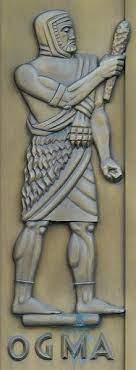
To the Celtic Gauls he was called Ogmios. According to both Gallic and Irish myths Ogma was a warrior god, depicted as a wrinkled old man, wearing lion’s skin cloak, carrying a bow and club. The Romans considered Ogmios as the Celtic equivalent of Hercules (Greek Heracles). They also depicting Ogimos as holding people chained to his tongue by their ears, to indicate he was the god of eloquence and poetry.

Author: Agaliha

The Effects the Full Moon Has On Us