Witch 101: “Witches’ Rede of Chivalry” c 2016

Witch 101: “Witches’ Rede of Chivalry”

The Witches’ Rede of Chivalry can be found in Ed Fitch’s book Magical Rites from the Crystal Well, containing work published in a popular Pagan magazine in the 19602 and ’70s. The Crystal Well featured writing based primarily on Central and Eastern European magickal traditions.

The Witches’ Rede of Chivalry may be written in somewhat archaic language, but it covers a number of important points, and I think it is worth taking a peek at. Here’s an example to show you what I mean: “A Witch’s word must have the validity of a signed and witnessed oath. Thus, give thy word sparingly, but adhere to it like iron.” Can’t argue with that, can you?


Source: Everyday Witch A to Z By Deborah Blake

(One Person’s View Point) New Moon Spells and Rituals for Tomorrow

(YOU CAN COPY AND PASTE ANY SPELLS POSTED TO A DOCUMENT TO PRINT AND/OR SAVE ON YOUR COMPUTER FOR PERSONAL USE ONLY)

Click here for more New Moon Spells and Rituals Source: Spells8.com

The New Moon is a lunar phase that happens when the Moon is located exactly between the Earth and the Sun. Because its bright side cannot be seen from our planet, some people also call it a “Dark Moon“.

A collection of spells for the new moon, including an easy spell that you can cast right now.

In this article, you’ll find:

New Moon Magic!

Quick New Moon Candle Spell

Energy of a New Moon · . * ✦

What to do in the New Moon?

Easy New Moon Rituals

Easy New Moon Spells

Meditations for the New Moon

(One Person’s View Point) Witchcraft 101: Naked c.2016

Witchcraft 101: Naked

There is a simple word that can strike fear into the heart of the bravest Witch: skyclad.

Skyclad is the word we use to mean, well, nude. As in, “This month’s full moon ritual will be done skyclad.”

Starkers, as the Brits say. In your birthday suit. Sans clothing. In your altogether. In short, buck-naked. Or as my dad used to say, “stark, nuked nade.”

Either way, it means you are out there under the moon with the breeze blowing through your, er….everything.

Some Witches are very comfortable practicing skyclad. Others wouldn’t do it on a bet. Still others save such dedication for their solitary rituals and prefer to wear garb when gathering with their fellow Witches.

All of the above is fine. There is no rule that says you have to perform Witchcraft naked (thank the Goddess), although there are some traditions where that is the norm. And although in the Charge of the Goddess it says “ye shall be naked in your rites,” this doesn’t mean that you have to stand outside at midwinter freezing your whatsits off.

As with most things witchy, you should use your own judgment and do what feels right to you. If you’re comfortable being naked, by all means do your rituals skyclad. If you’re not, you would probably find your nakedness so distracting that you wouldn’t be able to concentrate on your magick anyway, so there’s not much point to it.

The important thing to remember is that in the case of group rituals, you should discuss such things ahead of time and make sure that everyone agrees. There isn’t much that is more disconcerting than showing up at a ritual to find out that you are expected to disrobe when you weren’t planning on it.
Source: Everyday Witch A to Z Deborah Blake

Introducing 37 Popular Different Types of Witches

There are possible as many different types of witches, as witches themselves. These various types mentioned below are great for understanding your craft and giving you a frame to research and learn more about magical ways of being.

I want to describe them as an inspiration for you to find the best practice that will suit your aesthetic and interests. It’s not intended to give you another label nor to show the only possible way to practice witchcraft.

Feel free to combine these practices and find your unique way of magic.

Contents:

Book references for a Secular Witch:

Source Last Updated on September 10, 2021 by Eva Maria

Let’s Talk Witch – Your Power c 2015

Your Power

Now let’s talk about some techniques and exercises to help you begin raising and channeling your Wicca power.

First of all, anyone can cast a powerful magical spell. If you think you’re not powerful enough, or not magical enough, or if you’re still a little skeptical about Wicca, don’t worry.

You will still be able to perform very effective magic, if you can follow some simple instructions.

There is a very important principle that underlies all magic spells you will perform.

Some people call it The Secret. Others know it as the Law of Attraction. But the point is, you will attract what you think about and focus on. That is how powerful your mind is.

Magic, using tools and words and spells, just enhances this natural ability that your mind has to attract.

Magic lets you powerfully attract what you want, and it works because of the Law of Attraction.

The key here is to make sure that everything you do is in line with your goals. All your thoughts, all your actions, and everything you do should be in agreement with what you are trying to attract.

For example: if you are trying a spell to lose weight, then looking in the mirror and saying “look how fat I am, I’m never going to lose this weight!” is going against your purpose.

You must think positive, and imagine the reality you wish to achieve with your spell.

And if you binge on brownies, bon-bons, and junk food, you are also going against your purpose.

And your spell is not going to work.

Let me repeat this again because it’s important.

Your spells will not work unless you put your entire being into achieving your goal.

Magic without the proper intention is just a bunch of rhyming words.

When you do magic, you want it to work for you.

So do yourself a favor, and make sure that you avoid anything that contradicts or goes against the purpose of your spell.

Making negative statements will cancel out any positive energy created by your spell. This means that the spell won’t work.

When you cast a spell, you need to be confident that it will succeed. In fact, the more confident you are, the more successful your spell is likely to be.

Try to frame your thoughts and statements positively: “I will lose the weight.” “I can and I will achieve my goals.” “I am eating healthy foods to achieve my goals.”
When you make positive statements like this, you create positive energy that reinforces your spell and makes it stronger.

So make sure you are creating positive energy for your spell, both before, during, and after your spell is cast.

 
Source: Wicca Power Spells by Aurora Rede

(One Person’s View Point) Let’s Talk Witch – Skyclad c.2015

Skyclad


There is a simple word that can strike fear into the heart of the bravest Witch: skyclad.

Arrggghhhh! (See, told you.)

Skyclad is the word we use to mean, well, nude. As in, “This month’s full moon ritual will be done skyclad.”

Starkers, as the Brits say. In your birthday suit. Sans clothing. In your altogether. In short, buck-naked. Or as my dad used to say, “stark, nuked nade.”

Either way, it means you are out there under the moon with the breeze blowing through your, er … everything.

Some Witches are very comfortable practicing skyclad. Others wouldn’t do it on a bet. Still others save such dedication for their solitary rituals and prefer to wear garb when gathering with their fellow Witches.

All of the above is fine. There is no rule that says you have to perform Witchcraft naked (thank the goddess), although there are some traditions where that is the norm. And although in the Charge of the Goddess it says “ye shall be naked in your rites,” this doesn’t mean that you have to stand outside at midwinter freezing your whatsits off.

As with most things witchy, you should use your own judgment and do what feels right to you. If you’re comfortable being naked, by all means do your rituals skyclad. If you’re not, you would probably find your nakedness so distracting that you wouldn’t be able to concentrate on your magick anyway, so there’s not much point to it.

The important thing to remember is that in the case of group rituals, you should discuss such things ahead of time and make sure that everyone agrees. There isn’t much that is more disconcerting than showing up at a ritual to find out that you are expected to disrobe when you weren’t planning on it.


Source: Deborah Blake. Everyday Witch A to Z: An Amusing, Inspiring & Informative Guide to the Wonderful World of Witchcraft


Witchcraft Bare Basics Part 7 – The Ethics of Witchcraft/Wicca

The Ethics of Witchcraft/Wicca

Much has been written about magical ethics. Usually a list of clear dos and don’ts and thou shalts. The Wiccan Rede—“ An it harm none, do as thou will”— and the three-fold law—“ what you do comes back to you three-fold”— get bandied about as being the ethical pillars of Witchcraft. As I’m not Wiccan I don’t subscribe to these ideas. In the 1950s Doreen Valiente wrote a lovely poem called The Wiccan Rede. It drew on many sources including a poem from Aradia: Gospel of The Witches by Charles Leland, some Aleister Crowley material and older teachings. The last part, often referred to as the Rede is the well-known “an it harm none, do as thou will” although the whole thing is often reworded to mean “do whatever you like as long as you’re not hurting anybody”. I believe that in a time when witchcraft was being redefined and made out to be something nice and benevolent, it may have been important to defuse outside ideas about what witches do and make them appear “good” by instilling a moral code of sorts. The Wiccan Rede only applies to Wiccans however, not all witches or magicians.

Many following the Rede try to never think ill about anyone or use it as a reason to become vegetarian. The problem I see is that “harm none” includes yourself. Some blood and body types aren’t suited to a vegetarian diet. In addition every breath or step you take on the earth may be harming small creatures and organisms. Does this mean that we only apply “harm none” to those creatures we choose? If so, who decides what can or cannot be harmed? What is the criteria for a bug or organism to be added to the “none” category?

Harm None is also the wrong part of the rede to be focused on. Of the eight word shortened version, Harm None is the least. Will is the important part, this is discussed further later on.

The other thing about the Rede is that the word ‘rede’ means advice. Not rules, not law and not even guidelines. Jack Sparrow’s Pirate Code has more credence. The Rede is more akin to your Auntie pulling you aside to talk about boys (or girls). She’ll tell you what she thinks you should do, she may even tell you some of her horror stories. Her advice may be valid and sound but in the end the decision to act on her advice is all yours.

The three-fold law is, in some form or another, the golden rule in every culture. In Christianity the Bible states “as you sow, so shall you reap” and “an eye for an eye”. The Hindu and Buddhist faiths know it as Karma. Although Karma is not the cosmic instant reward and punishment system that New Age thought promotes it as, if you want to understand Karma, learn about it from the Hindi. Modern colloquialism expresses it as “what goes around, comes around”. However it is referred to, by whichever culture, it speaks of a consequential result for what you do in life.

In Witchcraft the three-fold part is often misunderstood. I read a blog post about how you should give money to a witch because of their three-fold law. If you give them $ 10, you’ll get $ 30 back. In the same vein if you do something bad it will be three times worse for you. The mistaken belief is that the three fold will come back at you three times when for those who believe in it, it’s on three different levels— Mind, Body and Spirit. I’ve found that there is often (but not always) a backlash. In physics— every action has an equal and opposite reaction, in Witchcraft it’s not necessarily as simple as it’s made out to be. There is also a theory that the threefold law was introduced as a way to keep beginners and learning witches safe from themselves.

It’s frequently stated that you shouldn’t interfere with another’s will. That you can’t or rather shouldn’t do a spell that will affect another without their permission. This is often said by people who then send healing energy all around the place without being asked for it and don’t see their own hypocrisy. I personally believe that it’s rarely a good idea to cast a spell regarding another person. Even if it’s “for their own good”. Who are you to decide what is best for another person? Who died and made you a God? They may have a life lesson going on, something that they need to learn from or learn how to cope with in order to grow. By ‘helping’ them you may in fact be harming them by preventing their own personal growth. It’s also a slippery slope, once you start ‘helping’ people, you can’t stop and it’s a short step away from interfering. This is different from binding and cursing but we’ll delve into that later.

Unless you belong to a faith that has its own ethics, you need to figure out what is ethical or not for yourself. Many people will assume that as a witch, you follow their system, or that witches are automatically Wiccan or Pagan and that you must subscribe to their own personal moral code in order to call yourself that. When it comes down to it, you need to ignore all the “know-it-alls” and be true to yourself. If you do ‘bad’ things there may be a backlash, but sometimes it’s worth it. Only you can know that for sure.

The Common Sense Spell Book
Debbie Dawson

Let’s Talk Witch – “What do spells and rituals of witchcraft and magic really do for me?” c.2015 by Lady Abyss

 “What do spells and rituals of witchcraft and magic really do or me?”

Hopefully, by the time you reach the end of this book, you will be able to answer that question for yourself. In the meantime, the following is a short list of benefits you can gain from doing regular witchcraft spells and rituals.

Disrupt the Trance of Everyday Life

Your practice should shift you out of the well-worn mental pathways of your daily life. The spells and rituals you do should make you pause in your day, be conscious and aware of who you are, where you are, and what your aims are. Any spells, consciously performed, should prevent you from being a purely mechanical robot.

Connect You with Spirit

Staying connected to Spirit is essential to attracting what you really want in your life. You can connect with Spirit through any or all of the spells and rituals described in this book. Any spell that quiets the mind or puts us in touch with physical sensation will bring us into contact with Spirit.

Help You Access Powers and Beings

Creating what we want in life is much easier when we have help. A daily practice of witchcraft or magic that puts you in contact with angels, guides, totem Spirits, and other helpers can increase your ability to attract what you want in life. Remember that there is a helpful being for just about anything you want dont be afraid to ask!

Help You Remember What You Want

Many of us go through our days in a reactionary mode we are not choosing our thoughts and actions so much as we are reacting to the stimulus around us. Daily performance of magical rituals and spells helps us remember what we really want in life, and keeps us from sabotaging ourselves with unwanted reactions. For instance, if your goal is to create peace and harmony in life, a daily witchcraft practice can keep you in touch with Spirit, reminding you not to react angrily to your co-workers insults.

Be in Accordance with Universal Principles

Doing daily spells and rituals that are designed with Universal principles in mind is much more effective than those that are not plus, they are guaranteed to be safe. Sound spells follow Rules of the Road, principles such as as above, so below, and four element principles. For instance, if youre designing a ritual to help you gain knowledge, you want to work with the principles of the magical element Air. If you want a ritual that will help you act, you want to work with Fire.

Source: Learn How to Do Witchcraft Rituals and Spells with Your Bare Hands

Alan G. Joel


Am I a Witch? All the Telltale Signs c.2019

Am I a Witch? All the Telltale Signs

Am I a Witch? Well this is a very tricky and difficult question. What defines a ‘natural witch’ from a ‘self-taught witch’ or a believer of magic? To answer all this we have to go way back and define the essence of the Witches.

Lore and the Arcane Truth

There are so many things surrounding the lore, the reality and the legends regarding the Witches. Sometimes information is deliberately insufficient only because witches have always tried to scare the naive, from messing with their stuff. Only the wise, the brave and the righteous ones were allowed to learn the Craft. Why because with Great Power comes great responsibility! For example when Magical Recipes demanded the ‘five fingers‘ they certainly didn’t mean to cut off the fingers of a living human. They just demanded cinquefoil, a powerful Mercurial herb used for Healing and Money.

What is a Witch?

Let’s be clear. When we talk about Witches we are using a genderless term. Witches can be both males and females. Historically, this term has been used to identify the person who uses the Arcane Arts. Moreover, it has been used to falsely accuse women for ‘devil worshipping’ or ‘followers of the pagan gods’.

Am I a Witch?

So… Let’s see the most important traits.

1. Have You heard the ‘Calling’ ?

This is probably the most important of all the Signs. Once you’ve heard it, it’s impossible to un-hear it. Although you can always turn your back at your true nature and stick with the material Realm, you will always know who you are and who you are meant to be.

The ‘Calling’ is a revelation, a moment of extreme spiritual clarity when you somehow realise your are a Witch and get a glimpse of your true Magical Nature. This usually happens by accident, during times of intense anxiety, desperate need for help, sadness or troubles. However, the Calling may be heard in a very young age or when the ‘time is right’. Sometimes it’s a vision, a sure feeling that you are magical, or a dream or someone who enters your life unexpectedly revealing to you the truth. Other times, it’s an actual magical experience, when supernatural phenomena occur, or even an interaction with spirits of nature or ghosts or maybe deities.

There are many witches who actually plan to hear ‘the calling’ during their next lives by arranging the proper circumstances. Of course this is rarely the case as this kind of spell demand advanced levels of Magical Power.

So have you heard the calling? Good! Let’s proceed!

2. Do you feel Connected with Nature?

The relationship between you and Nature can easily tell how magical you are. Although there are other sources of Magic, Nature is the most common one. So let’s see if you are familiar with these traits, commonly attributed to ‘Natural Born Witches’ :

  • You feel the Energy Shift inside you as the Seasons change.
  • Moon Cycle affects you.
  • Also, you feel connected to the Woods, the herbs and the trees.
  • Natural phenomena like strong winds, rain, thunderstorms charge you and raise your energy and awareness.
  • There is something about you that wants to be around with animals all the time.
  • Likewise, animals are attracted to you.
  • Since you remember yourself, you loved crystals!

3. Do you have Dreams, Memories or Visions of being a Witch?

Well, this may explain a lot. Unfortunately, many Witches suffer from the suppression of their Witchiness due to the ‘demonisation’ of the term. As we’ve all know, a Witch can be a synonym of an evil and envious person who uses his/her power to manipulate and abuse others.

However, most Witches are actually Empaths who suffer a lot when others hurt. Therefore they suppress their magical nature, denying it strongly for months, years or even their whole lives. However, there are times, when they are relaxed, or asleep, when vision and images of Witchcraft and spellcasting pop up to their minds.

This can also be memories from their early childhood, when you were ‘practicing’ your magic with an innocent mind and heart, before the essence of magic gets corrupted by the ‘system’.

4. Do you Think ‘out of the box’?

Do you despise those who censor your Thoughts? Witches are untamed creatures who love Wisdom and dare to reach for it. If you continuously find yourself doubting ‘the truth’ or the ‘religious teachings’ while you realise there is some truth in them, then this is a Witchy Traits. Witches don’t hate religion, as they believe in the existence of Higher entities. Yet they do like to think for themselves.

One of the great saying of Witchcraft is ‘to dare, to do and to keep silent’. The first two part of this saying mirrors the essence of a true, untamed, uncensored witch! One whose spirit is stronger than shallow teaching and hypocrisy.

5. Do you feel your Thoughts, your Emotions and your Words have power?

Most Witches know deep inside that their emotions and what they say actually shape reality. It’s funny as the first time they realise it is when they lie about something, and then suddenly it becomes true. For example, have you lied to your boss of being sick just to get a day-off, and after a while you indeed raise fever or something?

Witches influence and alter reality as they speak or they feel. And this exactly what defines them from all others. Thy might don’t even believe they have this ability but they discover it as they grow older. Of course, it needs practicing in order to learn how to focus this energy and not get drained.

6. Do you Collect Unusual Items?

One of the most ‘weird’ traits of witches is that they’ve always collect things that others think as trash. For example, seashore pebbles, or feathers or shells washed out from the ocean. Witches somehow sense the energy that surrounds these items and instinctively pick them up. Therefore, in most houses of Witches, you can see collections of these Weird items, which are usually considered absurd or useless by their visitors.

7. Do you frequently Observe Synchronicities?

As we’ve talked before about synchronicities, this is a very clear sign that something magical or spiritual is at work. It’s the language of the Universe. How the Spiritworld affects our Realm. You see repeating numbers, or maybe you repeatedly see animals who act as spiritual messengers. The list is endless. However, in most cases these patterns are acknowledgeable solely from the Witch as the message usually intends to have one receptor.

Defining the Untamed nature.

Although we’ve seen some of the most common traits of Witches, there are many different kinds of witches and there are definitely many different traits. However, Being a Witch is most commonly something we strongly believe and follow. Because it’s not the ‘omens’ that make us witches. It’s our Fiery Passion for Magic!


Are You a Witch?

(Seperate Article from 2016)

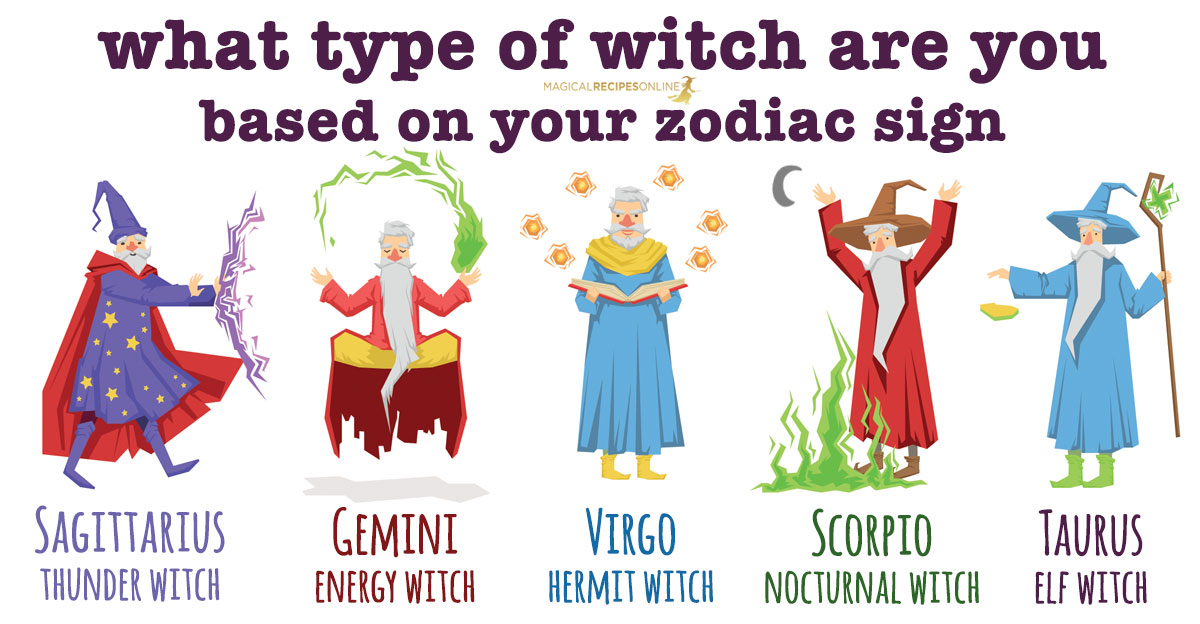
There are many ways to define how good you are in each types of Magic. One is astrology. You Zodiac sign can say many things about you especially when it comes to what you like and how your personality is prone to certain types of magic. Types of Witches can be categorized according to their Zodiac Signs as the Sun’s position in the Natal Chart shows the energy of the newborn child.

The Zodiac Circle and Types of Witches

On the other hand I would also advice you to search for the Zodiac Sign your natal Moon is placed in order to get a more personalised view on how Astrology can define the source of all your magic.

Aries: Blood Witch.

Witches born under the sign of Aries are blessed with the ability to cast powerful Candle Magic spells and tame the currents of energy. They don’t need much to empower their magic, just their fiery passion!

This comes from the fact the the first sign of the Zodiac is when Fire gets its power back. The Sun enters the Spring Equinox and nature is reborn. In their blood, waves of energy is ready to ignite their passions. If you are an Aries try this! Read all about colour correspondences of Candles and cast a simple Candle magic spell tonight! Come on!

Witches born under the sign of Taurus are very well attuned with the power of Earth and Nature. They gladly explore and exploit the powers of Herbs and most importantly the powers of their sexuality.

The first of the Earth Signs hide all the power of Nature in them. They’ve got this magnificent ability to make everything fertile, like flowers blooming. This is the real Elf power. Bringing the Life of Nature everywhere around them. If you are a Taurus try this. Search here for you favourite crystal which meets your needs and charge it with your passion!

Zodiac Signs and types of Witches

Taurus: Elf Witch.

Witches born under the sign of Taurus are very well attuned with the power of Earth and Nature. They gladly explore and exploit the powers of Herbs and most importantly the powers of their sexuality. The first of the Earth Signs hide all the power of Nature in them. They’ve got this magnificent ability to make everything fertile, like flowers blooming. This is the real Elf power. Bringing the Life of Nature everywhere around them. If you are a Taurus try this. Search here for you favourite crystal which meets your needs and charge it with your passion!

Gemini: Energy Witch.

Witches born under the sign of Gemini have a natural ability to sense changes in energy levels around them. They got extremely sensitive intuition and they can easily send & receive energy to past, present and future.

From all the Types of Witches they are the ones with the most versatile nature. Energy is like the wind and it always changes direction. Like their mood swings they can turn up-side-down of all energy. They can transmute negative to positive energy and vice versa depending on their emotional background. Their adventurous nature make them great in manipulating astral energy. If you are a Gemini try this.

Cancer: Kitchen Witch.

Witches born under the sign of Cancer are prone to work their magic indoors by harnessing the energy provided by home supplies like food and remedies. Cancers are typical kitchen witches always brewing their potions with lost of love and affection.

As we already saw the stomach of the Cancers are really sensitive as it is the part of the body which dilutes and transmutes energy – just like the kitchen. They have the amazing ability to give their lunar blessings to everything they want and touch. The Tides of the moon enchant their potions and their spells. If you are a Cancer try this.

Leo: Enchanter Witch.

Witches born under the sign of Leo have a natural ability to catch the attention of others making them extremely talented illusionists. They can easily hypnotise people / animals and charm them.

From all the Types of Witches, Leo is blessed by the Sun. The Sun is their governor and as the planets move around the Sun so do people around Leos. They got this amazing ability to attract what they want – providing they focus their energy. If you are a Leo try this.

Virgo: Hermit Witch.

Witches born under the sign of Virgo have are extremely potent in magical practice as long as they can remain focused. They tend to re-invent their magical self in the silence of Nature, whether this is the Green Woods or the peaceful Emerald Seas.

Virgo – as the name implies – the Virgin / the Untouched, needs time for themselves. From all the Types of Witches, they are the ones who need to find a way to explore the richness of their powers by their own. Only when alone they find their true potential

Once they do they can get back to being awesome in their social circles. If you are a Virgo try this. Grounding can help them banish negativity. Go somewhere you feel secure and lonely (preferably in a Forest or near the Sea). Breathe for few minutes and cast a spell.

Libra: Music Witch.

Witches born under the sign of Libra are blessed with inspiration and are usually extremely talented in arts and crafts. Libra Witches can easily compose spells and even sing them empowering their magical vibes.

From all the Types of Witches, this is what defines them: art and inspiration. Of course they need balance and harmony in order to work their magic. To do so, the need to find a way to center themselves. Only bey this way they will learn how great they are. If you are a Libra try this. Compose tonight a simple spell and cast it with music of your own!

Scorpio: Nocturnal Witch.

Witches born under the sign of Scorpio feel inspired and “enlightened” during the midnight hours, when silence prevails and darkness asserts its dominance. Do not confuse darkness with evil. Scorpios are just great perceiving what’s hidden.

What is hidden and secret ignites their curiosity and wakes up their powerful instincts. They have this amazing ability to scratch the surface in order to find what’s hidden underneath. This is how they learn so many things. From all the Types of Witches astrology defines them as the Wisest of the Zodiac. They may fear but they try to push fear behind. If you are a Scorpio try this. In the Midnight, go outside in a safe and lonely place. Look up the skies and talk to the night about your desire!

Sagittarius: Thunder Witch.

Witches born under the sign of Sagittarius are the children of Zeus / Jupiter / Thor, the God of Thunder. They have a great ability to direct a very “thick” and focused current of energy towards whatever they desire. They are wise and fair and they can cast really powerful magic.

From all the Types of Witches, Thunder Witch is the one who can push further and break the chains throughout wisdom and optimism. Where thunder strikes everything is possible. If you are a Sagittarius try this. Focus on your hands and think and re-think your desire over and over again. When you feel ready express your desire like a thunder bursting from you hands towards your target. Here you will find how to direct energy.

Capricorn: Green Witch.

Witches born under the sign of Capricorn are the ones who can equally easily assert their magical dominance both in Nature and in Urban Territory at the same time. They can tap into nature’s power and direct them in their career and everyday life.

Saturn the so called “Planet of Witches” governs Capricorn giving them the ability to command elemental forces with love and discipline.  If you are a Capricorn try this. Go out for a long walk and search for that “special tree” you feel connected with. Embrace the tree and become one with it and once you are ready send some magical energy to the future in your career / shop or wherever you work. Here you can learn more about grounding!

Aquarius: Star Witch.

Witches born under the sign of Aquarius are very well attuned with the orbs of the planets and stars. Once they look up in the night sky they just know that they are a part of something greater and although they know a little about it they can successfully direct star energy into this World.

The Stars is like a giant web where they a part of it. By looking at the stars, Aquarius knows and feels s/he is never alone. All are connected. Past, Present and Future. Thus, everything is possible. If you are an Aquarius try this. During the night, got out and talk to the stars about your desires!

Pisces: Fairy Witch.

Witches born under the sign of Pisces can easily meddle with the Fairy World and transcend the Physical plane. Those sweet Witches can easily invite fairies in their lives and establish a firm and fruitful connection with the spirit of nature.

From all the Types of Witches, a Fairy Witch is the one who live in this world but definitely belongs to another one. Not a single Pisces actually feels 100% ok with the material world. They all know deep inside that they are missing the greater truth. Thus from a really young age are trying to visualise and locate the world they really fit in. If you are a Pisces try this. Plant some Foxglove near your house and every morning invite the spirit of nature to come and live.


To My Fellow Poor Witches c.2018

Brief Look At Different Traditions In Witchcraft – Eclectic Wicca


Eclectic Wicca

Look in any personals column in a Craft-oriented newsletter or journal and you will see this catch-all phrase. Basically, it indicates that the individual does not follow any particular Tradition, denomination, sect, or magickal practice. They learn and study from many magickal systems and apply to themselves what appears to work best. I happen to be an Eclectic Wiccan.

Sea Witchcraft c. 2016

The Principles of Witchcraft Belief c.2018


The Principles of Witchcraft Belief


In the spring Witch meet held April 1974 in Minneapolis, Minnesota, The Council of American Witches adopted this statement entitled “The Principles of Wiitchcraft Beliefs.”

Of course Wiitchcraft Beliefs can vary from this from area to area, coven to coven and individual to individual there is no strict tenet laid down by a central council, this is just one particular bodies ideas.

Principles Outlined

1: We practice rites to attune ourselves with the natural rhythm of life forces marked by the phases of the Moon and the seasonal Quarters and Cross Quarters.

2: We recognize that our intelligence gives us a unique responsibility toward our environment. We seek to live in harmony with Nature, in ecological balance offering fulfillment and consciousness within an evolutionary concept.

3: We acknowledge a depth of power far greater than that apparent to the average person. Because it is far greater than ordinary it is sometimes called supernatural, but we see it as lying within that which is naturally potential to all.

4: We conceive of the Creative Power in the universe as manifesting through polarity ~as masculine and feminine~ and that this same Creative Power lies in all people, and functions through the interaction of the masculine and feminine. We value neither above the other, knowing each to be supportive to each other. We value sex as pleasure, as the symbol and embodiment of life, and as one of the sources of energies used in magickal practice and religious worship.

5: We recognize both outer worlds and inner, or psychological, worlds sometimes known as the Spiritual World, the Collective Unconscious, Inner Planes, etc. ~and we see in the interaction of these two dimensions the basis for paranormal phenomena and magickal exercises. We neglect neither dimension for the other, seeing both as necessary for our fulfillment.

6: We do not recognize any authoritarian hierarchy, but do honor those who teach, respect those who share their greater knowledge and wisdom, and acknowledge those who have courageously given of themselves in leadership.

7: We see religion, magick, and wisdom in living as being united in the way one views the world and lives within it ~a world view and philosophy of life which we identify as Witchcraft~ The Wiccan Way .

8: Calling oneself “Witch” does not make a Witch, but neither does heredity itself, not the collecting of titles, degrees, and initiations. A Witch seeks to control the forces within her/himself that make life possible in order to live wisely and well without harm to others and in harmony with Nature.

9: We believe in the affirmation and fulfillment of life in a continuation of evolution and development of consciousness giving meaning to the Universe we know and our personal role within it.

10: Our only animosity towards Christianity, or towards any other religion or philosophy of life, is to the extent that its institutions have claimed to be “the only way,” and have sought to deny freedom to others and to surpress other ways of religious practice and belief.

11: As American Witches, we are not threatened by debates on the history of the Craft, the origins of various terms, the legitimacy of various aspects of different traditions. We are concerned with our present and our future.

12: We do not accept the concept of absolute evil, nor do we worship any entity known as Satan or the Devil, as defined by the Christian tradition. We do not seek power through the sufferings of others, nor accept that personal benefit can be derived only by denial to another.

13: We believe that we should seek within Nature that which is contributory to our health and well-being.


Source: Wicca Chat

Kitchen Witchcraft: Find Magic in the Everyday c.2016

Different Paths of Witchcraft: Dianic Witch c.2018

Zsuzsanna Budapest, founder of Dianic Wicca. Z Budapest fought for the right to get paid for tarot readings and WON

Dianic Witch

Origins of Dianic Wicca:
Born of the feminist movement and founded by hereditary witch Zsuzsanna Budapest, Dianic Wicca embraces the Goddess but spends little time on her male counterpart. Most Dianic Wiccan covens are female-only, but a few have welcomed men into their groups, with the intention of adding some much-needed polarity. In some areas, the phrase Dianic Wiccan came to mean lesbian witch, but that is not always the case, as Dianic covens welcome women of any sexual orientation.

Budapest says specifically, “We always recognize, when we say “Goddess,” that She is the Life-giver, the Life-sustainer. She is Mother Nature.”

“There are only two kinds of people in the world: mothers and their children. Mothers can give life to each other as well as to men, who are not able to do the same for themselves. This constitutes a dependency upon the Female Life Force for life renewed, and was accepted naturally in ancient times by our ancient forebearers as a sacred gift of the Goddess. In patriarchal times this sacred gift was turned against women, and used to force them to give up roles of independence and power.”

Cursing & Hexing:
While many Wiccan paths follow a belief system that limits hexing, cursing or negative magic, some Dianic Wiccans make an exception to that rule. Budapest, a noted feminist Wiccan writer, has argued that hexing or binding those who do harm to women is acceptable.

Honoring the Goddess:
Dianic covens celebrate the eight Sabbats, and use similar altar tools to other Wiccan traditions. However, among the Dianic community there is not a lot of continuity in ritual or practice – they simply self-identify as Dianic to indicate that they follow a Goddess-based, feminine-focused spiritual path.

The core belief of Dianic Wicca, as founded by Z Budapest, states that the tradition “is a holistic religious system based on a Goddess-centered cosmology and the primacy of She Who is All and Whole unto Herself.”

Recent Controversies:
Dianic Wicca – and specifically, Z Budapest herself – has been at the center of a few controversies lately. At the 2011 PantheaCon, transgender women were specifically excluded from a women’s ritual hosted by a Dianic group. Budapest’s statements afterwards regarding the incident led to accusations of transphobia against her and the Dianic tradition, when she said, “These individuals selfishly never think about the following: if women allow men to be incorporated into Dianic Mysteries, What will women own on their own? Nothing! Again! Transies who attack us only care about themselves. We women need our own culture, our own resourcing, our own traditions. You can tell these are men, They don’t care if women loose the Only tradition reclaimed after much research and practice, the Dianic Tradition. Men simply want in. its their will. How dare us women not let them in and give away the ONLY spiritual home we have!”

On her group’s website, Budapest states that membership is open to cisgendered women (“Open to women born-women”) only.
Following the PantheaCon controversy, a number of offshoot groups of the Dianic tradition distanced themselves from Budapest and her coven. One group, the Amazon Priestess Tribe, publicly retired from the lineage with a press release that read, “We cannot support a policy of universal exclusion based upon gender at our Goddess-centered rites, nor can we condone disregard or insensitivity in communications regarding the topic of gender inclusion and Goddess-centered practice. We feel it inappropriate to remain members of a lineage where our views and practices diverge significantly from those of the primary lineage holder.”

___________________________________

The Dianic Tradition

Dianic Wicca, also known as Dianic Witchcraft and Dianic Feminist Witchcraft,[1] is a tradition, or Religious denomination, of the Neopagan religion of Wicca. It was founded by Zsuzsanna Budapest in the United States in the 1970s, and is notable for its focus on the worship of the Goddess, and on feminism. It combines elements of British Traditional Wicca, Italian folk-magic recorded in Charles Leland’s Aradia, feminist values, and ritual, folk magic, and healing practices Budapest learned from her mother.

It is most often practiced in female-only covens.

Beliefs and practices
Most Dianic Wiccans worship the Goddess only, believing that She is the source of all living and contains all within Her. There are Dianic witches who practice other forms of paganism (possibly including honoring a male deity or deities) outside of their Dianic practice. Some Dianics are monotheistic, some are polytheistic, some are atheist.

Most Dianics worship in female-only (as defined by Dianics usually as cisgender women, which excludes transgender women from their sisterhood) circles and covens, but there are mixed-gender Dianic traditions. Eclecticism, appreciation of cultural diversity, ecological concern, and familiarity with sophisticated concepts of psyche and transformation are characteristic. Originally lesbians formed the majority of the movement, however modern Dianic groups may be all-lesbian, all-heterosexual or mixed.

Most Dianic Wiccans as “positive path” practitioners do neither manipulative spellwork nor hexing because it goes against the Wiccan Rede; other Dianic witches (notably Zsuzsanna Budapest) do not consider hexing or binding of those who attack women to be wrong.

Differences between Dianic and mainstream Wicca
Like other Wiccans, Dianics may form covens, attend festivals, celebrate the eight major Wiccan holidays, Samhain, Beltane, Imbolc (or Imbolg), Lammas, the solstices and equinoxes (see Wheel of the Year) and the Esbats, which are rituals usually held at the full moon or dark moon. They use many of the same altar tools, rituals and vocabulary as other Wiccans. Dianics may also gather in more informal Circles.

The most noticeable differences between the two are that Dianic covens are usually female-only while other Wiccan covens are usually mixed, some aiming for equal numbers of men and women, and that most Wiccans worship the God and Goddess, while Dianics generally worship the Goddess as Whole Unto Herself; or if they worship the God, it is as a consort of the Goddess, rather than an equal.

It should be noted many Wiccans do not consider the Dianic path to be Wiccan at all as they only venerate, and sometimes espouse only the existence of, the Goddess.

Other Dianic traditions
Broadly speaking, Dianic tradition refers to the beliefs, practices, practitioners and history of woman’s mysteries, earth-religion, Neopagan Goddess worshippers. It is synonymous with the Neopagan religious traditions that place emphasis on the feminine divine. The term Dianic is derived from the Roman goddess of the moon, hunting and childbirth, Diana whose companion Nymphs were female.

The three main branches of Dianic Neopaganism are known as:
Dianic Wicca, a feminine tradition of Wicca started by Zsuzsanna Budapest and her 1980s book, The Holy Book of Women’s Mysteries.
McFarland Dianic, a Neopagan Fairy lineage tradition started by Mark Roberts and Morgan McFarland. One of relatively few Dianic traditions which accepts male members.

The Living Temple of Diana, an emerging shamanic witchcraft tradition of Dianic witchcraft started by Devin Hunter. The Living Temple of Diana’s practices center around empowerment, sovereignty, and carries the motto “We were created whole” as its creed. The Living Temple of Diana does not recognize gender or gender variation as a point of interest in its worship or witchcraft and as such accepts male, female, and transgendered members. Its lineage pulls from the Cult of Diana and was created as an alternative method of Dianic worship and witchcraft for those who are not concerned with CIS only circles.

(Non-Wiccan) Dianic Witches, who may have been inspired by Z Budapest, the New York Redstocking’s W.I.T.C.H. manifesto, or woman’s spirituality movements, who emphasize self-initiation, womanism and non-hierarchical organization. Most Dianics fall into this category, even if some acknowledge Z. Budapest as a foremother, because they do not participate in the initiation/ordination lineage of Dianic Wicca.
Dianic tradition is difficult to define because it has a limited historical basis and no formally defined doctrine. For some, Dianic Wicca is every day folk religion, hedge-witchery or kitchen-witchery; for others, Dianic tradition is more formal, with highly developed liturgy and cosmology. For most, in its essence Dianic tradition is a Woman’s Mysteries tradition, linked to such traditions across time and across cultures. They are a celebration of woman’s bodies, woman’s experiences, the Divine Feminine, and the biology and culture of womanhood, rather than rejection or dismissal of men and masculinity.

Most Dianic’s conceive of and experience the pagan Wheel of the Year in terms of both seasonal reality and also the life stages of women and of the Great Goddess: maiden, mother, queen, crone and hag.

Some Dianics, like other Wiccans, celebrate together in large-group rituals and spell-crafting on the sabbats (seasonal holy days) or the esbats (full-moon days). There are Dianic covens and circles, however many Dianics are solitary practitioners by preference or circumstance.

References

Patti Wigington, ThoughtCo.com

1.0 1.1 Falcon River (2004) The Dianic Wiccan Tradition. From The Witches Voice. Retrieved 2007-05-23.

J. River (2004) The Dianic Tradition. From The Witches’ Voice. Retrieved 2007-05-23.

Brief Look At Different Traditions In Witchcraft – Teutonic c.2015


Teutonic Witchcraft


From ancient time the Teutons have been recognized as a group of people who speak the Germanic group of languages. Culturally, this included the English, Dutch, Icelandic, Danish, Norwegian and Swedish peoples. This is also known as the Nordic Tradition.

Various Traditions of Witchcraft and Wicca: The Alexandrian Wicca c.2018

Alexandrian Wicca

Origins of Alexandrian Wicca:

Formed by Alex Sanders and his wife Maxine, Alexandrian Wicca is very similar to the Gardnerian tradition. Although Sanders claimed to have been initiated into witchcraft in the early 1930s, he was also a member of a Gardnerian coven before breaking off to start his own tradition in the 1960s. Alexandrian Wicca is typically a blend of ceremonial magic with heavy Gardnerian influences and a dose of Hermetic Kabbalah mixed in.

However, as with most other magical traditions, keep in mind that not everyone practices the same way.

Alexandrian Wicca focuses on the polarity between the genders, and rites and ceremonies often dedicate equal time to the God and the Goddess. While Alexandrian ritual tool use and the names of the deities differ from Gardnerian tradition, Maxine Sanders has been famously quoted as saying, “If it works, use it.” Alexandrian covens do a good deal of work with ceremonial magic, and they meet during new moons, full moons, and for the eight Wiccan Sabbats.

In addition, the Alexandrian Wiccan tradition holds that all participants are priests and priestesses; everyone is able to commune with the Divine, therefore there is no laity.

Influences from Gardner:
Similar to the Gardnerian tradition, Alexandrian covens initiate members into a degree system. Some begin training at a neophyte level, and then advance to First Degree.

In other covens, a new initiate is automatically given the title of First Degree, as a priest or priestess of the tradition. Typically, initiations are performed in a cross-gender system – a female priestess must initiate a male priest, and a male priest must initiate female members of the tradition.

According to Ronald Hutton, in his book Triumph of the Moon, many of the differences between Gardnerian Wicca and Alexandrian Wicca have blurred over the past few decades. It is not uncommon to find someone who is degreed in both systems, or to find a coven of one tradition that accepts a member degreed in the other system.

Who Was Alex Sanders?
A Witchvox article by an author listed only as an Elder of the Alexandrian Tradition says, “Alex was flamboyant and, among other things, a born showman. He played the press at every opportunity, much to the dismay of more conservative Wiccan Elders of the time. Alex also was known for being a healer, diviner, and a powerful Witch and magician. His forays into the media led to the publication of the romanticized biography King of the Witches, by June Johns, and later the publication of the classic Wiccan “coven biography, ” What Witches Do, by Stewart Farrar. The Sanders became household names in the UK during the 60’s and 70’s, and are responsible to a great degree for bringing the Craft into the public eye for the first time.”

Sanders passed away on April 30, 1988, after a battle with lung cancer, but his influence and the impact of his tradition is still felt today.

There are numerous Alexandrian groups in the United States and Britain, most of which maintain some degree of secrecy, and continue to keep their practices and other information oathbound. Included under this umbrella is the philosophy that one must never out another Wiccan; privacy is a core value.

Contrary to popular belief, Sanders never made his tradition’s Book of Shadows public, at least not in its entirety. While there are collections of Alexandrian information available to the general public – both in print and online – these are not the full tradition, and were generally designed as training materials for new initiates. The only way to access a complete Alexandrian BOS, or the full collection of information about the tradition itself, is to be initiated into a coven as an Alexandrian Wiccan.

Maxine Sanders Today
Today, Maxine Sanders has retired from the work that she and her husband spent much of their lives on, and practices alone. However, she still makes herself available for occasional consultations. From Maxine’s webpage, “Today, Maxine practices the Art Magical and celebrates the Craft’s rituals either in the mountains or in her stone cottage, Bron Afon. Maxine practices her Magic alone; she has retired from the work of teaching. Her vocation as a Priestess includes counseling those who are in need of kindness, truth and hope. She is often approached by those in the Craft who are not too proud to test the strength of the shoulders of those who have gone before. Maxine is a highly respected Priestess of the Sacred Mysteries. She has encouraged, enabled and inspired students of the Priesthood to take on the conscious mantle of their spiritual potential. She believes the catalyst for that inspiration comes from the Cauldron of the Goddess in all its guises.”

The Alexandrian Tradition

The Alexandrian tradition of Wicca was established in the 1960s by Alex Sanders and his wife Maxine.

Originally, Alex claimed to have been initiated by his grandmother when he was seven years old(reference, The King of the Witches by June Johns), but later admitted that this was untrue. In fact, he was initiated into a regular Gardnerian coven, by one of Patricia and Arnold Crowther’s initiates, a lady by the name of Pat Kopanski.

When Alex began to publicize Wicca, he encountered strong opposition from more traditional members of the Craft. Some saw it as nothing more than a bid by Alex for personal notoriety; others that he was profaning a mystery. Whatever his motivation, the publicity certainly made people aware of his existence; he and Maxine initiated a great many people in the 1960s and 1970s, including Stewart Farrar and Janet Owen.

Janet and Stewart married, and over the past twenty odd years have published several books about Wicca.

What Witches Do, published in 1971 (written during Stewart’s first year as a witch), focuses completely upon the Alexandrian tradition, and remains the best guide to the way in which a typical Alexandrian coven operates. Rare, but perhaps still available in second hand shops, is a record of Janet’s initiation, narrated by Stewart, called A Witch is Born, which also sheds some light on the traditional Alexandrian coven.

It is, of course, hard to quantify just what makes the essential “Alexandrian Tradition,” as covens vary considerably, even within the same culture. I have yet to encounter two covens who work precisely the same way, even from the same line. Generally though, Alexandrian covens focus strongly upon training, which includes areas more generally associated with ceremonial magic, such as Qabalah, Angelic Magic, and Enochian. The typical Alexandrian coven has a hierarchical structure, and generally meets weekly, or at least on Full Moons, New Moons and Festivals.

Most Alexandrian covens will allow non-initiates to attend circles, usually as a “neophyte,” who undergoes basic training in circle craft, and completes a number of projects, prior to being accepted by the coven for initiation to 1st degree. Some, though not all, Alexandrian covens will also welcome noninitiated “guests” at certain meetings. My own first experience of Wicca was as a guest of an Alexandrian coven.

Alexandrian Wicca uses essentially the same tools and rituals as Gardnerian Wicca, though in some cases,the tools are used differently, and the rituals have been adapted. Another frequent change is to be found in the names of deities and guardians of the quarters. In some ways these differences are merely cosmetic,but in others, there are fundamental differences in philosophy.

That said, over the last thirty years, the two traditions have moved slowly towards each other, and the differences which marked lines of demarcation are slowly fading away. Individual covens certainly continue to maintain different styles and working practices, but it is possible to speak today of “Wicca”encompassing both traditions.


Source: Patti Wigington Originally published on ThoughtCo.com

Witchcraft

Despite a generation of excellent research, the history of witchcraft remains bedeviled by a host of misperceptions. Ordinary readers often assume that the major witch-hunts occurred in the Middle Ages, that they were conducted by the Catholic Church, and that they reflected the prescientific notions and sexual fantasies of fanatics and neurotics. Elsewhere one can read that huge chain reaction witch trials constituted a “women’s holocaust” accounting for millions of deaths, and that the witch-hunters especially targeted midwives and female healers. All of these conclusions are both wrong and misleading. The great age of witchcraft trials came after 1430, and primarily after 1570. The prosecuting magistrates were almost always secular officials, imbued with the best thinking of prominent theologians, philosophers, and even scientists. The numbers of those executed have often been exaggerated by a factor of one or two hundred. Men made up perhaps a quarter of those executed, and there is little evidence that midwives or healers were singled out for suspicion anywhere. But historical prejudices are hard to uproot.

UNDERSTANDINGS OF WITCHCRAFT

Depending on one’s definition, various histories of witchcraft are defensible. It was once common, for example, to understand the crime of witchcraft as consisting essentially of having a pact with the devil, an agreement in which one exchanged one’s eternal soul for monstrous powers. Such a crime of diabolism had not existed in the ancient world and only slowly emerged from the medieval campaign against magic and heresy, especially against medieval heretics such as the Cathars and Waldensians, groups who challenged both Catholic doctrines and papal jurisdiction. By the late fourteenth century, however, canon lawyers, prominent inquisitors, learned academics, and several popes came to agree that by means of a contract with the devil, whether explicit or only implicit, a magician might work genuine harm in this world. These theorists also gradually worked out a composite view of all the different sorts of crimes and activities their heresy involved. It was increasingly believed that witch-heretics flew off to a “sabbath” where they renounced their Christian faith and baptism, worshipped the devil, danced together, and enjoyed a cannibalistic feast, devouring children whom they had killed while using their fat or other body parts to make loathsome potions. They were also thought to receive instruction in working harmful magic by which they might destroy their neighbors’ crops, interfere with the fertility of their cattle, and with the sex lives of those around them. Most luridly, witches were thought to have sexual relations with the devil or with lesser demons. During the fifteenth century large numbers of heretical “witches” or sorcerers began to be discovered, and increasingly they were women.

Another definition of witchcraft emphasizes the continuity of magical practices that witches had used in the West ever since classical times and the similarities between such practices and those found all around the world. On such an understanding, witchcraft is the belief in and use of unusual, secret, or even supernatural forces in order to force or promote specific desired ends. The ancient Greeks had believed in such magic but had not seen it as much of a daily threat. They originally thought that “magic” (mageia) was the strange, foreign religious practice of Persian priests (the magi) and of beggars or other dishonorable Greeks. Magic seemed both alien and disreputable. In Greek literature, the figure of the witch included characters such as Circe and Medea, women who used destructive magic to express their anger, lust, and frustration, but magic does not seem to have been a prominent fear among the Greeks. With the ancient Romans, however, harmful magic (maleficium) was forbidden in the earliest set of laws (the Twelve Tables, 451 B. C.E.) and was punished with increasing severity. The Roman historian Livy (History 39.41.5 and 40.43.2f) recounts episodes when apparently thousands of persons were executed by jittery judicial officials, and, in the late first century C.E., the Romans began to crack down on fraudulent magicae vanitates (‘worthless magic’), practices that included healing, divination, and astrology. Thus, this understanding of witchcraft did not require a devil or a pact but insisted on the dangers lurking in the hidden practices of lustful and vengeful witches.

A third notion of witchcraft may be found in the injunctions of the Old Testament, in which the authors of Exodus, Leviticus, Deuteronomy, and Kings, for example, forbade necromancy and divination, practices that competed with the rituals of the Levites and sacrificial priests while also Click here to read the rest of this article Source: encyclopedia.com

Some of the Most Common Witchcraft Paths c. 2016