(YOU CAN COPY AND PASTE ANY THIS POST TO A DOCUMENT TO PRINT AND/OR SAVE ON YOUR COMPUTER)
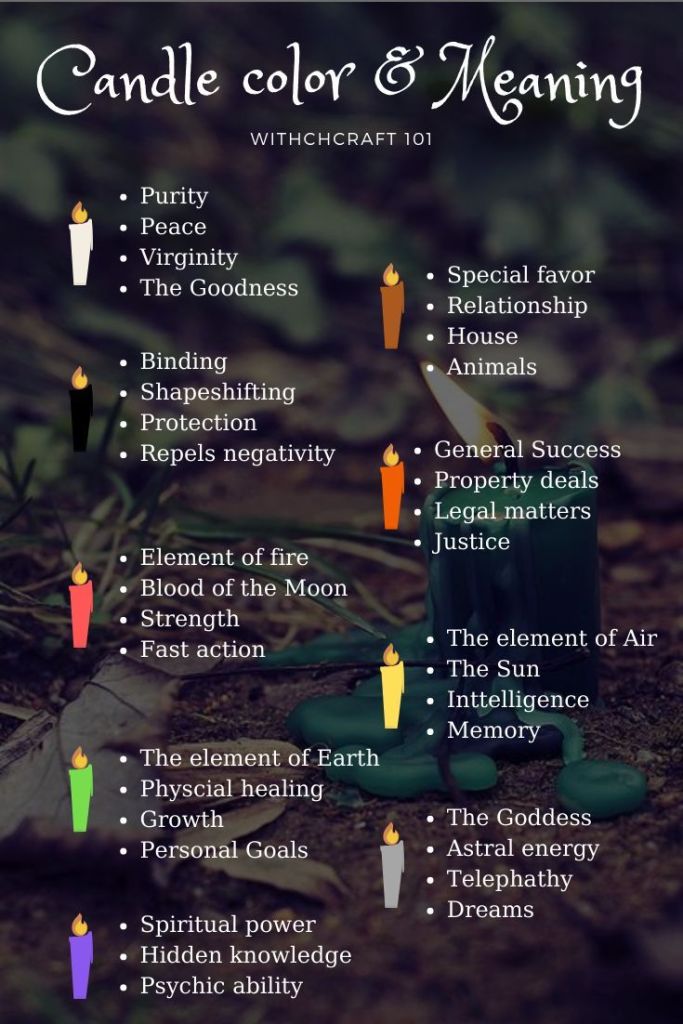

Every candle color has a different meaning. Discover the right one for your spell.
Candle magic is one of the simplest forms of magick. Candles represent the intense element of Fire and wand energy. In rituals, they are action-oriented and can be used to set something in motion or call in an energy. To help you set and focus on your intention, choosing the right candle color can help as each has a different spiritual meaning.
Below you’ll find everything you need to know about how to perform a basic candle spell and the best candle color depending on the day of the week and your desired result.
Candle magic is a type of manifestation ritual that is centered around the use of candles to create a desired outcome in a ritual or spell. Those who follow many different spiritual paths use candle magic, including witches.
We all know the element of Fire has a powerful, transformative effect, which is one reason so… Click here to read the rest of this article Source: pagangrimoire.com
Candles are essential tools in witchcraft, symbolizing the element of Fire and serving various magical purposes.
They are used to set intentions, with different colors corresponding to specific goals.
Candles are employed for elemental magic, anointed with oils, and adorned with symbols to enhance their magic.
Candle magic involves using the candle’s flame and attributes to manifest intentions.
Beyond metaphysical uses, candles have practical functions, such as providing light during rituals and ceremonies.
Click on the hyperlinks to read the rest of this article Source: magickalspot.com
Ever wondered what makes a spell truly work? Is it the tools, the timing, or maybe just a sprinkle of magic belief? Writing a spell can feel like stepping into a mysterious world filled with possibilities, but it doesn’t have to be complicated. If you’ve got an open heart, a clear mind, and a dash of creativity, you’re already halfway there. Think of it as crafting a recipe for your soul—a little bit of this, a pinch of that, and voilà!
Spells aren’t just about waving a wand or chanting in a forest (though, let’s be honest, that’s pretty cool too). At their core, they’re about connecting with the energies around you and channeling them toward your goals. Whether you’re manifesting good vibes, warding off negativity, or just trying to make your houseplants thrive, every spell starts with intention and a little bit of know-how.
And guess what? You don’t need to be a seasoned witch to write a successful spell. All you need is a desire to create change, some basic understanding of the magical process, and the willingness to give it a go. Ready to start crafting your spell? Let’s break it down step by step! Click here to read the rest of this article Source: witcheslore.com
Congratulations! You’ve just created a spell that’s uniquely yours. Writing a successful spell isn’t about perfection—it’s about intention, connection, and a little bit of trust in the unknown. Remember, magic is a journey, not a destination. Keep practicing, experimenting, and learning from your experiences.
And who knows? Your next spell might just be the one to bring a little extra sparkle into your life—or someone else’s. ?
Many experienced witches find themselves constantly running up against the confines of other peoples spells. Perhaps you’re never able to find the spell that’s just right, that feels tailored to your purpose. Or maybe you’ve become very comfortable working with your personal set of tools and ingredients but spells regularly call for things that you don’t have (and don’t care to have!) while underutilizing those items that you’ve so carefully curated for your craft.
For witches in this situation, writing your own spells might be the only plausible solution to reviving the fluidity and enjoyment of your craft.
For some newer witches the process of writing your own spells may seem a bit intimidating. When you haven’t got much experience under your belt sticking with spells written by other people just feels safer. And that’s OK! As with any art, you must first copy other peoples work until you simply cannot stand it anymore to really master the techniques and build a firm foundational knowledge. Only then do you start to compose and explore your own voice in your craft.
Even for those who are new to the craft however, playful experimentation can hold merit. If you feel confident and ready to explore a little more freely please do not hold yourself back regardless of whether you consider yourself a beginner or a more advanced witch.
Click here to read the rest of this article Source: theoccultwitch.com
Have you noticed a sequence of numbers appearing in your life over and over again? Perhaps you frequently see the same sequence such as 888, 999, 111, or 222. These occurrences may not be mere coincidences; rather, they could be your guardian angels trying to communicate with you through what is commonly known as angel numbers. In this article, we are exploring angel number and their meaning.
What Are Angel Numbers and Their Special Meanings
The Special Meanings Behind Angel Numbers
The Connection Between Angel Numbers and Numerology
Using Angel Numbers To Find Insights into Your Life Path
What it Means to Keep Seeing Angel Numbers
Practical Ways to Find Your Angel Number
Signs You Are on the Right Path When It Comes to Angel Numbers
Click on the hyperlinks to read the rest of this article Source: innerlightexplorers.com
In today’s world, filled with so much modern noise, parents and educators are always looking for unconventional ways to inspire children. One such magical tale is about angel numbers. Angels are believed to be guardians who send numerical messages to those in need of guidance, love, and support. Let’s see how having angel numbers around your child can be an enchanting experience.
Angel numbers are sets of digits believed to have special meaning and offer messages from the spiritual world. Anything from the time on your clock, a license plate number, or a street address might reveal an angel number that you should pay attention to. Numerology relies on this idea of interpreting divine messages sent by angels.
Adults aren’t the only ones who see angel numbers. Because children have pure hearts and vivid imaginations, they may experience these ‘numbers’ more because they haven’t yet lost their innocence. By teaching children about angel numbers, you can help them be more observant and aware, and they might actually see their angelic signs.
Kids are naturally drawn to stories, magic, and unseen worlds. Angel numbers can gently and playfully introduce them to the reassuring concept that they are never truly alone and that their guardian angels are watching over them. When they start noticing the same numbers repeatedly in their day-to-day lives—on clocks, license plates, or receipts—they can be taught to define these sequences as symbolic communications from the universe, filled with love, support, and encouragement.
For example, a series of 1010 might appear to a child, conveying a sign of turning points and self-mastery. 1010 can represent the beginning of new chapters, ventures, and opportunities, as well as the importance of believing in themselves. A child who tunes into these numbers might engage in a depth of wonder, curiosity, and connectivity to the world around them.
Creating an ongoing dialogue with kids about what these numbers mean to them, and encouraging them to express their feelings and thoughts creatively through stories or drawings, can elicit newfound creative and imaginative perspectives as they work through the experience. Exploring angel numbers can serve as a gateway for children to cultivate an awareness of themselves and the world around them, promising a sense of peace and support as they walk their paths.
Click here to read the rest of this article Source: kidsworldfun.com
Angel numbers are sequences of three or four digits that convey spiritual messages, often appearing in everyday situations like clocks or licenses. Each number has its own meaning—like 111 for manifestation and 222 for harmony. When you see these numbers, pay attention to your emotions, as they can offer insights into their significance. Keeping a journal can help track encounters and deepen your understanding. As you explore these numbers further, you’ll uncover how they resonate with your personal journey and provide guidance during pivotal moments, revealing even more about their unique meanings.
Common Angel Numbers and Meanings
Personal Journey With Angel Numbers
Higher Vibrations and Energies
Click on the hyperlinks to read the rest of this article Source: angelnumberwisdom.com
The Celtic’s used a writing system called Ogham or sometimes spelled Ogma which dates hundreds of years BCE (Before the Current Era). Most of the time the credit for the alphabets origins are given to the Druid Priests. As only they could read the meanings of the “Ogham Staves” when they were thrown. The Ogham alphabet consists of 25 different symbols which in turn are associated with specific trees or shrubs.
The alphabet can either be written vertically or horizontally but the actual marking for the symbol or letter always appears on the same side and location on the straight line that all the symbols/letter stem off of.
The Ogham Staves are used as a form of divination. You can use them the same as you would Runes or Tarot cards. To make Ogham Staves they should be craved into a piece of the tree or shrub they are associated with, all 25 pieces of wood should be the exact same length and when possible diameter.
How to use the staves is simple you hold them together in both hands, and roll them on your palms while you ask your question of them (be sure to keep your question clear and concise). When you feel it is time and with the question firmly fixed in your mind you let the staves drop from about 4 to 6 inches off the ground. Those closest to you are the future, the middle ones are for the present, and those furthest away are read for the past which led up to the present which will lead into the future.
Here is a picture of the alphabet writing, name of symbol/letter, and which tree or shrub is associated to it:

Other examples of the alphabet:


Here is are the symbols/letters on the tree or shrub they are associated with:


Ogham is a divination system like Tarot cards or runes that is also a system of writing used by the ancient Celts known as Druids. Ogham letters (also called Fews) are made up of simple lines that can be inscribed on any convenient surface. They are read from the bottom up.
Each Ogham letter stands for a type of tree, and the characteristics of that tree (prickly like holly, flexible like willow) grant the Ogham its insights into human nature. Just as each Tarot card should be studied for its individual meaning and its relationship to other cards, Ogham were meant to be studied one by one. This website is the product of my own discursive meditations with Ogham.
Individual Ogham letters are often engraved on sticks or printed on cards in order to use them for divination. To read Ogham as one would read Tarot cards or runes, any number of spreads can be utilized from asking a simple yes or no question where you pull a single Ogham stick/card to complex interpretations of a dozen Oghams thrown on a table or on the ground reveal the future depending on the angles at which they fall. I personally prefer a simple three Ogham reading. I do it every day sometime in the morning. In my mind or out loud, I ask the Ogham: “What do I need to know in order to make the best out of today?” and then reach my hand into the box where I keep my Ogham tiles. Then I pick three of them and lay them side by side.
Discover the fascinating world of Ogham divination and its meanings. This guide will teach you the historical background, symbolism, and significance of Ogham divination, while the video above will teach you how to create your own Ogham divination set (save it for the end!).
Lora O’Brien, founder of the Ogham Academy (and author of this article), has been studying and working with the Ogham for almost 30 years, while devoting the most recent of those years to a Masters in Irish History, and a thesis on the topic of the Ogham and Irish Identity.
Ogham divination is a modern way in which Contemporary Pagans, and those generally interested in divination, may predict future happenings, communicate with beings or entities such as Gods or Ancestors, or gain deeper insight and understanding of past, present, and future situations and events.
You will hear elsewhere that ‘it is an ancient Celtic system of fortune-telling and symbols which has been used for thousands of years by Druids and Shamans’… but the reality is, we have no reliable historical evidence on whether the Ogham was used for divination or magical practice.
What we do have are tantalising archaeological hints, and manuscript references which were recorded at a much later date, and in a very different context, to the events, situations, or stories they purport to be telling us about.
There are those of us, even within academic settings, who believe that while we absolutely MUST clearly understand and study the archaeology, linguistics, and historical source material that does remain to us with regard to the Ogham… we can also extrapolate and develop a modern spiritual, magical, and divination practice that is fulfilling and authentic to what we do actually know, while organically growing from and beyond the admitted restrictions of the evidence.
Ogham Divination uses a set of 25 symbols, based on the letters of the ancient Irish Gaelic script. Each symbol represents the letter name, is related to the others within its original Aicme or grouping, and holds a key to many layered deeper meanings which can be used to interpret a person’s life.
Depending on the context, each Ogham letter or Fid can take on a different meaning. While we do provide suggested meanings below, we strongly encourage you to study the original source materials and develop your own ‘kennings’ for each of the Feda (‘letters’) of the Ogham.
Though most Neo Pagan and New Age sources will tell you that Ogham Divination meanings come from some sort of ‘Celtic Tree Oracle’, this is unfortunately, inaccurate.
Though very popular, this nonsense comes from a misunderstanding that the Ogham alphabet is ALL about trees, and each ogham divinatory meaning is related to trees, or worse, a ‘Celtic Tree Calendar’.
Though we can blame Robert Graves for much of this, as he published it in his pseudo academic (but actually fiction and romantic poetry) book, the White Goddess. (More on that by Morgan Daimler Here).
Even leading Ogham scholars such as Damien MacManus have been frustrated by this focus within academia, as he stated in 1988:
Click here to read the rest of this article Source: ogham.academy


Definition
A Book of Shadows is a personal journal or collection of writings used by practitioners of magick and spirituality to document rituals, spells, experiences, and esoteric knowledge. It serves as both a magickal record and a spiritual guide, evolving alongside the practitioner’s journey.
The term Book of Shadows is believed to have been popularized by Gerald Gardner, the founder of modern Wicca, in the mid-20th century. Gardner described it as a tool for Wiccans to preserve rituals, spells, and teachings specific to their tradition. While its origins are relatively modern, the concept of keeping magickal records dates back to ancient times, with examples found in grimoires, alchemical texts, and sacred writings across cultures.
Over time, the Book of Shadows has transcended Wicca and is now embraced by practitioners of various spiritual and magickal paths.
The Book of Shadows is a living document, deeply personal to each practitioner.
Its significance lies in its ability to: … Click here to read the rest of this article Source: acredanarchy.org
The Book of Shadows, a powerful tool that will transform your magical practice by providing a sacred space to record, reflect, and refine your craft. This personal grimoire, introduced by Gerald Gardner in the early 20th century, is a guide to rituals, spells, and magical practices rooted in ancient pagan traditions. To get started, decide on a format that resonates with your practice, and set clear intentions to guide your entries. Organize your content by themes, and include personal reflections, magical tools, and symbolic colors. As you fill its pages, your Book of Shadows will become a valuable resource for your magical path, illuminating the path ahead.
Click on the hyperlinks to read the rest of this article Source: spellsbycarmen.com
The Wiccan Book of Shadows is a sacred and personal tool that serves as a guidebook, a repository of knowledge, and a record of spiritual experiences for practitioners of Wicca. Crafting your own Book of Shadows is a magical journey, as it allows you to infuse it with your intentions, beliefs, and unique energy. This enchanting grimoire becomes a reflection of your spiritual path and a source of inspiration throughout your Wiccan practice.
To begin creating your own Book of Shadows, find a journal or a blank book that resonates with you on a spiritual level. The texture and color of the cover, the scent of the pages, and the weight of the book should all evoke a sense of magic and wonder. This journal will become your sacred vessel, holding the knowledge and wisdom that you accumulate on your spiritual quest.
Before you embark on filling the pages of your Book of Shadows, take a moment to set your intentions. Find a peaceful and serene space where you can connect with the divine energies around you. Light a candle, burn some incense, and center your mind and spirit. Envision the purpose of your Book of Shadows as a sacred grimoire, a living artifact that captures the essence of your spiritual journey.
Once you have set your intentions, you may choose to create a title page that represents the essence of your magical practice. This page can include … Click here to read the rest of this article Source: witcheslore.com
Automatic writing is a great way to access your subconscious and explore creative ideas. It’s an enjoyable form of self-expression that can help you discover your inner voice.
This guide will provide the essential steps for beginners looking to get started with automatic writing. Here, we’ll discuss how to prepare yourself mentally and physically before starting this type of journaling practice.
With these simple tips and tricks, you’ll be able to start your journey into the world of automatic writing in no time!
Click on the hyperlinks to read the rest of this article Source: learningsupernatural.com
Angel numbers are sequences like 111, 222, and 333 that carry unique spiritual messages. For instance, 111 signifies manifestation, while 222 promotes balance in relationships. Other key numbers include 444, which offers protection, and 555, pointing to transformation. Each number’s meaning relates to personal experiences, guiding you through life’s challenges. By keeping track of these sightings, you can start recognizing patterns and insights. This journey of exploration reveals deeper connections between your thoughts and the universe. As you discover more about these numbers, you’ll reveal greater understanding of their significance in your life.
Cultural Significance of Angel Numbers
Common Misconceptions About Angel Numbers
Click on the hyperlinks to read the rest of this article Source: angelnumberwisdom.com


You must be logged in to post a comment.