Spell – Home Protection Powder: A Simple Spell Recipe

(YOU CAN COPY AND PASTE ANY SPELLS POSTED TO A DOCUMENT TO PRINT AND/OR SAVE ON YOUR COMPUTER)

Home Protection Powder: A Simple Spell Recipe

From spells8.com

Whether you just moved into a new home or you’ve been living in your home for a while, it is always a good idea to cast a protection spell over your space. This process doesn’t have to be elaborate or complicated. In fact, it generally involves about two steps: cleansing the space and then protecting it. Any other steps in the process are entirely optional and can add to the potency of your spell. If you are in search of a simple protection spell for your home, be sure to read this post to the very end!

Why bother about the energy of your home?

Believe it or not, the energy of your home can have an effect on your physical, mental, and spiritual well-being. This energy usually accumulates over time, but certain factors can play a role in how quickly unpleasant energy settles into your spaces. For example, if you spend a lot of time in emotionally charged situations during the day, you may end up bringing some unpleasant energy home with you. This energy may accumulate faster than if you spent your days in more pleasant or neutral situations. Surrounding yourself with unpleasant energies could lead you to feeling drained, grouchy, and generally not spiritually well in your own home.

Energy can also accumulate due to other people in your life. This includes people you let into your home such as family, friends, and even employees, and people that don’t come into your home but still send their energy in your direction. Putting up a magical protective barrier around your home can help to protect against physical damage such as break-ins, storms, or similar. It can also help protect your home against magical or psychic attacks from others or keep a wandering spirit from making itself too comfortable.

Clearing your home of unpleasant energies and protecting it from external energetic forces is very simple. Keep reading for some tips to get you started.

Make a Connection

Whether you are an animist or not, spend some time in your space. Light some incense if you want, play some nice music, and meditate in the heart of your home. Close your eyes and focus on your surroundings. Your home knows what it needs. If you listen well enough, it will tell you.

Clearing it Out

Once you’ve made the decision to clear out the energy from your home, it’s time to get to work. But what does clearing a space even mean? Well, you are going to be removing all energy from the space. This process clears out the energy, both good, bad, and otherwise, to leave room to call in what you want. If it makes it easier, you can think of this as an energetic cleaning rather than a physical one, though the two may look similar and utilize similar tools. This is step one of a good home protection spell.

One of the easiest methods of clearing a space is to clear it as you clean it. Charge your cleaning supplies with your magickal intention. You can do this by holding them firmly or holding your hands over them and speaking your words of intention over them. This could sound something like, “As I physically clean my space, so too do my cleaning supplies clear my home of unwanted energies and entities.” Then you use them to physically clean your space. At the same time, the energy you put forward to charge your supplies will also magickally clear the space.

Another method of clearing your space would be through the use of smoke or sound. You can burn special incense or herbs that have cleansing properties. One popular herb to burn for cleansing is rosemary, but any that you find clearing will work just as well. If you can’t use smoke you can cleanse with sound through clapping or bells. You can also use homemade cleansing sprays, too.

Calling it In

Once you’ve cleared your space, you will want to call something in to fill it. This step is optional, but keep in mind that nature doesn’t like a vacuum and nothing is truly empty for long. Use this step to call in the energy you want in your home. This can be done by playing some calming music, burning some relaxing or joyful incense, or decorating your home with pleasant flowers. Again, this can all be customized to suit your needs and desires for your space.

Choose Your Ingredients

Once your space is cleared and you have called in the energy you want, now it’s time to protect that energy. We are going to be making a salt powder to be used at the thresholds of our home. For this step, be sure to have some salt on hand. Salt is a wonderful protective ingredient to use in your powders, and for this recipe, it is the base ingredient. Salt is good for repelling and absorbing negative energy, keeping the energy that crosses your threshold in line with your intentions.

Along with salt, here are some more ideas of protective herbs you can include in your recipe.

Rosemary

Vervain

Bay Leaf

Aloe

Black Salt

Simple Home Protection Spell

Recipe by Francisco Huanaco

This powder is designed to protect your home with good energy and keep it free from problems. Support the magickal maintenance of your home with this protection powder.

INGREDIENTS

  • Salt – absorbs and repels negative energy

  • Rosemary – for protection (can substitute other protective herbs)

  • Jar or Bowl – for mixing the ingredients together

DIRECTIONS

  • Get your Salt

    Salt is protective and also repels negative energy. It is a good foundational ingredient for any witch to have and makes a simple base for our spell.
  • Get your Rosemary

    Rosemary is an herb that is commonly used for protection. In this case, you can use dried rosemary, fresh rosemary, or even substitute with an essential oil or other protective herb.
  • Mix it Together

    In your bowl, mix the salt and your protective herbs together. As you mix them, you can call on your guides, Gods, or other spirit allies to help you if you want. Stir in a clockwise motion to combine the ingredients as you say the following.
  • Sprinkle it Around

    With your mantra or affirmation in mind, sprinkle the salt mixture along every threshold and entry into your home. Include all doors, windows, and walkways. You can even repeat the above incantation if you’d like, drawing on the energy of the salt mixture as you do so.

For Your Listening PLeasure – Samhain

Samhain

Projects to Celebrate Samhain, the Witches’ New Year

As Samhain approaches, you can decorate your home with a number of easy craft projects. Start celebrating a bit early with these fun and simple ideas that honor the final harvest, and the cycle of life and death

01
of 10

Pagan Treat Bags for Samhain

Do you have Pagan kids coming over for a Samhain event? You can have a kid-friendly celebration by putting together a goodie bag that’s representative of your Pagan spirituality. The key here is to do some creative, outside the box thinking. Sure, there are a ton of Halloween decorations in the store at this time of year, but not all of those are really connected with Pagan religious belief systems. They’re really more about the secular celebration of Halloween, which is fine, unless you’re looking for kid-friendly stuff that honors Pagan spirituality.

Here are a few things to try:

  • Decorate the bags themselves with symbols that are meaningful to you – depending on the pantheon your group honors, you might include designs that are associated with Greek, Roman, Celtic, or Norse mythology.
  • Small herbal sachets: sew herbs into a fabric pouch. Use lavender to help with dreams, or other appropriate plants.
  • Crystals and gemstones: As long as the kids attending your event are beyond the put-everything-in-your-mouth stage, you could include rose quartz for love, hematite for protection, and more.
  • A Portable Altar Kit: Depending on how old the kids are, think about making an altar box that fits in a backpack or pocket. This might not be useful or safe for really young children, but older tweens and teens could use it responsibly.
  • Divination tools: make a simple pendulum with a stone wrapped in wire and attached to the end of a chain. Add a simple divination set by painting symbols on stones or wooden discs.
  • Wands: Make a simple wand with a stick and a crystal wrapped in wire.
  • Deity symbols: Does your tradition honor a particular god or goddess? Consider adding representative symbols – owls for Athenacats for Bastet, or an antler for Cernunnos. Try printing out a wallet-size image of the deity on heavy cardstock, add a prayer to your god/dess on the reverse side, and laminate it.

Finally, remember, Samhain is the same day as Halloween, so never underestimate the power of a few strategically placed pieces of delicious candy!

Click here for more craft ideas for Samhain from learnreligions.com

Wheel of the Year


The Wheel of the Year is a symbol of the eight Sabbats (religious festivals) of Neo-Paganism and the Wicca movement which includes four solar festivals (Winter Solstice, Spring Equinox, Summer Solstice, Fall Equinox) and four seasonal festivals (celebrating or marking a significant seasonal change). Contrary to modern-day Wiccan claims, there is no evidence of an ancient Wheel of the Year in its present form but it is clear that the Celts of thousands of years ago celebrated the festivals the wheel highlights, even if these celebrations were known by another name now long lost.

In the ancient Celtic culture, as in many of the past, time was seen as cyclical. The seasons changed, people died, but nothing was ever finally lost because everything returned again – in one way or another – in a repeating natural cycle. Although time in the modern world is usually regarded as linear, the cyclical nature of life continues to be recognized.

The modern-day Wheel of the Year was first suggested by the scholar and mythologist Jacob Grimm (1785-1863 CE) in his 1835 CE work, Teutonic Mythology, and fixed in its present form in the 1950s and early ’60s CE by the Wicca movement. The wheel includes the following holy days (most dates flexible year-to-year): …

Click here to read the rest of this article about the Wheel of the Year


Magickal Ideas for Imbolc

Let’s Have Some Fun – Lammas


Let’s Have Some Fun – Imbolc


Flashback 2000 Imbolc

Daylight hours are gradually lengthening, and the Earth is beginning to stir. Although she is still in the middle of her winter’s rest, our planet subtly begins to plan. It’s appropriate that this period is represented by Aquarius, an air sign, since all change begins first in the mind. Every new thought or idea is full of raw potential as the Earth is now,nailing for the touch of fire to ignite her new growth period. Uranus is the ruler of Aquarius, and the planet best known for its jurisdiction over the future. This electric energy only looks forward, never back. It is during Imbolc, in fact, as the Sun is passing through Aquarius, that many ideas are born. As we prepare for the upcoming Equinox, then, it’s important to be sure that we’re looking ahead, as Uranus does, with all the electric enthusiasm and genius of Aquarius. Honor the potential of the coming spring by uncovering your gift of prophecy. Whether you use a crystal ball, a dream journal, or another type of predictive tool, prepare for the Equinox in your heart, by understanding how much is possible now.

©️ By Kim Rogers-Gallagher Llewellyn’s Witches’ Datebook 2000 Page 95

Flashback 2000 Lammas

At Lammas, the Sun is at the very peak of Leo, the sign this planet loves above all others. Our star’s warmth is at its most powerful now in the Northern Hemisphere, as it appears directly overhead. At this time, life too, ia at its peak—as are the crops. The ancients celebrated this festival by giving thanks for their first harvest, most especially the grain harvest, even as they accepted the beginning of the God’s descent into the underworld. The myth of the asteroid-Goddess Ceres (Demeter), giver of the grain, also relates to this season. It was now when she would bid her daughter Farwell, since Persephone was obligated to return to the Underworld to rejoin Hades (Pluto). So bereaved was Ceres to see her daughter leave her, she refused to all the Earth to produce grain until her return. At this time,nothing, modern practitioners should be remind of both astrological principles: the fullness of life the Sun brings, and the necessity for rest, as signified by the coming fall.

©️ By Kim Rogers-Gallagher Llewellyn’s Witches’ Datebook 2000 Page 95

Summer Solstice Printable Coloring Pages

For Your Viewing Pleasure – Winter Solstice

What happens during the winter solstice?

For Your Listening PLeasure

SONG OF SUMMER SOLSTICE | Kulning & Nyckelharpa

This song is short but sweet.

Samhain

From History.com

CONTENTS

  1. Ancient Samhain
  2. Samhain Monsters
  3. Myths of Samhain
  4. Samhain in the Middle Ages
  5. Dumb Supper
  6. Christian Samhain
  7. Samhain Merges With Halloween
  8. Wicca and Samhain
  9. Celtic Reconstructionists
  10. Sources

Samhain is a pagan religious festival originating from an ancient Celtic spiritual tradition. In modern times, Samhain (a Gaelic word pronounced “SAH-win”) is usually celebrated from October 31 to November 1 to welcome in the harvest and usher in “the dark half of the year.” Celebrants believe that the barriers between the physical world and the spirit world break down during Samhain, allowing more interaction between humans and denizens of the Otherworld.

READ MORE: Halloween: Traditions, Rituals, Origins

Ancient Samhain

Ancient Celts marked Samhain as the most significant of the four quarterly fire festivals, taking place at the midpoint between the fall equinox and the winter solstice. During this time of year, hearth fires in family homes were left to burn out while the harvest was gathered.

After the harvest work was complete, celebrants joined with Druid priests…

Samhain Celebration Guide

To read more about celebrating Samhain please click on this link

From Plentiful Earth – Northern and Southern Hemispheres Samhain

MAGICKAL 🍂SAMHAIN

By: Forest🐾Devi✨ (Novice in the Heart’s Spirit Coven)


Voices from the spirit world whisper in the wind.

Tonight two worlds come ever closer the curtain waivers thin.

Hear the crackle of the flames burning in the hearth, while loved ones in the Summerlands 

Return to walk the earth.

We welcome in the new year, a time to shed our skin.

With gratitude for lessons learned the future ushers in.

As entities from other worlds come feast with us again.

All commenced in celebration of MAGICKAL Samhain

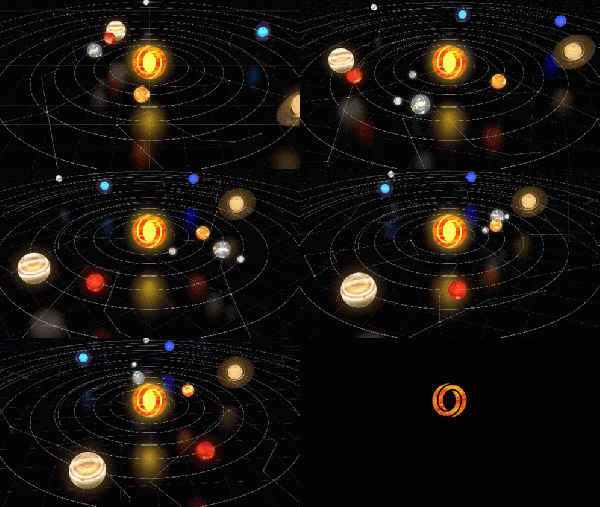
Sinister Solar System From NASA

Introduction

Our universe is full of mysterious sights, and spine-tingling sounds. Take a journey to the most frightful corners of the cosmos.

Click here for More interesting and fun information about our “Sinister Solar System”

The Origins of Halloween by Silver RavenWolf

Harvest Moon, velvet sky, pumpkins glowing, children laughing, costumes, candy, scary stories—just where did this autumn gaiety begin? Let’s look through those cobwebby corridors of time to unearth the exciting genealogy of the American Celebration we call Halloween!

Nothing is ever as simple as it seems—especially when dealing with history. Too often events and circumstances of our past were written or re-written by people who, for whatever reason, operated under an agenda, or simply wanted history to reflect how it should have been, rather than how it was. How, then, do we determine what is fact and what is fiction? In some cases, we can’t. In other situations, we dig.

The Celts

Many historians feel that the greatest strength in the Celtic people lies in their collective mythos. Wading through the romanticism to find unmodified information can prove a tricky endeavor. The earliest archaeological evidence we have of the Celts rest in France and Western Germany.  The Celtic people moved into Spain, Britain, and Switzerland between the fifth and first century BCE. They even ransacked Rome in 390 BCE.

The Celtic peoples celebrated four festivals called fire festivals–commonly know today as Samhain, Oimelc (Imbolc), Beltane, and Lughnasadh. Samhain (pronounced sow-in, sow rhymes with now) was the first and foremost a harvest festival relating to animal husbandry and preparations for the winter months. Fire is an element of cleaning, a vehicle of eradication, so it is not unlikely that fire would work itself into any type of religious celebration. Fire among the ancient peoples often represented an aspect of the divine.

What does the word Samhain mean? Well, we know what it doesn’t mean. There is no archeological or literary evidence of a Celtic god by the name of Samhain. This little slip of fact appears to have begum in the 1700s and continues in some misinformed publications today. The word Samhain actually means “summers end”.

So, where did this Lord of the Dead thing come in? Over time, Samhain took on a religious significance through ministrations of the Druids (the clergy of the Celt’s). Legends indicate that on Samhain all the hearth fires in Ireland were doused and then lit again from a central fire maintained by the Druids at Tlachtga. To the Celts, Samhain was a turning point from light into darkness, and it was thought that this break or fissure created easier access to their land of the dead, Tir nan Og.

The Druids

We need to know a little bit about the Druids to continue with our history of Halloween. The Druids were versed in all learning and were considered to have the gift of prophecy. They functioned as judge, ambassadors, healers, and religious leaders. The Druids first named the holiday Samhain.

 Feast of the Dead

As the Celtic religious system solidified so did the beliefs of the Celts concerning the dead—as has occurred in all religions, before and after the Celts. Since the turning points of the year were considered fissures in time and space, the Celts believe that the dead they loved so dearly could travel through time and space and return from Tir nan Og to visit them. The custom of leaving food at the table (the birth part of the treat part of trick-or-treat) was a gesture of welcome to the departed. From these visits came the belief that those who had gone beyond the land of the living could provide information on past or future events. This is how divination became associated with Samhain.

The Celts did not believe in devils or demons, but they did believe in the Fairy Folk, whom they thought inhabited the land of the dead (the land in-between). Fairies were thought to be resentful of humankind for taking over their land. Because time and space could be conquered on Samhain, fairies were said to roam countryside creating mischief and kidnapping a human or two now and then—just for fun, you understand.—except the humans never came back. Here then is the root of the scary stuff associated with Halloween. The mischief, of course, was caused by living humans, and accepted by the Celts as a psychological release before the onset of winter gloom—though I doubt they would explain it in those terms.

Is it odd, gross, or unusual that a group of people should set aside a day for the dead? Nope. Different cultures and religions have followed such a practice for centuries. Let’s get on our broom again and check out Rome and its contributions to Halloween.

 As the Celtic religious system solidified so did the beliefs of the Celts concerning the dead—as has occurred in all religions, before and after the Celts. Since the turning points of the year were considered fissures in time and space, the Celts believe that the dead they loved so dearly could travel through time and space and return from Tir nan Og to visit them. The custom of leaving food at the table (the birth part of the treat part of trick-or-treat) was a gesture of welcome to the departed. From these visits came the belief that those who had gone beyond the land of the living could provide information on past or future events. This is how divination became associated with Samhain.

The Celts did not believe in devils or demons, but they did believe in the Fairy Folk, whom they thought inhabited the land of the dead (the land in-between). Fairies were thought to be resentful of humankind for taking over their land. Because time and space could be conquered on Samhain, fairies were said to roam countryside creating mischief and kidnapping a human or two now and then—just for fun, you understand.—except the humans never came back. Here then is the root of the scary stuff associated with Halloween. The mischief, of course, was caused by living humans, and accepted by the Celts as a psychological release before the onset of winter gloom—though I doubt they would explain it in those terms.

Is it odd, gross, or unusual that a group of people should set aside a day for the dead? Nope. Different cultures and religions have followed such a practice for centuries. Let’s get on our broom again and check out Rome and its contributions to Halloween.

A Fly-BY of Ancient Rome

Rome had the habit of changing rulers as many times as you empty the lint trap in your dryer. Between 14 and 37 CE, Christianity had begun its rise in Rome. By 41 CE, Claudius had distinguished himself with the conquest of Britain. The Romans also had a harvest festival, so the Celts didn’t have much trouble blending the two holidays together after they came into contact with the Romans. It was around 314 CE when Constantine the Great declared the Roman Empire to be Christian, and the fate of Samhain and Druids was sealed.

 The Advent of Christianity

By the fourth and fifth centuries , Celtic Christianity had oozed into Ireland. St. Patrick has his hands full, and here is where the kettle starts to boil. At, first, the Pagans openly welcomed Christianity, but as Christianity filtered into the Celtic system, church officials had a few problems—mainly the Celtics didn’t want up their holidays or folk practices. The people were not willing to throw out traditions that were ingrained into their social structure. If you can’t get someone to completely change, what do you do? Compromise. And that’s exactly what happened. Samhain was changed to All Hollow’s Eve. To make the Pagan peoples adhere more closely to this new religion of Christianity, the clergy of the day taught the peasants that fairies were really demons and devils (remember, a concept totally unknown to Celtic belief or history) and their beloved dead were horrid ghosts and ghouls. The early Christian erroneously associated the Celtic land of the dead with the Christian concept of Hell.

To help the belief in Christianity along, Druids priestess were systematically murdered. Early Christians also taught the area peasants that their Lord of the Underworld was in fact Satan, which is ridiculous, as the two mythos don’t have anything in common. It appears that Christians misunderstood what the word Samhain meant: because the peasants use this celebration to honor the dead, Christians assumed that Samhain was the incorrect pronunciation of a Pagan deity in the Bible, recorded as Samuel, from the Semitic Sammael, meaning God of the under world.

The Witches

So far, we’ve talked about the land of the dead, how the early Christians managed to superimpose Satan onto Samhain, and how fairies got zapped into demons, but there has been no mention of Witches, commonly associated in our time with Halloween. Where did Witches come from?

During the Dark Ages, the Church sought to eradicate the Pagans and wise women from the countryside so that the church could amass both power and property. First, they had to devalue women because women kept the holy days, trained the children, and provided the cohesive socialization of the culture, thus women held the power to shape society. The church taught, among other things, that women had no souls. Once this teaching had occurred, it was only a small step to make them inhuman, and the Church was able to incite the superstitious populace.

The Celtic women were the strong hold of the family environment, and although the Celts accepted Christianity at first, they did not want to give up their family traditions or their lifestyle. The Church was not into free thinking—therefore anything that did not follow the church dictates was evil. Hence, the Witches (really the women) became evil. Since Samhain was a primary festival of the Celts and the Church had already determined that Samhain was evil, the association between Witches and Halloween was born.

All Saints’ Day / All Hallow’s EVE / Halloween

All Saints’ Day and All Hallow’s Eve (Halloween) were first introduced in the seventh century CE. All Saints’ Day was originally celebrated in the spring. The date was changed to November 1 to supplant Pagan beliefs because those pesky Pagans just refused to cough up their original Samhain. The day was to honor God and all his saints, known and unknown. All Saints’ Day later became Hallowmass, a mass to honor the dead. The Eve of All Hallow’s Day, October 31, became All Hallow’s Eve, which evolved into the word Hallowe’en. Although the church wished this time to be one of somber prayer and quite custom, the Celtics continued their customary bonfires and fortune telling.

All Souls’ Day is a bit different. This festival falls on November 2, a day to offer prayers and alms to assist the souls of those departed that manage to get stuck in purgatory, an in-between place that is neither heaven nor hell. Over the succeeding centuries, Halloween, like Christmas, picked up various customs and discarded others, depending on the complex socialization of the times and religious dictates.

Halloween Comes to America

Our first inkling of Halloween coming to America revolves not around a specific set of people (many indicate the Irish) but with William Penn’s motley collection of refugees from Europe. In 1663, Penn wrote a promotional tract about the Americans. As a result, fifty ships dropped the anchors in the Delaware River. They discharged persecuted souls from England, Ireland, Wales, and the Rhineland (now Germany). Collectively, the Germans and Irish shared Celtic heritage. Therefore many of the folk customs resonated together—including Halloween.

From 1684 through 1930, Halloween was more a time for tricking rather than for treating. Many of the tricks the German and Irish communities became universal, such as overturning outhouses, dismantling a wagon and putting it back together on top of a house or barn, and tying cows to church bells. The tricks often served as social function, such as mildly chastising a neighbor who exhibited antisocial behavior.

By 1910, several American manufactures were making or importing party products just for the American holiday Halloween. From noisemakers to costumes, a new holiday meant new business and an opportunity to make money.

The drawback to the new holiday came in the form of the “declared” Mischief Night, Goblin Night, or Devil’s night on October 30. Minor offenses, such as trying several garbage cans together and hanging them from a light pole, soaping windows with lard, and later, bars of hand soap, abounded. As the pranks grew to vandalism shopkeepers would bribe youngsters to ward off destruction of their property.

In an effort to stop the criminal behavior, the Boy Scouts, in conjunction with local town councils, cities, boroughs, instituted the custom of Trick-or-Treat night to help keep youngsters from naughty practices. By the 1930s the custom of trick-or-treating was well entrenched in our American culture. Halloween, like Christmas, became a holiday for children, and parents strove to make the holiday as much fun as possible for the enjoyment of their youngsters.

During he 1950s. ’60s, and ’70s our American Halloween stayed primarily the same, but in the ’70s and ’80s, with a recession coupled by a candy scare, groups and organizations once again sought to find appropriate avenues to make Halloween safe for America’s children. Halloween practices extended through the entire month of October. Haunted houses, parties, hay rides, plays, story hours, and numerous other events were held throughout the month.

In the mid-to-late 1990s certain sects of the Protestant Christian church declared war on Halloween. using the same erroneous propaganda cultivated hundreds of years ago. Other groups size Halloween for their own political agendas—hosting haunted houses showing aborted babies, drug addicts, and other modern day violent situations. This did not go over well, as the holiday had become an event primarily for children, not adult political issues. Radical Christian groups said that the holiday was Satanic—which, as we’ve seen from our research, is a bizarre and fantastic claim, based on misinformation, politicking, personal agendas and fear. With America’s policy of separation of church and state the battle for destroying Halloween in the United States is an uphill battle.

The original Samhain marked the the close of the agriculture season and functional third harvest festival. In America, Halloween has become the first holiday in our end-of-year rush for partied gaiety. Our Halloween functions as the opening of the three-month-long celebratory fest that includes Thanksgiving, Christmas, Yule, Kwanzaa, and Chanukkah, and ends with the popular American New Year.

As our children crave pumpkins with delightful chatter, adults find solace in a night when they can be whatever they want to be. We have little doubt about the joy this holiday bring to the American people. I am sure we will forever love the haunted house, the harvest Moon, the thrills and chills of a well-wrought tale—and, of course, the deliciously scary things that go EEEEK! in the night.

 Harvest Moon, velvet sky, pumpkins glowing, children laughing, costumes, candy, scary stories—just where did this autumn gaiety begin? Let’s look through those cobwebby corridors of time to unearth the exciting genealogy of the American Celebration we call Halloween!

Nothing is ever as simple as it seems—especially when dealing with history. Too often events and circumstances of our past were written or re-written by people who, for whatever reason, operated under an agenda, or simply wanted history to reflect how it should have been, rather than how it was. How, then, do we determine what is fact and what is fiction? In some cases, we can’t. In other situations, we dig.

Llewellyn’s Witches’ Datebook1999 Pages 24 to 29

Some Thoughts About Celebrating Samhain

Samhain is a day of reflection of the past year while celebrating the new. It is a day that whatever has not been harvested from gardens, fields, bushes, and trees get left for the wildlife and Fea Folk. It is also a day to communicate with those who have crossed the veil into the Summerlands. Many pagans and witches say it is the day and/or night to honor only those that have crossed in the last year but I do not go along with this way of thinking. While those who have passed since November 1, 2020 up to today do need more comforting and remembering them then those that have crossed over in other years past. The farther back in time you go to those who have crossed before the last year the more chance there is that they will be forgotten totally.

Hypothetically, if crossed the veil say 30 years ago or longer and each generation after you talk about you less and less as each year passes soon you will be forgotten completely. That one reason I have my Book of Shadows and Family Grimoire as one book that I hope keeps growing after I am gone. I have also placed pictures of ancestors at different ages as well as pictures of myself alone and with family members both ancestors and descents. In the section for ancestors I have included a picture of their headstone and where it can be found if I know.

So this Samhain when you are setting the extra place at the table, lighting a candle for each ancestors name, or however you choose to honor your ancestors (remember an ancestor does not have to be blood related they can be anyone in your life that help to mold you into the person you are today.) Set one more place, light one more candle, or whatever your tradition to remember your ancestors is for those who names have been forgotten since the first Homosapien of any branch of the human gene pool lived.

I implore you all to remember that we all can trace our lineage back to this mish mash of a gene pool and that the energy that runs through us connects us to every other living things and not just on Mother Earth. So the next time you have a negative thought about someone for any reason at all remember you are also having that negative thought about yourself.

I picked this song to be included in this post because for me it helps me to remember those, female or male or other, who otherwise might be forgotten

Grandmother

I wish all my family, which means everyone reading this post and by blood, a happy and blessed Samhain.


Lady Beltane 2018

Reed Moon: Celtic Tree Calendar

To read more about the Celtic Reed Month by Sarah Wayt

The celebration of Samhain, now known as Halloween, occurs during the Reed Moon. To the Celts this month hailed the end of the year, a time to cull the livestock and to connect with ancestors. All around the world festivals that honour the dead are celebrated. During the Reed Moon, light a candle for loved ones who have died and you may receive a message from the spirit world.

Releasing old energy

The Reed Moon is a good time to use divination to gain insights into the year that has passed. Perform energy work that will release old energy, burn symbols of illness on your bonfire on November the 5th during your Guy Fawkes celebrations. Remember the Celtic year does not begin until the Winter Solstice so use this interval to dream, not to make plans for the future.

The haunting sound of reed

In the past, the reed was used to make swift-flying arrow shafts that slew both enemies and game. In this way the plant was linked to the season of death and sacrifice, in which trees shed their leaves and the energy of nature became more introspective. Many early musical instruments also used the reed to create a haunting sound that has been connected to rites for the dead and the summoning of spirits.

Wind instruments

Modern day wind instruments have developed the same principle used by original reed instruments. Whereby a current of air is vibrated to produce a melodic sound.

Other traditional uses for reed include thatching. Rooftops were thatched with reeds, and as the Celts withdrew into their homes for the winter they honoured the plant that gave them shelter, making the reed a symbol of royalty and protection.

Reed Moon energy…

A Thought for Today

What is the Reason for Rain on Samhain?

[Revisions made September 25,2021 so a couple of dates might be wrong. The dates for my father’s and mother’s births and deaths are correct]

I have often wonder why it almost always rains and is cold on Samhain. Where I live, in the central United States, it usually nice the day before and the day after but rarely the day of.

This morning my Guides gave me an answer to this question that seems so right I have no idea why I never thought of it. It rains on Samhain because the veil between our world and the Summerlands is very thin allowing what the Spirits of our family and friends are feeling about residing in the Summerlands to come into our world and our feelings to go easier into their world. It also makes it easier to converse with them in many different ways (coming soon a post explaining this more)

Just as we weep for loved ones lost because we miss the person they were in this lifetime they weep because they miss us also so. The rain we experience is in reality their tears. The cold is because they do not need heat to keep a incarnated body warm like we do in this world.

When honoring your ancestors this Samhain remember to take into account their feelings and try to explain yours to them. Communication is not just important when we some someone face to face it is important when dealing with those who have crossed over too.  Do not think the dialogue has to stop when Samhain is over, it may not be as easy to hear them but if they have something you really need to hear you will. Talk to them, ask them questions, tell them things. Just because they no longer have a physical body does not mean they are not interested in things going on in your life.

When helping those who passed away this past year cross into the Summerlands remind them of the happiness, rest, joy and love they will feel there instead of the cold uncertainty of roaming this world with no physical body. If you feel they are hanging on to something in this world or have unfinished business they want to take care before moving across the veil ask how you can help them let go or finish the unfinished business. It is important for us all to cross into the Summerlands after our physical bodies will no longer support life in this world, so we can rejuvenate and be reborn into our next life time.

Talking with my mom today and helping her to finish something she left undone (this I will not share as it was very personal between the two of us) after dreaming about her the other night (October 2015) for the first time since she passed (Born December 12, 1934 Died August 24, 2015) brought a calm to me I have not felt since the day before she passed. I knew the moment my mom passed as I felt a pull on both my heart and root charkas the two most connected thigs in our human body that connect us our to our parents and our children. She is happy and excited to be fully reunited with my dad, he refused rebirth until she and he could have some time together alone and with my eight siblings, who all passed away shortly before or after birth, in the Summerlands They both told me today that they will wait for me to join them in the future when it is my time to return to the Summerlands before they consider another lifetime in this world. Which made me feel very loved and special. It also makes me cry happy/sad tears every time I think about the sacrifice they choose to make for me. You see my dad (Born March 25, 1934) crossed over the veil exactly one month before my twelfth birthday on April 1, 1970. (Please NO April Fool’s jokes. Thank you)

I am sorry if this post seems to ramble some but I was typing as it came to me and had a couple of interruptions for trick-or-treater, all the kids in the neighborhood love to come to the Witch’s house because she gives out good treat if they do not trick her.

[Some of this paragraph maybe early while some of it could be what  you needed to read today] May your Samhain be blessed,. May your time with your ancestors be joyful. My your New Year be filled with everything you need, a warm home, loving family and friends, enough food to keep hunger at bay, clothing to keep you comfortable and even bring you a way to get a couple of things you just want.

2015 Lady Beltane