Flashback 2000 Imbolc

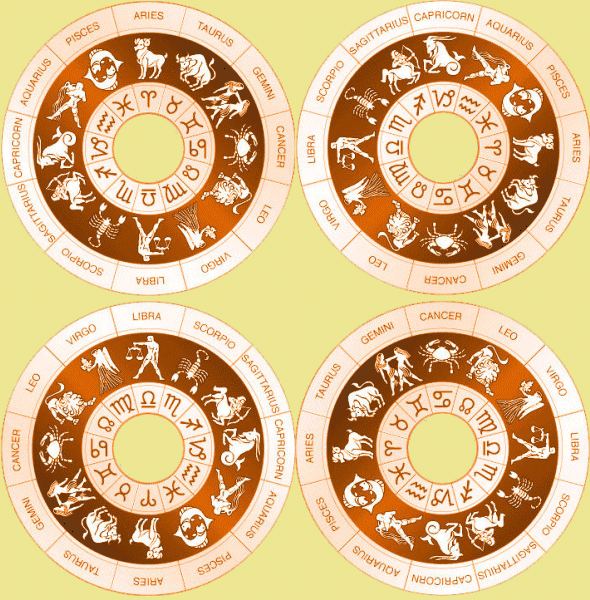
Daylight hours are gradually lengthening, and the Earth is beginning to stir. Although she is still in the middle of her winter’s rest, our planet subtly begins to plan. It’s appropriate that this period is represented by Aquarius, an air sign, since all change begins first in the mind. Every new thought or idea is full of raw potential as the Earth is now,nailing for the touch of fire to ignite her new growth period. Uranus is the ruler of Aquarius, and the planet best known for its jurisdiction over the future. This electric energy only looks forward, never back. It is during Imbolc, in fact, as the Sun is passing through Aquarius, that many ideas are born. As we prepare for the upcoming Equinox, then, it’s important to be sure that we’re looking ahead, as Uranus does, with all the electric enthusiasm and genius of Aquarius. Honor the potential of the coming spring by uncovering your gift of prophecy. Whether you use a crystal ball, a dream journal, or another type of predictive tool, prepare for the Equinox in your heart, by understanding how much is possible now.

©️ By Kim Rogers-Gallagher Llewellyn’s Witches’ Datebook 2000 Page 95

Flashback 2000 Lammas

At Lammas, the Sun is at the very peak of Leo, the sign this planet loves above all others. Our star’s warmth is at its most powerful now in the Northern Hemisphere, as it appears directly overhead. At this time, life too, ia at its peak—as are the crops. The ancients celebrated this festival by giving thanks for their first harvest, most especially the grain harvest, even as they accepted the beginning of the God’s descent into the underworld. The myth of the asteroid-Goddess Ceres (Demeter), giver of the grain, also relates to this season. It was now when she would bid her daughter Farwell, since Persephone was obligated to return to the Underworld to rejoin Hades (Pluto). So bereaved was Ceres to see her daughter leave her, she refused to all the Earth to produce grain until her return. At this time,nothing, modern practitioners should be remind of both astrological principles: the fullness of life the Sun brings, and the necessity for rest, as signified by the coming fall.

©️ By Kim Rogers-Gallagher Llewellyn’s Witches’ Datebook 2000 Page 95

Summer Solstice Printable Coloring Pages

For Your Viewing Pleasure – Winter Solstice

What happens during the winter solstice?

For Your Listening PLeasure

SONG OF SUMMER SOLSTICE | Kulning & Nyckelharpa

This song is short but sweet.

Some of the Witchcraft/Magickal Correspondence for Monday

(YOU CAN COPY AND PASTE ANY CORRESPONDENCES POSTED TO A DOCUMENT TO PRINT AND/OR SAVE ON YOUR COMPUTER FOR PERSONAL USE ONLY)

Monday is named after the moon. The Latin term for Monday is Dies Lunae (“moon’s day”); in the Old English language, this day was Monandaeg; in Greek, it was Hermera Selenes. All of these different names and languages translate to the same thing: the “day of the moon.”

Working with the different phases of the moon is an important skill that takes a bit of time for Witches to learn. So why not cut to the chase and experiment with the day of the week that is dedicated to the moon in all of its magickal energies and aspects?

Magickally, Monday encourages the lunar energies of inspiration, illusion, prophetic dreams, emotions, psychic abilities, travel, women’s mysteries, and fertility.

Source

Book of Witchery: Spells, Charms & Correspondences for Every Day of the Week
Ellen Dugan

Beltane Sunset to Sunset. April 30th – May 1st

Beltane honours Life. It represents the peak of Spring and the beginning of Summer. Earth energies are at their strongest and most active. All of life is bursting with potent fertility and at this point in the Wheel of the Year, the potential becomes conception. On May Eve the sexuality of life and the earth is at its peak. Abundant fertility, on all levels, is the central theme. The Maiden goddess has reached her fullness. She is the manifestation of growth and renewal, Flora, the Goddess of Spring, the May Queen, the May Bride. The Young Oak King, as Jack-In-The-Green, as the Green Man, falls in love with her and wins her hand. The union is consummated and the May Queen becomes pregnant. Together the May Queen and the May King are symbols of the Sacred Marriage (or Heiros Gamos), the union of Earth and Sky, and this union has merrily been re-enacted by humans throughout the centuries. For this is the night of the Greenwood Marriage. It is about sexuality and sensuality, passion, vitality and joy. And about conception. A brilliant moment in the Wheel of the Year to bring ideas, hopes and dreams into action. And have some fun…..

Traditions of Beltane

Beltane is a Fire Festival. The word ‘Beltane’ originates from the Celtic God ‘Bel’, meaning ‘the bright one’ and the Gaelic word ‘teine’ meaning fire. Together they make ‘Bright Fire’, or ‘Goodly Fire’ and traditionally bonfires were lit to honour the Sun and encourage the support of Bel and the Sun’s light to nurture the emerging future harvest and protect the community. Bel had to be won over through human effort. Traditionally all fires in the community were put out and a special fire was kindled for Beltane. “This was the Tein-eigen, the need fire. People jumped the fire to purify, cleanse and to bring fertility. Couples jumped the fire together to pledge themselves to each other. Cattle and other animals were driven through the smoke as a protection from disease and to bring fertility. At the end of the evening, the villagers would take some of the Teineigen to start their fires anew.” (From Sacred Celebrations by Glennie Kindred) Green Man – Beltane

To read more interesting things about Northern Hemisphere Beltane click here

Category Samhain/Deep Autumn

WE ARE THE ANCESTORS: MAY WE BE INTERESTING FOOD

May 9, 2020 · by Glenys D. Livingstone · in Samhain/Deep Autumn · Leave a comment Our present lives are formed by all who came before us. We are in-formed by them, whether conscious or not. In PaGaian Samhain ceremony as it has been done traditionally, participants are invited to remember the ancestors in this way: Let us remember our ancestors, those who have gone before, whose lives have been harvested, […]

THREADS OF GOLD IN THE COMPOST

April 20, 2020 · by Glenys D. Livingstone · in Samhain/Deep Autumn · 2 Comments There are threads of gold in the compost, if one has the vision for it. And we may take the golden thread, exclaim the strongest natural fibre known – our creative selves, our imaginations – for the building of a new world made sacred, of our conceiving: yet beyond our knowings, across the vast Darkness between […] For more interesting article about Southern Hemisphere Samhain click here  

Lammas/Lughnasadh Blessings Sisters, Brothers, and Guests

May your harvest be plentiful growing from what you sowed on Imbolc.

Blessed be dear ones.

Imbolc Blessing

Origins of Lupercalia

WOLVESOrigins of Lupercalia

Type of Holiday: Ancient

Date of Observation: February 15

Where Celebrated: Rome

Symbols and Customs: Blood, Februa, Goat, Milk, Wolf

Colors: Red and white, in the form of BLOOD and MILK , both played a part in the earliest observance of the Lupercalia. Nowadays these are the colors associated with Valentine’s Day, to which this ancient festival has been linked.

Related Holidays: Valentine’s Day

ORIGINS
The Lupercalia was a festival in the ancient Roman religion, which scholars trace back to the sixth century B . C . E . Roman religion dominated Rome and influenced territories in its empire until Emperor Constantine’s conversion to Christianity in the third century C . E . Ancient Roman religion was heavily influenced by the older Greek religion. Roman festivals therefore had much in common with those of the ancient Greeks. Not only were their gods and goddesses mostly the same as those in the Greek pantheon (though the Romans renamed them), but their religious festivals were observed with similar activities: ritual sacrifice, theatrical performances, games, and feasts.

The Lupercalia festival was held in honor of the WOLF who mothered Romulus and Remus, the legendary twin founders of Rome. During the original Roman celebration, members from two colleges of priests gathered at a cave on the Palatine Hill called the Lupercal-supposedly the cave where Romulus and Remus had been suckled by a she-wolf-and sacrificed a GOAT and a dog. The animals’ BLOOD was smeared on the foreheads of two young priests and then wiped away with wool dipped in MILK . The two young men stripped down to a goatskin loincloth and ran around the Palatine, striking everyone who approached them, especially the women, with thongs of goat skin called FEBRUA . It is believed that this was both a fertility ritual and a purification rite. It may also have been a very early example of “beating the bound, or reestablishing the borders of the early Palatine settlement.

There is some confusion over which god the Luperci or priests served; some say it was Faunus, a rural deity, and some say it was Pan, the god of shepherds who protected sheep from the danger of wolves. All that is certain is that by Caesar’s time, the annual ceremony had become a spectacular public sight, with young men running half-naked through the streets and provoking much good-natured hysteria among the women. February 15 was also the day when Mark Antony offered Julius Caesar the crown. Thanks to this historic event, and Shakespeare’s account of it in his play Julius Caesar, the Lupercalia is one of the best known of all Roman festivals.

It is interesting that such a rustic festival continued to be celebrated in Rome for centuries after it had been Christianized. Its survival can be partially credited to Augustus, who rebuilt the Lupercal in the first century B . C . E ., thus giving the celebration a boost. It continued to be observed until 494 C . E ., when Pope Gelasius I changed the day to the Feast of the Purification of the Virgin Mary. There is some reason to believe that the Lupercalia was a forerunner of the modern VALENTINE’S DAY: Part of the ceremony involved putting girls’ names in a box and letting boys draw them out, thus pairing them off until the next Lupercalia.

Source:
The Free Dictionary

As Imbolc Approaches

Imbolc/Candlemas Comments
As Imbolc Approaches

a guide to the Sabbat’s symbolism

by Arwynn MacFeylynnd

Date: February 1 or 2.

Alternative names: Imbolg, Candlemas, Oimelc, Brighid’s Day, Lupercus, the Feast of Lights, Groundhog’s Day

Primary meanings: The name “Imbolc” derives from the word “oimelc,” meaning sheep’s milk. It is considered a time of purification, preparation and celebration for new life stirring, anticipating spring. The holiday is also known as Candlemas; the custom of blessing candles at this time signifies awakening of life and honors the Celtic goddess Brighid, to whom fire is sacred. This Sabbat also celebrates banishing winter.

Symbols: Candle wheels, grain dollies and Sun wheels, a besom (witch’s broom), a sprig of evergreen, a bowl of snow and small Goddess statues representing her in the maiden aspect.

Colors: White, yellow, pink, light blue, light green; also, red and brown.

Gemstones: Amethyst, aquamarine, turquoise, garnet and onyx.

Herbs: Angelica, basil, bay, benzoin, clover, dill, evergreens, heather, myrrh, rosemary, willows and all yellow flowers.

Gods and goddesses: Brighid, the Celtic goddess of healing, poetry and smithcraft; all virgin and maiden goddesses; all fire and flame gods, connected with the newborn Sun.

Customs and myths: In Irish legends of the Tuatha De Danaan, Brighid is the name of three daughters of Dagda who over time were combined into one goddess. She was venerated in Scotland, Wales, on the Isle of Man and in the Hebrides. When celebrating Candlemas or Imbolc, spellwork for fertility, inspiration and protection are appropriate, defining and focusing on spiritual and physical desires for the future. Imbolc is a good time to get your life in order — physically, mentally, spiritually and emotionally. Make plans, organize, clean out drawers and closets to bring in the new and clearing out the old. Make and bless candles; light one in each room in honor of the Sun’s rebirth. Carry out rites of self-purification. Burn mistletoe, holly and ivy decorations from Yule to signify the end of harsh weather and old ways.

Gods – OgmaCeltic God c.2015


Ogma

Celtic God


In Irish-Celtic myth, Ogma is the god of eloquence and learning. He is the son of the goddess Danu and the god Dagda, and one of the foremost members of the Tuatha Dé Danann. He is the reputed inventor of the ancient Ogham alphabet which is used in the earliest Irish writings.

In the final battle at Mag Tuireadh he managed to take away the sword of the king of the Fomorians, but had to pay with his life for this feat. His Celtic equivalent is Ogmios.

Ogma or Oghma is a character from Irish mythology. A member of the Tuatha Dé Danann, he is often considered a deity and may be related to the Gaulish god Ogmios.

He fights in the first battle of Mag Tuired, when the Tuatha Dé take Ireland from the Fir Bolg. Under the reign of Bres, when the Tuatha Dé are reduced to servitude, Ogma is forced to carry firewood, but nonetheless is the only one of the Tuatha Dé who proves his athletic and martial prowess in contests before the king. When Bres is overthrown and Nuadu restored, Ogma is his champion. His position is threatened by the arrival of Lugh at the court, so Ogma challenges him by lifting and hurling a great flagstone, which normally required eighty oxen to move it, out of Tara, but Lugh answers the challenge by hurling it back. When Nuadu hands command of the Battle of Mag Tuired to Lugh, Ogma becomes Lugh’s champion, and promises to repel the Fomorian king, Indech, and his bodyguard, and to defeat a third of the enemy. During the battle he finds Orna, the sword of the Fomorian king Tethra, which recounts the deeds done with it when unsheathed. During the battle Ogma and Indech fall in single combat, although there is some confusion in the texts as in Cath Maige Tuired Ogma, Lugh and the Dagda pursue the Fomorians after the battle to recover the harp of Uaitne, the Dagda’s harper.

He often appears as a triad with Lugh and the Dagda, who are sometimes collectively known as the trí dée dána or three gods of skill, although that designation is elsewhere applied to other groups of characters. His father is Elatha and his mother is usually given as Ethliu, sometimes as Étaín. His sons include Delbaeth and Tuireann. He is said to have invented the Ogham alphabet, which is named after him.

Scholars of Celtic mythology have proposed that Ogma represents the vestiges of an ancient Celtic god. By virtue of his battle prowess and invention of Ogham, he is compared with Ogmios, a Gaulish deity associated with eloquence and equated with Herakles. J. A. MacCulloch compares Ogma’s epithet grianainech (sun-face) with Lucian’s description of the “smiling face” of Ogmios, and suggests Ogma’s position as champion of the Tuatha Dé Danann may derive “from the primitive custom of rousing the warriors’ emotions by eloquent speeches before a battle”, although this is hardly supported by the texts. Scholars such Rudolf Thurneysen and Anton van Hamel dispute any link between Ogma and Ogmios.

*
A Proto-Indo-European root *og-mo– ‘furrow, track, incised line’ may be the origin of the stem of the name. In addition, Proto-Celtic had a causative verbal suffix *-ej– ~ *-īj-. A hypothetical Proto-Celtic *Ogm-īj-o-sogm-. This agent noun would therefore mean ‘furrow-maker, incisor’ and may have had a metaphorical sense of ‘impresser.’ therefore looks very much like an agent noun derived from a verb formed by the addition of this causative suffix to the stem *

The Irish god of writing, eloquence and poetry. Ogma was credited of being inventor of the Celtic writing systems that the Druids used for their magic. These scripts were known as Ogham.

Ogma was the son of Dagda and the goddess Danu. Some other writers say that Ogma and Dagda were brothers; in this version they were the sons of Eithne. Ogma had also being called the son of Elatha, the king of the Fomorians.

Ogma was one the seven champions in the First Battle of Moytura (Mag Tuired), but when Bres became the king of Tuatha dé Danann, Ogma was degraded into working on humiliating manual job of gathering firewood.
When Lugh went to Nuada, asking for a place to serve the king, Ogma seemed to be Nuada’s foremost fighter. During the second battle of Moytura, Ogma had killed one of the Fomorian leaders, named Indech, the son of Domnu.

Ogma had married Etain, the daughter of Dian Cécht. Ogma had a son named Caipre. Some say that he was the father of MacCuill, MacCecht and MacGrené (MacGrene), the three Danann kings who ruled Ireland, during the Milesian invasion, though other say that Neit was their father.
To the Celtic Gauls he was called Ogmios. According to both Gallic and Irish myths Ogma was a warrior god, depicted as a wrinkled old man, wearing lion’s skin cloak, carrying a bow and club. The Romans considered Ogmios as the Celtic equivalent of Hercules (Greek Heracles). They also depicting Ogimos as holding people chained to his tongue by their ears, to indicate he was the god of eloquence and poetry.

Author: Agaliha

Calendar of the Sun for Friday, January 31

Calendar of the Sun

31 Wolfmonath

Imbolc Eve: Day of the Bean Sidhe

Color: Black
Element: Air
Altar: Upon cloth of black place a cup of blood, kept from the last slaughtering. Before it lay bloodstained rags and a flute, and many small unlit votive candles. Block the windows and shut out all sunlight.
Offering: Give aid to a child who has lost their mother.
Daily Meal: Red meat and milk.

Imbolc Eve Invocation

Go, my children, to the riverbank,
In the dark of the night when the wind is howling,
And you shall hear the wails of one who mourns,
And you shall see her kneeling by the water,
Washing the bloody clothes of those
Who did not survive the giving forth of life.
She weeps for the mothers lost,
She weeps for the children lost,
She weeps for the life cut short,
What should have been a joyous day
Become a night of mourning.
She weeps above all for those
Who have no one else to weep for them.
So we shall light a candle, on this night
Before the morn of Candlemas,
For all those who have no one to weep for them,
And we shall shed the tears
And we shall be the voice,
And we shall do the work
Of the lonely Bean Sidhe.

(The cup of blood is poured as a libation. Each comes forward and lights a small votive candle, and then all wail in a great torrent of sound together, with one playing the flute wildly over the cacophony. Those who can shed tears should do so. This should go on until all are exhausted from wailing, and then all should go quietly to their other tasks in silence until Hesperis.

[Pagan Book of Hours]

Enhanced by Zemanta

C A N D L E M A S: The Light Returns

C A N D L E M A S:  The Light Returns
=====================================
by Mike Nichols

It seems quite impossible that the holiday of Candlemas should be considered
the beginning of Spring.  Here in the Heartland, February 2nd may see a blanket
of snow mantling the Mother.  Or, if the snows have gone, you may be sure the
days are filled with drizzle, slush, and steel-grey skies — the dreariest
weather of the year.  In short, the perfect time for a Pagan Festival of Lights.
And as for Spring, although this may seem a tenuous beginning, all the little
buds, flowers and leaves will have arrived on schedule before Spring runs its
course to Beltane.

‘Candlemas’ is the Christianized name for the holiday, of course. The older
Pagan names were Imbolc and Oimelc.  ‘Imbolc’ means, literally, ‘in the belly’
(of the Mother).  For in the womb of Mother Earth, hidden from our mundane sight but sensed by a keener vision, there are stirrings.  The seed that was planted in her womb at the solstice is quickening and the new year grows.  ‘Oimelc’ means ‘milk of ewes’, for it is also lambing season.

The holiday is also called ‘Brigit’s Day’, in honor of the great Irish
Goddess Brigit.  At her shrine, the ancient Irish capitol of Kildare, a group of
19 priestesses (no men allowed) kept a perpetual flame burning in her honor.
She was considered a goddess of fire, patroness of smithcraft, poetry and
healing (especially the healing touch of midwifery).  This tripartite symbolism
was occasionally expressed by saying that Brigit had two sisters, also named
Brigit. (Incidentally, another form of the name Brigit is Bride, and it is
thus She bestows her special patronage on any woman about to be married or
handfasted, the woman being called ‘bride’ in her honor.)

The Roman Catholic Church could not very easily call the Great Goddess of
Ireland a demon, so they canonized her instead. Henceforth, she would be ‘Saint’
Brigit, patron SAINT of smithcraft, poetry, and healing.  They ‘explained’ this
by telling the Irish peasants that Brigit was ‘really’ an early Christian
missionary sent to the Emerald Isle, and that the miracles she performed there
‘misled’ the common people into believing that she was a goddess.  For some
reason, the Irish swallowed this.  (There is no limit to what the Irish
imagination can convince itself of.  For example, they also came to believe that
Brigit was the ‘foster-mother’ of Jesus, giving no thought to the implausibility
of Jesus having spent his boyhood in Ireland!)

Brigit’s holiday was chiefly marked by the kindling of sacred fires, since
she symbolized the fire of birth and healing, the fire of the forge, and the
fire of poetic inspiration.  Bonfires were lighted on the beacon tors, and
chandlers celebrated their special holiday. The Roman Church was quick to
confiscate this symbolism as well, using ‘Candlemas’ as the day to bless all the
church candles that would be used for the coming liturgical year.  (Catholics
will be reminded that the following day, St. Blaise’s Day, is remembered for
using the newly-blessed candles to bless the throats of parishioners, keeping
them from colds, flu, sore throats, etc.)

The Catholic Church, never one to refrain from piling holiday upon holiday,
also called it the Feast of the Purification of the Blessed Virgin Mary.  (It is
surprising how many of the old Pagan holidays were converted to Maryan Feasts.)  The symbol of the Purification may seem a little obscure to modern readers, but it has to do with the old custom of ‘churching women’.  It was believed that women were impure for six weeks after giving birth.  And since Mary gave birth at the winter solstice, she wouldn’t be purified until February 2nd.  In Pagan symbolism, this might be re-translated as when the Great Mother once again becomes the Young Maiden Goddess.

Today, this holiday is chiefly connected to weather lore.  Even our American
folk-calendar keeps the tradition of ‘Groundhog’s Day’, a day to predict the
coming weather, telling us that if the Groundhog sees his shadow, there will be
‘six more weeks’ of bad weather (i.e., until the next old holiday, Lady Day).
This custom is ancient.  An old British rhyme tells us that ‘If Candlemas Day be
bright and clear, there’ll be two winters in the year.’  Actually, all of the
cross-quarter days can be used as ‘inverse’ weather predictors, whereas the
quarter-days are used as ‘direct’ weather predictors.

Like the other High Holidays or Great Sabbats of the Witches’ year,
Candlemas is sometimes celebrated on it’s alternate date, astrologically
determined by the sun’s reaching 15-degrees Aquarius, or Candlemas Old Style (in 1988, February 3rd, at 9:03 am CST). Another holiday that gets mixed up in this is Valentine’s Day.  Ozark folklorist Vance Randolf makes this quite clear by
noting that the old-timers used to celebrate Groundhog’s Day on February 14th.
This same displacement is evident in Eastern Orthodox Christianity as well.
Their habit of celebrating the birth of Jesus on January 6th, with a similar
post-dated shift in the six-week period that follows it, puts the Feast of the
Purification of Mary on February 14th.  It is amazing to think that the same
confusion and lateral displacement of one of the old folk holidays can be seen
from the Russian steppes to the Ozark hills, but such seems to be the case!

Incidentally, there is speculation among linguistic scholars that the vary
name of ‘Valentine’ has Pagan origins.  It seems that it was customary for
French peasants of the Middle Ages to pronounce a ‘g’ as a ‘v’.  Consequently,
the original term may have been the French ‘galantine’, which yields the English
word ‘gallant’.  The word originally refers to a dashing young man known for his
‘affaires d’amour’, a true galaunt.  The usual associations of V(G)alantine’s
Day make much more sense in this light than their vague connection to a
legendary ‘St. Valentine’ can produce.  Indeed, the Church has always found it
rather difficult to explain this nebulous saint’s connection to the secular
pleasures of flirtation and courtly love.

For modern Witches, Candlemas O.S. may then be seen as the Pagan version of Valentine’s Day, with a de-emphasis of ‘hearts and flowers’ and an appropriate
re-emphasis of Pagan carnal frivolity.  This also re-aligns the holiday with the
ancient Roman Lupercalia, a fertility festival held at this time, in which the
priests of Pan ran through the streets of Rome whacking young women with
goatskin thongs to make them fertile.  The women seemed to enjoy the attention
and often stripped in order to afford better targets.

One of the nicest folk-customs still practiced in many countries, and
especially by Witches in the British Isles and parts of the U.S., is to place a
lighted candle in each and every window of the house, beginning at sundown on
Candlemas Eve (February 1st), allowing them to continue burning until sunrise.
Make sure that such candles are well seated against tipping and guarded from
nearby curtains, etc.  What a cheery sight it is on this cold, bleak and dreary
night to see house after house with candle-lit windows!  And, of course, if you
are your Coven’s chandler, or if you just happen to like making candles,
Candlemas Day is THE day for doing it.  Some Covens hold candle-making parties and try to make and bless all the candles they’ll be using for the whole year on this day.

Other customs of the holiday include weaving ‘Brigit’s crosses’ from straw
or wheat to hang around the house for protection, performing rites of spiritual
cleansing and purification, making ‘Brigit’s beds’ to ensure fertility of mind
and spirit (and body, if desired), and making Crowns of Light (i.e. of candles)
for the High Priestess to wear for the Candlemas Circle, similar to those worn
on St. Lucy’s Day in Scandinavian countries.  All in all, this Pagan Festival of
Lights, sacred to the young Maiden Goddess, is one of the most beautiful and
poetic of the year.

Enhanced by Zemanta

Imbolc…or As The Wheel Turns

Imbolc…or As The Wheel Turns

Author:   Morbek 

As the wheel turns…

Sorry, that was a, now obscure, reference to an old soap opera. Imbolc is tomorrow! The meaning of the word it’s self is “in the milk” or something close to that. The real meaning of Imbolc is that we are beginning to see the changes in the days and that spring will eventually be here!

The promise that we will be able to survive another year and thrive is starting to materialize. When Imbolc was Christianized, it became Candlemas, and is a celebration of light. We have just moved through the darkest part of the year and we are headed for the light.

So, beyond the textbook stuff, let’s look at what this Sabbat means to 21st century people. Since we get our milk and meat from the grocery store and no longer have to plan out how and what we will be eating for more than 24 hours, agrarian celebrations no longer resonate with a clear message or meaning for most of us.

We get up in the morning, go to work, grab lunch…. you know the routine. How or even why do we care if ewes are starting to produce milk? We don’t and it is that simple. But if you think about what the last few months have been like, dark, wet dreary, you can identify with the longing for bright blue skies and nice warm weather. Imbolc reminds us that, in a chaotic world, there are many things we can still predict. Stability is important to us.

This Sabbat is also an opportunity for us to bring ourselves, spiritually, into the light. The “Dark night of our soul” is almost over and we have a chance to reflect about the lessons we’ve learned through the tough times and integrate them into our personal wisdom and offer them to others’ through collective wisdom.

I encourage everyone to recognize that what we’ve gone through is over and we never have to visit those same dark days again. Remember the difficulties, glean the lessons learned and then let go of the pain and fear. There is no way to move forward into perfect love and perfect trust if you are clinging onto fear or emotional pain. Imbolc presents an occasion to learn and let go!

Humans are obsessed with marking time. Months, years, decades, centuries, are important mental markers. They Mayan people were so obsessed with time keeping that they wrote a calendar for the past as well as the future. I think our obsession is, in part, a need to compare our personal growth. We need mental cairn to see “from whence we came’.

So, where was I 10 years ago? Living in Pony, MT!

I was secretly wishing that the world would go to hell in a hand basket because of Y2K but I knew it wouldn’t because some pretty smart people who caused that little glitch, were still around to fix that little glitch. I was dealing w/that lovely inner ear/vertigo issue that I have called Meniers’ disease for the first time! I was scared because I had no spirituality and I was on the run from a stalker (hence, why I was in Pony (middle of no where) Montana) .

Where am I now? In Killeen, TX!

The world did go to hell in a hand basket but it had nothing to do with a computer glitch.
I still have the Meniers disease but it’s under control with medication. I have a spiritual system that works especially well for me so I am no longer afraid. And I have taken a stand against the stalker (yes…. 10 years later. He is still at it) .

Imbolc 2010 has presented me with an inner reflection opportunity. Having just attended the Army’s “Spiritual Fitness Summit” with some really smart, spiritual and powerful chaplains, I discovered what has kept most of us from being open to acceptance of other religious systems is fear.

Once I started talking while we were working in our small groups to set the U.S. Army’s definition of spirituality, everyone began to relax. I am guessing that they figured out that I wasn’t going to sacrifice anything in the middle of the room!!! Then this group of men did something I did not expect them to do…they listened to me! Balance will now be included in the definition of healthy spirituality as well as the recognition of nontraditional religions, either formal or informal!

What should be addressed here isn’t “wow, look at the good stuff I’ve done. Yay me!”

I want to look at the road that it took to get to where I am. I want to remember the lessons that I learned on that road (which was full of pot holes and always a construction zone) and i want to, somehow, help others to see that life is a good place to be when you are living in the moment!

I have always felt a call to serve others. Even when I was much younger and being self-centered, spoiled and without a clue what Personal Responsibility, Compassion and Unconditional love meant. I thought that I was too fat for the military so serving there was not going to work and I needed to be doing something that earned money. I wanted to raise children, so the convent was out! Besides….I like sex way too much to give that up for the god of Abraham! What to do? I was stuck at 20…then, along came my eldest child and, thankfully, my (still) best friend, Tara.

Yes, I know…I went back MUCH further than 10 years, stay with me here.

Because of my choice to become a mother, I learned responsibility and because of my oldest daughters’ network of friends (thanks Mark…I owe you one for this lesson) I learned personal responsibility and compassion.

Tara stood by me through all of my thoughtlessness, insults, screw-ups and selfishness. Tara was there for all times, the good and the horrible. Tara taught me that you could love the person but not their actions. She taught me that you love without conditions and you love freely without expectations of being loved back. Because of Tara, I learned unconditional love.

So, what am I doing with all of these lessons? I am making an attempt to teach them to others in a gentler manner than I learned them. I am leading, as best I can, by example. I have been smart enough to form friendships with deep connections with people who will call me on my bullsh*t so that I can do it while not giving all of myself while serving others…or so that I can do it and not be a hypocrite by doing it for my ego.

November 5th is the day my father died when i was 15. November 5th two thousand and nine is the day that I found my feet. It is the day that I honestly answered that call to serve others. THAT is another article for a later time.

Blessed Imbolc, be fearless and loving!

Enhanced by Zemanta

Candlemas: The Light Returns

Candlemas: The Light Returns
by Mike Nichols

It seems quite impossible that the holiday of Candlemas should be considered the  beginning of Spring.  Here in the Heartland, February 2nd may see a blanket of snow  mantling the Mother.  Or, if the snows have gone, you may be sure the days are filled with  drizzle, slush, and steel-grey skies — the dreariest weather of the year.  In short, the  perfect time for a Pagan Festival of Lights.  And as for Spring, although this may seem a  tenuous beginning, all the little buds, flowers and leaves will have arrived on schedule  before Spring runs its course to Beltane.

‘Candlemas’ is the Christianized name for the holiday, of course. The older Pagan names  were Imbolc and Oimelc.  ‘Imbolc’ means, literally, ‘in the belly’ (of the Mother).  For in  the womb of Mother Earth, hidden from our mundane sight but sensed by a keener vision,  there are stirrings.  The seed that was planted in her womb at the solstice is quickening  and the new year grows.  ‘Oimelc’ means ‘milk of ewes’, for it is also lambing season.

The holiday is also called ‘Brigit’s Day’, in honor of the great Irish Goddess Brigit.   At her shrine, the ancient Irish capitol of Kildare, a group of 19 priestesses (no men  allowed) kept a perpetual flame burning in her honor.  She was considered a goddess of  fire, patroness of smithcraft, poetry and healing (especially the healing touch of  midwifery).  This tripartite symbolism was occasionally expressed by saying that Brigit had  two sisters, also named Brigit. (Incidentally, another form of the name Brigit is Bride,  and it is thus She bestows her special patronage on any woman about to be married or  handfasted, the woman being called ‘bride’ in her honor.)

The Roman Catholic Church could not very easily call the Great Goddess of Ireland a  demon, so they canonized her instead. Henceforth, she would be ‘Saint’ Brigit, patron SAINT  of smithcraft, poetry, and healing.  They ‘explained’ this by telling the Irish peasants  that Brigit was ‘really’ an early Christian missionary sent to the Emerald Isle, and that  the miracles she performed there ‘misled’ the common people into believing that she was a  goddess.  For some reason, the Irish swallowed this.  (There is no limit to what the Irish  imagination can convince itself of.  For example, they also came to believe that Brigit was  the ‘foster-mother’ of Jesus, giving no thought to the implausibility of Jesus having spent  his boyhood in Ireland!)

Brigit’s holiday was chiefly marked by the kindling of sacred fires, since she  symbolized the fire of birth and healing, the fire of the forge, and the fire of poetic  inspiration.  Bonfires were lighted on the beacon tors, and chandlers celebrated their  special holiday. The Roman Church was quick to confiscate this symbolism as well, using  ‘Candlemas’ as the day to bless all the church candles that would be used for the coming  liturgical year.  (Catholics will be reminded that the following day, St. Blaise’s Day, is  remembered for using the newly-blessed candles to bless the throats of parishioners,  keeping them from colds, flu, sore throats, etc.)

The Catholic Church, never one to refrain from piling holiday upon holiday, also called  it the Feast of the Purification of the Blessed Virgin Mary.  (It is surprising how many of  the old Pagan holidays were converted to Maryan Feasts.)  The symbol of the Purification  may seem a little obscure to modern readers, but it has to do with the old custom of  ‘churching women’.  It was believed that women were impure for six weeks after giving  birth.  And since Mary gave birth at the winter solstice, she wouldn’t be purified until  February 2nd.  In Pagan symbolism, this might be re-translated as when the Great Mother  once again becomes the Young Maiden Goddess.

Today, this holiday is chiefly connected to weather lore.  Even our American  folk-calendar keeps the tradition of ‘Groundhog’s Day’, a day to predict the coming  weather, telling us that if the Groundhog sees his shadow, there will be ‘six more weeks’  of bad weather (i.e., until the next old holiday, Lady Day).  This custom is ancient.  An  old British rhyme tells us that ‘If Candlemas Day be bright and clear, there’ll be two  winters in the year.’  Actually, all of the cross-quarter days can be used as ‘inverse’  weather predictors, whereas the quarter-days are used as ‘direct’ weather predictors.

Like the other High Holidays or Great Sabbats of the Witches’ year, Candlemas is  sometimes celebrated on it’s alternate date, astrologically determined by the sun’s  reaching 15-degrees Aquarius, or Candlemas Old Style (in 1988, February 3rd, at 9:03 am  CST). Another holiday that gets mixed up in this is Valentine’s Day.  Ozark folklorist  Vance Randolf makes this quite clear by noting that the old-timers used to celebrate  Groundhog’s Day on February 14th.  This same displacement is evident in Eastern Orthodox  Christianity as well. Their habit of celebrating the birth of Jesus on January 6th, with a  similar post-dated shift in the six-week period that follows it, puts the Feast of the  Purification of Mary on February 14th.  It is amazing to think that the same confusion and  lateral displacement of one of the old folk holidays can be seen from the Russian steppes  to the Ozark hills, but such seems to be the case!

Incidentally, there is speculation among linguistic scholars that the vary name of  ‘Valentine’ has Pagan origins.  It seems that it was customary for French peasants of the  Middle Ages to pronounce a ‘g’ as a ‘v’.  Consequently, the original term may have been the  French ‘galantine’, which yields the English word ‘gallant’.  The word originally refers to  a dashing young man known for his ‘affaires d’amour’, a true galaunt.  The usual  associations of V(G)alantine’s Day make much more sense in this light than their vague  connection to a legendary ‘St. Valentine’ can produce.  Indeed, the Church has always found  it rather difficult to explain this nebulous saint’s connection to the secular pleasures of  flirtation and courtly love.

For modern Witches, Candlemas O.S. may then be seen as the Pagan version of Valentine’s  Day, with a de-emphasis of ‘hearts and flowers’ and an appropriate re-emphasis of Pagan  carnal frivolity.  This also re-aligns the holiday with the ancient Roman Lupercalia, a  fertility festival held at this time, in which the priests of Pan ran through the streets  of Rome whacking young women with goatskin thongs to make them fertile.  The women seemed  to enjoy the attention and often stripped in order to afford better targets.

One of the nicest folk-customs still practiced in many countries, and especially by  Witches in the British Isles and parts of the U.S., is to place a lighted candle in each  and every window of the house, beginning at sundown on Candlemas Eve (February 1st),  allowing them to continue burning until sunrise.  Make sure that such candles are well  seated against tipping and guarded from nearby curtains, etc.  What a cheery sight it is on  this cold, bleak and dreary night to see house after house with candle-lit windows!  And,  of course, if you are your Coven’s chandler, or if you just happen to like making candles,  Candlemas Day is THE day for doing it.  Some Covens hold candle-making parties and try to  make and bless all the candles they’ll be using for the whole year on this day.

Other customs of the holiday include weaving ‘Brigit’s crosses’ from straw or wheat to  hang around the house for protection, performing rites of spiritual cleansing and  purification, making ‘Brigit’s beds’ to ensure fertility of mind and spirit (and body, if  desired), and making Crowns of Light (i.e. of candles) for the High Priestess to wear for  the Candlemas Circle, similar to those worn on St. Lucy’s Day in Scandinavian countries.   All in all, this Pagan Festival of Lights, sacred to the young Maiden Goddess, is one of  the most beautiful and poetic of the year.

Enhanced by Zemanta

Gardnerian Traditional Witchcraft –B.14. Skyclad (1953) c.2013

Gardnerian Traditional Witchcraft –B.14. Skyclad (1953)

B.14. Skyclad (1953)
It is important to work naked from the start, so it becometh as second nature, and no thought of “I have no clothes” shall ever intrude and take your attention from the work.  Also, your skin being so accustomed to unconfinement, when power is given off the flow is more easy and regular.  Also, when dancing you are free and unconfined. . . .
And the greatest of all, the touch of the body of your beloved thrills your inmost soul, and so your body gives out its utmost power; and then it is most important of all that there is not the slightest thing to divert the attention, for then the mind must seize and mold the power generated, and redirect it to the desired end with all the force and frenzy of the imagination.
It has been said that no real knowledge may be gained our way, that our practices are such that they can only lead to lust; but this is not really so.  Our aim is to gain the inner sight, and we do it the most natural and easy way.  Our opponents’ aim is ever to prevent man and woman from loving, thinking that everything that helps or even permits them to love is wicked and vile.  To us it is natural, and if it aids the Great Work it is good.
‘Tis true that a couple burning with a frenzy for knowledge may go straight to their goal, but the average couple have not this fire.  We show them the way, our system of props and aids (i.e., magic ritual).  A couple working with nothing but lust will never attain in any case; but a couple who love each other dearly should already be sleeping together, and the first frenzy of love will have passed, and their souls will already be in sympathy.  If the first time or two they do stay a while to worship Aphrodite, ’tis only a day or two lost, and the intense pleasure they obtain only leads them again to the mysteries of Hermes, their souls more attuned to the great search.  Once they have pierced the veil they will not look back.
This rite may be used as the greatest of magics if it be done with both partners firmly fixing their minds on the object and not thinking of sex at all.  That is, you must so firmly fix your mind on your object that sex and all else are naught.  You inflame your will to such an extent that you may create a strain on the astral such that events happen.


The Effects the Full Moon Has On Us

Just A Thought On Remembering Our Ancestors


I feel it is important to remember Lady Abyss during a Samhain celebrations, so I bring you an article she wrote in 2013.

I wasn’t going to torture you today with any of my comments. But I have been surfing the web for cartoons (it is actually hard to find good cartoons). I am beginning to think I should never leave the site. I ran across a few images that made my eyes water and then I was taken back centuries ago.

The images were of witches or accused witches tied to a stake and burning. Another was of a woman on a plank being dunked into the water. If you know me well, you know I can talk an hour or two on our ancestors. But what happened today moved my soul. Perhaps in all the hustle and bustle, I had forgotten for a moment what this season is all about. It is the Witches’ New Year but it is also a time to remember our ancestors.

For me, remembering my ancestors is both joyous and heartbreaking. I am into genealogy and was able (thanks to a dear friend) to trace my roots back to Ireland. Knowing where you came from can be a good thing or if your a witch, not so good. I know you are scratching your heads over that one, right? What I mean is, I know how witches were treated in Ireland. Persecuted. Then they sailed to the New World to escape the torment and the persecution. But unfortunately, they didn’t. They were found out and the same thing they were trying to escape confronted them again. No peace whatsoever. What kind of life did they have?

Most of my ancestors were healers. I have ran across a few that were hanged as witches. That makes my blood curdle. Their blood flows through my veins today. I know that for sure. There are times I have flash backs to my ancestors’ time. To see and experience one of your kin being hanged is one of the worse things in your life. You can see it plainly but you are powerless to do anything about it. When the flashback is over, I cry and cry. Why were people so ignorant and judgmental back then? Why couldn’t they just let the witches live in peace?

Perhaps if history didn’t happen the way it did, we wouldn’t have what we do now. Perhaps it was a test of some kind for our ancestors. I know they had to have unbelievable faith, courage and enormous amount of love for our Religion and our Goddess.

One of the reasons I can talk about our ancestors for hours is because I admire them so much. I know what they sacrificed for us. When accused of being a witch, they could have simply turned their backs and denied it. But they didn’t. I know they didn’t want to die anymore than the next person. But sadly enough they did. Some were killed and others went underground to protect our Religion. To ensure it would be passed on from one generation to the next. Everyone of them took risks so we could have what we do today.

This time of the year is very special to all of us. Don’t get caught up in all the festivities and forget what it is really about, remembering our ancestors. We owe them so much. And we never can repay the debt we owe them. But we can remember them. I believe remembering and honoring is the greatest way we can say “Thank You” to them for all they have given us.

Without our ancestors and their sacrifices, we wouldn’t have our Religion. This Samhain, hold the memories of your ancestors dear to your heart. Remember them and give them the honors they deserve. They have given us so much.

In the honor and remembrance of all
our ancestors.
Thank the Goddess for them.