
Category: Beltane
Let’s Have Some Fun – Beltane

Beltane Activities and Correspondences c. 2016
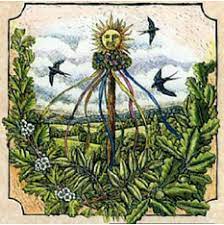
Beltane Activities and Correspondences
Guest Author – Leslie Ravenwing
Herbs – hawthorn, honeysuckle, St John’s wort, wood ruff, all flowers.
Colors- Green, Yellow, Pink, Blue
Foods – Strawberries, Cherries, Fruits, Salads, Wine
Goddesses – Aphrodite, Asherah, Belili, Brigid, Danu, Freya, Flora, Gwenhwyvar, Hina, Ishtar, Maia, Mary, Oiwyn, Oshun, Ostara, Sappha, Tonantzin, Vesta
Gods – Beltene, Cernunnous, Cupid/Eros, Manawyddan and Pan
Activities and Rituals
Fertilize, nurture and boost existing goals, games, activities of pleasure, leaping bonfires, making garlands, May Pole dance, planting seeds, walking one’s property, feasting
Stones/Gems – Emerald, malachite, amber, orange carnelian, sapphire, rose quartz
Other Names – Cetsamhain (opposite Samhain),May Day, Fairy Day,Sacred Thorn Day, Rood Day, Roodmas (the Christian term for Rood Day, Old Beltane, Beltaine, Beltain, Baltane, Walpurgis Night, Floriala (Roman feast of flowers from April 29 to May 1), Walpurgisnacht (Germanic-feast of St. Walpurga), Thrimilce (Anglo-saxon), Bloumaand (Old Dutch)
-Make paper baskets (use yarn as a handle) and place real or silk flowers in each basket. Hang them on door knobs of neighbors and family members but don’t let them know you did it!
-If you have children, make necklaces out of diasies and place them around their necks for the day to bring protection to them.
-Begin planting for the season.
-Create a MayPole and dance around it with your family or friends.
-Make a dish of fruits, berries, nuts and leave in the wood for the animals and fae folk to enjoy
– This is a night for bonfires, torch-lit processions and the high revelry of witches, preferably in high places. It is prime time for the Great Rite, a night (like Samhain) when the Goddess descends into women. Cailleach Beara (Cally Berry, Brighid’s crone aspect) turns to stone this night and does not to return until Samhain. Beltane Eve also marks the setting of the Pleiades
(One Person’s Viewpoint c 2015) Celebrating May Day – Beltane History
Celebrating May Day – Beltane History
The Fires of Tara:
Beltane kicks off the merry month of May, and has a long history. This fire festival is celebrated on May 1 with bonfires, Maypoles, dancing, and lots of good old fashioned sexual energy. The Celts honored the fertility of the gods with gifts and offerings, sometimes including animal or human sacrifice. Cattle were driven through the smoke of the balefires, and blessed with health and fertility for the coming year.
In Ireland, the fires of Tara were the first ones lit every year at Beltane, and all other fires were lit with a flame from Tara.
Roman Influences:
The Romans, always known for celebrating holidays in a big way, spent the first day of May paying tribute to their Lares, the gods of their household. They also celebrated the Floralia, or festival of flowers, which consisted of three days of unbridled sexual activity. Participants wore flowers in their hair (much like May Day celebrants later on), and there were plays, songs, and dances. At the end of the festivities, animals were set loose inside the Circus Maximus, and beans were scattered around to ensure fertility. The fire festival of Bona Dea was also celebrated on May 2nd.
A Pagan Martyr:
May 6 is the day of Eyvind Kelda, or Eyvind Kelve, in Norse celebrations. Eyvind Kelda was a Norwegian martyr who was tortured and drowned on the orders of King Olaf Tryggvason for refusing to give up his Pagan beliefs. A week later, Norwegians celebrate the Festival of the Midnight Sun, which pays tribute to the Norse sun goddess.
This festival marks the beginning of ten straight weeks without darkness.
The Greeks and Plynteria:
Also in May, the Greeks celebrated the Plynteria in honor of Athena, the goddess of wisdom and battle, and the patroness of the city of Athens (which was named after her). The Plynteria includes the ritual cleansing of Athena’s statue, along with feasting and prayers in the Parthenon. On the 24th, homage is paid to the Greek moon-goddess Artemis (goddess of the hunt and of wild animals). Artemis is a lunar goddess, equivalent to the Roman moon-goddess Diana – she is also identified with Luna, and Hecate.
The Green Man Emerges:
A number of pre-Christian figures are associated with the month of May, and subsequently Beltane. The entity known as the Green Man, strongly related to Cernunnos, is often found in the legends and lore of the British Isles, and is a masculine face covered in leaves and shrubbery. In some parts of England, a Green Man is carried through town in a wicker cage as the townsfolk welcome the beginning of summer. Impressions of the Green Man’s face can be found in the ornamentation of many of Europe’s older cathedrals, despite edicts from local bishops forbidding stonemasons from including such pagan imagery.
Jack-in-the-Green:
A related character is Jack-in-the-Green, a spirit of the greenwood. References to Jack appear in British literature back as far as the late sixteenth century. Sir James Frazer associates the figure with mummers and the celebration of the life force of trees. Jack-in-the-Green was seen even in the Victorian era, when he was associated with soot-faced chimney sweeps. At this time, Jack was framed in a structure of wicker and covered with leaves, and surrounded by Morris dancers. Some scholars suggest that Jack may have been a ancestor to the legend of Robin Hood.
Ancient Symbols, Modern Rites:
Today’s Pagans celebrate Beltane much like their ancestors did. A Beltane ritual usually involves lots of fertility symbols, including the obviously-phallic Maypole dance. The Maypole is a tall pole decorated with flowers and hanging ribbons, which are woven into intricate pattern by a group of dancers. Weaving in and out, the ribbons are eventually knotted together by the time the dancers reach the end.
In some Wiccan traditions, Beltane is a day in which the May Queen and the Queen of Winter battle one another for supremacy. In this rite, borrowed from practices on the Isle of Man, each queen has a band of supporters. On the morning of May 1, the two companies battle it out, ultimately trying to win victory for their queen. If the May Queen is captured by her enemies, she must be ransomed before her followers can get her back.
There are some who believe Beltane is a time for the faeries — the appearance of flowers around this time of year heralds the beginning of summer and shows us that the fae are hard at work. In early folklore, to enter the realm of faeries is a dangerous step — and yet the more helpful deeds of the fae should always be acknowledged and appreciated. If you believe in faeries, Beltane is a good time to leave out food and other treats for them in your garden or yard.
For many contemporary Pagans, Beltane is a time for planting and sowing of seeds — again, the fertility theme appears. The buds and flowers of early May bring to mind the endless cycle of birth, growth, death and rebirth that we see in the earth. Certain trees are associated with May Day, such as the Ash, Oak and Hawthorn. In Norse legend, the god Odin hung from an Ash tree for nine days, and it later became known as the World Tree, Yggdrasil.
If you’ve been wanting to bring abundance and fertility of any sort into your life — whether you’re looking to conceive a child, enjoy fruitfulness in your career or creative endeavors, or just see your garden bloom — Beltane is the perfect time for magical workings related to any type of prosperity.
Source: Article found on & owned by About.com Author: Patti Wigington
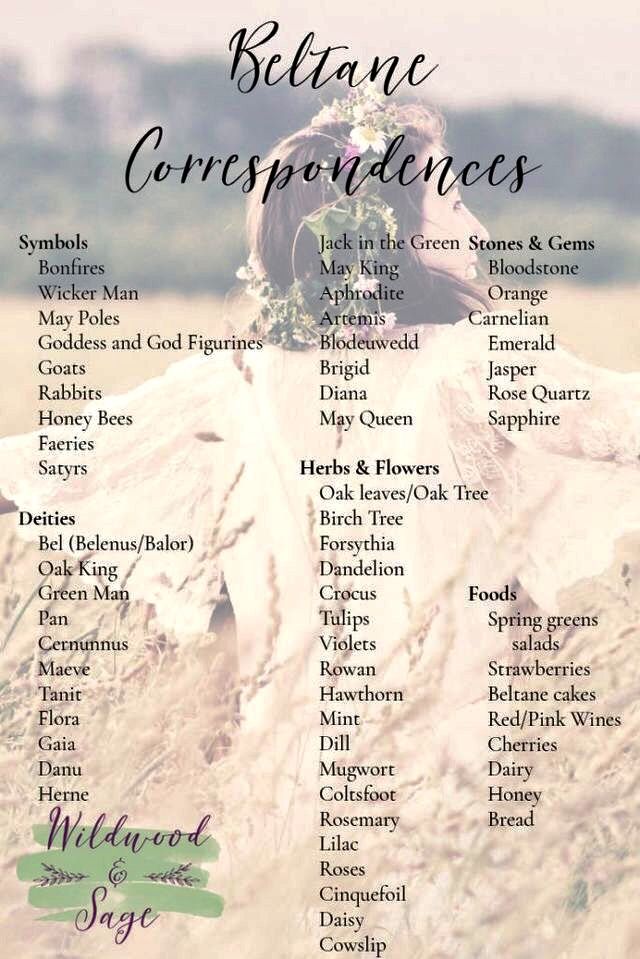
Beltane Correspondences
Spell For Beltane – Beltane Ritual-Solitary c.2015
(YOU CAN COPY AND PASTE ANY SPELLS POSTED TO A DOCUMENT TO PRINT AND/OR SAVE ON YOUR COMPUTER FOR PERSONAL USE ONLY)
A simple, fun and colorful ritual to enjoy
For this ritual one should dress brightly and strikingly, wearing flowers and greenery according to taste. A low altar should be built partially or entirely of stones at the middle of the ritual area.
What you will need:
Two candles should be placed on the altar, and the altar itself arranged as usual. (if the ritual is performed outdoors, the candles may be replaced be torches. These may be stuck in the ground on either side of the altar.)
Four candles or torches are placed before the altar to be lit later. A vertical pole about 3 feet in height is usualy erected on the far side of the altar: it should be decked with fruits, flowers, and bright ribbons. A half full cup of wine should be placed before the image of the Goddess.
Before dressing for the ceremony, take a ritual cleansing bath. When ready to go on with the rite, meditate for a while before going into the ritual area, thinking strongly on the old pagan ways and trying to imagine the rituals wich took place on this night in ages passed.
– Go alone to the ritual place. Kneeling before the altar, light the candles or torches on the altar, and the incense. Set alight the four candles before the altar and place them 3 or 5 feet from the altar at the North, then going deosil, saying:
“Here at this spot Do I create a place Sacred to the Gods of old. For a while, here and now Shall the ancient ways Live again”
– Take the wand and hold it out and salute toward the East, saying:
“Oh winds of the East Blow sweet and pure For the Lady reigns again!”
– Hold the wand out and salute toward the South, saying:
“Oh warmth of the South Bring forth life from the earth For the Lady reigns again!”
– Hold the wand out and salute toward the West, saying:
“Oh waters of the West Glisten clear and fresh For the Lady reigns again!”
– Hold the wand out and salute toward the North, saying:
“Oh lands of the North Grow rich and bounteous For the Lady reigns again!”
– Replace the wand and, holding the arms out over the altar, saying:
“Gracious and lovely Lady of the moon, Of joy and love, Protecteress of forests and wild things, This place is consecrated to Thee.”
-Take up the wine cup, holding it out at arm’s lenght, and pour out a few drops, saying:
” To the Great Ones of old And to the joyous times to come!”
-Drink some of the wine (or if you cannot drink alcohol, use an appropriate substitute).
– After a brief pause, rap three times on the altar with the wand saying:
“As woods and meadows flower forth I celebrate the ancient rite As the Ancients did before me. I cast the words into the mists Of time and space and otherwhere: Where one stays now, in years to come, May scores of others revel there. So may it be!”
– Rap once upon the altar. (More incense should be added now. Ad-lib additions are appropriate at this time…meditations, poetry …and the like.) (If a source of proper music is available, a solitary Dance of the Winds may be improvised.)
– Draw the Fertility talisman on the parchment, suffumigate it thrice, then, recite the supplication written on the back, …bow humbly and say:
“Friends of the nether worlds Now, come and assist us in our humble workings. Follow us to another sacred place of ours, And join your forces with ours, On this Fertilization Day.”
– Bury the talisman into the ground under an oak tree (if available), saying an ad-lib statement on the meaning of the talisman and its correspondances.Go back to the circle.
– When all is done, close by rapping four time with the wand, saying:
“Friends of the nether worlds Who have been about me for a while You may, with thanks, Return from whence you came.”
– Hold out arms and say:
“Blessed Lady of joy and laughter I thank Thee for Thy presence. May some of your love and power Remain with me. Blessed Be!”
– Put out the lights about the altar. As the two on the altar itself are darkened, say:
“This rite is ended…”
Note: Alter this ritual as needed to fit your circumstance. Note that many Beltane celebrations extend roughly one week past the May 1’st date, so any time in early May is appropriate to celebrate, in case you miss celebrating it on the May 1’st date.
Flashback 2004 Beltane
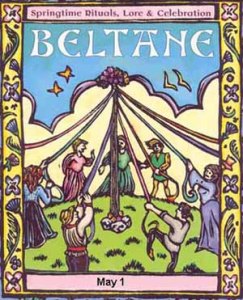
Beltane is he holiday that draws all witches outside to celebrate the returning power of the Sun and the fertility of the land.
Wear red robes for ritual and dress your altar with reds for passion. If you have identified a nearby rowan tree, you can make a wreath for your hair using rowan twigs. Decorate your house with freshly cut greens, herbs, and flowers. Arrange for music or drumming to lighten your steps of the dancers of the maypole or spiral dance. Lose yourself in the dance.
Fire is the honored element at this ritual, so have circle members jump a cauldron for purification and protection. Watr is another honored element: be certain to visit your local sacred spring or riverbank. Sprinkle perfume into the water for the undines. Again, leave a drop or two of milk and other food offerings for the nature spirits.
Wake before dawn on this day and watch the Sun rise over a river or beach. Gather a pitcherful where the Sun has gilded the water. When you return home, walk the bounds of your land, sprinkling water in your garden beds to ensure plenty of rainfall during the growing season.
By K. D. Spitzer in Llewellyn’s Witches’ Datebook 2004 Page 63
Blessed and Happy Beltane to Our Southern Hemisphere Family
From us in the Northern Hemisphere to our Brothers and Sisters in the Southern Hemisphere
Beltane Explained: How to Celebrate Beltane Like an Ancient Celt
Europeans have been putting on fiery May Day festivals for hundreds, and in some cases, thousands of years.
Whether it’s celebrating Sankt Walpurgisnacht (“Saint Walpurgis Night”) in Germany with bonfires, or celebrating Pálení čarodějnic (“burning of the witches”) in the Czech Republic with the burning of a twenty-five-foot-tall effigy of a witch, or even celebrating Easter in the Netherlands with some Paasvuren (“Easter fires”), these long-standing springtime traditions might all owe their existence to the Celtic cross-quarter day festival of Beltane.
Okay, fine, that’s a bit presumptuous. At the very least, Beltane likely influenced these celebrations, or at the very, very least, Beltane and Walpurgis Night and similar celebrations all share a common prehistoric (i.e., pre-Celtic, pre-Germanic) celebratory ancestor.
According to the World History Encyclopedia, Walpurgis Night, celebrated on the evening of April 30th, is derived from the “merging of the ancient pagan celebration of Beltane with the commemoration of the canonization of the Christian Saint Walpurga (l. c. 710 – c. 777 CE).”
The Encyclopedia goes on to note that the “ancient Celtic Sabbat (religious festival) of Beltane” had “merged with Germanic May Day” and was later Christianized sometime after 870 CE when Walpurga—a British-born Christian missionary and healer known for her ability to combat witchcraft—was canonized in Germany.
Meanwhile, in Ireland, the bishop of Cashel and king of Munster Cormac (d. 908 CE), was writing about Beltane in his eponymous glossary. Cormac claimed the festival of Beltane was named for the “lucky fire” or the “the two fires,” and he described how Irish pagans would drive cattle between two hillside bonfires in order to protect them from disease during their migration to summer pasturelands.
But look at me, getting ahead of myself here, like a bull charging between stacks of yet-to-be-lit firewood on an Irish hillside.
Before we explore all of the rituals associated with the ancient Celtic festival of Beltane, let’s cover the basics, starting with the definition and etymology of Beltane.
What is Beltane? (Definition and Etymology)…
Fertility Deities of Beltane c. 2017
Fertility Deities of Beltane
Beltane is a time of great fertility — for the earth itself, for animals, and of course for people as well. This season has been celebrated by cultures going back thousands of years, in a variety of ways, but nearly all shared the fertility aspect. Typically, this is a Sabbat to celebrate gods of the hunt or of the forest, and goddesses of passion and motherhood, as well as agricultural deities. Here are a list of gods and goddesses that can be honored as part of your tradition’s Beltane rituals.
Artemis (Greek): The moon goddess Artemis was associated with the hunt and was seen as a goddess of forests and hillsides. This pastoral connection made her a part of spring celebrations in later periods.
Bes (Egyptian): Worshiped in later dynasties, Bes was a household protection god, and watched over mothers and young children. He and his wife, Beset, were paired up in rituals to cure problems with infertility.
Bacchus (Roman): Considered the equivalent of Greek god Dionysus, Bacchus was the party god — grapes, wine, and general debauchery were his domain. In March each year, Roman women could attend secret ceremonies called the bacchanalia, and he is associated with sexual free-for-alls and fertility.
Cernunnos (Celtic): Cernunnos is a horned god found in Celtic mythology. He is connected with male animals, particularly the stag in rut, and this has led him to be associated with fertility and vegetation. Depictions of Cernunnos are found in many parts of the British Isles and western Europe. He is often portrayed with a beard and wild, shaggy hair — he is, after all, the lord of the forest.
Flora (Roman): This goddess of spring and flowers had her own festival, Floralia, which was celebrated every year between April 28 to May 3. Romans dressed in bright robes and floral wreaths, and attended theater performances and outdoor shows. Offerings of milk and honey were made to the goddess.
Hera (Greek): This goddess of marriage was the equivalent of the Roman Juno, and took it upon herself to bestow good tidings to new brides. A maiden about to marry could make offerings to Hera, in the hopes that she would bless the marriage with fertility. In her earliest forms, she appears to have been a nature goddess, who presides over wildlife and nurses the young animals which she holds in her arms.
Kokopelli (Hopi): This flute-playing, dancing spring god carries unborn children upon his own back, and then passes them out to fertile women. In the Hopi culture, he is part of rites that relate to marriage and childbearing, as well as the reproductive abilities of animals. Often portrayed with rams and stags, symbolic of his fertility, Kokopelli occasionally is seen with his consort, Kokopelmana.
Pan (Greek): This agricultural god watched over shepherds and their flocks. He was a rustic sort of god, spending lots of time roaming the woods and pastures, hunting and playing music on his flute. Pan is typically portrayed as having the hindquarters and horns of a goat, similar to a faun. Because of his connection to fields and the forest, he is often honored as a spring fertility god.
Priapus (Greek): This fairly minor rural god has one giant claim to fame — his permanently erect and enormous phallus. The son of Aphrodite by Dionysus (or possibly Zeus, depending on the source), Priapus was mostly worshiped in homes rather than in an organized cult. Despite his constant lust, most stories portray him as sexually frustrated, or even impotent. However, in agricultural areas he was still regarded as a god of fertility, and at one point he was considered a protective god, who threatened sexual violence against anyone — male or female — who transgressed the boundaries he guarded.
Sheela-na-Gig (Celtic): Although the Sheela-na-Gig is technically the name applied to the carvings of women with exaggerated vulvae that have been found in Ireland and England, there’s a theory that the carvings are representative of a lost pre-Christian goddess. Typically, the Sheela-na-Gig adorns buildings in areas of Ireland that were part of the Anglo-Norman conquests in the 12th century. She is shown as a homely woman with a giant yoni, which is spread wide to accept the seed of the male. Folkloric evidence indicates that the figures are theory that the figures were part of a fertility rite, similar to “birthing stones”, which were used to bring on conception.
Xochiquetzal (Aztec): This fertility goddess was associated with spring, and represented not only flowers but the fruits of life and abundance. She was also the patron goddess of prostitutes and craftsmen.
Source: Patti Wigington Published on ThoughtCo
Beltane – Spring is Here! Time to Get Your Gardens Ready
Welcome to springtime in the southern hemisphere. As the warmer weather comes a witches thoughts turns to sowing a garden. A garden can mean a different thing to each of us. For me it is getting my physical seeds ready for my veggie garden, to check to see if my herbs survived the winter or if I need to start new ones. Spiritually it means starting new seeds/paths for me to be able to grow to be closer to Mother Earth, the Universal energies, my students, and my teachers. To be able in the fall to reap full benefits of all that I have learned and put them into practice whether it is in my own personal life or helping my students with something. This year I need to plant new seeds and seedlings for all my flower gardens because early heavy rains in this part of the country washed away two inches of top soil in all my flower beds.
What does planting a garden mean to you? Do you plant flowers, vegetables, herbs, goals or a little of all of these or any combination? Remember whatever you plant will come to fruition with the right amount of love, watering (spiritually this can be communicating with each other in the pagan community or even be emailing me to say hi), sunshine (remember to thank the Sun God) and nurturing from within yourself (positive thoughts and affirmations) and from others in our community.
I would really LOVE to SEE COMMENTS on this post, please. Share with us your seeds and lets us help you grow them to their fullest potential!
Copyright 2017 Lady Beltane
Some of the Witchcraft/Magickal Correspondences and More for Beltane
THREE RITUALS FOR BELTANE
Beltane is a cross-quarter holiday on the Wheel of the Year that honors the return of summer, the return of the fertility of the Earth, and the element of fire. It’s a nature-based holiday that many of our ancestors celebrated for a long time, and now we get to carry that tradition forward.
Like Samhain, Beltane is a time when the veil is thin. This holiday is a particularly beautiful time to connect with nature spirits, as well as any other beings you’re wanting to create a connection with.
At Beltane, we honor the goddess as part of us. We honor the body, pleasure, sensuality, and sexuality. We bask in the fiery energy of the sun and the fertile energy that’s present.
In this blog, I’m sharing three rituals and suggested tools for Beltane that you can work with to honor this sacred holiday. Keep scrolling to watch a video and read more!
OPTIONAL RITUAL TOOLS FOR BELTANE
Feel free to add any of the symbols and tools outlined below to your Beltane rituals or altar. They each correspond with the energy of Beltane. They are not necessary and should be viewed as optional layered energy in your rituals.
Crystals: Rose quartz, garnet, pink tourmaline, rhodochrosite, emerald, malachite, and moonstone
Scents and plants: Sandalwood, ylang-ylang, lilac, angelica, jasmine, and rose
Candle colors: Pink, orange, and red
Element: Fire
Tarot: Empress
Rune: Berakno
Goddess: Venus/Freya
Tools and Symbols: Cowry shell, flowers, and anything that represents pleasure and creativity to you
PLEASURE RITUAL FOR BELTANE…
Click here to read the rest of the rituals from cassieuhl.com

Beltane Correspondences
From paganpages.org
Also known as: Bealtaine, Beltane, Bhealtainn, Bealtinne, Festival of Tana (Strega), Giamonios, Rudemass, and Walburga (Teutonic), Cetsamhain (opposite Samhain),Fairy Day,Sacred Thorn Day, Rood Day, Roodmas (the Christian term for Rood Day, Old Beltane, Beltain, Baltane, Walpurgis Night, Floriala (Roman feast of flowers from April 29 to May 1), Walpurgisnacht (Germanic-feast of St. Walpurga), Thrimilce (Anglo-saxon), Bloumaand (Old Dutch)
Date: May 1
Animals: Swallow, dove, swan, Cats, lynx, leopard
Deities: Flower Goddesses, Divine Couples, Deities of the Hunt, Aphrodite, artemis, Bast, Diana, Faunus, Flora, Maia, Pan, the Horned God, Venus, and all Gods and Goddesses who preside over fertility.
Tools: broom, May Pole, cauldron
Stones/Gems: emerald, malachite, amber, orange carnelian, sapphire, rose quartz
Colors: green, soft pink, blue, yellow, red, brown
Flowers & herbs: almond tree/shrub, ash, broom, cinquefoil, clover, Dittany of Crete, elder, foxglove, frankincense, honeysuckle, rowan, sorrel, hawthorn, ivy, lily of the valley, marigold, meadowsweet, mint, mugwort, thyme, woodruff may be burned; angelica, bluebells, daisy, hawthorn, ivy, lilac, primrose, and rose may be decorations, st. john’s wort, yarrow, basically all flowers.
Incense: frankincense, lilac, rose
Symbols & decorations: maypole, strings of beads or flowers, ribbons, spring flowers, fires, fertility, growing things, ploughs, cauldrons of flowers, butterchurn, baskets, eggs
Food: dairy, bread, cereals, oatmeal cakes, cherries, strawberries, wine, green salads
Activities & rituals: fertilize, nurture and boost existing goals, games, activities of pleasure, leaping bonfires, making garlands, May Pole dance, planting seeds, walking one’s property, feasting
Wiccan mythology: sexual union and/or marriage of the Goddess and God
It’s association with fire also makes Beltaine a holiday of purification.
Wiccan weddings are frequently held on or around Beltaine.
Beltane Foods to Bring to your Fire Festival
From PlentifulEarth.com
A beautiful, spring sun shines overhead on a beautiful Beltane morning, bringing blessings of warmth, love, and passion to every Witch present at the festival of Beltane. A bright fire burns in the distance, marking the celebration between Ostara and the Summer Solstice. The Green Man and Mother Earth each bless handfastings while dozens of Witches happily maypole dance to celebrate the fertility of this beautiful Sabbat.
45 minutes into the Beltane celebration, you think to yourself, “Is it time for the cakes and ale? I’m so ready for the feast! Oh! Hail and welcome!” We’ve literally all been there. Good news; food is a huge part of Wiccan and Pagan celebrations!
In this article, we’ll share the fruits, vegetables, meats, and foods that are best for a Beltane fire festival.
Beltane Recipes and Food Correspondences
Fruits
- Avocado
- Bananas
- Cacao (Chocolate)
- Cherries
- Figs
- Lemons
- Papayas
- Peaches
- Pineapples
- Strawberries
- Vanilla
Vegetables
- Asparagus
- Dandelion (any edible flowers)
- Garlic
- Ginger
- Jalapeno Peppers
- Lettuces
- Mint
- Radishes
- Rhubarb
- Serrano Peppers
- Truffles
Nuts
Herbs & Spices
- Honeysuckle
- Mint
- Nutmeg
- Smoked Paprika
- Thyme
Breads
- Banana Bread
- Bannock Bread
- Oatcakes
Cheeses
- Goat’s Cheese
Meats
- Beef
- Goat
- Rabbit
- Oysters
Drinks
- Ginger Ale
- Honeyed Wine
- Lemonaid
- Mead
- Milk
- Mugwort Tea
- Nettle Tea
- White Grape Juice
Toppings
- Chocolate Sauce
- Curry Sauces
- Honey
- Hot Sauce
- Olive Oil
Beltane Tarot Questions – Printable

A Very Happy and Blessed Beltane To All

For Your Viewing Pleasure – Beltane

Edinburgh’s Beltane Fire Festival celebrates the rebirth of summer with fire, dance and drumming c. 2017
Celtic festival of Beltane heats up in Scotland c. 2018
Printable Some Beltane Information

For Your Listening Pleasure – Beltane
Samhain Celebration Guide
To read more about celebrating Samhain please click on this link
From Plentiful Earth – Northern and Southern Hemispheres Samhain
Sweet Beltane
By Fawn Devi
Swirling around the maypole
Dancing to the drums
Celebrating sweet Beltane
Summer has begun
Mother earth breathes New life
Under the sun aglow
The marriage of the earth and sky
Fertility bestowed
Swirling around the maypole
Flowers in our hair
It’s the Goddess and the green man
& they’re blessed love affair
A Version of the History of Beltane
History of Beltane from beltanefire.com.au
The Beltane fire festival welcomes the abundance of the fertile earth and is celebrated with bonfires, Maypoles, burning of the Wickerman, dancing, and a feast, with its roots in European traditions, Beltane is observed by many of today’s Pagans and others as a time for performing rituals
The Celts divided the year into two main seasons. Winter, the beginning of the year fell on November 1 (Irish: Samain) and midyear and summer on May 1 (Irish: Beltaine), opposite for us here in the Southern Hemisphere.
These two junctures were thought to be critical periods when the bonds between the human and supernatural worlds were temporarily erased; on May Eve (southern hemisphere)…
 Witches Of The Craft®
You must be logged in to post a comment.