Let’s Talk Witch – Rune Magic

Egyptian Comments & GraphicsRune Magic

Rune magic or Magick is a Wiccan practice which involves using certain symbols and items when performing rituals or spells; they are most commonly used to create a physical charm which can be carried around with you. This section is designed to teach you the basics of rune magic and introduce you to the most common runes used as well as explain how to use them.

The first thing you need to understand about rune magic is that it is not simple, although it may look like it is just about drawing or making intricate symbols and sticking them to things it is actually more complex than that.

The runes themselves have very static meanings, this means they tend to be specific for one purpose or have only one meaning, this makes them ideal when casting specific spells such as good luck or protection but if you want anything more complex than that you will have to be very clear about the runes that you use, they are typically used in conjunction with other spells but can work great by themselves.
The list below will explain some of the most common runes, what they are used for and what they look like:

– Raido: Resembling the letter R, this rune is commonly used for safety in travel, trips or to help bring justice to a bad situation.

– Lagaz: Resembling the letter L, this is an especially popular rune for women due to the passion it can bring; it is also popular among students as it brings success and creativity to academic situation.

– Tir: Resembling the letter T, popular among men, just like Lagaz it promotes passion in males; it can also bring success over those competing against you.

– Sigel: Represented by an S and Z, this rune is used with those who have creative blocks or those who want to succeed, it is also used to bring strength to those who need it.

– Perdhro: Resembling the letter P, this rune is often used to help the caster find something that they thought was lost forever, to bring to light a situation that they were not aware of or to help them gain something of importance.

– Hagall: Resembling the letter H, this rune is often used by those who are in a situation in which they have no control and feel like they need a helping hand to make it through; it is also used to ward off unwanted interruptions.

-Othel: Represented by the letter O, this rune is often associated with protecting your most prized possessions, it is also used when wanting to inherit something from an elder, this doesn’t always refer to physical items, and it is often used to pass down traits through a bloodline.

– Uruz: Resembling the letters U and V, this rune is used commonly by those who are sick or know someone in need of healing, it promotes health and vitality, and it can also be used to boost the strength of your magic.

– Wunjo: Represented by a W and V, this rune is one of happiest runes out there, it promotes joy and success in every aspect of your life from your career to your love life.

– Algiz: Resembling the letter Z, this rune is particularly popular for good luck charms, personal development and to bring success.

Wicca Witch of the West: A Beginner’s Guide to Wicca, Spells, Herbs, Runes, and Rituals
Pamela Taylor


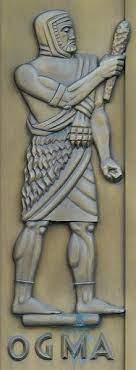
Gods – OgmaCeltic God c.2015


Ogma

Celtic God


In Irish-Celtic myth, Ogma is the god of eloquence and learning. He is the son of the goddess Danu and the god Dagda, and one of the foremost members of the Tuatha Dé Danann. He is the reputed inventor of the ancient Ogham alphabet which is used in the earliest Irish writings.

In the final battle at Mag Tuireadh he managed to take away the sword of the king of the Fomorians, but had to pay with his life for this feat. His Celtic equivalent is Ogmios.

Ogma or Oghma is a character from Irish mythology. A member of the Tuatha Dé Danann, he is often considered a deity and may be related to the Gaulish god Ogmios.

He fights in the first battle of Mag Tuired, when the Tuatha Dé take Ireland from the Fir Bolg. Under the reign of Bres, when the Tuatha Dé are reduced to servitude, Ogma is forced to carry firewood, but nonetheless is the only one of the Tuatha Dé who proves his athletic and martial prowess in contests before the king. When Bres is overthrown and Nuadu restored, Ogma is his champion. His position is threatened by the arrival of Lugh at the court, so Ogma challenges him by lifting and hurling a great flagstone, which normally required eighty oxen to move it, out of Tara, but Lugh answers the challenge by hurling it back. When Nuadu hands command of the Battle of Mag Tuired to Lugh, Ogma becomes Lugh’s champion, and promises to repel the Fomorian king, Indech, and his bodyguard, and to defeat a third of the enemy. During the battle he finds Orna, the sword of the Fomorian king Tethra, which recounts the deeds done with it when unsheathed. During the battle Ogma and Indech fall in single combat, although there is some confusion in the texts as in Cath Maige Tuired Ogma, Lugh and the Dagda pursue the Fomorians after the battle to recover the harp of Uaitne, the Dagda’s harper.

He often appears as a triad with Lugh and the Dagda, who are sometimes collectively known as the trí dée dána or three gods of skill, although that designation is elsewhere applied to other groups of characters. His father is Elatha and his mother is usually given as Ethliu, sometimes as Étaín. His sons include Delbaeth and Tuireann. He is said to have invented the Ogham alphabet, which is named after him.

Scholars of Celtic mythology have proposed that Ogma represents the vestiges of an ancient Celtic god. By virtue of his battle prowess and invention of Ogham, he is compared with Ogmios, a Gaulish deity associated with eloquence and equated with Herakles. J. A. MacCulloch compares Ogma’s epithet grianainech (sun-face) with Lucian’s description of the “smiling face” of Ogmios, and suggests Ogma’s position as champion of the Tuatha Dé Danann may derive “from the primitive custom of rousing the warriors’ emotions by eloquent speeches before a battle”, although this is hardly supported by the texts. Scholars such Rudolf Thurneysen and Anton van Hamel dispute any link between Ogma and Ogmios.

*
A Proto-Indo-European root *og-mo– ‘furrow, track, incised line’ may be the origin of the stem of the name. In addition, Proto-Celtic had a causative verbal suffix *-ej– ~ *-īj-. A hypothetical Proto-Celtic *Ogm-īj-o-sogm-. This agent noun would therefore mean ‘furrow-maker, incisor’ and may have had a metaphorical sense of ‘impresser.’ therefore looks very much like an agent noun derived from a verb formed by the addition of this causative suffix to the stem *

The Irish god of writing, eloquence and poetry. Ogma was credited of being inventor of the Celtic writing systems that the Druids used for their magic. These scripts were known as Ogham.

Ogma was the son of Dagda and the goddess Danu. Some other writers say that Ogma and Dagda were brothers; in this version they were the sons of Eithne. Ogma had also being called the son of Elatha, the king of the Fomorians.

Ogma was one the seven champions in the First Battle of Moytura (Mag Tuired), but when Bres became the king of Tuatha dé Danann, Ogma was degraded into working on humiliating manual job of gathering firewood.
When Lugh went to Nuada, asking for a place to serve the king, Ogma seemed to be Nuada’s foremost fighter. During the second battle of Moytura, Ogma had killed one of the Fomorian leaders, named Indech, the son of Domnu.

Ogma had married Etain, the daughter of Dian Cécht. Ogma had a son named Caipre. Some say that he was the father of MacCuill, MacCecht and MacGrené (MacGrene), the three Danann kings who ruled Ireland, during the Milesian invasion, though other say that Neit was their father.
To the Celtic Gauls he was called Ogmios. According to both Gallic and Irish myths Ogma was a warrior god, depicted as a wrinkled old man, wearing lion’s skin cloak, carrying a bow and club. The Romans considered Ogmios as the Celtic equivalent of Hercules (Greek Heracles). They also depicting Ogimos as holding people chained to his tongue by their ears, to indicate he was the god of eloquence and poetry.

Author: Agaliha

Woden – Help Me Read These Runes Aright…

Woden – Help Me Read These Runes Aright…

Author: RuneWolf   

I’ve been trolling the Internet lately looking for new information and/or viewpoints on the runes and, I must say, I’ve gathered more than a few resentments along the way.

Now, I am a steadfast believer in the sanctity of individual spiritual opinion, practice and experience, but I also believe that making things different doesn’t necessarily make them better, and that some things are best left in the original packaging, so to speak. (That’s one of the benefits of being a non-dualist – one can be a liberal AND a fundamentalist at the same time without ones head exploding…)

I also believe that if the Old Ways (i.e. the way things were done prior to about 1990) are to be preserved, someone has to speak up when the drift becomes a bit too drifty. And, yes, some of us have to be arrogant enough to think that we qualify for that position. At the very least, I hope that the Pagano-Heathen community can still agree to disagree, and that those of us who “pine for the Good Old Days” have at least as much right to speak up and say our piece as the innovators and pioneers.

(And now, a brief pause for the Politically Correct Disclaimer: What follows is not The Truth, nor the One Right And Only Way. It is simply what I have come to believe in as a result of research, study, practice and UPG [Unverifiable Personal Gnosis]. I believe in it strongly, and will both state and defend it passionately, but that does not mean that I think your way is wrong. Mine is just righter…)

For the sake of brevity, I will address three of the most heinous aberrations I see in “contemporary runelore”: the so-called “blank rune,” orientational interpretation of the runestaves and, for lack of a better term, the “New Aging” of the runelore. I will explain each of these categories more fully as I address them.

Before I do so, however, a bit needs to be said about the process of divination with the runes, in order for my arguments against these heresies to make sense. Since this topic itself cannot be easily covered in a book, let alone an essay, I must again be as succinct as I can be and still communicate the basic concepts.

First, let’s clarify a little terminology. What we commonly refer to as “runes,” (i.e. the little bits of wood, ceramics, metal or stone with the angular symbols on them) are more properly referred to as “runestaves.” “Rune” actually refers to the Mystery represented by each of those little angular symbols. However, to avoid needless confusion, I will acquiesce to popular usage, and refer to the staves as runes (small r), and the Mysteries as Runes (capitol R).

Divination with the runes is a lot like tracking earthquakes with a seismograph. What we are attempting to sense, through the agency of the runes, are the tremblings along the Web of Wyrd that may lead to one outcome or another, depending on other tremblings of the Web. A casting or spread of runes is a snapshot of the vibratory patterns of the Web at a particular point in space/time. While it is possible to hone a reading to a very precise degree, what one normally sees in runic divination is a rather broad picture of the current situation, and the many possibilities that could emerge in the as-yet-unmanifest future. One also needs to understand that, unlike Tarot, a runic divination is not necessarily relevant to the querent. One may indeed be the focus of a particular reading, in which case the reading will tend to resonate or make a great deal of sense. However, one may simply be caught up in an impersonal “Runic current,” in which case the reading may seem – at least at that moment – to be way off base.

There are many contemporary methods for casting or creating a rune reading, but many of these are borrowed from the Tarot tradition. How the runes were originally used is unclear, except that, from the lore, we know that several at a time were cast onto a cloth or other surface, and then interpreted.

With these admittedly broad strokes as our launch pad, let’s look at those “issues” I mentioned earlier.

The (Dreaded) Blank Rune:

There is no such thing.

That should put an end to it, but I know better by now.

To the best of my (admittedly limited) knowledge, the blank rune was first popularized by Ralph Blum in the ‘90s. It may have been around before but let’s be fair: before Blum’s book, precious few in mainstream American had ever heard of a rune, let alone a blank one. While I bitterly oppose Mr. Blum’s New Agey interpretations of the runes and his apparent attempt to combine them with the Tarot tradition, I have to give credit where credit is due: he did succeed in bringing the runes back into the popular consciousness and imagination, although the jury is still out on whether that is a good thing or a bad thing. While many Pagans and Heathens were and are scandalized and offended by his work, there are many writers of whom that can be said, so in all, I bear no great animosity toward the man and his work. I was first introduced to the runes through his book, though I was lucky enough to be set straight later on by my Elders and the Gods.

But I digress…

Since its introduction, the blank rune has come to symbolize many things, and has even been called (shudder!) Odin’s Rune. And while I can tolerate a lot of hooey, I have to draw the line right there. Ansuz is Odin’s Rune; period, end of discussion. If you don’t believe me, just ask Him…

Usually, the blank rune is said to represent the Great Mystery (as if the preceding twenty-four Mysteries weren’t great enough), which has always seemed a bit, well, lazy to me. It’s a convenient “back door” for those who divine themselves into a corner, and a good prop to point to when you haven’t a clue what the whole reading means, but still want to seem powerful and mysterious. In short, it’s a gimmick, and there is no place for gimmicks in serious runework.

The other manner in which I often see and hear the blank rune used is as the “significator” in a rune reading, i.e. a representation of the querent. This is pretty blatant plagiarism from the Tarot tradition and, again, has no place in runework. The Runes do not revolve around you, no matter how special you think you are – it is up to you to fit yourself into the patterns they may choose to reveal to you. If you really MUST have a “significator,” then let that be the first rune that you draw, and cast the others over/around it. But even then, remember that it is a metaphysical seismograph, and the tremors it is picking up may be so faint, so deep, that you see no possible connection to you or your present circumstances.

Orientational Interpretations:

By this I mean the interpretation of the runes according to whether they are “upright” or “reversed,” with upright interpretations being mostly “good,” and reversed mostly “bad.”

This is, again, a direct syncretism from the Tarot tradition, and is alien to the nature of the Runes. The primal cosmic forces that are the Runes cannot be subjected to dualistic reductionism and parsed into polarities of “good and bad,” “light and dark” and so on. The Runic forces are far too fundamental to the structure and function of the multiverse to be thought of in such limited terms. Each rune represents not merely the two obvious sides of a coin, but the edge also, and, for that matter, the very molecular structure of the coin that exists between the visible sides! Indeed, implicit in the very existence of the coin is all that the coin is not! And so it is with the Runes.

In studying and working with the runes, one comes to appreciate the true non-dualistic nature of reality, and to comprehend, however poorly, the vast and complex interweaving of weal and woe (“good” and “bad”) that is existence. This is not a Pollyanna attitude of “every cloud has a silver lining,” nor is it an entropic nihilism that sees all that is good, beautiful and true as ultimately ephemeral and therefore pointless. If anything, it has more in common with the worldview of philosophical Taoism than with any product of the Greco-Roman philosophers and their later European adherents. One recognizes that the ways of Wyrd are neither good nor bad, that they simply are what they are and one is free to accept them on their own terms, or categorize them in whichever pigeonhole one wishes. In the end, our labels and categorizations are swallowed up in the flow of the Runic currents.

If the Runes are then, in essence, shades of gray within shades of gray, how does one make sense of a rune casting? As the man once said, all things are relative, and it is in the relationship of each rune in the casting to every other rune that one intuits the influence, for weal or woe or both, of the individual Runic forces and the combinations thereof upon the matter in question. When one looks at the runes scattered in a casting, one is literally looking at patterns within patterns, and this is the true key to effective runic divination.

The “New Aging” of the Runes:

Here I refer to the association or “correspondence” of each Rune to such things as astrological signs and alchemical symbols, herbs, trees, stones, gems, crystals and such like. While it is true that, in some of the ancient rune poems and rhymes, various runes are associated with various phenomena of the natural world, such as trees, stars, hail, the sea, ice, etc., there is no precedence for assigning each rune a correspondence or association in each such category. The associations that exist seem to be made based upon the nature of the rune itself and the associated phenomenon, and there appears to be no meta-pattern on which to base a systematic matrix. Unfortunately, as with orientational interpretation, this practice has been promulgated by otherwise impeccable Runic scholars, and has therefore fallen into more or less common acceptance. Personally, I find the whole concept to be a bit too neat, tidy and structured to apply authentically to the primal, fractal essence of the Runes. The Runes are the ultimate “patternless patterns,” and by their very nature defy such systematization.

In the end, as with all esoteric studies, one must find ones own way to ones own Truth, and I would be the last to attempt to dissuade anyone from pursuing their own wyrd. The Runes will reveal themselves to you as they will, but I urge you to resist the temptation to try to fit them into a neat little cookie-cutter grid of meanings and associations. But neither can we let our understanding of them become ossified. I simply suggest that working with these most profound of Mysteries is adventure enough for one lifetime. We do not need to clutter our work with gimmicks and gewgaws from other paths and traditions.

Making Your Own Witches Runes

The following article calls for making clay Runes. Personally, I have never made a set of Runes out of clay. I prefer to use wood. Wood that has fallen from a tree. I know everyone know how to ask a tree for a limb or permission to cut one (so I won’t go into that). Be sure to double check the type of wood you want to use. I prefer to use Oak. I have a Willow tree out from I want to make a set from but the branches are not big enough yet.

Runes can be made out of clay, wood, or stones. What is important is that you made them. They will have a magickal bond only with you. It will be a bond like you have never experienced before.

Oh, one last thing, I didn’t write this article. In fact, I don’t know who did. I found it in the back on our site and pulled it from there.  Like I said finding info on the Witches Runes is extremely difficult.

Now for the article……….


How To Make Your Own Runes

You’ve probably seen the pre-made Runes that one can buy at any occult store or your local book store. That is the easy way of getting your own runes. The traditional way is to get small stones/pebbles and use them with the runic symbol carved or inked onto the stone/pebble. Another is to use bits of wood and cut them into the desired shape, then ink or carve the runic symbol. However, my favorite method is to go to the bluffs and gather up bags of natural clay and use this clay to form my runes and other tools. You can also use clay brought at a craft store it’s almost as good.

Making Clay Runes

Materials Needed:

Clay (red, natural, or artificial)

Pen/Pencil

Knife

Cloth or Leather

Once you’ve gotten the clay, take the time to mold the clay into the form you wish your runes to look, then leave them in the shade for 5 to 8 hours. I know you’re saying, why this? Well I can’t tell you, I’ve no idea, this is what my grandmother did and have been done for generations.

When you return the clay should be still slightly damp but not so damp that is falls apart or is mushy, it should be almost hard at the outer edges, with the center still a big pliable. The center is where you will be carving the runic symbol.

Now take a clay tablet that you’ve molded, and using either a pen, pencil, or knife carve into the tablet the specific rune that is to be, remember to think of what this rune will represent and infuse it with that form of energy, e.g: When carving the runic symbol for protection, envision it being strong, and guarding you against harm, and so on and so forth.

Once each tablet has been carved with it’s symbol, leave it to dry either so forth.

Once each tablet has been carved with it’s symbol, leave it to dry either any people lke the natural look, but when reading the runes often inking them in is advisable. My Grandmother actually use to make natural dyes from flowers, berries, bark, herbs, and other natural dying agents. She would dye each rune a different color according to it’s usage, like green for health, purple for power, yellow for light, and inner strength, and various other colors. I only suggest the Black or Red marker as simple way of marking your runes to read. You can of course use different colored markers to mark each rune, according to it’s color orientation or purpose, the choice is up to you.

The last step is to construct a pouch to which you will keep these runes, use either leather or cloth to construct this pouch. Remember Natural un-dyed leather or cloth is best, if using synthetic materials then use your own judgment. If in doubt, get a scarf/bandana and use that as the carrying bag for your runes.

That’s all there is to it basically.

Happy Rune Making!

*Remember if you decide to use stones or wood, just substitute those in the place of clay*

Lots of Astrampsychsu

Lots of Astrampsychsu


Lots of Astrampsychsu was a divinatory system probably devised in the second or third century CE and attributed to an alleged Astrampsychus the Magician. The system was popular in late Roman and early medieval times. The Lots began with ninety-two questions, the querent chooses one, and then randomly picks a number between one and ten. The chosen number is then added to the number of the question, and the sum is looked up in a table of oracular gods (in the Pagan version of the Lots) or Christian saints (in the Christian version). Each god or saint has a table of ten answers, and the randomly chosen number is used to select the correct answer.

The basic structure of the Lots resembles that of Napoleon’s Book of Fate, although the latter also draws on the divinatory art of geomancy.

Alectromancy (or Alectryomancy)

Alectromancy (or Alectryomancy)


An ancient divinatory for that utilized a cock. When practicing this divination a circle which was divided into as many parts as there were in the alphabet was drawn in a closed place. Then a wheat-corn was placed in each section beginning with the first letter, or A. Whoever placed the corn must recite a certain incantation while doing it. The time for this divination is when the sun or moon is in Aries or Leo.


The cock must be young and white. When his claws are cut off he is forced to swallow both of them together with a small roll of parchment made of lambskin upon which have been previously written words. Now the diviner holding the cock must repeat a certain incantation or conjuration. Next, when putting the cock with the circle, he must recite two verses of the Psalms, which are exactly the midmost of the seventy-two verses in the entry on Onimancy, and it should be noted on the authority of an ancient Rabbi that there is not anything within these seventy-two verses which is not of some use within
Kabbalism.


The cock, being in the circle, is observed to see from which of the letters he peck the grains, and upon these others must be quickly placed because frequently some words often contain the same letter two or three times. The letters should be written down and assembled, for they will infallibly reveal the name of the person concerning whom the inquiry was made.


A story of doubt concerns the magician Iamblicus who used this divination to discover the successor of Valens Caesar in the Roman Empire. . However, the bird just pecked four grains that spelled “T h e o.” This left a great uncertainty. The letters could stand for “Theodosius,” “Theodotus,” “Theodorus,” or “Theodectes.” When Valens heard of this divination he had several persons murdered whose names began with these letters. The magician to escape his known fate drank a draught of poison.
This form of divination resembles the use of a planchette or ouija board.
Another form of Alectromacy is sometimes practiced when a cock crows or is heard crowing.


Another version of the above divinatory incident was related by Ammanius Marcellinus in the fourth century AD. In this version the ritual is described somewhat differently. Sorcerers begun by placing a basin made of different metals on the ground and drawing around it at equal distances the letters of the alphabet. Then the sorcerer possessing the deepest occult knowledge would come forth, enveloped in a long veil, holding in his hands branches of vervain, and letting forth dreadful cries which were accompanied by hideous convulsions. Eventually, almost immediately, he would stop before the basin where he became rigid and motionless. He, then, struck with the branch in his hand upon a letter several times, and then proceeded doing likewise on other letters until the sufficient amount was selected to form a heroic verse which was then given out to the assembly.


Wnen the Emperor Valens was informed of this divinatory ritual, he was so appalled that the infernal powers had been consulted concerning his destiny that he ordered that not only the sorcerers but all the philosophers in Rome be severely punished that many lost their lives.


Details of the performance of Alectryomancy are exactly and curiously described in the fourth song of the Caquet Bonbec, written by the 14th century poet Jonquieres.

Let’s Talk Witch – Runes, What Are They? Do You Use Them?

bc1674d6d4a2c6d0233ebefb12dd491d

Let’s Talk Witch – Runes, What Are They? Do You Use Them?

Norse mythology tells ua about the God Odin (or Woden) brought the Runes to human beings. Used for two thousand years in Northern Europe and Scandinavia, the Runes were brought to the British Isles by Vikings and Saxon invaders. Centuries later, J. R. R. Tolkien’s trilogy The Lord of the Rings introduced many readers in the United States to the Runes and Ralph Blum’s bestselling Book of Runes taught them how to use the oracle.

The word “rune” means “secret” or “mystery.” It also refers to things that are whispered, to knowledge that’s revealed to us during moments of stillness and contemplation, which suggests that meditating on the Runes can help you understand their meanings.

The most popular version of the Runes come from an old Teutonic alphabet, the Elder Futhark, which contains twenty-four letters. Each rune is a letter. Unlike the letters in modern alphabets, however, these ancient glyphs aren’t just components of words, they convey deeper meaning as well.

Each rune is name for an animal, object, condition, or deity. The rune Berkana, which looks like a B, corresponds to the birch tree; it represents birth and growth. Ehwaz refers to a horse and signifies movement or progress.

Although most people think of the runes only in terms of the letters in one of the old Norse alphabets, other alphabets can be used for divination and spell working too. One such alphabet is Ogham, the Irish language that links each letter with a tree.

Just as the ancient Norse did, you can include runes in amulets and talismans for love, protection, health, prosperity, and other blessings. You might like to decorate your magickal tools with relevant runes. Or engrave a meaningful rune on a piece of jewelry and wear it to attract what you desire.

Perhaps the most familiar rune is Gifu, which means “gift.” It looks like an “X” a popular symbol for a kiss. In the old Norse alphabet, this rune is linked with love, so it’s perfect to include in love spells. Draw a X on paper and add it to a talisman, along with rose petals and other ingredients that correspond to love and romance. Or carve Gifu on a candle and light it; as the candle burns, it releases your intention into the universe.

Gardnerian Traditional Witchcraft –B.14. Skyclad (1953) c.2013

Gardnerian Traditional Witchcraft –B.14. Skyclad (1953)

B.14. Skyclad (1953)
It is important to work naked from the start, so it becometh as second nature, and no thought of “I have no clothes” shall ever intrude and take your attention from the work.  Also, your skin being so accustomed to unconfinement, when power is given off the flow is more easy and regular.  Also, when dancing you are free and unconfined. . . .
And the greatest of all, the touch of the body of your beloved thrills your inmost soul, and so your body gives out its utmost power; and then it is most important of all that there is not the slightest thing to divert the attention, for then the mind must seize and mold the power generated, and redirect it to the desired end with all the force and frenzy of the imagination.
It has been said that no real knowledge may be gained our way, that our practices are such that they can only lead to lust; but this is not really so.  Our aim is to gain the inner sight, and we do it the most natural and easy way.  Our opponents’ aim is ever to prevent man and woman from loving, thinking that everything that helps or even permits them to love is wicked and vile.  To us it is natural, and if it aids the Great Work it is good.
‘Tis true that a couple burning with a frenzy for knowledge may go straight to their goal, but the average couple have not this fire.  We show them the way, our system of props and aids (i.e., magic ritual).  A couple working with nothing but lust will never attain in any case; but a couple who love each other dearly should already be sleeping together, and the first frenzy of love will have passed, and their souls will already be in sympathy.  If the first time or two they do stay a while to worship Aphrodite, ’tis only a day or two lost, and the intense pleasure they obtain only leads them again to the mysteries of Hermes, their souls more attuned to the great search.  Once they have pierced the veil they will not look back.
This rite may be used as the greatest of magics if it be done with both partners firmly fixing their minds on the object and not thinking of sex at all.  That is, you must so firmly fix your mind on your object that sex and all else are naught.  You inflame your will to such an extent that you may create a strain on the astral such that events happen.


The Effects the Full Moon Has On Us

Good Blessed Monday Morning, My Dear Friends!

Good Monday Morning, my dear friends! How are you doing today? I hope your day is off to a good start. Ain’t the little guy in the pic cute as a bug? I love animals and can’t pass up pics of them.

I am at home and it is 2:00 in the morning. Ah, the peace and quiet, Ah, the pain. I laid down and my stitches in my arm woke me up hurting. I took a couple of pain pills and got bored waiting for them to kick in, lol! So dummy got on the computer. Smart, arm hurting, why not type? I am not the brightest light bulb in the pack, lol! Hey, maybe those pills are kicking in. I am getting goofy, well more goofier than usual.

I am going to run and get busy before this conversation gets totally out of hand, lol! I hope you are enjoying the split zone horoscopes. I also hope you noticed the top menu. No more digging for your dailies, just click U. S. or other zone and everything is right there. I figured that would be simpler for everyone, you won’t have to dig and hunt for your date’s horoscopes, tarot, runes, etc. Everything is right there at your fingertips. See I try to make your life as easy as possible. Easier on me too, lol! Well I am off and running now….

Have a super Monday and a fantastic week!

Luv & Hugs,

Lady A

More Monday Comments

Your Rune for September 16 is Uruz


Your Rune For Today

Uruz       

Uruz is the Rune of harmony, order and inner strength. Often it marks endings and beginnings of periods in our lives. Uruz  also symbolizes your ability to tackle new challenges by confronting them with the powers that lie within you. Opportunities probably abound for you right now.

Your Rune For September 8 is Uruz


                          Your Rune For Today

Uruz

Uruz is the Rune of harmony, order and inner strength. Often it marks endings and beginnings of periods in our lives. Uruz  also symbolizes your ability to tackle new challenges by confronting them with the powers that lie within you. Opportunities probably abound for you right now.

Your Rune For September 7 is Naudhiz


Your Rune For Today

Naudhiz        

Naudhiz may foretell needs unmet and friction in relationships. You may be in a time where you should be very careful in whatever endeavor you take on. Also it may be that you are about to learn some of life’s hard lessons and come out the other side of this period a stronger being.

Your Rune for August 20 is Uruz


Your Rune For Today

Uruz       

Uruz is the Rune of harmony, order and inner strength. Often it marks endings and beginnings of periods in our lives. Uruz  also symbolizes your ability to tackle new challenges by confronting them with the powers that lie within you. Opportunities probably abound for you right now.