
Tag: Ostara/Spring Equniox
Let’s Have Some Fun – Beltane

Beltane Activities and Correspondences c. 2016
Beltane Activities and Correspondences
Guest Author – Leslie Ravenwing
Herbs – hawthorn, honeysuckle, St John’s wort, wood ruff, all flowers.
Colors- Green, Yellow, Pink, Blue
Foods – Strawberries, Cherries, Fruits, Salads, Wine
Goddesses – Aphrodite, Asherah, Belili, Brigid, Danu, Freya, Flora, Gwenhwyvar, Hina, Ishtar, Maia, Mary, Oiwyn, Oshun, Ostara, Sappha, Tonantzin, Vesta
Gods – Beltene, Cernunnous, Cupid/Eros, Manawyddan and Pan
Activities and Rituals
Fertilize, nurture and boost existing goals, games, activities of pleasure, leaping bonfires, making garlands, May Pole dance, planting seeds, walking one’s property, feasting
Stones/Gems – Emerald, malachite, amber, orange carnelian, sapphire, rose quartz
Other Names – Cetsamhain (opposite Samhain),May Day, Fairy Day,Sacred Thorn Day, Rood Day, Roodmas (the Christian term for Rood Day, Old Beltane, Beltaine, Beltain, Baltane, Walpurgis Night, Floriala (Roman feast of flowers from April 29 to May 1), Walpurgisnacht (Germanic-feast of St. Walpurga), Thrimilce (Anglo-saxon), Bloumaand (Old Dutch)
-Make paper baskets (use yarn as a handle) and place real or silk flowers in each basket. Hang them on door knobs of neighbors and family members but don’t let them know you did it!
-If you have children, make necklaces out of diasies and place them around their necks for the day to bring protection to them.
-Begin planting for the season.
-Create a MayPole and dance around it with your family or friends.
-Make a dish of fruits, berries, nuts and leave in the wood for the animals and fae folk to enjoy
– This is a night for bonfires, torch-lit processions and the high revelry of witches, preferably in high places. It is prime time for the Great Rite, a night (like Samhain) when the Goddess descends into women. Cailleach Beara (Cally Berry, Brighid’s crone aspect) turns to stone this night and does not to return until Samhain. Beltane Eve also marks the setting of the Pleiades
Let’s Have Some Fun – Samhain
Samhain (Sow-en) – The Celtic roots of Halloween
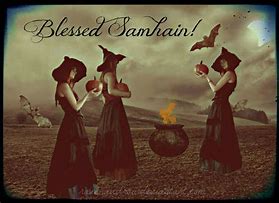
As millions of children and adults participate in the fun of Halloween on the night of October 31st, few will be aware of its ancient Celtic roots in the Samhain (Samain) festival. In Celtic Ireland about 2,000 years ago, Samhain was the division of the year between the lighter half (summer) and the darker half (winter). At Samhain the division between this world and the otherworld was at its thinnest, allowing spirits to pass through.
The family’s ancestors were honoured and invited home whilst harmful spirits were warded off. People wore costumes and masks to disguise themselves as harmful spirits and thus avoid harm. Bonfires and food played a large part in the festivities. The bones of slaughtered livestock were cast into a communal fire, household fires were extinguished and started again from the bonfire. Food was prepared for the living and the dead, food for the ancestors who were in no position it eat it, was ritually shared with the less well off.
Christianity incorporated the honouring of the dead into the Christian calendar with All Saints (All Hallows) on November 1st, followed by All Souls on November 2nd. The wearing of costumes and masks to ward off harmful spirits survived as Halloween customs. The Irish emigrated to America in great numbers during the 19th century especially around the time of famine in Ireland during the 1840’s. The Irish carried their Halloween traditions to America, where today it is one of the major holidays of the year. Through time other traditions have blended into Halloween, for example the American harvest time tradition of carving pumpkins.
Two hills in the Boyne Valley were associated with Samhain in Celtic Ireland, Tlachtga and Tara. Tlachtga was the location of the Great Fire Festival which begun on the eve of Samhain (Halloween). Tara was also associated with Samhain, however it was secondary to Tlachtga in this respect.
The entrance passage to the Mound of the Hostages on the Hill of Tara is aligned with the rising sun around Samhain. The Mound of the Hostages is…
Flashback 2004 Beltane
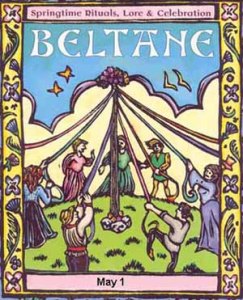
Beltane is he holiday that draws all witches outside to celebrate the returning power of the Sun and the fertility of the land.
Wear red robes for ritual and dress your altar with reds for passion. If you have identified a nearby rowan tree, you can make a wreath for your hair using rowan twigs. Decorate your house with freshly cut greens, herbs, and flowers. Arrange for music or drumming to lighten your steps of the dancers of the maypole or spiral dance. Lose yourself in the dance.
Fire is the honored element at this ritual, so have circle members jump a cauldron for purification and protection. Watr is another honored element: be certain to visit your local sacred spring or riverbank. Sprinkle perfume into the water for the undines. Again, leave a drop or two of milk and other food offerings for the nature spirits.
Wake before dawn on this day and watch the Sun rise over a river or beach. Gather a pitcherful where the Sun has gilded the water. When you return home, walk the bounds of your land, sprinkling water in your garden beds to ensure plenty of rainfall during the growing season.
By K. D. Spitzer in Llewellyn’s Witches’ Datebook 2004 Page 63
The Spiritual Meaning of Mabon

Let’s Have Some Fun – Printable Mabon Coloring Pages


Imbolc marks the Irish pagan start of spring – something is stirring
As the great wheel turns, we find ourselves slowly re-emerging from the deep dreamtime of winter into the portal of Imbolc.
Flashback 2002 Lammas
Lammas is the first of the harvest festivals and this year despite the fiery Sun, it has a strong, sensual feel of cardinal earth. Mars lends a masculine energy to the Sun this week to help with the organizing for this bread festival. Round cornbread as a solar disk is an apt and easy choice for the altar, but if you plan several days ahead, you can sprout a small amount (1/4 cup) of wheat or barely for kitchen witchery. Add this to your other grains to your own bread from scratch; or buy frozen bread dough, thaw, pat into a rectangle, and sprinkle the sprouted grains. Roll up your dough like a jelly roll and place in a greased bread pan into which you have sprinkled Irish oats. You can use a sharp knife to crave goddess symbols into the loaf before baking.
©️ By K. D. Spitzer Llewellyn’s Witches’ Datebook 2002 Page 93
Flashback 2002 Imbolc
Imbolc is an important day of purification and initiation; on the Sun’s day, February 2, the energies are very airy. This Sabbat is a good day for coven work, with an emotionally detached masculine Moon and Sun on the Sun’s day.
Dress yourself and your altar in white, while serving white beverages or any dairy food to honor the calving season. Spread the top of a one-pound round Camembert or Bire cheese with raspberry preserves. Cut a circle of puff pastry large enough to cover the cheese, wrap it, tucking the ends of the pastry under. Use scraps to decorate the top with goddess symbols. Brush with beaten egg yolk. Bake at 425 degrees until golden, and serve hot and melting on crackers. During this ritual, bless and dedicate all candles you will need for other ritual work throughout the year. A good way to start the ceremony is to light candles in the darkened room with chanting to encourage the lengthening days.
©️ By K. D. Spitzer Llewellyn’s Witches’ Datebook 2002 Page 41
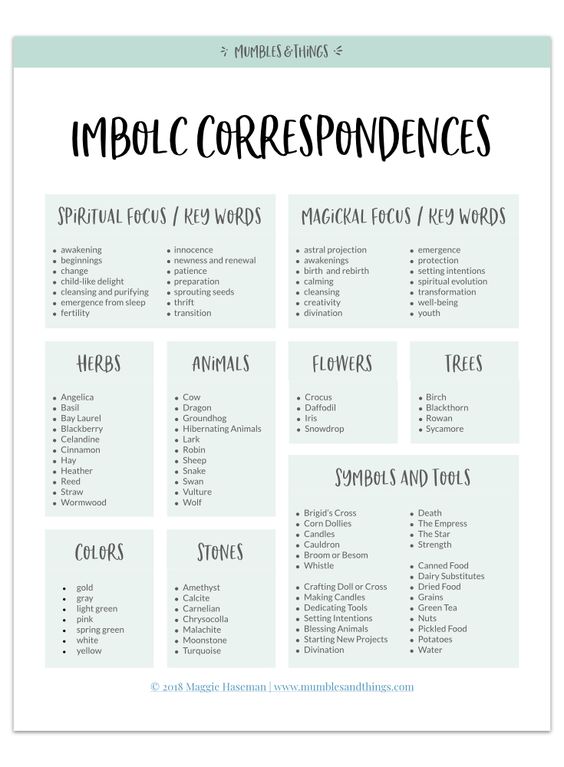
Some of the Witchcraft/Magickal Correspondence for Imbolc
(YOU CAN COPY AND PASTE ANY CORRESPONDENCES POSTED TO A DOCUMENT TO PRINT AND/OR SAVE ON YOUR COMPUTER)
Flashback 2022 – Lughnasadh/Lammas
Lughnasadh Bone Charm
Lughnasadh falls opposite of Imbolc on the Wheel of the Year. While Imbolc is widely considered a sabbat of the divine feminine, many consider Lughnasadh a celebration of the divine masculine. Being the first of three harvest festivals, we can mark the occasion with plentiful gratitude for not only the flora and fauna that feeds us physically on a daily basis, but also gratitude for the fact that the harvest allows us to survive and thrive, thereby increasing our positive spiritual influence in the world.
Simply acquire any bones to which your intuition leads. Yes, humanely and sustainably sourced chicken or cow bones are okay! Ensure that the bones are dry, and use a permanent marker to draw symbols and words related to the harvest, satisfaction, and sustenance onto them. Consider tying stalks of wheat or any grain to the bones once you are finished decorating. Hang these in your home (especially inside or outside the front door) to encourage a plentiful life and to honor the earth now and forever.
Raven Digitals Llewellyn’s Witches’ Datebook 2022 Page 107
Imbolc Lore and Rituals
Celebrating the Seasons by Selena Fox
Imbolc, also known as Candlemas and Groundhog’s Day, occurs at the beginning of February. It marks the middle of Winter and holds the promise of Spring. The Goddess manifests as the Maiden and Brigid. The Groundhog is a manifestation of the God. Colors are White, and sometimes Red. It is a festival of spiritual purification and dedication.
Thoroughly clean your altar and/or temple room. Do a self purification rite with Elemental tools — cleanse your body with salt (Earth), your thoughts with incense (Air), your will with a candle flame (Fire), your emotions with water (Water), and your spiritual body with a healing crystal (Spirit). Bless candles that you will be using for rituals throughout the year. Invoke Brigid for creative inspiration. Take a Nature walk and look for the first signs of Spring. Reflect upon/reaffirm spiritual vows and commitments you have made.
Resources
- Nineteen Ways to Celebrate Imbolc by Selena Fox
- Imbolc Customs and Lore by Selena Fox
- Litany of the Five Elements by Selena Fox
- Brigid Chants by Selena Fox
- Brigid Healing Ritual by Selena Fox
Click here to read the rest of this article about Imbolc from www.circlesanctuary.org
Let’s Have Some Fun – 9 Summer Solstice Crafts & Recipes for a Magical Litha
Source: moodymoons.com
Foraged Fairy Ladder/Trellis
It’s the season of fairies, and nothing delights the inner child more than playing with the woodland spirits.
This one is so easy, it’s almost self-explanatory.
Literally: Glue some sticks together. Yup. That’s it. I used hot glue for the one above.
If you want to get fancy, add little bits of (affiliate link —–>) sheet moss to get that aged-in-the-garden feel.
You can even train roses or herbs to grow on it.
Contents
The Magical History Of Yule, The Pagan Winter Solstice Celebration
On December 21 (or 22nd some years) we encounter the longest night of the year and the shortest day of the year. After that, the days grow longer until the Summer solstice. In various spiritual and pagan traditions, this seasonal cross-quarter is also known as Yule and is celebrated as a holiday.
In modern times, we typically celebrate Christmas, but long, long ago, Yule was celebrated by the Ancient Celts and various other Pagan religions. Perhaps one of the oldest winter celebrations in the entire world, ancient hunters and gatherers would mark their years based on the different seasons. And each seasonal cross-quarter, including the equinoxes and solstices, was thought to have spiritual significance.
According to Almanac.com, Yule comes from the old English word ‘Geol’ which is the equivalent of the old Norse word, jol. Both of which referred to the winter festivals that took place in celebration of the halfway point of winter.
Long before Christianity, the Ancient Celts and ancient British pagans would celebrate Yule, but when Christianity and…
Click here to read the rest of this article
Celebrating Litha, the Summer Solstice The Midsummer Sabbat: Celebrate the Power of the Sun!
Depending on your individual spiritual path, there are many different ways you can celebrate Litha, but the focus is nearly always on celebrating the power of the sun. It’s the time of year when the crops are growing heartily and the earth has warmed up. We can spend long sunny afternoons enjoying the outdoors, and getting back to nature under the long daylight hours.
Are you headed to the beach this summer? Take advantage of all of the magic it has to offer, with Seven Ways to Use Beach Magic. If you have little Pagans in your family, you can get them involved in the festivities too, with these 5 Fun Ways to Celebrate Litha with Kids. Finally, if you’re not sure how to get started celebrating Litha, try these Ten Great Ways to Celebrate Litha.
Traditions, Folklore and Customs
Interested in learning about some of the history behind Litha? Here’s some background on Midsummer celebrations—learn who the gods and goddesses of summer are, how they’ve been honored throughout the centuries, and about the magic of stone circles! Let’s start with a quick look at the history behind the celebrations of the summer solstice, as well as some of the customs and traditions of Litha.
There’s a ton of solar magic and myths and legends out there, and many cultures have worshiped the sun as part of religious practice throughout time. In Native American spirituality, the Sun Dance is an important part of ritual.
The summer solstice is also associated with festivals such as the Vestalia, in ancient Rome, and with ancient structures like the stone circles found all over the world.
Handfasting Season is Here
June is a traditional time for weddings, but if you’re Pagan or Wiccan, a Handfasting ceremony may be more appropriate. Find out the origins of this custom, how you can have a fantastic ceremony, selecting a cake, and some great ideas on gifts for your guests!
In a historical context, handfasting is an old tradition that has seen a resurgence in popularity lately. There are plenty of ways to have a magical ceremony that celebrates your spirituality as part of your special day. You may even want to invite some of the deities of love and marriage to be part of your ceremony!
If you’re not sure about how to have a handfasting, make sure you’ve got someone who is legally able to perform it, especially if you’re looking for a state-licensed marriage. You can use a basic handfasting ceremony template as a structure for your ceremony, and you might want to consider a Pagan-friendly custom like broom-jumping as part of your celebration.
Don’t forget, you’ll need a cake! Keep a few simple tips in mind when you’re selecting your handfasting cake.
Crafts and Creations
As Litha approaches, you can decorate your home (and keep your kids entertained) with a number of easy craft projects. Celebrate the sun’s energy with an elemental garden, a fiery incense blend, and a magic staff to use in ritual! You can make magical items as well, like a set of Ogham staves for some summer divination. Want to keep your home decor simple? Whip up a Litha blessing besom to hang on your door as a welcome to your summer guests.
Feasting and Food
No Pagan celebration is complete without a meal to go along with it. For Litha, celebrate with foods that honor the fire and energy of the sun, and a tasty batch of Midsummer mead.
Fertility Deities of Beltane c. 2017
Fertility Deities of Beltane
Beltane is a time of great fertility — for the earth itself, for animals, and of course for people as well. This season has been celebrated by cultures going back thousands of years, in a variety of ways, but nearly all shared the fertility aspect. Typically, this is a Sabbat to celebrate gods of the hunt or of the forest, and goddesses of passion and motherhood, as well as agricultural deities. Here are a list of gods and goddesses that can be honored as part of your tradition’s Beltane rituals.
Artemis (Greek): The moon goddess Artemis was associated with the hunt and was seen as a goddess of forests and hillsides. This pastoral connection made her a part of spring celebrations in later periods.
Bes (Egyptian): Worshiped in later dynasties, Bes was a household protection god, and watched over mothers and young children. He and his wife, Beset, were paired up in rituals to cure problems with infertility.
Bacchus (Roman): Considered the equivalent of Greek god Dionysus, Bacchus was the party god — grapes, wine, and general debauchery were his domain. In March each year, Roman women could attend secret ceremonies called the bacchanalia, and he is associated with sexual free-for-alls and fertility.
Cernunnos (Celtic): Cernunnos is a horned god found in Celtic mythology. He is connected with male animals, particularly the stag in rut, and this has led him to be associated with fertility and vegetation. Depictions of Cernunnos are found in many parts of the British Isles and western Europe. He is often portrayed with a beard and wild, shaggy hair — he is, after all, the lord of the forest.
Flora (Roman): This goddess of spring and flowers had her own festival, Floralia, which was celebrated every year between April 28 to May 3. Romans dressed in bright robes and floral wreaths, and attended theater performances and outdoor shows. Offerings of milk and honey were made to the goddess.
Hera (Greek): This goddess of marriage was the equivalent of the Roman Juno, and took it upon herself to bestow good tidings to new brides. A maiden about to marry could make offerings to Hera, in the hopes that she would bless the marriage with fertility. In her earliest forms, she appears to have been a nature goddess, who presides over wildlife and nurses the young animals which she holds in her arms.
Kokopelli (Hopi): This flute-playing, dancing spring god carries unborn children upon his own back, and then passes them out to fertile women. In the Hopi culture, he is part of rites that relate to marriage and childbearing, as well as the reproductive abilities of animals. Often portrayed with rams and stags, symbolic of his fertility, Kokopelli occasionally is seen with his consort, Kokopelmana.
Pan (Greek): This agricultural god watched over shepherds and their flocks. He was a rustic sort of god, spending lots of time roaming the woods and pastures, hunting and playing music on his flute. Pan is typically portrayed as having the hindquarters and horns of a goat, similar to a faun. Because of his connection to fields and the forest, he is often honored as a spring fertility god.
Priapus (Greek): This fairly minor rural god has one giant claim to fame — his permanently erect and enormous phallus. The son of Aphrodite by Dionysus (or possibly Zeus, depending on the source), Priapus was mostly worshiped in homes rather than in an organized cult. Despite his constant lust, most stories portray him as sexually frustrated, or even impotent. However, in agricultural areas he was still regarded as a god of fertility, and at one point he was considered a protective god, who threatened sexual violence against anyone — male or female — who transgressed the boundaries he guarded.
Sheela-na-Gig (Celtic): Although the Sheela-na-Gig is technically the name applied to the carvings of women with exaggerated vulvae that have been found in Ireland and England, there’s a theory that the carvings are representative of a lost pre-Christian goddess. Typically, the Sheela-na-Gig adorns buildings in areas of Ireland that were part of the Anglo-Norman conquests in the 12th century. She is shown as a homely woman with a giant yoni, which is spread wide to accept the seed of the male. Folkloric evidence indicates that the figures are theory that the figures were part of a fertility rite, similar to “birthing stones”, which were used to bring on conception.
Xochiquetzal (Aztec): This fertility goddess was associated with spring, and represented not only flowers but the fruits of life and abundance. She was also the patron goddess of prostitutes and craftsmen.
Source: Patti Wigington Published on ThoughtCo
Summer Solstice: The Meaning and History Behind the First Day of Summer
The summer solstice sets off the official start of summer as the Northern Hemisphere angles itself at the point in its orbit closest to the sun, causing the longest day and shortest night of the calendar year.
Many cultures, both ancient and modern, celebrate the sunlight with rituals and holidays.
What is the summer solstice?
The term solstice comes from the Latin words “sol” (sun) and “stitium” (still or stopped). It is used to describe the exact moment when the poles are tilted at their maximum toward or away from the sun.
The summer solstice occurs when the sun is directly above the Tropic of Cancer, which is the circle marking the latitude 23.5 degrees north, and which runs through …
Click here to read the rest of this article
Some of the Witchcraft/Magickal Correspondences and More for Beltane
THREE RITUALS FOR BELTANE
Beltane is a cross-quarter holiday on the Wheel of the Year that honors the return of summer, the return of the fertility of the Earth, and the element of fire. It’s a nature-based holiday that many of our ancestors celebrated for a long time, and now we get to carry that tradition forward.
Like Samhain, Beltane is a time when the veil is thin. This holiday is a particularly beautiful time to connect with nature spirits, as well as any other beings you’re wanting to create a connection with.
At Beltane, we honor the goddess as part of us. We honor the body, pleasure, sensuality, and sexuality. We bask in the fiery energy of the sun and the fertile energy that’s present.
In this blog, I’m sharing three rituals and suggested tools for Beltane that you can work with to honor this sacred holiday. Keep scrolling to watch a video and read more!
OPTIONAL RITUAL TOOLS FOR BELTANE
Feel free to add any of the symbols and tools outlined below to your Beltane rituals or altar. They each correspond with the energy of Beltane. They are not necessary and should be viewed as optional layered energy in your rituals.
Crystals: Rose quartz, garnet, pink tourmaline, rhodochrosite, emerald, malachite, and moonstone
Scents and plants: Sandalwood, ylang-ylang, lilac, angelica, jasmine, and rose
Candle colors: Pink, orange, and red
Element: Fire
Tarot: Empress
Rune: Berakno
Goddess: Venus/Freya
Tools and Symbols: Cowry shell, flowers, and anything that represents pleasure and creativity to you
PLEASURE RITUAL FOR BELTANE…
Click here to read the rest of the rituals from cassieuhl.com

Beltane Correspondences
From paganpages.org
Also known as: Bealtaine, Beltane, Bhealtainn, Bealtinne, Festival of Tana (Strega), Giamonios, Rudemass, and Walburga (Teutonic), Cetsamhain (opposite Samhain),Fairy Day,Sacred Thorn Day, Rood Day, Roodmas (the Christian term for Rood Day, Old Beltane, Beltain, Baltane, Walpurgis Night, Floriala (Roman feast of flowers from April 29 to May 1), Walpurgisnacht (Germanic-feast of St. Walpurga), Thrimilce (Anglo-saxon), Bloumaand (Old Dutch)
Date: May 1
Animals: Swallow, dove, swan, Cats, lynx, leopard
Deities: Flower Goddesses, Divine Couples, Deities of the Hunt, Aphrodite, artemis, Bast, Diana, Faunus, Flora, Maia, Pan, the Horned God, Venus, and all Gods and Goddesses who preside over fertility.
Tools: broom, May Pole, cauldron
Stones/Gems: emerald, malachite, amber, orange carnelian, sapphire, rose quartz
Colors: green, soft pink, blue, yellow, red, brown
Flowers & herbs: almond tree/shrub, ash, broom, cinquefoil, clover, Dittany of Crete, elder, foxglove, frankincense, honeysuckle, rowan, sorrel, hawthorn, ivy, lily of the valley, marigold, meadowsweet, mint, mugwort, thyme, woodruff may be burned; angelica, bluebells, daisy, hawthorn, ivy, lilac, primrose, and rose may be decorations, st. john’s wort, yarrow, basically all flowers.
Incense: frankincense, lilac, rose
Symbols & decorations: maypole, strings of beads or flowers, ribbons, spring flowers, fires, fertility, growing things, ploughs, cauldrons of flowers, butterchurn, baskets, eggs
Food: dairy, bread, cereals, oatmeal cakes, cherries, strawberries, wine, green salads
Activities & rituals: fertilize, nurture and boost existing goals, games, activities of pleasure, leaping bonfires, making garlands, May Pole dance, planting seeds, walking one’s property, feasting
Wiccan mythology: sexual union and/or marriage of the Goddess and God
It’s association with fire also makes Beltaine a holiday of purification.
Wiccan weddings are frequently held on or around Beltaine.
Beltane Foods to Bring to your Fire Festival
From PlentifulEarth.com
A beautiful, spring sun shines overhead on a beautiful Beltane morning, bringing blessings of warmth, love, and passion to every Witch present at the festival of Beltane. A bright fire burns in the distance, marking the celebration between Ostara and the Summer Solstice. The Green Man and Mother Earth each bless handfastings while dozens of Witches happily maypole dance to celebrate the fertility of this beautiful Sabbat.
45 minutes into the Beltane celebration, you think to yourself, “Is it time for the cakes and ale? I’m so ready for the feast! Oh! Hail and welcome!” We’ve literally all been there. Good news; food is a huge part of Wiccan and Pagan celebrations!
In this article, we’ll share the fruits, vegetables, meats, and foods that are best for a Beltane fire festival.
Beltane Recipes and Food Correspondences
Fruits
- Avocado
- Bananas
- Cacao (Chocolate)
- Cherries
- Figs
- Lemons
- Papayas
- Peaches
- Pineapples
- Strawberries
- Vanilla
Vegetables
- Asparagus
- Dandelion (any edible flowers)
- Garlic
- Ginger
- Jalapeno Peppers
- Lettuces
- Mint
- Radishes
- Rhubarb
- Serrano Peppers
- Truffles
Nuts
Herbs & Spices
- Honeysuckle
- Mint
- Nutmeg
- Smoked Paprika
- Thyme
Breads
- Banana Bread
- Bannock Bread
- Oatcakes
Cheeses
- Goat’s Cheese
Meats
- Beef
- Goat
- Rabbit
- Oysters
Drinks
- Ginger Ale
- Honeyed Wine
- Lemonaid
- Mead
- Milk
- Mugwort Tea
- Nettle Tea
- White Grape Juice
Toppings
- Chocolate Sauce
- Curry Sauces
- Honey
- Hot Sauce
- Olive Oil
 Witches Of The Craft®
You must be logged in to post a comment.