Flashback 2000 Imbolc

Daylight hours are gradually lengthening, and the Earth is beginning to stir. Although she is still in the middle of her winter’s rest, our planet subtly begins to plan. It’s appropriate that this period is represented by Aquarius, an air sign, since all change begins first in the mind. Every new thought or idea is full of raw potential as the Earth is now,nailing for the touch of fire to ignite her new growth period. Uranus is the ruler of Aquarius, and the planet best known for its jurisdiction over the future. This electric energy only looks forward, never back. It is during Imbolc, in fact, as the Sun is passing through Aquarius, that many ideas are born. As we prepare for the upcoming Equinox, then, it’s important to be sure that we’re looking ahead, as Uranus does, with all the electric enthusiasm and genius of Aquarius. Honor the potential of the coming spring by uncovering your gift of prophecy. Whether you use a crystal ball, a dream journal, or another type of predictive tool, prepare for the Equinox in your heart, by understanding how much is possible now.

©️ By Kim Rogers-Gallagher Llewellyn’s Witches’ Datebook 2000 Page 95

Flashback 2000 Lammas

At Lammas, the Sun is at the very peak of Leo, the sign this planet loves above all others. Our star’s warmth is at its most powerful now in the Northern Hemisphere, as it appears directly overhead. At this time, life too, ia at its peak—as are the crops. The ancients celebrated this festival by giving thanks for their first harvest, most especially the grain harvest, even as they accepted the beginning of the God’s descent into the underworld. The myth of the asteroid-Goddess Ceres (Demeter), giver of the grain, also relates to this season. It was now when she would bid her daughter Farwell, since Persephone was obligated to return to the Underworld to rejoin Hades (Pluto). So bereaved was Ceres to see her daughter leave her, she refused to all the Earth to produce grain until her return. At this time,nothing, modern practitioners should be remind of both astrological principles: the fullness of life the Sun brings, and the necessity for rest, as signified by the coming fall.

©️ By Kim Rogers-Gallagher Llewellyn’s Witches’ Datebook 2000 Page 95

Summer Solstice Printable Coloring Pages

For Your Viewing Pleasure – Winter Solstice

What happens during the winter solstice?

For Your Listening PLeasure

SONG OF SUMMER SOLSTICE | Kulning & Nyckelharpa

This song is short but sweet.

A Version of the History of Beltane

History of Beltane from beltanefire.com.au

The Beltane fire festival welcomes the abundance of the fertile earth and is celebrated with bonfires, Maypoles, burning of the Wickerman, dancing, and a feast, with its roots in European traditions, Beltane is observed by many of today’s Pagans and others as a time for performing rituals

The Celts divided the year into two main seasons. Winter, the beginning of the year fell on November 1 (Irish: Samain) and midyear and summer on May 1 (Irish: Beltaine), opposite for us here in the Southern Hemisphere.

These two junctures were thought to be critical periods when the bonds between the human and supernatural worlds were temporarily erased; on May Eve (southern hemisphere)…

BELTANE: SOUTHERN HEMISPHERE

Southern Hemisphere Beltane by Jane Hardwicke Collings

The date for the Southern Hemispheric Beltane is October 31st and ‘May Day’ is November 1st. The climax of Spring!

Beltane is the peak of Spring, a celebration of fertility. In ancient times it was the Beltane Rites that recon- nected each year the King to the Goddess, the masculine to the feminine. It is a time for us to give thanks for our fertile lives, our creativity and our gender specific gifts and roles. Its a time to notice and honour the difference in the masculine and feminine. It is a time of increasing growth, building to almost full potential, of beauty and heightened passion.

Beltane Spiritual Practice

Your being, as part of the Earth, part of the cycle of the seasons, will be influenced by this energy whether you’re paying attention to it or not. If you pay some attention, you will feel it, and you can be in flow with it.

Think like the gardener, and align with the Earth energy of now, contemplate the growth that is peaking in your life, that is getting all the attention…

Category Samhain/Deep Autumn

WE ARE THE ANCESTORS: MAY WE BE INTERESTING FOOD

May 9, 2020 · by Glenys D. Livingstone · in Samhain/Deep Autumn · Leave a comment Our present lives are formed by all who came before us. We are in-formed by them, whether conscious or not. In PaGaian Samhain ceremony as it has been done traditionally, participants are invited to remember the ancestors in this way: Let us remember our ancestors, those who have gone before, whose lives have been harvested, […]

THREADS OF GOLD IN THE COMPOST

April 20, 2020 · by Glenys D. Livingstone · in Samhain/Deep Autumn · 2 Comments There are threads of gold in the compost, if one has the vision for it. And we may take the golden thread, exclaim the strongest natural fibre known – our creative selves, our imaginations – for the building of a new world made sacred, of our conceiving: yet beyond our knowings, across the vast Darkness between […] For more interesting article about Southern Hemisphere Samhain click here  

A Samhain Blessing

“Blessed be the ancestors the ones whom life has fled.

Tonight we merry meet again, our own beloved dead.

The wheel of the year turns on, a new year in our sights.

The maiden has become the crone, we celebrate this night.

Author Unknown”

Halloween in Ireland

Terrifying tales and frightening facts from the home of Halloween

Halloween – a time for thrills, chills and scaring ourselves silly. But did you know that everyone’s favourite fright-filled holiday began in Ireland? Trace Halloween right back to its origins and you’ll find yourself in the mists of pagan Ireland over 3,000 years ago – a time when the ancient festival of Samhain was celebrated in the heart of Ireland’s Ancient East to mark the beginning of winter.

It’s said that at Halloween the boundary between our world and the Otherworld is at its thinnest, allowing spirits and demons to easily pass between the two. So come with us on a strange and spooky journey as we experience Halloween in Ireland.

Halloween in Ireland

Happy and Blessed Beltane to Our Sisters, Brothers, and Guests in the Southern Hemisphere

Beltane – Bealtaine Traditions in Irish Folklore

Beltane is the anglicised version of our Irish word Bealtaine – still in use and meaning ‘the month of May’ in our own language. Bealtaine is mentioned in some of the earliest Irish literature, and it is associated with important events in Irish mythology.

Irish folklore still holds the legacy of the traditions and customs associated with this ancient festival. Bealtaine and Samhain are the original two turning points for the ‘wheel of the year’ in Ireland. That’s May Eve and Hallowe’en, in case you’re not familiar.

These major Irish Pagan Festivals were pivotal – literally – times of upheaval of change for our ancestors over 8,000 years ago when the Hunter Gatherer societies moved from their Summer to Winter camping grounds at these seasonal turning points, and they still resonate through the landscape and the Irish communities to this day.

Just click here-To read the rest of this article

Beltane: (Bealtaine, Valpurgis)

Incense: Lilac, Frankincense
Decorations: Maypole, Flowers, Ribbons
Colours: Green

The Fire Festival of Beltane

This festival is also known as Beltane, the Celtic May Day. It officially begins at moonrise on May Day Eve, and marks the beginning of the third quarter or second half of the ancient Celtic year. It is celebrated as an early pastoral festival accompanying the first turning of the herds out to wild pasture. The rituals were held to promote fertility. The cattle were driven between the Belfires to protect them from ills. Contact with the fire was interpreted as symbolic contact with the sun. In early Celtic times, the druids kindled the Beltane fires with specific incantations. Later the Christian church took over the Beltane observances, a service was held in the church, followed by a procession to the fields or hills, where the priest kindled the fire. The rowan branch is hung over the house fire on May Day to preserve the fire itself from bewitchment (the house fire being symbolic of the luck of the house).

Just click here-To read the rest of this article

Beltane by The Goddess & The Green Man

Sunset to Sunset.

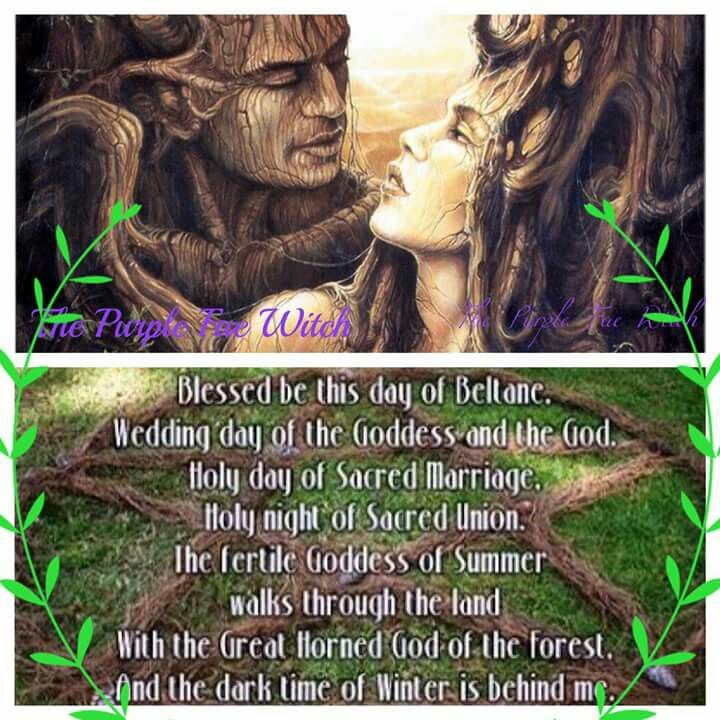
Beltane honours Life. It represents the peak of Spring and the beginning of Summer. Earth energies are at their strongest and most active. All of life is bursting with potent fertility and at this point in the Wheel of the Year, the potential becomes conception. On May Eve the sexuality of life and the earth is at its peak. Abundant fertility, on all levels, is the central theme. The Maiden goddess has reached her fullness. She is the manifestation of growth and renewal, Flora, the Goddess of Spring, the May Queen, the May Bride. The Young Oak King, as Jack-In-The-Green, as the Green Man, falls in love with her and wins her hand. The union is consummated and the May Queen becomes pregnant. Together the May Queen and the May King are symbols of the Sacred Marriage (or Heiros Gamos), the union of Earth and Sky, and this union has merrily been re-enacted by humans throughout the centuries. For this is the night of the Greenwood Marriage. It is about sexuality and sensuality, passion, vitality and joy. And about conception. A brilliant moment in the Wheel of the Year to bring ideas, hopes and dreams into action. And have some fun…..

Traditions of Beltane…

Just click here-To read the rest of this article

WHAT IS BELTANE?

One of the four quarter day festivals, Beltane saw members of communities come together to celebrate the return of the summer. The observance of this hugely important time in the turning of the wheel of the year was characterised by a celebration of the return of the fertility of the land, and would have been a time when livestock would have been put out to pasture.

The word ‘Beltane’ roughly translates as ‘bright fire’ and, as such, one of the most important rituals, which survives today in our modern festival, concerns the lighting of the Beltane bonfire. Fire was seen as a purifier and healer and would have been walked around and danced/jumped over by the members of the community. Farmers would also have driven their cattle between bonfires to cleanse and protect them before being put out into the fields.

In ancient communities, all hearth fires would have been extinguished and a new neid fire lit which would have then been used to relight people’s hearths in their own homes. In this way the community was connected to each other by the sacred fire which was central to all. The festival would also have been a time of courtship rituals and a celebration of our own fertility!

The important point to note when thinking about our own festival is the joy and the revelry that is fostered in the ritual. It is about casting off the darkness and celebrating the light. It is a time for celebrating fertility, both in the context of our biological functions as well as our own creative energies, the fertility of our creative community.

HISTORICAL BACKGROUND…

To continue reading the article on Beltane click here

For Your Viewing Pleasure

5 PAGAN TRADITIONS: How the Ancients Celebrated Beltane

For Your Viewing Pleasure

 I went to a Celtic Pagan Ceremony in Ireland (Gaelic Samhain Festival)

May Day by Jami Shoemaker – Part 1

Ancient Customs

Beltane (Anglicized spelling) is a fire festival, and was dedicated to the god of light, called variously Bel, Balor, Belenos, and Baldur. It marked the beginning of the summer season, and the return of the Sun to light and nourish the earth. Among the customs associated with the Celtic celebration of Beltane (literally “Bel’s fire”) is the lighting of two fires on a hilltop. The Druids gathered gathered wood from nine different trees to make their fire every year on top of Tara Hill in County Merath, Ireland. Traditionally, all other fires were extinguished, and relit from these sacred “need fires” as an act of renewal. Before cattle were taken into the open pasture for the summer they were driven either between the fires or through the ashes to purify them of disease, and men and women would leap the flames for protection, and for luck in matters of fertility, romance, and home.

This brings us to perhaps the most significant part of the Beltane customs—that of fetility and growth. With the return of light and warmth, the earth’s fertility was assured for another season. This mystery was seen as the union of the earth and sky, or Goddess and God. The fruit of the union was seen as greening of the countryside, and in the harvest to come. This coming together of the forces of nature was honored as the “Sacred Marriage” of the Goddess and God. Imitating their union was the ultimate act of the community.

In light of this “marriage of the gods,” Pagan weddings or “handfasting” were popular at this time of year. This was the commitment of a year and a day. giving the couple sort of “trial run” at marriage and after that time both parties could agree to a long-term relationship, or could go their separate ways without remorse.

For those only looking for a night of frolicking, the “greenwood marriage” was popular. Young men and women would spend the night at the Beltane fires, or would go into the woods on Beltane Eve, gathering garlands and flowers, making love, and staying up to greet the Sun. If a woman were lucky, she would find herself with child, as children conceived on May Eve were considered favored by the the gods. These “greenwood marriages” continued long after Christian form of marriage replaced the peasants’ handfasting. May Eve was a time to drop all inhibitions and enjoy unbridled sexuality. No rules applied. even married or handfasted couples would relax their commitment for this night.

Symbols of fertility abounded at May time—the greening of the woods, the flowering of plants, the mating of animals. Perhaps one of the most blatant symbols of fertility is the Maypole, traditionally cut and carried from the forest by the villages most viral young men. Though the symbol of the Maypole is universal (the living tree representing the growth that awakens with spring), the tradition of erecting a Maypole may stem from an ancient Roman tree-giving custom. It has been said that the erection of the Maypole, which includes burying one end in the earth, is yet another representation of the union of the gods.

Beltane falls exactly opposite Hallows,which marks the beginning of the dark half of the year. These two turning points were seen as powerful times in the wheel of the year. They fell on the “in-between” times, embodying the mysteries of light and dark, life and death, and the transitions between. It is at these times when the veil between the worlds of spirit and matter, the dead and the living, are the thinnest. Beltane was then associated with great magic. This was a time for divination, and for spells that would bring love and prosperity. It was also a time when the faery folk were more easily seen. Their appearance could bring good fortune, or, if a mortal were enticed by their mischievous ways, he or she might fall into a trance and be taken to a place beyond time.

Copyright Llewellyn’s Witches’ Datebook 2001 Pages 21 to 25 
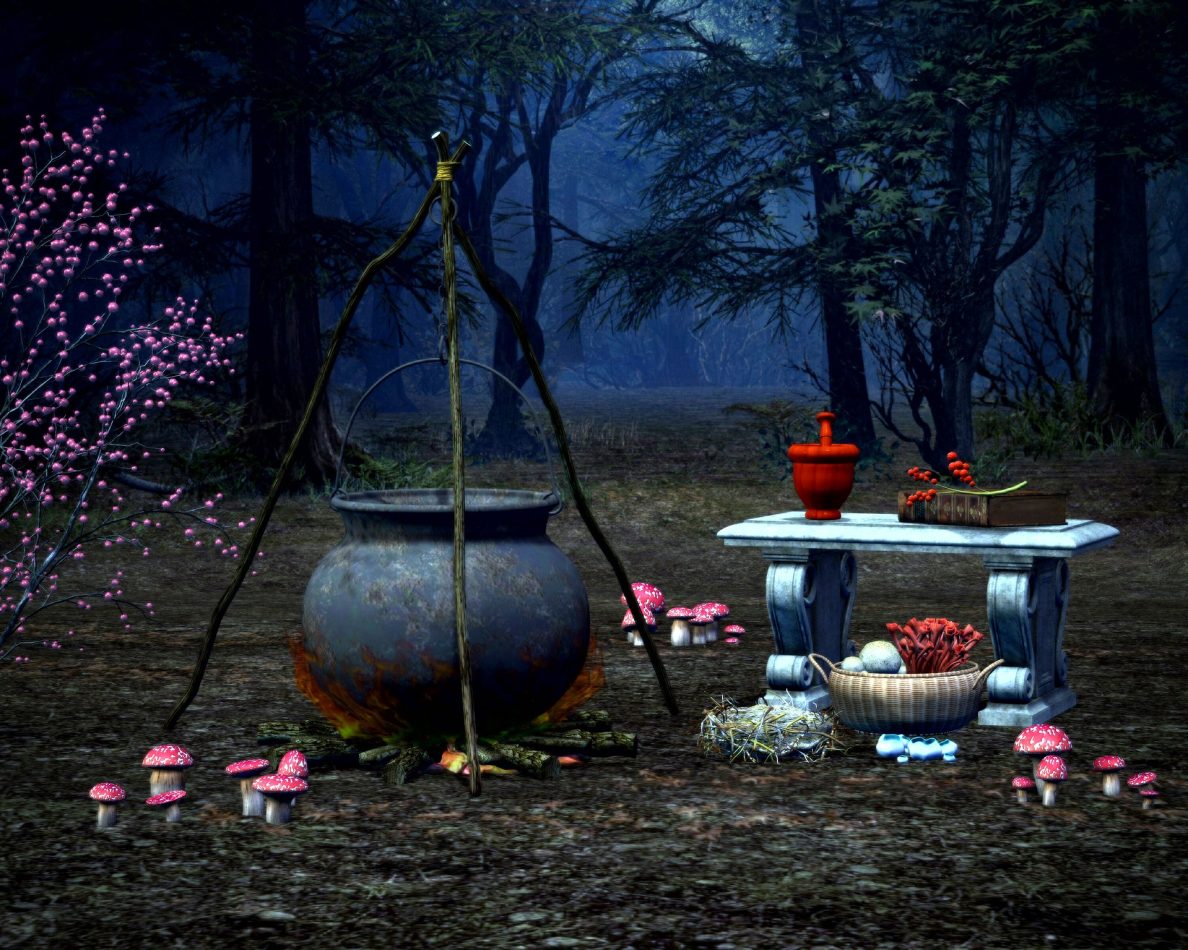
Celtic Tree Month – Coll – Hazel Moon August 5 – September 1


About the Celtic Tree Month – Coll (Hazel Moon): August 5 – September 1

“The lunar tree calendar of the Celts has long been a source of controversy among Celtic scholars. Some even claim it was never a part of the old Celtic world, but was an invention of author/researcher Robert Graves. The Druids are generally given credit by other researchers for creating this system. There seems to be no scholarly evidence to prove otherwise, yet many Celtic Pagans feel that the system pre-dates the time of Druidic influence over Celtic religious matters. It is probably reasonable to believe that the truth lies somewhere in between these three extremes. It is most likely that the tree system was in place, with minor regional variations before the time of the Druids who experimented with it, discovered the magical properties of each tree, and codified all the information into the system we have today.”

—-Joelles Sacred Grove

The Hazel Moon was known to the Celts as Coll, which translates to “the life force inside you.” This is the time of year when Hazelnuts are appearing on the trees, and are an early part of the harvest. Hazelnuts are also associated with wisdom and protection. Hazel is often associated in Celtic lore with sacred wells and magical springs containing the salmon of knowledge. This is a good month to do workings related to wisdom and knowledge, dowsing and divination, and dream journeys. If you’re a creative type, such as an artist, writer, or musician, this is a good month to get your muse back, and find inspiration for your talents. Even if you normally don’t do so, write a poem or song this month.

Source

Patti Wigington, Author
Published on ThoughtCo