
Tag: Life in The Craft Magazine
For Your Viewing Pleasure – In Memory of Lady Abyss and Her Appalachian Blood Family

A small part of the Appalachian Mountains
Donnie Laws Narrator
Presents Applanation folk tales and beliefs of these proud citizens of the USA.
The videos I choose to post here have to do with ghosts, witches, superstitions. All videos can be seen on YouTube.com under Donnie Laws YouTube.com Channel
The Guardian Ghost of the field. True Story of Unexplained Appalachia.
Appalachian Story of Mountain Witches
Appalachian Story of a Strange Hunting Encounter
Mountain superstitions of Appalachia Myths, Wives Tales and Signs
Rare Mountain Superstitions and sayings of Appalachia
Appalachia Mountain Roots Plants and Herbs
He has more videos to see and enjoy. I hope you learned a little something, I know I did, and enjoyed the videos I picked out.
Spell For Tomorrow – Lucky Seven Candle Dressing
(YOU CAN COPY AND PASTE ANY SPELLS POSTED TO A DOCUMENT TO PRINT AND/OR SAVE ON YOUR COMPUTER FOR PERSONAL USE ONLY)
Lucky Seven Candle Dressing
The number seven is lucky because so many good things come in sevens: the chakras or energy centers in the body, and the continents of the world. The number seven ranks among the most favored numbers by gamblers and lottery players. This candle dressing contains seven herbs, each representing something powerful and positive. Dress a candle of any color and burn it to attract luck in all areas of life.
For anointing, use 1 drop mint oil, 1 drop chamomile oil, and 1 drop sandalwood oil. Mix together 1/2 teaspoon crushed dried patchouli leaves for grounding, 1/2 teaspoon dried lavender flowers for attraction, 1/2 teaspoon dried dandelion petals for confidence, 1/2 teaspoon dragon’s blood resin powder for love, 1/2 teaspoon rosemary for truth, 1/2 teaspoon of sage for wisdom, and 1/2 teaspoon crushed myrrh gum for spirituality.
Try using this mixture on rainbow candle of seven colors for extra luck. Burn it just before an important event or celebration to make sure the experience is positive.
By Kate Freuler in Llewellyn’s Witches’ Datebook 2023 page 133
Divination Journal
Tarot Card
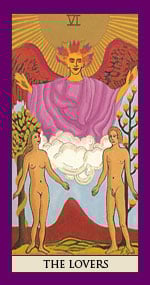
The Lovers
Keywords: choice, decision, love, communication, inspiration (ideas from above)!
Astrological Correspondence: Gemini
The Lovers card is representative not only of crucial life choices, but also of lovers, couples, and other partnerships, like business partners, siblings, and friends. The angel between a woman and a man, depicted on this card, symbolizes the struggle of deciding to follow one’s heart versus one’s temptation or obligation. The Lovers card symbolizes the choices that must be made to progress toward higher self-awareness; choices also reflect emotional values, indecisiveness, hesitation, and our fears about making wrong choices. This applies not only to love relationships – it is applicable to any relationship in which people are drawn together, even a casual one. It’s the card of uncertainty!

Rune

Hagalaz
“Hag-all-az” – Literally: “Hail” or “Hailstone” – Esoteric: Crisis or Radical Change
Key Concepts: hailstones, crisis and catastrophe, disruption, radical change, destructive elements of nature, severe weather, the uncontrollable, unavoidable unpleasantness, Jungian shadow, psychoanalysis, regression, acceptance of the unalterable
Psi: disruption, change, personal past
Energy: power beyond human ability to harness, perfect pattern, seed formation, objective confrontation, destructive natural forces, chaos
Mundane: bad weather, obstacles, surprises, shelter
Divinations: Change according to ideals, changes for the long-term good, controlled crisis, corrections, completion, inner harmony; or catastrophe, crisis, stagnation, loss of power, loss of property, short-term disappointment, victim-consciousness, obsession with the past, blame.
Governs:
Completeness and balance of power, integration of unconscious shadow elements
The inevitability of Fate, Wyrd, Orlog
Evolutionary progress and operations of becoming
The outworking of a perfect pattern
Protection through banishing or exorcising disharmonious patterns, protection
Awareness of the unconscious ideas for eventual processing
Causing discomfort in others by awakening their own subconscious ‘garbage’
Daily Influences
Tarot Influence
 Six of Coins
Material gain, charity and justice are at the forefront. That which is earned will be given.
Astrological Influence
 Gemini Reversed
Gemini reversed denotes vacillation. Decisions are not made, because all side of the issue pull with the same strength.
Element Influence
 Air
Air
Air denotes freedom and the ability to transcent the mundane. You may be, or may soon experience a spiritual or secular liberation.
Animal Spirit

Characteristics of the Coyote as a Spirit Guide

Advice from the Coyote

Witches Rune
Source: otherworldlyoracle.com

Crossroads
decisions, blocked paths, opportunities, the space between, spirits
The crossroads as a symbol and as an actual place are powerful. When we reach a crossroads in our lives, we have to make a decision. There may be a new path presented to us or our paths might be blocked. This could also indicate a spirit of the crossroads calling us.
Ogham

I Ching

Numerology

Angel Number

Crack the Cookie

The Words of Confucius
It does not matter how slowly you go as long as you do not stop.
(One Person’s View) Casting The Runes c. 2018
Casting The Runes
Each individual will eventually devise his or her own way of casting the runes. What follows are some
suggestions, all following a similar path, but they are by no means fixed rules.
It is important to remember that your runes are your own, and are special. You have created a link
with them and that is important. Never lend your runes, unless you feel comfortable doing this. I
personally would never lend runes, Tarot cards or crystals to anyone else. If you are unsure, maybe
you should try drawing a rune from your pouch and seeing what you get as an answer. It is suggested
that an upright rune gives a Yes answer, and an inverted one a No answer. However, those runes
which look the same either way may prove a problem!
A traditional way of casting the runes is to mix them in a pouch and cast them on a cloth, usually
velvet. I keep my runes in such a pouch and use them in this way. It usually happens that the runes I
am intended to use find their way into my hand or between my fingers as I mix them in the pouch. I
usually draw nine runes.
Others have suggested drawing three runes at a time, three times, with a break in between each set of
three.
Old Nordic tales suggest that throwing runes at a person was a means of casting a magical spell.
Likewise spells are said to have been cast by writing certain runic inscriptions on a piece of paper and
passing it to the unsuspecting intended victim.
All these things may belong in folklore, and have no bearing on the modern usage for runes; it is up to
the individual to decide. One runemaster I know draws three runes which represent current
circumstances. Having looked at these three runes, he returns them to the pouch and draws three
more. The second set of three represents courses of action or possible outcomes. The second set is
then also returned to the pouch and a final single rune drawn, which indicates influences likely to have
a bearing on the problem as a whole.
Tradition suggests that Odin’s number was 5. For this reason, some runemasters work with only five
runes. Those interested in numerology will note that the runes total 25 if you include the blank rune.
This all adds up to 7, which is a powerful and spiritual number, and for this reason, perhaps, some
runemasters draw seven runes when casting.
Another means of casting the runes is to ‘shuffle them’ and leave them to their own devices for a while
(15 minutes is usually suggested), and then draw 12, laying them on a runic chart especially
prepared for the purpose.
(One Person’s View) Ways Of Casting The Runes c. 2018
Ways Of Casting The Runes
There are probably hundreds of different ways to lay the runes for a casting. What is given here is
only a selection. It is by no means exhaustive.
I would suggest that you try some of these, going for the ones with which you feel comfortable before
trying your own ideas out. The reasons for this are many, not least of which it is important to
familiarise yourself with the runes and how they are read as a group before progressing.
It should also be remembered that you may have some personal thoughts on the meanings of the runes
at the time you are carrying out the casting, which you should not dismiss out of hand. The meanings
given here are basic, and again by no means exhaustive. You may for example wish to use all
the reverse meanings given, even though some runes look the same either way up. Experience is the
best teacher, and you must always do what you feel comfortable doing. Don’t go along with something
just because others do – make up your own mind.
Another means of casting the runes consists of five runes, called Odin’s casting. Again these are laid
down from right to left, with the third rune slightly raised from the remainder. I read these as being
two pages within a book with the third rune being that which is either holding the pages together, or
conversely, stopping them from being turned. I use a similar layout in Tarot readings.
Similar layout could be used with seven runes.
You could also consider using a 12 rune casting, linking each rune either with a month or with a sign
of the zodiac. This is usually laid out in a circle, as in Figure 7.3, although I have seen many
variations of this.
Yet another suggestion would be what is sometimes called the rune-cast method. Basically, you ‘shuffle’ the runes within their pouch, and having formed a circle of string on the floor, empty the pouch into it.
Those runes nearest to you have the greatest meaning. Should any have fallen outside the string circle,
these can be ignored; likewise if they fall on the string or have fallen face downwards.
There are many more ways of casting the runes, and no doubt you will find one suitable for you.
Experiment and practise.
Some of Corresponding Colors for Use with Candles, in Spells and Rituals
Source: lightwarriorslegion.com
Color |
Magickal Correspondence |
|---|
 |
Amber | Witchery skills |
 |
Black | Repelling, Ward negativity, Remove hexes, Protection, Spirit contact, Night, Truth, Remove discord or confusion, Banishing and binding. It can be used in meditation to deepen the meditative state. Waning moon workings. Black does not denote evil in any sense. |
 |
Blue | Calm, Tranquility, Truth, Justice, Forgiveness, Dreams, Protection, Communication, Will power, Weight loss, Healing and Change, Working with feelings and emotions. Blue is also associated with the acquisition of knowledge. |
 |
Blue (light) | Psychic awareness, Intuition, Opportunity, Peace, Understanding, Quests, Safe journey, Patience, Tranquility, Ward depression. |
 |
Brown | Finding lost objects, Endurance, Concentration, Material goods, Stability, Animal health, House blessing, Uncertainties, Earth and nature magick, Grounding, Real estate. |
 |
Copper | Business success, Passion, Money, Fertility, Career growth. |
 |
Gold | Positive attitude, Power, Physical Strength, Success, Achievement, Mental growth, Healing energy, Intuition, Divination, Fortune, Luxury, Male energy, Understanding, Wealth spells and magick. Associated with the Sun God and the power of the light. |
 |
Green | Abundance, Prosperity, Money, Material wealth. Success in the workplace, Good luck, Fertility, Healing, Balance, Acceptance, Employment, Courage, Agriculture, Changing direction or attitudes, Growth. Eliminating jealousy, Marriage, Nature magick. |
 |
Grey | Combating negativity. Balance and Neutrality, Promote Vision and Clarity in a given situation, Contemplation, Veiling, Cancellation, Hesitation. |
 |
Indigo | Vision, Psychic intuition, Deep Meditation, Spiritual guidance, Karma Workings, Neutralise another’s magick, Ward slander, Stop gossip, Overcome depression. Indigo is seen as a stopping colour, a colour to use in situations that need an end or a new beginning. |
 |
Lavender | Enhance psychic abilities, Knowledge, Intuition, Promote peace, Well being, Sleep, Relieves tensions, Spiritual development, Psychic growth, Divination, Sensitivity to the Other world, Blessings. |
 |
Orange | Creativity, Self-expression, Strength, Healing, Pulling things to you, Adaptability, Luck, Vitality, Encouragement, Clearing the Mind, Dominance, Energy both Physical and Magickal, Legal matters, New opportunities, Career, Overcoming addiction, Joy, Business success, Ambition, Fun, Action, Investments. |
 |
Peach | Kindness, Sympathy and Empathy, Compassion, Healing |
 |
Pink | Romance, Love, Harmony in Emotional Love, Honour, Mortality, Friendship, Self-love, Protection of children, Compassion and Relaxation. Peace at home. |
 |
Purple | Psychic awareness, Spiritual development, Spiritual Power, Wisdom, Influence, Intuition, Divination, Ambition, Healing, Progress, Business, Spiritual Communication, Protection, Hidden knowledge, Meditation, Change luck, Break habit, Generating protective energies. |
 |
Red | Strength, Truth, Lust, Physical passion, Anger, Respect, Power, Energy, Health, Vigor, Enthusiasm, Motivation, Courage, Passion, Action, Danger, Sexuality, Protection, Sports, Independence, Assertiveness, Competition Personal Power and Determination. Association with the life force of blood. |
 |
Silver | Moon, Night, Balance, Channelling, Psychic development, Clairvoyance, Lunar Magick, Meditation, Wards negativity, Intuition, Dreams, Victory. Associated with the Moon Goddess and Feminine energies. |
 |
Turquoise | Find alternative answers to difficult situations, Relieve stress |
 |
Violet | Self-improvement, Spirituality, Intuition, Insight, Clarity, Success in Searches. |
 |
White | White can be substituted for any other colour. Unity, Purification, Moon magic, Protection, Truth, Meditation, Peace, Sincerity, Justice, Beginnings, Warding of doubts and fears. Healing properties, a white candle may be lit to assist healing and recovery from illness. New moon and Full moon workings |
 |
Yellow | Self-confidence, Persuasion, Concentration, Pleasure, Happiness and creativity, Inspiration, Divination, Clairvoyance, Mental Alertness, Intellectual growth, Prosperity, Changes, Harmony, Creativity, Confidence, Communication, Flexibility, Friendship, Study, Travel. |
Some of Corresponding Colors for Use in all Aspects of Witchcraft for Thursday, Friday, and Saturday
Some of Corresponding Colors for Use in all Aspects of Witchcraft for Thursday, Friday, and Saturday
Thursday
Purple,
Deep Blue,
Green,
Turquoise,
Metallic,
Royal Blue,
Rich Royal Colors
Friday
Pink,
White,
Aqua,
Green,
Rose,
Coral,
Blue,
Copper,
Light Blue
Saturday
Black,
Maroon,
Dark Purple,
Gray,
Red,
Brown,
Blue,
White,
Dark Shades
Some of Corresponding Colors for Use in all Aspects of Witchcraft – Sunday and Monday
Some of Corresponding Colors for Use in all Aspects of Witchcraft
SUNDAY
Gold,
Yellow,
Orange,
Amber,
MONDAY
Silver,
Pearl,
White,
Grey,
Lavender,
Blue,
Ivory,
Light Blue,
Let’s Have Some Fun – Another Coloring Page

Some of the Witchcraft/Magickal Correspondence for Saturday
(YOU CAN COPY AND PASTE ANY COROSPONDENCES POSTED TO A DOCUMENT TO PRINT AND/OR SAVE ON YOUR COMPUTER)
Friday Source: plentifulearth.com
Planet: Saturn
Element: Earth, Fire
Gender: Female
Deities: Cronos, Fates, Hecate, Loki, Saturn
Colors: Purple, Black, Maroon, Dark Colors, Indigo
Crystals: Apache Tear, Black Onyx, Coal, Coral, Hematite, Jet, Lead, Obsidian, Pewter, Salt, Serpentine, Smoky Quartz, Tourmaline
Herbs & Plants: Amaranth, Beet, Belladonna, Boneset, Comfrey, Cypress, Hellebore, Hemlock, Hemp, Ivy, Mimosa, Morning Glory, Mullein, Quince, Skullcap, Slippery Elm, Thyme
Incenses: Cypress, Myrrh, Patchouli, Saturn Oil
Energies & Associations: Agriculture, Apprehension, Banishment, Binding, Boundaries, Caution, Cleansing, Creativity, Cursing, Destruction of All that Does Not Serve, Elderly Care, Endings, Exorcism, Fortune, Freedom, Hexing, Hidden Matters, Hope, Limitations, Locating Lost Items or People, Longevity, Meditation, Overcoming Obstacles, Protection, Psychic Defense, Revealing Truth, Self-Discipline, Spiritual Communication

Friday Source: amagickalpath.co.uk
Planet – Saturn
Spells/Magic – binding, debts, discovery, justice, karma, protection, longevity, endings, home
Magical aspects: longevity, exorcism, endings, apprehension, austerity, caution, and limitations.
Oils – Black Orchid, Hyacinth, Iris, Juniper,
Plants and trees – black helleborn,garden nightshade,blackthorn tree,cypress tree,hedge bindweed,hemlock.ivy,morning glory,mullein,snowdrop,marigold,Rosemarry,Rue,Rowan tree, yew tree, holly tree.
Stones – Obsidian, onyx,black pearl
Colours – black, grey, red, white, brown, blue
Metal -Lead
Energy Type – Female
Dieties – dedicated to the shadowy Anglo-Saxon god Saetere, the equivalent to the Roman Saturn, and the Greek Cronos. It is also associated with the Norns, the Norse equivalent of the Three Fates, and the Trickster-god, Loki.
Saturday is the best time to deal with such matters as: Binding, Patience, Stability, Neutralization, Material Gain, Protection, Karma, Death, Manifestation, Structure’s, Reality, Laws of society, Limits, Obstacles, Tests, Handwork, Real Estate, Dentists, Bones, Teeth, Farm Workers, Sacrifice, Separation, Stalkers, Murderers, Criminals, Civil Servants, Justice, Math’s, Plumbing, Joint Money Matters, Wills, Debts, Financing, Real Estate, Discoveries, Transformation and Relations with Older People.
Some of the Witchcraft/Magickal Correspondence for the Last Quarter Moon
(YOU CAN COPY AND PASTE ANY CORRESPONDENCES POSTED TO A DOCUMENT TO PRINT AND/OR SAVE ON YOUR COMPUTER)
LAST QUARTER Source: thehoodwitch.com
Moon rises at midnight and sets at noon; best effects between these times
Moon is 7-10 1/2 days after the full moon.
Workings: Addictions, divorce, endings, health and healing (banishing), stress, protection, and ancestors.
Purpose: Absolute destruction
Pagan Holiday: Fall Equinox
Goddess Name: The Morrigan’s Moon
Goddess Energy: harvest goddesses
Offering: Incense
Theme: Banishing
Tarot Trump: Judgement
(One Person’s View Point) Why Light a Candle
Light A Candle
In many different traditions lighting candles is a sacred action.
It expresses more than words can express.
It has to do with gratefulness.
From time immemorial, people have lit candles in sacred places. Why should cyberspace not be sacred?
You may want to begin or end your day by the sacred ritual of lighting a candle or in memory of a loved one … to send healing thoughts … in prayer … it’s all about your intent.
Just follow link below ~
Love & Blessings xxx
http://www.gratefulness.org/candles/candles.cfm?l=eng&gi=AMP
(One Person’s View) List of the Most Used Gods in Witchcraft
Adonis: Greek – consort of Aphrodite
Anubis: Egyptian – Jackal-headed God responsible for conducting souls to the underworld.
Apollo: Greek & Roman – God of the Sun, twin brother of Artemis
Cernunnos/Kernunnos: Celtic – The Horned God, consort of the Lady.
Dionysus: Greek – God of wine, fertility, and vegetation.
Eros: Greek – God of love and passion.
Herne: Celtic/Saxon – see Cernunnos.
Horus (the elder): Egyptian – God of the all-seeing eye. Has the head of a falcon and the body of a man.
Hymen: Greek – God of marriage and wedding feasts.
Lucifer: Italian – God of light, brother of Diana.
Mithra: Persian – God of the Sun and of victory in war
Odin: Scandinavian – God of the dead and of war. Consort of Freya.
Osiris: Egyptian – Fertility God, brother and consort of Isis.
Pan: Greek – God of nature and of woodland.
Poseidon: Greek – God of the sea.
Ra: Egyptian – God of the Sun. Father of Hathor by Nut.
Shiva: Hindu – God of the cycle of birth-death-rebirth. Consort of Kali.
Thor: Scandinavian – God of the sky and of thunder. Son of Odin
Thoth: Greek – God of wisdom and of writing.
Zeus: Greek – Supreme God. Brother of Demeter.
(One Person’s View) Crystals for the Beginner Witch
Disclaimer: No crystal, or gem or stone should be used for medicinal purposes in place of what your health care professional has prescribed for you for any reason. The content provided on this website is for informational purposes only and DOES NOT CONSTITUTE THE PROVIDING OF MEDICAL ADVICE and is not intended to be a substitute for independent professional medical judgment, advice, diagnosis, or treatment. Always seek the advice of your physician or other qualified health providers with any questions or concerns you may have regarding your health. WitchesofTheCraft.com, any staff member of WitchesofTheCraft.com and/or Lady Carla Beltane are not responsible for any type of negative reaction when using a crystal or gem or stone for any reason.
List of crystals that every witch should have in their witch toolbox…
Hematite: this is good to use for grounding, protection, and scrying
Rose Quartz: this is good for promoting love and helps fight anxiety and depression.
Clear Quartz: this is good for protection, healing, and clarity.
Selenite: Prevents bad dreams and great for clarity.
Amethyst: Used for protection and helps to rebut effects you don’t want.
These stones will help every witch out there in everyday life and for use during rituals or really anything and everything in your life.
Some of the Witchcraft/Magickal Correspondence for Wednesday
(YOU CAN COPY AND PASTE ANY CORRESPONDENCES POSTED TO A DOCUMENT TO PRINT AND/OR SAVE ON YOUR COMPUTER)
Wednesday Source: thewitchandwand.com
Wednesday aligns with the planet Mercury. This day is associated with intellectual pursuits, travel, communication, and memory.
Metal: Mercury
Colors: Orange, Yellow, Periwinkle
Gems and Stones: Aventurine, Moss Agate
Botanicals: Fern, Dill, Sweet Pea, Periwinkle, Eucalyptus, Aspen, Lily, Lavender
Spellwork: Communication, Divination, Luck, Travel, Knowledge, Memory

Flower Meaning, Symbolizes, and Spiritual Meaning – Sunflowers
Disclaimer: No flower or plant or herb should be used for medicinal purposes until you have checked with your health care professional to ask if it is safe for you to use it for any reason. The content provided on this website is for informational purposes only and DOES NOT CONSTITUTE THE PROVIDING OF MEDICAL ADVICE and is not intended to be a substitute for independent professional medical judgment, advice, diagnosis, or treatment. Always seek the advice of your physician or other qualified health providers with any questions or concerns you may have regarding your health. WitchesofTheCraft.com and/or any staff member of WitchesofTheCraft.com and/or Lady Carla Beltane are not responsible for any type of negative reaction when using this flower or plant for any reason.
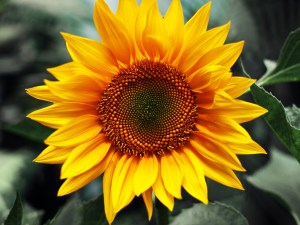
Sunflower Meaning, Symbolism, and Mythology
Sunflower meanings include happiness, optimism, honesty, longevity, peace, admiration, and devotion. The sunflower possibly surpasses all others in terms of its universal power to bring joy to people. With a round face and bright yellow petals resembling rays of sunshine, the sunflower has important cultural and spiritual significance to people around the world. In this post, you’ll learn about sunflower symbols and meanings, the sunflower in cultural mythology, and the spiritual significance of the sunflower.
Table of Contents
What does a sunflower symbolize?
Detailed Sunflower Meanings
Spiritual Meaning of the Sunflower
Sunflowers in Mythology and Folklore
Sunflower in Inca Mythology
Native American Sunflower Meanings
Sunflower Symbolism in Greek Mythology
Sunflower in Europe
Sunflower Symbolism in Victorian England
Chinese Sunflower Meanings
Sunflower Tattoo Meaning
Meaning of Some Types of Flowers c. 2015
Flowers have always been a big feature at weddings, too. As an example, look to the royal flower bouquet in the wedding of Prince William, Duke of Cambridge, to Kate Middleton (now Catherine, Ducchess of Cambridge). Her flowers had very special meaning.
The groom, too, wears a flower that appears in the bridal bouquet in his button-hole. This stems from the Medieval tradition of wearing his Lady’s colors, as a declaration of his love.
One fun idea is to have a garden gathering and have each person bring a flower that has meaning to them. Or, paint tiles on a kitchen island with a flower that represents each of your loved ones.
There is a language, little known,
Lovers claim it as their own.
Its symbols smile upon the land,
Wrought by nature’s wondrous hand;
And in their silent beauty speak,
Of life and joy, to those who seek
For Love Divine and sunny hours
In the language of the flowers.
–The Language of Flowers, London, 1875
Please tell us which flowers have meaning to you! If we are missing one of your favorites, please tell us which one and its meaning.
Wish to grow a flower that has meaning to you or a loved one? Click on the linked plant names for free planting and growing guides.
| Symbolic Meanings of Herbs, Flowers and Trees | |
|---|---|
| Aloe | Healing, protection, affection |
| Angelica | Inspiration |
| Arborvitae | Unchanging friendship |
| Bachelor’s button | Single blessedness |
| Basil | Good wishes |
| Bay | Glory |
| Black-eyed Susan | Justice |
| Carnation | Alas for my poor heart |
| Chamomile | Patience |
| Chives | Usefulness |
| Chrysanthemum | Cheerfulness |
| Clover, white | Think of me |
| Coriander | Hidden worth |
| Crocus, spring | Youthful gladness |
| Cumin | Fidelity |
| Daffodil | Regard |
| Daisy | Innocence, hope |
| Dill | Powerful against evil |
| Edelweiss | Courage, devotion |
| Fennel | Flattery |
| Fern | Sincerity |
| Forget-me-not | Forget-me-not |
| Geranium, oak-leaved | True friendship |
| Goldenrod | Encouragement |
| Heliotrope | Eternal love |
| Holly | Hope |
| Hollyhock | Ambition |
| Honeysuckle | Bonds of love |
| Horehound | Health |
| Hyacinth | Constancy of love, fertility |
| Hyssop | Sacrifice, cleanliness |
| Iris | A message |
| Ivy | Friendship, continuity |
| Jasmine, white | Sweet love |
| Lady’s-mantle | Comforting |
| Lavender | Devotion, virtue |
| Lemon balm | Sympathy |
| Lilac | Joy of youth |
| Lily-of-the-valley | Sweetness |
| Marjoram | Joy and happiness |
| Mint | Virtue |
| Morning glory | Affection |
| Myrtle | The emblem of marriage, true love |
| Nasturtium | Patriotism |
| Oak | Strength |
| Oregano | Substance |
| Pansy | Thoughts |
| Parsley | Festivity |
| Pine | Humility |
| Poppy, red | Consolation |
| Rose, red | Love, desire |
| Rosemary | Remembrance |
| Rue | Grace, clear vision |
| Sage | Wisdom, immortality |
| Salvia, blue | I think of you |
| Salvia, red | Forever mine |
| Savory | Spice, interest |
| Sorrel | Affection |
| Southernwood | Constancy, jest |
| Sweet pea | Pleasures |
| Sweet William | Gallantry |
| Sweet woodruff | Humility |
| Tansy | Hostile thoughts |
| Tarragon | Lasting interest |
| Thyme | Courage, strength |
| Tulip, red | Declaration of love |
| Valerian | Readiness |
| Violet | Loyalty, devotion, faithfulness |
| Willow | Sadness |
| Yarrow | Everlasting love |
| Zinnia | Thoughts of absent friends |

Credit: KafeKafe
Spell – Strength and Hope Candle Dressing
(YOU CAN COPY AND PASTE ANY SPELLS POSTED TO A DOCUMENT TO PRINT AND/OR SAVE ON YOUR COMPUTER FOR PERSONAL USE ONLY)
Strength and Hope Candle Dressing
Evergreens of all kinds are brought indoors for decorations during the winter months because they are symbols of hope and reminder that growth will prevail. Trees like pine, cedar and spruce stand strong and sturdy even in the harshest climates, displaying resilience and an amazing ability to survive in the face of adversity. This candle dressing can be incorporated into winter rituals or used on its own for spells for strength and endurance during difficult times. YOu might be able to find all the plant materials of this recipe in your own area.
You will need
For Anointing:
1 drop pine oil
1 drop peppermint oil
Than mix together
1 teaspoon dried pine needles
1 teaspoon dried cedar leaves
1 teaspoon dried crushed pinecone pieces
As you mix the dried plants, focus on the resilient toughness of a giant pine tree standing tall and strong despite all that works against it. Imagine yourself possessing the same majestic qualities. Anoint and dress a white, red or green candle.
Source: Kate Freuler Llewellyn’s Witches’ Datebook 2023 page 37
Some of the Witchcraft/Magickal Correspondences for Saturday
(YOU CAN COPY AND PASTE ANY CORRESPONDENCES POSTED TO A DOCUMENT TO PRINT AND/OR SAVE ON YOUR COMPUTER)
| Saturday | ||
| Magickal Intentions: Spirit Communications, Meditation, Psychic Attack or Defense, Locating Lost Things and Missing Persons, Building, Life, Doctrine, Protection, Knowledge, Authority, Limitations, Boundries, Time and Death |
Incense: Black Poppy Seed Myrrh |
|
| Planet: Saturn |
Sign: Capricorn Aquarius |
Angel: Cassiel |
| Colors: Black Grey Indigo |
Herbs/Plants: Myrrh Moss Hemlock Wolfsbane Coltsfoot Nightshade Fir |
Stones: Jet Smokey Quartz Amethyst Black Onyx Snowflake Obsidian Lava Pumice |


You must be logged in to post a comment.