Obon Festival 2024 in Japan: Meaning, Traditions and Dates

The Obon festival (お盆, also known as Bon festival) is an annual Japanese holiday that commemorates and remembers deceased ancestors. It is believed that their spirits return at this time to visit their relatives.

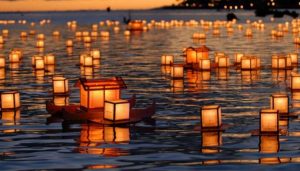
Chochin (paper) lanterns are hung to guide the spirits and Obon dances (bon odori) are performed. Families have reunions and visit the graves of their relatives and make food offerings at altars and temples.

It is observed from the 13th to the 15th day of the 7th month. However, according to the solar calendar the 7th month is July but according to the lunar calendar, the 7th month is August. Obon is therefore celebrated at different times in different regions depending on which calendar is observed.

The official dates are August 13-15 though it will be celebrated between July 13-15 in some places. The Obon week in mid-August is one of Japan’s three major holiday seasons making it one of the busiest times of the year for traveling. Many Japanese people will leave their cities around August 10 and come back on August 17-18.

Obon traditions and celebrations

On the first day of Obon, people take the chochin lanterns to the graves of their families. They call their ancestors’ spirits back home in a ritual called mukae-bon. In some regions, huge fires are lit at the entrances of houses to guide the spirits to enter.

At the end of the Obon festival, families help their ancestors’ spirits return back to the grave by guiding them with their chochin lanterns. The ritual is called okuri-bon. Again, the ritual varies slightly between different regions of Japan.

Floating lanterns (toro nagashi) Please click here to read the rest of this article

Goddess Of The Day: BENTEN

BENTEN


Shigato Hajime (Japan)

Themes: Luck; Wealth; Beauty

Symbols: Boats; Dragons; Guitars; Snakes; Saltwater

About Benten:

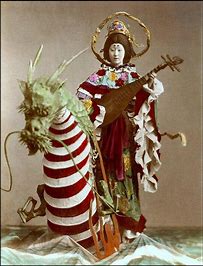
As the Japanese goddess steering the New Year’s Treasure Ship, Benten is a perfect figure to call on for financial improvements this year. She is the only goddess of luck in Japan and is referred to as queen of the seas and patroness of gamblers.

Japanese women invoke her to bring beauty and fortune into their lives. Benten is depicted as riding a golden dragon, playing a biwa (guitar), and sending out white snakes with her missies. Her robe bears a jewel that grants wishes.

To Do Today:

To welcome Benten’s prosperity into your home, sprinkle a little saltwater on the threshold today. Or, to generate beauty within and without, soak in a bath of Epsom salts while listening to guitar music. The Shigato Hajime festival honors the beginning of the work week

in Japan, where it is believed that good omens for work begin today. If you want to get a peek at how your employment will fare this year, try divination by dice (a traditional gambler’s tool). Hold one die in your hand, ask for Benten to provide a sign, then roll it. The results can be interpreted as follows:

(1) a negative omen; (2) feeling torn between two good options; (3) a good omen; (4) financial security (5) not much material change, but improvements in interoffice relationships (6) an excellent omen; roll again. If you get two more sixes, Benten’s treasures will be yours!

By Patricia Telesco

Celebrating 365 Days of Legends, Folklore and Spirituality for September 24 – Festival of Poets

September 24

Festival of Poets

This annual event takes place around this date in Japan. Poets come from all across Japan to visit the Imperial Palace, share their local legends, and compose verses. After the usual pleasantries, the guests are seated and served a cup of sake, after which each attendee is expected to create a verse pertaining to his or her visit. The poems are then read and the winner becomes the nation’s poet laureate.

Seasons of the Witch – Legends and Lore, Ancient Holidays And Some Not So Ancient!


Witchy Cat Graphics & Comments

Seasons of the Witch – Legends and Lore, Ancient Holidays And Some Not So Ancient!


Today Is …


Swaziland Festival of the She-Elephant. Feed the elephants at the zoo or place an elephant figurine on you altar.

Osiris: On this day, the birth of the vegetation- and fertility-god Osiris is celebrated by many Wiccans of the wiccan tradition.

The annual death and rebirth of Osiris personifies the self-renewing vitality and fertility of nature.

Japan: In the country of Japan, the annual Bon festival is celebrated on this date in honor of ancestral spirits.

1527: John Dee was born in London, England. He was renowned as an alchemist and was skilled in the arts of wizardry.

For many years he served as the royal astrologer of Queen Elizabeth I. He died in poverty in the year 1608.

Kronia – In ancient times, the Greek month of Hecatombion was also called Kronion, in honor of the old agricultural god Kronus, whose symbol was the reaper’s scythe. On the full moon (like the full moon of September which is also a Harvest Moon), the farm year ended with masters and slaves gathering to enjoy a harvest dinner together.

Obon Festival begins – Japanese Buddhist festival to honor the departed souls who return and share a life with us during these days. It is also called the Festival of the Lanterns, because of the colorful paper lanterns light the way. On the last day, the souls of the dead return and are given food offerings, accompanied by a silent, gliding circle dance, the bon-odori. Spirits with no relatives are honored with little boats bearing paper lanterns which are set afloat on the Tide of Returning Ghosts to drift out to sea. (Also celebrated in some places on Aug 13-15.)

Buddhist: Asala (Dhammacakka Day – Turning of the Wheel of Teaching) Buddhist observance of the day when Gautama Buddha made his first public proclamation to five ascetics. He taught the middle way, the noble eight-fold path and the four noble truths.

2003: Essex, England. Strange lights which floated and darted through the air were spotted in the skies over Cornwell Crescent in the town of Stanford-le-Hope at about 3:30 in the afternoon. The lights were caught on video by two witnesses. “I thought it was a UFO as there is no other explanation,” said one of the witnesses.

Remember The Ancient Ways and Keep Them Holy!

• • • •.

Courtesy of GrannyMoonsMorningFeast

Celebrating Other Spirituality 365 Days A Year – Obon, Festival of the Dead

HALLOWEEN

July 12 – 16


Obon, Festival of the Dead


Celebrated in Japan, Obon or Bon may be compared with All Hallows’ or All Souls’ Day. It is commonly believed that the spirits of the dead return to earth during Obon, and preparations rations are made to receive and honor them. Family shrines are cleaned, and special meals known as the “Feast of Fortune” are prepared for the spirits. Because lanterns are lighted in the cemeteries and at doorways to welcome ghostly visits, the holiday day is often called the Festival of Lanterns. Obon festivals are often sponsored by Buddhist religious congregations and are celebrated in Japan and in Japanese communities throughout the world.


Whispering Woods Dragon Lore course – Lesson 2

Whispering Woods Dragon Lore course
A history of Oriental Dragons
Lesson Two

The dragon is considered to be a mythological animal of Chinese origin, and a member of the NAGA (Sanskrit) family of serpentine creatures who protected Buddhism. It was by his subtle but powerful charms that the Naga Apalala was able to keep the wicked dragons in check.

Japan’s dragon lore comes predominantly from China. Images of the reptilian dragon are found throughout Asia, and the pictorial form most widely recognized today was already prevalent in Chinese ink painting in the Tang period (9th century CE).  Chinese Dragons are believed to decide where rain fell, to affect river flows and wind conditions. They breathed out heavy mists which create rain, and not fire like their Western counterparts. Chinese Dragons are associated with rivers. Folktales often have them carving out major rivers with their sinuous bodies. They are also associated with other water sources such as wells and springs.

According to the Chinese, the reason their Dragon has five toes, the Japanese dragon has four toes and the Korean dragon has three toes is because the further away from China a dragon goes the more toes that it loses. The Japanese believe just the opposite, believing that they grow more toes so that they eventually cannot walk very well.

The mortal enemy of the dragon is the Phoenix, as well as the bird-man creature known as Karura. In contrast to Western mythology, Asian dragons are rarely depicted as malevolent. Although fearsome and powerful, dragons are equally considered just, benevolent, as well as the bringers of wealth and good fortune. The dragon is also considered a shape shifter who can assume human form and mate with humans. The Chinese call the dragon ‘lung’ (long) because it is considered to be deaf.

In China, however, dragon lore existed independently for centuries before the introduction of Buddhism. Bronze and jade pieces from the Shang and Zhou dynasties (16th – 9th centuries BCE) depict dragon-like creatures. By at least the 2nd century BCE, images of the dragon are found painted frequently on tomb walls to dispel evil. Buddhism was introduced to China sometime in the 1st and 2nd centuries CE.

By the 9th century CE, the Chinese had incorporated the dragon into Buddhist thought and iconography as a protector of the various Buddha and the Buddhist law. These traditions were adopted by the Japanese (Buddhism did not arrive in Japan until the mid- 6th century CE).
In both China and Japan, the character for “dragon” is used often in temple names, and dragon carvings adorn many temple structures. Most Japanese Zen temples, have a dragon painted on the ceiling of their assembly halls.

In both Chinese and Japanese mythology, the dragon is one of four legendary creatures guarding the four cosmic directions (Red Bird – S, Dragon – E, Tortoise – N, and the Tiger – W). The four, known as the Four Celestial Emblems, appear during China’s Warring States period (476 BCE – 221 BCE), and were frequently painted on the walls of early Chinese and Korean tombs to ward off evil spirits.

The Dragon is the Guardian of the East, and is identified with the season spring, the color green/blue, the element wood (sometimes also water), the virtue propriety, the Yang male energy; supports and maintains the country (controls rain, symbol of the Emperor’s power). The Guardian of the South, the Red Bird (aka Suzaku, Ho-oo, Phoenix), is the enemy of the dragon, as is the bird-man Karura. Actually, the Phoenix is the mythological enemy of all Naga, a Sanskrit term covering all types of serpentine creatures, including snakes and dragons. The Dragon (East) and Phoenix (South) both represent Yang energy, but they are often depicted as enemies, for the Dragon represents the element wood, while the Phoenix signifies the element fire. However, they’re also often depicted together in artwork as partners. The Dragon is the male counterpart to the female Phoenix, and together they symbolize both conflict and wedded bliss; the emperor (dragon) and the empress (phoenix).

The oriental Dragon has the head of a camel, horns or a deer, eyes of a hare, scales of a carp, paws of a tiger, and claws resembling those of an eagle. In addition it has whiskers, a bright jewel under its chin, and on the top of its head the “poh shan” or foot rule, without which it cannot ascend to heaven.  This is merely a general description and does not apply to all dragons, some of which have heads of so extraordinary a kind that they cannot be compared with anything in the animal kingdom.

The breath of the Dragon changes into clouds from which is emitted either rain or fire. It is able to expand or contract its body, and in addition it has the power of transformation and invisibility.

The ancient Chinese Emperor Yao was said to be the son of a dragon, and many rulers of that country were metaphorically referred to as dragon-faced.”

Chinese Dragons:

Heavenly Dragon
The heavenly or celestial dragon (tian-long) was the celestial guardian who protected the heavens, supporting the mansions of the gods and shielded them from decay. The Tian-long could fly and are depicted with or without wings they are always drawn with five toes while all other dragons are shown with four or three toes.

Spiritual Dragon
The spiritual dragons (shen-long) were the weather makers. These giants floated across the sky and due to their blue color that changed constantly were difficult to see clearly. Shen- long governed the wind, clouds and rain on which all agrarian life depended. Chinese people took great care to avoid offending them for if they grew angry or felt neglected, the result was bad weather, drought of flood

.
Earth Dragon
Dragons that ruled the rivers, springs and lakes were called Earth dragons (di-long). They hide in the depths of deep watercourses in grand palaces. Many Chinese fairy tales spin yarns of men and women taken into these submarine castles to be granted special favors or gifts. Some of the di-long even mated with women to produce half-human dragon children.

Treasure Dragon
Believed to live in caves deep in the earth the (fu-can-long) or treasure dragon had charge of all the precious jewels and metals buried in the earth. Each of these dragons had a magical pearl that was reputed to multiply if it was touched. This pearl was as symbol of the most valuable treasure, wisdom.

From Japanese lore we have;
The Origin of the Sword of Heaven, one of the Three Sacred Treasures of Japan
Susano-O-no-Mikoto descends to the mountain Torikamiyama in Izumo, where he comes upon an old couple weeping beside their daughter. The man says that he’s a god of the land (kunitsukami) and that each year the eight-headed, eight-tailed serpent, the dragon-prince Yamata no Orochi has devoured one of his daughters (some versions say 12 most say 8 daughters), and that the time has come for him to claim the last.

Susano-o-no-Mikoto transforms the girl, Kushinada Hime, into a comb, which he puts in his hair, and orders that a special wine (The first gift of Saki to mortal men) be brewed and barrels of it placed along a fence with eight apertures or gates.

When the serpent drinks the potion and falls into a drunken sleep, Susano-O-no-Mikoto severs each of the heads with his sword.

As Susano-o-no-Mikoto is dismembering the dragons body to dispel the dragon-prince’s strong magic’s in one of the tails he discovers a sword, which he presents to Amaterasu. This is the sword that is later known as Kusanagi (Mower of Grass).

It is given to Ninigi no Mikoto by Amaterasu as one of the three symbols of his authority over Ashihara no Nakatsukuni.

And these three symbols become the Three Sacred Treasures of the Imperial Family of Japan, “Kenji (sacred Kusanagi sword called “Grasscutter”and Magatama, coma shaped beads (supposedly a jade and/or splendid jewels) and Yata no Kagami (mirror), thus begins the Story or Legend of Imperial Japans beginnings.

While Japanese Dragons are also weather elementals, they are more associated with the sea (the Tatsu) and wells and lakes rather than with rivers.

Perhaps because China has more great rivers and Japan is surrounded by seas. Nevertheless, Japanese Dragons are closely associated with the beginning of life and fertility. Japanese myths also include the Hai Riyo, a dragon-bird with scaly body and clawed feet but gilded feathered wings and tails.

The Japanese see their dragons as kings of the land.

Japanese Dragons:

There are the Tatsu, which are Japanese dragons. They are a symbol of the Mikado. They are also looked upon as imperial and spiritual power, and they like to live in lakes and springs.

Sui-Riu is the Japanese Dragon King. The Dragon King was in charge of all the rain, and he was sometimes known as “the rain dragon.”

Han-Riu is a multi-striped Japanese Dragon. Though the dragon is around forty feet long, this dragon can never reach heaven.

Ri-Riu, A bit of an unknown dragon, it is said that he has exceptional eye sight. And that he could see more than 100 miles away.

Ka-Riu was one of the smaller dragons, being that he was only seven feet long. It is said, however, that the Ka-Riu was fiery red.

Fuku Riu is a dragon of luck.

Hai-riyo is Japanese “Dragon-Bird”. Said to be much like the Chinese Ying-Lung, this was the most “evolved” form of a dragon.

Sui Riu–a rain-dragon, which when in pain causes reddish rain, colored by its blood.

From Korean Lore:

The Korean dragon was said to have certain specific traits: no wings, for example, in addition to a long beard.

The Korean dragon was said to have three toes. They are generally viewed as benevolent beings related to water and agriculture, often considered as bringers of rain and clouds. Many Korean dragons are said to have resided in rivers, lakes, oceans or even deep ponds up within the mountains.

The Koreans believe that all eastern dragons originated from Korea. When the dragons leave Korea and go toward China, they gain toes. When the dragons leave Korea and go toward Japan, they lose toes.

The Korean dragon is usually described as having a camel’s head with rabbit eyes, a serpentine neck, the belly of a frog and tiger feet.

As with Chinese dragons, the number nine is significant with Korean dragons and they are said to have 81 (9×9) scales on their backs.

Main Korean Dragons:

Yong – The powerful sky dragon

Yo – The hornless ocean dragon

Kyo – The mountain dragon

Korean dragons are said to have long beards and bear no wings. They prefer to spend most of their time in water such as rivers, or deep lakes away in the mountains. Korean dragons are considered to be benevolent and strongly tied to agriculture.

Quiz:
1. The mortal enemy of the dragon is the _____________.
2. The Dragon is the male counterpart to the female _________.
3. What type of a dragon is a “di long”?
4. Han-Riu–striped with ________ different colors.
5. Chinese and Korean dragons are said to have ____ scales on their back.
6. The dragon is one of _____ legendary creatures guarding the four cosmic directions
7. The oriental dragon has the paws of a ______.

Source:

Author & Researcher

Crick

Website: Whispering Woods

Crick also offers an online ezine which is located at Black Hen E-Zine

 

February 8th – “Mass for Broken Needles”

Witchy Comments & Graphics

“Mass for Broken Needles”

In Japan, the art of needlecraft is held in such high regard that all broken neeedles are brought to the Buddhist temples on this day and honored along with a veriety of sewing objects. In rural areas, the Goddess Wakahira, who overseas weaving is honored. It is believed that she will provide and make prosperous those she favors.

Enhanced by Zemanta

Your Charm for Tuesday, January 28th is The Tortoise

Your Charm for Today

The Tortoise

Today’s Meaning:  

The tortoise represents the dome of the sky, the universe. It tells you to take slow, deliberate steps and you can achieve everything you desire.

General Description:

In China, Japan, and many other countries in the East, the Tortoise is regarded as a talisman for repelling every description of magic, and the supposed malign influence of the evil eye. This jade charm is also used as a powerful amulet for good fortune, happiness, both of the heart and body, endurance, strength, and longevity. In Eastern Asia the Tortoise is regarded as the symbol of the universe, the dome of the sky being represented by the shell, and the earth by the body of the tortoise.

Enhanced by Zemanta

Celebrating Other Spirituality 365 Days a Year – Ama-Terasu

December 8th and 9th

Ama-terasu

At this time of the year, the ancient and most important of all the Shinto divinities, Ama-terasu is honored. Ama-terasu is the daughter of Izanagi and Izanami, the Gods of creation, who gave birth to the islands of Japan. So bright and great was her luster, Ama-terasu was sent to heaven to govern humanity. Laster she was jointed by her brother Tsuki-Yumi the Moon God. Ama-terasu is the supreme deity of the ordinary people and of the royal family. The Emperor is descended from her grandson and is the high priest of her cult.

Celebrating Spirituality 365 Days A Year – Festival of the Kitchen Goddess

magick89

November 7th and 8th

Sadie Hawkins Day, Festival of the Kitchen Goddess

From the 1930s comic strip, the character Sadie Hawkins overstepped the boundaries of propriety when she asked a man for a date. And, though we have come a long way since those days of male domination, many still feel that it is the man’s place to do the asking. So, on this day many schools and social organizations reverse the role and make it ladies’ choice.

In Japan, November 8th is set aside to honor the Goddess Uke-Mochi-No-Kami—she who possesses food—and the kitchen Gods Oki-Tsu-Hiko and Oki-Tsu-Hime. The God of the kitchen range Kamado-no-Kami is also greatly honored and venerated in most households. On this day, all the pots and pans are washed, and offerings of rice and rice wine are left in honor of the hearth side deities.


Your Animal Spirit for November 6th is The Horse

Your Animal Spirit for Today
November 6, 2013

Horse

When Horse came back to the Americas, he brought with him the ability to move rapidly from place to place—and it’s this rapid movement that he brings to you today. Get up, get out of the rut you’ve created. Grab Horse’s mane, pull yourself onto his back and let him carry you across the plains of your life. The time for being stuck is over.

Your Daily Charm for Nov. 5th is The Tortoise

The Charm of the Day

The Tortoise

Today’s Meaning:   

The tortoise represents the dome of the sky, the universe. It tells you to take slow, deliberate steps and you can achieve everything you desire.

General Description:

In China, Japan, and many other countries in the East, the Tortoise is regarded as a talisman for repelling every description of magic, and the supposed malign influence of the evil eye. This jade charm is also used as a powerful amulet for good fortune, happiness, both of the heart and body, endurance, strength, and longevity. In Eastern Asia the Tortoise is regarded as the symbol of the universe, the dome of the sky being represented by the shell, and the earth by the body of the tortoise.

Your Charm for Monday, October 21st is The Tortoise

Your Charm for Today

The Tortoise

Today’s Meaning:  

The tortoise represents the dome of the sky, the universe. It tells you to take slow, deliberate steps and you can achieve everything you desire.

General Description:  

In China, Japan, and many other countries in the East, the Tortoise is regarded as a talisman for repelling every description of magic, and the supposed malign influence of the evil eye. This jade charm is also used as a powerful amulet for good fortune, happiness, both of the heart and body, endurance, strength, and longevity. In Eastern Asia the Tortoise is regarded as the symbol of the universe, the dome of the sky being represented by the shell, and the earth by the body of the tortoise.

Your Animal Spirit for October 7th is the Dolphin

Your Animal Spirit for Today
October 7, 2013

Dolphin

Ever watched a school of dolphins playing with each other, or with the surfers in their midst? If you have, you’ll understand the message Dolphin brings today—the message of joyful play. Dolphins are in total harmony with their environment, and practice love for each other—always helping the young, or a sick comrade. Join Dolphin’s happy community today and celebrate how much we’re all alike, instead of focusing on our differences.

Celebrating Our Spirituality 365 Days A Year – Festival of Poets

Witchy Comments

September 24

Festival of Poets

This annual event takes place around this date in Japan. Poets come from all across Japan to visit the Imperial Palace, share their local legends, and compose verses. After the usual pleasantries, the guests are seated and served a cup of sake, after which each attendee is expected to create a verse pertaining to his or her visit. The poems are then read and the winner becomes the nation’s poet laureate.

Your Animal Spirit for Aug. 22nd is Bat

Your Animal Spirit for Today
    August 22, 2013

Bat

Bat’s internal radar is exceptionally attuned—is yours? Because Bat medicine is the medicine of transformation, he is asking you to re-examine your life to determine (using all of your senses) what is worth keeping and what needs to be discarded. For every death there is a rebirth and Bat is here to help you decide what goes and what stays.

Daily OM for August 19th – Savoring Ceremony

Savoring Ceremony
Tea Rituals

by Madisyn Taylor


Tea time with friends can be turned into ceremony simply by the intention in which you prepare your tea.


Coffee may be the power beverage that gets us revved up in the morning and fuels us when we’re burning the midnight oil, but tea is the drink we turn to when we want to relax and be refreshed at the same time. Black, green, white, herbal, hot, or ice cold, tea is more than a soothing beverage. It can be a ritual, a cultural experience, and even a spiritual practice.

The reverence for tea has inspired ceremony in many cultures. From the spirituality of Chanoyu, the Japanese way of preparing and serving tea, to the sharing of Maté in Latin America, tea rituals are for celebration, ceremony, and relationship bonding. In China, tea rituals are part of many wedding ceremonies with the bride and groom serving their elder relatives in a show of respect and gratitude. The Chinese art of drinking and serving tea has been a source of inspiration for poetry and song. The Russian custom of chaepitie has inspired a unique style of teapots, caddies, teacups, and cozies. The samovar, a special brewing device, has become the symbol of the Russian tea ceremony and an object of art in its own right. Iced tea, popular in the U.S., as well as other parts of the world, is a modern ritual bringing cool relief on a sweltering summer day.

You can turn your own tea time with a friend into a simple ceremony by preparing your tea with the intention of offering nourishment and good wishes to the other person. When you are seated together, rather than drinking your tea right away, look at one another and express your gratitude and appreciation for your friendship. When you pour the tea, again intend it as an offering. Drink your tea slowly, savoring its flavor and aroma. Let its warmth or its coolness soothe your body. When you are finished drinking your tea, thank your friend for taking part in this nourishing ritual with you. Whether savored in the presence of another or tasted alone, the custom of drinking tea provides a soothing pause in our hectic world. Drinking tea can be a daily ritual that brings inner calm and clarity to the body, mind, and soul.

Daily OM

Little Known Facts About Your Besom

il_fullxfull_277487690

Little Known Facts About Your Besom

The besom is a long-handled tool with a bundle at one end that once made from the broom plant, which grows on European heaths and pastures. Broom is characterized by yellow flowers and angular branches ideal for bundling. Thus, the instrument made of this plant came to be known as a broom.

Since Roman times, the broom has been associated with feminine power and magick. Prior to childbirth, women used a broom to sweep the threshold of a house both for protection and to prepare the way for the new spirit to enter. Gypsy marriage rituals included jumping over a broomstick to ensure the couple’s fertility; this ritual neatly marked the line between single and married life. The broom appears in the folklore of various countries and cultures, such as these:

In some parts of the Western world, a broom propped up outside a house identified it as a house of prostitution.

*In Madagascar, women danced with brooms while their men were at war in order to sweep away the enemy.

*In China, the broom represents wisdom and insight because it brushes away worries.

*In Japan, brooms are used during spring rituals to purify the ceremonial space.

*In Victorian-age America, a new broom would never be bought in May, “lest you sweep the family away.”

No, witches don’t fly on brooms–that’s just a colorful misconception. Instead, they use them to sweep away unwanted energies from sacred space.

Why Does The Chinese New Year Date Change Every Year?

Chinese New Year

By , About.com Guide

If you live in an area that has a Chinatown, chances are that at some point you’ve watched the Chinese New Year celebrations. However, Chinese New Year (also called the Spring Festival) doesn’t begin and end on a single weekend. Instead, the Spring Festival lasts a full fifteen days, with preparations beginning before the old year has come to a close. By the time the New Year arrives, families have already spent several days preparing for the big event; cleaning the house, buying gifts, and cooking festive foods.

People often wonder why the date for Chinese New Year changes each year. The Chinese calendar  is a combination solar/lunar calendar, based on a number of rather complex astronomical calculations, including the longitude of the sun. Chinese New Year falls on the second new moon after the winter solstice (all months begin with a new moon). In 2013, Chinese New Year Day falls on February 10th.

How did Chinese New Year come to be celebrated? According to an ancient legend, people were once tormented by a beast called a Nian – a ferocious creature with an extremely large mouth, capable of swallowing several people in a single bite. Relief from the Nian came only when an old man tricked the beast into disappearing. In reality, New Years festivities probably evolved from a desire to celebrate the end of winter and the fertility and rebirth that come with the spring, much like the ancient Roman festival of Lupercalia. Today, New Years is about family reunions and wishing everyone good fortune in the coming year.

The Spring Festival is China’s major traditional holiday, and is also celebrated in other parts of Southeast Asia, including Vietnam (where New Year’s Day is called “Tet”), Malaysia, Taiwan, and of course, Hong Kong. However, in my research I couldn’t find any mention of Chinese New Year’s celebrations in Japan. Lisa Heupel, an expert on Japanese Culture, came up with a possible reason – apparently the Japanese followed the lunar calendar until the middle of the nineteenth century. However, after the Meiji Restoration in 1868, they adopted the Gregorian calendar. Since that time New Years is celebrated on January 1st. While there are other popular festivals celebrating the arrival of spring, such as Hanami or the cherry blossom viewing festival, for the most part Chinese New Year goes unnoticed in Japan, except for a few small celebrations by the Chinese who live there.

Your Magickal Charm for Dec. 31st is Tortoise

Your Charm for Today

pic13

Today’s Meaning:

The tortoise represents the dome of the sky, the universe. It tells you to take slow, deliberate steps and you can achieve everything you desire.

General Description:

In China, Japan, and many other countries in the East, the Tortoise is regarded as a talisman for repelling every description of magic, and the supposed malign influence of the evil eye. This jade charm is also used as a powerful amulet for good fortune, happiness, both of the heart and body, endurance, strength, and longevity. In Eastern Asia the Tortoise is regarded as the symbol of the universe, the dome of the sky being represented by the shell, and the earth by the body of the tortoise.