From en.tutiempo.net
January 2023
| Monday | Tuesday | Wednesday | Thursday | Friday | Saturday | Sunday |
1 |
||||||
2 |
3 |
4 |
5 |
6 Full |
7 |
8 |
9 |
10 |
11 |
12 |
13 |
14 |
15 |
16 |
17 |
18 |
19 |
20 |
21 New |
22 |
23 |
24 |
25 |
26 |
27 |
28 |
29 |
30 |
31 |

| Monday | Tuesday | Wednesday | Thursday | Friday | Saturday | Sunday |
| 1 |
||||||
| 2 |
3 |
4 |
5 |
6 Full |
7 |
8 |
| 9 |
10 |
11 |
12 |
13 |
14 |
15 |
| 16 |
17 |
18 |
19 |
20 |
21 New |
22 |
| 23 |
24 |
25 |
26 |
27 |
28 |
29 |
| 30 |
31 |
If you want to calculate the planetary positions for a specific use and time, click on this link
To figure out GMT (Greenwich Mean Time) for your local time use this link
The time for these Custom Planetary Positions is from the local time in Los Angeles, California, USA
January 02, 2023
11:00 pm GMT 3:00 PM PST
Zodiac: Tropical (Standard Western)
True Lunar Node:11 Taurus 44 Rx
Mean Lunar Node:10 Taurus 06 Rx
Lilith (Black Moon):29 Cancer 22
Chiron:11 Aries 59
Ceres:03 Libra 34
Pallas:20 Cancer 11 Rx
Juno:25 Pisces 24
Vesta:14 Pisces 47
Eris:23 Aries 56 Rx

The time for these Custom Planetary Positions is from the local time in Chicago, Illinois, USA
January 02, 2023
09:00 pm GMT 3:00 PM CST
Zodiac: Tropical (Standard Western)
True Lunar Node:11 Taurus 44 Rx
Mean Lunar Node:10 Taurus 06 Rx
Lilith (Black Moon):29 Cancer 22
Chiron:11 Aries 59
Ceres:03 Libra 33
Pallas:20 Cancer 13 Rx
Juno:25 Pisces 22
Vesta:14 Pisces 46
Eris:23 Aries 56 Rx
The time for these Custom Planetary Positions is from the local time in Frankfurt, Germany, Europe
2 January 2023
02:00 pm GMT 3:00 PM CET
Zodiac: Tropical (Standard Western)
True Lunar Node:11 Taurus 45 Rx
Mean Lunar Node:10 Taurus 07 Rx
Lilith (Black Moon):29 Cancer 20
Chiron:11 Aries 59
Ceres:03 Libra 29
Pallas:20 Cancer 19 Rx
Juno:25 Pisces 15
Vesta:14 Pisces 39
Eris:23 Aries 56 Rx
If you need to calculate the planetary positions for a specific use and time, click on this link
To figure out GMT (Greenwich Mean Time) to your local time use this link
The time for these Custom Planetary Positions is from the local time in Sao Paulo, Brazil, South America
2 January 2023
06:00 pm GMT 3:00 PM BRT
Zodiac: Tropical (Standard Western)
True Lunar Node:11 Taurus 44 Rx
Mean Lunar Node:10 Taurus 07 Rx
Lilith (Black Moon):29 Cancer 21
Chiron:11 Aries 59
Ceres:03 Libra 31
Pallas:20 Cancer 15 Rx
Juno:25 Pisces 19
Vesta:14 Pisces 43
Eris:23 Aries 56 Rx

The time for these Custom Planetary Positions is from the local time in Cape Town, South Africa
2 January 2023
01:00 pm GMT 3:00 PM SAST
Zodiac: Tropical (Standard Western)
True Lunar Node:11 Taurus 45 Rx
Mean Lunar Node:10 Taurus 07 Rx
Lilith (Black Moon):29 Cancer 19
Chiron:11 Aries 59
Ceres:03 Libra 29
Pallas:20 Cancer 19 Rx
Juno:25 Pisces 13
Vesta:14 Pisces 38
Eris:23 Aries 56 Rx
The time for these Custom Planetary Positions is from the local time in Melbourne, Victoria, Australia
2 January 2023
04:00 am GMT 3:00 PM AEDT
Zodiac: Tropical (Standard Western)
True Lunar Node:11 Taurus 45 Rx
Mean Lunar Node:10 Taurus 09 Rx
Lilith (Black Moon):29 Cancer 17
Chiron:11 Aries 59
Ceres:03 Libra 24
Pallas:20 Cancer 27 Rx
Juno:25 Pisces 04
Vesta:14 Pisces 29
Eris:23 Aries 56 Rx
Believe it or not we cannot find just a Moon phase calendar for January 2023, and I have tried a lot of different keywords to search. So, we are going to use this same Moon phase calendar all year long.
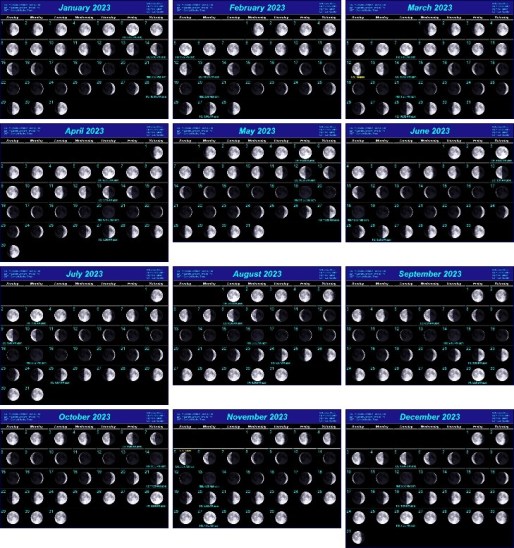
You can use this link to go forward or backward in time for Moon phase information. If you are curious, you can even find out what phase the Moon was in when you or anyone else was born.
The Moon’s current phase for today and tonight is a Waxing Gibbous phase. Visible through most of the night sky setting a few hours before sunrise. This phase is when the moon is more than 50% illuminated but not yet a Full Moon. The phase lasts about 7 days with the moon becoming more illuminated each day until the Full Moon. During a Waxing Gibbous the moon rises in the east in mid-afternoon and is high in the eastern sky at sunset. The word Gibbous first appeared in the 14th century and has its roots in the Latin word “gibbosus” meaning humpbacked.
Visit the January 2023 Moon Phases Calendar to see all the daily moon phase for this month.
The Waxing Gibbous on January 2 has an illumination of 83%. This is the percentage of the Moon illuminated by the Sun. The illumination is constantly changing and can vary up to 10% a day. On January 2 the Moon is 10.71 days old. This refers to how many days it has been since the last New Moon. It takes 29.53 days for the Moon to orbit the Earth and go through the lunar cycle of all 8 Moon phases.
There are 8 lunar phases the Moon goes through in its 29.53 days lunar cycle. The 4 major Moon phases are Full Moon, New Moon, First Quarter and Last Quarter. Between these major phases, there are 4 minor ones: the Waxing Crescent, Waxing Gibbous, Waning Gibbous and Waning Crescent. For more info on the Moon Cycle and on each phase check out Wikipedia Lunar Phase page.
Check the weather before a night of Moon gazing at weather.com
For a list of all the current meteor showers visit American Meteor Society
Here we go — the astrology of January is looking much better than the previous few months, and in more ways than one. January not only marks the end of three retrogrades, but once these planets begin to move forward again, there will officially be zero retrogrades taking place for the remainder of the month. That’s pretty unheard of, considering eight out of the 10 planets are consistently moving back and forth across the sky — so be sure to enjoy it while it lasts.
Mars, the planet of hostility, assertion, and confrontation will finally be ending its retrograde and stationing direct in Gemini in January, and Mercury, the planet of communication, thoughts, and ideas, will be stationing direct in Capricorn just a few days later. Uranus, an outer planet, will also be stationing direct in Taurus this month, but it’s bound to be less noticeable, since this planet is retrograde for five months every year anyway.
While Uranus retrogrades are pretty common (and thus less noticeable), Mercury and Mars retrogrades are in fact, very noticeable. Mars in particular has been retracing its steps through Gemini since Oct. 30, making it difficult to resolve conflict and handle heated encounters with ease. Mercury retrograde has been going on since Dec. 29, and while the planet of communication retrogrades roughly three times each year, it doesn’t make the delays, misunderstandings, and mishaps any less frustrating. The good thing is, once these three planets end their retrogrades, you’ll experience a surge in energy and mental clarity — just in time to set your New Years’ resolutions in motion.
Retrogrades take place when a planet reduces speed in the sky, appearing to move backwards. While they can’t actually turn around and move in the opposite direction, the slowness of a planet that typically moves swiftly tends to affect everyone in major ways, bringing up some potential challenges. For example, when Mercury stations retrograde, communicating effectively as well as processing information can become more difficult. Since Mercury and Mars are inner planets, their retrogrades tend to be much more noticeable, since they’re so close to Earth that they can be seen with a naked eye. Outer planets, like Uranus, retrograde for much longer, but since they’re further away from Earth, we don’t notice the effects as much.

JAN. 1: Hag’s Day – honoring the goddess as She Who Transforms
Day of Ishtar ( Inanna, Ashtart, Ashtaroth, Ashtoreth, Anat, Astarte, Anaitgis, Atar, Isis): Goddess of Love & Battle.
JAN. 2-3: Feast of Old to Greek Goddess Hekate – who guides all through transitions and crisis.
JAN. 6: Triple Goddess Day—honoring the Goddess as the Three-In-One;
Day of the Lord of the Dance – honoring Shiva, seeking his aid for prosperity and wisdom in the New Year, and for prosperity and wisdom in the New Year, and also for a spouse if desired.
JAN. 9: Festival of Isis: Mother Goddess, Great Goddess, Throne of Egypt
JAN. 16: Festival of Ganesh: God of Success
JAN. 17-18 Tu B’Shevat – Jewish Festival of Trees, celebrated with tree plantings and orchard blessings. Originally honored Old Canaanite-Hebrew Goddess Asherah.
JAN. 17-19 Feast of Fate – Ruler of Past, present, and Future, honoring Goddess as Moirai (old Greek), Norns (Old Norse), Coatlicue (Aztec), Pachamama (Inca), Manat (Old Arabic-Sufi) & Providence (Christian).
JAN. 18: Day of Danu – Celebrating the Great Mother Goddess who Shows the Way.
JAN. 23: Egyptian Day of Hathor: Goddess of Love, Tombs and the Sky.
JAN. 24-Feb 1 Sementivae – Old Roman festival of sowing, honoring Earth Goddess Terra (Greek Gaia), Grain Goddess Ceres (Greek Demeter), and Seed Goddess Proserpina (Greek Persephone).

FEB. 2: IMBOLC SABBAT: Cleansing, Purification, Quickening. Imbolc/St.Brigid’s Day – Old Celtic/Irish feast of Goddess Brigid; merged with the Christian feast of St. Brigid. Fires were lit to welcome Her as She traveled about blessing fields, animals, and people.
FEB. 7: Greek Day of Selene: Moon Goddess
FEB. 14: Norse Family Festival – Celebrated as Valentine’s Day
FEB. 1-14 Greek festival of God Dionysus – in which vines were pruned and sprinkled with wine, accompanied by ritual singing and dancing.
FEB. 15: Lupercalia (Festival of the Wolf): Pan’s Day—Honoring the Lord of the Wilderness, Animals, and Fertility. Coming of Spring.
FEB. 23: Egyptian Day of Nut: Goddess of Healing and Fertility
FEB. 28: Cake Day – Offering little cakes to the God and the Goddess; Remembering the ancestors with cakes and flowers.
MAR. 4: Celtic Feast of Rhiannon: Moon Goddess, Underworld Goddess
MAR. 5: Navigium Isidis – Egyptian festival honoring Goddess Isis as Lady of the Moon and Ruler of the Sea; celebrated with the launching of a boat of offerings.
MAR. 9: Mother Goddess Day – honoring all Mother Goddesses – the loving, nurturing Goddess.
MAR. 11: Great Night of Shiva: vigil and feast for Transcendence
MAR. 14: Egyptian Festival of Au Set: Snake Goddess who wards off poverty
MAR. 17: Roman Liberalia: Maenad Festival of Bacchus (Dionysus)– honoring the God of the Vine and Rebirth.
Canaanite of Festival of Astarte: Goddess of Love
MAR. 20: – Ala Festival (Nigerian)
– Iduna’s Day (Norse)
– Alban Eilir (Celtic, Druid holiday)
– Spring Harvest Festival (Egyptian)
MAR. 20-21: Sumerian Festival – celebrating the return of Dumuzi (God of Life and Death) from the Underworld to be with Inanna (Goddess of Life) for the verdant part of the year.
MAR. 20 or 21: OSTARA SABBAT: Spring Equinox; The Goddess of Spring.Spring Equinox aka Vernal Equinox aka Ostara. Marks the beginning of Spring. Days and nights are exactly equal, the sun rises and sets in the exact east and west. This holiday represents the first creation, but also the annual creation (planting so crops grow each year) and most symbolic, the perpetual creation. Fertility symbols abound such as eggs and rabbits. Spring or Vernal Equinox begins a forty day period which culminates with May Day, another fertility Spring festival of ancient origin. The other three forty day periods are: Fall Equinox (Sept 22 or 23) to Halloween/AllSaints Day (Oct. 31, Nov.1), Dec. 25 to Imbolc/Candlemas (Feb 1 or 2) and of course, Lent. Lent is the forty day period beginning on Ash Wednesday and ending on Easter Sunday every year.
MAR. 24: Feast Day of Archangel Gabriel whose name means, “The High One’s Hero,” or “Hero of God,” or “Power of God,” or “Might of God.” Note this day comes one day before Annunciation Day when Gabriel performed his most famous task. Since 1970, the Catholic Church no longer recognizes this day for Gabriel, ending a thousand year plus tradition by opting to lump him in with Raphael and Michael for a Feast of the Holy Archangels Day on Sept 29. Originally the Church had an angel for each of the four “corners” of the year, the solstices and equinoxes. It was the Church’s only recognition of these “pagan” holy days.
MAR. 25: Lady Day – honoring the Crone as Grandmother; Mother of the Mother.
MAR. 30: Babylonian Day of Bau: Mother of Ea (The Earth)
APR. 1: Dark Mother Day –honoring Black Annis, Kali;
Fool’s Day—honoring the God of Chaos Energy.
Day of Venus: Goddess of Love and the Hunt
APR. 5: Roman Day of Fortuna: Goddess of Fate
APR. 7: Feast of Blajini—offerings made to the Other People/Sidhe or Faeries “Kindly Ones”.
APR. 7-8: Feast of Greek Goddess Artemis (Roman Diana) – who represents the feminine in Nature and protects women throughout their lives.
APR. 8: Day of Mooncakes—honoring the Moon Goddess.
APR. 15: – Feast of Tellus Mater (Roman)
– Festival of Ba’ast, Feast of Bast (Egyptian cat goddess)
APR. 16: – St. Padarn’s Day (Celtic)
– Feast of St. George (Byzantine)
APR. 15-17: Feast of the Seas – Honoring God-Goddess as Olokun-Yemaya (Yoruba/Santeria) and Okeanos-Tethys (Old Greek).
APR. 22: Earth Day – Day to honor the Earth and to meditate on Deity manifesting as Mother Earth
– Festival of Isthar (Babylonian)
– Feast of the Divine Couple (Japanese)
– Feast of Elaphebolia (Greek)
– Odin’s Day – Norse festival.
APR. 23: Festival of the Greenman—honoring the God of the Forest and vegetation.
APR. 25: – Spring Festivals – Dedicated to Herne, Pan, Horned God.
– Roman Robligalia – Corn Mothers (Ceres and Demeter) and Harvest.
APR. 25: Spring Festival – dedicated to the Horned God and Corn Mother.
APR. 28: Celebrated April 28 – May 3: Festival of Flora: remembrance of those who passed into the Underworld.
APR. 30: May Eve—Walpurgis Night; annual gathering of Witches and covens. Beltane Begins at Sundown (Celtic, Wiccan) Old Norse Feast.
APR. 30 – MAY 2: – Beltane – Celtic festival marking the arrival of summer in ancient times, celebrating Blodeuwedd (Goddess of Flowers) and Llew (Oak King, God of the Waxing Sun).
– Old Norse Feast – Celebrating Nanna (Goddess of Flowers), true love of Baldur (God of Light).
– Feast of Sacred Marriage – Honoring Goddess-God as Inanna & Dumuzi , Ishtar & Tammuz (Old Sumerian), Isis & Osiris (Egyptian), Oshun & Shango (Yoruba/Santeria).
MAY 1: BELTANE SABBAT: Festival of Spring and Fertility. Sidhe Day. Beltaine – Celtic festival marking the arrival of summer in ancient times.
MAY 4: Celtic/British Festival of Cerridwen and Brigit: Corn Goddesses of Fertility
May 4 – Celtic Festival of Cerridwen and Brigit – Corn Goddesses of fertility, healing, and poets.
– St. Monica’s Day (Irish)
– Veneration of the Thorn (Irish)
– Festival of Sheila Na Gig (Irish)
MAY 6: – Shepherd’s Day – Day to meditate on Deity as Lord of Animals: Dumuzi (Old Sumerian), Osiris (Egyptian), Pan (Old Greek), Shiva Pasupati (Hindu).
– Eyvind Kelve (Norse)
MAY 9: – Greek Feast of Artemis
MAY 9-12: Lemuria – Roman festival when the spirits of the dead are thought to revisit their homes.
MAY 13: – Roman Garland Day, Offering garlands to Neptune.
– Month of Hawthorn, Celtic festival of the tree.
– Our Lady of Fatima Day (Portugal)
MAY 14: – Isis Day in ancient Egypt
MAY 14: -16 Feast of Divine Love and Compassion – Source of healing and beneficence, honoring the Goddess as Isis (Old Egyptian), Oshun (Yoruba/Santeria), Lakshmi (Hindu).
MAY 15: – Festival of Vesta (Roman)
– Maia and Mercury’s Day (Roman)
MAY 18: – Celtic Feast of Greek God Pan – Who represents the masculine in Nature and protects men throughout their lives. Men recognized the transitions in their lives and honored male fertility.
MAY 19: Celtic Feast of Brigid – In which sacred healing wells and springs were adorned with flowers in honor of Goddess Brigid, daughter of Mother Goddess Danu and Father God Dagda.
MAY 21: Dark/Bright Mother Goddess Day—honoring Hecate/Demeter; Uma; Kali/Parvati .
MAY 26: – Festival of Diana begins (ends 31st) (ancient Roman holiday)
MAY 28: FEAST OF BENDIDIA—family feast day honoring of the Goddess of the Moon, Dark Moon, Underworld, Secret Wisdom and Witches.
May 30 – Frigg’s Day, Northern Goddess, spouse of Odin (Teutonic “heathen” European pre-Christian holiday)
– Feast of the Queen of the Underworld Begins (Roman)
– Feast of the Queen of Heaven (European)
Month of Juno – Dedicated to Roman Goddess Juno, partner of Jove (God of Happiness), protector of marriage and family.
June 2 – Juno Regina’s Day (Roman)
– Sin’s Day (Norse)
– Shapatu of Ishtar (Babylonian)
– Seamen’s Day (Icelandish)
– St. Elmo’s Day
JUN. 5: Earth Mother Day—honoring Gaia/Tailtiu/Mother Earth. Calling forth good harvests.
JUN. 11: – Feast of Matuta (Roman)
– Matralia (Roman)
– Fortuna’s Day (Roman)
JUN. 13: Feast of Epona – The Celtic Horse Goddess honoring the Goddess of the Horse [Otherworld Guide].
– Athena’s Day (Greek)
– Minerva’s Day (Roman)
JUN. 14: – Vidar’s Day (Norse)
– Birthday of the Muses (Greek). Music, the arts & inspiration “born”
JUN. 16: – Night of the Teardrop (Egyptian)
JUN. 18: Roman Day of Anna – Goddess Danu to the Celts. Early Christian-Pagans made sure Anna entered the Kristian story, making her Yeshua’s grandmother, Mary’s mother.
JUN. 20: – Iron Skegge’s Day (Norse)
– Festival of Edfu (Egyptian)
– Kuan-Yin Day (day she became a Bodhisattva)
JUN. 21: LITHA SABBAT: Summer Solstice; celebrating Fullness of the Year, Midsummer’s Ever: offerings to the Other People.
– Day of Cerridwen and her Cauldron (English/Welsh)
– Day of Aine of Knockaine (Irish)
– Day of the Green Man (Northern Europe)
– The Great Mother (British)
– Alban Hefin (Druidic)
– Waa-Laa Ends (Native American)
– Litha (Wiccan)
– All Hera’s Day (Roman)
– Ishtar’s Day (Babylonian)
– Astarte’s Day (Canaanite)
– Aphrodite’s Day (Greek)
– Yemaya’s Day (Brazilian)
– Aine’s Day (Irish)
JUN. 23: Day of the Lady and Lord of the Sidhe—Otherworld aspects of the Divine.
– Day of the Fairy Goddesses – Aine, Ana, Anu, Danu
– Celtic Day of the Greenman – Herne, Cernunnos, Lugh
JUN. 24: TEMPLAR HOLY DAY. In the Roman calendar this day was thought to be Summer Solstice. The Church renamed this pagan holiday to St. John the Baptist Day. Templars revered it highly. On Jun 24, 1314 a mysterious band of knights joined Robert the Bruce of Scotland on the battlefield making his victory at Bannockburn possible. These knights could only have been the a troop of disbanded and now in-hiding Templars who had fled to western Scotland. St. John’s day was used by Freemasons in 1717 to found the first public (non-Scottish) Order of Freemasonry in London. Masonic teachings are said to descend from the esoteric Christianity of Templarism. St. John the Baptizer was beheaded because he wouldn’t give in and sacrifice his principles. This is a Templar ideal, as is the constancy and regularity — order out of chaos — of the solstices and equinoxes. So for both reasons, Christian and “pagan,” we observe this day.
– Feast of the Sun (Aztec)
– Midsummer Bride (Swedish)
– Inti Raymi (Incan)
– Lady Luck (European)
– Burning of the Lamps at Sais (Egyptian)
JUN. 25: Parvati Praise Day – Women’s Festival for Earth Mother
JUN. 27: Day of the Lares: Household Deities (/Roman) – honored and tended —cleanse/rededicate household – Altars/shrines.
JUN. 29: Shiva Day: Lord of the Dance invoked for blessings
JUN. 30: Sumerian Day of Aestas: Corn Goddess
JUL. 1: Crone Day – Kronia —honoring Kronos -Father Time and Rhea – Old Mother Nature.
JUL. 2: Roman Feast of Expectant Mothers.
JUL. 8 Celtic Month of Holly – Honoring the Holly tree.
JUL. 12-14: Feast of the Moon – Honoring Goddess as Selene (Old Greek), Ixchel (Maya), and Manat (Old Arabic-Sufi).
JUL. 13: Birth of Osiris – Egyptian God of Divine Youth, annually resurrected by Isis.
JUL. 17: Celtic Feast of Tailtiu – Mother Nature Goddess who fostered Lugh.
JUL. 21: Witch’s Day—Celebrating the Craft as life, practice and religion.
JUL. 19: Egyptian Opet Festival – Celebrating the marriage of Isis and Osiris.
JUL. 23: Roman Neptunalia: honoring Neptune, God of the Sea
JUL. 27: Belgium Procession of the Witches: Festival of Witches
JUL. 28: Archangel Auriel (Uriel) Day. His/Her name means “Fire or Light of God,” and titles include, Regent of the Sun, Angel of Music, Patron of Prophecy, Archangel of Salvation, Angel of the Presence. See Uriel.org for more about him/her, the crystal egg association, and paintings.
JUL. 29: Festival of Thor – Celebration of Norse God Thor
JUL. 31: thru Aug 2 – Lughnasadh – Old Celtic / Irish Feast of Goddess Tailtiu and God Lugh (Deities of Life and Light), celebrating the grain harvest. Aug. Eve; Sun God, Harvest God, Horned God willing to become the grain of life.
– Lammas, harvest festival coming 40 days after Summer Solstice, offer 1st fruits to the Divine (See Aug. 1)
– Festival of Loki – Day to honor Norse trickster god Loki and his consort Sigyn
– Feast of the Grain Harvest – Honoring Goddess Demeter & Kore (Old Greek), and God as Osiris (Egyptian).
AUG. 1: LUGHNASSADH / LAMMAS SABBAT: First Harvest—Bread Harvest. First Harvest Festival of the Celtic Sun God Lugh.
AUG. 2: Feast of the Black Madonna – Gnostic celebration of the Dark Goddess
AUG. 3: Day of the Dryads – Greek celebration of the Macedonian maiden spirits of woods and water.
AUG. 3-4: Feast of Old Greek Goddess Artemis (Roman Diana) – Defender of rights and liberties, and punisher of rapists and oppressors.
AUG. 5: Celtic Tree Month of Hazel begins.
AUG. 6: Celtic Fire Festival of Tan Hill.
AUG. 9: Druid Feast of the Fire Spirits
– Roman Vinalia Rustica: wine festival of Venus and Pan
AUG. 11-13: Feast of Father Sky – Honoring God as Obatala (Yoruba/Santeria), Ouranos (Greek), Svarog (Slavic), Thor (Norse), Taranis (Celtic), Dyaus (Hindu).
– Celtic Puck Fair – Fertility Festival.
AUG. 12: The Lights of Isis, Festival of the Egyptian Goddess Isis.
AUG. 19: Roman Vinalia: Marriage of Bacchus
AUG. 20: Marriage of the God and Goddess—Sun God enters Earth Goddess and rules Underworld as Lord of the Shadows.
AUG. 21: Festival of Hecate—Invoking her to protect the harvests now that the God resides within her aspect as the Earth Goddess.
AUG. 21: Greek Festival of Hecate – To protect the harvest.
AUG. 24: Feast of Egyptian God Osiris – Partner and true love of Isis, and father of Horus; guide of all husbands, fathers, and judges.
AUG. 25: Norse God Odin receives knowledge.
– Roman Festival of Goddess Ops – Lady of the Cornucopia, Bounty of the Harvest and Sustainer of Life.
AUG.27: Feast of Egyptian Goddess Isis – Partner and true love of Osiris, and mother of Horus; guide of all wives, mothers, healers, advocates, and teachers.
AUG. 28: Norse Harvest Festival.
AUG. 29 -Sep 11: Return of Isis – Egyptian festival marking the return to Egypt of Goddess Isis (as the star of Sept/Sirius) and God Osiris (as the rising Nile River).
AUG. 29 – SEPT. 11: Return of Isis & Osiris (star Sirius, rising Nile waters)
SEP. 2: Grape Vine Festival honoring Ariadne & Dionysus
SEP. 9 – 11: Feast of Mother Earth (Greek, etc)
SEP. 9 – 18: Greater Eleusinian Mysteries (Greek): rites of Demeter/Persephone/Hades done every five years. (prepare on the 2nd, initiates on the 11th, purifying sea bath or sea salt bath on the 12th, offerings of barley and grain on the 13th, ‘holy basket of Demeter’/Persephone’s adduction by Hades on the 14th, torch procession for Demeter’s search on the 15th, Holy Night/Initiations/Dedications show mystery/promise of renewed life on the 16th, games/sports/Feast of Divine Life dedicated to Triple Goddess of Kore-Demeter-Persephone on the 18th, return with earthen jars representing the womb of Demeter on the 19th).
SEP. 13: Egyptian Lighting the Fire Ceremony for all departed souls —honoring with candlelight the spirits of the dead.
SEP. 19: Feast of Thoth, Egyptian scribe god
SEP. 21 – 23: MABON SABBAT: Autumn Equinox; Second Harvest—Vine Harvest; Harvest Home/Thanksgiving Feast/Winter-finding for the Norse. The Fall Equinox always begins the forty day
– Birthday of Athena, Greek Goddess of Wisdom also known as Sophia
– Babylonian Ishtar’s Day: Great Goddess
Sep or sometimes Oct (day varies) Rosh Hashanah, Jewish New Year, always followed ten days later by
SEP. 26 – Oct 5: Navaratri, Hindu Festival of the Great Goddess – Huge holiday in India when Goddess destroys evil and restores cosmic order
Mesopotamian Day of the Sheepfolds: sacrifice to Goat God Azazel.
SEP. 27: Mesopotamian Day of the Willows: Festival of Astarte/Asherah
SEP. 29: Greek Festival Of Nemesis: Goddess of Fate
OCT. 2: Feast of the Guardian Spirits—honoring spirit guides and helpers.
OCT. 4: Roman Jejunium Cereris: Fast Day for Ceres
OCT. 9-11: Feast of Divine Wisdom – Source of all knowledge, honoring God-Goddess as Odin-Frigg (Norse); and Goddess as Sophia/Wisdom (Christian), Truth/Maat (Egyptian), Metis (Greek), Sarasvati (Hindu), & Manat (Arabic-Sufi).
OCT. 13: Knights Templar Remembrance Day
Greek Thesmophorus: five-day women’s pilgrimage for Aphrodite as Goddess of Genetyllis (childbirth), Demeter as Mother of a beautiful child (Persephone), with revelry the first day, celebration the second, temple of Demeter the third, fast and mourning for Persephone the fourth, and rejoicing the fifth day.
Oct 18 English Great Horn Fair – Festival of Herne.
OCT. 18: Great Horn Festival—Horned God and Lady of the Wood invoked for the fertility of wild game and the Hunting Season.
OCT. 24: Raphaelmas, Feast of Archangel Raphael, whose name means, “The High One Heals.” Since 1970, the Catholic Church no longer recognizes this day for Raphael, ending more than a thousand years of tradition by opting to lump him in with Gabriel and Michael for a Feast of the Holy Archangels Day on Sept 29.
OCT. 24: Druid Feast for Spirits of Air
OCT. 26 – NOV. 2: Egyptian Zetesis and Heuresis search and recovery of Osiris by Isis.
– Isia – Egyptian festival recalling Set (God of Destruction) killing God Osiris; Goddess Isis mourning Him, resurrecting Him, and conceiving God Horus with Him; and Osiris becoming Lord of Amenta, land of the dead. He weighs souls against the Feather of Truth on Goddess Maat’s Scale of Justice, but defers to Isis for those who fail the test.
OCT. 31: Samhain / Hallowmas / Halloween – Celtic New Year and feast of Cerridwen (Goddess of Death) and Beli (the Holly King, God of the Waning Sun). Last Harvest; New Year, day when the veil between the worlds is thinnest (God enters the Goddess’ womb for rebirth, hence the tomb become the womb. Third Harvest—Root Harvest; All Hallows Ever: Dark God and Dark Goddess united in the Underworld allow spirit communication at this most holy [hallowed] time.
– 31 – NOV. 2: Descent of Inanna – Sumerian fast recalling the descent of Inanna (Goddess of Life) to the Underworld. Ereshkigal (Goddess of Death and Rebirth) detained Her until She agreed to have Dumuzi (God of Life and Death) remain there each Winter.
– Fast of Hod – Norse fast marking Hod (blind God of Darkness) unintentionally killing Balder (God of Light), and devoted Nanna (Goddess of Flowers) dying of a broken heart.
0CT. 31 – Nov 6: Mid-Autumn / Day of the Dead / Hallowmas – Festival marking the transformation of life to death, the end of the agricultural year, departure of migrating and hibernating animals, and decay and death of vegetal and animal life. Observed by remembering departed ancestors and contemplating one’s own mortality.
NOV. 1: Cailleach’s Reign—Day of the Banshees; honoring the Riders of the Wild Hunt who search for souls to transport to the Land of Shadows. Reign of Celtic Cailleach, Crone Goddess.
NOV. 2: – White Tara Day. Day for meditation on Tantric Bodhisattva Goddess, White Tara, who guides the dead to Buddha Amitabha’s Pure Land, where all will find salvation.
– Egyptian Festival of Hathor: Mother of the Gods
NOV. 7 – 9: Feast of Divine Justice – Source of just law, honoring Goddess-God as Maat-Thoth (Egyptian); Goddess as Themis (Greek), Justice (Christian), and God as Forseti (Norse).
NOV. 11: Feast of Dionysus – Greek God whom Yeshua was “connected to” as the Cosmic Gnosis.
– Celtic Lunatishees—Day of the Fairy Sidhe; honoring the Other People in whom is held the immortal life force; Old November Eve [Samhain on old calendar].
NOV. 13: Festival of Jupiter – Roman deity associated with rain and agriculture, prime protector of the state, and concerned with all aspects of life.
– Roman Fontinalia – Feast of Fons, God of Springs.
NOV. 14: Feast of Musicians and Bards – Druid celebration of the Celtic musical arts.
NOV. 16: – Thracian Night of Hecate, Greek Goddess of the Hags or Wisewomen, (later called Witches), her name comes from Heqa-ma’at, a goddess in the ancient Egyptian Book of the Dead who later became Hekmah or Hokmah (also spelled Chokmah) meaning wisdom in the ancient Hebrew Bible (Old Testament). From Heqa-ma’at / Hecate / Hokmah we get the Greek word for wisewoman or holywoman, “hag”. Honoring Hecate – Thracian Goddess of the Moon, Magick, and Witches as the Teacher of the Craft.
NOV. 22: NIGHT OF SHIVA—family feast day honoring Shiva as the Pillar of Light/the life-force as the Infinite Light, with oil lamps and candlelight.
– Roman Festival of Diana: Goddess of Moon, Hunt, Wilderness, Birth.
NOV. 27: Uma/Parvati Day—honoring the Goddess as Queen and Mother of the Universe.
NOV. 29: Egyptian Feast of Hathor—honoring the Goddess as Horned Mother, and also as Sekhmet, the Lion Goddess of the Sun, and as Bastet, the Cat Goddess of Fertility and Life—Triple Goddess Bast-Hathor-Sekhmet.
DEC. 1: – Greek / Roman Day of Pallas Athena / Minerva.
– Day for Meditation on Tantric Bodhisattva Goddess Red Tara – Protector against evil and harm.
DEC. 3: – Roman Day of Cybele / Rhea – The Great Mother.
DEC. 4: – Feast of Shango – Orisha who defends against evil.
DEC. 6: – Mindfulness Day – Zen Buddhist day for mindfully seeing and acting with compassion for the poor and oppressed.
DEC. 7: – Haloia of Demeter.
DEC. 7 – 9: Feast of the Immanent Feminine Divine Spirit – Honoring Goddess as Maha Devi Shakti (Hindu), Holy Spirit Wisdom (Christian).
DEC. 8: Rohatsu – Zen Buddhist celebration of the Buddha’s enlightenment.
DEC. 11: – Sacred to Arianrhod.
DEC. 12: – Fiesta of Our Lady of Guadalupe – Mother of God and Mother of the Oppressed.
DEC. 13: – Feast of the Light-bringer – Honoring Goddess as Juno Lucina (Old Roman).
DEC. 14 – 28: Halcyon Days: time of tranquility.
DEC. 17: – Yoruba / Santeria feast of Orisha Babalu Aye – Healer of deadly diseases.
– Roman/Greek: Saturnalia begins festival to Saturn/Kronos as Harvest and Father Time with His scythe
DEC. 18: – Sacred to Epona.
DEC. 19: – Modresnact: Norse Mothers Night Festival.
DEC. 21: – thru 25 – Old Egyptian festival of Isis, the Magna Mater (Mother of God and Mother of All) giving birth to God Horus.
– YULE SABBAT: Winter Solstice; Return of the Sun God.
DEC. 23: – Sacred to Hathor.
DEC. 24: – Celtic Tree Month – Month of Reed ends, Tree Month of Elder begins.
– Celtic / German Nodlaig Eve/Modresnach: Night of the Great Mother
DEC. 25: – European Feasts of Herne, Frey, Dionysus – Birth of the God, the Light of the World.
DEC. 25: thru Jan 5: Old Norse festival honoring Saturn, Dionysus, Frey and Freya (Deities of Fertility) and the birth of the new-born Baldur (God of Light) with evergreens, fires, and feasting.
DEC. 28: – Sacred to Freya.
DEC. 31: Hogmanay—New Year’s Eve; Crone preparing to depart, winter at its height; Crone, old and withered year changes at midnight into young and fresh New Year. Hag’s Eve.
– Egyptian Lucky Day of Sekmet – Sekmet, the ravaging lioness, with her burning solar eye, is the destroyer/devourer aspect of the goddess.
| Weekday | Holiday | Category | Date | Days away |
|---|---|---|---|---|
| Sunday | New Year’s Day | Christian Holidays | Jan 1, 2023 | Today |
| Thursday | Guru Gobind Singh Birthday | Sikh Holidays | Jan 5, 2023 | in 4 days |
| Friday | Epiphany | Christian Holidays | Jan 6, 2023 | in 5 days |
| Friday | Armenian Orthodox Christmas Day | Christian Holidays | Jan 6, 2023 | in 5 days |
| Saturday | Mahayana New Year | Buddhist Holidays | Jan 7, 2023 | in 6 days |
| Sunday | Baptism of Jesus | Christian Holidays | Jan 8, 2023 | in 7 days |
| Friday | Lohri – Maghi | Sikh Holidays | Jan 13, 2023 | in 12 days |
| Sunday | Makar Sankranti | Hindu Holidays | Jan 15, 2023 | in 14 days |
| Sunday | Chinese New Year | Buddhist Holidays | Jan 22, 2023 | in 21 days |
| Thursday | Candlemas | Christian Holidays | Feb 2, 2023 | in 32 days |
| Sunday | Thaipusam | Hindu Holidays | Feb 5, 2023 | in 35 days |
| Monday | Tu Bishvat | Jewish Holidays | Feb 6, 2023 | in 36 days |
| Thursday | Saint Maroun’s Day | Christian Holidays | Feb 9, 2023 | in 39 days |
| Tuesday | Saint Valentine’s Day | Christian Holidays | Feb 14, 2023 | in 44 days |
| Wednesday | Parinirvana Day | Buddhist Holidays | Feb 15, 2023 | in 45 days |
| Saturday | Lailat al Miraj | Muslim Holidays | Feb 18, 2023 | in 48 days |
| Saturday | Maha Shivaratri | Hindu Holidays | Feb 18, 2023 | in 48 days |
| Monday | Fasching | Germany Holidays | Feb 20, 2023 | in 50 days |
| Wednesday | Lent | Christian Holidays | Feb 22, 2023 | in 52 days |
| Tuesday | Lailat al Bara’a | Muslim Holidays | Mar 7, 2023 | in 65 days |
| Tuesday | Purim | Jewish Holidays | Mar 7, 2023 | in 65 days |
| Tuesday | Holi | Hindu Holidays | Mar 7, 2023 | in 65 days |
| Tuesday | Holika Dahan | Hindu Holidays | Mar 7, 2023 | in 65 days |
| Wednesday | Hola Mohalla | Sikh Holidays | Mar 8, 2023 | in 66 days |
| Friday | Saint Patrick’s Day | Christian Holidays | Mar 17, 2023 | in 75 days |
| Sunday | Mothering Sunday | Christian Holidays | Mar 19, 2023 | in 77 days |
| Sunday | Saint Joseph’s Day | Christian Holidays | Mar 19, 2023 | in 77 days |
| Wednesday | Ugadi / Telugu New Year | Hindu Holidays | Mar 22, 2023 | in 80 days |
| Thursday | Ramadan | Muslim Holidays | Mar 23, 2023 | in 81 days |
| Saturday | Annunciation Day | Christian Holidays | Mar 25, 2023 | in 83 days
|
| Weekday | Holiday | Category | Date | Days away |
|---|---|---|---|---|
| Thursday | Rama Navami | Hindu Holidays | Mar 30, 2023 | in 88 days |
| Sunday | Palm Sunday | Christian Holidays | Apr 2, 2023 | in 91 days |
| Wednesday | Passover | Jewish Holidays | Apr 5, 2023 | in 94 days |
| Thursday | Maundy Thursday | Christian Holidays | Apr 6, 2023 | in 95 days |
| Thursday | Hanuman Jayanti | Hindu Holidays | Apr 6, 2023 | in 95 days |
| Friday | Good Friday | Christian Holidays | Apr 7, 2023 | in 96 days |
| Sunday | Easter | Christian Holidays | Apr 9, 2023 | in 98 days |
| Monday | Easter Monday | Christian Holidays | Apr 10, 2023 | in 99 days |
| Friday | Tamil New Year | Hindu Holidays | Apr 14, 2023 | in 103 days |
| Friday | Vaisakhi | Sikh Holidays | Apr 14, 2023 | in 103 days |
| Saturday | Bihu / Bengali New Year | Hindu Holidays | Apr 15, 2023 | in 104 days |
| Tuesday | Laylat al-Qadr | Muslim Holidays | Apr 18, 2023 | in 107 days |
| Tuesday | The Holocaust Remembrance Day | Jewish Holidays | Apr 18, 2023 | in 107 days |
| Tuesday | Yom HaShoah | Jewish Holidays | Apr 18, 2023 | in 107 days |
| Tuesday | Birthday of Guru Angad Dev | Sikh Holidays | Apr 18, 2023 | in 107 days |
| Friday | Eid al-Fitr | Muslim Holidays | Apr 21, 2023 | in 110 days |
| Saturday | Akshaya Tritiya | Hindu Holidays | Apr 22, 2023 | in 111 days |
| Sunday | Saint George’s Day | Christian Holidays | Apr 23, 2023 | in 112 days |
| Tuesday | Yom HaAtzma’ut | Jewish Holidays | Apr 25, 2023 | in 114 days |
| Wednesday | Israel’s Independence Day | Jewish Holidays | Apr 26, 2023 | in 115 days |
| Tuesday | Lag Baomer | Jewish Holidays | May 9, 2023 | in 128 days |
| Thursday | Feast of the Ascension | Christian Holidays | May 18, 2023 | in 137 days |
| Friday | Yom Yerushalayim | Jewish Holidays | May 19, 2023 | in 138 days |
| Friday | Savitri Brata | Hindu Holidays | May 19, 2023 | in 138 days |
| Friday | Vesak | Buddhist Holidays | May 19, 2023 | in 138 days |
| Friday | Shavuot | Jewish Holidays | May 26, 2023 | in 145 days |
| Sunday | Pentecost | Christian Holidays | May 28, 2023 | in 147 days |
| Monday | Whit Monday | Christian Holidays | May 29, 2023 | in 148 days |
| Sunday | Trinity Sunday | Christian Holidays | Jun 4, 2023 | in 154 days |
| Thursday | Corpus Christi | Christian Holidays | Jun 8, 2023 | in 158 days |
| Weekday | Holiday | Category | Date | Days away |
|---|---|---|---|---|
| Tuesday | Feast of Saint Anthony | Christian Holidays | Jun 13, 2023 | in 163 days |
| Friday | Martyrdom of Guru Arjan | Sikh Holidays | Jun 16, 2023 | in 166 days |
| Tuesday | Rath Yatra | Hindu Holidays | Jun 20, 2023 | in 170 days |
| Saturday | Feast of Saint John the Baptist | Christian Holidays | Jun 24, 2023 | in 174 days |
| Tuesday | Day of Arafah | Muslim Holidays | Jun 27, 2023 | in 177 days |
| Wednesday | Eid al-Adha | Muslim Holidays | Jun 28, 2023 | in 178 days |
| Thursday | Feast of Saints Peter and Paul | Christian Holidays | Jun 29, 2023 | in 179 days |
| Monday | Guru Purnima | Hindu Holidays | Jul 3, 2023 | in 183 days |
| Monday | Asalha Puja | Buddhist Holidays | Jul 3, 2023 | in 183 days |
| Saturday | Saint Vladimir Day | Christian Holidays | Jul 15, 2023 | in 195 days |
| Wednesday | Muharram / Islamic New year | Muslim Holidays | Jul 19, 2023 | in 199 days |
| Tuesday | Saint James the Great Day | Christian Holidays | Jul 25, 2023 | in 205 days |
| Thursday | Tisha B’Av | Jewish Holidays | Jul 27, 2023 | in 207 days |
| Friday | Ashura | Muslim Holidays | Jul 28, 2023 | in 208 days |
| Friday | Ashura Eve | Muslim Holidays | Jul 28, 2023 | in 208 days |
| Tuesday | Lammas | Christian Holidays | Aug 1, 2023 | in 212 days |
| Sunday | Bon Festival | Buddhist Holidays | Aug 13, 2023 | in 224 days |
| Tuesday | The Assumption of Mary | Christian Holidays | Aug 15, 2023 | in 226 days |
| Monday | Naga Panchami | Hindu Holidays | Aug 21, 2023 | in 232 days |
| Friday | Varalakshmi Vrata | Hindu Holidays | Aug 25, 2023 | in 236 days |
| Tuesday | Onam | Hindu Holidays | Aug 29, 2023 | in 240 days |
| Wednesday | Raksha Bandhan | Hindu Holidays | Aug 30, 2023 | in 241 days |
| Wednesday | Krishna Janmashtami | Hindu Holidays | Sep 6, 2023 | in 248 days |
| Friday | Nativity of Mary | Christian Holidays | Sep 8, 2023 | in 250 days |
| Thursday | Holy Cross Day | Christian Holidays | Sep 14, 2023 | in 256 days |
| Saturday | Rosh Hashanah | Jewish Holidays | Sep 16, 2023 | in 258 days |
| Sunday | Vishwakarma Puja | Hindu Holidays | Sep 17, 2023 | in 259 days |
| Monday | Fast of Gedaliah | Jewish Holidays | Sep 18, 2023 | in 260 days |
| Tuesday | Ganesh Chaturthi | Hindu Holidays | Sep 19, 2023 | in 261 days |
| Monday | Yom Kippur | Jewish Holidays | Sep 25, 2023 | in 267 day |
| Weekday | Holiday | Category | Date | Days away |
|---|---|---|---|---|
| Wednesday | Mawlid al-Nabi | Muslim Holidays | Sep 27, 2023 | in 269 days |
| Thursday | Anant Chaturdashi | Hindu Holidays | Sep 28, 2023 | in 270 days |
| Friday | Michael and All Angels | Christian Holidays | Sep 29, 2023 | in 271 days |
| Sunday | Sukkot | Jewish Holidays | Oct 1, 2023 | in 273 days |
| Saturday | Shemini Atzeret | Jewish Holidays | Oct 7, 2023 | in 279 days |
| Saturday | Simchat Torah | Jewish Holidays | Oct 7, 2023 | in 279 days |
| Sunday | Navaratri | Hindu Holidays | Oct 15, 2023 | in 287 days |
| Friday | Birth of the Guru Granth | Sikh Holidays | Oct 20, 2023 | in 292 days |
| Saturday | Saraswati Puja | Hindu Holidays | Oct 21, 2023 | in 293 days |
| Tuesday | Dussehra | Hindu Holidays | Oct 24, 2023 | in 296 days |
| Saturday | Sharad Purnima | Hindu Holidays | Oct 28, 2023 | in 300 days |
| Tuesday | All Hallows Eve | Christian Holidays | Oct 31, 2023 | in 303 days |
| Tuesday | Reformation Day | Christian Holidays | Oct 31, 2023 | in 303 days |
| Wednesday | All Saints’ Day | Christian Holidays | Nov 1, 2023 | in 304 days |
| Wednesday | Karva Chauth | Hindu Holidays | Nov 1, 2023 | in 304 days |
| Thursday | All Souls’ Day | Christian Holidays | Nov 2, 2023 | in 305 days |
| Thursday | Diwali | Hindu Holidays | Nov 9, 2023 | in 312 days |
| Friday | Dhanteras | Hindu Holidays | Nov 10, 2023 | in 313 days |
| Tuesday | Bhai Dooj | Hindu Holidays | Nov 14, 2023 | in 317 days |
| Sunday | Chhath Puja | Hindu Holidays | Nov 19, 2023 | in 322 days |
| Thursday | Thanksgiving | Christian Holidays | Nov 23, 2023 | in 326 days |
| Friday | Martyrdom of Guru Tegh Bahadur Sahib | Sikh Holidays | Nov 24, 2023 | in 327 days |
| Sunday | Christ the King | Christian Holidays | Nov 26, 2023 | in 329 days |
| Monday | Kartik Purnima | Hindu Holidays | Nov 27, 2023 | in 330 days |
| Monday | Guru Nanak Birthday | Sikh Holidays | Nov 27, 2023 | in 330 days |
| Tuesday | Loy Krathong | Buddhist Holidays | Nov 28, 2023 | in 331 days |
| Thursday | Saint Andrew’s Day | Christian Holidays | Nov 30, 2023 | in 333 days |
| Sunday | Feast of Saint Francis Xavier | Christian Holidays | Dec 3, 2023 | in 336 days |
| Wednesday | Saint Nicholas Day | Christian Holidays | Dec 6, 2023 | in 339 days |
| Friday | Feast of the Immaculate Conception | Christian Holidays | Dec 8, 2023 | in 341 days |
| Weekday | Holiday | Category | Date | Days away |
|---|---|---|---|---|
| Friday | Hanukkah | Jewish Holidays | Dec 8, 2023 | in 341 days |
| Friday | Bodhi Day | Buddhist Holidays | Dec 8, 2023 | in 341 days |
| Saturday | Dhanu Sankranti | Hindu Holidays | Dec 16, 2023 | in 349 days |
| Friday | Gita Jayanti | Hindu Holidays | Dec 22, 2023 | in 355 days |
| Sunday | Christmas Eve | Christian Holidays | Dec 24, 2023 | in 357 days |
| Monday | Christmas | Christian Holidays | Dec 25, 2023 | in 358 days |
| Tuesday | Saint Stephen’s Day | Christian Holidays | Dec 26, 2023 | in 359 days |
| Thursday | Holy Innocents | Christian Holidays | Dec 28, 2023 | in 361 days |
| Sunday | New Year’s Eve | Christian Holidays | Dec 31, 2023 | in 364 days |


SunSigns.Org is presenting you with the Chinese Horoscope 2023 for the Year of the Black Water Rabbit. The Chinese New Year commences on January 22, 2023, and will end on February 9th, 2024. We are offering you the overall picture of how the 12 Chinese Zodiacs will face their future during the year.
The Chinese horoscope 2023 will cover all the areas of life, such as health, romance, relationships, family, business, profession, and many other things. This yearly Chinese forecast prepares you to face all eventualities.
2023 Chinese Horoscopes for the different zodiacs covering the Rat, Ox, Tiger, Rabbit, Dragon, Snake, Horse, Sheep, Monkey, Rooster, Dog, and Pig signs are detailed below. You can also get the Feng Shui 2023 predictions and Chinese Horoscopes 2023 for all the signs.
SunSigns.Org has come out with astrological predictions Horoscope 2023 for the year 2023. This astrology forecast covers the various aspects of life of people such as profession, finance, love, romance, education, family, travel, and well-being. No need to wait! You can get an inkling into the future of yours as well as those of your family and friends.
It is well known that all individuals will fall under the influence of the 12 zodiac signs namely Aries, Taurus, Gemini, Cancer, Leo, Virgo, Libra, Scorpio, Sagittarius, Capricorn, Aquarius, and Pisces. Different planets have different impacts on the life of human beings. The Horoscope 2023 predicts future events likely to occur in their lives. We may not be able to change our destiny, but at least we can be geared up to face the eventualities.
Horoscope 2023 promises significant transformations in the areas of profession, love relationships as well as business ventures. You may reach great heights, But, at the same time, be ready to face equally more significant challenges. Predictions for the various zodiacs are available free of charge. You only have to click on the right yearly prediction.


There are no restrictions to shopping or important decisions today. The Moon is in Taurus.
Many of you will earn more money and get richer this year. And yet, at the same time, you will go through cupboards, closets, garages and storage areas so that you can downsize and get rid of what is no longer useful or relevant in your life.
This year will be very fortunate for you because in May, lucky Jupiter will enter your sign for the first time in 12 years, giving you a marvellous boost until June 2024. Count your lucky stars! It’s time to learn not to sell out to others but to integrate your world with others.
This is a powerful time in your life because you are entering your time of harvest, which is a cycle that occurs only once every 30 years. It will still be a time of great responsibilities; however, your success will be obvious to everyone.
You can look forward to a more popular year! Expect to make new friends and be more involved in clubs, groups and organizations. Meanwhile, start to prepare for a time of recognition in about three years. Pursue further education or training to prepare yourself.
For the first time in 12 years, this year, lucky Jupiter will travel across the top of your chart boosting your reputation and making you shine in the eyes of others. Expect a promotion, an award or an opportunity to pursue new work.
Plan for many travel opportunities this year, as well as opportunities to get further education and training. You begin this year with a sense of ambition. You will also receive more acknowledgement and recognition for your past efforts.
This year will bring you good financial opportunities. Many of you might inherit or benefit from the wealth and resources of someone else, including a spouse or a partner. It will also be a time of hard work, which means you will have to apply yourself to get the results you want.
Your closest relationships will be happier this year. In fact, this year is the best year in over a decade for Scorpios to get married. Meanwhile, many of you might have increased responsibilities with children. In July, August, Sept. and Oct. you look great to everyone!
This year holds marvellous opportunities for you. For starters, you can improve your health in 2023. Furthermore, you can get a better job, or improve your existing job with better duties and deserved recognition. Meanwhile, do what you can to stabilize your home and family scene.
Start saving now for a vacation this year because you want to have fun! Many of you will have increased joy from children. This is a wonderful year to pursue the arts, and also enjoy a busier social life. Meanwhile, a job change or residential move could be on the horizon.
This year you will be happier with your home scene. Many of you will move to better digs or you will improve your existing home. Furthermore, family members will be kinder and more generous to each other. Meanwhile, curb your spending and protect your assets.
This is a pivotal year for your sign because you are setting out now to reinvent yourself. You might experience a change that is so major, you will actually change your daily wardrobe. Meanwhile, it’s a fast-paced, optimistic, fun-loving year! Enjoy learning and improved relations with siblings and relatives.
Actress Sheila McCarthy (1956) shares your birthday today. You are creative and adaptable. You are also strong willed and determined. You often look more confident than you feel. This year is the last year of a nine-year cycle, which means it’s time to take inventory of your life and let go of people places and things that are holding you back.

If you want to calculate the planetary positions for a specific use and time, click on this link
To figure out GMT (Greenwich Mean Time) for your local time use this link
The time for these Custom Planetary Positions is from the local time in Los Angeles, California, USA
January 01, 2023
11:00 pm GMT 3:00 PM PST
Zodiac: Tropical (Standard Western)
True Lunar Node:11 Taurus 45 Rx
Mean Lunar Node:10 Taurus 09 Rx
Lilith (Black Moon):29 Cancer 16
Chiron:11 Aries 59
Ceres:03 Libra 21
Pallas:20 Cancer 31 Rx
Juno:24 Pisces 59
Vesta:14 Pisces 24
Eris:23 Aries 56 Rx

The time for these Custom Planetary Positions is from the local time in Chicago, Illinois, USA
January 01, 2023
09:00 pm GMT 3:00 PM CST
Zodiac: Tropical (Standard Western)
True Lunar Node:11 Taurus 45 Rx
Mean Lunar Node:10 Taurus 09 Rx
Lilith (Black Moon):29 Cancer 15
Chiron:11 Aries 59
Ceres:03 Libra 20
Pallas:20 Cancer 33 Rx
Juno:24 Pisces 56
Vesta:14 Pisces 22
Eris:23 Aries 56 Rx
The time for these Custom Planetary Positions is from the local time in Frankfurt, Germany, Europe. The local time is from the other two’s information.
1 January 2023
05:00 pm GMT 6:00 PM CET
Zodiac: Tropical (Standard Western)
True Lunar Node:11 Taurus 45 Rx
Mean Lunar Node:10 Taurus 10 Rx
Lilith (Black Moon):29 Cancer 14
Chiron:11 Aries 58
Ceres:03 Libra 18
Pallas:20 Cancer 36 Rx
Juno:24 Pisces 52
Vesta:14 Pisces 18
Eris:23 Aries 56 Rx
You can use this link to go forward or backward in time for Moon phase information. If you are curious, you can even find out what phase the Moon was in when you or anyone else was born.
The Moon’s current phase for today and tonight is a Waxing Gibbous phase. Visible through most of the night sky setting a few hours before sunrise. This phase is when the moon is more than 50% illuminated but not yet a Full Moon. The phase lasts about 7 days with the moon becoming more illuminated each day until the Full Moon. During a Waxing Gibbous the moon rises in the east in mid-afternoon and is high in the eastern sky at sunset. The word Gibbous first appeared in the 14th century and has its roots in the Latin word “gibbosus” meaning humpbacked.
Visit the December 2022 Moon Phases Calendar to see all the daily moon phase for this month.
The Waxing Gibbous on January 1 has an illumination of 74%. This is the percentage of the Moon illuminated by the Sun. The illumination is constantly changing and can vary up to 10% a day. On January 1 the Moon is 9.76 days old. This refers to how many days it has been since the last New Moon. It takes 29.53 days for the Moon to orbit the Earth and go through the lunar cycle of all 8 Moon phases.
There are 8 lunar phases the Moon goes through in its 29.53 days lunar cycle. The 4 major Moon phases are Full Moon, New Moon, First Quarter and Last Quarter. Between these major phases, there are 4 minor ones: the Waxing Crescent, Waxing Gibbous, Waning Gibbous and Waning Crescent. For more info on the Moon Cycle and on each phase check out Wikipedia Lunar Phase page.
Check the weather before a night of Moon gazing at weather.com
For a list of all the current meteor showers visit American Meteor Society




If you need to calculate the planetary positions for a specific use and time, click on this link
To figure out GMT (Greenwich Mean Time) to your local time use this link
The time for these Custom Planetary Positions is from the local time in Sao Paulo, Brazil, South America
1 January 2023
06:00 pm GMT 3:00 PM BRT
Zodiac: Tropical (Standard Western)
True Lunar Node:11 Taurus 45 Rx
Mean Lunar Node:10 Taurus 10 Rx
Lilith (Black Moon):29 Cancer 14
Chiron:11 Aries 59
Ceres:03 Libra 19
Pallas:20 Cancer 35 Rx
Juno:24 Pisces 53
Vesta:14 Pisces 19
Eris:23 Aries 56 Rx

The time for these Custom Planetary Positions is from the local time in Cape Town, South Africa
1 January 2023
01:00 pm GMT 3:00 PM SAST
Zodiac: Tropical (Standard Western)
True Lunar Node:11 Taurus 45
Mean Lunar Node:10 Taurus 10 Rx
Lilith (Black Moon):29 Cancer 13
Chiron:11 Aries 58
Ceres:03 Libra 16
Pallas:20 Cancer 39 Rx
Juno:24 Pisces 48
Vesta:14 Pisces 14
Eris:23 Aries 56 Rx
The time for these Custom Planetary Positions is from the local time in Melbourne, Victoria, Australia
1 January 2023
04:00 am GMT 3:00 PM AEDT
Zodiac: Tropical (Standard Western)
True Lunar Node:11 Taurus 45
Mean Lunar Node:10 Taurus 12 Rx
Lilith (Black Moon):29 Cancer 10
Chiron:11 Aries 58
Ceres:03 Libra 12
Pallas:20 Cancer 46 Rx
Juno:24 Pisces 38
Vesta:14 Pisces 05
Eris:23 Aries 56 Rx

Avoid shopping or important decisions from 7:30 AM to 12:30 PM EST today (4:30 AM to 9:30 AM PST). After that, the Moon moves from Aries into Taurus.
Today it’s easy to emotionally identify with your possessions, which is why you may be less willing to part with something or lend it to someone. You might also feel you have to defend yourself about something where there is really nothing at stake.
Today the Moon is in your sign, which will heighten your emotions. It will also create a greater need in you to belong to or relate to friends and loved ones today. The good news is that it tends to make you a little luckier than everybody else. Ask the universe for a favour.
This is a random date in the calendar. You don’t have to go out and paint the town red. It’s alright to stay home and hunker down. The reason I say this is because you don’t really feel much like socializing today. That’s quite alright. Relax.
A number of people are making a lot of demands on your time now. You’re busy with partners, close friends as well as groups, clubs and organizations. A female colleague might figure prominently in your plans today. Is this a time for a frank discussion?
For two days every month, the Moon is at the top of your chart bringing your focus to professional and business concerns. It calls attention to you. In fact, some people will be aware of personal details about your private life. Do you need to do some damage control?
Today you have an urge for a change of scenery. You want a chance to do something different that’s adventurous and exciting! Tread carefully because several other things might create some difficulties. Don’t be too ambitious. Just take baby steps today.
The placement of the Moon today will draw your attention to financial matters, inheritances, taxes, debt and shared property. Family discussions about old business, especially about property or home repairs are likely today. Go gently because people will be defensive. (It is what it is.)
For two days every month, the Moon will sit opposite your sign. When this occurs, you have to go more than halfway when dealing with others. You have to be cooperative and ready to compromise. Today is one of those days. (No biggie.)
Today you will have to put your own emotional considerations second to the demands of someone else. You might have to work for someone or perform a service for them. Nevertheless, this can be a gratifying experience. When we show kindness to others, we like ourselves more.
Romance might be more meaningful for you today because the Moon is sitting in the part of your chart that has domain over romance, fun, social occasions and all things creative. You might also be involved with children more than usual today. If so, you might feel overprotective.
Today you will enjoy the luxury of retiring to some place so that you can feel private and enjoy your own solitude. It’s the perfect time to go off by yourself and do a little navel gazing. You might see how strongly your habits control your life.
When talking to others today, you want a real connection with them. That’s why you will feel frustrated if the conversation is superficial. You want to get right down to the nitty-gritty of something and share it with someone. Real feelings. Real facts.
Actor Lance Reddick (1962) shares your birthday today. You are highly individualistic and always choose to walk to March to the beat of your own drum. You are friendly and value your relationships with others. Simplicity is the key to life this year. Take charge of your health. Physical exercise is important. Stay grounded and levelheaded.



You must be logged in to post a comment.