Flower Meaning, Symbolize, and Spiritual Meaning

(Someone asked Lady Abyss about this flower years ago. This was the best information I could find about it.)

All about Abutilon – History, Meaning, Facts, Care & More from littleflowerhut.com.sg

Abutilon belongs to the family Malvaceae, it is a shrub, which is grayish green color and hairy. It has heart-shaped leaves and their length is normally 6.9-11.9cm.

Abutilon is a bell shaped flower and the color of the flower ranges from yellow to pink to orange to deep red. The leaves of this flower are palmate like a maple therefore it is also called flowering maple.

The calyx in the flower has a cup-shaped appearance, greenish in color and it’s about 1.5cm long. Petals of this flower are normally shorter than the calyx and their color is not uniform which means that they are reddish on the lower surface and bright green on the upper surface.

It has leaves like maple trees with colorful flowers and the flowers have resemblance to crepe paper. It is commonly called as flowering maple although it has no relation to maple tree.

Abutilon is grown on annual basis but it is also possible to grow them during winters by maintaining the temperature. It is commonly present in tropical and warm temperate regions where it is grown outside however where the weather is extremely cold it is grown in greenhouses.

Abutilon is normally used as ornamental plant in gardens due to their five-petaled blossoms which are white to dark orange in color.

It has such fascinating and beautiful colors that it attracts birds like hummingbirds and other beneficial insects to your garden that will help your garden to bloom.

History of Abutilon

Abutilon is commonly called as Chinese lantern which is quite misleading because they are not completely Asian in origin. There are almost 200 species of this flower and majority of them are originated from South America.

These flowers were commonly grown in the tropical and subtropical regions of Africa, Asia and also Australia. Other species are also native to Mexico and Southwest America.

The name of this flower Abutilon is derived from Arabic word aubutilon which was given to the flower by a Persian astronomer and physician Avicenna, who is often referred to as the father of the modern medicine.

From some other available text it is said that this flower has Indian origin and it was first reported from India in the year 1826 but the exact history behind this flower is not known.

Characteristics of Abutilon

Abutilon is a genus of Mallow family; it is classified as tender and evergreen which are mostly used as seasonal houseplants in the Midwest. These flowers were very popular during the Victoria era later they lost their importance in the gardening world but then again they came back in gardens in many forms.

grow Abutilon flower

In the Malvaceae family, Abutilon is a very large group of flowering plants and it has around 200 species which are present in the tropical and subtropical regions.

The height of these plants ranges from 18 inches to 10 feet and they are shrubs, perennials or small trees. The flowers of Abutilon are oven invisible from the distance because they are hidden inside the leaves but once close you can spot the flowers with beautiful purplish color anther which gives it a fascinating appearance.

Abutilon are generally erect shrubs with arching branches, the branches normally bend downwards due to the weight of the flowers.

Leaves of this flower are normally palmate and they can be heavily lobed and jagged. The flowers are cup-like with a habit of downwards drooping.

Use of Abutilon

Abutilon is a shrub that is most commonly found in Asian countries including India. Apart from being used as ornamental plants in indoor gardens there are some other fabulous uses of this flower.

It has been reported that this flower has some great medicinal uses. Due to the presence of different useful metabolites it can effectively be used as anti-diabetic, blood tonic agent and anti-inflammatory agent. Apart from that, Abutilon is used for the treatment of leprosy, diarrhea, vaginal infections and for ear problems.

In Sidha medicines this plant is very much used for different ailments. Its bark, leaves, stems, flowers as well as seeds are used for medicinal purposes by the Tamils.

The leaves are grinded and the paste is applied to wounds and ulcers.

The flower’s extraction is used for the treatment of flu and cleaning wounds which means that this plant is a multipurpose plant which can be used to treat ailments as well increase the beauty of your garden.

How to Take care of Abutilon

As far as taking care of Abutilon is concerned it falls in two categories

A: when the plant is outdoors i.e. during summers

B: when it is indoors during winters

When Abutilon is outside in summers it should be kept in full or partial sun. When it is grown in northern areas where winters are quite harsh then the best thing is to grow the plants in containers so that it becomes easy to move the plant according to the weather conditions.

The pH of the soil must be neutral but most importantly it has to be well drained. These flowers do too much blooming that is why they need to be feed quite heavily which means that once in a week one must use water soluble fertilizer in order to keep them healthy.

During winters when you grow the plant as an indoor plant, then it will not require a lot of sunlight. Keep the plant in a cool room, don’t water the plant too much during this time instead spray the leaves and flowers once in a while.

If you notice any pest attack then apply Neem oil to cope up with the problem.

Happy Witchy Wednesday WOTC Family and Friends – Charge of the Goddess – Part 2

(I am trying something new today to see if you like it or not. Instead of a short thing for “A Thought for Today” I decided to bring you something with a little more background on a piece of poetry and how it came about. Let me know in the comments if you like to see more of this type of post please. Thank you for your help!)

The Sources of the Charge of the Goddess

(Warning this a very informative but long article. You will find a link at the bottom of this post to read the entire thing if you wish to)

The Charge of the Goddess is the closest thing to scripture that Wicca possesses. Like scripture, it is used in rituals and to support beliefs. And like scripture, its origins are obscure.

The Charge itself claims to be the words of the Goddess, beginning “Listen to the words of the Great Mother.” When Gerald Gardner first published an excerpt from it in Witchcraft Today (1954, p. 42), he claimed it came from the Roman era . He also speculated that “a similar charge was a feature of the ancient mysteries.”

Fairly early, however, the age and origin of the Charge was questioned. Stewart Farrar, in 1971 (p. 34), pointed out that a large part of it was quoted from Charles Godfrey Leland’s Aradia. Since then more work has been done in ferreting out the Charge’s sources, especially in Farrar and Farrar (1981, p. 42) and Kelly (1991, pp. 52 – 4, 114 – 5). The purpose of this essay will be to gather this work together, add more sources to it, and then analyze the relative contributions of the authors of the Charge.

The earliest form of the Charge (given by Kelly, 1991, p. 53), was a prose version put together by Gerald Gardner, called “Leviter Veslis” (“The Lifting of the Veil”). It consists mainly of the Leland material with large quotations from Aleister Crowley added, along with very small amount of original material. Kelly dates this version to before 1948. According to Doreen Valiente’s own account (1989, 60 – 62), some time after her initiation in 1953 she wrote first a rhyming version, and then the prose version used by most Wiccans. The first prose and the rhyming versions may be found in Kelly (p. 53) and Valiente (pp. 61-2), respectively. The first prose version reads:

Listen to the words of the Great mother, who of old was also called among men Artemis, Astarte, Dione, Melusine, Aphrodite, and by many other names.

“At mine Altars the youth of Lacedaemon in Sparta made due sacrifice.

[Whenever ye have need of anything, once in the month, and better it be when the moon is full, then ye shall assemble in some secret place and adore the spirit of Me who am Queen of all Witcheries.]

[“There ye shall assemble, ye who are fain to learn all sorcery, yet have not won its deepest secrets. To these will I teach things that are yet unknown.]

[“And ye shall be free from slavery, and as a sign that ye be really free, ye shall be naked in your rites, both men and women, and ye shall dance, sing, feast, make music, and love, all in my praise.]

For ecstasy is mine, and joy on earth. For ‘love is my law.’ Keep pure your highest ideal: strive ever toward it. Let naught stop you or turn you aside.

{There is a Secret Door that I have made to establish the way} to taste even on earth the elixir of immortality.}

Say {‘let ecstasy be mine, and joy on earth even to me, To Me} For I am a gracious Goddess. {I give unimaginable joys on earth, certainty, not faith, while in life! And upon death, peace unutterable, rest, and ecstacy, nor do I demand aught in sacrifice.”}

Hear ye the words of the {Star Goddesss}.

{“I love you: I yearn for you: pale or purple, veiled or voluptuous.}

{“I who am all pleasure, and purple and drunkenness of the innermost senses, desire you, put on the wings, arouse the coiled splendor within you, ‘Come unto me.’}

{“For I am the flame that burns in the heart of every man, and the core of every Star.}

“Let it be your inmost divine self who art lost in the constant rapture of infinite joy.

{“Let the rituals be rightly performed with joy and beauty.} Remember that all acts of love and pleasure are my rituals. So let there be {beauty and strength, leaping laughter, force and fire} within you.

(“And if thou sayest, I have journeyed unto thee, and it availed me not, Rather shalt thou say, ‘I called upon thee, and I waited patiently, and Lo, Thou wast with me from the beginning,’

For they that ever desired me, shall ever attain me, even to the end of desire.)

(The text is as published in Kelly, with corrections from Kelly, unpublished manuscript.)

The words within square brackets ([ ]) are from Leland, those within brackets ({ }) are from Aleister Crowley’s Book of the Law, and those within parentheses (( )) are from Crowley’s Liber LXV,. The passages in italics are found in Crowley’s essay “The Law of Liberty.”

The line “Hear ye the words of the Star Goddess” is not exactly the same as the line from The Law of Liberty, which reads “We have heard the voice of the Star Goddess.” However, the line in The Law of Liberty is followed by the same material as is found here, so we can be confident that that is its source. The first thing that should be noticed is how little of this version cannot be traced to published sources. Except for the introduction, this version is essentially quotations linked with a small number of connecting phrases.

The large number of quotations from “The Law of Liberty” illustrates Gardner’s method of composition especially well. He must have had that essay in front of him as he wrote, since his quotations from it are in the same order as they appear in the essay. This is especially striking in the case of the sections of the Charge wherein quotations from the essay are followed by excerpts from The Book of the Law. In all cases, these quotations are also found together in the essay.

Further, all but one of the quotations from The Book of the Law are also found in “The Law of Liberty.” In fact, except for that one phrase, all of this prose version of the Charge (except for the introduction and the short connectors) can be traced to three sources: Leland, “The Law of Liberty,” and Liber LXV. The significance of these Crowley sources will be discussed later.

In my earlier version of this article (Serith, 1996), I suggested that the only line from The Book of the Law which is found in the Charge but is not in “The Law of Liberty” (“There is a Secret Door that I have made to establish the way) would be found quoted in another of Crowley’s works. I have indeed found that work, Khabs Am Pekht. At the time that Gardner was composing the first prose version, it was to be found in The Equinox Vol. III:1, commonly called The Blue Equinox because of the color of its binding. Also published in The Blue Equinox were “The Law of Liberty” and Liber LXV.

There has been a fair amount of speculation on the connection between Crowley and Gardner. Some have gone so far as to suggest that Crowley wrote the Gardnerian rituals (Adler, 1979, 1986, p. 64, gives some examples).

Those wishing to see a strong Crowley influence have often pointed to the Charge. As I have shown, there is at this early point a fair amount of Crowley in it. Words from Crowley’s works are also found in the Great Rite and the Drawing Down the Moon rituals, as published by Stewart Farrar (1971, pp. 93-94 and 68 respectively). These are taken from the Gnostic Mass. It should come as no suprise at this point that the Gnostic Mass was published by Crowley in The Blue Equinox.

All of this material comes from the first, the earliest, layer of the Book of Shadows (Kelly’s 1949 version, and Farrar and Farrar’s (1984) Text A). There is one other identifiable quotation from Crowley in this layer, taken from “Two Fragments of Ritual” (Equinox I:10, Kelly, p. 56). The next layer (Kelly’s 1953 and Farrar and Farrar Text B) is that used by Gardner at the time of Valiente’s initiation. It contains one more piece by Crowley, the Amalthean Horn prayer (given in Kelly, p. 81, and Farrar and Farrar, 1981, p. 41), which is a slightly altered version of the poem “La Fortune,” from his Collected Works, Vol. III (p. 120). More Crowley was to enter later, under the editing of Valiente, as will be seen later. To be blunt: with one exception, all of the material taken from Crowley that has been attributed in print to the Book of Shadows in the phase during which Gardnerian Wicca was first taking shape (the 1949/Text A version) comes from one book – The Blue Equinox. Rather than there having been a strong connection between the Gardner and Crowley, then, their contact is likely to have been extremely limited.

The first entry into print of the Charge was an excerpt published In Witchcraft Today (p. 42), which reads:

Listen to the words of the Great Mother, who of old was also called among men Artemis, Astarte, Dione, Melusine, Aphrodite and many other names. At mine altars the youth Lacedaemon made due sacrifice. Once in the month, and better it be when the moon is full, meet in some secret place and adore me, who am queen of all the magics….For I am a gracious goddess, I give joy on earth, certainty, not faith, while in life; and upon death, peace unutterable, rest and the ecstasy of the goddess. Nor do I demand aught in sacrifice…. (The ellipses are in the original.)

This is the version that Gardner says he thinks “came from the time when Romans or sirangers came in.” It should be noted that since it was published in 1954 it dates from after Valiente’s inititiation in 1953. In light of that it seems a bit odd that, as seen below in the textual comparison, it deviates quite significantly from the first prose version, and that the second prose version follows the first prose rather than the published excerpt. It is likely from this that Gardner did not consider this published version authoritative, and may have been working from memory, resulting in the differences.

Most interesting is the phase with which Gardner introduces this fragment: “Before an initiation a charge is read beginning:”That he mentions this document specifically in the context of an initiation ritual is clear evidence that the idea of a “charge” and, of course, the term itself, originated in Gardner’s Masonic roots, where such charges are part of inititiation rituals.

The sources of the final version of the Charge, as edited by Valiente, are more complex. In the following analysis, I give the exact quotations from her sources, along with the Charge itself, so that Valiente’s editing may be seen more clearly. I have included as well those sections of Gardner’s Charge (both the first prose and the Witchcraft Today versions) which survived into the final form.

I have used these abbreviations for the sources:

AL: The Book of the Law (Liber AL vel Legis).
AP: Alipilli
AR: Aradia: Gospel of the Witches.
GD: The Golden Dawn (ed. Israel Regardie, III, p. 245). (The second half of this passage, “From me … return,” is also found in Milton’s “Paradise Lost,” Book V, but since the first part is not, it is unlikely that Valiente took it from Milton.)
KJV: King James Version of the Bible KP: “Khabs Am Pekht.”
LL: “The Law of Liberty” (including quotations ultimately from The Book of the Law.)
P1: Gardner’s prose version.
P2: Valiente’s prose version
65: Liber LXV II: 59-60 (Crowley).
V: This is material that could have been drawn from any number of sources. VV: The Vision and the Voice, chapters 19 and 5 (Crowley).
WT: The Witchcraft Today version.

Full bibliographical information will be found at the end of this article.

For the text itself I have relied on Kelly,1991, pp. 114-5 (correcting what appears to be an error by changing “ideals” to “ideal”). The few differences between this and other published versions do not affect my results in any substantial manner. (Other versions may be found in Farrar, 1971, pp. 197-198; Lady Sheba, 1971, pp. 65-67; and Leek, 1971, pp. 189-191. Excerpts from it are found in Holzer, 1971, pp. 16-17; Huson, 1970, p. 221; and Johns, 1969, p. 143. Starhawk, 1979, pp. 76-77, gives an awkardly edited version in which she has removed every phrase that has the word “man” in it.) I have used the abbreviation “P2” for this version.

P2: Listen to the words of the Great mother,
P1: Listen to the words of the Great mother,
WT: Listen to the words of the Great Mother,

P2: who was of old also called among men,
P1: who … of old was also called among men
WT: who … of old was also called among men

P2: Artemis, Astarte, Dione, Melusine,
P1: Artemis, Astarte, Dione, Melusine,
LL: Melusine
WT: Artemis, Astarte, Dione, Melusine,

P2: Aphrodite, Cerridwen, Diana, Arianrhod, Bride,
P1: Aphrodite,
WT: Aphrodite

P2: and by many other names. “At mine Altars the youth
P1: and by many other names. “At mine Altars the youth
WT: and many other names. At mine altars the youth

P2: of Lacedaemon in Sparta made due sacrifice.
P1: of Lacedaemon in Sparta made due sacrifice.
WT: of Lacedaemon made due sacrifice.

P2: “Whenever ye have need of anything, once in the month, and
P1: Whenever ye have need of anything, once in the month, and
WT: Once in the month, and
AR: Whenever ye have need of anything, Once in the month, and

P2: better it be when the moon is full. Then ye shall assemble
P1: better it be when the moon is full, ye shall assemble
WT: better it be when the moon is full, meet
AR: when the moon is full, Ye shall assemble

P2: in some secret place
P1: in some secret place
WT: in some secret place
AR: in some desert place, Or in a forest all together join,

P2: and adore the spirit of Me
P1: and adore the spirit of Me
WT: and adore me,
AR: To adore the potent spirit of your

P2: who am Queen of all Witcheries.
P1: who am Queen of all Witcheries.
WT: who am queen of all the magics
AR: queen, My mother, great Diana.

P2: “There ye shall assemble, ye who are fain to learn all
P1: There ye shall assemble, ye who are fain to learn all
AR: ye shall assemble She who fain would learn all

P2: sorcery, yet who have not won its deepest secrets. To
P1: sorcery, yet have not won its deepest secrets. To
AR: sorcery yet has not won Its deepest secrets,

P2: these will I teach things
P1: these will I teach things
AR: them my mother will teach all things

P2: that are yet unknown.
P1: that are yet unknown.
AR: as yet unknown.

P2: “And ye shall be free from slavery,
P1: “And ye shall be free from slavery,
AR: And ye shall all be freed from slavery, And so ye

P2: and as a sign that ye
P1: and as a sign that ye
AR: be free in everything; And as a sign that ye

P2: be really free, ye shall be naked in your rites,
P1: be really free, ye shall be naked in your rites, both
AR: are truly free, Ye shall be naked in your rites, both

P2: and ye shall dance, sing, feast,
P1: men and women, and ye shall dance, sing, feast,
AR: men And women also they shall dance, sing

P2: make music, and love, all in my praise.
P1: make music, and love, all in my praise.
AR: make music and then love in her praise

P2: “For mine is the ecstasy of the Spirit, and mine is also joy
P1: Let ecstasy be mine, and joy
LL: But ecstasy be thine and joy
AL: ecstasy be thine and joy

P2: on earth. For my Law is Love unto all beings.
P1: on earth. For “love is my law.”
LL: of earth Love is the Law
AL: of earth Love is the Law

P2: “Keep pure your highest ideal. Strive ever towards it.
LL: Keep pure your highest ideal; strive ever toward it

P2: Let naught stop you or turn you aside.
LL: without allowing aught to stop you or turn you aside,

P2: “For mine is the secret which opens upon the door of
P1: There is a Secret Door which I have made…
KP: There is a Secret door that I shall make
AL: There is a Secret door that I shall make

P2: youth and mine is the cup of the Wine of Life:

P2: and the Cauldron of Cerridwen,

P2: which is the Holy Grail of Immortality.

P1: to establish the way to taste even on earth the elixir of immortality.

P1: Say, “Let ecstacy be mine, and joy on earth even to me, To Me.

P2: “I am the Gracious Goddess who gives the gift of Joy
P1: For I am a gracious Goddess. I give unimaginable joys,
WT: For I am a gracious Goddess, I give joy
LL: Gracious Goddess I give unimaginable joys
AL: I give unimaginable joys

P2: unto the heart of Man.

P2: “Upon Earth I give the knowledge of the Spirit Eternal,
P1: on earth, certainty
WT: on earth
LL: on earth:
AL: on earth:

P2: and beyond death I give peace and freedom, and reunion
P1: And upon death, peace unutterable, rest and ecstacy,
WT: and upon death, peace
LL: upon death; peace
AL: upon death; peace

P2: with those who have gone before.

P2: Nor do I demand aught in sacrifice, for behold, I am the Mother of
P1: nor do I demand aught in sacrifice.”
WT: nor do I demand aught in sacrifice
LL: Nor do I demand aught in sacrifice.
AL: nor do I demand aught in sacrifice.

P2: all things, and my love is poured out upon earth.”

P2: Hear ye the words of the Star Goddess,
P1: Hear ye the words of the Star Goddess.
LL: We have heard the voice of the Star Goddess

P2: She in the dust of whose feet are

KJV:           dust of      feet

P2: the hosts of Heaven, whose body encircleth the universe.

KJV: host of heaven

P2: “I who am

P2: the beauty of the green earth; and the White Moon

V: the beauty of the green earth P2: amongst the Stars; and the mystery of the Waters;

P2: and the desire of the heart of man. I call unto thy soul:
VV: the blind ache within the heart of man
LL: the heart of every man
AL: the heart of every man

P2: arise and come unto me.
P1: arouse … “come unto me.”
LL: arouse … come unto me!
AL: arouse … come unto me!

P2: “For I am the Soul of nature who giveth life to the
P1: ‘For I am the
GD: O Soul of Nature giving life and energy to the

P2: Universe; 詮rom me all things proceed; and unto me, all
GD: Universe. From thee all things do proceed. Unto Thee all

P2: things must return.’
GD: must return.

P2: Beloved of the Gods and men
P2: thine inmost divine self shall
P1: Let it be your inmost divine self…
LL: He is then your inmost divine self…

P2: be enfolded in the raptures of the infinite
P1: in the constant rapture of the infinite
LL: in the constant rapture of the embraces of Infinite Beauty

P2: “Let my worship be within the heart that rejoiceth, for
VV: the heart that rejoiceth,

P2: behold: all acts of love and pleasure are my rituals;
P1: Remember that all acts of love and pleasure are my rituals.
LL: Remember that all acts of love and pleasure are rituals,

P2: and therefore let there be Beauty and Strength, Power
P1: So let there be beauty and strength,…
AL: beauty and strength

P2: and Compassion, Honour and Humility, Mirth and reverence within you.

P2: “And thou who thinkest to seek me, know that thy seeking and yearning
P1: “And if thou sayest, I have journeyed unto thee,
65: I have journeyed unto Thee,

P2: shall avail thee not
P1: and it availed me not…
65: and it availed me not.

P2:unless thou know the mystery,

P2: ‘That if that which thou seekest
AP: If that which thous seekest

P2: thou findest not within thee, thou wilt never find it without thee,
AP: thou findest not within thee, thou wilt never find it without thee,

P2: for behold; I have been with thee from the beginning,
P1: Thou wast with me from the beginning,’…
65: and Thou wast with me from the beginning.

P2: and I am that which is attained at the end of desire.”
P1: shall ever attain me the end of desire.”

The line attributed here to Alipilli, “That if that which thou seekest thou findest not within thee thou wilt never find it without thee” most likely was taken from L. A. Cahagnet’s Magnetic Magic, where it appears on the title page. It is found in other sources, such as Madame Blavatsky’s , vol. II, p. 617, where she credits it to “Abipili.” (It is more correctly Ali Puli.) However, it is Cahagnet which is found in Gardner’s library, and is therefore almost certainly Gardner’s source.

The material attributed to “Various sources” is that which is found in a number of works with which Gardner and/or Valiente could have been familiar with, and could therefore be thought of as “being in the air.” “The beauty of the green earth” is itself found in various sources. d’Este and Rankine (2008, 155) give two late 19th century examples. It is interesting that in both of their examples the phrase is used to complement “starry heavens,” and here it complements “White Moon amongst the Stars.” The opposition of earth and heaven is an obvious one, but the fact that in both cases the opposition mentions the stars makes me wonder.

“Dust of whose feet” is probably based on the King James Version of the Bible, where variations on it are found certainly four times: “dust of thy feet” (Isaiah 49:23), “dust of his feet” (Nahum 1:3), “dust of your feet” (Matthew 10:14) and “dust of their feet” (Acts 13:51). “Hosts of heaven” is easily formed from “host of heaven,” which is found 19 times in the KJV (Deut 4:19, 17:3; 1 Kings 22:19; 2 Kings 17:16, 21:3, 21:5, 23:4, 23:5; 2 Chron 18:18, 33:3, 3:5; Nehemiah 9:6; Isaiah 34:4; Jeremiah 8:2, 19:13, 33:22; Daniel 8:10; Zephaniah 1:5; Acts 7:42). “Whose body encircleth the universe” is a description of the Egyptian star/night sky goddess Nut, who, as Nuit, formed an important part of Crowley’s system, whose nature is described and name used in “The Law of Liberty.” She is depicted in the “Stele of Revealing,” upon which Crowley based his “Book of the Law.” A depiction of the stele may be found here. There are a total of 498 words in the version given by Kelly. The following table shows how many came from each source:

Valiente: 168 – (33.7%)
Leland: 93 – (18.7%)
Crowley: 83 – (16.7%)
Gardner: 66 – (13.3%)
Crowley
(edited by either Gardner or Valiente): 40 – (8.0%)
Alipilli: 18 – (3.6%)
Gardner (edited by Valiente): 12 – (2.4%)
Golden Dawn: 12 – (2.4%)
King James Version: 6 – (1.2%)

Before going on to discuss the sources further, there is a non-source that I need to address, Apuleius’s The Golden Ass. In this Roman novel the main character is turned into an ass as a punishment for spying on Click here to read the rest of this article from ceisiwrserith.com

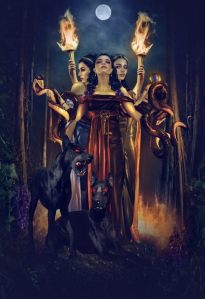
A Thought for Today – The Goddess Hecate or Hekate

” THEOGONY . “

Now Phoibe sought the love-delighting couch
Of Kaios and embracing with a god
Conceived the goddess and to her is born
Latona, robed with azure, ever mild,
To mortals placid and immortal gods;
Mild from her birth and gladsome o’er the rest
In Heaven.
Anon she famed Asteria bore
Whom Perses, to his ample palace erst
Leading, proclaimed his bride. She fruitful teemed
With Hecate, whom the Saturnian king
O’er all hath honoured and with glorious gifts
Endowed: allotting her divided sway
O’er earth and o’er the main untillable.
Nor less her honour in the starry skies
Chief reverenced by immortals and who’er
Of earth-born men with customed sacrifice
Propitiates Heaven, he then the name invokes
Of Hecate; abundant honour straight
Shall follow on his path, if to that prayer
Gracious the goddess leans and opulence
Attends his footsteps; for the power is hers.
O’er all the gods who born from earth and heaven
Received their share of glory, she supreme
Allotted empire holds: nor aught from her
Of all those honours midst the elder gods
Titanic held, hath Zeus in violence
Revoked or snatcht away; but as it stood:
In the beginning, so her portioned power
Endures. She sole-begotten, higher meed
Of glory hath obtained, far ampler sway
O’er Heaven and earth and main: for her doth Zeus
Delight to honour.
Lo! to whom she wills
Her presence is vouchsafed and instant aid
Magnific; whom she views with gracious eyes
He mid the forum o’er the people shines
Conspicuous. When the mailed men arise
To deadly battle, comes the goddess prompt
To whom she wills; bids rapid victory
Await them and extends the wreath of fame.
She sits upon the sacred judgment seat
Of venerable monarchs. She is found
Propitious, when in solemn games the youth
Contending strive; there is the goddess nigh
With succour; he whose hardiment and strength
Victorious prove with ease the graceful palm
Achieving, joyous o’er his parents’ age
Sheds a bright gleam of glory. She is known
To them propitious, who the fiery steed
Rein in the course; and them who labouring cleave
Thro the blue watery vast the untractable way.
They call upon the name of Hecate
With vows; and his, loud-sounding god of waves,
Earth-shaking Poseidon; easily at will
The glorious goddess yields the woodland prey
Abundant; easily, while scarce they start
On the mockt vision, snatches them in flight.
She too with Hermes is propitious found
To herd and fold and bids increase the droves
Innumerable of goats and fleecy flocks,
And swells their numbers or their numbers thins.
The sole-begotten of her mother’s love
She thus is honoured with all goodly gifts
Among immortals. Her did Zeus appoint
The nursing mother bland of infant youth;
Of all who thenceforth to the morn’s broad light
Should raise the tender lid — this from the first
Her soothing office and her honours these.

Author of original: Hesiod

A Laugh for Today – Computer Jokes

From Reader’s Digest

HELL VS. HE’LL

Autocorrect can go straight to he’ll. —Constance Normandeau

TURN IT OFF AND ON AGAIN

Whoever said that the definition of insanity is doing the same thing over and over again and expecting different results has obviously never had to reboot a computer.

—William Petersen

MONKEYING AROUND

Did you hear about the monkeys who shared an Amazon account? They were Prime mates.

Happy Witchy Wednesday WOTC Family and Friends – Charge of the Goddess – Part 1

(I am trying something new today to see if you like it or not. Instead of a short thing for “A Thought for Today” I decided to bring you something with a little more background on a piece of poetry and how it came about. Let me know in the comments if you like to see more of this type of post please. Thank you for your help!)

Charge of the Goddess History and Variations

From learnreligions.com

Charge of the Goddess is perhaps one of the best-known pieces of ritual poetry in today’s magical community, and is often credited to author and priestess Doreen Valiente. The charge itself is a promise, made by the Goddess to her followers, that she will guide them, teach them, and lead them when they need her the most.

However, before Valiente, there were earlier variants, dating back at least as far as Charles Leland’s Aradia: Gospel of the Witches. Because, like so many other writings in today’s Pagan world, Charge of the Goddess has evolved over time, it’s almost impossible to attribute it to one single author. Instead, what we have is a constantly changing and fluid piece of ritual poetry, that each contributor has changed, modified, and rearranged to suit their own tradition.

Did You Know?

The Charge of the Goddess first appeared in an early form during the late nineteenth century.

Doreen Valiente’s version, released in the late 1950s, is the most commonly referenced variation today.

Today, several traditions use unique versions that pay tribute to their own deities of a number of different pantheons.

Leland’s Aradia

Charles Godfrey Leland was a folklorist who roamed about the Italian countryside collecting legends during the final decade of the nineteenth century. According to Leland, he met a young Italian woman called Maddalena, who provided him with a manuscript about ancient Italian witchcraft and then promptly vanished, never to be heard from again. This, obviously, led some scholars to question the existence of Maddalena, but regardless, Leland took the information he claimed to have obtained from her and published it as Aradia: Gospel of the Witches in 1899.

Leland’s text, which reads as follows, is a speech that Aradia, daughter of Diana, delivers to her pupils:

When I shall have departed from this world,
Whenever ye have need of anything,
Once in the month, and when the moon is full,
Ye shall assemble in some desert place,
Or in a forest all together join
To adore the potent spirit of your queen,
My mother, great Diana.She who fain
Would learn all sorcery yet has not won
Its deepest secrets, them my mother will
Teach her, in truth all things as yet unknown.
And ye shall all be freed from slavery,
And so ye shall be free in everything;
And as the sign that ye are truly free,
Ye shall be naked in your rites, both men
And women also: this shall last until
The last of your oppressors shall be dead;
And ye shall make the game of Benevento,
Extinguishing the lights, and after that
Shall hold your supper thus…

Gardner’s Book of Shadows and the Valiente Version

Doreen Valiente played an instrumental part in twentieth-century Pagan practice, and her deeply evocative version of Charge of the Goddess may be the best known. In 1953, Valiente was initiated into Gerald Gardner’s New Forest coven of witches. Over the next several years, they worked together in expanding and developing Gardner’s Book of Shadows, which he claimed was based on ancient documents passed down through the ages.

Unfortunately, much of what Gardner had at the time was fragmented and disorganized. Valiente took on the task of re-organizing Gardner’s work, and more importantly, putting into a practical and usable form. In addition to finishing things up, she added her poetic gifts to the process, and the end result was a collection of rituals and ceremonies that are both beautiful and workable – and the foundation for much of modern Wicca, some sixty years later.

Although Valiente’s version, released in the late 1950s, is the most commonly referenced version today, there was an incarnation that appeared a decade or so earlier in Gardner’s original Book of Shadows. This variant, from around 1949, is a blend of Leland’s earlier work and a portion of Aleister Crowley’s Gnostic Mass. Jason Mankey at Patheos says,

“This version of the Charge was originally known as Lift Up the Veil, though I’ve heard it referred to as “Gardner’s Charge” on a number of occasions… Doreen Valiente’s version of The Charge of the Goddess dates back to sometime around 1957 and was inspired by Valiente’s desire for a less Crowley influenced charge.”

Some time after writing the Charge poem that has become well known to today’s Pagans, Valiente also crafted a prose variant, at the request of some members of her coven. This prose version has also become immensely popular, and you can read it over at the official Doreen Valiente website.

Newer Adaptations

As the Pagan community grows and evolves, so do the various forms of ritual texts. A number of contemporary authors have created their own versions of the Charge that reflect their own magical beliefs and traditions.

Starhawk included her own form of the work in The Spiral Dance, first published in 1979, which reads in part:

Listen to the words of the Great Mother,
Who of old was called Artemis, Astarte, Dione, Melusine, Aphrodite, Cerridwen, Diana, Arionrhod, Brigid, and by many other names:
Whenever you have need of anything, once a month, and better it be when the moon is full,
you shall assemble in some secret place and adore the spirit of Me Who is Queen of all the Wise.
You shall be free from slavery,
and as a sign that you be free you shall be naked in your rites.
Sing, feast, dance, make music and love, all in My Presence,
for Mine is the ecstasy of the spirit and Mine also is joy on earth.

The Starhawk version, which forms one of the cornerstones of her Reclaiming tradition, may be the one that newer Pagans are the most familiar with, but – as with any other piece of poetry or ritual – it is one that many have continuously adapted to suit their own needs. Today, several traditions use unique versions that pay tribute to their own deities of a number of different pantheons.

For a complete and in-depth breakdown of the various influences upon the different versions of the Charge, author Ceisiwr Serith has a great piece on his website*, comparing Aradia, Valiente’s work, and the Crowleyan variants.

(*Appears in a post for northern hemisphere’s Wednesday morning.)

Life in The Craft Magazine Update

I am trying to figure out how to make a contact list for all of the current subscribers but not having much luck figuring out WordPress email features. I will get the March issues out as soon as I can figure out how to make the email list for everyone otherwise, I have to send the magazine out to one person at a time. As I have been at my desk for 6 hours already today, I will make another stab at getting it out to you all tomorrow.

If anyone else would like to receive a free issue of Life in The Craft magazine, please send an email to ladybeltane@witchesofthecraft.com and I will add you to my emailing list whenever I figure out how to make one.

Life in The Craft magazine is 8 issues per year covering all the northern and southern hemisphere’s Sabbats plus other topics. Cost after the first two free issues is $3.00 USD per issue per month or $21.00 USD per year.

Apprentices enrolled in a course in WOTC’s School of Witchcraft receive a full year of the magazine for free as long as you are an active apprentice/student.

A Laugh for Today

Some of the Witchcraft/Magickal Correspondence for the March Full Moon

From theastartehome.wordpress.com

Signifier for Life

Names: 

  • Chaste Moon
  • Crow Moon
  • Crust Moon
  • Hrethkmonath (Hertha’s Month)
  • Lenting Moon
  • Lentzinmanoth (Renewal Month)
  • Moon of the Snowblind
  • Moon of Winds
  • Plow Moon
  • Raven Moon
  • Sap Moon
  • Seed Moon
  • Storm Moon
  • Sugar Moon
  • Windy Moon
  • Worm Moon

Angels:  Choose an angel that matches your intention

Animals:  Worm

Chakras:  Root

Colors:

  • Green
  • Yellow
  • Light Purple

Crystals/Metals:

  • Amethyst
  • Aquamarine
  • Aventurine
  • Bloodstone
  • Jasper
  • Moonstone
  • Obsidian
  • Opal
  • Rose Quartz
  • Tiger’s Eye
  • Topaz (blue)

Direction:  West

Element:  Water

Goddesses and Gods:

  • Artemis
  • Cybele
  • Isis
  • The Morrighan

Herbs/Oils: 

  • Apple Blossom
  • High John
  • Pennyroyal
  • Wood Betony

Intentions/Powers/Spell Uses:

  • Breaking illusions
  • Career Reinvention
  • Cleaning
  • Exploring
  • Fertility
  • Flow breaks into the open
  • Growth
  • Innocence
  • Lean living
  • Magikal tool cleansing
  • New beginnings
  • Prosperity
  • Purity
  • Rebirth
  • Seeing life truth even though it may be painful
  • Spirituality
  • Success

Reiki Symbol:  Hon Sha Ze Sho Nen

Tarot:

  • The Moon
  • The Sun

Time of Day:  Midnight

Trees/Plants: 

  • Cherry
  • Dogwood
  • Honeysuckle
  • Lilacs
  • Lotus

Virtues: 

  • balance
  • justice
  • harmony

Zodiac:  dependent on the sign in which the full moon takes place

Goddess of the Day – Isis

Isis

(Auset)

Perhaps the most important goddess of all Egyptian mythology, Isis assumed,
during the course of Egyptian history, the attributes and functions of virtually
every other important goddess in the land.  Her most important functions,
however, were those of motherhood, marital devotion, healing the sick, and the
working of magical spells and charms.  She was believed to be the most powerful
magician in the universe, owing to the fact that she had learned the Secret Name
of Ra from the god himself.  She was the sister and wife of Osiris, sister of
Set, and twin sister of Nephthys.  She was the mother of Horus the Child
(Harpocrates), and was the protective goddess of Horus’s son Amset, protector of
the liver of the deceased.

Isis was responsible for protecting Horus from Set during his infancy; for
helping Osiris to return to life; and for assisting her husband to rule in the
land of the Dead.

Her cult seems to have originally centered, like her husband’s, at Abydos near
the Delta in the North (Lower Egypt); she was adopted into the family of Ra
early in Egyptian history by the priests of Heliopolis, but from the New Kingdom
onwards (c. 1500 BC) her worship no longer had any particular identifiable
center, and she became more or less universally worshiped, as her husband was.

Full Moon Symbolism and Meaning

Full Moon Symbolism & Meaning

Exploring the Full Moon’s symbolic meaning is a journey full of intrigue, mystery, and wonder. Cultural views play a significant role in shaping the Full Moon’s symbolism. The meaning of the Moon has become richer over time. There’s great irony in the fact that the Moon reflects sunlight; so too, the Moon’s symbols are reflective of societal beliefs, traditions, and people’s observations of the lunar body’s transit in the nighttime sky throughout history.

Full Moon’s Symbolism, Meaning, & Correspondences Table of Contents

Full Moon Symbolism & Meaning

The Full Moon & Femininity

The Full Moon & The Medicine Wheel

Cultural & Religious Full Moon Symbolism

Moon Symbolism & Numerology

Western Astrology & The Full Moon

Full Moon & The Tarot

Animals & Full Moon Symbolism

Full Moon Symbolism & Meaning…

Click here to read the rest of this article

March 7th Divination Journal – Part 2

I Ching

From ichingonline.net

Fifty – three

Chien / Gradual Progress

The gnarled Pine grows tenaciously off the Cliff face:
The Superior Person clings faithfully to dignity and integrity, thus elevating the Collective Spirit of Man in his own small way.
Development.
The maiden is given in marriage.
Good fortune if you stay on course.

SITUATION ANALYSIS:

Adaptability mixed with integrity will bring a calm, steady progress.
Move from your center, always faithful to your principles, yet with the flexibility to weather any tempest.
Yours is not a meteoric rise to the top, but the solid, confident footing of one who has a clear vision of what can be, and who is willing to climb the distance to reach it.
The oracle foresees companionship along the way — a Divine comfort on any journey.

Numerology

From worldnumerology.com

Fifty – Three

It is more verbal, creative, and business-oriented.

See also 35…


Angel Number

Animal Spirit Guide or Helper

A Thought for Today – Worm Moon by Mary Oliver

Something about the coming of spring has always felt to me incredibly well-suited to poetry, as though it serves as an enchantment, calling the earth slowly back to life through incantation. As we continue to celebrate Women’s History Month, here is another poem from Mary Oliver, whose ability to blend the natural world with a sense of hope and renewal appropriately beckons the arrival of spring in Worm Moon. The title alludes to the first full moon in March, so-called because earthworms begin to show themselves again once the ground starts to thaw. Oliver makes the sensations of the transition palpable, both visual and sensual, as the winter stars slide away and the breeze blows over fields and bodies. You can feel her buoyancy in the italicized joyful, you can discern her sentiments without pretense in the final line. And that final sentiment is one, right now, that I’m willing to believe.

Worm Moon

1

In March the earth remembers its own name. Everywhere the plates of snow are cracking. The rivers begin to sing. In the sky the winter stars are sliding away; new stars appear as, later, small blades of grain will shine in the dark fields. And the name of every place is joyful.

2

The season of curiosity is everlasting and the hour for adventure never ends, but tonight even the men who walked upon the moon are lying content by open windows where the winds are sweeping over the fields, over water, over the naked earth, into villages, and lonely country houses, and the vast cities

3

because it is spring; because once more the moon and the earth are eloping – a love match that will bring forth fantastic children who will learn to stand, walk, and finally run over the surface of earth; who will believe, for years, that everything is possible.

4

Born of clay, how shall a man be holy; born of water, how shall a man visit the stars; born of the seasons, how shall a man live forever?

5

Soon the child of the red-spotted newt, the eft, will enter his life from the tiny egg. On his delicate legs he will run through the valleys of moss down to the leaf mold by the streams, where lately white snow lay upon the earth like a deep and lustrous blanket of moon-fire,

6

and probably everything is possible.

– Mary Oliver

From Twelve Moons

A Laugh for Today

Spell for Today – A FULL OR WAXING MOON SPELL TO REVIVE A WITCHES MAGICKAL POWERS

(YOU CAN COPY AND PASTE ANY SPELLS POSTED TO A DOCUMENT TO PRINT AND/OR SAVE ON YOUR COMPUTER)

A FULL OR WAXING MOON SPELL TO REVIVE A WITCHES MAGICKAL POWERS


At the Full or Waxing moon phase just before midnight anoint a PURPLE candle with real VANILLA essential oil or extract. Raise energy by tightening yourself up and pumping your hands, fingers to palms, up and down, and envisioning the moonlight as entering your body and flowing to the candle whilst you anoint it. Do this outside or before a window opened to the moonlight. Place the candle on the ground or windowsill and light it. Say:- 


“Fair Selene, Goddess of the Moon, love and light, I ask you to send me your magickal 
powers this moon lit night, By the power of the myriad starlight above me. 
And your moonlit heavens, so shall it be! ” 


Visualize your outstretched arms as soaking up the moonlight and the moonbeams being absorbed into you. You will feel the Goddess giving you her awesome power, snuff (NEVER blow out) your candle and leave it overnight on your altar or where it is. 


Either at the sunrise, or just before mid-day. Place the candle in the same place and 
stand arms outstretched towards the sun soaking up the energy of its heat and sunbeams, Say: 


“Great Ra, Lord of the sky and solar power, Lend your fiery magick to me. 
Let this witches powers be reawakened and be as powerful as the forces of the cool Moon and burning sun, By soil, wind, flame and sea, 
Grant my desire. So mote it be! ” 


Now your Magickal powers and your desire to use them will have been reawakened. 
Take your snuffed out candle to your altar and relight it there to burn out as a mark of 
respect to the God and Goddess. Spells are far more powerful if you write them yourself.

A Thought for Today – Prayer to the (March) Worm Moon

Archaeologists Find Well-Preserved 500-Year-Old Spices on Baltic Shipwreck

By Tom Little

LUND, Sweden (Reuters) – Archaeologists say they have uncovered a “unique” cache of well-preserved spices, from strands of saffron to peppercorns and ginger, on the wreck of a royal ship that sunk off Sweden’s Baltic coast more than 500 years ago.

The wreck of the Gribshund, owned by King Hans of Denmark and Norway, has lain off the coast off Ronneby since 1495 when it is thought to have caught fire and sank as the monarch attended a political meeting ashore in Sweden.

Rediscovered by sports divers in the 1960s, sporadic excavations of the ship have taken place in recent years. Previous dives recovered large items such as figureheads and timber. Now an excavation led by Brendan Foley, an archaeological scientist at Lund University, has found the spices buried in the silt of the boat.

“The Baltic is strange – it’s low oxygen, low temperature, low salinity, so many organic things are well preserved in the Baltic where they wouldn’t be well preserved elsewhere in the world ocean system,” said Foley. “But to find spices like this is quite extraordinary.” …

click here to read the rest of this article

A Laugh for Today

Witchcraft Symbols, Terms and Definitions – HEXAGRAM or SIX-POINTED STAR

HEXAGRAM or SIX-POINTED STAR

When surrounded by a circle, it represents the “divine mind” to many occult groups throughout the centuries. Many still use it in occult rituals. But to Jewish people, it is their Star of David.

Crystal, Gems, and Stones Meanings and Magickal Usage

Moonstone/Oligoclase from galleries.com

Chemistry: Na(90-70%) Ca(10-30%) (Al, Si)AlSiO8, Sodium calcium aluminum silicate.

Class: Silicates

Subclass: Tectosilicates

Group: Feldspars

Uses: ornamental and semi-precious stone and as mineral specimens.

Specimens

Oligoclase is not a well-known mineral but has been used as a semi-precious stone under the names of sunstone and moonstone. Sunstone has flashes of reddish color caused by inclusions of hematite. Moonstone shows a glowing shimmer similar to labradorescence, but lacking in color. The display is produced from lamellar intergrowths inside the crystal. These intergrowths result from compatible chemistries at high temperatures becoming incompatible at lower temperatures and thus a separating and layering of these two phases. The resulting shimmer effect is caused by a ray of light entering a layer and being refracted back and forth by deeper layers before it exits the crystal. This refracted ray has a different character than when it went in and produces the moonlike glow. Moonstone is an alternate birthstone for the month of June.

Oligoclase is a member of the Plagioclase Feldspar Group. The plagioclase series comprises minerals that range in chemical composition from pure NaAlSiO8Albite to pure CaAlSiOanorthite. Oligoclase by definition must contain 90-70% sodium to 10-30% calcium in the sodium/calcium position of the crystal structure. The various plagioclase feldspars are identified from each other by gradations in index of refraction and density in the absence of chemical analysis and/or optical measurements.

All plagioclase feldspars show a type of twinning that is named after albite. Albite Law twinning produces stacks of twin layers that are typically only fractions of millimeters to several millimeters thick. These twinned layers can be seen as striation like grooves on the surface of the crystal and unlike true striations these also appear on the cleavage surfaces. The Carlsbad Law twin produces what appears to be two intergrown crystals growing in opposite directions. Two different twin laws, the Manebach and Baveno laws, produce crystals with one prominant mirror plane and penetrant angles or notches into the crystal. Although twinned crystals are common, single crystals showing a perfect twin are rare and are often collected by twin fanciers.

PHYSICAL CHARACTERISTICS:

Color is usually off-white or gray or pale shades of green, yellow or brown.

Luster is vitreous to dull if weathered..

Transparency crystals are translucent to transparent.

Crystal System is triclinic; bar 1

Crystal Habits include blocky, or tabular crystals. Crystals have a nearly rectangular or square cross-section with slightly slanted dome and pinacoid terminations. Twinning is almost universal in all plagioclases. Crystals can be twinned according to the Albite, Carlsbad, Manebach and Baveno laws. Oligoclase can be found as a major rock forming component in granites and syenites.

Cleavage is perfect in one and good in another direction forming nearly right angled prisms.

Fracture is conchoidal.

Hardness is 6 – 6.5.

Specific Gravity is approximately 2.64 – 2.68 (average)

Streak is white.

Associated Minerals are quartzmuscovite and K-feldspars.

Other Characteristics: index of refraction is 1.533 – 1.552. Lamellar twinning may cause a grooved effect on cystal and cleavage surfaces that appear as striations.

Notable Occurrences include Sri Lanka; New York, USA; Russia; Sweden and Canada.

Best Field Indicators are occurrence, twinning striations, shimmer, density and index of refraction.

All About Rainbow Moonstone & It’s Hidden Powers from lakaiser.com

Rainbow moonstone.. such a magical stone! The name ‘Rainbow Moonstone’ was given due to the gemstone’s white sheen color that changes if it is rolled or rotated. The iridescent flashes on the gemstone have captivated the hearts of jewelry lovers for centuries. Moonstone is a mineral of the feldspar group and the optical phenomenon that causes the color play is known as Adularescence. The light moves across the gem much like the moonlight glides over a large body of water hence causing the extraordinary glow. The light reflects off of the thin layers of the feldspar minerals within the moonstone. The layers act as a diffuser, hence softening the light and allowing it to bounce around.

With its otherworldly facade, moonstone has mesmerized people of different cultures. Its use can be traced back to the ancient civilizations. The Romans believed that the moonstone was born from the solidified rays of the moon. The Greeks and the Romans have long associated the gem with their lunar gods. Other cultures strongly coveted that the stone’s powers were with the moon. It was especially prized during a full moon.

Although the Rainbow Moonstone found its way into jewelry throughout history, it wasn’t until the early 1900s that the stone became an iconic focal point. Rainbow Moonstone became immensely popular with various artists and goldsmiths during the Art Nouveau period, in the early 20th century. In the preceding years it was mainly used as an accent stone. Artisans like René Lalique focused on using natural, mystical stones with unique properties which were favored over glitzy stones. But the movement was short lived and it was soon followed by Art Deco which emphasized on the use of diamonds and precious gemstones. It wasn’t until the late 1960s that moonstone came back into fashion.

Seen as a veiled spectacle of light passing over the moon, the gemstone is highly valued among the monks, shamans, spiritualists, and devotees from various religions. The pearly iridescence it showcases holds a deep meaning and has a towering significance.

As ancient as the moon itself, the meaning of the Rainbow Moonstone lies within its playful glimmer. Its power nourishes, gives passion and awakens your feminine energies. The gemstone has the ability to not only heal you but is believed to guide you to your inner path. With the waxing and waning of the moon, it evokes tranquility and peace that has a sensual, enigmatic feel to it. It emanates an exuberance that can re-energizes a person’s mind, body and wash the negativity away. Enveloped in gleaming rays of gold, blue and purple the Rainbow Moonstone is embraced with white energy that makes it a protective gem.

But what does it really mean?

Often connected to the water signs, the Rainbow Moonstone is associated with lots of healing properties :

Enhances intuition

Makes wearer more accepting of change

Alleviates fear associated with change

Balances emotions

Promotes a calm mood

Encourages peace, harmony, and balance

Improves confidence

Helps a person become more passionate

Often called the “visionary stone”, Rainbow Moonstone mostly occurs in the regions of Armenia, Australia, the Alps in Austria, Mexico, Madagascar, Myanmar, Norway, Poland, India, Sri Lanka and the United States.

Goddess Of The Day: THALIA

THALIA

Feast of Fools (Europe)

Themes: Humor; Festivity; Recreation

Symbols: Party Decorations

About Thalia:

Among the Greek muses, Thalia is the goddess of festivity and humor. She inspires today’s celebration with unbridled revelry and joyfulness to round out the year on a playful, upbeat note.

To Do Today:

During the Middle Ages, around this time of year, a mock religious ritual took place, much like the impious Saturnalia. Normal roles were often reversed, and reverence went by the wayside, replaced by fun and pleasure.

I see no reason not to follow the example of our ancestors and give ourselves time to frolic a bit today. Do something that energizes you, inspires you, or makes you laugh out loud. For example, throw yourself a party complete with silly decorations and hats. Watch your favorite comedy flicks with folks who make you feel good, and generally let Thalia live through (and in )in your pleasure.

To keep Thalia’s playful, enthusiastic energy with you, bless an amethyst ( for joy and luck), saying,

Thalia, inspire my humor and muse;
throughout my life, joy diffuse.
Carry this with you anytime you feel your sense of humor waning.


By Patricia Telesco