

Category: Daily Posts
A Thought for Today

Gods – Anubis
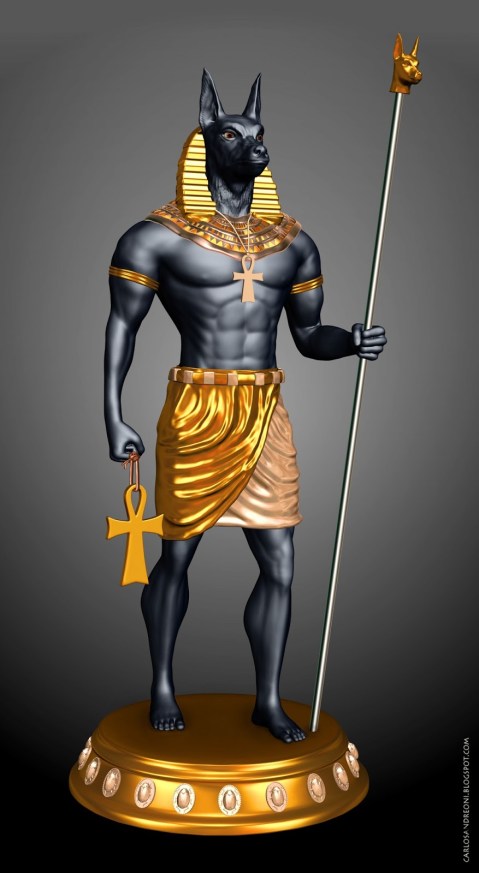
Anubis
Anubis is one of the most iconic gods of ancient Egypt. Anubis is the Greek version of his name, the ancient Egyptians knew him as Anpu (or Inpu). Anubis was an extremely ancient deity whose name appears in the oldest mastabas of the Old Kingdom and the Pyramid Texts as a guardian and protector of the dead. He was originally a god of the underworld, but became associated specifically with the embalming process and funeral rites. His name is from the same root as the word for a royal child, “inpu”. However, it is also closely related to the word “inp” which means “to decay”, and one versions of his name (Inp or Anp) more closely resembles that word. As a result it is possible that his name changed slightly once he was adopted as the son of the King, Osiris. He was known as “Imy-ut” (“He Who is In the Place of Embalming”), “nub-tA-djser” (“lord of the scared land”).
He was initially related to the Ogdoad of Hermopolis, as the god of the underworld. In the Pyramid Texts of Unas, Anubis is associated with the Eye of Horus who acted as a guide to the dead and helped them find Osiris. In other myths Anubis and Wepwawet (Upuaut) led the deceased to the halls of Ma´at where they would be judged. Anubis watched over the whole process and ensured that the weighing of the heart was conducted correctly. He then led the innocent on to a heavenly existence and abandoned the guilty to Ammit.
The ancient Egyptians believed that the preservation of the body and the use of sweet-smelling herbs and plants would help the deceased because Anubis would sniff the mummy and only let the pure move on to paradise. According to early myths, Anubis took on and defeated the nine bows (the collective name for the traditional enemies of Egypt) gaining a further epithet “Jackal ruler of the bows”.
The growing power of the Ennead of Heliopolis resulted in the merging of the two religious systems. However, Osiris was the King of the Underworld in the Ennead and he was more popular (and powerful) than Anubis. So Anubis was relegated to a god of mummification. To save face it was stated that Anubis had voluntarily given up his position when Osiris died as a mark of respect. Some myths even stated that Anubis was the son of Osiris and Nephthys (who was herself associated with the funeral rites). Anubis was still closely involved in the weighing of the heart, but was more a guardian than a ruler.
He became the patron of lost souls, including orphans, and the patron of the funeral rites. In this respect he overlapped with (and eventually absorbed) the Jackal God Wepwawet of Upper Egypt.
During the Ptolemaic Period Anubis became associated with the Greek god Hermes as the composite god Hermanubis. Hermes was messenger of the gods, while Anubis was principally guide of the dead. Hermanubis was some times given attributes of Harpokrates. He was worshipped in Rome until the second century and was popular with Rennaisance alchemists and philosophers.
Priests wore Anubis masks during mummification. However, it is not clear whether the Anubis mask was a later development influenced by the Osirian myth or whether this practice was commonplace in the earlier periods too. Anubis was also closely associated with the imiut fetish used during the embalming ritual. Anubis was credited with a high level of anatomical knowledge as a result of embalming, and so he was the patron of anaesthesiology and his priests were apparently skilled herbal healers.
Tombs in the Valley of the Kings were often sealed with an image of Anubis subduing the “nine bows” (enemies of Egypt) as “Jackal Ruler of the Bows” and it was thought that the god would protect the burial physically and spiritually. One of his epithets, “tpy-djuf” (“he who is on his mountain”) refers to him guarding the necropolis and keeping watch from the hill above the Theban necropolis. He was also given the epithet “khentyamentiu” (“foremost of the westerners” i.e. the dead) because he guarded the entrance to the Underworld.
He was originally thought to be the son of Ra and Hesat, Ra’s wife (who was identified with Hathor), but later myths held that he was the child of Osiris and Nephthys, or Set and Nephthys. He was sometimes described as the son of Bast because of her link to the perfumed oils used in embalming. His wife, Anput (his female aspect) was only really referred to in association with the seventeenth nome of Upper Egypt. It is thought that they were the parents of Kebechet, the goddess of the purification.
Dogs and jackals often patrolled the edges of the desert, near the cemeteries where the dead were buried, and it is thought that the first tombs were constructed to protect the dead from them. Anubis was usually thought of as a jackal (sAb), but may equally have been a wild dog (iwiw) He was usually depicted as a man with the head of a jackal and alert ears, often wearing a red ribbon, and wielding a flail. He was sometimes depicted as a jackal (such as in the beautiful examples from the tomb of Tutankhamun) but only rarely appears as a man (one example is in the cenotaph temple of Rameses II at Abydos).
His fur was generally black (not the brown associated with real jackals) because black was associated with fertility, and was closely linked to rebirth in the afterlife. In the catacombs of Alexandria he was depicted wearing Roman dress and the sun disk flanked by two cobras.
Anubis was worshipped throughout Egypt, but the center of his cult was in Hardai (Cynopolis) in the the seventeenth nome of Upper Egypt. To the east of Saqqara there was a place known as Anubeion, where a shrine and a cemetery of mummified dogs and jackals was discovered. He was also worshipped at cult centers in Abt (the the eighth nome of Upper Egypt) and Saut (Asyut, in the thirteenth nome of Upper Egypt).
____________________________
Anubis
Anubis (/əˈnuːbɪs/ or /əˈnjuːbɪs/;[1] Ancient Greek: Ἄνουβις, Egyptian: jnpw, Coptic: ⲁⲛⲟⲩⲡ Anoup) is the Greek name of a god associated with mummification and the afterlife in ancient Egyptian religion, usually depicted as a canine or a man with a canine head. Archeologists identified the sacred animal of Anubis as an Egyptian canid, the African golden wolf.
Like many ancient Egyptian deities, Anubis assumed different roles in various contexts. Depicted as a protector of graves as early as the First Dynasty (c. 3100 – c. 2890 BC), Anubis was also an embalmer. By the Middle Kingdom (c. 2055 – 1650 BC) he was replaced by Osiris in his role as lord of the underworld. One of his prominent roles was as a god who ushered souls into the afterlife. He attended the weighing scale during the “Weighing of the Heart,” in which it was determined whether a soul would be allowed to enter the realm of the dead. Despite being one of the most ancient and “one of the most frequently depicted and mentioned gods” in the Egyptian pantheon, Anubis played almost no role in Egyptian myths.
Anubis was depicted in black, a color that symbolized both rebirth and the discoloration of the corpse after embalming. Anubis is associated with Wepwawet (also called Upuaut), another Egyptian god portrayed with a dog’s head or in canine form, but with grey or white fur. Historians assume that the two figures were eventually combined. Anubis’ female counterpart is Anput. His daughter is the serpent goddess Kebechet.
Name
“Anubis” is a Greek rendering of this god’s Egyptian name. In the Old Kingdom (c. 2686 BC – c. 2181 BC), the standard way of writing his name in hieroglyphs was composed of the sound signs jnpw followed by a jackal over a ḥtp sign:
A new form with the “jackal” on a tall stand appeared in the late Old Kingdom and became common thereafter:
Anubis’ name jnpw was possibly pronounced [a.ˈna.pʰa], based on Coptic Anoup and the Akkadian transcription in the name “Reanapa” that appears in Amarna letter EA 315. However, this transcription may also be interpreted as rˁ-nfr, a name similar to that of Prince Ranefer of the Fourth Dynasty.
History
In Egypt’s Early Dynastic period (c. 3100 – c. 2686 BC), Anubis was portrayed in full animal form, with a “jackal” head and body. A “jackal” god, probably Anubis, is depicted in stone inscriptions from the reigns of Hor-Aha, Djer, and other pharaohs of the First Dynasty. Since Predynastic Egypt, when the dead were buried in shallow graves, “jackals” had been strongly associated with cemeteries because they were scavengers which uncovered human bodies and ate their flesh. In the spirit of “fighting like with like,” a “jackal” was chosen to protect the dead, because “a common problem (and cause of concern) must have been the digging up of bodies, shortly after burial, by jackals and other wild dogs which lived on the margins of the cultivation.”
The oldest known textual mention of Anubis is in the Pyramid Texts of the Old Kingdom (c. 2686 – c. 2181 BC), where he is associated with the burial of the pharaoh.
In the Old Kingdom, Anubis was the most important god of the dead. He was replaced in that role by Osiris during the Middle Kingdom (2000–1700 BC). In the Roman era, which started in 30 BC, tomb paintings depict him holding the hand of deceased persons to guide them to Osiris.
The parentage of Anubis varied between myths, times and sources. In early mythology, he was portrayed as a son of Ra. In the Coffin Texts, which were written in the First Intermediate Period (c. 2181–2055 BC), Anubis is the son of either the cow goddess Hesat or the cat-headed Bastet. Another tradition depicted him as the son of his father Ra and mother Nephthys. The Greek Plutarch (c. 40–120 AD) stated that Anubis was the illegitimate son of Nephthys and Osiris, but that he was adopted by Osiris’s wife Isis:
For when Isis found out that Osiris loved her sister and had relations with her in mistaking her sister for herself, and when she saw a proof of it in the form of a garland of clover that he had left to Nephthys – she was looking for a baby, because Nephthys abandoned it at once after it had been born for fear of Seth; and when Isis found the baby helped by the dogs which with great difficulties lead her there, she raised him and he became her guard and ally by the name of Anubis.
George Hart sees this story as an “attempt to incorporate the independent deity Anubis into the Osirian pantheon.” An Egyptian papyrus from the Roman period (30–380 AD) simply called Anubis the “son of Isis.”
In the Ptolemaic period (350–30 BC), when Egypt became a Hellenistic kingdom ruled by Greek pharaohs, Anubis was merged with the Greek god Hermes, becoming Hermanubis. The two gods were considered similar because they both guided souls to the afterlife. The center of this cult was in uten-ha/Sa-ka/ Cynopolis, a place whose Greek name means “city of dogs.” In Book XI of The Golden Ass by Apuleius, there is evidence that the worship of this god was continued in Rome through at least the 2nd century. Indeed, Hermanubis also appears in the alchemical and hermetical literature of the Middle Ages and the Renaissance.
Although the Greeks and Romans typically scorned Egypt’s animal-headed gods as bizarre and primitive (Anubis was mockingly called “Barker” by the Greeks), Anubis was sometimes associated with Sirius in the heavens and Cerberus and Hades in the underworld. In his dialogues, Plato often has Socrates utter oaths “by the dog” (kai me ton kuna), “by the dog of Egypt”, and “by the dog, the god of the Egyptians”, both for emphasis and to appeal to Anubis as an arbiter of truth in the underworld.
Roles
Protector of tombs
In contrast to real wolves, Anubis was a protector of graves and cemeteries. Several epithets attached to his name in Egyptian texts and inscriptions referred to that role. Khenty-imentiu, which means “foremost of the westerners” and later became the name of a different wolf god, alluded to his protecting function because the dead were usually buried on the west bank of the Nile. He took other names in connection with his funerary role, such as tpy-ḏw.f “He who is upon his mountain” (i.e. keeping guard over tombs from above) and nb-t3-ḏsr “Lord of the sacred land”, which designates him as a god of the desert necropolis.
The Jumilhac papyrus recounts another tale where Anubis protected the body of Osiris from Set. Set attempted to attack the body of Osiris by transforming himself into a leopard. Anubis stopped and subdued Set, however, and he branded Set’s skin with a hot iron rod. Anubis then flayed Set and wore his skin as a warning against evil-doers who would desecrate the tombs of the dead. Priests who attended to the dead wore leopard skin in order to commemorate Anubis’ victory over Set. The legend of Anubis branding the hide of Set in leopard form was used to explain how the leopard got its spots.
Most ancient tombs had prayers to Anubis carved on them.
Embalmer
As jmy-wt “He who is in the place of embalming”, Anubis was associated with mummification. He was also called ḫnty zḥ-nṯr “He who presides over the god’s booth”, in which “booth” could refer either to the place where embalming was carried out or the pharaoh’s burial chamber.
In the Osiris myth, Anubis helped Isis to embalm Osiris. Indeed, when the Osiris myth emerged, it was said that after Osiris had been killed by Set, Osiris’s organs were given to Anubis as a gift. With this connection, Anubis became the patron god of embalmers; during the rites of mummification, illustrations from the Book of the Dead often show a wolf-mask-wearing priest supporting the upright mummy.
Guide of souls
By the late pharaonic era (664–332 BC), Anubis was often depicted as guiding individuals across the threshold from the world of the living to the afterlife. Though a similar role was sometimes performed by the cow-headed Hathor, Anubis was more commonly chosen to fulfill that function. Greek writers from the Roman period of Egyptian history designated that role as that of “psychopomp”, a Greek term meaning “guide of souls” that they used to refer to their own god Hermes, who also played that role in Greek religion. Funerary art from that period represents Anubis guiding either men or women dressed in Greek clothes into the presence of Osiris, who by then had long replaced Anubis as ruler of the underworld.
Weighing of the heart
One of the roles of Anubis was as the “Guardian of the Scales.” The critical scene depicting the weighing of the heart, in the Book of the Dead, shows Anubis performing a measurement that determined whether the person was worthy of entering the realm of the dead (the underworld, known as Duat). By weighing the heart of a deceased person against Ma’at (or “truth”), who was often represented as an ostrich feather, Anubis dictated the fate of souls. Souls heavier than a feather would be devoured by Ammit, and souls lighter than a feather would ascend to a heavenly existence.
Bibliography
Main Source: Ancient Egypt Online
Goodenough, Simon (1997) Egyptian Mythology
Grajetzki, W (2003) Burial Customs in Ancient Egypt
Ikram, Salima (1997) Death and Burial in Ancient Egypt
Pinch, Geraldine (2002) Handbook Egyptian Mythology
Redford Donald B (2002) Ancient Gods Speak
Watterson, Barbara (1996) Gods of Ancient Egypt
Wilkinson, Richard H. (2003) The Complete Gods and Goddesses of Ancient Egypt
Wikipedia
Goddess Yemanja
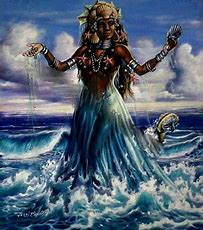
Yemanja
Iemanja Festival (Brazil)
Themes: Foresight, Divination, Psychic Abilities
Symbol: Water
To Do Today: At daybreak on this day, mediums in Brazil begin singing and dancing to summon the spirit of Iemanja, who provides glimpses of the year ahead. Worshipers take offerings carved with the wishes to rivers or to the ocean. Here, Iemanja’s spirit accepts the gifts, and the magic of the wish begins. To follow this custom make any small natural token and toss it in moving water with your wish, the water should be flowing toward you if you wish to being energy and flowing away from you if you want to carry away problems.
In keeping with today’s theme, soak in a mild saltwater bath to cleanse away any unwanted energy and heighten your senses.
Then try your favorite divination tool. Pray to Iemanja beforehand to bless your efforts. See what messages she has for you, especially on emotionally charged matters (water equates in metaphysical traditions).
Finally, to honor Iemanja, wear ocean blue clothing today, carry a blue stone (like lace agate or lapis), put a seashell or coral
in your pocket, dance in the rain (if the weather cooperates), or play in the sprinkler. Rediscover the element of water.
By Patricia Telesco
Flower – CALENDULA

CALENDULA: BEAUTIFUL FLOWERS THAT HEAL
If you have a garden, I hope you grow the beautiful annual flower calendula.
Calendula officinalis produces beautiful orange or yellow flowers from seed in midsummer until frost, attracting honeybees, bumblebees, and other pollen and nectar-seeking insects, as well as hummingbirds.
Calendula self-sows readily in the garden if you allow a few flower heads to fall to the ground (or you can harvest and dry the mature flowers, save the seeds, and plant them where you want them next spring). Its flowers are edible, and its long use as a cooking herb gives the flower its common name pot marigold. Adding calendula flowers to cooked foods (grains, casseroles, breads, even desserts) gives them a lovely yellow color.
The flowers also have a long history of use for healing, especially for wounds, inflammations of the skin, mouth, and mucous membranes, and sunburns. You’ll find extracts of calendula in many cosmetics, hair-care, and baby-care products, too.
When you harvest the blooms or handle the plants, a sticky, resinous substance with a distinctive, fruity fragrance clings to your fingers. Herbalists say these plant resins are partly responsible for the plant’s healing power.
HOW TO MAKE CALENDULA TEA/WASH, OIL, OR SALVE
Most calendula medicinals begin with a supply of fresh or dried flowers. If you’re not growing your own, buy dried flowers intended for human use.
- To make a tea that soothes internal mucous membranes, add calendula flowers to water in a ratio of a tablespoon of fresh or two teaspoons of dried flowers to a cup of water. Bring to a boil and simmer or allow to steep for 10 minutes. You can either drink the tea or use it as a soothing wash for sunburns, rashes, or sores. Refrigerate for up to a week any tea you don’t use right away.
- To make calendula oil/lotion, fill a sterilized glass jar (of any size) with dried calendula flowers and cover the flowers with a high quality oil: olive, almond, or grapeseed work well. Cover the jar and let it sit in a cool, dark place for four to six weeks, shaking or stirring occasionally. Strain the plant material from the oil using two or three layers of cheesecloth, and refrigerate the oil until ready for use. You can rub the oily cheesecloth bag holding the spent flowers onto face or hands as a moisturizer. To help prevent the oil from going rancid, add two or three drops of benzoin essential oil or half a teaspoon of tincture of benzoin per half cup of oil, along with a few drops of rosemary or lavender oil.
- To make a healing salve, add three or four teaspoons of melted beeswax per half cup of warmed oil in a double boiler, and stir well until the mixture begins to cool. Pour it into a suitable glass or metal container and seal. If the salve is too hard, reheat it and add a bit more oil; if it’s too runny, add a bit more beeswax.
April 17th Through 23rd Astronomy Pictures of the Day
These are the Astronomy Picture of the Day for the proceeding week starting on the past Monday through this Sunday. Just click on the hyperlink next to the date for the pictures you want to see.
2023 April 23: A Waterspout in Florida
2023 April 22: NGC 1333: Stellar Nursery in Perseus
2023 April 21: Solar Eclipse from Western Australia
2023 April 20: The Dark Seahorse in Cepheus
2023 April 19: Auroral Storm over Lapland
2023 April 18: Map of Total Solar Eclipse Path in 2024 April
2023 April 17: ELVES Lightning over Italy
Lady Beltane is Back to Regular Postings Sort Of
I talked with the company that pays me to advertise their whatever on WOTC via WordPress’ choices I found out that if you click on each day’s new posts only from the emails you get pertaining to them that the number of posts viewed per visitor is lower that if you click on one daily post and then do the others you want to read directly from the website. So, I ask you to please click on which ever email link you want to use to start reading the daily posts every day then use the main menu at the top of every page you go to read the other posts that interest you. Our views per visitors goes up which means I might get paid more than a couple of dollars per day for the posts I put live each day. Today I will make sure that all sub-menus for all the regular daily posts can be found under the heading “All Regular Daily Posts” with the exception of the spell I put up this you can find in sub-headings and by clicking on “Book of Shadows” in the main menu. So, once again I ask you to please click from post to post instead of using the emails to get to all the daily posts. If you are looking for posts on a specific topic than use the “Search” box on the left of the Homepage, if using a cell/mobile phone or tablet you may have to scroll down a ways to find it.
I am finally back to do most of the regular posts starting tomorrow. After being away from my computer for almost a week I have birthday horoscopes to check up on so please do not expect all the posts I have been doing daily today. I also will not be spending 5 to 7 hours daily on my computer posting things that three-quarters of the time I do not know whether you fine the posts helpful or interesting. So I will post what I find helpful on my path and hopefully you will find them helpful also.
After having this time off and doing some deep self-care and finding that my priority in life was WOTC instead of my family I am switching my priorities around. While WOTC still remains very important to me I am not going to plan my day around posting and answering emails. I am cutting my workday down to 4 hours a day which means I will be dropping some of the daily posts to weekly posts. By changing my way of thinking around so I no longer feel that I am taken for granted and all my work on here is not appreciated I looked forward to getting back to work today. It was either cut down on what I thought was needed to get new subscribers and keep current ones coming back or literally wind up saying, “The hell with this website all together.” Do not get me wrong I appreciate you coming to read what I post but it is disheartening when there are usually no “Likes” or comments on any posts while I make pennies a day and spending anywhere from 6 to 8 hours at my computer researching and posting which has a bad affect on my physical health. What really upset me so bad as to go into the worse fibromyalgia flare I have ever had, I had welts on my skin from my nerve ending being so hyperactive and into a major meltdown last Sunday was when I asked for help to get our dog Dreamer to the vet to find out why she was hardly able to walk or climb steps and only one person came forward to help us achieve that. I try very hard not to ask for monetary help from all of you unless it is an emergency or the yearly fund raiser because I realize money is tight for most of us as the economy the world over is still trying to rebound from the initial COVID pandemic, but I wasn’t asking you to just send me money I offered many different readings I do in return for your donation. This made me feel as if no one cared what happens to me or my family as long as I get all the posts up every day for you to read and if I neglect them oh well. I will no longer post at a specific time in the mornings or afternoons but will stay with doing post for tomorrow in the northern hemisphere which is today in the southern hemisphere starting again tomorrow.
There will soon be a companion Patreon account called WOTC’s Lady Beltane’s Grimoire to WOTC starting the first week in May 2023 or there about. On it you will find more intermediate and advanced spells, rituals, and other topics for magickal workings. This will also be where Life in The Craft will be available, along with some taped magickal workshops, a list offering the readings and cleansings I do. There will be a tiered option for joining and receiving the different topics. All spells and rituals will be in a PDF format for members to print out if they like. More information on this will be posted as I get the account up and running.
If you have read this far I thank you very much for the time you take out of your busy day to read this post and what WOTC has to offer to you every day. If there is a topic you would like to see a post or two about, please let us know in a comment or send an email to ladybeltane@witchesofthecraft.com.
May the Goddesses and Gods bless you and your families with positive everything, good health, and enough income to cover all your bills with some leftover for fun!
Lady Beltane will be gone until Sunday, April 23rd
I am totally exhausted heart, mind, and spirit. I need some time away to decide if I want to continue working about 7 – 9 hours a day, 7 days a week, for approximately $0.33 per hour or not. Posting is just one part of what I do daily. I also answer emails from people and my students, I hold monthly chats and Sabbat gatherings with my students as well. This is that part of my duty that gives me I great joy to do! Then there is the magazine that I put out on my own.
Add in our Dreamer who is rapidly declining in her quality of life, housework, and everything else I have going on with no real days off in almost 2 years which is leading me to somekind of breakedown. I am bone tired and ready to just quit the world for a few days.
I am going to take the next few days to decide where I am going from here if I can keep doing WOTC just as a labor of love because I made a promise to Lady Abyss to carry on her work or if I am going to put it up for sale. See you in a few days when I make my decision and we know if Dreamer is going to her eternal rest or not.
I am Off Until Thursday Morning
April 10th to April 16th Astronomy Picture of the Day
These are the Astronomy Picture of the Day for the proceeding week starting on the past Monday through this Sunday. Just click on the hyperlink next to the date for the pictures you want to see.
2023 April 16: M2 9: Wings of a Butterfly Nebula
2023 April 15: When Z is for Mars
2023 April 14: Portrait of NGC 3628
2023 April 13: NGC 2419: Intergalactic Wanderer
2023 April 12: NGC 206 and the Star Clouds of Andromeda
2023 April 11: North Star: Polaris and Surrounding Dust
2023 April 10: IC 2944: The Running Chicken Nebula
A Little Humor for Your Day
Vets in North Carolina has brought a smile to local residents, and the internet, with their weekly changing signs featuring “corny” pet jokes.
Holly Ridge Veterinary Hospital opened in 2015, and ever since owner Dr. Dante Martin and hospital manager Linda Martin have entertained the neighborhood.
Underneath their name and number, the team have used the interchangeable letters to write one-liners and jokes worthy of dads everywhere.

Gods – Apollo
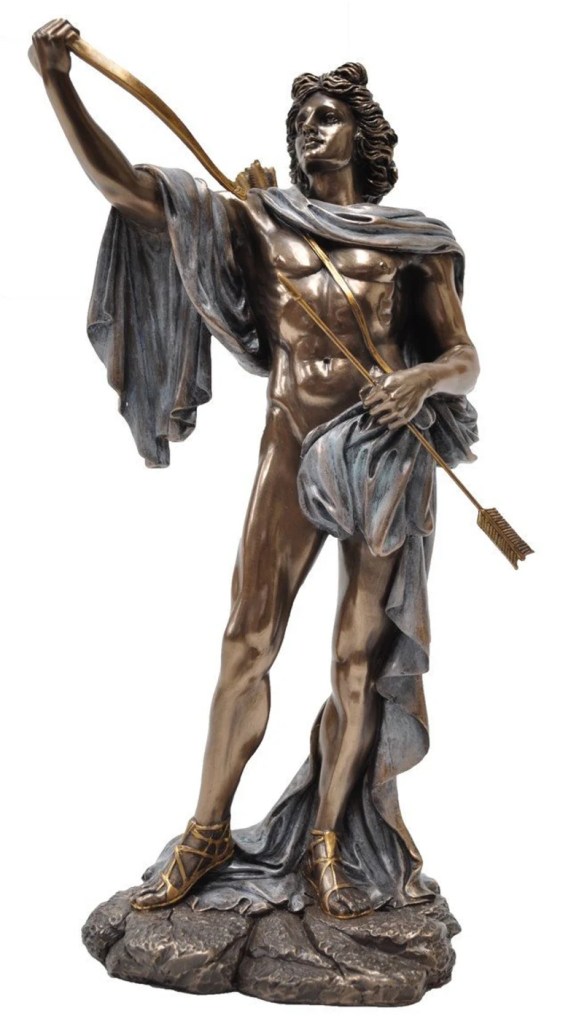
Greek God Apollo from gods-and-goddesses.com
In the mythology of ancient Rome, Apollo, known by the same name to the Greeks, was a versatile god. Due to this similarity, he has been called “the most Hellenic [or, Greek] of all the gods.” According to the Encyclopedia Britannica, “he was a god of divine distance, who sent or threatened from afar; the god who made men aware of their own guilt and purified them of it; who presided over religious law and the constitutions of cities; and who communicated with mortals through prophets and oracles his knowledge of the future and the will of his father,” Jupiter. As such, Apollo was one of the most widely worshiped Roman deities.
In myth, even his fellow gods – with the exception of his mother and father – feared Apollos. He was worshiped as an agricultural god, fending off the diseases and wild animals that could harm farm animals and crops. He was thus called Nomios, meaning “herdsman,” and Lyceius, as he opposed the lykoi, or wolves. An alternate name, Phoebus, meaning “bright,” connected Apollos with worship of the sun, and the title Alexikakos heralded him as the “Averter of Evil.”
Apollo Facts
Origins
In Roman mythology, Jupiter had an affair with the Titan goddess Latona. When Jupiter’s wife Juno found out about the affair and Latona’s pregnancy, she was infuriated. At this point there is some variation on his birth story, but it includes some of the following concepts:
Juno essentially cursed Latona and forbid all dry land from accepting her birth. Juno may have also sent a serpent named Python to chase Latona through ancient Greece. Latona fled and searched for a place where she could give birth. Eventually she found a place to give birth on the island of Delos, a wandering rock off the coast of mainland Greece. It was said that Delos was suitable for Latona to give birth because the island floated in the sea, and was not connected to the ground.
Latona gave birth to Diana by balancing her body on an olive branch to avoid coming into contact with the ground. After her birth, Diana was able to assist Latona in giving birth to Apollo on Delos. The treatment of his mother so enraged Apollo that only four days after his birth he embarked on a journey to destroy the Python.
Apollo traveled to Delphi, where he slayed the huge serpent, who had tormented his mother during her pregnancy. It should be noted that in some versions of the legend, the snake was instead slain because it tried to prevent Apollo from setting up his oracle.
Myths & Stories
The Roman myths of Apollo involve numerous romantic affairs, typically drawn from his previous Greek mythologies. For instance, in Metamorphoses, written by the Roman poet Ovid, Apollo pursues the beautiful nymph-daughter of the river god Pineios. When he is about to overtake her in his affections, she cries out to her father for help. Pineios turns his daughter into a laurel tree to protect her from Apollo’s lust. The laurel was later regarded as Apollo’s sacred plant.
In another myth, Apollos loved Coronis, the daughter of a king, and left a white raven to protect her while he was away. When the raven came to him to tell him that Coronis was having an affair with another man, Apollo was angry that the bird had not pecked out the lover’s eyes. His curse upon the bird scorched its feathers, which is why, the Romans believed, ravens are jet black in color. Apollo’s twin sister killed Coronis, but Mercurius rescued her unborn child.
Worship
Apollo was worshiped and honored in several ways. One such way was the creation of the Pythian Games. The Pythian Games were a collection of athletic contests and musical competitions that were established to commemorate Apollo’s slaying of Python.
A Temple of Apollo was built in Delphi, an ancient site just north of the Peloponnese peninsula in southern Greece. Mythology holds that Apollo established the famous Oracle of Delphi in a mysterious way. It stated that on one occasion, he transformed himself into a dolphin and leaped onto the deck of a Cretan ship. Once on deck, he undisguised himself and ordered the Cretan crew to follow him. Delphi was thus named after the dolphin, or delphis, and the cult of Apollo Delphinius (Apollo the dolphin) arose among the Cretans whose ship Apollo had commandeered.
An oracle, such as the Oracle of Delphi, is a place where prophecies are uttered in response to the petitions of a visitor. The medium used at Apollo’s oracle was a woman over the age of 50 who was thought to deliver divine communication with the gods while under inspiration. Her words were then interpreted by priests. Oracles of Apollo existed not only in the main temple at Delphi, but in his other temples as well. The Roman Emperor Augustus promoted the worship of Apollo after the Battle of Actium in 31 B.C., which was fought near one of the temples.
Festivals honoring Apollo
Many of the yearly festivals honored Apollo along with other gods, but the Delphic Stepterion, held once every eight years, celebrated this god directly. Its rituals involved reenacting the slaying of Python. The young actor was then temporarily banished to a narrow valley in Greece.
Art
In art, Apollo is usually depicted as a youth, having grown no beard. He may be represented robed or in the nude. He carries a bow and a stringed instrument called a lyre. Because of this lyre, some scholars believe that Apollo was originally a god of music, a favorite pastime of the shepherds whose flocks he was said to protect.
Apollo Today
As with many mythical figures, the legacy of Apollo lives on amid the sciences. During the 1960s and 1970s, the Apollo space program was conducted by NASA, and included the famous lunar landing.
Fast Facts
Role in Mythology: god of the Sun, Arts, Bows and Arrows
Alternative Names: Phoebus, Alexikakos, Nomios, Lyceius, Apollo Delphinius.
Family Relationships: Son of Jupiter and Latona, twin brother of Diana.
Symbols: Bow, lyre, laurel
Greek Equivalent: Apollo
Resources
“Apollo.” Encyclopaedia Britannica.
Leadbetter, Ron. “Apollo.” Encyclopedia Mythica.
Lenardon, Robert J., and Mark P.O. Morford. Classical Mythology. 9th ed. Oxford, New York: Oxford University Press.
“Python, Greek Mythology.” Encyclopaedia Britannica.
Bright magickal blessing WOTC Family on this beautiful Sunday!

It is a gorgeous day here with birds sing, butterflies and dragonflies are fliting about, bees are doing a fantastic job of pollinating my garden, the sun is shining and all it right in my life today! I would love to be able to walk through an area like this, but I probably would start sneezing which would be ok if I remembered to bring a tissue or 6 with me. 😄
Many of us work weekends and others only Monday through Friday. Those that have the weekend off can dread Mondays and have to get up after laying around or getting extra chores done or doing yardwork or whatever occupied their weekend just to get at a specific time and get dressed in work clothes to return to the everyday grind.
Personally, I have never minded Mondays when I was working a job where I had to leave my home and comfy clothes behind. But it wasn’t easy. So, I started having a mantra or affirmation to repeat for each day of the work week some are funny, and some are not. Grant they might not make sense to someone as much as they do to me, but I hope these can give you ideas to make up your own mantras and affirmations for your work week. Since I now work at home seven days almost every week, I had to add a couple more.
Monday – Hi ho, hi ho it’s off to work I go.
Tuesday – You can do whatever you set your mind to today.
Wednesday – I have made it this far I can make it to work the rest of this week.
Thursday – I am up and able to walk which makes this a beautiful day.
Friday – In eight hours I can go home than I will have another week behind me.
Saturday – I can get posts done with some breaks to rest my body.
Sunday – With Ra and Luna’s help I will get all the posts done this morning than play this afternoon.
I hope one or more of these help you through your week. Do you have a favorite mantra or affirmation you use to help you get through your days? If you don’t mind sharing it with us, please leave in the comments section below.
A Little Humor for Your Day

What do Ghosts suffer from? Saturday fright fever.
What do cows do on Saturday nights? They go to the mooooovies.
What did Friday say to Thursday? Come over on Saturday and stay for a Sundae.
What do ghosts like to do on a Saturday night? Boogie.
Which day of the week does one need the most? A day between Saturday and Sunday.
When did the King have his jousting contests? On Saturday Knight.
How do you keep the dreams alive on Saturdays? By hitting the snooze button.
What does a taxidermist do on Saturdays? Nothing special, just the usual stuff.
Why are fish lonely on the weekends? Because there’s no school on Saturdays or Sundays.
Why is Saturday actually a depressing day of the week? Because it’s a sadder day.
One View on – What Does It Mean To Be A Witch?
What Does It Actually Mean To Be A Witch?
By: Laurie Rihiimaki | Feb. 11, 2019
The term, ‘witch’ gets thrown around in everyday life soaked with a long history of negative connotation.‘Witch’ derives from the Old English noun, ‘wicca’ meaning a male witch and ‘wice’ meaning a female witch or sorceress. However, this negative stigma has recently been viewed as outdated and tired. So, what does it mean to be a witch?
Definition of A Witch
In general, witches today can be defined in three ways: someone who actively practices magical rituals or spells, someone who has a spiritual connection such as a psychic medium or a tarot reader, or someone who worships the Pagan gods.
The reality of what it means to be a witch today carries many traditions of the Pagan religion; something which was previously thought to be tied to the devil or satanic rituals. Modern day witchcraft often includes the lighting of candles, meditation, yoga, incense, the smudging of sage, crystals, dream analysis, and other rituals connected to Pagan roots.
However, witchcraft is simply about using the power of the universe and the mind to attract wants and desires. It’s about being in tune with Earth’s natural resources and using them to mystically quench a spiritual thirst.
How to Spot A Witch
Spotting a witch today compared to the 1600s is an entirely different puzzle. Nowadays, it’s rather easy to determine who’s a witch because they are generally proud of their mystical practice. We now know you can’t simply label someone a witch based on their physical appearance or outspokenness.
But, in the late-1500s to mid-1600s in Eastern Europe and early colonial America, witches were named purely based on societal suspicion. For example, if a woman was outspoken, she was a witch. If she owned land or had a great deal of assets, she was a witch. If a woman was widowed or a spinster, she was considered out of the ordinary, therefore, she was deemed a witch.
After the label ‘witch’ was plastered on a woman in the community, there were many ways to theoretically prove her connection to the feared and mysterious craft. One of these tests included the bizarre witch cake; a rye flour cake baked with the urine of the accused, which was then fed to a local dog that the community observed to determine if it showed the same behaviors as the ‘witch.’ People believed the urine would transmit satanic juices to the dog because of its supposed association with the devil.
There were many other devised strategies to determine the presence of a witch in the community including:
- Weighing the accused against a stack of bibles
- Asking them to recite the Lord’s prayer
- Counting the number of pets they had
- Counting the number of marriages they had
- Asking them if they had dreams that included Native Americans or their culture
- Observing if they talk to themselves
These tests and many others determined a community member’s right to continuing living.
The accused was also searched for the physical mark of a witch, including birthmarks, scars, or extra nipples. These mysterious physical marks, which we now discern as common biological features, were considered signs of the devil’s presence. The accused were pricked with knives on these marks; if the mark did not bleed, they were deemed a witch.
The Destigmatization of Witches
Witchcraft is not as highly feared as it once was. There are no widespread witch hunts or constant fear associated with the neighborhood spinsters and widows. The destigmatization of witches is seen more and more in our everyday lives as popular stores sell tarot cards and crystals. While smudging with sage and owning a spell book is a trending lifestyle add-on visible all over Instagram.
While this destigmatization of witches may seem trendy on the surface, as it’s popularly marketed, the spread of witch-awareness is closely related to a greater cause: the women’s empowerment movement rapidly spreading across the world.
Today, people recognize the need for a change in energy relating to the female’s place in society, but often women are feared for being strong-willed and outspoken. Then, like now, powerful women or those with important titles often face greater challenges than their male counterparts. In the 1600s they were burned at the stake or stoned to death; today, they can face belittlement of their accomplishments, their morality questioned, or reputations intentionally tarnished.
With that being said, one could argue that witchcraft is a necessary addition to modern society as it illuminates the daily struggles of women on various levels. With that feminist insight in mind, it’s vital to remember that witchcraft is not just one single thing across the board. It’s certainly not just the performance of spell casting or the donning of crystals. It’s an understanding of one’s own spirituality. And, at this period in time, which is faced with drastically polarizing viewpoints, it is essential to have beliefs that we can mold to our own specific needs.
From gaia.com
Some of the Witchcraft/Magickal Correspondence for Saturday
Magickal Intentions: Spirit Communications, Meditation, Psychic Attack or Defense, Locating Lost Things and Missing Persons, Building, Life, Doctrine, Protection, Knowledge, Authority, Limitations, Boundaries, Time and Death
Incense: Black Poppy Seed and Myrrh
Planet: Saturn
Sign: Capricorn and Aquarius
Angel: Cassel
Colors: Black, Grey and Indigo
Herbs/Plants: Myrrh, Moss, Hemlock, Wolfsbane, Coltsfoot, Nightshade and Fir
Stones: Jet, Smokey Quartz, Amethyst, Black Onyx, Snowflake Obsidian, Lava, Pumice
Oil: (Saturn) Cypress, Mimosa, Myrrh, Patchouli
Saturn lends its energies to the last day of the week. Because Saturn is the planet of karma, this day is an excellent time for spellwork involving reincarnation, karmic lessons, the Mysteries, wisdom, and long-term projects. It is also a good time to being efforts that deal with the elderly, death, or the eradication of pests and disease.
A Thought for Today – An Idea I Use to Help Stop an Anxiety/Panic Attack
I have had people suggest that I start posting some original things instead of copying and pasting from other website so much. So, I decided to give it a try by sharing something that helps to calm me down sometimes when I am going into an anxiety attack.
Photo by Lady Carla Beltane
I am not sure if you will see the Fairy wing in this picture that I do. This is along some unused, old railroad tracks about 1/4 of a block away from my home. I walk these tracks often looking, listening, and immersing myself in all nature has to offer me on any given day.
Yesterday as I walked along I kept being drawn back to this spot and until I quietly sat on the railroad tracks and opened myself up for any message a spirit guide, ancestor, animal spirit guide, gods, goddesses, archangels, Wee Folk or other beings had for me I was not able to hear them. It is a home for woodland Spirits, Fairies, Pixies, and Nymphs. I cannot adequately describe the feelings going through me and the gratitude I felt that Fae Folk decided to let me know where their home base was here.
When I lived in Lisle Fairies and beings that work with Funa and Flora had a home right next to the vegetable garden I planted by myself for fifteen years. Unfortunately, one of the ways I allowed this abuser (a different one than the one I just got the fantastic divorce, I foolishly allowed myself to remain in this relationship for 19 years but more on this another day) to get to me was by putting Miracle Grow in the my starter seeds without telling me and then spraying the garden in 2017, whereas I had always kept it as a pure organic garden from 2002 until that fateful summer. I even made a corner near the garage and garden into a compost pile which I would spread over the garden after Samhain and cover that with leaves from a beautiful Red Maple he had cut down. Neighbors would always try to figure out how without using unnatural fertilizer in my garden that I got a larger harvest than they did. I could not and would not tell them about the Wee Folk that helped my garden to flourish. No need to tell all of you the Wee Folk left because the chemicals stepped into their home and the garden never did well again.
To thank the Wee Folk, I would make them tiny fairy cakes served with warm milk and butter I made from heavy cream. I would place it about 12 inches from their home hidden under a small raspberry bush. They also got all put 2 of the raspberries every season and all the Mulberries they wanted, before he cut down the largest, most convenient for them to get to Mulberry tree.
Why did he keep cutting down healthy tree? Mainly because he knew I could feel the spirits living in each of them and loved having a beautiful backyard to sit in under shade if I wanted to or in the Sun. Cleo and Star enjoyed that backyard as it was fenced in, and they could go wherever they wanted to in it. He stopped this too by fertilizing the lawn with weed and feed.
Sorry got off on a tangent. If I can catch an anxiety attack I start walking along the tracks until I feel this is where I should stop for now. Then I just breath in the scents of the woods around me. Listen to all the different birds chatting with each other. Take time to notice what is starting to bud or lose its leaves depending on the season. For me this is a place of quite and a safety net of sorts. I would like to suggest to other that get anxiety or panic attacks to find someone to walk and/or sit and just enjoy the feast for all our senses that Gaia/Mother Earth gives us so freely. I almost always have something to drink with me as I never know if I’m going to be gone from our home for 5 minutes or maybe an hour, as I lose all track of time when I am in a wooded area and enjoying it. Before I leave where I choose to sit and feast I pour some or most of the non-acholic beverage out in the wood area to thank Gaia/Mother Earth for once again soothing my nerves.
A Little Humor for Your Day
One of my favorite easy, corny jokes for children of all ages…
How to get catch a unique bird?
wait for it…
almost to the answer…
just scroll down a little more…
You neak up on it? 😂
Have a beautiful day!
April 14, 2023 Northern Hemisphere’s Planetary Positions
If you need to calculate the planetary positions for a specific use and time, click on this link
Currentplanetarypositions.com
To figure out GMT (Greenwich Mean Time) to your local time use this link
For Your Local Time and Date

Northwestern Hemisphere
This local time is in Los Angeles, California, USA
April 14, 2023
11:00 pm GMT 4:00 PM PDT
Zodiac: Tropical (Standard Western)
Sun:24 Aries 44
Moon:15 Aquarius 40
Mercury:13 Taurus 32
Venus:04 Gemini 22
Mars:10 Cancer 22
Jupiter:22 Aries 29
Saturn:04 Pisces 05
Uranus:17 Taurus 31
Neptune:26 Pisces 13
Pluto:00 Aquarius 18
Moon:15 Aquarius 40
Mercury:13 Taurus 32
Venus:04 Gemini 22
Mars:10 Cancer 22
Jupiter:22 Aries 29
Saturn:04 Pisces 05
Uranus:17 Taurus 31
Neptune:26 Pisces 13
Pluto:00 Aquarius 18
True Lunar Node:04 Taurus 04 Rx
Mean Lunar Node:04 Taurus 42 Rx
Lilith (Black Moon):10 Leo 48
Chiron:16 Aries 24
Ceres:25 Virgo 28 Rx
Pallas:23 Cancer 09
Juno:19 Taurus 50
Vesta:29 Aries 40
Eris:24 Aries 34
Fire:6
Earth:6
Air:3
Water:4
Earth:6
Air:3
Water:4
Cardinal:7
Fixed:8
Mutable:4
Fixed:8
Mutable:4
Northern Hemisphere
This local time is in Chicago, Illinois, USA
April 14, 2023
09:00 pm GMT 4:00 PM CDT
Zodiac: Tropical (Standard Western)
Sun:24 Aries 39
Moon:14 Aquarius 28
Mercury:13 Taurus 29
Venus:04 Gemini 16
Mars:10 Cancer 19
Jupiter:22 Aries 28
Saturn:04 Pisces 05
Uranus:17 Taurus 31
Neptune:26 Pisces 13
Pluto:00 Aquarius 18
Moon:14 Aquarius 28
Mercury:13 Taurus 29
Venus:04 Gemini 16
Mars:10 Cancer 19
Jupiter:22 Aries 28
Saturn:04 Pisces 05
Uranus:17 Taurus 31
Neptune:26 Pisces 13
Pluto:00 Aquarius 18
True Lunar Node:04 Taurus 04 Rx
Mean Lunar Node:04 Taurus 42 Rx
Lilith (Black Moon):10 Leo 47
Chiron:16 Aries 23
Ceres:25 Virgo 28 Rx
Pallas:23 Cancer 08
Juno:19 Taurus 47
Vesta:29 Aries 37
Eris:24 Aries 34
Fire:6
Earth:6
Air:3
Water:4
Earth:6
Air:3
Water:4
Cardinal:7
Fixed:8
Mutable:4
Fixed:8
Mutable:4
Northeastern Hemisphere
This local time is in Frankfurt, Germany, Europe
14 April 2023
03:00 pm GMT 5:00 PM CEST
Zodiac: Tropical (Standard Western)
Sun:24 Aries 24
Moon:10 Aquarius 53
Mercury:13 Taurus 19
Venus:03 Gemini 59
Mars:10 Cancer 11
Jupiter:22 Aries 24
Saturn:04 Pisces 03
Uranus:17 Taurus 30
Neptune:26 Pisces 12
Pluto:00 Aquarius 18
Moon:10 Aquarius 53
Mercury:13 Taurus 19
Venus:03 Gemini 59
Mars:10 Cancer 11
Jupiter:22 Aries 24
Saturn:04 Pisces 03
Uranus:17 Taurus 30
Neptune:26 Pisces 12
Pluto:00 Aquarius 18
True Lunar Node:04 Taurus 04 Rx
Mean Lunar Node:04 Taurus 43 Rx
Lilith (Black Moon):10 Leo 46
Chiron:16 Aries 23
Ceres:25 Virgo 31 Rx
Pallas:23 Cancer 02
Juno:19 Taurus 38
Vesta:29 Aries 31
Eris:24 Aries 34
Fire:6
Earth:6
Air:3
Water:4
Earth:6
Air:3
Water:4
Cardinal:7
Fixed:8
Mutable:4
Fixed:8
Mutable:4
Some of the Witchcraft/Magickal Correspondence for Friday
FRIDAY
Friday is the day of love, beauty, friendship, fertility, and sex.
Planet: Venus
Spells/Magic: love, friendship, socialising, affection, harmony, relationships, reconciliation, beauty, romance.
Magical aspects: love, friendship, reconciliation, beauty
Essential Oils: Violet, Cherry, Lilac, Rose, Poppy, Patchouli
Plants and Trees: Adler tree,daisy, Apple tree, Aster, Birch tree, Blackberry, Catnip, Cherry tree, Crocus, Elderberry, Feverfew, Foxglove, Strawberry, Thyme, Vanilla, Sage, Cardamom.
Stones: Emerald, Jade, Malachite, Rose Quartz, Turquoise
Colors: green, pink, white, rose, coral.
Metal: Copper
Energy Type: Female
Dieties: Frigga, Venus
Spellwork: Love, Friendship, Romance, Fertility, Pleasure, Luxury, Beauty


You must be logged in to post a comment.