Some of the Witchcraft/Magickal Correspondence for Sunday


(YOU CAN COPY AND PASTE ANY CORRESPONDENCES POSTED TO A DOCUMENT TO PRINT AND/OR SAVE ON YOUR COMPUTER FOR PERSONAL USE ONLY)

Correspondences for Sunday


Magickal Intentions: Growth, Advancements, Enlightenment, Rational Thought, Exorcism, Healing, Prosperity, Hope, Exorcism, Money

Incense: Lemon, Frankincense

Planet: Sun

Sign: Leo

Angel: Michael

Colors: Gold, Yellow, Orange and White

Herbs/Plants: Marigold, Heliotrope, Sunflower, Buttercup, Cedar, Beech, Oak

Stones: Carnelian, Citrine, Tiger’s Eye, Amber, Clear Quartz and Red Agate

Oil: (Sun) Cedar, Frankincense, Neroli, Rosemary

The first day of the week is ruled by the Sun. It is an excellent time to work efforts involving business partnerships, work promotions, business ventures, and professional success. Spells where friendships, mental or physical health, or bringing joy back into life are an issue work well on this day, too.

June 28, 2026 Current Southern Hemisphere/Tomorrow’s Northern Hemisphere Moon Phase

You can find more moon phase details on both of the websites used in this post by clicking on each hyperlink.

Source: nineplanets.org

The Moon phase for June 28th, 2026 is a Waxing Gibbous phase. This is the phase where the moon is more than 50% illuminated but has not yet reached 100% illumination (which would be a Full Moon).

In the Northern Hemisphere, the right side will be illuminated, and in the Southern hemisphere it’ll be the left side that is illuminated.

The Waxing Gibbous phase, like all moon phases, will last for just over 7 days. The actual length will vary because of the elliptical shaped orbit of the moon. During this Waxing Gibbous phase the moon will rise in the east in the mid- to late-afternoon and will be high in the eastern sky at sunset.

Assuming it’s a clear night, the Waxing Gibbous moon will then be visible through most of the night before setting just before sunrise.

Fun fact:

Phase Details:

Phase: Waxing Gibbous

Moon age: 12.92 days

Moon illumination: 95.73%

Moon tilt: 119.777°

Moon angle: 0.49

Moon distance: 406,150.98 km

Moon sign: Sagittarius

Source: MoonGiant.com

You can use this link to go forward or backward in time for Moon phase information. If you are curious, you can even find out what phase the Moon was in when you or anyone else was born.

Visit the June 2026 Moon Phases Calendar to see all the daily moon phase for this month.

Today’s Waxing Gibbous Phase

The Waxing Gibbous on June 28 has an illumination of 98%. This is the percentage of the Moon illuminated by the Sun. The illumination is constantly changing and can vary up to 10% a day. On June 28 the Moon is 13.56 days old. This refers to how many days it has been since the last New Moon. It takes 29.53 days for the Moon to orbit the Earth and go through the lunar cycle of all 8 Moon phases.

Phase Details:

Phase: Waxing Gibbous
Illumination: 98%
Moon Age: 13.56 days
Moon Angle: 0.49
Moon Distance: 405,497.95 km
Sun Angle: 0.52
Sun Distance: 152,086,979.43 km

Pagan Studies of the Gods and Goddesses: Freya, Norse Goddess of love, beauty, magic (seidhr), fertility, war and death.


Freya

Norse Goddess of love, beauty, magic (seidhr), fertility, war and death.

Freya (Old Norse Freyja, “Lady”) is one of the preeminent goddesses in Norse mythology. She’s a member of the Vanir tribe of deities, but became an honorary member of the Aesir gods after the Aesir-Vanir War. Her father is Njord. Her mother is unknown, but could be Nerthus. Freyr is her brother. Her husband, named Odr in late Old Norse literature, is certainly none other than Odin, and, accordingly, Freya is ultimately identical with Odin’s wife Frigg (see below for a discussion of this).


Freya is famous for her fondness of love, fertility, beauty, and fine material possessions – and, because of these predilections, she’s considered to be something of the “party girl” of the Aesir. In one of the Eddic poems, for example, Loki accuses Freya (probably accurately) of having slept with all of the gods and elves, including her brother.[1] She’s certainly a passionate seeker after pleasures and thrills, but she’s a lot more than only that. Freya is the archetype of the völva, a professional or semiprofessional practitioner of seidr, the most organized form of Norse magic. It was she who first brought this art to the gods,[2] and, by extension, to humans as well. Given her expertise in controlling and manipulating the desires, health, and prosperity of others, she’s a being whose knowledge and power are almost without equal.

Freya presides over the afterlife realm Folkvang. According to one Old Norse poem, she chooses half of the warriors slain in battle to dwell there. (See Death and the Afterlife.)

Freya the Völva

Seidr is a form of pre-Christian Norse magic and shamanism that involved discerning the course of fate and working within its structure to bring about change, often by symbolically weaving new events into being.[3] This power could potentially be put to any use imaginable, and examples that cover virtually the entire range of the human condition can be found in Old Norse literature.

In the Viking Age, the völva was an itinerant seeress and sorceress who traveled from town to town performing commissioned acts of seidr in exchange for lodging, food, and often other forms of compensation as well. Like other northern Eurasian shamans, her social status was highly ambiguous – she was by turns exalted, feared, longed for, propitiated, celebrated, and scorned.[4]

Freya’s occupying this role amongst the gods is stated directly in the Ynglinga Saga, and indirect hints are dropped elsewhere in the Eddas and sagas. For example, in one tale, we’re informed that Freya possesses falcon plumes that allow their bearer to shift his or her shape into that of a falcon.[6]

During the so-called Völkerwanderung or “Migration Period” – roughly 400-800 CE, and thus the period that immediately preceded the Viking Age – the figure who would later become the völva held a much more institutionally necessary and universally acclaimed role among the Germanic tribes. One of the core societal institutions of the period was the warband, a tightly organized military society presided over by a chieftain and his wife. The wife of the warband’s leader, according to the Roman historian Tacitus, held the title of veleda, and her role in the warband was to foretell the outcome of a suggested plan of action by means of divination and to influence that outcome by means of more active magic, as well as to serve a special cup of liquor that was a powerful symbol of both temporal and spiritual power in the warband’s periodic ritual feasts.[7][8]

One literary portrait of such a woman comes to us from the medieval Old English epic poem Beowulf, which recounts the deeds of King Hroðgar and his warband in the land that we today know as Denmark. The name of Hroðgar’s queen, Wealhþeow, is almost certainly the Old English equivalent of the Proto-Germanic title that Tacitus latinised as “veleda.”[9] Wealhþeow’s “domestic” actions in the poem – which are, properly understood, enactments of the liquor ritual described above – are indispensable for the upkeep of the unity of the warband and its power structures. The poem, despite its Christian veneer, “hint[s] at the queen’s oracular powers… The Hrothgar/Wealhtheow association as presented in the poem is an echo of an earlier more robust and vigorous politico-theological conception.”[10]

This “politico-theological conception” was based on the mythological model provided by the divine pair Frija and Woðanaz, deities who later evolved into, respectively, Freya/Frigg and Odin. Woðanaz is the warband’s chieftain, and Frija is its veleda. In addition to the structural congruencies outlined above, Wealhþeow and Freya even own a piece of jewelry with the same name: Old English Brosinga mene and Old Norse Brísingamen (both meaning something like “fiery/glowing necklace”). That both figures refer to the same ancient archetype, whether on the human or the divine plane, is certain.

Freya and Frigg

While the late Old Norse literary sources that form the basis of our current knowledge of pre-Christian Germanic religion present Freya and Frigg as being at least nominally distinct goddesses, the similarities between them run deep. Their differences, however, are superficial and can be satisfactorily explained by consulting the history and evolution of the common Germanic goddess whom the Norse were in the process of splitting into Freya and Frigg sometime shortly before the conversion of Scandinavia and Iceland to Christianity (around the year 1000 CE).

As we’ve noted above, the Migration Period goddess who later became Freya was the wife of the god who later became Odin. While somewhat veiled, this is ultimately still the case in Old Norse literature. Freya’s husband is named Óðr, a name which is virtually identical to that of Óðinn (the Old Norse form of “Odin”). Óðr means “ecstasy, inspiration, furor.” Óðinn is simply the word óðr with the masculine definite article (-inn) added onto the end. The two names come from the same word and have the same meaning. Óðr is an obscure and seldom-mentioned character in Old Norse literature. The one passage that tells us anything about his personality or deeds – anything beyond merely listing his name in connection with Freya – comes from the Prose Edda, which states that Óðr is often away on long journeys, and that Freya can often be found weeping tears of red gold over his absence.[11] Many of the surviving tales involving Odin have him traveling far and wide throughout the Nine Worlds, to the point that he’s probably more often away from Asgard than within it. Many of Odin’s numerous bynames allude to his wanderings or are names he assumed to disguise his identity while abroad. Thus, it’s hard to see Freya’s husband as anything but an only nominally distinct extension of Odin.

Freyja and Frigg are similarly accused of infidelity to their (apparently common) husband. Alongside the several mentions of Freya’s loose sexual practices can be placed the words of the medieval Danish historian Saxo Grammaticus, who relates that Frigg slept with a slave on at least one occasion.[12] In Lokasenna and the Ynglinga Saga, Odin was once exiled from Asgard, leaving his brothers Vili and Ve in command. In addition to presiding over the realm, they also regularly slept with Frigg until Odin’s return.[13][14] Many scholars have tried to differentiate between Freya and Frigg by asserting that the former is more promiscuous and less steadfast than the latter,[15] but these tales suggest otherwise.

Frigg is depicted as a völva herself. Once again in Lokasenna, after Loki slanders Frigg for her infidelity, Freya warns him that Frigg knows the fate of all beings, an intimation of her ability to perform seidr.[16] Frigg’s weaving activities are likely an allusion to this role as well. And, as it turns out, Freya is not the only goddess to own a set of bird-of-prey feathers for shapeshifting – Frigg is also in possession of one.[17]

The word for “Friday” in Germanic languages (including English) is named after Frija,[18] the Proto-Germanic goddess who is the foremother of Freya and Frigg. None of the other Germanic peoples seem to have spoken of Frija as if she were two goddesses; this approach is unique to the Norse sources. It should come as no surprise, therefore, that in the Norse sources we find a confusion as to which goddess this day should have as its namesake. Both Freyjudagr (from Freyja) and Frjádagr (from Frigg) are used.

The names of the two goddesses are also particularly interesting in this regard. Freyja, “Lady,” is a title rather than a true name. It’s a cognate of the modern German word Frau, which is used in much the same way as the English title “Mrs.” In the Viking Age, Scandinavian and Icelandic aristocratic women were sometimes called freyjur, the plural of freyja.[19] “Frigg,” meanwhile, comes from an ancient root that means “beloved.”[20] Frigg’s name therefore links her to love and desire, precisely the areas of life over which Freya presides. Here again we can discern the ultimate reducibility of both goddesses to one another: one’s name is identical to the other’s attributes, and the other name is a generic title rather than a unique name.

Clearly, then, the two are ultimately the same goddess. Why, then, are they presented as nominally distinct in the late Old Norse sources? Unfortunately, no one really knows.

Looking for more great information on Norse mythology and religion? While this site provides the ultimate online introduction to the topic, my book The Viking Spirit provides the ultimate introduction to Norse mythology and religion period. I’ve also written a popular list of The 10 Best Norse Mythology Books, which you’ll probably find helpful in your pursuit.


Originally Published on Norse Mythology for Smart People

References:

[1] The Poetic Edda. Lokasenna, stanzas 30, 32.

[2] Snorri Sturluson. Ynglinga Saga 4. In Heimskringla: eða Sögur Noregs Konunga.

[3] Heide, Eldar. 2006. Spinning Seiðr. In Old Norse Religion in Long-Term Perspectives: Origins, Changes and Interactions. Edited by Anders Andrén, Kristina Jennbert, and Catharina Raudvere. p. 166.

[4] Price, Neil S. 2002. The Viking Way: Religion and War in Late Iron Age Scandinavia. p. 279-328.

[5] Snorri Sturluson. Ynglinga Saga 4. In Heimskringla: eða Sögur Noregs Konunga.

[6] Ellis-Davidson, Hilda Roderick. 1964. Gods and Myths of Northern Europe. p. 117.

[7] Tacitus, Cornelius. Germania 8.

[8] Enright, Michael J. 1996. Lady with a Mead Cup: Ritual, Prophecy and Lordship in the European Warband from La Tène to the Viking Age.

[9] Ibid. p. 192.

[10] Ibid. p. 66.

[11] Snorri Sturluson. The Prose Edda. Gylfaginning 35.

[12] Saxo Grammaticus. The History of the Danes.

[13] The Poetic Edda. Lokasenna, verse 26.

[14] Snorri Sturluson. Ynglinga Saga 3. In Heimskringla: eða Sögur Noregs Konunga.

[15] See, for example: Grimm, Jacob. 1882. Teutonic Mythology, Volume 1. Translated by James Steven Stallybrass. p. 302.

[16] The Poetic Edda. Lokasenna, verse 29.

[17] Snorri Sturluson. The Prose Edda. Skáldskaparmál 18-19.

[18] Ellis-Davidson, Hilda Roderick. 1964. Gods and Myths of Northern Europe. p. 111.

[19] Grimm, Jacob. 1882. Teutonic Mythology, Volume 1. Translated by James Steven Stallybrass. p. 300.

[20] Orel, Vladimir. 2003. A Handbook of Germanic Etymology. p. 114.

Freyja

Definition
by Emma Groeneveld

Freyja (Old Norse for ‘Lady’, ‘Woman’, or ‘Mistress’) is the best-known and most important goddess in Norse mythology. Beautiful and many-functioned, she features heavily as a fertility goddess stemming from her place in the Vanir family of the gods (the other and main one is the Æsir family) along with her twin brother Freyr and father Njord, and stars in many myths recorded in Old Norse literature as lover or object of lust. She lives in Fólkvangr (‘Field of the People’), rides a carriage drawn by cats, and is connected not just with love and lust but also with wealth, magic, as well as hand-picking half of all fallen warriors on battlefields to go into Odin’s hall of Valhalla – the other half being selected by Odin himself. She likely played an important role in old Scandinavian religion.

FAMILY
Freyja is part of the Vanir family of the gods who handle all things fertility-related, including harvests (her brother Freyr); wind, sea, and wealth (her father Njord); and her own expertise regarding love, lust, and wealth, too. Her mother appears to have been giant-daughter and wife of Njord, Skadi, and while originally Freyja may have been paired in a brother-sister married couple with Freyr, Icelandic mythographer Snorri Sturluson (1179-1241 CE) – our most comprehensive source when it comes to Norse mythology – has her down as wife of Ódr, who she has two daughters with; Hnoss and Gersimi (Gylfaginning, 35). These names both mean something along the lines of ‘preciousness’ or ‘treasure’ and were possibly used in later poetry as manifestations of Freyja herself.

Ódr is said to have gone traipsing around on long journeys, inexplicably leaving Freyja behind, who would then search for him while weeping golden tears; this tale dates back to at least as early as the 10th century CE. He and Odin are commonly thought to have originally been one and the same person, with Ódr functioning as a shortened form of Odin.

ATTRIBUTES
One of Freyja’s attributes has already been mentioned: her cat-drawn carriage with which she zooms around the Norse mythological cosmos. Another is a garment – a coat, cloak or dress-like thing – made out of falcon feathers. Possibly, the boar Hildisvíni should also be counted among Freyja’s attributes; the Hyndluljóð poem has her riding said boar, and a boar connection, in general, is made more plausible by the fact that her brother Freyr is also associated with a boar, in his case named Gullinborsti. Sýr, another name of Freyja’s, is sometimes translated as ‘sow’, too, but it also might mean ‘to protect’, ‘to shield,’ in which case it would negate this third boar link. Germanic mythological powerhouse H. R. Ellis Davidson adds another animal: “Horses were certainly associated with the fertility pair Freyr and Freyja, and said to be kept in their holy places” (104). Her last – but not least – attribute is the necklace Brísingamen.

FREYJA’S MANY ROLES
The baseline of Freyja’s various functions comes from her role as fertility goddess as per her Vanir descent. Specifically, her other name Horn (Hǫrn, or Härn) probably comes from Old Norse horr, which means flax or linen. This was an important product which began being cultivated early on in Scandinavia and was thought to ward off evil and give fertility to humankind. Flax manufacture was a female affair, and as bridal dresses were made of linen, Freyja became a sort of defender of love and weddings, too. Another one of her names, Gefn, is Old Norse for ‘giver’, bringing to mind a role as a goddess of plenty.

The handed-down mythology emphasises Freyja’s role in all things related to sexuality (apart from childbirth, with which she seems unconcerned). For one, she often features as an irresistible object of lust, mainly in the eyes of the giants. The giant Thrym, for example, is only cool with returning the hammer he has stolen from Thor if he gets Freyja for his own. Besides her being the ‘price’ of many things – which the other gods try to avoid paying, as such – other myths reinforce Freyja’s supposed free and considerable sexuality. Although Loki in the Lokasenna poem badmouths everyone around him and accuses all the goddesses of various sexual acts, Freyja is reprimanded by Loki as follows:


Be silent, Freyja! | for fully I know thee,

Sinless thou art not thyself;

Of the gods and elves | who are gathered here,

Each one as thy lover has lain. (30)


She also consents to sleep with four dwarves in turn in order for them to hand over the Brísingamen to her and is accused in the Hyndluljóð poem of being the hero Óttar’s lover. Presumably, then, early Scandinavians looked to Freyja in matters of love and lust.

To make things even better, Freyja is also a goddess of wealth, as attested to by the many poetic references that link her to treasure. Her tears are said to be made of gold, even being synonymous with the material:


Gold is called Freyja’s Tears (…). So sang Skúli Thorsteinsson:

Many a fearless swordsman

Received the Tears of Freyja.

(Skáldskaparmál, 37)


The fact that Freyja’s daughters’ names Hnoss and Gersimi mean ‘preciousness’ or ‘treasure’ could arguably be seen as the “product of poetic convention in which Freyja was recognized as the source of treasure: perhaps as the weeper of golden tears, perhaps as a goddess ruling over wealth” (Billington & Green, 61).

Her connection with magic is also well-known, and Snorri Sturluson relays how it was Freyja who first taught the shamanistic magic called seiðr to the Æsir. Finally, the way Freyja chooses slain warriors to be on her as opposed to Odin’s team carries her into more ferocious spheres, functioning as a goddess of death and perhaps even battle itself. Which god selects you seems to boil down to social or personal status, or perhaps comes from the fact that both the Vanir and the Æsir needed someone to fulfil this role on the battlefield. This link between Freyja and Odin, as well as Odin’s own strong proficiency with magic, helps illustrate how Odin and Ódr, Freyja’s husband, could plausibly have originally been the same person.

MYTHS INVOLVING FREYJA
As evidenced above, there are plenty of myths recorded in the Old Norse sources that are keen to dive into the subject of Freyja. The Hyndluljóð poem emphasises she was more than just a pretty face; in it, Freyja visits wise-woman Hyndla asking her to unravel the hero Óttar’s ancestry, soaking up this knowledge. However, in the Þrymskviða (the ‘Lay of Thrym’, a poem possibly composed in the 12th or 13th century CE and found in the Poetic Edda), her desirability is once again a core theme. The story tells of Thor’s hammer being stolen by the giant Thrym, who will not return the hammer unless he gets his hands on Freyja. Freyja refuses to tag along, however, giving up the Brísingamen to help Thor disguise himself as her. After almost giving things away because Thor gorged himself to such an extent at the wedding banquet so as to raise suspicion – his burning eyes not helping either – Loki luckily smooth-talks his way out of it and ensures they get the hammer back. For good measure, Thor kills Thrym and a bunch of other giants on his way out.

As for other giant-related myths, the giant Hrungnir boasts he would bodily move Valhalla into Jotunheimen (the realm of the giants), sink Asgard (the realm of the gods), and kill all the gods except for Freyja and Sif, who he will take home with him (Skáldskaparmál, 17). In the tale of the Giant Master Builder, a giant offers to build walls around Asgard as long as he gets Freyja, the sun and the moon. Regarding her necklace Brísingamen, which is assigned to Freyja by Late Old Norse sources (13th and 14th centuries CE), the most famous myth concerns its theft (most commonly by Loki) but is preserved in such a fragmentary and tricky way that it is now rather hard to come up with one comprehensive story. The most detailed version is also the youngest and thus not the pinnacle of reliability: the Sǫrla Þáttr, which survives in the 14th century CE Flateyjarbók, describes how Freyja sleeps with four dwarves to get the Brísingamen, and how Odin then forces Loki to steal the necklace from her. Loki enters her bedroom as a fly, stings her so she moves her hand off of the necklace, and grabs it. By contrast, Snorri Sturluson has Loki and Heimdall fighting each other over the necklace (Skáldskaparmál, 8).

CULT OF FREYJA
As a fertility goddess, Freyja would have taken up a central role in old Scandinavian religion, playing a part in the circle of life. J. P. Schjødt explains her special position:

Freyja is one of the few individual goddesses who has had a major role in the more official religious cult (whereas many female deities seen as collectives played a part in both myth and ritual). She incorporates many traits that can be found in fertility goddesses all over the world, among whom is a clear connection also to death. (Brink & Price, 221)

The Old Norse sources do not specifically detail the existence of a cult of Freyja per se, but the large number of place-names in Sweden and Norway related to her name, such as Frøihov (from Freyjuhof, ‘Freyja’s temple’) and Frǫvi (from Freyjuvé, ‘Freyja’s shrine’), show clear worship, perhaps even pointing to a public cult as opposed to the domestic cult one would expect of a goddess of love. It is clear that the people of Iceland on the cusp of conversion to Christianity around the year 1000 CE still had Freyja clearly on their mind. The Íslendingabók states that Hjalti Skeggjason, a supporter of Christianity, was outlawed for blasphemy after calling Freyja a bitch (in this case a female dog, but taken to mean he wanted to call her a whore) at the Althing parliament. She was obviously still important enough for people to not successfully get away with these sorts of things.

ABOUT THE AUTHOR
Emma Groeneveld
Emma has studied History & Ancient History. During her Master’s she focused on Herodotus as well as the juicy politics of ancient courts, but more recently she has been immersing herself in everything prehistoric. She both writes and edits for AHE.


Originally published on Ancient History Encyclopedia

(One Person’s View Person) Venus, The Goddess of Fridays and Love

Venus


Venus is the Roman goddess of love, beauty, prosperity, fertility, and victory. She was so important to Romans that they claimed her as their ancestress. According to mythology, her son Aeneas fled from Troy to Italy. He became the ancestor of Remus and Romulus, who founded Rome.

So, in a way, it’s accurate to say that Venus was the mother of Rome. However, Venus had strong ties to GREEK MYTHOLOGY, too. The Romans thought she was the same goddess as APHRODITE, the GREEK GODDESS of love. They adopted many of Aphrodite’s symbols, such as roses and myrtle, to represent Venus. Myrtle was so important to this goddess that, during her festival, worshipers and even statues of her wore myrtle wreaths.

Venus’s festival took place on April 1. It was called the Veneralia. Aside from draping Venus in flowers, followers also carefully washed her statue, and promised to fulfill the moral obligations of good Roman wives and husbands. Many men and women also asked her advice on matters of the heart.

Other symbols of Venus included the scallop shell, doves, dolphins, pomegranates, pearls, mirrors, and girdles. Many of these were also adopted from Aphrodite. So was her origin story; she was said to be born of seafoam.

One of the most famous works of Western art depicts this event: Botticelli’s The Birth of Venus. It portrays her as standing on a large shell, her hair covering her, surrounded by other mythical figures. This artwork from hundreds of years after the Romans worshiped Venus shows how important her mythology continued to be even after the fall of Rome.

Plenty of other artworks also depict Venus, her birth, and her other myths. In fact, painting Venus was so popular that, after the classical era, any unclothed female figure came to be called a ‘Venus’.

Venus had many titles, representing her importance. These included:

  • Venus Cloacina – the Purifier
  • Venus Felix – the Lucky, suggesting she could be prayed to for good luck
  • Venus Genetrix – Mother, representing her role as mother of rome
  • Venus Murcia – Myrtle, representing the importance of this plant to her
  • Venus Verticordia – the Changer of Hearts, representing her role in love
  • Venus Victrix – Victorious, showing that she was a godess of victory

Later on in the Roman empire, Venus became even more important to Rome. She got new festivals on August 12 and October 9, and a shrine on a famous hill in Rome. Why? Well, Julius Caesar claimed her as his ancestor. Many other famous Roman politicians began to vie for her favor, and eventually, as Caeser became the head of a dynasty, she became associated with his legacy.

Venus was married to Vulcan, the god of fire and the forge. Vulcan was notoriously ugly – one of the ugliest of the gods. But he loved her so much that he created a golden carriage to pull her around. The carriage was drawn by doves to match Venus’s own beauty.

Venus was also the mother of CUPID, the god of love. Next time you see a picture of Cupid – maybe on Valentine’s day – you can think of his mother, Venus.

Despite her identification with Aphrodite, Venus was a native Roman goddess who was not adopted from anywhere. Her name is exactly the same as a Roman word for a particular kind of love. That name can be traced all the way back to the language before Latin, to a word meaning “to desire or love”. It’s clear that Venus was with the Romans for a long time.

Because she was the goddess of love, Venus was very important to new brides. They made offerings to her before they got married. Some people also say that they gave their childhood toys to her when they left home to get married.

Venus had many temples in Rome, since she was so important. The earliest known one was founded in 295 BC. Later, in 217 BC, Rome decided to give Venus a newer and even better temple after they lost an important battle. They thought that Venus was on the side of their enemies, and wanted to sway her. From this story, it’s easy to see how important Venus was to victory for the Romans.

You might be wondering why we have a planet named Venus. The planet is, indeed, name after the goddess. It was visible in the ancient night sky at certain times of the year, and looked like a very bright star. Because it was so bright and beautiful, it was named Venus. Ironically, the planet Venus is covered with acid clouds, so the name is not very suitable for a goddess of love and fertility. Nevertheless, the name shows us how much of an impact the Romans had on science.

Although Venus is no longer worshiped by large numbers of people, we still remember her in art and science thanks to her widespread influence.


Source: Venus: https://greekgodsandgoddesses.net – Greek Gods & Goddesses, February 22, 2017

June 27, 2026 Current Southern Hemisphere/Tomorrow’s Northern Hemisphere Moon Phase

You can find more moon phase details on both of the websites used in this post by clicking on each hyperlink.

Source: nineplanets.org

The Moon phase for June 27th, 2026 is a Waxing Gibbous phase. This is the phase where the moon is more than 50% illuminated but has not yet reached 100% illumination (which would be a Full Moon).

In the Northern Hemisphere, the right side will be illuminated, and in the Southern hemisphere it’ll be the left side that is illuminated.

The Waxing Gibbous phase, like all moon phases, will last for just over 7 days. The actual length will vary because of the elliptical shaped orbit of the moon. During this Waxing Gibbous phase the moon will rise in the east in the mid- to late-afternoon and will be high in the eastern sky at sunset.

Assuming it’s a clear night, the Waxing Gibbous moon will then be visible through most of the night before setting just before sunrise.

Fun fact:

Phase Details:

Phase: Waxing Gibbous

Moon age: 12.89 days

Moon illumination: 95.63%

Moon tilt: 121.537°

Moon angle: 0.49

Moon distance: 406,140.53 km

Moon sign: Sagittarius

Source: MoonGiant.com

You can use this link to go forward or backward in time for Moon phase information. If you are curious, you can even find out what phase the Moon was in when you or anyone else was born.

Visit the June 2026 Moon Phases Calendar to see all the daily moon phase for this month.

Today’s Waxing Gibbous Phase

The Waxing Gibbous on June 27 has an illumination of 95%. This is the percentage of the Moon illuminated by the Sun. The illumination is constantly changing and can vary up to 10% a day. On June 27 the Moon is 12.67 days old. This refers to how many days it has been since the last New Moon. It takes 29.53 days for the Moon to orbit the Earth and go through the lunar cycle of all 8 Moon phases.

Phase Details:

Phase: Waxing Gibbous
Illumination: 95%
Moon Age: 12.67 days
Moon Angle: 0.49
Moon Distance: 405,139.69 km
Sun Angle: 0.52
Sun Distance: 152,082,396.03 km

Spell For Tomorrow – Friday Attraction Love Spell

(YOU CAN COPY AND PASTE ANY SPELLS POSTED TO A DOCUMENT TO PRINT AND/OR SAVE ON YOUR COMPUTER FOR PERSONAL USE ONLY. You can find the origin of the spell by clicking on the hyperlink.)

LOVE SPELL WARNING: Love spells such as this one take the person who you want to love you free will/spirit away. What happens with a spell like this is the person will become obsessed with you to the point of possibly losing their job, which in turn can make them lose their home, automobile, friends, their family, etc. I have heard of people under love spells dying from not eating or drinking when they are not in the presence of the spellcaster 24/7/365. So, unless you want some who only loves you because of a spell you put on them then go for it. But if you want someone to love you because they feel that emotion towards you then please do not do this spell. The same warning goes for animals, birds, reptiles, or anything else that has a heart and can create a bond with someone.

Friday Attraction Love Spell Source: modgepodgemystic.com

As a human we all have a need and desire to love another and have another love us. For some of us that means being in a partnership or relationship. Today is the perfect day to cast a spell to get some magical help attracting that special someone. Try this love spell today to attract that special someone you have had your eye on into your life. Keep in mind this is not meant for someone in a relationship already, this is not a break up spell.

What you will need:
A rosebud or entire rose flower
Two pieces of paper
A pink candle

How to perform:
Light your candle and on either side of it place two pieces of paper, one with your name and the other with that of the person you are attracting Chant the spell below:
“You and I will be one, in love and unity. Venus, goddess of love, listens to my plee. Let this love come to me. My heart is waiting to be loved by you (name of the person you are attracting) and with my soul dear Venus, I thank you.”
Repeat the spell 3 more times while you visualize your future partner running towards you, imagine them hugging you and telling you “I will love you forever.”
Let the candle burn while you take the papers and either wrap your rosebud in them or close the papers inside your flower petals. Than take them and bury them in the earth. As you do Recite “ From now on you and I will be united in Love as deep as the Earth.”
Once done blow out your candle and place it on your altar. For the next 3 days light it to feed the spell.

Some of the Witchcraft/Magickal Correspondence for Friday

(YOU CAN COPY AND PASTE ANY CORRESPONDENCES POSTED TO A DOCUMENT TO PRINT AND/OR SAVE ON YOUR COMPUTER FOR PERSONAL USE ONLY)

Friday Correspondences Source: witheslore.com

Love and Beauty

Friday is ruled by Venus, the planet of love, beauty, and pleasure. This is the day for romance spells, self-love rituals, and anything that brings joy. Whether you’re attracting love, strengthening a relationship, or boosting your own confidence, Friday’s energy is sweet and harmonious.

If you want to enhance your beauty, try a glamour spell or a self-care ritual with rose quartz. This is also a great day for friendship spells, artistic inspiration, and anything that brings happiness.

Since Venus is all about attraction, use this day to draw in positivity—whether it’s love, joy, or creative energy. Cooking a meal with intention, wearing pink or green, or surrounding yourself with flowers can help amplify Friday’s magic.

Best for: Love, beauty, attraction, creativity, harmony, self-love

June 25, 2026 Current Northern Hemisphere Moon Phase

You can find more moon phase details on both of the websites used in this post by clicking on each hyperlink.

Source: nineplanets.org

The Moon phase for today is a Waxing Gibbous phase. This is the phase where the moon is more than 50% illuminated but has not yet reached 100% illumination (which would be a Full Moon).

In the Northern Hemisphere, the right side will be illuminated, and in the Southern hemisphere it’ll be the left side that is illuminated.

The Waxing Gibbous phase, like all moon phases, will last for just over 7 days. The actual length will vary because of the elliptical shaped orbit of the moon. During this Waxing Gibbous phase the moon will rise in the east in the mid- to late-afternoon and will be high in the eastern sky at sunset.

Assuming it’s a clear night, the Waxing Gibbous moon will then be visible through most of the night before setting just before sunrise.

Fun fact:

Phase Details:

Phase: Waxing Gibbous

Moon age: 10.82 days

Moon illumination: 84.38%

Moon tilt: 139.033°

Moon angle: 0.49

Moon distance: 403,486.85 km

Moon sign: Scorpio

Source: MoonGiant.com

You can use this link to go forward or backward in time for Moon phase information. If you are curious, you can even find out what phase the Moon was in when you or anyone else was born.

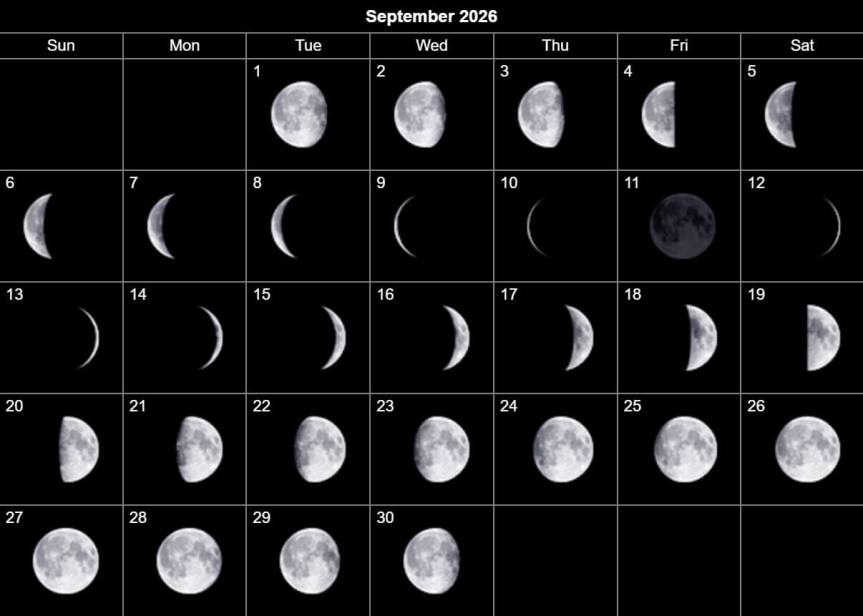
Visit the June 2026 Moon Phases Calendar to see all the daily moon phase for this month.

Today’s Waxing Gibbous Phase

The Waxing Gibbous on June 25 has an illumination of 84%. This is the percentage of the Moon illuminated by the Sun. The illumination is constantly changing and can vary up to 10% a day. On June 25 the Moon is 10.91 days old. This refers to how many days it has been since the last New Moon. It takes 29.53 days for the Moon to orbit the Earth and go through the lunar cycle of all 8 Moon phases.

Phase Details:

Phase: Waxing Gibbous
Illumination: 84%
Moon Age: 10.91 days
Moon Angle: 0.50
Moon Distance: 401,762.92 km
Sun Angle: 0.52
Sun Distance: 152,071,360.79 km

June 26, 2026 Current Southern Hemisphere/Tomorrow’s Northern Hemisphere Moon Phase

You can find more moon phase details on both of the websites used in this post by clicking on each hyperlink.

Source: nineplanets.org

The Moon phase for June 26th, 2026 is a Waxing Gibbous phase. This is the phase where the moon is more than 50% illuminated but has not yet reached 100% illumination (which would be a Full Moon).

In the Northern Hemisphere, the right side will be illuminated, and in the Southern hemisphere it’ll be the left side that is illuminated.

The Waxing Gibbous phase, like all moon phases, will last for just over 7 days. The actual length will vary because of the elliptical shaped orbit of the moon. During this Waxing Gibbous phase the moon will rise in the east in the mid- to late-afternoon and will be high in the eastern sky at sunset.

Assuming it’s a clear night, the Waxing Gibbous moon will then be visible through most of the night before setting just before sunrise.

Fun fact:

Phase Details:

Phase: Waxing Gibbous

Moon age: 11.85 days

Moon illumination: 90.79%

Moon tilt: 131.212°

Moon angle: 0.49

Moon distance: 405,281.41 km

Moon sign: Scorpio

Source: MoonGiant.com

You can use this link to go forward or backward in time for Moon phase information. If you are curious, you can even find out what phase the Moon was in when you or anyone else was born.

Visit the June 2026 Moon Phases Calendar to see all the daily moon phase for this month.

Today’s Waxing Gibbous Phase

The Waxing Gibbous on June 26 has an illumination of 90%. This is the percentage of the Moon illuminated by the Sun. The illumination is constantly changing and can vary up to 10% a day. On June 26 the Moon is 11.77 days old. This refers to how many days it has been since the last New Moon. It takes 29.53 days for the Moon to orbit the Earth and go through the lunar cycle of all 8 Moon phases.

Phase Details:

Phase: Waxing Gibbous
Illumination: 90%
Moon Age: 11.77 days
Moon Angle: 0.49
Moon Distance: 403,847.94 km
Sun Angle: 0.52
Sun Distance: 152,077,101.22 km

June 24, 2026 Current Southern Hemisphere/Tomorrow’s Northern Hemisphere Moon Phase

You can find more moon phase details on both of the websites used in this post by clicking on each hyperlink.

Source: nineplanets.org

The Moon phase for today is a Waxing Gibbous phase. This is the phase where the moon is more than 50% illuminated but has not yet reached 100% illumination (which would be a Full Moon).

In the Northern Hemisphere, the right side will be illuminated, and in the Southern hemisphere it’ll be the left side that is illuminated.

The Waxing Gibbous phase, like all moon phases, will last for just over 7 days. The actual length will vary because of the elliptical shaped orbit of the moon. During this Waxing Gibbous phase the moon will rise in the east in the mid- to late-afternoon and will be high in the eastern sky at sunset.

Assuming it’s a clear night, the Waxing Gibbous moon will then be visible through most of the night before setting just before sunrise.

Fun fact:

Phase Details:

Phase: Waxing Gibbous

Moon age: 8.76 days

Moon illumination: 67.61%

Moon tilt: 150.218°

Moon angle: 0.5

Moon distance: 396,868.94 km

Moon sign: Libra

Source: MoonGiant.com

You can use this link to go forward or backward in time for Moon phase information. If you are curious, you can even find out what phase the Moon was in when you or anyone else was born.

Visit the June 2026 Moon Phases Calendar to see all the daily moon phase for this month.

Today’s Waxing Gibbous Phase

The Waxing Gibbous on June 24 has an illumination of 76%. This is the percentage of the Moon illuminated by the Sun. The illumination is constantly changing and can vary up to 10% a day. On June 24 the Moon is 10.01 days old. This refers to how many days it has been since the last New Moon. It takes 29.53 days for the Moon to orbit the Earth and go through the lunar cycle of all 8 Moon phases.

Phase Details:

Phase: Waxing Gibbous
Illumination: 76%
Moon Age: 10.01 days
Moon Angle: 0.50
Moon Distance: 398,764.60 km
Sun Angle: 0.52
Sun Distance: 152,064,677.10 km

Weekly Horoscopes Sunday, June 21 to Saturday, June 27, 2026

Click on the hyperlinks below to read your horoscope for the coming week.

Click here to read your daily and weekly horoscope Source: georgianicols.com

Click here to read your weekly horoscope Source: horoscope.com

Spell For Tomorrow – 9 Knot Spell

(YOU CAN COPY AND PASTE ANY SPELLS POSTED TO A DOCUMENT TO PRINT AND/OR SAVE ON YOUR COMPUTER FOR PERSONAL USE ONLY.)

This is a spell that is limited only by your own imagination.

Your intention is what flues this spell so make sure you have it set in every part of you before starting this spell. Once you start the spell let nothing interferes with working it, including random thoughts in your mind. If you lose your concentration stop the spell and go back to start from the beginning of this spell.

u

Some of the Witchcraft/Magickal Correspondence for Tuesday

(YOU CAN COPY AND PASTE ANY CORRESPONDENCES POSTED TO A DOCUMENT TO PRINT AND/OR SAVE ON YOUR COMPUTER FOR PERSONAL USE ONLY)

June 23, 2026 Current Southern Hemisphere/Tomorrow’s Northern Hemisphere Moon Phase

You can find more moon phase details on both of the websites used in this post by clicking on each hyperlink.

Source: nineplanets.org

The Moon phase for June 23rd, 2026 is a Waxing Gibbous phase. This is the phase where the moon is more than 50% illuminated but has not yet reached 100% illumination (which would be a Full Moon).

In the Northern Hemisphere, the right side will be illuminated, and in the Southern hemisphere it’ll be the left side that is illuminated.

The Waxing Gibbous phase, like all moon phases, will last for just over 7 days. The actual length will vary because of the elliptical shaped orbit of the moon. During this Waxing Gibbous phase the moon will rise in the east in the mid- to late-afternoon and will be high in the eastern sky at sunset.

Assuming it’s a clear night, the Waxing Gibbous moon will then be visible through most of the night before setting just before sunrise.

Fun fact:

Phase Details:

Phase: Waxing Gibbous

Moon age: 8.76 days

Moon illumination: 67.61%

Moon tilt: 150.218°

Moon angle: 0.5

Moon distance: 396,868.94 km

Moon sign: Libra

Source: MoonGiant.com

You can use this link to go forward or backward in time for Moon phase information. If you are curious, you can even find out what phase the Moon was in when you or anyone else was born.

Visit the June 2026 Moon Phases Calendar to see all the daily moon phase for this month.

Today’s Waxing Gibbous Phase

The Waxing Gibbous on June 23 has an illumination of 68%. This is the percentage of the Moon illuminated by the Sun. The illumination is constantly changing and can vary up to 10% a day. On June 23 the Moon is 9.09 days old. This refers to how many days it has been since the last New Moon. It takes 29.53 days for the Moon to orbit the Earth and go through the lunar cycle of all 8 Moon phases.

Phase Details:

Illumination: 68%
Moon Age: 9.09 days
Moon Angle: 0.50
Moon Distance: 395,026.99 km
Sun Angle: 0.52
Sun Distance: 152,057,286.75 km

(One Person’s View Point) Moon Flower Meaning, Symbolizes, and Spiritual Meaning

Today’s flower is dedicated to my spirit/heart brother White Owl who’s favorite flower was the Moon Flower.

Disclaimer: No flower or plant or herb should be used for medicinal purposes until you have checked with your health care professional to ask if it is safe for you to use it for any reason. The content provided on this website is for informational purposes only and DOES NOT CONSTITUTE THE PROVIDING OF MEDICAL ADVICE and is not intended to be a substitute for independent professional medical judgment, advice, diagnosis, or treatment. Always seek the advice of your physician or other qualified health providers with any questions or concerns you may have regarding your health. WitchesofTheCraft.com and/or any staff member of WitchesofTheCraft.com and/or Lady Carla Beltane are not responsible for any type of negative reaction when using this flower or plant for any reason.

Meaning And Symbolism Of The Moonflower

Also referred to as the moon vine, the moonflower is a plant whose flowers bloom only at night, hence its name. They often have white blossoms, but some varieties have purple ones instead, but all of them are powerfully fragrant and give off a romantic vice.

During the day, the flowers of the moon vine are closed off like tiny buds that are only one or two inches wide.

However, after the sun sets, they slowly open wide as if to welcome the moon and can expand up to seven inches wide. This is why the plant has often been associated with the moon.

What Does The Moonflower Symbolize?

The moonflower’s appearance, fragrance, and behavior make it appear mystical and romantic, leading to deep symbolism attached to its presence. Here are ten of the most popular meanings of the moonflower:

1. Divine Existence

Several cultures revere the moonflower due to its association with gods and mystical beings.

The presence of this plant serves as a reminder that there are mystical experiences in the world that cannot be explained by logic alone.

For example, the ancient Greeks believed that the flowers on the plant represented the tears of the moon goddess Selene. Aside from this, the moonflower is also thought to be associated with Hecate, the goddess of witchcraft and magic.

Related Article: Meaning And Symbolism Of Waves

2. Feminine Energy

The moon is widely accepted as a symbol of femininity and is attributed with female qualities such as intuition and emotion.

Even the phases of the moon have been associated with the female reproductive cycle.

With the moonflower’s deep connection with the moon, the plant has also become linked to feminine energy. As such, it is often used in lunar rituals to help attract the power and energy of the moon.

Related Article: Meaning and Symbolism of Watches

3. Healing And Recovery

In some countries, such as Cameroon and Thailand, the moonflower is recognized for its medicinal properties.

Several parts of the plants can be used to treat snakebites, boils, hemorrhoids, and wounds. It can work as a laxative, antipyretic, and anti-diabetic, as well as helping to increase breast milk production.

Spiritually, this plant can help heal wounds of betrayal, rejection, and abandonment. Let it surround you and help you achieve deeper emotional wellness by tapping at the wisdom and energy of the moon.

Related Article: Meaning And Symbolism Of Teddy Bears

4. Duality And Contradiction

While the moonflower can help heal physical and emotional illnesses, it can also have a toxic effect.

The contrasting effects of the moonflower make it a symbol of duality and contradiction, as it can heal and cause harm at the same time. Because of this, the plant and its extracts must not be ingested randomly.

It must be taken with caution, subject to the approval and monitoring of a medical professional. Improper use of this plant can result in heart problems, nausea, vomiting, and diarrhea. Some people also experience psychological effects like agitation, confusion, anxiety, or hallucinations.

5. Spiritual Guidance

With bright flowers that only bloom at night, the moonflower is often seen as a symbol of guidance.

It helps illuminate the dark paths at night and accompanies spirits in their journey. With this, some cultures believe that the plant can help them commune with otherworldly beings like ghosts and spirits.

In some countries, the moonflower would be planted around gravesites so they could help guide the souls of the departed on their way to the afterlife. The Japanese would also use the moonflower in ceremonies to honor the dead.

6. Dreams And Fantasies

Its oneness with the night also makes the moonflower a symbol of sleep and dreams.

The plant’s deep connection with the moon gives it psychic abilities as well. As such, it is often the flower of choice for people who are fascinated by the unknown or those who want to explore the mystic realm.

Some cultures believe that the plant carries the powers of the moon goddess and is thus associated with mystery and magic. Others claim that placing a moonflower under your pillow will allow you to receive visions or prophecies through your dreams.

7. Growth And Determination

As the petals of the moonflower remind you of the moon, its climbing vines stand for growth and change.

This is primarily because of its remarkable ability to survive in different kinds of environments and even in unlikely places, like abandoned lots or cracks in the sidewalk.

The plant also makes use of night creatures like moths and baths to aid in pollination, enabling it to reach new territories and establish its presence there.

This shows its resilience and determination to keep on surviving, despite unfavorable conditions. As such, the moonflower can serve as your inspiration when you are going through challenges in life.

8. Fertility And Reproduction

Each moonflower plant is able to produce hundreds of seeds each year.

These seeds fall to the ground and self-propagate, getting themselves ready for growth in the next season. This means that the plant can grow by itself without the need for special nurturing or human intervention.

Because of these abilities, the moonflower has been associated with fertility and reproduction. In some cultures, such as in China, the plant is given to new mothers as a sign of goodwill.

9. Protection And Shelter

Its association with the moon goddess also makes the moonflower a symbol of protection.

The blossoming of the flowers at night represents the watchful eye of the goddess, who is believed to protect those sleeping under her radiance.

The large petals of the flower also curve around the center as if to protect it from outside elements that may cause it harm. Aside from this, the delicate fragrance of the flowers also have the ability to ward off evil spirits, thus protecting night travelers from harm while on their journey.

10. Blooming In Adversity

While most flowers look best under the shining rays of the sun, the moonflower reaches its peak beauty at night.

This is a reminder that it is possible for you to bloom and achieve your full potential even in the middle of difficulties.

The moonflower shows you that there is beauty in darkness as it shows off its pretty petals and spreads its fragrance at night.

If you find yourself faced with challenges that prohibit you from growing or moving forward, let the blossoms of the moonflower show you that there is opportunity even in adversity.

Conclusion

The moonflower is known for its unique behavior of closing up its petals during the day and opening them up at night.

This behavior has associated it with the moon along with Selene, the goddess of the moon, and Hecate, the goddess of witchcraft and magic.

Because of this, the plant has been attributed with meanings related to protection, divine presence, and spiritual guidance. Moonflower is also both a healing and a toxic plant, which gives it a symbolism of duality and contradiction.

Meanwhile, its ability to produce hundreds of seeds and to grow even in unexpected places enables it to represent fertility, growth, and determination.

(One Person’s View Point) Crystal of the Day – Moonstone

Crystal of the Day – Moonstone

As its name implies, moonstone is tied to the lunar deities, in particular, any goddess with a triune or triple aspect. Diana, Selene, and Hecate are often associated with moonstone. This stone can be used in workings related to female reproduction, menstrual cycles and childbirth. On a magical level, include moonstone in rites having to do with wisdom and intuition, womens’ mysteries, and goddess-centric ceremonies.

Common Name: Moonstone

Also known as: Cylon Opal

Appearance: White to colorless, sometimes found in pale blues; looks a bit like Opal in some cases

Element(s): Water

Planetary connection: Moon

Deity connection: Any goddess with a triple aspect – Diana, Selene, Hecate

Healing powers: Anything related to female reproduction, childbirth, menstrual cycles

Magical uses: Can be used in workings related to wisdom and intuition, Goddess-focused rituals

(One Person’s Viewpoint) Gemstone of the Day is Moonstone

Gemstone of the Day

Moonstone


(Color: off-white or gray or pale shades of green, yellow or brown)


Hardness: 6                            
Specific Gravity: 2.57                        
Chemistry: Na(90-70%) Ca(10-30%) (Al, Si)AlSi2 O8, Sodium calcium aluminum silicate       
Class: Silicates            
Crystallography:  triclinic; bar 1           
Cleavage:  perfect in one and good in another direction                   
Fracture: conchoidal                            
Streak: white                               
Luster: vitreous to dull

Healing: Moonstone is used to draw love, hope and protection. And to promote unselfishness. Moonstone is used in healing ailments of the stomach and lymph glands, aids with female problems and helps to relieve stress. It is used to ease pregnancy and childbirth. It is also used in the treatment of circulatory disorders.

Workings: Use moonstone to strengthen intuition and psychic perception and to bring a connection of balance and harmony with Spirit. In India, Moonstone is known as a “dream stone”, as it is supposed to bring about clear and beautiful dreams. During the waning of the moon the stone aids in prophesy. It is also known as a stone of fertility. It is said to have the power to grant dreams. Wear Moonstone for protection while traveling on water. Use Moonstone as a talisman of Good Fortune. Its element is Water, its energy is receptive and its associated planet is the Moon. Its astrological signs are Cancer, Libra and Scorpio. It vibrates to the number 4.

Chakra Applications: Use Moonstone to cleanse the Chakras of negative energy. Use it to activate the Heart Chakra.

Foot Notes: Moonstone is a semi-translucent stone that is made of albite and orthoclase feldspar.

Source: The Whispering Woods Author: Crick


One Person’s View Point About the Moonstone

MOONSTONE


SCIENTIFIC INFORMATION: Moonstone is one variation of Orthoclase. It
owes its beautiful silvery to bluish sheen (‘adularescence’ or ‘schil-
ler’) to its composition of extremely thin plates of orthoclase and
albite. The thinner these plates are, the bluer is the sheen. There are
also moonstones consisting mainly of albite. These are less translucent,
but they can occur in a variety of colours: grey, blue, green, brown,
yellow and white. There are also moonstone cat’s-eyes. The chemical
composition is KAlSi3O8 and the hardness is 7. The streak is white.

ENVIRONMENT: The potash feldspars are important rock-forming minerals in
plutonic, volcanic, and metamorphic rocks. Adularia and sanidine are
found usually in volcanic rocks.

OCCURENCE: The main countries of origin are Ceylon, southern India (the
district near Kangayam), Tanzia and Malagasy which, together with Burma,
produces some of the finest stones with a deep blue schiller. White
adularia crystals up to 2.5 cm (1″) across have been found in gold-bear-
ing quartz veins at Bodie, Mono Co., California, and in the silver mines
of the Silver City district, Owhyee Co., Idaho.

GEMSTONE INFORMATION: Moonstone is always cut into cabochons, to display
the cat’s-eye, or schiller.

NAME: Adularia (another name for Moonstone) comes from the locality in
Switzerland, the Adula Mts.

LEGEND and LORE: This stone has always been revered because of its lunar
attraction. It was believed that the shiller in the stone would follow
the cycles of the moon. (Becoming greatest when the moon was full.) In
addition, it has always been considered a “feminine, or Goddess” stone.

MAGICAL PROPERTIES: Meditation with moonstone calls into consciousness
the three-form moon phase goddesses, Diana/Selene/Hecate, the waxing,
Full and waning Moon. These are woman as goddess in her ages and
contradictions, Maiden/Mother/Crone. Cunningham favors this stone for
spells involving love. In addition he has a longish essay on using it
for a “diet” stone.

HEALING: Because of it’s feminine nature, Moonstone has long been
considered a “womans healing stone”. It is used traditionally for
healing/balancing of female organs and hormones.

PERSONAL EXPERIENCE: I use Moonstone at the Transpersonal Point, for
connection to the Goddess and Universal Feminine Energy. This is the
connection to dreams and dreaming, feminine “intuition”, and “cycles”.
There are cycles of time, seasons, the moon, stars, etc. I also use/give
2623

this stone for those clients who are having difficulty being in tune
with the feminine side of their nature.  (Everyone has a masculine and
a feminine side.)

NOTES: In the past, this stone has also been called “Cylon Opal”.

——-bibliography——-

1. Scientific, Environment, Occurence and Name are from (or paraphrased
from) “The Audobon Society Field Guide to North American Rocks and
Minerals”.

2. Precious and semi-precious gemstone information may come from
“Gemstones” by E. H. Rutland.

3. Other Precious and semi-precious gemstone information may come from
“Gem Cutting”, sec. ed., by John Sinkankas.

4. Legends and Lore, Magical Properties are from “Cunningham’s En-
cyclopedia of Crystal, Gem & Metal Magic”, by Scott Cunningham.

5. Some of the healing information may come from “Color and Crystals, A
Journey Through the Chakras” by Joy Gardner.

6. Some of the healing information may come from “A Journey Through the
Chakras” by Joy Gardner.

7. Personal Experience is from MY personal experience, journals and
notebooks, by <grin> Tandika Star.

8. Birthstone poem from “The Occult and Curative Powers of Precious
Stones” by William T. Fernie, M.D.

Spell For Tomorrow -Moonstone Travel

(YOU CAN COPY AND PASTE ANY SPELLS POSTED TO A DOCUMENT TO PRINT AND/OR SAVE ON YOUR COMPUTER FOR PERSONAL USE ONLY.)

Moonstone Travel Spell

This spell will call on Meness, the patron moon god of travelers. We met Meness earlier, in the meditation for Monday. I suggest setting up this spell in the evening. Find a spot that faces east or that is illuminated by moonlight. Or try setting this up under the moon, in the garden, or on the porch or your outside deck. Get some atmosphere going! Try using a scented candle, such as jasmine or gardenia, to coordinate the fragrance with the moon’s energies.

Gather the following items:

• A photo of your destination, your travel itinerary, or your airline tickets

• 4 small tumbled moonstones

• A scented white votive candle and holder

• A lighter or matches

Set up this spell on a safe, flat surface. Light the candle and place it in the holder. Place your paperwork/tickets or itinerary to one side of the candle. Arrange the four stones in a circle around the holder. Place your hands on the travel paperwork, and ground and center. Then repeat the following spell three times:

Meness, patron of travelers, watch over me

Whether I travel in the air, on land, or sea

Like a talisman in my pocket a stone will I tuck

Moonstones do encourage a safe journey and bring good luck. Take one of the stones and keep it in your pocket while you travel. You may close the spell by saying:

For the good of all, with harm to none

By the moon and stars, this spell is done.

Gather up your papers and tuck them away for your trip. Allow the candle to burn out on its own. If you performed this outside, then move your candle and the remaining stones indoors to let the candle safely finish burning. Never leave your candle unattended.

Source: Book of Witchery: Spells, Charms & Correspondences for Every Day of the Week BY Ellen Dugan

*All of Ms. Dugan’s books used on the WOTC are available for purchase on Amazon.com. 

The Witches Correspondences for Monday


(YOU CAN COPY AND PASTE ANY CORRESPONDENCES POSTED TO A DOCUMENT TO PRINT AND/OR SAVE ON YOUR COMPUTER FOR PERSONAL USE ONLY)

The Witches Correspondences for Monday


Day: Monday ( Moon-day)

Planet: Moon

Colors: Silver and White and Grey

Crystals: Moonstone, Pearl, Aquamarine, Silver, Selenite

Aroma: Jasmine, Lemon, Sandalwood, Moon Oil, African violet, Honeysuckle, Myrtle, Willow, and Wormwood

Herb: Moonwart

The sacred day of the Moon, personified by such goddesses as Selene, Luna, Diana, and Artemis. The Moon is ruler of flow affecting the changeable aspects of people. If a full moon falls on a Monday, its powers are at theirmmost potent. Magical aspects: peace, sleep, healing, compassion, friendships, psychic awareness, purification, and fertility

Monday is ruled by the moon – an ancient symbol of mystery and peace. Monday is a special day for mothers as the cycle of the moon has long been associated with the female menstrual cycle. Those wishing to conceive a baby would be wise to try on a Monday as the magic of motherhood is strong and pregnancy is in the air.

This is the proper day of the week to perform spells and rituals involving agriculture, animals, female fertility, messages, reconciliation’s, theft, voyages, dreams, emotions, clairvoyance, home, family, medicine, cooking, personality, merchandising, psychic work, Faerie magic, and Goddess rituals.