
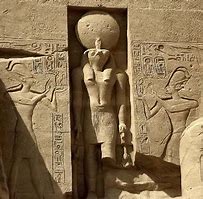
Gods – Ra

Egyptian Sun God Ra from gods-and-goddesses.com

Ra is the Egyptian god of the Sun. He was also the predominant creator god in ancient Egyptian religion. He was the most powerful and most worshiped of all Egyptian gods. The sun, and therefore Ra, represented life, warmth, and growth to ancient Egyptians. He was so important that he earned the status of King of the Gods, with the Egyptian kings or pharaohs holding the title “sons of Ra.”

Understanding and describing Ra is difficult because of the many forms he was depicted in, as well as the practice of creating new deities by merging existing deities. As one of the creator gods, Ra created himself before his identity was combined with several other gods, including Horus and Atum. This resulted in new names such as Ra-Horakhty and Atum-Ra.

Ra Facts

Name(s):  Ra, Amun-Ra
Rules over: Sun, Chief God
Gender: Male
Symbols: Sun, Sun Disk, Scepter, Ankh
Sacred animals: Falcon
Parents:  None
Siblings: Thoth, Serket, Sobek, Apep

Origins

Reference to Ra was first made during the Second Dynasty of ancient Egypt (c. 2890 – c. 2686 BC), also known as the Old Kingdom. His stature grew to that of a major god by the Fifth Dynasty (c. 2494 – c. 2345 BC).

Family

The eye of Ra is an extension of Ra’s power, and is the feminine counterpart to the sun god in Egyptian mythology. His daughters Bastet, Sekhmet, and Hathor were all considered to be “eyes of Ra” and instruments of his vengeance.

Together with Atum, Ra also fathered Shu, the god of wind, and Tefnut, the goddess of rain. Tefnut gave birth to Nut and Geb, who in turn were the parents of OsirisIsis, Set, and Nephthys. These nine make up the Heliopolitan Ennead.

Symbols

Ra is pictured and represented in many pieces of ancient Egyptian art found in temples, tombs, hieroglyphics, relics, and other relics. He was generally depicted in human form, most notably with a falcon head crowned with a sun disc; a sacred cobra called Uraeus encircled the disc. Sometimes his head also took the form of a ram or a beetle, depending on the deity with whom he merged.

Powers & Duties

The ancient Egyptians believed Ra created all forms of life by calling them into existence using their secret names. Alternatively, some narratives also stated that man was created from Ra’s tears and sweat.

The sun god was believed to travel across the sky in a solar bark with the sun on his head. He traveled through the underworld in a bark called Sektet (meaning “growing weaker”) during the night, defending himself against and overcoming monsters such as the serpent Apophis. The prayers and the blessings of the living supposedly accompanied him together with the souls of the dead. In the morning he traveled in a bark called Matet (meaning “becoming stronger”).

Worship

Egyptian pharaohs spent most of their money on sun temples during the Fifth Dynasty. They were specially aligned in Ra’s honor. By the time the New Kingdom arrived (c. 1550 BC), the worship became more elaborate. Detailed texts describing Ra’s journey on the sun boats were written on tomb walls, while hymns, prayers, and spells were created in acts of worship.

Heliopolis, meaning sun city in Greek, was the principal seat of worship of Ra. It was known as Iunu or “place of the pillars” in ancient Egypt. Its remains can still be seen today in the Cairo suburb of Al-Matariyyah.

Facts About Ra

  • Many solar temples were built in honor of Ra, but none featured a statue of him. Instead, he was represented by the sunlight openly flowing into the temple, which had an obelisk and altar at its center.
  • A scarab beetle called Khepri who rolled up the sun at sunrise was seen as Ra’s morning manifestation;
  • At sunset Ra manifested in Khnum, another creator god, normally depicted with a ram’s head;
  • At noon, when the sun was most powerful, the sun god was just Ra;
  • Apep, the god of chaos, was Ra’s greatest enemy. He supposedly tried to swallowed Ra as the sun god entered the underworld, causing the sun to set. When he spat Ra out after not succeeding in his quest, the sun rose again;
  • Many solar temples were built in honor of Ra, but none featured a statue of him. Instead, he was represented by the sunlight openly flowing into the temple, which had an obelisk and altar at its center;
  • Egyptian mythology links Ra to the Tree of Life, a sacred symbol in the solar temple at Heliopolis. The fruit of the Tree of Life gave eternal life, although it was only available to the gods and aging pharaohs;
  • The Tree of Life was seat to Bennu, the mythological phoenix that represented Ra’s soul;
  • The worship of Ra began to fade with the rise of Christianity after the Romans conquered Egypt around 30 BC.

A Way to Get Energized

Sometimes we do not need a speel or full ritual to connect with and use magick. As the following will show.

I have a very busy life with working with the carnvil in the summer, running our online coven, mentoring witches, besides taking care of home, hubby, my familiar and our two other dogs. So there are many times my physical energy levels is almost at zero. I have found that calling upon Ra, the Ancients Egyptian Sun God, to fill me with his energy is a way to go to make it through a day.

When the Sun is out and I can see it, in others words a clear or partily cloudy day, I just stand outside and face Ra. I then ask him to please fill me with his warmth and energy. After I see red through my eyelids I know he has done his best for me at that time. I thank him for his gift and continue on with my day feeling filled with energy.

When I cannot see the Sun outdoors it gets a little more complicated. To fix this, I have a picture I took of the Sun on a cloudless day on my cell phone. I bring the picture up and ask Ra for his warmth and energy to come from his picture into me. This way does take longer about seven to ten minutes as opposed to only about three to five minutes when I can see Ra directly. When I feel myself full of his energy I thank him for his gift and go on with my day.

This is a simple thing to do and good for us too as we each need a lot of Vitamin D daily. I have read a couple of studies that stated spending twenty minutes a day with no sunblock on your face or a hat covering it up will give you all the Vitamin D you need that day. The reason to do it daily is our bodies does not store this vitamin. This is just a suggestion and not meant in any way as medical advice. Check with your personal health care giver before letting Ra bless you for the twenty minutes.

Copyright 2015 Lady Beltane

Sunday – The day of the Sun Gods


Sunday–The Day of the Sun

Among all peoples in early times the sun was an object of wonder. It was to them a mystery, but although they could never understand it, they imagined many explanations of it. When we remember that in those long-ago days nothing was known of the rotation of the earth or of its movement round the sun, we can readily see how very real the movement of the sun must have seemed. But if it moved across the sky it must be a chariot, for it was in chariots that all men travelled quickly, while none but a god could ride across the sky.

The nature of the sun may have been difficult to understand, but the comforts and the benefits which it brought to men were plain to all. It was a kindly god who gave the earth warmth and light, who ripened the crops and the fruit and made them serviceable to man, who clothed the trees with leaves and scattered the fields with flowers. It is little wonder then that in all parts of the world men worshiped the sun, and the god whom they pictured in their imagination was all the more real to them because of the great worh he performed.

We have seen how the Greeks and Romans worshiped the sun as Apollo, the god who set out each day when the Gates of the East had been opened by the Goddess of the Dawn, and, driving his chariot across the sky, dipped down into the oeean, where a boat awaited him to bring him back. Apollo was the most beautiful of the gods, as befitted the giver of light and happiness, and was worshiped throughout those sunny lands of the South. On the Island of Rhodes, off the coast of Asia Minor, stood one of the Seven Wonders of the World, a statue of Apollo. It was known as the Colossus of Rhodes on account of its size, for it was 100 feet high, the fingers of the god being as long as a man. It was placed at the entrance to a harbour, and remained in position for nearly sixty years, and was then (224 B.C.) overthrown by an earthquake.

The principal temples of Apollo were in the Island of Delos, and at Delphi in Greece, and it was at this town of Delphi that the great Pythian Games were held every four years in honour of the god. The games were so called because Apollo was believed to have slain at Delphi a dragon called Python.

The sun’s daily journey, his contest with the darkness, and his final victory at the dawn of the new day are ideas which have led to endless stories, and we find these stories are very similar among different peoples. Ra, the great sun-god of Egypt, was pictured as travelling by day in a ship across the waters of the sky, and returning during the night through the kingdom of the dead. To the Egyptians Ra was a symbol of life, death, and a new birth or resurrection. Through the night Ra fought with the lord of the powers of darkness, a huge serpent, who awaited the sun in the west with a band of demons, and whom he overcame at the approach of dawn. Ra was always represented either as a hawk or as a man with a hawk’s head, with the sun on his head. The hawk was chosen as his symbol, because it was said to fly towards the sun.

In India the sun was worshiped as the god Agni, who rode in a shining chariot drawn by blood-red horses. He was golden-haired, and had a double face, seven tongues, and seven arms.

Among the gods of the early British who were driven into Ireland was the sun-god Nudd, or Ludd, as he was sometimes called. His name appears in Ludgate, and it is thought that his temple stood on what is now Ludgate Hill in London. At a town called Lydney, in Gloucestershire, the remains of a temple to Ludd have been found, with many inscriptions containing his name.

The Angles and Saxons imagined the sun to be carried in a chariot driven by a maiden named Sol, as we shall read later. They had no god whom we can describe exactly as a sun-god, but several of their gods were like the sun in many ways, particularly Frey, whose sword sent out rays of light like the sun, and who caused the crops to ripen, and Balder the Beautiful, the God of Light, who was the favourite son of Odin, father of the gods, and was, as his name shows, the most handsome of the gods, ever happy and light-hearted. His golden hair and his bright, clear eyes shone like the sun, and his radiant smile warmed the hearts of all who met him. He knew no thought of evil, but was “good and pure, and bright, was loved by all, as all love light”.

In spite of his lovable nature, however, Balder was destined to misfortune through his twin brother, Hodur, the God of Darkness, who was the exact opposite of his brother, for he was gloomy and silent, and suffered from blindness. Odin, through his great wisdom, knew that disaster was to come to Balder, and spared no effort to stave off the evil day, by making all things in creation swear that they would never harm the God of Light. This they were only too ready to do, and all made a solemn vow, with the one exception of a shoot of mistletoe, which was passed over as being too slight a thing ever to cause harm to anyone. Balder being now free from all possibility of hurt, the gods one day amused themselves by shooting and throwing at him, laughing gaily as the objects they threw fell short or turned aside. Now Loki, the God of Fire, was bitterly jealous of the God of Light, and, as he watched the sport, his evil nature prompted him to a cruel and cowardly deed. Having discovered that the mistletoe alone of all created things had made no promise, Loki hastened to the gate of Valhalla, where the mistletoe was growing and plucking it, by the help of his magical power quickly fashioned from it an arrow. He then returned and sought out Hodur, who, because of his blindness, was standing idly aside and taking no part in the sport. Loki pretended to take pity on him, and fitting the arrow to a bow which he placed in Hodur’s hands, he offered to aim the shaft for the blind god. Aided by Loki, Hodur let fly the fatal arrow, and, to the horror and amazement of the gods, Balder fell dead. The anger of the gods against Hodur knew no bounds, and they would have killed him had it not been for their own law, which forbade the shedding of blood in Asgard, the home of the gods. All Asgard was plunged in the deepest grief, and Hermod, the messenger of the gods, was sent to Hel, the Goddess of the Underworld, praying her to restore Balder to life. Hel consented to do so, on condition that all created things should weep for Balder. Messengers were at once sent out over all the world to bid all things weep for Balder. Living creatures, trees, and flowers, and even the stones shed tears for the god they had loved so well; but at last a giantess was found whose only reply to the messengers was “Let Hel keep what she has”. Thus the evil Loki, for he it was in the disguise of a giantess, showed once again his cruel hatred of Balder, and caused the whole earth to mourn the loss of the radiant God of Light.

The gods now prepared for the burial of Balder. As was the custom among the Northmen, fuel was piled on the deck of Balder’s ship Ringhorn, and the body was then laid on the funeral pyre. The sides of the ship were decorated with rich cloth and garlands of flowers, and swords, armour, drinking-vessels, and many other things which the gods valued, were placed beside the hero. A torch was then put to the fuel, and the ship was launched. The funeral pyre floated slowly towards the west, the rising flames lighting up sea and sky, until at last, like the sun itself, it sank slowly into the sea, and all light faded from the sky

Your Charm for June 29th is Necklace of Charms

Your Charm for Today

Necklace of Charms

Today’s Meaning:
What you need in this aspect is a bit of understanding. You can find happiness in abundance if you understand and accept the differences of those with whom you share your life within this aspect.

General Description:
This is an Egyptian group of amulets. The centre ornament is the Lotus, from which hangs the emblem of Millions of years — Thou shalt never perish, never, never come to an end. The Lotus bestowed upon the wearer Light and Understanding, the gifts of the god Ra, their sun god, king of gods and of men. The Fish, the symbol of the Egyptian goddess who controlled the rising of the Nile brought Abundance and Riches. The other pendant is in the form of a lock of hair, the meaning of which is obscure.

Deity of the Day for September 28th is RA

RA

God of the sun; sometimes identified or considered synonomous with Atum. Ra created man from his tears. At one time Ra became so digusted with men that he orderd Hathor to kill them all. This Hathor did with such zeal that Ra took pity on men and ordered Hathor to stop. Crazed with blood, Hathor ignored the order, and Ra resorted to chicanery to save humankind. Ra mixed beer with pomegranate juice and left pots of the concoction about the battlefield. Thinking the mixture was blood, Hathor drank it greedily and got too swacked to carry out her mission.