The Witches Magick for Jan. 14 – A Healing Spell

COMPASSIONATE MAGICK – A HEALING SPELL

To help hurry along a person’s recovery from an illness, write their name on a human-shaped candle (based on gender). While anointing it with myrrh or mint oil, visualize healing energy in the form of white light, flowing from your fingers into the candle. Recite:

In the divine name of the Goddess who breathes life into us all
I consecrate and charge this candle as a magical tool for healing.
 

Place the charged candle on top of a photograph of the sick person, and then light the wick.

As the candle burns down, concentrate on the person, willing them to be healthy, and chant this incantation:

Magic mend and candle burn,
Sickness end; good health return
Enhanced by Zemanta

Your Charm for January 13 is The Heart

Your  Charm for January 13th is The Heart

The Heart

 Today’s Meaning:       

A course of events that cannot be altered has been set in motion within this aspect. Accept whatever happens in the near future and do not waste your time fretting about it–you can do nothing.         

General Description:        

This was a favourite charm in Egypt, worn in order to frustrate magicians, sorcerers and evil wishers from bewitching the wearer and stealing the soul from the heart; for it was the general belief that if the soul left the heart, the boy would soon fade away and perish. The ancient Egyptians also believed that, after death, the heart was taken, in the underworld, and weighed against the symbols of the law; if found perfect, it was restored to the body, which at once came to life again and enjoyed everlasting felicity

Enhanced by Zemanta

Let’s Talk Witch – Winter Purification Rituals

Witchy Comments & Graphics
Let’s Talk Witch – Winter Purification Rituals

During the winter, stagnant energy and negativity can build up in our homes. Fire is a natural purifier and is excellent to use during the winter to cleanse our living space. Here are three rituals for you to try.

This ritual uses winter spices to help clear the home of negativity. Combine a pinch each of allspice, ginger, and clove. Sprinkle these spices onto the fire. Using a small pine branch, trace the shape of the pentagram in the air over the hearth. At first, hold the pine branch above the flames and visualize any negativity being sucked up the chimney. Then lay the pine branch directly into the flames, if it pops and cracks a lot, then you did have some negative energy hanging around. If you perform this ritual in your cauldron or other dish, when the ashes cool, sprinkle them away from your home.

To create a calm atmosphere in the home and to purify yourself of any negative thoughts, this spell combines snow (or ice), rose water, and fire. First, in a bowl combine some fresh snow, or a few ice cubes, and a teaspoon of rose water. Place the bowl in front of the fire and let the snow or ice melt. When melted, stir the mixture with your hand and anoint your forehead and each wrist. The scent of the rose water should calm you— let go of any bad thoughts. Take this mixture around your home and sprinkle it in front of doors and windows. Return to your hearth and bless the fireplace and chimney. Pour any extra mixture outside.

As a good general cleansing technique, after you have built a fire or when the wood is glowing brightly, sprinkle a handful of regular table salt onto the fire. This serves to bless and purify any space, as a bonus the salt also helps to slow any creosote build-up in the chimney. Use this once a day in my wood stove.


Excerpt from:
Article: Winter Fire Magic
Author: James Kambos
Source: Llewellyn’s 2014 Magical Almanac: Practical Magic for Everyday Living

For All Our Friends Up North, Snow Magick!

Snow Magick

When winter rolls around, in some parts of the world there is an abundance of wonderful white stuff – snow! If you live in one of those areas, it makes sense to take advantage of snow’s natural properties and work those energies into your magical endeavors. Think about, for starters, some of snow’s physical characteristics. The most obvious one is that it’s cold. It’s also white. Sometimes it’s light and powdery, other times it may be heavy and wet. How can you incorporate these into your magical workings?

If you’re a fan of candles, make ice candles – they’re are a lot of fun and easy to make during the winter months. .

Build a snowman as a very large magickal poppet. Assign a snowman the magical task of being a guardian at the entrance to your property.

Got a bad habit you need to get rid of? Form that bad habit into snowballs, and throw them as far away from you as you can.

Snow quartz crystals are often associated with fulfillment of hopes and dreams. Use actual snow instead of crystals in workings related to wishes and goals.

If someone is bothering you and won’t leave you alone, try this simple bit of magic. Write their name on a slip of paper, and pack it in snow in a zip-loc bag. Place the bag in your freezer, and leave it there until the person “chills out.”

Go for a walk in the woods on a day that it’s snowing. Enjoy the silence, and the magic of the snowfall – some people report that they have experienced messages from the Divine as they walk on a snowy day. Perhaps it’s because we’re better able to hear the gods when it’s quiet!

By Patti Wigington, About.com

Let’s Glance at Today’s Totem/Power Animal – The Crow/Raven

Crow/Raven

This large, stately black bird assumes an almost universal role as a symbol of death or destiny.

Among the Celtic people, the bird was associated with various war goddesses, who could assume the form of a raven at will. The Vikings held similiar beliefs about the valkyries, and it was decreed that understanding the speech of birds could help one gain entry to the world of valkyries and ravens, where the results of future battles were ordained. Valkyries, in their coats of lustrous black feathers, were also known as Kraken, or crows. Warriors who fell in battle and whose bodies could not be reclaimed by friends or family were known as hrafengrennir, “raven feeders.”

The great Danish hero Sigurd was the some of King Ragnar Lodbrok and the valkyrie Krake, a shape-shifter who could choose to be a beautiful maiden or a crow.

0In numerous fairy tales of the northern Europeans, the raven is the spirit helper who guides the hero through the dangerous turns and traps of his quest. The raven is also a reliable consultant on the vagaries of the Other World.

In the Germanic tradition, the great hero Emperor Fredrick is guarded by ravens as he sleeps in his underground sanctuary until the day of his return to earth.

During the dark and troubled Middle Ages in Europe, the crow also came to be associated with Satan because of its black color and raucous cry. Moralistic animal fables were told of the crow’s shame of its blackness, even to the point of scattering mud on elegant swans in an attempt to make them look like him. They, of course, could wash off the dirt, but the jealous crow could never change his color. St. Antony, however, was not disturbed by such negative reports against the crow, for he chose it as his animal symbol.

Among many Native American tribes, especially among the plains and southwestern groups, the crow is a trickster figure, similiar in many ways to the coyote.

The Dakota envision the crow as an assistant to the plover, the Spirit of the South, who presided over warm weather. When the Spirit of the North arrived with his winter wolves, a battle ensued between them and the crow and the plover. According to tradition, if the two birds with their war clubs are able to beat back the wolves, warm weather would prevail for a little while longer before the harsh cold set in over the plains.

The Pueblo groups usually associate owls and crows with Dark Side witchcraft, and it was generally accepted that witches could change themselves into crows at will and fly at night to work their evil deeds.

In the Native American zodiac, those born from September 23 to October 22 are Crow/Raven people. The Medicine Wheel describes them as social, energetic, and full of nervous energy and fluctuating moods. But they are generally very flexible and adapt well to new enviroments and circumstances.

If you have selected the crow as your totem animal-or if the crow has selected you-you may consider yourself to be something of a shape-shifter, gifted at wearing many faces. Be cautious of becoming too manipulative of others and impinging upon the free will of those who may be a bit gullible and easily led.

Your crow is a keen-eyed student of the enviroment from a perspective seldom achieved by ordinary observers. As one who watches shrewdly over the lay of the land on both spiritual and physical levels, your totem animal expresses a point of view that touches several dimensions. As you learn better how to listen, you will find that he is a messenger without peer.

As a spirit helper, the crow will be able to get you in touch with many ancient mysteries, but you must regularly enter the Silence to be certain that you do not yield to the temptation of exploiting the powers of these ancient wisdoms for the glory of the Dark Side. If you are able to maintain your spiritual balance, the crow will guide you to become a gifted practitioner of True Magick and Medicine.

Dreams

Your animal totem is warning you that should you continue a present course of action, you will be in for a great disappointment.

Totems

The Transformative Power Of Your Personal Animal Totem

Brad Steiger

ISBN 0-06-251425-3

———————————————————-


The Crow

Crows are very vocal birds. They are sly and often deceptive in their actions. Crows have been known to build false nests high in treetops to confuse predators. The height of their nests give them the opportunity to watch everything that is going on around them. Many cultures think of crow as the keeper of knowledge for nothing escapes their keen sight.

Crows travel in groups and make mischief in teams. As one crow explores something new, others will watch closely to see what happens and then learn from it. In this way they seem to always be in council with each other. They often raise a ruckus when hunters are around, warning deer and other birds. Crows recognize possible danger and always post lookouts when feeding—thier most vulnerable time.

Their language is complex and they have a remarkable voice range. Each caw has its own meaning. Sometimes crow warns of impending danger. Other times it signals a time to join in council and make decisions. Listening to crow can teach those with this medicine how to hear the truth of what is being said.

The striking black color of crow represents the color of creation. It is the womb out of which the new is born. Black the color of night gives birth to the light of a new day. Crow is a daytime bird reminding us that magic and creation are present in both. Their ability to shift between the known and unknown world indicates new journeys.

Because crow is adaptable to all environments and will eat almost anything they can survive in almost any situation. Crow is associated with magic, unseen forces and spiritual strength. If crow flies into your life, get out of your familiar nest, look beyond your present range of vision, listen to its caw and act accordingly.

Author Unknown

Snow Magic

Snow Magic

By , About.com

When winter rolls around, in some parts of the world there is an abundance of wonderful white stuff – snow! If you live in one of those areas, it makes sense to take advantage of snow’s natural properties and work those energies into your magical endeavors. Think about, for starters, some of snow’s physical characteristics. The most obvious one is that it’s cold. It’s also white. Sometimes it’s light and powdery, other times it may be heavy and wet. How can you incorporate these into your magical workings?

  • If you’re a fan of candles, make ice candles – they’re are a lot of fun and easy to make during the winter months. Try the instructions here: Imbolc Ice Candles to make your own ice candles.
  • Build a snowman as a very large magical poppet. Assign a snowman the magical task of being a guardian at the entrance to your property.
  • Got a bad habit you need to get rid of? Form that bad habit into snowballs, and throw them as far away from you as you can.
  • Snow quartz crystals are often associated with fulfillment of hopes and dreams. Use actual snow instead of crystals in workings related to wishes and goals.
  • If someone is bothering you and won’t leave you alone, try this simple bit of magic. Write their name on a slip of paper, and pack it in snow in a zip-loc bag. Place the bag in your freezer, and leave it there until the person “chills out.”
  • Go for a walk in the woods on a day that it’s snowing. Enjoy the silence, and the magic of the snowfall – some people report that they have experienced messages from the Divine as they walk on a snowy day. Perhaps it’s because we’re better able to hear the gods when it’s quiet!

Supportive Practices of the Craft

Supportive Practices of the Craft

Author:   Iain Quicksilver   

In addition to the practices of witchcraft usually discussed, such as divination and herb lore, there are practices, which support a witch’s overall efforts. The following seven sections describe practices I have found useful for tuning up my Craft practice and keeping it properly focused.

1: Cycles

Witches follow cycles in everything they do, out of respect for their overall balance of health. They don’t work all year, and then try to relax through a brief vacation; witches take little mini-vacations all the time. They sometimes appear to be laid back and lazy, but they respond well in a crisis, and they somehow get their tasks done.

A witch aims at discovering her own biorhythms, so as to work with, rather than against, her natural energy cycle. But in practice there are usually compromises to be made with work and other factors. Her actual daily schedule may be set somewhat askew to her biorhythms, but a witch will adapt to it and arrange for periods of rest between work to attend to quarters other than South / Will / Fire. There are knowledge and skills to acquire, and emotions and the circle and the practice of inner and/or outer stillness to attend to. And there is a little goofing off, daytime rest, which is essential; just watch the animals.

Starting with the Sun cycle and making allowances for work, etc., a witch reserves the earlier parts of the day for practical affairs. She will not work on taxes, for instance, into the evening hours, but will start earlier in the season and devote some weekend daytime hours to the chore. Evening is for going within, withdrawing to one’s own hearth and communing with ancestors and familiar spirits.

2: Directions

It isn’t on any list of witch tools, but a compass is important to the modern witch so she can orient her life and work to the four directions. Witchcraft is always done in a physical context. Pagans are highly aware of their immediate environment and traffic with spirits of the field, yard, stream, the most prominent local tree, as well as with household spirits. The key to contacting household spirits lies in feelings.

When you first move into a new house or apartment, it feels cold and uninviting, especially if it hasn’t been lived in for a while. Not much later, it fits you comfortably like a suit of old clothes; and if, in addition, it is alive with saged boundaries and household shrines, you feel liked by the house as well as liking it yourself. This is a boundary perception, which we are taught to ignore or treat as a subjective matter, but if instead we address the good feelings and express our appreciation for the atmosphere of our dwelling, we break that boundary and begin to recover ancient pagan perception.

In the same way, outdoor sprites can be contacted through greater sensitivity to one’s feelings without discounting them from habit.

Upon awakening in the morning, when a witch is ready to start the day, it is a good practice to take out the compass and address the four quarters. One begins in the North, opening oneself to calming energy. Then to the East, holding in mind briefly what needs to be known or learned today. Then to the South, deciding the first tasks. Then to the West, expanding awareness according to one’s ways. Then seal to the North, stilling the mind and body once again. The witch is now ready to face the day.

3: Expanding Awareness

One way of expanding awareness when silently addressing the West is to relax and wait for something in your peripheral awareness to stand out and beckon your attention. It might be the reflection of something in a window, or the shadow of a tree or the spaces in its foliage. Whatever it is, when it gets your attention, continue to view it peripherally. You are in touch with its mana, or magical energy, and can use it throughout the day when you call it to mind. The image in your memory should be peripheral, not central, i.e. the way it looked when it got your attention. This can also be done with things heard peripherally. These are some of my ways.

4: Conserving Magical Energy

There is a kind of energy or power that the modern world has forgotten, though the memory of it is preserved in folk tales and myths. Indigenous peoples are well aware of it and live their lives with reference to it. While the immediate environment abounds in it, and we take it in all the time, we do not notice it because we squander it in habitual ways, habits that have been with us from early childhood. The ancient Latins called it numen, and the Mongolians, hiimori. It is always personal, taking on the features of the person holding it.

It is only by conserving this energy that the witch becomes ready to do magic, both in the circle and life. We don’t realize that everything takes energy, even unconscious ignoring of things in our environment, such as shadows, eyeglass frames, or background sounds. When we expand our attention to include such things, we gain the energy that was used in keeping them in the background of our attention, the penumbra or half-shadow. This energy is always exponentially higher than the small amount required to expand the attention.

The energy takes four forms for witches, associated with the four ancient elements. The energy of Air makes us learn and understand new things that hadn’t occurred to us before. In everyday life, it also manifests in any new knowledge or understanding.

The energy of Fire boosts the will and lets us accomplish tasks in life that seemed too big to tackle. In order to bring changes into our physical lives, we have to both give up some things, at least temporarily, and adopt other things or actions that further the goal. In the Craft, habits or actions that squander magical energy have to be sacrificed, and then the freed energy finds new outlets on its own.

The energy of Water attracts us to the unknown, and gives us the daring to escape the current limitations of our lives. This is the energy of initiation, which expands and transforms our awareness and can give our lives a whole new basis.

The energy of Earth is cloaked in silence. Witches seek inner and outer stillness, quite as much as Zen monks or Hindu yogis do. This stillness is deep, and the deeper the witch descends into it, the more he or she is transformed and the greater the magical energy that results. It is pursued gradually and at first in little things, like learning to sit still and not scratch, or refraining from certain topics in conversation.

Not that the witch is inactive, quite the contrary; Earth, the North, is also the place of our physicality, and the witch exercises regularly, and takes care of business through Fire and the South. Stillness refers instead to the enormous amount of energy we waste in fidgeting and performing other small, unnecessary actions, both mental and physical: for instance, compulsively repeating past conversations in one’s mind or rehearsing conversations to come in some hypothetical future event (for all thoughts of the future are hypothetical) .

The witch sums up a past event and plans for the future, but these are finite acts that come to an end, instead of repeating over and over and wearing on the nerves. The energy to be had by restricting such habits cannot be anticipated in advance. Out of stillness comes new understanding, closing the circle of practice towards Air and the East.

Thus the witch pursues the four powers of the magus: to know, to will, to dare, to keep silence. But there is a fifth power that results from the balanced development of the four: to go. The witch is saving energy for his or her definitive journey, the flight to the True Sabbat, fellowship and celebration with the ancestors, spirits, and deities in the other world. Folklore depicts it as a joyous occasion, and colors it with the pleasures and longings of the time when the tales were spun. Some tried to cut corners and get there more quickly through the use of the witch’s flying ointment. The actual flight may or may not follow traditional lines.

One may not literally fly up the chimney and then meet the Wild Hunt in the sky and fly to a rath or burg and descend therein through a tunnel into the Otherworld. The journey may parallel many of these features, nonetheless; and there are preliminary journeys to be made that go partway there.

The flight to the True Sabbat is a milestone on the way to the witch’s ultimate journey to the Sun, when he or she acquires a body of light that can materialize at will, so that further incarnations here in middle Earth are no longer needed. This transformation seals the work of the Craft and completes the vows made at initiation; thenceforth one does other work, perhaps as a guardian elemental, paying back for the help received along the way on this side by paying forward.

5: The Familiar

Witches traditionally kept a cat, sometimes a horse, as a familiar. The witch’s astral journeys were made in company with the spirit of the familiar.

The best information I have found on this practice is in Timothy Knab’s A War of Witches, a factual account of an anthropologist’s investigation, some twenty plus years later, of a battle with brujos and brujas in the highlands of central Mexico. In the course of his investigation, he is inducted into Toltec brujeria by one of the survivors and makes a journey to Tlalocan, the Toltec Underworld.

Tlaloc, the Lord of the Underworld, keeps animal spirits called naguals in his corrals. He gives a nagual to each human at birth. The nagual could perhaps be thought of as the link, within each of us, to other animals, inherited though latent from the prehistoric past. But it is a real spirit and to be a brujo one must find one’s nagual. Afterwards, an experienced brujo, through many journeys to Tlalocan, may have acquired a number of naguals, keeping them in fetish objects like puma’s claws, or in a special gourd.

The human soul is called the tonal. It has two halves. One faces towards the Sun and stands guard over the body when the dark lower half, the shadow, goes on journeys down the world pillar to the underworlds. The shadow is so called, both because it lies below our daily awareness and faces towards the nether regions, and because it follows its nagual into the depths as the latter’s shadow.

If the nagual is a cat spirit, the shadow takes on the semblance of a cat spirit. This is done for protection from hungry denizens of the deep, who prize the heart blood of a tonal but will let a nagual go by.

The discipline Knab goes through in becoming a brujo is well worth the reading. But to return to our own practice, preparation for a liaison with a cat familiar’s spirit, besides the obvious step of getting a cat, would seem to involve re-molding one’s own psyche closer to that of a feline. We do this unconsciously when we sit in company with a cat and enjoy its utter relaxation. Cats are content to go from moment to moment doing whatever they are doing, even if it is only resting.

We, however, often have a habit of doubting whether we are making best use of our time, or regretting we are not elsewhere doing other things. Cats, apparently, have no such qualms. The daily practice of witchcraft in fact promotes a calm mind fully given to the moment. Apparently cultivation of inner stillness connects us with the animal, pre-rational mind, so that we can enjoy shuttling between two minds, as the occasion permits.

This is only an example of how the witch models him or herself on a cat familiar. Whether or not one goes on journeys with the cat, cultivating a close relationship with one will draw the witch closer to his or her own inner, pre-rational mind, through which he or she can call up power from the Deep in circle.

6: The Patron Deity

It isn’t incumbent upon pagans to have a special relationship with a single deity, but it can be a rewarding experience. The pagan will continue to honor the other deities and spirits, of course, and may enter into a similar relationship with another later on. Suppililiumas, the king of the Hittites, was singularly devoted to his goddess, and as we know, his subject Abraham devoted his wandering life to his family god, the later Yahweh.

All gods stand ready to teach by sharing their consciousness, and by helping the devotee to practice the disciplines that lead to that awareness. Pagans will generally choose a patron deity (male or female) on the basis of temperamental preferences, though they may be influenced by a dream or vision. The relationship can be devotional or more like a friendship. In the latter case the deity is like an older mentor or senior partner. In late heathen times, Thor was popular with people seeking this latter relation.

In the Craft, the Lord and the Lady serve as patrons. The Lord is the year-god, who has waxing and waning aspects, and these replace each other at the solstices. Because the outgoing aspect dies and is reborn six months later, the Lord (sometimes called the Lad) is more of a demigod, and is not quite up to the Lady’s level. Witches and warlocks alike tend to relate to the Lord as a tutor or preceptor, and to the Lady devotionally.

The continental Celtic god Cernunnos is associated by modern witches with the year-god. He is known only from artifacts and only by the description given him by Greek traders in antiquity on the Ister or Danube river – the horned or antlered one (we do not know his Celtic name) . Cernunnos teaches witches the way to deal skillfully with both the outer and inner life.

The Oak King or waxing year aspect teaches, by example, how to deal with the outer world joyfully and fruitfully. The Holly King or waning aspect is the psycho pomp or soul-guide in Craft initiation, and also provides fellowship with ancestors at Samhain, October 31st.

On the Gundestrup cauldron, found in a peat bog in Denmark, Cernunnos is the central carved figure. He has two antlers, wears a torque or neck-ring signifying wealth, and holds another in his right hand, as bestower of wealth. His left hand grasps a ram-headed snake by the neck, an Underworld animal linked with healing and sacrifice.

It often happens that a pagan already pursues some discipline designed to conserve magical energy, and chooses an appropriate god or goddess, asking him or her to be the patron of that practice. If the god is willing, he or she will help, first of all, by reminding the devotee to practice whatever part of the askesis is appropriate for the present situation.

The devotee thanks his or her patron for these reminders, knowing from experience that practice would be slacker without them. As the partnership goes on, the world will start to take on the colors peculiar to that deity’s consciousness and personality, and will cause subtle changes in the personality of the devotee as well.

The patron deity also teaches in dreams and guides the devotee in waking life by means of signs and omens, often peculiar coincidences that seem mysteriously significant.

The Lady nurtures and feeds witches as well as all her children on the earth, and also teaches those who prefer to relate to a female divinity. The discipline taught by the Lady involves cleansing the emotions of their verbal accretions. The devotee learns to feel without thinking or analyzing or labeling the feeling. In this way, the witch or warlock draws closer to the animals, who have naked feelings unclothed in thoughts. The askesis of the Lady is especially suitable for couples.

7: Inventory

Supportive practices of witchcraft aim at optimizing the free flow of energy through the life of a witch.

A cluttered life is full of energy knots that trap old, stale energy called `miasma’ by the ancients. The first phase of a spell, purification, is designed to unravel one or more of these knots, so that an increase in the flow of magical energy renders the flow palpable. The energy must be felt to be directed, and as some of it is flowing all the time (however feebly) , the rate of flow must be increased for it to be felt. It can then be directed to a chosen purpose in the consecration phase, and, in the final phase, charged with all the force the witch can command through expanded awareness.

But if the witch’s life is full of energy knots, untying one or two of them by purification may not result in a very strong flow of energy. For a stronger flow, the witch must gradually remove clutter from his/her life so that energy knots are few and easily unraveled.

Clutter comes in many forms. There is mental and emotional clutter; the clutter of always being too busy because of over-commitment; the memory-clutter of too many unfinished projects; and the material clutter found in the home: over-stuffed closets, garages, basements, storage sheds, etc. This section is about material clutter.

By learning and applying the principles of feng shui, we can facilitate a free flow of the energy the Chinese call ch’i throughout the home; but before putting feng shui into practice, we must face and do something about the mountains of clutter tucked away in corners, closets, cupboards and other hiding places. We may think that if our accumulations are out of sight they will be out of mind as well, but the deeper, pre-rational mind we share with the animals keeps tabs on every least thimble.

When the writer Aldous Huxley’s house in California burned down, he remarked on how clean it felt to be free of so many possessions. This was a drastic example of what we can achieve in a smaller degree through the practice of inventory.

The deep mind keeps a file on every item we own, and these files must be closed and cleared away if the witch is to use the filing function for fulfilling oaths and following threads of self-discipline. Accordingly, at regular intervals a witch will go through some of his or her clutter, putting things together that belong together, and getting rid of items no longer needed. A good rule of thumb to follow is to keep what one can use (sentiment counts as a use) and put the rest where it is likely to do the most good. In this we see an illustration of the balance of the Craft, which aims at getting maximum enjoyment and effectiveness from possessions without getting bogged down in being possessed by them.

Putting things you don’t need where they will do the most good may mean giving things away; but be careful doing this, as you may lose friends if they feel you are dumping stuff on them. And above all, never tell anyone you are following the rule of inventory, as gifts should at least appear to be made from a feeling of friendship.

Closing accounts with past unfinished business, either by abandoning old projects or by completing them, leads to a greater integration with one’s past selves, and can clear a channel through memory, and far memory, for the witch to travel in the inner journey down to the Summerland

__________________________________________

1. For numen see Rose, H.J. in the bibliography.

2. For hiimori see Sangerel, both references, in the bibliography.

3. For the folklore of the Sabbat, see Jackson in the bibliography.

4. On the journey to the Sun, see Grimassi, p. 219, in the bibliography, also Nikhilananda, vol. II, p. 158.

5. See Knab in the bibliography.

6. See Gurney in the bibliography. More recently, a royal charter of King Suppliliumas has been found, authorizing a mercantile expedition to Byblos on the ancient Lebanese coast. Abraham may have been in it.

7. See Davidson (I) in the bibliography.

8. For the significance of Cernunnos in modern witchcraft, see Farrar in the bibliography.

9. See Davidson (II) in the bibliography.

_______________________________________________
Footnotes:
Bibliography:

Davidson, H.R. (I) , Gods and Myths of Northern Europe, London, Penguin Books, 1990.

__________ (II) , Myths and Symbols in Pagan Europe, Syracuse, NY, Syracuse
University Press, 1988.

Farrar, Janet and Stewart, Eight Sabbats for Witches, Custer, WA, Phoenix Publishing, 1988.

Grimassi, Raven, Ways of the Strega, St. Paul, MN, Llwellyn Publications, 1995.

Gurney, O.R., The Hittites, London, Penguin Books, 1952.

Jackson, Nigel, Call of the Horned Piper,

Knab, Timothy J., A War of Witches, Boulder, CO, Westview Press, 1995.

Nikhilananda, Swami, translator, The Upanishads, in 4 vols. New York, Ramakrishna-
Vivekananda Center, 1975. Prasna Upanishad is in Vol. 2.

Rose, H.J., Religion in Greece and Rome, New York, Harper Torchbooks, 1959.

Sarangerel (I) , Chosen by the Spirits, Rochester, VT, Destiny Books, 2001.

_______ (II) , Riding Windhorses, Rochester, VT, Destiny Books, 2000.

The Law of the Power


Witchy Comments & Graphics

The Law of the Power

The Power shall not be used to bring harm, to injure or control others. But if
the need rises, the Power shall be used to protect your life or the lives of
others.

The Power is used only as need dictates.

The Power can be used for your own gain, as long as by doing so you harm none.

It is unwise to accept money for use of the Power, for it quickly controls its
taker. Be not as those of other religions.

Use not the Power for prideful gain, for such cheapens the mysteries of Wicca
and magick.

Ever remember that the Power is the sacred gift of the Goddess and God, and
should never be misused or abused.

And this is the law of the Power.

(* Wicca – S. Cunningham)

The Witches Magick For December 9th – Three-Stone Home Magick

The Witches Magick For December 9th

Three-Stone Home Magick

Cast this spell to bring more harmony and happiness into your home by way of benevolent faeries.

You will need three small white stones you find in nature.

At 6:07 p.m., draw a magick circle and call in the elements. Hold each of the three stones in your power hand, one at a time, and face your altar. Take a deep, complete breath in and out. Merge with the faeries and charge each of the stones by saying:

“Blessed be, blessed three moon and star stones,
Please bring harmony and happiness to my home.”

Now, slowly spin clockwise three times. When you are done spinning say:

“Helpful, bright, and friendly faeries
Please bring harmony and happiness to my home
Ayea, Ayea, Ayea, blessed fae! So Be It!

Sit or stand quietly in the middle of your circle and imagine the helpful powers of the earth, air, fire, and water faeries bringing more harmony and joyful happiness to your home forever and a day. Do this for at least fifteen minutes, then offer the stones to the faeries by placing them gently on the ground beneath a flower, bush or tree. As you do, repeat with each stone:

Blessed be, blessed three moon and star stones
Please bring harmony and happiness to my home.

Your Charm for December 5th is The Bulla

Your Charm for Today

The Bulla

Today’s Meaning:        

You are distracted from this aspect by other areas of your life you feel are more pressing. This aspect is suffering from this lack of attention. You must ask yourself how much more you can let it suffer before you give it due attention.

General Description:

From remote times the terrors of the arts of fascination have been dreaded, and by wearing this charm, which contained a written invocation to their gods, it was believed that full protection was obtained. The Bulla was popular in Rome from a very early period. It was worn on a necklace, or upon the girdle. The Gorgons head, with hair of writhing snakes, was believed to terrify and drive away the power of the bewitcher. Even today in many countries, the magic power of the evil eye is still believed in.

How to do Magick

How to do Magick

Very, very carefully

There are certain factors that must be in your mind when you do magick.

1. The Wiccan Rede?

2. The rule of three?

3. Have you been asked to do the magic?

4. Are you ready to take away another’s will?

5. Are you ready to pay for what you are going to do?

Magick is something that one does not take lightly. Do not let the movies or TV be your guide at this time. For everything we do there is a price to pay.

So say you, that you will only do “good magick.” Therefore you have nothing to worry about. You have a friend that has been ill for a while and you decide to help them. You cast a healing spell and your friend does not get better, but instead dies. You know whose fault that is? You – the caster.

First by casting the spell without being asked goes against the Rede. Secondly you are taking over a persons will. You have no idea what medication had been given to your friend. You stick your two cents in and wind up counteracting the good the medication might have done. Now what do you thing will happen to you? Remember the rule of three. Good returns good three times, evil returns evil three times. Feeling comfortable with this, are you?

Great, you will stay away from healing, but what about that great looking Guy or Gal at the office. You would like them for yourself. Before you cast, think, which of the five items above are you willing to accept?

All of a sudden casting does not seem like fun and games. In the future you will learn that casting is not to be taken lightly. It is not a gift, but a responsibility, and one not to be taken lightly. When you are willing to accept the responsibility and results of casting them should you get involved.


Cook Book Spells

There are many books on the market with spells in them. Spells, unlike recipes are not some thing that you can get out of a book. In my Grimore are spells I have cast and that have worked for me. I can hand the book over to you and all you would have is a book of lovely words. That’s all! A spell is part of the individual casting.

It is not necessary for a spell to be spoken in rhyme, but it helps. By writing your spell in rhyme it forces you to give though to what you are doing. You MUST be very specific with what you want a spell to do; else it can come back to you.


Self Gain

Never cast a spell that will benefit you with riches, or rewards. It is not our place in the universe to be the richest people in existence. But don’t get me wrong. If you are unemployed there is nothing with casting a spell to gain employment. But be careful here too. Your competition for the job may be unemployed also.


For a Simple Healing the cost is…

Wiccans and Witches DO NOT have a sliding fee schedule for the magic we do. As a matter of fact we DO NOT charge. To charge is to belittle who and what you are. We give from our hearts. For the most part the Wiccan community cares for those around us. We love the Earth and all she stands for. We care for animals and humans alike. Being a Wiccan / Witch is NOT a business.


Why Spells Don’t Always Work

WHY  SPELLS DON’T ALWAYS WORK

Spell casting, in and of itself, is not difficult. Generally, it follows an
easy formula with separate and distinct steps. A spell is a procedure to
follow to reach a desired end. It does not require a great deal of money, a
huge compendium of tools, or exotic ingredients to work. It does require
faith in yourself and a commection with deity.
When describing spells to non-magickal people, a witch will often tell them
that a spell is much like a prayer. You are calling upon divinity to assist
you, as in a prayer, but a spell requires more than just pleading to divinity
to help you out of a jam. In a spell YOU are an active ingredient. Your
faith and your knowledge are as important as understanding there is divinity
out there to call upon.
Many of you have already heard of the Witches’ Pyramid, the foundation of our magickal acts: To Know, To Will, To Dare, and To Be Silent. This pyramid is  the underlying structure of any spell formula.
To Know 
Before you can cast a spell, you need to know who you are. Ego aside, you
have to come to terms with who you are, how you operate, and why you do the things you do.
The second thing you must know is precisely what you want. This is not as
easy as it seems. People rarely sit back and consider what they really want
out of life. Part of this is because they are afraid. They fear they may not
get what they want, and they fear that they will fail. These fears stop us
from knowing.
For example, time and time again people I know have spelled for love. They
have not done the ultimate no-no by targeting a specific person, but they do
something just as bad–they don’t really know what they ultimately want.
When they get what they spelled for, often they are disappointed, because
there is something attached to that new lover they didn’t think of.
Therefore, all spells must be specific.
One of the best ways to begin a working is to write out, in detail, exactly
what you want in one straight line on a piece of paper. Underneath,
phonetically begin to pare each word down. Underneath that line, pare the
words down again. Continue this procedure until only one letter from each
word is left. Interlock the few remaining letters into a sigil. Use this
sigil in whatever magickal application you have chosen to ensure your spell
remains specific.
To Will  
Another stumbling block in spell casting is lack of will, whether it is will
power, belief, or conviction. Will depends on how badly you want to make a
change. Do you believe you are capable of making the change, or do you think
it is only wishful thinking? Are you willing to re-program your mind, your
environment, your relationships, in order to bring about ther change you
desire? Without will, a spell will fizzle. Is your mind fogged with doubt,
or unnecessary problems that will prevent bringing about the change you say
you want?
One of the best techniques for increasing your will power is the use of
meditation on a daily basis. Once you have learned to relax, use the alpha
state to program the events you wish to come to pass. You should work on
both short-term and long-term goals.
Another technique that is useful in spell casting is to write down why you
wish to manifest something. Let this explanation sit on your altar
overnight, then re-read it. Does it make sense? Is this what you really
want? Does your reasoning still appear firm, or is it full of holes?
Are you patient? Patience has a lot to do with will. Once you have a firm
grip on “will,” you are a third of the way through on accurate spell casting.
To Dare  
To dare means you are not inclined to sit around on your laurels. It means
that you are not choosing to procrastinate, rather you are choosing to move
with purpose. To dare indicates that you are no longer afraid of the
outcome, or fear failure. You are confident that you control your own
destiny to the point where you won’t even argue about it, either with someone
else, or yourself.
Although “to dare” doesn’t appear to create a lot of work, it does require
you to make an active decision. This is the next catalyst for your magickal
operation. From here, you will plan the appropriate day, hour, moon phase,
astrological energies, and tools required for working magick,including what
divinity you will choose. To dare can lead to a great deal of work and
preparation.
To Be Silent  
Even if you are an adept, you should learn to be quiet about your magickal
operations. There is only one exception, which is when you are working with
a group. If the group mind is actively participating on a project they
should be informed of their success or failure.
In the beginning, you should be silent so that you are not affected by
others’ opinions. Don’t tell them what you are performing magick for, as you
risk failure. Why? Because they can unconsciously affect you with their
disbelief or negativity.
Likewise, once you become proficient at spell casting, don’t announce
it–especially to a novice. No real adept will ever tell a novice that “My
spells always work.” Not only is it rude, it is also untrue. Everyone
fails. Imagine what a novice would think if they knew you lost your job,your
kids are running rampant, and you are deeply in debt. If your spells always
worked, you would not be in such a fix, would you? Foolish words can ruin
your reputation, which in turn, will ruin your own self-confidence.
Therefore, keep your trap shut–this ensures success in your magickal
operations as well as keeping your reputation intact. No one likes a
braggart, and no one considers an egotistical Witch a good leader or cleric.
When Spell’s Fail  
Try this chant
Oh God/dess (whoever you worship) I am not worthy of    
your perfect grace, nor the magick i find within myself    
and within you. I ask now in Just, for i have grown weak    
that thou would accompany me in rituals and spells.    
Be By my side in this time of need. I do not deserve you    
Oh God/dess. but still I ask, for i am only but a mortal    
Oh God/dess, Bless me!    
Oh God/dess, accompany me!    
Oh God/dess, Shine light upon me!    
Oh God/dess, grant me wisdom!    
Oh God/dess, Grant me Humility!    
Oh God/dess, Stay with me!    
Oh God/dess, Protect me from evil!    
Oh God/dess, I love thee above all things!    
Please Oh ancient ones, hear me!    
Amen

Let’s Talk Witch – Warnings & Cautions For The New Wiccan or Witch

Warnings & Cautions For The New Wiccan or Witch

If you’ve looked at this site at all, you’ve seen the wonderful things that happen when you begin following a Wiccan path. I’ve been asked to discuss the not-so-nice things that can happen. I’m not trying to scare anyone off, just give you enough information so you can make an informed decision.

The Shadows are out there:

They exist, in the invisible world that parallels our own, living creatures. Unlike creatures from our world, they lack physical form, and feed on energy instead of matter. They are as varied as the animal life on our world. They range in size (power) from the equivalent of insects and rodents to the equivalent of magically trained humans, and beyond to the Great Old Ones. (My land is inhabited by one of these-it gives the psychic impression of a mountain with legs. It is not unfriendly, but an elephant is not unfriendly toward ants either. I stay out of our woods when it is about.) I mentioned that these creatures feed on energy. Most are content to graze on the random energy fields that leak from humans and other creatures in our world. Others, however, are a little more sinister. These, the ones you have to worry about, I call the Shadows.

Shadows come in three basic varieties. First are the little ones that feed off the energy in negative emotions. If you are emitting strong negativity, they will be drawn to you like flies to rotten meat. If you aren’t magically protected, they will happily latch onto your energy field (aura) and snack on it. They are usually not much more troublesome than leeches or mosquitoes; however, a thousand leeches could weaken a person severely.

Next come the more dangerous variety, more like rats or vultures than mosquitoes. These are attracted both by negative emotions and the energy of magical workings. They are stronger, and can push past weak or flawed defenses to get to you. And they are much harder to peel loose once they have their teeth into you.

Last are the intelligent variety. Their favorite meal is human life energy, the ‘heart-fire’ that burns in each of us. They are relatively rare even in their own realm, but they exist. The terms ‘Imp’ , ‘Evil Spirit’ and ‘Demon’ are fairly accurate. They are very strong. The more intelligent ones are capable of working their own Magic to breach your defenses. The most intelligent variety , being as lazy as humans, prefer to talk you into dropping your defenses and linking your energy field to theirs. (“Open yourself to me, and I will grant you power beyond your wildest dreams.” Yeah, right.) They also are capable (if someone is helpful enough to open a doorway for them) of entering our world. Once here, if they can get past all your defenses unless you are very strong at warding. They can enter your body and feast at will, even asserting a degree of control over you. Yes, this is exactly like the old stories of Demon possession.

You – yes, you can be a Vampire:

There exist in this world evil creatures. They are highly intelligent, capable of working magic, and extremely devious. They are capable of not only psychic magical attacks, but physical ones as well. As a species, they tend to be amoral, murderous animals. I call them ‘humans’. Humans are also capable of ‘feeding’ off the energies of other humans- Herne (owner of this website) calls them “Psychic Vampires”. They do this to gain more magical power, to control others, or to replace the energies they are losing by dealing with the Shadows. Some humans can even do this while traveling astrally. So that Evil Spirit that tried to get into your last circle may not have been from the other side; it could have been your next-door neighbor.

Oops! Did I just do that?

Magic is an art form. Despite the best efforts of Ritual Magicians and Technopagans, it remains as unpredictable and powerful as the weather unless you are highly skilled and focused. Scientists studying weather prediction in the 1970’s discovered something amazing. Weather, they found, is so unstable as to be impossible to predict more than a day or two in advance. In fact, computer models suggested something they called the Butterfly Theory. It seems that the air disturbed by a butterfly taking off from a cactus in Mexico, if it happened at the right time and place, could in theory cause devastating storms and tornadoes in the U.S. Midwest. Magic is very similar. Each action we take, magical or mundane, has consequences that spread out from it like the ripples in a pond.

They spread out, touching everything- and reflect back to converge on the source. Be very sure, then, before you work magic, exactly what the consequences may be. Ask yourself, “If this spell backfires on me, and affects me instead of the intended target, can I live with the result?” Thus, I tend to use magic “only in direst need, and then must the cause be just” (author unknown).

Some Wiccans counsel about how rain on your fields could cause drought elsewhere. This might be true, if you are trying with your own personal power to ‘squeeze’ the rain clouds as they pass over. But asking the Lady and Lord for the blessing of rain for everybody’s crops is a different thing entirely. Selfish magic has negative consequences: Loving, giving magic only positive ones. For Selfishness is the true root of all evil. “I want it! Destroy the world, let Chaos take the universe, as long as I get what I want!” Be careful of what you ask, you just may get it…

Power corrupts:

So, you’ve studied hard, learned all about Wiccan magic, and now you find you can really do things. All the power of the Elements is yours to command. Love, money, power, respect- all these are yours. You are special. You are powerful. You are a God! Now, you must convince others to worship you, to lend you their energy so that your power can grow. But that’s OK, because you are a loving God, and you want only what’s best for your worshipers. And you know what’s best for them, for you know all, and see all. For you alone are God of this world you have created.

Can’t happen? Do the names Jim Jones, Sun Myung Moon or David Koresh ring a bell? It is important to remember that the gift of magical power is just that- a gift from the Lady and Lord. It must never be abused. And glorifying yourself because of something lent to you is like showing up at your class reunion in a borrowed suit and a rented Jaguar. This reason and this reason alone is why you will not find the Council of this site posting or trading spells and rituals. We don’t hand out loaded guns here.

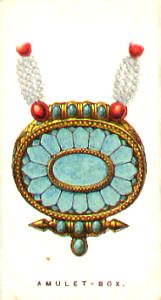
Your Charm for November 28th is The Amulet Box

Your Charm for Today

The Amulet Box

Today’s Meaning:  

There are papers in your near future. This aspect is affect by legal papers of some kind–a contract, a deed or a license of some kind. These papers will bring improvement to your life.

General Description:

The people of Tibet are most superstitious. It is the custom for almost everyone to wear charms. The Amulet-box illustrated contains small inscribed scrolls covered with magical characters. These magical formulae are written and blessed by their Lamas. The scrolls are believed to be all powerful spells for appeasing evil spirits, keeping the wearers from all physical harm, safeguarding them from every kind of danger, and protecting them from the blighting effects of the evil eye. Many of these charm boxes are of gold elaborately chased, and encrusted with turquoise.

Amulets

Amulets


The usage of amulets seems universal stemming from the human desire for protection. The existence seems to extend from the cave dwellers to the present. As objects they come and go with fashion, taking on different designs and shapes, but their purpose remains the same. No matter how civilized a culture may be, the amulets are present.
The term amulet is derived from either the Latin word amuletum or the old atin term amoletum which means, “means of defense.” Pliny, the Roman naturalist, described three types of amulets: those which offered protection against trouble and adversity; those which provided a medical or prophylatic treatment; and substances used as medicine.


Among ancient cultures such as the Egyptians, Assyrians, Babylonians, Arabs, and Hebrews great importance was placed on the use of amulets. The Egyptians employed them everywhere. The frog protected fertility;
ankhs symbolized everlasting life and generation; the udjat, or eye, was for good health, comfort, and protection against evil; the scarab beetle was for resurrection after death and protection against evil magic. One of the most notable amulets of ancient Egypt is the Eye of Horus

.
Cylinder seals were used as amulets by the Assyrians and Babylonians. Within them were embedded semiprecious and precious stones; each stone supposedly possessed its own unique magical powers. There were various animal shaped amulets; such as, the ram for virility; and the bull for virility and strength.


The Arabs, too, had amulets protecting them against evil. Small sacks containing dust from tombs were worn. They also wore pieces of paper on which were written prayers, spells, magical names or the powerful attributes of God such as “the compassionate” and “the forgiver.”


The Hebrews wore crescent moons to ward off the
evil eye and they attached bells to their garments to ward off evil spirits.


In Africa the natives were discovered having amulets too which the Western explorers and missionaries called
fetishes. The fetish symbolized protection to the natives.
Historically the two most universal symbols of amulets have been the eye and the phallic symbols. Eyes are thought to protect against evil spirits and are found on tombs, walls, utensils, and jewelry. The phallic symbol, represented by horns and hands, is protection against the evil eye.


The names of God and magical words and numbers have generally been thought to provide protection and fashioned into amulets. These methods of gaining protection extend back to antiquity and were extremely popular during the Renaissance to the early 19th century. Accompanying these were the grimoires, books of magical instruction written for and by magicians. In magic, using the name of a deity is the same as drawing down divine power. This is the reason why portions of grimoires resemble prayer books.
The
Tetragrammation, the Hebrew personal name for God- -YHWH and pronounced Yahweh”- – , is believed to be very powerful in magic operations and has been fashioned into amulets by different spellings. It is believed to help magicians in conjuring up demons and give him protections from negative spirits.


The SATOR square
has also been fashioned into amulets. Throughout the centuries attempts have been made to decipher the squire but it still remains unintelligible. It was discovered on walls and vassals of ancient Rome. In amulet form it is considered to be protection against sorcery, poisonous air, colic, pestilence, and for protecting cow’s milk against witchcraft.


Most all cultures hold the belief that sacred religious books such as the Koran,
Torah, and Bible possess protective powers. Bits of parchment containing quotes from these books are carried in leather pouches, silver boxes, or like containers as amulets. Ancient pagans wore figurines of their gods as amulets. The remnant of this custom is still seen in the Catholic religion where some members still wear scapulars and medals of the saints.


Many pagans and witches presently wear jewelry fashioned in amuletic designs with their protective purpose in mind.

Witches Do It In A Magical Circle

Witches Do It In A Magical Circle

Author:   Rhys Chisnall   

Sacred space is a space that is ‘experienced or seen as’ sacred but remember, this need not mean it has any extra unseen property. In many religions, it is a permanent structure such as a church, a mosque, a druid’s grove or a temple. The place is seen as sacred, as numinous and special suitable and worthy of where the Divine can be experienced. These places are often made sacred through certain rites and ritual… a form of magic, which to my mind is the manipulation of meaning to transform phenomenal reality. The rites are the manipulation of meaning which leads to ‘experiencing as’ the church as sacred (even to those who never partook in the original rituals) and if that is not the transformation of phenomenal reality I don’t know what is.

Witchcraft differs from other religious and spiritual traditions in that it does not have any permanent sacred spaces. There are no permanent temples in the initiatory Craft perhaps because it is a spiritual tradition where the focus of the experience of the Divine is through life and death, where there is no dualism between the sacred and the profane, therefore there is no need for a permanent temple. In the Craft the sacred space is declared at every meeting, wherever and whenever the coven meets.

This sacred space is declared when the circle is cast by the High Priestess with her athame and is both psychological and mythological in character. It is psychological, firstly, as it is visualised by and ‘felt by’ the participants as the sphere is formed about them. It is ‘experienced as’ by the mind through an act of imagination. Secondly, the setting up of the sacred space in the Craft prepares the Witches for the rite in which they are to participate. For example a church is laid out to either assault the senses such as in the stain glass, incense, bells, candles, crucifixes and robes of the priest in Catholicism, or the in the stark whitewash and lack of symbolism of the Methodists. The symbolism, the bells and smells of the Catholic or the austerity stemming from the suspicion of idolatry of the Protestant both work to put the worshipper into a worshipful and receptive state of mind.

Likewise the words, gestures, incense, candle light and nudity involved in the casting of the circle puts the Witches into the state of mind where magic (the manipulation of meaning to transform phenomenal reality) can occur. If the same method of casting is used each time (as in Initiatory Craft) , then expectation and classical conditioning (like Pavlov’s dogs) combine to create the appropriate state of mind with little effort on the part of the Witch. Vivianne Crowley (1989) tells us of one priestess who says something like, “I only need to hear the swish of a broom and I am in an altered state of consciousness”. I can confirm from experience that that this is certainly the case. During the set up of our rituals and the casting of the circle, after twelve years of being with the same coven, I automatically slip into ritual consciousness.

The circle is also mythological and is full of symbolism. The circle can relate to four of the classical elements, air, fire, water and earth. It can relate, like the phases of the moon and the wheel of the year to the stages of life such as youth, maturity, old age and death. To my mind this means it can relate to stages in the hero’s journey, the mono-myth described by Professor Joseph Campbell in his book, The Hero with a Thousand faces. This is the journey of the mystic, who goes out into the metaphorical wilderness, fairy land, the world of adventure. It is here that the mystic has their adventure/experience, attaining gnosis (spiritual knowledge) , before returning to everyday life where they have to integrate what they have learnt. The failed hero or mystic is not able to do this and is stuck in the adventure world and so perishes. The circle can also be symbolic of the changing seasons of the year, spring, summer, autumn, and winter, which of course, underpin the myths of the Craft.

The circle, mythologically speaking, is out of time. It is also all time, all the seasons, all the stages of life, all parts of the hero’s quest and so paradoxically, which can happen in myth, is all time and at the same time it is out of time. The circle is experienced as the mythological every-when, fairy land and eternity where the tick, tick, tick of time does not pass; there is no past, present or future. Mythologically speaking, this is the mystical state. It is in this space were we experience mythologically, rather than logically. We participate in mythology, finding meaning that allows us to engage with the mysteries.

It acts as a mythological circle that psychologically contains the emotion and meaning. It represents the keeping away of thoughts and feeling not required for the ritual. These are the daily round of duties and thoughts, which might be stresses about work, money, or whether we have left the cooker on. They are outside the psychological circle and we within the ritual are on the inside. It is a psychological and mythological barrier between the emotions, thoughts and meaning necessary for the job at hand, and those that would distract us from our purpose. So the circle acts as a boundary and protection of meaning containing the emotional power we raise.

To conclude it is both a mythological space where we engage with and act mythologically and a psychological boundary. However, while this requires imagination, visualisation and concentration; it is not the same thing as play-acting. Rather it is ‘seeing as’, making and experiencing as profound meaning rather than simply make believe. This meaning can be allegorical but it is also archetypal in that it related to our deep feelings that are invoked by what is fundamentally important in life.

_______________________________________

Footnotes:
Campbell, J, (1993) , The Hero with a Thousand Faces, Fortana Press
Crowley, V., (1989) , Wicca: The Old Religion in the New Age, Aquarian Press

Our True ‘Magical Tools’

Our True ‘Magical Tools’

Author:   Solonius  

Our ‘magical items’ are only mundane objects without inherent power! After much deliberation, I’ve decided that I must toss that match into the gasoline can. I feel that there is an undue amount of romanticism attached to what are only supposed to be the tools of the witch’s trade. We are supposed to be wise enough to know that it is our minds, through our focused thoughts, that perform our spells and ceremonies, not our tools.

Wren composed a very thorough and thoughtful essay on the types and uses of Magical Tools, posted here in Witchvox back on 16 July 2000. I highly recommend reading it for the knowledge that you can gain. I’m re-posting what I personally feel is the most insightful part of that essay:

— THE WITCH:
You are the most magickal tool of all. It is your intentions and energies that determine the results of any magickal work. Many Witches never use any other tool but their own personal energies! And some of the most powerful workings can be done without ever leaving your armchair. It is the focus, concentration, intentions and desires that reside within YOU that are the real ‘tools’ of the Witch! —

Here is what happens: We read a book that says we need these various tools to perform a spell, rite, or ceremony. So we head out to the local magic shop to find said tools, and we all know they absolutely must be cool looking! We decide that this implement would make a great magical tool. We ‘cleanse’ the object of any negative energies (Please explain that? Energy is energy; it only has potential directed by the user, right?) We name our tools. We keep them special by not using them for any other purpose. We hold them as sacred objects due to the use we place upon them. We have special clothes that we put on when we wish to do our ceremonies or cast our spells.

The question I ask is: WHY? Is it only to get us “in the mood?” Is it pretentious vanity?

It is the tip of the sword that makes the groove as we begin to cast our magical circle. What is our mind doing? Our mind is visualizing the cutting of the veil. Our mind is that which creates a magical space. It is our mind that makes that space a place where all things are possible. We know what a circle looks like, yet we use this romanticized object to perform a simple task a finger could do. Are we thinking that the tool is imparting some magical power instead of our minds? Do the Realms above the Physical Plane require the use of our physical objects to breach a veil… or is it our focused minds that do the breaching?

Our tools take on the aspect of talismans by investing energy into the belief that they contain power. A talisman has no power other than the power of suggestion. It is our minds that place the belief in the power of a talisman, not the other way around. Is it a certain pair of shoes, tied a certain way, that allow us to toss a basketball into a hoop time and time again? Or is it the amount of attention we pay to what we are doing that hones our skills? The shoes might help us with our traction, but it is our minds that grasp the laws of physics. It is our minds that understand that we should apply this much force to move the mass of the basketball the distance to the basket. Why do we invest our energy into such a belief that it is all because of our shoes?

I feel the answers are simply these: Laziness and self-doubt. If we can get a tool that has power invested in it, we personally won’t have to work as hard. Those tools are on isle 5: Black and Decker or DeWalt. By placing more focus on the tool, and not on how to focus our thoughts, we seed doubt in our own mental ability to accomplish the task without our really cool looking magical item. It is our thoughts and desired intent that require our concentrated efforts. It is our minds that require the effort of learning, and developing our focus to such an extent that we have confidence in our own abilities. That confidence leads to more success.

We can’t be very confident in our own abilities if we are still riding around with training wheels after years of practice. Are our minds so weak that we need these really cool looking tools, consecrated on the first full moon of spring by a 4th generation Grand Poobah of the 1st Circle of the Wolf’s Shrine, using real dragon’s tears? (My apologies if you think I’m talking about you.) Will we think that such a tool will assist us in gathering energy? For that to happen we have to invest energy into the belief that it will. A magical tool does not gather, storehouse or bestow energy; WE are the conduits!

It is our imaginations that gather the energy and it is our intended desires that direct that energy to our desired outcome. We perform that ceremony, spell or rite for a purpose. We gather energy through our mind to enact that purpose. The actuality of spell-craft is this; we must gather energy, and then direct that energy. By assigning esoteric importance to mere tools, we yield energy that we are gathering for the spell in order to maintain a belief that the tool has infused power for our use. Better that gathered energy be used to enact our purpose! When we gather energy for a spell, and we cast out that energy to enable our desire, what is left to inhabit the magical tool? Are we confusing ourselves into thinking we are focusing physical energy (bound to this plane type of energy) or spiritual / mental energy? Although it might be convenient to think of these two types of energy as similar, they are, in fact, NOT. (If you think that I am mistaken, pick up your magical wand and, through you, focus its magical energy that a paperclip might float up in the air. If you accomplish this feat, you truly are a POWER in the Universe.)

Let me back up a little. Are tools necessary? YES! The focus we achieve from them is their true purpose. That, and that only, is their true use. Did we need a special pencil to help us add 2+2 a long time ago? Did the pencil give us the self-confidence that we would come to the answer? We eventually learned that we didn’t need any other tool than our own mind to perform the equation. It doesn’t make sense to think that a pencil will provide the answer for us; it was only used to keep us on track and help us progress. Are tools useful? YES! The more complex the spell, rite or ceremony, the more we can use tools to help us stay on track and stay in focus. And in that respect, almost any tool will do, (first and foremost being our minds) as long as we are focused on what we want to accomplish.

By practicing on focusing our minds, eventually we see that everything else we involve in the process is distracting, energy-wasting fluff. I highly doubt that the Spiritual Realm requires our theatrical production, with or without the props or an audience’s participation, to receive the energy and intent of our focused desire. We have fooled ourselves into believing it does because of our own desire for some romantic pageantry. But remember this: A tool is only what it is (this includes the spell) … it is a means to an end.

My intended purpose here is to urge you to think about these things! I am not requesting that you accept my opinion as your own.

Be Well,
Solonius

Tools of the Craft

Tools of the Craft

Tools are visual, symbolic aids that posses no power of their own…whatsoever. If you feel no desire to have some, or any tools that are mentioned, don’t get them. For many years, the only tool I used was a candle, and sometimes a pen and paper to write something down to burn. They were just as effective as the ones I do with tools.

How can you do a ritual or spell with no tools? It’s quite simple, by using your personal power. How meaningful, powerful, and effective any ritual or spell is depends entirely on how much energy YOU put into it. Your personal power is the single most important, and only necessary tool you need. Many who are just starting out feel that they have to rush around going bankrupt to get every fancy looking tool they see in order to perform a ritual. They feel that it can’t be done without them or that the tools themselves contain the energy they need. This is simply not true.

The tools you have should be chosen because you are drawn to them or feel that they will enhance your rituals. They are used as vessels to direct YOUR energy. Something to remember when you begin collecting your tools is that they don’t have to be expensive. An athame can be a black handled common kitchen knife (my 1st was a letter opener). Your pentacle can be drawn on a piece of paper like mine is, or carved in wood or clay. I’ve purposely included photos of tools that are bought or made as well as substitutes of all my tools. I did so to show that you shouldn’t feel obligated to have to purchase fancy, expensive ones. I’m an artist/photographer (among other things), and artists are very visual people. It would seem that while I’ve been at this for over 25 years…I need the visual tools or I wouldn’t have bought, found, like the squirrel tail around the top right hand corner of my crowded altar, or been given most of them. They help me, but that doesn’t mean they’ll help you. Only get, or take home from the earth, what (if anything) calls to you. And if you take something from the earth, do something to give thanks. It could be a peanut, water or even a penny for the fairy folk.

Once you have chosen a tool to use for rituals, it should be cleansed and consecrated. Consecration is the act of performing a small ritual in which you declare it as your tool for magickal purposes. After this is done, it should NEVER be used for other purposes. If you use your athame to do a ritual, and then go butter your toast with it, it no longer carries any meaning. Although the tools posses no power of their own, they do carry a special symbolic meaning and your energy. After consecration, they have a purpose and therefor should be only be used for that purpose alone.

There is one tool in The Craft that surpasses all others. Every other tool, no matter how expensive, will be useless with out it. When it comes right down to it..it’s the only tool you need. That tool is YOUR personal power. To enhance your personal power, you need to exercise it. Practice meditation and visualization techniques, and be able to ground and center yourself. No ritual or spell will ever be successful with out personal power, and you can’t gain any without practicing these methods to be able to have control of your thoughts, and crystal clear visualization which is a MANDATORY aspect of any spell or ritual. Don’t make light of the enormous importance of practicing the techniques of meditation, and visualization, on a regular basis.

Transferred Over From The Old WOTC Site on Yuku

Your Charm for Saturday, Nov. 16th is The Amulet Box

Your Charm for Sat., November 16th

The Amulet Box

Today’s Meaning:   

There are papers in your near future. This aspect is affect by legal papers of some kind–a contract, a deed or a license of some kind. These papers will bring improvement to your life.

General Description:      

The people of Tibet are most superstitious. It is the custom for almost everyone to wear charms. The Amulet-box illustrated contains small inscribed scrolls covered with magical characters. These magical formulae are written and blessed by their Lamas. The scrolls are believed to be all powerful spells for appeasing evil spirits, keeping the wearers from all physical harm, safeguarding them from every kind of danger, and protecting them from the blighting effects of the evil eye. Many of these charm boxes are of gold elaborately chased, and encrusted with turquoise.

Hey It Says Free, I’m going to grab it – Free Quiz – Are You a Natural Born Witch?

Free Quiz – Are You a Natural Born Witch?

You may be a natural born witch and not even know it! Many people are born with a lot of natural magical ability. Some people are aware of their ability, but many are not. There are many religions, such as Wicca that teach real magic in one form or another. However, you do not need to practice any particular religion in order to learn how to develop real magical ability. The first step is to determine your level of natural ability. The next step is to learn how to develop it and make the most of it.

Here’s a quiz to help you determine your level of natural magical ability. Answer the
following questions to find out if you are a natural born witch:

Do your watches or clocks always seem to run either slow or fast?

Do electrical things seem to act strange around you?

If yes, is it more noticeable when you’re emotional or when discussing certain
topics?

Have you ever just “known something, even if there’s no rational way you could
know it?

Have you ever had dreams that came true?

Have you ever “seen other people’s past lives?

Do you have unusually good luck with certain things?

Do things seem to happen just because you want them to?

Do other people seem to do things because you want them to?

Do you often know what other people are thinking or feeling?

Do you often find a great parking space, even when a parking lot is full?

Do you often know who’s calling before you answer the phone or look at the caller
ID unit?

Do other people seem to feel a need to touch you?

Are children and/or animals attracted to you?

Do people seem to fear you, or feel intimidated by you for no apparent reason?

Do you have a “green thumb”?

Did you have any kind of “imaginary friends as a young child?

Have you ever seen or felt the presence of ghosts?

Do people seem to be either very attracted to you, or very repelled by you?

Do people seem to stare at you for no apparent reason?

How many “yes answers did you have:
1-5 You have a small amount of natural ability
6-10 You have an average amount of natural ability
11-15 You have a very high degree of natural ability
16 -20 You are exceptionally gifted!

Mistress of Magic