
Category: Articles
Witchcraft Symbols, Terms and Definitions
Some terms listed on this page may seem like common-sense words; however, they’re defined here as most often used in Wicca, Witchcraft, and general Paganism. Some terms have a different meaning in general society, other religions, and other sub-cultures.
Please keep this in mind when learning the terms as they’re listed here.
Did you come across a term on this site or another Wiccan/Pagan source that you’re unfamiliar with or uncertain of and can’t find it on this page? Please send us a message so we can add it to this page for you!
If you already know what term you’re looking for, you can use Ctrl-F (Windows) or Cmd-F (Mac) to search. Likewise, if you’re using a tablet or smartphone, you may use your browser’s “Find” setting to search this page.
Today’s Word is
Absolute:
concentrated, highly aromatic mixture similar to essential oils.
March 9th Today in Worldwide History
Today’s Important Historical Events
141 BC Liu Che, posthumously known as Emperor Wu of Han, assumes the throne of the Han Dynasty in China and rules for 54 years
1522 Martin Luther begins preaching his “Invocavit Sermons” in the German city of Wittenberg, reminding citizens to trust God’s word rather than violence and thus helping bring to a close the revolutionary stage of the Reformation
1776 Adam Smith publishes the influential economics book “The Wealth of Nations”
1918 Russian Bolshevik Party becomes the Communist Party
1933 US Congress is called into special session by President Franklin D Roosevelt, beginning its “100 days”
1961 Soviet flight Sputnik 9 carries and returns from orbit a dog named Chernushka (Blackie), frogs and a guinea pig

Today’s Historical Events
141 BC Liu Che, posthumously known as Emperor Wu of Han, assumes the throne of the Han Dynasty in China and rules for 54 years
590 Bahram Chobin is crowned as King Barham VI of Persia
1009 First known written mention of Lithuania, in the annals of Quedlinburg
1230 Bulgarian Tsar Ivan Asen II defeats Theodore of Epirus near the village of Klokotnitsa
1276 Augsburg becomes an Imperial Free City
1496 Jews are expelled from Carintha, Austria
1497 Nicolaus Copernicus‘ 1st recorded astronomical observation
1500 Pedro Álvares Cabral departs Lisbon, Portugal at the head of a 13 ship expedition to India that will also claim Brazil for Portugal
Today’s Historical Events in Flim and TV
1933 “42nd Street” a musical film revolving around rehearsals for a Broadway show, directed by Lloyd Bacon, with choreography by Busby Berkeley, and songs by Harry Warren and by Al Dubin, premieres at the Strand, NYC; later adapted as a stage musical
1954 1st local color TV commercial WNBT-TV (WNBC-TV) NYC (Castro Decorators)
1954 WMUR TV channel 9 in Manchester, NH (ABC) begins broadcasting
1961 The Supremes release singles “I Want A Guy” and “Never Again”
1979 “The Passage”, directed by J. Lee Thompson and starring Anthony Quinn, is released in the United States
1981 7th People’s Choice Awards: Clint Eastwood, Jane Fonda & Goldie Hawn win (Motion Picture) and Alan Alda & Carol Burnett win (TV)
1981 Dan Rather becomes primary anchorman of CBS-TV News
Today’s Historical Events in Music
1842 Giuseppe Verdi‘s opera “Nabucco” premieres in Milan
1844 Giuseppe Verdi‘s opera “Hernani” premieres in Venice
1849 Carl Nikolais opera “Die lustigen Weiber von Windsor” premieres
1868 The opera “Hamlet” by Ambroise Thomas premieres in Paris
1897 Premiere of (parts of) Gustav Mahler‘s 3rd Symphony, in Berlin, Germany
1930 Kurt Weill and Bertolt Brecht‘s satirical opera “The Rise and Fall of the City of Mahagonny” premieres in Leipzig, Germany
1959 “Juno” opens at Winter Garden Theater NYC for 16 performances
1959 The Coasters’ single “Charlie Brown” peaks at #2 on the Billboard Top 100
Today’s Historical Events in Sports
1864 26th Grand National: George Stevens wins his 3rd GN aboard 10/1 Emblematic; winning mare’s full sister Emblem the race winner the previous year
1870 32nd Grand National: George Stevens wins consecutive GN’s aboard 7/2 favourite The Colonel; his 5th and final GN victory
1895 Stanley Cup, Victoria Rink, Montreal, Quebec: Montreal Victorias clinches trophy as Montreal HC beats Queens University (Kingston, Ontario), 5-1
1897 Cleveland Indians fans start calling the team “Indians” (in 1915 becomes official)
1897 MLB Cleveland Spiders sign Louis Sockalexis, full-blooded Penobscot
1904 Brandon’s Lester Patrick becomes 1st hockey defenseman to score a goal
1908 Italian football club Inter Milan founded as Foot-Ball Club Internazionale
1923 NHL Championship: Montreal Canadiens outscore Ottawa Senators, 3-2, in 2
Witchcraft Symbols, Terms and Definitions – Ouroboros
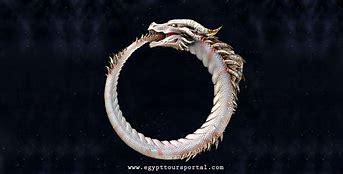
From symbolsandmeanings.net
Rich with cultural significance and religious meaning, the ouroboros symbol embodies rebirth, eternity, self-reliance, immortality, and nature’s cyclic character. Commonly known as “the snake eating itself”, the ouroboros is among the most prominent ancient symbols found in the history of different cultures, religions and civilizations.
One surely does wonder how a single symbol managed to endure the test of time and make its mark on so many civilizations and cultural beliefs.
Let us get right into it and have a closer look at its meaning, symbolism, origin and uses throughout history.
Ancient Egyptian Tombs: The First Appearance of The Ouroboros Symbol
The ouroboros first appeared on a golden shrine in King Tut’s (Tutankhamen) tomb in Egypt in the 13th century BC. The tombs featured two ouroboroi engraved on the gilded shrine along with some strange text. These ouroboroi appeared as serpents wrapped around the head and feet of a mummified figure, which is believed to have been King Tut himself, or the sun god Ra, or perhaps an amalgamation of both.
According to expert Egyptologists, the symbol was to “refer to the mystery of cyclical time, which flows back to itself”. Since the ancient Egyptians saw time as repetitive, constantly evolving cycles instead of a linear path, the ouroboros represented the immortality of human beings and its interconnection to nature’s cycles.
Ouroboros Meaning and Symbolism
The ouroboros symbol has appeared on temples, ancient artifacts, tombs, and artwork throughout history. Pronounced as ‘oo.ruh.bo.ruhs’, this symbol represents how everything in this universe is interconnected, going back to nature and becoming one with it once again after death. The unbroken circle of the snake eating itself represents universal unity, rebirth, and renewal through death.
The term ouroboros is derived from two ancient Greek words – ‘oura’ and ‘boros’. ‘Oura’ refers to tail while ‘boros’ means eating. When we combine the two words, it results in the meaning ‘he that eats his own tail’ or even just simply ‘tail eater’.
Believed to be based on serpents shedding their skin to make place for a new one, the ouroboros is an ancient symbol of eternal life and infinite growth. Although historians are unsure of the exact origins of the ouroboros symbol, it is believed to be inspired by snakes, serpents, and lizards that curl up to protect themselves.
With numerous different interpretations, some claim it represents the cycle of life and death, with the universe remaining central to it all. Others believe it represents the recreation of life through death or even the rebirth of the dead to reach an immortal state.
Snake Eating Itself: Association with Ancient Mythology and Civilizations
Being one of the most popular ancient symbols, the ouroboros has appeared throughout history in different ancient civilizations and cultures. Like the ever-rising sun, this symbol is believed to have gone through its own journey from Egypt to the ancient Greek alchemists and eventually making its way to the modern era.
After being featured predominantly in Egyptian civilization, the ouroboros slithered out to ancient Greek mythology through the Phoenician culture, where it received a new representation.
Greek Philosophy
For Plato, the ouroboros represented self-reliance and showed a perfect being that needed nothing but itself. He further believed the symbol showed a dark side with self-destruction and the tendency to devour itself.
Historians also draw a parallel between the ouroboros and the Greek myth about Sisyphus. According to the myth, Zeus punishes Sisyphus by making him roll a boulder up a hill. As soon as he gets to the top, the boulder inevitably falls back down, and he has to roll it up once again.
Ancient Romans
The ouroboros symbolized infinity for the Romans. They also associated the symbol with the god Saturn who controlled the cycles of each year. Roman philosophy states that Saturn connected each year to the next, forming an endless loop that is depicted by the snake eating its own tail.
Norse Mythology: Manuscripts and Jörmungandr
Vikings told stories of a giant serpent called Jörmungandr, who guarded Midgard (their name for Earth). Jörmungandr was one of Loki’s three children and was thrown into the great ocean by Odin.
There, he grew into a size so big that he could eventually encircle the whole world to reach and devour his own tail. It was said that if the World Serpent, or Jörmungandr, released his tail, Ragnarok would begin. The World Serpent was closely associated with the ouroboros symbol.
Ouroboros Symbol in the Modern World: Becoming The Infinity Symbol
In recent times, the ouroboros has undergone significant reinterpretation to become the infinity symbol. This concept was initiated in the 20th century with Mobius strips, the Droste Effect, and numerous paintings depicting the symbol reproducing itself. It is commonly worn as bracelets, rings, and even tattooed on the body to serve as a constant reminder of life’s cyclic journey.
An early 20th-century psychotherapist, Carl Jung, saw the ouroboros as a symbol of the human psyche. Jung had studied the symbol in alchemy and claimed that it represented the human ability to regenerate through self-reflection, just as a serpent sheds off old skin to become anew.
He justified it through a perspective that believed humans can only become whole after integrating our conscious selves with our shadow selves.
Moreover, the ouroboros often appears in the field of cybernetics, the study of feedback loops and circular causality. Cybernetics is based on the theory that inputs create certain outputs, which are then used as inputs for further outcomes – completing the circle.
Mathematicians and philosophers both appreciate the symbol similarly, applying the cybernetics theory to justify concepts in psychology, biology, computer science, and even engineering.
Outside of the research and STEM fields, people use the ouroboros symbol to represent the constant flow of creation, symbol of destruction, and recreation that makes our world come to a full circle. It instills the belief that every part of life is connected, with joy following sorrow and failure, eventually leading to success.
We may be worlds apart from the early Egyptian civilizations and the alchemists that ran experiments in their shabby workshops, but the ouroboros continues to light our paths with wisdom.
The Snake Eating Itself, Ouroboros Tattoo Meaning
Ouroboros tattoo meaning may differ according to the shape and form of the symbol drawn. It is a rebirth symbol, that is why a person who has overcome difficulties and troubles recently might want to have an ouroboros tattoo.
On the other end, it is also the symbol of infinity, so the person carrying an ouroboros tattoo might have had it to represent something that is ‘eternal’ for them.
In that sense, when seen next to a date, an ouroboros tattoo represents the idea that something that happened on that date is eternal, e.g. getting married or meeting someone special.
And if you believe in reincarnation, an ouroboros ink is obviously just the perfect choice for you.
Did you know that this ancient symbol heavily inspired similar artwork that appeared in the immensely popular Fullmetal Alchemist Brotherhood series with many symbols created by brilliant Japanese artist Hiromu Arakawa?
This wraps up our piece on the ouroboros symbol, the snake eating itself, its origins, symbolism and meanings.
March 8 Today in Worldwide History
Today’s Important Historical Events
1531 Henry VIII recognised as supreme head of Church in England by the Convocation of Canterbury
1817 The New York Stock Exchange is founded
1867 British North America Act is passed in the House of Commons, serves as Canada’s constitution for more than 100 years
1917 Russian “February Revolution” begins in earnest with protests celebrating International Woman’s Day and riots in St Petersburg over food rations and conduct of the war [OS=Feb 23]
1948 US Supreme Court rules in McCollum v. Board of Education that religious instruction in public schools is unconstitutional
1973 The Provisional Irish Republican Army undertakes its first operation in Great Britain, planting four car bombs in London; 10 members of PIRA are arrested at Heathrow Airport while trying to leave the country
2014 Malaysia Airlines Flight MH370 with 239 people loses contact and disappears, prompting the most expensive search effort in history and one of the most enduring aviation mysteries

Today’s Historical Events
1531 Henry VIII recognised as supreme head of Church in England by the Convocation of Canterbury
1586 Johan van Oldenbarnevelt becomes Dutch chief legal advisor
1658 Peace of Roskilde between Sweden & Denmark
1702 James II’s daughter Anne Stuart becomes Queen of England, Scotland and Ireland following the death of William III
1706 Vienna’s Wiener Stadtbank established
1711 Antoin de Guiscard tries English premier Haley for murder
1722 Afghan monarch Mir Mahmud occupies Persia
1746 Duke of Cumberland’s troops occupy Aberdeen
Today’s Historical Events in Flim and TV
1949 WAGA TV channel 5 in Atlanta, GA (CBS) begins broadcasting
1953 KSWO TV channel 7 in Lawton, Oklahoma (ABC) begins broadcasting
1953 Vernon Duke, Ogden Nash and Sammy Cahn’s musical revue “Two’s Company”, starring Bette Davis, and choreographed by Jerome Robbins, closes at Alvin Theater, NYC; runs for, after 90 performances
1953 WFMJ TV channel 21 in Youngstown, Ohio (NBC) begins broadcasting
1959 KUAT TV channel 6 in Tucson, AZ (PBS) begins broadcasting
1970 WTCI TV channel 45 in Chattanooga, TN (PBS) begins broadcasting
1980 6th People’s Choice Awards: Burt Reynolds & Jane Fonda win (Motion Picture) and Alan Alda & Carol Burnett win (TV)
Today’s Historical Events in Music
1813 1st concerto of Royal Philharmonic
1884 1st performance of Edward MacDowell’s 2nd Piano Suite
1902 1st performance of Jean Sibelius‘ 2nd Symphony, his most popular, by the Helsinki Philharmonic Society
1957 1st performance of David Diamond’s 6th Symphony in Boston
1960 “Greenwillow” opens at Alvin Theater NYC for 95 performances
1962 The Beatles (with Pete Best) BBC radio debut – a cover of Roy Orbison’s “Dream Baby (How Long Must I Dream)” , recorded the previous evening on stage at the Playhouse Theatre in Manchester
1966 “Golden Boy” closes at Majestic Theater NYC after 569 performances
1973 Paul & Linda McCartney are fined £100 for growing cannabis
Today’s Historical Events in Sports
1865 27th Grand National: Captain Henry Coventry wins aboard French outsider Alcibiade at 100/7
1900 NL decides to go with 8 teams They exclude Baltimore, Cleveland, Louisville & Washington (in 1953 Boston Braves move to Milwaukee)
1904 Australian cricket spin bowler Hugh Trumble dismisses England batsmen Bernard Bosanquet, Plum Warner and Dick Lilley for his second Test hat-trick in 5th Test victory in Melbourne; Trumble’s final Test
1906 Stanley Cup, Dey’s Arena, Ottawa, ON: Ottawa HC beats Smiths Falls (ON), 8-2 for a 2-0 sweep of challenge series
1913 MLB Federal League organizes with 6 teams, including the Chicago Whales, who built and played at Weeghman Park (now Wrigley Field); League folded after 3 seasons
1930 Baseball slugger Babe Ruth signs 2-year contract for a then huge $160,000 with NY Yankees; GM Ed Barrow, wrongly predicts “No one will ever be paid more than Ruth”
1931 Australian Championships Men’s Tennis: Jack Crawford wins 1st of 4 Australian titles; beats fellow Australian Harry Hopman 6-4, 6-2, 2-6, 6-1
1931 Australian Championships Women’s Tennis: In an all-Australian final Coral McInnes Buttsworth beats Marjorie Cox Crawford 1-6, 6-3, 6-4
Happy Witchy Wednesday WOTC Family and Friends – Charge of the Goddess – Part 2
(I am trying something new today to see if you like it or not. Instead of a short thing for “A Thought for Today” I decided to bring you something with a little more background on a piece of poetry and how it came about. Let me know in the comments if you like to see more of this type of post please. Thank you for your help!)
The Sources of the Charge of the Goddess
(Warning this a very informative but long article. You will find a link at the bottom of this post to read the entire thing if you wish to)
The Charge of the Goddess is the closest thing to scripture that Wicca possesses. Like scripture, it is used in rituals and to support beliefs. And like scripture, its origins are obscure.
The Charge itself claims to be the words of the Goddess, beginning “Listen to the words of the Great Mother.” When Gerald Gardner first published an excerpt from it in Witchcraft Today (1954, p. 42), he claimed it came from the Roman era . He also speculated that “a similar charge was a feature of the ancient mysteries.”
Fairly early, however, the age and origin of the Charge was questioned. Stewart Farrar, in 1971 (p. 34), pointed out that a large part of it was quoted from Charles Godfrey Leland’s Aradia. Since then more work has been done in ferreting out the Charge’s sources, especially in Farrar and Farrar (1981, p. 42) and Kelly (1991, pp. 52 – 4, 114 – 5). The purpose of this essay will be to gather this work together, add more sources to it, and then analyze the relative contributions of the authors of the Charge.
The earliest form of the Charge (given by Kelly, 1991, p. 53), was a prose version put together by Gerald Gardner, called “Leviter Veslis” (“The Lifting of the Veil”). It consists mainly of the Leland material with large quotations from Aleister Crowley added, along with very small amount of original material. Kelly dates this version to before 1948. According to Doreen Valiente’s own account (1989, 60 – 62), some time after her initiation in 1953 she wrote first a rhyming version, and then the prose version used by most Wiccans. The first prose and the rhyming versions may be found in Kelly (p. 53) and Valiente (pp. 61-2), respectively. The first prose version reads:
Listen to the words of the Great mother, who of old was also called among men Artemis, Astarte, Dione, Melusine, Aphrodite, and by many other names.
“At mine Altars the youth of Lacedaemon in Sparta made due sacrifice.
[Whenever ye have need of anything, once in the month, and better it be when the moon is full, then ye shall assemble in some secret place and adore the spirit of Me who am Queen of all Witcheries.]
[“There ye shall assemble, ye who are fain to learn all sorcery, yet have not won its deepest secrets. To these will I teach things that are yet unknown.]
[“And ye shall be free from slavery, and as a sign that ye be really free, ye shall be naked in your rites, both men and women, and ye shall dance, sing, feast, make music, and love, all in my praise.]
For ecstasy is mine, and joy on earth. For ‘love is my law.’ Keep pure your highest ideal: strive ever toward it. Let naught stop you or turn you aside.
{There is a Secret Door that I have made to establish the way} to taste even on earth the elixir of immortality.}
Say {‘let ecstasy be mine, and joy on earth even to me, To Me} For I am a gracious Goddess. {I give unimaginable joys on earth, certainty, not faith, while in life! And upon death, peace unutterable, rest, and ecstacy, nor do I demand aught in sacrifice.”}
Hear ye the words of the {Star Goddesss}.
{“I love you: I yearn for you: pale or purple, veiled or voluptuous.}
{“I who am all pleasure, and purple and drunkenness of the innermost senses, desire you, put on the wings, arouse the coiled splendor within you, ‘Come unto me.’}
{“For I am the flame that burns in the heart of every man, and the core of every Star.}
“Let it be your inmost divine self who art lost in the constant rapture of infinite joy.
{“Let the rituals be rightly performed with joy and beauty.} Remember that all acts of love and pleasure are my rituals. So let there be {beauty and strength, leaping laughter, force and fire} within you.
(“And if thou sayest, I have journeyed unto thee, and it availed me not, Rather shalt thou say, ‘I called upon thee, and I waited patiently, and Lo, Thou wast with me from the beginning,’
For they that ever desired me, shall ever attain me, even to the end of desire.)
(The text is as published in Kelly, with corrections from Kelly, unpublished manuscript.)
The words within square brackets ([ ]) are from Leland, those within brackets ({ }) are from Aleister Crowley’s Book of the Law, and those within parentheses (( )) are from Crowley’s Liber LXV,. The passages in italics are found in Crowley’s essay “The Law of Liberty.”
The line “Hear ye the words of the Star Goddess” is not exactly the same as the line from The Law of Liberty, which reads “We have heard the voice of the Star Goddess.” However, the line in The Law of Liberty is followed by the same material as is found here, so we can be confident that that is its source. The first thing that should be noticed is how little of this version cannot be traced to published sources. Except for the introduction, this version is essentially quotations linked with a small number of connecting phrases.
The large number of quotations from “The Law of Liberty” illustrates Gardner’s method of composition especially well. He must have had that essay in front of him as he wrote, since his quotations from it are in the same order as they appear in the essay. This is especially striking in the case of the sections of the Charge wherein quotations from the essay are followed by excerpts from The Book of the Law. In all cases, these quotations are also found together in the essay.
Further, all but one of the quotations from The Book of the Law are also found in “The Law of Liberty.” In fact, except for that one phrase, all of this prose version of the Charge (except for the introduction and the short connectors) can be traced to three sources: Leland, “The Law of Liberty,” and Liber LXV. The significance of these Crowley sources will be discussed later.
In my earlier version of this article (Serith, 1996), I suggested that the only line from The Book of the Law which is found in the Charge but is not in “The Law of Liberty” (“There is a Secret Door that I have made to establish the way) would be found quoted in another of Crowley’s works. I have indeed found that work, Khabs Am Pekht. At the time that Gardner was composing the first prose version, it was to be found in The Equinox Vol. III:1, commonly called The Blue Equinox because of the color of its binding. Also published in The Blue Equinox were “The Law of Liberty” and Liber LXV.
There has been a fair amount of speculation on the connection between Crowley and Gardner. Some have gone so far as to suggest that Crowley wrote the Gardnerian rituals (Adler, 1979, 1986, p. 64, gives some examples).
Those wishing to see a strong Crowley influence have often pointed to the Charge. As I have shown, there is at this early point a fair amount of Crowley in it. Words from Crowley’s works are also found in the Great Rite and the Drawing Down the Moon rituals, as published by Stewart Farrar (1971, pp. 93-94 and 68 respectively). These are taken from the Gnostic Mass. It should come as no suprise at this point that the Gnostic Mass was published by Crowley in The Blue Equinox.
All of this material comes from the first, the earliest, layer of the Book of Shadows (Kelly’s 1949 version, and Farrar and Farrar’s (1984) Text A). There is one other identifiable quotation from Crowley in this layer, taken from “Two Fragments of Ritual” (Equinox I:10, Kelly, p. 56). The next layer (Kelly’s 1953 and Farrar and Farrar Text B) is that used by Gardner at the time of Valiente’s initiation. It contains one more piece by Crowley, the Amalthean Horn prayer (given in Kelly, p. 81, and Farrar and Farrar, 1981, p. 41), which is a slightly altered version of the poem “La Fortune,” from his Collected Works, Vol. III (p. 120). More Crowley was to enter later, under the editing of Valiente, as will be seen later. To be blunt: with one exception, all of the material taken from Crowley that has been attributed in print to the Book of Shadows in the phase during which Gardnerian Wicca was first taking shape (the 1949/Text A version) comes from one book – The Blue Equinox. Rather than there having been a strong connection between the Gardner and Crowley, then, their contact is likely to have been extremely limited.
The first entry into print of the Charge was an excerpt published In Witchcraft Today (p. 42), which reads:
Listen to the words of the Great Mother, who of old was also called among men Artemis, Astarte, Dione, Melusine, Aphrodite and many other names. At mine altars the youth Lacedaemon made due sacrifice. Once in the month, and better it be when the moon is full, meet in some secret place and adore me, who am queen of all the magics….For I am a gracious goddess, I give joy on earth, certainty, not faith, while in life; and upon death, peace unutterable, rest and the ecstasy of the goddess. Nor do I demand aught in sacrifice…. (The ellipses are in the original.)
This is the version that Gardner says he thinks “came from the time when Romans or sirangers came in.” It should be noted that since it was published in 1954 it dates from after Valiente’s inititiation in 1953. In light of that it seems a bit odd that, as seen below in the textual comparison, it deviates quite significantly from the first prose version, and that the second prose version follows the first prose rather than the published excerpt. It is likely from this that Gardner did not consider this published version authoritative, and may have been working from memory, resulting in the differences.
Most interesting is the phase with which Gardner introduces this fragment: “Before an initiation a charge is read beginning:”That he mentions this document specifically in the context of an initiation ritual is clear evidence that the idea of a “charge” and, of course, the term itself, originated in Gardner’s Masonic roots, where such charges are part of inititiation rituals.
The sources of the final version of the Charge, as edited by Valiente, are more complex. In the following analysis, I give the exact quotations from her sources, along with the Charge itself, so that Valiente’s editing may be seen more clearly. I have included as well those sections of Gardner’s Charge (both the first prose and the Witchcraft Today versions) which survived into the final form.
I have used these abbreviations for the sources:
AL: The Book of the Law (Liber AL vel Legis).
AP: Alipilli
AR: Aradia: Gospel of the Witches.
GD: The Golden Dawn (ed. Israel Regardie, III, p. 245). (The second half of this passage, “From me … return,” is also found in Milton’s “Paradise Lost,” Book V, but since the first part is not, it is unlikely that Valiente took it from Milton.)
KJV: King James Version of the Bible KP: “Khabs Am Pekht.”
LL: “The Law of Liberty” (including quotations ultimately from The Book of the Law.)
P1: Gardner’s prose version.
P2: Valiente’s prose version
65: Liber LXV II: 59-60 (Crowley).
V: This is material that could have been drawn from any number of sources. VV: The Vision and the Voice, chapters 19 and 5 (Crowley).
WT: The Witchcraft Today version.
Full bibliographical information will be found at the end of this article.
For the text itself I have relied on Kelly,1991, pp. 114-5 (correcting what appears to be an error by changing “ideals” to “ideal”). The few differences between this and other published versions do not affect my results in any substantial manner. (Other versions may be found in Farrar, 1971, pp. 197-198; Lady Sheba, 1971, pp. 65-67; and Leek, 1971, pp. 189-191. Excerpts from it are found in Holzer, 1971, pp. 16-17; Huson, 1970, p. 221; and Johns, 1969, p. 143. Starhawk, 1979, pp. 76-77, gives an awkardly edited version in which she has removed every phrase that has the word “man” in it.) I have used the abbreviation “P2” for this version.
P2: Listen to the words of the Great mother,
P1: Listen to the words of the Great mother,
WT: Listen to the words of the Great Mother,
P2: who was of old also called among men,
P1: who … of old was also called among men
WT: who … of old was also called among men
P2: Artemis, Astarte, Dione, Melusine,
P1: Artemis, Astarte, Dione, Melusine,
LL: Melusine
WT: Artemis, Astarte, Dione, Melusine,
P2: Aphrodite, Cerridwen, Diana, Arianrhod, Bride,
P1: Aphrodite,
WT: Aphrodite
P2: and by many other names. “At mine Altars the youth
P1: and by many other names. “At mine Altars the youth
WT: and many other names. At mine altars the youth
P2: of Lacedaemon in Sparta made due sacrifice.
P1: of Lacedaemon in Sparta made due sacrifice.
WT: of Lacedaemon made due sacrifice.
P2: “Whenever ye have need of anything, once in the month, and
P1: Whenever ye have need of anything, once in the month, and
WT: Once in the month, and
AR: Whenever ye have need of anything, Once in the month, and
P2: better it be when the moon is full. Then ye shall assemble
P1: better it be when the moon is full, ye shall assemble
WT: better it be when the moon is full, meet
AR: when the moon is full, Ye shall assemble
P2: in some secret place
P1: in some secret place
WT: in some secret place
AR: in some desert place, Or in a forest all together join,
P2: and adore the spirit of Me
P1: and adore the spirit of Me
WT: and adore me,
AR: To adore the potent spirit of your
P2: who am Queen of all Witcheries.
P1: who am Queen of all Witcheries.
WT: who am queen of all the magics
AR: queen, My mother, great Diana.
P2: “There ye shall assemble, ye who are fain to learn all
P1: There ye shall assemble, ye who are fain to learn all
AR: ye shall assemble She who fain would learn all
P2: sorcery, yet who have not won its deepest secrets. To
P1: sorcery, yet have not won its deepest secrets. To
AR: sorcery yet has not won Its deepest secrets,
P2: these will I teach things
P1: these will I teach things
AR: them my mother will teach all things
P2: that are yet unknown.
P1: that are yet unknown.
AR: as yet unknown.
P2: “And ye shall be free from slavery,
P1: “And ye shall be free from slavery,
AR: And ye shall all be freed from slavery, And so ye
P2: and as a sign that ye
P1: and as a sign that ye
AR: be free in everything; And as a sign that ye
P2: be really free, ye shall be naked in your rites,
P1: be really free, ye shall be naked in your rites, both
AR: are truly free, Ye shall be naked in your rites, both
P2: and ye shall dance, sing, feast,
P1: men and women, and ye shall dance, sing, feast,
AR: men And women also they shall dance, sing
P2: make music, and love, all in my praise.
P1: make music, and love, all in my praise.
AR: make music and then love in her praise
P2: “For mine is the ecstasy of the Spirit, and mine is also joy
P1: Let ecstasy be mine, and joy
LL: But ecstasy be thine and joy
AL: ecstasy be thine and joy
P2: on earth. For my Law is Love unto all beings.
P1: on earth. For “love is my law.”
LL: of earth Love is the Law
AL: of earth Love is the Law
P2: “Keep pure your highest ideal. Strive ever towards it.
LL: Keep pure your highest ideal; strive ever toward it
P2: Let naught stop you or turn you aside.
LL: without allowing aught to stop you or turn you aside,
P2: “For mine is the secret which opens upon the door of
P1: There is a Secret Door which I have made…
KP: There is a Secret door that I shall make
AL: There is a Secret door that I shall make
P2: youth and mine is the cup of the Wine of Life:
P2: and the Cauldron of Cerridwen,
P2: which is the Holy Grail of Immortality.
P1: to establish the way to taste even on earth the elixir of immortality.
P1: Say, “Let ecstacy be mine, and joy on earth even to me, To Me.
P2: “I am the Gracious Goddess who gives the gift of Joy
P1: For I am a gracious Goddess. I give unimaginable joys,
WT: For I am a gracious Goddess, I give joy
LL: Gracious Goddess I give unimaginable joys
AL: I give unimaginable joys
P2: unto the heart of Man.
P2: “Upon Earth I give the knowledge of the Spirit Eternal,
P1: on earth, certainty
WT: on earth
LL: on earth:
AL: on earth:
P2: and beyond death I give peace and freedom, and reunion
P1: And upon death, peace unutterable, rest and ecstacy,
WT: and upon death, peace
LL: upon death; peace
AL: upon death; peace
P2: with those who have gone before.
P2: Nor do I demand aught in sacrifice, for behold, I am the Mother of
P1: nor do I demand aught in sacrifice.”
WT: nor do I demand aught in sacrifice
LL: Nor do I demand aught in sacrifice.
AL: nor do I demand aught in sacrifice.
P2: all things, and my love is poured out upon earth.”
P2: Hear ye the words of the Star Goddess,
P1: Hear ye the words of the Star Goddess.
LL: We have heard the voice of the Star Goddess
P2: She in the dust of whose feet are
KJV: dust of feet
P2: the hosts of Heaven, whose body encircleth the universe.
KJV: host of heaven
P2: “I who am
P2: the beauty of the green earth; and the White Moon
V: the beauty of the green earth P2: amongst the Stars; and the mystery of the Waters;
P2: and the desire of the heart of man. I call unto thy soul:
VV: the blind ache within the heart of man
LL: the heart of every man
AL: the heart of every man
P2: arise and come unto me.
P1: arouse … “come unto me.”
LL: arouse … come unto me!
AL: arouse … come unto me!
P2: “For I am the Soul of nature who giveth life to the
P1: ‘For I am the
GD: O Soul of Nature giving life and energy to the
P2: Universe; 詮rom me all things proceed; and unto me, all
GD: Universe. From thee all things do proceed. Unto Thee all
P2: things must return.’
GD: must return.
P2: Beloved of the Gods and men
P2: thine inmost divine self shall
P1: Let it be your inmost divine self…
LL: He is then your inmost divine self…
P2: be enfolded in the raptures of the infinite
P1: in the constant rapture of the infinite
LL: in the constant rapture of the embraces of Infinite Beauty
P2: “Let my worship be within the heart that rejoiceth, for
VV: the heart that rejoiceth,
P2: behold: all acts of love and pleasure are my rituals;
P1: Remember that all acts of love and pleasure are my rituals.
LL: Remember that all acts of love and pleasure are rituals,
P2: and therefore let there be Beauty and Strength, Power
P1: So let there be beauty and strength,…
AL: beauty and strength
P2: and Compassion, Honour and Humility, Mirth and reverence within you.
P2: “And thou who thinkest to seek me, know that thy seeking and yearning
P1: “And if thou sayest, I have journeyed unto thee,
65: I have journeyed unto Thee,
P2: shall avail thee not
P1: and it availed me not…
65: and it availed me not.
P2:unless thou know the mystery,
P2: ‘That if that which thou seekest
AP: If that which thous seekest
P2: thou findest not within thee, thou wilt never find it without thee,
AP: thou findest not within thee, thou wilt never find it without thee,
P2: for behold; I have been with thee from the beginning,
P1: Thou wast with me from the beginning,’…
65: and Thou wast with me from the beginning.
P2: and I am that which is attained at the end of desire.”
P1: shall ever attain me the end of desire.”
The line attributed here to Alipilli, “That if that which thou seekest thou findest not within thee thou wilt never find it without thee” most likely was taken from L. A. Cahagnet’s Magnetic Magic, where it appears on the title page. It is found in other sources, such as Madame Blavatsky’s , vol. II, p. 617, where she credits it to “Abipili.” (It is more correctly Ali Puli.) However, it is Cahagnet which is found in Gardner’s library, and is therefore almost certainly Gardner’s source.
The material attributed to “Various sources” is that which is found in a number of works with which Gardner and/or Valiente could have been familiar with, and could therefore be thought of as “being in the air.” “The beauty of the green earth” is itself found in various sources. d’Este and Rankine (2008, 155) give two late 19th century examples. It is interesting that in both of their examples the phrase is used to complement “starry heavens,” and here it complements “White Moon amongst the Stars.” The opposition of earth and heaven is an obvious one, but the fact that in both cases the opposition mentions the stars makes me wonder.
“Dust of whose feet” is probably based on the King James Version of the Bible, where variations on it are found certainly four times: “dust of thy feet” (Isaiah 49:23), “dust of his feet” (Nahum 1:3), “dust of your feet” (Matthew 10:14) and “dust of their feet” (Acts 13:51). “Hosts of heaven” is easily formed from “host of heaven,” which is found 19 times in the KJV (Deut 4:19, 17:3; 1 Kings 22:19; 2 Kings 17:16, 21:3, 21:5, 23:4, 23:5; 2 Chron 18:18, 33:3, 3:5; Nehemiah 9:6; Isaiah 34:4; Jeremiah 8:2, 19:13, 33:22; Daniel 8:10; Zephaniah 1:5; Acts 7:42). “Whose body encircleth the universe” is a description of the Egyptian star/night sky goddess Nut, who, as Nuit, formed an important part of Crowley’s system, whose nature is described and name used in “The Law of Liberty.” She is depicted in the “Stele of Revealing,” upon which Crowley based his “Book of the Law.” A depiction of the stele may be found here. There are a total of 498 words in the version given by Kelly. The following table shows how many came from each source:
Valiente: 168 – (33.7%)
Leland: 93 – (18.7%)
Crowley: 83 – (16.7%)
Gardner: 66 – (13.3%)
Crowley
(edited by either Gardner or Valiente): 40 – (8.0%)
Alipilli: 18 – (3.6%)
Gardner (edited by Valiente): 12 – (2.4%)
Golden Dawn: 12 – (2.4%)
King James Version: 6 – (1.2%)
Before going on to discuss the sources further, there is a non-source that I need to address, Apuleius’s The Golden Ass. In this Roman novel the main character is turned into an ass as a punishment for spying on Click here to read the rest of this article from ceisiwrserith.com
Happy Witchy Wednesday WOTC Family and Friends – Charge of the Goddess – Part 1
(I am trying something new today to see if you like it or not. Instead of a short thing for “A Thought for Today” I decided to bring you something with a little more background on a piece of poetry and how it came about. Let me know in the comments if you like to see more of this type of post please. Thank you for your help!)
Charge of the Goddess History and Variations
From learnreligions.com
Charge of the Goddess is perhaps one of the best-known pieces of ritual poetry in today’s magical community, and is often credited to author and priestess Doreen Valiente. The charge itself is a promise, made by the Goddess to her followers, that she will guide them, teach them, and lead them when they need her the most.
However, before Valiente, there were earlier variants, dating back at least as far as Charles Leland’s Aradia: Gospel of the Witches. Because, like so many other writings in today’s Pagan world, Charge of the Goddess has evolved over time, it’s almost impossible to attribute it to one single author. Instead, what we have is a constantly changing and fluid piece of ritual poetry, that each contributor has changed, modified, and rearranged to suit their own tradition.
Did You Know?
The Charge of the Goddess first appeared in an early form during the late nineteenth century.
Doreen Valiente’s version, released in the late 1950s, is the most commonly referenced variation today.
Today, several traditions use unique versions that pay tribute to their own deities of a number of different pantheons.
Leland’s Aradia
Charles Godfrey Leland was a folklorist who roamed about the Italian countryside collecting legends during the final decade of the nineteenth century. According to Leland, he met a young Italian woman called Maddalena, who provided him with a manuscript about ancient Italian witchcraft and then promptly vanished, never to be heard from again. This, obviously, led some scholars to question the existence of Maddalena, but regardless, Leland took the information he claimed to have obtained from her and published it as Aradia: Gospel of the Witches in 1899.
When I shall have departed from this world,
Whenever ye have need of anything,
Once in the month, and when the moon is full,
Ye shall assemble in some desert place,
Or in a forest all together join
To adore the potent spirit of your queen,
My mother, great Diana.She who fain
Would learn all sorcery yet has not won
Its deepest secrets, them my mother will
Teach her, in truth all things as yet unknown.
And ye shall all be freed from slavery,
And so ye shall be free in everything;
And as the sign that ye are truly free,
Ye shall be naked in your rites, both men
And women also: this shall last until
The last of your oppressors shall be dead;
And ye shall make the game of Benevento,
Extinguishing the lights, and after that
Shall hold your supper thus…
Gardner’s Book of Shadows and the Valiente Version
Doreen Valiente played an instrumental part in twentieth-century Pagan practice, and her deeply evocative version of Charge of the Goddess may be the best known. In 1953, Valiente was initiated into Gerald Gardner’s New Forest coven of witches. Over the next several years, they worked together in expanding and developing Gardner’s Book of Shadows, which he claimed was based on ancient documents passed down through the ages.
Unfortunately, much of what Gardner had at the time was fragmented and disorganized. Valiente took on the task of re-organizing Gardner’s work, and more importantly, putting into a practical and usable form. In addition to finishing things up, she added her poetic gifts to the process, and the end result was a collection of rituals and ceremonies that are both beautiful and workable – and the foundation for much of modern Wicca, some sixty years later.
Although Valiente’s version, released in the late 1950s, is the most commonly referenced version today, there was an incarnation that appeared a decade or so earlier in Gardner’s original Book of Shadows. This variant, from around 1949, is a blend of Leland’s earlier work and a portion of Aleister Crowley’s Gnostic Mass. Jason Mankey at Patheos says,
“This version of the Charge was originally known as Lift Up the Veil, though I’ve heard it referred to as “Gardner’s Charge” on a number of occasions… Doreen Valiente’s version of The Charge of the Goddess dates back to sometime around 1957 and was inspired by Valiente’s desire for a less Crowley influenced charge.”
Some time after writing the Charge poem that has become well known to today’s Pagans, Valiente also crafted a prose variant, at the request of some members of her coven. This prose version has also become immensely popular, and you can read it over at the official Doreen Valiente website.
Newer Adaptations
As the Pagan community grows and evolves, so do the various forms of ritual texts. A number of contemporary authors have created their own versions of the Charge that reflect their own magical beliefs and traditions.
Starhawk included her own form of the work in The Spiral Dance, first published in 1979, which reads in part:
Listen to the words of the Great Mother,
Who of old was called Artemis, Astarte, Dione, Melusine, Aphrodite, Cerridwen, Diana, Arionrhod, Brigid, and by many other names:
Whenever you have need of anything, once a month, and better it be when the moon is full,
you shall assemble in some secret place and adore the spirit of Me Who is Queen of all the Wise.
You shall be free from slavery,
and as a sign that you be free you shall be naked in your rites.
Sing, feast, dance, make music and love, all in My Presence,
for Mine is the ecstasy of the spirit and Mine also is joy on earth.
The Starhawk version, which forms one of the cornerstones of her Reclaiming tradition, may be the one that newer Pagans are the most familiar with, but – as with any other piece of poetry or ritual – it is one that many have continuously adapted to suit their own needs. Today, several traditions use unique versions that pay tribute to their own deities of a number of different pantheons.
For a complete and in-depth breakdown of the various influences upon the different versions of the Charge, author Ceisiwr Serith has a great piece on his website*, comparing Aradia, Valiente’s work, and the Crowleyan variants.
(*Appears in a post for northern hemisphere’s Wednesday morning.)
March 7th Today in History
Today’s Important Historical Events
161 Roman Emperor Antoninus Pius dies and is succeeded by co-Emperors Marcus Aurelius and Lucius Verus, an unprecedented political arrangement in the Roman Empire
1530 English King Henry VIII‘s divorce request is denied by the Pope
1876 Alexander Graham Bell receives a patent for the telephone in the US
1912 Roald Amundsen announces his discovery of the South Pole (located 14 December 1911)
1936 Adolf Hitler breaks the Treaty of Versailles by sending troops into the Rhineland

Today’s Historical Events
161 Roman Emperor Antoninus Pius dies and is succeeded by co-Emperors Marcus Aurelius and Lucius Verus, an unprecedented political arrangement in the Roman Empire
321 Roman Emperor Constantine I decrees that the dies Solis Invicti (sun-day) is the day of rest in the Empire
1138 Conrad II von Hohenstaufen re-elected German king
1277 Condemnation of 219 philosophical and theological theses by Stephen Tempier, Bishop of Paris
1530 English King Henry VIII‘s divorce request is denied by the Pope
1560 Christian fleet under Gian Andrea lands at Djerba, North Africa
1573 Turkey & Venice sign peace treaty
1621 John Pieterszoon Coen’s troops land on Lontor, East Indies
Today’s Historical Events in Flim and TV
1946 18th Academy Awards: “The Lost Weekend” Ray Milland & Joan Crawford win
1955 7th Emmy Awards: “Make Room for Daddy”, Danny Thomas & Loretta Young win
1955 Musical “Peter Pan”, starring Mary Martin broadcast live on NBC as part of “Producers’ Showcase” series; attracts a then record 65 million viewers
1968 The BBC broadcasts the news for the first time in color on television
1970 WXOW TV channel 19 in La Crosse, WI (ABC) begins broadcasting
1975 “Mirror”, Russian film directed by Andrei Tarkovsky, starring Margarita Terekhova and Ignat Daniltsev, is released
1979 5th People’s Choice Awards: Burt Reynolds & Olivia Newton-John win (Motion Picture) and Alan Alda, Mary Tyler Moore & Carol Burnett win (TV)
Today’s Historical Events in Music
1824 Giacomo Meyerbeers opera “Il Crociati in Egitto” (The Crusader in Egypt) premieres at La Fenice in Venice with famous castrato Giovanni Battista Velluti singing
1896 W. S. Gilbert and Arthur Sullivan‘s 14th and final comic opera together “The Grand Duke” premieres at the Savoy Theatre, London
1917 1st jazz record released on a 78 by Original Dixieland Jass Band for the Victor Talking Machine Company (“Dixie Jazz Band One Step,” one side “Livery Stable Blues” other)
1918 H Carroll & J McCarthy’s musical “Oh, Look!” premieres in NYC
1923 Carlos Gardel applies for Argentine citizenship
1946 “Three to Make Ready” opens at Adelphi Theater NYC for 323 performances
1959 “Bells Are Ringing” closes at Shubert Theater NYC after 925 performances
1962 The Beatles made their broadcasting debut on BBC radio
Today’s Historical Events in Sports
1855 17th Grand National: John Hanlon wins aboard Irish horse Wanderer at 25/1
1857 Baseball decides 9 innings constitutes an official game, not 9 runs
1860 22nd Grand National: Tommy Pickernell wins aboard Irish horse Anatis at 5/1
1866 28th Grand National: 1852 winner Alec Goodman wins his second GN aboard Irish 40/1 outsider Salamander
1870 Cincinnati Red Stockings, 1st pro BB team, begin 8-mo tour of Midwest & East
1922 US Ladies’ Figure Skating championship won by Theresa Weld Blanchard
1922 US Men’s Figure Skating championship won by Sherwin Badger
1930 Georgetown High of Chicago defeats Homer 1-0 in basketball
Spell for Today – A FULL OR WAXING MOON SPELL TO REVIVE A WITCHES MAGICKAL POWERS
(YOU CAN COPY AND PASTE ANY SPELLS POSTED TO A DOCUMENT TO PRINT AND/OR SAVE ON YOUR COMPUTER)
A FULL OR WAXING MOON SPELL TO REVIVE A WITCHES MAGICKAL POWERS
At the Full or Waxing moon phase just before midnight anoint a PURPLE candle with real VANILLA essential oil or extract. Raise energy by tightening yourself up and pumping your hands, fingers to palms, up and down, and envisioning the moonlight as entering your body and flowing to the candle whilst you anoint it. Do this outside or before a window opened to the moonlight. Place the candle on the ground or windowsill and light it. Say:-
“Fair Selene, Goddess of the Moon, love and light, I ask you to send me your magickal
powers this moon lit night, By the power of the myriad starlight above me.
And your moonlit heavens, so shall it be! ”
Visualize your outstretched arms as soaking up the moonlight and the moonbeams being absorbed into you. You will feel the Goddess giving you her awesome power, snuff (NEVER blow out) your candle and leave it overnight on your altar or where it is.
Either at the sunrise, or just before mid-day. Place the candle in the same place and
stand arms outstretched towards the sun soaking up the energy of its heat and sunbeams, Say:
“Great Ra, Lord of the sky and solar power, Lend your fiery magick to me.
Let this witches powers be reawakened and be as powerful as the forces of the cool Moon and burning sun, By soil, wind, flame and sea,
Grant my desire. So mote it be! ”
Now your Magickal powers and your desire to use them will have been reawakened.
Take your snuffed out candle to your altar and relight it there to burn out as a mark of
respect to the God and Goddess. Spells are far more powerful if you write them yourself.
Witchcraft Symbols, Terms and Definitions – HEXAGRAM or SIX-POINTED STAR
HEXAGRAM or SIX-POINTED STAR

When surrounded by a circle, it represents the “divine mind” to many occult groups throughout the centuries. Many still use it in occult rituals. But to Jewish people, it is their Star of David.
March 6 Today in History
Today’s Important Historical Events1479 Treaty of Alcaçovas: Portugal gives the Canary Islands to Castile in exchange for claims in West Africa
1836 Battle of the Alamo: After 13 days of fighting 1,500-3,000 Mexican soldiers overwhelm the Texan defenders, killing 182-257 Texans including William Travis, Jim Bowie and Davy Crockett
1857 Dred Scott Decision: US Supreme Court rules Africans cannot be US citizens
1869 Dmitri Mendeleev presents the first periodic table of the elements to the Russian Chemical Society
1899 “Aspirin” (acetylsalicylic acid) patented by Felix Hoffmann at German company Bayer

Today’s Historical Events
1079 Omar ibn Ibrahim al-Chajjam completes Jalali-calendar
1323 Treaty of Paris – Flemish relinquish claims over the County of Zeeland
1447 Tommaso Parentucelli succeeds Pope Eugene IV as Nicolas V
1454 Thirteen Years’ War: Delegates of the Prussian Confederation pledge allegiance to Casimir IV of Poland, and the Polish king agrees to help in their struggle for independence from the Teutonic Knights.
1479 Treaty of Alcaçovas: Portugal gives the Canary Islands to Castile in exchange for claims in West Africa
1521 Portuguese navigator Ferdinand Magellan discovers Guam
1579 Veluwe joins Union of Utrecht
1590 Dutch and English army led by Maurice of Nassau captures heavily protected city of Breda using a small assault force hidden in a peat barge

Today’s Historical Events
1851 Dion Boucicault‘s play “Love in a Maze” premieres in London
1909 Dutch film distributor Jean Desmet opens his first permanent cinema, the Cinema Parisien in Rotterdam
1959 11th Emmy Awards: Playhouse 90, Jack Benny Show, Raymond Burr win
1967 WACS TV channel 25 in Dawson, GA (PBS) begins broadcasting
1978 Brian Clark’s stage drama “Whose Life is it Anyway?” starring Tom Conti and Jane Asher, and directed by Michael Lindsay-Hogg, opens at the Mermaid Theatre, London
1980 Emmy 7th Daytime Award presentation – Susan Lucci loses for 1st time
1981 Walter Cronkite signs off as anchorman of “CBS Evening News”
1985 Yul Brynner appears in his 4,500th performance of “The King & I”

Today’s Historical Events in Music
1808 1st college orchestra in US founded, at Harvard in Cambridge, Massachusetts
1831 Vincenzo Bellini’s opera “La Sonnambula” premieres at Teatro Carcano in Milan, Italy
1853 Giuseppe Verdi‘s opera “La Traviata” premieres at Teatro La Fenice in Venice, Italy
1965 Frank Loesser’s musical “How to Succeed in Business Without Really Trying”, starring Robert Morse and Rudy Vallée, closes at 46th Street Theatre, NYC, after 1415 performances, 7 Tony Awards, and a Pulitzer Prize
1965 The Temptations’ single “My Girl” reaches #1 on the Billboard Pop Chart; written and produced by the Miracles members Smokey Robinson and Ronald White
1967 2nd Academy of Country Music Awards: Merle Haggard and Bonnie Guitar win
1970 Beatles release single “Let it Be” in UK
1974 “Over Here!” musical written by Richard & Robert Sherman opens at Shubert Theater, NYC for 341 performances (top-grossing production 1974)

Today’s Historical Events in Sports
1858 20th Grand National: William Archer wins aboard outsider Little Charley at 100/6
1867 29th Grand National: John Page wins aboard Irish 16/1 shot Cortolvin; trainer Harry Lamplugh’s second GN victory
1895 England beat Australia to win one of the best cricket series ever, 3-2; Jack Brown hits the fastest 50 in test cricket in 28 mins
1906 Cubs sign 3rd baseman Harry Steinfeldt to complete Tinker-Evers-Chance
1919 NHL Championship: Montreal Canadiens beat Ottawa Senators, 3 games to 1 with 1 tie
1922 Babe Ruth signs 3 year contract with NY Yankees at $52,000 a year
1923 MLB St. Louis Cardinals announce their players will wear numbers on their uniforms
1945 George Nissen of Cedar Rapids, Iowa, receives a patent for the first modern trampoline
Let’s Talk Witch – Sigils and Symbols Used In Magick c. 2014
Let’s Talk Witch – Sigils and Symbols Used In Magick
Sigils, symbols and names are often carved into candles to add to the intent, power and purpose of the spell.
To draw something to you carve your symbol or sigil into the candle by starting from the bottom and make your sigil ‘grow’ moving it upwards. To banish something start your carving from the top of the candle moving downwards.
If you are drawing letters you can stack them, by drawing each letter one over the top of another. Again if you are drawing something to you start to carve at the bottom of the candle and if you are banishing something start at the top.
The spiral method means you start your carving at the bottom of the candle and move to the right, spiralling the letters of your carving upwards to bring something towards you, or start at the top and spiral downwards to banish something.
For a straightforward carving just draw your design in the middle of the candle, it could be a heart for a love spell or a pound/ dollar sign to draw money.
To reverse a spell or when banishing negativity, you could try writing a word backwards on the candle.
If you don’t want anyone to see what you have carved into the candle use a needle as this makes a very fine line and even you probably won’t be able to make out the end result, but the important thing is that spirit will.
Another way of hiding what you are doing is by carving your intent on the base of the candle so that no one can see it.
Source:
Pagan Portals – Hoodoo: Folk Magic Patterson, RachelMagick Symbols – SUN GOD FACE c. 2018
SUN GOD FACE

The sun face is a symbol that has been central to most major spiritual systems throughout history. Since the sun god usually reigned over a pantheon of lesser gods. His symbol played a vital part in pagan worship (and in the rituals of occult secret societies) around the world. In Inca myths, the sun was worshipped as the divine ancestor of the nation. The sun was worshipped as a personified, life-giving deity in Babylonian, Egyptian, Greek, Roman, and other major civilizations of history. The more common symbol is the familiar face in the center of the sun’s rays. A dot or point in the center of a circle symbolizes the blending of male and female forces. Hindus call the midpoint in a circle the bindu – the spark of masculine life within the cosmic womb.
March 5th Today in History
Today’s Important Historical Events
363 Roman Emperor Julian moves from Antioch with an army of 90,000 to attack the Sassanid Empire, in a campaign that brings about his own death
1046 Persian scholar Naser Khosrow begins the 7 year Middle Eastern journey which he will later describe in his book Safarnama
1496 English King Henry VII grants John Cabot (Giovanni Caboto) a commission to explore for new lands
1770 Boston Massacre (Incident on King Street): British soldiers kill 5 men in a crowd throwing snowballs, stones and sticks at them. African American Crispus Attucks 1st to die; later held up as early black martyr. Massacre galvanizes anti-British feelings.
1946 Winston Churchill‘s “Iron Curtain” speech in Fulton, Missouri, popularizes the term and draws attention to the division of Europe

Today’s Historical Events
363 Roman Emperor Julian moves from Antioch with an army of 90,000 to attack the Sassanid Empire, in a campaign that brings about his own death
1046 Persian scholar Naser Khosrow begins the 7 year Middle Eastern journey which he will later describe in his book Safarnama
1179 3rd Lateran Council (11th ecumenical council) opens in Rome
1496 English King Henry VII grants John Cabot (Giovanni Caboto) a commission to explore for new lands
1528 Utrecht governor Maarten van Rossum plunders The Hague
1558 Smoking tobacco introduced into Europe by Spanish physician Francisco Fernandes
1579 Betuwe joins Union of Utrecht
1616 Astronomical work ‘de Revolutionibus’ by Nicolaus Copernicus placed on Catholic Forbidden index
Today’s Historical Events in Flim and TV
1936 8th Academy Awards: “Mutiny on the Bounty”, Victor McLaglen & Bette Davis wins
1953 6th British Film and Television Awards (BAFTAs): “The Sound Barrier” Best Film
1955 WBBJ TV channel 7 in Jackson, TN (ABC) begins broadcasting
1956 “King Kong” 1st televised
1956 Capitol Records releases “Songs for Swingin’ Lovers!”, the tenth album by American singer Frank Sinatra: upbeat collection of pop tunes with jazz arrangements by Nelson Riddle became the first album ever to top the new UK Albums Chart
1958 KDUH TV channel 4 in Scottsbluff-Hay Spring, NB (ABC) 1st broadcast
1959 16th Golden Globes: “The Defiant Ones”, David Niven, & Susan Hayward win
1962 19th Golden Globes: “The Guns of Navarone”, Maximilian Schell, & Geraldine Page win
Today’s Historical Events in Music
1807 1st performance of Ludwig van Beethoven‘s 4th Symphony in B
1853 Piano company Steinway & Sons founded by Heinrich Steinweg (later Henry Steinway) in New York City
1856 Covent Garden Opera House, London, destroyed in a fire
1868 Arrigo Boito’s opera “Mefistofele” premieres in Milan
1899 1st performance of Edward MacDowell’s 2nd Concerto in D
1907 1st radio broadcast of a musical composition aired
1919 Louis Hirsch & Harold Atteridge’s musical premieres in NYC
1942 World première of Dmitri Shostakovich‘ 7th Symphony in Kuybyshev, Russia
Today’s Historical Events in Sports
1840 2nd Grand National: Bartholomew Bretherton wins aboard 16/1 Jerry; a then smallest field of 13
1845 7th Grand National: William Loft aboard outsider Cure-All wins in record time of 10 minutes, 47 seconds
1910 Stanley Cup, Dey’s Arena, Ottawa, ON: Montreal Wanderers beat Ottawa Senators, 3-1
1949 Bradman plays his last innings in 1st-class cricket, gets 30
1955 2nd ACC Men’s Basketball Tournament: NC State beats Duke, 87-77
1960 7th ACC Men’s Basketball Tournament: Duke beats Wake Forest, 63-59
1960 Ice Dance Championship at Vancouver won by Denny & Jones (GRB)
1960 Men’s Figure Skating Championship in Vancouver won by Alain Giletti (FRA)
WHICH WITCH ARE YOU? FIVE WAYS TO HARNESS THE CRAFT c. 2019
WHICH WITCH ARE YOU? FIVE WAYS TO HARNESS THE CRAFT
Witchcraft seems like a particularly buzzy topic these days, with books, blogs, and more delivering ancient magic to a modern audience. But while stylized Tarot cards and light-catching crystals have their place, the shift from intrigued observer to practicing pagan can be a daunting one. So why not start the process by determining which brand of witchery resonates with you?
Read on to learn about five specialized takes on witchcraft—and where the variants came from.
COSMIC WITCH
A comic witch is a witch who uses planetary and celestial energy in their practice. They study and feel a personal and spiritual connection with not only the main planets in our solar system, but with asteroids, meteors, supernovas, stars, constellations, galaxies, and black holes. Cosmic witches pay particular attention to astrology, horoscopes, and zodiac signs—but that only gives us a picture of how the cosmic forces influence the individual. Cosmic witches are focused on how celestial energy influences the inner self, but also the world.
Cosmic witches have been around since the study of planets. According to the American Federation of Astrologers, the Babylonians are credited with the birth of astrology. They used their astrological charts to predict the “recurrence of seasons and certain celestial events.” Around 2000 B.C., Babylonian astrologers believed that the sun, moon, and the five known planets (Uranus, Neptune, and Pluto had yet to be discovered) all had distinct character traits (Mercury representing communication, Venus representing affection, and so on). Cosmic witches use these planetary traits to call upon their energy. For example, many witches choose to perform spells on a full moon because the full illumination can create an extra magical boost and enchantment—and the rock itself is said to align with emotions and the soul.
A present-day cosmic witch may not be using astrology to predict the weather, but rather to predict future events or influences. For example, it’s beneficial for a cosmic witch to know when Mercury is in retrograde, and in which sign, because it will allow them to determine where communication breakdowns will occur, and in what guise. If a cosmic which was planning to perform a love spell, their best chance of having it being successful during a new moon which corresponds with new beginnings and relationships.
DIVINATION WITCH
A divination witch uses their magic to try to predict the future, often employing a variety of tools—or one that resonates. There are so many mediums with which to connect into the magic of the world: think Tarot, oracle cards, a pendulum, the I Ching, palmistry, and tasseography, and more.
Divination and divination witches have existed in just about every time period in history. In ancient Greece, divination witches were known as Oracles, and it was believed that deities spoke through them. A famous oracle was high priestess Pythia—known as the Oracle of Delphi—who was thought to be the mouthpiece of the god, Apollo. Every culture has its own form of divination. In ancient China, the diviner would carve out their question onto an ox bone until it cracked, and then the cracks were analyzed.
Today, divination witches don’t claim to be the mouthpiece of the gods, instead using divination predict likely answers to simple queries like, “Am I on the right career path?” or “Does this relationship stand a chance?” And in true modern fashion, divination methods like Tarot can even be found on our phones.
GREEN WITCH
A green witch works with magical properties found in the natural world. Their craft is based on respecting nature and all living things. Green witches focus on the magical correspondence of herbs, plants, and flowers. This incorporates herbalism, which is the study of botany and use of plants intended for medicinal purposes.
Herbalism is found in many cultures, but Chinese herbal medicine is one of the ancient variations still practiced today. Chinese herbology is based on the concepts of yin, yang, and Qi energy, where the herbs can either cool (yin) or stimulate (yang) certain parts of the body, the concept used for ritual and spiritual practices as well as medicinal. In parts of Africa, an herb known as purslane was used for purification during and after ritual ceremonies, while in some Scandinavian countries, clover was once used to ward off evils spirits and help develop psychic ability. In folk magic tradition, chamomile is said known to bring luck.
Today, green witches still take herbal magic very seriously, using essential oils and creating small physic gardens in their own apartment. Be aware that this is a learned art: it’s extremely important to know the health effects of the herbs you plan to use or ingest as well as the magical benefits.
KITCHEN WITCH
A kitchen witch practices magic within their own home. Their magic is not based on any divine power or spiritual guidance, but that magic that can be found in the everyday routine. Their craft comes out while cooking, baking, and nesting while tapping into the power of their own intention.
Witchcraft and cooking have always gone hand-in-hand. During the late 15th and mid-18th century many of the 200,000 witches (mostly women) were tortured, hanged, or burned at the stake were accused of poisoning food. Even now, our classic image of a witch persists as a woman stirring her cauldron. There has always been a magical and ritualistic nature surrounding food. Like green witchcraft, kitchen witches use herbalism in their food-based magic—but kitchen witchery isn’t just about food. It can also be making a homemade offering to a deity, cleansing and protection your home, and so on.
SEA WITCH
A sea witch, also known as a water witch, works with the element water in order to tap into their magic. They feel a deep, powerful connection to the water—whether it is the ocean, sea, or lake. This powerful pull leads them to be more aware of their own mystical energies.
Sea witches have been found in many cultures throughout history. From the sea nymph Calypso of The Odyssey; Sycorax of Shakespeare’s play The Tempest; even Ursula in Disney’s The Little Mermaid. However, sea witches have a deeper history in mythology. In Norse mythology, sea witches were magical, malevolent feminine spirits who often took the form of mermaids. These witches believed that their power and bond over the sea and tides was born of their worship for the moon. The triple goddess symbol holds particularly deep meaning for sea witches, as it represents the three phases of the monthly lunar cycle: waxing, full, and waning.
Along with praying to the moon, sea witches have had a long history with practicing dowsing, a method of divination for finding water, metals, even grave sites underground by using a Y-shaped stick made of hazel. Dowsing has been around since the Middle Ages, used frequently in Europe until its association with witchcraft caused the practice to be shunned; its legitimacy as a science is still up for debate. Contemporary sea witches may not be luring sailors to their deaths, but they are still incorporating water, weather, and the moon into their practices, finding their own magical connection with the sea.
Some of the Witchcraft/Magickal Correspondence for Saturday

Magickal Intentions: Spirit Communications, Meditation, Psychic Attack or Defense, Locating Lost Things and Missing Persons, Building, Life, Doctrine, Protection, Knowledge, Authority, Limitations, Boundaries, Time and Death
Incense: Black Poppy Seed and Myrrh
Planet: Saturn
Sign: Capricorn and Aquarius
Angel: Cassiel
Colors: Black, Grey and Indigo
Herbs/Plants: Myrrh, Moss, Hemlock, Wolfsbane, Coltsfoot, Nightshade and Fir
Stones: Jet, Smokey Quartz, Amethyst, Black Onyx, Snowflake Obsidian, Lava, Pumice
Oil: (Saturn) Cypress, Mimosa, Myrrh, Patchouli
Saturn lends its energies to the last day of the week. Because Saturn is the planet of karma, this day is an excellent time for spellwork involving reincarnation, karmic lessons, the Mysteries, wisdom, and long-term projects. It is also a good time to being efforts that deal with the elderly, death, or the eradication of pests and disease.
March 4th Today in History
Today’s Important Historical Events
1238 Battle of the Sit River: Mongol forces of Batu Khan overcome Russians under Yuri II of Vladimir-Suzdal near Yaroslavl in Russia, ending Russian resistance
1801 Thomas Jefferson is the first US President to be inaugurated in Washington, D.C.
1861 Abraham Lincoln is inaugurated as the 16th US President
1902 American Automobile Association (AAA) founded in Chicago
1933 Franklin D. Roosevelt inaugurated as 32nd US President, pledges to pull US out of the Depression, “We have nothing to fear but fear itself”
1936 1st flight of the airship Hindenburg at Friedrichshafen, Germany
2009 International Criminal Court issues an arrest warrant for Sudanese President Omar Hassan al-Bashir for war crimes and crimes against humanity in Darfur becoming the first sitting head of state to be indicted

Today’s Historical Events
51 Nero, later to become Roman Emperor, is given the title princeps iuventutis (head of the youth)
306 Martyrdom of Saint Adrian of Nicomedia
852 Croatian Duke Trpimir I issued a statute, a document with the first known written mention of the Croats name in Croatian sources
938 Translation of the relics of martyr Wenceslaus I, Duke of Bohemia, the patron saint of the Czech state
1152 Frederick I Barbarossa elected Holy Roman Emperor
1215 King John of England makes an oath to the Pope as a crusader to gain the support of Innocent III
1238 Battle of the Sit River: Mongol forces of Batu Khan overcome Russians under Yuri II of Vladimir-Suzdal near Yaroslavl in Russia, ending Russian resistance
1351 Ramathibodi becomes King of Siam
Today’s Historical Events in Flim and TV
1841 Dion Boucicault‘s stage comedy “London Assurance” opens at Theatre Royal, Covent Garden, London
1922 1st vampire film “Nosferatu”, an un-authorized adaptation of Bram Stoker‘s Dracula, premieres at the Berlin Zoological Garden, Germany
1937 9th Academy Awards: “The Great Ziegfeld”, Paul Muni & Luise Rainer wins
1943 15th Academy Awards: “Mrs. Miniver”, James Cagney & Greer Garson win
1947 WWJ (now WDIV) TV channel 4 in Detroit, MI (NBC) begins broadcasting
1965 David Attenborough becomes the new controller of BBC2
1976 2nd People’s Choice Awards: John Wayne & Katharine Hepburn win (Motion Picture) and Telly Savalas & Carol Burnett win (TV)
Today’s Historical Events in Music
1830 Vincenzo Bellini’s opera “I Capuleti e i Montecchi” premieres at the Teatro La Fenice in Venice, Italy
1877 Pyotr Ilyich Tchaikovsky’s ballet “Swan Lake” has its world premiere, performed by the Bolshoi Ballet in Moscow
1895 Gustav Mahler conducts the premiere of his incomplete 2nd Symphony (“Resurrection”) in Berlin, Germany, with the Berlin Philharmonic; complete version debuts in December
1913 Gabriel Faure’s opera “Pénélope”, based on Homer’s “The Odyssey”, premieres at the Salle Garnie, in Monte Carlo, Monaco
1966 John Lennon says “We (the Beatles) are more popular than Jesus”
1968 3rd Academy of Country Music Awards: Glen Campbell and Lynn Anderson win
1973 15th Grammy Awards: 1st Time Ever I Saw Your Face, America
1977 Roger Sessions’ 6th Symphony premieres (in fully completed form) in New York City with José Serebrier conducting the Juilliard Orchestra
Today’s Historical Events in Sports
1846 8th Grand National: William Taylor aboard outsider Pioneer wins by 3 lengths from Culverthorpe
1857 19th Grand National: Charlie Boyce wins aboard Emigrant at 10/1
1868 30th Grand National: George Ede victorious aboard Irish 9/1 shot The Lamb; horse wins second GN in 1871
1903 Stanley Cup, Montreal Arena, Westmount, Quebec: Montreal HC beats Winnipeg Victorias, 4-1 for a 2-1 challenge series victory
1913 NY Yankees are 1st to train outside US (Bermuda)
1927 Babe Ruth becomes the highest-paid player in MLB history when he signs 3-year, $70,000 per season contract with the New York Yankees
1931 Don Bradman is bowled for a rare first ball duck by Herman Griffith (4-50) on the last day of 5th cricket Test vs West Indies in Sydney; Windies win by 31 runs but lose series to Australia, 4-1
1933 Noordwijk soccer team forms
Witchcraft Symbols, Terms and Definitions
Widdershins
From moonlitpriestess.com
Some terms listed on this page may seem like common-sense words; however, they’re defined here as most often used in Wicca, Witchcraft, and general Paganism. Some terms have a different meaning in general society, other religions, and other sub-cultures.
Please keep this in mind when learning the terms as they’re listed here.
Did you come across a term on this site or another Wiccan/Pagan source that you’re unfamiliar with or uncertain of and can’t find it on this page? Please send us a message so we can add it to this page for you!
If you already know what term you’re looking for, you can use Ctrl-F (Windows) or Cmd-F (Mac) to search. Likewise, if you’re using a tablet or smartphone, you may use your browser’s “Find” setting to search this page.
Widdershins:
counter-sunwise movement (counter-clockwise in the Northern Hemisphere); generally associated with negative (as in aggressive, banishing, binding, cleansing, etc.) magick.

From Spells8.com
Widdershins
Motion of energy directed in a counter-clockwise movement. This can be used to undo or reverse a spell.
March 3 Today in History
Today’s Important Historical Events
1575 Indian Mughal Emperor Akbar defeats Bengali army at the Battle of Tukaroi
1857 Second Opium War: France and the United Kingdom declare war on China
1861 Alexander II of Russia signs the Emancipation Manifesto, freeing serfs and granting them the full rights of free citizens [O.S. Feb 19]
1887 Anne Sullivan begins teaching 6 year old blind-deaf Helen Keller
1917 1st major strike of the Russian “February Revolution” starts at the giant Putilov factory in Petrograd [OS=Feb 18]
1921 Toronto’s Dr Banting & Dr Best announce discovery of insulin
1939 Mahatma Gandhi begins a fast in Mumbai (Bombay) to protest against autocratic rule in India
1943 Battle of the Bismarck Sea: Australian and American air forces devastate Japanese navy convoy
1991 Los Angeles police officers severely beat motorist Rodney King, the beating is famously captured on amateur video and later leads to riots when the police officers are acquitted

Today’s Historical Events
78 Origin of Saka Era (India)
468 St Simplicius elected to succeed Catholic Pope Hilarius
473 Glycerius appointed a puppet Emperor of the Western Empire by Burgundian king and patrician Gundobad (deposed 474)
493 Ostrogoten King Theodorik the Great beats Odoaker
1284 Statute of Rhuddlan incorporated the Principality of Wales into England
1409 Austrian civil war ends
1431 Bishop Gabriele Condulmer elected as Pope Eugene IV
1575 Indian Mughal Emperor Akbar defeats Bengali army at the Battle of Tukaroi
Today’s Historical Events in Flim and TV
1958 KTVU TV channel 2 in Oakland-San Francisco, California (IND) 1st broadcast
1966 WRFT (now WVFT) TV channel 27 in Roanoke, VA (IND) begins broadcasting
1975 1st People’s Choice Awards: John Wayne & Barbra Streisand win (Motion Pictures) and Alan Alda, Telly Savalas & Mary Tyler Moore win (TV)
1985 “Moonlighting” with Cybill Shepard & Bruce Willis premieres on ABC TV in the US
1990 Carole Gist (20) is the 1st African American to be crowned Miss USA in Wichita, Kansas
2002 33rd NAACP Image Awards: “Ali” wins Outstanding Motion Picture
2005 American rapper 50 Cent releases his album “The Massacre” (2005 Billboard Album of the Year, Grammy Award nomination for Best Rap Album 2006)
2006 37th NAACP Image Awards: “Crash” wins Outstanding Motion Picture
Today’s Historical Events in Music
1794 1st performance of Joseph Haydn’s 101st Symphony in D (“The Clock”) at the Hanover Rooms, in London, England
1842 1st performance of Felix Mendelssohn‘s 3rd (“Scottish”) Symphony in Leipzig Gewandhaus
1875 Georges Bizet‘s last and greatest opera “Carmen” premieres at the Opéra-Comique in Paris, France
1931 “The Star-Spangled Banner” officially becomes US national anthem by congressional resolution; lyrics by Francis Scott Key in 1814, set to John Stafford Smith’s 18th century tune “The Anacreontic Song”
1931 Cab Calloway records “Minnie the Moocher” (Jazz’s 1st million seller)
1940 American bandleader Artie Shaw records “Frenesi” on RCA Victor label
1944 Premiere performance of US Army Corporal Samuel Barber‘s 2nd Symphony by the Boston Symphony, conducted by Serge Koussevitzky in Boston, Massachusetts
1955 Elvis Presley makes his 1st TV appearance on a broadcast of radio show “Louisiana Hayride”
Today’s Historical Events in Sports
1841 3rd Grand National: Horatio Powell wins aboard 14/1 Charity; first mare to win the race
1847 9th Grand National: Denny Wynne wins aboard 10/1 Mathew; regarded as the first Irish-trained horse to win the race
1852 14th Grand National: Alec Goodman wins first of 2 GN victories (1866) aboard Miss Mowbray
1869 31st Grand National: George Stevens wins his 4th GN aboard 100/7 outsider The Colonel; repeats with back-to-back victories the following year
1883 In the series decider England beats Scotland, 2 tries to 1 at Raeburn Place, Edinburgh to win the inaugural Home Nations Rugby Championship with an undefeated record
1904 England cricket all-rounder Bernard Bosanquet takes 6 for 51 as tourists dismiss Australia for 171 in the 4th Test in Sydney to regain the Ashes; take an unassailable, 3-1 series lead
1920 Montreal Canadiens scores NHL record 16 goals beating Quebec Bulldogs
1950 National-American Football League reverts to calling itself the NFL after 3 months
What is a Soul Contract? The Complete Guide to Soul Contracts
How do soul contract affect you? How does it affect you as a person?
Soul contracts are based on the notion that before incarnating into a new body, our souls correspond other’s souls. During these prenatal meetings, human souls negotiate agreements to collaborate and develop further on Earth.
- Why do Soul Contracts Exist?
- How Do Soul Contracts Affect Us?
- What is a Soul Contract Made Of
- How Do Soul Contracts Work?
- How To Prepare For Your Next Contract
- How To Use Your Soul Contract For Success
- Is There A Link Between Soul Contracts And Soulmates?
- What Is A Soul Family?
- Can You Break a Soul Contract?
- What If I’ve Made a Mistake?
- How Soul Contracts Affect People?
- Final Thoughts
Positive and unpleasant experiences build our souls’, to borrow a phrase from Aldous Huxley. However, in order to participate in them, we require the help of other folks – and other souls.
These soul contracts assist us in achieving our life’s purpose. In a nutshell, these individuals aid us in learning all we need to know about humans. These ties are often claimed to have a spiritual bond.
During our time on Earth, we feel the greatest when we’re around individuals with whom we have shared soul agreements. There are, however, some connections that cause us unendurable agony in order to assist us progress in life. Both love and distress exist in these connections.
According to the theory of a soul contract, before we incarnate in this lifetime, we correspond with a specific soul. The two souls then meet and negotiate an agreement to collaborate and grow together on Earth. In order to do that, we require the help from other people – and other souls.
These contracts aren’t written in stone. They’re created to stimulate our spiritual growth, just like any other decision we make in life. However, when two souls are meant for each other, their connection will bring them the greatest happiness.
 Witches Of The Craft®
You must be logged in to post a comment.