What is the animal sign for Chinese New Year 2025? 2025 is the year of the Green Wood Snake. 2025 Chinese New Year Day is on Wednesday, January 29, 2025, in the China time zone. The Chinese New Year’s Eve is on Tuesday, January 28, 2025. They are national holidays in China. Usually, the New Year holiday is at least five days long from Chinese New Year’s eve. Plus Saturday and Sunday, the legal holiday could expand to seven days long.
How old is China? What is the lunar new year 2025? China will be 4722 years old on Wednesday, January 29, 2025. This is because that the Yellow King, the first king of China, was inaugurated in 2697 B.C.
The first day of Chinese Spring is on February 3, 2025. This date is called Li-Chun 立春, which means the start of Spring. Chinese New Year Day usually is around the first day of Spring. Therefore the Chinese New Year holiday is also called Spring Festival 春節. Chinese New Year Day is the new moon date of the first lunar month. It’s from the Chinese Lunar Calendar. The first day of spring is the first day of Tiger month. This date is the first day of the Chinese Astrological Year. This is from the Chinese Astrology Calendar, which is the calendar of Chinese Zodiac Signs. 2025 is the year of the Green Snake.
ZUNIL, GUATEMALA—As the Sun climbs over a hillside ceremony, Ixquik Poz Salanic invokes a day in the sacred calendar: T’zi’, a day for seeking justice. Before she passes the microphone to the next speaker, she counts to 13 in K’iche’, an Indigenous Maya language with more than 1 million present-day speakers in Guatemala’s central highlands. A few dozen onlookers nod along, from grandmothers in traditional dresses to visiting schoolchildren shifting politely in their seats. Then the crowd joins a counterclockwise procession around a fire at the mouth of a cave, shuffle dancing to the beat of three men playing marimba while they toss offerings of candles, copal, and incense to the wind-licked flames.
Poz Salanic, a lawyer, serves as a daykeeper for her community, which means she keeps track of a 260-day cycle—20 days counted 13 times—that informs Maya ritual life. In April, archaeologists announced they had deciphered a 2300-year-old inscription bearing a date in this same calendar format, proving it was in use millennia ago by the historic Maya, who lived across southeastern Mexico and Central America. In small villages like this one, the Maya calendar kept ticking through conquest and centuries of persecution.
As recently as the 1990s, “Everything we did today would have been called witchcraft,” says fellow daykeeper Roberto Poz Pérez, Poz Salanic’s father, after the day count concludes and everyone has enjoyed a…
A 3,000-year-old clay figurine thought to portray an ancient goddess has been discovered in a volcanic lake in central Italy.
Archaeologists think the object was a votive figurine that was probably crafted so prayers could be directed to it. Its features are only crudely finished, but the figurine still bears the handprints of whoever made it, as well as the impression of a fabric pattern that suggests it was originally clothed in some sort of garment.
Government archaeologists for the Etruria region and police divers made the discovery last month at Lake Bolsena, about 50 miles (80 kilometers) northwest of Rome.
The east side of the lake is the location of the submerged Gran Carro archaeological site, which is thought to be the remains of an Iron Age village built in the 10th or ninth century B.C. and which later sank underwater.
The clay figurine, which measures about 6 inches (15 centimeters) long, was found in the ruins of a residence at the sunken site, and archaeologists think it was related to a domestic ritual. Similar rituals have been documented in the region in later periods, suggesting such practices are very ancient, and similar figurines have been found in Iron Age graves, according to a translated Facebook post .
“This is an exceptional discovery, one of a kind,” the archaeologists said in the post. “It shows aspects of daily life in the early Iron Age, of which little is known in southern Etruria.”
Submerged village
Geologists have established that Lake Bolsena formed between 600,000 and 200,000 years ago during eruptions of the underlying Vulsini volcano. Roman records indicate the volcano was active as recently as 104 B.C., and scientists now think the ancient village was submerged when the eastern shore sank amid seismic activity.
According to archaeologists, the sunken village containing the newfound figurine was probably built by people from the Villanovan culture, an early stage of the Etruscan civilization that preceded the founding of Rome. The thousands of artifacts found there since the 1960s include pieces of wood, household objects, jewelry and pieces of pottery, and studies of the village’s layout suggest how the Iron Age society there was organized.
The Gran Carro site is now being developed under the National Recovery and Resilience Plan, which includes the creation of an underwater path for visitors, according to the Facebook post.
One of the site’s most mysterious features is the Aiola, a large pile of submerged stones that archaeologists now think was a structure built beside a geothermal spring. Recent discoveries in the San Casciano dei Bagni region, a few miles to the north, indicate such hot springs were sacred to the later Etruscans and Romans.
Explorations in 1991 showed the Aiola structure still contained fragments of wooden poles and pottery from the Iron Age, and research in 2020 showed that the stones covered an earthen mound. Coins minted during the rule of the Roman emperor Constantine the Great (who lived circa 272 to 337) have also been found at the site, indicating it was used even in late Roman times.
In 1986, the band “The Bangles” sang about “all the old paintings on the tombs” where the figures they depict are “walking like an Egyptian.” Though he was neither an art historian nor an Egyptologist, songwriter Liam Sternberg was referring to one of the most striking features of ancient Egyptian visual art — the depiction of people, animals and objects on a flat, two-dimensional plane. Why did the ancient Egyptians do this? And is ancient Egypt the only culture to create art in this style?
Drawing any object in three dimensions requires a specific viewpoint to create the illusion of perspective on a flat surface. Drawing an object in two dimensions (height and breadth) requires the artist to depict just one surface of that object. And highlighting just one surface, it turns out, has its advantages.
“In pictorial representation, the outline carries the most information,” John Baines, professor emeritus of Egyptology at the University of Oxford in the U.K. told Live Science. “It’s easier to understand something if it is defined by an outline.”
When drawing on a flat surface, the outline becomes the most important feature, even though many Egyptian drawings and…
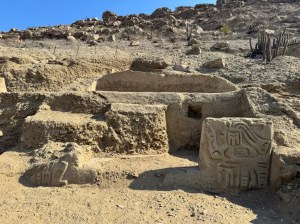
Archaeologists in Peru have unearthed the remains of what they believe are a 4,000-year-old temple and theater, shining a new light on the origins of complex religions in the region.
The team began studying the new archaeological site of La Otra Banda, Cerro Las Animas, in June. Last year, the local government alerted them to looting that had been taking place near the northern Peruvian town of Zaña, according to a press release from the Field Museum in Chicago, Illinois, Wednesday.
They excavated a plot roughly 33 feet long and 33 feet wide, finding signs of ancient walls made of mud and clay at just six feet deep.
“It was so surprising that these very ancient structures were so close to the modern surface,” Luis Muro Ynoñán, a research scientist at the Field Museum who led the team, said in the release.
After digging deeper, archaeologists found “one section” of a large temple, Muro Ynoñán said, adding that “one of the most exciting” finds was a small theater “with a backstage area and a staircase that led to a stage-like platform.”
“This could have been used to perform ritual performances in front of a selected audience,” he added
One of the theater’s staircases was flanked by mud panels with an elaborate carved design of a mythological bird-like creature, according to the release. The figure resembled other images of mythological creatures dating to the Initial Period, around 2,000 to 900 BC, giving clues to when the temple was built.
“The Initial Period is important because it’s when we first start to see evidence of an institutionalized religion in Peru,” Muro Ynoñan said, adding that Please click here to read the rest of this article
Archaeologists in Greece have discovered a 2,700-year-old temple that houses a horseshoe-shaped altar overflowing with offerings.
Constructed of bricks, the temple is 100 feet (30 meters) long and is located next to the Temple of Amarysia Artemis, a sanctuary dedicated to the Greek goddess Artemis, which researchers found in 2017 on the island of Evia, according to a translated statement from Greece’s Ministry of Culture.
During excavations in 2023, archaeologists found the second temple.
“One of the peculiarities of this temple is the significant number of structures found inside it,” the researchers wrote on Jan. 9 in a translated Facebook post detailing their finding.
Those structures included several hearths located in the temple’s nave, including the ash-caked altar stacked with offerings such as pottery; vases; Corinthian alabaster, or the carved mineral gypsum; gold and silver jewelry studded with coral and amber; amulets; and bronze and iron fittings. The altar also contained several pieces of charred bone.
Some of the pottery pieces predate the newfound temple and were fired during the late eighth century B.C., leading researchers to suspect that the altar may have once resided outside the temple and was later moved indoors.
In the sixth century B.C., brick partitions were placed at the sanctuary’s heart for added support, leading researchers to think that the temple was “partially destroyed” by a fire, according to the statement.
Beneath the temple, archaeologists found several dry stone walls from a different building that once stood at the site, along with several bronze figurines shaped like bulls and a ram. They also unearthed remnants of buildings from the eighth and ninth centuries B.C. next to the first temple, as well as a fortification system dating to the more recent early Copper Age, or roughly 4000 to 3500 B.C.
Sheela Na Gigs are quasi-erotic stone carvings of a female figure usually found on Norman or to be more precise Romanesque churches. They consist of an old woman squatting and pulling apart her vulva, a fairly strange thing to find on a church. The carvings are old and often do not seem to be part of the church but have been taken from a previous older, usually romanesque, building. See the weathering on the Church Stretton Sheela as compared to the surrounding masonry. It is very likely that the sheela comes from an earlier 12th century chapel that stood on the site.
Even though the image is overtly sexual the representation is always grotesque, sometimes even comical. They are usually associated with “hags” or “old women”. The carvings often incorporate ribs showing on the torso and sometimes facial scaring as well, although this feature seems to be more common in Ireland than in mainland Britain and the continent.
The carvings are normally found on Churches usually of Norman origin and of Romanesque design, but they can also be found on Secular buildings (e.g. above a stable door in Haddon Hall Derbyshire, they can also be found on many castles in Ireland )
Sheela na gigs can be found all over Britain, Ireland and even France and Spain. In fact Images of Lust proposes a Continental origin for them.
While the most common interpretation of a sheela na gig is “a pagan idol” there is little evidence for a pagan connection. The prevalence of sheelas in Ireland (far more so than anywhere else) suggests that even if the image originates on the continent the image has meaning for the Irish. However the pagan interpretation of sheelas is by far the most popular and generates most of the debate on the figures.
The Sheela Na Gig Project
The Sheela Na Gig Project is an attempt to collate information about Sheela Na Gigs in the UK. Whereas there seems to be plenty of data on Irish figures the UK and continental figures are often overlooked. This website aims to address the balance by listing all known figures in the UK complete with photographs and include information on figures from the continent. This is by necessity a work in progress so please check back to see if any “new” sheelas have been added. You will find many figures here that appear in books on the subject and some that do not. The site also includes figures which are reported as being Sheela Na Gigs but in fact are other types of Romanesque motifs. The information on this site has mostly come from first hand visits to the figures except where indicated. We have been gathering information on figures since 1999 using visits, printed sources, information supplied by visitors to the site and users of the sheela na gig mailing list. All articles and photographs are copyright John Harding unless otherwise stated.
Sarsina is a sleepy, rural town of barely 3,000 residents straddling the pristine Apennine mountains in Italy’s Emilia Romagna region, surrounded by stunning views and grazing sheep.
While it has a glorious past, as a strategic defensive outpost for the Roman Empire and the birthplace of the famed playwright Plautus, today there’s not much to do beyond hiking and birdwatching.
And though both locals and holidaymakers would agree that a rustic, slow-paced lifestyle is part of Sarsina’s charm, its residents were nonetheless excitedly awaiting the construction of a development including a new supermarket, fitness center and playground. But it was not meant to be — at least, not as originally planned.
That’s because workers at the site on the outskirts of town in December 2022 unearthed the ruins of an ancient Roman temple — or ‘capitolium’ — dating back to the first century BC.
In early July, a first look at the underground treasure came to light: a single imposing structure of horizontal sandstone blocks and marble slabs, 577 square meters wide, which researchers have identified as the podium above which the columns and walls of an ancient temple were built.
And what has come out of the ground so far could be just the tip of the iceberg.
“We have unearthed three separate rooms, likely dedicated to the triad of gods Jupiter, Juno and Minerva,” lead archaeologist at the excavation site Romina Pirraglia told CNN. “The excavations are still underway… and we have already identified an older, deeper layer of ruins dating back to the 4th century BC, when the Umbrian people (an ancient Italic tribe who predated the Romans) lived in the area. The entire temple could be even larger than what we now see.”
According to Pirraglia, the discovery of a capitolium — the main temple in an important Roman city, and a hub for trade as well as religious and social interactions — further confirms the strategic role Sarsina played during the Roman Empire. The town was built in a key mountainous area close to the Tuscan border and overlooking the Savio river, an important waterway connecting central and northern Roman cities.
The discovery of the temple has pushed local authorities to revise their building plans. Federica Gonzato, superintendent of archaeology, fine arts and landscape for the provinces of Ravenna, Rimini and Forlì-Cesena, which includes Sarsina, is adamant in wanting to preserve the ruins and further research its great past.
“We will not tear it down to make room for modern structures, this must be very clear. Previous urban plans will be changed, we will find new construction sites for recreation and sports,” Gonzato said. “The temple is an incredible finding that sheds light on how ancient Roman towns rose and fell across time.”
What makes the discovery exceptional is the temple’s unique state of preservation. “The marvelous quality of the stones have been spared from sacks, enemy invasions and plunders across millennia thanks to the remote location of Sarsina, a quiet spot distant from larger cities,” Gonzato added. “Temples such as this one (were) regularly plundered, exploited as quarries with stones and marble slabs taken away to be re-used to build new homes. But Sarsina’s capitolium podium structure is practically untouched, with its entrance staircase well-preserved, and this is extremely rare.”
Gonzato believes the discovery will further research on demography and urban transformations in ancient times. And there’s more to the site than just the temple’s podium. Pirraglia said there are signs that the building was reused in medieval times. An ancient water drainage system was found alongside medieval tombs and hearths indicating that locals likely inhabited it, or used the site for other social purposes.
“This is the beauty of Italy: wherever you dig, some hidden treasure comes out of the ground. Wonders never cease to amaze us,” said Gonzato.
A long-lost ancient temple of Apollo has been excavated after archaeologists from the Universities of Frankfurt and Kiel in Germany successfully located its whereabouts in Frangissa, near Pera Orinis in Cyprus.
The temple had been known about since 1885 but had been considered lost, a press release from the deputy culture ministry reported.
“The current research project aims to explore these complex structures, which often evolved over several centuries, and gain important insights into the functioning of ancient sanctuaries,” the press release said.
Current estimates place the temple as dating back to the Hellenistic period—a period of Ancient Greece that started in 323 B.C. and ended in 32 B.C.
“After its construction, the district underwent successive remodeling and expansion. In a later phase, transverse walls were added, altering the interior of the courtyard. Additionally, parallel flat stone bases were erected alongside the outer walls, likely serving as supports for columns and carrying the roof of a hall that surrounded all sides,” the statement from the ministry said.
In Ancient Greece, temples provided a place for worship and ritual practices, as well as providing a place for social, political, and economic functions.
In Greek mythology, Apollo was the god of sun and light and was worshiped at temples and during festivals.
“Through the exemplary investigation of the sanctuary of Frangissa, the current research project aims to explore these complex structures, which often evolved over several centuries, and gain important insights into the functioning of ancient sanctuaries,” the statement said.
Of particular interest was the discovery of fragments of terracotta—a type of ancient pot constructed from brownish-red earthenware.
These fragments belonged to a huge male terracotta figure, the press release said.
“The robe of the figure was intricately decorated with incised ornaments. Similar fragments were previously found in 1885 and taken to the Cyprus Museum,” it said. “The newly found fragments perfectly match these ancient fragments, confirming the identification of the sanctuary with the site excavated in 1885, which was previously based on various circumstantial evidence.”
Archaeologists also found a head of an archaic warrior statuette.
Excavations began in 2021, when the remains of ancient masonry were discovered. The work continued in 2022, until the temple was finally uncovered this year,
Excavations will continue in the area, to allow archaeologists to discover more about the site and the role it played in Ancient Greece.
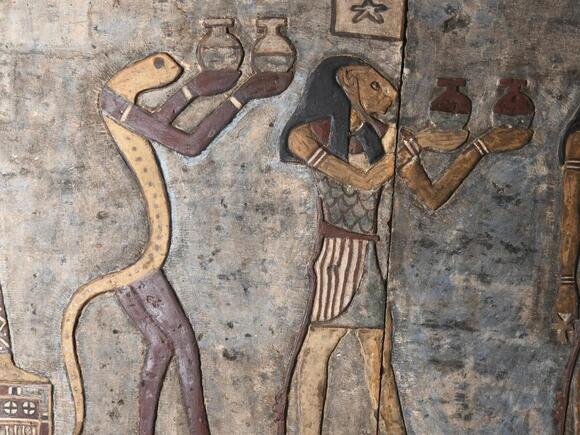
Ancient Egyptian star signs were found under a thick layer of soot and dust in the Temple of Esna.
The colors in the full set of Egyptian zodiac symbols are vivid after being protected by the grime.
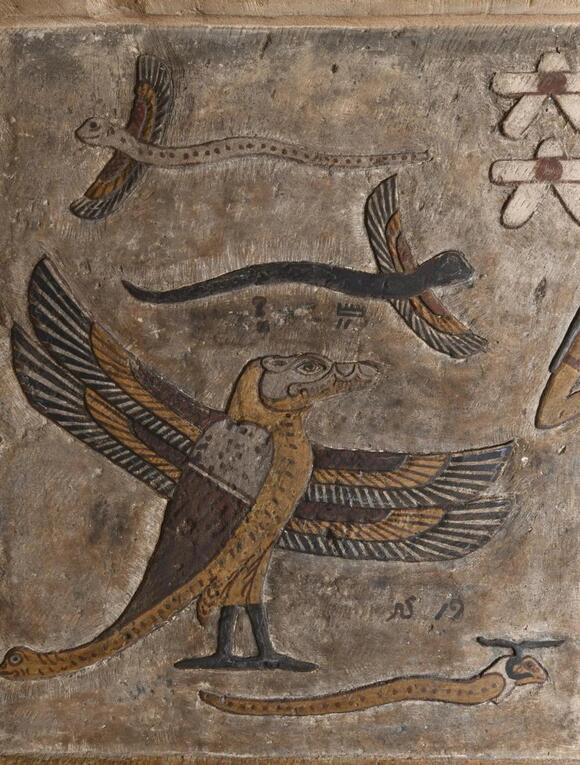
They also found depictions of beasts, including a snake with a ram’s head and a bird with a crocodile’s head.
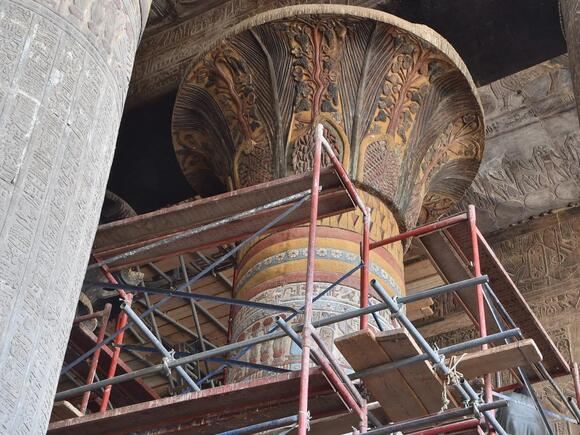
A rare full set of ancient Egyptian astrological symbols has been uncovered under 2,000 years’ worth of grime in Luxor’s Temple of Esna, in southern Egypt.
The set is just one of three full sets of ancient Egyptian zodiac signs uncovered in Egyptian temples, said Dr. Daniel von Recklinghausen, a Tübingen Egyptologist who worked on the project.
“Representations of the zodiac are very rare in Egyptian temples,” Professor Christian Leitz, an Egyptologist of the University of Tübingen who worked on the project, said in a press release.
The temple was already famous for its astronomical ceiling, but some of the star signs had not been detected in previous archaeological missions, Mostafa Waziri, secretary-general of Egypt’s Supreme Council of Antiquities, said in a briefing per Arab News.
With these last signs uncovered, the archaeologists were able to confirm the temple contains a full set of the 12 Egyptian star signs, from Aries to Pisces, Hisham El-Leithy, head of the Egyptian expert team, per Arab News.
The symbols were hidden under a thick layer of muck
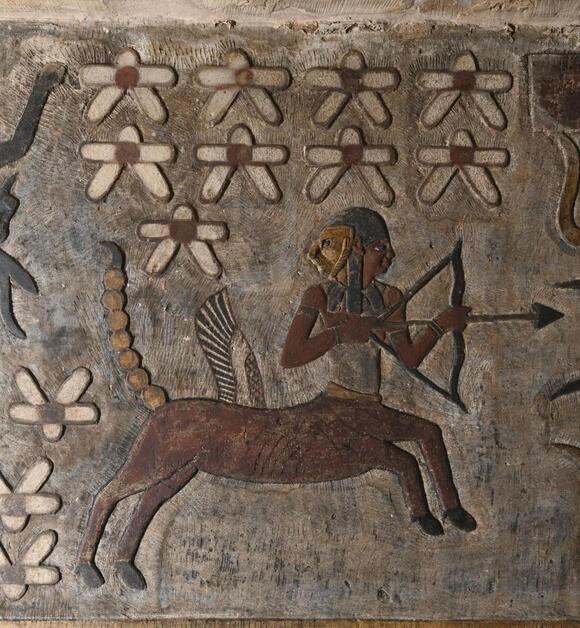
The zodiac sign Sagittarius Ahmed Emam, Ministry of Tourism and Antiquities
The discovery was made by a joint team of experts from the Egyptian Center of Documentation of Antiquities and the University of Tübingen, Germany, who are renovating and documenting the temple’s original colors.
“The zodiac was used to decorate private tombs and sarcophagi and was of great importance in astrological texts, such as horoscopes found inscribed on pottery sherds,” said Recklinghausen, adding: “However, it is rare in temple decoration.”
Several of the signs are recognizable to us. These include the Sagittarius, which is represented by a horse with the torso of a human archer — though in ancient Egyptian times, he also had a spiked tail and wings.
The scorpio is also easily recognizable, represented by a scorpion surrounded by stars.
An ancient Egyptian representation of the zodiac sign Scorpio. Ahmed Emam, Ministry of Tourism and Antiquities
These symbols were hidden under nearly 2,000 years of dust and dirt which has kept them in an incredible state of preservation.
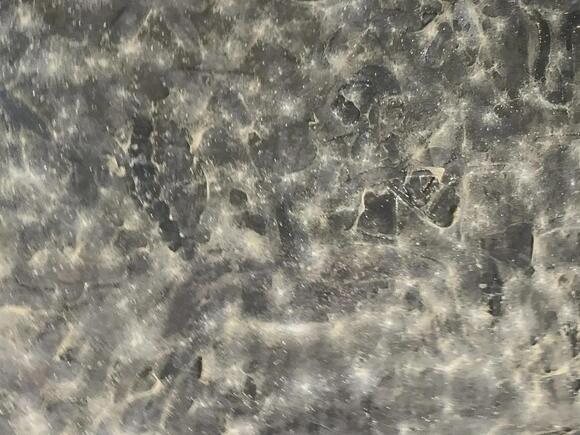
This is what the Sagittarius looked like before restoration. Ahmed Emam, Ministry of Tourism and Antiquities
The Temple of Esna took 400 years to complete
The symbols were found in the Temple of Esna, an ancient Egyptian temple that dates back to the Greco-Roman times and was completed in A.D. 250 , per Egypt Independent.
Only the Hypostyle Hall remains of the temple.
This vestibule, a 121-foot-long, 65-foot-wide, and 50-foot-high sandstone structure held up by 24 columns, took 400 years to complete, per a press release.
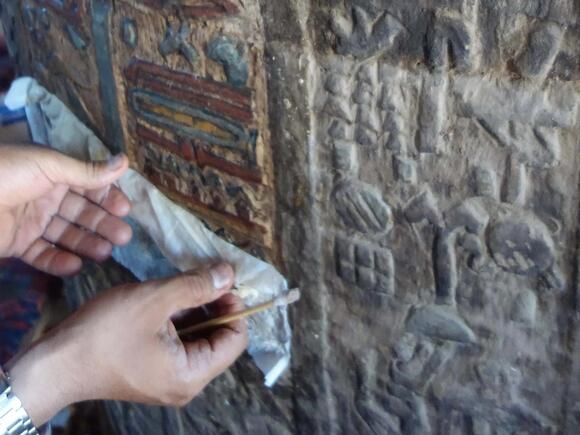
Restoration process in the Temple of Esna. Ahmed Amin
Every inch of the temple, which also contains 18 decorative free-standing columns, is covered in intricate designs.
A column in the Temple of Esna being restored. Ahmed Amin
The team has been renovating the temple for the past five years. These zodiac symbols were uncovered in the latest series of renovations, which revealed the designs in brilliant colors.
Ancient Egyptians adopted astrology late in their reign
These symbols show the decans, which are zodiac symbols representing the 12 hours of the night. Ahmed Emam, Ministry of Tourism and Antiquities
Egyptians were introduced to astrology quite late in their rule, during Greco-Roman times.
“The zodiac itself is part of Babylonian astronomy and does not appear in Egypt until Ptolemaic times ,” said Leitz.
Some of the symbols of their zodiac system have been lost in time. Pictured above, for instance, are the Decans, used to measure the twelve hours of the night.
Zodiac symbols were not the only discovery in this latest round of renovations. The archaeologists also uncovered representations of the planets Jupiter, Saturn and Mars.
They also found various fabulous beasts, including a snake with a ram’s head and a bird with a crocodile’s head, the tail of a snake, and four wings, per the press release.
Depiction of winged snakes and an animal with bird, crocodile and snake features. Ahmed Emam, Ministry of Tourism and Antiquities
The temple of Esna is teaching us a lot of information about how ancient Egyptians read the stars.
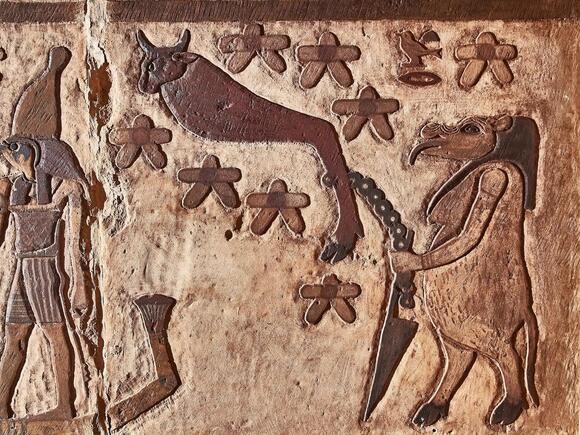
One inscription, uncovered in a previous round of renovation, showed how Egyptians compared the Big Dipper to a bull’s leg tied to a stake by a goddess in hippo form, per a press release.
According to an accompanying press release, the Big Dipper was considered to be the manifestation of the evil god Seth who murdered his brother Osiris.
The depiction shows the hippo goddess holding Seth back to prevent him from reaching Osiris in the underworld.
A painting in the Temple of Esna shows the Big Dipper, in the shape of a bull’s leg, being held back by a goddess. Ahmed Amin
This article is not a complete list of the Celtic Goddesses and Gods. It seems to be the more popular ones in modern pagan traditions. They will also correspondence to some of the other ancient pantheons in other parts of the ancient world.
You’ve always wanted to stroll across the beautiful landscape of Ireland. To make sure that you don’t miss out on the best spots, you decide to make use of a local touring company.
Suddenly one appears before you. How strange that you didn’t notice this building before, but heck, the banner outside claims it’s five-star and that you’ll meet Celtic gods and goddesses in person. They are probably just actors in costume — a little cheesy — but you don’t see any other places that are open at the moment.
To your surprise, you realize that your hiking companions are the actual Celtic gods and goddesses. While you fight off the sudden faint feeling, you remember that the ridiculously steep deposit is only refundable at the end of the trip. There’s no turning back now.
A big guy claps his hand on your shoulder and says, “Fear not, tiny mortal. You’re going to have a fun time learning all about the ancient Celtic pantheon and the people who worshipped us.”
You just want your deposit back. So when the group picks up their backpacks and heads out, you follow.
Name: The Dagda – the good god Realms: Father god of Ireland; knowledge, weather, fertility, druids, warriors Family: Father of Aengus, Brigid, and Danu, member of the Tuatha Dé Dannan Fun Fact: In Dorsetshire is an enormous drawing of a man. Some believe that the chalk creation is meant to show this deity…
Name: Ériu Realms: Patron goddess of Ireland Family: Daughter of Ernmas and Fiachna Mac Delbáeth; has two sisters called Banba and Fódla; mother of Bres Fun Fact: Her sisters’ names are sometimes used as poetic titles for Ireland…
(Side Note: This is the God who is honored during a Lammas/Lughnasadh celebration)
Name: Lugh Realms: God of crafts, light, and Sun Family: Son of Eithne and Cian; father of Cú Chulainn Fun Fact: His full name is a little strange — Lugh of the Long Arms…
(Side Note: Epona is also considered the Goddess of all domestic animals in modern times. I work with her closely when teaching a puppy or an older dog manners to get along better in the human world)
Name: Epona Realms: Patron goddess of horses, mules, fertility, and cavalry Family: ??? Fun Fact: In the Gaulish tradition, Epona was never shown in human form; only as a mule or a horse. The Romans showed her as a woman on a throne, standing between horses or driving a chariot…
(Side Note: This is the Goddess who is honored during a Imbolc celebration)
Name: Brigid Realms: Goddess of poetry, fertility, motherhood, passion, dawn, healing, smithing, fire, invention, and life Family: Married to Bres; mother of Ruadán; daughter of the Dagda Fun Fact: She inspired a goddess in Haiti, called Maman Brigitte
Name: Danu Realms: A mother goddess; the earth, nature, wind, fertility, death, wisdom, cattle, regeneration, wealth Family: She was the consort of both the Sun god, Belenos, and the sea god, Beli; daughter of the Dagda, member of the Tuatha De Dannan. Fun Fact: Danu is another geographical smash hit. Among the places named after this goddess is the River Danube, the Paps of Anu, a region in Ireland’s County Kerry, and possibly the Dane Hills in Leicestershire…
Name: Aengus Realms: God of love and youth Family: Son of Boann and the Dagda, member of the Tuatha Dé Dannan Fun Fact: Four birds surround him at all times and, according to mythology, they symbolize his smooches (Yep. His kisses)…
Name: Toutatis Realms: Possibly the guardian god of the Gauls Family: ??? Fun Fact: Ancient writers suggested that he was the equivalent of the Roman god, Mars…
Name: The Morrigan, the Great Queen, the Phantom Queen. Realms: Goddess of war, fate, death, and destiny Family: Great-granddaughter of King Nuada, member of the Tuatha Dé Dannan Fun Fact: In some versions of Celtic mythology, Ireland was named for this Irish goddess…
Name: Belenus Realms: God of the Sun, spring festivals, healing, medicine, and guardianship Family: ??? Fun Fact: According to Roman sources, Belenus was the popular kid in the Celtic mythology during the 3rd century…
Name: Taranis Realms: Wheels, thunder, weather, the sky Family: ??? Fun Fact: Archaeologists have discovered thousands of votive wheels in Gaul. They were popular offerings to Taranis…
(Side Note: This is the God who is honored during a Beltane celebration)
Name: Cernunnos Realms: Forests, wildlife, wealth, fertility, and possibly the underworld Family: ??? Fun Fact: This Celtic god is more of an entity today, in modern Wiccan traditions, than during the past…
(This includes the Chinese characters if you want to write it somewhere. You can copy and paste the characters from here. I have alternated the colors so each character stands out.)
(I came across this website with a lot of information about the Chinese New Year please click on the link above if you want to read more about this than the couple of paragraphs I have copied and pasted.)
Santa Claus—otherwise known as Saint Nicholas or Kris Kringle—has a long history steeped in Christmas traditions. Today, he is thought of mainly as the jolly man in red who brings toys to good girls and boys on Christmas Eve, but his story stretches all the way back to the 3rd century, when Saint Nicholas walked the earth and became the patron saint of children. Find out more about the history of Santa Claus from his earliest origins to the shopping mall Santas of today, and discover how two New Yorkers—Clement Clark Moore and Thomas Nast—were major influences on the Santa Claus millions of children wait for each Christmas Eve.
The Legend of St. Nicholas: The Real Santa Claus
The legend of Santa Claus can be traced back hundreds of years to a monk named St. Nicholas. It is believed that Nicholas was born sometime around A.D. 280 in Patara, near Myra in modern-day Turkey. Much admired for his piety and kindness, St. Nicholas became the subject of many legends. It is said that he gave away all of his inherited wealth and traveled the countryside helping the poor and sick. One of the best-known St. Nicholas stories is the time he saved three poor sisters from… Click here to read more of this article on history.com
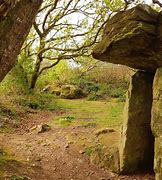
A Spanish “stonehenge” has reemerged amid the country’s devastating drought, officials said.
The historic marvel, officially called the Dolmen of Guadalperal, has only been visible four times, according to officials.
Experts believe the striking circle of dozens of megalithic stones has existed since 5000 BC. However, it was first discovered by German archaeologist Hugo Obermaier in 1926 before it became flooded in 1963 due to a rural development project under Francisco Franco’s dictatorship.
Now, the structure sits in a corner of the Valdecanas reservoir located in the country’s central province of Caceres.
As Spain faces its worst drought in 60 years, officials say the water level in the reservoir has dropped to 28% capacity.
“It’s a surprise, it’s a rare opportunity to be able to access it,” archaeologist Enrique Cedillo from Madrid’s Complutense University told Reuters.
The structure itself has an unknown creator, experts say.
Dolmens are vertically arranged stones that usually support a flat boulder or capstone, according to…
I used to believe my great-grandmother was the first person on earth. She was so old, she HAD to be. Those deep lines carved around her eyes and mouth were a dead giveaway.
Turns out I was wrong. Unbelievably wrong. People have graced the vast grassy plains of this planet since long before even Nana’s great grandparents were alive (and there’s even a tortoise that’s older than her!).
Who knew? Well, I do now, and you can as well.
Here’s a complete ancient civilizations timeline — their names, dates, locations, and some bizarre bits of trivia about them — starting with one that was still flourishing only 600 years ago, and concluding with one still powering forward today.
One of the most extensive ancient Roman temple complexes in northern Europe, which includes sacrificial altars used by soldiers on a far frontier of the Roman Empire, has been unearthed in the Netherlands.
The first century A.D. site — known as a temple sanctuary — was located near the fork of the Rhine and Waal rivers and a short walk from Roman forts along the Lower German Limes, which was then the northernmost border of the empire. It now lies near the Dutch city of Zevenaar in the eastern Gelderland region, near the border with Germany.
The sanctuary consisted of at least three large temples and many smaller altars dedicated to particular Roman gods and goddesses, and would mainly have been used for sacred vows by Roman soldiers stationed at the nearby forts, project leader Eric Norde, an archaeologist at the Dutch archaeology agency RAAP, told Live Science.
Hundreds of artifacts have been found at the site, including coins and jewelry; while the tips of spears and lances, and the remains of armor and horse harnesses, emphasize its military nature, he said.
The discoveries give a glimpse of the lives of soldiers stationed on the frontiers of the empire, far from the Roman heartlands.
“It’s the best-preserved Roman sanctuary in the Netherlands, and perhaps in a much larger area,” Norde said. “It’s quite extraordinary.”
The central government of the Netherlands and the provincial Gelderland government have contracted RAAP to excavate the site, which was first unearthed during commercial clay extraction works in 2021, according to a statement by the Dutch cultural ministry(opens in new tab). The clay extraction has been stopped for the excavations but is continuing nearby, and so the archaeological site is closed to the public for now.
There are at least a thousand reasons to visit Sicily, the great island – indeed the largest in the Mediterranean – that forms the triangular football to the boot that is the Italian peninsula. They are all very good reasons, including amazing landscapes, a uniquely complex and delicious cuisine, a history that is diverse and multifaceted beyond belief, excellent wines, a vast array of archaeological sites, an even vaster one of historical towns and villages. But one key reason to visit the island is missing from the list above: Greek temples!
Greek temples are one of the earliest well-defined expressions of what we now recognise as the Western tradition in architecture, and one of the most influential ones by a vast margin to this day. They go back to the 8th or 7th centuries BCE, and, as the name entails, they are indeed a key achievement of the Archaic Greeks. They originated in what is the south of modern Greece, namely the Peloponnese and Central Greece, where Greek temple architecture appears to have its main roots, probably derived from local wooden predecessors.
The Greek mainland’s architectural style is the Doric one, considered to be the most austere and ‘male’ in character. The eastern Aegean and Asia Minor were famous for their own development, the more elegant and ‘female’ Ionic style, conceived about a century after the Doric one. Its most prominent examples at Samos, Ephesus, and Didyma (much better preserved than the other two) are also marked by their …
I have been following this website Irish Pagan School for about two years and have taken a couple of courses through them about Irish Celtic Paganism. The first course I took was on Ogham and even though I have been reading ogham Staves for years I learned somethings I was doing wrong that would affect a reading and some new ways to go about using the Ogham alphabet. Their courses are do not cost a lot for the information you can gain plus you can go back to the material time and time again. You will get almost daily information usually in the form of a video through youtube.com. You can find the list of a variety of topics here by Irish Pagan School Videos I highly recommend watching a few if you are all interested in Celtic Paganism. Even with their Irish accent they are easy to understand.
Yesterday’s email announced a new way to gain information and I am really looking forward to listening to their podcasts. Here is the email I received including the link for the podcasts.
We’re aiming for new episodes every Wednesday, so there’ll be one showing up tomorrow, and a bonus one on Sunday because Monday is my birthday and I wanted to give you a small gift. 🎁
It’s not filtered out to every podcast player yet, but you can catch it on spotify and quite a few more currently, so please subscribe, follow, review, and all that good stuff (and of course – listen and even share the episodes?) to help us get off to a good start.”
Demeter and Persephone are strongly connected to the time of the Autumn Equinox. When Hades abducted Persephone, it set in motion a chain of events that eventually led to the earth falling into darkness each winter. This is the time of the Dark Mother, the Crone aspect of the triple goddess. The goddess is bearing this time not a basket of flowers, but a sickle and scythe. She is prepared to reap what has been sown.
The earth dies a little each day, and we must embrace this slow descent into dark before we can truly appreciate the light that will return in a few months.
This ritual welcomes the archetype of the Dark Mother and celebrates that aspect of the Goddess which we may not always find comforting or appealing, but which we must always be willing to acknowledge. Decorate your altar with symbols of Demeter and her daughter — flowers in red and yellow for Demeter, purple or black for Persephone, stalks of wheat, Indian corn, sickles, baskets. Have a candle on hand to represent each of them — harvest colors for Demeter, black for Persephone. You’ll also need a chalice of wine, or grape juice if you prefer, and a pomegranate.
If you normally cast a circle, or call the quarters, do so now. Turn to the altar, and light the Persephone candle. Say:
The land is beginning to die, and the soil grows cold. The fertile womb of the earth has gone barren. As Persephone descended into the Underworld, So the earth continues its descent into night. As Demeter mourns the loss of her daughter, So we mourn the days drawing shorter. The winter will soon be here.
Light the Demeter candle, and say:
In her anger and sorrow, Demeter roamed the earth, And the crops died, and life withered and the soil went dormant. In grief, she traveled looking for her lost child, Leaving darkness behind in her wake. We feel the mother’s pain, and our hearts break for her, As she searches for the child she gave birth to. We welcome the darkness, in her honor.
Break open the pomegranate (it’s a good idea to have a bowl to catch the drippings), and take out six seeds. Place them on the altar. Say:
Six months of light, and six months of dark.
The earth goes to sleep, and later wakes again.
O dark mother, we honor you this night,
And dance in your shadows.
We embrace that which is the darkness,
And celebrate the life of the Crone. Blessings to the dark goddess on this night, and every other.
As the wine is replaced upon the altar, hold your arms out in the Goddess position, and take a moment to reflect on the darker aspects of the human experience. Think of all the goddesses who evoke the night, and call out:
Demeter, Inanna, Kali, Tiamet, Hecate, Nemesis, Morrighan. Bringers of destruction and darkness, I embrace you tonight. Without rage, we cannot feel love, Without pain, we cannot feel happiness, Without the night, there is no day, Without death, there is no life. Great goddesses of the night, I thank you.
Take a few moments to meditate on the darker aspects of your own soul. Is there a pain you’ve been longing to get rid of? Is there anger and frustration that you’ve been unable to move past? Is there someone who’s hurt you, but you haven’t told them how you feel? Now is the time to take this energy and turn it to your own purposes. Take any pain inside you, and reverse it so that it becomes a positive experience. If you’re not suffering from anything hurtful, count your blessings, and reflect on a time in your life when you weren’t so fortunate.
When you are ready, end the ritual.
By Patti Wigington,Paganism/Wicca Expert
Article found on & owned by ThoughtCo






 Witches Of The Craft®
You must be logged in to post a comment.