Lady Abyss’ Spell Of The Day: Scrying Spell to See The Future

Scrying Spell to See the Future

It may take some practice to learn to relax and allow visions to come to you. Trust your intuition and pay attention to what you feel as well as what you see.

Best time to perform this spell:

*   During the new moon

*   When the sun or moon is in cancer, Scorpio, or Pisces

*   On Mondays

Ingredients or equipment needed:

*   A cauldron or large dark bowl filled with water

*   A broom straw

*   2 cloves, crushed

*   A rose thorn or common pin

*   Rubbing Alcohol

The Spell:

  1. Fill the cauldron or bowl with water and sprinkle the crushed cloves in it.
  2. Sterilize the thorn or pin and your finger with rubbing alcohol, then prick your finger and squeeze a drop of blood into the water.
  3. Make three, slow, gentle clockwise circles in the water with the broom straw. Gaze into the water without skepticism or preconceptions. Allow impressions about your future to arise into your awareness–don’t censor or analyze, just keep an open mind and an open heart. Gaze as long as you like.
  4. When you’re finished, empty the water, and write down what you experienced.

Incense of the Day for April 11 is Clearing Incense

Clearing Incense

3 parts Frankincense

3 parts Copal

2 parts Myrrh

1 part Sandalwood

Burn this incense to clear your home of negative vibrations, especially when household members are arguing or when the house seems heavy and thick with anger, jealousy, depression, fear and other negative emotions. Leave the windows open while burning this mixture.

Gemstone of the Day for April 11 is Jasper

Gemstone of the Day
 
 
Jasper

Chalcedony qtz. Multicolored, solid. Yellow, orange, brown, green. Yellow for stomach, intestines, liver, spleen areas. earthy grounding. Green: Respiratory/Heart Chakra. General tissue regeneration; mineral assimilation; general healing. Darker colors: more grounding. Suggested to be used for elixirs because it will not over-stimulate any part of the body. Considered more effective if it is used for long periods of time because it works slowly. It is a methodical and meticulous worker. Each color of Jasper has additional specific qualities when used alone. Jasper works well in conjunction with Opals. Recommended for executives as an aid to quick thinking. Also helps them endure stress.
Brown Jasper: Helps one find stability and balance. Benefits ailments that result from environmental pollution. Boosts the immune system and assist in extracting pollutants and toxins from the body. Keep in mind that this process takes some time since Jaspers work slowly. Helps one become more ecologically aware. Well suited for use by people who wish to relive past events through regression or analysis.
Green Jasper: Especially suited to tempering aspects of your life that have taken on too great an importance. Works as a gentle daily reminder that the whole is only the result of all the parts. Works best on ailments of the upper torso, digestive tract, and the cleansing organs.
Red Jasper: Much like Bloodstone in its link to the circulatory system. Beneficial in battling diseases of the blood and detoxifying blood-rich organs like the liver. It helps bring problems to light before they are a threat.
Yellow Jasper: Beneficial to the endocrine glands and the cleansing organs. Makes one feel stronger and in better physical condition.

Herb of the Day for April 11th is Black Cohosh

Herb of the Day

 
Black Cohosh
Botanical: Cimicifuga racemosa (NUTT.)
Family: N.O. Ranunculaceae

Synonyms—Black Snake Root. Rattle Root. Squaw Root.
Bugbane.
Part Used—Root.


Habitat—A native of North America, where it grows freely in shady woods in Canada and the United States. It is called Black Snake Root to distinguish it from the Common Snake Root (Aristolochia serpentaria).

Description—The seeds are sent annually to Europe, and should be sown as soon as the season will permit. It flowers in June or early in July, but does not perfect seed in England, though it thrives well in moist shady borders and is perfectly hardy. It is a tall, herbaceous plant, with feathery racemes of white blossoms, 1 to 3 feet long, which being slender, droop gracefully. The fruits are dry.

The plant produces a stout, blackish rhizome (creeping underground stem), cylindrical, hard and knotty, bearing the remains of numerous stout ascending branches. It is collected in the autumn after the fruit is formed and the leaves have died down, then cut into pieces and dried. It has only a faint, disagreeable odor, but a bitter and acrid taste.

The straight, stout, dark brown roots which are given off from the under surface of the rhizome are bluntly quadrangular and furrowed. In the dried drug, they are brittle, broken off usually quite close to the rhizome. In transverse section, they show several wedge-shaped bundles of porous, whitish wood. A similar section of the rhizome shows a large dark-colored, horny pith, surrounded by a ring of numerous pale wedges of wood, alternately with dark rays, outside which is a thin, dark, horny bark.

Constituents—The chief constituent of Cimicifuga root is the amorphous resinous substance known as Cimicifugin, or Macrotin, of which it contains about 18 per cent but the bitter taste is due to a crystalline principle named Racemosin. The drug also contains two resins, together with fat, wax starch, gum, sugar and an astringent substance.

Medicinal Action and Uses—Astringent, emmenagogue, diuretic, alternative, expectorant. The root of this plant is much used in America in many disorders, and is supposed to be an antidote against poison and the bite of the rattlesnake. The fresh root, dug in October, is used to make a tincture.

In small doses, it is useful in children’s diarrhea.

In the paroxysms of consumption, it gives relief by allaying the cough, reducing the rapidity of the pulse and inducing perspiration. In whooping-cough, it proves very effective.

The infusion and decoction have been given with success in rheumatism.

In infantile disorders, it is given in the form of syrup. It is said to be a specific in St. Vitus’ Dance of children. Overdoses produce nausea and vomiting Preparations—Fluid extract, U.S.P., 15 to 30 drops. Fluid extract, B.P., 5 to 30 drops. Tincture, U.S.P., 1 drachm. Tincture, B.P., 15 to 60 drops. Cimicifugin, 1 to 6 grains. Powdered extract, U.S.P., 4 grains.

Deity of the Day for April 11 is Epona (Celtic)

Deity of the Day

Epona

 (Celtic)
Divine Horse/The Great She. Goddess of Horses, Asses, Mules, Oxen and, to some degree, of Springs and Rivers.  Goddess of fertility and maternity.  Protective of horses, horse breeding, prosperity, dogs, healing, springs, crops. She was especially popular with Roman soldiers. Animal associations Horses and dogs.

THE GODDESS IS ALIVE

THE GODDESS IS ALIVE
              
Moon shines down upon a sea of Light,
Shifting sands lay singing in the Heart of the Night.
I looked upon a scene that gripped me to the core,
White-clad maidens below were dancing on the shore.
  
Sweet sounds slipped from moon-lit throats,
Wind whipped hair abound,
Lit by the light within and without,
The Women circled ’round.
  
As I stood, water engulfed my feet,
My body swayed to your Heavenly Heart beat.
Wind and wave and fire light,
Paled in my mind Earthly delight.
  
Time slipped by me as you held your embrace,
And windblown spray covered my face.
Protected deep within your Womb,
I could feel the tender pain of Life’s bloom.
 
Candles flared high as the Dance progressed,
Deep inside with a healing touch you blessed.
All around, wind, wave and fire shouted of your life,
Your light speared deep within, soothing my strife.
 
Divine Mother, Goddess of Light,
To you I come seeking protection from the night.
Come home to shelter within your arm,
Surrounded by Love, hidden from harm.

Holy Mother, Queen of Heaven and Earth,
From you we all trace our Birth.
Heavenly Goddess, light from above,
Shine down upon us, we pray for your Love.

Today is Monday, April 11th

Monday is ruled by the moon

Archangel: Gabriel

Candle colour: Silver

Incenses: Jasmine or Myrrh

Crystals: Moonstone or Opal

Use Mondays for spells for fertility, protection especially while traveling for home, and family and to increase psychic and healing powers.

Where possible, work close to any water and, as a bonus, by moonlight.

Your Daily Influences for April 11th

Your Daily Influences
April 11, 2011 
 

Tarot Influence

Rune Influence


Charm Influence
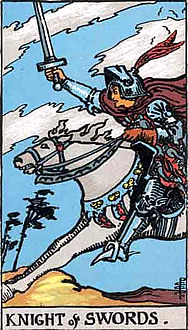
Knight of Swords Reversed
Given to bragging. A bully, prone to fighting. Possibly self destructive.
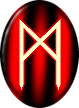
Mannaz
Now is the time for you to explore your inner self and those of others. Your intelligence and creativity are very well honed at the moment. Cooperation from and with others should be very easy to attain.
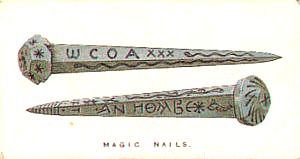
Magic Nails
Your sleep may be disturbed by restless spirits over the short period. They will not pass until the next waning moon. Their presence is to influencing a major decision you must make although which way they may not reveil. This aspect is affected by psychic restlessness.
Your Daily Influences represent events and challenges the current day will present for you. They may represent opportunities you should be ready to seize. Or they may forewarn you of problems you may be able to avoid or lessen. Generally it is best to use them as tips to help you manage your day and nothing more.

Your Charm for April 11th

Your Charm for Today
<!–   Interpretation Basics–>


The Tau Cross
 
Today’s Meaning:
A journey that you or someone close to you must make will have a positive influence on this aspect. This trip may be over a great distance.General Description:
This charm was worn by the ancients toprotect the wearer against disease and snake bites. The Jews used it as an amulet for epilepsy and erysipelas. It is still used in Ireland as a talisman against stickness. The Tau is one of the most ancient crosses and the forerunner of the Latin Cross. Moses used the Tau Cross with the brazen serpent attached, to save the Childrenof Israel in the wilderness from the attacks of the fiery serpents. The Cross has always been the symbol of life eternal. It was this mark, the Tau Cross, that was placed upon the foreheads of those exempted from Divine wrath in Jerusalem.

Your Animal Spirit for April 11th

Your Animal Spirit for Today
April 11, 2011 
 

your daily animal spirit for today

Ant

Ant is dutiful, patient, industrious and focused. If you ever put an obstacle in the middle of an ant trail, you’ll notice that ant will go over it, around it, or even under it—but ant will NOT let the obstacle drive him backwards. Above all, ant is a team player, and knows that if each member of the team does his assigned task, the team will succeed. Do you have goals that are best met by team effort? If so, get the other players off the bench and let them into your game.

Today’s Chakra Energy Levels for April 11th

Today’s Chakra Energy Levels

The Chakras represent the seven primary energy hubs in the body. Life force energy is constantly flowing in and out of these centers. Just as the cosmos is constantly changing, so too are the levels of energy absorbed and radiated by our Chakra centers. The graph below is a representation of the quantities of Chakra energies available today.

Sahasrara:
   
61%
 
   
26%
Vishuddha:
   
30%
Anahata:
   
32%
Manipura:
   
88%
Svadhisthana:
   
81%
Muladhara:
   
8%

Legend:
Sahasrara – The Crown Chakra represents energies associated with cosmic consciousness, spirituality, knowledge, wisdom and inner peace.
Ajna – The Third Eye Chakra represents energies focused on both physical and spiritual vision. Psychic powers resonate from the Ajna Chakra, as well as your image of the Cosmos as a whole (the big picture) and the many nuances that make your journey unique.
Vishuddha – Throat Chakra is the energy center associated with communication and creativity. Your energy to express yourself verbally and creatively are derived from the Vishuddha Chakra.
Anahata – The Heart Chakra’s energy is concentrated on issues concerning your emotions. This energy fuels your power to love, feel compassion and maintain balance between disparate aspects of your being.
Manipura – The Power Chakra provides the energy that fuels our strength of will, individuality and sense of self-worth.
Svadhisthana – The Spleen or Sacral Chakra supplies the energy we use emotionally and sexually. This is the energy used to connect to others.
Muladhara – The Root or Base Chakra furnishes the energy used to create and maintain our foundation. This is the energy that keeps us on firm ground and provides us with the basic skills to uphold a place in the world.

The Planets Now for April 11th


<!– –>

Position of the planets based on Greenwich Mean Time (GMT).
 
Sun:
21° 31′
in Aries
Moon:
24° 43′
in Cancer
Mercury:
18° 06′
in Aries
Venus:
18° 39′
in Pisces
Mars:
07° 27′
in Aries
Jupiter:
17° 38′
in Aries
Saturn:
13° 13′
in Libra
Uranus:
01° 49′
in Aries
Neptune:
00° 24′
in Pisces
Pluto:
07° 13′
in Capricorn
Aspects:
Conjunction: Mars Uranus 5º
Conjunction: Mercury Jupiter 0º
Conjunction: Sun Jupiter 3º
Conjunction: Sun Mercury 3º
Opposition: Jupiter Saturn 4º
Opposition: Mars Saturn 5º
Opposition: Mercury Saturn 4º
Semi-Sextile: Mercury Venus 0º
Semi-Sextile: Sun Venus 2º
Semi-Sextile: Uranus Neptune 1º
Semi-Sextile: Venus Jupiter 1º
Square: Mars Pluto 0º
Square: Saturn Pluto 5º
Square: Sun Moon 3º
Square: Uranus Pluto 5º
Trine: Moon Venus 6º
The Sun in Aries
Leadership qualities tend to come to the forefront. Optimism is high and challenges seem a bit easier to meet. Taking care of number one can be a main theme in this period. Aggression levels and the need for adventure are likely to rise as well. Impulsive, decisive, and courageous actions by even the meekest of souls are very possible at this time.

Sun Opposition or Square Moon
This aspect can create a polarity of desires. As an example, one may desire maximum personal freedom while longing for a powerful intimate relationship based on a long term commitment.

Sun Conjunt Mercury
One’s ears may be closed to the advice of others.

Sun Conjunct Jupiter
Optimism and confidence are likely to be high in many. Life’s positive energies are very strong. Gain through luck is very possible.

Moon In Cancer
Emotions are likely to guide behavior. Passions may run so high in some that they will need to withdraw and reenergize. Many may display such wild mood swings that they leave those around them completely confused.

Moon Sextile or Trine Venus
Now is a good time to make sure those close to you realize just how important they are to you.

Mercury In Aries
Mercury in Aries is an influence that does not favor diplomacy. Many will be far more outspoken than usual. Dissension will be prevalent. Traditional approaches to handling challenges are likely to be replaced by new, more affective strategies. The need to be on the cutting edge of things will be strong.

Mercury Conjunct Jupiter
Seeking the “essence” of things may become a preoccupation. The need and ability to share ideas is strong.

Mercury Opposition or Square Saturn
This aspect provides a favorable window for tackling complex intellectual problems.

Venus In Pisces
Feelings are likely to run very deep. One may find themselves swelled with compassion that the need to help others becomes a major motivator. Creativity should be very strong and could lead to the development of exceptional innovations in the future.


Mars In Aries
Action is the keyword at this time. Those who act quickly and decisively should be favored. Self-sufficiency and the ability to act alone are valuable assets. Many will do well by focusing on short term goals.

Mars Opposition or Square Saturn
This aspect favors launching projects and starting relationships that one intends to commit to for the long term. Substantial progress in ongoing projects is likely as well.

Mars Conjunct Uranus
The need for personal freedom may be very strong. Many will show a pronounced lack of patience. Look internally for inspiration and motivation.

Mars Opposition or Square Pluto
This aspect favors those who put the full force of their will into reaching their goals. During this time it would be wise not to share one’s plans and ideas with a broad audience.

Jupiter In Aries
Self-reliance and optimism are favored at this time. Those who enjoy challenges and competition are favored. Adopting a never surrender attitude is a key component to attaining success.

Jupiter Opposition or Square Saturn
This aspect tends to muddle the distinction between what is real and what one wishes to be real. Setbacks can be experienced due to this nebulous vision of reality.

Saturn In Libra
Intimacy may be more of a chore than a pleasure. Some will find their progress towards strengthening intimate bonds and attaining goals muted by feelings of inadequacy.

Saturn Opposition or Square Pluto
This aspect may make it difficult to commit one’s self to anything beyond the moment at hand. However, those who do take on new goals will put the full force of their nature into achieving them.

Uranus In Aries
The astrological influence of Uranus is measured in increments of 7 years. What this means is that the effects of Uranus influence an entire generation. Day to day the Uranian influence may be imperceptible, but when the period is viewed as a whole the impact of Uranus is likely to be strikingly apparent.

Iconoclasm, independence and self-sufficiency are likely to be major themes during this period. Traditional values will be challenged. Those with a pioneering spirit will flourish.

Uranus Square Pluto
A mental restlessness and the need for complete personal freedom are possible influences of this aspect. In some the need for total autonomy may be so strong that they will challenge any attempt to subdue their independence.

Neptune In Pisces
Because Neptune takes approximately 14 years to move across Pisces its day to day influence may be imperceptible, but when the period is viewed as a whole the impact of Neptune in Pisces is likely to be strikingly apparent.

Gentleness, creativity, and the pursuit of spiritual truth are strong influences at this time. Many may find mysticism and unorthodox religions very attractive.


Pluto In Capricorn
Because Pluto takes approximately 15 years to move across Capricorn its day to day influence may be imperceptible, but when the period is viewed as a whole the impact of Pluto in Capricorn is likely to be strikingly apparent.

Strong economic gains can be made during this period. Pluto in Capricorn favors those who are able to make logical decisions and devise pragmatic solutions to the challenges before them.

Your Deck of Ancient Symbols Card for April 11th

Your Deck of Ancient Symbols Card for Today


The Golden Egg

The Golden Egg denotes the opportunity for substantial material gains. However, the Golden Egg is also a reminder that unmanaged greed ensures what gains are made will be lost.

As a daily card, The Golden Egg suggest that the prospects for you to increase your financial wealth are very strong today. Seize whatever opportunities come your way, but don’t ride them too long or you may find yourself no better off than you were before they came along.

Acceptance: Not Just Tolerance

Acceptance: Not Just Tolerance

Author: Aliana Soulfire

I have been a witch (in-progress, really) for six years. My parents were “Christians” or like to think they were, at any rate. But at just barely sixteen I found something new, something that called to my soul. And that was paganism, and magick.

At the beginning of December 2006, I was married in a handfasting-type ceremony I wrote myself. My mother was displeased when she first heard this, but I stood my ground. It was a ceremony I could feel connected to, one in which I could actually feel like I was making a binding between two souls, not just repeating lines. But I digress.

This is about acceptance. Please do not misunderstand me. By acceptance I do not mean that you have to worship everything. I mean, maybe we, as in the world, should accept the fact that maybe the gods for each different religion actually exist. Doesn’t mean we all have to pay respects to each one. Just means they are out there.

Most people, on every side, think I’m a lunatic for saying such things. But really, acknowledging that Allah exists doesn’t make you a Muslim. Acknowledging the Christians’ god is the same.

Saying that Isis, Diana, Ra, The God or Goddess, or any one of them is real doesn’t mean you’re going to have to start burning incense and saying spells to the midnight moon.

What if they all exist, and we just quietly and peacefully choose to worship who we will?

There are flaws to any religion, regardless of who thinks what. There are zealots, too. The Muslim terrorists. The Christians who forced their religion on so many cultures from the past. And the modern Witches/Pagans/Wiccans bad-mouthing Christians constantly.

So what if their God exists? Should it bother you?

If you know in your heart that Diana watches over you, or that your spells work, great! If not, maybe you should study up on lots of different paths and find one that speaks to you.

The anger and hatred we have spread over the world because of religious differences is causing pain everywhere.

I personally think tolerance is just a nicer way to be condescending to another person or people. Seriously, look at what ‘tolerate’ means: to put up with. Now that doesn’t even sound nice. If someone tells another person his/her god doesn’t exist or that he/she is going to hell, it’s more than likely that person is the one who is insecure in his/her own beliefs. But I’m sure most people who read this will disagree.

Look at this country; we can’t even have a war protest that is peaceful. It hurts that we can’t seem to see a different way of life. Look to our future. What do we want our children to believe? That violence is the only way to succeed?

Let go of all the grudges you hold. We have to teach our children that peace is attainable, and the more we teach that, the more the idea will take hold in their hearts. I want this world to be a better place for my kids, when I finally have them. And I still have the hope that it can be.

But it requires effort. Lots of effort, a ton of open-mindedness, and a heart big enough to never give up. Peace is real, and it doesn’t take having a war to gain it. There will be bad people in the world, no matter what we do. Don’t hate everyone else just because of them. Don’t judge based on the worst people or actions of that society.

Seriously, though, there is nothing wrong about having faith in a specific god or group of gods. It shouldn’t matter. We should all respect the difference, of course, but please, don’t fight over faiths or paths.

Just picture this: Our children are all grown, and they didn’t have to suffer through what a lot of us did. On the television there is news of a tenth annual Paths Festival, where people from every religion can go to study, meet others, learn, and enjoy being together. The energy in the air is vibrant, full of life, tranquility, and happiness. You walk out the door wearing your cross or pentacle, or Star of David; you wear it with pride, instead of leaving it at home in fear.

While, of course, there would still be fighting over something, at least that would be one less thing we’d try to battle over. Life will never be springtime forever. As humans, we are obsessed about differences in everyone else. Celebrate those differences. Celebrate life. If we do that, it may help.

Look at our past and present for proof that we need to change. The Middle East has been torn by war with its own people for centuries. Christians killed in the name of god. Jews have had a horrible history of being oppressed by many different peoples. And today in our society, the Middle East is still in conflict.

In America, this country of the “free”, you are looked on with suspicion if you have a Quran, or worship Allah. You are “weird” or a “devil-worshipper” if you wear a pentacle. You are strange or bad for being different than the ruling powers.

What is the good of this free country if we deny those who seek that freedom? We are supposed to welcome people with open arms, not look down on them, or wrongly accuse them.

We have sauntered right off the path our forefathers tried to lay down for us. Thomas Jefferson, a man who owned a Quran, freed his slaves and above all, believed in freedom for the masses. He is what Americans today should be. Open-minded, accepting.

Our American Muslims should not have to live in fear of being thought a terrorist. Our Pagans should not fear Christians denouncing them. Our Christians should not focus on converting the whole country. That was not the original purpose.

Someday everyone will understand what I mean. A better way to peace. A better life for our children. They should be able to bring Qurans, Bibles, or their Book of Shadows to school with them. They should not fear rejection for being themselves, for following their hearts.

No one should ever have to fear that. Least of all, our future.

The Importance of Daily Magical Practice

The Importance of Daily Magical Practice

Author: Taylor Ellwood

One attitude that I find to be odd in some magical practitioners is the attitude that you don’t need to do a daily practice of magic. It seems that instead you just cast your spell and sigil whenever you really need it and the rest of the time magic is put to the wayside until needed again. This approach has always puzzled me, mainly because it treats magic as a tool, much like a shovel. I’ll grant that you don’t need to use a shovel everyday of your life (unless you work at a job where it’s an essential tool). Also a shovel is used for a specific set of jobs and won’t fit every circumstance in your life.

Perhaps that’s the case with magic as well. Perhaps for some people it really is just a tool and only applies to when they need it. The rest of the time magic goes into the shed, until it’s needed again. But I think such an approach ignores some realities of magic that sometimes are glossed over in favor of obtaining results first and asking questions later. Some of these realities are practical, while others fit into the spiritual aspect of magic, but all of these realities are important and shouldn’t be taken for granted.

The first reality involves the practical application of magic, not just to a situation, but also to life. Magic is a process, not a result. Even the results that are obtained in magic end up feeding into the process of magic. You get a result for situation and that situation is resolved, but what about the impact of that magic on your life, on the relationships you have with other people, events, your environment, or your job?

These factors and many others are impacted every time magic is done, even if that impact isn’t overt. And the result of that impact is that inevitably magic draws you back into the process because some other situation needs to be addressed or explained or mediated or dealt with and magic can provide an answer.

The second reality is a spiritual reality. For many people magic is a form of spirituality, a way of meaningfully connecting with each other and also with forces large and small, seen and unseen. Such an interaction isn’t one that can just be discarded when you don’t need it.

I was recently reminded of this when I did a ritual to help me locate work in Portland. The spirits informed me they’d be happy to help me out, but that they also felt really neglected, because I hadn’t done any of the usual rituals I’d usually do with them. I prayed each day, but there hadn’t been a major ritual done just for them, with nothing being received on my end, other than the satisfaction of having connected with these beings that I identify as meaningful in my life.

I could easily provide excuses, including my current living arrangements, but the truth is that I had to acknowledge that spiritually I felt a bit devoid lately with my magical practice. Actually doing the ritual to get their help to find a job helped a lot in connecting with them, but it was easy to perceive why they felt used, because that ritual was about a purpose and goal, but it wasn’t a celebration of the bond between us. The spiritual component of my magical workings had been ignored and magic, at least for a short while, had been more of a tool and result and less of a process and spirituality for me. I’d taken the connections I had for granted, even with daily prayer. Fortunately for me this could be rectified with rituals and a willingness to recognize the importance of those spirits in my life.

We all stumble from time to time on the path of our individual spiritualities. In stumbling we are forced to look at where we are going and actually cultivate an awareness of what’s important right now, as opposed to what’s far ahead. That cultivation can take many forms, but one of the most notable ways to manage it is to actually hold yourself to a daily practice of magic.

Now I know some people will say, “But I don’t have the discipline to do that” or “You don’t really need to do a daily practice to make magic work.” Sadly, I must disagree with these statements, for these are the kind of statements that most often engender an approach to magic that is primarily results based and only sees magic as a tool to be put aside when it isn’t needed.

I also believe that just as muscles atrophy without use or exercise, so can a person’s ability and talent to work magic fade if s/he doesn’t maintain a consistent practice. Without regular practice you can’t build your relationship with magic or test the limits of what you can do. And while there’s always the possibility that daily practice leads to a plateau, where nothing new seems to happen, varying your routine, or more importantly just sticking it out and doing the work will inevitably attract change in your life (sometimes much more than you want).

On the other hand, if you do incorporate a daily practice into your life it will allow you to flex those magical muscles. In turn this will increase your ability to handle magic and even allow you to build reserves of energy that you can draw on when you really need them. My daily practice mentally and spiritually refreshes me. I always feel more energized after meditation and other exercises I do.

Make no mistake though, daily practice is work. It involves making time each day to do that work, not just when it’s convenient for you. There are days where I don’t want to wake up at five thirty in the morning to do my daily exercises, but I know when I don’t do those exercises I always feel less centered and focused. The result is found in the work, in my choice to renew my spiritual commitment to magic, myself, and the spirits I work with everyday. The result is the process, and so I’m not obsessed with getting to the end of the journey. There is no end, but the journey itself is a multitude of beginnings and endings, which my daily practice connects me to.

To really appreciate the impact of magic in your life, make the time to incorporate it into your life. Walk with magic everyday in your heat and mind and be open to all of its manifestations. But don’t treat it like a tool to be cast aside when the need is no longer apparent. While you might get the results you want now, you may find at a later time that just when you need something to happen it won’t, because you don’t understand what you’re working with. And that brings me to my final point.

A daily practice allows you to experience magic, and through that experience come to understand the dynamics that inform how magic works. When you understand the dynamics, then you know that what you’re working with isn’t a tool. The dynamic involves living magic and your daily practice is just a tiny fraction what it means to live magic. But living magic will bring you experiences that you might otherwise miss out on.

So open yourself to cultivating a daily practice and from there let that show you how to manifest magic into your life.

Elucidating the Divine: A Druid Perspective

Elucidating the Divine: A Druid Perspective

Author: Vetch

Introduction

There are so many deep, theological questions that never seem to be tackled – things that make us question our beliefs, and wonder why we took on that particular aspect of a certain faith’s philosophy – after all, I’ve always been a person who feels I shouldn’t just go with what “feels right”, but I should be secure in my convictions to defend them from attack. In a roundabout way, this is my confession to behaving as something of a Pagan apologist in my studies of Christian witnessing material and conversations regarding my community. What I say I do with regards to my beliefs correlates nicely with apologetics:

Apologetics is the field of study concerned with the systematic defense of a position. Someone who engages in apologetics is called an apologist or an “apologete”. The term comes from the Greek word apologia (áðïëïãßá), meaning defense of a position against an attack.

Anyway, this essay is in two parts. The first is a discussion of a common concept of divinity found in the Pagan community in comparison with the others – polytheism, the belief in multiple deities, and the variations in which it occurs.

The second part of this essay is a more general theorizing on what constitutes a God or Goddess (note, in my generic language, “God” means a male or female deity unless otherwise indicated – taken as an asexual term for both). This is building on a conversation I’ve been having with a Heathen online, following my inflammatory reading of some philosophy of religion and recognizing something I’d never even considered before regarding the Gods.

It should be also noted here as a general disclaimer that I am not as of yet old enough to study with a Druid order and won’t be until June, so my views are my own personal perceptions as a Druid, and I don’t claim to speak for the BDO, OBOD, AODA, ADF, or any of the others, though my views have been shaped in part by the works of older Druids representing the four orders I have mentioned (Emma Restall Orr, OBOD’s website and introductory material, John Michael Greer, and Isaac Bonewits and Rev. Robert Lee (Skip) Ellison.)

Polytheism

It’s always best to choose a dictionary definition to start off a warbling passage of philosophical and theological ideas, so here we are, lifted shamelessly from Wikipedia:

Polytheism is belief in or worship of multiple gods or deities. The word comes from the Greek words poly+theoi, literally “many gods.” In polytheistic belief, gods are perceived as complex personages of greater or lesser status, with individual skills, needs, desires and histories.

These gods are not always portrayed in mythology as being omnipotent or omniscient; rather, they are often portrayed as similar to humans (anthropomorphic) in their personality traits, but with additional individual powers, abilities, knowledge or perceptions

Generally speaking, then, polytheism is what the Reconstructionists and the Heathen community have – they worship multiple distinct Gods and Goddesses, typically of one culture or civilization’s pantheon, viewing the Gods as possessing a hierarchy of importance like humans have the equivalent of classes (there are chiefs of Gods, like Odin and Zeus) and each God has their own personality, likes, dislikes, powers, jurisdictions, sometimes particular area of veneration or pool of worshippers, and as many people with direct experience of the Gods will attest, they tend to have their own preferred votive offerings in ritual.

Philosophy of religion generally assumes that when we say “God”, we are referring to an entity like the Christian God – perfect (or incapable of error), with knowledge of everything past, present and future, powers without limit, and completely benevolent. However, anyone who reads mythology or knows their cultural history knows that the ancients talked of “Wars in Heaven” where the Gods didn’t get on with each other.

The Olympians often squabbled amongst one another, and the Eddas are populated with stories where Loki causes trouble and the Aesir and the Vanir fought for a time before making peace. It was once said that thunder was the Gods going to war.

So we know that, if we are a reconstruction of the “Old Religion” as Neo-Pagans and Heathens, we can’t view the Gods as perfect. They have clearly demonstrated otherwise – that they are capable of error. Likewise, we can assume that as Gods, more powerful than we humans, their mistakes are more colossal and with more consequences than our own.

Our ancestors also made images of their Gods, not as idols to worship (stone gods, the Frosts have called them) but as representations or focuses for their prayers, in the same way a Christian might light votive candles and imagine the rising smoke to be carrying their prayers to God, or the saints if they are Catholic to intercede on their behalf.

The Celts took a long time to produce statues of their Gods – perhaps they, as Muslims do, had a cultural prohibition against making images of the Gods (as Muslims do the Prophet). So we know from archaeological discoveries how people perceived the Gods to look – how they in a sense anthropomorphized the Gods or made them human enough to be understood – and what duties they ascribed to the Gods.

In mythology, gods can have complex social arrangements. For example, they have friends and foes, spouses (Zeus and Hera) and (illegitimate) lovers (Zeus and his consorts and children), they experience human emotions such as jealousy, whimsy or uncontrolled rage (The fight between Tiamat and Marduk) and they may practice infidelity or be punished. They can be born or they can die (especially in Norse mythology), only to be reborn.

Jesus may be the most famous “Son of God”, but he is not the only son of a God, even one in human form – we know Hercules was half-divine and as mortal as the people he protected. We know the Gods behaved a lot like us – they were guilty of all kinds of indiscretions, most commonly having affairs (my patron Manannan mac Lir is guilty of running off from his wife Fand, who then had an affair with the hero Cuchulainn).

Gods are also very human in their behavior – like Dian Cecht, they are capable of doing bad things in their jealousy, like killing their sons and destroying other people’s work so it won’t surpass their own (Dian Cecht scattered Airmid’s herbs out of jealousy). Some even eat their own children to prevent themselves from being overthrown. They live and die as we do. This I’ll come back to later.

So it’s pretty clear how the ancient people thought of the Gods. But we in the Pagan community have made delineation between two types of polytheism – “soft” and “hard”. Soft polytheism is where a modern Pagan views the Gods as being aspects, faces, or manifestations of a single God or Goddess (even a duotheistic pair), or of a Supreme Being or Spirit who is greater than any of them.

We find this theory of divinity in Hinduism, which allows for countless Gods, which are all manifestations of a single, impersonal divine Creator – termed Brahman or Atman. However, this isn’t actually polytheism – it is a concept quite closely related called monism. Commonly expressed by Pagans as “All is One” or “All Gods are one God, and all Goddesses are one Goddess”, monism can be defined as the following:

Monism, the metaphysical and theological view that all is of one essence, and this essence is sometimes called the monad.

Therefore soft polytheism isn’t polytheism at all, only monism. This doesn’t invalidate it, but we’d do better to call it by its real name, rather than pretend associations with what we call “hard” polytheism – the ancient view that the Gods were personal, anthropomorphized beings.

Having spoken to a few Witches and Pagans of many more years than myself, who are monists, and having read in Margot Adler’s Drawing Down the Moon that many of the influential people of the early Pagan movement subscribed to this belief, it’s obvious it is just as valid a theory – and just as old, because Hinduism and systems like it go a long way back. I just think we need to recognize certain facts.

Having finished with my analysis of polytheism, I want to move on to the second part of my essay and the more pertinent part – what constitutes what we conceptualize as a God? This section will discuss modern Pagan conceptions of divinity, the old perception of what constitutes a God, and the difficulties of defining such a thing.

What constitutes a God?

We don’t conceive of the Gods as the philosophers do, as omniscient and omnipotent. I think we can also throw out that the Gods are necessarily by nature benevolent, because we know from the Eddas, the Mabinogion, the Tain and other repositories of ancient lore and mythology that the Gods are a quarrelsome lot when you boil down to it. In a sense, then, we could dismiss that there is a problem of evil, which requires us to think up a theodicy. Otherwise, this would be the inconsistent triad proposed by Epicurus – firstly, evil and suffering exist in the world; secondly, God is all-powerful; thirdly, God is all-loving.

Such a God, Epicurus argues, cannot exist, because a God that is totally benevolent would want to extinguish suffering, and a God that is totally powerful would be capable of extinguishing evil, which causes suffering. Yet he/she does not. In summary, Epicurus’ teachings were:

The opinion of the crowd is, Epicurus claims, that the gods “send great evils to the wicked and great blessings to the righteous who model themselves after the gods.”, when in reality the gods do not concern themselves at all with human beings.

He also stated that there isn’t really such a thing as good or evil, only that as humans place such value in transitory things, we define what is pleasurable or enjoyable as good, and what is painful as bad. If we lose a child, we are in emotional pain, so the death of a child is bad. If we enjoy lazing around on a summery day, then doing so is good. (He did, however, warn against overindulgence, as people are of course aware that too much drinking, however nice at the time, causes hangovers later, which cause pain to your head.)

If we assume that one does not have to be all-loving and all-powerful to be a God, then we don’t need to consider the Gods should be doing anything to erase evil. In fact, it’s more likely that we create what is evil ourselves, through causing pain to others, unconscious or not.

You’ll notice that war gods tend to be in charge of the pantheon, as chief if you like – Teutates, the “God of the Tribes”, is one, and Odin as Lord of the Slain is another, gathering half the best warriors to Valhalla. There are some exceptions, and notable examples are that the jurisdiction of war is not necessarily attributed only to male deities – Sekhmet, Ishtar, Athena, and the Morrigan (in triune form as Macha, Nemain and Badb as well as by herself) are all Goddesses of war and battle.

So already we’ve thought that to be a God, you don’t need to be all-loving, or have a particular desire to end the bad things in the world, because more often than not the Gods do them themselves. Do you need to be immortal in order to be a God? Well, actually, no – take a look at Norse mythology. The Gods are quite capable of living for a long time, but they are dependent on the golden apples of Idunna – shown when Loki happened to lose them and rapidly needed to get them back to stop the Gods from dying. Further, at Ragnarok, the Gods will die, though Heathens generally think they will be reborn or renewed after Ragnarok, along with the rest of the world.

A God doesn’t need to be immortal, or benevolent. I think we could also dismiss that a God needs to be all-powerful. If every copy of the Bible and the Christian and Jewish scriptures disappeared (I am not counting Islam here, because though I don’t believe this theory many Christians reckon the Allah worshipped by Muslims is an old moon god as opposed to “The God” they worship, which is the same as the Jewish God Yahweh as Christianity is an offshoot of Judaism), then the God of the Bible would no longer have any theoretical power. Nobody would believe in him, so if he caused an earthquake, people wouldn’t attribute it to him but “just one of those things”.

I think Gods have a certain amount of power by themselves. That’s one distinguishing feature of a God – that they possess alone earth-changing powers, wielding the natural energy we call magic in a far more skilled way than we do, and to far greater accuracy, and with less effort. But I’d also argue that a second distinguishing feature of a God is, that like the sidhe in Laurell K Hamilton’s Meredith Gentry series, they get more powerful if they are worshipped. The prayers of the faithful give them strength; the focus of people’s belief in them makes them more solid and real, and more capable of doing things on this physical plane.

A third feature of a God is that their influence spreads with their followers. Most Gods have a homeland or place of origin where their worship started, where they first started interacting with the humans – for the Aesir it’s Scandinavia, for the Celtic Gods it’s central Germany and Gaul and Britain (the druids were supposedly trained in Britain, the school posited to be at Anglesey, destroyed by Suetonius).

A Heathen in America calls on Thor and the sky rumbles with thunder – the fact that people who worship him live in the US means that he can exact changes upon natural phenomena there as if it were in his own country. Like the deities of Neil Gaiman’s American Gods, we take our deities with us when we journey away from their original place of worship.

I would argue a fourth feature of what makes a God is that they exist generally in a spirit form, but wear a human form (incarnate) here for an unlimited period of time. After all, if a God is not all-powerful, benevolent, all-seeing (if they fight so much, they can’t be able to see the consequences of their actions – but they must have some foresight because the Norse Gods know about Ragnarok) and immortal, you could define an especially powerful human being that way. However, a powerful human, whilst able to journey between here and the Otherworld in spirit form (you can’t take your body there), they are only in a flesh-shape for a limited period of time. They grow old, weak, and they die. But a God’s human body need not do that – I’m sure Odin can wander around as an old grey man for centuries if he wished.

Characteristics of a God:

(1) A God is an extremely powerful entity by themselves, capable of changing futures and natural phenomena with minimal effort, equivalent to the muscle power needed to flick a fly off your knee;

(2) A God’s power increases when they are worshipped, or their ability to affect changes here in this Middle World increases when there are people whose adoration they feed off, or worshippers they can work through as appointed avatars;

(3) A God’s influence over the world travels with their followers when they uproot from their original homeland and settle elsewhere;

(4) A God is an entity that exists normally in spirit form, but is capable of wearing human flesh in whatever design they like and for as long as they like, instead of being stuck born one way and dying after eighty years.

These are my four criteria for defining what makes a God, which doesn’t have to be able to know everything, or to be all powerful – simply better at these things than humans. I would argue that the Gods are not perfect, as the Christian God and the philosophical God is purported to be – they aren’t omniscient, omnibenevolent, or omnipotent. Further, how could we conceive of perfection? I think we think of the Gods as being like us, and therefore imperfect (as we know we’re not), because then their motives and reasoning capabilities are like ours.

We can then understand why the Gods might do something, or that they are sometimes guided by whimsy or emotion as we are. But a perfect being, a perfect God (let us lay aside our earlier theodicy which prevents a perfect God from existing), would not be like us. Perfection does not equal perfection, and does not resemble it. The motives of a perfect God would be alien and terrifying, as we wouldn’t understand it. Therefore the concept of deciding whether said God’s motives were good or bad is impossible, as it is arbitrary on the part of the God without independent judgment upon it.

I can say I don’t like it that Taranis soaked me with rain, because it made me wet and miserable, and I know that it probably amused him as it would be if I could soak my priest who had too much mouth; a perfect God drenching me with rain would confuse me (I’m assuming here I asked for the rain to keep off me until I got under shelter), because I wouldn’t understand why he did it. This is probably a poor example, but I think you get the idea.

Just quickly, I want to examine why we should think a bit better about some of our other deity concepts. Not to invalidate them, but I don’t understand why anyone would conceive that a God is merely a human archetype, or a symbol, or even an advanced thoughtform through which we focus our magical energies and intentions. A Catholic evangelist asked this niggling question:

Finally, some suppose that the gods do not have independent, objective reality but are just symbols. The question is: symbols of what? On the one hand, if they are symbols of nature and natural forces, then it is difficult to see why they should be worshiped. Electricity is part of nature, but if one does not worship it when it comes from a light socket, it is difficult to see why one should worship it when one imagines and names a symbolic thunder god to represent it.

The problem with this idea of conceiving deity is that it’s pointless. Why should you say you’re evoking a God in your ritual, if all you are doing is using a name with ideas attached to focus your own powers? As said above, it’s like worshipping a light bulb as a receptacle of electricity (cognate with magic, here) that gives light (results of spells).

If the Gods are symbols of a greater force, that is monism, or monotheism in a thin veneer of polytheism. I think we should think about that.

Vetch


Footnotes:
Wikipedia articles

“Anti-Neo-Pagan Apologetics” (Google it to find the Catholic site with the irritating questions that caused this essay)

Aliens The Truth (a great site, and my conversation on “are the Gods perfect or imperfect?” is on there under the “Religion and Faith section”

Also, thanks to Sigurd (Odinist) and givethedogabone (Witch)

 

Youth or Truth – Will History Repeat Itself in Wiccan Witchcraft?

Youth or Truth – Will History Repeat Itself in Wiccan Witchcraft?

Author: Roninwolf

Several observations I have made about the religion of Wicca-witchcraft-paganism-neo-paganism or what-you-will have caused me deep distress and I fear for the viability of a path I wish to continue walking upon. Questions have come to me in reading works of the elders that I cannot put aside and I believe must be answered now or in the furtherance of the future.

The first is that Wiccan witchcraft has no mechanism for theocracy. In the tenets of a faith-that-is-many faiths in a faith among all faiths, there is crime and no punishment.

In the few common words of our faith “an it harm none, do what thou wilt, ” there is “harm” which is the acknowledgement of one of the two truths of the human condition — analogous to the building of a prison (along with the building of a cemetery) — yet there is nothing written which says what societal punishment harm shall yield.

Phrases such as “separation of church and state” and “the laws of God are higher than the laws of man” come into my recollection and I wonder why we have no punishments save banishment. Surely theft is a crime we acknowledge as a people, why then is it not mentioned by name? It does fit under the category of harm, and as such is a violation of out tenet “an it harm none”, but nowhere is it written so plainly as “thou shalt not steal” as it is written in the cannons of Christian, Jewish, Islamic and many other religions.

Is it sufficient to say, “harm none” and let it be the whole of the law? Aren’t we simply passing the buck, so to speak, to the state? And if that is so, what state: A state that demands remunerations and fines or a state that demands the hand of the perpetrator?

This and other questions occurred to me when I heard a certain Republican congressman talking about the fact that new and small businesses do not need to concern themselves with retirement benefits. I am concerned that the youth of our faith (or youth of our “organized faith” for those who believe their faith to be pre-historic) may blind us to reality.

Near the subject of crime and punishment, there is also the subject of heresy. To any monotheist’s query, we would flatly reply that we have no heresy, that all paths are equal, valid (for lack of a better term) and right.

Yet, when Christianity was less than a century old, it had no heresy either. Then Titus sacked the second temple of Jerusalem, the cult of Mary (J.C.’s mother) lost power in the city and the cult of Paul grew and flourished. Judeo-Islamism too, had no heresy before the schism between Isaac and Ishmael. I do not know the specifics, but Islam had no heresy before there was a falling out between the descendants of Muhammad. Monothiest-versus-polythiest aside, I believe the same “heretical” schism may befall witchcraft.

Already we have seen something like heresy when Alex Sanders began his own coven using the rituals of Gerald Gardner. Is it the inevitable fate of faith to split and if so, how long will it be before the followers of, for example, Gardner, call the followers of Silver Ravenwolf or Christopher Penzak heretics?

Yes, we believe that all Gods are one God and all Goddesses are one Goddess, but is the strength of our faith in the universality of our pan-fraternal/sororal kinship strong enough to supercede a dissention of faith? I wonder.

Again, I ask these questions because I have asked them of myself and I cannot find answers that do not assuage my fears. It is my hope that these questions are answered before circumstances demand that we answer them hastily.

All faiths, in some manner or another, must answer to one another: That is, what do “we” think of “them”? That question has taken many forms and has been the subject of many debates; such as “are all paths valid”. In the same way that English recognition of the United States in 1783 gave credence to the existence of a new country, one faith’s acknowledgement of another gives tacit approval of that faith.

An example of that is that Christians, Jews, Muslims and Hindus all consider the others to be “people of the book”; this suggests collusion if not camaraderie between them (despite infighting also between them). What do we say of the follower’s of Heaven’s Gate or the Moonies? We call them cults (in the derisive sense). But what does that say about our tenet “all paths are valid”?

I have been wondering on this subject and believe that no one law can encompass the outlook of our faith on other faiths. Certain paths of Christianity and Islam call us evil agents of the devil. Still others say because their path is right, our must be wrong. Albeit, a certain “sticks and stones” maxim comes to my mind, words other people use to describe us become valid as we all inhabit the same planet.

I thought for a time that the law “all paths are valid that do not contradict the law that all paths are valid, ” but this seems unusable to me. Must we then interview (as it were) each faith and draw our battle-lines in ink? Would we not then be the same as all other faiths?

Even though our faith does not require that others believe as we do in order for it to be valid to us, our inalienable rights as citizens of the world should require us stand up and declare that we are valid and here are our reasons.

The question that faces me is: Whether our faith of non-denominationalism and non-judgementalism allows us to even declare, as a faith, what is right and wrong?

The final question I posit is this: Can we not answer these questions because we are right (and potentially original in the history of religion) or because we are young and cannot look beyond the next ten generations? Civilization and state collapse: are we transplantable or are we flash-in-the-pan?

We know we are a different faith, but are we different because we are unlike any other faith in our acceptance of other paths or are we simply children who cannot accept the positions held by millennia-old religions?

Note: Inasmuch as I write this to flesh out my own thoughts, I write this to invite others to correct me if I have erred.