

Tag: Word of the Day
July 10, 2023 Moon Current Phase, Northern and Southern Hemisphere’s Planetary Positions

Moon’s Current Phase
You can use this link to go forward or backward in time for Moon phase information. If you are curious, you can even find out what phase the Moon was in when you or anyone else was born.
From MoonGiant.com
The Moon’s current phase for today and tonight is a Last Quarter phase. This phase occurs roughly 3 weeks after the New Moon when the Moon is three quarter of the way through it’s orbit around the earth. If you live in the northern hemisphere the Moons left side will be illuminated and the right side will be dark. For those of you in the southern hemisphere it will be the opposite with the right side illuminated. Also called a Third Quarter phase, it will rise around midnight on the eastern horizon and set in the west around noon the next day. In the days following the Third Quarter Phase the Moon’s illumination will decrees each day until the New Moon.
Visit the July 2023 Moon Phases Calendar to see all the daily moon phase for this month.
Today’s Last Quarter Phase
The Last Quarter on July 10 has an illumination of 45%. This is the percentage of the Moon illuminated by the Sun. The illumination is constantly changing and can vary up to 10% a day. On July 10 the Moon is 22.58 days old. This refers to how many days it has been since the last New Moon. It takes 29.53 days for the Moon to orbit the Earth and go through the lunar cycle of all 8 Moon phases.
Phase Details
Phase: Last Quarter
Illumination: 45%
Moon Age: 22.58 days
Moon Angle: 0.53
Moon Distance: 373,846.57 km
Sun Angle: 0.52
Sun Distance: 152,088,081.27 km
Illumination: 45%
Moon Age: 22.58 days
Moon Angle: 0.53
Moon Distance: 373,846.57 km
Sun Angle: 0.52
Sun Distance: 152,088,081.27 km
The 8 Lunar Phases
There are 8 lunar phases the Moon goes through in its 29.53 days lunar cycle. The 4 major Moon phases are Full Moon, New Moon, First Quarter and Last Quarter. Between these major phases, there are 4 minor ones: the Waxing Crescent, Waxing Gibbous, Waning Gibbous and Waning Crescent. For more info on the Moon Cycle and on each phase check out Wikipedia Lunar Phase page.
Useful Moon Resources
Check the weather before a night of Moon gazing at weather.com
For a list of all the current meteor showers visit American Meteor Society

If you need to calculate the planetary positions in either hemisphere you can use this for a specific use and time in your local time zone, click on this link
Currentplanetarypositions.com
To figure out GMT (Greenwich Mean Time) to your local time use this link
For Your Local Time and Date

Northern Hemisphere’s Planetary Positions
Northwestern Hemisphere
This local time is in Los Angeles, California, USA
July 10, 2023
11:00 pm GMT 4:00 PM PDT
Zodiac: Tropical (Standard Western)
Sun:18 Cancer 26
Moon:29 Aries 29
Mercury:29 Cancer 34
Venus:26 Leo 01
Mars:00 Virgo 17
Jupiter:10 Taurus 55
Saturn:06 Pisces 47 Rx
Uranus:22 Taurus 06
Neptune:27 Pisces 40 Rx
Pluto:29 Capricorn 23 Rx
Moon:29 Aries 29
Mercury:29 Cancer 34
Venus:26 Leo 01
Mars:00 Virgo 17
Jupiter:10 Taurus 55
Saturn:06 Pisces 47 Rx
Uranus:22 Taurus 06
Neptune:27 Pisces 40 Rx
Pluto:29 Capricorn 23 Rx
True Lunar Node:00 Taurus 48
Mean Lunar Node:00 Taurus 06 Rx
Lilith (Black Moon):20 Leo 33
Chiron:19 Aries 54
Ceres:05 Libra 26
Pallas:00 Virgo 18
Juno:10 Cancer 29
Vesta:07 Gemini 28
Eris:25 Aries 15
Fire:5
Earth:7
Air:2
Water:5
Earth:7
Air:2
Water:5
Cardinal:8
Fixed:6
Mutable:5
Fixed:6
Mutable:5
Northern Hemisphere
This local time is in Chicago, Illinois, USA
July 10, 2023
09:00 pm GMT 4:00 PM CDT
Zodiac: Tropical (Standard Western)
Sun:18 Cancer 21
Moon:28 Aries 23
Mercury:29 Cancer 25
Venus:25 Leo 59
Mars:00 Virgo 14
Jupiter:10 Taurus 54
Saturn:06 Pisces 47 Rx
Uranus:22 Taurus 06
Neptune:27 Pisces 40 Rx
Pluto:29 Capricorn 24 Rx
Moon:28 Aries 23
Mercury:29 Cancer 25
Venus:25 Leo 59
Mars:00 Virgo 14
Jupiter:10 Taurus 54
Saturn:06 Pisces 47 Rx
Uranus:22 Taurus 06
Neptune:27 Pisces 40 Rx
Pluto:29 Capricorn 24 Rx
True Lunar Node:00 Taurus 48
Mean Lunar Node:00 Taurus 06 Rx
Lilith (Black Moon):20 Leo 32
Chiron:19 Aries 54
Ceres:05 Libra 24
Pallas:00 Virgo 16
Juno:10 Cancer 26
Vesta:07 Gemini 26
Eris:25 Aries 15
Fire:5
Earth:7
Air:2
Water:5
Earth:7
Air:2
Water:5
Cardinal:8
Fixed:6
Mutable:5
Fixed:6
Mutable:5
Northeastern Hemisphere
This local time is in Frankfurt, Germany, Europe
10 July 2023
02:00 pm GMT 4:00 PM CEST
Zodiac: Tropical (Standard Western)
Sun:18 Cancer 05
Moon:24 Aries 28
Mercury:28 Cancer 50
Venus:25 Leo 52
Mars:00 Virgo 04
Jupiter:10 Taurus 52
Saturn:06 Pisces 47 Rx
Uranus:22 Taurus 06
Neptune:27 Pisces 40 Rx
Pluto:29 Capricorn 24 Rx
Moon:24 Aries 28
Mercury:28 Cancer 50
Venus:25 Leo 52
Mars:00 Virgo 04
Jupiter:10 Taurus 52
Saturn:06 Pisces 47 Rx
Uranus:22 Taurus 06
Neptune:27 Pisces 40 Rx
Pluto:29 Capricorn 24 Rx
True Lunar Node:00 Taurus 48
Mean Lunar Node:00 Taurus 07 Rx
Lilith (Black Moon):20 Leo 30
Chiron:19 Aries 53
Ceres:05 Libra 19
Pallas:00 Virgo 08
Juno:10 Cancer 17
Vesta:07 Gemini 19
Eris:25 Aries 15
Fire:5
Earth:7
Air:2
Water:5
Earth:7
Air:2
Water:5
Cardinal:8
Fixed:6
Mutable:5
Fixed:6
Mutable:5
Southern Hemisphere’s Planetary Positions
Southeastern Hemisphere
This local time is in Sao Paulo, Brazil, South America
10 July 2023
07:00 pm GMT 4:00 PM BRT
Zodiac: Tropical (Standard Western)
Sun:18 Cancer 17
Moon:27 Aries 16
Mercury:29 Cancer 15
Venus:25 Leo 57
Mars:00 Virgo 11
Jupiter:10 Taurus 54
Saturn:06 Pisces 47 Rx
Uranus:22 Taurus 06
Neptune:27 Pisces 40 Rx
Pluto:29 Capricorn 24 Rx
Moon:27 Aries 16
Mercury:29 Cancer 15
Venus:25 Leo 57
Mars:00 Virgo 11
Jupiter:10 Taurus 54
Saturn:06 Pisces 47 Rx
Uranus:22 Taurus 06
Neptune:27 Pisces 40 Rx
Pluto:29 Capricorn 24 Rx
True Lunar Node:00 Taurus 48
Mean Lunar Node:00 Taurus 06 Rx
Lilith (Black Moon):20 Leo 32
Chiron:19 Aries 54
Ceres:05 Libra 23
Pallas:00 Virgo 14
Juno:10 Cancer 24
Vesta:07 Gemini 24
Eris:25 Aries 15
Fire:5
Earth:7
Air:2
Water:5
Earth:7
Air:2
Water:5
Cardinal:8
Fixed:6
Mutable:5
Fixed:6
Mutable:5
Southern Hemisphere
This local time is in Cape Town, South Africa
10 July 2023
02:00 pm GMT 4:00 PM SAST
Zodiac: Tropical (Standard Western)
Sun:18 Cancer 05
Moon:24 Aries 28
Mercury:28 Cancer 50
Venus:25 Leo 52
Mars:00 Virgo 04
Jupiter:10 Taurus 52
Saturn:06 Pisces 47 Rx
Uranus:22 Taurus 06
Neptune:27 Pisces 40 Rx
Pluto:29 Capricorn 24 Rx
Moon:24 Aries 28
Mercury:28 Cancer 50
Venus:25 Leo 52
Mars:00 Virgo 04
Jupiter:10 Taurus 52
Saturn:06 Pisces 47 Rx
Uranus:22 Taurus 06
Neptune:27 Pisces 40 Rx
Pluto:29 Capricorn 24 Rx
True Lunar Node:00 Taurus 48
Mean Lunar Node:00 Taurus 07 Rx
Lilith (Black Moon):20 Leo 30
Chiron:19 Aries 53
Ceres:05 Libra 19
Pallas:00 Virgo 08
Juno:10 Cancer 17
Vesta:07 Gemini 19
Eris:25 Aries 15
Fire:5
Earth:7
Air:2
Water:5
Earth:7
Air:2
Water:5
Cardinal:8
Fixed:6
Mutable:5
Fixed:6
Mutable:5
Southwestern Hemisphere
This local time is in Melbourne, Victoria, Australia
10 July 2023
06:00 am GMT 4:00 PM AEST
Zodiac: Tropical (Standard Western)
Sun:17 Cancer 46
Moon:19 Aries 58
Mercury:28 Cancer 10
Venus:25 Leo 44
Mars:29 Leo 51
Jupiter:10 Taurus 49
Saturn:06 Pisces 48 Rx
Uranus:22 Taurus 05
Neptune:27 Pisces 40 Rx
Pluto:29 Capricorn 24 Rx
Moon:19 Aries 58
Mercury:28 Cancer 10
Venus:25 Leo 44
Mars:29 Leo 51
Jupiter:10 Taurus 49
Saturn:06 Pisces 48 Rx
Uranus:22 Taurus 05
Neptune:27 Pisces 40 Rx
Pluto:29 Capricorn 24 Rx
True Lunar Node:00 Taurus 48
Mean Lunar Node:00 Taurus 08 Rx
Lilith (Black Moon):20 Leo 28
Chiron:19 Aries 53
Ceres:05 Libra 13
Pallas:29 Leo 59
Juno:10 Cancer 05
Vesta:07 Gemini 11
Eris:25 Aries 15
Fire:7
Earth:5
Air:2
Water:5
Earth:5
Air:2
Water:5
Cardinal:8
Fixed:8
Mutable:3
Fixed:8
Mutable:3
July 10 Astronomy Picture of the Day
Discover the cosmos! Each day a different image or photograph of our fascinating universe is featured, along with a brief explanation written by a professional astronomer.
2023 July 10
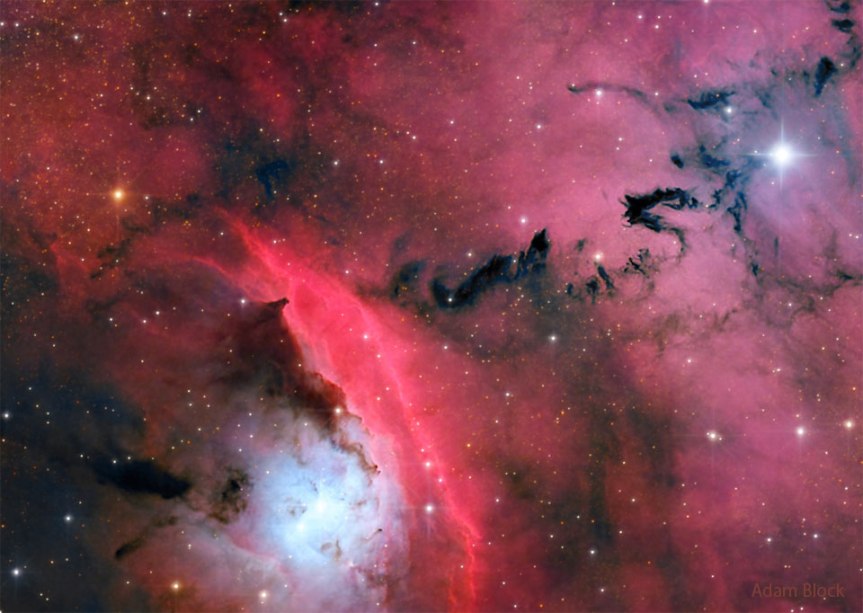
Stars, Dust and Nebula in NGC 6559
Image Credit & Copyright: Adam Block, Telescope Live
Explanation: When stars form, pandemonium reigns. A textbook case is the star forming region NGC 6559. Visible in the featured image are red glowing emission nebulas of hydrogen, blue reflection nebulas of dust, dark absorption nebulas of dust, and the stars that formed from them. The first massive stars formed from the dense gas will emit energetic light and winds that erode, fragment, and sculpt their birthplace. And then they explode. The resulting morass can be as beautiful as it is complex. After tens of millions of years, the dust boils away, the gas gets swept away, and all that is left is a bare open cluster of stars.
Witchcraft – The Dawn of Witchcraft c. 2014
Witchcraft
The Dawn of Witchcraft
by Ilil Arbel, Ph.D.
Good hunting and fishing determined the survival of the Stone Age tribe. A little later, the number of domestic animals and the success of crops meant life or death. The tribe also needed many children. They had to replace those who died in infancy and early childhood, and few people lived beyond their thirties.
A division of labor existed from the earliest societies. Men hunted and fished. Women gathered food and cared for the children. Men had a male god, who controlled the hunt. The god wore horns or antlers, representing his power over the prey. Women worshiped a great mother goddess. She insured fertility and controlled the magical and medicinal powers of plants. Later, when agriculture was developed, both god and goddess protected the domestic animals and the crops. A priestess and a priest worked together as the representatives of the gods. They had ceremonies to influence the gods to help the people.
Slowly, the ideas of an afterlife and reincarnation began to emerge. The horned male god took on the additional feature of the god of death. The female goddess added the moon and its cycles to her domain. They were united in a sacred marriage, and shared fertility rites.
Their myth, still alive today, is simple. The goddess represents life. The god represents death. Life and death are a continuous cycle. The cycle contains three great truths – loving, dying, and reincarnating to live again. Magic controls all of them. To fulfil love, one must be born, unite with the loved one, die, and reincarnate. The cycle may repeat as many times as necessary.
During the Stone Age the people believed that reincarnation occurred in groups. You found yourself, life after life, with the same people. Witches no longer believe in group reincarnation, but it is easy to understand why the Stone Age people did. They lived in closely knit tribes and were afraid to be reincarnated among “strangers.” Reincarnation itself, however, is still an important part of the Old Religion.
All gods and demons emerge from humanity’s relationship with nature. To understand the minds of the prehistoric cave painters, one must look at isolated societies that still live in a similar way. Many anthropologists call these people “primitive.” This word gives the incorrect impression of inferiority. These people are not inferior in any meaningful way. They are just not living in our mechanized, Westernized society. Their way of life is just as complex and rich; their minds are just as alert as ours. Furthermore, they maintain a connection with nature that we have lost.
The Tasaday of Mindanao, Orochon of Siberia, Gilyaks of the Amur valley, and the Australian aborigines work in surprisingly similar ways. Their cultures present evidence about how the prehistoric mind worked.
The lives of these people are balanced with nature. The word is significant, because as you will see in an upcoming chapter, the balanced life is one of the principles of Witchcraft. Witches seek exactly what these people had maintained naturally for thousands of years – a balance that was lost with the development of civilization.
The prehistoric people saw themselves as part of their surrounding, neither more nor less important than the animals, the plants, the stones and the rivers. They believed that inanimate objects had lives of their own. Judging by the behavior of the isolated societies mentioned above, the Stone Age people often spoke with the fire, the stones, the water. If you ask the Orochon or Tasaday about it, they will tell you that the inanimate object understands and answers them.
The reasoning power of such people is different from ours. They see little difference between the real and the unreal. They will rarely ask why something happens. Things happen, and they will deal with the results. They use no written language and therefore have a powerful memory.
Interestingly, even today, a witch keeps as few written records as possible. She must burn all her papers when she realizes that she is near death, unless there is a very reliable witch who will inherit the notes and include them in her own work.
Researchers always assumed that this habit existed because of the danger during the Witch Trials. Every Medieval witch memorized as much as possible. When the inquisition marched into her home to look for evidence, it was best not to have the grimoires, as spell books are called, around the house. However, the truth about the memorizing habit may be deeper. Perhaps the witch is still following the prehistorical tradition of magic without written language.
We generally look for rational explanations for illnesses, sudden death, or accidents. The Stone Age people thought differently. Spirits and invisible forces filled their world. Magic caused distressing events. Someone conjured the malevolent spirits; perhaps the spirits themselves were angry and wanted revenge. If a wild beast or a force of nature caused death, then the supernatural force behind them actually made them do it. One had to appease or control the force. The shaman, priest, or witch could achieve that by establishing a relationship with the objects or the forces. In other words – he or she had to use magic.
The entire physical world was alive, swirling with energy waves, for the shaman and the witch. They established relationships with storms, water, and the seasons themselves. In a deep enough trance, they entered into a two-way conversation with the elements. They released their powerful souls from their bodies and let the souls kill the enemies or the beasts, heal the sick, or direct the animals toward the hunters.
The people were, above and beyond anything else, hunters and gatherers. They depended upon two factors. First, the availability of animals and plants; second, their ability to escape extremely dangerous predators. Fortunately, their witches knew herbal medicine and the setting of bones, and the hard life had some compensations. The tight communal life encouraged an incredible level of nonverbal communication. To us, they would seem telepathic, so well they understood each other without words. They were like flocks of birds or schools of fish that react to a situation as one large creature. In addition, they had supernatural endurance. This talent still exists in many isolated societies. For instance, look at the “runners” in Tibet. These are men who can run distances that are considered literally impossible by modern athletes. They do it in a trance, without much effort, and arrive in good shape. It’s all mind power.
The Stone Age magic-making was simple. They had dances that imitated the hunt and controlled the hunted animals. The dancers wore antlers or bird masks, whirled, chanted, and went into trances. These ceremonies, the beginning of Witchcraft, are painted over and over on cave walls.
The image of the horned god may have started during these dances. Imagine a dancer, wearing antlers to impersonate a reindeer or a stag. He is whirling in a trance, moving with the rhythm of the chant and drums in the warm cave. The fire behind him throws a strong shadow on the cave’s wall. The shadow is strange and threatening, and it attracts the attention of the tribe’s artist, always sensitive to new images. He picks a bit of charcoal from the fire, and quickly draws around the shadow. The drawing looks like a man/beast. As the months go by, the artist draws him again and again, developing a new image, adding the image into the magic.
It joined a wall already full of beautifully, accurately drawn pictures of animals and birds. The artists of the Stone Age were hunters who killed many animals. As they cut the animals for food, they learned much about anatomy. From necessity, they were also good observers of the animals during their daily lives. The art, however, was neither artistic expression nor a celebration of yesterday’s successful hunt. It was, just like the dance, an act of magic. By drawing an animal you controlled it. A picture of a successful hunt today would produce one tomorrow. A picture of an animal giving birth would insure fertility and good future hunts. Drawing dangerous animals falling into pits would make sure they would not kill you, but die themselves first. This was Witchcraft.
There were the dreams, too. To the Stone Age mind, dreams had a reality as definite as the waking world. The spirit, released from the body, walked the dream world; it spoke with other dreaming spirits or with the spirits of the dead. The dreams revealed the future, and were important to the well-being of the entire tribe. It is entirely possible that Out-of-Body-Experience (OBE) started like that. People who have experienced OBE claim a part of their consciousness, or their soul, leaves their body and explores the world on its own. Ancient cultures in all parts of the world described OBE. It is practiced today by people of various religions and nationalities. Parapsychologists argue whether OBE exists, or if it is a powerful dream form. Witches claim they just do it. At this stage of modern research, there is still no proof either way.
As the climate changed and lost some of its harshness, people began to live longer, create settlements, and develop agriculture. The witch’s importance did not diminish. The prosperity of crops and domestic animals, fertility of the land, and the continuous development of herbal medicine remained the witch’s domain.
Religion became more organized, but the job of the witches remained the same – influencing the supernatural powers. It didn’t matter if the people called them shamans, shape-changers, wizards, druids, priestesses or witches. It didn’t matter if they worked in the woods, the meadows, or at the altar of the simple, beautiful new temples. They helped humanity survive, worshiped the nature gods, served the earth.
And so it went on for generations. It continues today. The similarity between Witchcraft in the various ancient cultures is so strong, and the relationship to today’s Witchcraft is so amazing, there is no possible way to assume it happened by chance. Let’s look at a few cultures. They are not in any order – it’s more like a bit of time travel to places of interest.
In Denmark, archaeologists found the grave of a powerful Bronze Age witch. The grave contained obvious evidence of wealth – gold, jewelry, costly swords. It also had various items of Witchcraft, neatly arranged in a large bronze bowl. Identical Witchcraft ingredients are still used in folk medicine, and similar tools are used by today’s witch. Here is a list of the items.
Folk medicine:
- A lynx’s claw.
- A weasel’s bones.
- Snakes’ vertebrae.
- Iron pirate pieces. If struck over the body of a sick person, the striking of the pirate will clear both physical and mental diseases and the effect of the evil eye.
- Charcoal of an aspen tree. In today’s folk medicine, the charcoal is useful if the tree was hit by lightning. It is possible that the aspen in the grave was burned in the same way.
Magic items:
- Horses’ teeth.
- Twigs of a rowan tree.
- An iron knife.
- A sword.
The old Scandinavian Sagas describe activities of witches which are still part of today’s ceremonies. They also tell the usual stories – shape changing, riding on poles, or sending the soul out of the bodies.
Another interesting ancient connection exists in Mexico. A witch cult there was centered around a goddess, or a “Witch Queen.” She always carried or rode a broom. The broom, to the Mexicans, symbolized purity and cleanliness. This is particularly important because the Medieval European witch considered cleanliness and order essential. Her contemporaries rarely bathed, and kept food debris on their straw-covered floors for weeks. The witches in Mexico, just like the European ones, always wore big necklaces. Men wore the same kind of leather apron as the Irish male witches.They worked in small rooms to confine the power – much like the circles of power of the European witches.
There is no explanation to the similarity. Some historical researchers believe that perhaps people traveled across the Atlantic before Columbus, and introduced the Old Religion to Mexico. Or perhaps the needs of Witchcraft created similar evolution wherever and whenever it was practiced.
Ancient Egypt, Greece and Rome treated magic as if it was science. Not that they were particularly concerned with pure science; they were more interested in practical results. However, they had to know the medicinal and poisonous properties of hundreds of plants; they knew how to use hypnosis; they understood human consciousness. The magicians combined their practice with incantations and prayers, which is why today’s scientists do not take them seriously. But they were not much different. When achieving an identical result, today’s scientist credits it to reasoning or experimentation. The sorcerer assumed they were given by a supernatural power.
Some great scholars in Greece worked as sorcerers. Pythagoras, the mathematician, openly practiced philosophy, science and magic. He had a strong influence on Plato, not himself a sorcerer, but clearly a believer. One can see that in his Dialogues Aristotle suggested the influence of the magical theory in his History of Animals. Neither he nor Plato feared the magicians, though many other people did. Obviously, they understood, with their better education and sharp minds, what the sorcerers were doing.
Finding the roots of Ancient Greek Witchcraft and Hellenistic Witchcraft is easy. One has simply to look at their great holidays. Take, for example, the Eleuisian holiday which attracted thousands of people. Much like the May holiday participants in the British Isles, the Greeks had games, theater, wine, food, dancing and music. Everyone was at least half drunk and ready for religious ecstasy. Mystical rites included the purging of the fear of death, the procession in honor of the dead, and the wild, whirling dancing. People fell into trance-like states, many acting as if they were in direct communication with the gods. It was similar to Voodoo possession – or to the ancient shaman/witch union with the unseen forces. Naturally, some people were better at it than others, and some became priests and priestesses.
The best known priestesses were those who worked at the Oracle of Delphi. They dedicated their lives to the gods and practiced prophecy and divination. The priestess sat over a cleft in the rocks, from which fumes of various drugs rose to envelop her body. The drugs brought on a trance state, and under it she told the future. Another priestess or priest had to explain the messages, because often they were hard to understand. Many of the prophecies came true, and the practice lasted thousands of years. It is silly to dismiss the whole thing as a lie, as the Catholic church later tried. Ancient Greece was a culture of sophistication, intellect and learning. Could a handful of priests really trick these people for so long?
The god Pan is another connection with witchcraft. In the Dianic tradition of Witchcraft, one of the schools still active today, the horned god is still named Pan. Is it the same deity? There are some differences. But this happens to every ancient religion. Take the Judeo-Christian tradition. The current merciful God is very different from the angry desert deity that took the Israelites out of Egypt and into Canaan, destroying entire nations in His path. And yet any Priest, Minister or Rabbi would be horrified if you dared suggest that it was another God – Jehovah is Jehovah! Well, Pan is Pan. Then and now, he is a nature god, a part of every living animal and plant. And he is still with his goddess and with those who call themselves the Guardians of the Earth.
Shape changing was common in Greece, too, as seen by both mythology and literature. Zeus’ love affairs are famous for it. He changed into a swan, a bull, or even a shower of golden rain, as the occasion demanded. Also, the famous book The Golden Ass, by Apuleius of Madaura tells of such a change. It is a story of Greek man who, with the help of an untrained witch’s apprentice, turns himself accidentally into a donkey. After many misadventures, the goddess Isis restores him from the animal shape and he becomes her priest.
There are several great Greek witches. Medea is probably the most famous witch of antiquity. She is strong, possibly insane, and murderous. Hecate is first a moon goddess, then a witch goddess who rules the nights and all its frightening creatures. Circe is a sorceress who turns her lovers into swine when she tires of them. All the Greek stories of the great, power wielding, magnificent witches view them as evil. This is because they were, originally, priestesses of the Old Religion, worshipers of the mother goddess. The “new” Greek religion saw them as competition and turned them into evil hags, as most cultures do. For further proof, the texts often stress the witches’ knowledge of herbal medicine and magic – the obvious traits of the followers of Wicca, then as now.
The Romans used much magic in their daily lives. They employed magical astrology, and used amulets, incantations, healing and cursing formulas.
The Romans had an interesting device, very similar to today’s Ouija board. It was a metal disk, supported by a wooden tripod. On its rim, the letters of the alphabet were inscribed. The person performing the ritual suspended a ring on a thread, right above the disk. Some incantation was said, and the ring began to swing like a pendulum, forming words and answering questions.
The Aeneid describes magic extensively. Dido, the tragic heroin, is a powerful sorceress whose magic eventually turns against herself, much like Medea’s in Greece. Horace’s plays describe evil Witchcraft, including some horrifying ritual murder of children. Other Roman poets describe necromancy and divination. Obviously, witches in Rome had a bad reputation.
Romans, as a nation, enjoyed cruelty. One has only to look at their arena games and war atrocities to see that. The stories about the witches reflect that taste. Unquestionably, some Roman witches turned to the dark side. The records show that their help was often used for poisoning, necromancy, and even attempts at raising of the dead and the creation of zombies. It was a sad period for true followers of the Old Religion.
In Egypt, magic was entirely scientific. It was mixed with religion, but nevertheless practiced as a precise and organized activity. From the mythologies and magic books it is clear that they had a system of the Occult based on subjects. There are separate texts on astrology, alchemy, formulas for magic in daily use, etc. The practitioners were specialists. The ordinary people, in addition to consulting the experts, could also purchase amulets and herbs for self protection and do-it-yourself magic.
Repeating the magic formula in exactly the same way, even down to the tone of voice, was called “right speaking.” The Book of the Dead stated that the gates to the other world would not open to a person who did not know his secret name or who uttered it incorrectly. The name of each gate in the other world also required correct reading and pronunciation.
The Egyptians had many books containing formulas and incantations, spells and charms for daily use. Amulets were important. They were worn by the living and put on the dead. Amulets could be made of any material and sometimes carved with magic formulas. Some shapes were particularly popular, such as the scarab and the heart. The Egyptians even had amulets to protect each part of the body. The books often mention dreams and shape changing. For example, there are spells in the Book of the Dead teaching the newly deceased how to change into birds, crocodiles, or serpents.
The positive image of the witch lasted for generations. Eventually, however, patriarchal monotheism took over in the West, first by Judaism and later by Christianity. With it, the position of the witch deteriorated. The Bible often refers to witches in a negative manner. They are always fiercely persecuted by the priests of Jehovah. Most notable is the Witch of Endor, who is consulted secretly by King Saul. The story is interesting because Saul killed many witches on the demand of the Prophet Samuel. She is one of the few survivors.
Earlier, Moses and Aaron practiced Egyptian magic, described in detail in Exodus. They turned a stick into a snake, for instance, during a competition with the Egyptian magicians. The plagues visited on the Egyptians, including such things as pestilence and darkness in the middle of the day, sound like malevolent Witchcraft. Naturally, the Bible describes the plagues as punishment by God.
King Solomon, David’s son, was supposed to be the wisest man of his generation, perhaps the wisest ever to live on Earth. He was a magician as well. The book The Wisdom of Solomon was written many years after his death, but much of it is probably based on his words. In it he said that God gave him power and knowledge, and that his studies included not only science but the Occult. In the original text, this included power over demons. The sentence was mistakenly translated as power over the winds, because the two words are similar in the original Hebrew. He also claimed knowledge of exorcism.
Nevertheless, the Bible is determined that no witch should be permitted to live. The reason is simple. A witch is not only a worshiper of a competing religion, but a symbol of a matriarchal society. A society ruled by women is offensive to the male-dominated Jews and Christians. So the settlement of the Israelites in Canaan is the point in time in which the power of the Old Religion began its slow decline. It has taken many centuries and a fierce struggle, but a gentle nature religion is no match to the powerful, military, new religion. Starting from Mount Sinai, a fiery volcano in the desert, the Judeo-Christian creed swept everything in its violent path and conquered the Western world.
Source:
Witchcraft – The Trials c. 2014
Witchcraft
The Trials
by Ilil Arbel, Ph.D.
To understand the connection between Christianity and the Old Religion, one must make the acquaintance of the Devil. Satan is an ambivalent fellow, and trying to figure out his character, origin, and relationship to God is difficult.
Here is a sentence from Isaiah, stating with authority that God created evil. “I form the light, and create darkness; I make peace, and create evil; I the Lord do all these things.” Clear enough. But if he was created by God, who is always good, how can the Devil be bad?
Again, God wants to be killed in the person of Christ. It is his design, and it is meant for the benefit of mankind. If so, why are those who execute Christ considered “Devilish” for so long? They were doing God’s will!
God is all powerful and all good. However, if God wanted to create a world which was all good, and couldn’t do it, than he is not all powerful. If he didn’t want to make a world which was all good, than He is not all good.
How do you get out of that? You create an Adversary, who is equal to God in power, and is in a constant struggle with Him. But that doesn’t work either. The notion is taken from Persian Dualism, and to true Christians, this is heresy. The solution? God permits the Devil to operate and make man into a sinner. In other words, an evil principle is needed to test men’s faith. This solution works until you ask the next question. Why is the sinner punished for what is permitted by God?
This would lead nowhere. If you continue with the questioning, eventually you will hit the wall — it is so because the Church says that it is so. Well, heresy or not, the Adversary, permitted or otherwise, remained. He had to. He was badly needed.
The Devil has many forms. He has superhuman intelligence and cunning, though sometimes he can be tricked. He is a handsome fellow, unless he transforms himself into an animal or a monster. He can perform miracles. He has tremendous legal expertise. He has scientific knowledge and understands the nature of the universe — and the psychology of men and women. He can be, and often is, quite charming.
During those times, if you were a good Christian, you believed in him. For without sin there is no overcoming temptation, no salvation, no need of a Church. Without Satan, there is no Christianity.
On the other hand, Satan could not have existed without the Church. Pagans had no fear of magic in itself. They were aware of magic used for good or for bad purposes, but the power itself they considered neutral. Most importantly, it came from men and women, natural to humanity itself. So the gods, demigods, spirits, etc., could never have given birth to the powerful entity of Satan.
To Christians, supernatural powers should come only from God, as miracles. If the saints did not perform them, then a demon did. Shows of second sight, moving of objects without physical action, transportation by levitation and so on frightened them.
As the smaller spirits and demigods were changed into demons, only one entity was strong enough to assume the role of the Adversary. The Devil took the shape of the familiar horned god. Pan loved nature; he was one with the earth; he even looked right with his horns and hooves. He was perfect for the job, and he got it. The new “evil entity” and his hordes of demons were now ready to tempt and mislead mankind.
In 380, Emperor Theodosius declared that all his subjects had to become Christians. Anyone following a different religion was a heretic. The heretics were to expect penalties by an authority guided by divine wisdom. The Church didn’t only kill the heretic – his or her family and friends were also seized. Their property was confiscated. Anyone who opposed them was declared a disciple of the Devil.
Christians now felt free to desecrate any temple – a good excuse to loot. In the process, they destroyed an enormous amount of Pagan literature. This literature was irreplaceable, and its destruction left us with huge holes in our understanding of the period. The Church destroyed the theater and any nonreligious music; limited art to religious subjects; declared that science was the Devil’s tool. It ignored the natural world with all its wonders, and feared it as temptation for sin. Life was just a preliminary to the glory of the afterlife in Heaven.
In a world that closed upon itself and denied nature, the Witches were at a disadvantage even before the great trials. They were part of a different, threatening way of life. The Church declared a war on Paganism. In the name of saving people’s souls it prepared to kill any number of bodies.
For the body didn’t matter at all. Pain and suffering were good if they happened in the name of Christ. The salvation of one’s soul depended on purity, celibacy, and iron obedience. So what if the body of the sinner was tortured, or even killed? Only the soul mattered. In one document, a priest declared that if an innocent person was executed, it didn’t really matter. God will recognize his own and the person will go directly to paradise. The brief, sad life on this dreary, sinful world did not count. From the 11th century on, the Catholic Church had many rival religions. They included Manicheans, Catharists, Waldenses and Albagenses. All were Christian, but the Church declared they were heretics. For various reasons, they also included Witchcraft, so to be a witch meant to be automatically a heretic.
Part of the crusade against witches was the spreading of wild rumors about their immoral and unnatural activities. The Church accused them of flying on broomsticks, having demon lovers, and murdering Christian children. It was quite a successful campaign, and brought a large number of women, some of them teen age girls or even children, to the stake.
The professional witch hunter made a very good living. There is a story about Matthew Hopkins, a professional witch hunter during the time of Puritans. The man developed a practical and quick system of destroying his victims. He would go into a village, find out who was unpopular with the Puritan regime, and report them. They would be tortured for a confession, and Hopkins would be paid per head for each conviction. The victims almost always confessed, since death was preferable to weeks of continuous torture.
Most of the victims, of course, had nothing to do with the Old Religion. They never saw a coven or an initiation ceremony. They may have known a little herbal medicine and possibly talked to their cats – strong evidence in those days. Enough to put them on the rack or burn them at the stake.
In 1318 and again in 1320, the Pope brought Witchcraft under the jurisdiction of the Inquisition. The inquisition, as usual, was ready to eradicate any heretic, so the witch trials expanded. Women were made to confess to crimes that were everything the Old Religion abhorred. People would say anything under torture, and the torture was too horrible to describe in a book such as this. The women confessed, under this horror, the orgy-like nature of the Sabbats. They admitted to submitting themselves to intercourse with the Devil – often described as taking the shape of a male goat! They admitted to casting spells that harmed their neighbors’ health, domestic animals, or crops; of using human body parts, even children’s, in their magical brews; of cannibalism, particularly involving newborn babies; of giving birth to the children of demons. All that and more – from people who worshiped Nature, who were the guardians of the sacred earth.
As the hysteria continued, the Pope sent two Dominican inquisitors, Kramer and Sprenger, to Germany. The two men wrote a book together, considered at the time the best textbook on Witchcraft. The name of this book was, in Latin, Malleus Maleficarum, which means The Witch’s Hammer. It is still available today, in the translation of Montague Summers. Summers was one of the few twentieth-century men to believe that the witches got what they deserved. He later wrote a book of his own, The History of Witchcraft, explaining the wickedness of Witchcraft. His book is a mind-boggling piece of superstition, ignorance and hate. As Summers was an educated man, a respected man of the Church, the book throws light on the obvious question: “How could they? How could men of God torture and kill in the name of such nonsense?” Read The History of Witchcraft. It’s worth it. You’ll understand what a Grand Inquisitor was really like.
The Malleus Maleficarun is horrifying. It explains the depraved nature of the Witch. It permits, even encourages torture, as means of extracting confession. It approves of life imprisonment for the repenting witch, and death to the unrepenting. It explains a sudden insanity as demonic possession – thus allowing the torture of the insane, a practice that lasted for centuries. The worst of it is that it is calmly arranged as a logical, clear, methodical, legal text.
This monstrous book extended its influence until the middle of the 18th century. Even Martin Luther was interested in it. Despite his objection to much within the Catholic Church, he believed in the Devil, and had, apparently, a confrontation with him. There is a story, substantiated by an ink stain in the castle of Wartburg, that the Devil tried to harass Luther. Luther threw his ink bottle at him. One wonders about his state of mind and his hallucinations.
Interestingly, Luther thought that witches rarely attended any Sabbats. According to Montague Summers, he held that witches generally hallucinated it under drugs or in a trance, but not always. On rare occasions, he thought, the Sabbats actually took place. Obviously, Luther couldn’t make up his mind. At any rate, he did not object to the witch hunts or the executions. Perhaps he didn’t care much.
There are always those who try to stop the madness of mobs. They are the enlightened, the brave, the true heroes of their time. The philosopher Giordano Bruno, for instance, burned at the stake for saying what St. Augustine said before — that witches were just sadly deluded women. Great doctors like Paracelus, Johan Wier and Thomas Syderham risked their lives to fight it.
To end the madness, it took an inquisitor who could no longer tolerate it. Alonso Salaza y Frias, after a mass execution in Navarre, decided to do an investigation of his own. When it was finished, he openly declared that all the victims of this particular execution were innocent. He then refused, officially, to accept any further accusation without tangible proof. During trials, he would allow no torture. The property of the accused witch would no longer be confiscated.
The public lost interest. Without the pleasure of seeing a woman humiliated and tortured to death, and without the hope of material gains, what was the point of accusing anyone? And you had to supply proof! What an innovation! No doubt, some bemoaned the good old days, when all you had to do was point at someone you didn’t like and wail: “witch!”
In England, they pretended they did not use torture, but some of their methods were so near it that the distinction is not clear. They were actively hunting witches for centuries, but eventually, in 1712, one witch was convicted but not executed. The British, like the Spanish, began to lose interest in the spectacle of horror. In Scotland the last burning was in 1727. In Germany, the last execution was in 1628. In France, it was stopped by a law passed in 1682. Europe began to emerge from the darkness.
The horror story is not yet over, though. Witchcraft in early America will be dealt with in the next chapter. While fewer people were executed in this country, it is probably the worst example, since the immigrants came here to escape oppression.
Folk medicine:
- A lynx’s claw.
- A weasel’s bones.
- Snakes’ vertebrae.
- Iron pirate pieces. If struck over the body of a sick person, the striking of the pirate will clear both physical and mental diseases and the effect of the evil eye.
- Charcoal of an aspen tree. In today’s folk medicine, the charcoal is useful if the tree was hit by lightning. It is possible that the aspen in the grave was burned in the same way.
Magic items:
- Horses’ teeth.
- Twigs of a rowan tree.
- An iron knife.
- A sword.
The old Scandinavian Sagas describe activities of witches which are still part of today’s ceremonies. They also tell the usual stories – shape changing, riding on poles, or sending the soul out of the bodies.
Another interesting ancient connection exists in Mexico. A witch cult there was centered around a goddess, or a “Witch Queen.” She always carried or rode a broom. The broom, to the Mexicans, symbolized purity and cleanliness. This is particularly important because the Medieval European witch considered cleanliness and order essential. Her contemporaries rarely bathed, and kept food debris on their straw-covered floors for weeks. The witches in Mexico, just like the European ones, always wore big necklaces. Men wore the same kind of leather apron as the Irish male witches.They worked in small rooms to confine the power – much like the circles of power of the European witches.
There is no explanation to the similarity. Some historical researchers believe that perhaps people traveled across the Atlantic before Columbus, and introduced the Old Religion to Mexico. Or perhaps the needs of Witchcraft created similar evolution wherever and whenever it was practiced.
Ancient Egypt, Greece and Rome treated magic as if it was science. Not that they were particularly concerned with pure science; they were more interested in practical results. However, they had to know the medicinal and poisonous properties of hundreds of plants; they knew how to use hypnosis; they understood human consciousness. The magicians combined their practice with incantations and prayers, which is why today’s scientists do not take them seriously. But they were not much different. When achieving an identical result, today’s scientist credits it to reasoning or experimentation. The sorcerer assumed they were given by a supernatural power.
Some great scholars in Greece worked as sorcerers. Pythagoras, the mathematician, openly practiced philosophy, science and magic. He had a strong influence on Plato, not himself a sorcerer, but clearly a believer. One can see that in his Dialogues Aristotle suggested the influence of the magical theory in his History of Animals. Neither he nor Plato feared the magicians, though many other people did. Obviously, they understood, with their better education and sharp minds, what the sorcerers were doing.
Finding the roots of Ancient Greek Witchcraft and Hellenistic Witchcraft is easy. One has simply to look at their great holidays. Take, for example, the Eleuisian holiday which attracted thousands of people. Much like the May holiday participants in the British Isles, the Greeks had games, theater, wine, food, dancing and music. Everyone was at least half drunk and ready for religious ecstasy. Mystical rites included the purging of the fear of death, the procession in honor of the dead, and the wild, whirling dancing. People fell into trance-like states, many acting as if they were in direct communication with the gods. It was similar to Voodoo possession – or to the ancient shaman/witch union with the unseen forces. Naturally, some people were better at it than others, and some became priests and priestesses.
The best known priestesses were those who worked at the Oracle of Delphi. They dedicated their lives to the gods and practiced prophecy and divination. The priestess sat over a cleft in the rocks, from which fumes of various drugs rose to envelop her body. The drugs brought on a trance state, and under it she told the future. Another priestess or priest had to explain the messages, because often they were hard to understand. Many of the prophecies came true, and the practice lasted thousands of years. It is silly to dismiss the whole thing as a lie, as the Catholic church later tried. Ancient Greece was a culture of sophistication, intellect and learning. Could a handful of priests really trick these people for so long?
The god Pan is another connection with witchcraft. In the Dianic tradition of Witchcraft, one of the schools still active today, the horned god is still named Pan. Is it the same deity? There are some differences. But this happens to every ancient religion. Take the Judeo-Christian tradition. The current merciful God is very different from the angry desert deity that took the Israelites out of Egypt and into Canaan, destroying entire nations in His path. And yet any Priest, Minister or Rabbi would be horrified if you dared suggest that it was another God – Jehovah is Jehovah! Well, Pan is Pan. Then and now, he is a nature god, a part of every living animal and plant. And he is still with his goddess and with those who call themselves the Guardians of the Earth.
Shape changing was common in Greece, too, as seen by both mythology and literature. Zeus’ love affairs are famous for it. He changed into a swan, a bull, or even a shower of golden rain, as the occasion demanded. Also, the famous book The Golden Ass, by Apuleius of Madaura tells of such a change. It is a story of Greek man who, with the help of an untrained witch’s apprentice, turns himself accidentally into a donkey. After many misadventures, the goddess Isis restores him from the animal shape and he becomes her priest.
There are several great Greek witches. Medea is probably the most famous witch of antiquity. She is strong, possibly insane, and murderous. Hecate is first a moon goddess, then a witch goddess who rules the nights and all its frightening creatures. Circe is a sorceress who turns her lovers into swine when she tires of them. All the Greek stories of the great, power wielding, magnificent witches view them as evil. This is because they were, originally, priestesses of the Old Religion, worshipers of the mother goddess. The “new” Greek religion saw them as competition and turned them into evil hags, as most cultures do. For further proof, the texts often stress the witches’ knowledge of herbal medicine and magic – the obvious traits of the followers of Wicca, then as now.
The Romans used much magic in their daily lives. They employed magical astrology, and used amulets, incantations, healing and cursing formulas.
The Romans had an interesting device, very similar to today’s Ouija board. It was a metal disk, supported by a wooden tripod. On its rim, the letters of the alphabet were inscribed. The person performing the ritual suspended a ring on a thread, right above the disk. Some incantation was said, and the ring began to swing like a pendulum, forming words and answering questions.
The Aeneid describes magic extensively. Dido, the tragic heroin, is a powerful sorceress whose magic eventually turns against herself, much like Medea’s in Greece. Horace’s plays describe evil Witchcraft, including some horrifying ritual murder of children. Other Roman poets describe necromancy and divination. Obviously, witches in Rome had a bad reputation.
Romans, as a nation, enjoyed cruelty. One has only to look at their arena games and war atrocities to see that. The stories about the witches reflect that taste. Unquestionably, some Roman witches turned to the dark side. The records show that their help was often used for poisoning, necromancy, and even attempts at raising of the dead and the creation of zombies. It was a sad period for true followers of the Old Religion.
In Egypt, magic was entirely scientific. It was mixed with religion, but nevertheless practiced as a precise and organized activity. From the mythologies and magic books it is clear that they had a system of the Occult based on subjects. There are separate texts on astrology, alchemy, formulas for magic in daily use, etc. The practitioners were specialists. The ordinary people, in addition to consulting the experts, could also purchase amulets and herbs for self protection and do-it-yourself magic.
Repeating the magic formula in exactly the same way, even down to the tone of voice, was called “right speaking.” The Book of the Dead stated that the gates to the other world would not open to a person who did not know his secret name or who uttered it incorrectly. The name of each gate in the other world also required correct reading and pronunciation.
The Egyptians had many books containing formulas and incantations, spells and charms for daily use. Amulets were important. They were worn by the living and put on the dead. Amulets could be made of any material and sometimes carved with magic formulas. Some shapes were particularly popular, such as the scarab and the heart. The Egyptians even had amulets to protect each part of the body. The books often mention dreams and shape changing. For example, there are spells in the Book of the Dead teaching the newly deceased how to change into birds, crocodiles, or serpents.
The positive image of the witch lasted for generations. Eventually, however, patriarchal monotheism took over in the West, first by Judaism and later by Christianity. With it, the position of the witch deteriorated. The Bible often refers to witches in a negative manner. They are always fiercely persecuted by the priests of Jehovah. Most notable is the Witch of Endor, who is consulted secretly by King Saul. The story is interesting because Saul killed many witches on the demand of the Prophet Samuel. She is one of the few survivors.
Earlier, Moses and Aaron practiced Egyptian magic, described in detail in Exodus. They turned a stick into a snake, for instance, during a competition with the Egyptian magicians. The plagues visited on the Egyptians, including such things as pestilence and darkness in the middle of the day, sound like malevolent Witchcraft. Naturally, the Bible describes the plagues as punishment by God.
King Solomon, David’s son, was supposed to be the wisest man of his generation, perhaps the wisest ever to live on Earth. He was a magician as well. The book The Wisdom of Solomon was written many years after his death, but much of it is probably based on his words. In it he said that God gave him power and knowledge, and that his studies included not only science but the Occult. In the original text, this included power over demons. The sentence was mistakenly translated as power over the winds, because the two words are similar in the original Hebrew. He also claimed knowledge of exorcism.
Nevertheless, the Bible is determined that no witch should be permitted to live. The reason is simple. A witch is not only a worshiper of a competing religion, but a symbol of a matriarchal society. A society ruled by women is offensive to the male-dominated Jews and Christians. So the settlement of the Israelites in Canaan is the point in time in which the power of the Old Religion began its slow decline. It has taken many centuries and a fierce struggle, but a gentle nature religion is no match to the powerful, military, new religion. Starting from Mount Sinai, a fiery volcano in the desert, the Judeo-Christian creed swept everything in its violent path and conquered the Western world.
Source:
Gods – Egyptian Anubis God Of Death

Egyptian God Anubis – God Of Death
Anubis Facts
Anubis was the god of the dead and the underworld until the Middle Kingdom, when this role was taken over by Osiris.
He is one of the oldest gods, references in text go back as far as the Old Kingdom.
Anubis is the inventor and god of embalming and mummification.
He guided the death through the underworld (called Duat).
Anubis was the Guardian of the Scales, used to weigh the hearts of dead souls.
His high level of anatomical knowledge due to embalming made him the patron of anesthesiology.
A crouching statue of Anubis took a central place in Tutankhamun’s tomb.
Priests who performed the embalming of dead corpses wore a jackal mask.
Greek mythology blends Hermes with Anubis to result in the god Hermanubis.
Anubis is known as the god of death and is the oldest and most popular of ancient Egyptian deities. The ancient Egyptians revered Anubis highly because they believed he had tremendous power over both their physical and spiritual selves when they died.
References to Anubis are found in texts dating back to the Old Kingdom. His fame lasted until the Middle Kingdom, when his role as God of death was taken over by Osiris and Anubis became Osiris’ assistant.
Ancient Egyptians strongly believed in the afterlife, which was an essential aspect of their culture and religion. They considered death a transition to another realm rather than an end.
His Roles included all the following:
- God of Mummification
- Protector of tombs and cemeteries
- Guide of souls in the afterlife
- Ruler of the underworld
- Gardian of the Scales of Justice
Anubis The Jackal God
Anubis was either seen as a man with a jackal head or completely in the form of a jackal.
In ancient Egypt, scavengers like jackals ruled the cemeteries. They dug up the freshly buried and tore at their flesh and ate it. Historians believe that this is what prompted the ancients to portray the god of the afterlife as a jackal, to fight fire with fire. New genetic research indicates that the ancient Egyptian jackal is not a jackal at all, but an ancient wolf.
Anubis’ skin is often depicted as black, while jackals are typically brown. The reason is that the color black is a symbol of death, but also a symbol of the Nile’s fertile and black soil.
The Main Role of Anubis
Absolute ruler of the underworld
In very ancient history Anubis was known to be the absolute ruler of the underworld (called Duat). Later theories indicate that this role was taken over by Osiris. Anubis was responsible for overseeing the realm of the dead and ensuring the souls of the deceased were guided safely to their final resting place. As the ruler of the underworld, Anubis was also tasked with maintaining order, protecting the dead from malevolent forces, and ensuring the proper balance between the worlds of the living and the dead.
The Guardian of the Scales:
One of his many roles surrounding the dead included the Guardian of Scales where he dictated the fate of souls. As depicted in the Book of the Dead, Anubis weighs the decedent’s heart against the weight of a feather. The feather represents “Ma’at” or truth. If the scale of justice tipped toward the heart, the dead person would be consumed by Ammit, a female demon the ancient Egyptian people dubbed “devourer of the dead.” If the scale of justice tipped toward the feather, Anubis would lead the decedent to Osiris so he could ascend to a worthy existence in heaven.
The God of embalming and mummification:
Anubis held the important role of overseeing the embalming and mummification of the dead. It was essential to the ancient Egyptian belief in the afterlife. Mummification was intended to preserve the body, allowing the soul, or “ka”, to recognize and reunite with it in the afterlife. Anubis was believed to oversee and guide the embalmers during the mummification process. Anubis’ role as the god of mummification solidified his importance in the spiritual journey of the deceased.
Several rituals were performed to honor Anubis during the mummification process. One such ritual was the “Opening of the Mouth” ceremony, which involved a priest wearing an Anubis mask and touching the mouth of the mummy or statue with special tools. This ritual was believed to restore the deceased’s ability to speak, breathe, eat, and drink in the afterlife. Offerings of food, drink, and other necessities were presented to Anubis, seeking his favor and protection throughout the mummification process and the journey to the afterlife.
The daughter of Anubis (Kebechet), is frequently seen as his assistant in the mummification process of the dead. Ancient Egyptians believed that Anubis sniffed the bodies of the dead, so they preserved them with sweet smelling herbs and plants.
Protector of Tombs:
As the Egyptian god responsible for protecting the dead, many prayers to Anubis were carved into their tombs and offerings were made to him to ensure the safety of the deceased’s remains. Anubis his role as protector of the deathextended to both the physical protection of the tombs from grave robbers and the spirutual protection of the death from malovent forces Anubis held this role until Osiris gained popularity and took it over.
Scepter and ankh
In ancient Egyptian art, Anubis is often depicted holding specific items that symbolize his roles and responsibilities. The most common objects held by Anubis are the “was” scepter and the “ankh.”
The “was” scepter (𓏭) is a long staff with a forked base and a stylized animal head at the top, typically that of a canine. This powerful symbol represents dominion, power, and authority, signifying Anubis’ status as a guardian and protector of the dead. However, the “was” scepter is not exclusive to Anubis, as it can also be seen in the hands of other Egyptian gods and pharaohs.
The “ankh” (☥) is a well-known ancient Egyptian symbol that resembles a cross with a loop at the top. It represents the concept of eternal life and is often called the “key of life” or the “key of the Nile.” When Anubis holds the ankh, it symbolizes his role in guiding the souls of the deceased to eternal life in the afterlife.
Anubis and Osiris
The mythology of the story varies, but according to legend:
- Osiris’ brother (Seth), killed Osiris by luring him into a fancy coffin, sealing it shut, and pushing it into the Nile.
- Osiris’ wife and sister (Isis), retrieved Osiris’ body on the Phoenician coastline, but an angry Seth chopped up Osiris’ body and scattered it throughout Egypt.
- Anubis, Isis and Nephthys, set about to find the pieces and were successful (except for Osiris’ phallus).
- Another Egyptian God called Thoth, helped restore the body and Anubis wrapped Osiris in linen, the action of which bestowed on him the title, “He Who is in the Place of Embalming”.
Anubis’ role shifted from being the primary god of the dead to a subordinate position to Osiris. Anubis became the god of mummification and guardian of the tombs, while Osiris assumed the role of the ruler of the underworld and judge of the dead.
Despite the shift in their roles, Anubis and Osiris maintained a cooperative and complementary relationship in the afterlif.
Anubis Family
Parents
Several versions exist of how Anubis came into being:
- Son of Nephthys and Osiris: the most popular version is that Anubis is the son of Nephthys and Osiris. As the Goddess of Darkness, Nephthys would naturally be mother to a god who oversaw the embalming process and also guided souls into the afterlife.
- Son of Nephthys and Seth: it is also speculated that Seth is Anubis’ father. In this version, it is believed that Nephthys disguised herself as Osiris’ beautiful sister, Isis, to beget a half brother for Horus. As Seth is the God of darkness, storms and destruction, it is easy to see how Anubis could be his son.
- Son of Nephtys and Ra: in early mythology texts, Ra (the sun God), was depicted as being Anubis’ father, while his mother was speculated as being either Hesat the cow goddess, Bastet the cat-headed warfare goddess, or Nephthys.
-
Wife
Anubis’ wife name is Anput (or Input), a lesser-known goddess in the Egyptian pantheon. Like her husband, she is associated with the afterlife, mummification, and the protection of the dead. Anput is usually depicted as a woman with a jackal or a jackal-headed human, similar to Anubis’ form. Her iconography is less prevalent in ancient Egyptian art and monuments than Anubis, but she is occasionally mentioned in texts and depicted in various artifacts.
-
Daughter
Anubis and Anput are believed to have a daughter, Kebechet (or Qebehsenuef), who is also associated with the afterlife. Kebechet is typically represented as a snake or a snake-headed woman and is considered the goddess of purification, providing refreshing, purifying waters to the souls of the deceased during their journey to the afterlife. Her role complements that of her parents, further emphasizing the interconnectedness of the ancient Egyptian gods and their various functions in guiding and protecting the dead.
- Anubis’ family relationships reflect the interconnected nature of ancient Egyptian gods, with each member playing a complementary role in the realm of the afterlife. As a family, Anubis, Anput, and Kebechet work together to guide, protect, and purify the deceased, ensuring their safe passage to the afterlife and ultimate reunification with their eternal body.
A Shrine for Anubis
Anubis was worshiped all over Egypt, and his cult center was in Cynopolis, located in the 17th nome (province) of Upper Egypt. Translated, Cynopolis is Greek for “city of the dog,” which fits well because of the close relation between jackals and dogs, and the fact that some scholars believe Anubis was indeed an ancient wolf.
A shrine for Anubis was discovered in King Tut’s tomb in 1922. Made of wood, plaster, lacquer and gold leaf, the statue depicts Anubis in animal form in a recumbent position exactly how he is in his hieroglyph. As the sledge it rested on would indicate, the shrine was probably used in the funeral procession of the great Pharaoh, and was oriented to the west to help guide the Pharaoh into the afterlife (which the ancient Egyptians believed was in the direction of the setting sun).
Anubis in Art
Aside from the Anubis statue discovered in King Tut’s tomb, his representation can be found frequently in ancient Egyptian art. In the Valley of the Kings, an image of Anubis in his role as “Jackal Ruler of the Bows” was often used to seal tombs. The nine bows represented all the enemies of Egypt, and it was believed that Anubis had defeated every one of them. Anubis masks and statuettes dating back to early to late Ptolemaic period (332-30 BC) exist in museums today.
In tomb paintings and murals, Anubis is often shown accompanying the deceased or presiding over the “Weighing of the Heart” ceremony, showcasing his importance in the soul’s journey through the underworld. Additionally, funerary texts and inscriptions frequently invoke Anubis’ name for protection and guidance, further highlighting his significance in ancient Egyptian religious beliefs and practices.
Statues of Anubis, often in the form of a jackal or a jackal-headed human, were placed in and around tombs and mortuary temples to serve as guardians against potential physical and spiritual threats. The presence of Anubis was believed to deter grave robbers and protect the tomb from malevolent forces.
Anubis in Modern Culture
Anubis continues to hold a place in popular culture, with his image and mythology appearing in various forms of media, including literature, film, television, and video games. His jackal-headed form has become an iconic symbol of ancient Egyptian mythology, often featured in contemporary art and fashion. Anubis has also been a popular subject in fantasy and sci-fi genres, often portrayed as a powerful and mysterious deity with various supernatural abilities. Despite his ancient origins, Anubis’ image and symbolism continue to capture the imagination of modern audiences, serving as a reminder of the enduring legacy of ancient Egyptian culture.
July 10, 2023 Daily Horoscopes
Click here to read Georgia Nicols Daily Horoscopes
Moon Alert
Avoid shopping or important decisions from 7 PM to 8:15 PM EDT today (4 PM to 5:15 PM PDT). After that, the Moon moves from Aries into Taurus.
Aries (March 21-April 19)
Start this day in a cautionary frame of mind. It’s the beginning of the week, nevertheless, you could get in trouble by speaking too fast or too sharply because you’re inclined to feel things intensely today! Knowing this, you can pull your punches and agree to disagree.
Taurus (April 20-May 20)
Steer clear of controversial subjects today. Whatever happens that irks you – just let it go. Why ruin your peace of mind and the harmony of your daily environment by getting caught up in something that will soon be history? Instead, focus on improving your digs.
Gemini (May 21-June 20)
They say that how something begins affects how it unfolds. Therefore, because today is the beginning of the week, avoid arguments because who wants a week like that? Not you. Be patient with female colleagues and friends. Likewise, be patient with chaotic activity at home.
Cancer (June 21-July 22)
Money squabbles might take place today or perhaps disagreements about something that you own? Keep your perspective. Don’t get carried away with what annoys you. Think about the long-range view and what your long-term objectives are.
Leo (July 23-Aug. 22)
Avoid arguments that might easily arise today about practically anything, mainly because you are emotionally tense today. (Admit it.) The brittle tree is always the first to snap in the wind. You don’t have to be right. You don’t have to win. Just be you and relax.
Virgo (Aug. 23-Sept. 22)
There’s a strong undercurrent going on today perhaps because of a dispute that’s taking place behind the scenes? Some kind of hidden information might upset your relations with kids or a romantic partner or even your practical dealings about shared property and the wealth of someone else? (Tread carefully.)
Libra (Sept. 23-Oct. 22)
When talking to friends and members of groups today, especially with younger people, you might find that feelings are running high. By nature, you like to have harmonious surroundings around you, and you like to get along with others. Therefore, watch what you say, and don’t get carried away.
Scorpio (Oct. 23-Nov. 21)
Be respectful when talking to authority figures today – bosses, parents, teachers and the police. You’ll only be doing yourself a favour. Why antagonize people in authority when they have the power to make your life miserable? (I think this is a no-brainer.)
Sagittarius (Nov. 22-Dec. 21)
Avoid touchy subjects like politics, religion and racial issues today if you can because these will lead to arguments and intense situations, especially related to your job, your health and perhaps even a pet. Decide not to make a big deal about anything. Coast through this day.
Capricorn (Dec. 22-Jan. 19)
Don’t get your belly in a rash over financial disagreements today, especially about how to divide or share something like an inheritance. Ideally, you might want to postpone these discussions for later in the week when the vibes are more mellow. Go with what works.
Aquarius (Jan. 20-Feb. 18)
Be patient with partners and close friends today. Avoid situations that pit you against each other because who wants to start the week like that? Instead, take a breath and practice some tolerance. (You cannot practice tolerance unless your views are tested.)
Pisces (Feb. 19-March 20)
Squabbles about money, earnings, or your job, your health or a pet are on the table today. Unfortunately, if you get involved in these intense discussions, it will only ruin your day. You don’t need this. Instead, choose a playful escape. Perhaps sports or fun activities with kids or something to do with the entertainment world.
If Your Birthday Is Today
Actress Golshifteh Farahani (1983) shares your birthday today. You appreciate beauty and art because you are sensitive to everything going on around you. You learn quickly and you work hard. Focus on the needs of family and your personal responsibilities this year so that you can be helpful to others. Take care of yourself. Time for a makeover?

Click here for today’s or anyone’s birthday horoscope from thehoroscope.co
Aries (March 21-April 19)
It seems that you are starting this week under a few compromises as you will try to come to terms with a certain change that has or is going to happen.
There might be something about your career troubling you or something related to a personal long term goal. You won’t have the courage to face all consequences and thus you’ll try to easily back off from the situation.
Taurus (April 20-May 20)
With this new week start you are discovering something extra about yourself, especially related to you being all productive and efficient.
It seems you will be able to focus entirely on your tasks and that you will refrain all personal thoughts while at work. If it were to say why, it seems that you prefer to keep yourself busy with other things.
Gemini (May 21-June 20)
This beginning of the week catches you in a transformation frenzy. Maybe you’ve already started to implement some changes in your life or maybe you’re expecting the right time.
Keep in mind that there are always chances to seize and you should keep your eyes open in order to see how the developing of a certain situation can help you with your own plans.
Cancer (June 21-July 22)
It seems that this beginning of the week will be entirely focused on your love life. You are craving for more attention and a lot more communication between you two.
You won’t probably hesitate to ask for what you need although the reactions you will meet won’t be the most fortunate. You should try to acknowledge the border between emotionality and clinginess.
Leo (July 23-Aug. 22)
This beginning of the week will engage your mind in all kinds of activities. And don’t think it is only work. The kind of activities this Monday puts you up for include a lot of interaction with other people.
You will definitely be enjoying the company of someone important but also the company of some people that are just like you.
Virgo (Aug. 23-Sept. 22)
This week starts under personal auspices. It seems that it has finally come the time to enjoy the fruits of your work as life finally opens up and shows you why it was really worth doing all that effort.
It is going to be a day in which you rejoice for what you got and think of what you should be doing as the next steps in your big personal plan.
Libra (Sept. 23-Oct. 22)
This beginning of the week will give you a clue of the consequences your attitude towards your family has had.
There are going to still be things to which you will have to adapt but most of the important stuff is already settled. Don’t try to make any sudden changes around the home before you truly understand which is the dynamic of your family.
Scorpio (Oct. 23-Nov. 21)
This new week start will bring your career in main focus as urgent things are prompting you to leave personal life aside and completely dwell in your work tasks.
Therefore it is essential for you to keep a clear mind and not postpone anything important. Don’t worry if there might be things you will miss at home because eventually those close to you will understand your efforts.
Sagittarius (Nov. 22-Dec. 21)
This week start is going to show you how important your family and your safety truly are for you. Whether you are or not the brave and ambitious kind, you will always find a place to rest and open up at home.
Maybe it’s time to make some transformations in your comfortable place in order to feel even more secure and safe in your home environment.
Capricorn (Dec. 22-Jan. 19)
This beginning of the week will help you clear your mind about the outcome of your previous actions. Maybe there are things that haven’t turned up so well and for which you will have to apologize while it might be others things that are on the right track and that need a bit of supervision.
The only word of advice is for you not to lose your temper whenever the situation gets heated.
Aquarius (Jan. 20-Feb. 18)
This new week beginning will turn your face towards the past. This doesn’t necessarily mean that you will be dwelling in melancholia over past events but there sure will be a touch of nostalgia going on around.
It’s a good time to analyze some of your actions but you shouldn’t be reading too much into those times as they are long gone.
Pisces (Feb. 19-March 20)
This week starts with you adjusting to a new schedule. It might be that you are just starting new classes or maybe you are planning a different activity.
It is also a good day to fight for a cause, be it something personal that you truly believe in or something that is strongly connected to your partner. It’s time to involve your friends also.
Witchcraft – Under Early Christianity c. 2014
Witchcraft
Under Early Christianity
by Ilil Arbel, Ph.D.
As we begin to examine the relationship between the Old Religion and the Catholic Church, one thing must be clear. This book is not an attack on the Catholic Church. The Church, as we know it today, is a wonderful organization. It is charitable, supportive of many great institutions and a patron of learning. Naturally, no one can agree with everything the Church does or thinks. We are entitled to disagreement, which, in turn, boosts progress. However, while part of the historical clash of the religions is painful, it is not told as criticism of the Church today. Over many centuries, the Church evolved into the larger and richer organization we now know.
In addition, many of those responsible for the terror of the Witch Trials were more administrators than men of God. They wanted property and power. Much like some corrupt politicians, they thought that the end justified the means. On the other hand, some Christians truly believed in the influence of the Devil, believed it with all their hearts, and thought that by tormenting the body they saved the soul. It is difficult to understand, in our century, how deeply superstitious most Medieval people were, and how much the supernatural threatened their lives. Many acted out of ignorance and terror.
In 906, Regino, abbot of Prum, wrote an interesting document. It became known as the Canon Episcopi. Few documents in history were so misunderstood; few caused so much violence.
Regino described the habits of some misguided women who believed in their own hallucinations and illusions. These women thought that the Pagan Goddess, Diana, flew them over great distances. At those faraway places, they worshiped her and her husband, the Devil. Regino, a compassionate man, made it clear that he believed the Devil himself was responsible. The Devil made the poor women think that what happened in their dreams really took place.
Sure, Regino was frustrated by the women’s stupidity – how could they think that any god could exist away from the one true faith, Christianity? However, not for a moment did he believe in the flights, the Sabbaths, or anything else the women said they had done.
Until that time, the Church Fathers felt the same way, accepting Witchcraft as a stupid hoax. After all, how could an illiterate bunch of women have power over God’s world? Nonsense! Any good Christian, using the name of Jesus, could get rid of the tricks of a witch. St. Augustine, for example, heard that witches turned men into donkeys by feeding them magical cheese. He thought it was funny. To the people who told him the story, he said that such events must have been hallucinations or jokes.
Of course the Church did not approve of Witchcraft. The women who worshiped Diana were sinful Pagans who tried to cheat good Christians. But they were powerless. Only God had power over humanity.
If only they stuck to these views. If only there was no connection made between Witchcraft and Dualism. Dualism was a belief that gave real power to evil as represented by Satan. The horned God of the witches, as you will see later, looked very much like Satan. If this connection was not made, perhaps humanity would have been spared the carnage of the witch trials.
But the Church didn’t understand Regino and disagreed, eventually, even with its own early Fathers. The Church took Regino’s document and twisted the meaning around. For six centuries they read it as an admission that the women actually flew to worship at the Sabbaths. Interestingly, Regino didn’t even mention Witchcraft in the document. What he asked was that the clergy would preach that such ideas are false. A gentle man, all he wanted was to convince those women to desert Paganism and embrace Christianity. Poor Regino. Had he seen the tortured and murdered victims, he would have been horrified.
For in the early centuries of Christianity, Paganism was not suppressed; Christians and Pagans lived side by side. They did it for so long, that Christians took over some of the Pagan gods, holy places and customs, in order to reconcile people to the new religion. Pope Gregory the Great, for instance, went as far as ordering the placement of Christian relics in Pagan shrines. He hoped that the people would gradually begin to think that the old god was a new saint. Pagan feast days were used for Christian holidays. Christmas, perhaps, is the most notable example. In the Bible, the exact date of Christ’s birth is never mentioned. So they placed it right over an important pagan holiday.
Those gods that did not become Christian saints were turned into demons. However, many new converts to Christianity continued to worship them side by side with the new God. One Saxon king had a temple with two altars, one for Christ and one for the “Devils.” If you look carefully at Christianity now, so much of the Pagan still remains – the dove, the lamb, the sacred fish symbol, the ever-burning fire, the Virgin Birth, the Resurrection, the Baptism – all were, once, Pagan symbols.
As far as the 12th century, priests complained that in Ireland, the people worshiped Pagan Deities. In England, even some monks were caught worshiping Diana in woodland shrines. This continued up to the 14th century. About the same time, the poet Petrarch, while visiting Colonge, saw women performing Pagan rituals. Old habits die hard, country people are conservative, and the transition was not as easy as the Church would have it.
A 6th century Portuguese monk, acting as a missionary, complained that the women worshiped their “devils” quite openly. The interesting thing here is that the monk believed in the existence of those devils. He said the woods, streams, rivers and meadows were full of the devils, and he saw them with his own eyes!
To entice the women to the new faith, churches were built over the old holy places. In the British Isles, they were built over the shrine of Astarte in Northumberland, of Diana in Bath, of Mithras in York. In Spain, they built them over sacred mounds. Still, the women did not accept them. The priests complained that the women brought their old habits into the new churches anyway – they sang, they danced, they performed strange rituals.
Many chieftains accepted the new faith because politically it was advantageous. Some men followed. There was a good reason why the women stuck harder to Paganism — the Church despised women. According to the Bible, women caused the Original Sin. The Church considered them weak, stupid, faithless, and hardly above beasts of burden. They had no rights, no protection, no dignity. In almost every way, they were slaves. The strong women of the Old Religion, the priestess, the Witch, the teacher, the healer, became the enemy of all that was sacred. How could they accept Christianity?
Diana’s cult remained so widespread, that the Church viewed her as an arch rival. Eventually they started to refer to her as the “Queen of the Witches.” Occasionally they attempted to include her in the Church, like so many of the saints. But they soon realized it was impossible. The Grand Inquisitor Torquemada, the most famous, or infamous, of them all, declared that Diana was the Devil.
Naturally, a secret religion that allowed a woman an important place, appealed not only to the hereditary witches, but to many converts as well. Recruits were never welcomed, though, as they were always potential spies. So the religion went underground almost totally and became a secret society. Many of the people that were later tortured and killed had no connection whatsoever to the Old Religion. The real followers knew, from long experience, how to hide.
This was a strange time. Many new sects came into being, and both Paganism and Christianity influenced all of them. To many people, Jesus himself was a magician. He exorcized demons. He healed the sick by “laying on of hands.” He raised the dead and made predictions. He claimed Divine Origin and Virgin Birth. It is true that he never tried to prove himself, and claimed all his power came from God. He didn’t want to be thought of as a magician. But to the common people it mattered little.
To understand those times a little better, two sects should be examined – Gnostics and Kabbalists.The Gnostics were not really Christians, and the Church did not approve of them. They were people who wanted peace, mysticism, and a chance to think about the universe. Most of them lived in the wilderness. Unfortunately, the Church destroyed much of their writing with the usual thoroughness. That left us with only partial knowledge of their nature.
The Gnostics disliked the world. They did not believe God created it himself, as He was not interested in creating anything. He was totally removed from any matter, and existed in a realm which was beyond matter. A split in the Godhead had occurred at some point. This split they called The Fall, and it somehow created a demon, called the Demiurge. The Demiurge created the Universe. Some said he did it with the help of Sophia, the feminine side of God. The Demiurge also created six other demons, called Archons, to help him in his work.
To make matters worse, the Demiurge had completely forgotten about The Fall, and believed himself to be the only God. With the help of his Archons he created Man. Man, therefore, is created and trapped by a god who has deluded himself. In other words, God is crazy. Man’s only hope to escape to his true home and the true God is through knowing the true state of affairs. The word Gnosis, which is what the name of the religion is based on, means Knowledge.
Naturally, the denial of the Christian God did not endear the Gnostics to the Church. And the Demiurge was admirably suitable for identification with Satan. Evil by nature, a fallen angel, self-deluded and cunning at the same time – what could be better? Heresy! Kill the Gnostics!
Now, you could ask, where is the connection to Witchcraft? Gnosticism is a totally different religion, isn’t it? It does not love the world; it despises nature and its beauty; the earth is a place to escape from rather than enjoy. Nothing in common, right? Wrong. Religious teachings can always, but always, be twisted around to benefit someone.
This time of furious faith was the golden age of the magicians, and many of them had Gnostic influence. For example, take Simon Magus – a very successful magician. Simon Magus may have been a native of Samaria. At any rate, he was working there during the time of the Crucifixion. His following, however, continued as far as the 4th century CE and spread far and wide.
Simon was impressed by the apostle Philip’s cures and exorcisms. He decided to be baptized, but saw Christianity more like a magical system than a new religion. He probably didn’t care much about the distinction, being of a practical rather than a spiritual nature. His intention was to buy the apostle’s secret of “laying on of hands” for healing. Very understandably, he thought it was a great magic trick.
Unfortunately, it offended the apostle Peter, who disliked Simon Magus immediately. On their first meeting, Peter rebuked Simon for trying to buy the apostles’ secret. Incidentally, this is where the word “simony” is derived from – buying and selling of priestly gifts or powers. Simon, who considered all of them professional magicians, could not see what was wrong in buying a perfectly good trade secret for a fair price. He probably thought Peter behaved like a pompous hypocrite, but being a particularly pleasant man, Simon took the rebuke with good grace.
Simon’s writings show a lot of female imagery. Paradise, for example, he described as the “womb.” The imagery links him strongly to the Old Religion. Unlike Jesus, he never objected when people called him a magician. After his death, his successor called himself Nenander, meaning Moon-man. Neander claimed to be the reincarnation of Simon himself. In later centuries, one of the great objections made against Simon Magus was his acceptance of women as equals. In true Wicca tradition, he viewed the power of the gods as shared between male and female.
He had a disciple, a Phoenician sorceress called Helen. With her he established a sort of trinity in which he was the Father and the Son, and she was the Holy Ghost. So in actuality, he adapted the new religion to his own views. He and Helen were worshiped, though, in front of statues of Zeus and Athena. So he certainly appealed to the Pagans as well.
Helen was worshiped in many forms by the followers, particularly as Sophia, the Gnostic Virgin of Light and wisdom. So here was a strong connection to Gnosticism. She was also claimed to be Mary, Mother of Jesus, and occasionally Mary Magdalene. It was all completely mixed.
Simon Magus, despite his bizarre activities, does not come across exactly like a charlatan. Rather, he operated like a Shaman. True, he did practice some necromancy and even said he had created a human being from thin air and a wandering soul. But these improbable tales were probably just plain advertising and increased business. And many people benefited from his healing.
His end is shrouded in mystery. The legend said he had a contest with the apostle Peter, in front of the Emperor Nero, who was an admirer of Simon. He proved his powers by flying at great height. Peter, supposedly calling on God, broke the spell and sent Simon down to his death. Considering the fact that the flight was probably staged with wires, and that Peter must have tampered with the mechanism, it is interesting that no one ever charged Peter for the murder of Simon Magus.
The second sect to be examined is The Kabbalah. There are many arguments as to when it started. The Kabbalah is Jewish mysticism. It is secret knowledge, forbidden to most people. To study it, you had to be a scholar, male, over forty years of age and married. Otherwise, you were never allowed to touch it. This patronizing attitude was justified by saying that it presented a danger to lesser beings – such as unmarried men or any women. It is available to anyone today, and is extremely interesting. Some good introductory books will be mentioned in the bibliography. For the student of Witchcraft, it is a valuable subject.
Some scholars say that one of the major books, the Zohar, was written in 1275 by the Spanish Kabbalist Moses de Leon. But it is obvious the date means only that it was written down on paper at that time. In oral tradition, it existed much earlier. Some sources believe the Kabbalah was practiced at the time of the early Gnostics. Others go back even further. There is no way to prove it, but the material gives the impression of extreme antiquity.
The similarity between Witchcraft and Kabbalah is astounding, and is often overlooked, mostly because researchers try to pin the origin of Kabbalah on Gnosticism. True, there is a great similarity between Gnosticism and Kabbalah. This is because Gnosticism, as well as Kabbalah, had much of their origin in the Old Religion, but the Old Religion existed thousands of years before either of them.
The format of The Kabbalah is misleadingly simple. The base is a diagram of the sacred tree of life; it is made by ten circles joined by twenty-two lines. The ten circles are called Sephiroth in Hebrew. The word means “the emanations of God.” Each soul undergoes a fall from the top circle, the Godhead, through the other circles, each representing a stage of creation, into our world and an earthly body. Then, the soul has to work on its climb back into the Godhead, using the astral body, or the body of light, as its vehicle. The creative Godhead is all pure thought. It is split in two, male and female, so the tree is represented by a female side and a male side, equal in power and necessary for the maintenance of the world.
Through various techniques of devotion, meditation, and concentration, it is possible to release the soul. Then, by using the tree of life, you can travel the universe through the twenty-two paths (those lines that connect the ten Sephiroth). Much can be learned that way.
Another great Kabbalistic similarity to Witchcraft is the “Gimatria.” This is a system of conversion of words into numbers, and then back into other words of the same number. It sounds simple, but it allows the practitioner to use words of power. Particularly important are the forbidden names of various angels or even, at the ultimate, the unmentionable name of God. The use of language is extended to various formulas and the manipulation of words – very much like magic spells.
One such charm is open to anyone and is quite useful. It is not magic and has no true mystery. It deals directly with your subconscious and could enhance your success with various projects and goals. And yet it is so ancient that it goes back to the invention of writing itself – when the written word was power. Try it.
Take a peace of paper, and in the shortest possible way, write down a sentence that represents a goal. Let’s say you want to be a professional artist some day, but have very little time to paint or draw, because of your school obligations, part-time job, social life, or sports. You regret that, because you know that to be an artist you must work at it. So write “I AM A GREAT ARTIST.” Now cross out letters so that each letter appears only once. Here are the steps:
- “I” is removed. You now have I AM A GREAT ARTST
- “A” is removed. You now have I A M GRET RTST
- “M” appears only once. “G” appears only once. No need to touch them.
- “R” is removed. You now have I A M G R E T T S T
- “T” is removed. You now have I A M G R E T S
- “S” appears only one. No need to touch it.
After you do that, you will end with this bizarre word “IAMGRETS” which obviously is meaningless. Stare at the word very intently for a long time. Carry it with you. Stare at it often. It sinks, eventually, into your subconscious. You will find that in a few weeks you’ll be doing some unexpected things. Perhaps you will step into an art supplies store and buy those water colors you promised yourself last spring. Or maybe you’ll find yourself drawing caricatures of your teachers at class (not a good idea – beware of being caught). Or you will have an idea of sketching something as part of a school project, perhaps an experiment in biology, which suddenly looks much better when presented graphically. It works every time. This is a small example of Witchcraft at its practical best.
Well, it can’t be denied that Witchcraft does work. But the horror of the next few centuries was not based on practical little magic things like that. Nor was it about the love of nature and its worship. It was about humanity’s relationship with a nonexistent entity who had many names.
Source:
Witchcraft – Introduction to Witchcraft c. 2014
Witchcraft
Introduction to Witchcraft
by Ilil Arbel
Your world is rational and well ordered. Science, technology and regulated business are part of it. Why bother with a subject that seems so Medieval, perhaps even obsolete? What has Witchcraft to do with you, as you sit at your books, or at your computer? Thinking about these threatening old tales and vague images of evil may even make you uncomfortable. Is it at all worth your time?
Very much so. No pursuit is more important than the attempt to understand one’s own self. Magic preceded psychology, and the story of Witchcraft affords a significant glimpse into the development of our minds and feelings. Somehow, in the innermost recesses of our private thoughts, something still answers the call of the ancient horns of the Wild Ride of the Fairies and witches. With all our modern achievements, we are the same beings that once huddled in dark caves. It is good to acknowledge our heritage and learn from it.
The story of the witches is as old as the story of humanity itself, as proven by prehistoric evidence. They stayed throughout the centuries, sometimes openly, sometimes underground, but always influential. They are still with us.
Unfortunately, much of what is known about Witchcraft is based on superstitious nonsense, causing a bias toward a large group of people. This is unacceptable in today’s enlightened society, when most people try avoiding bigotry and prejudice. There has never been a group of people as misunderstood as those who follow Witchcraft, or as its followers call it, the Old Religion. It is estimated that nine million people have been humiliated, tortured and murdered because the world did not comprehend their ancient way of life.
In its purest form, the Old Religion is nature worship. It is also called Wicca, or The Way of the Wise People, and the followers are far from evil – they see themselves as guardians of the Earth and servants of a nature goddess. They are connected with the seasons, the plants, the animals and the planet, and seek a balanced life. They have much in common with ecologists. True, nothing in this world is untainted, and in the long history of Witchcraft there have been those who followed Satanism, Devil worship, Black Magic, Shamanism and Voodoo, among many other cults. But besides the fact that all those disciplines profess to the ability of creating magic, they have very little in common with true Witchcraft.
Upcoming chapters will discuss these Satanic activities as well as pure Witchcraft. It is impossible to understand the history of Witchcraft without knowing something about the Dark Side of magic. But it is important to realize that they are not, and never have been, one and the same.
Naturally, a good old village witch, who had to make a living selling her products and services, was a bit of a ham. While she could simply live and work in a clean cottage full of fragrant medicinal herbs, it looked much more convincing if she had a skull and a few bones on a shelf. It wouldn’t hurt if her trusty cat was all glossy black rather than a tabby. The sound of a bubbling cauldron had a good effect. And the broom looked better if it was a bit charred by fire. The customers could imagine her flying out of her chimney, cackling gleefully to herself as the sparks almost caught the broomstick. The image was good for business.
But when the great Witch Craze began in earnest, and the witches lost their places as the village doctors to become the enemies of the Church, people no longer knew what was true and what was not. It was all a mix, anyway. Take the old broom, for instance. A witch never really rode it through the air, of course. Where did this bizarre story come from?
The answer is surprisingly simple. Witches used long, dark wooden poles to perform a special fertility dance. They rode the pole as if it was a hobbyhorse, and jumped as high into the air as possible. They believed that the higher they jumped, the better the crops could grow. Sometimes they “rode” the poles to their nightly gatherings, jumping up and down all the way. Occasionally the neighbors saw them, though they wouldn’t follow them too far, as ordinary folks were superstitious and afraid of the dark in those days. The neighbors couldn’t quite understand what the witches were doing, singing and jumping like that. Could they be preparing to take off and fly? It seemed very likely. Of course all the witches’ doings were secretive, it was part of the Old Religion. They had to do something with this pole between festivals. So what better way to hide its purpose than to disguise it as a broom? All you had to do was to tie a few twigs and branches around it, and there it was, ready to sweep your cottage.
The Old Religion existed since the Stone Age. In a tradition that old, there have to be some rituals and forms of worship that may not appeal to everyone. Witches are aware of it and keep their practices to themselves. With very few exceptions, such as Sybil Leek or Aleister Crowley, who for various reasons made it their business to be known openly as witches, you won’t know who they are. Secrecy is essential, because even in today’s enlightened society, with all the laws against witches repealed, the presence of a witch still produces anxiety in a community, sometimes even direct persecution. Imagine if suddenly it becomes known in your hometown that the owner of the grocery store, or the plumber, or the lawyer who lives across the street, is a practicing witch. Imagine if it is your doctor, or the principal of your school. They will not be burned at the stake, of course. But the town, most likely, will either stop using their services or demand their resignation. It has happened many times.
The secrecy makes it difficult for those who have an open mind and truly want to understand. Who are these elusive people? What do they really believe in? Where have they originated? Do they have inherited traits, giving them paranormal, psychic powers? Do they cause harm to anyone? One thing is clear. From our earliest history, from the very beginning, the witches have been with us.
There are certain caves, at archaeological sites dating 30,000 BCE, located in the regions between Russia and Spain. On the walls, and even on the ceilings of some of them, there are many carvings and paintings of easily recognizable animals, mostly bisons, antelopes, horses, bulls and deer. They are beautifully and realistically executed in both black and colored scenes. The artists were good observers and could draw the animals with amazing accuracy. However, there is also a repeated representation of a mysterious creature, who could not have possibly roamed the plains with the animals. He is half man, half animal. His face is human, but he has large horns adorning his head. He is covered with fur and has a tail, but he stands upright and his feet and hands are human. His eyes are large, sad, wise and very human. Many archaeologists agree that he is the image of a sorcerer or witch, a powerful member of an ancient pagan religion. His followers probably believed that he was a “shape changer,” a man who could make magic and change at will to an animal form. This school of archaeology believes that Western Witchcraft is a continuation of this pagan religion.
Other theories are a lot less likely and if considered each by itself, only partially explain the complicated origin of Witchcraft. Some people believe that witches were indeed in league with the Devil. This is an outdated, primitive approach, particularly for those with a scientific turn of mind, and a healthy skepticism about the existence of such an entity as the Devil.
Another theory is based on the belief that all the witches’ activities are based on nothing but hallucinations. Smearing their bodies with hallucinogenic drugs could account for flying dreams, images of savage demons and other interesting details of their Sabbaths. Undoubtedly some covens did use drugs. There will be a chapter in this book, devoted to the flora and fauna associated with Witchcraft, and it must be admitted right here that not all plants were grown just for healing. Belladonna, Monkshood, Datura, and Nightshade were often used at the festivals, and they were hallucinogenic when properly prepared. But they were only a small part of the activities, mostly recreational in nature or an aid to altered states of consciousness. Dismissing the entire proceedings as hallucinogenic dreams is, at best, an oversimplification of a very complex subject.
Another important theory is the connection between Western witches and the Fairies, Pixies, and other “Little People” of Europe. Combining this theory with the one about the ancient, Stone Age religion may explain, once and for all, where witches come from.
There are many races of pygmies living in the world today. Some examples are the pygmies of Africa, Malaysia, New Guinea and The Philippines. The pattern of their lives is similar – they are generally pushed around by their bigger neighbors. As a defense, they develop a secretive lifestyle. They are usually great hunters, almost magically able to stalk and attract their prey. They possess poison arrows which they can shoot with uncanny accuracy. They move with such agility and stealth that it seems as if they can be invisible at will. Their neighbors invariably think they have magic powers. The pygmies are hostile, in general, but if well treated may become friendly, and share their knowledge of herbs, hunting and weather patterns, or even leave gifts or exchange goods with their neighbors. Powerful enemies, faithful friends, always acting under the cover of the dark night, no matter where they live.
Races like that existed in Europe. There are old rock dwellings in the Isle of Man, Ireland, Scotland, Finland, and Russia in which you had to be about two to three feet tall to fit comfortably if standing upright. While individuals of this height exist, of course, there is no whole nation left in Europe today that is of this stature, so these dwellings provide an important clue.
Let’s review the origin of witches in the British Isles as an example. When the various invaders, such as the Romans, Saxons, and Normans entered the area, they encountered these small people. They gave them various names – Fairies, Pixies, Sidhe, and so on. Some names still have a meaning for us today. The term Pixie, for instance, is derived from Picts, a well-known old race from Northern England and Scotland. Other name origins are obscure. As usual, the Little People were hostile to their conquerors. They stole cattle and destroyed crops, resenting the fact that they were driven away from the best lands. But some friendships occurred, too, sometimes even leading to marriages between the invaders and the larger of the Little People.
Having a “Fairy wife” was a good thing. The ladies may have been small in stature, but they were very clever and pretty, and sometimes brought not only superior knowledge of the region and its natural resources, but also wealth. A very happy marriage occurred as late as 1380 A.D. between the chief of the MacLeod Clan in Scotland and a noble Fairy, who gave him a famous gift, the Fairy Flag of Dunvegan. It still exists in a Museum. Many of the descendants of this marriage live today. There are also tales of Roman, Saxon or Norman girls who ran away to become the wives of the King of the Fairies or his Lords. It was believed these women led wonderful, long lives in Fairyland, away from the toil and trouble of our “ordinary” world. These enchanting folktales will be discussed in a chapter devoted to the great literary figures in Witchcraft.
Some of the Little People lived in tiny rounded houses made of wood. There were no windows, only a smoke hole in the ceiling, admitting a delicate twilight into the room. The roof was rounded, too, and covered with sod. In spring, under the gentle rains and soft sunlight of the region, the houses sprouted grass. From a little distance, the grass made the houses look exactly like small green hills. You could get in through a door on the side of the house, but also through the smoke hole in the ceiling, which was usually equipped with a ladder for the convenience of the sentries. So the big neighbors could see the Little People going in and out of the side of the so-called hills, or go down a smoking chimney. How easy it was to make up stories about the mysterious Little People, the Sidhe, who lived inside hills and disliked sunlight. Even more important, how obvious is the origin of the story of a flying witch that could get in and out of a house through the chimney! After all, if she didn’t fly, how else could she get to the roof? An old hag like her surely couldn’t climb so high?
The Romans mingled with the Little People and had many descendants. These Roman-Britons stayed after the Romans left. They were larger than the original Little People, and looked a bit different. But they had, of course, much sympathy and understanding with them. When the Roman priests left, they took the gods with them, as was the custom of those years. So even if the Roman-Britons didn’t do so before, naturally they now started worshiping the same sweet, kind nature goddesses the Little People worshiped. After all, the native goddesses could so easily be identified with the Roman Diana or Venus. The bonds of family relationships and religion were strong. Together the two races faced the new invasions of the Saxons, Normans, Vikings, and eventually the Catholic Church.
The Saxons were good farmers, stolid, serious people, and they didn’t like the frivolity of the Little People. So they banished them to the heaths, were they lived for generations, and were called the “Heathens.” Curiously, we still refer to non-Christians by that name. The Little People went about their business, carrying on their night festivals, coloring their nude bodies with green paint made of certain herbs, and generally enjoying life. The Saxons disapproved, in principle, but being human, sometimes mingled anyway. The charm of the Little People was, at times, irresistible. The descendants of the mixed marriages were even larger than those who married Romans, since the Saxons were taller and heavier.
Then Came the Normans, and they liked the Little People very much. The Normans were not strongly Christian, they disliked the Saxons, and they found an affinity with the Heathens. Many of the Heathens took employment with the Norman Lords. For some reason the Little People were always very good with horses. This was a skill the Normans respected, as they were very fond of horses. The mischievous Little People delighted in the enmity between their old adversaries the Saxons, and the Norman lords. They felt appreciated by their new employers, and often invited them to the night festivals they still celebrated. The Normans couldn’t resist. Outnumbered by the boring Saxons, they wanted fun and adventure. There are stories of horses disappearing from stables and of Norman Lords and Ladies riding all night, wearing strange disguises, on their way to attend the festivals. Perhaps this was the beginning of the legends of the Wild Hunts of the Fairies or the Wild Rides of the witches. Many, many mixed marriages took place.
Naturally, despite their mutual dislike, the Normans and the Saxons also started to mix. The descendants of this three-way mix no longer colored their nude bodies in green paint, but some continued to dye their clothes with this color. Wearing green clothes, you could easily camouflage yourself in, say, Sherwood Forest with your Merry Men, and shoot with uncanny accuracy at your enemies. You could have much fun stealing from the rich, and giving to the poor, as good Fairies always did, couldn’t you? Or you would wear your green clothes at the May Games, which were similar to Witches’ Sabbaths, complete with the Great Maypole, feasts, and mystical initiations.
So here is how the origin of the witches begins to make sense. This is the story as it occurred in England. The same stories, or very similar ones, took place in Finland, Russia, Germany, and many other European countries. If the original Little People really possessed paranormal powers, as so many of their contemporaries claimed, those powers would be diluted by the mixed marriages, but not disappear. They would lie latent, surfacing occasionally in succeeding generations, as all talents do. It’s a long way from the ancient heaths, and those who wished to maintain the traditions of the Old Religion went through much pain and change through the years. So their descendants, friends and followers, who are the witches of today, may possess some psychic powers, or they may not. They follow a tradition as old as human civilization, but one that underwent many upheavals and transformations. They love and serve the Earth, but are still feared by humanity.
This book attempts to disentangle the mysteries and contradictions, without invading the privacy the witches wish to keep. Their history deserves a thorough and sympathetic examination. Like the members of any other group of people, they should be understood and respected for whom they are and what they stand for, without bigotry and prejudice.
Source:
July 9, 2023 Moon’s Current Phase, Northern and Southern Hemisphere’s Planetary Positions
Moon’s Current Phase
You can use this link to go forward or backward in time for Moon phase information. If you are curious, you can even find out what phase the Moon was in when you or anyone else was born.
From MoonGiant.com
The Moon’s current phase for today and tonight is a Waning Gibbous. During this phase the Moon can be seen in the early morning daylight hours on the western horizon. This is the first phase after the Full Moon occurs. It lasts roughly 7 days with the Moon’s illumination growing smaller each day until the Moon becomes a Last Quarter Moon with an illumination of 50%. The average Moon rise for this phase is between 9pm and Midnight depending on the age of the phase. The moon rises later and later each night setting after sunrise in the morning.
Visit the July 2023 Moon Phases Calendar to see all the daily moon phase for this month.
Today’s Waning Gibbous Phase
The Waning Gibbous on July 9 has an illumination of 56%. This is the percentage of the Moon illuminated by the Sun. The illumination is constantly changing and can vary up to 10% a day. On July 9 the Moon is 21.54 days old. This refers to how many days it has been since the last New Moon. It takes 29.53 days for the Moon to orbit the Earth and go through the lunar cycle of all 8 Moon phases.
Phase Details
Phase: Waning Gibbous
Illumination: 56%
Moon Age: 21.54 days
Moon Angle: 0.54
Moon Distance: 369,891.79 km
Sun Angle: 0.52
Sun Distance: 152,091,761.84 km
Illumination: 56%
Moon Age: 21.54 days
Moon Angle: 0.54
Moon Distance: 369,891.79 km
Sun Angle: 0.52
Sun Distance: 152,091,761.84 km
The 8 Lunar Phases
There are 8 lunar phases the Moon goes through in its 29.53 days lunar cycle. The 4 major Moon phases are Full Moon, New Moon, First Quarter and Last Quarter. Between these major phases, there are 4 minor ones: the Waxing Crescent, Waxing Gibbous, Waning Gibbous and Waning Crescent. For more info on the Moon Cycle and on each phase check out Wikipedia Lunar Phase page.
Useful Moon Resources
Check the weather before a night of Moon gazing at weather.com
For a list of all the current meteor showers visit American Meteor Society

If you need to calculate the planetary positions in either hemisphere you can use this for a specific use and time in your local time zone, click on this link
Currentplanetarypositions.com
To figure out GMT (Greenwich Mean Time) to your local time use this link
For Your Local Time and Date

Northern Hemisphere’s Planetary Positions
Northwestern Hemisphere
This local time is in Los Angeles, California, USA
July 09, 2023
11:00 pm GMT 4:00 PM PDT
Zodiac: Tropical (Standard Western)
Sun:17 Cancer 29
Moon:16 Aries 00
Mercury:27 Cancer 35
Venus:25 Leo 36
Mars:29 Leo 41
Jupiter:10 Taurus 46
Saturn:06 Pisces 49 Rx
Uranus:22 Taurus 04
Neptune:27 Pisces 40 Rx
Pluto:29 Capricorn 25 Rx
Moon:16 Aries 00
Mercury:27 Cancer 35
Venus:25 Leo 36
Mars:29 Leo 41
Jupiter:10 Taurus 46
Saturn:06 Pisces 49 Rx
Uranus:22 Taurus 04
Neptune:27 Pisces 40 Rx
Pluto:29 Capricorn 25 Rx
True Lunar Node:00 Taurus 48 Rx
Mean Lunar Node:00 Taurus 09 Rx
Lilith (Black Moon):20 Leo 26
Chiron:19 Aries 53
Ceres:05 Libra 07
Pallas:29 Leo 51
Juno:09 Cancer 56
Vesta:07 Gemini 04
Eris:25 Aries 15
Fire:7
Earth:5
Air:2
Water:5
Earth:5
Air:2
Water:5
Cardinal:8
Fixed:8
Mutable:3
Fixed:8
Mutable:3
Northern Hemisphere
This local time is in Chicago, Illinois, USA
July 09, 2023
09:00 pm GMT 4:00 PM CDT
Zodiac: Tropical (Standard Western)
Sun:17 Cancer 24
Moon:14 Aries 52
Mercury:27 Cancer 25
Venus:25 Leo 34
Mars:29 Leo 38
Jupiter:10 Taurus 45
Saturn:06 Pisces 49 Rx
Uranus:22 Taurus 04
Neptune:27 Pisces 40 Rx
Pluto:29 Capricorn 25 Rx
Moon:14 Aries 52
Mercury:27 Cancer 25
Venus:25 Leo 34
Mars:29 Leo 38
Jupiter:10 Taurus 45
Saturn:06 Pisces 49 Rx
Uranus:22 Taurus 04
Neptune:27 Pisces 40 Rx
Pluto:29 Capricorn 25 Rx
True Lunar Node:00 Taurus 48 Rx
Mean Lunar Node:00 Taurus 09 Rx
Lilith (Black Moon):20 Leo 25
Chiron:19 Aries 53
Ceres:05 Libra 06
Pallas:29 Leo 49
Juno:09 Cancer 53
Vesta:07 Gemini 02
Eris:25 Aries 15
Fire:7
Earth:5
Air:2
Water:5
Earth:5
Air:2
Water:5
Cardinal:8
Fixed:8
Mutable:3
Fixed:8
Mutable:3
Northeastern Hemisphere
This local time is in Frankfurt, Germany, Europe
9 July 2023
02:00 pm GMT 4:00 PM CEST
Zodiac: Tropical (Standard Western)
Sun:17 Cancer 07
Moon:10 Aries 51
Mercury:26 Cancer 50
Venus:25 Leo 26
Mars:29 Leo 27
Jupiter:10 Taurus 42
Saturn:06 Pisces 49 Rx
Uranus:22 Taurus 03
Neptune:27 Pisces 40 Rx
Pluto:29 Capricorn 25 Rx
Moon:10 Aries 51
Mercury:26 Cancer 50
Venus:25 Leo 26
Mars:29 Leo 27
Jupiter:10 Taurus 42
Saturn:06 Pisces 49 Rx
Uranus:22 Taurus 03
Neptune:27 Pisces 40 Rx
Pluto:29 Capricorn 25 Rx
True Lunar Node:00 Taurus 48 Rx
Mean Lunar Node:00 Taurus 10 Rx
Lilith (Black Moon):20 Leo 23
Chiron:19 Aries 53
Ceres:05 Libra 00
Pallas:29 Leo 41
Juno:09 Cancer 43
Vesta:06 Gemini 55
Eris:25 Aries 15
Fire:7
Earth:5
Air:2
Water:5
Earth:5
Air:2
Water:5
Cardinal:8
Fixed:8
Mutable:3
Fixed:8
Mutable:3
Southern Hemisphere’s Planetary Positions
Southeastern Hemisphere
This local time is in Sao Paulo, Brazil, South America
9 July 2023
07:00 pm GMT 4:00 PM BRT
Zodiac: Tropical (Standard Western)
Sun:17 Cancer 19
Moon:13 Aries 43
Mercury:27 Cancer 15
Venus:25 Leo 32
Mars:29 Leo 35
Jupiter:10 Taurus 44
Saturn:06 Pisces 49 Rx
Uranus:22 Taurus 04
Neptune:27 Pisces 40 Rx
Pluto:29 Capricorn 25 Rx
Moon:13 Aries 43
Mercury:27 Cancer 15
Venus:25 Leo 32
Mars:29 Leo 35
Jupiter:10 Taurus 44
Saturn:06 Pisces 49 Rx
Uranus:22 Taurus 04
Neptune:27 Pisces 40 Rx
Pluto:29 Capricorn 25 Rx
True Lunar Node:00 Taurus 48 Rx
Mean Lunar Node:00 Taurus 09 Rx
Lilith (Black Moon):20 Leo 25
Chiron:19 Aries 53
Ceres:05 Libra 04
Pallas:29 Leo 47
Juno:09 Cancer 50
Vesta:07 Gemini 00
Eris:25 Aries 15
Fire:7
Earth:5
Air:2
Water:5
Earth:5
Air:2
Water:5
Cardinal:8
Fixed:8
Mutable:3
Fixed:8
Mutable:3
Southern Hemisphere Same
This local time is in Cape Town, South Africa
9 July 2023
02:00 pm GMT 4:00 PM SAST
Zodiac: Tropical (Standard Western)
Sun:17 Cancer 07
Moon:10 Aries 51
Mercury:26 Cancer 50
Venus:25 Leo 26
Mars:29 Leo 27
Jupiter:10 Taurus 42
Saturn:06 Pisces 49 Rx
Uranus:22 Taurus 03
Neptune:27 Pisces 40 Rx
Pluto:29 Capricorn 25 Rx
Moon:10 Aries 51
Mercury:26 Cancer 50
Venus:25 Leo 26
Mars:29 Leo 27
Jupiter:10 Taurus 42
Saturn:06 Pisces 49 Rx
Uranus:22 Taurus 03
Neptune:27 Pisces 40 Rx
Pluto:29 Capricorn 25 Rx
True Lunar Node:00 Taurus 48 Rx
Mean Lunar Node:00 Taurus 10 Rx
Lilith (Black Moon):20 Leo 23
Chiron:19 Aries 53
Ceres:05 Libra 00
Pallas:29 Leo 41
Juno:09 Cancer 43
Vesta:06 Gemini 55
Eris:25 Aries 15
Fire:7
Earth:5
Air:2
Water:5
Earth:5
Air:2
Water:5
Cardinal:8
Fixed:8
Mutable:3
Fixed:8
Mutable:3
Southwestern Hemisphere
This local time is in Melbourne, Victoria, Australia
9 July 2023
06:00 am GMT 4:00 PM AEST
Zodiac: Tropical (Standard Western)
Sun:16 Cancer 48
Moon:06 Aries 14
Mercury:26 Cancer 10
Venus:25 Leo 17
Mars:29 Leo 15
Jupiter:10 Taurus 39
Saturn:06 Pisces 50 Rx
Uranus:22 Taurus 03
Neptune:27 Pisces 40 Rx
Pluto:29 Capricorn 26 Rx
Moon:06 Aries 14
Mercury:26 Cancer 10
Venus:25 Leo 17
Mars:29 Leo 15
Jupiter:10 Taurus 39
Saturn:06 Pisces 50 Rx
Uranus:22 Taurus 03
Neptune:27 Pisces 40 Rx
Pluto:29 Capricorn 26 Rx
True Lunar Node:00 Taurus 48 Rx
Mean Lunar Node:00 Taurus 11 Rx
Lilith (Black Moon):20 Leo 21
Chiron:19 Aries 52
Ceres:04 Libra 54
Pallas:29 Leo 32
Juno:09 Cancer 32
Vesta:06 Gemini 47
Eris:25 Aries 15
Fire:7
Earth:5
Air:2
Water:5
Earth:5
Air:2
Water:5
Cardinal:8
Fixed:8
Mutable:3
Fixed:8
Mutable:3
July 9th Astronomy Picture of the Day
Discover the cosmos! Each day a different image or photograph of our fascinating universe is featured, along with a brief explanation written by a professional astronomer.
2023 July 9
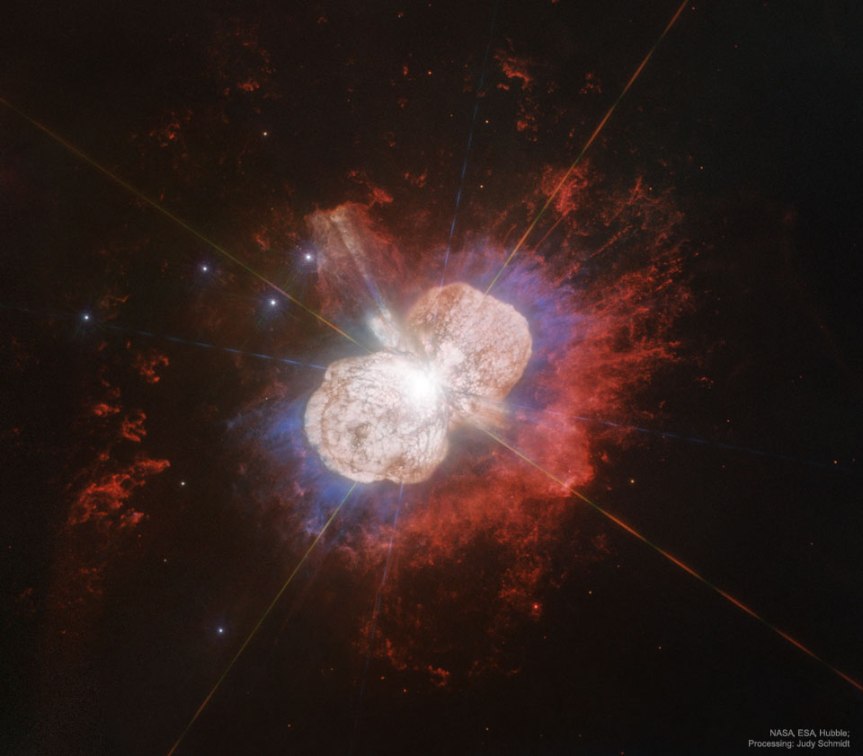
Doomed Star Eta Carinae
Image Credit & Copyright: NASA, ESA, Hubble; Processing & License: Judy Schmidt
Explanation: Eta Carinae may be about to explode. But no one knows when – it may be next year, it may be one million years from now. Eta Carinae‘s mass – about 100 times greater than our Sun – makes it an excellent candidate for a full blown supernova. Historical records do show that about 170 years ago Eta Carinae underwent an unusual outburst that made it one of the brightest stars in the southern sky. Eta Carinae, in the Keyhole Nebula, is the only star currently thought to emit natural LASER light. This featured image brings out details in the unusual nebula that surrounds this rogue star. Diffraction spikes, caused by the telescope, are visible as bright multi-colored streaks emanating from Eta Carinae’s center. Two distinct lobes of the Homunculus Nebula encompass the hot central region, while some strange radial streaks are visible in red extending toward the image right. The lobes are filled with lanes of gas and dust which absorb the blue and ultraviolet light emitted near the center. The streaks, however, remain unexplained.
Goddesses – Greek Olympian Demeter, goddess of earth and harvest

Demeter, goddess of earth and harvest
Demeter (Deo, Ceres) was a goddess of earth and harvest. Her greatest gifts to mankind was corn and the knowledge of agricultural techniques. She was also described by Nonnus, Orphic hymn to Ceres and Homeric hymn to Demeter as the Lady of the fruits (of the earth) and according to the latter also as the bringer of seasons. Mostly she was described as a daughter of the titan couple Cronus and Rhea but there are some conflicts among different authors where she was described as a daughter of Cronus and Cybelle. However, Gaea, Cybelle, Hestia, Rhea, Hera and even Demeter are quite often referred as the mother earth goddess which is why it comes to misidentifying the correct goddess. Anyhow, it is known that she resided in most of the mystery cults which were promising a path to blessed afterlife. She had several children of which Persephone was the most famous and due to her abduction by Hades, and Demeter’s search for her daughter, mysteries of Demeter were born. Most famous were Eleusinian Mysteries, the festivals which were held once a year, and the great festivals, held every five years at Eleusis in Ancient Greece where it all began and is closely connected to the myth of her daughter’s abduction. This event was of great importance and had its basis from an old agrarian cult which goes back to the Mycenaean period. This ceremony is believed to be the interpretation of the myth in three stages; descent, search and ascent, where the main theme of celebration was the ascent where, in the myth itself, Persephone is reunited with her mother.
Appearance in the works of art
Most of the time, she is depicted as an adult woman, holding torch in one hand and cornucopia in the other. The cornucopia was a goat’s horn that would give its owner whatever he desired. It symbolises rich harvest or an abundance of food. Sometimes, she is depicted with a golden blade, believed to be from the time of Titanomachy.
Gifts to Mankind
As mentioned above, Demeter’s greatest gift to humanity was corn and agricultural techniques. It is said that she was the first who discovered corn and later shared her secret with Tripolmenus while at Eleusis. She is also credited to had taught men how to sow corn, how to plough dirt and how to avoid all the troubles associated with it. According to Hyginus and Orphic hymn to Ceres, she even taught them how to tame oxen in order to help them plough the large amounts of earth later on. But that was not all, Demeter also instruced laws and obidience to men so that they could become accostumed to deal with one another justly and because of all these great blessings to humanity, she was awarded with the most notable honours, generous sacrifices and magnificent feasts and festivals by all men, even barbarians, who had partaken of this kind of food.
Love affairs and her descendants
The goddess was mentioned to had some love affairs but only one was due to her willingness. Her only true love was a mortal man by the name of Iasion, a prince of Samothrace. It is said that they made love in a thrice-ploughed fallow in the rich land of Crete but when Zeus had heard about this affair, he struck Iasion with a thunderbolt because of jelaousy. It was too late though as Demeter got pregnant and gave birth to Plutus and according to Hyginus, who claims that she had borne two sons, also to Philomelus. Zeus of course got his hands on her later and famous Persephone was concieved but some of the authors are not mentioning Zeus as her father. In Clement’s Exhortations, however, Zeus himself was actually a son of Demeter and later had intercourse with her and begat Persephone. Furthermore, Clement also talks about mysteries of Demeter and that they commemorate the amorous embraces of Zeus with his mother Demeter but, considering that she was, by some people, thought to be the mother goddess, this should come as no surprise. Anyway, the goddess was also courted by Poseidon but she had refused his advances and transformed herself into a mare to escape him but the god of the sea was unrelentless and tricked her into mating with him by transforming himself into a beautiful stallion. She later gave birth to a divine horse Arion and, according to Pausanias, to a girl whose surname was “Mistress” but does not want to reveal her first name to the uninitiated (in mysteries) people. Carmanor, a lord of Crete, is also said to be one of her mates with whom she later gave birth to Eubuleus.
The abduction of Persephone
When Persephone, her beloved daughter, was abducted, Demeter was searching for her in vain. Unable to find her, she in sorrow and anger burned all the fruits of the earth or, in another version of the story, she neglected to look after the crops and lands soon became barren. And upon “Demeter’s curse”, which caused great drought on lands and consequently famine, it was Hecate who came to Demeter and told her about what she had heard.
Together they went to Helios who was able to see all deeds from both mortals and immortals. He told Demeter that Zeus and Hades were to blame. The goddess became so mad that she had given ultimatum for the lands to stay barren until she was to see her daughter again. Finally Zeus intervened, scared of potentially seeing all mortals gone. He sent Hermes to the underworld to speak to Hades and try to convince him to let Persephone return to her mother. After Hermes’ successful persuasion, Hades was willing to let her go but on the other hand tricked her with honey-sweet pomegranate seed as farewell gift. Once eaten the seed, she became bound to the underworld and would have to return eventually. Demeter was once again outraged but in the end they had come to an agreement that Persephone could stay two-thirds of the time per year with her mother while she had to return to the underworld for one-third of the time. Demeter lifted the curse from the lands but, as a sign of protest, she was casting her sorrow each year when her daughter had to leave for the underworld. This was known as the winter time. This particular myth is very coveted among ancient authors so therefore the story itself may slightly vary from author to author such as where the abduction took place, where Demeter looked for her and in details where some authors provide further clues of the events that followed or events that had happened before the abduction.
Taking refuge in Eleusis
When Demeter was searching for her daughter Persephone, she took refuge at the palace of Celeus, the king of Eleusis. She took the form of an old woman and asked the king for shelter. Celeus welcomed her in and give her an assignment to nurse his sons Demophon and Triptolemus. As a token of gratitude in her dark times, she planned to make Demophon immortal by placing him in the flames of the heart, to burn away his mortal self. It is also said that, while in her care, the boy grew faster than normal and his face became godlike. When the time had come and Demeter wanted to cover the boy in flames, the ritual was interrupted because the boy’s mother Metanira came in and started screaming. The flames were put out and immortality attempt was put to an end. According to Ovid and Hyginus, however, it was his brother Triptolemus whom the goddess wanted to make immortal. It is said that later, after the failed immortality attempt, Demeter taught Triptolemus all the divine arts and mysteries of agriculture. Triptolemus then in return taught anyone who wished to learn. Before Demeter returned to Olympus, she instructed Triptolemus and Celeus on how to celebrate the rites in her temple which then became known as Mysteries of Demeter. It is also said that the lesser mysteries were held every year, but the greater mysteries only every five years.
Mysteries of Demeter
As mentioned above, Triptolemus was the first who had been initiated into mysteries of Demeter where the goddess shared all her secrets about earth’s fertility with him. He later spread these secrets to the initiated people and the mysteries became known as Eleusinian mysteries. But these were not the only mysteries associated with the goddess. Sabazian and Lernean mysteries and a lot of un-named mysteries are also being related to the mysteries of the goddess and there was also the day of Demeter or the day of Ceres mentioned by Fulgentis and Virgil.
Similar event is described by Ovid who calls it Games of Ceres and reveals how these are connected to the myth of Persephone and how it was celebrated. It is said that torches are present on this day as a memorial of Demeter’s search for her daughter when she kindled two pine-trees to serve her as a light after sunset. It is also said that, because Demeter broke her fast at nightfall after unsuccessful quest of searching for her daughter, the initiates time their meals at night during ceremony and they wear white robes because this is the goddess’ proper color which is believed to be associated with harvest. Ovid also mentions that a fox is burned at the festival as a memorial to the incident of a “vixen fox” which was caught by a young lad and set on fire in retribution for carrying off many farm fowls. But the burning fox had escaped his hands and ran into a corn field that caught on fire and all the crops for the incoming winter perished in flames. Therefore, a certain law of Carseoli forbade to name a fox on that day and as a punishment, to the species for destroying crops, a fox is burned.
Her sacred placesThere are several places mentioned by the authors that were sacred to Demeter. In Homeric hymn to Demeter it is said that Paros and Antron are sacred to the goddess, while both Ovid and Claudian are mentioning Henna, Sicily. Diodorus Siculus on the other hand recokns that the whole island of Sicily is sacred to Demeter. There was also an island in Ionian sea mentioned by Apollonius Rhodius but the author was unsure whether or not it was called Drepane. The island by the ancient name Drepane is now known as island Corfu which is located near Albanian border in Ionian Sea. There was also a river mentioned in Pausanias’ Descriptions of Greece that was precious to her. It was called Rheiti. Claudain, on the other hand, even mentiones a palace of Demeter which was supposedly built by the Cyclopes but the location remains a mystery. On top of all the places, the river and the supposed palace, there is also a giant oak tree mentioned, by Callimachus and Ovid, to be very dear to the goddess. It was cut down by disrespectful Erysichthon who was then punished by Demeter. She had summoned Famine who then breathed her pestilential poison through his mouth and throat and breast, and spread the curse of utmost hunger in his veins.
Other mythsWhile in search of Persephone, Demeter used a spell on her daughter’s maids and changed them into sirens so that they could help in her quest. Originally they were nymphs and daughters of river Acheolus and muse Melpomene. The goddess was also involved in a myth of Pelops who was killed by Tantalus, cut up, cooked and served to the gods at the great feast. The gods soon realised what happened and brought Pelops to life again. They assembled his body once again but he was missing an arm. It was Demeter who had previously, before the discovery, eaten it. Therefore, the goddess wanted to make up for it and solved a puzzle by fitting and enspelling an ivory substitute on his torso. Pelops was alive and complete again and gods satisfied with their just act. In another myth, Demeter showed anger when Triopas, a king of Thessalians, once tore down her temple. She brought infinte hunger upon him so that he could not be satisfied by any amount of food and later when he was already dying she sent a snake to finish the job. He was bitten and died and then placed among stars by the will of the goddess as reminder to others not to mess with her.
Gods – Greek Olympia – Poseidon, god of sea, floods and earthquakes

Poseidon, god of sea, floods and earthquakes
Poseidon (Earthshaker, Dark-haired one, Neptune) was Olympian god of sea, floods and earthquakes. In some cases, he is also referred to as a tamer of horses. He was known for his fast changing temperament and being easily offended. And because he was also dignified and competitive, it was very important not to offend him or argue his statements and acts. Those who angered him became the victims of his wrath. He was known for causing major catastrophic events, such as floods, earthquakes and sea storms, and even unleashed his sea monsters in order to get even. Poseidon was also very lustful and selfish when it came to women. He had numerous affairs with both goddesses and mortals, by either seducing them or tricking them by changing his form, not to mention abducting and violating them. However, Poseidon did have some positives and was always passionate in supporting his cause or the cause of his favourite characters, helping them in many different ways by giving them unique traits and special powers or granting them divine animals. He even changed gender of Caenis and Mestra on their own request.
Appearance in the works of art
Poseidon is often depicted as a grown man with longer curly hair and long beard, wearing a crown and holding a magical trident. On more than few occasions, he is depicted in his domain of the sea and in company of his wife Amphitrite. Sometimes, he is depicted riding horses or a chariot drawn by horses.
Becoming the Ruler of the Sea
He was a descendant of Cronus and Rhea. With his brothers he fought bravely against the Titans. During the war he received the magical Trident, a weapon of great power made by the Cyclopes as a token of gratitude for helping them to escape from Tartarus. With their new weapons and help from enemies of Cronus, they were able to defeat and imprison the titans. After the victory, when the division of cosmos had to be decided between three brothers, they drew lots and he got the realm of Sea under his control. He also became second in command to Zeus. However, there is an alternative story how he became the ruler of the sea. According to Hyginus, it was Cronus himself who casted him under the sea when he was born, out of fear of dethroning him. Clement affirms this by saying that it was his destiny to become a sea ruler.
Love affairs and his descendants
Divine and semi-divine lovers
The god of the Sea is credited with having numerous love affairs with both goddesses and mortal women but in his honor he only had one wife, a sea-goddess called Amphitrite. With her he had a son Triton, who is also closely related to the sea, and Rhode, a water nymph closely related to Helios and island of Rhodes. Poseidon also had his eye set for Alcyone, one of the Pleiads, and soon he had an intercourse with her. She later gave birth to two sons, Hyrieus and Hyperenor and a daughter Atheusa. Plutarch also mentions Anippê, a daugher of Nile, who gave birth to Burisis by Poseidon. According to Hyginus, he made love with Antiopa, a daughter of Aeolus (supposedly son of Hippotes), who gave birth to two sons Boeotus and Hellen, and Arethusa, a daughter of Nereus, who gave him another son Abas. There was also Amymone, a daughter of Danaus, a mythical king of Egypt, who once called Poseidon to aid her when she was cornered in the woods by a satyr. So he came and drove the creature away and because of this courageous act she laid with him and from this embrace Nauplius was born. He also pursued Demeter who transformed herself into a mare to escape his lust but Poseidon tricked her with transforming himself into a stallion and mated with her. Demter then gave birth to goddess Desponia and variously to Arion, a horse with the ability to speak human language. Poseidon even had an intercourse with Medusa in the temple of Athena. Athena later cursed Medusa by changing her into a monster. It is also said by some authors that she was impregnated and when her head was chopped off by Perseus, Pegasus and Chrysaor arose from her blood and therefore they are giving credits to Poseidon as the father. He also fathered Polyphemus with the sea-nymph called Thoosa and Euphemus with Europe. It is said by Hyginus that Euphemus had the ability to walk on water.
Mortal lovers
One day, he tricked a mortal woman named Tyro by transforming himself in Enipeus, the river-god of her desire. She then gave birth to twin-boysPelias and Neleus who were known to be famous greek heroes. Aethra, the princess of Troezen is also said to had an intercourse with the god in the shrine of Athena and later gave birth to Theseus. Another famous hero by the name Orion was born to Poseidon and Euryale, a daughter of Minos, and it is said that he had been granted the ability to walk on water by his father. There was also Hippothous or Hippothoon who was begat by Alope after she was embraced by Poseidon. But, because Alope was uncertain who the father of her child was, unfortunate events followed for both of them. She was imprisoned and put to death and the child was exposed to danger twice but each time a mare came and furnished him milk. It was then when Sheperds had realized that it must be the will of the gods to spare him and gave him name Hippothous. It is also said that Alope was then turned, by the god, into a spring near Eleusis. Similar thing happened to Melanippe, a daughter of Desmontes, who was, after being impregnated by Poseidon, blinded and tossed in prison by her father Desmontes and the two sons Aeolus and Boeotus, that she had given birth to, thrown to wild beasts. But they managed to survive and eventually, led by their father, came back to Desmontes, killed him and freed their mother from prison whose sight was restored by Poseidon himself who is also credited as the father of Bellerophon by Eurynome. a daughter of Nysus. Another interesting tale comes from Apollodorus where it is said that Poseidon had a lover by the name Canace and she later gave birth to five sons, Aloeus, Epopeus, Hopleus, Nireus and Triops. Aloeus later married Iphimedia, a daughter of his brother Triops, but she fell in love with Poseidon and the god apparently couldn’t resist missing an opportunity like this because by him she later gave birth to two sons, Ephialtes and Otus. They were known as the Aloads or Aloadae giants.
Wraths of Poseidon
During his time, many vengeful acts were recorded. Most known are from the Odyssey where he chased Odysseus for eight years for blinding his son Polymphemus, the one-eyed cyclops. He was causing deadly storms and earthquakes, trying to drown the hero and prevent him from ever reaching Ithaca. It is also said that he punished Phoeacians by turning their ship into stone because they welcomed and helped the hero. Poseidon also became furious when he helped Laomedon, a king of Troy, with building the walls in exchange for a wealthy ransom. When the walls were built, the king refused to pay the god and therefore Poseidon flooded the region and sent an enormous sea-monster to ravage the lands of Troy.
The Trojan Cetus, as it was called, terrorized the whole country over and over again before the Trojans finally, after consultation with the Oracle, agreed to sacrifice King’s daughter Hesione in order to satisfy Poseidon enough to recall the monster. However, Laomedon had another option which was to promise a reward for Heracles who was just passing by from one of his quests. Heracles agreed, defeated the Cetus, and saved Hesione. In a similar story, where Cassiopeia, a mother of Andromeda, boasted that her daughter is more beautiful than the Nereids, relatives and employes of Poseidon. When they heard of this Cassiopeia’s pride, they complained to Poseidon who then released a Cetus to terrorise the lands of Ethiopia. They were, like the Trojans, advised by the oracle to sacrifice the princess to the monster. Thereafter they had chained Andromeda to the rock and left her to be devoured by the monster. Then Perseus came to rescue, but unlike Heracles, he defeated the Cetus and saved Andromeda because of love at first sight. Another one who offended the god was Inachus who, according to Apollodorus, testified that the land of Argos belonged to Hera after the gods were involved in a dispute. Poseidon was outraged and in revenge dried up all remaining springs, leaving the land completely waterless and useless to Hera.
There had also been a contest for the patronage of Athens between Athena and Poseidon. In order to win city’s deviotion, they had to produce a useful gift for its population. Poseidon was first to act and struck his trident hard in the earth, creating a well with streaming water. However, the water turned out to be salty and not so useful for the people. Athena was next and created the olive tree, by planting an olive branch into the hole that she made with a spear. Delighted with olives, oil and useful wood, people of Athens chose Athena over Poseidon. This angered the god who then, in his vengeful act, flooded the city and lands nearby with salt water. There is, however, an alternative explanation provided by Ovid where it is said nothing about revenge but that Poseidon, instead of giving fresh water to locals, presented a horse to men but the result was the same as they had picked Athena over him because of the olive tree. Then there were also two kings who paid their price for offending the god. First was Minos, a king of Crete, who tricked Poseidon with sacrificing an ordinary bull to him instead of the one given to him by the god as promised. The Earthshaker then had his revenge as he made the promised bull savage and casted a spell on his wife Pasiphae to fall in love with it. As a result of such action, the Minotaur was born which was a punishment enough for Minos. The other one was Erechtheus, a king of Athens, whose army killed Poseidon’s son Eumolpus in the battle for Athens. The god then demanded that one of his daughters should be sacrificed to him but because the daughters of Erechtheus had an agreement with each other that if one dies, the rest would commit suicide, the king of Athens lost all of his daughters. In the end Poseidon also requested from Zeus to struck Eechtheus with a thunderbolt which ended the king’s life and bloodline.
Helping others
Not all accounts are about revenge though. Poseidon could also be very passionate and understanding to those who he favoured and therefore gave good words or interviened himself on their behalf. One of such accounts is the myth of Ares and Aphrodite when they were trapped in the bed of Hephaestus. After all the gods have been summoned to see this adultery and having a laugh at it, it was Poseidon who convinced Hephaestus to let Ares go, in spite of what had been done. This was not the only god he helped. It is said, by Hyginus, that he also protected Leto from vengeful Hera and took her to Ortygia which later became known as Delos after Posedion had transformed it, and he also granted a wish of Aphrodite and accepted her descendants into his realm of Sea. It is worth mentioning that he also accepted a nypmh Leucothea into a divine company in deep waters with open arms and consequently did a great deed for mankind because ever since she supposedly helps seafares who lose their way. The god also once saved Ajax from the sea after previously cracking his boat in half due to hero’s boastful claim that he taught Antichlous everything about horses which of course was not true. Poseidon gave him a lesson but because he favoured the hero he spared his life. Poseidon was also very generous with gifts as he gave his son Peleus two magnificent horses, Balius and Xanthus, and also granted chariots to Idas and Pelops. He also blessed his son Neleus with boundless strength and ability to change shape whenever in a battle and other son Percilymenus the ability to change shape at will. To his grandson Pterelaus he granted immortality by implanting golden hair on his head. There had also been two accounts of sex-change recorded, both on own volition. There was a woman by the name Caenis whom the god once saw walking on the beach and ravished her. He felt bad about it so he offered to grant her any wish desired and she wanted to become a man so that such atrocity would never happen to her again. Poseidon granted her wish and made her a man named Caeneus but also made a new man invulnerable to any blow of sword or spear. Second was one the god’s lovers, named Mestra, who was only temporary changed to a man in order to conceal her from her father and master Erysichthon. He was looking for her and eventually, because he couldn’t find her, gave up and left. Poseidon then turned her back into original form.
Trojan war
Poseidon sided with the Greeks and was helping them all along but on one occasion he is said to had worked against them. It is said by Homer and Quintus Smyrnaeus that the god was jealous because of the impressive wall the Greeks have built around their ships. He was worried that its fame would overshadow his work on Trojan walls and, because of it, helped Trojans destroy it which left consequences on the morale of Greek soldiers. Thereafter, Poseidon had to interviene again and it is said that he encouraged troops indirectly ,because of the rules Zeus had set for immortals not to engage in battle, and fused both Ajaxes with power through his staff when being disguised in the shape of an old seer named Calchas. He is also said to had protected Idomeneus at all costs and even helped him kill Alcathos.
Later in war the god of the Sea became angered because Trojans killed his grandson Amphimachus and his indirect involvement was not helping much as Trojans were taking advantage over them. It was then when he agreed to take part in Hera’s plot to decieve Zeus. After the king of the gods had been put to sleep, Poseidon engaged in the battlefield to lead the Greek army and it is said that he roared so loud as if it were nine thousand men, all to raise morale and finally put an end to Trojans. And it had an effect until Zeus woke up and realised he had been tricked. Immediately he gave orders for all the immortals to withdraw from the battle but Poseidon opposed for a while until he realised that it is best to listen to his brother. He, then, finally withdrew himself from the battlefield and returned to the sea realm. Later, he was summoned to the assembly with the rest of the immortals where Zeus gave them a choice to pick a side and fight for them if they wish to do so. Poseidon is said to had intended to fight Apollo if provoked but the gods came to an agreement and let men decide their battle. When Greeks had finally taken the upper hand in war and when they were attacking Troy, Poseidon is mentioned to had shaken the walls and foundations of the city and driven back posts of Dardan or Dardanian gates. It is also said that after the war was won, he gave Trojans favourable winds which enabled them to escape and prevented further death casualties. According to Homer, he also previously saved Aeneas from a certain death in a battle with Achilles.
Poseidon’s sacred places
Some of the places are being mentioned by the authors that Poseidon had a special bond to. One of such is Onchestus and it is said that he had a precinct there, in his sacred grove. According to Virgil, Delos is also said to be very dear to the god which he previously transformed. Another such island is the island of Calauria which was a part of mainland town of Troezen at the time but Plutarch says that whole Troezen was sacred to Poseidon and that he was a patron god of this land. Very interesting story comes from Pausanias where it is said that Delphi was once controlled by Poseidon and Calauria by Apollo who then offered this beautiful island to the god of the Sea in exchange for the Oracle. According to Homer, there was one other place sacred to the god, named Helice or Helike which was, as the evidence shows, unfortunately sunk by tsunami in the year 373BC.
Other mythsThe god was also involved in other myths such as the war of theGiants, the great flood and even the plot of the gods against Zeus. It is said by Apollodorus that Poseidon fought a giant Polybotes in Gigantomachy, where the god was forced to destroy part of the island to defeat the giant. It all happened on the island of Cos where Posedion broke off a piece of the island and hurled it at Polybotes. This piece was later known as the island Nisyrum, now Nisyros, and it situated between islands Tilos and Cos in Aegean sea. As mentioned earlier, he was also a part of Zeus‘ master plan to end humanity and it is said that he unleashed a great flood on the command of the King of the gods and later ceased the event by cracking earth open, enabling the water to sink in. This was not the only case where Poseidon helped his brother. It is said by Valerius Flaccus, in accordance to the battle between Zeus and Typhoeus (Typhon), that it was Poseidon who finished the giant by pulling him in the water and sending him to Tartarus. He also helped Zeus in Titanomachy as already said early in this article but there is more to the story. In Hesiod’s Theogony it is said that after the war had ended and when the Titans had been sent to Tartarus, Poseidon built a gate of bronze and fixed it upon the entrance of this unforgivable pit so that none of the prisoners would ever be able to escape. Poseidon also participated in Hera’s plot to overthrow Zeus where they had not further plan after tying him down. Of course the plan was doomed from the beginning and after Zeus was freed, he harshly punished his wife to make an example for others and afterwards even Poseidon wouldn’t dare to complain to his brother.
Wicca, Witchcraft or Paganism? c. 2013
If you’re reading this page, chances are you’re either a Wiccan or Pagan, or you’re someone who’s interested in learning more about the modern Pagan movement. You may be a parent who’s curious about what your child is reading, or you might be someone who is unsatisfied with the spiritual path you’re on right now. Perhaps you’re seeking something more than what you’ve had in the past. You might be someone who’s practiced Wicca or Paganism for years, and who just wants to learn more.
For many people, the embracing of an earth-based spirituality is a feeling of “coming home”. Often, people say that when they first discovered Wicca, they felt like they finally fit in. For others, it’s a journey TO something new, rather than running away from something else.
Paganism is an Umbrella Term
Please bear in mind that there are dozens of different traditions that fall under the umbrella title of “Paganism”. While one group may have a certain practice, not everyone will follow the same criteria. Statements made on this site referring to Wiccans and Pagans generally refer to MOST Wiccans and Pagans, with the acknowledgement that not all practices are identical.
Not All Pagans are Wiccans
There are many Witches who are not Wiccans. Some are Pagans, but some consider themselves something else entirely.
Just to make sure everyone’s on the same page, let’s clear up one thing right off the bat: not all Pagans are Wiccans. The term “Pagan” (derived from the Latin paganus, which translates roughly to “hick from the sticks”) was originally used to describe people who lived in rural areas. As time progressed and Christianity spread, those same country folk were often the last holdouts clinging to their old religions. Thus, “Pagan” came to mean people who didn’t worship the god of Abraham.
In the 1950s, Gerald Gardner brought Wicca to the public, and many contemporary Pagans embraced the practice. Although Wicca itself was founded by Gardner, he based it upon old traditions. However, a lot of Witches and Pagans were perfectly happy to continue practicing their own spiritual path without converting to Wicca.
Therefore, “Pagan” is an umbrella term that includes many different spiritual belief systems – Wicca is just one of many.
Think of it this way:
Christian > Lutheran or Methodist or Jehovah’s Witness
Pagan > Wiccan or Asatru or Dianic or Eclectic Witchcraft
As if that wasn’t confusing enough, not all people who practice witchcraft are Wiccans, or even Pagans. There are a few witches who embrace the Christian god as well as a Wiccan goddess – the Christian Witch movement is alive and well! There are also people out there who practice Jewish mysticism, or “Jewitchery”, and atheist witches who practice magic but do not follow a deity.
What About Magic?
There are a number of people who consider themselves Witches, but who are not necessarily Wiccan or even Pagan. Typically, these are people who use the term “eclectic Witch” to apply to themselves. In many cases, Witchcraft is seen as a skill set in addition to or instead of a religious. A Witch may practice magic in a manner completely separate from their spirituality; in other words, one does not have to interact with the Divine to be a Witch.
Weekly Horoscope Sunday, July 9 to Saturday, July 15, 2023
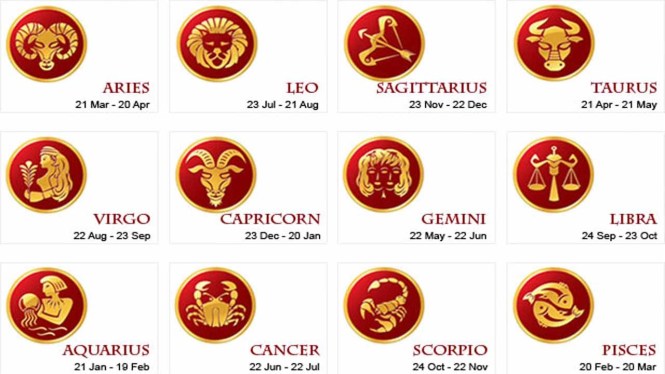
Click here to read Georgia Nicols Daily Horoscopes
All Signs
Some weeks are excellent times for productivity. Other weeks are mushy and full of distractions. We might make lists and have ambitious intentions but somehow, in the end, nothing gets done. Accept the fact that this week is about enjoying yourself. Don’t push the river. Now is the time to give work a back seat. Have fun! Especially evenings and weekends. A lunar T-square on Thursday will create a bit of angst (terms and conditions may apply). Do yourself a favour and make time to enjoy the good life! You are a credit to this world. You are not a loan.
Aries (March 21-April 19)
This is a lovely week for you, especially if you are spending more time at home with family and a parent. You will enjoy a chance to cocoon and relax in familiar surroundings. A few surprises might occur this week. You might buy something unusual or high tech, or perhaps very modern, for your home. At the beginning of the week, be patient with your kids. (On Thursday, let sleeping dogs lie.) Don’t look for trouble. Meanwhile, both Mercury and Venus are in a part of your chart that boosts social outings, fun with sports events, romantic tete-a-tetes and above all – exciting times and vacations! Let your hair down and have a good time! (Fear not. Finances still look extremely good.)
Taurus (April 20-May 20)
Even though this week is more laid-back, nevertheless, it is fast-paced and busy with errands, short trips and conversations with relatives and siblings. Be patient with family members on Monday. Enjoy opportunities to redecorate where you live and make things look more attractive. Social outings will appeal, especially physical activities and competitive sports. Take things easy on Thursday because financial matters might create some angst. Nevertheless, lucky Jupiter is in your sign and you have divine protection. Explore romantic possibilities along with creative opportunities. Get in touch with your muse. This is a strong week for writers and artists.
Gemini (May 21-June 20)
Cash flow, earnings, and your assets and belongings in general, are still on your mind. In fact, something unexpected might occur towards the end of the week that impacts your wealth. Avoid power struggles on Monday because the rest of the week is pretty laid-back. Nevertheless, increased chaos, work and busy activity on the home front might push your buttons, especially on Thursday. But overall, this is a fun filled, fast-paced week for you! Make sure that you fine-tune your attitude so that you can appreciate this. So many of our experiences are coloured by our expectations and what we are thinking ahead of time. Keep an open mind! (But not so open that everything falls out.)
Cancer (June 21-July 22)
With the Sun in your sign for a few more weeks, of course, you’re blessed. You feel energized and confident and strong! Important people and favourable situations will be attracted to you. Note: on Friday, you might feel rebellious about something. Keep your eyes open. Meanwhile, despite the fact that this is more of a laid-back, fun filled week; nevertheless, you have moneymaking ideas. Possibly on Monday, someone will disagree with you about these ideas or something that you own. (This is short-lived.) You might also attract money to you this week. You will certainly enjoy spending it on beautiful things for yourself and others. This week, you’re very convincing when talking to others. (Why not use this advantage?)
Leo (July 23-Aug. 22)
Mercury is moving into your sign, which means the next few weeks are perfect for expressing your views. You will put a great deal of yourself into whatever you say. Your mind will be busy – jumping from subject to subject; plus, Mercury will give you the urge to travel because you want to learn new things and see new places. If you can – by all means, get out of town. Meanwhile, avoid power struggles with partners and close friends on Monday. On Thursday, everyone feels a glitch somewhere; you might have a financial disagreement with someone. It’s not big – but it’s there. Meanwhile, enjoy your good press because right now, you look great to everyone! People see you as successful and affluent. Just smile. Don’t ruin a good thing.
Virgo (Aug. 23-Sept. 22)
You’re energetic now because fiery Mars is in your sign (which is something that happens only once every two years, for seven weeks). Because Mars symbolizes energy, when this planet is in your sign, you are suddenly driven to work hard to further your own interests. You will assert yourself among others. It also indicates a time of great activity in your life because your physical energy is so high. Obviously, you will be more of a fighter for your own rights than usual. Meanwhile, this continues to be a popular time for you. Expect to meet someone unusual or the end of the week — or an offer from a group might surprise you?
Libra (Sept. 23-Oct. 22)
The Sun is still at the top of your chart casting you in a flattering spotlight, which happens only once a year for four weeks. Make the most of this! Ask for what you want. (You have two more weeks.) You might have power struggles with a friend or a member of a group on Monday; and Thursday threatens travel glitches or problems with politics or religion. Aside from that, this is a great week to enjoy the company of others, especially younger, creative, talented people. (Not surprising because you are a lover of the arts). New romance might begin. Perhaps a friend will become a lover? Expect a surprise from a boss, parent or the police (someone in authority) at the end of the week. If the posse is after you – be careful.
Scorpio (Oct. 23-Nov. 21)
Avoid power struggles with authority figures at the beginning of this week. Likewise, on Thursday, you might have an entanglement with a friend or one of your kids. Practice patience because both these hiccups are temporary. Aside from that, this is a great week to travel, learn and explore new ideas and meet new faces. An unexpected travel opportunity might come your way at the end of the week. Remember that this is a wonderful year to improve your marriage or existing partnerships – or to meet someone new. This is a blessing that comes only once every 12 years! It’s also a great year to get married. Because you look so attractive to bosses, some of you might begin a relationship with an authority figure.
Sagittarius (Nov. 22-Dec. 21)
Steer clear of controversial subjects on Monday. Don’t even go there. Likewise, avoid power struggles with bosses and parents on Thursday. Meanwhile, keep on top of banking and financial situations on Friday to avoid a surprise. Aside from these minor warnings – this is a great week for you. You might travel. You might meet people from other countries or different cultures. Opportunities in publishing, the media, medicine and the law are possible — in fact, likely. Continue to look for ways to improve your health. Likewise, continue to look for ways to improve your job or get a better job. These are all things that can happen this year, and maybe this week! (Coming soon to a theatre near you.)
Capricorn (Dec. 22-Jan. 19)
Here are the key points to watch out for this week: Avoid financial arguments or disagreements about shared property on Monday. On Thursday, there might be disagreements about work, a pet, or your health. On Friday, a close friend or partner might throw you a curveball. Aside from that, the rest of the week, (and to a lesser extent the days mentioned), is a wonderful time to enjoy yourself! Take a vacation if you can. Accept invitations to socialize and party. Enjoy the arts. Meanwhile, romance will be hot and sexy. It’s also likely that money and favours from others will come to you. This is an excellent week to ask for a loan or mortgage. You wanted more?
Aquarius (Jan. 20-Feb. 18)
Even though you’re in work mode now, you will find ways to relax and enjoy yourself this week. For example, you might entertain at home. Perhaps, groups will gather at your home. You will definitely have lively discussions with partners and close friends because Mercury has just moved opposite your sign. Admittedly, on Monday, you must avoid disputes with someone close to you. (They could get nasty.) And on Thursday, glitches with your kids or about finances might be annoying. On Friday, a work-related surprise or something to do with a pet or your health might also take place. But these are minor details. On the whole, this is a marvellous week to socialize and enjoy yourself. Have fun!
Pisces (Feb. 19-March 20)
And the beat goes on…. This week you will have lovely opportunities to enjoy playful times with kids, sports events, social outings and romantic connections with others. It’s a wonderful week to socialize and enjoy yourself! Work-related arguments might take place on Monday, or perhaps disputes about pets. Domestic upsets might occur on Thursday; and on Friday, social plans might suddenly change. Please note, be extra vigilant with your kids on Friday. But aside from these highlighted glitches, the entire week offers social opportunities and chances for you to have a good time. Ideally – take a vacation! Send me a postcard.
July 9, 2023 Daily Horoscopes
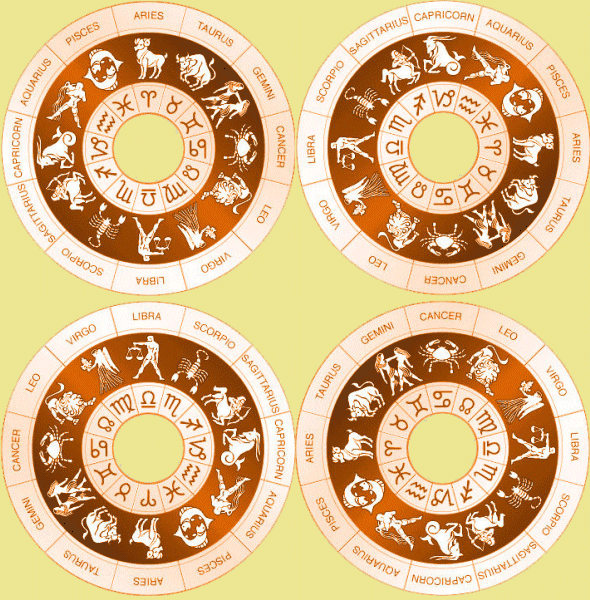
Click here to read Georgia Nicols Daily Horoscopes
Moon Alert
There are no restrictions to shopping or important decisions today. The Moon is in Aries.
Aries (March 21-April 19)
You’re convincing today. However, family conversations will be idealistic, gentle and mutually sympathetic. You might want to explore ideas that you would like to turn into a reality. These wishes and dreams might apply to the family or to where you live.
Taurus (April 20-May 20)
Don’t worry if you spend a lot of time daydreaming or being lost in a fantasy world today because that’s just what’s happening. You can use this influence to share your hopes and dreams for the future with someone else. Your imagination is heightened today, which is wonderful for artistic projects.
Gemini (May 21-June 20)
If shopping today, you will be tempted to buy luxurious, elegant items. To cover all your bases, keep your receipts. (You might feel different in a few days.) Meanwhile, moneymaking ideas might have a pie-in-the-sky quality. Give everything a second, sober thought.
Cancer (June 21-July 22)
Today Mercury is in your sign dancing with fuzzy Neptune, which pumps your creative imagination and makes you more sensitive to the aspects of the world around you. Don’t worry about wasting time. This is the perfect day for a fantasy life and whimsical escapes.
Leo (July 23-Aug. 22)
You will welcome any time spent alone today to indulge in memories, fantasies and wishful thinking. That’s because today it’s easy for your mind to drift off into never-never land. This is an excellent day for artists and writers. It’s also a fun time for kids’ activities.
Virgo (Aug. 23-Sept. 22)
Conversations with friends will be mutually sympathetic and warm today because each person will listen to the other with sincerity. You might also be involved with a charitable organization with a mandate to help those who are less fortunate. (Noble.)
Libra (Sept. 23-Oct. 22)
This is a good day to make your plea to bosses or authority figures if you need them to sympathize with your situation. In fact, most people feel warm hearted and sympathetic to each other today. It’s as if they know what it’s like to walk a mile in someone else’s wedgies.
Scorpio (Oct. 23-Nov. 21)
Discussions about philosophy, religion, art and other intellectual subjects will be heady and interesting today because your mind is open and willing to entertain many concepts. You might also have a strong wish to travel and “get away from all this.”
Sagittarius (Nov. 22-Dec. 21)
Postpone important financial decisions today, especially about inheritances or how to share or divide something because you might give away the farm. Generosity is a wonderful thing; however, there is such a thing as idiot compassion. When it comes to dividing wealth, stay levelheaded.
Capricorn (Dec. 22-Jan. 19)
Today you are happy to cocoon at home. You might have an important conversation with a female family member. Fortunately, discussions with others will be sympathetic and supportive, which is why it’s a good day to reach out if you need help – or to offer help.
Aquarius (Jan. 20-Feb. 18)
If you are at work today, a coworker or fellow colleague might ask for your help or want to confide in you. This is just fine because today if you can help someone – you will. Meanwhile, many of you will also be involved with pets at a special, affectionate level.
Pisces (Feb. 19-March 20)
This is a fabulous day for artists or anyone who needs to use their imagination to be successful in whatever they’re doing. This is also a lovely day to deal with children and share stories and imaginative ideas. Meanwhile, romance will be the stuff of movies. (Don’t leave home without a rose between your teeth.)
If Your Birthday Is Today
Actress Kelly McGillis (1957) shares your birthday today. You are an independent thinker. You are confident, strong willed and eager to explore what life has to offer. You have a creative imagination. Expect exciting changes this year along with increased personal freedom. Let go of anything that holds you back. Seek out new opportunities and be ready to act on them. You might travel.
Click here for today’s or anyone’s birthday horoscope from thehoroscope.co
Aries (March 21-April 19)
Today it seems that the current disposition will prompt you to be emotionally needy. Despite the fact that you usually prefer to do things on your own, this time you are going to feel the need to share your activities with someone.
This is an auspicious time for entering relationships because most natives will feel very comfortable about commitment.
Taurus (April 20-May 20)
Today you are going to find it hard to adapt to change and you will probably meet any of the day’s challenges with a feeling of fear and consistent worry.
This kind of behavior should prompt you to adjust to such transformations and not exaggerate every minor delay that happens to you. Instead of fighting to take control over the smallest things you should be viewing the bigger picture.
Gemini (May 21-June 20)
Today you will feel entirely comfortable in your skin and it seems that you will also have time to tend to a hobby or something that you like doing with no remorse or feeling that you are wasting time.
Allow yourself to relax and let loose, especially if you have friends close to you. For some natives it might be a good time to take a vacation.
Cancer (June 21-July 22)
This Sunday you will probably feel like yourself in the company of your family and you will seek the comfort of your house rather than hang around with friends some place else.
Your nurturing nature surfaces and all your attention will be directed towards your close ones. It is also a good moment for family dynamics, like new relationships or becoming official.
Leo (July 23-Aug. 22)
It seems that today you will be seeing the results of a process of adapting you started some time ago. There were things you probably slowly changed in your routine and now it seems you will be noticing them work at their best.
This could mean that opportunities in this regard are still open and you can still successfully transform other things in your life.
Virgo (Aug. 23-Sept. 22)
This Sunday your entire focus will be on your finances and on finding new ways to improve your disposable income.
Maybe you can take more money for your projects or maybe there’s an opportunity for you to learn a new skill that could help you ask for a raise. This is a moment when you can peacefully focus on your value and evaluate your activity.
Libra (Sept. 23-Oct. 22)
It seems that most natives will be entering some sort of spotlight today in which they will not only get everyone’s attention but they will also meet with important people.
Maybe today’s encounters won’t seem that important on the spot but eventually you will realize that things are connected. Act polite no matter to whom you are talking to.
Scorpio (Oct. 23-Nov. 21)
Today is going to be a quite a slow day for most natives so they will probably prefer to relax or isolate themselves from all ruckus.
This however doesn’t mean that they will be untouchable, it seems they crave for social contact but they do have some pretense on whom they should be joining. It’s a good day for dreaming with their eyes open.
Sagittarius (Nov. 22-Dec. 21)
The current disposition will make you a lot more sociable and a lot more open to novelty and to sharing your knowledge with others.
You will find it easier to get closer to people and even those with whom you will come in contact with will notice how relaxed and honest you are. Getting out of your comfort zone and interacting with all kinds of people is beneficial for you today.
Capricorn (Dec. 22-Jan. 19)
Despite this being Sunday your mind is wondering towards work tasks or towards your personal goals. It seems you are so ambitious and so set to work that everything becomes important.
Any issue you might have with someone else becomes a personal vendetta and you are set to react no matter how stupid or insignificant the conflict is.
Aquarius (Jan. 20-Feb. 18)
The current disposition will prompt you to expand your horizon, either through education or through travel.
You will be feeling inclined to read all kinds of things or to interact with people you consider know more than you. You might also feel bored and set up a battle to stop things from becoming so dull. Activities that involve learning or socializing with other people are benefited at this stage.
Pisces (Feb. 19-March 20)
This Sunday you are going to be all serious and responsible. Your motto will turn into something like there is no time for fun, there’s so much work to do.
This attitude might be a good wake up call for you and will help you clear next week’s schedule and organize everything through but at the same time might bring a wave of unnecessary fears and concerns.
Hope You Are Having a Magickally Good and Peace Filled Sunday WOTC Family and Friends!
I am so excited today I get to spend this afternoon with 2 of my sons, a daughter-in-law, and my 2 youngest grandsons!
So I will get done as many of the tomorrow posts as I can before I have to shower and get ready. The rest or those I put only on the next day tomorrow.
Wishing you and yours a happy, healthy, and magickal Sunday!
Good Day WOTC Family and Friends! What is On Your Mind Today?

I am sorry today’s posts went up so late, but I haven’t been sleeping well again and was to exhausted yesterday to do anything more but cuddle with Star, Merlin, and Cleo on the couch. I will get part of Sunday’s posts done today and the rest tomorrow. I am still very tired at my age and with my health difficulties 4 hours of broken sleep for a week doesn’t let my brain function as it normally does.
How are you doing today?
July 8, 2023 Moon’s Current Phase

You can use this link to go forward or backward in time for Moon phase information. If you are curious, you can even find out what phase the Moon was in when you or anyone else was born.
From MoonGiant.com
The Moon’s current phase for today and tonight is a Waning Gibbous. During this phase the Moon can be seen in the early morning daylight hours on the western horizon. This is the first phase after the Full Moon occurs. It lasts roughly 7 days with the Moon’s illumination growing smaller each day until the Moon becomes a Last Quarter Moon with an illumination of 50%. The average Moon rise for this phase is between 9pm and Midnight depending on the age of the phase. The moon rises later and later each night setting after sunrise in the morning.
Visit the July 2023 Moon Phases Calendar to see all the daily moon phase for this month.
Today’s Waning Gibbous Phase
The Waning Gibbous on July 8 has an illumination of 68%. This is the percentage of the Moon illuminated by the Sun. The illumination is constantly changing and can vary up to 10% a day. On July 8 the Moon is 20.47 days old. This refers to how many days it has been since the last New Moon. It takes 29.53 days for the Moon to orbit the Earth and go through the lunar cycle of all 8 Moon phases.
Phase Details
Phase: Waning Gibbous
Illumination: 68%
Moon Age: 20.47 days
Moon Angle: 0.54
Moon Distance: 366,702.85 km
Sun Angle: 0.52
Sun Distance: 152,094,728.50 km
Illumination: 68%
Moon Age: 20.47 days
Moon Angle: 0.54
Moon Distance: 366,702.85 km
Sun Angle: 0.52
Sun Distance: 152,094,728.50 km
The 8 Lunar Phases
There are 8 lunar phases the Moon goes through in its 29.53 days lunar cycle. The 4 major Moon phases are Full Moon, New Moon, First Quarter and Last Quarter. Between these major phases, there are 4 minor ones: the Waxing Crescent, Waxing Gibbous, Waning Gibbous and Waning Crescent. For more info on the Moon Cycle and on each phase check out Wikipedia Lunar Phase page.
Useful Moon Resources
Check the weather before a night of Moon gazing at weather.com
For a list of all the current meteor showers visit American Meteor Society
July 8, 2023 Daily Horoscopes

Click here to read Georgia Nicols Daily Horoscopes
Moon Alert
Avoid shopping or important decisions from 2 PM to 3:30 PM EDT today (11 AM to 12:30 PM PDT). After that, the Moon moves from Pisces into Aries.
Aries (March 21-April 19)
This is a pleasant day. Check the Moon Alert to see when the Moon enters your sign because after that, things will tend to more easily go your way. However, you might also feel a heightened sense of emotion about everything. Enjoy puttering around home, making repairs.
Taurus (April 20-May 20)
Interactions with friends might take place this morning. However, later in the day, you’ll be happy to be more reclusive and seek time alone to chill out or work on your own in privacy. This is a fortunate time for you! It’s important to believe in yourself and your positive future.
Gemini (May 21-June 20)
This day will get friendlier and more popular for you as it wears on. Enjoy schmoozing with others, especially female friends and colleagues. Group activities, especially this afternoon will appeal. People will enjoy talking to you because you are enthusiastic right now. (Enthusiasm is contagious.)
Cancer (June 21-July 22)
This morning you want to explore new places and ideas because you feel eager to expand your horizons. However, later in the day, you might be involved with a parent or a boss. In fact, whatever you do will be high viz. to some people and they will know details about your personal life.
Leo (July 23-Aug. 22)
This is a friendly, sociable weekend! You can already feel that the vibes are more relaxed today. Nevertheless, this morning you might want to take care of banking details and issues related to inheritances and shared property. This afternoon is a great time to go someplace you’ve never been before.
Virgo (Aug. 23-Sept. 22)
You will have to cooperate with others, and go along to get along this morning. By later in the day, you might be fixated on issues related to shared property, inheritances or something to do with the wealth or the responsibilities of someone else. Nevertheless, you’re popular today!
Libra (Sept. 23-Oct. 22)
You make a wonderful impression on others now, which is why this will be a fun-filled weekend for you. Enjoy competitive sports and physical activities. You will also enjoy gatherings, with groups or clubs and organizations, especially with creative, artistic people.
Scorpio (Oct. 23-Nov. 21)
This is a playful, fun-loving day! Accept invitations to party and socialize. You might be involved with kids’ activities more than usual, as well as the theatre, social diversions and musical performances. Anything to do with sports will appeal. Great date day!
Sagittarius (Nov. 22-Dec. 21)
Home and family are definitely your focus today. In fact, some of you might be more involved than usual with a parent. This seems to be a time when you are paying attention to taxes, debt, insurance matters, inheritances and shared property. Do your homework.
Capricorn (Dec. 22-Jan. 19)
This morning you will be busy with errands, discussions with siblings, neighbours and relatives and attending to little tasks that demand your attention. Once these are out of the way, later in the day, you’ll enjoy relaxing at home.
Aquarius (Jan. 20-Feb. 18)
Financial issues and cash flow have your attention this morning. After that Moon changes signs (see above), the pace of your day will pick up and you’ll get busier with appointments, short trips and fun outings. Get ready for a fun weekend.
Pisces (Feb. 19-March 20)
This day begins with the Moon in your sign, which gives you a slight advantage over all the other signs. However, midday (see above), it leaves your sign and moves into Aries, which will highlight issues about cash flow and shopping. Fun day to socialize!
If Your Birthday Is Today
Actor Kevin Bacon (1958) shares your birthday today. You are dynamic; plus, pragmatic and practical. You’re also focused, self-disciplined and have a strong sense of will. You are kind. Simplicity is the key to life this year. Take charge of your health. Physical exercise is important, especially as a tool for self-discipline. Stay grounded, levelheaded and productive.

Click here for today’s or anyone’s birthday horoscope from thehoroscope.co
Aries (March 21-April 19)
This Saturday it seems that you have brought with yourself all the stubbornness in the world. No one can say something against your words or else you will refuse to continue interacting with them.
You are also going to be very subjective in regard of personal matters but also when talking about the actions of others. You shouldn’t count that much on your own perceptions.
Taurus (April 20-May 20)
Today you might start having a few doubts regarding something you’ve done in the past or regarding your partner.
This means you will behave all inquisitive and that you will start doubting everything what others tell you. Maybe you should find objective means to get your information and not let your heart rule over your head for too long.
Gemini (May 21-June 20)
This Saturday you will be curious about everything that moves around you. Certain unexpected events might draw your attention towards things you missed or misinterpreted in the past.
Such an event will create an entire row of suspicions to you, hence making you question all kinds of things. It’s a good time for research, especially in the field of humanities.
Cancer (June 21-July 22)
Passion and love are in the air right now and nothing will distract your attention from your feelings. Keeping a close look on your emotions is good, especially if it helps you not fall into temptation.
You will probably benefit from an incredible libido today but you are strongly encouraged to view the serious and responsible side of your relationships too.
Leo (July 23-Aug. 22)
Today you will probably find yourself enjoying the current situation in your life, from the way things go with your career to your family life.
This might be the sound of settling but you should bear in mind that there’s much more to that. You should be responsible and realistic about your capacities but still maintain a lot of ambition and motivation.
Virgo (Aug. 23-Sept. 22)
Today you will be faced with a situation that will get you thinking whether you are earning enough and whether it is time to ask for a raise or not.
Maybe there’s work you have brought home with you to deal with over the weekend and you feel like you are being taken advantage of. Whether or not your expenses are higher, it might be a good time to evaluate the price of your work.
Libra (Sept. 23-Oct. 22)
A quiet day ahead for most natives, especially in terms of love. This can mean that either people are settled and enjoying their comfortable couples time or maybe that nothing interesting will happen in this territory.
In any case, there are other good auspices for work or for self reflection. Engage in a spiritual activity that will help you discover something about yourself.
Scorpio (Oct. 23-Nov. 21)
You should be using this Saturday to indulge yourself in activities that can revive both your mind and soul.
So why not go for a beauty treatment, spend the day at the spa or read an article on personal development. It is a good day to line up your attributes and skill and see where things need to be brushed up a little.
Sagittarius (Nov. 22-Dec. 21)
Today you might discover that your partner or someone close in your family can help you in regard to a project at work.
This means that if you’re bringing work at home you should ask for a helping hand because there is someone that could help you heighten your professional image. Other than that, you should be spending at least a few hours out in the open relaxing.
Capricorn (Dec. 22-Jan. 19)
Today will offer you the opportunity to see something that can be improved in your life. This will be either in your love life or regarding your personal development.
This doesn’t mean that you won’t be all of a sudden philosophical but a bit of analysis will show you things that were kept somewhat hidden from the naked eye.
Aquarius (Jan. 20-Feb. 18)
You are going to show how incredibly responsible you are as some unexpected changes happen and you will have to take care of the well being of the family.
There is also a high chance that your efforts will be remarked and those with liberal professions will be benefited. You should spend some of the day outside in the open doing a relaxing physical activity.
Pisces (Feb. 19-March 20)
This should be another day of repose and relaxation for you in prepare for the following week. Make sure you eat right and not exaggerate with physical activities. This means that despite the fact that sport might relax you, it’s time to leave it for later.
Be careful not to indulge in sweets or other heavy caloric treats as your body might respond aggressively.
 Witches Of The Craft®

You must be logged in to post a comment.