Aries (March 21-April 19)
2022 kicks off with a concentration of energy spotlighting your career. It’s time to accept your sacred calling and say yes to new possibilities about how to share your gifts, wisdom, and insight with the world. You’ve got this! You’re a natural leader and were born for this time. Don’t rush the process that’s unfolding before you.
Venus goes retrograde until January 29, sending you on a trip to the past. You’ll be rethinking dreams that didn’t quite manifest and exploring financial decisions you’ve made throughout your life. Think about what was happening eight years ago, as those are some of the same central themes right now. Mercury goes retrograde on January 14, and it’s time to organize yourself by adopting supportive habits in work. Clear off your desk and make space in your life for something new. February is going to be a full month! Take it slow right now.
The North Node moves into Taurus on January 18, kicking off an 18-month cycle of focus on finances. You could discover ways to draw more income or look at your budget and see where to save. Your financial well-being starts with your mindset—give yourself a few good pep talks. Mars in Sagittarius until January 24 is a motivational force.
Relationships have dramatic highs and lows this month with Venus retrograde. Your partner could be more sensitive mid-month. The Cancer full moon on January 17 stirs up a whole spectrum of emotions. Be intentional about self-care and channel your passion into achieving your dreams.
Taurus (April 20-May 20)
This month takes you on a date with destiny as the North Node enters your sign on January 18. The transiting North Node shows us what to prioritize, and this year, the spotlight is on you. The Capricorn new moon on January 2 helps you see an expanded vision and inspires faith. With these influences stirring passion, drive, and dedication, why not start right now by making self-care a priority and fine-tuning your schedule so you have more time for yourself?
Venus, your ruling planet, is going retrograde until January 29. Venus relates to finances, relationships, and self-worth, and when it’s retrograde, we see some truth we otherwise couldn’t see. It’s a time to revisit past relationships and make peace. As you replay scenes from younger years, you can reach new levels of understanding not to let your past defeat you. You can create your life anew with the dawning of each day.
Awaken your sense of adventure. Broaden your perspective any way you can, through travel, learning, teaching, writing, and more. You could finish and publish your book or commit to a new course of study. You’ll be motivated toward the end of the month when Mars enters Capricorn on January 25.
You’re building on previous success in your professional life, so stay dedicated to what you’ve begun. If you feel a little scattered, find your grounding through experiences in the arts. Tour a museum or gallery, for example. You’re rising to new levels of abundance and success. Allow the process to take whatever time it needs.
Gemini (May 20-June 20)
2022 starts at a steady pace, thanks to Venus and Mercury going retrograde this month. Let’s start with Mercury, your ruling planet. Mercury defies binary thinking. It’s masculine sometimes, feminine others. Sometimes, it’s malefic, and at other times, it’s benefic. It’s a changeable planetary guardian. You’re going to be looking back at the past in ways you didn’t anticipate this month—retrograde cycles pull us back and in. As you explore memories, unpack fears, or reconnect with people from your past, keep Mercury in mind. Can you remain neutral, nonjudging? Can you see from different sides of a situation and learn something new?
With Jupiter shining in Pisces, your imagination knows no bounds. Use it with care because you can imagine the worst-case scenario or the best-case one. After the last two years we’ve had, I understand why you’d have doubts about finances, relationships, or your career. You’ve seen the other shoe drop, and you might be slow to trust in the goodness of the universe. You’re safe to have faith.
The Cancer full moon on January 17 stirs up past financial matters concerning long-term savings and investments. If you have considered refinancing or taking out a loan, this would be a good time to explore options. Rely on your intuition, but realize you might not be as clear from January 12-15.
Build a bridge between your head and heart—you’ll be working with both thoughts and emotions this month. You’re opening your capacity to love and deepening your dedication to your loved ones.
Cancer (June 21-July 22)
Welcome to the new year! Ease in and take your time. Starting a new chapter is a slow, gradual process, and you’ll want to create space for reflection and introspection with Venus retrograde until January 29.
This retrograde cycle puts your love life in the focus, and you could revisit storylines from past relationships. Let any surprise encounters with ex-lovers remind you of who you were once upon a time. Thank them for playing their part in your story but stay grounded in your present-day life. Nostalgia romanticizes the past, and this year’s astrology is too promising to turn back. Keep moving forward one step at a time. You’re creating new opportunities for love, abundance, and fulfillment.
The new moon on January 2 spotlights partnerships. In your professional life, focus on collaboration. The North Node in Taurus on January 18 emphasizes belonging to a group of like-minded peers, and community is a highlight of the year for you.
Our relationships give us a chance to experience different facets of our personalities. It’s as if our loved ones hold up big mirrors within which we can see our light and shadows. Four planets move through Capricorn—your opposite sign—at various times this month. Be willing to see your part in anything or anyone you attract into your life. Instead of being quick to assign blame when things go wrong, ask, what is this here to teach me? This message is most pertinent after Mercury goes retrograde on January 14.
Leo (July 23-August 22)
Congratulations! You advanced to another year! You’ve studied your limitations and accessed your power to overcome them. Some of the decisions you made were tough—without a clear right or wrong answer. You reached new milestones in your career and learned patience as you took the steps toward them. This month, it’s time to imagine what comes next. You can carve out new pathways to joy, love, and fulfillment. But first, ease out of 2021 in slow motion.
At the new moon on January 2, adopt a new habit to support your wellness goals. Follow a routine, get plenty of rest, and be in nature. These types of movements can form a structure within which you can dream, create, and play.
The North Node enters Taurus on January 18, kicking off an 18-month cycle during which your public life and career occupy much of your mental space. What activities make your life feel alive with purpose? What people do you love to serve? This type of inquiry helps you access inner guidance as you prepare to answer a sacred call this year.
After January 19, the sun moves through Aquarius, shining its beams on your partnerships. Both Venus and Mercury are retrograde this month, giving you the chance to revisit the past in all areas of life. You could have an encounter with someone who played a big role in your life, or you could relive past scenarios in your current relationship for resolution.
Virgo (August 23-September 22)
Your creativity reaches an all-time high this month, setting a tone for the whole year. Sing, dance, make art, or anything else that feeds your drive for self-expression. Make it part of your spiritual practice. By doing so, you’ll please your inner child and restore a sense of innocence that may have been squelched throughout adulthood, especially in the last two years. We can thank Jupiter in Pisces for reminding you of what inspires joy. We can also look at Mercury retrograde on January 14 for rekindling a childlike sense of wonder. What will you create this year?
This month shines a spotlight on romantic relationships. Venus goes retrograde until January 29, and you could be more aware of what’s not working in your relationships. Along with that, you could reminisce about past love. In weathering any emotional ups and downs of the retrograde season, you can commit to building a better relationship with yourself and others. Jupiter’s influence suggests it’s a time of magnetic attraction when you can draw in love as if taking a breath of air—with ease. If you are single and want a relationship, be open to the magical process. It won’t be like anything you have seen before.
Professionally, you are building a new platform, and it takes time. Mars enters Capricorn on January 24 as a motivational force to contribute in new ways. Balance this drive to act with health practices that help you stay grounded and present in your body. Prioritize meditation and self-care early in the month as Mercury moves through Aquarius. Your mind will be active with ideas and creative insights; let your body rest in between projects.
Libra (September 23-October 22)
Your ruling planet, Venus, is going retrograde until January 29, and it has you reviewing your life. The start of a new year gives us pause to reflect. You could recall memories that open doorways in your psyche; ones that have been closed for some time. You’re healing the fractured places within yourself and repairing some past relationships. Honor the process and give yourself the space you need.
Moving is a strong possibility for you, especially around the time of the new moon on January 2. If you feel uncomfortable in your space for some reason—too cluttered, not enough room, or outdated furnishings—it’s time to clear and spruce it up. Mercury goes retrograde on January 14, signaling a time to make home repairs and declutter.
On January 19, the sun moves into Aquarius, a fellow air sign, and romance is a definite highlight through the end of the month, which is helpful if you’ve had relationship challenges during Venus retrograde. If you’re single, you might be too busy to think about relationships, but either way, relationships have probably been top of mind.
Mars, the planet of individuation, enters Capricorn on January 25, and you could feel a slight tug of war with your partner or with family members. Perhaps you are weighing the pressures of home and work, trying to get a sense of equilibrium. If conflicts arise, you do not always have to be the one to compromise. Mars helps to establish boundaries as a part of self-care. Lean into Mars for support.
Scorpio (October 23-November 21)
Listening is one of your superpowers because you’re attuned to what people don’t say as much as what they do. You take it all in, and you’re quite skilled in intuiting fact from fiction. So, you’ll appreciate this month’s astrology because it allows you to understand some of what may not have been clear before. There’s an emphasis on communication and, well, miscommunication—which happens to sharpen your skills.
You have truth and wisdom to share. So, don’t hold back. You step into the role of a teacher in your professional and personal lives. At the same time, be mindful of how you say what you need to say. Mercury goes retrograde on January 14, and we all feel more sensitive to words than usual. Lead with kindness.
Venus is retrograde until January 29, helping you revisit relationships that have grown distant or been severed by conflict. You feel filled with compassion when the Sun, Venus, and Neptune dance together from January 5-10. You could reconnect with people from your past or make amends with someone who once hurt you.
On January 11, when Mars challenges Neptune, be willing to take the high road in a conflict. Those situations will feel less intense after January 17.
Jupiter in Pisces shines favorably on you this year. Set intentions early this month to ride the waves of that positive energy. Write them to be simple, clear, and measurable. Luck is part doing and part receiving. You take action on behalf of what you want. Then, you allow goodness to flow in your life.
Sagittarius (November 22-December 21)
It’s time to rewrite your money story and realize you have the power to change any aspect of it. Here’s an exercise I created years ago—which worked! Thinking of your life as a work of fiction, personify money. What character would money play? Define the relationship between you. Is money a dictator? An unruly child? When we create mythology—a narrative—about aspects of our lives, we can see clues about changing them. Venus is retrograde until January 29, making this a time to review our beliefs about prosperity and abundance.
The sun enters Aquarius on January 19, and it’s time for connecting. Let the Aquarius sun invigorate your social life, but be mindful of how you spend your time. Mars shines in your sign until January 24, and with extra energy, you could overcommit. Keep it all in balance.
Professional goals take on new meaning this month as you look to create more balance in your life. Jupiter shines in Pisces, making this a year of magical thinking. Carve out time and space to explore what it all means. Let your activities this month be a guide for the whole year.
With Venus retrograde until the 29th and Mercury retrograde after the 14th, it’s a time to make peace with the past, practice radical acceptance, and make forgiveness a part of the healing process. While finances are a big retrograde theme, relationships are, too. Be willing to see all aspects of yourself, including the shadows, to come out the other side more whole.
Capricorn (December 22-January 19)
Unpack the old photos and tapes; nostalgia takes you back to the past this month with Venus and Mercury going retrograde in your sign. These retrograde cycles help you see things about yourself, your relationships, and your childhood you haven’t been ready to before. If you worry you’ll get stuck in the past, think of the analogy of a bow and arrow. The further back you pull the bowstring, the more powerfully that arrow flies to hit its target. This year, you’re aiming for specific goals; revisit the past to shoot forward in February.
The beginning of the month is quite romantic, in that you feel the warm glow of love. Relationships are a theme for the Cancer Full Moon on January 17, but several planets are stacked in your sign, amplifying your need for space. As you set your schedule, keep this in mind. Don’t overdo it!
From January 5-10, the sun, Venus, and Neptune dance together, blending mystical occurrences into your everyday life. Everything will feel more magical and dreamlike. Watch for synchronicities and clues from the universe. Trust that your ancestors are present as guides. It would be a good time for a retreat or other personal development activities. For example, you can discipline yourself to structure a meditation or yoga practice. With Jupiter in Pisces, you’re primed to learn something new, which could be a part of an overall self-improvement plan. What kinds of skills would you like to develop? Are there any new certifications you would like to have? It’s a new year with a clean slate. You can create a life you imagine.
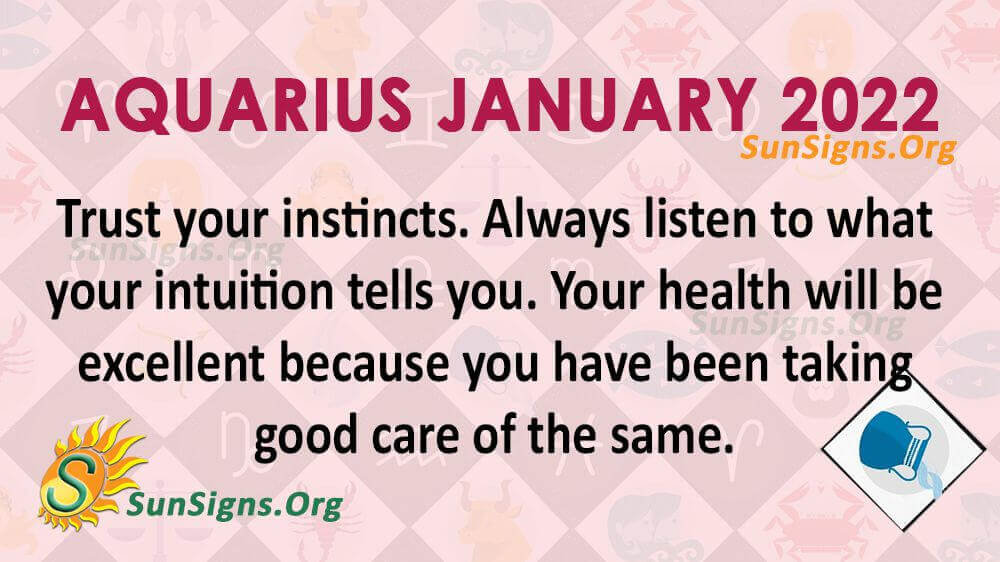
Aquarius (January 20-February 18)
We enter Aquarius season on January 19 as the sun beams out from your sign. Ease into the new year without pressure. It’s a reflective time, with Venus going retrograde until January 29 and Mercury going retrograde after January 14. As you discover relics from the past, like old photo albums or family videos, you can appreciate how far you’ve come. At the same time, past longings or unfulfilled dreams might come back into your awareness. Experiment with the idea of doing what you might have done. Bring back an aspect of you that longs to be known and seen.
Mercury moves through your sign from January 1-24, an excellent transit for focused work, but Mercury retrograde is more about finishing business than starting it. Consider eliminating the clutter of your life. Imagine this month as a warm-up to 2022, with the real activity happening in February. If you complete lingering unfinished projects this month, you will clear space in your life for new beginnings.
The new moon on January 2 inspires magic. Meditate, journal, relax your mind, and still your body. Ground into this moment and all it has to offer. It is a highly creative time: Uranus, the planet associated with your sign, stations direct on January 18. If you have resisted change, now is the time to release fear and open to possibilities.
You’re rethinking dynamics in relationships and maybe touching base with people from your past. Finances are also a matter of inquiry as they fall under Venus’s domain. Be willing to feel your way through the fog of uncertainty. You’ll have more insights as we move into February.
Pisces (February 19-March 20)
Welcome to the first month of a remarkable year in your life! Jupiter transits through your sign like a bright light shining on all you do. However, you may want to lay some groundwork for what’s to come. This month is all about building that platform.
Let’s start with the big astrological news. Venus, the planet of beauty, relationships, and finances, is retrograde until January 29. During this cycle of self-discovery and growth, you could revisit relationships that have drifted apart or make discoveries about friends or family members. Look at how others’ actions mirror back aspects of yourself or how they conjure up dormant memories. In facing your shadow or healing through remembering, you come out more powerful on the other side of the retrograde phase. You’ll be unstoppable next month and beyond!
With Venus moving through Capricorn, you’re quite the social butterfly! Spread your wings and fly without allowing yourself to be troubled by others’ problems. Your friendships are getting a makeover throughout the month. Reconnecting with people from your past could be a way into more heart-centered living, especially if that process involves forgiveness, compassion, and healing.
The full moon on January 17 highlights your love life. If you are in a relationship, you and your partner could enjoy more connection and intimacy as you work through challenges together to build trust. Despite hectic schedules, make time to be present with one another. If you reconnect with a lover from your past, take it slow. In romance, stay grounded, especially at the beginning of the month. Live in the present while accepting the past and stepping consciously into the future.
















You must be logged in to post a comment.