April 9, 2023 Northern Hemisphere’s Planetary Positions

If you need to calculate the planetary positions for a specific use and time, click on this link

Currentplanetarypositions.com

To figure out GMT (Greenwich Mean Time) to your local time use this link  

For Your Local Time and Date 

Northwestern Hemisphere

This local time is in Los Angeles, California, USA

April 09, 2023
10:00 pm GMT 3:00 PM PDT
Zodiac: Tropical (Standard Western)

Sun:19 Aries 47
Moon:05 Sagittarius 06
Mercury:08 Taurus 55
Venus:28 Taurus 30
Mars:07 Cancer 44
Jupiter:21 Aries 16
Saturn:03 Pisces 37
Uranus:17 Taurus 15
Neptune:26 Pisces 02
Pluto:00 Aquarius 15

True Lunar Node:04 Taurus 02
Mean Lunar Node:04 Taurus 58 Rx

Lilith (Black Moon):10 Leo 14

Chiron:16 Aries 06
Ceres:26 Virgo 17 Rx
Pallas:21 Cancer 22
Juno:16 Taurus 53
Vesta:27 Aries 22

Eris:24 Aries 31

Fire:7
Earth:7
Air:1
Water:4
Cardinal:7
Fixed:8
Mutable:4

Northern Hemisphere

This local time is in Chicago, Illinois, USA

April 09, 2023
08:00 pm GMT 3:00 PM CDT
Zodiac: Tropical (Standard Western)

Sun:19 Aries 42
Moon:03 Sagittarius 58
Mercury:08 Taurus 50
Venus:28 Taurus 24
Mars:07 Cancer 41
Jupiter:21 Aries 15
Saturn:03 Pisces 36
Uranus:17 Taurus 15
Neptune:26 Pisces 02
Pluto:00 Aquarius 15

True Lunar Node:04 Taurus 02
Mean Lunar Node:04 Taurus 58 Rx

Lilith (Black Moon):10 Leo 14

Chiron:16 Aries 06
Ceres:26 Virgo 17 Rx
Pallas:21 Cancer 20
Juno:16 Taurus 50
Vesta:27 Aries 20

Eris:24 Aries 31

Fire:7
Earth:7
Air:1
Water:4
Cardinal:7
Fixed:8
Mutable:4

Northeastern Hemisphere

This local time is in Frankfurt, Germany, Europe

9 April 2023
03:00 pm GMT 4:00 PM CEST
Zodiac: Tropical (Standard Western)

Sun:19 Aries 30
Moon:01 Sagittarius 09
Mercury:08 Taurus 35
Venus:28 Taurus 10
Mars:07 Cancer 35
Jupiter:21 Aries 12
Saturn:03 Pisces 35
Uranus:17 Taurus 14
Neptune:26 Pisces 02
Pluto:00 Aquarius 15

True Lunar Node:04 Taurus 01
Mean Lunar Node:04 Taurus 59 Rx

Lilith (Black Moon):10 Leo 12

Chiron:16 Aries 05
Ceres:26 Virgo 20 Rx
Pallas:21 Cancer 16
Juno:16 Taurus 43
Vesta:27 Aries 14

Eris:24 Aries 31

Fire:7
Earth:7
Air:1
Water:4
Cardinal:7
Fixed:8
Mutable:4

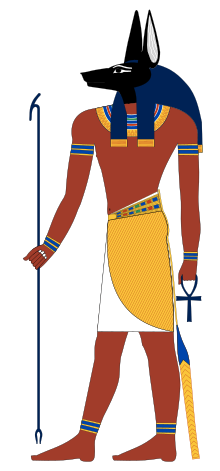
Gods – Anubis – Egyptian c. 2018

Anubis


Anubis is the Greek name of a god associated with mummification and the afterlife in ancient Egyptian religion, usually depicted as a canine or a man with a canine head. Archeologists have identified Anubis’s sacred animal as an Egyptian canid, the African golden wolf.

Like many ancient Egyptian deities, Anubis assumed different roles in various contexts. Depicted as a protector of graves as early as the First Dynasty (c. 3100 – c. 2890 BC), Anubis was also an embalmer. By the Middle Kingdom (c. 2055 – 1650 BC) he was replaced by Osiris in his role as lord of the underworld. One of his prominent roles was as a god who ushered souls into the afterlife. He attended the weighing scale during the “Weighing of the Heart,” in which it was determined whether a soul would be allowed to enter the realm of the dead. Despite being one of the most ancient and “one of the most frequently depicted and mentioned gods” in the Egyptian pantheon, Anubis played almost no role in Egyptian myths.

Anubis was depicted in black, a color that symbolized both rebirth and the discoloration of the corpse after embalming. Anubis is associated with Wepwawet (also called Upuaut), another Egyptian god portrayed with a dog’s head or in canine form, but with grey or white fur. Historians assume that the two figures were eventually combined. Anubis’ female counterpart is Anput. His daughter is the serpent goddess Kebechet.

Name

“Anubis” is a Greek rendering of this god’s Egyptian name. In the Old Kingdom (c. 2686 BC – c. 2181 BC), the standard way of writing his name in hieroglyphs was composed of the sound signs jnpw followed by a jackal over a ḥtp sign:

i n
p
w C6

A new form with the “jackal” on a tall stand appeared in the late Old Kingdom and became common thereafter:

i n
p
w E16

Anubis’ name jnpw was possibly pronounced [a.ˈna.pʰa], based on Coptic Anoup and the Akkadian transcription 𒀀𒈾𒉺<a-na-pa> in the name <ri-a-na-pa> “Reanapa” that appears in Amarna letter EA 315. However, this transcription may also be interpreted as rˁ-nfr, a name similar to that of Prince Ranefer of the Fourth Dynasty.

History

In Egypt’s Early Dynastic period (c. 3100 – c. 2686 BC), Anubis was portrayed in full animal form, with a “jackal” head and body.  A “jackal” god, probably Anubis, is depicted in stone inscriptions from the reigns of Hor-Aha, Djer, and other pharaohs of the First Dynasty.  Since Predynastic Egypt, when the dead were buried in shallow graves, “jackals” had been strongly associated with cemeteries because they were scavengers which uncovered human bodies and ate their flesh. In the spirit of “fighting like with like,” a “jackal” was chosen to protect the dead, because “a common problem (and cause of concern) must have been the digging up of bodies, shortly after burial, by jackals and other wild dogs which lived on the margins of the cultivation.”

The oldest known textual mention of Anubis is in the Pyramid Texts of the Old Kingdom (c. 2686 – c. 2181 BC), where he is associated with the burial of the pharaoh.

In the Old Kingdom, Anubis was the most important god of the dead. He was replaced in that role by Osiris during the Middle Kingdom(2000–1700 BC). In the Roman era, which started in 30 BC, tomb paintings depict him holding the hand of deceased persons to guide them to Osiris.

The parentage of Anubis varied between myths, times and sources. In early mythology, he was portrayed as a son of Ra. In the Coffin Texts, which were written in the First Intermediate Period (c. 2181–2055 BC), Anubis is the son of either the cow goddess Hesat or the cat-headed Bastet. Another tradition depicted him as the son of Ra and Nephthys. The Greek Plutarch (c. 40–120 AD) stated that Anubis was the illegitimate son of Nephthys and Osiris, but that he was adopted by Osiris’s wife Isis:

For when Isis found out that Osiris loved her sister and had relations with her in mistaking her sister for herself, and when she saw a proof of it in the form of a garland of clover that he had left to Nephthys – she was looking for a baby, because Nephthys abandoned it at once after it had been born for fear of Seth; and when Isis found the baby helped by the dogs which with great difficulties lead her there, she raised him and he became her guard and ally by the name of Anubis.

George Hart sees this story as an “attempt to incorporate the independent deity Anubis into the Osirian pantheon.” An Egyptian papyrus from the Roman period (30–380 AD) simply called Anubis the “son of Isis.”

In the Ptolemaic period (350–30 BC), when Egypt became a Hellenistic kingdom ruled by Greek pharaohs, Anubis was merged with the Greek god Hermes, becoming Hermanubis. The two gods were considered similar because they both guided souls to the afterlife. The center of this cult was in uten-ha/Sa-ka/ Cynopolis, a place whose Greek name means “city of dogs.” In Book XI of The Golden Ass by Apuleius, there is evidence that the worship of this god was continued in Rome through at least the 2nd century. Indeed, Hermanubis also appears in the alchemical and hermetical literature of the Middle Ages and the Renaissance.

Although the Greeks and Romans typically scorned Egypt’s animal-headed gods as bizarre and primitive (Anubis was mockingly called “Barker” by the Greeks), Anubis was sometimes associated with Sirius in the heavens and Cerberus and Hades in the underworld. In his dialogues, Plato often has Socrates utter oaths “by the dog” (kai me ton kuna), “by the dog of Egypt”, and “by the dog, the god of the Egyptians”, both for emphasis and to appeal to Anubis as an arbiter of truth in the underworld.

Roles

Protector of tombs

In contrast to real wolves, Anubis was a protector of graves and cemeteries. Several epithets attached to his name in Egyptian texts and inscriptions referred to that role. Khenty-imentiu, which means “foremost of the westerners” and later became the name of a different wolf god, alluded to his protecting function because the dead were usually buried on the west bank of the Nile. He took other names in connection with his funerary role, such as tpy-ḏw.f “He who is upon his mountain” (i.e. keeping guard over tombs from above) and nb-t3-ḏsr “Lord of the sacred land”, which designates him as a god of the desert necropolis.

The Jumilhac papyrus recounts another tale where Anubis protected the body of Osiris from Set. Set attempted to attack the body of Osiris by transforming himself into a leopard. Anubis stopped and subdued Set, however, and he branded Set’s skin with a hot iron rod. Anubis then flayed Set and wore his skin as a warning against evil-doers who would desecrate the tombs of the dead. Priests who attended to the dead wore leopard skin in order to commemorate Anubis’ victory over Set. The legend of Anubis branding the hide of Set in leopard form was used to explain how the leopard got its spots.

Most ancient tombs had prayers to Anubis carved on them.

Embalmer

As jmy-wt “He who is in the place of embalming”, Anubis was associated with mummification. He was also called ḫnty zḥ-nṯr “He who presides over the god’s booth”, in which “booth” could refer either to the place where embalming was carried out or the pharaoh’s burial chamber.

In the Osiris myth, Anubis helped Isis to embalm Osiris. Indeed, when the Osiris myth emerged, it was said that after Osiris had been killed by Set, Osiris’s organs were given to Anubis as a gift. With this connection, Anubis became the patron god of embalmers; during the rites of mummification, illustrations from the Book of the Dead often show a wolf-mask-wearing priest supporting the upright mummy.

Guide of souls

By the late pharaonic era (664–332 BC), Anubis was often depicted as guiding individuals across the threshold from the world of the living to the afterlife. Though a similar role was sometimes performed by the cow-headed Hathor, Anubis was more commonly chosen to fulfill that function. Greek writers from the Roman period of Egyptian history designated that role as that of “psychopomp”, a Greek term meaning “guide of souls” that they used to refer to their own god Hermes, who also played that role in Greek religion. Funerary art from that period represents Anubis guiding either men or women dressed in Greek clothes into the presence of Osiris, who by then had long replaced Anubis as ruler of the underworld.

Weighing of the heart

One of the roles of Anubis was as the “Guardian of the Scales.” The critical scene depicting the weighing of the heart, in the Book of the Dead, shows Anubis performing a measurement that determined whether the person was worthy of entering the realm of the dead (the underworld, known as Duat). By weighing the heart of a deceased person against Ma’at (or “truth”), who was often represented as an ostrich feather, Anubis dictated the fate of souls. Souls heavier than a feather would be devoured by Ammit, and souls lighter than a feather would ascend to a heavenly existence.


Source

Wikipedia


Flower Meaning, Symbol and Spiritual Meaning – Lotus

Lotus from symbolsage.com

Lotus flowers are beautiful flowers that are commonly associated with purity, inner strength  and tranquillity, but its symbolism extends beyond that. The flower plays a symbolic role in various religions such as Hinduism, Buddhism, Sikhism, and Jainism. Given its deep symbolic meanings and connection to religion, the lotus flower is considered one of the most sacred plants. Here’s a closer look at the lotus.

Origins of Lotus Symbolism

Lotus flowers were symbolically depicted as early as Ancient Egypt, where white and blue lotuses are more common. In Egypt, the flower was known as Seshen and was associated with Egyptian gods. Because of the way in which the lotus emerged from the water, followed the movement of the sun and then closed back up and returned into the water, only to repeat the process the next day, the lotus was associated with the sun god, Ra.

The Ancient Egyptians believed that lotuses were symbolic of creation, rebirthstrength and power. Perhaps, for this reason, during childbirth Egyptian women tended to wear lotus amulets with a picture of Heqet, a goddess of fertility. The lotuses were present in art, hieroglyphics, and paintings to represent fertility, a new beginning, and purity.

Other historical references to the lotus can be found in Ancient Greece and in Indian religions. In Ancient Greece, the flower represented innocence, modesty, and purity.

References to lotuses in Hinduism can be traced back to at least 1400 BC through Vedic texts that depict Hindu gods holding or standing on lotuses. Early references can also be found in the Buddhist religion, and the Buddha is often depicted sitting on a lotus.

Symbolism of the Lotus

The meanings behind the flower relate to the symbolism of the lotus growing out of muddy waters. The flowers’ roots anchor it in the mud, but the flower rises above its murky environment, blossoming open one petal at a time. Based on these unique growing conditions, the lotus flower has come to have many symbolic meanings.

Spiritual Enlightenment

The lotus represents spiritual enlightenment. Regardless of its dirty environment and the muddy water it’s rooted in, the lotus rises above it all to bloom in beauty, facing the sun. This is symbolic of overcoming the material world and emerging from the muddy waters of suffering to reach spiritual enlightenment and wisdom.

Detachment

The flower symbolizes detachment as the lotus detaches itself from the water and filth that sullies its environment. This symbolism serves as a reminder to separate ourselves from things that could sully our soul and to instead focus on the things that matter, such as wisdom, relationships and spiritual enlightenment.

Resurrection & New Beginnings

Lotuses also symbolize resurrections and new beginnings. The flower emerges in the morning, only to close up at night and disappear into back into the water. in the morning, a new blossom remerges and continues the cycle. This representation makes the lotus a common flower at funerals. This is also why the flower was popular in Egyptian symbolism.

Purity & Cleanliness

The lotus represents purity and cleanliness, as it’s able to emerge from the murky waters pure and unsullied. In particular, the flower represents the purity of the human soul, as the center of the flower is never tainted by its journey, nor is it by the daily exposure to the murky water.

The lotus flower blooms slowly one petal at a time, which is similar to the gradual steps required to reach spiritual enlightenment. In this sense, the lotus is a symbol of personal progress. Regardless of the color of the petals, the middle is typically yellow, which represents the goal of enlightenment.

Nature & Womanhood

The lotus has also been associated with nature and womanhood. Some representations use a lotus bud to symbolize a virgin. In contrast, a fully grown flower is a mature, sexually experienced female.

Remaining True to Yourself

The lotus is also an excellent example of remaining true to yourself and who you are. Regardless of the murky waters and environment, the lotus remains grounded, proud of what it is and yet still a part of its environment. It beautifies it and makes it better simply by being there.

Lotus Symbolism in Religion

The lotus is a religiously significant symbol, especially for Eastern religions. While many of the symbolic meanings are similar, each religion has its own associations as well.

Lotus Flower in Buddhism

Buddhists see the lotus as a representation of life. The mud is the suffering, challenges, and obstacles we face, and the flower symbolizes overcoming those obstacles. This growth can be viewed as progressing towards a state of purity or the path to enlightenment. Also related to life, Buddhists see the flower as representing rebirth and reincarnation. The flower also signifies purity, spirituality, and self-cleaning.

The Sutra of the Lotus Flower of the Wonderful Law is an essential Buddhist scripture that highlights the teachings of Buddha about the lotus. The lesson states that without mud, there can be no lotus, but the lotus remains untainted by the mud. This scripture serves as a reminder that suffering and happiness are not mutually exclusive. Without one, you cannot have the other.

Lotus Flower in Hinduism

Within Hindu symbolism, the lotus is associated with prosperity, fertility, and beauty. The lotus is also associated with a number of Hindu gods and relates to the sacred Padma lotus. The Padma is the part of the soul that drives people towards spiritual enlightenment even through struggles. This drive is similar to the manner in which the lotus flower pushes through the mud and muck to reach the surface.

The lotus is associated with several Hindu gods, including Lakshmi, Brahma, and Vishnu, who is known as the Lotus-Eyed One and is known for beauty and purity. Other gods are depicted with lotuses in artwork because of the association with purity and divinity.

Another association given to the lotus, according to some followers of Hinduism, is creation. Similar to how the lotus blooms with sunlight, Hindus believe the world bloomed into creation in the presence of consciousness.

Lotus Flower in Sikhism

The lotus flower is used as an analogy for how to live life, as explained by Bhai Gurdas Ji, an influential Sikh figure and writer. These writings are referred to as keys to understanding Gurbani and grasping the basics of Sikhism.

Accordingly, just as the lotus remains unsullied in the water, you must stay unaffected by the evils of the world. Another important point is the idea that as the lotus loves the sun and blooms for it, so will the person who, through loving devotion, know the Lord.

Those are just two of the many references he makes to the lotus flower throughout his teachings. It is mentioned an estimated 420 times as representing the human soul.

Other meanings of the lotus in Sikhism can be considered the same as the general symbolism of the lotus. However, it is worth noting that the lotus flower is not commonly used as a Sikh symbol today.

Lotus Flower in Jainism

The lotus is not a main religious symbol of Jainism, a faith centered around self-help, but it is an identifying symbol for some Jains. The blue lotus is the symbol of Nami, the 21st Jain. A red lotus represents the 6th Jain, Padmaprabha.

What Do Different Lotus Colors Mean?

The lotus flower naturally comes in a variety of colors. While the Hindu religion mainly uses the white lotus in its depictions, Buddhism uses a range of lotus colors, each with its symbolic meaning.

Blue represents the importance of spirit over knowledge. It also represents common sense, wisdom, and knowledge.

White symbolizes Bodhi, which is a state of enlightenment. White lotuses are also known as the womb of the world and represent the purity of the mind and soul.

The eight-petal lotus is shown as purple and represents Buddha’s eightfold path to the noble truth, also known as the path to self-awakening. Because of its association with the path, the purple lotus is viewed as mystical and spiritual.

Red represents the heart, so the red lotus symbolizes pure love and compassion.

The most important lotus, the true lotus of Buddha, is depicted as pink in color. Stemming from this title, the pink louts represents the history and essence of Buddha.

When true spiritual enlightenment has been achieved, it is represented by the gold lotus.

Lotus in Jewelry and Fashion

Today the lotus remains one of the most popular symbols in jewelry and fashion. It’s often used in pendants, rings, bracelets and earrings, or simply kept as a charm. The image can be stylized and represented in many ways, including as an open bloom or a closed bud. It’s also popular in Buddhist or spiritual jewelry.

Lotus jewelry also makes a great gift idea:

As a gift to someone coming of age, it’s a reminder to stay grounded and true to oneself, while ever striving upwards.

For someone going through a difficult period in their life, the lotus is a symbol of overcoming adversity and hardship, while still keeping one’s spirit intact.

As a romantic gift to a loved one, the lotus represents the tenacity to hold onto your relationship and the willingness to grow together.

The lotus symbol is also popular in tattoos and clothing. Because the symbol doesn’t belong to any one group or faith, it’s seen as a universal symbol that holds meaning to everyone.

Wrapping Up

The lotus flower is a beautiful, powerful symbol. The many meanings and religious connections of the lotus make it an excellent choice for artwork, jewelry, clothing and as a decorative motif.

April 3rd to April 9th Astronomy Pictures of the Day

These are the Astronomy Picture of the Day for the proceeding week starting on the past Monday through this Sunday. Just click on the hyperlink next to the date for the pictures you want to see.

2023 April 09: The Egg Nebula in Polarized Light
2023 April 08: M100: A Grand Design Spiral Galaxy
2023 April 07: Rigel Wide
2023 April 06: Terran 1 Burns Methalox
2023 April 05: Rubin’s Galaxy
2023 April 04: Olympus Mons: Largest Volcano in the Solar System
2023 April 03: The Galactic Center Radio Arc

April 9 Today in Worldwide History

Today’s Important Historical Events

1483 Edward V (aged 12) succeeds his father Edward IV as king of England. He is never crowned, and disappears presumed murdered, after incarceration in the Tower of London with his younger brother Richard (the “Princes in the Tower”)

1731 British mariner Robert Jenkins’ ear cut off by Spanish Guarde Costa in the Caribbean, later catalyst for war between Britain & Spain

1768 John Hancock refuses to allow two British customs agents to go below deck of his ship, considered by some to be the first act of physical resistance to British authority in the colonies

1865 Confederate General Robert E. Lee and 26,765 troops surrender at Appomattox Court House to US Lieutenant General Ulysses S. Grant ending the Civil War in North Virginia

1869 Hudson Bay Company cedes its territory to Canada

1992 John Major elected Prime Minister of the United Kingdom after his Conservative Party wins the most votes in British electoral history

2003 Baghdad falls to U.S. forces, ending the Invasion of Iraq, but resulting in widespread looting

Today’s Historical Events

193 Septimius Severus is proclaimed Roman Emperor by the army in Illyricum

475 Byzantine Emperor Basiliscus issues a circular letter (Enkyklikon) to the bishops of his empire, supporting the Monophysite christological position

715 Constantine ends his reign as Catholic Pope

817 Louis the Pious, King of the Franks, barely survives when wooden gallery collapses in Aachen, prompts him to later name his succession

1241 Battle of Liegnitz – Mongolian armies inflict one of the largest defeats in Polish history on Polish and Germans force led by Henry of Silesia with 20-25,000 killed or massacred, including Henry

1388 Battle of Näfels; Glarius Swiss defeat Habsburg (Austrian) army

1413 Henry V crowned King of England at Westminster Abbey

1440 Christopher of Bavaria is appointed King of Denmark (1440-48)

Today’s Historical Events in Flim and TV

1928 Mae West‘s NYC debut in a daring new play “Diamond Lil”

1950 Bob Hope‘s 1st TV appearance

1954 7th Cannes Film Festival: “Gate of Hell” directed by Teinosuke Kinugasa wins the Grand Prix du Festival International du Film

1954 WECT TV channel 6 in Wilmington, NC (NBC/CBS) begins broadcasting

1962 34th Academy Awards: “West Side Story” (Best Picture, Director, and 8 more), Sophia Loren (Two Women) & Maximilian Schell (Judgement At Nuremberg) win

1967 Shortwave broadcaster Radio NY Worldwide’s transmitter burns down

1971 Ringo Starr releases single “It Don’t Come Easy” in the UK

1973 “Paper Moon” film starring Ryan O’Neal and his daughter, Tatum O’Neal, directed by Peter Bogdanovich premieres in Hollywood, California; Tatum O’Neal becomes youngest (age 10) Academy Award winner (Supporting Actress)

Today’s Historical Events in Music

1894 1st performance of Anton Bruckner‘s 5th Symphony in B in Graz

1939 Marian Anderson sings before 75,000 at the Lincoln Memorial in Washington, D.C.

1942 Alexander Gretchaninov‘s 4th Symphony premieres at Carnegie Hall, NYC, with John Barbirolli conducting the New York Philharmonic

1949 Revival of Sidney Howard’s Pulitzer Prize-winning 1924 stage drama “They Knew What They Wanted”, closes at the Music Box Theatre, NYC, after 61 performances

1950 4th Tony Awards: “The Cocktail Party” (play) & “South Pacific” (musical) win

1957 Howard Hanson‘s “Song of Democracy” premieres in Washington, D.C.

1965 Beatles “Ticket to Ride” is released in UK

1967 “At the Drop of Another Hat” closes at Booth NYC after 105 performances

Today’s Historical Events in Sports

1880 British Open Men’s Golf, Musselburgh Links: Scotsman Bob Ferguson wins first of 3 straight titles; beats Peter Paxton by 5 strokes

1896 Australian athlete Edwin Flack claims the middle distance double at the Athens Olympics winning the 800m final in 2:11.0; his 2nd victory of the Games after success in the 1500m

1896 Greek shooter Pantelis Karasevdas scores a perfect 40 hits to win the military rifle event at the Athens Olympics; Greek 1-2-3 with Pavlos Pavlidis and Nicolaos Trikupis taking out the minor placings

1912 1st exhibition baseball game at Fenway Park (Red Sox vs Harvard)

1913 Brooklyn Superbas’ (later Dodgers) Ebbets Field opens; visiting Philadelphia Phillies win, 1-0

1925 Babe Ruth rushed to hospital

1928 Top-Oss soccer team forms in Oss

1931 Chicago Cy Wentworth beats Montreal Canadiens at 13:50 of 6th period

A Thought for Today

The Wisdom of Buddha


The tongue like a sharp knife… Kills without drawing blood.

Easter History and Traditions

Easter is a Christian holiday that celebrates the belief in the resurrection of Jesus Christ. In the New Testament of the Bible, the event is said to have occurred three days after Jesus was crucified by the Romans and died in roughly A.D. 30. The holiday concludes the “Passion of Christ,” a series of events and holidays that begins with Lent—a 40-day period of fasting, prayer and sacrifice—and ends with Holy Week, which includes Holy Thursday (the celebration of Jesus’ Last Supper with his 12 Apostles, also known as “Maundy Thursday”), Good Friday (on which Jesus’ crucifixion is observed) and Easter Sunday. Although a holiday of high religious significance in the Christian faith, many traditions associated with Easter date back to pre-Christian, pagan times.

When Is Easter 2023?

Easter 2023 occurs on Sunday, April 9. However, Easter falls on a different date each year.

Easter Sunday and related celebrations, such as Ash Wednesday and Palm Sunday, are considered “moveable feasts,” although, in western Christianity, which follows the Gregorian calendar, Easter always falls on a Sunday between March 22 and April 25. Easter typically falls on the first Sunday after the first full moon occurring on or after the spring equinox.

In Eastern Orthodox Christianity, which adheres to the Julian calendar, Orthodox Easter falls on a Sunday between April 4 and May 8 each year.

In some denominations of Protestant Christianity, Easter Sunday marks the beginning of Eastertide, or the Easter Season. Eastertide ends on the 50th day after Easter, which is known as Pentecost Sunday.

In Eastern Orthodox branches of Christianity, Easter Sunday serves as the start of the season of Pascha (Greek for “passover”), which ends 40 days later with the holiday known as the Feast of the Ascension.

Why Is Easter Called ‘Easter’?

St. Bede the Venerable, the 6th-century author of Historia ecclesiastica gentis Anglorum (“Ecclesiastical History of the English People”), maintains that the English word “Easter” comes from Eostre, or Eostrae, the Anglo-Saxon goddess of spring and fertility. Other historians maintain the “Easter” derives from in albis, a Latin phrase that’s plural for alba, or “dawn,” that became eostarum in Old High German, a precursor to the English language of today.

Despite its significance as a Christian holy day, many of the traditions and symbols that play a key role in Easter observances actually have roots in pagan celebrations—particularly the pagan goddess Eostre—and in the Jewish holiday of Passover.

Religious Tradition of Easter

The resurrection of Jesus, as described in the New Testament of the Bible, is essentially the foundation upon which the Christian religions are built. Hence, Easter is a very significant date on the Christian calendar.

According to the New Testament, Jesus was arrested by the Roman authorities, essentially because he claimed to be the “Son of God,” although historians question this motive, with some saying that the Romans may have viewed him as a threat to the empire.

He was sentenced to death by Pontius Pilate, the Roman prefect in the province of Judea from A.D. 26 to 36 Jesus’ death by crucifixion, marked by the Christian holiday Good Friday (the Friday before Easter), and subsequent resurrection three days later is said, by the authors of the gospels, to prove that he was the living son of God.

In varying ways, all four of the gospels in the New Testament (Matthew, Mark, Luke, and John) state that those who believe in Jesus’ death and resurrection are given “the gift of eternal life,” meaning that those of faith will be welcomed into the “Kingdom of Heaven” upon their earthly death.

Passover and Easter

Notably, Easter is also associated with the Jewish holiday of Passover, as well as the exodus of the Jews from Egypt, as described in the Old Testament. These links are clearly seen in the Last Supper, which occurred the night before Jesus’ arrest and the sufferings Jesus endured following his arrest.

The Last Supper was essentially a Passover feast. However, the New Testament describes it as being given new significance by Jesus: He identified the matzah (or bread) he shared with his 12 apostles as his “body” and the cup of wine they drank as his “blood.”

These rituals would come to symbolize the sacrifice he was about to make in death, and became the basis for the Christian ritual of Holy Communion, which remains a fundamental part of Christian religious services.

As Jesus’ arrest and execution were said to have occurred during the Jewish observance of Passover, the Easter holiday is often close to the former celebration on the Judeo-Christian calendar.

Easter Traditions

In western Christianity, including Roman Catholicism and Protestant denominations, the period prior to Easter holds special significance.

This period of fasting and penitence is called Lent. It begins on Ash Wednesday and lasts for 40 days (not including Sundays).

The Sunday immediately prior to Easter is called Palm Sunday, and it commemorates Jesus’ arrival in Jerusalem, when followers laid palm leaves across the road to greet him.

Many churches begin the Easter observance in the late hours of the day before (Holy Saturday) in a religious service called the Easter Vigil.

In Eastern Orthodox Christianity, Easter rituals start with the Great Lent, which begins on Clean Monday (40 days prior to Easter, not including Sundays). The last week of Great Lent is referred to as Palm Week, and it ends with Lazarus Saturday, the day before Palm Sunday.

Palm Sunday marks the beginning of Holy Week, which ends on Easter.

Easter Eggs

Irrespective of denomination, there are many Easter-time traditions with roots that can be traced to non-Christian and even pagan or non-religious celebrations. Many non-Christians choose to observe these traditions while essentially ignoring the religious aspects of the celebration.

Examples of non-religious Easter traditions include Easter eggs, and related games such as egg rolling and egg decorating.

It’s believed that eggs represented fertility and birth in certain pagan traditions that pre-date Christianity. Egg decorating may have become part of the Easter celebration in a nod to the religious significance of Easter, i.e., Jesus’ resurrection or re-birth.

Many people—mostly children—also participate in Easter egg “hunts,” in which decorated eggs are hidden. Perhaps the most famous Easter tradition for children is the annual White House Easter Egg Roll, when children roll Easter eggs down Capitol Hill.

Easter Bunny

In some households, a character known as the Easter Bunny delivers candy and chocolate eggs to children on Easter Sunday morning. These candies often arrive in an Easter basket.

The exact origins of the Easter Bunny tradition are unknown, although some historians believe it arrived in America with German immigrants in the 1700s. Rabbits are, in many cultures, known as enthusiastic procreators, so the arrival of baby bunnies in springtime meadows became associated with birth and renewal.

Notably, several Protestant Christian denominations, including Lutherans and Quakers, have opted to formally abandon many Easter traditions, deeming them too pagan. However, many religious observers of Easter also include them in their celebrations.

Easter foods are steeped in symbolism. An Easter dinner of lamb also has historical roots, since a lamb was often used as a sacrificial animal in Jewish traditions, and lamb is frequently served during Passover. The phrase “lamb of God” is sometimes used to refer to Jesus and the sacrificial nature of his death.

Today, Easter is a commercial event as well as a religious holiday, marked by high sales for greeting cards, candies (such as Peeps, chocolate eggs and chocolate Easter bunnies) and other gifts.

Sources

McDougall, H. (2010). “The pagan roots of Easter.” The Guardian.
Sifferlin, A. (2015). “What’s the origin of the Easter bunny?” Time.com.
Barooah, J. (2012). “Easter eggs: History, Origin, Symbolism and tradition.” Huffington Post.
Chapman, E. and Schreiber, S. (2018). “The history behind your favorite Easter traditions.” Goodhousekeeping.com.

The Ancient Pagan Origins of Easter By Joanna Gillan

Easter is a festival and holiday celebrated by millions of people around the world who honor the resurrection of Jesus from the dead, described in the New Testament as having occurred three days after his crucifixion at Calvary. It is also the day that children excitedly wait for the Easter bunny to arrive and deliver their treats of chocolate eggs.

The date upon which Easter is held varies from year to year, and corresponds with the first Sunday following the full moon after the March equinox. It occurs on different dates around the world since western churches use the Gregorian calendar , while eastern churches use the Julian calendar.

While Easter, as we know it today, was never a  pagan festival, its roots and many of its traditions have associations with ancient pagan customs and beliefs.

According to the New Unger’s Bible Dictionary: “The word Easter is of Saxon origin, Eastra, the goddess of spring, in whose honour sacrifices were offered about Passover time each year. By the eighth century Anglo–Saxons had adopted the name to designate the celebration of Christ’s resurrection.” However, even among those who maintain that Easter has pagan roots, there is some disagreement over which pagan tradition the festival emerged from. Here we will explore some of those perspectives.

Resurrection as a Symbol of Rebirth

One theory that has been put forward is that the Easter story of crucifixion and resurrection is symbolic of rebirth and renewal and retells the cycle of the seasons, the death and return of the sun.

According to some scholars, such as Dr. Tony Nugent, teacher of Theology and Religious Studies at Seattle University, and Presbyterian minister, the Easter story comes from the Sumerian legend of Damuzi ( Tammuz) and his wife Inanna ( Ishtar), an epic myth called “The Descent of Inanna” found inscribed on cuneiform clay tablets dating back to 2100 BC. When Tammuz dies, Ishtar is grief–stricken and follows him to the underworld. In the underworld, she enters through seven gates, and her worldly attire is removed. “Naked and bowed low” she is judged, killed, and then hung on display. In her absence, the earth loses its fertility, crops cease to grow and animals stop reproducing. Unless something is done, all life on earth will end.

After Inanna has been missing for three days her assistant goes to other gods for help. Finally one of them Enki, creates two creatures who carry the plant of life and water of life down to the Underworld, sprinkling them on Inanna and Damuzi, resurrecting them, and giving them the power to return to the earth as the light of the sun for six months. After the six months are up, Tammuz returns to the underworld of the dead, remaining there for another six months, and Ishtar pursues him, prompting the water god to rescue them both. Thus were the cycles of winter death and spring life.

Dr. Nugent is quick to point out that drawing parallels between the story of Jesus and the epic of Inanna “doesn’t necessarily mean that there wasn’t a real person, Jesus, who was crucified, but rather that, if there was, the story about it is structured and embellished in accordance with a pattern that was very ancient and widespread.”

The Sumerian goddess Inanna is known outside of Mesopotamia by her Babylonian name, “Ishtar”. In ancient Canaan Ishtar is known as Astarte, and her counterparts in the Greek and Roman pantheons are known as Aphrodite and Venus. In the 4th Century, when Christians identified the exact site in Jerusalem where the empty tomb of Jesus had been located, they selected the spot where a temple of Aphrodite (Astarte/Ishtar/Inanna) stood. The temple was torn down and so the Church of the Holy Sepulchre was built, the holiest church in the Christian world.

Dr. Nugent points out that the story of Inanna and Damuzi is just one of a number of accounts of dying and rising gods that represent the cycle of the seasons and the stars. For example, the resurrection of Egyptian Horus; the story of Mithras, who was worshipped at Springtime; and the tale of Dionysus, resurrected by his grandmother. Among these stories are prevailing themes of fertility, conception, renewal, descent into darkness, and the triumph of light over darkness or good over evil.

Easter as a Celebration of the Goddess of Spring

A related perspective is that, rather than being a representation of the story of Ishtar, Easter was originally a celebration of Eostre, goddess of Spring, otherwise known as Ostara, Austra, and Eastre. One of the most revered aspects of Ostara for both ancient and modern observers is a spirit of renewal.

Celebrated at Spring Equinox on March 21, Ostara marks the day when light is equal to darkness, and will continue to grow. As the bringer of light after a long dark winter, the goddess was often depicted with the hare, an animal that represents the arrival of spring as well as the fertility of the season.

According to Jacob Grimm’s Deutsche Mythologie , the idea of resurrection was ingrained within the celebration of Ostara: “Ostara, Eástre seems therefore to have been the divinity of the radiant dawn, of upspringing light, a spectacle that brings joy and blessing, whose meaning could be easily adapted by the resurrection-day of the christian’s God.”

Most analyses of the origin of the word ‘Easter’ agree that it was named after Eostre, an ancient word meaning ‘spring’, though many European languages use one form or another of the Latin name for Easter, Pascha, which is derived from the Hebrew Pesach, meaning Passover.

Easter and Its Connection to Passover

Easter is associated with the Jewish festival of Passover through its symbolism and meaning, as well as its position in the calendar. Some early Christians chose to celebrate the resurrection of Jesus on the same date as Passover, which reflects Easter having entered Christianity during its earliest Jewish period. Evidence of a more developed Christian festival of Easter emerged around the mid-second century.

In 325 AD, Emperor Constantine convened a meeting of Christian leaders to resolve important disputes at the Council of Nicaea. Since the church believed that the resurrection took place on a Sunday, the Council determined that Easter should always fall on the first Sunday after the first full moon following the vernal equinox. Easter has since remained without a fixed date but proximate to the full moon, which coincided with the start of Passover.

While there are distinct differences between the celebrations of Pesach and Easter, both festivals celebrate rebirth – in Christianity through the resurrection of Jesus, and in Jewish traditions through the liberation of the Israelites from slavery.

The Origins of Easter customs

The most widely-practiced customs on Easter Sunday relate to the symbol of the rabbit (‘Easter bunny’) and the egg.  As outlined previously, a hare was a symbol associated with Eostre, representing the beginning of Springtime. Likewise, the egg has come to represent Spring, fertility, and renewal. In Germanic mythology, it is said that Ostara healed a wounded bird she found in the woods by changing it into a hare. Still partially a bird, the hare showed its gratitude to the goddess by laying eggs as gifts.

The Encyclopedia Britannica clearly explains the pagan traditions associated with the egg: “The egg as a symbol of fertility and of renewed life goes back to the ancient Egyptians and Persians, who had also the custom of colouring and eating eggs during their spring festival.” In ancient Egypt, an egg symbolised the sun, while for the Babylonians, the egg represents the hatching of the Venus Ishtar, who fell from heaven to the Euphrates.

So where did the tradition of an egg-toting Easter Bunny come from? The first reference can be found in a German text dating to 1572 AD: “Do not worry if the Easter Bunny escapes you; should we miss his eggs, we will cook the nest,” the text reads. But it wasn’t until the tradition made its way to the United States via the arrival of German immigrants, that the custom took on its current form. By the end of the 19th century, shops were selling rabbit-shaped candies, which later became the chocolate bunnies we have today, and children were being told the story of a rabbit that delivers baskets of eggs, chocolate and other candy on Easter morning.

In many Christian traditions, the custom of giving eggs at Easter celebrates new life. Christians remember that Jesus, after dying on the cross, rose from the dead, showing that life could win over death. For Christians, the egg is a symbol of the tomb in which the body of Jesus was placed, while cracking the egg represents Jesus’ resurrection. In the Orthodox tradition, eggs are painted red to symbolize the blood Jesus shed on the cross .

Regardless of the very ancient origins of the symbol of the egg, most people agree that nothing symbolizes renewal more perfectly than the egg – round, endless, and full of the promise of life.

While many of the pagan customs associated with the celebration of Spring were at one stage practised alongside Christian Easter traditions, they eventually came to be absorbed within Christianity, as symbols of the resurrection of Jesus. The First Council of Nicaea (325 AD) established the date of Easter as the first Sunday after the full moon (the Paschal Full Moon) following the March equinox .

Whether it is observed as a religious holiday commemorating the resurrection of Jesus Christ, or a time for families in the northern hemisphere to enjoy the coming of Spring and celebrate with egg decorating and Easter bunnies, the celebration of Easter still retains the same spirit of rebirth and renewal, as it has for thousands of years.

From ancient-origins.net By Joanna Gillan
9 April 2023 Southern Hemisphere’s Planetary Positions

If you need to calculate the planetary positions for a specific use and time, click on this link

Currentplanetarypositions.com

To figure out GMT (Greenwich Mean Time) to your local time use this link  

For Your Local Time and Date 

Southeastern Hemisphere

This local time is in Sao Paulo, Brazil, South America

9 April 2023
06:00 pm GMT 3:00 PM BRT
Zodiac: Tropical (Standard Western)

Sun:19 Aries 37
Moon:02 Sagittarius 51
Mercury:08 Taurus 44
Venus:28 Taurus 18
Mars:07 Cancer 39
Jupiter:21 Aries 14
Saturn:03 Pisces 36
Uranus:17 Taurus 15
Neptune:26 Pisces 02
Pluto:00 Aquarius 15

True Lunar Node:04 Taurus 02
Mean Lunar Node:04 Taurus 58 Rx

Lilith (Black Moon):10 Leo 13

Chiron:16 Aries 05
Ceres:26 Virgo 18 Rx
Pallas:21 Cancer 18
Juno:16 Taurus 47
Vesta:27 Aries 18

Eris:24 Aries 31

Fire:7
Earth:7
Air:1
Water:4
Cardinal:7
Fixed:8
Mutable:4

Southern Hemisphere

This local time is in Cape Town, South Africa

9 April 2023
03:00 pm GMT 5:00 PM SAST
Zodiac: Tropical (Standard Western)

Sun:19 Aries 30
Moon:01 Sagittarius 09
Mercury:08 Taurus 35
Venus:28 Taurus 10
Mars:07 Cancer 35
Jupiter:21 Aries 12
Saturn:03 Pisces 35
Uranus:17 Taurus 14
Neptune:26 Pisces 02
Pluto:00 Aquarius 15

True Lunar Node:04 Taurus 01
Mean Lunar Node:04 Taurus 59 Rx

Lilith (Black Moon):10 Leo 12

Chiron:16 Aries 05
Ceres:26 Virgo 20 Rx
Pallas:21 Cancer 16
Juno:16 Taurus 43
Vesta:27 Aries 14

Eris:24 Aries 31

Fire:7
Earth:7
Air:1
Water:4
Cardinal:7
Fixed:8
Mutable:4

Southwestern Hemisphere

This local time is in Melbourne, Victoria, Australia

9 April 2023
05:00 am GMT 3:00 PM AEST
Zodiac: Tropical (Standard Western)

Sun:19 Aries 05
Moon:25 Scorpio 33
Mercury:08 Taurus 05
Venus:27 Taurus 40
Mars:07 Cancer 22
Jupiter:21 Aries 06
Saturn:03 Pisces 33
Uranus:17 Taurus 13
Neptune:26 Pisces 01
Pluto:00 Aquarius 15

True Lunar Node:04 Taurus 01
Mean Lunar Node:05 Taurus 00 Rx

Lilith (Black Moon):10 Leo 09

Chiron:16 Aries 03
Ceres:26 Virgo 24 Rx
Pallas:21 Cancer 07
Juno:16 Taurus 28
Vesta:27 Aries 03

Eris:24 Aries 31

Fire:6
Earth:7
Air:1
Water:5
Cardinal:7
Fixed:9
Mutable:3

A Laugh for Your Day

da264a211e7a29e52e043eeff7a2f83e

Saturday, April 8, 2023 Daily Horoscopes

Click here to read Georgia Nicols Daily Horoscopes

Moon Alert

There are no restrictions to shopping or important decisions today. The Moon is in Scorpio.

Aries (March 21-April 19)

Check banking details and anything related to shared property, inheritances and insurance matters because something unexpected could impact these areas for you today. Likewise, if you are responsible for someone or to someone, the game might change. Be in the know.

Taurus (April 20-May 20)

Very likely, a partner or close friend will throw you a curveball today. They will say or do something you least expect. Or possibly, you will meet someone who’s a real character. Someone close to you might want to change the rules or do things differently. (Whaaat?)

Gemini (May 21-June 20)

Your work routine might suffer from unexpected glitches and delays today. Power outages, computer problems, staff shortages, delayed deliveries – could be anything. Possibly, a coworker will surprise you. For some, this surprise could be a health-related situation or something to do with a pet.

Cancer (June 21-July 22)

Parents should be extra vigilant today because this is an accident-prone day for your kids. Be aware of where they are and what they’re doing. Likewise, social plans might suddenly change today. They might be cancelled; or you might get a surprise invitation? Who knows?

Leo (July 23-Aug. 22)

Your home routine will change today. Small appliances might break down or a minor breakage could occur. Perhaps, a visitor will knock on your door? (Get dressed so you’re ready for anything.) This might indicate a dispute with an authority figure in the family.

Virgo (Aug. 23-Sept. 22)

Pay attention to everything you say and do today because this is an accident-prone day for you. This includes verbal gaffs as well as physical accidents. Naturally, nothing has to happen if you are mindful of what you’re doing. Therefore, slow down and be aware.

Libra (Sept. 23-Oct. 22)

Something unexpected might impact your assets, your possessions or your wealth today. You might find money; you might lose money. Be smart and protect what you own against loss, theft or damage. Make friends with your bank account.

Scorpio (Oct. 23-Nov. 21)

Today the Moon is in your sign sitting opposite unpredictable Uranus. This can make you obsessed with something unusual or unconventional. Because you are obsessed about it, you might become unreasonable. Check what you’re doing. Today you also feel independent! Don’t be surprised if you’re restless, irritable or stubborn. Be cool.

Sagittarius (Nov. 22-Dec. 21)

This is a vaguely restless day for you and you might not know why. Don’t worry. You don’t have to know why; just be aware that it’s fine if you feel a bit on edge. This is a fleeting dark cloud on your horizon that will be gone by tomorrow. Relax.

Capricorn (Dec. 22-Jan. 19)

Relations with friends or a member of a group might be tested today because you have a strong difference of opinion, or you don’t agree with the mandate of a group. Or perhaps someone is acting out or doing something unusual? Be aware this might happen, and you will have to use skilful means to cope.

Aquarius (Jan. 20-Feb. 18)

Relations with parents and bosses are unpredictable today, which is why you need to stay mellow and focused. Above all, avoid a knee-jerk reaction if someone says something you don’t like. If you let this go by, everything might be fine by tomorrow, and you’ll be glad you said nothing.

Pisces (Feb. 19-March 20)

Travel plans will be interrupted, delayed or cancelled today. Or perhaps, you suddenly have to travel when you didn’t expect to do so? Likewise, school schedules might change or be tricky. Steer clear of people who want to push their political or religious agenda on you. That’s their thing. It’s not necessarily yours.

If Your Birthday Is Today

Actor Taylor Kitsch (1981) shares your birthday today. You have a strong sense of justice. You focus strongly on improving yourself. You are independent and courageous. This year is the first year of a new nine-year cycle. Stay flexible. Keep your eyes open for new opportunities. Be prepared to be a leader.

April 8, 2023 Moon Goddess Current Phase

You can use this link to go forward or backward in time for Moon phase information. If you are curious, you can even find out what phase the Moon was in when you or anyone else was born.

From MoonGiant.com

The Moon’s current phase for today and tonight is a Waning Gibbous. During this phase the Moon can be seen in the early morning daylight hours on the western horizon. This is the first phase after the Full Moon occurs. It lasts roughly 7 days with the Moon’s illumination growing smaller each day until the Moon becomes a Last Quarter Moon with an illumination of 50%. The average Moon rise for this phase is between 9pm and Midnight depending on the age of the phase. The moon rises later and later each night setting after sunrise in the morning.

Visit the April 2023 Moon Phases Calendar to see all the daily moon phase for this month.

Today’s Waning Gibbous Phase

The Waning Gibbous on April 8 has an illumination of 94%. This is the percentage of the Moon illuminated by the Sun. The illumination is constantly changing and can vary up to 10% a day. On April 8 the Moon is 17.04 days old. This refers to how many days it has been since the last New Moon. It takes 29.53 days for the Moon to orbit the Earth and go through the lunar cycle of all 8 Moon phases.

Phase Details

Phase: Waning Gibbous
Illumination: 94%
Moon Age: 17.04 days
Moon Angle: 0.52
Moon Distance: 381,313.64 km
Sun Angle: 0.53
Sun Distance: 149,810,162.19 km

The 8 Lunar Phases

There are 8 lunar phases the Moon goes through in its 29.53 days lunar cycle. The 4 major Moon phases are Full Moon, New Moon, First Quarter and Last Quarter. Between these major phases, there are 4 minor ones: the Waxing Crescent, Waxing Gibbous, Waning Gibbous and Waning Crescent. For more info on the Moon Cycle and on each phase check out Wikipedia Lunar Phase page.

Useful Moon Resources

April 8, 2023 Northern Hemisphere’s Planetary Positions

If you need to calculate the planetary positions for a specific use and time, click on this link

Currentplanetarypositions.com

To figure out GMT (Greenwich Mean Time) to your local time use this link  

For Your Local Time and Date 

Northwestern Hemisphere

This local time is in Los Angeles, California, USA

April 8, 2023
10:00 pm GMT 3:00 PM PDT
Zodiac: Tropical (Standard Western)

Sun:18 Aries 48
Moon:21 Scorpio 40
Mercury:07 Taurus 43
Venus:27 Taurus 20
Mars:07 Cancer 13
Jupiter:21 Aries 02
Saturn:03 Pisces 31
Uranus:17 Taurus 12
Neptune:26 Pisces 00
Pluto:00 Aquarius 14

True Lunar Node:04 Taurus 01
Mean Lunar Node:05 Taurus 01 Rx

Lilith (Black Moon):10 Leo 07

Chiron:16 Aries 02
Ceres:26 Virgo 27 Rx
Pallas:21 Cancer 01
Juno:16 Taurus 18
Vesta:26 Aries 55

Eris:24 Aries 30

Fire:6
Earth:7
Air:1
Water:5
Cardinal:7
Fixed:9
Mutable:3

Northern Hemisphere

This local time is in Chicago, Illinois, USA

April 8, 2023
08:00 pm GMT 3:00 PM CDT
Zodiac: Tropical (Standard Western)

Sun:18 Aries 43
Moon:20 Scorpio 33
Mercury:07 Taurus 37
Venus:27 Taurus 14
Mars:07 Cancer 10
Jupiter:21 Aries 01
Saturn:03 Pisces 31
Uranus:17 Taurus 12
Neptune:26 Pisces 00
Pluto:00 Aquarius 14

True Lunar Node:04 Taurus 01
Mean Lunar Node:05 Taurus 01 Rx

Lilith (Black Moon):10 Leo 07

Chiron:16 Aries 02
Ceres:26 Virgo 28 Rx
Pallas:20 Cancer 59
Juno:16 Taurus 15
Vesta:26 Aries 53

Eris:24 Aries 30

Fire:6
Earth:7
Air:1
Water:5
Cardinal:7
Fixed:9
Mutable:3

Northeastern Hemisphere

This local time is in Frankfurt, Germany, Europe

8 April 2023
03:00 pm GMT 4:00 PM CEST
Zodiac: Tropical (Standard Western)

Sun:18 Aries 31
Moon:17 Scorpio 47
Mercury:07 Taurus 21
Venus:26 Taurus 59
Mars:07 Cancer 04
Jupiter:20 Aries 57
Saturn:03 Pisces 29
Uranus:17 Taurus 11
Neptune:26 Pisces 00
Pluto:00 Aquarius 14

True Lunar Node:04 Taurus 01
Mean Lunar Node:05 Taurus 02 Rx

Lilith (Black Moon):10 Leo 05

Chiron:16 Aries 01
Ceres:26 Virgo 30 Rx
Pallas:20 Cancer 55
Juno:16 Taurus 07
Vesta:26 Aries 47

Eris:24 Aries 30

Fire:6
Earth:7
Air:1
Water:5
Cardinal:7
Fixed:9
Mutable:3

April 8th Today in Worldwide History

Today’s Important Historical Events

1767 Ayutthaya kingdom falls to Burmese invaders

1886 William Ewart Gladstone introduces the first Irish Home Rule Bill into the British House of Commons.

1898 Battle of Atbara River, Anglo-Egyptian forces crush 6,000 Sudanese

1913 Opening of China’s 1st parliament takes place in Peking (now Beijing)

2004 Darfur conflict: The Humanitarian Ceasefire Agreement is signed by the Sudanese government and two rebel groups

Today’s Historical Events

217 Roman Emperor Caracalla is assassinated (and succeeded) by his Praetorian Guard prefect, Marcus Opellius Macrinus

1093 The new Winchester Cathedral is dedicated by bishop Walkelin in Winchester, England

1139 Roger II of Sicily is excommunicated

1149 Pope Eugene III takes refuge in the castle of Ptolemy II of Tusculum

1195 Alexius III Angelus drives out brother Isaak II as Byzantine emperor

1232 Mongol army under General Subedei begins the siege of Chinese Jin capital of Kaifeng – 1st occasion gunpowder used in a major engagement

1271 Krak des Chevaliers, the greatest fortress built by medieval crusaders in the Levant, is finally taken by the forces of Mamlūk sultan Baybars I

1341 Petrarch crowned a poet on the Capitoline Hill in Rome

Today’s Historical Events in Flim and TV

1963 35th Academy Awards: “Lawrence of Arabia“, Anne Bancroft & Gregory Peck win

1968 40th Academy Awards postponed to Apr 10th due to death of Martin Luther King

1968 WKPI TV channel 22 in Pikeville, Kentucky (PBS) begins broadcasting

1974 Discovery Island opens at Walt Disney World, Florida

1975 47th Academy Awards: “The Godfather Part II”, Ellen Burstyn & Art Carney win

1979 205th & final episode of “All in the Family”; followed by “Archie Bunker’s Place” for 4 seasons

Today’s Historical Events in Music

1781 Premiere of Mozart‘s violin sonata K379

1876 Amiliare Ponchielli’s opera “La Gioconda” premieres in Milan

1931 Dmitri Shostakovich‘s ballet “The Arrow” premieres

1935 Béla Bartók’s 5th String quartet premieres in Washington, D.C.

1938 Walter Piston‘s 1st Symphony in E, premieres in Boston, by the Boston Symphony, conducted by the composer

1942 Arnold Schoenberg & Tudor’s ballet “Pillar of Fire” premieres in NYC

1950 “Miss Liberty” closes at Imperial Theater NYC after 308 performances

1954 “By the Beautiful Sea” opens at Majestic Theater NYC for 270 performances

Today’s Historical Events in Sports

1935 2nd Augusta National Invitation Tournament (Masters) Golf: Gene Sarazen wins Monday playoff with Craig Wood by 5 strokes

1941 In his 4th title defense in 9 weeks Joe Louis beats Tony Musto by TKO in the 9th round at the Arena, Saint Louis, Missouri to retain NYSAC heavyweight boxing crown

1943 1943 NFL Draft: Frank Sinkwich from University of Georgia first pick by Detroit Lions

1943 Stanley Cup Final, Boston Garden, Boston, MA: Detroit Red Wings beat Boston Bruins, 2-0 for a 4-0 series sweep and their 3rd SC Championship

1945 1945 NFL Draft: Charley Trippi from University of Georgia first pick by Chicago Cardinals

1956 20th US Masters Tournament, Augusta National GC: Jack Burke Jr. wins his first major title, 1 stroke ahead of amateur Ken Venturi; final Masters played without a 36-hole cut

1963 Detroit Tigers claim young pitcher Denny McLain on waivers from the Chicago White Sox; McLain goes on the win Cy Young Award 1968, 69 and AL MVP 1968

1966 American Football League votes in 36 year old Al Davis as commissioner after Joe Foss resigns; appointment lasts 3 months when AFL merges with NFL

Spell – Banishing A Person from Your Life


(YOU CAN COPY AND PASTE ANY SPELLS POSTED TO A DOCUMENT TO PRINT AND/OR SAVE ON YOUR COMPUTER)

Spell for Breaking Ties – Banishing A Person from Your Life

This is a spell for love gone wrong, for ending a personal, family or business relationship that you no longer wish to be in. It is a fire spell. To work it, gather herbs of protection and an image of the person (photograph, poppet, etc.) -Something written in their own hand, a lock of hair, a piece of clothing or a personal object will also do.

.
Put everything into a fireproof container – iron cauldron, marble mortar, whatever – and set fire to it as you perform the spell. It should make a very satisfactory blaze that reduces to ashes. The ashes can be buried or washed down a drain. Flush them down a toilet if you are very angry. Dispose of all the objects that connect you to the person: gifts, letters, photographs, etc. It is especially important to get rid of jewelry. Move house if you have to.

Be careful with this spell. It’s permanent, so don’t use it unless you really mean forever. It’s also powerful. Say:


“by basilisk and bloodstone 
by the garlic in the fields 
by the poppies and what they yield 
invisibly I make my shield 
to detect thee and deflect thee 
By dragon’s blood and salamanders 
by horses when their hooves strike sparks 
by the dragon breathing flames from the Book of Life 
I erase thy names 
I cut the cords and unlock the chains 
I sever all the ties by which we were bound 
and with impenetrable walls myself I surround 
against thy power and its source 
against thy evil and its source 
Vesta, Pele, Lilith Kali Kali Kali 
I banish thee forever from me 
and any harm from thee to me 
doubles back and tables turned 
thou shalt by thyself be burned 
Lilith, Vesta, Pele Kali Ma Kali Ma 
by the power of three times three I banish thee, 
I banish thee, I banish thee I am set free So mote it be! ” 

Goddesses – Skadi

Norse Goddess Skadi from gods-and-goddesses.com

Skadi is the Norse giant goddess of winter, hunting, and skiing. Known as the snowshoe goddess, she rules over mountains, wildernesses, winter, revenge, knowledge, damage, justice, and independence. Passionate in her pursuits, especially in the pursuit of justice, Skadi is determined to live how she wants and not be told by the gods of Asgard.

Skadi lives in the highest part of the mountain where the snow never melts in her father’s grand hall, Thrymheim. Odin once described her home as the “ancient court” and described her as the shining bride of the Gods. Skadi, a giant, is the enemy of the gods of Asgard. Being a giant, she is associated with darkness, cold, and death, just like winter. However, Skadi is seen to be more benevolent than the rest of her giant kin.

Skadi Facts

Name(s): Skadi
Rules over: Winter, Hunting
Gender: Female
Symbols: Bow and Arrow
Linked Animals: Wolves
Parents: Thiazi (Father) and Njord (Mother)
Siblings: Many half-siblings
Greek Similar: Boreas
Roman Similar: Aquilo

Family

However, Skadi becomes welcomed by the gods of Asgard when she marries one of them. Her father, the giant Thiazi, kidnapped the goddess Idun, the beautiful goddess of youth, and, therefore, the gods’ apples of immortality. Odin killed him for doing so and rescued Idun. However, Skadi was furious and determined to avenge the death of her father. She took her weapons and stormed the citadel of Asgard claiming for either revenge or compensation—she gave them the choice of a harmful or benign consequence. The gods, scared of the ferociousness of Skadi, decided they’d rather give her gold. Skadi didn’t want gold, since she was already rich from her father and grandfather’s pillaging. Odin then offered her a husband from among the Asgardian gods, giving her the status of goddess. She agreed, but Odin said she could only look at the gods’ shoes to choose her husband. Skadi agreed, hoping that she’d pick handsome Baldur, whom she had a crush on, but she chose ugly Njord, the god of the sea, because he had the best shoes.

Njord and Skadi’s marriage didn’t last long—only half a month. Njord couldn’t stand the cold and isolated mountains and Skadi couldn’t stand the brightness and noise of the coastline. So, they got a divorce. There are different myths as with whom Skadi ended up afterwards. Some say she got together with Ullr, the god of winter and archery. But, some say she married Odin and gave birth to many sons with him.

Symbols

Her bows, skis, and snowshoes are her most mentioned attributes as she is very skilled at using them all to hunt and to engage in battle.

Powers & Duties

Skadi is the Norse goddess of winter. She is the personification of strength, courage, and endurance, but is also known for her revenge as well.

Facts About Skadi

  • Skadi is pronounced SKAHD-ee;
  • Her name means “harm” or “shadow”;
  • Skadi’s name also relates to “Scandinavia,” which is said to be “Skadi’s Isle”;
  • One of Saturn’s moons, “Skathi,” is named after Skadi;
  • One of the reasons she is called the snow-shoe goddess is because she was forced to choose a husband from the gods by only looking at their shoes;
  • Skadi may not have even had snow-shoes. Some believe that the translation for snow-shoes is actually supposed to be skis;
  • After a feast, Loki started talking to Heimdall and Skadi interrupted, telling Loki he was too “light-hearted” and wouldn’t be having fun much longer because he would be bound to a sharp rock with the ice-cold entrails of his dead son;
  • Loki claimed that he got Skadi into his bed, which she denies. Loki was known to say the same about numerous goddesses;
  • When Loki was captured and bound, Skadi placed above his face a venomous snake that dripped venom onto him, causing him so much pain that it earthquakes result.

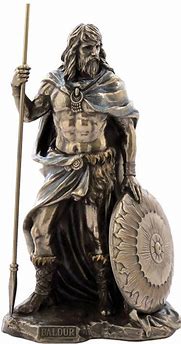
Gods – Baldur

Norse God Baldur from gods-and-goddesses.com

Baldur is the Norse god of innocence, beauty and goodness. He is known as “The Shining One.” He is the most handsome god of Asgard and known for his invulnerability. Ironically, he is most known for his death.

His name is spelled in several different ways, including Baldur, Baldr or Balder.

Baldur Facts

Name(s): Baldur
Rules over: Light, Joy, Summer.
Gender: Male
Symbols: Ringhorn (Greatest of all ships)
Linked Animals:
Parents: Odin (Father) and Frigg (Mother)
Siblings: Hod, Hermod; Thor, Vidar, and Vali are half-siblings
Greek Similar: Apollo
Roman Similar: Apollo

Appearance

The key physical attribute of Baldur is that he exuded beauty, and was possibly the most beautiful of the Aesir gods. He was said to be so beautiful that light shined from him. This can be found in the ancient Norse manuscript called the Prose Edda, from which a substantial amount of what is known about Norse mythology is derived from. The Prose Edda contains four main sections.

In the second section, called Gylfaginning, it states “Hann er svá fagr álitum ok bjartr svá at lýsir af honum, ok eitt gras er svá hvítt at jafnat er til Baldrs brár”. This passage can be roughly translated to “He is so beautiful in appearance and so bright that he shines, and one grass is so white that it is even to Baldr’s brow.”

Family

He is the son of Odin (father) and Frigg (mother). His siblings include Hod and Hermod, and his half-siblings include Vidar, and Vali.

Symbols

The greatest ship ever built was the Ringhorn, or Hringhorni, and belonged to Baldur. It a symbol commonly associated with the god.

Upon Baldur’s death, a giant fire was made on the deck of the Ringhorn, and his body was laid on top of it to be cremated.

Powers & Duties

Baldur is the god and champion of goodness, innocence, and forgiveness. His twin brother, Hod, is the god of darkness.

Myths

Baldur started to have dreams the night after some sort of grave misfortune happened to him. His mother and the other gods were nervous for Baldur because he was one of the most beloved gods in Asgard. They asked Odin what the dream meant, and Odin embarked on a quest to the underworld. There he met a dead seeress who told Odin that Baldur would soon die. When Odin got back and let everyone know, Frigg was desperate to try and save her son.

Frigg was able to get every living thing to promise not to harm him. Therefore, Baldur became invincible and he was even more beloved by everyone in Asgard. However, Loki was jealous of Baldur and tried to discover any weakness he may have. When he asked Frigg if she made sure that everything promised not to harm Baldur, she said she forgot to ask mistletoe, but that it was too small, weak, and innocent to harm him anyway.

During a party, Baldur told everyone to throw sharp objects at him as entertainment since he couldn’t be harmed. Everyone was having a good time. Loki then gave blind Hod (who was unknowingly Baldur’s twin brother) a dart made of mistletoe and told him to throw it at Baldur. When it struck Baldur, he died.

Frigg then asked everyone to travel to the land of the dead and offer Hel, the death-goddess, a ransom for Baldur’s release. Hermod, a son of Odin agreed. When he finally got to the throne room of Hel, he saw a distraught Baldur sitting next to her in a seat of honor. Hermod tried to convince Hel to let Baldur go, explaining that everyone was mourning his death. She said that she’ll let him go if everyone in the world wept for him. However, an old hag called Thokk refused to weep saying that he never did anything for her. But the hag turned out to be Loki, who was caught and chained up for eternal punishment.

But, Baldur won’t be dead forever. Although his death signaled the beginning of the events that would eventually lead to Ragnarok, his resurrection signaled the end of Ragnarok and the beginning of the new world. Once the cosmos was destroyed and recreated and all the gods had served their purposes and fallen to their prophesied fates, Baldur will return to the land of the living. He will bless the land and its inhabitants and bring with him light, happiness, and hope to fill the new world.

Facts About Baldur

  • Skadi had a crush on Baldur and had hoped to choose him based off his shoes, but instead accidentally chose Njord.
  • The name Baldur may mean “brave” or “Bold”, but it may also stem from Norse terms for “white” or “shining”.
  • Baldur’s wife is called Nanna, and they have a son named Forseti, the God of Justice.
  • Baldur’s great hall is called Breidablik.
  • After Baldur’s death, his wife, Nanna, was so distraught, that she herself died.
  • Odin placed the golden ring, Draupnir, on Baldur when he died, but later sent it back to Helheim.
  • Baldur and Hod will rule Asgard together in place of Odin after Ragnarok.
  • When Baldur died, he was placed on his ship Hringhorni for a funeral pyre. But, it was too large to launch the ship out to sea. So, the gods asked Hyrrokkin, the strongest giantess, to push it into the sea. She was successful.
  • Thor hallowed Baldur’s funeral pyre flames by holding his hammer over them.

A Thought for Today

The Wisdom of Buddha

April 8, 2023 Southern Hemisphere’s Planetary Positions

If you need to calculate the planetary positions for a specific use and time, click on this link

Currentplanetarypositions.com

To figure out GMT (Greenwich Mean Time) to your local time use this link  

For Your Local Time and Date 

Southeastern Hemisphere

This local time is in Sao Paulo, Brazil, South America

8 April 2023
06:00 pm GMT 3:00 PM BRT
Zodiac: Tropical (Standard Western)

Sun:18 Aries 38
Moon:19 Scorpio 26
Mercury:07 Taurus 30
Venus:27 Taurus 08
Mars:07 Cancer 08
Jupiter:20 Aries 59
Saturn:03 Pisces 30
Uranus:17 Taurus 12
Neptune:26 Pisces 00
Pluto:00 Aquarius 14

True Lunar Node:04 Taurus 01
Mean Lunar Node:05 Taurus 02 Rx

Lilith (Black Moon):10 Leo 06

Chiron:16 Aries 02
Ceres:26 Virgo 29 Rx
Pallas:20 Cancer 57
Juno:16 Taurus 12
Vesta:26 Aries 50

Eris:24 Aries 30

Fire:6
Earth:7
Air:1
Water:5
Cardinal:7
Fixed:9
Mutable:3

Southern Hemisphere

This local time is in Cape Town, South Africa

8 April 2023
03:00 pm GMT 5:00 PM SAST
Zodiac: Tropical (Standard Western)

Sun:18 Aries 31
Moon:17 Scorpio 47
Mercury:07 Taurus 21
Venus:26 Taurus 59
Mars:07 Cancer 04
Jupiter:20 Aries 57
Saturn:03 Pisces 29
Uranus:17 Taurus 11
Neptune:26 Pisces 00
Pluto:00 Aquarius 14

True Lunar Node:04 Taurus 01
Mean Lunar Node:05 Taurus 02 Rx

Lilith (Black Moon):10 Leo 05

Chiron:16 Aries 01
Ceres:26 Virgo 30 Rx
Pallas:20 Cancer 55
Juno:16 Taurus 07
Vesta:26 Aries 47

Eris:24 Aries 30

Fire:6
Earth:7
Air:1
Water:5
Cardinal:7
Fixed:9
Mutable:3

Southwestern Hemisphere

This local time is in Melbourne, Victoria, Australia

8 April 2023
05:00 am GMT 3:00 PM AEST
Zodiac: Tropical (Standard Western)

Sun:18 Aries 06
Moon:12 Scorpio 16
Mercury:06 Taurus 48
Venus:26 Taurus 30
Mars:06 Cancer 51
Jupiter:20 Aries 51
Saturn:03 Pisces 27
Uranus:17 Taurus 10
Neptune:25 Pisces 59
Pluto:00 Aquarius 14

True Lunar Node:04 Taurus 00
Mean Lunar Node:05 Taurus 03 Rx

Lilith (Black Moon):10 Leo 03

Chiron:16 Aries 00
Ceres:26 Virgo 35 Rx
Pallas:20 Cancer 46
Juno:15 Taurus 53
Vesta:26 Aries 36

Eris:24 Aries 30

Fire:6
Earth:7
Air:1
Water:5
Cardinal:7
Fixed:9
Mutable:3

Spell – Hair on Stick Lust Spell

For many, Friday is the last work day of the week. It’s considered the fifth day of the work week and, also, the “cut loose” day. By Friday night, people are out having a party. That makes Friday the perfect day for lust, banish, fast-grant, and find spells. This day is so powerful (energy wise). That’s why whatever you do on this day will, usually, have a strong effect. If you want things out of your life, the darkness and power, associated with this day, bring the energy you need for that. If you need strong, immediate results, this is your day, as well.

Hair on Stick Lust Spell

Items you will need:

3 strands of hair
1 comb or brush
1 small stick
1 tube of red paint
1 bottle of glue

Spell

Find a small stick and paint it red. While the paint is drying, comb through your hair and take three strands from your comb or brush. After the paint on the stick is dry, cover the stick in glue. Then, wrap the three strands of hair around the stick and let the glue dry.
Now, say this chant:
“I’ve wrapped up my passion.
I’ve wrapped up my lust.
I’m ready for it to come out.
I’m ready to trust
My desires and my will,
So the Universe can make it real.”
Put the stick under your bed, and your desires should could true.

A Witch’s Week of Spells and Activities
Helga C. Loueen