
CIRCLE MAKING THROUGH THE SEASONS
By Selena Fox – Copyright 1985
Reprinted with the expressed written permission of Selena Fox/Circle
Sanctuary
Whether you celebrate the Pagan seasonal holidays indoors or outside, alone or
with others, you can enhance the beauty and effectiveness of you Sabbat
ceremonies by decorating your circle with gifts of Nature appropriate to the
season.
Marking the circle space and the four directions on the ground or floor aids in
visualizing the circle of energy that forms in a place during a ritual. Doing
this is very helpful for beginners in ritual, for new groups, and for ecumenical
workings which include people of many paths. Using seasonal decorations to mark
the circle and quarters strengthens the connection of the participants and the
ceremony with Nature and the particular energy of a holiday. For the same
reason, it also is good to have some seasonal decorations on the altar, whether
it is positioned centrally as we do or at some other place in the circle.
When possible, those taking part in a Sabbat ceremony should ritually collect
decorations for the circle from Nature themselves. When collecting plant parts,
be they dried or fresh, from gardens, parks, or the wilds, before you begin, be
sure to honor the Spirits of the Plants and the Spirit of the Place you are
visiting. Pause a few moments, commune with them through silent meditation,
state your need for circle decorations, and ask for their help. Then, let them
intuitively guide you during the gathering process. When you are done, give
thanks for the gifts you have received. Remember that the decorations you gather
are parts of other life-forms here on Planet Earth, rather than non-sentient
things for you to manipulate for your own purposes. Respect Nature Spirits and
they will become you friends and bring special blessings to your seasonal
celebrations.
Spending time in natural settings to collect decorations before a rite can
greatly help you spiritually align yourself to the season. This is especially
important for you to do if you spend a lot of your waking life inside buildings
and traveling around in heavily urbanized areas. However, if circumstances are
such that you cannot gather decorations from Nature for a holiday, you can still
ask Plant Spirits for guidance in your selection process when you shop in the
marketplace.
Once you have obtained the decorations, as you place them in and around your
circle focus on honoring the space, the plants, the season, and the ritual about
to happen. This can be done silently as a meditation or by jubilantly singing
and moving to a seasonal song. For group rituals, outlining the circle is a
wonderful way to get all participants, including children, involved in preparing
for the ritual. The shared experience of creating the space aids in attunement
and in developing a strong group spirit necessary for effective ceremonies. When
everyone is responsible for bringing a particular kind of decoration to outline
a circle, such as pine boughs for Yule, not only does the circle take form with
greater ease, but more importantly, marking out the circle with everyone’s
contributions symbolizes the blending together of the individual energies of
participants into a harmonious whole.
After a seasonal ritual is over, remove decorations from the circle with the
spirit of thanksgiving. These decorations not only embody the energy of the
Nature Spirits worked with during their gathering, but also contain the energy
of the ritual. They have served as ceremonial tools and should be taken away
with respect, not hurriedly swept up and thrown into a trash can. Often, we
return the natural decorations we have used to Mother Earth, letting wildlife
feed on fruits and grains, and mulching the plants in our gardens with flowers
and greens. Decorations also can be placed on personal altars after the ceremony
as reminders of the season or given as healing gifts to friends who were not
able to be present at the ceremony. If they have been energized for a particular
purpose during a ceremony, decorations can also serve as charms.
The suggestions I present here for each holiday are drawn primarily from my own
experiences doing Sabbats with groups of people in these Northlands, and should
be adapted to suit your own circumstances, such as local climate and vegetation
cycles, ceremonial place, number of ritual participants, and type of spiritual
path. I’ve included ideas for outlining the circle space itself, marking the
quarters and decorating a central altar.
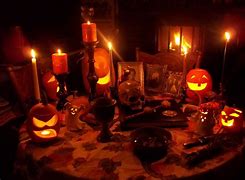
SAMHAIN / HALLOWEEN
Outline the circle with dry colored leaves and perhaps some nuts and sprigs of
dried herbs such as curled dock flowers. At each of the four quarters, stand a
shock of dried corn stalks with a lighted carved pumpkin or jack-o-lantern at
the base. On the altar in the center, place a large jack-o-lantern to symbolize
the Spirit of the holiday and the Otherworld, and surround it with acorns,
symbols of rebirth, and with photographs and other mementos of dead friends,
relatives, and ancestors you would like to honor. You might also place a lit
votive candle by mementos of each loved one to represent their Spirit which
lives on.
YULE / WINTER SOLSTICE
Outline the circle with pine cones and freshly cut pine boughs. Set tall red
candles at the four quarters with holly at their bases. In the center, lay a
Yule wreath of evergreens, preferably one you have fashioned yourself. In the
center of the wreath, place a large red candle to represent the reborn Sun.
Place it in a small cauldron, if you have one, to symbolize the Goddess of
Rebirth. Around the outside of the wreath make another circle with sprigs of
mistletoe which can be energized during the rite and later given to participants
and friends to bring blessings to their homes in the New Solar Year. Our
community Yule altar also contains eight red ribbons representing the Wheel of
the Year, eight plates for Sabbat cakes, and personal blessing candles brought
by participants.
IMBOLC / CANDLEMAS
Outline the circle with white votive candles, symbolizing the purification
aspect of this holiday. Place large white candles at each of the quarters and at
the center. Surround the central candle with any early greens and buds that have
appeared in your area, and with sunflower seeds to represent the promise of
renewed life in coming Spring. The seeds can be later set out for wild birds.
White candles also can be set in the center by participants to symbolize self-
purification and spiritual awakening.
OSTARA / SPRING EQUINOX
Outline the circle with any greenery that has appeared already in the Spring,
such as budding willow branches, ground ivy and other herbs. If Winter snows
still abound, which often is the case here in Wisconsin, use a green cord or
green ribbons to form the circle and represent the greening of Spring. You could
also outline the circle with packets of seeds which will later be planted in
gardens. At each of the four quarters, place a green candle. In the center of
the circle, place a basket with brightly colored hard-boiled eggs in it,
representing the Spring Goddess and the resurrection of life. These eggs can be
eaten as part of the rite or later buried in gardens as fertility charms.
BELTANE / MAY DAY
Outline the circle with a variety of flowers and tree blossoms, symbolizing the
blossoming of life. For group ceremonies, have everyone exchange some of the
flowers they bring with other participants before the outlining of the circle
begins. This ancient gesture of friendship aids in group attunement, generates a
festive mood, and strengthens connection with the love energy of the holiday. At
each of the four quarters, place a basket or vase of flowers. In the center, set
a Maypole decorated with brightly colored ribbons to represent the activating
principle of Nature. The ribbons should be an even number of streamers if the
traditional Maypole dance will be done. Otherwise, each participant should tie a
bit of ribbon around the pole to symbolize wishes for personal growth in the
coming Summer. Free-form ecstatic dancing can then be done around the pole to
energize the wishes. After the rite, take flowers to gardens to bless them and
promote fertility.
LITHA / SUMMER SOLSTICE
Outline the circle with candle lanterns or candles set in earth in wide-mouthed
jars. A beautiful and powerful way to create the circle space with these lights
is to have participants carry the candles in a ritual procession at dusk to the
ceremonial spot, circle it several times clockwise, come to a standstill once a
comfortable sized circle is made, and then set them down behind them. This works
very well especially with large groups and it is a part of each year’s opening
ritual at the International Pagan Spirit Gathering we sponsor at Solstice time.
Luminarias, which are candles set in sand in small paper bags, are another
stunning way to create a ring of light for an evening Solstice ceremony.
However, the ring of light is made, torches or large candles work well in the
four quarters. In the center of the circle, kindle a large bonfire of sacred
woods and herbs, if your location permits. You might want to feed the fire as it
rises with the dried wreath from Yule as we do each year to symbolize the peak
of the Solar Year. Otherwise, set a large red candle in the center, and surround
it with oak boughs, yarrow flowers, and other sacred plants of the season
growing in the area.
LUGHNASSAD / LAMMAS
Outline the circle with stalks of wheat or other grains, if available. Or, if
you prefer, make the circle with sprigs of sweet smelling herbs such as mint and
basil, and with wildflowers such as Queen Anne’s Lace and red clover blossoms.
Set baskets of herbs and Summer flowers at the four quarters and in the center,
representing the productiveness of Nature. Also on the central altar, place a
freshly-bakes loaf of bread to symbolize the Spirit of the holiday. The bread
can be shared among participants and with the Earth as a form of communion.
MABON / FALL EQUINOX
Outline the circle with gourds, apples, nuts, and other foods of the season.
Preferably, these are ones grown in your own gardens or in fields in the local
areas. Set a large gourd or pile of fruits and vegetables at each of the
quarters to represent harvest abundance. In the center, place a thanksgiving
cornucopia or cauldron filled to overflowing with offerings of harvest produce
and herbs. Ears of multi-colored Indian corn also are an excellent seasonal
altar decoration. The foods that ring the circle can later be eaten in a Harvest
feast. The central offerings should be returned to the Earth in thanksgiving.
With my thanks to Lady Abyss for this great information first posted this in January 2011






 Witches Of The Craft®
You must be logged in to post a comment.