Deity of the Day for July 13 is Baldur, Norse God of Light

Deity of the Day

Baldur, Norse God of Light


Baldur was the son of Frigga and Odin, and the twin brother of Hod, or Hodur. Baldur’s name sometimes appears as Balder, or alternately Baldr. Baldur was beautiful and radiant, and was beloved by all the gods. Hodur, on the other hand, was dark and moody, spent a lot of time in darkness because of his blindness, and was generally unpopular with everyone he met.

In one famous story, after Baldur reveals that he’s been having foreboding dreams, Frigga asked all of nature to promise not to cause any harm to her beloved son.
From Sæmund’s Edda:
“On a course they resolved,
that they would send
to every being,
assurance to solicit,
Balder not to harm.
All species swore
oaths to spare him;
Frigg received all
their vows and compacts.”

Unfortunately, in her haste, Frigga overlooked the mistletoe plant, so Loki – the resident trickster – took advantage of the opportunity and fooled Hod into killing his twin brother with a spear made of mistletoe. Baldur was later restored to life.

Because of the story of his life, death and resurrection, Baldur features prominently in Norse mythology. An important festival was held in honor of Baldur the Good at midsummer, because it was known to be the anniversary of his death and descent into the underworld. Celebrations were held involving big bonfires and outdoor festivities, much of which involved watching the sun rise and set. Bear in mind that in the extreme Northern latitudes inhabited by the Norse peoples, the sun never really sets at midsummer; instead, it touches the horizon and then rises again to begin a new day.

When Christianity moved into the Norse countries, Baldur’s celebration became the festival of St. John instead.


Source:
Author:aganism/Wicca Expert

Website: Article Found On & Owned By About.com

Deity of the Day for July 8th is Ares, Roman God of War

Deity of the Day


Ares
Greek God of War

Ares, the Greek Warrior God:

Ares was a Greek god of war, and son of Zeus by his wife Hera. He was known not only for his own exploits in battle, but also for getting involved in disputes between others. Furthermore, he often served as an agent of justice.

The Rape of Alkippe:

A Greek legend tells the tale of Ares slaying of one of Poseidon’s sons. Ares had a daughter, Alkippe, and Poseidon’s son Halirrhothios attempted to rape her.

Ares interrupted before the act was completed, and promptly killed Halirrhothios. Poseidon, livid at the murder of one of his own children, put Ares on trial before the twelve gods of Olympus. Ares was acquitted, as his violent actions were justified.

Worship of Ares:

As a warrior god, Ares wasn’t quite as popular with the Greeks as his counterpart, Mars, was among the Romans. This may have been due to his unreliability and unpredictable violence – something which would have been completely contrary to the Greek sense of order. He doesn’t seem to have been very popular among the Greeks, who appear to have been mostly just indifferent to him.

In fact, many of the legends surrounding Ares culminate in his own defeat and humiliation. In Homer’s Odyssey, Zeus himself insults Ares after his return from the battlefields of Troy – where Ares was defeated by the armies of Athena. Zeus says:
Do not sit beside me and whine, you double-faced liar.
To me you are the most hateful of all gods who hold Olympus.
Forever quarreling is dear to your heart, wars and battles.

His worship was centered in small cults, rather than amongst the general populace of Greece. Specifically, more warlike areas like Macedonia, Thrace, and Sparta paid homage to Ares.

There are numerous accounts of a Spartan man, Menoikeus, offering himself as sacrifice to Ares, in order to secure the gates of Thebes. Gaius Julius Hyginus, a Greek historian, wrote in Fabulae, “When the Thebans consulted Teiresias, he told them that they would win the battle if Kreon’s son Menoikeus [one of the Spartoi] were to offer himself as a victim to Ares. When he heard this, Menoikeus took his life in front of the gates.”

Although little is known of the cults of Ares and how they specifically paid tribute, most sources do refer to sacrifices being made prior to battle. Herodotus refers to the offerings made by the Scythians, in which one of every one hundred prisoners taken in battle is sacrificed to Ares. He also describes, in his Histories, a festival which took place in Papremis, part of Egypt. The celebration re-enacts the meeting of Ares with his mother, Hera, and involves beating priests with clubs – a ritual which often turned violent and bloody.

The Warrior Oath

Aeschylus’ epic narrative, Seven Against Thebes, includes a warrior’s oath and sacrifice to Ares:
Seven warriors yonder, doughty chiefs of might,
Into the crimsoned concave of a shield
Have shed a bull’s blood, and, with hands immersed
Into the gore of sacrifice, have sworn
By Ares, lord of fight, and by thy name,
Blood-lapping Terror, Let our oath be heard-
Either to raze the walls, make void the hold
Of Cadmus – strive his children as they may –
Or, dying here, to make the foemen’s land
With blood impasted.

Today, Ares is seeing a resurgence in popularity thanks to a number of pop culture references. He appears in Rick Riordan’s highly successful Percy Jackson series for young readers, as well as Suzanne Collins’ books about Gregor the Overlander. He also shows up in video games, such as God of War and was portrayed by the late actor Kevin Smith in the Xena: Warrior Princess television series.

Some Hellenic Pagans pay tribute to Ares as well, in rituals honoring his bravery and masculinity


Source
Author:Patti Wigington , Paganism/Wicca Expert

Website: Article found on & owned by About.com

Goddess For Today: Thmei

4th of July Comments

Goddess For Today: Thmei
Independence Day (United States)

Themes   Freedom; Justice; Honor; Divination; Balance; Equality; Foresight; Morality
Symbols   Scales or Balanced Items:  Ostrich Feathers

About Thmei:  This Egyptian Goddess of Law and Mother of virtue watches over human conduct, looking for right action, wise decisions,
ethical dealings, and just outcomes.  On a broader scale, she also tends to matters of universal law, that we might learn its patterns, internalize
its ideals, and then use this awareness throughout the year.

In some instances, Thmei is considered a prophetic Goddess to call on in determining the outcome of any course of action, especially legal ones.
Egyptian art depicts Thmei bearing a single ostrich feather, the symbol of truth with self and others.

To Do Today:  Celebrate your personal independence, and break free from any constraints that seem unjust or
unethical, asking Thmei for the power and courage to endure. To make a Thmei charm that draws equity into all
your dealings, find a portable token that, to you, represents balance, harmony, and fairness.  Put this on your
bathroom scale, saying, Balance and harmony within this shrine, Thmei, make impartial dealings mine!
Carry this token with you, or leave it in the area where you feel inequity or discord exists.
)0(
By Patricia Telesco ~ From “365 Goddess” and GrannyMoon’s Morning Feast


Courtesy of GrannyMoonsMorningFeast

Deity of the Day for July 3rd is Khepri, The Egyptian God

Deity of the Day

Khepri


Khepri (also spelled Khepera, Kheper, Khepra, Chepri) is a god in the ancient Egyptian religion.

Khepri was connected with the scarab beetle (kheprer), because the scarab rolls balls of dung across the ground, an act that the Egyptians saw as a symbol of the forces that move the sun across the sky. Khepri was thus a solar deity. Young dung beetles, having been laid as eggs within the dung ball, emerge from it fully formed. Therefore, Khepri also represented creation and rebirth, and he was specifically connected with the rising sun and the mythical creation of the world. The Egyptians connected his name with the Egyptian language verb kheper, meaning “develop” or “come into being”. Kheper, (or Xeper) is a transcription of an ancient Egyptian word meaning to come into being, to change, to occur, to happen, to exist, to bring about, to create, etc. Egyptologists typically transliterate the word as ?pr. Both Kheper and Xeper possess the same phonetic value and are pronounced as “kheffer”.

There was no cult devoted to Khepri, and he was largely subordinate to the greater sun god Ra. Often, Khepri and another solar deity, Atum, were seen as aspects of Ra: Khepri was the morning sun, Ra was the midday sun, and Atum was the sun in the evening.

Khepri was principally depicted as a scarab beetle, though in some tomb paintings and funerary papyri he is represented as a human male with a scarab as a head. He is also depicted as a scarab in a solar barque held aloft by Nun. The scarab amulets that the Egyptians used as jewelry and as seals represent Khepri.


Source:
Wikipedia

WOTC Extra (b) – The Divine Masculine

Witchy CommentsThe Divine Masculine

The feminine is not complete without the masculine; together, these energetic polarities form a whole. Before the re-emergence of Goddess-centered spirituality, only the male divinity’s face was present in most parts of the world. Some Wiccans and Witches concentrate on the Divine Feminine. Others, however, believe that the Divine expresses as both male and female.

Witches often depict the Divine Masculine as having three faces, which represent the stages of a man’s life: youth, maturity, and old age. However, Witches aren’t the only ones who envision a tripart God. Christians honor the male trinity of Father, Son, and Holy Spirit. In the Hindu religion, Brahma represents the creative principle of God, Vishnu is considered the preserver, and Shiva is the destroyer. Although the cultural aspects of these deities may differ, they still recognize the tripart expression of the masculine force.
The Only Book of Wiccan Spells You’ll Ever Need (The Only Book You’ll Ever Need)
Marian Singer; Trish MacGregor


WOTC Extra (a) – The Divine Feminine

Witchy Comments The Divine Feminine

Many Wiccans believe that the Divine is both feminine and masculine, so they venerate the Goddess and God. The Goddess is symbolized by Mother Earth. Concern for the environment and “green” practices demonstrate respect for the Goddess, who is manifest in all of nature. It’s no accident that movements honoring the Earth and the Goddess evolved simultaneously. Indeed, many Witches believe that unless Goddess energy reawakens within each of us and in the world as a whole, the planet may be destroyed.

Witches often depict the Goddess in three stages that represent the three phases of a woman’s life: maiden, mother, and crone. Celtic art illustrates this tripart nature as three interlocking pointed loops called vesica piscis, which symbolize the opening to the womb. Others show the feminine trinity as three phases of the moon: waxing, waning, and full.

The Only Book of Wiccan Spells You’ll Ever Need (The Only Book You’ll Ever Need)
Marian Singer; Trish MacGregor

Let’s Talk Witch – Honoring and Invoking Deities

Witchy CommentsHonoring and Invoking Deities

Many witches believe that divine assistance is always available to you and that Gods and Goddesses gladly offer their guidance, help, and energy to humans to use for positive purposes. Some view divine beings as higher aspects of human consciousness, which can be accessed and activated through magickal means.

Ask First!

If you want to connect with a particular entity, first ask that god or goddess to listen to your request and come to your aid. One theory states that deities will not interfere with your own free will— you must ask them sincerely for help.

If you aren’t used to considering a divine being as a partner in your spiritual and practical pursuits, you may wonder how to go about petitioning your favorite god or goddess for assistance. Here are a few suggestions:

Make an offering of some sort to the deity. Burning incense is a popular offering, although you may wish to choose an offering that more specifically corresponds to the nature of the deity whose help you seek.

Place a figurine of the chosen deity on your altar and focus your attention on it.

Use an oracle, such as tarot cards or runes, to access divine wisdom and open your mind to messages from the deities.

Pray.

Meditate.

Light a candle in honor of the deity you wish to petition.

Design and perform a ritual to the deity.

Write your request on a slip of paper, then burn it.

Choose a crystal or gemstone that relates to the deity. Carry the stone in your pocket and touch it periodically.

Plant herbs or flowers in honor of the god or goddess. Choose plants that correspond to the deity’s nature and your intent, such as roses for love or mint for prosperity.

 
The Only Book of Wiccan Spells You’ll Ever Need (The Only Book You’ll Ever Need)
Marian Singer; Trish MacGregor

Deity of the Day for June 30 is Helios

Deity of the Day

Helios


Helios (/ˈhiːli.ɒs/; Ancient Greek: Ἥλιος Hēlios; Latinized as Helius; Ἠέλιος in Homeric Greek) was the personification of the Sun in Greek mythology. He is the son of the Titan Hyperion and the Titaness Theia (Hesiod) (also known as Euryphaessa (Homeric Hymn 31)) and brother of the goddesses Selene, the moon, and Eos, the dawn.

Helios was described as a handsome titan crowned with the shining aureole of the Sun, who drove the chariot of the sun across the sky each day to earth-circling Oceanus and through the world-ocean returned to the East at night. In the Homeric hymn to Helios, Helios is said to drive a golden chariot drawn by steeds (HH 31.14–15); and Pindar speaks of Helios’s “fire-darting steeds” (Olympian Ode 7.71). Still later, the horses were given fiery names: Pyrois, Aeos, Aethon, and Phlegon.

As time passed, Helios was increasingly identified with the god of light, Apollo. However, in spite of their syncretism, they were also often viewed as two distinct gods/titan (Helios was a Titan, whereas Apollo was an Olympian). The equivalent of Helios in Roman mythology was Sol, specifically Sol Invictus.

The best known story involving Helios is that of his son Phaëton, who attempted to drive his father’s chariot but lost control and set the earth on fire.

Helios was sometimes characterized with the epithet Panoptes (“the all-seeing”). In the story told in the hall of Alcinous in the Odyssey (viii.300ff.), Aphrodite, the consort of Hephaestus, secretly beds Ares, but all-seeing Helios spies on them and tells Hephaestus, who ensnares the two lovers in nets invisibly fine, to punish them.

In the Odyssey, Odysseus and his surviving crew land on Thrinacia, an island sacred to the sun god, whom Circe names Hyperion rather than Helios. There, the sacred red[citation needed] cattle of the Sun were kept:

You will now come to the Thrinacian island, and here you will see many herds of cattle and flocks of sheep belonging to the sun-god. There will be seven herds of cattle and seven flocks of sheep, with fifty heads in each flock. They do not breed, nor do they become fewer in number, and they are tended by the goddesses Phaethusa and Lampetia, who are children of the sun-god Hyperion by Neaera. Their mother when she had borne them and had done suckling them sent them to the Thrinacian island, which was a long way off, to live there and look after their father’s flocks and herds.

Though Odysseus warns his men, when supplies run short they impiously kill and eat some of the cattle of the Sun. The guardians of the island, Helios’ daughters, tell their father about this. Helios appeals to Zeus telling them to dispose of Odysseus’ men or he will take the Sun and shine it in the Underworld. Zeus destroys the ship with his lightning bolt, killing all the men except for Odysseus.
Solar Apollo with the radiant halo of Helios in a Roman floor mosaic, El Djem, Tunisia, late 2nd century

In one Greek vase painting, Helios appears riding across the sea in the cup of the Delphic tripod which appears to be a solar reference. Athenaeus in Deipnosophistae relates that, at the hour of sunset, Helios climbed into a great golden cup in which he passes from the Hesperides in the farthest west to the land of the Ethiops, with whom he passes the dark hours. While Heracles traveled to Erytheia to retrieve the cattle of Geryon, he crossed the Libyan desert and was so frustrated at the heat that he shot an arrow at Helios, the Sun. Almost immediately, Heracles realized his mistake and apologized profusely, in turn and equally courteous, Helios granted Heracles the golden cup which he used to sail across the sea every night, from the west to the east because he found Heracles’ actions immensely bold. Heracles used this golden cup to reach Erytheia.

By the Oceanid Perse, Helios became the father of Aeëtes, Circe and Pasiphaë. His other children are Phaethusa (“radiant”) and Lampetia (“shining”).

Helios is sometimes identified with Apollo: “Different names may refer to the same being,” Walter Burkert observes, “or else they may be consciously equated, as in the case of Apollo and Helios.”

In Homeric literature, Apollo is clearly identified as a different god, a plague-dealer with a silver (not golden) bow and no solar features.

The earliest certain reference to Apollo identified with Helios appears in the surviving fragments of Euripides’ play Phaethon in a speech near the end (fr 781 N²), Clymene, Phaethon’s mother, laments that Helios has destroyed her child, that Helios whom men rightly call Apollo (the name Apollo is here understood to mean Apollon “Destroyer”).

By Hellenistic times Apollo had become closely connected with the Sun in cult. His epithet Phoebus, Phoibos “shining”, drawn from Helios, was later also applied by Latin poets to the sun-god Sol.
Coin of Roman Emperor Constantine I depicting Sol Invictus/Apollo with the legend SOLI INVICTO COMITI, c. 315 AD.

The identification became a commonplace in philosophic texts and appears in the writing of Parmenides, Empedocles, Plutarch and Crates of Thebes among others, as well as appearing in some Orphic texts. Pseudo-Eratosthenes writes about Orpheus in Catasterismi, section 24:

“But having gone down into Hades because of his wife and seeing what sort of things were there, he did not continue to worship Dionysus, because of whom he was famous, but he thought Helios to be the greatest of the gods, Helios whom he also addressed as Apollo. Rousing himself each night toward dawn and climbing the mountain called Pangaion, he would await the sun’s rising, so that he might see it first. Therefore Dionysus, being angry with him, sent the Bassarides, as Aeschylus the tragedian says; they tore him apart and scattered the limbs.”

Dionysus and Asclepius are sometimes also identified with this Apollo Helios.

Classical Latin poets also used Phoebus as a byname for the sun-god, whence come common references in later European poetry to Phoebus and his car (“chariot”) as a metaphor for the sun. But in particular instances in myth, Apollo and Helios are distinct. The sun-god, the son of Hyperion, with his sun chariot, though often called Phoebus (“shining”) is not called Apollo except in purposeful non-traditional identifications.

Despite these identifications, Apollo was never actually described by the Greek poets driving the chariot of the sun, although it was common practice among Latin poets. Therefore, Helios is still known as the ‘sun god’ – the one who drives the sun chariot across the sky each day.


Source:
Wikipedia

WOTC Extra – Gods and Their Attributes

The SupernaturalGods and Their Attributes


Since the beginning of time, cultures around the world have honored a masculine force. The yang energy of the universe has been depicted in various guises and personalities, as individual deities with specific natures, powers, and responsibilities. The many faces of the God express qualities associated with the male archetype: strength, virility, daring, leadership skills, logic, protection, knowledge, and courage.

Archetypes transcend nationalities and religions, appearing in various yet similar forms in many different cultures. For example, the Greek god Zeus corresponds to the Roman god Jupiter. You can see overlaps between the Egyptian god Thoth and the Greeks’ Hermes. Mars and Mithras, both gods of war, were worshiped by soldiers in Rome and Persia, respectively.

On days when a witch wishes to identify with certain god-like qualities, she can ask for help from a deity who embodies those attributes. If you want to ace an exam, you could call on Mercury, Thoth, or Hermes to assist you. If you hope to overcome a formidable challenge or adversary, Ganesh is the god with whom to ally yourself. Regardless of your goal or concern, you’ll find a deity who can provide the help you need.
 
The Everything Wicca and Witchcraft Book: Rituals, spells, and sacred objects for everyday magick (Everything®)
Skye Alexander

Let’s Talk Witch – Honoring and Invoking Deities

The SupernaturalHonoring and Invoking Deities


How can you get a god or goddess on your side? Many witches believe that divine assistance is always available to you and that the deities gladly offer their guidance, help, and energy to humans to use for positive purposes. Some view divine beings as higher aspects of human consciousness, which can be accessed and activated through magickal means.

If you aren’t used to considering a divine being as a partner in your spiritual and practical pursuits, you may wonder how to go about petitioning your favorite god or goddess for assistance. Here are a few suggestions.

1. Make an offering of some sort to the deity. Burning incense is a popular offering, although you may wish to choose an offering that more specifically corresponds to the nature of the deity whose help you seek.

2. Place a figurine of the chosen deity on your altar and focus your attention on it.

3. Use an oracle, such as tarot cards or runes, to access Divine Wisdom and open your mind to messages from the deities.

4. Pray.

5. Meditate.

6. Light a candle in honor of the deity you wish to petition.

7. Design and perform a ritual to the deity.

8. Write your request on a slip of paper, then burn it.

9. Choose a crystal or gemstone that relates to the deity. Carry the stone in your pocket and touch it periodically.

10. Plant herbs or flowers in honor of the god or goddess. Choose plants that correspond to the deity’s nature and your intent, such as roses for love or mint for prosperity.

The Everything Wicca and Witchcraft Book: Rituals, spells, and sacred objects for everyday magick (Everything®)
Skye Alexander

Deity of the Day for June 22nd – Olwen, Welsh Goddess

Deity of the Day


Olwen

Welsh Goddess

(Welsh) [O-loon] Also Olwyn. A daughter of the king of the Giants, Ysbadadden. Her name means “the golden wheel”, which makes some see her as an opposing force to Arianrhod of “the silver wheel”. Her other nickname was “Lady of the White Tracks” because wherever she walked the trefoil plants commonly called shamrocks would pop up. This indicated that she may have been a Triple Goddess unto herself with several other associations long lost to us.

The hero Culhwch was a suitor of Olwen’s who went on a mythic journey to find her after her father, who knew he would die if their marriage took place, hid her. In this part of the myth she is the May Queen, a partner of the new sacrificial God who takes the place of the old one

Olwen also had adventures in faeryland after she was captured by horse riding faeries. She was rescued by her father after a year and a day of captivity. (May Queens are often linked to the faery kingdom.)

Deity of the Day for June 14th – Lugh (Celtic God)

Deity of the Day

Lugh

Master of Skills


Patron of the Arts:

Similar to the Roman god Mercury, Lugh was known as a god of both skill and the distribution of talent. There are countless inscriptions and statues dedicated to Lugh, and Julius Caesar himself commented on this god’s importance to the Celtic people. Although he was not a war god in the same sense as the Roman Mars, Lugh was considered a warrior because to the Celts, skill on the battlefield was a highly valued ability.

In Ireland, which was never invaded by Roman troops, Lugh is called sam ildanach, meaning he was skilled in many arts simultaneously.

Lugh Enters the Hall of Tara:

In one famous legend, Lugh arrives at Tara, the hall of the high kings of Ireland. The guard at the door tells him that only one person will be admitted with a particular skill — one blacksmith, one wheelwright, one bard, etc. Lugh enumerates all the great things he can do, and each time the guard says, “Sorry, we’ve already got someone here who can do that.” Finally Lugh asks, “Ah, but do you have anyone here who can do them ALL?” At last, Lugh was allowed entrance to Tara.

The Book of Invasions:

Much of the early history of Ireland is recorded in the Book of Invasions, which recounts the many times Ireland was conquered by foreign enemies. According to this chronicle, Lugh was the grandson of one of the Fomorians, a monstrous race that were the enemy of the Tuatha De Danann. Lugh’s grandfather, Balor of the Evil Eye, had been told he would be murdered by a grandson, so he imprisoned his only daughter in a cave.

One of the Tuatha seduced her, and she gave birth to triplets. Balor drowned two of them, but Lugh survived and was raised by a smith. He later led the Tuatha in battle, and indeed killed Balor.

Roman Influence:

Julius Caesar believed that most cultures worshipped the same gods and simply called them by different names. In his Gallic War essays, he enumerates the popular deities of the Gauls and refers to them by what he saw as a corresponding Roman name. Thus, references made to Mercury actually are attributed to a god Caesar also calls Lugus — Lugh. This god’s cult was centered in Lugundum, which later became Lyon, France. His festival on August 1 was selected as the day of the Feast of Augustus, by Caesar’s successor, Octavian Augustus Caesar, and it was the most important holiday in all of Gaul.

Weapons and War:

Although not specifically a war god, Lugh was known as a skilled warrior. His weapons included a mighty magic spear, which was so bloodthirsty that it often tried to fight without its owner. According to Irish myth, in battle, the spear flashed fire and tore through the enemy ranks unchecked. In parts of Ireland, when a thunderstorm rolls in, the locals say that Lugh and Balor are sparring – thus giving Lugh one more role, as a god of storms.

The Many Aspects of Lugh:

According to Peter Beresford Ellis, the Celts held smithcraft in high regard. War was a way of life, and smiths were considered to have magical gifts — after all, they were able to master the element of Fire, and mold the metals of the earth using their strength and skill. Yet in Caesar’s writings, there are no references to a Celtic equivalent of Vulcan, the Roman smith god.

In early Irish mythology, the smith is called Goibhniu, and is accompanied by two brothers to create a triple god-form. The three craftsmen make weaponry and carry out repairs on Lugh’s behalf as the entire host of the Tuatha De Danann prepares for war. In a later Irish tradition, the smith god is seen as a master mason or a great builder. In some legends, Goibhniu is Lugh’s uncle who saves him from Balor and the monstrous Formorians.

One God, Many Names

The Celts had many gods and goddesses, due in part to the fact that each tribe had its own patron deities, and within a region there might be gods associated with particular locations or landmarks. For example, a god who watched over a particular river or mountain might only be recognized by the tribes who lived in that area. Lugh was fairly versatile, and was honored nearly universally by the Celts. The Gaulish Lugos is connected to the Irish Lugh, who in turn is connected to the Welsh Llew Llaw Gyffes.

Celebrating the Harvest of Grain

The Book of Invasions tells us that Lugh came to be associated with grain in Celtic mythology after he held an harvest fair in honor of his foster mother, Tailtiu. This day became August 1, and that date ties in with the first grain harvest in agricultural societies in the Northern Hemisphere. In fact, in Irish Gaelic, the word for August is lunasa. Lugh is honored with corn, grains, bread, and other symbols of the harvest. This holiday was called Lughnasadh (pronounced Loo-NA-sah). Later, in Christian England the date was called Lammas, after the Saxon phrase hlaf maesse, or “loaf mass.”

An Ancient God for Modern Times

For many Pagans and Wiccans, Lugh is honored as the champion of artistry and skills. Many artisans, musicians, bards, and crafters invoke Lugh when they need assistance with creativity. Today Lugh is still honored at the time of harvest, not only as a god of grain but also as a god of late summer storms.

Even today, in Ireland many people celebrate Lughnasadh with dancing, song, and bonfires. The Catholic church also has set this date aside for a ritual blessing of farmers’ fields.


Source:

Deity of the Day for June 13th is Minerva Roman Goddess of Wisdom

Deity of the Day

Minerva

Roman Goddess of Wisdom


Areas of Influence: Minerva was the Goddess of wisdom and crafts.

Only in Rome was she worshiped as the Goddess of war.

This Goddess represented the application of intellect to everyday tasks. As the Goddess of wisdom she was accredited with inventing spinning, weaving, numbers and music. Her attributes were so numerous that Ovid described her as the “Goddess of a thousand works.”
She is also the patron of Goddess of medicine.

Origins and Genealogy: The name of this Goddess is said to be of Etruscan origin.

Her parents were Jupiter and Métis. Elements of the myths surrounding her birth however have been poached from Greek Goddess Athena, as she too is born fully grown, from her father’s head.

She was considered third among the Gods and Goddesses and was part of the Capitolian triad alongside Juna and Jupiter.

Strengths: Wisdom, creativity and strength.

Weaknesses: Out of touch with emotions.

Minerva’s Symbolism

The Roman Goddess of wisdom is depicted in full battle dress with a coat of mail, a helmet and a spear.

Sacred Animal/Insect: Owl and the spider.

Sacred Plants: Her sacred plants were the olive, mulberry and alder trees.

Festivals: The main festival celebrating this Goddess took place March 19th – 23rd.

A smaller festival occurred later in the year on the 13th of June.

Greek Equivalent: Athena

Minerva’s Archetypes

The Teacher/ Inventor:

The Teacher and Inventor communicates knowledge, experience and wisdom.

In it’s shadow aspect, the Teacher may manipulate and mislead their students by indoctrinating them with negative beliefs and destructive behaviours.

This is Minerva’s primary Archetype as she teaches humans how to spin and weave. She is also accredited in Roman mythology for inventing numbers and medicine.

The Warrior:

Archetype represents physical strength, and the ability to protect and fight for your rights and those of of others.

The shadow side of the Warrior reflects the need to win at all costs, abandoning ethical principles to prove your supremacy.

Although Roman mythology borrows heavily from it’s Greek counterparts, it is only in Rome that Minerva is worshipped as the Goddess of war, despite always being depicted in full battle dress. This is why I have ranked this Archetype as only of secondary importance for this Goddess.

How To Work With These Archetypes

The Teacher/Inventor:

This Archetype may suggest a love of passing on wisdom and learning to others.

This Goddess wise counsel can also be called upon to help you see a way through any present difficulties or to help you to master a new skill.

The shadow aspect of this stereo type is also a reminder that whenever we find ourselves in a teaching or mentoring role we must aim to be a positive role model, encouraging others to reach their full potential.

The Warrior:

If you are drawn to work with this Goddess you may require her Warrior spirit to help you to stand up for your rights and set firm personnal boundries. This Goddess can be a great stereotype to work with if you want to take control in your life, and wish to no longer play the role of the victim.

You may also wish to call upon this Goddess to champion the cause of others.

Conversely this Goddess may appeal to you if you have a very strong sense of self and are proud of the victories you have achieved. The shadow side may be asking you to reflect honestly on the cost of these victories. Have they been at the expense of others or your principals?


Source:

The Goddess-Guide.com

Deity of the Day for June 9th is Eris, Goddess of Chaos

Deity of the Day

Eris

A goddess of chaos, Eris is often present in times of discord and strife. She loves to start trouble, just for her own sense of amusement, and perhaps one of the best known examples of this was a little dustup called the Trojan War.

It all started with the wedding of Thetis and Pelias, who would eventually have a son named Achilles. All of the gods of Olympus were invited, including Hera, Aphrodite and Athena – but Eris’ name got left off the guest list, because everyone knew how much she enjoyed causing a ruckus.

Eris, the original wedding crasher, showed up anyway, and decided to have a little fun. She tossed a golden apple – the Apple of Discord – into the crowd, and said it was for the most beautiful of the goddesses. Naturally, Athena, Aphrodite and Hera had to bicker over who was the rightful owner of the apple.

Zeus, trying to be helpful, chose a young man named Paris, a prince of the city of Troy, to select a winner. Aphrodite offered Paris a bribe he couldn’t resist – Helen, the lovely young wife of King Menelaus of Sparta. Paris selected Aphrodite to receive the apple, and thus guaranteed that his hometown would be demolished by the end of the war.


Deity of the Day for May 14th is Pomona

Deity of the Day

Pomona

Areas of Influence: Pomona was one of the Numina, the Roman guardian spirits who watched over people, homes and special places. She protected fruiting trees and gardens.

She is an agricultural Goddess , responsible for the care and cultivation of fruit trees and orchards. Her name is actually derived from the Latin word pomun, meaning fruit. Her dedication to her work left her little time for love. She turned down the offers of marriage from Silvanus and Picus but was eventually tricked into marriage by Vertumnus. This deity was served by high priests known as Flamen Pomonalis in a sacred grove known as the Pomonal.

Origins and Genealogy: I can find no references to her parents, siblings and children.

Strengths: A nurturer, dedicated to her job. As a fertility Goddess she represented abundance.

Weaknesses: So busy looking after her trees that she has little time for herself.

Symbolism: A popular figure in art she is shown as a beautiful Goddess carrying a knife to prune with and a platter of fruit or a cornucopia.

Sacred Animal/Bird/Plant: Apples.

Festival: A feast was held annually on the November 1st when apples, nuts and grapes were consumed to celebrate the harvest.

Unlike many of the Roman Goddesses she has no specific Greek equivalent.

Pomona’s Archetype

The Mother

The Mother is a life-giver and the source of nurturing, devotion, patience and unconditional love. The ability to forgive and provide for her children and put them before herself is the essence of a good mother.

In its shadow aspect the Mother can be devouring, abusive and abandoning. The shadow Mother can also make her children feel guilty about becoming independent and leaving her. It is not necessary to be a biological Mother to have this stereotype. It can refer to anyone who has a lifelong pattern of nurturing and devotion to living things.

As Goddess of the harvest she represents the Mother Archetype as she nurtures the fruits, trees and the plants in the garden.

How to Work With This Archetype

The Mother

You are exhibiting the features of the shadow Mother if you smother your children and are over protective. Encourage independence and allow children to make mistakes but be available to give care and advice when it’s needed.

The other shadow Mother is the one that abandons her children, or is so busy that she has no time for nurturing her young.


Source:
Goddess-Guide.com

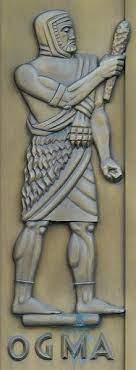
Gods – OgmaCeltic God c.2015


Ogma

Celtic God


In Irish-Celtic myth, Ogma is the god of eloquence and learning. He is the son of the goddess Danu and the god Dagda, and one of the foremost members of the Tuatha Dé Danann. He is the reputed inventor of the ancient Ogham alphabet which is used in the earliest Irish writings.

In the final battle at Mag Tuireadh he managed to take away the sword of the king of the Fomorians, but had to pay with his life for this feat. His Celtic equivalent is Ogmios.

Ogma or Oghma is a character from Irish mythology. A member of the Tuatha Dé Danann, he is often considered a deity and may be related to the Gaulish god Ogmios.

He fights in the first battle of Mag Tuired, when the Tuatha Dé take Ireland from the Fir Bolg. Under the reign of Bres, when the Tuatha Dé are reduced to servitude, Ogma is forced to carry firewood, but nonetheless is the only one of the Tuatha Dé who proves his athletic and martial prowess in contests before the king. When Bres is overthrown and Nuadu restored, Ogma is his champion. His position is threatened by the arrival of Lugh at the court, so Ogma challenges him by lifting and hurling a great flagstone, which normally required eighty oxen to move it, out of Tara, but Lugh answers the challenge by hurling it back. When Nuadu hands command of the Battle of Mag Tuired to Lugh, Ogma becomes Lugh’s champion, and promises to repel the Fomorian king, Indech, and his bodyguard, and to defeat a third of the enemy. During the battle he finds Orna, the sword of the Fomorian king Tethra, which recounts the deeds done with it when unsheathed. During the battle Ogma and Indech fall in single combat, although there is some confusion in the texts as in Cath Maige Tuired Ogma, Lugh and the Dagda pursue the Fomorians after the battle to recover the harp of Uaitne, the Dagda’s harper.

He often appears as a triad with Lugh and the Dagda, who are sometimes collectively known as the trí dée dána or three gods of skill, although that designation is elsewhere applied to other groups of characters. His father is Elatha and his mother is usually given as Ethliu, sometimes as Étaín. His sons include Delbaeth and Tuireann. He is said to have invented the Ogham alphabet, which is named after him.

Scholars of Celtic mythology have proposed that Ogma represents the vestiges of an ancient Celtic god. By virtue of his battle prowess and invention of Ogham, he is compared with Ogmios, a Gaulish deity associated with eloquence and equated with Herakles. J. A. MacCulloch compares Ogma’s epithet grianainech (sun-face) with Lucian’s description of the “smiling face” of Ogmios, and suggests Ogma’s position as champion of the Tuatha Dé Danann may derive “from the primitive custom of rousing the warriors’ emotions by eloquent speeches before a battle”, although this is hardly supported by the texts. Scholars such Rudolf Thurneysen and Anton van Hamel dispute any link between Ogma and Ogmios.

*
A Proto-Indo-European root *og-mo– ‘furrow, track, incised line’ may be the origin of the stem of the name. In addition, Proto-Celtic had a causative verbal suffix *-ej– ~ *-īj-. A hypothetical Proto-Celtic *Ogm-īj-o-sogm-. This agent noun would therefore mean ‘furrow-maker, incisor’ and may have had a metaphorical sense of ‘impresser.’ therefore looks very much like an agent noun derived from a verb formed by the addition of this causative suffix to the stem *

The Irish god of writing, eloquence and poetry. Ogma was credited of being inventor of the Celtic writing systems that the Druids used for their magic. These scripts were known as Ogham.

Ogma was the son of Dagda and the goddess Danu. Some other writers say that Ogma and Dagda were brothers; in this version they were the sons of Eithne. Ogma had also being called the son of Elatha, the king of the Fomorians.

Ogma was one the seven champions in the First Battle of Moytura (Mag Tuired), but when Bres became the king of Tuatha dé Danann, Ogma was degraded into working on humiliating manual job of gathering firewood.
When Lugh went to Nuada, asking for a place to serve the king, Ogma seemed to be Nuada’s foremost fighter. During the second battle of Moytura, Ogma had killed one of the Fomorian leaders, named Indech, the son of Domnu.

Ogma had married Etain, the daughter of Dian Cécht. Ogma had a son named Caipre. Some say that he was the father of MacCuill, MacCecht and MacGrené (MacGrene), the three Danann kings who ruled Ireland, during the Milesian invasion, though other say that Neit was their father.
To the Celtic Gauls he was called Ogmios. According to both Gallic and Irish myths Ogma was a warrior god, depicted as a wrinkled old man, wearing lion’s skin cloak, carrying a bow and club. The Romans considered Ogmios as the Celtic equivalent of Hercules (Greek Heracles). They also depicting Ogimos as holding people chained to his tongue by their ears, to indicate he was the god of eloquence and poetry.

Author: Agaliha

Song of the Goddess

Egyptian Comments & Graphics
SONG OF THE GODDESS

(based on an invocation by Morgan*)

I am the Great Mother, worshipped by all creation and existent prior to their consciousness. I am the primal female force, boundless and eternal.

I am the chaste Goddess of the Moon, the Lady of all magic. The winds and moving leaves sing my name. I wear the crescent Moon upon my brow and my feet rest among the starry heavens. I am mysteries teries yet unsolved, a path newly set upon. I am a field untouched by the plow. Rejoice in me and know the fullness of youth.

I am the blessed Mother, the gracious Lady of the harvest. I am clothed with the deep, cool wonder of the Earth and the gold of the fields heavy with grain. By me the tides of the Earth are ruled; all things come to fruition according to my season. I am refuge and healing. ing. I am the life-giving Mother, wondrously fertile.

Worship me as the Crone, tender of the unbroken cycle of death and rebirth. I am the wheel, the shadow of the Moon. I rule the tides of women and men and give release and renewal to weary souls. Though the darkness of death is my domain, the joy of birth is my gift.

I am the Goddess of the Moon, the Earth, the Seas. My names and strengths are manifold. I pour forth magic and power, peace and wisdom. dom. I am the eternal Maiden, Mother of all, and Crone of darkness, and I send you blessings of limitless love.

Wicca: A Guide for the Solitary Practitioner

Scott Cunningham

Deity of the Day for May 4th is Bona Dea, The Good Goddess

Deity of the Day

Bona_Dea_-338x500

 Bona Dea

The Good Goddess

Bona Dea (“The Good Goddess”) was a divinity in ancient Roman religion. She was associated with chastity and fertility in women, healing, and the protection of the Roman state and people. According to Roman literary sources, she was brought from Magna Graecia at some time during the early or middle Republic, and was given her own state cult on the Aventine Hill.

Her rites allowed women the use of strong wine and blood-sacrifice, things otherwise forbidden them by Roman tradition. Men were barred from her mysteries and the possession of her true name. Given that male authors had limited knowledge of her rites and attributes, ancient speculations about her identity abound, among them that she was an aspect of Terra, Ops, the Magna Mater, or Ceres, or a Latin form of Damia. Most often, she was identified as the wife, sister or daughter of the god Faunus, thus an equivalent or aspect of the nature-goddess Fauna, who could prophesy the fates of women.

The goddess had two annual festivals. One was held at her Aventine temple; the other was hosted by the wife of Rome’s senior annual magistrate, for an invited group of elite matrons and female attendants. The latter festival came to scandalous prominence in 62 BC, when the politician Clodius Pulcher was tried for his intrusion on the rites, allegedly bent on the seduction of Julius Caesar’s wife, whom Caesar later divorced because “Caesar’s wife must be above suspicion”. The rites remained a subject of male curiosity and speculation, both religious and prurient.

Bona Dea’s cults in the city of Rome were led by the Vestal Virgins, and her provincial cults by virgin or matron priestesses. Surviving statuary shows her as a sedate Roman matron with a cornucopia and a snake. Personal dedications to her are attested among all classes, especially plebeians, freedmen and women, and slaves. Approximately one third of her dedications are from men, some of whom may have been lawfully involved in her cult.

Titles, names and origins

Bona Dea (“The Good Goddess”) is both an honorific title and a respectful pseudonym; the goddess’ true or cult name is unknown. Her other, less common pseudonyms include Feminea Dea (“The Women’s Goddess”), Laudandae…Deae (“The Goddess…to be Praised”)., and Sancta (“The Holy One”). She is a goddess of “no definable type”, with several origins and a range of different characteristics and functions.

Based on what little they knew of her rites and attributes, Roman historians speculated her true name and identity. Festus describes her as identical with a “women’s goddess” named Damia, which Georges Dumézil sees as an ancient misreading of Greek “Demeter”. In the late Imperial era, the neoplatonist author Macrobius identifies her as a universal earth-goddess, an epithet of Maia, Terra, or Magna Mater, worshiped under the names of Ops, Fauna and Fatua. The Christian author Lactantius, claiming the late Republican polymath Varro as his source, describes her as Faunus’ wife and sister, named Fenta Fauna, or Fenta Fatua (Fenta “the prophetess” or Fenta “the foolish”).

Republican era

The known features of Bona Dea’s cults recall those of various earth and fertility goddesses of the Graeco-Roman world, especially the Thesmophoria festival to Demeter. They included nocturnal rites conducted by predominantly or exclusively female intitiates and female priestesses, music, dance and wine, and sacrifice of a sow. During the Roman Republican era, two such cults to Bona Dea were held at different times and locations in the city of Rome.

One was held on May 1 at Bona Dea’s Aventine temple. Its date connects her to Maia; its location connects her to Rome’s plebeian commoner class, whose tribunes and emergent aristocracy resisted patrician claims to rightful religious and political dominance. The festival and temple’s foundation year is uncertain – Ovid credits it to Claudia Quinta (c. late 3rd century BC). The rites are inferred as some form of mystery, concealed from the public gaze and, according to most later Roman literary sources, entirely forbidden to men. In the Republican era, Bona Dea’s Aventine festivals were probably distinctly plebeian affairs, open to all classes of women and perhaps, in some limited fashion, to men. Control of her Aventine cult seems to have been contested at various times during the Mid Republican era; a dedication or rededication of the temple in 123 BC by the Vestal Virgin Licinia, with the gift of an altar, shrine and couch, was immediately annulled as unlawful by the Roman Senate; Licinia herself was later charged with inchastity, and executed. By the Late Republic era, Bona Dea’s May festival and Aventine temple could have fallen into official disuse, or official disrepute.

The goddess also had a Winter festival, thoroughly documented but attested on only two occasions (63 and 62 BC). It was held in December, at the home of the current senior annual Roman magistrate cum imperio, whether consul or praetor. It was hosted by the magistrate’s wife and attended by respectable matrons of the Roman elite. This winter festival is not marked on any known religious calendar but was dedicated to the public interest and supervised by the Vestals, and therefore must be considered official. Shortly after 62 BC, Cicero presents it as one of very few lawful nocturnal festivals allowed to women, privileged to those of aristocratic class, and coeval with Rome’s earliest history.

Festival rites

The Winter festival is known primarily through Cicero’s account, supplemented by later Roman authors. First, the house was ritually cleansed of all male persons and presences, even male animals and male portraiture. Then the magistrate’s wife and her assistants made bowers of vine-leaves, and decorated the house’s banqueting hall with “all manner of growing and blooming plants” except for myrtle, whose presence and naming were expressly forbidden. A banquet table was prepared, with a couch (pulvinar) for the goddess and the image of a snake. The Vestals brought Bona Dea’s cult image from her temple and laid it upon her couch, as an honoured guest. The goddess’ meal was prepared: the entrails (exta) of a sow, sacrificed to her on behalf of the Roman people (pro populo Romano), and a libation of sacrificial wine. The festival continued through the night, a women-only banquet with female musicians, fun and games (ludere), and wine; the last was euphemistically referred to as “milk”, and its container as a “honey jar”. The rites sanctified the temporary removal of customary constraints imposed on Roman women of all classes by Roman tradition, and underlined the pure and lawful sexual potency of virgins and matrons in a context that excluded any reference to male persons or creatures, male lust or seduction,. According to Cicero, any man who caught even a glimpse of the rites could be punished by blinding. Later Roman writers assume that apart from their different dates and locations, Bona Dea’s December and May 1 festivals were essentially the same.

Clodius and the Bona Dea scandal

The Winter rites of 62 BC were hosted by Pompeia, wife of Julius Caesar, senior magistrate in residence and pontifex maximus. Publius Clodius Pulcher, a popularist politician and ally of Caesar, was said to have intruded, dressed as a woman and intent on the hostess’ seduction. As the rites had been vitiated, the Vestals were obliged to repeat them, and after further inquiry by the senate and pontifices, Clodius was charged with desecration, which carried a death sentence. Cicero, whose wife Terentia had hosted the previous year’s rites, testified for the prosecution.

Caesar publicly distanced himself from the affair as much as possible – and certainly from Pompeia, whom he divorced because “Caesar’s wife must be above suspicion”. He had been correctly absent from the rites but as a paterfamilias he was responsible for their piety. As pontifex maximus, he was responsible for the ritual purity and piety of public and private religion. He must act to ensure that the Vestals had acted correctly, then chair the inquiry into what were essentially his own household affairs. Worse, the place of the alleged offense was the state property loaned to every pontifex maximus for his tenure of office. It was a high profile, much commented case. The rites remained officially secret, but many details emerged during and after the trial, and remained permanently in the public domain. They fueled theological speculation, as in Plutarch and Macrobius: and they fed the prurient male imagination – given their innate moral weakness, what might women do when given wine and left to their own devices? Such anxieties were nothing new, and underpinned Rome’s traditional strictures against female autonomy. In the political and social turmoil of the Late Republic, Rome’s misfortunes were taken as signs of divine anger against the personal ambition, religious negligence and outright impiety of her leading politicians.

Clodius’ prosecution was at least partly driven by politics. In an otherwise seemingly thorough account, Cicero makes no mention of Bona Dea’s May festival, and claims the goddess’ cult as an aristocratic privilege from the first; the impeccably patrician Clodius, Cicero’s social superior by birth, is presented as an innately impious, low-class oaf, and his popularist policies as threats to Rome’s moral and religious security. After two years of legal wrangling, Clodius was acquitted – which Cicero put down to jury-fixing and other backroom dealings – but his reputation was damaged. The scandalous revelations at the trial also undermined the sacred dignity and authority of the Vestals, the festival, the goddess, office of the pontifex maximus and, by association, Caesar and Rome itself. Some fifty years later, Caesar’s heir Octavian, later the princeps Augustus, had to deal with its repercussions.

Imperial Era

Octavian presented himself as restorer of Rome’s traditional religion and social values, and as peacemaker between its hitherto warring factions. In 12 BC he became pontifex maximus, which gave him authority over Rome’s religious affairs, and over the Vestals, whose presence and authority he conspicuously promoted. His wife Livia was a distant relative of the long-dead but still notorious Clodius; but also related to the unfortunate Vestal Licinia, whose attempted dedication of Bona Dea’s Aventine Temple had been thwarted by the Senate. Livia restored the temple and revived its May 1 festival, perhaps drawing attention away from her disreputable kinsman and the scandalous events of 62 BC. Thereafter, Bona Dea’s December festival may have continued quietly, or could simply have lapsed, its reputation irreparably damaged. There is no evidence of its abolition. Livia’s name did not and could not appear in the official religious calendars, but Ovid’s Fasti associates her with May 1, and presents her as the ideal wife and “paragon of female Roman virtue”. Most of Bona Dea’s provincial and municipal sanctuaries were founded around this time, to propagate the new Imperial ideology. An Imperial cult centre in Aquileia honours an Augusta Bona Dea Cereria, probably in connection with the corn dole. Other state cults to the goddess are found at Ostia and Portus. As the Vestals seldom went beyond Rome’s city boundary, these cults would have been led by leading women of local elites, whether virgin or matron.

Livia’s best efforts to restore Bona Dea’s reputation had only moderate success in some circles, where scurrilous and titillating stories of the goddess’ rites continued to circulate. Well over a century after the Clodius scandal, Juvenal describes Bona Dea’s festival as an opportunity for women of all classes, most shamefully those of the upper class – and men in drag (“which altars do not have their Clodius these days?”) – to get drunk and cavort indiscriminately in a sexual free-for-all.

From the late 2nd century, an increasing religious syncretism in Rome’s traditional religions presents Bona Dea as one of many aspects of Virgo Caelestis, the celestial Virgin, Great Mother of the gods, whom later Mariologists identify as prototype for the Virgin Mary in Christian theology. Christian theologists present Bona Dea – or rather, Fauna, whom they clearly take her to be – as one of the innumerable Roman gods who supposedly show the immorality and absurdity at the heart of traditional Roman religion; according to them, no prophetess, merely “foolish Fenta”, daughter and wife to her incestuous father, and “good” (bona) only at drinking too much wine.

Temples

Bona Dea’s Roman temple was situated on a lower slope of the northeastern Aventine Hill, beneath the height known as Saxum, southeast of the Circus Maximus. Its foundation year is unknown. According to Dumezil, Festus’ identification of Bona Dea with Damia infers a foundation date in or shortly after 272 BC, after Rome’s capture of Tarentum; but Cicero claimed the goddess’ cult as coeval with Rome’s foundation. In the middle Republican era, the temple may have fallen into disrepair, or its cult into official disfavour. In 123 BC the Vestal Licinia gave the temple an altar, small shrine and couch for the goddess, but they were removed as unlawful by the pontifex maximus P. Scaevola. Its use and status at the time of the Bona Dea scandal are unknown. It was restored in the Imperial era, once by the empress Livia, wife of Augustus, and perhaps again by Hadrian. It survived to at least the 4th century AD. Nothing is known of its architecture or appearance, save that unlike most Roman temples it was walled. It was an important centre of healing; harmless snakes roamed its precincts, and it held a store of various medicinal herbs that could be dispensed at need by its priestesses. Men were forbidden entry but could dedicate offerings to the goddess, or, according to Ovid, could enter the precincts “if bidden by the goddess”.

Most provincial sanctuaries and temples to Bona Dea are too decayed, despoiled or fragmentary to offer firm evidence of structure and layout, but the remains of four confirm a layout consistent with the sparse descriptions of her Aventine temple. In each, a perimeter wall surrounds a dense compound of annexes, in which some rooms show possible use as dispensaries. The layout would allow the concealment of inner cults or mysteries from non-initiates. There is evidence that at least some remained in use to the 4th century AD as cultic healing centres.

Dedications and iconography

Despite the exclusively female, aristocratic connections of her winter festival at Rome and her high status as a protecting deity of the Roman state, elite dedications to Bona Dea are far outnumbered by the personal dedications of the Roman plebs, particularly the ingenui; the greatest number of all are from freedmen and slaves; and an estimated one-third of all dedications are from men, one of whom, a provincial Greek, claims to be a priest of her cult. This is evidence of lawful variation – at least in the Roman provinces – from what almost all Roman literary sources present as an official and absolute rule of her cult. Inscriptions of the Imperial era show her appeal as a personal or saviour-goddess, extolled as Augusta and Domina; or as an all-goddess, titled as Regina Triumphalis (Triumphal Queen), or Terrae marisque Dominatrici (Mistress of sea and land). Private and public dedications associate her with agricultural deities such as Ceres, Silvanus, and the virgin goddess Diana.[47] She is also named in some dedications of public works, such as the restoration of the Claudian Aqueduct.

Most inscriptions to Bona Dea are simple and unadorned but some show serpents, often paired. Cumont (1932) remarks their similarity to the serpents featured in Pompeian lararia; serpents are associated with many earth-deities, and had protective, fertilising and regenerating functions, as in the cults of Aesculapius, Demeter and Ceres. Some Romans kept live, harmless snakes as household pets, and credited them with similarly beneficial functions.

Images of the goddess show her enthroned, clad in chiton and mantle. On her left arm she holds a cornucopia, a sign of her abundant generosity and fruitfulness. In her right hand, she holds a bowl, which feeds a serpent coiled around her right arm: a sign of her healing and regenerative powers. This combination of snake and cornucopia are unique to Bona Dea. The literary record offers at least one variation on this type; Macrobius describes her cult statue as overhung by a “spreading vine”, and bearing a sceptre in her left hand.

Mythology

Cicero makes no reference to any myth of Bona Dea. Later Roman scholars connected her to the goddess Fauna, a central figure in Latium’s aristocratic foundation myth, which was thus re-embroidered as a Roman moral fable. Several variants are known; Fauna is daughter, wife or sister of Faunus (also named Faunus Fatuus, meaning Faunus “the foolish”, or seer). Faunus was son of Picus, and was the first king of the Latins, empowered with the gift of prophecy. In Roman religion he was a pastoral god and protector of flocks, with a shrine and oracle on the Aventine, sometimes identified with Inuus and later, with Greek Pan. As his female counterpart, Fauna had similar gifts, domains and powers in relation to women. In Plutarch’s version of the myth, the mortal Fauna secretly gets drunk on wine, which is forbidden her. When Faunus finds out, he thrashes her with myrtle rods; in Lactantius’s version, Faunus thrashes her to death, regrets the deed and deifies her. Servius derives the names Faunus and Fauna, collectively the Fatui, from fari (to prophesy): they “are also called Fatui because they utter divine prophecy in a state of stupor”. Macrobius writes that Bona Dea is “the same as Fauna, Ops or Fatua… It is said too that she was the daughter of Faunus, and that she resisted the amorous advances of her father who had fallen in love with her, so that he even beat her with myrtle twigs because she did not yield to his desires though she had been made drunk by him on wine. It is believed that the father changed himself into a serpent, however, and under this guise had intercourse with his daughter.” Macrobius refers the serpent’s image at the goddess’ rites to this mythical transformation, and to the live, harmless serpents who roamed the goddess’ temple precincts.

Varro explains the exclusion of men from Bona Dea’s cult as a consequence of her great modesty; no man but her husband had ever seen her, or heard her name. For Servius, this makes her the paragon of chaste womanhood. Most likely, once Fauna’s mythology seemed to offer an explanation for Bona Dea’s mysterious cult, the myth developed circumstantially, to fit what little was known of the practice. In turn, the cult practice may have changed to support the virtuous ideological message required of the myths, particularly during the Augustan religious reforms that identified Bona Dea with the empress Livia. Versnel (1992) notes the elements common to the Bona Dea festival, Fauna’s myths, and Greek Demeter’s Thesmophoria, as “wine, myrtle, serpents and female modesty blemished”.

Cult themes in modern scholarship

Bona Dea’s is the only known festival in which women could gather at night, drink strong, sacrificial-grade wine and perform a blood sacrifice. Although women were present at most public ceremonies and festivals, the religious authorities in Roman society were the male pontiffs and augurs, and women could not lawfully perform rites at night, unless “offered for the people in proper form”. Women were allowed wine at these and other religious occasions. At other times, they might drink weak, sweetened, or diluted wine in moderation but Roman traditionalists believed that in the more distant and virtuous past, this was forbidden, “for fear that they might lapse into some disgraceful act. For it is only a step from the intemperance of Liber pater to the forbidden things of Venus”. Some ancient sources infer that women were banned from offering blood-and-wine sacrifice in their own right; even banned from handling such materials; both claims are questionable. Nevertheless the strong, sacrificial grade wine used in the rites to Bona Dea was normally reserved for Roman gods, and Roman men.

The unusual permissions implicit at these rites probably derived from the religious authority of the Vestals. They were exceptional and revered persons; virgins, but not subject to their fathers’ authority; and matrons, but independent of any husband. They held forms of privilege and authority otherwise associated only with Roman men, and were answerable only to the Senior Vestal and the Pontifex Maximus. Their ritual obligations and religious integrity were central to the well being of the Roman state and all its citizens.

The euphemistic use of wine at this festival has been variously described as a substitution for milk and honey, relatively late in the cult’s development; as a theologically absurdity;unacceptable outside this specific religious sphere. Fauna’s myths illustrate the potential of wine as an agent of sexual transgression; wine was thought to be an invention of Liber-Dionysus, who was present as the male principle in certain “soft fruits”, including semen and grapes; and ordinary wine was produced under the divine patronage of Venus, the goddess of love and sexual desire. Its aphrodisiac effects were well known.

For Staples, the euphemisms are agents of transformation. The designation of wine as “milk” conceives it as an entirely female product, dissociated from the sexually and morally complex realms of Venus and Liber. Likewise, the wine jar described as a “honey jar” refers to bees, which in Roman lore are sexually abstinent, virtuous females who will desert an adulterous household. Myrtle, as the sign of Venus, Faunus’ lust and Fauna’s unjust punishment, is simply banned; or as Versnel puts it, “Wine in, Myrtle out”. The vine-leaf bowers and the profusion of plants – any and all but the forbidden myrtle – transform the sophisticated, urban banqueting hall into a “primitive” dwelling, evoking the innocence of an ancestral golden age in which women rule themselves, without reference to men or Venus, drinking “milk and honey”, which are “markers par excellence of utopian golden times” – under the divine authority of Bona Dea.

Source:
Wikipedia

Deity of the Day for Beltane is The Green Man, Spirit of the Forest

Deity of the Day for Beltane

The Green Man

Spirit of the Forest

For our ancient ancestors, many spirits and deities were associated with nature, wildlife, and plant growth. After all, if you had just spent the winter starving and freezing, when spring arrived it was certainly time to give thanks to whatever spirits watched over your tribe. The spring season, particularly around Beltane, is typically tied to a number of pre-Christian nature spirits. Many of these are similar in origin and characteristics, but tend to vary based on region and language.

In English folklore, few characters stand out — or are as recognizable — as the Green Man.

Strongly connected to Jack in the Green and the May King, as well as John Barleycorn during the fall harvest, the figure known as the Green Man is a god of vegetation and plant life. He symbolizes the life that is found in the natural plant world, and in the earth itself. Consider, for a moment, the forest. In the British Isles, the forests a thousand years ago were vast, spreading for miles and miles, farther than the eye could see. Because of the sheer size, the forest could be a dark and scary place.

However, it was also a place you had to enter, whether you wanted to or not, because it provided meat for hunting, plants for eating, and wood for burning and building. In the winter, the forest must have seemed quite dead and desolate… but in the spring, it returned to life. It would be logical for early peoples to have applied some sort of spiritual aspect to the cycle of life, death and rebirth.

Folklorist James Frazer associates the Green Man with May Day celebrations, and with the character of Jack in the Green, who is a more modern adaptation of the Green Man. Jack is a more specifically defined version of the nature spirit than the earlier Green Man archetype. Frazer speculates that while some form of the Green Man was probably present in a variety of separate early cultures, he developed independently into a variety of newer, more modern characters. This would explain why in some areas he is Jack, while in others he is Robin of the Hood, or Herne the Hunter in different parts of England. Likewise, other, non-British cultures seem to have similar nature deities.

The Green Man is typically portrayed as a human face surrounded by dense foliage. Such images appear as far back as the eleventh century, in church carvings. As Christianity spread, the Green Man went into hiding, with stonemasons leaving secret images of his face around cathedrals and churches. He enjoyed a revival during the Victorian era, when he became popular with architects, who used his visage as a decorative aspect in buildings.

Legends connected to the archetype of the Green Man are everywhere. In the Arthurian legend, the tale of Sir Gawain and the Green Knight is a prime example. The Green Knight represents the pre-Christian nature religion of the British Isles. Although he originally confronts Gawain as an enemy, the two later are able to work together – perhaps a metaphor for the assimilation of British Paganism with the new Christian theology. Many scholars also suggest that the tales of Robin Hood evolved from Green Man mythology. Allusions to the Green Man can even be found in J.M. Barrie’s classic Peter Pan – an eternally youthful boy, dressed in green and living in the forest with the wild animals. Today, some traditions of Wicca interpret the Green Man as an aspect of the Horned God, Cernunnos.


Author:

Article found on & owned by About.com


Information on The Great Rite


The Great Rite

Understanding The Rite
The Great Rite IS NOT for everyone and like all rituals it can be used as positive act just as easily as it can be used to abuse. While modern attitudes about sex are puritan in many circles, within the pagan world, it is simply part of nature. But that doesn’t mean it isn’t used without accountability. This energy of the union between partners is part of the miracle of love between two people. It’s energy is more than just physical gratification, it can become a prayer, a method of worship, and in honoring the Great Spirits in the form of the God and Goddess joining to form the God Head (Spirit).
 
In addition, the Great Rite is not always a physical act. While it may have started out that way in ancient cultures, societies and understandings evolve. So too do spiritual rites and ceremonies. Whither conducted as a physical act, or a symbolic act, the Great Rite can be a very beautiful and powerful event when conducted with the utmost respect and reverence.
 
But as with ANY ritual, it can be misused as well. And all practitioners MUST understand the rights they hold within a group and within any ritual. Sexual harassment is a misuse of power, regardless of how it’s invoked. Demanding sexual favors in return for something badly needed, or desired is abuse and criminal, both in a spiritual sense as well as a physical accountability. Demanding a coupling for an initiation when the initiant is not comfortable with the union, is intimidation and rape. The causing of pain, terror and humiliation is a criminal act and is more than a misuse of power, it is a spiritual sin even within the pagan world. It is the desecration of the first grail, the womb of a woman and a disrespect to the spiritual path of any religion.
 
In ancient times, the GreatRite dealt with the union of the Goddess to the God to win favor or blessings from the Divine Universe. It was a ritual of survival that promoted fertility of fields, flocks and family.
 
Today the Great Rite deals with the essence of feminine and masculine energy as it relates to the God and Goddess. The idea is that in order to establish true Divinity within oneself, you need to accept and join your two natures together. We are all part masculine and part feminine within our being. Only when we learn to accept the nature of both can we discover the true divinity within.
 
Sex and Magik
Sex and magik have long gone hand in hand. This is nothing new and contrary to ‘moral’ attitudes, it’s not something that’s done just to get laid. Linking the sexual act with divine forces was an easy leap for early humans. Not understanding the medical process of copulation and conceiving. Prehistoric tribes documented their divine rituals through cave paintings which depict this idea fairly well.
 
These early paintings, carvings and figurines such as the ‘Venus of Willendor’ are perfect examples of the early reverence for fertility of a woman and her ability to give new life. This miracle of life was seen just as that, a miracle given to a woman by a deity, typically a Goddess. A woman who was extremely fertile was considered to be favored by the God/Goddess and elevated within her tribal structure. Some cultures viewed such a woman as the embodiment of the tribal Goddess who granted favor over the tribe. If this great Mother was fertile and brought new life to the tribe, that favor was also granted to the growing, harvest and hunting seasons of the tribe as well. In ancient times, all these events were strongly linked and each affected the other.
 
When early humans realized it took two to create life, the pendulum slowly switched from focusing on the matriarch to the patriarch. As long as a woman could bear children, she still held great power within her tribe. When she grew older and less fertile, she often chose her successor. But her singular power as ‘Mother Goddess’ shifted and was soon to be shared with a deserving male of the tribe.
 
In these ancient times, the fertility of a woman was seen as a blessing or as the Goddess living through the woman. The strength and ability of a man to provide food and housing for the tribe was seen as the God blessing or working through the physical hunter. Some suggest this is the early concept of the Horned God seen throughout legend and myth.
 
It is clear however, that the Goddess and Mother of the tribe was just as important as the God and the Hunter. Without both, the tribe will suffer and die. There cannot be abundance and sustenance for the whole society without the work of both the Goddess and God to provide fertility of the fields, the herds and even the tribe itself. From this early concept of survival, the reverence of ritual celebration and the union of male and female was born.
 
A Little History
From the beginnings of recorded history, we know that in Mesopotamia and Chaldea, Prostitution was a sacred profession, unlike today. Sacred Prostitution was seen as holy and practitioners were providing a service of the Goddess to the cultures of their society. A man would go to the temple and with an offering, he would request service of a Priestess within. His purpose was to gain favor of the Goddess for more children back at home with his wife, or an extra bit of fertility for his fields, or herds of sheep, cattle or camels. In lying with the Priestess he might feel blessed or honored, and go home full of confidence. He might dig extra irrigation ditches for his fields, or be more encouraged to lay with his wife.
 
The myths of the Greeks, to a greater or lesser extent are concerned with sex and the union of Deities with the lowly humans they rule over. The Greek pantheons constantly sought out human partners who’s conceived children often became revered demi-gods. These myths had both a good and bad side of their tale. On one hand, divine unions were seen as gifts from the Gods and often became ritualized. They became honored experiences even if they didn’t yield a child, but still gained abundance in the fields or herds.
 
On the other hand some tribes such as the Samothraki, involved the sacrifice of young men at one point in their history. Some Priestess would lay with a young man and to ensure she would become pregnant, she carried a very sharp, leaf-shaped knife which she used to take the life of the man she lay with. Sacrificing his life would ensure his essence was transferred to her womb.
 
There is even evidence of Sex and the Goddess in Biblical Times. It is held by some historians that the Hebrew God Yaweh was originally a phallic deity. In fact it is an accepted historical belief that the Hebrews were not always a monotheistic society. Phallic pillars were set up for worship in many of those early Hebrew villages, along with images of the Goddess Anat or Anath. Even today, the lineage of the faith is passed through the feminine side of the family. If a Jewish woman marries outside the faith, her children can be counted as Jewish, but if a man marries outside the faith it’s not so straight forward.
 
Through many passages of the Bible we can see evidence of Goddess worship. In Judges V, the Song of Deborah is a clear example. The story of Susanna and the elders is another example. If you can find an early version of the bible, you can see the ritualistic venues and importance of women such as Queen Esther who is another ‘goddess’ symbol. If read with a perspective of the Great Rite, it becomes clear that this queen was also a priestess of the Goddess. Through his reign, her husband the king had to prove his virility and therefore his right to lay with her. This is a very clear connection between the earliest Great Rite rituals and the bible. And don’t forget the Songs of Solomon, which have been considered one of the most glorious love poems ever written.
 
Other Biblical considerations revolve around the use of language of the time. The use of rock or stone, didn’t refer to the stability of God in ones life, but rather phallic symbology of the God. From early historical times, even up to the middle ages, ‘rocks’ or ‘stones’ often referred to the male testicles, and of course, pillars to the penis. “Of the rock that begat thee thou are unmindful” Deuteronomy 32:18. “For who is God save the Lord? And who is a rock save our God” Samuel 2:32. In this case God’s rock provided mankind with a son, the Lord Jesus.
 
The bible also provides one of the biggest examples of the reverence between the Divine and human coupling through the conception of Jesus. Early variations of the bible come right out and say “God lay with Mary and she conceived a son”. That translation has changed over the years thanks to the French and the first use of the term “immaculate conception” (meaning without sin or blemish) in 1497.
 
During the middle ages, oaths, promises and sworn statements were made ‘with a hand laid upon the sacred stone’. When taking the oath of office and loyalty, the right hand of the official was placed beneath the testicles of the king. In parts of the Middle East, this is still practiced today.
 
All this began to change after the fall of Rome and with the rise of Christianity. Sex began to be denied both as a source of magikal power and of pleasure between partners. Where as sex was seen as a gift from the gods, it was now becoming a sin and to find pleasure in the act of sexual copulation, was to accept the influence of the Devil. By this time, women were seen as the temptress who could drag a man down into the pits of hell and the only way to keep her from having that control, she must be subservient to her husband, brother, or even her son. Her sole value became her ability to bear children which quickly became a bargaining point as a bride or as a prize of war.
 
Items such as a Chastity belt became common place, but were deadly for the women who wore them. After years of being forced in such contraptions, a woman would develop various diseases, including blood poisoning. During this time, a woman’s life expectancy was no more than 30 years. Her entire value, power and favored desires were forgotten and tossed aside. She was property and her only value was the ability to provide a male heir to her husband and his family line. What a sad turn of events that diminished both the value of women and the sanctity of the physical pleasure and spiritual connection of the sexual union.
 
The Great Rite – Physical vs. Symbolic
The Great Rite is probably the most well known or heard about pagan rituals. Today it is a rite of sexual intercourse that pays homage to the polarity of male/female; god/goddess, priest/priestess. The rite can be performed “in-true” form, meaning the actual physical act of intercourse. Or “in-token” form, meaning a symbolic act of the union between God and Goddess.
 
This polarity exists in all things in and around the universe. The Great Rite therefore expresses the physical, mental, spiritual aspects of the Divine through the astral union between a man and woman as representations of the God and Goddess. Ok..say what? In other words, the energy created between a man and woman during the physical act of intercourse is an expression of spiritual energy from the God and Goddess.
 
To many the Great Rite is the Hieros Gamos, The Sacred Marriage or the Holy Matrimony, which results in the creation of the God Head (spirit). It’s the top of the spiritual trinity, whose base is the God and Goddess. This concept is nothing new and dates back to neolithic periods. Ancient kings required Hieros Gamos, which was a union with a priestess representing the Goddess, in order to rule. The King represented the God, the priestess the Goddess and through their Union his reign was both approved and blessed by the Divine Spirit. From this perspective it takes both the God and the Goddess to create the greater Divine Spirit and attain favor of that Spirit.
 
Depending on the tradition, the Great Rite was performed within a Magik Circle between the High Priest and Priestess. It is sometimes also performed for seasonal festivals, and especially handfastings between the newly married couple.
 
At times it has been used as an Initiation into a coven (such as 3rd degree initiations in the Gardnerian and Alexandrian traditions). Representing the inner marriage of the soul and spirit, ego and self. It is the gateway to becoming a whole being. In these type of initiations, the Rite is performed between the initiant and the High Priest, or High Priestess. This is done either “In token”, which is symbolically using ritual tools, such as an athame inserted into a chalice. Or “in true”, which is the physical sexual act.
 
When the rite is performed as a celebration of the season, it is often conducted “in true” form by a couple who are already intimate partners. The public display of the union varies between traditions. For instance, a portion of the rite maybe performed within the ritual circle in front of the coven, and the intimate union is performed in private.
 
Gerald Gardner established an open and public display of the Great Rite with the coven watching. The Coven members would form the circle edges and the couple would copulate in the center. He also favored ritual scourging as part of the rite, a practice which has fallen greatly out of favor.
 
Other covens perform a portion of the ritual with everyone watching and then those forming the circle would turn their back on the couple in the center. Others Covens instruct the circle members to walk backwards out of the sacred ritual space, then turn and file out clockwise leaving the couple in private. And still other groups form a closed circle, and then open a doorway allowing the couple to exit the ritual circle and enter their own private space, which is typically a circle that was earlier prepared by the couple.
 
Because of the puritanical influence over sexual encounters, many modern groups practice the Great Rite “In-Token”. What’s important about any ritual is the energy it pulls in and creates. There’s no denying that many people are uncomfortable with the physical display of sexual unions. Making everyone feel at ease creates a calm peaceful energy for the spiritual gathering. So In-Token rituals are becoming more popular. The main point to the Great Rite is the creation of energy between the male(physical being) and female(spiritual being) to form the whole(the Divine Creation). That can be just as easily done through symbolic means as it can through a physical act.
 
There are several items that can be used to represent the Goddess in these forms of the Great Rite. A ritual cup is the most common, but a ritual bowl, a cauldron or even a fire bowl can be used. The corresponding item to represent the God can be a ritual athame, a wand, a sword or a staff. I have seen a carved tree (about 3ft in length) used as the God, and a fire bowl as the Goddess. The log was placed in the bowl and set on fire to represent the union. The gathering than danced by the light of the fire, honoring the spirit that moved within and through everyone present.
 
There are many variations that can be conducted for this ritual. There is no single or right way.
 
The Great Rite – The Ritual
The Rite maybe performed in many methods or formats. There are several rituals performed with the Great Rite for varying purposes, here are just a few.

  • The Rite of Pan
  • The Rite of the Horned God
  • The Rite of the Moon Cup
  • The Dance of Love
  • The Ritual of the Hawthorn Tower
  • The Raising of Osiris
  • The Two of Swords
  • The Grail of Grace
  • The of Crystal
  • The Calling of a Soul
  • The House of the goddess
  • The Adoration of the Pillar
  • The Rite that is Left Undone
 
Each of these empowers the rite with the energy of the union for specific purpose, but can be for different meanings. The Rite of the Horned God honors the great hunter and provider of a Tribe for instance.
 
In the Rite of Pan, the male force is the hunter and the female force the prey. Through out the ritual the struggle between male and female is established, but before the rite is realized, an understanding is gained that while the male is strong on the earth/physical sphere, the female is equally strong on the above/spiritual sphere.
 
In the Rite of the Moon Cup, the woman is the summoner, and the man her target. She is the daughter of the Moon, her representation on earth. He is Lord of the Forest who pays homage to the Goddess (the moon) for his domain.
 
The Dance of Love is often a ritual performed by a committed couple in private. The idea is to generate Divine energy for a specific purpose, such as to favor the couple with fertility or abundance of their individual family. In this ritual, the couple spends time in meditation prior to their union to connect with the Divine Universe. This act raises their energy to a higher level of reverence to distinguish this moment as something more special and important than other acts of love making. This also helps empower the partners to express their energy as the representations of the God and Goddess during physical contact. All of which culminates in the creation of energy for their specified intent, and it’s release into the ethereal world for manifestation.
 
 
The Great Rite – Straight or Gay
The concept of straight or gay is not an issue in Pagan communities in general. Same sex encounters are common in nature and being that humans are part of nature, it is seen as a common practice there as well. The Great Rite is not about the ‘physical’ aspects of a man and woman, but rather their expression of energy as the God and Goddess. This can be easily accomplished between same sex couples just as it can be expressed through heterosexual couples.
 
Feminine energy is not something that only women have. Men have too. By the same token, masculine energy is not specific to men. Women have it too. The Great Rite can be expressed through same sex couples simply by choosing which side of the polarity coin (masculine vs. feminine) is going to be represented by which partner.
 
Further Reading
This posting is ONLY an introduction into the concept behind the Great Rite and a few of the rituals which use it’s energy. Further reading prior to anyone practicing this rite is required. I have purposely made this post a high level explanation and have intentionally left out how the ritual is invoked. Primarily because of the ease to misuse this rite.
 
For further reading, I recommend the following:

  • Vivianne Crowley “Wicca: The Old Religion in the New Millennium”
  • Janet and Stewart Farrar “A Witches Bible- Complete”
  • Dolores Ashcroft-Nowicki “The Tree of Ecstasy”