The Four Rules and The Law of White Witchcraft c.2018

The Four Rules and The Law of White Witchcraft

Torin Wathame

**Notice**
This document may be distributed freely so long as it is not altered, edited, or changed in any way from its original form. A copy of this document in its true original form may be gotten from our home page.

In order to live a full and successful life as a ‘White Witch’, one must first understand what the rules of the game are. The principles which are put forth below are intended to be a very simple, basic way to remember the way of the White Craft.

The total idea may be visualized as a four legged stool. Each of the Rules can be seen as a leg and The Law may be seen as the seat. The Rules without The Law are uncomfortable and nigh on to useless in their function. The Law without the Rules gives you a comfortable place to be, but it is rather impractical and again, nearly useless. However, when all of these are brought together they make a highly stable, functional, and enjoyable life.

The Four Rules
Live – Live each day as if it were your last, for one day you will be right.
Love – Love yourself first and foremost. For when you truly love yourself, loving those around you will come as easily as breathing – and we all must breathe.
Learn – Learn your life’s lessons – each as it comes – for that is the reason we are here.
Enjoy – Enjoy your life, because if you do not most likely someone else will enjoy it for you… and then your time here will have been wasted.
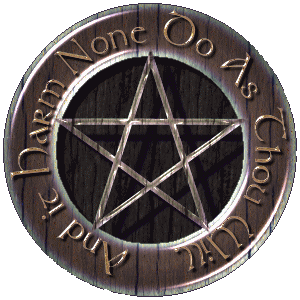
The Law: Harm None.

Explanations

Live
The first Rule put forth sounds pretty straight forward at first. Then you actually try to live it! 🙂 Living each day as if it were your last means maximizing your potential for every moment that you have been given.

If you are let go from your job… that is an opportunity to face truth and see what you can do to make yourself more marketable and go get a BETTER job. Or, if you are highly motivated, dedicated, and a risk taker you can take that chance to start your own company.

When I first began to follow these principles, my business was not very successful, my marriage was only tolerable, and I often felt depressed about my situation as a whole. Then I began to live each moment.’Carpe Diem’ (Seize the day) became my motto. I began to maximize every moment and live in the moment, not for the moment.

This does not mean that in order to be a good witch that you have to work like a rabid squirrel on ‘speed’… but it does mean that you have to be honest with yourself to see what your situation really is and to make the most of it. I believe that if I can go to bed at night and think to myself that I had done the very best I could that day with the information I had at each moment of opportunity, then the day was a success. But if I go to bed thinking that I had let an opportunity slip away I do not beat myself up over it. I simply say to myself, “Gee Torin, that was one you missed. I’ll get it the next time it comes along.”

Love
What is life without love? Honestly, I can’t imagine what that would be like. Yet many people live their lives without the most important form of love there is – the love of the self. If you truly understand yourself and are willing to take responsibility for your own actions you will suddenly find a great love for yourself.

In order to give free and unconditional love to another person you must first have that kind of feeling for yourself. This is all this means.

Learn
One of the cornerstones of The Craft is the belief that our souls are here on this plane of existence at this point in time to learn lessons. Your lessons are different from (although probably quite similar to) my own. Learn what life teaches you. It is no more difficult than this.

Enjoy
The life of the witch does not require you to live your life in suffering nor poverty. There are no mandates for pain, unhappiness, or unpleasantness. We do not see suffering as the ‘key’ to getting into Heaven (or the Summerlands as some of us call it). Indeed, we see such things as exactly what they are… unpleasant! This does not mean that we never have unpleasant things happen to us, nor that we walk around in a constant state of denial.

We see suffering as either the result of an action we took (i.e. going to jail for robbing a bank) or the way that The Unknown (see “The Deities of Witches” by Torin W.) has chosen to teach us a lesson which we need to learn but have not done anything consciously to bring about the circumstances (i.e. the totally unexpected death of a close friend).

Witch Craft allows you to reap all of the happiness and prosperity from your life that you can muster… so long as you stay within the accepted boundaries. For instance, if you work hard at an honest job you like to do then there is nothing which says you should feel badly for being more successful than others. But if you rob a bank, you may be happy with the things that the money can buy for a short period of time, but eventually you will suffer far greater than if you had simply worked for it. (I know this may sound somewhat like a contradiction to what I said earlier, but I do not believe in keeping a job which does not give me enough pleasure, satisfaction, and money to make up for the difficulties I endure.)

The Law: Harm None
I have been asked to explain this statement more than all of the previous ideas combined. I often describe ‘Harm None’ as “the Law which must remain unbroken, but cannot remain whole at all times.” Think about it, you can’t do it as a human being.

In order to actually harm none you would have to be in total and complete harmony with all things int he Universe at exactly the same time. Your immune system would not kill bacteria and other infections (because that would be harming them). Nor would you allow the bacteria to infect you because that would cause harm to yourself. You would not eat meat, nor vegetables because it would cause the destruction of either. Neither would you not eat because that would harm you. Do you see how this is simply an impossibility?

What I teach my students is to take great pains to Harm None and to think out the results of any act as far as possible ahead of time. I also stress that whenever magics are being worked that the free will of any individual or group should never be infringed.

I have been asked specifically about the use of various types of drugs in witchcraft and their relationship to the ‘Harm None’ principle. I believe that The Bright Ones gave us a sober state of mind for a reason. They also gave our brains some of the most potent chemicals known to man for achieving altered states of consciousness. Therefore i see no reason to alter the chemistry of the brain in order to ‘gain enlightenment’. Ask any recovering drug addict… he/she will tell you that the drugs lie to you.

Because of part of the training I give, I require that no illegal drugs are used while under my tutelage. In fact, if a student becomes sick during training and requires a prescription strength pain reliever, the training schedule is reworked to allow for the purging of the body before training resumes.

One of my students used to do a good deal of psychotropic drugs (i.e. LSD, mushrooms, etc.). Then he and I began to work together. After a few months of training, we worked a circle to allow him to develope his psychic senses (i.e. clairaudience, clairvoyance, etc.) When he left the circle he related to me a feeling such as none he had ever known. His words were, “It was a hundred thousand times better then the best acid trip I had ever taken.”

In short, I personally feel that drugs can be a great hinderance and only cause damage to your soul. But I also recognize the free will of the individual. I can only tell you that in my own perception, drugs do cause harm to you.

Merry Part and Blessed Be
Torin W.


Originally Published on Pagan Library


Hereditary Witchcraft

Various Types of Witchcraft: The Pow-Wow Tradition c. 2018

The  Pow-Wow Tradition

The Pow-Wow Tradition is a classic example of this melding of “The Old Ways” of the Europeans and local Native Indian beliefs. Though some claim that the Pow Wow Witchcraft is German in its origin, it is more an adoption of local traditions of theAlgonquin peoples by the early German and Dutch immigrants of pagan heritage who settled in the Pennsylvania region of the United States.

Observing the Algonquin’s powwows, the pagan immigrants discovered that like themselves, the Natives used charms and incantations for healing. Impressed with their methods of driving out evil spirits, they adopted the term “powwowing” to refer to their own magickal healings. As their practice of magick was also centered on herbs and healing, they learned from the local people about the native roots and herbs for use in charms and healing.

As stated earlier, the term Pow-Wow comes from the Algonquin word ‘pauwau’”, meaning ‘vision seeker’ and the Pow-Wow Witches encompass shamanic like rituals of healing through visions and the application of traditional medicines, which are often accompanied by prayers, incantations, songs, and dances. The Pow-Wow Tradition places great significance on the vision seeker as the nexus of tribal activities and rituals.

_______________________

Pow-wow

Written and compiled by George Knowles

During the 17th and 18th centuries there was much migration from continental Europe, when whole families seeking to flee the hardships, famine and poverty of their own lands, set their sights on the adventure and prosperity offered in the new lands of hope and glory called America.  Many of the German settlers who colonized the interior of Pennsylvania also brought with them their Old World beliefs in Witchcraft and Magick.  Due to the lands resemblance to their former homes in Europe, many of them settled in the rich rural areas of York, Dauphin, Lancaster, Schuylkill, Carbon and Reading, which over time became commonly known as the counties of the Pennsylvania Dutch (Dutch, a corruption of “Deutsch” meaning German).

The early Pennsylvania Dutch peoples were a proud family orientated folk-people, deeply religious, and fiercely defensive of their traditional ways of life.  They kept to themselves and were suspicious of outsiders, and even retained their German language.  This over time and through necessity became mixed with English to form their particular Pennsylvania Dutch dialect.  They also continued to practice their own form of traditional Witchcraft and magick.  As much of their witchcraft and magick was centered on herbs and healing, they enlisted the aid of local Indians to learn about and find native roots and herbs for use in medicinal recipes.

Observing the Indians powwows, their meetings for ceremonial dance and conference purposes, they discovered that like themselves, the Indians used charms and incantations for healing.  Impressed with the Indians methods of driving out evil spirits, they adopted the term “powwowing” to refer to their own magickal healings.  Powwowing has survived through the advance of time and is still practiced today, and while some of the charms and incantations used date back to ancient times, many contain Biblical and Kabalistic elements that can be adapted for modern-day use.

Of the old pioneers to emigrate from Germany and settle in Pennsylvania, John George Hohman is of particular interest concerning powwowing.  Hohman and his wife Catherine immigrated to Pennsylvania in 1802 and settled near Reading.  He was a devout Roman Catholic and a great believer in faith healing, however he proved to be a mediocre practitioner and also failed at farming.  Facing financial ruin he began to collect various charms and herbal remedies, as well as collating those passed down through centuries of oral tradition, and published them in a handbook called “The Long Lost Friend”.  This allowed Hohman to achieve some modest financial success, for it quickly became one of two “Bibles” on powwowing (the other being an anonymous book called the “Seventh Book of Moses”), both of which could be found in virtually every Pennsylvania Dutch household.

In “The Long Lost Friend”, Hohman mixed magick and healing formulas gleaned from a variety of sources, including Germany, England and Egypt, some dating back to antiquity.  It was not a book of “hexes” Hohman emphasizes, (a “hex” was a spell, curse or bewitchment cast by a Witch, commonly with evil intent, though it could be use for either good or bad purposes) and should be used for healing not for destroying.  In it he also included the wisdom of the Gypsies and the Kabbalah, as well as testimonials of his own successes.  In his introduction he states:

“There are many in America who believe in neither hell nor heaven, but in Germany there are not so many of these persons found.  I, Hohman, ask:  Who can immediately banish the wheal, or mortification?  I reply, and I, Hohman, say:  All this is done by the Lord.  Therefore, a hell and a heaven must exist, and I think very little of any who dares deny it”.

Hohman also promised his readers that:

“Whoever carries this book with him, is safe from all his enemies, visible or invisible, and whoever has this book cannot die without the holy corpse of Jesus Christ, nor drowned (sic) in any water, nor burn up in any fire, nor can any unjust sentence be passed upon him.  So help me”.

In the book he offers the following charm to prevent witches from bewitching cattle, or to stop evil spirits from tormenting people in their sleep at night.  It should be written down and placed either in the stable or on the bedstead:

“Trotter Head, I forbid thee my house and premises, I forbid thee my horse and cow-stable, I forbid thee my bedstead, that thou mayest not breathe upon me, breathe into some other house, until thou hast ascended every hill, until thou hast counted every fence post, and until thou hast crossed every water.  And thus dear day may come again into my house, in the name of God the Father, the Son, and the Holy Ghost.  Amen”.   

The second “bible” of powwowing is the “Seventh Book of Moses”.  This is a mixture of material take from the Talmud, Kabbalah and the Old Testament.  It explains how to break a hex by wearing an amulet containing specially selected herbs wrapped in parchment paper inscribed with biblical verses or charms.  In another method it tells how the hexed person should avoid direct sunlight, to stay in-doors when the moon is full, to cover the ears at the sound of a bell, and to never listen to the crowing of a cock.  Most family households in the Pennsylvania Dutch “hex belt” (as these areas became known) had copies of both powwowing “bibles”, and anyone could use them.  However the charms were believed more effective when prescribed or recited by a “bona fide” practitioner.

The most skilled of powwowing practitioners are born into it, inheriting such occult abilities as healing, clairvoyance and precognition.  According to tradition, the “seventh son of a seventh son” inherits special powers, and is thought to be the most powerful, but both men and women can be practitioners.  Powwowers start their training at an early age, and are taught only by family members of the opposite sex.  They use a variety of techniques to help their clients, such as the laying on of hands, incantations and signs (such as the sign of the cross).  Some specialize in charms and amulets, while others may use special herbs, potions and powders.  One well-reputed powwower from the turn of the century was called Charles W. Rice.  He lived in York, where he specialized in curing blindness with a potion he called “Sea Monster Tears”.  This he dispensed at $2.50 a drop.

The most common of the powwower’s charms are the “Himmels-briefs” (heavens letters).  These are basically a guarantee of protection written by the powwower on a piece of parchment paper in biblical verse.  It is then hung up in the home or barn, or carried on the person it was written for.  They can be written to protect the home, animals and people from all sorts of harm and disaster, be they natural or un-natural.  Disbelievers were told:  “Whosoever doubts the truth of a Himmels-briefs, may attach a copy of the brief to the neck of a dog and fire upon it, he will then be convinced of its truthfulness”.  Himmels-briefs typically cost from $25.00 to hundreds of dollars depending on the power and reputation of the powwower and the specifics of the charm.  They were particularly popular with the soldiers of World War I, who carried them into battle for protection against injury and death.

Most powwowers work quietly and attract their clients by word of mouth and reputation.  Some work at it as a sideline to their main business, seeing clients only in the evenings or at weekends, others work at it full-time.  To many it is considered unethical to charge fees for their services, and instead accept “voluntary contributions” though they may suggest appropriate amounts for specific services.  Most will also help those clients who cannot pay, trusting that grateful clients will return when funds are available.

Today the secrets of Powwowing remain very much a Pennsylvania Dutch family tradition.  However, Silver Ravenwolf a modern day neo-pagan, author and founder of the Black Forest Circle and Seminary, is also a trained practitioner of Pow-Wow, and has published her own version of Powwowing in a book called:  Hex Craft:  Dutch Country Pow-wow Magick (Llewellyn Publications; 1st edition – May 1995).

_________________


Spirit Walk Ministry

The Encyclopedia of Witches & Witchcraft  – By Rosemary Ellen Guiley

An ABC of Witchcraft Past and Present  – By Doreen Valiente

A copy of the The Long Lost Friend” can be downloaded free from here:

  http://www.think-aboutit.com/pdf/powow.pdf

First published on the 04th  March 2007 © George Knowles  –  Updated on the 18th May 2006

The Various Paths of Witchcraft – Draconic Wicca/Witchcraft c. 2018

Draconic Wicca/Witchcraft

______________________

Draconic Wicca is the utilization of the powers of the dragons. There are as many dragons as there are people. They are as varied as humans are also. We work with these dragons to achieve the results that we seek. In doing so, we have to deal with the unique personalities of each type of dragon. The dragons have no real hierarchy other than age, except for the case of ‘The Dragon’.

The Dragon is the combined powers of the God and the Goddess. The Dragon is invoked or evoked during Sabbats and in times when great magick is needed (not when you can not find your keys). Invoking means to call into you the power of the dragon that you name i.e. a fire dragon. You ask that this dragon assume himself/herself into your spiritual body. To evoke means to call a dragon to you, to join you in your magickal workings.

The reason it is called Draconin “Wicca” is because of the similarities to the wiccan religion of today. This religion was originally brought to Earth by the blessed races when Atlantis was formed. The name of the religion itself cannot be pronounced in present English certainly not spelled. This religion was taken away from the Atlantians and Atlantis destroyed.The druids were the descendants of the Old Religion and passed on by mouth.

The spirits God: The god is the male half of the ‘divine being’. He has many faces and has known many names. To wiccans, he is known as the horned god, the sun god, and many more. God is not just Father, he is Mate, Consort, Lover, Friend, Brother, Hunter, Husband, Law-giver, and Partner.

Goddess: The goddess is the female half of the ‘divine being’. She also has had many faces and many names. Wiccans, druids, and the coven all respect the Maiden, Mother, and Crone aspect of the goddess show in the entire universe.

Red Dragon: The Red Dragon is effectively the goddess of the dragons and very, very few known her actual name. She represents all of the blessed races and has a counterpart for each. Dragons/Races of the

Elements: Each race has its own head keeper of the elements and/or directions. The elements are: Air, Earth, Fire, Water, Light, Darkness and Spirit These spirits are called in to help with specific elements and what the elements and directions can help with different things. Healing would be Earth for example.

Many names are used to invoke different aspects of the above spirits. The goddess might be invoked as Bast (Egyptian name) for example for healing and another time Athena (Greek) for wisdom. There is a good saying. “There are many faces of the one god.” However this doesn’t apply for the Red Dragon of other guardians of the elements. This mostly applies for the God and Goddess aspects. The sabbats are more like the old druidic sabbats, which any good reference is hard to find, than the ones that are found in Wiccan religions.

_________________________________

Draconian lore and practice are rarely found in any of the published books on magick. (There are a few very notable exceptions, like D. J. Conway’s ‘Dancing with Dragons’)

Draconian magick is, by definition, magick that is fueled by the symbolism and energies of Dragons.

While not actually defined as a Tradition of Wicca, Draconian Magick shares many of its defining elements. It has a code of honor just like a more Traditional Wicca Path, that is perhaps a little more strict than the Wiccan Rede however. Draconian Magick has always been passed down from teacher to student, perhaps that is one reason there is so little information available.

Dragon Magick is not for everyone. Those that choose to practice it must be self-disciplined individuals who are serious about changing things in their lives and the world around them. They must be willing to have beings be brutally honest with them and be willing to turn that same honesty upon yourself. Working with dragons is a hard path, but ultimately rewarding. The journey of rediscovering the true essence of Dragon Magick can be an uncomfortable experience for some people, being forced to examine aspects of their inner-selves that they would rather not acknowledge. But self knowledge and self integration are the true keys to magickal wisdom and power… Opening yourself to acceptance of your true self is a task that few of us have the courage to face, and yet it is an important step to undertake if true power is to be achieved in any magickal Tradition.

For most practitioners of magick, Dragons represent Wisdom and Balance. But for those who are practitioners of Draconian Magick, Dragons are seen as Deities and held in the highest regards. No other Deities are held higher. While Dragons are revered in most Traditions of Paganism or Wicca, they are not thought of in the form of Deities.

When holding a Ritual which includes Dragons, or is a Dragon Ritual, it is important to understand that in Draconian beliefs, the Dragon is held in the All-High, or exalted position. Placing another Deity in a position higher than that of the Dragon is an insult to the Dragon…
Draconian Magick is unequivocally a school of the Left-Hand Path.

That is to say it is a school which teaches the immortalisation and deification of the individual psyche, as opposed to the Right-Hand Path which seeks to submerge that psyche within a sense of universal oneness…I believe that many Wiccans and Pagans today tend to shy away from anything Dark, there are allot of Wiccans out there who claim to practice only ‘white’ magick, And, while most Wiccans/Pagans do not use the statement “I walk a Right-Hand Path” They do. But, to me at least, this creates an imbalance. There cannot be Light without Dark. There is a certain degree of Darkness within us all. You cannot be in Balance if you deny one side of your nature. Many Wiccans/Pagans automatically assume a Dark Witch performs magick that is wrong, negative, or even evil. This is simply not true.


The left-hand path is about the elevation and centrality of the self as well as the rejection of religious authority and societal taboos. The left-hand path focuses on the strength and will of the practitioner, downplaying the need for intercession by any high power (although they may believe a higher power exists).

<VS>

The right-hand path concentrates on the symbols of goodness, of the Light of the Divine, the connection of self with the Divine, and the purification of self in order to reconnect with the Divine. Many right-hand followers believe that there is a Divine power that holds sway over the universe and through prayer and worship that Divinity will help to better their lives. The vast majority of religions are considered part of the right-hand path, from Christianity to Wicca.

So, When I hear people say “I’m a White Witch” or the ever popular “I’m a Green Witch” I just smile and keep moving…
I have said it before, and I’ll say it again… IF I had to pick a color, I’d have to say I’m a Grey Witch.
I believe in Balance. In all things there should be a Balance. In my Spiritual Path I strive for Balance. There is a Darkness in us all. I do not deny the Darkness, I embrace it. Does this make me evil? I don’t believe so, because I Balance it with Light… There is a Light within us all as well…
I know I’m probably going to get a few people who point to the Wiccan Rede… and espouse they’re religion doesn’t harm anyone… Well, let me just state that neither does mine. I follow the Rede, always have. The main thing is, I don’t rely on ANY religion to dictate my Morals, my sense of Right or Wrong, I Rely on Myself. In this sense, I follow (Some) of the Christians 10 commandments as well… NOT because I worry about some eternal damnation, but simply because it fits within my own moral concept. I do not need any religion to ‘guide’ my moral compass, or direct my Spiritual path.
I do not Pray to the Goddess to alter or enhance my life. I do not repent my sins before any Goddess or God. I know that I have done things in my life that were wrong. I recognize this fact and strive always to change these behaviors.
I don’t think any Natural inclination (such as SEX) is wrong.
I eat Meat. Because I Like it. and really humans are Omnivores…
I do not believe in the usual concepts of good or evil…
AND… I do not judge myself based on someone else’s judgement of me. I am who I am.

Self-responsibility is also seen as of utmost importance when working with Dragons. You must be able to view your actions objectively…and accept the consequences of those actions, whether the outcome is positive or negative.

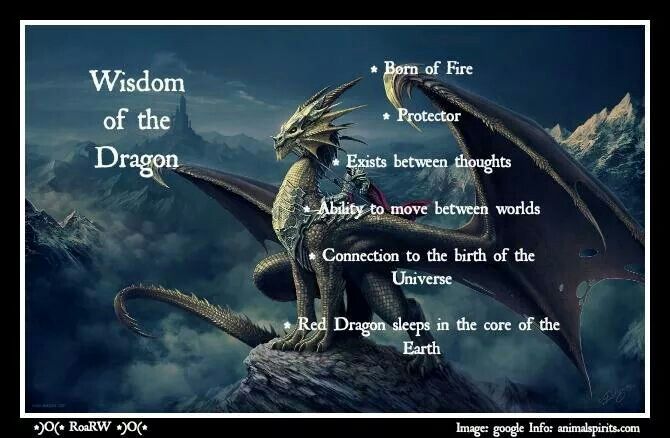
Dragons are warriors for light (lightworkers). They are a collective of souls who service the light. They can infuse their souls into bodies that are not dragon (human for example). In this way they can work for light and efficiently bring about changes. This is one thing that makes them invaluable in Healing Ceremonies. Some call any magickal practice with Dragons is to “Dance with Dragons”, but they can be more then just a dance partner. As teachers of ancient knowledge their grasp of it is deep and profound. Their ability to help in divination is astonishing and quite accurate. As protectors during rituals and everyday life there are no equals. And if a Dragon chooses to take you under their wings you will have the opportunity of learning knowledge and evolving your magickal ability to a degree which few have known.

During meditative channeling, Dragons usually appear to people as themselves. There are those times when they appear as winged humans, or something else, but for the most part you see them as they appear as they would be in their own realm.
Dragons are a part of the Fae Realm. When the Fae drew back from humankind and sealed themselves from our sight, the Dragons became the Gatekeepers to that realm. Guarding forever the passage from our realm to theirs. Which is one reason it is so hard to gain access to the Faerie Realm. Most people who are aware of the Fae Realm already know that the Fae are able to enter our realm at will, humans, however must first gain access past these mighty Guardians. A Dragon can look into the soul of a human and gauge the enlightenment that the human has gained. This is one reason that the practitioner of Dragon Magick must strive for enlightenment…

The Goddess & God:
The Dragon is the combined powers of the God and the Goddess. The Dragon is invoked or evoked during Sabbats and in times when great magick is needed.

Red Goddess Dragon:
The Goddess is the female half of the ‘Divine Being’. She also has had many faces and many names. Wiccans, Druids, and the coven all respect the Maiden, Mother, and Crone aspect of the Goddess shown in the entire universe.
The Dragon Goddess always appears as a Red Dragon. The Red Goddess Dragon is effectively the Goddess of the Dragons and very, very few know her actual name. She represents all of the blessed races and has a counterpart for each.

The God Dragon:
The God is the male half of the ‘Divine Being’. He has many faces and has known many names. To Wiccans, he is known as the Horned God, the Sun God, and many more.
The Draconian God is not just Father, he is Mate, Consort, Lover, Friend, Brother, Hunter, Husband, Law-giver, and Partner.

Dragon Guardians and Guides:
Dragons are famous for their fierce protective nature. Though most myths portray Dragons as protectors of great treasures, they have been known to be protectors of people too.

The Dragon serves as a Powerful Guardian and Guide. Once you discover your Guardian Dragon/Dragon Guide you should encourage communication, and acknowledge your Dragon’s presence as often as possible, the same as you would with an Animal Spirit Guide or even a Guardian Angel. You will need to let you Guardian Dragon/Dragon Guide know that you are now open and willing to listen to any guidance, advice or teaching they wish to impart to you.

One way to do this is to meditate and concentrate upon your Guardian/Guide. Light candles and incense for them, and leave offerings for them upon your altar. Designing a special altar just for your Guardian/Guide is a good idea, a place where you can concentrate your energies towards the Guardian.

Many magick practitioners will surround themselves with imagery of their Guardian/Guide, immersing themselves externally in the energies of the Guardian/Guide. This will help you to draw the Guardian/Guide to you, and will assist you in achieving your connection.


As with any Guardian/Guide, finding your Guardian Dragon/Dragon Guide is not the problem. Most likely they are already around you, and in fact may have attempted contact with you in the past. This happens with many different types of Guardians and Guides, we fail to recognize the messages that they are sending us. If this is the case, contact should be easy to obtain once you have let the Dragon know you are ready & willing to connect with them.

One thing you must remember though, is when you do feel a Dragon in your house it does not mean that it’s “your”Dragon. Sometimes it can take years for a Dragon to decide to be someone’s Guardian/Guide, so just because there is one in your house or one that’s been following you for years, unless he/she tells you otherwise, don’t jump to conclusions and think that you have a Guardian Dragon or a Dragon Guide, it could be there for reason’s of it’s own… Sometimes though, a person can live their entire lives with a Guardian Dragon/Dragon Guide and never know it…


(Just a note: I have been combining Guardian Dragon & Dragon Guide, but I don’t want to give the impression that they are the same thing. These are two completely different Dragons, who perform completely different tasks, the way that you find them & connect with them, however, is the same.)


To find your Guardian Dragon or Dragon Guide, you must first find you Element…
As a general rule, you can go by your astrological sign;
Capricorn – Earth
Aquarius – Air
Pisces – Water
Aries – Fire
Taurus – Earth
Gemini – Air
Cancer – Water
Leo – Fire
Virgo – Earth
Libra – Air
Scorpio – Water
Sagittarius – Fire

The second means of determining which Elementals you have the best connection with is through your first name. Your birth-name is, like your astrological chart, an energy center, reflecting the play of certain energies within your life. The vowels of your first name are the keys to determining with which elemental you are most harmonious.

The primary vowel in your first name indicates which group of Elementals you can align with most easily. The primary vowel is the one most strongly pronounced.

Element                   Vowel                                 Elemental Being
Fire                                 I                                        Salamanders

Earth                              U                                          Gnomes

Air                                   E                                             Sylphs

Water                              O                                           Undines

Ether/Chaos A The Ether/Choas                     Element will accentuate and intensify the relationship and activity of every

Elemental force to which it is applied ~ for good or bad.

If the astrological element and the name element are the same, it can indicate that you have come to double your work with that group of Elemental Beings and the Energies that they work with. If they are opposite, they do Not cancel each other out, it means that it is up to you to find a Balance between them when you are working with them.

Once you know which Element you are aligned with, simply match it with that type of Dragon. For instance; I am a Capricorn; So, according to my astrological chart, I resonate most strongly with the Earth Elemental… and my first name is Mary; So, that’s an A; Which makes it Ether/Choas… Which means that I align with the Earth Elemental and all contact will be accentuated and intensified.

Okay, so now, knowing my Element, I would look down at the Elemental Dragons and know that my Guardian Dragon/Dragon Guide would be the Earth Dragon…

Some people will resonate with more than one Element, and therefor more than one Elemental Dragon as well… Also, if the chart says one thing, and your soul is telling you another, always go with your soul… It knows best, Always.

{Just a note: This formula for determining which Element you align with came from Ted Andrews’s book ‘Enchantment of the Faerie Realm’ … Also, I have changed it somewhat to include the Element Choas, as he explains Ether, they are the same thing.}

Elemental Dragons:
Air Dragons
These great dragons are ruled by the Sairys (pronounced Sair-iss), their Elemental color is pure yellow, light blue, silver, white and gray…
Where they inhabit is often warm and moist. Air dragons often have a very peaceful nature and they like to share what they know, in fact they feel that all knowledge is worth having. As their name suggests, they control the winds and can manipulate air with amazing dexterity. They can even remove all air from an area creating a vacuum that is next to impossible to fill. These dragons are often long and slender, some have gauzy wings and their scales often have a feather-like quality and may have actual feathers around their heads, necks, and paws. They govern the Eastern quarter of the Circle and you can apply Eastern associations to these dragons.

Positive associations of these dragons are new beginnings, the Spring, breath, optimism, joy, intelligence, mental quickness and renewal.
Negative associations of air dragons are frivolity, gossip, fickleness, inattention, stagnation, bragging, and forgetfulness.

The magick that these dragons control is often used to control weather, as one would expect. They are also useful in spells that blow away the old and are excellent in protection rituals as well as magick that works for mental flexibility and openness to new ideas. Teachers and students both will find a wealth of information with these dragons as they can teach us how to better impart our wisdom as well as sharpening our minds so that we can learn better.

Other forms of dragons that fall under this category are Lightening Dragons, Storm Dragons, Wind Dragons, and Weather Dragons.

Fire Dragons
The Ruler of these dragons is Fafnir (pronounced faf-near), their Elemental color is pure red, amber, red-orange and all shades of flames.

They tend to live in warm and dry areas. These dragons have a fiery disposition but can be very gentle and understanding, it is also true that they can be unpredictable and difficult to work with until they get to know you. Once you gain a fire dragon’s loyalty they are unwavering and powerful friends. Their bodies are often thick and heavy with a long snake-like necks and tails. They often have wicked looking horns on their head and their mere presence can make a room warmer. Fire dragons are fierce protectors and are often heralded by their loud roar. They govern the Southern Quarter of the circle and Southern correspondences can be applied to fire dragons.

Positive association for fire dragons are summer, the sun, blood, any kind of helpful fire, enthusiasm, activity, change, passion, courage, daring, will power, and leadership.

Negative associations for these dragons are hate, jealousy, fear, anger, war, ego, conflicts, and irritability.


The magick of fire dragons is often used for personal purification on any level, for energy or courage, and for the stamina needed to pursue your dreams and finish important projects. You can also use their potent magick to help remove barriers, but once they are set on a course they are very difficult to halt and will go through or over anything or anyone to achieve their goal. If you don’t have a good working relationship with these dragons and you employ them they can turn your spell into something destructive that will ‘burn’ through all obstacles and leave ruin in their place.
Other forms of Fire Dragons are Steam Dragons, Heat Dragons, Lava Dragons, and Desert Dragons.

Water Dragons
Water dragons are ruled by Naelyon (pronounced nail-yawn), their Elemental color is pure blue, dark blue, blue green, and turquoise.
They live in cold and moist areas. Water dragons have a very soothing influence and are drawn by strong emotions but will not contact anyone who lets their emotions constantly run away with them. A room may feel a few degrees cooler when water dragons visit or you may notice an increase in the humidity. These dragons are long and serpentine and rarely have legs or wings. Their scales will have a silvery or shimmery hue to them and they tend to have a feathery fringe around their mouths. Many times they appear looking like Oriental dragons and their eyes may have a glowing quality to them. Water dragons govern the Western quarter of the Circle and Western associations may be applied to these dragons.
Positive associations are calm water, compassion, peacefulness, forgiveness, love, intuition, calmness, peace of mind, and fluidity.
Negative associations for these dragons are floods, storms, laziness, indifference, instability, lack of emotional control, insecurity, and overwhelming grief.

The magic of these dragons is generally used for dealing with emotions, either calming them or stirring them up. You can also use their energy to help with movement or to help keep things fluid and open. You can call on these great dragons to help open up your psychic centers and lend their aid to your divination skills. Water dragons are also useful for calmness in all situations and on all levels, when you have to deal with anything that will tax your emotions you should ask water dragons to lend their aid.

Other types of Water Dragons are Ice Dragons, Mist Dragons, and Rain Dragons.

Earth Dragons
These dragons are ruled by Grael (pronounced grail), their elemental color is pure green, every shade of Brown and Black.
Their homes are in cold and dry places. Earth dragons are very quiet beings, they will observe from a distance until they are ready to approach you. Once you have befriended an earth dragon they are very straight forward and will be blunt and honest with you but are very loving and nurturing. They tend to have a ridge of sharp scales down their necks and back, their body scales are often very reminiscent of armor. Of all the dragons, these are the ones that like treasure and in order to build a strong relationship you should keep a jar or dish full of coins. The earth dragon’s bodies tend to be very heavy and most of them have four legs, when they have wings their wingspan is enormous. Earth dragons govern the Northern Quarter of the Circle and Northern associations may be applied to them.

Positive associations for earth dragons are respect, endurance, strength, responsibility, stability, prosperity, thoroughness, and having a purpose in life.

Negative associations are rigidity, unwillingness to change, stubbornness, and lack of consciousness, vacillation, and weakness.

Earth dragon magick is good form building long lasting foundations, for helping to complete long-range goals, and for invoking stability into your life. You can also call on them for physical and mental endurance as well as the strength to accept responsibility. If you are planning to do a spell for enduring prosperity and success, earth dragons are excellent for this but they expect you to work towards your goals and not demand that they deliver it to you.

Other kinds of Earth Dragons are Stone Dragons, Nature Dragons, Mountain Dragons, and Forest Dragons.


Chaos Dragons
These dragons don’t have a ruler, their color is pure black, and their homes are in Elemental Chaos. These dragons are always dark colors that blend into blackness, often it will look like they have stars caught in their scales. Their bodies are heavy and huge; in fact they tend to be the largest of all dragons. They have wide, wedge-shaped heads and their long tails often are barbed or spiked. Chaos dragons have huge wings that often blend into the night sky and may be hard to make out; they are masters of camouflage in spite of their large bulk and are rarely seen if they don’t wish it.

These dragons are not evil or malicious, they work with us and their magick is often incomprehensible to us and they go beyond our limited view of happenings. Because of this their acts may seem cruel, but they are working for our greater good. These dragons are pure representations of chaos and we are to call on them when we realize that not every problem or situation can be resolved with order and reasoning. When working with these dragons they will go straight to the source of your problem or question and force you to confront it. This can be rather uncomfortable for us as we will need to deal with hidden aspects of ourselves that we may not be ready to face, so be sure that you are prepared to accept the consequences of invoking a chaos dragon. Chaos Dragons do not act as Guardians nor Guides.

Chaos dragon magic is mainly concerned with the re-creation of lives, relationships, and careers. You can employ them to help break through barriers, with changing luck, and in bringing about vast changes.
You can work with them to explore past lives and their magick is particularly powerful aids in divination.

Their magick is also used to confine anything that will hinder you in forward growth and movement, if you invoke this aspect of them be prepared to have everything that is holding you back leave you life whether you want it gone or not. This is the type of dragon that we work with when we talk about ‘riding the dragon’; eventually during this ritual we will have to confront our worst enemy ~ ourselves…

Chaos Dragons can also be heralds warning of catastrophe, to ignore what they have to say may bring about destruction in our lives.

Dragon Color Meanings:
Purple Dragon;
The Purple Dragon, sometimes referred to as “the ancient one”, is the embodiment of the highest level of the dragon collective (the wisdom).
The purple dragon is many dragons. Once a Dragon reaches a high enough evolution, they become part of the collective. All these consciousnesses are compiled into one composite that holds all the wisdom and knowledge of the Dragons.
The Purple Dragon is the ‘Law Giver’ Setting the rules for all others to follow. This is the Dragon who often appears to test you. Failing these tests can have bad results. These test are to judge a persons honesty, integrity and loyalty…All of the things that the Dragons look for when answering a summons from us. You do not call upon the purple. His visits are random.

Silver Dragons;
Reflection, they inhabit the meridians of the universe. These dragons come around when we look into ourselves. Perspectives are a good word for silver dragons, and they see every perspective from every reflection.

Orange Dragons;
The will is the color orange. These dragons bring in strength, confidence, and bravery. Fire dragons by nature, they move with quickness. They don’t inflate ego’s, they merely instill confidence.

Green Dragon;
The green dragon is the planet dragon, or earth dragon. Material in a big sense, however green is the color of life in the big picture. Lessons of “the material”, are a big part of the way they teach. I would categorize the earth dragon among these qualities as well.

Brown Dragons;
Brown dragons are about physicality, and all its properties. They are masters of physics, on all realities, from shaping matter (shape shifting), to gravity, and physical form. Sphere is a keyword to understanding the brown dragon.

Blue Dragons;
They are about the consciousness, communication, and mental awareness. They are also intricately linked with what illusion is, how to see through it, and how to create it. There are many illusions on this plane, and the blue dragon can guide one through them. Their insight into the etheric plane is tremendous, they see how it moves and works, because it is one of the primary realms for these dragons to do their mental work.

Red Dragons;
(Besides representing the Mother/Female Goddess)
Red dragon characteristics are desire, passion, fire, rage. These dragons literally eat darkness, and transmute it to light. Intensity is only matched by the amount of fire these dragons wield. To them energy is food…

White Dragons;
White dragons maintain the purity of the collective, the grace connection. They often are guardians. These dragons can also be channeled for healing.

Gold Dragons;
The golden ray, the creative spark are aspects of gold dragons. They are the keepers of phi. They speak the language of the heart. Art and music are brought here by gold dragons. Gold dragons can be channeled for healing. See sacred geometry, and the golden means.

Dragon Deities:
Dragon God Gneicht;
Gneicht is the ruler of the Night… of doorways (both opening and closing them)
As a guide his visit speaks of opportunities, both taken and missed, depending on the type of message he brings you…

Morthan (moor’-z’dan)
Dragon Goddess of bountiful harvests of all kinds; Mother aspect of Dragonkind. Nurturing, Protective and Generous…
Call on Morthan when in need of emotional support or financial assistance.

Veaug (vog)
Dragon God of obscurity and that which is hidden; does not like assisting in hiding actions or objects. This dragon is adept at finding things from the Ancients that have been lost in obscurity (old tomes, amulets, magickal items) His assistance can further the summoners knowledge greatly, but he is easily angered, be sure that the item you seek is worth his time before calling upon him…

Luqueas (luk-wee-ass, long U, long E)
Dragon trickster God; take great care when inviting His presence. He is a joker, a wild card. His action are not always in the best interest of the summoner. He is like a politician, he can talk circles around most people & beings, but his words are not always truthful. He can be a strong ally… If you are careful.

Tysteal (tiss’-dell)
Dragon shephard Goddess; guardian of the meek; a dragon person’s first line of defense.
Call upon Tysteal when in need of Protection.

Mordak (moo-ór-dak)
Dragon God of war, vengeance and retributions of all kinds; make dead certain that you are within your magickal rights before calling Him down, as he is not amused by a fallacious summons.

Davliteau (dav-lí-too)
Dragon God of conjured entities; very helpful in ridding one’s self of “sent” conjurations and the like; benevolent to the core; very helpful and willing attendant being, though He has little power in other areas. He acts as a protector from other Beings or Dragons who are sent to harass or harm you. He can be called upon when you are having trouble controlling one of the lesser Beings.

Ouida (o-weed’-a, long O, soft a)
Dragon Goddess of guidance.
Call upon Ouida when you are uncertain of your Path, if you are unsure of which life-choice to make. She can help with decisions about finances, marriage, carrier choices, etc.
She is one who stands in the Doorway of Time, Looking both ways at once.

Solange (so-londg’)
Dragon deity of healing. Though Dragons rarely become involved in human affairs, Solange cares about those who care for others. He will lend a healing touch to any beneficial healing spell, but there is a price for His assistance. He requires the planting of fruit trees (three at the least and 9 at the most) for his services. He will also attend to your herb garden and bless it with His dragon power.

Ryusan (rí-u-san, long I, long U)
Translates literally to “my dragon.” Ryusan, of the three-headed Japanese variety, is best at consoling and nurturing a hurt spirit, whether it be in a host body or not. Ryusan is an expert at guiding spirits on to their next journey. Ryusan can contact those who have passed on. He is a Guardian of the Veil and stand between our realm and the realm beyond. This is the Dragon you would call upon with assistance in Divination…


Reference

If you are interested in Dragon Magick or the Path, check out this wonderful informative site, Wicca Dreamers: Dragon Wicca 

 

The Various Paths of Witchcraft: Egyptian Witchcraft c. 2018


Egyptian Comments & Graphics

Egyptian Witchcraft

Like the witch craft of any other region, the Egyptian witch craft is based upon the country’s tradition, myth, legend, rituals, drama, poetry, song, dance, worship, magic and living in harmony with the earth.

The practitioners of Egyptian witch craft honor the ancient Egyptian gods and goddesses including the Triple goddess of the waxing, full and waning moon and the horned god of the sun, death and animal life.

Since moon has an important place in Egyptian witch craft, therefore both men and women in city apartments, suburban backyards and country glades meet on full moons and on festival occasions to raise their energy levels and harmonize themselves with the natural forces.

Congregations in Egyptian witch craft are called temples and covens where the seekers are initiated into learning the witch craft. The repeated patterns of changing seasons have great importance in the Egyptian witch craft. Ritual and festivals evolved to celebrate these seasonal cycles more especially during the sowing and harvesting seasons.

Egyptian witch craft, therefore, has an image of the ‘Wheel of the Year’ with its eight spokes which symbolize the four agricultural and pastoral festivals and the four solar festivals commemorating seasonal solstices and equinoxes. Like the ancient Pagans and witches, Egyptian witches consider the day as beginning at sundown and ending at sundown the following day.

Egyptian witches hone their divination skills in the increasing starlight and moon light and as winter begins, they work with the positive aspects of the dark tides. Therefore October 31-November eve is the most auspicious period for the Egyptian witches as this, according to them, is the time when the veil that separates our world from the next is the thinnest. This period allows the dead to return to the world of living when their kith and kin welcome and feast them.Egyptian Zodiac Wheel

Egyptian witches perform magic at gatherings called Moon Celebrations or Esbats which coincide with the phases of the moon. Witches practice healing magic, protection, retaliation and channeling of energy to develop themselves spiritually. They create circles to work magic. The primary tool that they use to work magic is a ritual knife called a Sacred Blade or Athame. The sacred blade gets charged with energy of the owner and is used to define space such as drawing a sacred circle where the owner’s will and energy work. A bowl of water is used to symbolize the element of water and its properties: cleansing, regeneration, and emotion.

Other important tools denote the elements earth, air, fire, and water. A pentacle (a pentagram traced upon a disk, like a small dish) is often used to symbolize earth and its properties, stability, material wealth and practical affairs. Alternatively, a small dish of salt or soil can be used to symbolize the earth element.

Scarab and Witchcraft
Witchcraft is based upon personal faith and beliefs, worship of pagan gods and nature. This belief system coincides with the deification of Scarab and its identification with Ra or Atum by Egyptians.

___________________________________

Egyptian Witchcraft


Just like the witchcraft of other countries, the Egyptian witchcraft has been influenced by the legend, myth, tradition, worship, dance, song, magic, poetry and rituals of its own country. The followers of this witchcraft pay respect to the Egyptian deities that includes gods as well as goddesses. The goddess that is well-known is the Triple goddess and the god that is popular in this culture is the horned god.

As the moon is considered to be an important part of the Egyptian witchcraft, the practitioners of Wicca in this country get together on full moons as well as festive events for the purpose of balancing themselves with the forces of the nature and also for the purpose of improving their energy levels.

The places that people go to worship the deities are in the covens as well as temples and these are the places where the followers of Wicca learn more about witchcraft. The Egyptian witchcraft stresses on the importance of the changes in the seasons and there are many festivals that are connected to the seasonal changes.

Most of the festivals and rituals in the Egyptian witchcraft take place during the harvesting as well as sowing seasons. This kind of witchcraft is said to have a wheel of the year and this wheel has four pastoral and agricultural festivals and the remaining four festivals are celebrated in honor of equinoxes and solstices. Just like the traditional witches and pagans, the Egyptian witches also believe that the day starts at sundown and it ends at sunset of the very next day.

The witches in Egypt improve their divinatory skills in moon light and starlight. They also do this when the winter season begins. It is to be noted that the practitioners of witchcraft work with the dark tides (positive aspects). This is probably the reason why the last day of October and the eve of November is considered to be a favorable period. The witches are also of the opinion that it is during this time that the veil between out world and the other world is the thinnest. It is also during this time that the people who are still living invite their deceased loved ones for feast and the spirits come to the world of the living.

The gatherings where the practitioners of the Egyptian witchcraft carry out magic are known as Esbats or Moon Celebrations. These celebrations takes place during the different phases of the moon and this is the reason why they are known as moon celebrations. During the Esbats, the practitioners perform protection and healing magic and they also channel the energy for the purpose of developing themselves spiritually.

To perform magic, the witches draw circles. Athame or the Sacred Blade is a ritual knife that the witches make use of for the purpose of working on magic and this is also their most important tool. This blade is charged with the energy of the witch to whom the Athame belongs to and then this tool is used for the purpose of creating a circle where the witch will work on her energy and will. The witches also make use of a bowl of water because this represents the element of water and also the properties of water like regeneration, cleansing and emotion. Many a times, the witches make use of a pentagram to represent the earth and the properties of this symbol are material wealth, practical affairs and stability.

_____________________________________


Ancient Egyptian Magic

Magicians
In Egyptian myth, magic (heka) was one of the forces used by the creator to make the world. Through heka, symbolic actions could have practical effects. All deities and people were thought to possess this force in some degree, but there were rules about why and how it could be used.

Priests were the main practitioners of magic in pharaonic Egypt, where they were seen as guardians of a secret knowledge given by the gods to humanity to ‘ward off the blows of fate’. The most respected users of magic were the lector priests, who could read the ancient books of magic kept in temple and palace libraries. In popular stories such men were credited with the power to bring wax animals to life, or roll back the waters of a lake.

By the first millennium BC, their role seems to have been taken over by magicians (hekau). Healing magic was a speciality of the priests who served Sekhmet, the fearsome goddess of plague.

Lower in status were the scorpion-charmers, who used magic to rid an area of poisonous reptiles and insects. Midwives and nurses also included magic among their skills, and wise women might be consulted about which ghost or deity was causing a person trouble.

Amulets were another source of magic power, obtainable from ‘protection-makers’, who could be male or female. None of these uses of magic was disapproved of – either by the state or the priesthood. Only foreigners were regularly accused of using evil magic. It is not until the Roman period that there is much evidence of individual magicians practising harmful magic for financial reward.

Techniques
Dawn was the most propitious time to perform magic, and the magician had to be in a state of ritual purity. This might involve abstaining from sex before the rite, and avoiding contact with people who were deemed to be polluted, such as embalmers or menstruating women. Ideally, the magician would bathe and then dress in new or clean clothes before beginning a spell.

Metal wands representing the snake goddess Great of Magic were carried by some practitioners of magic. Semi-circular ivory wands – decorated with fearsome deities – were used in the second millennium BC. The wands were symbols of the authority of the magician to summon powerful beings, and to make them obey him or her.

Only a small percentage of Egyptians were fully literate, so written magic was the most prestigious kind of all. Private collections of spells were treasured possessions, handed down within families. Protective or healing spells written on papyrus were sometimes folded up and worn on the body.

A spell usually consisted of two parts: the words to be spoken and a description of the actions to be taken. To be effective all the words, especially the secret names of deities, had to be pronounced correctly. The words might be spoken to activate the power of an amulet, a figurine, or a potion. These potions might contain bizarre ingredients such as the blood of a black dog, or the milk of a woman who had born a male child. Music and dance, and gestures such as pointing and stamping, could also form part of a spell.

Protection
Angry deities, jealous ghosts, and foreign demons and sorcerers were thought to cause misfortunes such as illness, accidents, poverty and infertility. Magic provided a defence system against these ills for individuals throughout their lives.

Stamping, shouting, and making a loud noise with rattles, drums and tambourines were all thought to drive hostile forces away from vulnerable women, such as those who were pregnant or about to give birth, and from children – also a group at risk, liable to die from childhood diseases.

Some of the ivory wands may have been used to draw a protective circle around the area where a woman was to give birth, or to nurse her child. The wands were engraved with the dangerous beings invoked by the magician to fight on behalf of the mother and child. They are shown stabbing, strangling or biting evil forces, which are represented by snakes and foreigners.

Supernatural ‘fighters, such as the lion-dwarf Bes and the hippopotamus goddess Taweret, were represented on furniture and household items. Their job was to protect the home, especially at night when the forces of chaos were felt to be at their most powerful.

Bes and Taweret also feature in amuletic jewellery. Egyptians of all classes wore protective amulets, which could take the form of powerful deities or animals, or use royal names and symbols. Other amulets were designed to magically endow the wearer with desirable qualities, such as long life, prosperity and good health.

Healing
Magic was not so much an alternative to medical treatment as a complementary therapy. Surviving medical-magical papyri contain spells for the use of doctors, Sekhmet priests and scorpion-charmers. The spells were often targeted at the supernatural beings that were believed to be the ultimate cause of diseases. Knowing the names of these beings gave the magician power to act against them.

Since demons were thought to be attracted by foul things, attempts were sometimes made to lure them out of the patient’s body with dung; at other times a sweet substance such as honey was used, to repel them. Another technique was for the doctor to draw images of deities on the patient’s skin. The patient then licked these off, to absorb their healing power.

Many spells included speeches, which the doctor or the patient recited in order to identify themselves with characters in Egyptian myth. The doctor may have proclaimed that he was Thoth, the god of magical knowledge who healed the wounded eye of the god Horus. Acting out the myth would ensure that the patient would be cured, like Horus.

Collections of healing and protective spells were sometimes inscribed on statues and stone slabs (stelae) for public use. A statue of King Ramesses III (c.1184-1153 BC), set up in the desert, provided spells to banish snakes and cure snakebites.

Statue of Horus Horus © A type of magical stela known as a cippus always shows the infant god Horus overcoming dangerous animals and reptiles. Some have inscriptions describing how Horus was poisoned by his enemies, and how Isis, his mother, pleaded for her son’s life, until the sun god Ra sent Thoth to cure him. The story ends with the promise that anyone who is suffering will be healed, as Horus was healed. The power in these words and images could be accessed by pouring water over the cippus. The magic water was then drunk by the patient, or used to wash their wound.

Curses
Though magic was mainly used to protect or heal, the Egyptian state also practised destructive magic. The names of foreign enemies and Egyptian traitors were inscribed on clay pots, tablets, or figurines of bound prisoners. These objects were then burned, broken, or buried in cemeteries in the belief that this would weaken or destroy the enemy.

In major temples, priests and priestesses performed a ceremony to curse enemies of the divine order, such as the chaos serpent Apophis – who was eternally at war with the creator sun god. Images of Apophis were drawn on papyrus or modelled in wax, and these images were spat on, trampled, stabbed and burned. Anything that remained was dissolved in buckets of urine. The fiercest gods and goddesses of the Egyptian pantheon were summoned to fight with, and destroy, every part of Apophis, including his soul (ba) and his heka. Human enemies of the kings of Egypt could also be cursed during this ceremony.

This kind of magic was turned against King Ramesses III by a group of priests, courtiers and harem ladies. These conspirators got hold of a book of destructive magic from the royal library, and used it to make potions, written spells and wax figurines with which to harm the king and his bodyguards. Magical figurines were thought to be more effective if they incorporated something from the intended victim, such as hair, nail-clippings or bodily fluids. The treacherous harem ladies would have been able to obtain such substances but the plot seems to have failed. The conspirators were tried for sorcery and condemned to death.

The dead
All Egyptians expected to need heka to preserve their bodies and souls in the afterlife, and curses threatening to send dangerous animals to hunt down tomb-robbers were sometimes inscribed on tomb walls. The mummified body itself was protected by amulets, hidden beneath its wrappings. Collections of funerary spells – such as the Coffin Texts and the Book of the Dead – were included in elite burials, to provide esoteric magical knowledge.

The dead person’s soul, usually shown as a bird with a human head and arms, made a dangerous journey through the underworld. The soul had to overcome the demons it would encounter by using magic words and gestures. There were even spells to help the deceased when their past life was being assessed by the Forty-Two Judges of the Underworld. Once a dead person was declared innocent they became an akh, a ‘transfigured’ spirit. This gave them akhw power, a superior kind of magic, which could be used on behalf of their living relatives.


Reference
Witchcraft 
J. Roslyn Antle, High Priestess, The 7Witches Coven
Dr Geraldine Pinch, BBC History 

Books
Amulets of Ancient Egypt by Carol Andrews (British Museum Press, 1994)
‘Witchcraft, Magic and Divination in Ancient Egypt’ by JF Borghouts in Civilizations of the Ancient Near East edited by JM Sasson (Charles Scribner’s Sons, 1995)
Magic in Ancient Egypt by Geraldine Pinch (British Museum Press/University of Texas Press, 1994)


The Various Paths of Witchcraft: Kitchen Witchcraft c.2018

Kitchen Witchcraft

Kitchen witchcraft is witchcraft based in the kitchen, often incorporating much in the way of cooking and herb work. There are large overlaps with hearth witchcraft. Kitchen witches are, if anything, more come-as-you-are and tend to use kitchen items as tools when required.

There’s a growing movement within modern Paganism known as kitchen witchery. The kitchen is, after all, the heart and hearth of many modern households. When you have a gathering in your home, where do most of your guests hang out? Why, the kitchen, of course! Also, thanks to a declining economy, many more people are making meals from scratch and the kitchen has once again become a place where people spend hours, rather than minutes.

So it’s no surprise that kitchen witchery has seen a rise in popularity.

Meal Prep as Magic
When you take the time to put meals together from the basic ingredients, you have a magical opportunity at hand. You can infuse every dish with intent and will. A meal can stop being something you dump out of a can, and start being a ritual in and of itself. When you take the time to prepare something with your own hands, it lends sacredness to the meal, and will make you want to spend time savoring it with your family rather than just snarfing it down on your way out the door to soccer practice. By changing the way you view food, its preparation, and its consumption, you can craft some practical magic at its simplest level.

How To Bring Magic Into the Kitchen
As you become more aware of what it’s like to live magically, and more in tune with your own actions and activities, you may at some point realize that your own kitchen is a magical one.

There are a number of things you can do to enhance the magical atmosphere in your kitchen. Try some or all of these to get started.

First of all, consider having a kitchen altar. The stovetop is today’s equivalent of the hearth fires of old, and it’s where most food preparation is done. Create a small altar with items that can be moved as needed—add a statue of a home or hearth goddess, a cauldron, or a candle.

If you like, paint a trivet with symbols of your tradition.

Make sure your herbs are readily accessible in your kitchen. If you cook with them, display them in decorative jars. Make sure that they’re not sitting in direct sunlight, though, or they’ll lose their potency. If possible, have live plants in pots to use during the year. Keep fresh vegetables on hand as well.

Read up on practices like Feng Shui so you can optimize your work space for maximum efficiency, both spiritual and practical.

Keep the space clean. Much like any other sacred space, physical cleanliness maintains spiritual cleanliness. It’s hard to find balance in a place that is cluttered and chaotic. Make sure countertops are wiped down after each meal, keep the sink free of dirty dishes, and organize cupboards and shelves so they are easy to use.

Want to feel joyful every time you walk into your kitchen? Paint the walls in colors that are comforting and happy! If your house still has the 1970’s metallic flecked wallpaper in the kitchen, it’s time to get it out of there. Choose a color that makes you and your family feel good — earth tones are soothing, yellows are happy and bright, and greens bring prosperity and abundance.

Keep cookbooks and recipes organized where you can find them. You might even want to have a special book of magical recipes that you keep separate from your regular Book of Shadows.

You can also incorporate magical practices into your cooking. When you’re stirring a recipe, consider stirring in a deosil or widdershins direction, depending on the goal you wish to achieve. If you’re making a sandwich, spread condiments like mustard in a sigil for your purpose. When you bake bread, add herbs or spices that correspond to your magical needs.

Get your kitchen clean and organized, and you’ll be well on your way to a successful path as a kitchen witch!


************

Kitchen Witchcraft

As with all the diverse paths of witchcraft there is no one single definition of what it is to be a kitchen witch. There are practises many kitchen witches have in common but any individual will make the path of the kitchen witch her own. That said there are some common traits that help make up the definition of those practising kitchen witchery.

The kitchen and specifically the hearth or the kitchen fire is traditionally seen as being the heart of the home and the family. For the kitchen witch the kitchen and the hearth are the central focus of her path. The hearth itself – or for those witches who have homes without a hearth – the kitchen fire or stove will play an intrinsic part in the magic she works. Kitchen witches are likely to undertake a lot of workings with fire, be it fire to create (cooking) or fire to destroy (burning to banish).

The kitchen witch may choose to keep an altar in the kitchen – devoted to deity, ancestors, elements or spirits depending on the personal nature of her beliefs. This may be incorporated into the magic she works, it may have a protective function (items for protection may not necessarily be in the form of a formal altar, a kitchen witch may prefer to hang charms about her work space) or it may simply be a focal point for worship. Some kitchen witches choose to honour the Gods/Goddesses associated with the home – perhaps most popularly Hestia the Greek Goddess of the hearth.

A kitchen witch’s path is often about improvisation and the use of ordinary common place objects to work magic. Unlike some (usually Wiccan) witches a kitchen witch may choose not to differentiate between ceremonial and everyday tools. Kitchen witches may use the same knife for sacrifice or ritual as they do for chopping the vegetables. The usefulness of items is emphasised above their sanctity and it is the view of some witches that it is the utility of the object that lends it the power.

A kitchen witch is likely to be interested in every stage of food production and this begins with growing her own herbs and vegetables and raising her own livestock. Of course this is not practical for every kitchen witch but it is likely there will be a nod to the food production process in the home of every kitchen witch. This may vary from running a full size farm to growing a pot of basil on the windowsill but the idea is the same – the witch is working with ingredients she has grown herself.

There is sometimes a misconception that the path of the kitchen witch focuses exclusively around food and the preparation of meals. This is not true although cooking does play a big part in this particular craft. Stirring intent into meals, cooking with specially selected magical herb and using organic and homegrown produce are solid trademarks of kitchen witchery. The crafting and creating however is not limited to the production of food and many kitchen witches will incorporate more diverse crafting such as soap making, weaving, knitting, using natural ingredients to create home made medicines and other traditional crafts into their practise. Magic can be as effectively achieved by sewing intent into a shirt as it can be by stirring intent into the dinner and it is important not to pigeon hole the kitchen witch as working in a single limited capacity. If anything the focus on improvisation and use of everyday tools for workings make the kitchen witch an unusually diverse practitioner. Those who think she is just good for baking cakes underestimate her greatly.

Kitchen Witchery – although a relatively modern term – is perhaps one of the most traditional paths a witch can walk. The kitchen witch looks for meaning in the mundane and usefulness in the easily accessible. She hides in plain sight better than most and incorporates her mundane routine with her magical life in a harmonious manner. There is perhaps no modern witch treading a more similar path to her ancestors than the kitchen witch who works her magic in the heart of her home and her family.

********

Reference

Patti Wigington, Published on ThoughtCo.com

Witch Path Forward

Various Paths of Witchcraft/Wicca: Seax-Wica c. 2018


Seax-Wica


Seax-Wica


Seax-Wica (also known as Saxon Witchcraft) is a tradition of modern Pagan Witchcraft which is largely inspired by the iconography of historical Anglo-Saxon Paganism. The tradition also draws inspiration from Anglo-Saxon Witchcraft in England between the 5th and 11th centuries CE, during the Early Middle Ages. However, unlike Asatru or Theodism, Saxon Witchcraft is not a reconstruction of the early medieval religion itself.


The tradition was founded in 1973 by Raymond Buckland, an English-born High Priest of Gardnerian Wicca who moved to the United States in the 1970s. Buckland had been dissatisfied with the corruption, abusive behavior, and ego trips he saw in some covens and developed Seax-Wica to answer those concerns. His book, “The Tree”, was one of the first books to explore modern Pagan Witchcraft from a solitary perspective. He offered serious seekers both an introductory text on Saxon Witchcraft, a tradition of modern Witchcraft that could be practiced alone, as well as with a coven.


The tradition primarily honours Germanic deities such as Woden and Freya, the typical 8 Sabbats of modern Pagan Witchcraft, and uses a minimal set of the usual ceremonial tools and a spear. Runes are significant and regularly discussed.


Seax-Wica

The Tree (1974) was the founding text of the Seax tradition.
Seax-Wica is a tradition, or denomination, of the neopagan religion of Wicca which is largely inspired by the iconography of the historical Anglo-Saxon paganism, though, unlike Theodism, it is not a reconstruction of the early mediaeval religion itself.


The tradition was founded in 1973 by Raymond Buckland, an English-born high priest of Gardnerian Wicca who moved to the United States in the 1970s. His book, The Tree, was written with the intent for it to be a definitive guide to Seax-Wica, and was published in 1974 by Samuel Weiser, and subsequently republished in 2005 as Buckland’s Book of Saxon Witchcraft.


The tradition primarily honours four principal deities: Woden, Thunor, Frig or Freya and Tiw. These are seen as representations of the Wiccan deities of the Horned God and the Mother Goddess. The tradition uses a minimal set of ceremonial tools, including a spear. Runes are also significant.


Openness
Seax-Wica does not employ any secrecy oath. Buckland’s Book of Saxon Witchcraft was written in mind that the reader would already be well versed in the various techniques of Witchcraft and Wiccan ritual. However, Buckland has pointed out that his Complete Book of Witchcraft gives instructions on how to proceed when no tools are available. These instructions are enough to allow one to begin, self-initiate, and consecrate one’s first tools.


Organisation
Seax-Wica allows self-dedication as entry into its tradition. In the Seax tradition, covens work by a form of democracy, electing, un-electing, and re-electing coven officers, the high priest and priestess. Within ritual settings, there are the thegn, a type of sergeant-at-arms/guard/watchman, who can also be responsible for the covenstead (the meeting place of the coven), or guarding a ceremony being performed; there is also a scribe/secretary, who keeps most, if not all, of the coven’s records. The word “Thegn”, or “Thane” is an Anglo-Saxon title (Anglo-Saxon: þeg(e)n meaning “a servant, one who does service for another.”)


Buckland was not the head of the tradition, but is respected as its founder, and continued to practice and contribute to it, until his death on September 27, 2017.


The first elected steward of Seax Wica is Wulfeage (Sean Percival) on 2006,[citation needed] who was elected by covens worldwide and is still steward to this day


Seax-Wica

The History of Seax-Wica is a short and interesting one. There are no long myths of the origins of the tradition, no claims to antiquity, and very few conflicting versions of how the tradition came to be.


Mostly Seax-Wica came from the vision of one man, Raymond Buckland. While he was in America teaching the tradition he learned from Gardner to us willing Americans, he found his own ideas developing along lines that differed in important ways from Gardner’s. So, he kept true to his oaths of silence and split with Gardner. He spent many years researching Pagan traditions, and he sat down and wrote, from start to finish, Seax-Wica.


Seax-Wica has a basis of Saxon belief. From what Buckland has said and what I have read, there is a mish-mash of traditions and celebrations intermixed into this tradition, mainly because the Saxon culture itself was made up of many different traditions as well. Many scholars have tried to separate out “pure” Saxon from the rest, and it can’t be done.


Because of this, you have a Norse influence in the Gods’ names. Instead of something completely different, the God is Woden and the Goddess is Freya. If you didn’t know that the Saxons were heavily influenced by the Norse, you could get more than a bit confused by this seeming deity displacement.


Along with the deity influence, probably the best known feature of Seax-Wica is the rune script. In the research I have done on the Internet to see what everyone else thinks of Seax-Wica, I have found 30 different pages with just the rune script on it, and no other information on Seax-Wica. I find this interesting since this rune script is very close to that used by the Norse and their famous FUThARK script. Why use a copy when you can use the original?


One thing that was a novelty in 1974 when Buckland started Seax-Wica was that none of the ceremonies or rites were secret. There was no oath of secrecy binding members of the groups together, nor was there an iron-clad rule that stated everything learned must be passed down without any changes. Individual Priests and Priestesses were encouraged to do research and add to the tradition if it suited them, and to share that knowledge with everyone that was interested.


Regardless of any of that, Raymond Buckland developed Seax-Wica in 1973 and wrote The Tree which was published in December of 1974. This book encouraged the seeker to look beyond what he wrote and to add it to the tradition if they wanted to.


The rituals are on a solar cycle, although Moon rites are encouraged. However, unlike many traditions, it is not only the God that is celebrated during the Sabbats, but both deities, and the same holds true for the Moon Esbats as well. Both God and Goddess are honored at each rite or ritual held in their honor. There is no ritual sacrifice of the God, no supremacy of the Goddess and the Priestess.


There is also a transition time from the Lord to the Lady and vice-versa. In the Seax-Wica tradition, Samhain is the time of the start of the new year, and it is also the time when the Lord is more influential than the Lady. The Lord is supposed to lead the Wiccans through the night of winter into the spring. At Beltane the Lady takes over from the Lord and leads the Wiccans through the summer and fall, when the Earth is alive and growing. Note that one is not supreme to the other, but rather it is a division of who has more guidance over the world during their times. Like every good parent, if necessary the Lady will respond if called upon during the winter and the Lord will act if called upon during the Summer.


There are no power plays because the Covens are truly autonomous and democratic. Each year a vote is taken by the Coven, and a new Priest or Priestess may be elected at this time to lead the Coven for the coming year. Some Covens elect both at the same time each year, others elect the Priest in the Summer, and the Priestess in the Winter. But it is plain that it is almost impossible to have a “Coven Cronies” syndrome without some extraordinary circumstances occurring. There are no degree systems, no initiations, other than the one that makes one a Wiccan. After that, the new initiate has the same right and authority to speak and be heard as the Priestess of the Coven. From the moment of initiation, the new Wiccan is considered a Priest/ess of the Gods.


The actual rituals that are written down in The Tree are short and to the point. There is little that is confusing about the rite itself, other than some unclarity about just what some of the tools are used for. In a few cases, a tool is called for in a ritual that is never used again. For instance, the wand is called upon as necessary for the Ostara celebration, but in actual practice it is not used in the rite at all.


One of the more prominent differences between Seax-Wica and other traditional practices is the Athame (called a Seax in Seax-Wica). In this tradition it can be single or double edged. The Seax is also used in a variety of everyday uses that many traditional practitioners would be shocked to find a ritual knife being used for, from cutting herbs in the garden to cutting the roast for the dinner table that night. The rationale for this is that the more you use a ritual knife, in whatever purpose, the more of yourself you put into the blade and the better able it is to mesh with your energies during a ritual.


This is the reason that many of the standard tools are missing from Seax-Wican practice. For example, the White Handled Knife, normally used for making inscriptions, is replaced by the Seax. The same for the Boline or herb knife. The Cords, used in many traditional Covens, are absent from most of the Seax-Wican tradition except during initiation and cord magick, in which any cord can be used. There is also no Scourge and no ritual flagellation in the Seax-Wican practice. A spear is added to the ritual implements for one of the officers to use in the execution of his duties.


Seax-Wica is focused more on the religion of Wicca than the Witchcraft and spellcraft aspects. In The Tree there is some information on spell casting, herbs and divination, but a practitioner of Seax-Wica would be well-rewarded to get some supplemental works and books on magick and divination to round out their education. This is intentional. The Tree assumes that the person going into Seax-Wica is either already well read in Witchcraft or they are willing to become so.


Another change is the absence of the Maiden and the Crone coven positions. There are four officers in a Seax-Wican coven, but to replace them, the Thegn (pronounced Thain) and the Scribe were made. The thegn position combines many duties but mostly they act as the coven Sergeant-at-Arms. They are responsible for summoning the Coven for the ritual, drawing the physical boundaries of the Circle and acting as the Stage Manager during the ritual. The holder of this position uses the Spear.


The Scribe is the Coven secretary. This person is responsible for keeping all of the coven records, from membership rolls to monies received from donations, to agreements for hand partings. If the coven chooses to become a legal church, this would be the person that handles all the paperwork involved in this undertaking.


One other major difference is that Seax-Wica, unlike most traditional groups, recognizes self initiation. The rationale for this stance can be summed up in one phrase, “who initiated the first Witch?” As such, the declaration of Self Dedication is seen as just as valid as a coven initiation and little to no emphasis is placed upon “So and so, initiated by whom, initiated by this person…” or the lineage of a witch.


While this can and does cause some conflict with other traditions, it also encourages those who have little to no contact with other like minded people to acknowledge their deities and their choice of religion.


With all the advantages listed above, there are some problems with the practice however.


The encouragement to add to the tradition can lead to eclecticism run rampant. Researching the roots of Paganism and Witchcraft can lead to a mixing of cultures that can be confusing to a new practitioner of Seax-Wica. However, many good covens try to break out what has been added to the tradition from Buckland’s teachings and truly try to not confuse cultures and practices.


Another drawback is because Seax-Wica recognized self dedication, it can promote the “one book and I’m a Witch” mind set that has been so prevalent in recent years. With a book like The Tree this is especially dangerous. The Tree, the main Book of Shadows for this tradition, is spare in the rituals and explanations of those rituals. As stated before, it assumes you are already well read in Wicca. If a new practitioner started with The Tree as their primary reference, it could lead into the new person leaping into Wicca full bore without much of the information that is needed and without consideration of what they are about to do or how it will affect the rest of their life. But this problem is more prevalent if one uses The Complete Book of Witchcraft as the sole source of information rather than The Tree.


It also can lead to the “Insta-Priest/ess” syndrome where this practitioner is considered a Priest/ess of Seax-Wica and they have little to no study in many of the areas that are important to the Priests and Priestesses out there. However, to those with a true vocation, who are willing to put in the time and effort to research Wicca and Paganism and Witchcraft, this can be a tremendous advantage. There are those who were not able to find a coven to join or a group who was practicing to initiate them who were able to be with the Gods and participate in an environment that is, to all intents and purposes, free of politics.


This, unfortunately, leads to many various levels of knowledge in the Seax-Wica community as a whole. One good thing that comes out of the sparsity of information is that if you do have a call upon your heart, the finding of information is a joy, and all the others who don’t have a similar call will probably leave Wicca and Seax-Wica after a while and it’s popularity has faded. But this is also a problem in the Wiccan community as a whole, rather than unique to Seax-Wica.


The rituals as written by Buckland and his wife, Tara, are somewhat perfunctory. This “minimalistic ritual” can be good in that there is little to read or memorize for a specific ritual and it leaves a lot of room for elaboration. But this can also be bad in that there is little feel for the ritual because you are not given time to become involved with the rite before the celebration is over. However, some judicious elaboration and rewriting of the rituals can take care of that problem, and some of the rituals, like the hand fasting, are exceedingly powerful if done properly.


The final disadvantage that I can think of is that the way Buckland writes the tradition, it seems shallow. Not that the practitioners are shallow, but the practices, rites and way of doing things feels like it has no depth to it.


I must state this this last point is my personal opinion, and it stems mostly from how I got to Seax-Wica in the first place. I came to Seax-Wica from Mormonism, where rituals and a close connection with God are encouraged, but conformity in the Church is even more encouraged. So it is possible in the framework of Mormonism to have absolutely no testimony of the Church, the Bible, God or anything else they believe in and still be a member. Just so long as you know what to do and when to do it. I had no sense of the Religion, and was looking for something to fill that void. Seax-Wica was the instrument I chose to fill that gap, and over time it did. I have a sense of the Gods now, but I did not when I first started out. All of this sense of the Gods came from independent study of outside materials.


This can be overcome with study and a true sense of the Gods, but it could turn some off. I think in some ways, this was intentional, but I don’t know. It may simply be that there are no illusions about Seax-Wica being the continuation of something from the mists of time, so it will take time for a deep respect for Seax-Wica to be developed.


As you can see from this introduction to Seax-Wica, there are many strengths to it and the disadvantages can be overcome with study and perseverance. This tradition of Wicca is one that has a great deal going for it, but it is also a tradition that has mostly been dismissed by more traditional groups because of it’s lack of antiquity. However, if one accepts that all religious paths are ultimately made by humanity for humanity, then this lack of roots becomes a small matter.


It can even become the basis for an in-depth study of many Pagan paths, as well as a starting point for a lifelong seeking of knowledge.


I, myself, started with Seax-Wica. I jumped into the Wiccan Religion and into Seax-Wica completely from the beginning. That starting point led me to Celtic Religions, Druidry, and eventually into Witchcraft. It taught me a sense of who I am, and Seax-Wica showed me what I did and didn’t want in a religion that I followed. For a time, I thought, like many, that Buckland was a God and that everything he said was the TRUTH and completely infallible. But I also believed that the picture of Covens he painted was the truth, where all the members got along, and cooperated with each other and that the members loved each other with everything they had. I believed that Wiccans were a group of people who had identified what was dark and negative inside themselves and that they had taken steps to eradicate it in their lives. I believed it so strongly that I desperately wanted to be part of that group.


Well, time passed and I am wiser than I was. But because of how Seax-Wica was presented to me, and how Wicca was presented through Seax-Wica, I still wish to be part of this group


Seax-Wica is not for everyone. If you decide to follow this tradition there will be much asked for by the Gods. Study, practice, reading and research, internalizing lessons and evolutions of yourself will all become necessary. You will be asked to present the Best of what a Wiccan Priest/ess can be at all times, to your fellow Wiccans, and to others who will never understand what Wicca is about.


But despite all that, or because of it, your relationship with the Gods will truly become personal and internal. This is an excellent starting point, so long as you are willing to work and do your share.


And, ultimately, isn’t that what a religion is supposed to do?


Reference:

Wikipedia

Erin’s Journal

The Tree by Raymond Buckland Publisher: Samuel Weiser Publication date: December 1974 ISBN: 0877282587
Buckland’s Complete Book of Witchcraft by Raymond Buckland Publisher: Llewellyn Publication date: December 1986 ISBN: 0875420508

Different Paths of Witchcraft: Appalachian Granny Magic c. 2018

Appalachian Granny Magic


The Appalachian Granny Magic Tradition of Witchcraft is one that is only recently being heard of. Though the tradition is a very old one, dating all the way back to the first settlers of the magical Appalachian Mountains who came over from Scotland and Ireland in the 1700’s. They brought along their even older Irish and Scottish Magical Traditions with them. Those two ‘old world’ Traditions were then blended with a dash of the local tradition of the Tsalagi (Now, called the Cherokee Indians.) The recipe for the Appalachian Granny Magic Tradition was then complete, though this potion simmered on a low boil for many generations before anyone dubbed it with the name, ‘Appalachian Granny Magic.’

The Witches of the Appalachian Mountains called themselves ‘Water Witches’ and/or ‘Witch Doctors’ depending upon whether they were personally more gifted in healing, midwifery and such realms of magic, or if they were more in tune with dowsing for water, ley lines, energy vortexes and the making of charms and potions. Often a Practitioner called themselves by both titles if they were so diverse in their Magical practices.

The Appalachian Granny Magic Tradition, like many of the older ones, was passed on from parents to their children for many generations, and generally was not ‘taught’ outside of the individual family structures. Because of the rural and secluded nature of the Appalachian community, the old customs, wisdom, and practices were not as often lost, forgotten, or ‘modernized’ as the ‘old world’ traditions that came over to other, more urban areas of the ‘new world.’ Therefore, one will often find that ancient Irish or Scottish songs, rhymes, dances, recipes, crafts, and ‘The Craft,’ are more accurately preserved in Appalachia than even in Ireland or Scotland.

Many of these old Scot/Irish traditions, as well as the Tsalagi traditions, both magical and mundane, were carried on in Appalachia until modern times. Some songs, spells, and such have been passed down for many years that way, though sadly, sometimes only by rote, with the original meanings beings lost in the shifting sands of time.

In the secluded mountains of Kentucky, Tennessee, Georgia, the Virginias and the Carolinas, this denomination of the ancient religion of Witchcraft continued right on through the decades of the eighteenth, nineteenth, and the early twentieth centuries; a time when Witchcraft elsewhere was being nearly forgotten and abandoned by the increasingly modern and monotheistic world. The people of the mountains still relied upon Mother Nature in a way, that ‘city folk’ did not anymore. The fertility of the crops, the livestock, and of the people themselves was as paramount to the Appalachians of 1900 as it was to the early American colonists in the 1600’s. Therefore, fertility, and the worship of Mother Nature, Jack frost, Father Winter, Chloe, Spider Grandmother, Demeter, and such varied deities continued in the Appalachian region, staying a current part of the people’s faith, rather than becoming a mythic memory as such ‘nature worship’ did elsewhere. In fact, we still see “Lady Plenty and Lady Liberty” Goddess of the harvest, with cornucopia in hand, and Goddess of freedom, on the official North Carolina State seal.

Amazingly, even the terms “Witch””, “Witchcraft”, “spells”, “charms” and such never became taboo in the modern Appalachian culture. Nearly every mountain top and ‘holler’ community had their local ‘Witch’ who was openly called such, as a title of honor, not as a insult or a charge of crime, as the term came to be used in other more urban American cultures of the seventeen, eighteen and nineteen hundreds.

The “Witch Doctors” were still called upon to heal a sick child, or deliver a baby, or tend to the dying, as Witches had been so charged with doing in Europe during ancient times. Since often a mountain community had no medical doctor to call upon, the local Witches continued to work as the only healers, well up until the early twentieth century.

The local ‘Witch’ was also called upon to dowse for water, ley lines, and energy vortexes when one was digging a well, planting a new garden, burying a loved one, or doing any other work with the Earth. Thereby, the term ‘Water Witch’ arose, though, it is misleading, as these Witches dowsed for more than just water, and one did not have to be a Witch to dowse, though most dowsers of that era and location were, indeed, Witches.

The fairy folk, leprechauns, and other ‘wee people,’ followed the Scots and Irishmen to Appalachia, it seems, as the Witches of this tradition continue to work closely with these beings. Of course, the Tsalagi people had their own such beings, here when the Scots and Irishmen arrived. The Tsalagi called their magical being neighbors; ‘Yunwi Tsunsdi,’ which translates to ‘The Little People.’ Offerings are still commonly given to the wee people daily in Appalachia. To this day, you will find a granny woman leaving a bowl of cream on her back door step, or throwing a bite of her cornbread cake out a window, before placing it upon her families’ table.

The spirits of the dead are often worked with as well, a lot of ancestral spirit guide workings are passed down through our Tradition, those practices trace back to not only Scotland and Ireland, but the Tsalagi Nation as well. ‘Haints’ are widely feared as ‘angry’ ancestral spirits, and many spells, charms, and rituals are practiced to keep these troublemakers at bay. One of the most interesting and common haint related spells requires that the doors of a home be painted ‘haint blue.’ Haint Blue is a bright baby blue with a periwinkle tinge, very close to but about one shade darker than the Carolina Tarheels’ Blue color. This color is believed to repel the spirits and keep them out of the home.

Music is a large part of the Appalachian Granny Magic Tradition. Many of the oldest spells are sung and danced. Clogging, as Irish Step-dancing came to be called in Appalachia, as well as reels, gigs, lullabies, and chants sung in rounds are all very common magical ingredients in Appalachian spells. For example, a traditional Earth Blessing to be sung while planting and harvesting goes; (Broken into syllables for easier pronunciation of the ancient Tsalagi language, English translation follows)

A da we hi a ne he ne ha
Do hi u a iu ni
O lo hi a li ga lu lo hi u nah ta
Ga li e li ga O sa da du
Wise Protectors, they are so giving
Serenity, it resounds
Mother Earth and Father Sky are so giving
I am thankful, it is good

Another example of the old world musical roots of Appalachian musical magic is the locally common use of the song ‘Auld Lang Syne’ for Samhain and Funerals, as well as the secular new year.

Divination is popular among Appalachian Granny Witches. Many read Tarot, and regular playing cards, tea leaves, and clouds. Scrying in bowls of water, dirt, or sand is also common. Spider webs are scrutinized for messages from the Cherokee Spider Grandmother Goddess, a Goddess of fate, magic, weaving, art and storytelling, who is said to weave magical messages into the webs of her creatures. (In Tsalagi, She was called; ‘Kanene Ski Amai Yehi.’)

The tools of the Appalachian Granny Witch vary a bit from the modern ‘Wiccan’ tools we all are so familiar with. The Wand, often instead called the ‘rod’, as it is in fact a dowsing rod, is the most important tool. This is usually a long straight rod, rather than the ‘forked stick’ type dowsing rod used by mundane dowsers. It is generally made of wood from a flowering tree such as dogwood, apple or peach, (For Water dowsing) or made from a metal, (For ley line or energy dowsing) copper conducts energy best, I personally feel. A ritual blade, such as a Athame, is only occasionally used and more often a agricultural blade like a thresher, ax or such will be used in its stead. Cauldrons are used more widely than chalices, in fact, a cauldron placed in ones front yard was a ‘open-for-business’ type Witches’ sign in times gone by, much like a barber’s pole is used today. However, that practice has become a popular decoration in the South in recent decades, and one is likely to find a person has a cauldron decorating their front yard, because they saw it in ‘Southern Homes Magazine’ and thought it was quaintly attractive, rather than it being used to advertise that the ‘Witch is in,’ so to speak. Mirrors, candles, brooms, pottery, and baskets are other common tools of the Tradition, and all of those items are still commonly made at home, by hand in the mountains of Appalachia.

As most of the Magic of the Tradition is of a healing, practical or sympathetic nature rather than “High” or Ritualistic in form, and there are some differences related to that. Ritual clothing is generally not used, and circles are not cast for every spell, only the more formal rites. An Appalachian Witch, like myself, might do a dozen or more spells in any given day, often with two or three generations of practitioners taking part, so running in to change clothes, or stopping to cast a full circle in the ‘strict’ form would be rather impractical, and in fact, neither was commonly done in the past, in our Tradition. Although some modern Appalachian Witches, being eclectic already with our Scottish, Irish, and Tsalagi roots, have started to use some other Traditions’ practices (such as wearing ritual clothing, casting a formal circle, etc.) at times, as well.

We, as a Magical Tradition, are very practical, and ‘down-to-earth.’ We are very eclectic, and informal in our approach to Witchcraft. It is our way of life, as well as our religion. And we are working to preserve both, for the future generations of Appalachian Granny Magic Tradition Witches.

***************

Appalachian Granny Magic


Wicca, mountain, Appalachia, magic, witches, charms

I. Abstract

This report on Appalachian magic summarizes the beliefs and practices of the mountain folk. The purposes and structures of the system are shown in detail along with various knowledge associated with the witches of the mountains. The witches of the mountains fall into three categories: witches, granny women, and water witches. Witches and granny women are categorized together here, and the terms are used interchangeably; water witches are discussed about in less detail because the tradition is passed down to men in the family and not in public view. The deities invoked are explained and certain supernatural beings are examined. The history of mountain magic, mainly Cherokee tribe and Irish witch practices, are mentioned because they are the origin of the magic used today. Even though the mountains are being modernized, the folk lore and magic are still part of the culture of the mountain community.

II. Scope and Purpose of the System

Appalachia Magic identifies itself as the basic culture of the Appalachian people. To them it is not considered magic, but it is the way of life for them handed down through the generations. There is no formal system to which it identifies itself because the magic is hard to place in its own category. This difficulty is because the magic is so deeply incorporated into the culture of the people. The folk magic is found throughout the Appalachian Mountains event though in present times it is quickly dwindling. The most concentrated area where one will find the Magic is in the southern mountains. Being available to all people, Appalachia magic still believes that some people are more apt to use magic, but the people who are able to perform the magic are not from a certain class.

Appalachia makes no official claims about itself. Some of the users make claims of the Christian God while others give credit to pagan gods, yet the magic can be used by all. No devotion to any god is given, yet references to gods to act out the wishes are used. The concern of Appalachian magic is focused on portents, omens, cures, curses, and protections (McCoy 3). Most of the magic results are intangible things such as love and health. Every aspect of life can have the Appalachian arts inserted into it. Mostly all the charms and invocations are for positive actions, so there is no “black magic” (harmful magic) in the Appalachians.

III. Authority Structure

a. Sources and Criteria of Valid Knowledge

The knowledge for the Appalachian people is a wide variety of sources.

There is no exact source of sacred scripture used by the witches. There are references to all kinds of religions and traditions in the charms and incantations, yet no devotion to a certain god is done by all the witches. They seem to be free to worship whom they want to and invoke which gods they desire to do their bidding.

The number three is very prominent in the magic. The emphasis on the number three is said to originate from Ireland and be a reference to the three goddesses of the Irish people. After a while in the Appalachian mountains, Christianity reached the people and the number three was then used to reference to the trinity, so today there is a mixture of people who invoke the Irish goddesses or the trinity. Some also make reference to the gods of the Cherokee people (McCoy 4). In many charms one will hear references to the personified deity of the moon, stars, and sun.

The most sacred part of the magic seems to be the traditions. The culture of the Appalachian people runs very deep. They are willing to defend, even to their death, their traditions which made it very hard for people to try to modernize them during the past 100 years. The sayings and incantations are passed down by word of mouth and are considered extremely sacred, but they are never written down for fear of losing their magical power which I will address later on.

b. Methods of Inquiry

The methods of Inquiry are very specific for the Appalachian people.

The easiest way to learn the supernatural arts is to be born around them. If a person is native to the Appalachians and lives in a place where it is practiced, he will grow up hearing stories of the magical practices and this is the beginning of his knowledge. The most common way to easily receive the powers of a witch is to be given them by someone. Most likely, the powers are given to a family member. Traditionally it is give to one female per generation. For the less powerful magic, one can learn it through a type of “apprenticeship.” One belief is that the magical power of a woman is increased during her menstrual cycle; thus, during a woman’s period is the best time for her to learn the magical arts from a granny woman (a witch who above all possesses the power to make potions). To possess the powers of a water witch, the ability to find underground water through the use of two pieces of wood or metal, you must be male. In most instances the powers were inherited through his father or grandfather. There is one more way to receive the knowledge of magic: to be given the powers through god/nature. The most spectacular natural phenomena in the mountains are lightning. Lightning is believed to be a rip or portal between the world of humans and supernatural beings (McCoy 74). Often places struck by lightning are avoided because of the belief the area is haunted, yet if a person is struck by lightning, he is considered to be given very special powers. After he is struck, he is observed for changes physically and mentally. The powers can range from receiving second sight (being able to make predictions and see into people’s souls) to a scar, indicating the area of the body in which his magic is most powerful. If you are not from the mountains, there is a very slim possibility of you learning their ways of magic because of the suspicion mountain people have of outsiders.

c. Institutions and Professional Structure

The preservation and practices are not kept in an organized manner.

As mentioned above, the traditions are handed down orally. The stories are kept by storytellers telling them to children, and the magic practices are kept alive through the people using and teaching them. With the quick modernization which is currently happening in the Appalachians, the culture is somewhat dying. There is no central authority of witches in the mountains to control who is a witch and set rules. Even though there is no official hierarchy, some witches are looked to above others. Granny women, the term used for the medicinal witches, are usually elder women in the community, and they are the ones people come to with their problems or the desire to learn magic (McCoy 11). Water witches have no hierarchy because the secrets are deeply rooted in family ties, so if a person needs to find water, they just ask the diviner, another term for water witches, to do it (McCoy 12).

The Granny women are recognized through out the community by their actions. They do not where any special garb or have any physical attributes, except being elderly, that a person can identify them by. The witches are held to a set of standards such as they are never paid for their services. They are also expected to be ethical, and never do harm to another human being. Yet the biggest rule of the witches is to keep silent about their magical art. Because of their silence, most witches learned their ways from their parents. The vow of silence was thought to originate from England’s witch hunters, yet there is another, more mystical reason behind the vow (McCoy 15). If a witch teaches her ways to someone, it is thought to take power away from her, so witches do not reveal their secrets to everyone. Even though Granny women do teach their students, most of the teachings consist of potions from herbs and not the magic which lies behind them. Because the women do not practice harmful magic, the witches of the community do not hold an oppressive control over the people. Instead, they are looked at for their wisdom and asked for help.

IV. History

The history of Appalachian magic is very old. It has been carried on in the mountains since they have first been settling by pioneers. The pioneers brought their magical ways with them from Ireland and incorporated them with Cherokee beliefs when marriages between the two races started. The people had to flee their homes because of persecution, yet they believed magic was good and natural. Because of certain practices and sayings in mountain magic, researchers were able to prove the magic came from Europe. Many practices suggest European influence, but the belief in the three goddesses and the Christian devil eliminate any doubt of the origin. The three goddesses, from Celtic mythology, are called upon in many incantations to give power to the user or to carry out actions. Also the devil is called upon, but not worshipped, in many of the rituals. The spirits which believe to haunt the woods are also indications of the roots of this magic. The jackro, known in Ireland as a jackaroo, is believed to be in the mountains of Ireland (McCoy 37). In the southern mountains, a leprechaun-like creature is said to be in the mountains. Even though the origin of the name is unknown, most likely from the Indians or Irish, the Oogle is said to be race of little people roaming the hills searching for people to bestow good luck upon. There is said to even be a loch-ness like creature in “Lake Tallulah” Georgia (McCoy 35).

The sources used for this paper are the next generation witches. Edaina McCoy, writer of Mountain Magick, believes the supernatural arts of the mountain people are very useful. She first learned of them from stories told by her grandparents, yet the magic somewhat died within her family. She does practice the arts today to some extent, mostly the usage of potions and herbal remedies. The other primary source is me. Within my family from the mountains of Georgia, magic is very prominent. My grandmother and aunt are both witches to some extent and are very secretive about their practices. One of the men in my community, a dear friend of mine, is also what some call a “water witch.” Even though I have not witnessed him “divining” for water, I do know that he was the one that found the underground spring which today gives water to my house. Also the many practices, stories, and superstitions which have been passed down to me have secrets and mythology of Appalachian magic in them. I believe in the magic because it has had effects on my family. My house has water and my grandmother has healed warts and taken the “burn out of fire” (the sting from a burn) for my father and mother. Although the magic of the mountains is becoming harder to find, it is by no means obsolete. I often find myself doing traditions that were taught to me, yet I had no idea of the magical aspects incorporated into them. The traditions of carrying a buckeye in your pocket and eating black eyed peas on New Year’s Day are charms which I have been taught to practice (McCoy 47).

V. Representative Examples of Argumentation

The users of magic, performed in the mountains, are very secretive and suspicious of outsiders, so no explanation of their practices is given. Yet when asked they will simply tell the person it is they way they were raised. They find no need to defend their arts because they are not trying to “convert” people, nor do they feel the need to defend their beliefs against skeptics. At first view, it does seem that the arts are in conflict with Christianity, because the witches do invoke gods and nature, yet upon research they are not “worshiping the deities”. Even though they invoke gods, they pledge allegiance to the god of their choosing or to none at all. Many Granny women are very fundamentalist Christians and are looked to as religious leaders in their communities.

VI. Suggested Position in Comparative Scales

a. Relative emphasis on traditional authority—or testimony of experience.

The emphasis on traditional authority and testimony of experience are divided equally. The Granny women have always been in the Appalachian Mountains, and people who have not heard testimonies or experiences still hold reverence for them. Yet the witches are so deeply incorporated into the tradition and culture of the mountains, stories of their works and results are always heard; therefore, both the authority given to the Granny woman and tales of experiences are important.

b. Relative centralization of authority—or decentralization.

There is no focus on a certain authority like most cults and religions, yet there is not a total decentralization of authority. The magic is available to all people, not a certain class, yet some people are more prone to have magical skills than others. The only people that can be looked at as an authority are the Granny women, yet they are not in control over anyone. Instead, they are just looked at as wise, good women who unselfishly help the community.

c. Relative emphasis on invisible realities—or material, earthly ones.

Most of the focus is on the spiritual, intangible realms. Witches invoke the supernatural realm to affect the material realm. The deities invoke in the charms are of the invisible realm such as the Christian god, the three goddesses, or the nature gods of the Cherokee tribe. Even the witches are said to hold powers from the invisible realm such as the power of second sight: being able to see the future. Also they are said to be able to look into people souls and to travel in spirit into people’s houses to perform their magic.

d. Mainly spiritual or moral objectives—or pragmatic aims.

Most of the charms are used for realistic aims instead of spiritual ones. In the magic, one will never see a charm for a clean soul or entrance into a heaven. On the contrary the charms call for results such as healing or the love of a person. In addition to those aims are predictions and safety from the creatures of the woods or hauntings. Most of these charms for simple things like healings originate from the daily life of the Appalachian people. Because of the hard conditions of Appalachian life, focus on the spiritual goals is usually overlooked. Instead of focusing on eternal life, people look for ways to ensure a good life and not to die quickly. With the magic steeply entrenched in a culture believing in harmful supernatural beings like the haints, one will find most of the Appalachian charms ward off evils.

e. Most power or agency reserved for a diving being—or realizable in individuals.

Although the Granny women and water witches are said to have powers, all the supernatural power give credit to a higher deity. As mentioned above the charms and incantations invoke a supernatural being, so the witches actually have minimum power because they are acting through the spirits. There is no internal power for witches to connect with, but only an ability within one’s self to invoke spiritual beings.


Resources:

Author: Ginger Strivelli, Witchvox 

Mountain Magick by Edain McCoy

Voices of Our Ancestors by Dhyani Ywahoo

Scottish Witchcraft by Raymond Buckland

Celtic Myth and Magic by McCoy

Myths of the Cherokee James Mooney

Appalachian Pagan Alliance website

McCoy, Edain. Mountain Magick. Minnesota: Llewellyn, 1997.
This was my primary source which I read very meticulously because it was the only direct information about Appalachian Magic. The information in this work gave me the most information (besides previously acquired knowledge from my family).

Underhill, Callia. The Wicca Book of Divination. New York: Barnes and Noble, 1996
This source is extremely useful in understanding the past of Appalachian Magic. Though it never talks about it directly, Wicca, the main subject of the book, is the ancestor of Appalachian Magic.

Various Paths of Witchcraft: Druidry c. 20218

Druidry

Druidry, sometimes termed Druidism, is a spiritual or religious movement that generally promotes harmony, connection, and reverence for the natural world. This commonly is extended to include respect for all beings, including the environment itself. Many forms of modern Druidry are modern Pagan religions, although most of the earliest modern Druids identified as Christians. Originating in Britain during the 18th century, Druidry was originally a cultural movement, only gaining religious or spiritual connotations in the 19th century.

The core principle of Druidry is respect and veneration of nature, and as such it often involves participation in the environmental movement. Another prominent belief among modern Druids is the veneration of ancestors, particularly those who belonged to prehistoric societies.

Arising from the 18th century Romanticist movement in Britain, which glorified the ancient Celtic peoples of the Iron Age, the early neo-Druids aimed to imitate the Iron Age priests who were also known as druids. At the time, little accurate information was known about these ancient priests, and the modern Druidic movement has no direct connection to them, despite contrary claims made by some modern Druids.

In the late eighteenth century, modern Druids developed fraternal organizations modeled on Freemasonry that employed the romantic figure of the British Druids and Bards as symbols of indigenous British spirituality. Some of these groups were purely fraternal and cultural, creating traditions from the national imagination of Britain. Others, in the early twentieth century, merged with contemporary movements such as the physical culture movement and naturism. Since the 1980s some modern druid groups have adopted similar methodologies to those of Celtic Reconstructionist Paganism in an effort to create a more historically accurate practice. However, there is still controversy over how much resemblance modern Druidism may or may not have to the Iron Age druids.

Definition

Modern Druidry derives its name from the magico-religious specialists of Iron Age Western Europe who were known as druids. There is no real historical continuity between the druids of Iron Age Europe and the modern Druids. However, some Druids nevertheless regard modern Druidry as a genuine continuation of the practices of the Iron Age druids. The concerns of modern Druidry—which include healing the planet and seeking connections with the natural world—are likely very different from those of the Iron Age societies in which the original druids lived.

Everything presently known about the Iron Age druids derives from archaeological evidence and Greco-Roman textual sources, rather than material produced by these druids themselves. Due to the scarcity of knowledge about the Iron Age druids, their belief system cannot be accurately reconstructed. Some Druids incorporate everything that is known about Iron Age druids into their practices. However, as noted by scholar of religion Jenny Butler, the historical realities of Iron Age religion are often overlooked by Druids in favour of “a highly romanticised version”. Many Druids believe that the practices of the Iron Age druids should be revived yet modified to meet current needs. In Ireland, some Druids have claimed that because the island was never conquered by the Roman Empire, here the Iron Age druids survived and their teachings were passed down hereditarily until modern times, at which modern Druids can reclaim them. Some Druids claim that they can channel information about the Iron Age druids.

Druidry has been described as a religion, a new religious movement, a “spiritual movement”, and as a nature religion. It has been described as a form of contemporary Paganism, and on the contemporary Pagan spectrum between reconstructionism and eclecticism, Druidry sits on the latter end. Various Druidic groups also display New Age and neo-shamanic influences. The Druidic community has been characterised as a neo-tribe, for it is disembedded and its membership is elective.Druidry has been described as a form of Celtic spirituality, or “Celtic-Based Spirituality”.Scholar of religion Marion Bowman described Druidry as the “Celtic spirituality par excellence. Some practitioners regard Druidry as a form of “native spirituality”, and it displays an affinity with folk religions. In defining Druidry as a “native spirituality”, some Druids seek to draw elements from other native religions, such as the belief systems of Australian Aboriginal and Native American communities.Practitioners differ in the levels of formality and seriousness that they bring to their adherence. Some groups use the word Druid for both male and female practitioners, eschewing the term Druidess for female followers.

Following terms devised by the Druid Philip Carr-Gomm, a distinction has been drawn between “cultural” Druids, who adopt the term as part of their Welsh and Cornish cultural activities, and “esoteric” Druids who pursue the movement as a religion. The scholar of religion Marion Bowman suggested “believing” as an alternative term to “esoteric”. There are also individuals who cross these two categories, involving themselves in cultural Druidic events while also holding to modern Pagan beliefs. Some cultural Druids nevertheless go to efforts to disassociate themselves from their esoteric and Pagan counterpart; the Cornish Gorseth for example has publicly disassociated any links to Paganism. Some Druids identify as Pagan, others as Christian. Some practitioners merge Pagan and Christian elements in their own personal practice, in at least one case identifying as a “Christodruid”. Other practitioners adopt additional elements; for instance there are self-described “Zen Druids” and “Hasidic Druids”. The Berengia Order of Druids drew upon elements from science fiction television shows like Star Trek and Babylon 5.

The earliest modern Druids aligned themselves with Christianity.In the early eighteenth-century, early Druidic writers like William Stukeley regarded the Iron Age druids as proto-Christians who were monotheists worshipping the Christian God. In a similar vein, some modern Druids believe that ancient druidic wisdom was preserved through a distinct Celtic Christianity. Over the course of the twentieth century, and particularly since the early 1960s, Druidry increasingly came to be associated with the modern Pagan movement.

Beliefs

Druidic beliefs vary widely, and there is no set dogma or belief system followed by all adherents.

Druidry also draws upon the legends surrounding King Arthur. One of the clearest links between Arthuriana and Druidry is through the Loyal Arthurian Warband, a Druidic group that employs Arthurian symbolism as part of its environmental campaigns.

Nature-centered spirituality

Druidry has been described as a nature venerating movement. Druidry conceives of the natural world as being imbued with spirit, and thus regard it as alive and dynamic.Because they view the natural world as sacred, many Druids are involved in environmentalism, thereby acting to protect areas of the natural landscape that are under threat from development or pollution.

Druids are generally critical of mainstream society, regarding it as being “governed by consumerism, environmental exploitation and the supremacy of technology.” In contrast to this, Druids seek to establish a way of living that they regard as being more “natural”. Through seeking a connection with nature, Druids pursue a sense of “cosmic belonging”.

Theology

“Grant O Goddess, thy protection
and in protection, strength
and in strength, understanding
and in understanding, knowledge
and in knowledge, the knowledge of justice
and in the knowledge of justice, the love of it
and in the love of it, the love of all existences
and in the love of all existences, the love of Goddess and all Goodness”
“The Druid’s Prayer”, after Iolo Morganwg.

By the end of the 19th century, Druidry was described as a “monotheistic philosophical tradition”. Druidry is now often described as polytheistic, although there is no set pantheon of deities to which all Druids adhere. Emphasis is however placed on the idea that these deities predate Christianity.These deities are usually regarded as being immanent rather than transcendent. Some practitioners express the view that the real existence of these deities is less important to them than the impact that said belief has on their lives.

With the increase in polytheistic Druidry, and the widespread acceptance of Goddess worship, “The Druid’s Prayer”, which had been originally written in the 18th century by Druid Iolo Morganwg and emphasises the unity of the supreme Deity, had the word “God” replaced with “Goddess” in common usage.

Some Druids regard it as possible to communicate with various spirits during ritual.Certain Druids in Ireland have for instance adopted belief in the Sí, spirits from Irish folklore, into their Druidic system, interpreting them as elementals. They have adopted the folkloric belief that such spirits are repelled by iron and thus avoid bringing iron to their rituals, so as not to scare spirits away.

Awen

Awen is a concept of spirit or divinity in Druidry, which inspires poetry and art, and is believed to be a “flowing spirit” given by the Deity, which can be invoked by the Druid. In many Druidic rituals, Awen is invoked by either chanting the word “Awen” or “A-I-O” three times, in order to shift the consciousness of the participants involved. The word “Awen” derives from the Welsh and Cornish terms for “inspiration”.

Ancestor veneration

A connection with ancestors is important in Druidry. In some recorded examples, Druids regard the “ancestors” as an amorphous group, rather than as a set of named individuals.The Druidic concept of ancestry is that of “ancestors of the land”, rather than the “ancestors of the blood” venerated by some Heathen groups; they perceive a spiritual connection, rather than a genetic one, as being important.[46] Emphasising ancestors gives practitioners a sense of an identity which has been passed down from the past over the course of many centuries.

Ancestor veneration leads many to object to the archaeological excavation of human remains and their subsequent display in museums. Many have organised campaigns for their reburial. For instance, in 2006, a neo-Druid called Paul Davies requested that the Alexander Keiller Museum in Avebury, Wiltshire rebury their human remains, and that storing and displaying them was “immoral and disrespectful”. Criticism of this view has come from the archaeological community, with statements like “no single modern ethnic group or cult should be allowed to appropriate our ancestors for their own agendas. It is for the international scientific community to curate such remains.”

Rites and practices

Druidic groups are usually known as groves. Such a term reflects the movement’s association with trees, and references the idea that Iron Age druids performed their rituals within tree groves. Larger Druidic organisations are usually termed orders, and those that lead them are often termed chosen chiefs.

Some British Druid orders divide membership into three grades, referred to as “bards”, “ovates”, and then “Druids”. This three-tier system mirrors the three degrees found in British Traditional Wicca. Other groups eschew any division into bard, ovate, and druid. OBOD primarily educates its members in its form of Druidry through a correspondence course.

Ceremonies

Each Druidic grove conducts its rituals and ceremonies in a unique way. Druidic rituals are designed to align their participants with the spirit imbuing nature. According to the anthropologist Thorsten Gieser, Druidic rituals are best seen not as a set of formalised actions but as “a stance, an attitude, a particular mode of experience and perception which gives rise to a feeling of being-in-the-world, of being part of Nature.” The practices of modern Druids typically take place outside, in the daylight, in what is described as “the eye of the sun”, meaning around midday. In some cases, they instead perform their rites indoors, or during the night. Druidic rituals usually reflect on the time of year and the changing of the seasons.

Druidic rituals often involve the participants standing in a circle and begin with a “calling of the quarters”, in which a participant draws a circle in the air in a deosil direction to hail the north, south, east, and west, marking out the space in which the ceremony will take place. Libations may be poured onto the ground while a chalice of drink is passed around the assembled participants, again in a deosil direction. Food, often in the form of bread or cake, it also passed around the Druids and consumed. This may be followed by a period of meditation among those assembled. A form of earth energy is then visualised, with participants believing that it is sent for a designated healing purpose. This may be designed to help the victims of a particular event, such as a war or an epidemic, or it might be directed to assist individuals known to the group who are ill or requiring emotional support. After the end of the ceremony, the Druids may remain together to take part in a meal, or visit a nearby pub.

There is no specific dress code for ritual within the Druidic movement; some participants wear ordinary clothes, others wear robes. Some groups favour earth-coloured robes, believing that this links them to the natural world and that it aids them in traveling unnoticed when going about at night. “Celtish” language is often employed during ceremonies, as are quotations and material from the Carmina Gadelica. Most use some form of Morganwg’s Gorsedd Prayer.

Some Druids also involve themselves in spell-casting, although this is usually regarded as a secondary feature among their practices.

Locations for ritual

Rituals commonly take place at formations in the natural landscape or at prehistoric sites, among them megalithic constructions from the Neolithic and Bronze Age or earthworks from the Iron Age.Druids often believe that, even if the Iron Age druids did not build these monuments, they did use them for their rites. Performing rituals at said sites allows many Druids to feel that they are getting close to their ancestors. Druids regard them as sacred sites in part as recognition that prehistoric societies would have done the same. Druids in various parts of Ireland and Britain have reported such sites being home to a “Spirit of the Place” residing there. Many Druids also believe that such sites are centres of earth energy and lie along ley lines in the landscape. These are ideas that have been adopted from Earth mysteries writers like John Michell.

In the popular imagination, Druids are closely linked with Stonehenge—a Neolithic and Bronze Age site in Wiltshire, southern England. Although Stonehenge predates the Iron Age and there is no evidence that it was ever used by Iron Age druids, many modern Druids believe that their ancient namesakes did indeed use it for their ceremonies.[70] Druids also use many other prehistoric sites as spaces for their rituals, including stone circles like that at Avebury in Wiltshire. Some Druids have erected their own, modern stone circles in which to perform their ceremonies. Druidic practices have also taken place at Early Neolithic chambered long barrows such as Wayland’s Smithy in Oxfordshire, and the Coldrum Long Barrow in Kent. In Ireland, Druids perform ceremonies at one of the island’s best known prehistoric sites, the Hill of Tara. In 2000, scholar of religion Amy Hale noted that Druidic rituals at such prehistoric sites were “increasingly more common”. She regarded the stone circle as “a symbol of an imagined Celtic past” shared by both Druids and Gorseth Bards.As well as performing group rituals at sites, Druids also visit them alone to meditate, prayer, and provide offerings. Aside from Sabbat rituals, rites of passage can also take place at such sites, such as a Druidic baby-naming ceremony which took place at Kent’s Chestnuts Long Barrow.

Attitudes to land and environmental conservation are important to the Druidic world-view. In 2003, Druids performed a ritual at the Hill of Tara to heal the location after road construction took place in the adjacent landscape. Others have carried out rituals at Coldrum Long Barrow to oppose fracking in the landscape. Druids have also involved themselves in tree planting projects.

In the 1990s and early 2000s, the use of a ritual based on the sweat lodge became increasingly popular among some Neo-druids in Ireland and the U.K.[81] Some Druids regard these sweat lodges as “initiatory and regenerative opportunities to rededicate oneself to honouring the Earth and the community of life.” This practice is regarded differently by different individuals. Some practitioners regard it as a “revival” of genuine pre-Christian druidic practices, others see it a creative and respectful borrowing from one “native spirituality” into another, and a third school of thought regards it as a form of cultural theft. Native Americans who preserve the sweat lodge ceremonies for their communities have protested the appropriation of the ceremony by non-Natives, increasingly so now that people have been injured, and some have died, in fraudulent sweat lodge ceremonies performed by non-Natives.

Arts and poetry

In Druidry, a specific ceremony takes place known as an Eisteddfod, which is dedicated to the recitation of poetry and musical performances. Within the Druidic community, practitioners who are particularly skilled in their recitation of poetry or their performance of music are referred to as Bards. Although bardism can also be found in other Pagan traditions such as Eco-Paganism, it is of particular importance within Druidry. Bards perform at Eisteddfod at various occasions, from formal rituals to pub get-togethers and summer camps and environmental protests.Among the Druidic community, it is often believed that bards should be divinely inspired in producing their work.

Storytelling is important within Druidry, with stories chosen often coming from the vernacular literature of linguistically Celtic countries or from Arthurian legend. Musical performances typically draw from the folk musical traditions of Ireland, Scotland, England, France, and Brittany.[89] Instruments used commonly include lap harps, mandolins, whistles, bag pipes, and guitars.[89] Bards utilise archaic words such as “t’was”, “thence”, and “deeds”, while speaking in a grandiose manner of intonation. The general purpose of bardism, according to scholar of religion and bard Andy Letcher, is to create an “ambience” of “a catchall ahistorical past; a Celtic, medieval, Tolkienesque, once-upon-a-time enchanted world”.[89] Instruments commonly used by Druidic Bards include acoustic stringed instruments like the guitar and the clarsach, as well as the bodhran, bagpipe, rattle, flute and whistle. The scholar of religion Graham Harvey believed that these specific instruments were preferred by modern Druids because many of them were Irish in origin, and therefore gave a “Celtic flavour, seemingly invoking the Iron Age”, the period during which the ancient druids lived.

Groups like the British Druid Order have established their own gorseddau.[58] Unlike the Welsh cultural gorseddau, these Druidic events often allow anyone to perform as a bard if they are inspired to do so.

Druids have participated in other musical genres and with more technological instruments, including the blues and rave music, and one British club, Megatripolis, opened with the performance of a Druidic ritual.

Other practices

Among many Druids, there is a system of tree lore, through which different associations are attributed to different species of tree, including particular moods, actions, phases of life, deities and ancestors. Different species of trees are often linked to the ogham alphabet, which is employed in divination by Druids. Rather than ogham, some practitioners favour coelbren—an alphabet likely devised by Iolo Morganwg—for their divinatory practices.

Many Druids engage in a range of healing therapies, with both herbalism and homeopathy being popular within the Druidic community.

Druids often revive older folk customs for use on their practices. The England-based Secular Order of Druids for instance possess a hobby horse based on that used in the ‘Obby ‘Oss festival of Padstow, Cornwall.

Festivals

Druids generally observe eight spiritual festivals annually, which are collectively known as the Wheel of the Year. These are the same festivals usually celebrated by Wiccans.[99] In some cases groups attempt to revive folkloric European festivals and their accompanying traditions. In other cases the rites are modern inventions, inspired by “the spirit of what they believe was the religious practice of pre-Roman Britain.”[100] For reasons of practicality, such celebrations are not always held on the specific date of the festival itself, but on the nearest weekend, thus maximising the number of participants who can attend.

Four of these are solar festivals, being positioned at the solstices and equinoxes; these are largely inspired by Germanic paganism. The other four are the “Celtic” festivals, the crossquarter days inspired by modern interpretations of ancient Celtic polytheism. The idea of the Wheel of the Year was introduced into Druidry by Ross Nichols, who founded the Order of Bards, Ovates and Druids in 1964, and he had gained this idea from his friend Gerald Gardner, who had implemented it in his Bricket Wood coven of Gardnerian Witches in 1958.

History

The Druidic movement originated among the Romanticist ideas of the ancient druids that had begun to be developed in the 17th and 18th centuries. While many Early Mediaeval writers, particularly in Ireland, had demonised the ancient druids as barbarians who had practiced human sacrifice and tried to suppress the coming of Christianity, certain Late Mediaeval writers had begun to extol what they believed were the virtues of the druids, and reinvented them as national heroes, particularly in Germany, France and Scotland. It was also during this period that Conrad Celtis had begun to propagate the image of the druids as having been bearded, wise old men wearing white robes, something that would prove highly influential in future centuries.

The image of the Iron Age druids as national heroes would later begin to emerge in England during the Early Modern period, with the antiquarian and Anglican vicar William Stukeley (1687–1765) proclaiming himself to be a “druid” and writing a number of popular books in which he claimed that prehistoric megaliths like Stonehenge and Avebury were temples built by the druids, something now known to be incorrect. Stukeley himself, being a devout but unorthodox Christian, felt that the ancient druids had been followers of a monotheistic faith very similar to Christianity, at one point even stating that ancient druidry was “so extremely like Christianity, that in effect, it differed from it only in this; they believe in a Messiah who was to come into the world, as we believe in him that is come”.

Soon after the publication and spread of Stukeley’s writings, other people also began to self-describe themselves as “druids” and form societies: the earliest of these was the Druidic Society, founded on the Welsh island of Anglesey in 1772. Largely revolving around ensuring the continued financial success of business on the island, it attracted many of Anglesey’s wealthy inhabitants into it, and donated much of its proceeds to charity, but was disbanded in 1844. A similar Welsh group was the Society of the Druids of Cardigan, founded circa 1779, largely by a group of friends who wished to attend “literary picnics” together. The third British group to call itself Druidic was English rather than Welsh, and was known as the Ancient Order of Druids. Founded in 1781 and influenced by Freemasonry, its origins have remained somewhat unknown, but it subsequently spread in popularity from its base in London across much of Britain and even abroad, with new lodges being founded, all of which were under the control of the central Grand Lodge in London. The Order was not religious in structure, and instead acted as somewhat of a social club, particularly for men with a common interest in music. In 1833 it suffered a schism, as a large number of dissenting lodges, unhappy at the management of the Order, formed their own United Ancient Order of Druids, and both groups would go on to grow in popularity throughout the rest of the century.

Development of religious Druidry

None of the earliest modern Druidic groups had been religious in structure; however, this was to change in the late 18th century, primarily because of the work of a Welshman who took the name of Iolo Morganwg (1747–1826). Born as Edward Williams, he would take up the cause of Welsh nationalism, and was deeply opposed to the British monarchy, supporting many of the ideals of the French revolution, which had occurred in 1789. Eventually moving to London, he began perpetuating the claim that he was actually one of the last initiates of a surviving group of druids who were descended from those found in the Iron Age, centred on his home county of Glamorgan. He subsequently organised the performing of Neo-druidic rituals on Primrose Hill with some of his followers, whom he categorised as either Bards or Ovates, with he himself being the only one actually categorised as a Druid. He himself practiced a form of religion he believed the ancient druids had, which involved the worship of a singular monotheistic deity as well as the acceptance of reincarnation. In Wales, Druidry had taken on an explicitly religious formation by the 1840s.

Morganwg’s example was taken up by other Welshmen in the 19th century, who continued to promote religious forms of Druidry. The most prominent figure in this was William Price (1800–1893), a physician who held to ideas such as vegetarianism and the political Chartist movement. His promotion of cremation and open practice of it led to his arrest and trial, but he was acquitted, achieving a level of fame throughout Britain. He would declare himself to be a Druid, and would do much to promote the return of what he believed was an ancient religion in his country.

In 1874, Robert Wentworth Little, a Freemason who achieved notoriety as the first Supreme Magus of the occult Societas Rosicruciana, allegedly founded the Ancient and Archaeological Order of Druids, which, like the Societas Rosicruciana, was an esoteric organisation. Meanwhile, at the start of the 20th century, Druidic groups began holding their ceremonies at the great megalithic monument of Stonehenge in Wiltshire, England: the historian Ronald Hutton would later remark that “it was a great, and potentially uncomfortable, irony that modern Druids had arrived at Stonehenge just as archaeologists were evicting the ancient Druids from it” as they realised that the structure dated from the Neolithic and early Bronze Age, millennia before the Iron Age, when the druids first appear in the historical record.

One member of the Ancient Order of Druids was the English Gerald Gardner, who later established Gardnerian Wicca.

Pagan Druidry in Europe

The most important figure for the rise of Neopagan Druidry in Britain was Ross Nichols. A member of The Druid Order, in 1964 he split off to found the Order of Bards, Ovates and Druids (OBOD). In 1988 Philip Carr-Gomm was asked to lead the Order.

Nichols drew upon ideas from the Earth mysteries movement, incorporating many of its ideas about Glastonbury into his interpretation of Druidry.

Between 1985 and 1988, the Druid Tim Sebastion campaigned for religious access to Stonehenge, forming the Secular Order of Druids (SOD) around him. In the late 1980s, SOD’s campaign was joined by another group focused on Stonehenge access, led by a Druid calling himself King Arthur Pendragon; by 1993, his group had formalised as the Loyal Arthurian Warband.[114] In 1988, a Druid order was also established in Glastonbury, Somerset, under the leadership of Rollo Maughfling. In the late 1970s, the former Alexandrian Wiccan high priest Philip Shallcrass established the British Druid Order (BDO) to create a more explicitly Pagan form of Druidry. Fellow Druid Emma Restall Orr became co-leader of the group in the mid-1990s. Feeling the system of Orders too limiting, in 2002 Orr created The Druid Network, which was officially launched in 2003.

The early 1990s were—according to the historian Ronald Hutton—”boom years” for British Druidry. In 1989, the Council of British Druid Orders was established to co-ordinate the activities of different Druid groups at the national level.[118] Further reflecting this spirit of unity, in 1992 a rite took place on London’s Primrose Hill in which various Druid orders participated. That year, two new Druidic magazines began publication Shallcrass’ Druid’s Voice and Steve Wilson’s Aisling. However, arguments between different groups persisted and in 1996, the AOD, OBOD, and BDO withdrew from the Council of British Druid Orders. In the late 1990s, English Heritage relented to pressure and agreed to allow Druidic and greater public access to Stonehenge. During the 1990s, Pagan Druidic groups were also established in Italy, with British Druids like Carr-Gomm visiting the country to give talks to the Pagan community.

Druidry in North America

The earliest American Druid organizations were fraternal orders such as the United Ancient Order of Druids and the American Order of Druids. The former was a branch of a British organization that had split from the Ancient Order of Druids, while the latter was founded in Massachusetts in 1888. Both were forms of fraternal benefit societies rather than religious or neo-pagan groups.

In 1963, the Reformed Druids of North America (RDNA) was founded by students at Carleton College, Northfield, Minnesota, a liberal arts college that required its members to attend some form of religious services. As a form of humorous protest against this rule, a group of students, who contained Christians, Jews and agnostics within their ranks, decided to create their own, non-serious religious group. Their protest was successful, and the requirement was scrapped in 1964. Nonetheless, the group continued holding services, which were not considered Neopagan by most members, but instead thought of an inter-religious nature. From its beginning, the RDNA revolved around the veneration of the natural world, personified as Mother Earth, holding that religious truth could be found through nature. They had also adopted other elements of Neopaganism into their practices, for instance celebrating the festivals of the Wheel of the Year, which they had borrowed from the Neopagan religion of Wicca.

While the RDNA had become a success, with new branches or “groves” being founded around the United States, the many Neopagan elements of the RDNA eventually rose to prominence, leading several groves to actively describe themselves as Neopagan. This was opposed by several of the group’s founders, who wanted it to retain its inter-religious origins, and certain groves actually emphasized their connection to other religions: there was a group of Zen Druids in Olympia and Hassidic Druids in St. Louis for instance. Among those largely responsible for this transition towards Neopaganism within the organisation were Isaac Bonewits and Robert Larson, who worked in a grove located in Berkeley, California. Believing that the Reformed Druidic movement would have to accept that it was essentially Neopagan in nature, Bonewits decided to found a split-off group known as the New Reformed Druids of North America (NRDNA), which he defined as an “Eclectic Reconstructionist Neo-Pagan Priestcraft, based primarily upon Gaulish and Celtic sources”.

Bonewits still felt that many in the RDNA were hostile towards him, believing that he had infiltrated their group, and so in 1985 he founded a new, explicitly Neopagan Druidic group, Ár nDraíocht Féin (Our Own Druidism; a.k.a. ADF) and began publishing a journal, The Druid’s Progress. Arguing that it should draw from pan-European sources, rather than just those that were considered “Celtic”, he placed an emphasis on academic and scholarly accuracy, taking a stand against what he perceived as the prevalent pseudo-historical ideas of many Neopagans and Druids. In 1986, several members of Ár nDraíocht Féin openly criticized Bonewits for his pan-European approach, wishing modern Druidism to be inspired purely by Celtic sources, and so they splintered off to form a group called the Henge of Keltria.

The Ancient Order of Druids in America (AODA), currently headed by Pagan author and druid John Michael Greer, was founded as the Ancient Order of Masonic Druids in America in 1912 in Boston, Mass. The founder, James Manchester had obtained a charter from the Ancient Order of Masonic Druids of England (AOMD). AOMD started in 1874 as the Ancient Archaeological Order of Druids (AAOD) by Robert Wentworth Little, the founder of Societas Rosicruciana in Anglia (SRIA). SRIA is the immediate predecessor organization of the Hermetic Order of the Golden Dawn (HOGD). In 1972, the Ancient Order of Masonic Druids in America changed its name to the current name the Ancient Order of Druids in America and started initiating women, which it had not done so previously because of its masonic origin. It was also at this time that AOMD denied ever having recognized AOMDA and wasn’t interested in doing so at that time.

*********

Reference

Wikipedia

Different Paths of Witchcraft: Stregheria c. 2018

Stregheria

Stregheria is a branch of modern Paganism that celebrates early Italian witchcraft. Its adherents say that their tradition has pre-Christian roots, and refer to it as La Vecchia Religione, the Old Religion. There are a number of different traditions of Stregheria, each with its own history and set of guidelines.


Today, there are many Pagans of Italian descent who follow Stregheria. The website Stregheria.com, which bills itself as “the home of Stregheria on the web,” says,


“Catholicism served as a veneer that was fitted over the Old Religion in order to survive during the period of violent persecution at the hands of the Inquisition and secular authorities. To many modern Italian Witches, most Catholic saints are simply ancient pagan gods dressed in Christian garb.”


Charles Leland and Aradia
Stregheria appears to be based primarily upon the writings of Charles Leland, who published Aradia: Gospel of the Witches in the late 1800s. Although there’s some question about the validity of Leland’s scholarship, Aradia continues to be the basis of most Stregheria traditions. The work purports to be a scripture of an ancient pre-Christian witch cult, passed along to Leland by a woman named Maddalena.


According to Maddalena, by way of Leland, this tradition honors Diana, the moon goddess, and her consort, Lucifer (not to be confused with the Christian devil, who is also named Lucifer).


Together, they had a daughter, Aradia, and she comes to earth to teach people the ways of magic. To some degree, this teaching is focused on enlightening peasants as to how to overthrow their tyrannical masters, and find freedom is escaping from societal and economic constraints.

Leland’s material gained in popularity among Italian Americans during the 1960s, but his work was not the only influence on what is today practiced as Stregheria.


During the 1970s, author Leo Louis Martello, who was open about his practice of Italian witchcraft, wrote numerous titles detailing his family’s practice of magic originating in Sicily. According to Sabina Magliocco, in her essay Italian American Stregheria and Wicca: Ethnic Ambivalence in American Neopaganism,


“While the secret nature of his family magical practice made it impossible for him to reveal all its characteristics, he described it as a remnant of Sicily’s cult of Demeter and Persephone, preserved under the guise of Marian worship in the Catholic Church. In fact, he claimed that Sicilian families concealed their pagan religion under the guise of devotion to the Virgin Mary, whom they interpreted as simply another version of the goddess Demeter.”


There has been some skepticism towards Leland’s claims. Author and scholar Ronald Hutton has theorized that if Maddalena did exist, the document she gave Leland may have contained her own family’s hereditary tradition, but that it was not necessarily a widespread practice of “Italian witchcraft.” Hutton also suggests that Leland had enough knowledge of local folklore that he could, conceivably, have made the whole thing up in its entirety.


Regardless of the source, Aradia has had a significant impact on modern Pagan practice, particularly among those who follow Stregheria.


Stregheria Today
As with many other Neopagan religions, Stregheria honors both male and female deities, typically personified as the moon goddess and the horned god. Author Raven Grimassi, in his book Ways of the Strega says Stregheria is a blend of ancient Etruscan religion blended with Italian folk magic and early rural Catholicism.


Grimassi says of his tradition of Stregheria,


“The Arician Tradition strives to maintain the ancient mystery teachings while at the same time working to adapt to modern times. Therefore we do embrace new material and teachings, but we do not discard older material.”


Interestingly, there are some practitioners of Italian witchcraft who have tried to distance their version of Stregheria from Grimassi’s and the other Neopagan forms of the religion.


Some, in fact, have complained that it’s become “too blended” with Wicca and other non-Italian traditions. Maria Fontaine, a third-generation Stregha from Pittsburgh, says,


“A lot of what’s traditionally sold as Stregheria by Neopagan authors is an offshoot of Wicca with Italian names and customs mixed in. Although there are some similarities, it’s very different from traditional Italian folk magic. It’s like the difference between eating real Italian food in a village in Tuscany, and going to your local Olive Garden restaurant for dinner. There’s nothing wrong with either, they’re just very different.”

Stregheria

We believe that the Great Spirit, or source of All things is both masculine and femanine in nature.


We believe that all humans have a spark of divine within themselves, the soul.


We also believe that we are actually spiritual beings who are temporarily encased in physical body.


We believe in reincarnation and view it as a process for spiritual liberation from the physical dimension.


We believe in psychic abilities and the supernatural as normal conditions which have been suppressed by the Judaic/Christian culture, but may be restored through the practice of the Old Ways.


We believe in magick as a manifestation of energy that is directed by the mind through various ancient techniques.


We believe in spiritual worlds and spiritual beings.


We believe in the Law of Action and Reaction, and that what we do affects others, and what others do affects us. Therefore we always strive to live in peace with everyone.


We believe in Karma, we believe in responsiblity and consequences.


We believe in love, life and harmony as the spiritual foundation of our ways.


We believe in the expression of religious beliefs through rituals and festivals.


We believe in Earth Energy, we acknowledge places and objects of natural power existing upon our planet.


We believe in a positive afterlife and a successful spiritual evolution.


We believe that everything in Nature is of equal importance. Everything is linked and entwinded beyond seperation.


The Triad Traditions

Most every religion has different “sects” within it. This braching off allows each group to specialize in a particular area, as well as creating a healthy diversity within the tradition. Stregheria or Strega also has branches or sects. Making up the Old Religion are three groups, known as the Triad Traditions. They are known seperately as the Janarra, the Tanarra, and the Fanara. When Aradia first brought the Old Religion to the people of Italy, she taught her followers the secrets of the Earth, the Moon, and the Stars. With the beginning of the persecution of witches in Italy, the Religion split. Each group was entrusted with one section of the mysteries.


They seperated. The Fanara, who are the Keepers of the Earth Mysteries, centered in northern Italy. They kept the secrets of ley lines, and other forces of the Earth. The Janarra and Tanarra both occupy central Italy. The Janarra are the Keepers of the Lunar Mysteries. They are entrusted with the mysteries of the lunar energy, and other powers of the Moon. The Tanarra are the keepers of the Stellar Mysteries. They hold the mysteries of stellar forces.


Common to all three traditions are the arts of herbalism, divination, magic, ritual,and other aspects associated with the Old Religion.


Each tradition has one person who is responsible for maintaining the purity of the Tradition, as well as ensuring its continued survival. This leader is called the Grimas. The Grimas allows only new aspects to be added to the Tradition that do not deviate from the original teachings. Each Grimas has a working knowledge of the other traditions. They work together in making decisions which will effect the Old Religion. Basically, it is their job to make sure the Strega religion stays true to its followers.


A fourth tradition now also exists, developed by Raven Grimassi Originally a branch of Tanarra, it is known as the Aridian Tradition. It is a blending of the Triad Traditions, and is an attempt to restore the original Religion Aradia brought back to the people long ago.


Stregha Ritual

The Watchers called Grigori, are called to guard the ritual circle and to witness the ritual. Strega also recognizes a third person, Aradia. She came to be known as the Holy Strega, a spiritual teacher and wise woman. The message of Aradia, called the Covenant, offered her followers the path to freedom and personal empowerment. Aradia also taught that the traditional powers of a witch would belong to any who adhered to the way of the Old Religion. Aradia called these Gifts and Beliefs. The Charge of Aradia is the message she left her followers.


The Covenant of Aradia

Observe the times of the Treguenda, for therein is the foundation of the powers of Stregheria.


When good is done to you, then do good to another. If someone wishes to repay you for a kindness, then bind them to go out of their way to help three others, then this shall clear the debt.


Do not use the arts of Stregheria to appear powerful among others. Do not lower the standards of the Art and thereby bring contempt upon the Old ways.


Do not take the life of anything unless it is to preserve life, yours or another’s.


Do not give your word of honour lightly, for you are bound by your words and by your oaths.


Do not accept any authority over you unless it is of the Gods. Instead, cooperate with others but do not be a slave and always preserve your honour. Give respect to others and expect respect in return.


Teach all who appear worthy and aid the continuance of the Old Religion.


Do not belittle another’s religious beliefs, but simply state your own truths. Strive to be at peace with those who differ.


Do not purposely cause harm to another, unless it is to prevent true harm to yourself or another.


Strive to be compassionate to others, and to be aware of the hearts and minds of those around you.


Be true to your own understanding and turn away from those things which oppose the good in you, or are harmful to you. Hold reverence to all within Nature. Destroy nothing, scar nothing, waste nothing, live in harmony with Nature, for the ways of Nature are our own ways.


Remain open in your heart and in your mind to the Great Ones who created all that is, and to your brothers and sisters alike.


Charge of Aradia

Whenever you have need of anything, once in the month when the Moon is full, then shall you come together at some deserted place, or where there are woods, and give worship to She who is Queen of all Witches. Come all together inside a circle, and secrets that are as yet unknown shall be revealed.


And your mind must be free and also your spirit and as a sign that you are truly free, you shall be naked in your rites. And you shall rejoice, and sing; making music and love. For this is the essence of spirit, and the knowledge of joy.


Be true to your own beliefs, and keep to the Ways, beyond all obstacles. For ours is the key to the mysteries and the cycle of rebirth, which opens the way to the Womb of Enlightenment.


I am the spirit of witches all, and this is joy and peace and harmony. In life does the Queen of all witches reveal the knowledge of Spirit. And from death does the Queen deliver you to peace and renewal.


When I shall have departed from this world, in memory of me make cakes of grain, wine, and honey. These shall you shape like the Moon, and then partake of wine and cakes, all in my memory. For I have been sent to you by the Spirits of Old, and I have come that you might be delivered from all slavery. I am the daughter of the Sun and the Moon, and even though I have been born into this world, my Race is of the Stars.


Give offerings all to She who is our Mother. For She is the beauty of the GreenWood, and the light of the Moon among the Stars, and the mystery which gives life, and always calls us to come together in Her name. Let Her worship be the ways within your heart, for all acts of love and pleasure gain favor with the Goddess.


But to all who seek her, know that your seeking and desire will reward you not, until you realize the secret. Because if that which you seek is not found within your inner self, you will never find it from without. For she has been with you since you entered into the ways, and she is that which awaits at your journey’s end.


Gifts of Aradia

In the fourteenth century, Aradia taught that the traditional powers of a witch would belong to any who followed in the ways of the Old Religion. Aradia called these powers “Gifts”, she also stressed the point that these powers were the benefits of adhering to the Old Ways, and not the reason for becoming a witch.


These are the powers:


To bring success in love
To bless and consecrate
To speak with spirits
To know of hidden things
To call forth spirits
To know the Voice of the Wind
To possess the knowledge of transformation
To possess the knowledge of divination
To know and understand secret signs
To cure disease
To bring forth beauty
To have influence over whild beasts
To know the secrets of the hands


The Strega Wheel of the Year

“The Treguendas”

The Strega Wheel of the Year turns as the Wiccan does, It is written; “Aradia teaches us that Nature is the Great Teacher, and that by participating in the seasonal festivals, we come to know the higher ways of the Spirit.” The celebrations are similar to the Wiccan Sabbats. These celebrations are called Treguendas. There are eight Treguendas which make up the year. Four major rites occur in October, February, May and August. These are the Spiritual Festivals. Four minor festivals occur on the Spring and Autumnal Equinoxes, and the Summer and Winter Solstices. These are agricultural festivals.


ShadowFest — La Festa Dell’ Ombra — October 31

ShadowFest marks both the beginning and ending of our year. On November Eve, we mark the time when our Lady descends into the Underworld seeking to understand the Mystery of Death. She meets Dis, the Lord of the Underworld. She is angry with him, for he has taken away those things that she loved. He tells her it is not he who does this, but age and fate which robs her of these things. He simply tries to make the time until they are reborn more pleasant. Eventually, he wins her heart. They come together in Holy Union, and share their mysteries with each other.


Winter Solstice — La Festa dell’ Inverno — December 21/22

Goddess gives birth to the new Sun God, the child of the Holy Union of ShadowFest. The Watchers, known to the Streghe as the Grigori, come to see this new child, but are suprised to see Janus there presenting his new-born child. It is here that we see Dis and Janus are the two faces of the Great God. The Grigori then proceed to the world of man, bringing the new Lord of the Sun. Lupercus, the Sun, once again begins his growth.


Lupercus — Festa di Lupercus — February 2

The Festival of Lupercus marks the puberty of our Lord, Lupercus. The Grigori have set “twelve labours” before the young Wolf God that he must master to prove his worth as the new Sun God. Lupercus proves his worth by completing the tasks. Lupercus is invoked at this time of year to scatter the wolves of the dark winter night. Assisting us in releasing the atavistic power within us all. Through him, we are free of the constraints of our bodies, and of the winter season.


Spring Equinox — Equinozio della Primavera — March 21/22

The Vernal Equinox celebrates the beginning of the Goddess’ ascent from the “Realm of Shadows”. Longing for her children and the light of the Sun, She emerges. As She returns, the Earth awakens, and her children rejoice. This is a time of great fertility. It is also the time that the God Lupercus is slain in a hunting accident. Yet he rises the next day as the new Sun God, taking on the persona of Janus. His brother, Cern, takes rule of the Waxing Year on Earth and will, with the regenerative growth of his antlers, become the Horned God of summer.


Tana’s Day — La Giornata di Tana — May Eve/May 1

Celebration for the full return of the Goddess from the Realm of Shadows. She has returned to her hidden children, bringing with her the Mysteries she has learned. We also celebrate God and Goddess, and their delight in each other. They court, and the world is made merry. Goddess becomes the dominant force, and the Goddess months begin.


Summer Solstice — La Festa dell’ Estate — June 21/22

Summer Solstice marks the marriage of God and Goddess. From this union comes the bounty of the Harvest Tide. This is a time of growth and life. At this time we do works to heal the Earth. This is also a time when the Elemental forces are abound in great number. We honour the fata, the elementals, and other spirits of Nature. (For the witch and the fata are of a similar nature…)


Cornucopia — La Festa Di Cornucopia — August Eve

The celebration of anticipation of plenty. This is the time of the First Harvest. God is preparing to sacrifice himself so that the world can continue. Even as we begin our harvest, we plant the seeds of rebirth. For those seeds which are planted now and nurtured over the cold winter will become the strong plants of spring.


Autumn Equinox — Equinozo di Autunno — September 21/22

Time of the full harvest. The bounty of the harvest is due to God’s sacrifice of himself. Janus now dies and departs to the Underworld. The Lord of Light has now become the Lord of Shadows. He now becomes the Hooded One, and after this Treguenda, we too become hooded in our rites until the Goddess begins her Ascent again at Primavera. Our God Cern is killed in another hunting accident, and Lupercus again takes rule of the Waning Year. Grieving for her lost lover, Goddess descends into the Realm of Shadows, seeking him. In celebratation, we feast upon the bounty of the harvest. We count our blessings and prepare for the upcoming Winter.


Sources:

Article by Patti Wigington, Published on ThoughtCo 
Grimassi, Raven: Italian Witchcraft, Llewellyn Publications (previously titled Ways of the Strega).
Leland, Charles Godfrey: Aradia, the Gospel of the Witches, Witches Almanac Publishing
Martello, Leo Louis: Witchcraft, the Old Religion, Kensington Press
Aymen Fares, Published on Spiritual

Various Paths of Witchcraft: British Traditional Witchcraft c. 2018

44e685_7404d214ce79438baa1959c38d8184c5~mv2

British Traditional Witchcraft

British Traditional Wicca, or BTW, is an all-purpose category used to describe some of the New Forest traditions of Wicca. Gardnerian and Alexandrian are the two best-known, but there are some smaller subgroups as well. The term “British Traditional Wicca” seems to be used in this manner more in the United States than in England. In Britain, the BTW label is sometimes used to apply to traditions which claim to predate Gerald Gardner and the New Forest covens.


Although only a few Wiccan traditions fall under the “official” heading of BTW, there are many offshoot groups which can certainly claim kinship with the British Traditional Wiccans. Typically, these are groups which have broken off from a BTW initiatory line, and formed new traditions and practices of their own, while still being loosely connected with BTW.


One can only claim to be part of British Traditional Wicca if they (a) are formally initiated, by a lineaged member, into one of the groups that falls under the BTW heading, and (b) maintain a level of training and practice that is consistent with the BTW standards.


In other words, much like the Gardnerian tradition, you can’t simply proclaim yourself to be British Trad Wiccan.


Joseph Carriker, an Alexandrian priest, points out in a Patheos article that BTW traditions are orthopraxic in nature. He says, “We do not mandate belief; we mandate practice. In other words, we do not care what you believe; you may be agnostic, polytheistic, monotheistic, pantheistic, animistic, or any variety of other classification of human belief. We care only that you learn and pass on the rites as they were taught to you. Initiates must have similar experiences with the rites, though the conclusions they come to as a result of them may be wildly different. In some religions, belief creates practice. In our priesthood, practice will create belief.”


Geography doesn’t necessarily determine whether or not someone is part of BTW. There are branches of BTW covens located in the United States and other countries—again, the key is the lineage, teachings and practice of the group, not the location.


British Traditional Witchcraft

It’s important to recognize, however, that there are many people who are practicing a traditional form of British witchcraft that is not necessarily Wiccan in nature. Author Sarah Anne Lawless defines traditional witchcraft as “A modern witchcraft, folk magic, or spiritual practice based on the practices and beliefs of witchcraft in Europe and the colonies from the early modern period which ranged from the 1500s to the 1800s… there really were practicing witches, folk magicians, and magical groups during this time, but their practices and beliefs would have been tinged with Catholic-Christian overtones and mythology – even if thinly veneered on top of the Pagan ones… Cunning folk are a good example of the survival of such traditions even up to the mid-1900s in rural areas of the British Isles.”


As always, keep in mind that the words witchcraft and Wicca are not synonymous. While it’s entirely possible to practice a traditional version of witchcraft that pre-dates Gardner, and many people do it, it’s not necessarily true that what they are practicing is British Traditional Wicca. As mentioned above, there are certain requirements in place, put there by members of the Gardnerian-based traditions, that determine whether a practice is Wiccan, or whether it is witchcraft.

__________________________

The Guild Structure of British Traditional Wicca


Introduction


Within British Traditional Wicca (called in Britain simply “Initiatory Wicca”), there exists a structure known as the degree system. One’s first degree is initiation, or becoming one of the Wicca. Second and third degree initiates are acknowledged to be more experienced initiates of progressively greater skill, talent, or “power.”


But what does it all mean in practice? In order to answer this question, let’s discuss the parallels that the medieval guild structure has with the Wiccan degree system.


A guild was an association of artisans who controlled the practice of their craft in a particular town. A few guilds in France even gave rise to the earliest of the universities, where our modern academic degrees—bachelor’s, master’s, doctorate—retain this guild-like structure: apprentice, journeyman, master.


For those not conversant with matters medieval, here is a brief description of the guild structure.


Apprentices lived with their master while being taught the craft; parents paid for the apprenticeship. An apprentice did not marry until apprenticeship was over, and in return the master guildsman taught well. At the conclusion of apprenticeship, the youth became a journeyman, who had fully learned his trade but was not yet a master. He now earned a wage and was expected to save enough money to start up his own business. For the journeyman to become a master, he had to submit a master work piece to a guild for judgment. If the work were deemed worthy, the journeyman would be admitted to the guild as a master.


However, an extremely significant difference exists between the craft guild system and the Craft or Wiccan degree system. That difference is simple—there is no requirement for any initiate to seek elevation to a higher degree.


In the trade guilds, apprentices are expected to complete training in trade skills and rise to journeyman status as an employable worker in that trade. Mastery is not a guaranteed status, for that requires a certain aptitude or talent beyond the skills, whereas apprentices become journeymen or “flunk out.” In contrast, in the Craft an initiate may continue at first degree without seeking to achieve a higher degree, as they choose. Initiates may, equally, choose to seek elevation as they grow in their Craft and in their life.


Let me state clearly, here, that one must seek out training, initiation, or elevation in British Traditional Wicca. One must ask, or one does not receive; the Wicca do not proselytize. At the same time, asking does not guarantee that any candidate will be accepted for training with a coven’s outer court, initiated into a coven, or elevated to a higher degree. Receiving a yes or no answer from one coven may not be the final answer—but no is a valid answer. Coven leaders make their decisions for the good of their Craft and their coven. Often, no means “not now” or “not with these elders” or “I don’t know why, but my spidey-sense says not him, or not for us.”


Apprentice
Historically, an apprentice was contractually bound for a set period of time (usually seven years) to serve a master at a trade or craft—weaving, metal-smithing, carpentry, stone-working, etc. The apprentice’s duties were often simple labor at the outset, cleaning the shop and learning the most basic activities by observation and instruction: the names and uses of the tools of the trade; the materials used and how they were acquired, stored, readied, and put to use; and the social interactions of the shop, between customer and master, or master and workers, which might include lesser masters, journeymen, and other apprentices.


The duties of an apprentice were to learn his trade in all its aspects, and to keep the secrets of that trade. The master committed in his turn to train the apprentice in the specific trade—the obverse side of the contractual coin. The master provided instruction at the level needed and opportunities to learn by doing. He also corrected the inevitable errors of a novice and remedied the difficulties encountered in novice projects.


The first degree
In British Traditional Wicca, one’s “apprenticeship” begins with initiation. At the time of Gerald Gardner’s initiation in 1939, witchcraft was illegal in Britain. As described by Gerald Gardner, it was only during his actual initiation that he even discovered that the coven initiating him were witches. “I was half-initiated before the word ‘Wica’ which they used hit me like a thunderbolt, and I knew where I was, and that the Old Religion still existed.”


Gardner’s initiation was when he began to learn the Craft specifically. His long interest in matters magical and occult informed his witchy education, but it was not until he was a sworn “brother of the Art Magical” that any information was shared—be it written or oral or action. Like the apprentice of old, Gardner was oath-bound to keep the secrets of the Wicca.


In Gardner’s published non-fiction, he states that he may not describe the magical techniques and words that the Wicca use in their rites; he is keeping his oath of secrecy. For this reason, when writing his 1949 novel High Magic’s Aid, he instead used material from the 19th century McGregor-Mathers English translation of The Key of Solomon (a Latin grimoire of ceremonial magic) to flesh out the scenes that depicted magical workings (spells).


Our rites are transformative, productive of subtle change in those who undergo them. Any new initiate is exposed to words and actions and energies within the magical circle that are outside of prior experience.


It is often said that one’s first degree is especially about getting to know the Goddess, a reality necessitated by the patriarchal roots of modern culture, one in which the very title Pope means “father.” Like the apprentice, a new initiate has duties which are, primarily, to learn: to know the Wiccan calendar, to call a quarter, to structure a ritual, to memorize an esbat ritual, to cast a circle, etc.


Our solar-calendared rituals follow what is now called “the Wheel of the Year” in a neat progression of eight sabbats at the solstices and equinoxes alternating with the cross-quarters that begins at Hallowe’en. Hallowe’en, Candlemas, May Eve, Lammas, these are the fire festivals central to the Wicca. One sabbat ritual at a specific season is a scant introduction to that sabbat’s energies as well as its traditional ritual.


Think about it. You may remember one special Yuletide, but it is more likely that, for instance, you think of youthful summer camps or Mardi Gras events as a collective montage that is seasonal in nature and features a number of actions and feelings that mean that time of year to you. So it is with our sabbats. Doing them more than once takes more than one year.


For this reason, the lunar esbat rituals become familiar to the new initiate much more quickly. Celebrated once or twice monthly at full and new moons, frequent repetition aids both the memorization expected of initiates and aids them to perform the energetic steps that occur in creating, working, interacting with deities, and concluding any ritual circle. By the time initiates have completed a year working in coven, they have experienced at least twelve esbat rituals as well as the four fire festivals, and more likely all eight of the currently practiced sabbats.[6] They will have memorized the esbat ritual text and actions used in coven, and the annual progression of the sabbats have taught the basics of the Wiccan progression of seasons and energies. An experienced first-degree initiate can call a quarter, or all four, perform a simple traditional circle solo if required, work with an experienced partner to lead a pre-arranged esbat or sabbat within the coven, and aid in the general running of the coven. Energetically, the initiate will raise and ground energy as led by the coven leaders or elders.


If the initiate is working towards a hoped-for elevation to the second degree, the necessary first degree material has been completely hand-copied into the initiate’s own book of shadows. Likely the initiate has pursued individual own study interests in support of the coven or personal practice. Within a particular coven’s practice, the initiate may be assigned reading, writing, or practical exercises to complete as a part of training. Thus, sometime following that oft-quoted “year and a day,” a first-degree initiate may be elevated to the second degree.


Journeyman
Journeymen artisans were expected to do just that, journey. Travel from town to town, work with others of the same guild in which they had apprenticed, learn and share styles, materials, tools, and techniques. Like apprenticeship, a journeyman’s study could take years. Journeymen were paid a wage, might live apart from the master’s residence, often married and started a family.


To transition to mastery, journeymen undertook to create a master-piece, a piece of work by their hands that was adjudged to be work worthy of a guild master. And not every journeyman, sometimes called a “jack,” succeeded in becoming a master in his guild. “Jack of all trades and master of none” refers to a person unsuccessful in achieving master status. A competent journeyman often remained in his master’s business as a valued assistant and still might rise to mastery in time. In larger craft workshops, a number of masters might work in a common facility.


The second degree
Whether an initiate has been once or thrice round the Wheel of the Year and its sabbat cycle, elevation to the second degree brings many responsibilities and connections. First and foremost, second-degree elevation connects an initiate to the current of energy specific to initiatory Wicca. Such connection causes inevitable changes in an initiate—ones that need to be absorbed throughout her ensuing year and a day. The second degree carries a responsibility to the Craft as a whole.


The expectations for a newly elevated second-degree witch begin with getting to know the God, a task which often involves path-workings and underworld trance journeys.


Once the degree has settled, the second may guest with other covens, or attend multi-tradition open sabbats or classes of other traditions of witchcraft. During second degree work, initiates explore within themselves as well as without. Often second-degree initiates find challenges in dealing with their shadow selves, those parts which they’d rather not acknowledge, confront, resolve, nor have others know.


The duties of a second-degree witch include learning to teach magical skills, assisting the leaders of the coven, and learning the process of initiation to first or second degree.[9] The teaching requirement of second degree does not send our initiates out in search of converts; the Wicca do not proselytize. A second-degree initiate may have personal or family knowledge that interests the coven. For example, a student of eastern European ancestry might give the coven a class on traditional techniques and designs for dying pysanky, Slavic Easter eggs. Another may pursue research into home-brewing methods for making ritual ales or wines or meads, and share successful recipes in ritual. A working geologist may introduce the group to practical uses of natural minerals, including how to find the crystal that works—in contrast to the one that just looks pretty.


A second-degree practitioner may be given responsibilities beyond that of every coven member. A woman might be named “maiden” of the coven, often considered a deputy high priestess. Similarly, a man might be appointed “guardian” or “summoner” or asked to understudy the role of the high priest. Such understudy roles match the custom of the “maiden coven,” where its coven leaders are second-degree initiates growing into fully-fledged coven leaders under the guidance of their parent coven.


Underworld journeying, shamanic studies, divinatory methods beyond any yet used, Craft history, the second degree calls the witch to live the Wiccan path as much as study it. Inevitably, bumps and bruises, missteps and mistakes occur along the way. Often, coven leaders are called upon to assist with mistakes, correct missteps, cluck over the bumps, and salve the bruises… or not, as seems good to them. Sometimes a coven leader’s hardest task is to allow the error to occur, and wait until asked for assistance before deciding whether to act or to let be, to speak or to keep silent.


During second-degree studies, practitioners determine or discover any Craft specialties. They may have healing talent, and learn ways to use it within Craft as well as without. They may find they develop undiscovered psychic skills, or even the ability to teach them. A second-degree witch may choose a wider audience, presenting open rituals for the local pagan community, offering classes in herbs, stones, divination, or dance. Nothing in the tradition forbids such public teaching, and nothing in the tradition demands it.


Second degree also requires practitioners to step out of their comfort zone, another form of journeying. They may be adept at tarot but ignorant of astrology, talented at rhymed spells but unable to keep a steady beat on drum or rattle. Learning unfamiliar skills, stretching into tasks and techniques that are unfamiliar or outright alien, these challenges broaden practitioners while adding more tools to their witchy toolbox.


Unlike the first degree, once one has progressed to the second degree, one is expected to work to achieve the third degree. First degrees are practitioners, plain and simple, with but responsibility to their gods, their coven, and themselves. Second degree engenders a deeper change, imbuing a sense of having begun something which is less than complete… and an awareness of challenges to come.


Master
In the guild system, once a panel of masters in one’s own guild adjudged one’s submitted master work piece(s) as being of the standard expected of a master in that guild, then one became a master. To give an example, journeymen knitters in one 14th century European guild presented three items to be judged of master-work quality: a man’s shirt, a hat, and a carpet.


The third degree
One’s training in any degree truly begins when the ritual initiating or elevating one to that degree is complete.[10] Thus, Gerald Gardner was taught the secrets of the Craft only after his initiation. Similarly, once a candidate is brought to second or third degree, a period of further learning follows, no matter how well-prepared and how apt the candidate may be. At the same time, every BTW coven is autonomous—independent, a law unto itself. This autonomy means that the newly minted third degree witch—theoretically—springs forth fully formed with lore and wisdom at the ready. In practice, any new coven leader consults with her mentors while “finding her feet.”


Once the ritual that creates a third-degree witch is complete, that witch may move into leadership of her coven. She may remain in a supportive role to her coven leaders; for instance, she may be especially skilled in a magical ability, and talented in the teaching of it. In the mobile population and fluctuating job market of our modern society, she may find herself relocated from a region thick with BTW covens to one with but one or two across three states… or none. In such a case, any third-degree witch can found a coven from scratch, a time-consuming labor of love. Equally, she may simply work as “a witch alone” for a time.


By the same token, a witch may be head of the only BTW coven—as far as anyone knows—within several hundred miles, or encounter life-altering circumstances that put her in the midst of a metropolitan region where every second coven among a baker’s dozen is BTW. She might choose, in such a case, to join an existing coven… or even an elder’s coven, a rarity that occasionally blossoms.


All Wiccan covens are led by a third-degree priestess, called in BTW the High Priestess, and assisted by the priest of her choosing, usually also third degree, the High Priest. As with guilds and mastery, achieving the third degree moves a witch into some kind of a leadership role. Because covens are led by thirds, a new third-degree witch may step in to lead an existing coven, or “hive off” from the parent coven to form a new one.


Some of the lore and practice of the higher degrees are unsuited to less-experienced witches. For this reason, written, oral, and ritual practices are usually passed by coven leaders to first, second, and third degrees separately, most often individually. For example, a new initiate may never have experienced the intense combination of spiritual and physical energies that often occur during a magical working in coven. Thus, coven leaders must ensure that when initiates do encounter such, they recover successfully with any needed assistance. Further, coven leaders teach their initiates how to recognize and care for their own needs if working magic alone, as well as in coven, a common practice for many witches.


Any elder may choose to share written, oral, and ritual practice with any initiate as it seems needed, so that a first-degree or second-degree coven member might come to have some lore and material usually restricted to a third-degree witch. In an example of my knowledge, when a witch’s sister was stalked and assaulted with emotional wounds to the entire family, that witch consulted her coven leaders.


Those coven leaders chose to summon arcane aid to back up the mundane legal actions already taken—a restraining order, police charges filed, action for damages, and so on. In an arcane echo of these mundane actions, the coven leaders led a degree-specific circle of the second and third degree members of their coven, which then “bound” and “banished” the perpetrator from doing further injury. And so did that witch come to have written and oral lore—at second degree—which was usually reserved to the third degree.


Conclusion
Such is one of many duties of leadership, to ensure both the continuation and safe practice of our Craft, just as the master in a guild workshop both taught and oversaw safe practice of his craft. The Wicca do not proselytize; however, our elders find that a fair number of individuals seek out the Wicca hoping to learn magic, join a coven, work love spells, gain power, break hexes, acquire status, and so on.


A very few of those seekers discover that the more they learn about British Traditional Wicca, the greater the sense of coming home, of returning to a spirituality and deities they never knew they missed. And some of us find the teachers who “fit” for us happen to be of the Wicca… which is how my own journey into the Craft grew from chance meetings into my own initiation, and thence to hiving off and founding my own coven. A saying among us encapsulates this progression: “May the Gods preserve the Craft!”


Apprenticeships often included fostering; apprentices were housed and fed and clothed by their contracted master, living as a part of his extended family. I do not discuss this aspect of the master-apprentice relationship here, except to note that it existed—its relevance to Wicca is that a coven leader’s role often seems quasi-parental.


Wicca is often called an experiential religion for this reason—it is not about believing, it’s about doing, experiencing, and dealing with the result.


Historically, the four cross-quarter sabbats or “fire festivals” of Candlemas, Beltane, Lammas, and Samhain or Hallowmas were the Wiccan large events; the solstices & equinoxes were celebrated at the closest full moon circle or esbat. A particularly successful Yule ritual in the late 1950s in Gardner’s coven led to the coven asking to celebrate the solar quarters as separate sabbats.


The phrase “a year and a day” describes one full year counted inclusively‚ a term used in mathematics but most often applied to the calendar. Example: one full week, counted inclusively, is 8 days Sunday through Sunday. The same effect arises in music, where an octave (meaning eight) higher is seven half-tones up from the original pitch.


At second degree, most North American initiates have the ability—but not the authority—to initiate another person into the Wicca; that authority remains with the third-degree coven leaders, who may appoint a working pair of second degrees to lead what is sometimes called a maiden coven. Initiations into such a maiden coven are performed by the second-degree leaders… whose authority to perform the initiations are granted by their elder third degrees. In contrast, some European BTW covens are led by second-degree initiates; the third degree being viewed as almost a spiritual retirement, or one undertaken by a working partnership together to complete the hieros gamos.


Between the two largest segments of initiatory Wicca, Gardnerian and Alexandrian, it has been said that Gardnerians initiate and then train to that level, different from Alexandrians, who train to a level and then initiate to match. These two methods represent the ends of a spectrum along which any coven may operate—if true in practice at one time, that practice has altered in most locations.


In the commonest North American practice, many third-degree witches are coven leaders. In other parts of the world, both second and third-degree witches are coven leaders, and as noted before, British and European covens are often led by second-degree practitioners. In either system, third-degree coven leaders become autonomous and independent.

Reference
Patti Wigington, ThoughtCo.com

Deb Snavely, Wiccan Rede Online 

Various Types of Witchcraft – Hereditary Witchcraft c.2018

00e7db143cbfa2a0ff5ae7eec468a6e0

Hereditary Witchcraft

As you meet more and more people in the Pagan community, you’ll occasionally encounter someone who claims to be a “hereditary witch.” They may even tell you they’ve been “Wiccan since birth,” but what does that really mean?

Well, it could mean a variety of things, but for a lot of us, it generally sends up a red flag when someone uses the phrase “born witch” or “Wiccan from birth.” Let’s look at why that may be the case.

Is There Witch DNA?
You’re not born Christian or Muslim or Hindu. There’s no “Wiccan DNA” that makes any one person more genetically witchy than someone who begins practicing in their fifties. You simply cannot be a Wiccan since birth because Wicca is an orthopraxic religious system that generally involves you doing and believing certain things that make you Wiccan. You can be raised by Wiccans–and many children are–but that doesn’t make you Wiccan from the moment you pop out of the womb, it simply means you were born to Wiccan parents.

That said, certainly, there seem to some people who may be more adept at Witchy Things at some point in their life, but there’s no chromosomal or biological difference in these folks as compared to the general population. You’ll obviously meet people that are psychically gifted, and whose parent or grandparent or child also displays these same traits. But if you operate on the assumption that everyone has some latent psychic ability anyway, it may be that these individuals were encouraged to use their talents while growing up, rather than repressing them like the majority of other people.

You may also encounter people in the Pagan community who claim “born witch” status because of some ancestral link to an individual in the past who was accused of witchcraft. You’ll bump into plenty of people who think Salem ancestry makes them special. It doesn’t, for a variety of reasons.

Familial Traditions of Magic
Also, there are certainly hereditary traditions of witchcraft, but by “hereditary” we don’t mean that the practices are biologically inherited.

These are typically small, familial traditions, or Fam Trads, in which beliefs and practices are handed down from one generation to the next, and outsiders are rarely included. PolyAna identifies as a hereditary witch, and her family hails from Appalachia. She says,

“In our family, what we do is more of a folk magic tradition. My son and I and my granddaughter, who is adopted, practice the same folk magic as my mother and grandmother did. We’ve done it as far back as anyone can remember. We follow the Celtic gods, and my Granny was nominally Catholic but brought a belief in the old gods with her from Ireland. She found a way to make it work, and we’ve carried on those traditions.”

PolyAna’s family practices aren’t typical, but there are certainly other hereditary traditions like hers out there. However, it’s hard to even estimate how many there are, because the information is generally kept within the family and not shared with the general public. Again, this is a family tradition based on practices and beliefs, rather than any documentable genetic link. For families with an Italian background, Stregheria is sometimes practiced in the United States and other countries.

Author Sarah Anne Lawless writes,

“The passing on of traditions through the family is a global concept, and is not restricted to culture or continent. There are many family traditions existing in the United States… who all bear a striking resemblance to the fairy doctors and cunning folk of Northern Europe, many of whom were hereditary themselves. The traditions… were strict and binding; they could only teach one student from the next generation of the family of the opposite sex. In many older witchcraft families in the UK, the traditions of transferring knowledge are thought to follow similar rules.”

For many modern Pagans, including those in hereditary family traditions, witchcraft is either a skill set that is developed and honed over years of practice, or it’s a belief system that is seen as a religion that one spends a lifetime working towards.

For some people, it’s a combination of the two.

So, after all that, could someone be part of a hereditary familial tradition? Absolutely, he or she certainly could. But if what they’re claiming is some sort of biological superiority that makes them witchier than everyone else, you should consider it suspect at best.
____________________________________

Hereditary Witchcraft

Are You:

psychic?

drawn to dark, mysterious things?

not just interested in Vampires and Faeries, you want to be one?

unable to stay away from books about witchcraft and sorcery?

able to see or sense ghosts, and the past lives of places?

excited about going to places like Salem, or Whitby?

into dark glamor and wish to convey a powerful presence?

compelled by the Mysteries?

having trouble staying in your body? Are out of body experiences a away of life?

Since childhood you have practiced rituals to either placate the Gods, or communicate with spirits.

in a natural deep communion with nature and the spirits in trees, plants, animals, and landscapes.

passionate that sacred things and places must be protected.

more perceptive than most other people you know?

convinced that you have to keep these qualities to yourself.

These are just some of the possible traits that can indicate that you may be a hereditary witch — that you are a carrier of the Witch Blood

How it Used to Be
I grew up in the 1960’s and 1970’s, in a small town of Irish and French Catholics in Massachusetts. Witches were believed to be either fairy tale characters or evil old women who were burned at the stake in the Middle Ages.

England had serious laws against witchcraft until 1951. After these laws were repealed, Gerald Gardner went public with Wicca, a religion he developed by cobbling together folk lore, the ideas of Margaret Murray, some involvement with British magical traditions, and perhaps with a mix of the tribal ritual he may have seen in his years as a civil servant in Indonesia.

Robert Cochran came along later claiming to come from a long line of witches, as did Sibyl Leek. Still, the idea of a family carrying on an unbroken heritage of witchcraft or magical practices was considered a very wild claim. Yet some people seemed to be born with psychic and magical powers, were clearly drawn to tales of witchery and magic, and had the imagination to create communities of like minded souls who came together to be witches.

Those desires had to come from some place! This is where the idea of the Witch Blood was born. It may have been Robert Cochran who coined the term to describe people who for some inexplicable reason were willing to risk everything — jobs, houses, partners, families, etc. in order to pursue the path of witchcraft. Witch Queen Maxine Sanders was driven out of her home by frightened neighbors and had another house torched when they found out she was a Witch, even though she had done them no harm.

The conclusion was that, just as in fairy tales in which the Beggar Maid is discovered to be a Princess by virtue of her uncharacteristic beauty and refinement, someone with witch blood in their veins can be spotted by other witches. Perhaps there are people who come from families where the Craft was practiced long ago. These practices went underground, or were replaced with Christianity, but something remains in the genes that is passed down to one or members of the family unrecognized, or misunderstood.

Dormant Witch Blood can also be ignited by Initiation into Wicca, Faery Witchcraft practices, and the creation of a magical way of life.

Now
Today, many people have been born into witch families, and raised in the Craft. There is no doubt that they are hereditary witches and carry the Witch Blood. There is no mystery surrounding it as there when I was a young person just finding this stuff out about myself.

Still, I am sure that there are some in the current generation who feel these things and have no role models in their families. Their families may even be fundamentalist Christians — I have known a few people like that. Some Christians doth protest too much, and some ex-witches have gone into Christianity because of bad experiences in covens, or after frightening themselves when the magic actually works! They can be the most virulent antagonists against witchcraft.

Of course films and now television are currently having a field day with witches. Teenagers can take them on as role models, and in many cases, not be stigmatized as weirdos. In general, I have found witches to be a pretty happy lot, optimistic and creative, imaginative and fun loving. If sinister overtones are there, it is because of the dark cycle we all must go through, and the way some us walk between the worlds. Some witches are also sociopaths, but that isn’t just because they are witches, nor is sociopathology exclusive to witches and magicians.

If you have found yourself wandering in the woods, or walking the hills like a lost soul, hoping somewhere deep inside, where even you cannot verbalize it, that you will find them, then you might be blessed with the witch blood. If you leave offerings for the spirits, try to engage others to sit in a circle and call the spirits, if you feel you have a secret name, you might have the witch blood. If you are more drawn to these things than “normal” activities, are more comfortable in nature than in a church, if you can’t get your nose out of certain types of books….then I may have news for you….you maybe a Hereditary Witch,

Source:
Patti Wigington, ThoughtCo 
Winterspells 

Various Types of Witchcraft: Druidism c. 2018

44e685_7404d214ce79438baa1959c38d8184c5~mv2

Druidism


Druidism refers to the system of religion and philosophy (and rites and ceremonies) taught by the Druids, the priestly and learned class in the ancient Celtic societies of Western Europe, Britain and Ireland. Modern attempts at reconstructing, reinventing or reimagining the practices of the ancient Druids are called Neo-Druidism or Druidry.


The earliest written mention of Druids dates from a lost work of the Greek doxographer Sotion of Alexandria in the early 2nd Century BC, and the fullest account comes down to us from Gaius Julius Caesar. The Druids were suppressed by the Roman government and disappeared from the written record by the 2nd Century AD, although they continued to feature prominently in later Irish myth and literature. Our historical knowledge of Druids is very limited, and there is little contemporary evidence for even their existence.


The Celtic communities that Druids served were polytheistic, also showing signs of animism in their reverence for various aspects of the natural world, such as the land, sea and sky, and their veneration of other aspects of nature, such as sacred trees and groves (the oak and hazel were particularly revered), tops of hills, streams, lakes and plants such as the mistletoe.


The Druids, who were almost exclusively male, combined the duties of priest, judge, scholar and teacher in these communities. They enjoyed exemption from military service as well as from payment of taxes. It was not a hereditary caste, and Druidic lore consisted of a large number of verses learned by heart, which could take up to twenty years, although nothing is known to have survived of the Druids’ oral literature, even in translation.


Fire was regarded by the Druids as a symbol of various divinities and was associated with cleansing. They believed in a form of metempsychosis, or reincarnation of the soul after death. They were versed in various methods of divination and were reported to be able to predict the future by observing the flight and calls of birds and by the sacrifice of holy animals. Alleged ritual killing and human sacrifice were aspects of druidic culture that shocked classical writers. They could punish members of Celtic society by a form of excommunication, and this exclusion from society was one of the most dreaded punishments.


There was a revival of interest in the Druids in England and Wales from the 18th Century, much of it historically inaccurate, and Druids began to figure widely in popular culture with the advent of Romanticism. John Toland, who founded the Ancient Druid Order in 1717, shaped many of the ideas about Druids current during much of the 19th Century. The Order was organized by Henry Hurle along the lines of Freemasonry, and it continued until it split into two groups in 1964. The writer and artist William Blake was credited as having been its “Chosen Chief” from 1799 to 1827, although there is no corroboration of this.


John Aubrey, in the 17th Century, was the first modern writer to connect Stonehenge and other megalithic monuments with the Druids, and this theory was spread more widely by William Stukeley in the 18th Century, despite the apparent contradiction of linking the Druidic religion (which dates from the Iron Age) with the much older monument. The Ancient Order of Druids were the first to practise rituals at Stonehenge in 1905, and Stonehenge has since become a popular place of pilgrimage for Neo-Druids and others following Pagan or Neopagan beliefs.

————————————————————

Druidism

One of the most striking characteristics of Druidism is the degree to which it is free of dogma and any fixed set of beliefs or practices. In this way it manages to offer a spiritual path, and a way of being in the world that avoids many of the problems of intolerance and sectarianism that the established religions have encountered.


There is no ‘sacred text’ or the equivalent of a bible in Druidism and there is no universally agreed set of beliefs amongst Druids. Despite this, there are a number of ideas and beliefs that most Druids hold in common, and that help to define the nature of Druidism today:


Theology
Since Druidry is a spiritual path – a religion to some, a way of life to others – Druids share a belief in the fundamentally spiritual nature of life. Some will favour a particular way of understanding the source of this spiritual nature, and may feel themselves to be animists, pantheists, polytheists, monotheists or duotheists. Others will avoid choosing any one conception of Deity, believing that by its very nature this is unknowable by the mind.
Monotheistic druids believe there is one Deity: either a Goddess or God, or a Being who is better named Spirit or Great Spirit, to remove misleading associations to gender. But other druids are duotheists, believing that Deity exists as a pair of forces or beings, which they often characterise as the God and Goddess.


Polytheistic Druids believe that many gods and goddesses exist, while animists and pantheists believe that Deity does not exist as one or more personal gods, but is instead present in all things, and is everything.


Whether they have chosen to adopt a particular viewpoint or not, the greatest characteristic of most modern-day Druids lies in their tolerance of diversity: a Druid gathering can bring together people who have widely varying views about deity, or none, and they will happily participate in ceremonies together, celebrate the seasons, and enjoy each others’ company – realising that none of us has the monopoly on truth, and that diversity is both healthy and natural.


Nature forms such an important focus of their reverence, that whatever beliefs they hold about Deity, all Druids sense Nature as divine or sacred. Every part of nature is sensed as part of the great web of life, with no one creature or aspect of it having supremacy over any other. Unlike religions that are anthropocentric, believing humanity occupies a central role in the scheme of life, this conception is systemic and holistic, and sees humankind as just one part of the wider family of life.


The Otherworld
Although Druids love Nature, and draw inspiration and spiritual nourishment from it, they also believe that the world we see is not the only one that exists. A cornerstone of Druid belief is in the existence of the Otherworld – a realm or realms which exist beyond the reach of the physical senses, but which are nevertheless real.
This Otherworld is seen as the place we travel to when we die. But we can also visit it during our lifetime in dreams, in meditation, under hypnosis, or in ‘journeying’, when in a shamanic trance.


Different Druids will have different views on the nature of this Otherworld, but it is a universally held belief for three reasons. Firstly, all religions or spiritualities hold the view that another reality exists beyond the physical world, rather than agreeing with Materialism, that holds that only matter exists and is real. Secondly, Celtic mythology, which inspires so much of Druidism, is replete with descriptions of this Otherworld. Thirdly, the existence of the Otherworld is implicit in ‘the greatest belief’ of the ancient Druids, since classical writers stated that the Druids believed in a process that has been described as reincarnation or metempsychosis (in which a soul lives in a succession of forms, including both human and animal). In between each life in human or animal form the soul rests in the Otherworld.


Death and Rebirth
While a Christian Druid may believe that the soul is only born once on Earth, most Druids adopt the belief of their ancient forebears that the soul undergoes a process of successive reincarnations – either always in human form, or in a variety of forms that might include trees and even rocks as well as animals.
Many Druids share the view reported by Philostratus of Tyana in the second century that the Celts believed that to be born in this world, we have to die in the Otherworld, and conversely, that when we die here, we are born into the Otherworld. For this reason, Druid funerals try to focus on the idea that the soul is experiencing a time of birth, even though we are experiencing that as their death to us.


The Three Goals of the Druid
A clue as to the purpose behind the process of successive rebirths can be found if we look at the goals of the Druid. Druids seek above all the cultivation of wisdom, creativity and love. A number of lives on earth, rather than just one, gives us the opportunity to fully develop these qualities within us.
Wisdom

The goal of wisdom is shown to us in two old teaching stories – one the story of Fionn MacCumhaill (Finn MacCool) from Ireland, the other the story of Taliesin from Wales. In both stories wisdom is sought by an older person – in Ireland in the form of the Salmon of Wisdom, in Wales in the form of three drops of inspiration. In both stories a young helper ends up tasting the wisdom so jealously sought by the adults. These tales, rather than simply teaching the virtues of innocence and helpfulness, contain instructions for achieving wisdom, encoded within their symbolism and the sequence of events they describe, and for this reason are used in the teaching of Druidry.


Creativity

The goal of creativity is also central to Druidism because the Bards have long been seen as participants in Druidry. Many believe that in the old days they transmitted the wisdom of the Druids in song and story, and that with their prodigious memories they knew the genealogies of the tribes and the stories associated with the local landscape. Celtic cultures display a love of art, music and beauty that often evokes an awareness of the Otherworld, and their old Bardic tales depict a world of sensual beauty in which craftspeople and artists are highly honoured. Today, many people are drawn to Druidry because they sense it is a spirituality that can help them develop their creativity. Rather than stressing the idea that this physical life is temporary, and that we should focus on the after-life, Druidism conveys the idea that we are meant to fully participate in life on earth, and that we are meant to express and share our creativity as much as we can.


Love

Druidry can be seen as fostering the third goal of love in many different ways to encourage us to broaden our understanding and experience of it, so that we can love widely and deeply.


Druidry’s reverence for Nature encourages us to love the land, the Earth, the stars and the wild. It also encourages a love of peace: Druids were traditionally peace-makers, and still are. Often Druid ceremonies begin with offering peace to each cardinal direction, there is a Druid’s Peace Prayer, and Druids plant Peace Groves. The Druid path also encourages the love of beauty because it cultivates the Bard, the Artist Within, and fosters creativity.


The love of Justice is developed in modern Druidry by being mentioned in ‘The Druid’s Prayer’, and many believe that the ancient Druids were judges and law-makers, who were more interested in restorative than punitive justice. Druidry also encourages the love of story and myth, and many people today are drawn to it because they recognize the power of storytelling, and sense its potential to heal and enlighten as well as entertain.


In addition to all these types of love that Druidism fosters, it also recognizes the forming power of the past, and in doing this encourages a love of history and a reverence for the ancestors. The love of trees is fundamental in Druidism too, and as well as studying treelore, Druids today plant trees and sacred groves, and support reforestation programmes. Druids love stones too and build stone circles, collect stones and work with crystals. They love the truth, and seek this in their quest for wisdom and understanding. They love animals, seeing them as sacred, and they study animal lore. They love the body and sexuality believing both to be sacred.


Druidism also encourages a love of each other by fostering the magic of relationship and community, and above all a love of life, by encouraging celebration and a full commitment to life – it is not a spirituality which tries to help us escape from a full engagement with the world.


Some Druid groups today present their teachings in three grades or streams: those of the Bard, Ovate and Druid. The three goals sought by the Druid of love, wisdom and creative expression can be related to the work of these three streams. Bardic teachings help to develop our creativity, Ovate teachings help to develop our love for the natural world and the community of all life, and Druid teachings help us in our quest for wisdom.


Living in the World
The real test of the value of a spiritual path lies in the degree to which it can help us live our lives in the world. It needs to be able to provide us with inspiration, counsel and encouragement as we negotiate the sometimes difficult and even tragic events that can occur during a lifetime.
The primary philosophical posture of Druidism is one of love and respect towards all of life – towards fellow human beings and animals, and all of Nature. A word often used by Druids to describe this approach is reverence, which expands the concept of respect to include an awareness of the sacred. By being reverent towards human beings, for example, Druids treat the body, relationships and sexuality with respect and as sacred. Reverence should not be confused with piousness or a lack of vigorous engagement – true reverence is strong and sensual as well as gentle and kind.


This attitude of reverence and respect extends to all creatures, and so many Druids will either be vegetarian or will eat meat, but support compassionate farming and be opposed to factory farming methods. Again, the belief that we should love all creatures is likely to be tempered with a robust realism that will not exclude the possibility that we might want to kill certain creatures, such as mosquitoes.


For many Druids today the primary position of love and respect towards all creatures extends to include a belief in the idea of causing no harm to any sentient being. This idea is known in eastern traditions as the doctrine of ‘Ahimsa’, or Non-Violence, and was first described in around 800 BCE in the Hindu scriptures, the Upanishads. Jains, Hindus and Buddhists all teach this doctrine, which became popular in the west following the non-violent protests of Mahatma Gandhi. The Parehaka Maori protest movement in New Zealand and the campaigns of Martin Luther King in the USA also helped to spread the idea of Ahimsa around the world.


Many Druids today adopt a similar stance of abstaining from harming others, and of focussing on the idea of Peace, drawing their inspiration from the Classical accounts of the Druids, which portrayed them as mediators who abstained from war, and who urged peace on opposing armies. Julius Caesar wrote: ‘For they [the Druids] generally settle all their disputes, both public and private… The Druids usually abstain from war, nor do they pay taxes together with the others; they have exemption from warfare.’ And Diodorus Siculus wrote: ‘Often when the combatants are ranged face to face, and swords are drawn and spears are bristling, these men come between the armies and stay the battle, just as wild beasts are sometimes held spellbound. Thus even among the most savage barbarians anger yields to wisdom, and Mars is shamed before the Muses.’


In addition Druids today can follow the example of one the most important figures in the modern Druid movement, Ross Nichols, who in common with many of the world’s greatest thinkers and spiritual teachers, upheld the doctrines of non-violence and pacifism. Many of Nichols’ contemporaries, who shared similar interests in Celtic mythology, were also pacifists, including T.H.White, the author of the Arthurian The once & Future King. Nichols often used to finish essays he wrote with the simple sign-off: ‘Peace to all beings.’


The Web of Life and the Illusion of Separateness
Woven into much of Druid thinking and all of its practice is the idea or belief that we are all connected in a universe that is essentially benign – that we do not exist as isolated beings who must fight to survive in a cruel world. Instead we are seen as part of a great web or fabric of life that includes every living creature and all of Creation. This is essentially a pantheistic view of life, which sees all of Nature as sacred and as interconnected.
Druids often experience this belief in their bodies and hearts rather than simply in their minds. They find themselves feeling increasingly at home in the world – and when they walk out on to the land and look up at the moon or stars, or smell the coming rain on the wind they feel in the fabric of their beings that they are a part of the family of life, that they are ‘home’, and that they are not alone.


The consequences of this feeling and belief are profound. Apart from this trusting posture towards life bringing benefits in psychological and physical health, there are benefits to society too. Abuse and exploitation comes from the illusion of separateness. once you believe that you are part of the family of life, and that all things are connected, the values of love, and reverence for life naturally follow, as does the practice of peacefulness, of harmlessness or ‘Ahimsa’.


The Law of the Harvest
Related to the idea that we are all connected in one great web of life is the belief held by most Druids that whatever we do in the world creates an effect which will ultimately also affect us. A similar idea is found in many different traditions and cultures: folk wisdom in Britain says that ‘what goes around comes around’ and in ancient Egypt, the idea attributed to the Apostle Paul when he said ‘As ye sow, so shall ye reap,’ was spoken by the god Thoth several thousand years earlier in the Egyptian Book of the Dead, when he said ‘Truth is the harvest scythe. What is sown – love or anger or bitterness – that shall be your bread. The corn is no better than its seed, then let what you plant be good.’ In Hinduism and Buddhism the idea is expressed as the doctrine of cause and effect (karma).
The two beliefs – that all is connected and that we will harvest the consequences of our actions – come naturally to Druids because they represent ideas that evolve out of an observation of the natural world. Just as the feeling of our being part of the great web of life can come to us as we gaze in awe at the beauty of nature, so the awareness that we will reap the consequences of our actions also comes to us as we observe the processes of sowing and harvesting.


Source:
The Order of Bards Ovates & Druids


Various Traditions of Witchcraft – Gardnerian Wicca/Witchcraft c. 2018

Gardnerian Wicca/Witchcraft

Who Was Gerald Gardner?

Gerald Brousseau Gardner (1884–1964) was born in Lancashire, England. As a teen, he moved to Ceylon, and shortly prior to World War I, relocated to Malaya, where he worked as a civil servant. During his travels, he formed an interest in native cultures, and became a bit of an amateur folklorist. In particular, he was interested in indigenous magic and ritual practices.

After several decades abroad, Gardner returned to England in the 1930s, and settled near the New Forest.

It was here that he discovered European occultism and beliefs, and – according to his biography, claimed that he was initiated into the New Forest coven. Gardner believed that the witchcraft being practiced by this group was a holdover from an early, pre-Christian witch cult, much like the ones described in the writings of Margaret Murray.

Gardner took many of the practices and beliefs of the New Forest coven, combined them with ceremonial magic, kabbalah, and the writings of Aleister Crowley, as well as other sources. Together, this package of beliefs and practices became the Gardnerian tradition of Wicca. Gardner initiated a number of high priestesses into his coven, who in turn initiated new members of their own. In this manner, Wicca spread throughout the UK.

In 1964, on his way back from a trip to Lebanon, Gardner suffered a fatal heart attack at breakfast on the ship on which he traveled.

At the next port of call, in Tunisia, his body was removed from the ship and buried. Legend has it that only the ship’s captain was in attendance. In 2007, he was re-interred in a different cemetery, where a plaque on his headstone reads, “Father of Modern Wicca. Beloved of the Great Goddess.”
Origins of the Gardnerian Path

Gerald Gardner launched Wicca shortly after the end of World War II, and went public with his coven following the repeal of England’s Witchcraft Laws in the early 1950s.

There is a good deal of debate within the Wiccan community about whether the Gardnerian path is the only “true” Wiccan tradition, but the point remains that it was certainly the first. Gardnerian covens require initiation, and work on a degree system. Much of their information is initiatory and oathbound, which means it can never be shared with those outside the coven.

The Book of Shadows

The Gardnerian Book of Shadows was created by Gerald Gardner with some assistance and editing from Doreen Valiente, and drew heavily on works by Charles Leland, Aleister Crowley, and SJ MacGregor Mathers. Within a Gardnerian group, each member copies the coven BOS and then adds to it with their own information. Gardnerians self-identify by way of their lineage, which is always traced back to Gardner himself and those he initiated.
Gardner’s Ardanes

In the 1950s, when Gardner was writing what eventually become the Gardnerian Book of Shadows, one of the items he included was a list of guidelines called the Ardanes. The word “ardane” is a variant on “ordain”, or law. Gardner claimed that the Ardanes were ancient knowledge that had been passed down to him by way of the New Forest coven of witches. However, it’s entirely possible that Gardner wrote them himself; there was some disagreement in scholarly circles about the language contained within the Ardanes, in that some of the phrasing was archaic while some was more contemporary.

This led a number of people – including Gardner’s High Priestess, Doreen Valiente – to question the authenticity of the Ardanes. Valiente had suggested a set of rules for the coven, which included restrictions on public interviews and speaking with the press. Gardner introduced these Ardanes – or Old Laws – to his coven, in response to the complaints by Valiente.

One of the largest problems with the Ardanes is that there is no concrete evidence of their existence prior to Gardner’s revealing them in 1957. Valiente, and several other coven members, questioned whether or not he had written them himself – after all, much of what is included in the Ardanes appears in Gardner’s book, Witchcraft Today, as well as some of his other writings. Shelley Rabinovitch, author of The Encyclopedia of Modern Witchcraft and Neo-Paganism, says, “After a coven meeting in late 1953, [Valiente] asked him about the Book of Shadows and some of its text.

He had told the coven that the material was ancient text passed down to him, but Doreen had identified passages that were blatantly copied from the ritual magic of Aleister Crowley.”

One of Valiente’s strongest arguments against the Ardanes – in addition to the fairly sexist language and misogyny – was that these writings never appeared in any previous coven documents. In other words, they appeared when Gardner needed them most, and not before.

Cassie Beyer of Wicca: For the Rest of Us says, “The problem is that no one’s sure if the New Forest Coven even existed or, if it did, how old or organized it was. Even Gardner confessed what they taught was fragmentary… It should also be noted that while the Old Laws speaks only of the punishment of burning for witches, England mostly hanged their witches. Scotland, however, did burn them.”

The dispute over the origins of the Ardanes eventually led Valiente and several other members of the group to part ways with Gardner. The Ardanes remain a part of the standard Gardnerian Book of Shadows. However, they are not followed by every Wiccan group, and are rarely used by non-Wiccan Pagan traditions.

There are 161 Ardanes in Gardner’s original work, and that’s a LOT of rules to be followed. Some of the Ardanes read as fragmentary sentences, or as continuations of the line before it. Many of them do not apply in today’s society. For instance, #35 reads, “And if any break these laws, even under torture, the curse of the goddess shall be upon them, so they may never be reborn on earth and may remain where they belong, in the hell of the Christians.” Many Pagans today would argue that it makes no sense at all to use the threat of the Christian hell as punishment for violating a mandate.

However, there are also a number of guidelines that can be helpful and practical advice, such as the suggestion to keep a book of herbal remedies, a recommendation that if there is a dispute within the group it should be fairly evaluated by the High Priestess, and a guideline on keeping one’s Book of Shadows in safe possession at all times.

You can read a complete text of the Ardanes here: Sacred Texts – the Gardnerian Book of Shadows
Gardnerian Wicca in the Public Eye

Gardner was an educated folklorist and occultist, and claimed to have been initiated himself into a coven of New Forest witches by a woman named Dorothy Clutterbuck. When England repealed the last of its witchcraft laws in 1951, Gardner went public with his coven, much to the consternation of many other witches in England. His active courting of publicity led to a rift between him and Valiente, who had been one of his High Priestesses. Gardner formed a series of covens throughout England prior to his death in 1964.

One of Gardner’s best known works, and the one that truly brought modern witchcraft into the public eye was his work Witchcraft Today, originally published in 1954, which has been reprinted several times.

Gardner’s Work Comes to America

In 1963, Gardner initiated Raymond Buckland, who then flew back to his home in the United States and formed the first Gardnerian coven in America. Gardnerian Wiccans in America trace their lineage to Gardner through Buckland.

Because Gardnerian Wicca is a mystery tradition, its members do not generally advertise or actively recruit new members.

In addition, public information about their specific practices and rituals is very difficult to find.

__________________________________

Gardnerian Wicca/Witchcraft

Gardnerian Wicca, or Gardnerian witchcraft, is a tradition in the neopagan religion of Wicca, whose members can trace initiatory descent from Gerald Gardner. The tradition is itself named after Gardner (1884–1964), a British civil servant and amateur scholar of magic. The term “Gardnerian” was probably coined by the founder of Cochranian Witchcraft, Robert Cochrane in the 1950s or 60s, who himself left that tradition to found his own.

Gardner claimed to have learned the beliefs and practises that would later become known as Gardnerian Wicca from the New Forest coven, who allegedly initiated him into their ranks in 1939. For this reason, Gardnerian Wicca is usually considered to be the earliest created tradition of Wicca, from which most subsequent Wiccan traditions are derived.

From the supposed New Forest coven, Gardner formed his own Bricket Wood coven, and in turn initiated many Witches, including a series of High Priestesses, founding further covens and continuing the initiation of more Wiccans into the tradition. In the UK, Europe and most Commonwealth countries someone self-defined as Wiccan is usually understood to be claiming initiatory descent from Gardner, either through Gardnerian Wicca, or through a derived branch such as Alexandrian Wicca or Algard Wicca. Elsewhere, these original lineaged traditions are termed “British Traditional Wicca”

Beliefs and practices
Covens and initiatory lines

Gardnerian Wiccans organise into covens, that traditionally, though not always, are limited to thirteen members. Covens are led by a High Priestess and the High Priest of her choice, and celebrate both a Goddess and a God.

Gardnerian Wicca and other forms of British Traditional Wicca operate as an initiatory mystery cult; membership is gained only through initiation by a Wiccan High Priestess or High Priest. Any valid line of initiatory descent can be traced all the way back to Gerald Gardner, and through him back to the New Forest coven.

Rituals and coven practices are kept secret from non-initiates, and many Wiccans maintain secrecy regarding their membership in the Religion. Whether any individual Wiccan chooses secrecy or openness often depends on their location, career, and life circumstances. In all cases, Gardnerian Wicca absolutely forbids any member to share the name, personal information, fact of membership, and so on without advanced individual consent of that member for that specific instance of sharing. (In this regard, secrecy is specifically for reasons of safety, in parallel to the LGBT custom of being “in the closet”, the heinousness of the act of “outing” anyone, and the dire possibilities of the consequences to an individual who is “outed”. Wiccans often refer to being in or out of the “broom closet”, to make the exactness of the parallel clear.)

Theology
In Gardnerian Wicca, the two principal deities are the Horned God and the Mother Goddess. Gardnerians use specific names for the God and the Goddess in their rituals. Doreen Valiente, a Gardnerian High Priestess, revealed that there were more than one. She said that Gardner referred to the Goddess as Airdia or Areda, which she believed was derived from Aradia, the deity that Charles Leland claimed was worshipped by Italian witches. She said that the God was called Cernunnos, or Kernunno, which in Celtic meant “The Horned One”. Another name by which Gardnerians called the God was Janicot (pronounced Jan-e-ko), which she believed was Basque in origin.

The Gardnerian tradition teaches a core ethical guideline, often referred to as “The Rede” or “The Wiccan Rede”. In the archaic language often retained in some Gardnerian lore, the Rede states, “An it harm none, do as thou wilt.”

Witches … are inclined to the morality of the legendary Good King Pausol, “Do what you like so long as you harm no one”. But they believe a certain law to be important, “You must not use magic for anything which will cause harm to anyone, and if, to prevent a greater wrong being done, you must discommode someone, you must do it only in a way which will abate the harm.”

Two features stand out about the Rede. The first is that the word rede means “advice” or “counsel”. The Rede is not a commandment but a recommendation, a guideline. The second is that the advice to harm none stands at equal weight with the advice to do as one wills. Thus Gardnerian Wiccan teachings stand firm against coercion and for informed consent; forbid proselytization while requiring anyone seeking to become an initiate of Gardnerian Wicca to ask for teaching, studies, initiation. To expound a little further, the qualifying phrase “an (if) it harm none” includes not only other, but self. Hence, weighing the possible outcomes of an action is a part of the thought given before taking an action; the metaphor of tossing a pebble into a pond and observing the ripples that spread in every direction is sometimes used. The declarative statement “do as thou wilt” expresses a clear statement of what is, philosophically, known as “free will.”

A second ethical guideline is often called the Law of Return, sometimes the Rule of Three, which mirrors the physics concept described in Sir Isaac Newton’s Third Law of Motion: “When one body exerts a force on a second body, the second body simultaneously exerts a force equal in magnitude and opposite in direction on the first body.”This basic law of physics is more usually today stated thus: “For every action, there is an equal and opposite reaction.” Like the Rede, this guideline teaches Gardnerians that whatever energy or intention one puts out into the world, whether magical or not, some response of equal effect will return. This teaching underlies the importance of doing no harm—for that would give impetus to a negative reaction centered on oneself or one’s group (such as a coven).

In Gardnerian Wicca, these tradition-specific teachings demand thought before action, especially magical action (spell work). An individual or a coven uses these guidelines to consider beforehand what the possible ramifications may be of any working. Given these two ethical core principles, Gardnerian Wicca hold themselves to a high ethical standard. For example, Gardnerian High Priestess Eleanor Bone was not only a respected elder in the tradition, but also a matron of a nursing home. Moreover, the Bricket Wood coven today is well known for its many members from academic or intellectual backgrounds, who contribute to the preservation of Wiccan knowledge. Gerald Gardner himself actively disseminated educational resources on folklore and the occult to the general public through his Museum of Witchcraft on the Isle of Man. Therefore, Gardnerian Wicca can be said to differ from some modern non-coven Craft practices that often concentrate on the solitary practitioner’s spiritual development.

The religion tends to be non-dogmatic, allowing each initiate to find for him/herself what the ritual experience means by using the basic language of the shared ritual tradition, to be discovered through the Mysteries. The tradition is often characterised as an orthopraxy (correct practice) rather than an orthodoxy (correct thinking), with adherents placing greater emphasis on a shared body of practices as opposed to faith

History
Gardner and the New Forest coven
On retirement from the British Colonial Service, Gardner moved to London but then before World War II moved to Highcliffe, east of Bournemouth and near the New Forest on the south coast of England. After attending a performance staged by the Rosicrucian Order Crotona Fellowship, he reports meeting a group of people who had preserved their historic occult practices. They recognised him as being “one of them” and convinced him to be initiated. It was only halfway through the initiation, he says, that it dawned on him what kind of group it was, and that witchcraft was still being practiced in England.

The group into which Gardner was initiated, known as the New Forest coven, was small and utterly secret as the Witchcraft Act of 1735 made it illegal—a crime—to claim to predict the future, conjure spirits, or cast spells; it likewise made an accusation of witchcraft a criminal offense. Gardner’s enthusiasm over the discovery that witchcraft survived in England led him to wish to document it, but both the witchcraft laws and the coven’s secrecy forbade that, despite his excitement. After World War II, Gardner’s High Priestess and coven leader relented sufficiently to allow a fictional treatment that did not expose them to prosecution, “High Magic’s Aid”.

Anyhow, I soon found myself in the circle and took the usual oaths of secrecy which bound me not to reveal any secrets of the cult. But, as it is a dying cult, I thought it was a pity that all the knowledge should be lost, so in the end I was permitted to write, as fiction, something of what a witch believes in the novel High Magic’s Aid.

After the witchcraft laws were repealed in 1951, and replaced by the Fraudulent Mediums Act, Gerald Gardner went public, publishing his first non-fiction book about Witchcraft, “Witchcraft Today”, in 1954. Gardner continued, as the text often iterates, to respect his oaths and the wishes of his High Priestess in his writing. Fearing, as Gardner stated in the quote above, that witchcraft was literally dying out, he pursued publicity and welcomed new initiates during that last years of his life. Gardner even courted the attentions of the tabloid press, to the consternation of some more conservative members of the tradition. In Gardner’s own words, “Witchcraft doesn’t pay for broken windows!”

Gardner knew many famous occultists. Ross Nichols was a friend and fellow Druid (until 1964 Chairman of the Ancient Order of Druids, when he left to found his own Druidic Order of Bards, Ovates, and Druids). Nichols edited Gardner’s “Witchcraft Today” and is mentioned extensively in Gardner’s “The Meaning of Witchcraft”. Near the end of Aleister Crowley’s life, Gardner met with him for the first time on May 1, 1947, and visited him twice more before Crowley’s death that autumn; at some point, Crowley gave Gardner an Ordo Templi Orientis (OTO) charter and the 4th OTO degree—the lowest degree authorizing use of the charter.

Doreen Valiente, one of Gardner’s priestesses, identified the woman who initiated Gardner as Dorothy Clutterbuck, referenced in “A Witches’ Bible” by Janet and Stewart Farrar.Valiente’s identification was based on references Gardner made to a woman he called “Old Dorothy” whom Valiente remembered. Biographer Philip Heselton corrects Valiente, clarifying that Clutterbuck (Dorothy St. Quintin-Fordham, née Clutterbuck), a Pagan-minded woman, owned the Mill House, where the New Forest coven performed Gardner’s initiation ritual. Scholar Ronald Hutton argues in his Triumph of the Moon that Gardner’s tradition was largely the inspiration of members of the Rosicrucian Order Crotona Fellowship and especially that of a woman known by the magical name of “Dafo”. Dr. Leo Ruickbie, in his Witchcraft Out of the Shadows, analysed the documented evidence and concluded that Aleister Crowley played a crucial role in inspiring Gardner to establish a new pagan religion. Ruickbie, Hutton, and others further argue that much of what has been published of Gardnerian Wicca, as Gardner’s practice came to be known, was written by Blake, Yeats, Valiente and Crowley and contains borrowings from other identifiable sources.

The witches Gardner was originally introduced to were originally referred to by him as “the Wica” and he would often use the term “Witch Cult” to describe the religion. Other terms used, included “Witchcraft” or “the Old Religion.” Later publications standardised the spelling to “Wicca” and it came to be used as the term for the Craft, rather than its followers. “Gardnerian” was originally a pejorative term used by Gardner’s contemporary Roy Bowers (also known as Robert Cochrane), a British cunning man, who nonetheless was initiated into Gardnerian Wicca a couple of years following Gardner’s death.

Reconstruction of the Wiccan rituals

Gardner stated that the rituals of the existing group were fragmentary at best, and he set about fleshing them out, drawing on his library and knowledge as an occultist and amateur folklorist. Gardner borrowed and wove together appropriate material from other artists and occultists, most notably Charles Godfrey Leland’s Aradia, or the Gospel of the Witches, the Key of Solomon as published by S.L. MacGregor Mathers, Masonic ritual, Crowley, and Rudyard Kipling. Doreen Valiente wrote much of the best-known poetry, including the much-quoted Charge of the Goddess.

Bricket Wood and the North London coven

In 1948-9 Gardner and Dafo were running a coven separate from the original New Forest coven at a naturist club near Bricket Wood to the north of London. By 1952 Dafo’s health had begun to decline, and she was increasingly wary of Gardner’s publicity-seeking. In 1953 Gardner met Doreen Valiente who was to become his High Priestess in succession to Dafo. The question of publicity led to Doreen and others formulating thirteen proposed ‘Rules for the Craft’, which included restrictions on contact with the press. Gardner responded with the sudden production of the Wiccan Laws which led to some of his members, including Valiente, leaving the coven.

Gardner reported that witches were taught that the power of the human body can be released, for use in a coven’s circle, by various means, and released more easily without clothing. A simple method was dancing round the circle singing or chanting; another method was the traditional “binding and scourging.”[26] In addition to raising power, “binding and scourging” can heighten the initiates’ sensitivity and spiritual experience.

Following the time Gardner spent on the Isle of Man, the coven began to experiment with circle dancing as an alternative. It was also about this time that the lesser 4 of the 8 Sabbats were given greater prominence. Brickett Wood coven members liked the Sabbat celebrations so much, they decided that there was no reason to keep them confined to the closest full moon meeting, and made them festivities in their own right. As Gardner had no objection to this change suggested by the Brickett Wood coven, this collective decision resulted in what is now the standard eight festivities in the Wiccan Wheel of the year.

The split with Valiente led to the Bricket Wood coven being led by Jack Bracelin and a new High Priestess, Dayonis. This was the first of a number of disputes between individuals and groups, but the increased publicity only seems to have allowed Gardnerian Wicca to grow much more rapidly. Certain initiates such as Alex Sanders and Raymond Buckland who brought his take on the Gardnerian tradition to the United States in 1964 started off their own major traditions allowing further expansion.

Source:

Patti Wigington, Published on ThoughtCo 
Wikipedia 

Various Paths of Witchcraft – Ceremonial Magick

OakTree_Pentagram_Tattoo_by_Ralwor

Various Paths of Witchcraft – Ceremonial Magick

Ceremonial Magick Definition
Ceremonial Magick: Ceremonial Magick is one of the most complicated systems of spiritual attainment in the world. It is a mixture of Jewish, Christian, and ancient Egyptian philosophy mixed with ancient Indian and Chaldean ideas spiced with a hint of earlier Paganism. This is mixed with the ceremonial aspects of Catholicism and Masonry. It usually heavily involves the study of the Kabbalah, the mysticism of the world put into Jewish and Judeo-Christian terms.

source: Truth About Psychic Powers, Donald Michael Kraig

Ceremonial Magick:
The object of ceremonial magick is to stimulate the senses, to power-up the emotions, and to firmly conceptualize the purpose of the operation—which is to create a transcending experience to unite Personality with the Divine Self. To this end, rituals, symbols, clothing, colors, incenses, sound, dramatic invocations and sacraments are selected in accordance with established “correspondences” of one thing to another to transport the magician towards a mystical reality.

______________________

Ceremonial Magick

Ceremonial magic is generally defined as magic in which the practitioner uses specific rituals and invocations to call upon the spirit world. Also called high magic, ceremonial magic uses as its base a blend of older occult teachings–Thelema, Enochian magic, Kabbalah, and other various occult philosophies are typically incorporated.


Ceremonial vs. Natural Magic

Ceremonial magic differs from natural magic, or low magic.

Natural magic is the practice of magic in accordance with the natural world–herbalism, etc.–while ceremonial magic involves the invoking and control of spirits and other entities. Although there is much more to it than this–ceremonial magic in and of itself being fairly complex–these are the main surface differences. Ultimately, the main purpose of performing high magic is to bring the practitioner closer to the Divine itself, whether that is in the form of a deity or another spiritual being.


Origins of Ceremonial Magic

In the late sixteenth century, a translation of Heinrich Cornelius Agrippa’s De incertitudine et vanitate scientiarum described “ceremoniall magicke” as containing two parts, “Geocie and Theurgie,” or goetia and theurgy. Although this was the first documented use of the term ceremonial magic, the practices involved had been around for at least a century or two, as the rituals have been noted in the grimoires of early Renaissance and medieval-era magical practitioners.

Over the years, numerous European occultists studied and practiced many of the rituals and ceremonies still in use today. Francis Barrett was an Englishman, born in the late eighteenth century, who studied metaphysics, the Kabbalah, natural occult philosophy and alchemy. Long intrigued by the writings of Agrippa, and by other esoteric texts, Barrett wrote a work entitled The Magus, heavily influenced by Agrippa’s works, and purporting to be a magical textbook focusing on herbalism, the use of numerology, the four classical elements and other correspondences.

The French occultist Alphonse Louis Constant, better known by his pseudonym Éliphas Lévi, lived in the 1800s, and was part of a number of radical socialist groups. An avid Bonapartist, Lévi developed an interest in the Kabbalah, and subsequently magic, as part of a group of radicals who believed that magic and the occult were essentially a more advanced form of socialism. He was fairly prolific and wrote a number of works on what we today call ceremonial magic, as well as books on spiritualism (The Science of Spirits) and the secrets of the occult (The Great Secret, or Occultism Unveiled).

Like Barrett and Agrippa, Lévi’s flavor of ceremonial magic was heavily rooted in Judeo-Christian mysticism.


Ceremonial Magic Today

During the Victorian era, spiritualist and occult groups flourished, and perhaps none is as well known as the Hermetic Order of the Golden Dawn. This secret society embraced ceremonial magical practices, although it eventually imploded when members couldn’t seem to agree on the actual religious beliefs of the group. Like their predecessors, many Golden Dawn members were Christians, but there was an influx of Pagan beliefs brought in that eventually led to the fragmenting of the Order.

Many of today’s ceremonial magic practitioners trace their roots to the teachings of the Golden Dawn. Ordo Templi Orientis (O.T.O.) is an international organization which was originally modeled on Freemasonry. During the 1900s, under the leadership of occultist Aleister Crowley, O.T.O. began to include elements of Thelema as well. Following Crowley’s death, the organization has seen a number of changes in leadership. Like many ceremonial magic groups, membership includes a series of initiations and rituals.

Builders of the Adytum (B.O.T.A.) is a Los Angeles-based ceremonial magic tradition that carries influence from both the Golden Dawn and the Freemasons. In addition to group ritual work, B.O.T.A. offers correspondence classes on Kabbalah, astrology, divination, and many other aspects of occult studies.

Although information on ceremonial magic often seems to be limited, this is due in part to the need for secrecy within the community. Author Dion Fortune once said of the teachings of ceremonial magic, “Secrecy concerning practical formulae of ceremonial magic is also advisable, for if they are used indiscriminately, the virtue goes out of them.”

Today, there is a great deal of publicly available information on the practice and beliefs of high magic, or ceremonial magic. However, it is said that the information out there is incomplete and that it is only through training and work that a practitioner can unlock all of the secrets of ceremonial magic.

___________________________

Ceremonial Magic

Ceremonial magic or ritual magic, also referred to as high magic and as learned magic in some cases, is a broad term used in the context of Hermeticism or Western esotericism to encompass a wide variety of long, elaborate, and complex rituals of magic. It is named as such because the works included are characterized by ceremony and a myriad of necessary accessories to aid the practitioner. It can be seen as an extension of ritual magic, and in most cases synonymous with it. Popularized by the Hermetic Order of the Golden Dawn, it draws on such schools of philosophical and occult thought as Hermetic Qabalah, Enochian magic, Thelema, and the magic of various grimoires.


Renaissance magic
The term originates in 16th-century Renaissance magic, referring to practices described in various Medieval and Renaissance grimoires and in collections such as that of Johannes Hartlieb. Georg Pictor uses the term synonymously with goetia.
James Sanford in his 1569 translation of Heinrich Cornelius Agrippa’s 1526 De incertitudine et vanitate scientiarum has “The partes of ceremoniall Magicke be Geocie, and Theurgie”. For Agrippa, ceremonial magic was in opposition to natural magic. While he had his misgivings about natural magic, which included astrology, alchemy, and also what we would today consider fields of natural science, such as botany, he was nevertheless prepared to accept it as “the highest peak of natural philosophy”. Ceremonial magic, on the other hand, which included all sorts of communication with spirits, including necromancy and witchcraft, he denounced in its entirety as impious disobedience towards God.

Revival
Starting with the Romantic movement, in the 19th century, a number of people and groups have effected a revival of ceremonial magic.


Francis Barrett
Among the various sources for ceremonial magic, Francis Barrett’s The Magus embodies deep knowledge of alchemy, astrology, and the Kabbalah, and has been cited by the Golden Dawn, and is seen by some[according to whom?] as a primary source. But according to Aleister Crowley, perhaps the most influential ceremonial magician of the Modern era, much of it was cribbed from Agrippa’s Three Books of Occult Philosophy.


Eliphas Levi
Eliphas Lévi conceived the notion of writing a treatise on magic with his friend Bulwer-Lytton. This appeared in 1855 under the title Dogme et Rituel de la Haute Magie, and was translated into English by Arthur Edward Waite as Transcendental Magic, its Doctrine and Ritual.


In 1861, he published a sequel, La Clef des Grands Mystères (The Key to the Great Mysteries). Further magical works by Lévi include Fables et Symboles (Stories and Images), 1862, and La Science des Esprits (The Science of Spirits), 1865. In 1868, he wrote Le Grand Arcane, ou l’Occultisme Dévoilé (The Great Secret, or Occultism Unveiled); this, however, was only published posthumously in 1898.


Lévi’s version of magic became a great success, especially after his death. That Spiritualism was popular on both sides of the Atlantic from the 1850s contributed to his success. His magical teachings were free from obvious fanaticisms, even if they remained rather murky; he had nothing to sell, and did not pretend to be the initiate of some ancient or fictitious secret society. He incorporated the Tarot cards into his magical system, and as a result the Tarot has been an important part of the paraphernalia of Western magicians. He had a deep impact on the magic of the Hermetic Order of the Golden Dawn and later Aleister Crowley, and it was largely through this impact that Lévi is remembered as one of the key founders of the twentieth century revival of magic.


Hermetic Order of the Golden Dawn
The Hermetic Order of the Golden Dawn (or, more commonly, the Golden Dawn) was a magical order of the late 19th and early 20th centuries, practicing a form of theurgy and spiritual development. It was probably the single greatest influence on twentieth century Western occultism. Some aspects of magic and ritual that became core elements of many other traditions, including Wicca, Thelema and other forms of magical spirituality popular today, are partly drawn from the Golden Dawn tradition.


Aleister Crowley
English author and occultist Aleister Crowley often introduced new terminology for spiritual and magical practices and theory. For example, he termed theurgy “high magick” and thaumaturgy “low magick”. In The Book of the Law and The Vision and the Voice, the Aramaic magical formula Abracadabra was changed to Abrahadabra, which he called the new formula of the Aeon of Horus. He also famously spelled magic in the archaic manner, as magick, to differentiate “the true science of the Magi from all its counterfeits.”


Magical tools
The practice of ceremonial magic often requires tools made or consecrated specifically for this use, which are required for a particular ritual or series of rituals. They may be a symbolic representation of psychological elements of the magician or of metaphysical concepts.


In Magick (Book 4), Part II (Magick), Aleister Crowley lists the tools required as a circle drawn on the ground and inscribed with the names of god, an altar, a wand, cup, sword, and pentacle, to represent his true will, his understanding, his reason, and the lower parts of his being respectively. On the altar, too, is a phial of oil to represent his aspiration, and for consecrating items to his intent. The magician is surrounded by a scourge, dagger, and chain intended to keep his intent pure. An oil lamp, book of conjurations and bell are required, as is the wearing of a crown, robe, and lamen. The crown affirms his divinity, the robe symbolizes silence, and the lamen declare his work. The book of conjurations is his magical record, his karma. In the East is the magick fire in which all burns up at last.


Grimoires
A grimoire /ɡrɪmˈwɑːr/ is a record of magic. Books of this genre, are records of magical experiments and philosophical musings, giving instructions for invoking angels or demons, performing divination and gaining magical powers, and have circulated throughout Europe since the Middle Ages.


It is common belief that magicians were frequently prosecuted by the Christian church, so their journals were kept hidden to prevent the owner from being burned. But it is also a well-known fact that church and the rabbi keep records of demonic activity and exorcism too in their own magical records which were used for similar record keeping. Some claim that the new age occultism is a sham and borrowed heavily from these old record books by the religious. Such books contain astrological correspondences, lists of angels and demons, directions on casting charms, spells, and exorcism, on mixing medicines, summoning elemental entities, and making talismans. Magical books in almost any context, especially books of magical spells, are also called grimoires.


Enochian magic
Enochian magic is a system of ceremonial magic centered on the evocation and commanding of various spirits that was the magical exploration made by an English occultist Dr. John Dee. It is based on the 16th-century writings of Dr John Dee and Edward Kelley, who claimed that their information was delivered to them directly by various angels. Dee’s journals contained the Enochian script, and the table of correspondences that goes with it. It claims to embrace secrets contained within the apocryphal Book of Enoch. It is a widely held belief that these revelations were personal and specific to Dee’s life and reality and borrowed on imagination heavily.


Organizations
Among the many organizations which practice forms of ceremonial magic aside from the Golden Dawn are the A∴A∴, Ordo Templi Orientis, and the Builders of the Adytum.


References:
The Llewellyn Encyclopedia
Patti Wigington, ThoughtCo.com
Wikipedia 

Various Paths of Witchcraft: Eclectic Wicca/Witchcraft c. 2018

Eclectic Wicca/Witchcraft

The Merriam Dictionary defines the word ‘eclectic’ as meaning “selecting what appears to be best in various doctrines, methods, or styles .” Eclectic Wiccans (and eclectic Pagans, who are a very similar group) do just that, sometimes on their own and sometimes in informal or formal groups.

Overview of Eclectic Wicca
Eclectic Wicca is an all-purpose term applied to witchcraft traditions, often ​NeoWiccan (meaning modern Wiccan), that doesn’t fit into any specific definitive category.

Many solitary Wiccans follow an eclectic path, but there are also covens that consider themselves eclectic. A coven or individual may use the term ‘eclectic’ for a variety of reasons. For example:

Mixed and matched traditions: A group or solitary may use a blend of beliefs and practices from several different pantheons and traditions.
Modified traditions: A group could be an offshoot of an established tradition of Wicca, such as Gardnerian or Alexandrian, but with modifications to their practice that make them significantly different from that original tradition.
Uniquely individual practices: An individual may be creating his or her own tradition of beliefs and practices, and because this system can’t be defined as something else, it is usually defined as eclectic.
Uninitiated practitioner: A solitary may be practicing what he or she has learned from publicly available sources on Wicca, but not be using oathbound, initiatory material, and so recognizes that his or her practice is eclectic.
Because there is often disagreement about who is Wiccan and who isn’t, there can be confusion regarding existing lineaged Wiccan traditions, and newer eclectic traditions. Some would say that only lineaged covens (based on traditional practices) should be permitted to call themselves Wiccan. By that reasoning, anyone who claims to be eclectic is, by definition, not Wiccan but Neowiccan (‘new’ or nontraditional Wiccan).

Bear in mind that the term Neowiccan simply means someone who practices a newer form of Wicca, and is not meant to be derogatory or insulting.

Church of Universal Eclectic Wicca
One organization that supports practitioners of eclectic Wicca is the Church of Universal Eclectic Wicca. They describe themselves as follows:

Universalism is a religious belief that allows for the existence of truth in a multitude of places. Eclectism is the practice of taking from many places….What we encourage is experimentation and exploration towards those things in your religious life that work and letting go of those things that don’t. UEW defines Wicca as any religion that calls itself Wicca, AND believes in a god/force/power/whatever that is either genderless, both genders or manifests as a male/female polarity that we agree to call “the Lord and Lady.” AND upholds the Five Points of Wiccan Belief.

The Five Points of Wiccan Belief include the Wiccan Rede, the Law of Return, the Ethic of Self-Responsibility, the Ethic of Constant Improvement and the Ethic of Attunement. The Wiccan Rede is written in many ways, but its intent is consistent: “do what you will, so long as it harms none.” The Law of Return states that whatever positive or negative energy a person puts out into the world will be returned to that person three times over.

__________________________


Eclectic Witchcraft

The definition of the eclectic witch is one of the hardest magical traditions to pin down if for no other reason than the fact that the term “eclectic” means different things to different witches. Very simply put an eclectic witch is one who follows more than a single tradition and who utilises different paths, cultures and traditions in the work that she does.

The confusion comes in when discussing to what extent different magical systems can be brought together for positive effect. There is a deal of difference between a witch who is conversant in two or three different traditions and blends the parts of each that call to her into a unified whole which is her own path and a witch who just picks up the odd idea here and there and throws them all haphazardly into the random pot without making any effort to understand the culture and history behind each tradition. Without understanding why a magical practise is relevant to a tradition it is futile to absorb that practise into individual workings and a witch who chooses to do so will not reap much benefit from it. It is important however to understand that some paths are very compatible and an eclectic witch who makes use of ideas from paths from a similar field will likely find it helps her move forward in the development of her own path.

To some extent most modern witches display a certain amount of eclecticism and it could be argued that the witch who does not is missing out as it is hard to imagine any tradition that could not be enriched by the ideas and practises of another. The difficulty with being eclectic comes when non harmonious systems are brought together and the lack of understanding behind the ideas from all of the different systems are not adequately understood. This wouldn’t lead to any danger but it would render the workings of such a witch pretty worthless. One of the most important things to learn about magic is that it works if you understand why you are doing something. Using random ingredients because they have value to a witch on another path but mean nothing to you are unlikely to yield great results. There is also the danger of over-diversifying – a witch who wants to study, learn and work with everything is diluting the essence of every tradition she works with. With no cohesion between the magical paths she chooses to work with her own path will eventually become nothing but a pick and mix of meaningless fragments.

The concept of being eclectic can be extended to fit the idea of a tradition changing over time. Even the most rigid family based traditions adapt and evolve as new family members are born and add their input into the path. There is (at least as far as I am aware) no specific term that fits a witch who adheres to one primary tradition but allows her path to evolve and change. In the absence of such a term we refer to these witches as being eclectic. Strictly speaking they do not fit the term but they do echo the idea that witchcraft cannot stand still and that in order not to stagnate every path needs fresh ideas and input to stay alive.

Eclectic Wicca is a different concept to Eclectic Witchcraft although the principle of choosing different elements from different established strands still rings true. An eclectic Wiccan may practise a blend of Alexandrian and Gardnerian or even a blend between one Wiccan tradition and a different magical path. Where Eclectic Wicca cannot be applied as a term is when the practises of an individual do not confirm to the established structure of the Wiccan religion. You cannot for example make any claim to be Wiccan if you do not believe in deity. Wicca, unlike witchcraft is a defined religious path with specific beliefs at its heart. An individual who does not share the core beliefs cannot claim to be a part of the religion.

Source:

Patti Wigington 
Witch Way Forward

Let’s Talk Witch – Why Witches and Wiccans Cast Spells? c. 2015


Why Witches and Wiccans Cast Spells?

Spellcasting certainly isn’t the sole reason for practicing Wicca, but it dovetails nicely with your spiritual practice. Wiccans are concerned with improving ourselves and, by extension, improving the world. Crafting and casting spells help in both of these areas. Spells offer a method for actively dealing with situations in life that require an additional boost of energy, and also offer an opportunity to maintain or restore balance. Spells are catalysts for change.

When a Wiccan casts a spell, a deity is very often brought into that method of powering change. This creates an interesting form of spiritual spellcraft that merges the basic spell and an act of prayer. Wiccan spellcraft, like other forms of religious spellcraft, adds a ritual dimension to spells, making it much more than simple witchcraft.

The very processes of crafting and casting spells teach you the basics of energy work—whether you realize it or not. Spells teach you how energy moves, how you can harness and handle it, and how you can direct it to affect various areas of your life. Whereas rituals offer you the opportunity to tap into the energy around you to re-attune yourself on a regular basis, spells offer you the opportunity to touch the web of energy that connects those living and organic things day by day, and to see how touching it in a slightly different place produces a slightly different effect.

Source: Solitary Wicca For Life: Complete Guide to Mastering the Craft on Your Own

Arin Murphy-Hiscock


Special Edition of Witchcraft/Magickal Correspondences, Rituals and Other Things for Samhain

Symbolism: death and regeneration, transformation, end of old projects, new beginnings, return, change, rest, success, plenty, knowledge

Symbols: skulls, bats, cats, leaves, nuts, seeds, barren trees and branches, pumpkins, cauldron, pentacle, crystal ball, besom or broom, witch’s hat, moon, crows/ravens, ghosts, goblins, banshees, candy/caramel apples, chocolate, Jack-o-Lanterns, costumes, Trick-or-Treats, Death, acorns, bones, gourds, scarecrowsColors: black, orange, red, silver, gold, brown, purple, yellow

Food and Drink: apples, cider, pork, hazelnuts, pomegranates, pumpkins, potatoes, squash, cranberries, turnips, beets, mugwort tea, ale, mulled wine, pies/cakes for the dead

Herbs: apple leaf, almonds, bay leaf, nettle, hemlock, cloves, cinnamon, mandrake root, marigold, mums, mugwort, pine, rosemarysagewormwood, tarragon, rue, garlic, ginger, hazelnut, allspice

Deities: Hekate, The Crone, Cerridwen, Bast, Persephone, Horned Hunter, Cernunnos, Osiris, Hades, Anubis, Loki, Arawn, Dis, and any other death/underworld god or goddess

Crystals and Gemstones: black obsidian, jasper, onyx, bloodstone, smoky quartz, carnelian,

Animals: cats, especially black cats, bats, spiders, rats, wolves, snakes, ravens and crows, owls, stags, jackals, scorpions

Magic: This is the time to honor the dead. Set up an altar, serve them cakes, and let them know they are not forgotten. If you wish to communicate with deceased friends and family, this is the best time of year. The veil thins the night of Samhain, making communication easy. Do NOT, however, entice spirits, disrespect them, or perform any other magic that is anything less than respectful. I repeat, don’t do it. Samhain is also a great time to practice divination in the form of runes, scrying, tarot, tea readings, etc. Reflect over the previous year and perform blessing spells to ring in the new year. Astral projection, lucid dreaming, and hedge riding are also much easier to perform on this night but remember to be safe. Banishing magic, especially those for bad habits, are especially strong on this night.

Please note this is not a complete list but a brief overview of symbols, colors, herbs, deities, and the like. If I have missed something that you feel should make the list, please feel free to contact me via the comments or through email.

Click her for more ideas from Zenned Out for Samhain Rituals and Correspondences

The ancient Celtic celebration of Samhain (pronounced sow-in), celebrated on October 31st and November 1st, marks the end of our seasonal cycle on the Wheel of the Year. This is why it’s often referred to as the witch’s New Year. Seasonally speaking, Samhain is the third and final harvest of the season or the last rally to store and prepare for the coming Winter season.

This sacred celebration reaches much farther than harvests and is also a time when the veil between the physical and spirit world is at its thinnest. The Celtic people believed that spirits walked among them during this time, so Samhain is accepted as an ideal time to communicate and connect with the spirit realm. Here’s a fun drawing I created with ritual suggestions for Samhain. Keep scrolling to learn more about each one.

See the source image

From PaganPages.org Samhain Correspondences By Jennifer Wright

Free Pagan Magazine

Other Names:
celtic ~ Summer’s End, pronounced “sow” (rhymes with now) “en” (Ireland), sow-een (Wales) – “mh” in the middle is a “w” sound – Greater Sabbat(High Holiday) – Fire Festival Oct 31-Nov 1(North Hemisphere) – Apr 30-May 1 – The Great Sabbat, Samhiunn, Samana, Samhuin, Sam-fuin, Samonios, Halloween, Hallomas, All Hallows Eve, All Saints/All Souls Day(Catholic), Day of the Dead (Mexican), Witches New Year, Trinoux Samonia, Celtic/ Druid New Year, Shadowfest (Strega), Martinmas or Old Hallowmas (Scotttish/Celtic) Lá Samhna (Modern Irish), Festival of the Dead, Feile Moingfinne (Snow Goddess), Hallowtide (Scottish Gaelis Dictionary), Feast of All Souls, Nos Galen-gae-of Night of the Winter Calends (Welsh), La Houney or Hollantide Day, Sauin or Souney ( Manx), oidhche na h-aimiléise-the night of mischief or confusion(Ireland), Oidhche Shamna (Scotland)

Rituals:
End of summer, honoring of the dead,scrying, divination, last harvest, meat harvest

Incense:
Copal, sandalwood, mastic resin, benzoin, sweetgrass, wormwood, mugwort, sage, myrrh or patchouli

Tools:
Besom, cauldron, tarot, obsidian ball, pendulum, runes, oghams, Ouija boards, black cauldron or bowl filled with black ink or water, or magick mirror

Stones/Gems:
Black obsidian, jasper, carnelian, onyx, smoky quartz, jet, bloodstone

Colors:
Black, orange, red

Symbols & Decorations:
Apples, autumn flowers, acorns, bat, black cat, bones, corn stalks, colored leaves, crows, death/dying, divination and the tools associated with it, ghosts, gourds, Indian corn, jack-o-lantern, nuts , oak leaves, pomegranates, pumpkins, scarecrows, scythes, waning moon

Foods:
Apples, apple dishes, cider, meat (traditionally this is the meat harvest) especially pork, mulled cider with spices, nuts-representing resurrection and rebirth, nuts, pomegranates, potatoes, pumpkins, pumpkin bread, pumpkin pie, roasted pumpkin seeds, roasted pumpkin seeds, squash.

Goddesses:
The Crone, Hecate(Greek), Cerridwen(Welsh-Scottish), Arianrhod(Welsh), Caillech (Irish-Scottish), Baba Yaga (Russian), Al-Ilat(persian), Bast (Egyptian), Persephone (Greek), Hel(Norse), Kali(Hindu), all Death & Otherworld Goddesses

Gods:
Horned Hunter(European), Cernnunos(Greco-Celtic), Osiris(Egyptian), Hades (Greek), Gwynn ap Nudd (British), Anubis(Egyptian), Coyote Brother (Native American), Loki (Norse), Dis (Roman), Arawn (Welsh), acrificial/Dying/Aging
Gods, Death and Otherworld Gods

Herbs and Flowers:
Almond, apple leaf , autumn joy sedum, bay leaf, calendula, Cinnamon, Cloves cosmos, garlic, ginger , hazelnut, hemlock cones, mandrake root, marigold, mums, mugwort (to aid in divination), mullein seeds, nettle, passionflower, pine needles, pumpkin seeds, rosemary (for remembrance of our ancestors), rue, sage, sunflower petals and seeds, tarragon, wild ginseng, wormwood

Animals:
Stag, cat, bat, owl, jackal, elephant, ram, scorpion, heron, crow, robin

Mythical Beings:
Pooka, goblin,medusa, beansidhe, harpies

Essence:
Magick, plenty; knowledge, the night, death & rebirth, success, protection; rest, new beginning; ancestors; lifting of the veil, mundane laws in abeyance, return, change

Dynamics/Meaning:
Death & transformation, Wiccan new year,wisdom of the Crone, end of summer, honoring, thinning of the veil between worlds, death of the year, time outside of time, night of the Wild Hunt, begin new projects, end old projects

Work:
Sex magick, release of bad habits, banishing, fairy magick, divination of any kind, candle magick, astral projection, past life work, dark moon mysteries, mirror spells (reflection), casting protection , inner work, propitiation, clearing obstacles, uncrossing, inspiration, workings of transition or culmination, manifesting transformation,creative visualization, contacting those who have departed this plane

Purpose:
Honoring the dead, especially departed ancestors, knowing we will not be forgotten; clear knowledge of our path; guidance, protection, celebrating reincarnation

Rituals/Magicks:
Foreseeing future, honoring/consulting ancestors, releasing the old, power, understanding death and rebirth, entering the underworld, divination, dance of the dead, fire calling, past life recall

Customs:
Ancestor altar, costumes, divination, carving jack-o-lanterns, spirit plate, the Feast of the Dead, feasting, paying debts, fairs, drying winter herbs, masks, bonfires, apple games, tricks, washing clothes

Element:
Water

Gender:
Male

Threshold:
Midnight

From Plentiful Earth – How to pronounce Samhain

Popularized by Wicca, Samhain is a celebration that occurs around the same time as Halloween, All Hallow’s Eve, and Day of the Dead — on or around October 31. This wonderful day is often celebrated as a time to commune with our ancestors and the passing spirits, as the veil between the worlds has become its thinnest. The festival of Samhain is easily most Witches’ favorite Sabbat of the year, a fact we can all agree on. However, it’s easy to strike up a war of the Witches when it comes to saying the word out loud!

We know first hand, as American Witches in the United States, how embarrassing it can be to read the ancient Gaelic word as “Sam-hayne” on paper when we’re learning and then try to say it in front of seasoned coven-mates! We’re here to save you some red cheeks and give you the confidence to talk about your favorite holiday out loud! The good news? There are 3 ways to pronounce this ancient Celtic, each from a different region of its birthplace!

3 Correct Samhain Pronunciations

How to pronounce Samhain – Video

How to pronounce Samhain in Irish Gaelic

  • Sow-in

How to pronounce Samhain in Welsh

  • Sow-een

How to pronounce Samhain in Scottish Gaelic

  • Sav-en

Now, pick your favorite way and say it with pride, Witch!

 Remember what is not harvested by Samhain needs to be left in the fields, tress, bushes, ectara for the wild animals to forge over the cold months.

Wish you all a safe, blessed, and happy Samhain.

Witchcraft Within Covens c.2015

Witchcraft Within Covens

A coven is a group of members of a unit of witchcraft and, in fact, can number anything from two to 13, or even more. The number 13 is traditionally designated by the 13 moon cycles that make up one year, and 13 is the number of the Goddess (hence it became unlucky under Christian influence).

Gardenerian covens generally number 13. Some covens are affiliated formally or informally to specific traditions, but they increasingly unite for organisational as well as legal and political strength, particularly in Australia and parts of the USA. On-line covens are also springing up and they are an excellent way for solitary practitioners to gain support and information. Reliable, bona fide covens will offer the same safeguards as any ordinary coven, but of course the normal restraints you should show on contacting any Internet site will apply.

The beginning of the path to learning about Wicca within a formal coven is usually marked by a dedication. Initiation, after a year and a day, or a similar recognised magical period, will confer formal entry. Further different levels of knowledge and responsibility may also be involved, for example elevation to a second or third degree, so that eventually initiates can begin their own covens if they wish.


A Practical Guide to Witchcraft and Magic Spells
By Cassandra Eason

Traditional Witchcraft c. 2014

Traditional Witchcraft


Witchcraft is often referred to as “The Old Religion” and “Craft of the Wise.” Witchcraft has been present since the beginning of humanity in many forms. It was never a defined, organized religion, particularly not a universal one, but it was everywhere, as it is now. Those who practice Witchcraft are called Witches, no matter what their sex. A very common misconception is that a warlock is a male Witch. This could not be further from the truth. Warlock means “Oath breaker” and can be applied to either sex. Basically it is someone who betrays the trust of a coven. Witches are not evil-doers, rather, they are the most moral, most aware and sensitive people you will ever come across. They realize that every action has a reaction in every reality. Witches abide by a code of “Harm none, do as thou will.” This rule can be interpreted in many ways, but in short, it means do as you wish, and be sure not intentionally harm any innocent.

Witches tend to be pantheists, that is they recognize the divine in all things. Most Witches in some fashion worship the Goddess and her consort, the Horned God. The Horned God is a deity of fertility and festivity, often represented by a man with deer antlers or a satyr-like being, as artefacts of Pan and Cernunnos depict. One can easily see now where the Christian concept of the devil originated. It is always wise to remember that the gods of the old religions become the devils of the new in many western cultures. So never have Witches worshipped “the devil” as Christianity portrays. We actually find the idea of personifying evil rather stupid, for if you give something a name, you give it power. Witches, likewise, don’t believe in Hell. We cannot believe in an “all-loving” god that would send its own children to damnation, simply because they did not worship him in a certain form. Instead, Witches believe in a transient-like afterlife, sometimes called the Summer-lands, as well as reincarnation. Most Witches practice magick or spell-craft, following along the lines of “harm none.” Magick cannot be defined as “black” or “white,” because of the complexity of the results. For more about magick, go to Magick, Symbols and Spell-craft.

                                       What is the Modern Tradition of Witchcraft?


Usually people’s first reaction to ModTrad is “Isn’t that an oxymoron?.. How can something be modern and traditional?” Well, the key to it is that we examine the traditions and folklore of the past, and decipher a way to interpret them in a contemporary format that relates better to humanity’s needs today. Modtrad incorporates a system of careful research, reflection and ingenuity. Although most of us fantasize about living out in the middle of nowhere, being self-sufficient, close to the earth, the reality is that most of us lead urban-based lives. When one examines the eight sabats on the wheel of year, one discovers that they are planting/harvest/farming based. How does this relate to us now, living in the concrete jungle, lacking fields and livestock? How do we keep the meaning and intention in something that seems outdated? How does this reflect through all the aspects of the Craft, such as spell craft and our view of the Goddess? This is the challenge of Modern Traditional Witchcraft.