

Category: Our History
For Your Viewing Pleasure – Imbolc
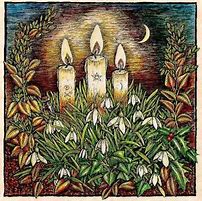
Imbolc Lore and Rituals
Celebrating the Seasons by Selena Fox
Imbolc, also known as Candlemas and Groundhog’s Day, occurs at the beginning of February. It marks the middle of Winter and holds the promise of Spring. The Goddess manifests as the Maiden and Brigid. The Groundhog is a manifestation of the God. Colors are White, and sometimes Red. It is a festival of spiritual purification and dedication.
Thoroughly clean your altar and/or temple room. Do a self purification rite with Elemental tools — cleanse your body with salt (Earth), your thoughts with incense (Air), your will with a candle flame (Fire), your emotions with water (Water), and your spiritual body with a healing crystal (Spirit). Bless candles that you will be using for rituals throughout the year. Invoke Brigid for creative inspiration. Take a Nature walk and look for the first signs of Spring. Reflect upon/reaffirm spiritual vows and commitments you have made.
Resources
- Nineteen Ways to Celebrate Imbolc by Selena Fox
- Imbolc Customs and Lore by Selena Fox
- Litany of the Five Elements by Selena Fox
- Brigid Chants by Selena Fox
- Brigid Healing Ritual by Selena Fox
Click here to read the rest of this article about Imbolc from www.circlesanctuary.org
Pagan Holidays Lughnasadh Lammas | Everything You Need To Know
The Lughnasadh and Lammas Pagan holidays celebrates the Wheel of the Year and the arrival of the late summer season!
The days are sticky hot and you spend your time finding ways to cool down. Gardens and farmlands are ripe with veggies in shades of dark green and yellow. This is the beginning of the first harvest and primarily involves grain and corn. Although the sun is strong and hot, you’ll notice the days are beginning to shorten.
This season is lush and abundant, but Nature is already beginning to sense the coming of colder Winter days. So begins the days of preparation: gathering seeds to plant next Spring, harvesting herbs, canning jams and jellies, and baking bread to store for those cold days ahead.
It’s important to also understand that there is so much more to Lughnasadh and not just the literal interpretation of harvesting because you may not be farming your own fields.
This is a time for gratitude, personal growth, and renewal. The energy and intentions of Lughnasadh are still prevalent in the day to day lives of those who live a nature spirituality based life.
Many Pagans, Witches, and those interested in Nature Spirituality celebrate the seasonal cycles. Sometimes referred to as the Wheel of the Year, and consisting of eight celebrations. Four of these festivals (Imbolc, Beltane, Lughnasadh, and Samhain) are rooted in Celtic history and origins. The other four (Spring Equinox, Summer Solstice, Autumn Equinox, and Winter Solstice) represent the sun’s location. I created a complete guide to each season, including history, traditions, symbols, correspondences, ritual ideas, and how you can celebrate.
Table of Contents:
What is the Difference Between Pagan Holidays Lammas and Lughnasadh?
Lammas Meaning, Traditions, and Why We Celebrate Pagan Holidays
How To Celebrate Lammas and Lughnasadh
PRESERVE FOODS AND MAKE JAMS/JELLIES
DONATE TO YOUR LOCAL FOOD BANK
Simple Ritual Ideas For Lughnasadh and Lammas Pagan Holidays
MEDITATE WITH CANDLES AND CRYSTALS
Lughnasadh and Lammas Correspondences
Lughnasadh and Lammas Pagan Holidays Journal Prompt Ideas
Click here to read the rest of the article Source: thepeculiarbrunette.com
Imbolc – History, Traditions, Correspondences, and Simple Ritual Ideas
(YOU CAN COPY AND PASTE ANY SPELLS POSTED TO A DOCUMENT TO PRINT AND/OR SAVE ON YOUR COMPUTER FOR PERSONAL USE ONLY)
Many Pagans, Witches, and those interested in Nature Spirituality celebrate the seasonal cycles. Sometimes referred to as the Wheel of the Year, and consisting of eight celebrations. Four of these festivals (Imbolc, Beltane, Lughnasadh, and Samhain) are rooted in Celtic history and origins. The other four (Spring Equinox, Summer Solstice, Autumn Equinox, and Winter Solstice) represent the sun’s location. I created a complete guide to each season, including history, traditions, symbols, correspondences, ritual ideas, and how you can celebrate.
Imbolc is a fire festival that celebrates the home and the halfway point between Winter Solstice and the Spring Equinox. It is quite literally Midwinter and while the days continue to grow lighter it is still dark and cold outside. Cabin fever has set in and we are all yearning to unburden ourselves from the long dark days. This can be an especially difficult time for those who suffer from seasonal affective disorder (SAD) and is a BIG reason why a celebration is so lovely right now!
After months of self-reflection, planning, and goal setting, aspiration and ambition are beginning to stir. The tiniest bits of enthusiasm is starting to awaken beneath the surface. Goals and dreams that you’ve created over the long cold nights are now being lit from the flames of Midwinter. Let your creativity and imagination help manifest these dreams!
Table of Contents
Spiritual / Magickal Intentions
Botanicals, Herbs, and Greenery
Take a walk outside to connect with the sun
How to Celebrate Imbolc and Activities
Light candles or make your own
Bake some cinnamon treats (cinnamon rolls, bread, pies, cakes, cookies, etc)
Start a new craft project or hobby
Spend time with loved ones or host a potluck
Click here to read more of this article Source: thepeculiarbrunette.com
Wiccaning – the Name-Giving Ceremony c2016
Wiccaning – the name-giving ceremony
Wiccaning, or name-giving, is the term used to describe the festivities that attend the birth of a child. Since wicca is essentially a fertility religion, the birth of a child is perceived as a gift from the gods and as a sacred rite in itself. After the birth of the child, when the life of the family has returned to normal, the parents and community celebrate the wiccaning of the child, giving it a name that will protect it during its growth and development. There is no fixed age or format for the name-giving ceremony – it can occur during the baptism, the brit milah (Jewish circumcision ceremony), or any ceremony that is not connected to a religion and is mainly pagan. It must be remembered that wicca is a religion of choice, and although the child receives a name, he/ she is entitled to choose his/ her own spiritual path or religion upon reaching maturity – as well as to change his/ her name!
Source: Day-by-Day Wicca: A complete guide to Wicca from Beliefs and Rituals to Magic and Witchcraft (Astrolog Complete Guides) by Tabatha.Jennings
How do I write a Spell?
How do I write a Spell?
State your intention. Decide on the result you want to accomplish with the spell.
The Moon is important in witchcraft and, therefore, has a profound influence. The Moon is important in witchcraft and, therefore, has a profound influence.
Time your spell. Timing when casting spells can be important. The Moon is important in witchcraft, and therefore has a profound influence upon us. It is very important to choose the right moon phase for your spell;Magical workings for gain, increase or bringing things to you, should be initiated when the moon is waxing (from new to full);When the moon is waning (from full to dark), then its time for magical workings of decrease or sending away.
The highest energy occurs at the full moon, and therefore this is the most powerful time for magical workings. The new moon is the next most powerful time for magic.
Work with the seasons. There is a natural time for starting things (a planting time), for maturing things (a growing time), for reaping things (a harvest time) and, of course, a time for rest and planning.
Gather your tools. Make sure that you have all the tools that you need for casting the spell. Your tools must have no inherent magic. They are to help you create a mood. You also have to clean your tools. Don’t forget to cleanse and bless (consecrate) your tools before your begin casting your spell.
Understand magic. Remember that magic is the manipulation of energy, a thought is a form of energy and a visualization is an even stronger form of energy. Your visualization can be a method used to intensify further and direct your will. Your visualization can be the method by which you control the magical energy you have produced. You must know what you want. You must see it. You must feel the high energy flow. You must direct it.
Write your spoken words. For making your words and thoughts stronger you can write your spell into a rhyme to be spoken aloud; this makes it easier to remember your spell, you can also chant your spell to raise energy.
Remember the Threefold Law. Everything that you want to reach with this spell comes back 3 times, good or wrong.
Additonal Tips
Before you write your final version of your spell, you can write on a note what you want to reach with your spell, and what you are needing.
Don’t forget to cast a circle before doing any spell, for you are totally vulnerable for elementals when casting higher powers of other beings.
Meditation is the key to relaxation, and being completely relaxed allows energy to flow freely throughout your body. You should learn how to clear your mind and focus with whats on hand.
Remember the very important law: if thee harm none, do what thou will.
Remember to always end a spell in “In no way shall this spell reverse, or place upon me any curse, so mote it be”
The Witches’ History, Our History

The Witches’ History, Our History
In the early days, when Christianity was slowly growing in strength, the Old Religion—the Wiccans and other pagans—was one of its rivals. It is only natural to want to get rid of a rival and the Church pulled no punches to do just that. It has frequently been said that the gods of an old religion become the devils of a new. This was certainly the case here. The God of the Old Religion was a horned god. So, apparently, was the Christian’s Devil. Obviously then, reasoned the Church, the pagans were Devil worshippers! This type of reasoning is used by the Church even today. Missionaries were particularly prone to label all primitive tribes upon whom they stumbled as devil-worshippers, just because the tribe worshipped a god or gods other than the Christian one. It would not matter that the people were good, happy, often morally and Ethically better living than the vast majority of Christians … they had to be converted!
The charge of Devil-worship, so often leveled at Witches, is ridiculous. The Devil is a purely Christian invention; there being no mention of him, as such, before the New Testament. In fact it is interesting to note that the whole concept of evil associated with the Devil is due to an error in translation. The original Old Testament Hebrew Ha-satan and the New Testament Greek diabolos simply mean “opponent” or “adversary”. It should be remembered that the idea of dividing the Supreme Power into two—good and evil—is the idea of an advanced and complex civilization. The Old Gods, through their gradual development, were very much “human” in that they would have their good side and their bad side. It was the idea of an all-good, all-loving deity which necessitated an antagonist. In simple language, you can only have the color white if there is an opposite color, black, to which you can compare it. This view of an all-good god was developed by Zoroaster (Zarathustra), in Persia in the seventh century BCE. The idea later spread westward and was picked up in Mithraism and, later, in Christianity.
As Christianity gradually grew in strength, so the Old Religion was slowly pushed back. Back until, about the time of the Reformation, it only existed in the outlying country districts. Non-Christians at that time became known as Pagans and Heathens. “Pagan” comes from the Latin Pagani and simply means “people who live in the country”. The word “Heathen” means “one who dwells on the heath”. So the terms were appropriate for non-Christians at that time, but they bore no connotations of evil and their use today in a derogatory sense is quite incorrect.
As the centuries passed, the smear campaign against non-Christians continued. What the Wiccans did was reversed and used against them. They did magick to promote fertility and increase the crops; the Church claimed that they made women and cattle barren and blighted the crops! No one apparently stopped to think that if the Witches really did what they were accused of, they would suffer equally themselves. After all, they too had to eat to live. An old ritual act for fertility was for the villagers to go to the fields in the light of the full moon and to dance around the field astride pitchforks, poles and broomsticks; riding them like hobby horses. They would leap high in the air as they danced, to show the crops how high to grow. A harmless enough form of sympathetic magick. But the Church claimed not only that they were working against the crops, but that they actually flew through the air on their poles … surely the work of the Devil!
In 1484 Pope Innocent VIII produced his Bull against Witches. Two years later two infamous German monks, Heinrich Institoris Kramer and Jakob Sprenger, produced their incredible concoction of anti-Witchery, the Malleus Maleficarum (The Witch Hammer). In this book definite instructions were given for the prosecution of Witches. However, when the book was submitted to the Theological Faculty of the University of Cologne—the appointed censor at that time—the majority of the professors refused to have anything to do with it. Kramer and Sprenger, nothing daunted, forged the approbation of the whole faculty; a forgery that was not discovered until 1898.
Gradually the hysteria kindled by Kramer and Sprenger began to spread. It spread like a fire—flashing up suddenly in unexpected places; spreading quickly across the whole of Europe. For nearly three hundred years the fires of the persecutions raged. Humankind had gone mad. The inhabitants of entire villages where one or two Witches were suspected of living, were put to death with the cry: “Destroy them all… the Lord will know his own!” In 1586 the Archbishop of Treves decided that the local Witches had caused the recent severe winter. By dint of frequent torture a “confession” was obtained and one hundred twenty men and women were burned to death on his charge that they had interfered with the elements.
Since fertility was of great importance—fertility of crops and beasts—there were certain sexual rites enacted by the Wicca, as followers of the nature religion. These sexual rites seem to have been given unnecessary prominence by the Christian judges, who seemed to delight in prying into the most minute of details concerning them. The rites of the Craft were joyous in essence. It was an extremely happy religion and so was, in many ways, totally incomprehensible to the gloomy Inquisitors and Reformers who sought to suppress it.
A rough estimate of the total number of people burned, hung or tortured to death on the charge of Witchcraft, is nine million. Obviously not all of these were followers of the Old Religion. This had been a wonderful opportunity for some to get rid of anyone against whom they bore a grudge!’ An excellent example of the way in which the hysteria developed and spread is found in the case of the so-called Witches of Salem, Massachusetts. It is doubtful if any of the victims hung* there were really followers of the Old Religion. Just possibly Bridget Bishop and Sarah Good were, but the others were nearly all pillars of the local church up until the time the hysterical children “cried out” on them.
But what about Satanism? The Witches were called worshippers of the Devil. Was there any truth to this? No. Yet as with so many of the charges, there was reason for the belief. The early Church was extremely harsh on its people. It not only governed the peasants’ way of worship but also their ways of life and love. Even between married couples, sexual intercourse was frowned upon. It was felt that there should be no joy from the act, it being permitted solely for procreation. Intercourse was illegal on Wednesdays, Fridays and Sundays; for forty days before Christmas and a similar time before Easter; for three days prior to receiving communion, and from the time of conception to forty days after paturition. In other words, there was a grand total of approximately two months in the year only when it was possible to have sexual relations with your spouse … but without deriving pleasure from it, of course!
It was no wonder that this, together with other such harshness, led to a rebellion—albeit a clandestine one. The people—this time the Christians—finding that their lot was not bettered by praying to the so-called God of Love, decided to pray to his opposite instead. If God wouldn’t help them, perhaps the Devil would. So Satanism came into being. A parody of Christianity; a mockery of it. It was a revolt against the harshness of the Church. As it turned out the “Devil” did not help the poor peasant either. But at least he was showing his disdain for the authorities; he was going against the establishment. It did not take Mother Church long to find out about this rebellion. Satanism was anti-Christian. Witchcraft was also—in their eyes—anti-Christian. Ergo, Witchcraft and Satanism were one and the same.
In 1604 King James I passed his Witchcraft Act, but this was repealed in 1736. It was replaced by an Act that stated that there was no such thing as Witchcraft and to pretend to have occult powers was to face being charged with fraud. By the late seventeenth century the surviving members of the Craft had gone underground; into hiding. For the next three hundred years, to all appearances Witchcraft was dead. But a religion which had lasted twenty thousand years, in effect, did not die so easily. In small groups—surviving covens, of times only of family members—the Craft continued.
In the literary field Christianity had a heyday. Printing had been invented and developed during the persecutions, therefore anything published on the subject of Witchcraft was written from the Church’s point of view. Later books had only these early works to which to refer so, not unnaturally, they were heavily biased against the Old Religion. In fact it was not until 1921, when Dr. Margaret Alice Murray produced The Witch Cult In Western Europe, that anyone looked at Witchcraft with anything like an unbiased light. From studying the records of the trials of the Middle Ages, Murray (an eminent anthropologist and then Professor of Egyptology at London University) picked up the clues that seemed to her to indicate that there was a definite, organized, pre-Christian religion behind all the “hogwash” of the Christian allegations. Although her theories finally proved a little far-fetched in some areas, she did indeed strike some chords. Wicca was by no means as far-reaching and widespread as Murray suggested (nor was there proof of a direct, unbroken line of descent from the cavepeople), but there can be no doubt that it did exist as an indubitable religious cult, if sporadic as to time and place. She enlarged on her views in a second book, The God of the Witches, in 1931.
In England, in 1951, the last laws against Witchcraft were finally repealed. This cleared the way for the Witches themselves to speak up. In 1954 Dr. Gerald Brousseau Gardner, in his book Witchcraft Today, said, in effect, ‘What Margaret Murray has theorized is quite true. Witchcraft was a religion and in fact it still is. I know, because I am a Witch myself.” He went on to tell how the Craft was still very much alive, albeit underground. He was the first to give the Witches’ side of the story. At the time of his writing it seemed, to him, that the Craft was rapidly declining and perhaps only hanging on by a thread. He was greatly surprised when, as a result of the circulation of his books, he began to hear from many covens throughout Europe, all still happily practicing their beliefs. Yet these surviving covens had learned their lesson. They did not wish to take the chance of coming out into the open. Who was to say the persecutions could not start again?
For a while Gerald Gardner’s was the single voice speaking for the Craft. However, whatever one’s feelings about Gardner, whatever one’s belief in the Wicca’s origins, all present-day Witches and would-be Witches owe him a tremendous debt of gratitude for having had the courage to stand up and speak out for Witchcraft. It is because of him that we can enjoy the Craft, in its many forms, today.
In America the first Witch to “stand up and be recognized” was Raymond Buckland. At that time there were no covens visible in this country. Initiated in Scotland (Perth) by Gardner’s High Priestess, Buckland set out to emulate Gardner insofar as to try to straighten the long-held misconceptions and to show the Craft for what it truly is. Soon Sybil Leek arrived on the scene, followed by Gavin and Yvonne Frost and other individuals. It was an exciting time as more and more covens, and many different traditions, came intonthe open or at least made themselves known. Today the would-be Witch has a wide selection from which to choose: Gardnerian, Celtic (in many variations), Saxon, Alexandrian, Druidic, Algard, Norse, Irish, Scottish, Sicilian, Huna, etc. That there are so many, and such varied, branches (“denominations” or “traditions”) of Witchcraft is admirable. We are all different. It is not surprising that there is no one religion that suits all people. In the same way, then, there can be no one type of Witchcraft to suit all Witches. Some like lots of ritual, while some are for simplicity. Some are from Celtic backgrounds, others from Saxon, Scots, Irish, Italian, or any of a number of others. Some favor a matriarchy; others a patriarchy and still others seek a balance. Some prefer to worship in a group (coven), while others are for solitary worship. With the large number of different denominations, then, there is now more likelihood of everyone finding a path they can travel in comfort. Religion has come a long way from its humble beginnings in the caves of pre-history. Witchcraft, as one small facet of religion, has also come a long way. It has grown to become a world wide religion, legally recognized.
Today, across America, it is not at all unusual to find open Wiccan festivals and seminars taking place in such unlikely places as family campgrounds and motels such as the Holiday Inn. Witches appear on television and radio talk shows; they are written up in local and national newspapers and magazines. Witchcraft courses are given in colleges. Even in the Armed Forces is Wicca recognized as a valid religion— Department of the
Army Pamphlet No. 165-13 “Religious Requirements and Practices of Certain Selected Groups—A Handbook for Chaplains” includes instructions as to the religious rights of Witches right alongside those of Islamic groups, Sikh groups, Christian Heritage, Indian Heritage, Japanese and Jewish groups.
Yes, Witchcraft has a place in past history and will have a definite place in the future.
Excerpt from Buckland Complete Book of Witchcraft
Raymond Buckland, Author
Am I a Witch? All the Telltale Signs c.2019
Am I a Witch? All the Telltale Signs
Am I a Witch? Well this is a very tricky and difficult question. What defines a ‘natural witch’ from a ‘self-taught witch’ or a believer of magic? To answer all this we have to go way back and define the essence of the Witches.
Lore and the Arcane Truth
There are so many things surrounding the lore, the reality and the legends regarding the Witches. Sometimes information is deliberately insufficient only because witches have always tried to scare the naive, from messing with their stuff. Only the wise, the brave and the righteous ones were allowed to learn the Craft. Why because with Great Power comes great responsibility! For example when Magical Recipes demanded the ‘five fingers‘ they certainly didn’t mean to cut off the fingers of a living human. They just demanded cinquefoil, a powerful Mercurial herb used for Healing and Money.
What is a Witch?
Let’s be clear. When we talk about Witches we are using a genderless term. Witches can be both males and females. Historically, this term has been used to identify the person who uses the Arcane Arts. Moreover, it has been used to falsely accuse women for ‘devil worshipping’ or ‘followers of the pagan gods’.
Am I a Witch?
So… Let’s see the most important traits.
1. Have You heard the ‘Calling’ ?
This is probably the most important of all the Signs. Once you’ve heard it, it’s impossible to un-hear it. Although you can always turn your back at your true nature and stick with the material Realm, you will always know who you are and who you are meant to be.
The ‘Calling’ is a revelation, a moment of extreme spiritual clarity when you somehow realise your are a Witch and get a glimpse of your true Magical Nature. This usually happens by accident, during times of intense anxiety, desperate need for help, sadness or troubles. However, the Calling may be heard in a very young age or when the ‘time is right’. Sometimes it’s a vision, a sure feeling that you are magical, or a dream or someone who enters your life unexpectedly revealing to you the truth. Other times, it’s an actual magical experience, when supernatural phenomena occur, or even an interaction with spirits of nature or ghosts or maybe deities.
There are many witches who actually plan to hear ‘the calling’ during their next lives by arranging the proper circumstances. Of course this is rarely the case as this kind of spell demand advanced levels of Magical Power.
So have you heard the calling? Good! Let’s proceed!
2. Do you feel Connected with Nature?
The relationship between you and Nature can easily tell how magical you are. Although there are other sources of Magic, Nature is the most common one. So let’s see if you are familiar with these traits, commonly attributed to ‘Natural Born Witches’ :
- You feel the Energy Shift inside you as the Seasons change.
- Moon Cycle affects you.
- Also, you feel connected to the Woods, the herbs and the trees.
- Natural phenomena like strong winds, rain, thunderstorms charge you and raise your energy and awareness.
- There is something about you that wants to be around with animals all the time.
- Likewise, animals are attracted to you.
- Since you remember yourself, you loved crystals!
3. Do you have Dreams, Memories or Visions of being a Witch?
Well, this may explain a lot. Unfortunately, many Witches suffer from the suppression of their Witchiness due to the ‘demonisation’ of the term. As we’ve all know, a Witch can be a synonym of an evil and envious person who uses his/her power to manipulate and abuse others.
However, most Witches are actually Empaths who suffer a lot when others hurt. Therefore they suppress their magical nature, denying it strongly for months, years or even their whole lives. However, there are times, when they are relaxed, or asleep, when vision and images of Witchcraft and spellcasting pop up to their minds.
This can also be memories from their early childhood, when you were ‘practicing’ your magic with an innocent mind and heart, before the essence of magic gets corrupted by the ‘system’.
4. Do you Think ‘out of the box’?
Do you despise those who censor your Thoughts? Witches are untamed creatures who love Wisdom and dare to reach for it. If you continuously find yourself doubting ‘the truth’ or the ‘religious teachings’ while you realise there is some truth in them, then this is a Witchy Traits. Witches don’t hate religion, as they believe in the existence of Higher entities. Yet they do like to think for themselves.
One of the great saying of Witchcraft is ‘to dare, to do and to keep silent’. The first two part of this saying mirrors the essence of a true, untamed, uncensored witch! One whose spirit is stronger than shallow teaching and hypocrisy.
5. Do you feel your Thoughts, your Emotions and your Words have power?
Most Witches know deep inside that their emotions and what they say actually shape reality. It’s funny as the first time they realise it is when they lie about something, and then suddenly it becomes true. For example, have you lied to your boss of being sick just to get a day-off, and after a while you indeed raise fever or something?
Witches influence and alter reality as they speak or they feel. And this exactly what defines them from all others. Thy might don’t even believe they have this ability but they discover it as they grow older. Of course, it needs practicing in order to learn how to focus this energy and not get drained.
6. Do you Collect Unusual Items?
One of the most ‘weird’ traits of witches is that they’ve always collect things that others think as trash. For example, seashore pebbles, or feathers or shells washed out from the ocean. Witches somehow sense the energy that surrounds these items and instinctively pick them up. Therefore, in most houses of Witches, you can see collections of these Weird items, which are usually considered absurd or useless by their visitors.
7. Do you frequently Observe Synchronicities?
As we’ve talked before about synchronicities, this is a very clear sign that something magical or spiritual is at work. It’s the language of the Universe. How the Spiritworld affects our Realm. You see repeating numbers, or maybe you repeatedly see animals who act as spiritual messengers. The list is endless. However, in most cases these patterns are acknowledgeable solely from the Witch as the message usually intends to have one receptor.
Defining the Untamed nature.
Although we’ve seen some of the most common traits of Witches, there are many different kinds of witches and there are definitely many different traits. However, Being a Witch is most commonly something we strongly believe and follow. Because it’s not the ‘omens’ that make us witches. It’s our Fiery Passion for Magic!
Are You a Witch?
(Seperate Article from 2016)
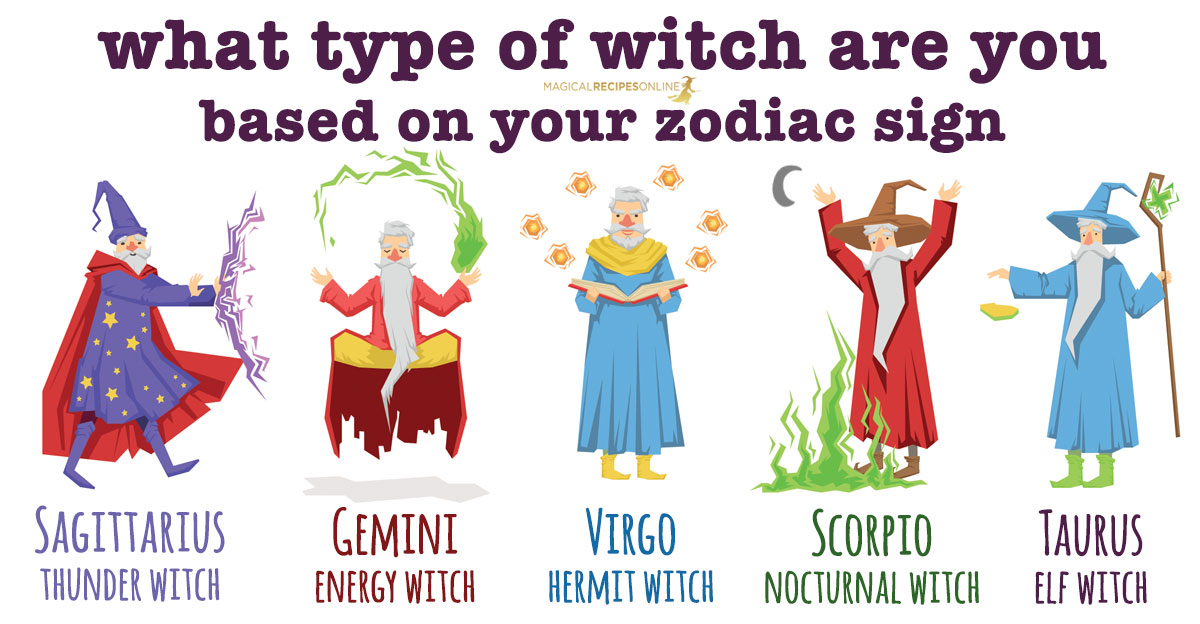
There are many ways to define how good you are in each types of Magic. One is astrology. You Zodiac sign can say many things about you especially when it comes to what you like and how your personality is prone to certain types of magic. Types of Witches can be categorized according to their Zodiac Signs as the Sun’s position in the Natal Chart shows the energy of the newborn child.
The Zodiac Circle and Types of Witches
On the other hand I would also advice you to search for the Zodiac Sign your natal Moon is placed in order to get a more personalised view on how Astrology can define the source of all your magic.
Aries: Blood Witch.
Witches born under the sign of Aries are blessed with the ability to cast powerful Candle Magic spells and tame the currents of energy. They don’t need much to empower their magic, just their fiery passion!
This comes from the fact the the first sign of the Zodiac is when Fire gets its power back. The Sun enters the Spring Equinox and nature is reborn. In their blood, waves of energy is ready to ignite their passions. If you are an Aries try this! Read all about colour correspondences of Candles and cast a simple Candle magic spell tonight! Come on!
Witches born under the sign of Taurus are very well attuned with the power of Earth and Nature. They gladly explore and exploit the powers of Herbs and most importantly the powers of their sexuality.
The first of the Earth Signs hide all the power of Nature in them. They’ve got this magnificent ability to make everything fertile, like flowers blooming. This is the real Elf power. Bringing the Life of Nature everywhere around them. If you are a Taurus try this. Search here for you favourite crystal which meets your needs and charge it with your passion!
Taurus: Elf Witch.
Witches born under the sign of Taurus are very well attuned with the power of Earth and Nature. They gladly explore and exploit the powers of Herbs and most importantly the powers of their sexuality. The first of the Earth Signs hide all the power of Nature in them. They’ve got this magnificent ability to make everything fertile, like flowers blooming. This is the real Elf power. Bringing the Life of Nature everywhere around them. If you are a Taurus try this. Search here for you favourite crystal which meets your needs and charge it with your passion!
Gemini: Energy Witch.
Witches born under the sign of Gemini have a natural ability to sense changes in energy levels around them. They got extremely sensitive intuition and they can easily send & receive energy to past, present and future.
From all the Types of Witches they are the ones with the most versatile nature. Energy is like the wind and it always changes direction. Like their mood swings they can turn up-side-down of all energy. They can transmute negative to positive energy and vice versa depending on their emotional background. Their adventurous nature make them great in manipulating astral energy. If you are a Gemini try this.
Cancer: Kitchen Witch.
Witches born under the sign of Cancer are prone to work their magic indoors by harnessing the energy provided by home supplies like food and remedies. Cancers are typical kitchen witches always brewing their potions with lost of love and affection.
As we already saw the stomach of the Cancers are really sensitive as it is the part of the body which dilutes and transmutes energy – just like the kitchen. They have the amazing ability to give their lunar blessings to everything they want and touch. The Tides of the moon enchant their potions and their spells. If you are a Cancer try this.
Leo: Enchanter Witch.
Witches born under the sign of Leo have a natural ability to catch the attention of others making them extremely talented illusionists. They can easily hypnotise people / animals and charm them.
From all the Types of Witches, Leo is blessed by the Sun. The Sun is their governor and as the planets move around the Sun so do people around Leos. They got this amazing ability to attract what they want – providing they focus their energy. If you are a Leo try this.
Virgo: Hermit Witch.
Witches born under the sign of Virgo have are extremely potent in magical practice as long as they can remain focused. They tend to re-invent their magical self in the silence of Nature, whether this is the Green Woods or the peaceful Emerald Seas.
Virgo – as the name implies – the Virgin / the Untouched, needs time for themselves. From all the Types of Witches, they are the ones who need to find a way to explore the richness of their powers by their own. Only when alone they find their true potential
Once they do they can get back to being awesome in their social circles. If you are a Virgo try this. Grounding can help them banish negativity. Go somewhere you feel secure and lonely (preferably in a Forest or near the Sea). Breathe for few minutes and cast a spell.
Libra: Music Witch.
Witches born under the sign of Libra are blessed with inspiration and are usually extremely talented in arts and crafts. Libra Witches can easily compose spells and even sing them empowering their magical vibes.
From all the Types of Witches, this is what defines them: art and inspiration. Of course they need balance and harmony in order to work their magic. To do so, the need to find a way to center themselves. Only bey this way they will learn how great they are. If you are a Libra try this. Compose tonight a simple spell and cast it with music of your own!
Scorpio: Nocturnal Witch.
Witches born under the sign of Scorpio feel inspired and “enlightened” during the midnight hours, when silence prevails and darkness asserts its dominance. Do not confuse darkness with evil. Scorpios are just great perceiving what’s hidden.
What is hidden and secret ignites their curiosity and wakes up their powerful instincts. They have this amazing ability to scratch the surface in order to find what’s hidden underneath. This is how they learn so many things. From all the Types of Witches astrology defines them as the Wisest of the Zodiac. They may fear but they try to push fear behind. If you are a Scorpio try this. In the Midnight, go outside in a safe and lonely place. Look up the skies and talk to the night about your desire!
Sagittarius: Thunder Witch.
Witches born under the sign of Sagittarius are the children of Zeus / Jupiter / Thor, the God of Thunder. They have a great ability to direct a very “thick” and focused current of energy towards whatever they desire. They are wise and fair and they can cast really powerful magic.
From all the Types of Witches, Thunder Witch is the one who can push further and break the chains throughout wisdom and optimism. Where thunder strikes everything is possible. If you are a Sagittarius try this. Focus on your hands and think and re-think your desire over and over again. When you feel ready express your desire like a thunder bursting from you hands towards your target. Here you will find how to direct energy.
Capricorn: Green Witch.
Witches born under the sign of Capricorn are the ones who can equally easily assert their magical dominance both in Nature and in Urban Territory at the same time. They can tap into nature’s power and direct them in their career and everyday life.
Saturn the so called “Planet of Witches” governs Capricorn giving them the ability to command elemental forces with love and discipline. If you are a Capricorn try this. Go out for a long walk and search for that “special tree” you feel connected with. Embrace the tree and become one with it and once you are ready send some magical energy to the future in your career / shop or wherever you work. Here you can learn more about grounding!
Aquarius: Star Witch.
Witches born under the sign of Aquarius are very well attuned with the orbs of the planets and stars. Once they look up in the night sky they just know that they are a part of something greater and although they know a little about it they can successfully direct star energy into this World.
The Stars is like a giant web where they a part of it. By looking at the stars, Aquarius knows and feels s/he is never alone. All are connected. Past, Present and Future. Thus, everything is possible. If you are an Aquarius try this. During the night, got out and talk to the stars about your desires!
Pisces: Fairy Witch.
Witches born under the sign of Pisces can easily meddle with the Fairy World and transcend the Physical plane. Those sweet Witches can easily invite fairies in their lives and establish a firm and fruitful connection with the spirit of nature.
From all the Types of Witches, a Fairy Witch is the one who live in this world but definitely belongs to another one. Not a single Pisces actually feels 100% ok with the material world. They all know deep inside that they are missing the greater truth. Thus from a really young age are trying to visualise and locate the world they really fit in. If you are a Pisces try this. Plant some Foxglove near your house and every morning invite the spirit of nature to come and live.

Famous Witches In History: Marie Laveau c. 2018
Famous Witches from History

Marie Laveau
(1801 – 1881)
Marie Laveau was a Louisiana Creole practitioner of Voudou (or Voodoo) in New Orleans. Shrouded in mystery, she has become over time the archetypal image of the “Voodoo Queen”, and managed to combine the roles of Voodoo priestess and devoted Catholic. Her character has since appeared in many works of fiction and popular music. Her daughter Marie Laveau II (c.1827 – c.1895) also practiced Voudou, and accounts often confuse the two women.
She was born free in Louisiana on 10 September 1801 (or, according to other sources, some time in the 1790s), the daughter of a white planter and a free Creole woman of colour. She moved to the French Quarter of New Orleans in her youth and was raised a devout Catholic. In 1819, she married Jacques (or Santiago, in other records) Paris, an emigrant from Haiti. After Paris’ death, Marie Laveau became a hairdresser, catering to wealthy white families, and took a lover, Christophe Glapion, with whom she lived in a common-law relationship until Glapion’s death in 1835. She reportedly bore fifteen children, including Marie Laveau II, who was born around 1827 and who apparently bore a striking resemblance to her mother.
Other than these biographical details, little is known with any certainty about the life of Marie Laveau, but it appears that she and her daughter between them established and nurtured a “Voodoo Queen” reputation. She is said to have had a large snake (named Zombi, after an African god) which many believed possessed great powers itself, and she would dance with the snake wrapped around her. The occult part of her magic mixed Roman Catholic beliefs (including saints) with African spirits and religious concepts. She frequently visited the sick in New Orleans’ prisons, and at one point she was called upon by the city’s elite to help combat the Yellow Fever epidemic of the 1850’s.
Some believe that the mother was more powerful, while the daughter arranged more elaborate public events, but it seems clear that they received varying amounts of financial support. There are contemporary reports of as many as twelve thousand spectators, both black and white, swarming to the shores of Lake Pontchartrain to catch a glimpse of Marie Laveau II performing her legendary rites on St. John’s Eve (June 23 – 24).
One of Laveau’s best documented exploits involved the murder trial of a young Creole gentleman, which seemed almost certain to end in a guilty verdict for the young man. His father approached Marie and promised her anything if she could rescue his son, and Marie agreed, asking for the man’s New Orleans house in return. Marie secretly placed several charms throughout the courtroom and, when the young man was declared not guilty, the father gave her his house as promised, and Laveau gained the instant attention of the city’s elite.
Some believe that her feared magical powers were actually based on her network of informants in the households of the prominent citizens of New Orleans, which she developed while working as a hairdresser. Others assert that she owned her own brothel and developed informants that way. Either way, she appears to have excelled at obtaining inside information on her wealthy patrons by instilling fear in their servants, whom she “cured” of mysterious ailments.
The New Orleans newspapers announced the death of Marie Laveau on June 16, 1881, and official New Orleans records indicate that a “Marie Glapion Laveau” died on June 15, 1881 (although giving her age as 98). Many people also claimed to see her in town after this date, although she did have several daughters who may have been mistaken for her. She was reportedly buried in Saint Louis Cemetery #1 in New Orleans, and the Glapion family tomb continues to attract visitors, some of whom draw three x’s (XXX) on its side in the hopes that Laveau’s spirit will grant them a wish.
___________________________________
The Real Story of the Voodoo Queen of New Orleans

Known as the Voodoo Queen of New Orleans, according to many eyewitness accounts, this was a title Marie Laveau not only earned, but to this day has not relinquished. In fact, the crypt where she’s buried St. Louis Cemetery #1 is believed ot be the most haunted cemetery in America. Visitors claim to have seen the ghost of the Voodoo Queen herself, inside the cemetery, walking around tombs, in her trademark turban, while whispering a Santeria Voodoo curse to disrespectful gawkers. If you visit her grave, you’ll notice that people still leave offerings, candles, flowers, Voodoo dolls, all in the hopes that Laveau will bestow her supernatural blessings. When people make a wish at her tomb, they return if their wish comes true and leave three X marks as a sign of their gratitude.
So, who was the Voodoo Queen of New Orleans? How did a freeborn Creole woman rise to become one of the most powerful, influential and feared women in 19th century Louisiana? Here’s the truth behind the legend…
Slave ships from West Africa first brought Voodoo to Louisiana. Practicioners knew which plants and herbs could heal and which could bring about hallucinations, sickness, and death.
Upon arrival, the slaves were christened Catholic and were orally taught the faith. In Catholicism the slaves found parallels in their own belief systems and in conjunction with their own religious practices involving naturalism, spiritualism and herbalism, voodoo practitioners would create amulets that had the power to heal or cause harm and perform rituals involving drums, prayer and dances designed to bring about a desired effect. Marie Laveau was one such voodoo practitioner. – Strange History
As a free woman of color, Marie Catherine Laveau was born in New Orleans on September 10, 1801. She was the illegitimate daughter of a free man of color and a Creole mother. Historians believe that Marie’s mother and grandmother were voodoo practitioners. In 1819, at the ripe young age of 18, Laveau married Jacques Paris, with whom she had two children, both of which are believed to have died young. Her husband also passed away under mysterious circumstances. By the time she was in her 20s she was known around town as the Widow Paris. This name would also be etched onto her tomb, which has become quite the popular tourist attraction.
After the death of Jacque, Marie became a hairdresser, most of her clients were wealthy white socialites, which allowed her to be privy to the myriad of rumors and gossip that floated around the French Quarter. Because Laveau had access to a wealth of information from both the elite women she serviced, to their servants and slaves, she was able to convince people that she was a Voodoo priestess with mystical powers. She was basically a 19th century Miss Cleo. Laveau then entered into a common-law marriage with Louis Christophe Dominick Duminy de Glapion (say that five times fast!) and they had seven children together. Unfortunately, only two of her children survived past childhood. In all, it’s believed Marie gave birth to 15 children, of which one lived to adulthood.
Of Laveau’s magical career, there is little that can be substantiated, including whether she had a snake she named Zombi after an African god, whether the occult part of her magic mixed Roman Catholic saints with African spirits, or whether her divinations were supported by a network of informants she developed while working as a hairdresser in prominent white households and in a brothel she ran. She appeared to excel at obtaining inside information on her wealthy patrons by instilling fear in their servants whom she either paid or cured of mysterious ailments.
People from each strata of society sought out Marie’s assistance with spells and potions.
It has been said that the Voodoo Queen of New Orleans had the power to put a person into or out of City Hall. She nurtured the sick through multiple epidemics, stood on the gallows ministering to the condemned and was accused of causing the deaths, through voodoo, of both a lieutenant governor and a governor. Many condemned her as a witch while others praised her as a saint. – Strange History
By the 1860s, Marie ceased practicing voodoo in public, however according to folklore she continued to practice foro well into old age. Her daughter Marie Laveau II actually picked up the mantle her mother left behind and was known for her “wild rituals in the swamps around New Orleans.” It’s believed that she drowned in Lake Pontchartrain.
Marie Laveau died on June 15, 1881. The New Orleans Daily Picayune printed the following obituary:
“Those who have passed by the quaint old house on St. Ann, between Rampart and Burgundy streets with the high frail looking fence in front over which a tree or two is visible, have been within the last few years, noticed through the open gateway a decrepid old lady with snow white hair, and a smile of peace and contentment lighting up her golden features. For a few years past she has been missed from her accustomed place. The feeble old lady lay upon her bed with her daughter and grand children around her ministering to her wants.”
The paper went on to write that she died with a smile on her face, and was buried in the family tomb at 5PM, in St. Louis Cemetery #1. Her funeral was attended by throngs of people.
Marie’s beauty and wisdom were also recounted in her obituary, however, her voodoo practices were referred to as being “skilled in the practice of medicine” and being “acquainted with the valuable healing qualities of the indigenous herbs.” The paper touched upon stories of her healing abilities as a “very successful nurse.”
“In yellow fever and cholera epidemics she was always called upon to nurse the sick, and always responded promptly. Her skills and knowledge earned her the friendship and approbation, of those sufficiently cultivated, but the ignorant attributed her success to unnatural means and held her in constant dread. Notably in 1853 a committee of gentlemen, appointed at a mass meeting held at Globe Hall, waited on Marie and requested her on behalf of the people to minister to the fever stricken. She went out and fought the pestilence where it was thickest and many alive today owe their salvation to her devotion. Not alone to the sick man was Marie Laveau a blessing. To help a fellow citizen in distress she considered a priceless privilege.”
The paper was very explicit in providing every minute detail of Laveau’s life. Noting that she lived in an “unassuming cottage”, built by French settlers, and was in a state of decay, but Marie welcomed people into her home, day or night, and provided them food and a warm place to spend the night.
Marie also made herself available to condemned men, providing them counsel before they were they were executed. In fact, Marie became a folk hero of sorts, fighting on behalf of the condemn. It was reported that she’d beg for mercy for prisoners, and she was reportedly very anti-capital punishment. In her obituary, the local paper noted her pious nature, and her devotion to Jesus and the church:
“All in all Marie Laveau was a most wonderful woman. Doing good for the sake of doing good alone, she obtained no reward, oft times meeting with prejudice and loathing, she was nevertheless content and did not lag in her work. She always had the cause of the people at heart and was with them in all things. During the late rebellion she proved her loyalty to the South at every opportunity and fully dispensed help to those who suffered in defense of the “lost cause.” Her last days were spent surrounded by sacred pictures and other evidences of religion, and she died with a firm trust in heaven. While God’s sunshine plays around the little tomb where her remains are buried, by the side of her second husband, and her sons and daughters, Marie Laveau’s name will not be forgotten in New Orleans.”
Reference: Tatiana Danger Roadtrippers
Smells like witch spirit: How the ancient world’s scented sorceresses influence ideas about magic today

Most perfume ads suggest that the right scent can make you sexy, alluring and successful. A blend by Black Phoenix Alchemy Labs, meanwhile, offers to make you smell like Hecate, the three-faced Greek goddess of witchcraft.
As a classics scholar who studies both magic and the senses in the ancient world, this idea of a witch-inspired perfume fascinates me – and “Hecate” is just one of many magic-inspired fragrances available today.
What does a witch smell like, and why would you deliberately perfume yourself like one?
Smells are impossible to see or touch, yet they affect us emotionally and even physically. That’s similar to how many people think of magic, and cultures around the world have connected the two. My current research is focused on how magic and scent were linked in ancient Rome and Greece, ideas that continue to shape views of witches in the West today.
Greeks and Romans of all walks of life believed in magic and used spells ranging from curses to healing magic and garden charms. Magical handbooks from the time show that Greco-Egyptian magicians used fragrance extensively in their rituals, even scented inks, and doctors believed strong-smelling plant species to be more medically effective than others. The gods themselves were thought to smell sweet, and places they touched retained a pleasant odor, making scent a sign of contact with the divine.
Witches wielding perfumes
Professional magicians in the ancient world claimed they could curse enemies, summon gods, heal the sick, raise ghosts, tell the future and accomplish various other miraculous feats. Surviving descriptions suggest that a majority of them were men, although certainly not all.
When it comes to Greek and Roman fiction, however, most magicians are women.
Witches in ancient literature use smells even more … Click here to read the rest of this article
To My Fellow Poor Witches c.2018

For Your Viewing Pleasure – Appalachia Mountain Roots Plants and Herbs
Disclaimer: No herb should be used for medicinal purpose until you have checked with your health care professional to ask if it is safe for you to use it for any reason. The content provided on this website is for informational purposes only and DOES NOT CONSTITUTE THE PROVIDING OF MEDICAL ADVICE and is not intended to be a substitute for independent professional medical judgment, advice, diagnosis, or treatment. Always seek the advice of your physician or other qualified health providers with any questions or concerns you may have regarding your health. WitchesofTheCraft.com, any staff member of WitchesofTheCraft.com and/or Lady Carla Beltane are not responsible for any type of negative reaction when using this herb for any reason.
This is an interesting series by Donnie Law about the Appalachian Mountain people in the eastern USA. Included in this area is where Lady Abyss was from in Kentucky, USA. So, I always think of her when I am watching one of these videos.
Appalachia Mountain Roots Plants and Herbs

Appalachia – From Wikipedia
Appalachia (/ˌæpəˈlætʃə, –leɪtʃə, –leɪʃə/) is a cultural region in the Eastern United States that stretches from the Southern Tier of New York State to northern Alabama and Georgia.[1] While the Appalachian Mountains stretch from Belle Isle in Canada to Cheaha Mountain in Alabama, Appalachia typically refers only to the cultural region of the central and southern portions of the range, from the Blue Ridge Mountains of Virginia southwest to the Great Smoky Mountains. As of the 2010 United States Census, the region was home to approximately 25 million people.[2]
Since its recognition as a distinctive region in the late 19th century, Appalachia has been a source of enduring myths and distortions regarding the isolation, temperament, and behavior of its inhabitants. Early 20th century writers often engaged in yellow journalism focused on sensationalistic aspects of the region’s culture, such as moonshining and clan feuding, and often portrayed the region’s inhabitants as uneducated and prone to impulsive acts of violence. Sociological studies in the 1960s and 1970s helped to re-examine and dispel these stereotypes.[3]
While endowed with abundant natural resources, Appalachia has long struggled economically and been associated with poverty. In the early 20th century, large-scale logging and coal mining firms brought wage-paying jobs and modern amenities to Appalachia, but by the 1960s the region had failed to capitalize on any long-term benefits[4] from these two industries. Beginning in the 1930s, the federal government sought to alleviate poverty in the Appalachian region with a series of New Deal initiatives, such as the construction of dams to provide cheap electricity and the implementation of better farming practices. On March 9, 1965, the Appalachian Regional Commission[5] was created to further alleviate poverty in the region, mainly by diversifying the region’s economy and helping to provide better health care and educational opportunities to the region’s inhabitants. By 1990, Appalachia had largely joined the economic mainstream but still lagged behind the rest of the nation in most economic indicators.[3]
For Your Viewing Pleasure – 1612: The Disturbing Witch Trial That Shook Britain | The Pendle Witch Child

HERBALISM AND FOLK REMEDIES: A BEGINNERS LOOK INTO TRADITIONAL HEALING
Disclaimer: No herb should be used for medicinal purpose until you have checked with your health care professional to ask if it is safe for you to use it for any reason. The content provided on this website is for informational purposes only and DOES NOT CONSTITUTE THE PROVIDING OF MEDICAL ADVICE and is not intended to be a substitute for independent professional medical judgment, advice, diagnosis, or treatment. Always seek the advice of your physician or other qualified health providers with any questions or concerns you may have regarding your health. WitchesofTheCraft.com, any staff member of WitchesofTheCraft.com and/or Lady Carla Beltane are not responsible for any type of negative reaction when using this herb for any reason.
In an era dominated by advanced pharmaceuticals and medical technologies, the humble origins and principles of herbalism and folk remedies often seem overshadowed. Yet, there is a growing interest in these traditional methods of healing – a thirst for returning back to the wild and seeping in all the knowledge of natural medicines and foods we can find in the world around us. This interest is not just a nostalgic return to the practices of our ancestors, but a rational and evidence-based reconsideration of what effective medicine can look like in a modern context.
The reliance on synthetic drugs, heralded for their targeted action and potency, has somewhat obscured the value found in the natural compounds that have been the bedrock of medicinal practices for millennia. Despite this pharmaceutical shift, many folk remedies have remained in our homes – from lemon and ginger teas for sore throats and colds, to baking soda paste on nettle stings to stop the itchiness, what the world naturally gives us works – and so we come back to it.
There are benefits in herbal medicines, even if it is not quite understood which components are doing the helping, as this study suggests. These findings give credibility to traditional remedies and expand our knowledge on healing with accessible and effective resources that align with the principles of sustainability. It is always good to keep in mind that traditional medicine is in direct competition with the business of big pharma, so it’s no surprise there is a lack of official research being poured into the subject.
This exploration of natural remedies has identified active ingredients in common foods and herbs that support the treatment of various conditions— such as garlic’s antimicrobial properties, the anti-inflammatory effects of turmeric, and the treatment of depression using St Johns Wort (though, for clarification, this particular study claims to have “inconclusive” results, despite finding St Johns Wort more effective than the standard treatments).
Nonetheless, these findings validate traditional medicine, as well as illuminate a path forward where health care can be more sustainable, grounded, and in tune with the natural world. Integrating folk remedies into contemporary healthcare practices is not about rejecting modern medicine’s achievements but about broadening our approach to healing.
HOW PLANTS CONNECT US TO MAGICK…
Click here to read the rest of this article Source: wildweremain.com
1 Person’s View on The Ultimate Guide to Kitchen Witchery
Food is essential. Some people take great delight in cooking and preparing meals while others find the activity to be a necessary chore.
But when does cooking become more than just cooking?
When you stir in a little magic and whip up something enchanting. Many of the basic ingredients you use to make your meals every day also have magical attributes.
What’s the difference between just throwing a few things together in a pot and creating magic?
Intent and focus, of course!
Whether you are still a secret witch or simply don’t have time for elaborate rituals, kitchen witchery is an easy way to integrate magic into your daily life. Herbs and other mundane ingredients can be used to witchify your next meal.
Your Kitchen Altar
If you plan to use kitchen witchery as your primary mode of witchcrafting, you may want to begin thinking of your kitchen as a sacred space. This, of course, will depend on your living situation and personal practice.
Take a moment to think about your kitchen. It’s probably often overlooked and under appreciated, but some truly magical things happen in this room.
The gifts of the Earth are transformed and combined into creations that nourish and benefit your body. That’s pretty neat!
While you probably can’t treat your kitchen as an altar all the time, there are a few things you can do to transform this room into a sacred space.
Address Energetic Imbalances
Just like any other space, the kitchen can sometimes collect unwanted energies, especially if it doesn’t get much sunlight. All those cabinets and crevices between appliances don’t help matters. And if you live in a rental there could be years of energetic build…
Magical Kitchen Decorations…
Tools…
Dishes, Cookware and Other Containers…
The Oven…
The Cauldron…
Mortar and Pestle…
Pantry…
Cooking and Eating Utensils…
Steps for Food Magic
-
Set your purpose or intention before preparing each meal. For bigger changes you may need more than one meal.
-
Select foods and ingredients that are suitable for your intention.
-
Choose foods that you enjoy. Just because something has the magical association you are looking for doesn’t mean you should force yourself to eat something you dislike.
-
Choose foods that contribute to a healthy diet. Don’t let magic lead you toward an unbalanced diet of junk food. Self care, folks!
-
Visualize your intention. As you are prepare the ingredients by chopping, peeling, and heating, visualize yourself in the life where your intention has manifested.
-
Eat with intention. Continue visualizing your life where your intention has manifested. Visualize the energy of the food transforming within you into your magical purpose.
-
Give it time. Magic manifests gradually and naturally. Your magical purpose will likely not transform overnight.
Tips for Magical Cooking
-
Make sure you’re in a positive mood when working your culinary magic. You are, after all, the most important player when it comes to the vibrational energy of the meal.
-
Meditate, cleanse yourself, listen to music or perform another self care ritual before you begin cooking.
-
Be sure your intention is clear while you work in the kitchen so that your food is imbued with the magical essence you look to create.
-
Share your magical intention for the food with anyone who is sharing the meal with you. Be prepared to only charge your portion if they are not interested in magical food.
-
Incorporate kitchen witchery into your practice most easily at the Sabbats. If you are already celebrating with a special meal or potluck with friends, try making something magical and seasonal.
-
Remember that it’s not always necessary to look it up. Spicy food is generally protective, citrusy food is generally purifying, sweet food is generally loving. Do what feels right to you.
-
Consider starting a magical food diet that fuels your intention with foods that have similar energies. Check with a doctor or nutritionist before making drastic changes to your diet.
Cooking and magic have a lot in common. Both create something new by combining specific ingredients and both are meant to improve the overall well-being of the creator. Best of all—no matter how long you’ve been practicing each—there’s always more to learn: new tricks, techniques, and combinations.
Give yourself time to practice and experiment, and learn from your successes and mistakes.
Click here to read the rest of this article Source: mumblesandthings.com
Folk Magic
The term folk magic encompasses a wide variety of diverse magical practices united only by the fact that they are the magical practices of the common folk, rather than the ceremonial magic that was worked by the learned elite.
Folk magic is generally of a practical nature, meant to address the common ills of the community: healing the sick, bringing love or luck, driving away evil forces, finding lost items, bringing good harvests, granting fertility, reading omens and so on. Rituals are generally relatively simple and often change over time as the workers are generally illiterate. Materials used are commonly available: plants, coins, nails, wood, eggshells, twine, stones, animals, feathers, etc.
Folk Magic in Europe
It’s becoming increasingly common to see claims about European Christians persecuting all forms of magic, and that folk magicians were practicing witchcraft. This is untrue. Witchcraft was a specific type of magic, one that was harmful. Folk magicians did not call themselves witches, and they were valued members of the community.
Moreover, until the last few hundred years, Europeans frequently did not distinguish between magic, herbalism, and medicine. If you were ill, you might be given some herbs. You might be instructed to consume them, or you might be told to hang them over your door. These two directions would not be seen as different nature, even though today we would say one was medicinal and the other was magic.
Hoodoo and Rootwork
Hoodoo is a 19th-century magical practice found primarily among African-American populations. It is a mixture of African, Native American, and European folk magic practices. It is generally strongly steeped in Christian imagery. Phrases from the Bible are commonly used in workings, and the Bible itself is considered a powerful object, able to drive away negative influences.
It is also frequently referred to as rootwork, and some label it witchcraft. It has no connection to Vodou (Voodoo), despite the similar names.
Pow-Wow and Hex-Work
Pow-Wow is another American branch of folk magic. While the term has a Native American origin, the practices are primarily European in origin, found among… Click here to read the rest of this article Source: learnreligions.com
The 13 Principles of Wiccan Belief

The 13 Principles of Wiccan Belief Source: wiccangathering.com
In the 1970s in the United States, a coalition of Wiccan groups banded together and set to put and end to misconceptions about Wicca. For too long, they thought, Wicca had been subject to uninformed stereotypes, stigma, and lack of proper recognition. So, what are the thirteen principles exactly?
The Thirteen Principles of Wiccan Belief were a summation to clear up misconceptions about Wicca and they outlined concepts such as: non-harm, disassociation from the devil, acknowledging the power of nature and the spiritual world, and living in harmony with the universe.
They also covered some societal issues like environmental responsibility and equality of the sexes. The federation wanted to communicate what Wicca was, and also what it was not.
The Principles are monumental because Wiccans and neo-Pagans are loosely organised and often can never agree. However the 13 principles of Wiccan belief forged an agreement among these diverse groups. The legacy of this historic agreement still lasts today.
For more general information about Wiccan beliefs, check out our beginner’s guide to Wiccan beliefs.
Origination of the 13 Principles of Wiccan Belief
In the 1970s, there were many misconceptions about Wicca and other pagan religions in the eyes of the general public. For instance, often Wicca and Witchcraft were misunderstood to be the same as Satanism or were misconstrued with the Christian Devil. There was much fear of pagan practices, and many untrue myths and stigma floating around.
A group of American Wiccans wanted to go on the offensive and correct the misinformation. Wicca is naturally a decentralized religion as there is no official religious document, no central leader, and no governing authority. Wiccans are subject only to the divine.
There are infinite varieties which fall under the umbrella of pagan religion, and each practitioner has their own personal belief. They sought to create a document to clearly outline a general set of principles which all Wiccans adhere to.
However they thought it was possible to create a summary that all traditions could agree to and unite under. It was the goal of these principles to clarify what Wicca really was (and wasn’t).
Timeline
The period surrounding the 13 principles spans from 1973 until 1974. It started when Carl Llewellyn Weschcke created and chaired the “Council of American Witches”. (It’s sometimes called “The American Council of Witches”.)
The council was composed of about 73 members from various Wiccan, Pagan, and Witchcraft paths. The council convened in fall 1973 in Minneapolis.
You may know Carl Llewellyn Weschcke from his publishing company, Llewellyn Worldwide Ltd., which publishes pagan, Wiccan, and occult books. Weschcke published a newsletter called “Touchstone,” which formed the basis of a comprehensive document on the wide variety of Wiccan beliefs.
In April 1974, the council met again in Minneapolis. At this meeting they adopted Weschcke’s document. This document became the 13 Principles of Wiccan Belief that we know today.
Legacy of the Principles
Although the Council only lived for a short time (it disbanded later on in 1974), its legacy lives on. One of the largest impacts of the Principles is its inclusive definition of the overall guidelines of Witchcraft traditions. It embraces the full range of pagan and Wiccan beliefs. As a testament to this, the Principles are still embraced today.
Another notable legacy is to get governmental recognition of Wicca. The Principles were added to the US Army’s Handbook for Chaplains which is a huge achievement.
The the 13 Principles of Wiccan Belief were groundbreaking in another way. They described everyone regardless of “sexual preference.” This was an incredible feat at the time.
The Text of the Thirteen Principles of Wiccan Belief
These were taken from the text of the Council of American Witches Principles of Wiccan Beliefs.
Adopted By The Council Of American Witches Spring Witch meet of 1974, Minneapolis, Minnesota
The Council of American Witches finds it necessary to define modern Witchcraft in terms of the American experience and needs. In 1974 the Council of American Witches was formed with 73 Witches of varying traditions. They attempted to form a statement of common principles and definitions shared by Witches in order to dispel misinformation.
These principles have been incorporated into one or more editions of the U.S. Army handbook for chaplains. Although most Witches embrace the Wiccan Rede, many embrace some or all of the 13 Principles of Wiccan belief.
We are not bound by traditions from other times and other cultures and owe no allegiance to any person or power greater than the Divinity manifest through our own being. As American Witches, we welcome and respect all life-affirming teachings and traditions, and seek to learn from all and to share our learning within our Council. Here follows the introduction that accompanied the principles, this explains them better than we can, and the 13 principles themselves.
The 13 Principles of the Wiccan Belief:
Introduction: In seeking to be inclusive, we do not wish to open ourselves to the destruction of our group by those on self-serving power trips, or to philosophies and practices contradictory to those principles. In seeking to exclude those whose ways are contradictory to ours, we do not want to deny participation with us to any who are sincerely interested in our knowledge and beliefs, regardless of race, colour, sex, age, national or cultural origins or sexual preference.
We practice rites to attune ourselves with the natural rhythm of life forces marked by the phases of the Moon and the seasonal Quarters and Cross Quarters.
We recognise that our intelligence gives us a unique responsibility towards our environment. We seek to live in harmony with nature in ecological balance offering fulfilment to life and consciousness within an evolutionary concept.
We acknowledge a depth of power far greater than that is apparent to the average person. Because it is far greater than ordinary it is sometimes called “supernatural”, but we see it as lying within that which is naturally potential to all.
We conceive of the Creative Power in the universe as manifesting through polarity – as masculine and feminine – and that this same Creative Power lies in all people and functions through the interaction of the masculine and the feminine. We value neither above the other knowing each to be supportive of the other. We value sex as pleasure as the symbol and embodiment of life, and as one of the sources of energy used in magical practice and religious worship.
We recognise both outer and inner, or psychological, worlds — sometimes known as the Spiritual World, the Collective Unconscious, Inner Planes, etc. — and we see in the interaction of these two dimensions the basis for paranormal phenomena and magickal exercises. We neglect neither dimension for the other, seeing both as necessary for our fulfilment.
We do not recognise any authoritarian hierarchy, but do honour those who teach, respect those who share their greater knowledge and wisdom, and acknowledge those who have courageously given of themselves in leadership.
We see religion, magick and wisdom in living as being united in the way one views the world and lives within it – a world view and philosophy of life which we identify as Witchcraft – the Wiccan Way.
Calling oneself a “Witch” does not make a Witch – but neither does heredity itself, nor the collecting of titles, degrees, and initiations. A Witch seeks to control the forces within her/himself that make life possible in order to live wisely and without harm to others and in harmony with nature.
We believe in the affirmation and fulfilment of life in a continuation of evolution and development of consciousness giving meaning to the Universe we know and our personal role within it.
Our only animosity towards Christianity, or towards any other religion or philosophy of life, is to the extent that its institutions have claimed to be “the only way,” and have sought to deny freedom to others and to suppress other ways of religious practice and belief.
As American Witches, we are not threatened by debates on the history of the Craft, the origins of various terms, the origins of various aspects of different traditions. We are concerned with our present and our future.
We do not accept the concept of absolute evil, nor do we worship any entity known as “Satan” or “the Devil”, as defined by Christian tradition. We do not seek power through the suffering of others, nor do we accept that personal benefit can be derived only by denial to another.
We believe that we should seek within Nature that which is contributory to our health and well-being.
Brief Look At Different Traditions In Witchcraft – Eclectic Wicca
Eclectic Wicca
Look in any personals column in a Craft-oriented newsletter or journal and you will see this catch-all phrase. Basically, it indicates that the individual does not follow any particular Tradition, denomination, sect, or magickal practice. They learn and study from many magickal systems and apply to themselves what appears to work best. I happen to be an Eclectic Wiccan.
Sea Witchcraft c. 2016


You must be logged in to post a comment.