Gods and Goddesses – An Overview of Greek Titans Gods

I am using just one website greek-gods.org for this overview of Greek Titans Gods and Goddesses so, if I missed any please let me know in the comments section. Thank you!

The Titans, elder Greek gods and first divine rulers

The mighty Titans were a powerful race that ruled the world before Olympians, in a time of the Golden Age of men. They were immortal giants of incredible strength and knowledge of old religion rituals and magic. They are also known as the Elder Gods and their dwelling place was at Mount Othrys. In Greek culture they were interpreted as personifications of the earth (Gaea) and the sky or heavens (Uranus).

The first generation of Titans were descendants of Gaea and Uranus who originally gave birth to Twelve Titans, six males and six females. Males were CoeusCronusCriusHyperionIapetus and Oceanus and females were MnemosynePhoebeRheaTheiaThemis and Tethys. They arose to power when Cronus, in a plot with his mother and his brothers, castrated his father Uranus and took the rulership of Cosmos from him. More details about this conflict can be found in the Genesis

During this reign, the titans and other primeval gods decided to pass on the godly genes and gave birth to the second generation of Titans. Hyperion and Theia gave birth to EosHelios and Selene, while Coeus and Phoebe brought forth Leto and Asteria. Oceanus and Tethys gave birth to Oceanids and Potamoi who are in general not referred as Titans. However, an Oceanid Clymene, a daughter of Oceanus and Tethys, helped Iapetus to continue the next generation and bore him AtlasPrometheusEpimetheus and Menoetius. Crius and his half-sister Eurybia, a daughter of Gaea and Pontus, brought forth AstraeusPallas and Perses and, eventually, Cronus and Rhea gave birth to younger gods, ZeusHadesPoseidonHeraHestia and Demeter who rebelled against Cronus and his followers and later defeated them in a ten-year war, known as Titanomachy. They called themselves the Olympian Gods, after Mount Olympus which was their main dwelling place, and became the new rulers of Cosmos.

The Titans

Click on the hyperlink for each God or Goddess for more information about them. I will post on each individually in the days and weeks to come.

First generation

Crius

Cronus

Hyperion

Iapetus

Mnemosyne

Oceanus

Phoebe

Rhea

Tethys

Theia

Second generation

Eos

Epimetheus

Helios

Leto

Prometheus

Gods – Aeolus

Aeolus – Greek God Of Wind

Aeolus

Aeolus is the name of a few different characters in GREEK MYTHOLOGY, but the one most commonly associated with the name is the god of winds. He plays a key role in Homer’s Odyssey, in which he’s also known as the keeper of the winds. This Aeolus, from the story, was originally human, but in later classical writings he was treated as only a god.

AEOLUS FACTS

Name(s): Aeolus/ Aiolos
Rules over: Wind, Air, Island of Aiolia
Title: God of the Winds and Air
Gender: Male
Symbols: Open Bag
Sacred animals: Kingfisher
Items: Harp
Parents: Hippotes & (possibly) Melanippe
Consort: Cyane
Other significant others: Retinue: – Anemoi
Children: 12 Children according to Homer, though varying accounts across different stories
Roman name: Aeolus

Aeolus – God Of Wind

The god of wind was the son of Hippotes, who was mortal. Aeolus himself was king of the island of Aeolia and befriended ODYSSEUS when his crew was stranded on the island. The friendship led to Aeolus bagging up all the winds except a gentle westerly wind, which would help Odysseus get home (this Aeolia was located near Sicily, and in real life is part of the Lipari Islands). But his crew got greedy and, after deciding the mysterious bag must hold untold wealth, opened the bag and released the other winds, which only prolonged their journey home.

In Other Myths

Aeolus is also the name of a half-human son of POSEIDON, the OLYMPIAN GOD of the sea, and the name of another human who may have been the ancestor of the other two. The god-of-wind and son-of-Poseidon Aeoluses are often confused by writers.

The third Aeolus, the son of Hellen and a nymph, Orseis, married Enarete and lived in another area called Aeolia, which later became Thessaly. This version had a daughter named Arne, who later gave birth to the Aeolus who was the son of Poseidon. The son of Poseidon, when not conflated with the god of wind, is sometimes treated as a grandfather of the god of wind, and also as the founder of Lipara in the Lipari Islands. It was extremely confusing to Greek writers and historians, too.

SOURCE: <a href=”https://greekgodsandgoddesses.net/gods/aeolus/”>Aeolus: https://greekgodsandgoddesses.net</a&gt; – Greek Gods & Goddesses, October 18, 2019

Gods and Goddesses – Creative Deities c. 2012

Creative Deities

Gods/Goddesses– Lugh, Goibniu, Brigit, Cerridwen, the Dagda, Ogma, Taliesin, Merlin, Bran the Blessed, Manannan mac Lir, Diancecht, Nantosuelta, Nuada, Luchtaine, Credne, Druantia, Scathach, Kai, Weyland, Rhiannon, Cernunnos, Athena, Hera, Hestia, the Muses, Apollo, Hermes, Hephaestus, Artemis, Thalia, Euphrosyne, Aglaia, Pan, Terpsichore, Hades, Pan, Euterpe, Orpheus, Minerva, Pales, Juno, Mercury, Vulcan, Diana, Faunus, Vesta, Osiris, Ptah, Khnemu, Thoth, Isis, Neith, Seshat, Anubis, Hathor, Khepera, Ra, Bast, Bes, Xochiquetzal, Itzamna, Pachacamac, Quetzalcoaltl,Tezcatlipoca, Xochipilli, Ishtar, Astarte
Color– True Pure Blue
Incence/Oil– Lily of the Valley
Animals– Dolphin, Whales
Spirits– Mermaid
Stones– Azurite, Torquoise
Metal– Aluminum
Plants– Carnation, Honeysukle, Vervain
Wood– Bramble
Planet– Neptune
Tarot Cards– Four Kings, Four Twos
Magickal Tools– Cauldron, Wand
Direction– South
Rituals– Achieving Equilibrium, Spiritual Manifestations, Creative Force, Divine Inspiration

In Place of a God – Buddhism

Buddhism – Definition, Founder, and Origins from history.com

Buddhism is a faith that was founded by Siddhartha Gautama (“the Buddha”) more than 2,500 years ago in India. With about 500 million followers, scholars consider Buddhism one of the major world religions. Its practice has historically been most prominent in East and Southeast Asia, but its influence is growing in the West. Many Buddhist ideas and philosophies overlap with those of other faiths.

Table of Contents

Buddhism Beliefs

Founder of Buddhism

Types of Buddhism

Dharma

Four Noble Truths

Eightfold Path

Buddhist Holy Book

Dalai Lama

Buddhist Holidays

Buddhism Beliefs

Some key Buddhism beliefs include:

  • Followers of Buddhism don’t acknowledge a supreme god or deity. They instead focus on achieving enlightenment—a state of inner peace and wisdom. When followers reach this spiritual echelon, they’re said to have experienced nirvana.
  • The religion’s founder, Buddha, is considered an extraordinary being, but not a god. The word Buddha means “enlightened.”
  • The path to enlightenment is attained by utilizing morality, meditation and wisdom. Buddhists often meditate because they believe it helps awaken truth.
  • There are many philosophies and interpretations within Buddhism, making it a tolerant and evolving religion.
  • Some scholars don’t recognize Buddhism as an organized religion, but rather, a “way of life” or a “spiritual tradition.”
  • Buddhism encourages its people to avoid self-indulgence but also self-denial.
  • Buddha’s most important teachings, known as The Four Noble Truths, are essential to understanding the religion.
  • Buddhists embrace the concepts of karma (the law of cause and effect) and reincarnation (the continuous cycle of rebirth).
  • Followers of Buddhism can worship in temples or in their own homes.
  • Buddhist monks, or bhikkhus, follow a strict code of conduct, which includes celibacy.
  • There is no single Buddhist symbol, but a number of images have evolved that represent Buddhist beliefs, including the lotus flower, the eight-spoked dharma wheel, the Bodhi tree and the swastika (an ancient symbol whose name means “well-being” or “good fortune” in Sanskrit).

Gods – Aengus (Irish Celtic)

Aengus – God of Love, Youth, Summer and Poetry

The Dagda is not thought to have welcomed the news of the arrival of Aengus.

It is said that upon hearing the news that Boann was pregnant, the Dagda attempted to hide the pregnancy by keeping the sun still in the sky for 9 months so that the gestation would take place in the space of a day.

It is possibly fitting then that Aengus, the Irish god of love, youth, summer and poetry, was in fact a love child himself.

Aengus (or Óengus as is sometimes used) was another member of the Tuatha dé Danann with expert knowledge of weaponry. His sword, Moralltach, or the Great Fury given to him by the god of the sea, Manannan mac Lir, was one of his prized possessions.

One story exists of how the Dagda when assigning land to his children, he forgot to leave land for Aengus.  At this time, the Dagda was living in Newgrange and Aengus tricked him into letting him live there permanently.

Aengus’ skill with poetry was thought to be so great that he was able to break magic spells with this gift, such as the one placed on Étain in the love story with Midir.

In a dream Aengus falls in love with a beautiful maiden, Caer Ibormeith. He searches day and night until he finds her at the Lake of the Dragon’s Mouth.

There was a catch that Caer was stuck in the form of a swan and was only able to return to a human form for one day every second year. In order to marry her, Aengus had to correctly identify her as a swan among 150 other swans, which he was able to do. Then he also transformed into a swan and flew with her to his home in the Brú na Boinne.

Gods – Janus

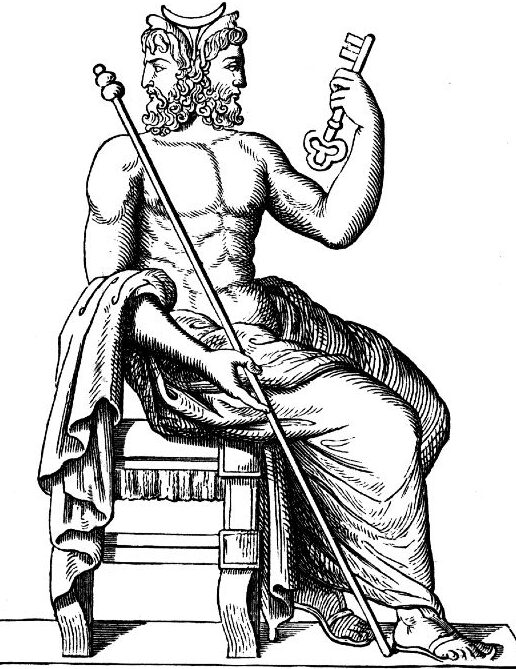
Janus – the Roman god of time, beginnings and endings, transitions, change, war and peace, as well as… doors.

Many think that all Roman gods are just renamed copies of the “original” Greek deities. However, that’s not the case. Meet Janus – the Roman god of time, beginnings and endings, transitions, change, war and peace, as well as… doors.

Janus was a peculiar deity in many ways, including in how he was worshipped, what his name actually means, and his murky origins. More has been left unknown about this deity that has been preserved through history, so let’s try to quickly go over what we do know about him.

Who was Janus?

Janus in Greek Mythology

Why Did Janus have Two Faces?

Importance of Janus in Modern Culture

FAQs About Janus

Wrapping Up

Gods – Achelous

The Greecian patron god of the “silver-swirling” Achelous River

Originally in Greek mythology, Achelous was the god of all rivers and water of the world. During Hellenistic times, he was only associated with the Achelous river. This is the largest river in all Greece. Every river has its own river spirit and Achelous was considered the chief of all the deities of rivers.

ACHELOUS FACTS

Name(s): Achelous
Rules over: The River Achelous
Title: The patron god of the “silver-swirling” Achelous River
Gender: Male
Symbols: Cornucopia
Sacred animals: Bull
Items:
Parents: Oceanus and Tethys
Consort:
Other significant others: Retinue:- Naiad Nymphs
Children: The Sirens by Terpsicore, The Acheloides, Callirhoe
Roman name: Achelous

Etruscan Mythology

In Etruscan mythology, Achelous was considered an important deity. He was intimately associated with water. This has become a Greek tradition. He also has significant underworld associations. In the 8th century, iconography representing a man-faced bull was initially adapted for Achelous as he was considered an Etruscan deity. The Greeks also eventually adopted this tradition of his image.

Important Divinity

Throughout Greece, Achelous was treated as an important divinity from the earliest times. He was invoked when people took oaths, make prayers as well as made sacrifices and more. An oracle was considered a gateway to knowing the will of the gods. Every oracle Achelous gave to humans is believed to have been added to by ZEUS at Dodoma. It included a command to provide sacrifices to Achelous. The meaning of the god himself to people in Greece is illustrated by the widespread worship of Achelous. Some believe this may account for the belief that He is the representative of sweet water in general. This means they believed Achelous to be the source of all nourishment.

Seer-Healer And Mercenaries

One of the most important exponents in Etruscan and Greek societies during the Iron Age were the mercenaries and seer-healers. The image of Achelous was a man with the face of a bull. He was an emblem used by the mercenaries and seer-healers in Greek societies for hundreds of years. It is believed this early figure was initially adapted by the iconographic and mythological traditions of Asalluhi, who was the god of magic and incantations. This was done because he was also considered a princely bison figure in Near Eastern traditions. Achelous was believed to go to the surface of the earth in marshes and spring. He would then eventually begin flowing as rivers.

Achelous Mythology

The king of CALYDON was Oeneus. Achelous was a suitor of the king’s daughter who was named Deianeira. On some thrones in ancient Greece were representations of the contest between Heracles with Achelous. It is in Megarans at Olympic in the treasury where there was a STATUE of Achelous made of gold and cedar wood that was created by a greek named Dontas. There are also many depictions of him as a bearded man in his prime or an older gray-haired man. In Classical and Archaic times, it was common to depict Achelous as a man-faced bull. It was also common for a city’s coinage to feature a man-faced bull.

Heracles Battle

Achelous battled Heracles for the attention of Deianira. She was a river nymph. During the battle, Achelous turned himself into a bull and a serpent. Heracles ripped off one of the horns of Achelous This forced him to surrender to Heracles. Achelous wanted the horn back. He traded the goat horn of Amalthea to HERACLES to get it back. Achelous then gave the horn to the Naiads. They changed the horn into a cornucopia. Deianeria was relieved. She was horrified at the idea of being courted by a river god from the underworld.

Achelous Children

Some consider Achelous to have fathered the Sirens of Terpsicore, Calliope or MELPOMENE. They were created from the blood he lost when Heracles pulled off his horn. Alcmaeon was a god who was the son of Eriphyle and Amphiaraus. After losing a large battle, Alcameon found peace at a spot along the Achelous river. It was here that Achelous offered Alcameon his daughter Callirhoe for marriage. Before this could happen, Achelous required Alcmaeon to get jewellery and clothing from his mother who was called Eriphyle. This was the clothing Eriphyle wore when she sent the father of Achelous to his death. Alcameon agreed and was also going to get the cloths from king Phegeus. This is the person who had sent his sons to murder Alcmaeon.

Italian Middy Feast

When THESEUS was waiting for a river’s raging flood to subside, he was the guest of Achelous. Where Thesus stayed was described as a building made of rough and spongy pumice. It had a floor of soft moss. Oyster and freshwater mussel shells covered the ceiling. In Italy during the sixteenth century, there was a desire to recreate this Classical space. It also inspired these types of dwellings to be built in France. The banquet served at the home of Achelous was written about and became a prototype for midday feasts in Italy. They would take place in garden grottoes under fountain-cooled shade.

Origin Of River Achelous

It is said Achelous lost one of THE SIRENS that was his daughters. During his intense sadness, he invoked his mother Gaea. She received Achelous to her bosom. On the spot where this occurred, Gaea caused a river named Achelous to come forth. It is said that the river had a bull’s voice. The winding of the river is said to have been caused because Achelous could turn himself into a serpent.

Recent studies have shown the substance of Achelous as a god goes back to Old Europe during the Bronze age. This was a time when some Old European cultures disappeared. These traditions eventually made their way to Greece, Sardinia, Italy, and Sicily. No single group of people followed Achelous, but his image has lasted through many generations. A god that is a man-faced bull is found in many places around the Mediterranean.

SOURCE: <a href=”https://greekgodsandgoddesses.net/gods/achelous/”>Achelous: https://greekgodsandgoddesses.net</a&gt; – Greek Gods & Goddesses, October 23, 2019

Gods – Helios

Helios – The Greek Sun God

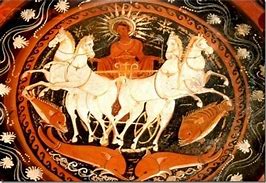
A handsome TITAN with flowing hair, driving a golden chariot pulled by four fiery steeds across the sky. That was the image that would come to the minds of ancient Greeks when they thought of Helios. To them, he was the representation of the sun and sunlight, traveling across the sky every day. Some authors report that select Greeks revered him as much as they did Zeus.

HELIOS FACTS

Name(s): Helios
Rules over: The Sun
Title: Titan God of the Sun
Gender: Male
Symbols: Sun, Chariot, Aureole
Sacred animals: Horse, Rooster, Cattle, Wolf
Items: Frankincense, Cornucopia, Black Poplar, Heliotrope
Parents: Hyperion and Theia
Consort: Clymene, Rhode – possible others: – Clytie, Perse, Leucothea
Other significant others: Siblings: – Selene and Eos
Children: Abundant children including: – The Charites, Phaethon, The Horae, Pasiphae, Circe, Aeëtes, Heliadae, and Heliades
Roman name: Sol

Helios Appearance

Artwork of the time often shows Helios to be wearing a shining aureole, or halo, of the sun upon his head. He had piercing eyes and long, curly hair.

Family History

Helios was the son of the Titan HYPERION and the Titaness, THEIA, making him a second generation Titan.
His sisters were goddesses SELENE, the moon, and EOS, the dawn.

Wives

The Titan had several wives and consorts. Among them were his sister, Selene, and Perse, an OCEANID.

Children of Helios

Helios sired many children with his different wives. The Charites, Phaethon, The HORAEPASIPHAËCIRCE, Aeëtes, Heliadae, and Heliades are among his known offspring.

The All Seeing Eye

It is not uncommon so see Helios given the epitaph Panoptes, or all-seeing, as the Greeks believed that he could witness anything in the heavens or on earth.

According to the myth about PERSEPHONE’S abduction by HADES, it was Helios who saw the crime occur. When DEMETER, Persephone’s mother, demanded to know the whereabout of her daughter, the Titan was able to inform her that Hades had kidnapped the goddess.

Another tale illustrating his ability describes Helios witnessing an affair between APHRODITE and ARES. He reported this to HEPHAESTUS, Aphrodite’s husband, and helped set a trap to catch the two lovers. Caught in the act, the gods then banished Ares from Olympus for his crime.

This ability would have made him a valuable friend to keep and a frightening enemy to have.

Daily Travels

As the sun god, Helios would make a daily journey across the sky. Four horses, Aethon, Pyrois, Phlegon and Eous, drew his chariot.

Each morning, his sister, EOS, would paint the dawn sky with her fingers and pull the misty curtain, through which Helios would appear, aside. He would drive his blazing chariot across the heavens until his travels were complete. At this time, he would he would hide in a golden cup that fell to earth while his sister, Eos, would begin her nightly trek.

Meeting with Hercules

Legend has it that one day while lost in his quest to find the island of Erythia, HERCULES grew frustrated and shot an arrow towards the sun. Upon realizing what he had done, he apologized to the Titan. Helios, however, was so taken with the boldness of this action that he presented Hercules with his golden cup. Hercules was then able to use this cup to reach his destination.

Helios Appearance in The Odyssey

Helios has a small but notable role in the Odyssey. When Odysseus and his men land on Thrinacia, one of the islands dedicated to the sun god, Odysseus warns them not to touch any of Helios’ cattle or sheep that graze on the land. They do not heed this warning and, in his absence, slaughter some of the best of the animals.

Alerted to this by one of his daughters, Helios appeals to ZEUS for revenge. He threatens to take the sun and shine it onto the dead of the UNDERWORLD, instead of on the earth, if the men’s act goes unpunished. Zeus then strikes the crew’s ship with a lightning bolt, killing everyone except for ODYSSEUS.

Cult Worship

The island of Rhodes, believed to have been shaped by Helios, is a place where people honored him as an important deity. Legend has it that when the island first came into being, it was muddy and uninhabitable. Helios dried the land and filled it with life, including seven of his sons known as Heliadae. Because of Helios’ life-giving intervention, some residents of the island worshiped him, and the island became sacred to Helios.

In the 3rd Century BC the people of Rhodes built the COLOSSUS OF RHODES which was a 30 metre (90 foot) statue of Helios, it was won of the SEVEN WONDERS of the Ancient world.

The Dorians, one of the four major ethnic groups of Greece at the time, also seemed to have celebrated Helios more than many Greeks of the era. There is even speculation that they were the people who brought the worship of the sun god to Rhodes.

Conclusion

Despite having what some historians believe to be a significant place in the Greeks’ hearts, Helios did not play a massive part in their mythology, and it seems that he was eventually replaced by APOLLO. Nevertheless, his image as the handsome Titan driving a blazing chariot pulled through the sky by his fire-breathing steeds lives on to this day.

Quick Facts:

Mother: Theia
Father: Hyperion
Siblings: Selene and Eos
Known wives/consorts: Selene, Perse, Clymene, Aegle, Neaera, Rhodos, Ocyrrhoe, Leucothoe, Nausidame, and Gaia
Known as: the Sun God
Roman equivalent: Sol

SOURCE: <a href=”https://greekgodsandgoddesses.net/gods/helios/”>Helios – The Sun God: https://greekgodsandgoddesses.net</a&gt; – Greek Gods & Goddesses, February 9, 2017

Gods – Osiris

Egyptian God Osiris

In Egyptian mythology, Osiris is the god sent by Ra as pharaoh to rule over the first inhabitants of Egypt, along with his sister and wife Isis. Osiris was wise, intelligent, and benevolent. He led mankind on the path to greatness, joy, and prosperity in just a few centuries of reign.

Nevertheless, Osiris’ success was not appreciated by all: Set, Osiris’ brother, became very jealous of Osiris and planned to assassinate him.

Thus, in order to take the power of Osiris by force, Set traps Osiris by organizing a great contest during a banquet organized in the honor of Osiris and Isis. During this feast taking place on the banks of the Nile and welcoming many guests, Set brings a pretty chest decorated with rich jewels that he proposes to offer to anyone who would be able to enter fully into it.

Surprisingly, none of the guests manage to do so. But if no one can get into Set’s chest, it’s for a very simple reason: Set’s chest is specially designed so that only Osiris can enter inside.

When it is the Egyptian ruler’s turn to try to get into the chest, Set immediately welds the openings in the chest. He then throws the chest into the Nile, killing Osiris by drowning.

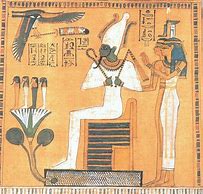
One of the symbols for Osiris

Osiris is the Egyptian god of life, death and resurrection. He took on many roles, names and forms in ancient Egyptian mythology over time. He is also a prominent god of the Heliopolitan Ennead.

Osiris (the Greek form of his name) was known as Asir in ancient Egypt. Other names or epithets he went by, include “Lord of Eternity”, “Great God” and “Foremost of the Westerners”.

Osiris Facts

Name(s): Osiris, Osiris-Apis
Rules over: Land of Egypt (Old Kingdom), Underworld (New Kingdom)
Gender: Male
Symbols: Atef Crown, Crook
Sacred animals: Ostrich Feathers on Atef Crown
Parents: Geb, Nut
Siblings: Horus, Set, Isis, Nephthys

Family

As the oldest son of Geb, the earth god, and Nut, the sky goddess, Osiris features in many stories and myths documented in ancient religious texts. He is brother to Set, Horus the ElderIsis, and Nephthys, and father to Horus the Younger (with Isis) and Anubis (with Nephthys).

The most famous myth about Osiris is also a central one in ancient Egyptian religion. Different versions are told, but it generally describes how he is killed by his jealous brother Set and his body then scattered in pieces over Egypt. A grieving Isis searches for and finds all the pieces except his penis. Nephthys and Anubis help her put the body back together but have to make him a new penis from gold. He comes back to life just long enough for Isis to become pregnant with Horus the Younger.

Symbols

Mostly depicted as a partially mummified pharaoh, Osiris’ complexion is commonly green (representing rebirth), but sometimes black (representing the fertile floodplain of the Nile River). On his head is often the Atef crown, a headdress with two feathers on either side and a disc at the top. He usually has a beard like those of the pharaohs and carried a crook and flail. The crook symbolizes his role as a shepherd god.

Powers & Duties

In Egyptian mythology, Osiris was originally the founder of agriculture. He allegedly persuaded the Egyptians to end cannibalism (though there is no evidence that they were ever cannibals). This myth is linked to his role of presiding over death and resurrection, processes which are compared to the cycles of growth and decay experienced in nature.

Osiris’ prominence was evident in the fact that he was often simply referred to as “god.” He was viewed as an equal and sometimes even superior to Ra, the sun god.

After his death, Osiris became the king of the underworld. Instead of being feared in his role as the god of death, he was associated with resurrection and regeneration, and his presence in the underworld was viewed as comforting. This fact is illustrated in many portrayals where he wears a kind smile on his face.

Worship

In the Early Dynastic period, the center of Osiris’ worship was in Abydos, where his head is said to be buried.

During Akhet, the first season of the ancient Egyptian calendar, festivals were held across Egypt to celebrate Osiris’ life, death, and rebirth.

Osiris absorbed and became associated with many other deities over time. They included Wepwawet, Sahu, Banebdjed, and Anhur. This means that he was almost constantly worshiped across Egypt until the rise of Christianity during the time of the Roman Empire. His cult continued in Philae, an island in the Upper Nile, until the time of Emperor Justinian I (527 to 565).

Facts About Osiris

  • The people of ancient Egypt believed that Osiris disappeared into the underworld with their crops during winter;
  • Examples of corn mummies made of seeded dirt and molded to resemble Osiris were found in Tutankhamen’s tomb. It is believed such “mummies” were placed in many tombs with the dead. The seeds germinated in the dark are a symbol of rebirth;
  • The people of Mendes worshipped Osiris’ soul as an aspect called Banebdjed, with “Ba” referring to his soul and “djed” referring to a pillar. Benebdjed is depicted as a ram in ancient Egyptian art;
  • The ostrich feathers on each side of the Atef crown are said to represent Osiris’ cult center at Djedu;
  • Some myths held the belief that the pharaohs became Osiris when they died;
  • The judgment scene in Book of the Dead describes how Osiris welcomes the deserving dead into his kingdom after being judged by 42 divine judges. Those who did not live a good life are left to the mercy of a “devourer”;
  • After Osiris died at the hand of Set, Anubis presided over his mummification, thereby becoming the first embalmer. Anubis was the original god of the underworld before Osiris took over;

Gods – Anubis

Anubis


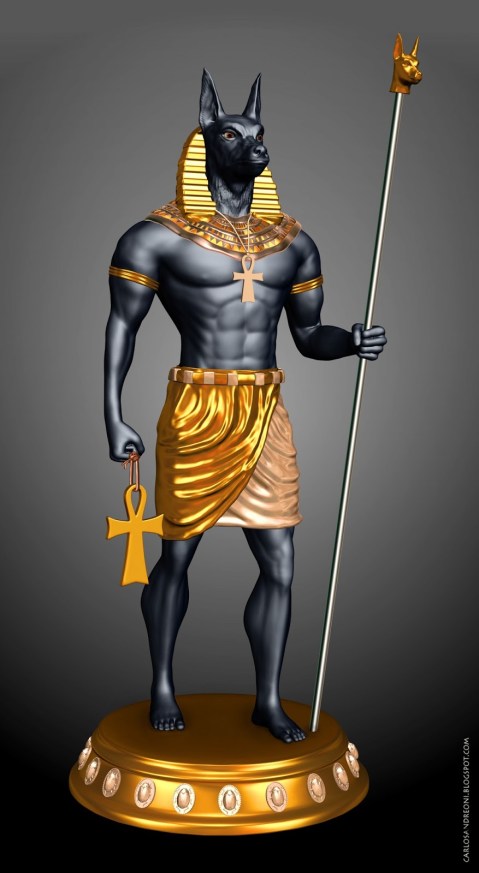
Anubis is one of the most iconic gods of ancient Egypt. Anubis is the Greek version of his name, the ancient Egyptians knew him as Anpu (or Inpu). Anubis was an extremely ancient deity whose name appears in the oldest mastabas of the Old Kingdom and the Pyramid Texts as a guardian and protector of the dead. He was originally a god of the underworld, but became associated specifically with the embalming process and funeral rites. His name is from the same root as the word for a royal child, “inpu”. However, it is also closely related to the word “inp” which means “to decay”, and one versions of his name (Inp or Anp) more closely resembles that word. As a result it is possible that his name changed slightly once he was adopted as the son of the King, Osiris. He was known as “Imy-ut” (“He Who is In the Place of Embalming”), “nub-tA-djser” (“lord of the scared land”).

He was initially related to the Ogdoad of Hermopolis, as the god of the underworld. In the Pyramid Texts of Unas, Anubis is associated with the Eye of Horus who acted as a guide to the dead and helped them find Osiris. In other myths Anubis and Wepwawet (Upuaut) led the deceased to the halls of Ma´at where they would be judged. Anubis watched over the whole process and ensured that the weighing of the heart was conducted correctly. He then led the innocent on to a heavenly existence and abandoned the guilty to Ammit.

The ancient Egyptians believed that the preservation of the body and the use of sweet-smelling herbs and plants would help the deceased because Anubis would sniff the mummy and only let the pure move on to paradise. According to early myths, Anubis took on and defeated the nine bows (the collective name for the traditional enemies of Egypt) gaining a further epithet “Jackal ruler of the bows”.


The growing power of the Ennead of Heliopolis resulted in the merging of the two religious systems. However, Osiris was the King of the Underworld in the Ennead and he was more popular (and powerful) than Anubis. So Anubis was relegated to a god of mummification. To save face it was stated that Anubis had voluntarily given up his position when Osiris died as a mark of respect. Some myths even stated that Anubis was the son of Osiris and Nephthys (who was herself associated with the funeral rites). Anubis was still closely involved in the weighing of the heart, but was more a guardian than a ruler.

He became the patron of lost souls, including orphans, and the patron of the funeral rites. In this respect he overlapped with (and eventually absorbed) the Jackal God Wepwawet of Upper Egypt.


During the Ptolemaic Period Anubis became associated with the Greek god Hermes as the composite god Hermanubis. Hermes was messenger of the gods, while Anubis was principally guide of the dead. Hermanubis was some times given attributes of Harpokrates. He was worshipped in Rome until the second century and was popular with Rennaisance alchemists and philosophers.

Priests wore Anubis masks during mummification. However, it is not clear whether the Anubis mask was a later development influenced by the Osirian myth or whether this practice was commonplace in the earlier periods too. Anubis was also closely associated with the imiut fetish used during the embalming ritual. Anubis was credited with a high level of anatomical knowledge as a result of embalming, and so he was the patron of anaesthesiology and his priests were apparently skilled herbal healers.


Tombs in the Valley of the Kings were often sealed with an image of Anubis subduing the “nine bows” (enemies of Egypt) as “Jackal Ruler of the Bows” and it was thought that the god would protect the burial physically and spiritually. One of his epithets, “tpy-djuf” (“he who is on his mountain”) refers to him guarding the necropolis and keeping watch from the hill above the Theban necropolis. He was also given the epithet “khentyamentiu” (“foremost of the westerners” i.e. the dead) because he guarded the entrance to the Underworld.


He was originally thought to be the son of Ra and Hesat, Ra’s wife (who was identified with Hathor), but later myths held that he was the child of Osiris and Nephthys, or Set and Nephthys. He was sometimes described as the son of Bast because of her link to the perfumed oils used in embalming. His wife, Anput (his female aspect) was only really referred to in association with the seventeenth nome of Upper Egypt. It is thought that they were the parents of Kebechet, the goddess of the purification.

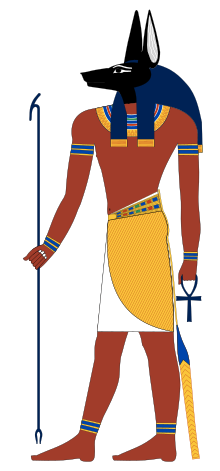
Dogs and jackals often patrolled the edges of the desert, near the cemeteries where the dead were buried, and it is thought that the first tombs were constructed to protect the dead from them. Anubis was usually thought of as a jackal (sAb), but may equally have been a wild dog (iwiw) He was usually depicted as a man with the head of a jackal and alert ears, often wearing a red ribbon, and wielding a flail. He was sometimes depicted as a jackal (such as in the beautiful examples from the tomb of Tutankhamun) but only rarely appears as a man (one example is in the cenotaph temple of Rameses II at Abydos).

His fur was generally black (not the brown associated with real jackals) because black was associated with fertility, and was closely linked to rebirth in the afterlife. In the catacombs of Alexandria he was depicted wearing Roman dress and the sun disk flanked by two cobras.

Anubis was worshipped throughout Egypt, but the center of his cult was in Hardai (Cynopolis) in the the seventeenth nome of Upper Egypt. To the east of Saqqara there was a place known as Anubeion, where a shrine and a cemetery of mummified dogs and jackals was discovered. He was also worshipped at cult centers in Abt (the the eighth nome of Upper Egypt) and Saut (Asyut, in the thirteenth nome of Upper Egypt).

____________________________

Anubis

Anubis (/əˈnuːbɪs/ or /əˈnjuːbɪs/;[1] Ancient Greek: Ἄνουβις, Egyptian: jnpw, Coptic: ⲁⲛⲟⲩⲡ Anoup) is the Greek name of a god associated with mummification and the afterlife in ancient Egyptian religion, usually depicted as a canine or a man with a canine head. Archeologists identified the sacred animal of Anubis as an Egyptian canid, the African golden wolf.

Like many ancient Egyptian deities, Anubis assumed different roles in various contexts. Depicted as a protector of graves as early as the First Dynasty (c. 3100 – c. 2890 BC), Anubis was also an embalmer. By the Middle Kingdom (c. 2055 – 1650 BC) he was replaced by Osiris in his role as lord of the underworld. One of his prominent roles was as a god who ushered souls into the afterlife. He attended the weighing scale during the “Weighing of the Heart,” in which it was determined whether a soul would be allowed to enter the realm of the dead. Despite being one of the most ancient and “one of the most frequently depicted and mentioned gods” in the Egyptian pantheon, Anubis played almost no role in Egyptian myths.

Anubis was depicted in black, a color that symbolized both rebirth and the discoloration of the corpse after embalming. Anubis is associated with Wepwawet (also called Upuaut), another Egyptian god portrayed with a dog’s head or in canine form, but with grey or white fur. Historians assume that the two figures were eventually combined. Anubis’ female counterpart is Anput. His daughter is the serpent goddess Kebechet.

Name
“Anubis” is a Greek rendering of this god’s Egyptian name. In the Old Kingdom (c. 2686 BC – c. 2181 BC), the standard way of writing his name in hieroglyphs was composed of the sound signs jnpw followed by a jackal over a ḥtp sign:
A new form with the “jackal” on a tall stand appeared in the late Old Kingdom and became common thereafter:
Anubis’ name jnpw was possibly pronounced [a.ˈna.pʰa], based on Coptic Anoup and the Akkadian transcription in the name “Reanapa” that appears in Amarna letter EA 315. However, this transcription may also be interpreted as rˁ-nfr, a name similar to that of Prince Ranefer of the Fourth Dynasty.

History
In Egypt’s Early Dynastic period (c. 3100 – c. 2686 BC), Anubis was portrayed in full animal form, with a “jackal” head and body. A “jackal” god, probably Anubis, is depicted in stone inscriptions from the reigns of Hor-Aha, Djer, and other pharaohs of the First Dynasty. Since Predynastic Egypt, when the dead were buried in shallow graves, “jackals” had been strongly associated with cemeteries because they were scavengers which uncovered human bodies and ate their flesh. In the spirit of “fighting like with like,” a “jackal” was chosen to protect the dead, because “a common problem (and cause of concern) must have been the digging up of bodies, shortly after burial, by jackals and other wild dogs which lived on the margins of the cultivation.”

The oldest known textual mention of Anubis is in the Pyramid Texts of the Old Kingdom (c. 2686 – c. 2181 BC), where he is associated with the burial of the pharaoh.

In the Old Kingdom, Anubis was the most important god of the dead. He was replaced in that role by Osiris during the Middle Kingdom (2000–1700 BC). In the Roman era, which started in 30 BC, tomb paintings depict him holding the hand of deceased persons to guide them to Osiris.

The parentage of Anubis varied between myths, times and sources. In early mythology, he was portrayed as a son of Ra. In the Coffin Texts, which were written in the First Intermediate Period (c. 2181–2055 BC), Anubis is the son of either the cow goddess Hesat or the cat-headed Bastet. Another tradition depicted him as the son of his father Ra and mother Nephthys. The Greek Plutarch (c. 40–120 AD) stated that Anubis was the illegitimate son of Nephthys and Osiris, but that he was adopted by Osiris’s wife Isis:

For when Isis found out that Osiris loved her sister and had relations with her in mistaking her sister for herself, and when she saw a proof of it in the form of a garland of clover that he had left to Nephthys – she was looking for a baby, because Nephthys abandoned it at once after it had been born for fear of Seth; and when Isis found the baby helped by the dogs which with great difficulties lead her there, she raised him and he became her guard and ally by the name of Anubis.

George Hart sees this story as an “attempt to incorporate the independent deity Anubis into the Osirian pantheon.” An Egyptian papyrus from the Roman period (30–380 AD) simply called Anubis the “son of Isis.”

In the Ptolemaic period (350–30 BC), when Egypt became a Hellenistic kingdom ruled by Greek pharaohs, Anubis was merged with the Greek god Hermes, becoming Hermanubis. The two gods were considered similar because they both guided souls to the afterlife. The center of this cult was in uten-ha/Sa-ka/ Cynopolis, a place whose Greek name means “city of dogs.” In Book XI of The Golden Ass by Apuleius, there is evidence that the worship of this god was continued in Rome through at least the 2nd century. Indeed, Hermanubis also appears in the alchemical and hermetical literature of the Middle Ages and the Renaissance.

Although the Greeks and Romans typically scorned Egypt’s animal-headed gods as bizarre and primitive (Anubis was mockingly called “Barker” by the Greeks), Anubis was sometimes associated with Sirius in the heavens and Cerberus and Hades in the underworld. In his dialogues, Plato often has Socrates utter oaths “by the dog” (kai me ton kuna), “by the dog of Egypt”, and “by the dog, the god of the Egyptians”, both for emphasis and to appeal to Anubis as an arbiter of truth in the underworld.

Roles
Protector of tombs
In contrast to real wolves, Anubis was a protector of graves and cemeteries. Several epithets attached to his name in Egyptian texts and inscriptions referred to that role. Khenty-imentiu, which means “foremost of the westerners” and later became the name of a different wolf god, alluded to his protecting function because the dead were usually buried on the west bank of the Nile. He took other names in connection with his funerary role, such as tpy-ḏw.f “He who is upon his mountain” (i.e. keeping guard over tombs from above) and nb-t3-ḏsr “Lord of the sacred land”, which designates him as a god of the desert necropolis.

The Jumilhac papyrus recounts another tale where Anubis protected the body of Osiris from Set. Set attempted to attack the body of Osiris by transforming himself into a leopard. Anubis stopped and subdued Set, however, and he branded Set’s skin with a hot iron rod. Anubis then flayed Set and wore his skin as a warning against evil-doers who would desecrate the tombs of the dead. Priests who attended to the dead wore leopard skin in order to commemorate Anubis’ victory over Set. The legend of Anubis branding the hide of Set in leopard form was used to explain how the leopard got its spots.

Most ancient tombs had prayers to Anubis carved on them.

Embalmer
As jmy-wt “He who is in the place of embalming”, Anubis was associated with mummification. He was also called ḫnty zḥ-nṯr “He who presides over the god’s booth”, in which “booth” could refer either to the place where embalming was carried out or the pharaoh’s burial chamber.

In the Osiris myth, Anubis helped Isis to embalm Osiris. Indeed, when the Osiris myth emerged, it was said that after Osiris had been killed by Set, Osiris’s organs were given to Anubis as a gift. With this connection, Anubis became the patron god of embalmers; during the rites of mummification, illustrations from the Book of the Dead often show a wolf-mask-wearing priest supporting the upright mummy.

Guide of souls
By the late pharaonic era (664–332 BC), Anubis was often depicted as guiding individuals across the threshold from the world of the living to the afterlife. Though a similar role was sometimes performed by the cow-headed Hathor, Anubis was more commonly chosen to fulfill that function. Greek writers from the Roman period of Egyptian history designated that role as that of “psychopomp”, a Greek term meaning “guide of souls” that they used to refer to their own god Hermes, who also played that role in Greek religion. Funerary art from that period represents Anubis guiding either men or women dressed in Greek clothes into the presence of Osiris, who by then had long replaced Anubis as ruler of the underworld.

Weighing of the heart

One of the roles of Anubis was as the “Guardian of the Scales.” The critical scene depicting the weighing of the heart, in the Book of the Dead, shows Anubis performing a measurement that determined whether the person was worthy of entering the realm of the dead (the underworld, known as Duat). By weighing the heart of a deceased person against Ma’at (or “truth”), who was often represented as an ostrich feather, Anubis dictated the fate of souls. Souls heavier than a feather would be devoured by Ammit, and souls lighter than a feather would ascend to a heavenly existence.

Bibliography

Main Source: Ancient Egypt Online
Goodenough, Simon (1997) Egyptian Mythology
Grajetzki, W (2003) Burial Customs in Ancient Egypt
Ikram, Salima (1997) Death and Burial in Ancient Egypt
Pinch, Geraldine (2002) Handbook Egyptian Mythology
Redford Donald B (2002) Ancient Gods Speak
Watterson, Barbara (1996) Gods of Ancient Egypt
Wilkinson, Richard H. (2003) The Complete Gods and Goddesses of Ancient Egypt
Wikipedia

Gods – Aten

Click here for more information about the Egyptian God Aten from egyptian-history.com

Do you want to know who was Aten (or Aton), the god representing the Sun in the ancient Egyptian civilization? Do you want to know how Aten almost became the sole god of Egypt during the reign of a “heretic pharaoh”?

Fascinated by ancient Egypt, our team has prepared an article that answers these questions.

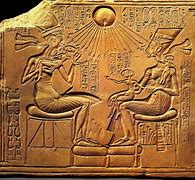
Aten is the “Sun disk god” of ancient Egypt: he is the incarnation of the Sun. The god Aten appears during the 25th century BC as a minor god of Egypt. However, it was in 1353 BC that Aten really entered the posterity by becoming the single god of Egypt throughout the reign of Akhenaten, the so-called “heretic pharaoh.”

In this article, you will discover:

  • The place of the solar god Aten in Egyptian mythology
  • The history of the “Cult of Aten” advocated by the pharaoh Akhenaten (who will progressively establish the replacement of all the gods by the unique and almighty Aten)
  • The great problem that Aten posed when he became the sole god of Egypt: the end of the myth of the “Weighing of the Heart”

At the end of this article, you will know everything about the god Aten and the Cult of Aten of Akhenaten.

Let’s start right away by presenting who Aten is according to Egyptian mythology.

1) Who was Aten?

Aten, the Sun disk god, is the personification of the Sun. Aten takes his name from the Egyptian word “yati” meaning “to be far away” (which obviously refers to the Sun high in the sky).

Clearly aware that the Sun is vital for life, the ancient Egyptians praised the multi-armed Sun disk called Aten very early in their history (from the year 2500 BC according to the Egyptian collection of texts called “Pyramid Texts”).

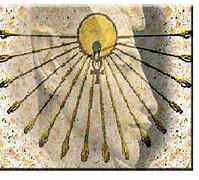
Aten is represented as a radiant sphere with long hands with which he bathes the world with his light, a necessary condition for plant, animal, and human life. In some representations, the Sun disk god has hands holding the Egyptian cross “ankh” (the Egyptian symbol of life) which seems to be stretched out to the earth to bring it food and fertility (thus representing the beneficial effects of the rays of the Sun).

Subsequently, in the course of the history of Egypt, more and more links appear between Aten and the kings of Egypt. According to ancient Egyptian legends, it is the pharaoh who controls the Sun: it is the pharaoh who orders the Sun to rise and set at the same times as he does.

Yet, if Aten is so famous in our modern society, it is because Aten became the one and only god of ancient Egypt during a small period of history: that of the “heresy of Akhenaten.”

2) The Cult of Aten

You now have a glimpse of the divinity embodying the Sun. Now let us discover the history of the establishment of the cult that placed him in the position of single god of Egypt.

A) The god Amun

In order to understand how Aten became the unique god of Egypt, one must understand the story of the almost “almighty” god he replaced: the god Amun.

Amun was initially the god of the creation of life. According to Egyptian mythology, there was only the original Darkness and the original Ocean at the beginning of our world. Then, through the repeated contacts between the Darkness and the Ocean was born the god Atum, the god representing the breath of life. Immediately after this event, responding to the call of Atum (i.e. the call of life),  the two gods Ra and Amun were born by their own will.

The falcon-headed Sun god Ra creates the Earth, the stars, and the Universe by harmoniously mixing the original Darkness and the original Ocean. It is thus he who creates the Sun Aten which he then places like a crown on his head to illuminate the Universe, having known until then only the night.

The god Amun creates life by changing himself into a goose to lay an egg. Then, Amun changes himself into a snake to hatch and fertilize this egg. He thus creates the first animal, vegetable, and human life forms.

During the New Kingdom of Egypt’s period (the period of Egypt from 1550 to 1069 BC), the god Amun will become more and more important in Egyptian beliefs. Amun will gradually become known in his form of Amun-Ra, i.e. a form in which he becomes one with the hawk Sun god Ra. Under this form, Amun is therefore responsible for the creation of the “Universe” in addition to the creation of “life.”

It was during the reign of Akhenaten’s grandfather and father (respectively Thutmose IV and Amenhotep III) that Amun became a god truly more important than all the others.

However, Egypt did not fall into a form of monotheistic religion since, despite his importance, Amun did not replace the other gods and goddesses (the jackal Anubis remained the god of death, the ibis Thoth remained the god of knowledge, the cat Bastet remained the goddess of women and joy, Bes remained the dwarf god of the home . . .).

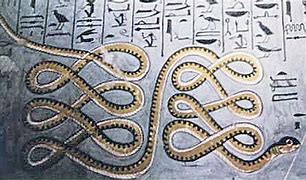
Gods – Apep

Apep Egyptian Serpent God of Choas from egyptian-history.com

You wish to know who is Apep, the Egyptian serpent god? You want to understand the role played by Apep in the myth of the solar boat of Ra?

Great amateurs of Egyptian mythology, we are here to enlighten you on these subjects.

Apep is a giant Egyptian serpent god whose goal is to devour Ra, the Sun god illuminating the entire universe. According to Egyptian mythology, every night since the creation of the world, Apep has tried to eat Ra, even though the latter was always defended by Set, Sobek, Maat, Isis, and Thoth.

Today, we will discover together:

  • The myth of Apep in the Egyptian mythology
  • The myth of the eternal combat of Apep against Ra
  • The other Apep: the snake Jörmungandr and the asteroid 99942 Apophis

Very soon you will know all about the Egyptian evil snake called Apep.

Let’s discover immediately the story of the largest snake of ancient Egypt!

1) Apep in Egyptian Mythology

Already present before the creation of the world by Ra, Apep (or Apophis) is an evil entity, the embodiment of darkness and destruction. Apep is a huge snake, allegedly as wide and long as the Nile. This snake is a fundamentally evil being whose sole motivation is to eat the falcon-headed Sun god Ra.

The latter illuminates the world during the day, crossing the sky on his boat before passing through the Underworld to return to his point of departure. It is in the world of darkness that Ra is the target of all types of monsters, demons and ghosts who wish to eat him. Indeed, Ra, a hawk with a Sun on his head, appears extremely appetizing to them.

2) Apep against Ra

Each night, Apep thus leads his army with the aim of eating Ra. Yet, he encounters great difficulty in reaching his objective because Ra has assembled a team of Egyptian gods to defend himself:

– Set, the god of chaos and tempests: with the mission to focus on Apep and repel him with sandstorms and lightning.

– Sobek, the crocodile god of strength and power: Ra’s long-time bodyguard, the god Sobek, unlike Set, focuses on the evil horde of Apep.

– Thoth, the ibis god of knowledge: planning, for each night, a new strategy to surprise Apep and his army.

– Maat, the winged goddess of justice: offering magical healing to her team and, able to fly, catching the team members who have fallen out of the boat of Ra.

– Isis, the goddess of magic: unleashing powerful spells on Apep and his army during difficult situations.

With this shock team, Apep lost every single fight, which never discouraged him. Apep could be mortally wounded, but he had the ability to regenerate when he was covered by the deepest darkness of the world of the dead.

Apep is the antithesis of the gods, representing chaos and darkness, the opposite of the values of the Egyptian pantheon, whose sacred mission was to spread order and light throughout the world. However, Apep contributes to the equilibrium of the universe, being one of its original components, and therefore should not be definitively defeated because his total elimination would destabilize the universe just as much as if the gigantic snake managed to eat Ra.

According to his myth, Apep is responsible for eclipses. Sometimes, Apep succeeded in swallowing Ra during surprise attacks in broad daylight, which made the sun disappear from the sky of mortals. Fortunately, the other gods quickly came to the rescue to pierce the belly of Apep, freeing Ra and thus ending the eclipse.

3) The other version of the myth of Apep: Set, the substitute of Ra

In Egyptian religion, Set gradually takes the place of Ra in the myth of the solar boat and replaces the entire team of Egyptian gods. Ra is then relegated only as the bearer of the Sun and not as the eternal adversary of Apep as he was.

How unfortunate it would be if you missed this great passage in Egyptian mythology: here is a concise summary of the “myth of Osiris” that tells us why Ra was replaced by Set.

A) The myth of Osiris

According to the Egyptian myth of the “Beginning”, Ra created the world by cleverly mixing the Darkness (from which Apep came) and the original Ocean.

From this enlightened mixture came Shu (the wind) and Tefnut (the warmth of the Sun). Shu and Tefnut married to give birth to Geb (the earth) and Nut (the sky). Geb and Nut in turn married and had two sons and two daughters (who also married each other in pairs): Osiris, Set, Isis and Nephthys.

Osiris took his sister Isis as his wife while Set took his sister Nephthys as his wife. Osiris was quickly sent to Earth to become the god-pharaoh who guide mankind.

When he arrived, Osiris fully committed himself to his mission, he brought to humanity a peace, security and unity that had never been seen before.

Set soon became jealous of Osiris’ position but kept this resentment to himself at first. However, when he realized that Nephthys was cheating on him with Osiris, he began to feel a deep hatred for his brother.

Set decided to assassinate Osiris in order to obtain the throne of Egypt. To do so, he visited the best craftsmen in the world to create a beautiful chest covered with precious stones and metals. This chest was made with a certain interior shape so that the only thing it could contain was Osiris himself. Set organized a large banquet on the banks of the Nile to which he invited Osiris and his relatives. At this event, he declared that he would offer the large chest to anyone who entered the chest in its entirety.

Not surprisingly, only Osiris managed to enter the chest. It was at this point that the plan of Set and his accomplices was revealed: they hurled themselves onto the chest and welded its opening before throwing it into the Nile. Osiris drowned.

The chest then drifted down the Nile until it came to a shrub by the riverside that trapped it in its roots. Over the years, the shrub completely absorbed the chest and Osiris. The chest and Osiris gradually found themselves in the middle of its trunk. On its side, the tree grew at a supernatural speed, thanks to the divine presence of the body of the deceased Osiris. The tree grew so large that it fed the lust of a great foreign king, who made it one of the columns of his palace.

Isis, who traveled the world in search of her husband’s body, arrived in this royal palace after years and years of searching. She convinced the king to give the pillar to her and cure her only heir of a fatal disease in appreciation. In possession of the chest (and thus the body of Osiris, she succeeded in reviving him for a single night, which enabled her to become pregnant with Horus).

But before she has time to perform certain rituals to bring Osiris back to life, Set falls on the body of Isis’ unfortunate husband during a hunting trip. To prevent any resurrection that might lead to the end of his reign, Set cuts the body of Osiris into fourteen pieces and scatters them throughout Egypt.

Once again, Isis sets out to find the body of Osiris in tears. These tears attract Nephthys and Anubis (the son Nephthys had with Osiris) who are sympathetic to Isis and help her in her quest. The three of them manage to find 13 of the 14 parts. But as they were about to find the last part, a fish eats it and digests it quickly. This part (namely, the phallus of Osiris) is thus lost forever.

Osiris cannot be reconstituted in its entirety and is brought back to life with an incomplete body. This incomplete body will then prevent him from directing the living. Set will therefore retain his place as king of Egypt (exercising a much less just and upright reign than his brother during his lifetime). Osiris will be forced to leave the world of the living and go to the Underworld where he will rule over the dead.

B) The myth of Horus and Set

As an adult, Horus claims the throne of his father from the greatest and wisest of the gods organized in an instance called the “divine assembly”.

The majority of this enlightened tribunal, composed of Ra (the falcon-headed Sun god)Shu (the god representing the wind), and Thoth (the ibis-headed god of knowledge), immediately rebelled against Egypt’s current situation. Shu and Thoth find despicable that Set could deprive Horus by killing his father of his rightful royal place. The two gods are therefore ready to go to Set and ask him to abdicate without delay.

Nevertheless, the myth cannot stop here: Ra is extremely offended that his opinion is not asked (because he is the father and first of all the gods of Egypt).

The falcon Sun god declares that Horus may well make a bad king. For Ra, the latter must prove his worth before any form of abdication that could put Egypt in a very unfortunate position.

The declaration of Ra is followed by various great trials between Set and Horus: duels, chariot races, and trials of strength, all of which have one thing in common: the countless frauds that Set commits in the course of them. Set wins all the tests organized by the jury by this not very honorable way.

The many trials of the competition culminate in the trial called the “Hippopotamus Trial”. In this event, the two rival gods must each plunge to the bottom of the Nile as hippopotamuses and hold their breath as long as possible. During this test, Isis, out of concern for the future of her son, will create a magic harpoon to catch Set and bring him back to the surface of the Nile (which would make him lose the test). Isis succeeds in touching Set with her harpoon, which makes Horus win (who wins a trial against Set for the first time).

Horus is however very unhappy with the situation because he has the ambition to win fairly. Very angry, Horus tears off his mother’s head and throws it away (fortunately, Thoth fetches this head and resuscitates Isis).

Following this matricide, the court of the three gods is angry against Horus and punishes him by proposing to Set to decide the form of a last trial. This final trial would determine who would be the definitive king and guide of Egypt for millennia to come. Set then chooses a final trial that would be memorable and would legitimize his superiority over Horus forever. Set thus claimed that the final test would be a race of ships built only with stones.

After these events, Horus, exhausted, falls asleep on one of Egypt’s highest mountains to take a well-deserved night’s rest before a challenge that will not be easy. Wanting to ensure his victory, Set discreetly follows him and tears out his left eye while he sleeps.

He then cuts that eye into six equal parts and hides them throughout the world. Seeing in this action a consequent imbalance in the next trial, Thoth will immediately seek to reconstitute the eye of Horus.

While Horus sleeps, the god of knowledge travels around the world at superhuman speed but can only gather five of the six fragments. He thus creates himself the last missing fragment and reconstitutes a new and more efficient eye thanks to a new magical sixth piece. This eye will have the capacity to see “what-is-invisible” (i.e. the future and the past).

As soon as his work is finished, Thoth gives the eye back to Horus, who will thus not be disadvantaged in any way in the upcoming boat race.

The trial begins with a boat construction: Horus starts by looking for some beautiful stones to build his boat. However, his new prodigious eye reveals to him that “he will not win the race”.

Horus becomes very worried: it is important for him to recover the throne that was once stolen from his father. So Horus tries to cheat: he builds a wooden boat with a plaster exterior that has a texture similar to stone.

The next day, the race begins. Set arrives without a boat because he has a rather specific plan. Set is convinced that the top of a high mountain could very well serve as a boat and should float.

However, his plan is a cruel failure because as soon as he launches his boat, the rounded tip of the mountain sinks steeply. The council therefore declares Horus the winner. Mad with rage, Set throws himself on Horus’ boat to ransack it and the deception is revealed. The boat being made of wood, Horus is obviously disqualified.

The divine council decides to meet in order to find the adequate solution to this unprecedented case. They call upon the just and wise Osiris (who became god of the dead after his death) to guide them in their decision. With the will to put his young son in power, Osiris tries to tip the jury’s balance in his favor with a clever stratagem.

He addresses the Sun, the Moon, and all the stars and asks them to follow him into his subterranean realm. Deprived of the light of these vital stars, the world of the living is on the verge of total collapse. Ra, Shu, and Thoth have no choice but to accept Osiris’ request.

Horus defeats the evil Set and comes to power, as he should have done initially. Later, he will marry Hathor, goddess of love and beauty. Having inherited his father’s qualities, he ruled the land of the Nile with a masterly hand.

Set, meanwhile, was banished to the desert, his original kingdom. It was here that he began his long journey of repentance alongside Ra in his solar boat.

It was truly at his redemption that Set became a popular and beloved god. After having been the god of chaos and destruction, now he is able to question himself by working for the good cause. Gradually, he becomes the symbol of the victory of good over evil in the struggle against Ra’s enemy, Apep.

The Egyptian snake god

You now know everything about the mysteries surrounding the largest snake in Egyptian mythology through the myths of the solar bark and the myth of Ra’s replacement by Set. As a bonus, you know more about 99942 Apophis and about Jörmungand (the Apep of Asgard).

If the myths of ancient Egypt are something you are interested in, know that we offer many necklacesringsbracelets and T-shirts referring to ancient Egypt.

In connection with the story of Apep, we obviously invite you to take a look at our collection of Egyptian necklaces. To do so, nothing could be simpler: just click on the image below!


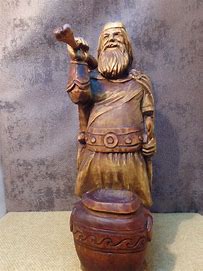
Gods – The Dagda

The Dagda – Celtic God of Agriculture, Fertility, Seasons and Weather from letsgoireland.com

Who is the king of the gods in Celtic mythology?

The Dagda Celtic god is believed to be the father of the gods and is thought of as a strong, manly figure with the knowledge and wisdom of the druids.

As a god he had immense power and influence. The Dagda is the Celtic god of agriculturefertility of the land and animalsweathertime and seasons.

He is also connected with life and death. Donn, the Irish god of death may have been an aspect of the Dagda.

Good, fruitful harvests were critical for the survival of Celtic people and animals, so it is easy to see how central a role this god played in the Celtic pantheon.

The fertility and health of cattle was also of primary importance as a person’s wealth was often counted in terms of cattle. Retribution payments for certain crimes were also paid in cattle according to the old Irish Brehon laws.

One ritual to ensure a fruitful harvest in the coming year was the annual coupling of the Dagda with his wife, the Morrigan goddess at the feast of the Samhain (on 1 November).

Some of the Dagda’s most prized possessions included an enchanted harp and a magical staff, with which he could kill 9 men at once with or restore their lives at will. He also had a bottomless cauldron to ensure that no man left his table feeling hungry.

The Dagda was the supposed father of several other important figures in Irish mythology including the goddess Brigid and Bodb Derg who featured a key role in the tale of the Children of Lir.

The river goddess Boann was his lover and mother of his child, and fellow god, Aengus.

Gods – Charge Of The God

Oak and Holly Kings

Charge Of The God on summergoddess.wordpress.com

Since Wicca is about balance in the Universe; a newer addition to the tradition is the “Charge of the God”. Once again, there are several versions out there for you to choose from. I am listing two here for you to see; the first is from my personal Book of Shadows, the second was another version that I liked for its content and poetic flow. (Once again, you will notice that the version I use does not have the names of the God listed within the first line.)

As I said before; Wicca is about balance. For this reason I feel that the Charge of the God is necessary when invoking the combination of the Goddess and the God within your ritual. This gives you the balance of the feminine; (wisdom and emotion,) and the masculine; (strength and protection,) in your rituals and spell casting.

The Charge Of The God

Listen to the words of the Great Father, who of old was called by many names:

My law is harmony with all things.

Mine is the secret that opens the gates of life and Mine is the dish of salt of the Earth that is the body of Cernunnos, which is the eternal circle of rebirth.

I give the knowledge of life everlasting; and beyond death, I give the promise of regeneration and renewal.

I am the sacrifice, the Father of all things and My protection blankets the Earth.

Now hear the words of the dancing God, the music of whose laughter stirs the winds, whose voice circles the seasons:

I who am the Lord of the Hunt and the Power of the Light; sun among the clouds and the secret of the flame, I call upon your bodies to arise and come unto me.

For I am the flesh of the Earth and all its beings.

Through Me all things must die and with Me they are reborn.

Let My worship be in the body that sings–for behold, all acts of willing sacrifice are My rituals.

Let there be desire and fear, anger and weakness, joy and peace, awe and longing within you.

For these; too, are parts of the mysteries found within you, within Me. All beginnings have endings, and all endings have beginnings.

Gods – Vishnu

The 10 Avatars of the Hindu God Vishnu from learnreligions.com

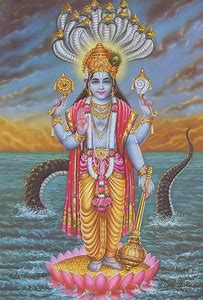
 Vishnu is among the most important deities of Hinduism. Together with with Brahma and Shiva, Vishnu forms the principal trinity of Hindu religious practice.

In his many forms, Vishnu is regarded as the preserver and protector. Hinduism teaches that when humanity is threatened by chaos or evil, Vishnu will descend into the world in one of his incarnations to restore righteousness.

The incarnations that Vishnu takes are called avatars. The Hindu scriptures speak of ten avatars. They are thought to have been present in the Satya Yuga (the Golden Age or Age of Truth), when mankind was ruled by gods.

Collectively, the avatars of Vishnu are called dasavatara (10 avatars). Each has a different form and purpose. When an individual is faced with a challenge, a particular avatar descends to address the issue.

The myths associated with each avatar reference a specific period of time when they were most needed. Some people refer to this as the cosmic cycle or the Time-Spirit. For instance, the first avatar, Matsya, descended long before the ninth avatar, Balarama. More recent mythology states that Balarama may have been the Lord Buddha.

No matter the specific intent or place in time, the avatars are meant to re-establish the dharma, the path of righteousness or universal laws taught in the Hindu scriptures. The legends, myths, and stories that include the avatars remain important allegories within Hinduism.

01 of 10

The First Avatar: Matsya (The Fish)

A depiction of Vishnu Matsya (left)
Wikimedia Commons

Matsya is said to be the avatar that rescued the first man, as well as other creatures of the earth, from a great flood. Matsya is sometimes depicted as a great fish or as a human torso connected to the tail of a fish.

Matsya is said to have forewarned man about the coming flood and ordered him to preserve all the grains and living creatures in a boat. This story is similar to many deluge myths found in other cultures.

02 of 10

The Second Avatar: Kurma (The Tortoise)

A depiction of the turtle avatar of Vishnu
Wikimedia Commons

Kurma (or Koorma) is the tortoise incarnation that relates to the myth of churning the ocean to obtain treasures dissolved in the ocean of milk. In this myth, Vishnu took the form of a tortoise upon which to support the churning stick on his back.

The Kurma avatar of Vishnu is usually seen in a mixed human-animal form.

03 of 10

The Third Avatar: Varaha (The Boar)

Varaha (the boar) Avatar
Ann Ronan Pictures/Getty Images

Varaha is the boar that raised the earth from the bottom of the sea after the demon Hiranyaksha dragged it to the bottom of the sea. After a battle of 1,000 years, Varaha raised the earth out of the water with his tusks.

Varaha is depicted as either a full boar form or as a boar head on a human body.

04 of 10

The Fourth Avatar: Narasimha (The Man-Lion)

Narasimha, the man-lion avatar of Vishnu
CORBIS/Getty Images

As the legend goes, the demon Hiranyakashipiu obtained a boon from Brahma that he could not be killed or harmed by any means. Now arrogant in his security, Hiranyakshipiu began to cause trouble both in heaven and on earth.

However, his son Prahlada was devoted to Vishnu. One day, when the demon challenged Prahlada, Vishnu emerged in the form of a man-lion known as Narasimha to slay the demon.

05 of 10

The Fifth Avatar: Vamana (The Dwarf)

A sculpture depicting Vamana, the dwarf avatar of Vishnu
Angelo Hornak/Getty Images

In the Rig Veda, Vamana (the dwarf) appears when the demon king Bali ruled the universe and the gods lost their power. One day, Vamana visited the court of Bali and begged for as much land as he could cover in three steps. Laughing at the dwarf, Bali granted the wish.

The dwarf then assumed the form of a giant. He took the whole earth with the first step and the entire middle world with the second step. With the third step, Vamana sent Bali down to rule the underworld.

06 of 10

The Sixth Avatar: Parasurama (The Angry Man)

Parasurama, the priest avatar of Vishnu
CORBIS/Getty Images

In his form as Parasurama, Vishnu appears as a priest (Brahman) who comes to the world to kill bad kings and protect humanity from danger. He appears in the form of a man carrying an ax, sometimes referred to as Rama with an ax.

In the original story, Parasurama appeared to restore Hindu social order which had become corrupted by the arrogant Kshatriya caste.

07 of 10

The Seventh Avatar: Lord Rama (The Perfect Man)

Statue depicting Lord Rama, the perfect man, an avatar of Vishnu
Instants/Getty Images

Lord Rama is the seventh avatar of Vishnu and a major deity of Hinduism. He is considered supreme in some traditions. He is the central figure of the ancient Hindu epic “Ramayana” and is known as King of Ayodhya, the city believed to be Rama’s birthplace.

According to the Ramayana, Rama’s father was King Dasaratha and his mother was Queen Kausalya. Rama was born at the end of the Second Age, sent by the gods to do battle with the multi-headed demon Ravana.

Rama is often depicted with blue skin, standing with a bow and arrow.

08 of 10

The Eighth Avatar: Lord Krishna (The Divine Statesman)

A depiction of Lord Krishna (right), an avatar of Vishnu
Ann Ronan Pictures/Getty Images

Lord Krishna (the divine statesman) is the eighth avatar of Vishnu and is one of the most widely revered deities in Hinduism. He was a cowherd (sometimes depicted as a charioteer or statesman) who shrewdly changed rules.

According to legend, the famous poem, the Bhagavad Gita, is spoken by Krishna to Arjuna on the battlefield.

Krishna is depicted in a variety of forms because there are so many stories surrounding him. The most common story describes Krishna as a divine lover who plays the flute; he is also described in his child form. In paintings, Krishna often has blue skin and wears a crown of peacock feathers with a yellow loincloth.

09 of 10

The Ninth Avatar: Balarama (Krishna’s Elder Brother)

A depiction of Balarama, an avatar of Vishnu
Wikimedia Commons

Balarama is said to be the elder brother of Krishna. It is believed that he engaged in many adventures alongside his brother. Balarama is rarely worshiped independently, but stories always focus on his prodigious strength.

In visual representations, he is usually shown with pale skin in contrast to Krishna’s blue skin.

In a number of versions of the mythology, Lord Buddha is thought to be the ninth incarnation. However, this was an addition that came after the dasavatara was already established.

10 of 10

The Tenth Avatar: Kalki (The Mighty Warrior)

Statue of Lord Kalki
Premiumstock / iStock / Getty Images Plus

Kalki (meaning “eternity” or “mighty warrior”) is the last incarnation of Vishnu. He is not expected to appear until the end of Kali Yuga, the current time period. Kalki will come, it is believed, to rid the world of oppression by unrighteous rulers. It is said that he will appear riding a white horse and carrying a fiery sword.

SOURCE: Das, Subhamoy. “The 10 Avatars of the Hindu God Vishnu.” Learn Religions, Aug. 28, 2020, learnreligions.com/avatars-of-vishnu-p2-1769984.

Gods – Anubis – Egyptian c. 2018

Anubis


Anubis is the Greek name of a god associated with mummification and the afterlife in ancient Egyptian religion, usually depicted as a canine or a man with a canine head. Archeologists have identified Anubis’s sacred animal as an Egyptian canid, the African golden wolf.

Like many ancient Egyptian deities, Anubis assumed different roles in various contexts. Depicted as a protector of graves as early as the First Dynasty (c. 3100 – c. 2890 BC), Anubis was also an embalmer. By the Middle Kingdom (c. 2055 – 1650 BC) he was replaced by Osiris in his role as lord of the underworld. One of his prominent roles was as a god who ushered souls into the afterlife. He attended the weighing scale during the “Weighing of the Heart,” in which it was determined whether a soul would be allowed to enter the realm of the dead. Despite being one of the most ancient and “one of the most frequently depicted and mentioned gods” in the Egyptian pantheon, Anubis played almost no role in Egyptian myths.

Anubis was depicted in black, a color that symbolized both rebirth and the discoloration of the corpse after embalming. Anubis is associated with Wepwawet (also called Upuaut), another Egyptian god portrayed with a dog’s head or in canine form, but with grey or white fur. Historians assume that the two figures were eventually combined. Anubis’ female counterpart is Anput. His daughter is the serpent goddess Kebechet.

Name

“Anubis” is a Greek rendering of this god’s Egyptian name. In the Old Kingdom (c. 2686 BC – c. 2181 BC), the standard way of writing his name in hieroglyphs was composed of the sound signs jnpw followed by a jackal over a ḥtp sign:

i n
p
w C6

A new form with the “jackal” on a tall stand appeared in the late Old Kingdom and became common thereafter:

i n
p
w E16

Anubis’ name jnpw was possibly pronounced [a.ˈna.pʰa], based on Coptic Anoup and the Akkadian transcription 𒀀𒈾𒉺<a-na-pa> in the name <ri-a-na-pa> “Reanapa” that appears in Amarna letter EA 315. However, this transcription may also be interpreted as rˁ-nfr, a name similar to that of Prince Ranefer of the Fourth Dynasty.

History

In Egypt’s Early Dynastic period (c. 3100 – c. 2686 BC), Anubis was portrayed in full animal form, with a “jackal” head and body.  A “jackal” god, probably Anubis, is depicted in stone inscriptions from the reigns of Hor-Aha, Djer, and other pharaohs of the First Dynasty.  Since Predynastic Egypt, when the dead were buried in shallow graves, “jackals” had been strongly associated with cemeteries because they were scavengers which uncovered human bodies and ate their flesh. In the spirit of “fighting like with like,” a “jackal” was chosen to protect the dead, because “a common problem (and cause of concern) must have been the digging up of bodies, shortly after burial, by jackals and other wild dogs which lived on the margins of the cultivation.”

The oldest known textual mention of Anubis is in the Pyramid Texts of the Old Kingdom (c. 2686 – c. 2181 BC), where he is associated with the burial of the pharaoh.

In the Old Kingdom, Anubis was the most important god of the dead. He was replaced in that role by Osiris during the Middle Kingdom(2000–1700 BC). In the Roman era, which started in 30 BC, tomb paintings depict him holding the hand of deceased persons to guide them to Osiris.

The parentage of Anubis varied between myths, times and sources. In early mythology, he was portrayed as a son of Ra. In the Coffin Texts, which were written in the First Intermediate Period (c. 2181–2055 BC), Anubis is the son of either the cow goddess Hesat or the cat-headed Bastet. Another tradition depicted him as the son of Ra and Nephthys. The Greek Plutarch (c. 40–120 AD) stated that Anubis was the illegitimate son of Nephthys and Osiris, but that he was adopted by Osiris’s wife Isis:

For when Isis found out that Osiris loved her sister and had relations with her in mistaking her sister for herself, and when she saw a proof of it in the form of a garland of clover that he had left to Nephthys – she was looking for a baby, because Nephthys abandoned it at once after it had been born for fear of Seth; and when Isis found the baby helped by the dogs which with great difficulties lead her there, she raised him and he became her guard and ally by the name of Anubis.

George Hart sees this story as an “attempt to incorporate the independent deity Anubis into the Osirian pantheon.” An Egyptian papyrus from the Roman period (30–380 AD) simply called Anubis the “son of Isis.”

In the Ptolemaic period (350–30 BC), when Egypt became a Hellenistic kingdom ruled by Greek pharaohs, Anubis was merged with the Greek god Hermes, becoming Hermanubis. The two gods were considered similar because they both guided souls to the afterlife. The center of this cult was in uten-ha/Sa-ka/ Cynopolis, a place whose Greek name means “city of dogs.” In Book XI of The Golden Ass by Apuleius, there is evidence that the worship of this god was continued in Rome through at least the 2nd century. Indeed, Hermanubis also appears in the alchemical and hermetical literature of the Middle Ages and the Renaissance.

Although the Greeks and Romans typically scorned Egypt’s animal-headed gods as bizarre and primitive (Anubis was mockingly called “Barker” by the Greeks), Anubis was sometimes associated with Sirius in the heavens and Cerberus and Hades in the underworld. In his dialogues, Plato often has Socrates utter oaths “by the dog” (kai me ton kuna), “by the dog of Egypt”, and “by the dog, the god of the Egyptians”, both for emphasis and to appeal to Anubis as an arbiter of truth in the underworld.

Roles

Protector of tombs

In contrast to real wolves, Anubis was a protector of graves and cemeteries. Several epithets attached to his name in Egyptian texts and inscriptions referred to that role. Khenty-imentiu, which means “foremost of the westerners” and later became the name of a different wolf god, alluded to his protecting function because the dead were usually buried on the west bank of the Nile. He took other names in connection with his funerary role, such as tpy-ḏw.f “He who is upon his mountain” (i.e. keeping guard over tombs from above) and nb-t3-ḏsr “Lord of the sacred land”, which designates him as a god of the desert necropolis.

The Jumilhac papyrus recounts another tale where Anubis protected the body of Osiris from Set. Set attempted to attack the body of Osiris by transforming himself into a leopard. Anubis stopped and subdued Set, however, and he branded Set’s skin with a hot iron rod. Anubis then flayed Set and wore his skin as a warning against evil-doers who would desecrate the tombs of the dead. Priests who attended to the dead wore leopard skin in order to commemorate Anubis’ victory over Set. The legend of Anubis branding the hide of Set in leopard form was used to explain how the leopard got its spots.

Most ancient tombs had prayers to Anubis carved on them.

Embalmer

As jmy-wt “He who is in the place of embalming”, Anubis was associated with mummification. He was also called ḫnty zḥ-nṯr “He who presides over the god’s booth”, in which “booth” could refer either to the place where embalming was carried out or the pharaoh’s burial chamber.

In the Osiris myth, Anubis helped Isis to embalm Osiris. Indeed, when the Osiris myth emerged, it was said that after Osiris had been killed by Set, Osiris’s organs were given to Anubis as a gift. With this connection, Anubis became the patron god of embalmers; during the rites of mummification, illustrations from the Book of the Dead often show a wolf-mask-wearing priest supporting the upright mummy.

Guide of souls

By the late pharaonic era (664–332 BC), Anubis was often depicted as guiding individuals across the threshold from the world of the living to the afterlife. Though a similar role was sometimes performed by the cow-headed Hathor, Anubis was more commonly chosen to fulfill that function. Greek writers from the Roman period of Egyptian history designated that role as that of “psychopomp”, a Greek term meaning “guide of souls” that they used to refer to their own god Hermes, who also played that role in Greek religion. Funerary art from that period represents Anubis guiding either men or women dressed in Greek clothes into the presence of Osiris, who by then had long replaced Anubis as ruler of the underworld.

Weighing of the heart

One of the roles of Anubis was as the “Guardian of the Scales.” The critical scene depicting the weighing of the heart, in the Book of the Dead, shows Anubis performing a measurement that determined whether the person was worthy of entering the realm of the dead (the underworld, known as Duat). By weighing the heart of a deceased person against Ma’at (or “truth”), who was often represented as an ostrich feather, Anubis dictated the fate of souls. Souls heavier than a feather would be devoured by Ammit, and souls lighter than a feather would ascend to a heavenly existence.


Source

Wikipedia


Gods – Baldur

Norse God Baldur from gods-and-goddesses.com

Baldur is the Norse god of innocence, beauty and goodness. He is known as “The Shining One.” He is the most handsome god of Asgard and known for his invulnerability. Ironically, he is most known for his death.

His name is spelled in several different ways, including Baldur, Baldr or Balder.

Baldur Facts

Name(s): Baldur
Rules over: Light, Joy, Summer.
Gender: Male
Symbols: Ringhorn (Greatest of all ships)
Linked Animals:
Parents: Odin (Father) and Frigg (Mother)
Siblings: Hod, Hermod; Thor, Vidar, and Vali are half-siblings
Greek Similar: Apollo
Roman Similar: Apollo

Appearance

The key physical attribute of Baldur is that he exuded beauty, and was possibly the most beautiful of the Aesir gods. He was said to be so beautiful that light shined from him. This can be found in the ancient Norse manuscript called the Prose Edda, from which a substantial amount of what is known about Norse mythology is derived from. The Prose Edda contains four main sections.

In the second section, called Gylfaginning, it states “Hann er svá fagr álitum ok bjartr svá at lýsir af honum, ok eitt gras er svá hvítt at jafnat er til Baldrs brár”. This passage can be roughly translated to “He is so beautiful in appearance and so bright that he shines, and one grass is so white that it is even to Baldr’s brow.”

Family

He is the son of Odin (father) and Frigg (mother). His siblings include Hod and Hermod, and his half-siblings include Vidar, and Vali.

Symbols

The greatest ship ever built was the Ringhorn, or Hringhorni, and belonged to Baldur. It a symbol commonly associated with the god.

Upon Baldur’s death, a giant fire was made on the deck of the Ringhorn, and his body was laid on top of it to be cremated.

Powers & Duties

Baldur is the god and champion of goodness, innocence, and forgiveness. His twin brother, Hod, is the god of darkness.

Myths

Baldur started to have dreams the night after some sort of grave misfortune happened to him. His mother and the other gods were nervous for Baldur because he was one of the most beloved gods in Asgard. They asked Odin what the dream meant, and Odin embarked on a quest to the underworld. There he met a dead seeress who told Odin that Baldur would soon die. When Odin got back and let everyone know, Frigg was desperate to try and save her son.

Frigg was able to get every living thing to promise not to harm him. Therefore, Baldur became invincible and he was even more beloved by everyone in Asgard. However, Loki was jealous of Baldur and tried to discover any weakness he may have. When he asked Frigg if she made sure that everything promised not to harm Baldur, she said she forgot to ask mistletoe, but that it was too small, weak, and innocent to harm him anyway.

During a party, Baldur told everyone to throw sharp objects at him as entertainment since he couldn’t be harmed. Everyone was having a good time. Loki then gave blind Hod (who was unknowingly Baldur’s twin brother) a dart made of mistletoe and told him to throw it at Baldur. When it struck Baldur, he died.

Frigg then asked everyone to travel to the land of the dead and offer Hel, the death-goddess, a ransom for Baldur’s release. Hermod, a son of Odin agreed. When he finally got to the throne room of Hel, he saw a distraught Baldur sitting next to her in a seat of honor. Hermod tried to convince Hel to let Baldur go, explaining that everyone was mourning his death. She said that she’ll let him go if everyone in the world wept for him. However, an old hag called Thokk refused to weep saying that he never did anything for her. But the hag turned out to be Loki, who was caught and chained up for eternal punishment.

But, Baldur won’t be dead forever. Although his death signaled the beginning of the events that would eventually lead to Ragnarok, his resurrection signaled the end of Ragnarok and the beginning of the new world. Once the cosmos was destroyed and recreated and all the gods had served their purposes and fallen to their prophesied fates, Baldur will return to the land of the living. He will bless the land and its inhabitants and bring with him light, happiness, and hope to fill the new world.

Facts About Baldur

  • Skadi had a crush on Baldur and had hoped to choose him based off his shoes, but instead accidentally chose Njord.
  • The name Baldur may mean “brave” or “Bold”, but it may also stem from Norse terms for “white” or “shining”.
  • Baldur’s wife is called Nanna, and they have a son named Forseti, the God of Justice.
  • Baldur’s great hall is called Breidablik.
  • After Baldur’s death, his wife, Nanna, was so distraught, that she herself died.
  • Odin placed the golden ring, Draupnir, on Baldur when he died, but later sent it back to Helheim.
  • Baldur and Hod will rule Asgard together in place of Odin after Ragnarok.
  • When Baldur died, he was placed on his ship Hringhorni for a funeral pyre. But, it was too large to launch the ship out to sea. So, the gods asked Hyrrokkin, the strongest giantess, to push it into the sea. She was successful.
  • Thor hallowed Baldur’s funeral pyre flames by holding his hammer over them.

Gods – Huitzilopochtli

Huitzilopochtli Aztec God of War from gods-and-goddesses.com

The major deities of a civilization often say quite a bit about how that civilization works. How the god is worshipped and why the people respond to that god is often as important as the stories of the god itself. At the heart of the religion of the Mexica and the Aztec empire lie Huitzilopochtli, a god of the sun and warfare that had a major impact on the daily lives of those who lived in the empire.

Huitzilopochtli Facts

Name(s): Huitzilopochtli
Rules over: War, Sun
Gender: Male
Symbols: Sun
Sacred animals: Hummingbird
Greek Similar: Apollo, Ares
Roman Similar: Apollo, Mars

Description

Though Huitzilopochtli was a god of war and battle, he didn’t always spend his time in forms that modern people would consider to be warlike. In fact, one of his most common forms was that of a hummingbird.

When Huitzilopochtli was not a hummingbird, he would keep the hummingbird imagery. He was depicted as a man who was painted blue, with feathers on an arm and a leg and a hummingbird helmet. The hummingbird imagery is so important that it has become the defining feature of most depictions of Huitzilopochtli and one of the few ways to easily identify him among the Mesoamerican gods.

Symbols

Huitzilopochtli had quite a few different symbols. One of the major symbols with which he was associated with in both his bird and human forms was the hummingbird. He was also closely associated with the sun, especially in his aspect as the warrior who fought against the darkness. Perhaps his most important symbol, though, was the capital city of Tenochtitlan.

Powers & Abilities

As the primary god of war of the Mexica and the Aztec Empire, Huitzilopochtli’s ranged wider than most war gods. While most gods in Mesoamerica would be responsible for certain types of war or certain types of weaponry, Huitzilopochtli was responsible for all of it. As such, the Mexica attributed everything that happened on the battlefield to Huitzilopochtli – even if they lost. It was a situation that saw a great deal of power handed over to the god.

The other major power of Huitzilopochtli was his ability to fight back the encroaching night. While sun gods traditionally were associated with the cycle of the day, Huitzilopochtli had a more pressing duty. It was through him that an encroaching permanent could be fought off, and only Huitzilopochtli was mighty enough for this task. Many of the major Aztec sacrifices were intended to help Huitzilopochtli fight off the darkness.

It should also be noted that Huitzilopochtli was a god of the afterlife as well. If Aztec soldiers were killed in battle or women died in childbirth, they were said to join Huitzilopochtli. Though he was not a death god, he did still have command of those souls that fell in those specific circumstances and they would serve in his palace.

Family

Huitzilopochtli actually has a fairly wide-ranging family in Aztec myth, though figuring out exactly to whom he is related requires reading specific stories. There are two separate myths about Huitzilopochtli’s creation, each of which gives him a mutually-exclusive family group.

In the first story, Huitzilopochtli is the son of Tonacatecutli and Tonacacihuatl, the universal creators. According to this myth, his brothers are two gods called Tezcatlipocas as well as Quetzalcoatl.

In a different myth cycle, he is the son of the goddess Coatlicue. This myth cycled gives him four hundred brothers, the Centzonuitznaua, as well as a sister called Coyolxauhqui. Regardless of the myth cycle, Huitzilopochtli seems to have no children.

Stature

Huitzilopochtli actually has a fairly odd place in the mythology of the Mesoamerican world. He is worshipped as one of the primary deities of the Aztec empire and he is the chief god of the Mexica people, but he’s also one of the very few gods worshipped in the region who doesn’t seem to have counterparts that stretch back through multiple civilizations.

This is unusual because Huitzilopochtli’s stature puts him on par with several other gods that can be traced at least back to the Maya, if not all the way back to the Olmec. Whether this means that Huitzilopochtli was god strictly worshipped by the Mexica or that he has further connections that have yet to be discovered is still a point of contention.

What is perhaps more important is that the stature of this god meant that he was seen as more than just a god of one aspect of nature. He was responsible for the success and failure of the Mexica, and thus of the Aztec Empire. It is hard to overstate how important he was to his worshippers at his height.

Worship

Huitzilopochtli was the primary god of Tenochtitlán, the heart of the Aztec Empire. It was here that he was worshipped along with Tlaloc atop the Temple Mayor and here that he was the recipient of bloody human sacrifices.

The southern side of the Temple Mayor had steps painted red to represent sacrificial blood, an apt color considered some of the primary methods of worship that Huitzilopochtli received. The sacrifices to Huitzilopochtli were primarily war captives, and they were beheaded and skinned in honor of the god. In fact, Huitzilopochtli’s priests would also eat parts of the sacrificial victims in order to become closer to the god.

Not all of Huitzilopochtli’s worship was bloody, though. In some ceremonies, quail eggs would be sacrificed to the god, his image would be decorated with garlands, and women would dance traditional dances. There was even a celebration in which an effigy of the god would be made out of dough and people would each eat a piece of Huitzilopochtli.

Fast Facts

– Huitzilopochtli was an Aztec god of both the sun and warfare.
– Huitzilopochtli is usually depicted as a man in a hummingbird crown.
– Huitzilopochtli was one of two major gods worshipped in Tenochtitlan and is often given credit for telling the Mexica to settle the city.
– Huitzilopochtli is one of the chief deities of the Aztec and to whom countless human sacrifices are made.

Gods – Heimdall

Norse God Hemidall from gods-and-goddesses.com

Heimdall (or Heimdallr in Old Norse) is the Watchman of the Norse Gods. He guards the entryway of Asgard, the realm of the gods and stands firm at the edge of the Bifrost, the rainbow bridge that connects Asgard to Midgard (the realm of humans). Heimdall’s home near the Bifrost is called Himinbjorg (“sky cliffs”), where he keeps a vigil on the Bifrost and drinks heavenly mead.

Heimdall Facts

Name(s): Heimdall
Rules over: Watchmen of the Norse gods
Gender: Male
Symbols: Gjallarhorn
Linked Animals: Ram, Gulltoppr the Horse
Parents: Odin (Father), Nine Sisters (Mothers)
Siblings: Sif
Greek Similar: None
Roman Similar: None

Family

Heimdall is said to be a son of Odin, born from 9 mothers who were all sisters; the theory is that he is the son of the 9 daughters of the sea god, Aegir.

In Norse mythology, Heimdall is also known as the Father of Humankind because he helped establish the hierarchical structure of Norse society. In the Norse poem Rigsthula, Heimdall slept with three different human couples from different social classes for three nights. In the poem, these couples are named “Great-Grandparents,” “Grandparents,” and “Parents.” The social classes were serfs, peasants, and nobles.

The first born was an ugly, but strong boy named Thrall—ancestor of all serfs. Then came Karl, the ancestor of all peasants and skilled farm worker. Finally, Jarl, the ancestor of all warriors and nobles, was born with great intellect and the skills of hunting and combat. The names of the three sons became the words that denoted the three social classes in the Norse language.

Symbols

The most common symbol affiliated with Heimdall is the Gjallarhorn, or Resounding Horn. Heimdall would blow the horn to warn Asgard of impending attacks.

In the book Gylfaginning of Prose Edda, Heimdall is said to possess a horse named Gulltoppr, which means “golden mane” or “golden top”.

Powers & Duties

He is known to have great powers of the senses. Heimdall can hear grass grow and even the wool grow on sheep. He can also see more than 100 leagues and needs less sleep than a bird. These powers make him the perfect watchman for Asgard.

Heimdall’s most important duty, besides being Watchman of the Bifrost, is warning. He owns the Gjallarhon, the Resounding Horn, and will blow it when the giants attack; the giants are the enemies of the gods of Asgard. Legend has it that Ragnarok will begin when they attack Asgard and Heimdall blows his horn. Loki will lead the giants to Asgard, while Heimdall will try to stop Loki and they will end up slaying each other.

Many believed that Heimdall sometimes liked to escape his duties of watchman and would go on adventures using the name Rig, which meant king. A very famous story of one of these adventures is how he found and returned Freya’s treasure, the Brisingamen (an amber necklace) after doing battle with Loki who was in the shape of a seal. Loki had stolen the Brisingamen and hid himself amongst seals to avoid detection. But Heimdall, who had been sitting quietly disguised as a seal for hours, watched. He then immediately got down from his rock and punched Loki in the face and retrieved the necklace for Freya.

Facts about Heimdall

  • Heimdall’s name is pronounced “HAME-doll”;
  • He is known as the shining god—the whitest of all the gods. He has golden armor and golden teeth;
  • The horn, Gjallarhon, is thought to be hidden under the world tree Yggdrasil;
  • Heimdall owns a golden horse named Gulltoppr;
  • Not only does Heimdall have super senses, but he also has foreknowledge;
  • In Old Norse, Heimdallr means “the one who illuminates the world”;
  • He is known to be the wisest and most handsome of the gods of Asgard;
  • Not much is known about Heimdall, as there aren’t a lot of surviving poems or artifacts that mention him;
  • Some other names of Heimdall are Hallinskidi, which means “ram,” and Gullintanni, which means “golden-teeth”;
  • He is sometimes associated with sheep and rams. Some believe this to be due to his “golden teeth” because older rams’ teeth have a yellow sheen;
  • Heimdall’s sword is called “Head”;
  • Sometimes, Heimdall is equated with the Vedic deity Dyaus;
  • He is also sometimes equated with the Christian archangel Michael because he is the link between the realms of the humans and gods and his horn will signal the end of the world;
  • The three main sources of knowledge about Heimdall are the medieval epic poems, Poetica Edda, Prose Edda, and Heimskringia.  There is also an earlier poem called the Heimdalargaldr, in which only two lines survive.

Gods – Ra

Egyptian Sun God Ra from gods-and-goddesses.com

Ra is the Egyptian god of the Sun. He was also the predominant creator god in ancient Egyptian religion. He was the most powerful and most worshiped of all Egyptian gods. The sun, and therefore Ra, represented life, warmth, and growth to ancient Egyptians. He was so important that he earned the status of King of the Gods, with the Egyptian kings or pharaohs holding the title “sons of Ra.”

Understanding and describing Ra is difficult because of the many forms he was depicted in, as well as the practice of creating new deities by merging existing deities. As one of the creator gods, Ra created himself before his identity was combined with several other gods, including Horus and Atum. This resulted in new names such as Ra-Horakhty and Atum-Ra.

Ra Facts

Name(s):  Ra, Amun-Ra
Rules over: Sun, Chief God
Gender: Male
Symbols: Sun, Sun Disk, Scepter, Ankh
Sacred animals: Falcon
Parents:  None
Siblings: Thoth, Serket, Sobek, Apep

Origins

Reference to Ra was first made during the Second Dynasty of ancient Egypt (c. 2890 – c. 2686 BC), also known as the Old Kingdom. His stature grew to that of a major god by the Fifth Dynasty (c. 2494 – c. 2345 BC).

Family

The eye of Ra is an extension of Ra’s power, and is the feminine counterpart to the sun god in Egyptian mythology. His daughters Bastet, Sekhmet, and Hathor were all considered to be “eyes of Ra” and instruments of his vengeance.

Together with Atum, Ra also fathered Shu, the god of wind, and Tefnut, the goddess of rain. Tefnut gave birth to Nut and Geb, who in turn were the parents of OsirisIsis, Set, and Nephthys. These nine make up the Heliopolitan Ennead.

Symbols

Ra is pictured and represented in many pieces of ancient Egyptian art found in temples, tombs, hieroglyphics, relics, and other relics. He was generally depicted in human form, most notably with a falcon head crowned with a sun disc; a sacred cobra called Uraeus encircled the disc. Sometimes his head also took the form of a ram or a beetle, depending on the deity with whom he merged.

Powers & Duties

The ancient Egyptians believed Ra created all forms of life by calling them into existence using their secret names. Alternatively, some narratives also stated that man was created from Ra’s tears and sweat.

The sun god was believed to travel across the sky in a solar bark with the sun on his head. He traveled through the underworld in a bark called Sektet (meaning “growing weaker”) during the night, defending himself against and overcoming monsters such as the serpent Apophis. The prayers and the blessings of the living supposedly accompanied him together with the souls of the dead. In the morning he traveled in a bark called Matet (meaning “becoming stronger”).

Worship

Egyptian pharaohs spent most of their money on sun temples during the Fifth Dynasty. They were specially aligned in Ra’s honor. By the time the New Kingdom arrived (c. 1550 BC), the worship became more elaborate. Detailed texts describing Ra’s journey on the sun boats were written on tomb walls, while hymns, prayers, and spells were created in acts of worship.

Heliopolis, meaning sun city in Greek, was the principal seat of worship of Ra. It was known as Iunu or “place of the pillars” in ancient Egypt. Its remains can still be seen today in the Cairo suburb of Al-Matariyyah.

Facts About Ra

  • Many solar temples were built in honor of Ra, but none featured a statue of him. Instead, he was represented by the sunlight openly flowing into the temple, which had an obelisk and altar at its center.
  • A scarab beetle called Khepri who rolled up the sun at sunrise was seen as Ra’s morning manifestation;
  • At sunset Ra manifested in Khnum, another creator god, normally depicted with a ram’s head;
  • At noon, when the sun was most powerful, the sun god was just Ra;
  • Apep, the god of chaos, was Ra’s greatest enemy. He supposedly tried to swallowed Ra as the sun god entered the underworld, causing the sun to set. When he spat Ra out after not succeeding in his quest, the sun rose again;
  • Many solar temples were built in honor of Ra, but none featured a statue of him. Instead, he was represented by the sunlight openly flowing into the temple, which had an obelisk and altar at its center;
  • Egyptian mythology links Ra to the Tree of Life, a sacred symbol in the solar temple at Heliopolis. The fruit of the Tree of Life gave eternal life, although it was only available to the gods and aging pharaohs;
  • The Tree of Life was seat to Bennu, the mythological phoenix that represented Ra’s soul;
  • The worship of Ra began to fade with the rise of Christianity after the Romans conquered Egypt around 30 BC.