
Dear sisters, brothers, and honored guests may the Great Mother and Great Father, Lord and Lady, bless you and your family with all things positive! – Lady Beltane

Dear sisters, brothers, and honored guests may the Great Mother and Great Father, Lord and Lady, bless you and your family with all things positive! – Lady Beltane

The Hermit denotes a need to have some space between you and the everyday hustle and bustle of our busy world. The Hermit needs to retreat. Indeed, happiness for The Hermit requires seclusion, freedom from material wants, and time for intense introspection. The answers The Hermit needs cannot be found in our physical world. The truths he seeks are internal, spiritual, and the distraction of a well developed social life can only impede his quest for his personal truths. Still, although not anything remotely resembling extroversion, The Hermit does sometimes need to share time with others; so he can both learn and teach, guide and be guided. The Hermit’s time spent amongst people depletes his energy rapidly. To avoid mental and physical overload he has to retreat from social settings quickly.

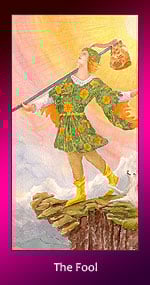
You deserve a partnership that deepens as you get to know each other. Wait for the person who has risen above commitment immaturity if commitment is your desire. The Fool reminds us that dating someone is not a mistake. It is falling in love and marrying them if it is not right. If your long-term relationship is encountering a difficult patch, now is the time to work together to rebuild.
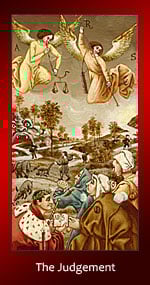
The Judgement card indicates that you’ve had some sexual hang-ups in the past, but you’re working toward getting over them. This is a period of transition, and although you’re doing the work, you may not be getting the exact results you desire. Forgive yourself for past missteps in order to take a sexual step forward today. Being afraid to express your true erotic self can even effect other areas of your life, so getting beyond your sexual inhibitions translates into a happier overall existence.
NEW SURPRISE
Your first big shock of the new year has arrived. It could be a welcome relief, but you may not know what to do with it. Were you expecting company?
Tarot.com is Part of the Daily Insight Group ©2017

“Log-uhz” – Literally: “Water” or Ocean – Esoteric: Unconscious, Collective Memory
Rune of the unconscious context of becoming or the evolutionary process. Rune of Life’s longing for itself.
Psi: emotion, psychic powers, unconscious mental processes, love, dreaming
Energy: life energy, ocean spirit, origins of life, collective unconscious, the astral plane, love as unity, evolution
Mundane: water, imagination, occultism, dreams
Divinations: Life, passing a test, sea of vitality and of the unconscious growth, memory, dreams; or fear, circular motion, avoidance, withering, depression, manipulations, emotional blackmail, lack of moral fiber, fantasy, poison, toxicity
Governs:
Transpersonal powers
Mastery of emotion in order to shape wyrd
Guidance through difficult initiatory tests, ie. initiation into life
Increase in vitality and life force
Communication between your conscious mind to another’s unconscious mind
Development of ‘second sight’ or prophetic wisdom
All powers of dreaming (lucid dreams, astral projection)
Tarot Influence

Eight of Coins
A time to learn the ways of an occupation. A viable venture may be beginning. Handling worldly affairs skillfully.
Astrological Influence
 Cancer Reversed
Cancer reversed denotes a lack of creative energy and disregard for home-life
Element Influence
 Water Reversed
Water reversed denotes secrets to which you are not privy. Approach all ventures with caution.

Porcupine has appeared in your reading today to bring a message of innocence and trust. Although Porcupine can throw quills when cornered, he is gentle, loving, and non-aggressive. Is there an area of your life that need Porcupine energy? Have you lost the ability to trust??

Brace yourself. The number 3 as it appears for you today signals that your spirit guides are close by, eager to help you with your needs. You have been on a path of taking care of yourself and your efforts are being rewarded. They have always been there, but you are in a position to sense them more now. Ask them for help with anything. Your mind, body, and spirit are integrated into a seamless unit. You are one with the Universe. Let the Universe benefit you as you send out your own positive energy.

Today’s Meaning:
A course of events that cannot be altered has been set in motion within this aspect. Accept whatever happens in the near future and do not waste your time fretting about it–you can do nothing.
General Description:
This was a favorite charm in Egypt, worn in order to frustrate magicians, sorcerers and evil wishers from bewitching the wearer and stealing the soul from the heart; for it was the general belief that if the soul left the heart, the body would soon fade away and perish. The ancient Egyptians also believed that, after death, the heart was taken, in the underworld, and weighed against the symbols of the law; if found perfect, it was restored to the body, which at once came to life again and enjoyed everlasting felicity.

I am happy to join with you today in what will go down in history as the greatest demonstration for freedom in the history of our nation.
Five score years ago, a great American, in whose symbolic shadow we stand today, signed the Emancipation Proclamation. This momentous decree came as a great beacon light of hope to millions of Negro slaves who had been seared in the flames of withering injustice. It came as a joyous daybreak to end the long night of their captivity.
But one hundred years later, the Negro still is not free; one hundred years later, the life of the Negro is still sadly crippled by the manacles of segregation and the chains of discrimination; one hundred years later, the Negro lives on a lonely island of poverty in the midst of a vast ocean of material prosperity; one hundred years later, the Negro is still languished in the corners of American society and finds himself in exile in his own land.
So we’ve come here today to dramatize a shameful condition. In a sense we’ve come to our nation’s capital to cash a check. When the architects of our republic wrote the magnificent words of the Constitution and the Declaration of Independence, they were signing a promissory note to which every American was to fall heir. This note was the promise that all men, yes, black men as well as white men, would be guaranteed the unalienable rights of life, liberty, and the pursuit of happiness.
It is obvious today that America has defaulted on this promissory note in so far as her citizens of color are concerned. Instead of honoring this sacred obligation, America has given the Negro people a bad check, a check which has come back marked “insufficient funds.” But we refuse to believe that the bank of justice is bankrupt. We refuse to believe that there are insufficient funds in the great vaults of opportunity of this nation. And so we have come to cash this check, a check that will give us upon demand the riches of freedom and the security of justice.
We have also come to this hallowed spot to remind America of the fierce urgency of now. This is no time to engage in the luxury of cooling off or to take the tranquilizing drug of gradualism. Now is the time to make real the promises of democracy; now is the time to rise from the dark and desolate valley of segregation to the sunlit path of racial justice; now is the time to lift our nation from the quicksands of racial injustice to the solid rock of brotherhood; now is the time to make justice a reality for all of God’s children. It would be fatal for the nation to overlook the urgency of the moment. This sweltering summer of the Negro’s legitimate discontent will not pass until there is an invigorating autumn of freedom and equality. Nineteen sixty-three is not an end, but a beginning. And those who hope that the Negro needed to blow off steam and will now be content, will have a rude awakening if the nation returns to business as usual. There will be neither rest nor tranquility in America until the Negro is granted his citizenship rights. The whirlwinds of revolt will continue to shake the foundations of our nation until the bright day of justice emerges.
But there is something that I must say to my people, who stand on the worn threshold which leads into the palace of justice. In the process of gaining our rightful place, we must not be guilty of wrongful deeds. Let us not seek to satisfy our thirst for freedom by drinking from the cup of bitterness and hatred. We must forever conduct our struggle on the high plane of dignity and discipline. We must not allow our creative protests to degenerate into physical violence. Again and again we must rise to the majestic heights of meeting physical force with soul force. The marvelous new militancy, which has engulfed the Negro community, must not lead us to a distrust of all white people. For many of our white brothers, as evidenced by their presence here today, have come to realize that their destiny is tied up with our destiny. And they have come to realize that their freedom is inextricably bound to our freedom. We cannot walk alone. And as we walk, we must make the pledge that we shall always march ahead. We cannot turn back.
There are those who are asking the devotees of Civil Rights, “When will you be satisfied?” We can never be satisfied as long as the Negro is the victim of the unspeakable horrors of police brutality; we can never be satisfied as long as our bodies, heavy with the fatigue of travel, cannot gain lodging in the motels of the highways and the hotels of the cities; we cannot be satisfied as long as the Negro’s basic mobility is from a smaller ghetto to a larger one; we can never be satisfied as long as our children are stripped of their selfhood and robbed of their dignity by signs stating “For Whites Only”; we cannot be satisfied as long as the Negro in Mississippi cannot vote, and the Negro in New York believes he has nothing for which to vote. No! no, we are not satisfied, and we will not be satisfied until “justice rolls down like waters and righteousness like a mighty stream.”
I am not unmindful that some of you have come here out of great trials and tribulations. Some of you have come fresh from narrow jail cells. Some of you have come from areas where your quest for freedom left you battered by the storms of persecution and staggered by the winds of police brutality. You have been the veterans of creative suffering. Continue to work with the faith that unearned suffering is redemptive. Go back to Mississippi. Go back to Alabama. Go back to South Carolina. Go back to Georgia. Go back to Louisiana. Go back to the slums and ghettos of our Northern cities, knowing that somehow this situation can and will be changed. Let us not wallow in the valley of despair.
I say to you today, my friends, so even though we face the difficulties of today and tomorrow, I still have a dream. It is a dream deeply rooted in the American dream. I have a dream that one day this nation will rise up and live out the true meaning of its creed, “We hold these truths to be self-evident, that all men are created equal.” I have a dream that one day on the red hills of Georgia, sons of former slaves and the sons of former slaveowners will be able to sit down together at the table of brotherhood. I have a dream that one day even the state of Mississippi, a state sweltering with the heat of injustice, sweltering with the heat of oppression, will be transformed into an oasis of freedom and justice. I have a dream that my four little children will one day live in a nation where they will not be judged by the color of their skin but by the content of their character.
I HAVE A DREAM TODAY!
I have a dream that one day down in Alabama — with its vicious racists, with its Governor having his lips dripping with the words of interposition and nullification — one day right there in Alabama, little black boys and black girls will be able to join hands with little white boys and white girls as sisters and brothers.
I HAVE A DREAM TODAY!
I have a dream that one day every valley shall be exalted, and every hill and mountain shall be made low. The rough places will be plain and the crooked places will be made straight, “and the glory of the Lord shall be revealed, and all flesh shall see it together.”
This is our hope. This is the faith that I go back to the South with. With this faith we will be able to hew out of the mountain of despair a stone of hope. With this faith we will be able to transform the jangling discords of our nation into a beautiful symphony of brother-hood. With this faith we will be able to work together, to pray together, to struggle together, to go to jail together, to stand up for freedom together, knowing that we will be free one day. And this will be the day. This will be the day when all of God’s children will be able to sing with new meaning, “My country ’tis of thee, sweet land of liberty, of thee I sing. Land where my father died, land of the pilgrim’s pride, from every mountainside, let freedom ring.” And if America is to be a great nation, this must become true.
So let freedom ring from the prodigious hilltops of New Hampshire; let freedom ring from the mighty mountains of New York; let freedom ring from the heightening Alleghenies of Pennsylvania; let freedom ring from the snow-capped Rockies of Colorado; let freedom ring from the curvaceous slopes of California. But not only that. Let freedom ring from Stone Mountain of Georgia; let freedom ring from Lookout Mountain of Tennessee; let freedom ring from every hill and mole hill of Mississippi. “From every mountainside, let freedom ring.”
And when this happens, and when we allow freedom to ring, when we let it ring from every village and every hamlet, from every state and every city, we will be able to speed up that day when all of God’s children, black men and white men, Jews and Gentiles, Protestants and Catholics, will be able to join hands and sing in the words of the old Negro spiritual: “Free at last. Free at last. Thank God Almighty, we are free at last.”
Source: Martin Luther King, Jr., I Have A Dream: Writings and Speeches that Changed the World, ed. James Melvin Washington (San Francisco: Harper, 1986), 102-106.
Link to the website where I copied this world-famous speech there is more information besides what I posted: I HAVE A DREAM speech MLKjr
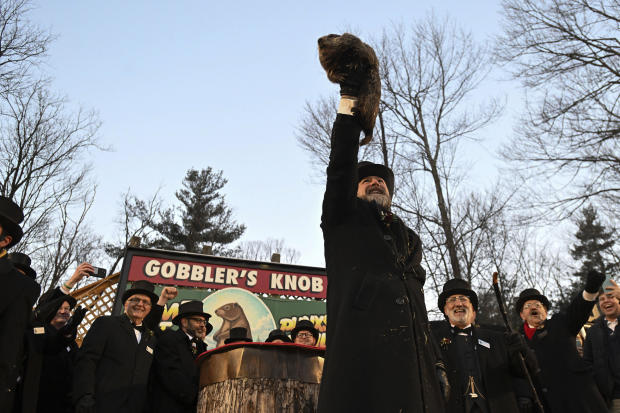
Pennsylvania’s most famous groundhog emerged from his burrow on a cold Thursday morning and saw his shadow, declaring there would be six more weeks of winter. Punxsutawney Phil made his prediction as a deadly storm wreaked havoc in the South and the Northeast was bracing for a dangerous Arctic blast.
The “inner circle” is a group of local dignitaries who are responsible for planning the events, as well as feeding and caring for Phil himself.
The annual event in Punxsutawney originated from a German legend about a furry rodent. Officials in the community – which is about 65 miles northeast of Pittsburgh – welcomed a crowd of thousands to this year’s festivities.
According to records dating back to 1887, Phil has predicted winter more than 100 times. Ten years were lost because no records were kept, organizers said.
An ATHAME is the gas you use for your grill.
A CENSOR is a drink you mix with alcohol.
ASTRAL PROJECTION is a home-made movie viewer.
A SYMPATHITIC LINK is when you feel sorry because your chain broke.
WICCA is that part of the candle that burns.
APHRODITE is a prehistoric bird.
ARCHETYPES is a kind of building structure.
BLESSED BE is the god of insects.
A BOOK OF SHADOWS contains silhouettes of friends or family members.
A BRAZIER is support wear for women.
CASTING is done with a fishing line, or on a set in Hollywood.
CHARGING is done with a credit card or battery.
The only way to get into a CIRCLE is to have the right of way.
Crystal CLEANSING is done with window cleaner.
CYCLES have to do with your washing machine and when to add fabric softener.
DEMETER is where you put your quarter when you park downtown.
A DOLMAN is a new brand of banana.
HANDFASTING is eating without utensils.
LEY LINES happen at the airport in Hawaii.
PAN is something you fry food in.
A QUARTER is 25 cents and still buys a cup of coffee. (Note: This person is not only new to magick, but they also haven’t been out in a while!)
SKYCLAD is a shade of blue clothing.
A TRAD is a type of geometrical figure.
WHEEL OF FORTUNE is the game show with Vanna White.
If you want to perceive
And understand objectively,
Just don’t allow yourself
To be confused by people.
Detach from whatever you
Find inside or outside yourself.
Detach from religion,
Tradition, and society,
And only then will you
Attain liberation.
When you are not
Entangled in things,
You pass through
Freely to autonomy.

– Linji (d. 867)

It depends on your Tradition which day you celebrate Imbolc. We celebrated it yesterday and I know some of you might celebrate it today. We generally celebrate our Sabbats the day before for a reason. For instance, we celebrate Imbolc last night. We did our rituals, lit our fires, run out the old stale Winter air and the season, hopefully. We did some cleansing and we have a lot more to do today. We had a good feast and in spite of being so sleepy, we managed to stay up to greet the morning’s first light. The joy of celebrating the night before, it just unbelievable. You get to stay up and greet the new born Sun on one of the most glorious mornings of all, Imbolc. You can feel the freshness as the new born Sun comes over the horizon. As He rises His head and proclaims victory and Spring will return to us shortly. The magick courses through your veins and it seems you are recharged and ready to take on anything that comes your way. As the warmth of the Sun courses through your veins, you feel your magick grow and grow, till you feel like you are the most powerful witch on the face of Mother Earth.
We have made celebrating the Sabbats the night before a habit. If you have never done it, you need to try it. Just go outside and wait for the Sun to come up. You can feel the magick in the air as you welcome Him back. It is so magickal that you can actually hear the Sun talk back to you with His warm rays of light shining down upon you. I cannot explain it fully. It is something you have to experience for yourself. It re-generates your spirit and your soul. You feel the darkest of the Winter months fall off of you. You know when you see the Sun on this special day, it is a fresh start, a new season, a season of rebirth. It is truly a season for us to celebrate, the Sun has returned to us and with this we are promised the season of renewal and birth. Mother Earth is going to come back to life. The birds will sing, the grass will turn green, the flowers will bloom once again, life has come out of hibernation, it is awakening. Awakening to a new start, a new season, what a beautiful time of year this is. I can imagine you have figured out by now Imbolc is one of my favorite Sabbats.
Imbolc is a time for truly rejoicing. Go outside today and let the warmth of the Sun renew your spirit and fill your soul with the hope and joy the new season ahead holds for us.
Wishing You & Yours A Very Joyous & Beautiful Imbolc,
Lady of the Abyss
If any part of your invocation of the South Quarter includes any lines from any song by Lynard Skynard….
If chewing tobacco is considered a sacred herb…..
If part of your rite includes throwing shotgun shells on the fire….
If the bell on your alter was ever worn by an animal in a pasture….
If the cakes and wine are done with a bowie-knife, a can of Foster’s, and a Little Debbie…..
If they chose their High Priestess at a wet t-shirt contest….
If when your priestess says “Blessed Be” in circle, you respond with “YEEE-HAW!”…
If you believe a pentagram is a Western Union message to 5 people….
If you bought your chalice at the Piggly Wiggly…..
If you buy your incense and candles at Wal-Mart….
If you call the God and Goddess by hollerin’ “Hey, y’all! Watch me!”….
If you call the North Quarter, but what you call it is an inner court secret…..
If you can play the “Burning Times” on the banjo….
If you carry your ritual sword in your pickup’s gun rack…..
If you found out your familiar is an oppossum — and still ate it……..
If you have combined Maypole Dancing/ Tractor Pull/ Turkey Shoot for Beltane….
If you have cast a love spell on livestock….
If you have ever called the National Enquirer because you raised a potato that resembled the Willendorf Goddess….
If you’ve ever cancelled a coven meeting to watch Pay-Per-View wrestling on TV….
If you’ve ever written a spell on the back of a Denny’s menu…..
If you have ever refilled your chalice from a keg…..
If you invoke the spirits so that your beer lasts longer…..
If you pray nightly to the god of big tires…..
If you sacrifice BBQ and pork rinds on an alter made of old car hoods….
If you shoot guns into the air when the priestess says, “the circle is open but never unbroken”…
If you smoke Salem cigarettes for the historical significance….
If you think a “family tradition” is a dating club….
If you think the Wiccan Rede is good for making twig furniture….
If you worship the gods of cheap beer and Nascar….
If you’ve ever done a candle spell for your local high-school football team….
If you’ve ever harvested ritual herbs with a weed whacker…..
If you’ve ever meditated to “Dueling Banjos”…..
If you’ve reached the 3rd Degree but not the third grade……
If your God statue looks a little too much like Elvis Presley…..
If your Goddess picture says “Miss September” at the bottom……
If your Wand of Power is a cattle prod…..
If your altar cloth is a Confederate flag…..
If your altar cloth is vinyl……
If your altar cloth says “Holiday Inn” or “Howard Johnson’s”….
If your altar has a spit cup…..
If your altar pentacle is a photo of John Wayne’s star on the “Hollywood Walk of Fame”…..
If your annointing oil smells like Old Spice…..
If your athame is by Bowie…..
If your broom has 4 wheel drive and SC plates…..
If your ceremonial chalice says “Budweiser” on it….
If your ceremonial garb consists of cut-offs and a tube-top…..
If your circle dance contains the words “dosey-do”……
If your circle dance is a two-step….
If your coven chose its High Priest at a belching contest….
If your coven’s secret names for the God and Goddess are “Cooter” and “Sweet Cheeks”….
If your coven-stead is propped up on cinder blocks…..
If your craft name starts with “Bubba”……
If your familiar can point quail….
If your familiar keeps mice out of the granary…..
If your favorite Great Rite partner is your first, second, and third cousin….
If your backyard ritual libation is brewed in an illegal backyard still……
If your favorite painting of the Goddess does her hair like Rheba McEntire….
If your maiden sweeps the circle with a weed whacker….
If your most sacred altar items include a hubcap, a velvet painting, and a half-empty can of chaw…..
If your outdoor circle has defunct washing machines for quarter altars….
If your pantheon includes Yukon Jack, Jim Beam and the St. Pauli Girl…
If your ritual music has ever included Johnny Cash singing “Ring of Fire”….
If your robes are made out of denim with Harley Davidson patches…..
Well, you might just be a redneck pagan!!
Website: Pagan Library
(Side Note From Lady Beltane – I believe it is important to honor the men and women whose sweat, bad backs, ectara who helped build the USA into the country it is today. Most if not all of the “Founding Fathers” owned slaves. Many of them fathered children with the women and it was usually not by the woman’s choice that she had to lay with her owner. When you think about it is it fair for any person anywhere in the world today to be owned by another person?)
Black History Month is an annual celebration of achievements by African Americans and a time for recognizing their central role in U.S. history. Also known as African American History Month, the event grew out of “Negro History Week,” the brainchild of noted historian Carter G. Woodson and other prominent African Americans. Since 1976, every U.S. president has officially designated the month of February as Black History Month. Other countries around the world, including Canada and the United Kingdom, also devote a month to celebrating Black history.
WATCH: Black History Documentaries on HISTORY Vault
The story of Black History Month begins in 1915, half a century after the Thirteenth Amendment abolished slavery in the United States.
That September, the Harvard-trained historian Carter G. Woodson and the prominent minister Jesse E. Moorland founded the Association for the Study of Negro Life and History (ASNLH), an organization dedicated to researching and promoting achievements by Black Americans and other peoples of African descent.
READ MORE: The Man Behind Black History Month
Known today as the Association for the Study of African American Life and History (ASALH), the group sponsored a national Negro History week in 1926, choosing the second week of February to coincide with the birthdays of Abraham Lincoln and Frederick Douglass. The event inspired schools and …

1. Ask them if they are Satan worshipers.
2. Be considerate, rearrange their altar so it will look neat.
3. Blow out their altar candle if it is still daylight. (No need to waste a good candle!)
4. Pick up their gems for a closer look.
5. Sharpen their dull, black-handled knife.
6. Witness to them about the ‘One True Religion’.
7. Untie the knots in their cord.
8. Take hold of their jewelry for a closer look.
9. Play card games with their Tarot deck.
10. Ask them if they are Satan worshipers.
Mercury/Neptune/Air/North/West/Southwest/Female/Male/Gemini/Virgo
Magickal Intentions: Communication, Divination, Writing, Knowledge, Business Transactions, Debt, Fear, Loss, Travel, Money Matters
Color: black, light blue, brown, gray, green, magenta, orange, peach, purple, red, silver, turquoise, violet, white, yellow; orange is the primary color
Number: 3, 5
Metal: mercury
Charm: distaff, rod, runes, staff, iridescent garments
Stone: moss agate, amethyst, bloodstone, emerald, hematite, lapis lazuli, lodestone, pearl, ruby, sapphire, sodalite, all blue stones
Animal: bear, dog, fox, magpie, swan, weasel
Plant: almond, bayberry, chamomile, cherry, cinnamon, cinquefoil, clove, coltsfoot, ginger, hazel, hazelnut, jasmine, lavender, millet, oak, peppermint, periwinkle, rosemary, sage, St. John’s wort, sweet pea, tamarind, lemon verbena, violet
Incense: cassia, cedar, cinnamon, clove, frankincense, jasmine, lavender, mastic, mint, rosemary, sage, sandalwood, storax, dried and powdered citrus peel, and all incense made from aromatic bark, wood, and seeds
Goddess: Carmenta, Hecate (Queen of Crossroads), Hel, Ishtar, Ma’at, the Morrigan, Nike
God: Anubis, Bragi, Elath-Iahu. Enki, Garuda, Hermes, Maximon (Black Magician), Mercury, Nebo (Wise God of Wednesday), Odin, Shango, Ullr, Vishnu, Wayland, Woden
Evocation: Agrat Bat Mahalat, Michael, Miel, Raphael, Seraphiel, Tiriel
Courtesy of Moonlight Musings

To the Romans, this day was called Dies Mercurii, or “Mercury’s day” Mercury was a popular character in the Roman pantheon. A messenger of the gods, he presided over commerce, trade, and anything that required skill or dexterity. The Celts also worshiped Mercury and eventually equated him with the Norse god Odin (some spelling variations on this name include Wotan, Wodin, and Wodan). In Norse mythologies, Odin, like Mercury, is associated with poetry and music. Interestingly enough, both Odin and Mercury were regarded as psychopomps, or the leaders of souls, in their individual mythologies.
Odin, one of the main gods in Norse mythology, was constantly seeking wisdom. He traveled the world in disguise as a one-eyed man with a long gray beard, wearing an old, beat-up hat and carrying a staff or a spear (which brings to my mind images of Gandalf from The Lord of the Rings). In the Old English language, this day of Mercury evolved into Wodnes daeg, “Woden’s day,” or Wednesday.
Wednesday carries all of the planetary and magickal energies and associations of the witty and nimble god Mercury himself. Some of these mercurial traits included good communication skills, cleverness, intelligence, creativity, business sense, writing, artistic talent, trickiness, and thievery. And don’t forget all of those wise and enigmatic qualities associated with the Norse god Odin/Wodin, not to mention the goddess Athena’s contributions of music, the arts, handmade crafts, and writing. Wednesdays afford excellent opportunities for seeking wisdom, changing your circumstances, and improving your skills, be they in trade and commerce, music and art, or in communication and writing.
–Book of Witchery: Spells, Charms & Correspondences for Every Day of the Week
Ellen Dugan

There will be no Imbolc/Lammas issue of Life in The Craft magazine this turning of the Wheel of the Year as it would contain my chaotic energy. Plus, I just have not felt up to being able to even edit last year’s issue to send out.
You may have missed the posts explaining what has been going on in my life since January 1, 2023 so let me give you the highlights.
January 3rd, my third oldest grandson left for active duty in the USA Army. His first two weeks in Basic Combat Training were really rough and I was helping my daughter, his mom adjust to her younger son being unreachable most of the time besides me trying to get use to it. I am happy to say that as of the end of last week he, my daughter, and myself have almost adjusted to a new normal.
January 7th, we welcomed my 10th grandchild into the family. An hour after his birth he had to be put on oxygen and have a feeding tube inserted. Here I was helping my middle son and his wife cope with having a baby in the NICU. I was very worried for my grandson as well. I am happy to say he came home to meet his big brother on January 13, 2023.
January 13rd My daughter whose son just enter the Army earlier in the month had one of her and her fiancée cats get sick overnight. The vet ran tests and found he had a lymph node type cancer. He came home from the animal hospital only to enter eternal sleep on January 23rd.
January 18th The latest thing to upset the family was my youngest son’s constant canine companion of 11 years hurt his leg get up from under the kitchen table. The leg appeared only to be sprained so he was treating him for this at home. By January 27 his leg was swollen with sores on it. Into the vet we go to find out Kage had a very sever break in his femur to the point even if he had taken him to the vet the day it happened it would have cost thousands of dollars to try to have it fixed. Kage had devolved an septic infection, an infect that is in the bloodstream. My son made the hardest decision of his life to have his beloved companion put into eternal rest. I was very close to Kage also and had known him just as long as my son had. I also would dog sit if my son went away for a couple of days. This death was so totally unexpected that I am still having a hard time dealing with my feelings over it. Like crying as I type this.
All of this extra stress and silly weather put into the worse fibromyalgia I have ever experienced and am still trying to get it to calm down. It also, brought me nightmares, lower immunity leading to a cold I am trying to get rid of. I have had super highs, my grandson coming home very healthy, to deep lows, Kage’s death and every emotion in between. This is why I took days off here and there through January from all things connected to WoTC. I literally forced myself to start working again this last Sunday. I also contribute my wanting to honor Lady Abyss’ memory by reposting some of her things this week as a way to live up to me telling her I would carry on the Goddess’ work on this website when I took over in May of 2019. I will do what I can daily or let you know why I am not posting on any given day.
Thank you all for your support, understanding, beautiful words in comment and emails.

Be bold and daring today! Expand your knowledge of the Craft by working with the planetary energies of Mercury on this multifaceted day of the week. Consider the Greco-Roman gods Mercury and Hermes and all of the many lessons they have for you. Embrace change and movement, and work on your communication techniques. Conjure up a little good luck for yourself with that Mercury dime spell. Call on Athena to inspire you to try magickal arts and crafts and to be more creative in your own spellwork and witchery.
Meditate on Odin and see what you can discover about him. I wonder what sort of fabulous and fascinating magickal wisdom you will uncover? Odin is a shaman, after all; he may appear in many guises and faces. I guarantee that he will make you laugh at yourself before he is through with you, but you will learn. It’s up to you what you do with that knowledge. Will you let it shapeshift into wisdom?
Wednesday is the wild and wily day of the week, so try to go with the flow; don’t fight the quirky energies of the day. Most importantly, follow your heart, and always keep a good sense of humor, because of Wednesdays you will really need it.
Source
Book of Witchery: Spells, Charms & Correspondences for Every Day of the Week
Ellen Dugan

This comes to us thanks to Lady of the Abyss. Originally posted on WOTC on June 10, 2018.
Dear sisters, brothers, and honored guests may the Great Mother and Great Father, Lord and Lady, bless you and your family with all things positive!

Dedicated to the powers of the planet Mars, personified as Ares, Tiwaz, Tiw, and Tyr.
Element : Water
Planet : Mars
Zodiac Sign : Aries / Scorpio
Angel : Samuel
Metal : Iron, Steel
Incense / Perfumes : Dragon’s Blood, Patchouli
Oil : Basil, Coriander, Ginger
Color : Red, Orange
Stones : Bloodstone, Garnet, Carnelian,
Plants/Herbs : Allspice, Blessed Thistle, Cayenne, Daisy, Garlic, Ginger, Pepper, Pine, Red Rose, Thyme, Tobacco, Wormwood
Magick to work: self-assertion, energy, and courage, victory, endurance, passion, masculine goals in general, sex, aggression, protection, controlled power, ambition, arguments, competition, conflict, destruction, lust, male sexuality, sports, strife, struggle, surgery, medical issues, upheaval, war
 Witches Of The Craft®
You must be logged in to post a comment.